

Psalms 52:2

Hebrew (Westminster Leningrad Codex) Psalms 52:2 appears in the Hebrew Old Testament. The text above is from the Westminster Leningrad Codex. Each word links to its Strong’s number, a concise gloss, and parsing drawn from the Open Scriptures Hebrew Bible morphology. Click any word for its full Brown-Driver-Briggs (BDB) entry.
Download image
Cite this verse

Psalms 52:2 (World English Bible). Public Domain. Lemma interlinear Bible study tool, https://lemma.gebible.app/v/psalms/52/2.

Show BibTeX & RIS
BibTeX
RIS
English Translation
Your tongue plots destruction, Like a sharp razor, working deceitfully.
World English Bible · Public Domain
Download a study sheet

One document with this verse’s original text, its word-by-word gloss line, the meaning frame, cross-references with their text, attributed commentary, and full source and license credits — printable, and it pastes into notes with its structure intact.

This verse Autodidact and up

Study sheet (.html) Plain text (.txt)

A passage Seminary Student

Up to 50 verses in one chapter. A passage sheet keeps up to 6 commentary sources and 12 cross-references per verse, in the order this page ranks them, and says so on the sheet whenever that leaves anything out. Ask for a single verse and you get the Autodidact verse sheet above.

Everything on this page stays free to read, with no account — the sheet is a download of what is already on screen, not access to it.

Want to remove ads? Support Godless Engineer
Compare translations 3

The same verse in 3 English versions, stacked beneath the original-language interlinear above. Click any original word for its lexicon entry.

Each is an independent rendering of the whole verse — the interlinear is not word-aligned to these translations.

Highlighted words mark where these versions differ — a whole-verse word diff, not a word-by-word alignment.

  • World English Bible Public Domain
    Your tongue plots destruction, Like a sharp razor, working deceitfully.
  • King James Version Public Domain
    The tongue deviseth mischiefs; like a sharp razor, working deceitfully.
  • unfoldingWord Literal Text CC BY-SA 4.0
    Like a sharpened razor, your tongue devises calamities, worker of betrayal!

unfoldingWord Literal Text — © unfoldingWord, licensed CC BY-SA 4.0. Word-aligned USFM3 via Door43 (git.door43.org/unfoldingWord/en_ult).

Versions to compare (up to 4)

3 of 4 selected

Show all 17 translations

Every available English version of this verse, each an independent rendering of the whole verse.

  • World English Bible Public Domain
    Your tongue plots destruction, Like a sharp razor, working deceitfully.
  • Berean Standard Bible Public Domain
    Your tongue devises destruction like a sharpened razor, O worker of deceit.
  • Majority Standard Bible Public Domain
    Your tongue devises destruction like a sharpened razor, O worker of deceit.
  • King James Version Public Domain
    The tongue deviseth mischiefs; like a sharp razor, working deceitfully.
  • American Standard Version (1901) Public Domain
    Thy tongue deviseth very wickedness, Like a sharp razor, working deceitfully.
  • Revised Version (1885) Public Domain
    Thy tongue deviseth very wickedness; like a sharp razor, working deceitfully.
  • Geneva Bible (1599) Public Domain
    Thy tongue imagineth mischiefe, and is like a sharpe rasor, that cutteth deceitfully.
  • Douay-Rheims (1899) Public Domain
    when Doeg the Edomite came and told Saul David went to the house of Achimelech
  • Young's Literal Translation Public Domain
    Mischiefs doth thy tongue devise, Like a sharp razor, working deceit.
  • Literal Standard Version CC BY-SA 4.0
    Your tongue devises mischiefs, || Like a sharp razor, working deceit.
  • Unlocked Literal Bible CC BY-SA 4.0
    Your tongue plans destruction like a sharp razor, working deceitfully.
  • unfoldingWord Literal Text CC BY-SA 4.0
    Like a sharpened razor, your tongue devises calamities, worker of betrayal!
  • Darby Bible Public Domain
    Thy tongue deviseth mischievous things, like a sharp razor, practising deceit.
  • World Messianic Bible Public Domain
    Your tongue plots destruction, like a sharp razor, working deceitfully.
  • Free Bible Version CC BY-SA 4.0
    You plot to make people suffer; your words cut like a sharp razor, you liar!
  • Bible in Basic English Public Domain
    Purposing destruction, using deceit; your tongue is like a sharp blade.
  • JPS Tanakh (1917) Public Domain
    (52-4) Thy tongue deviseth destruction; like a sharp razor, working deceitfully.

Literal Standard Version (2020), Covenant Press — licensed CC BY-SA 4.0. Text via the HelloAO Bible API (eBible.org). Unlocked Literal Bible (unfoldingWord) — licensed CC BY-SA 4.0. Text via the HelloAO Bible API (eBible.org). unfoldingWord Literal Text — © unfoldingWord, licensed CC BY-SA 4.0. Word-aligned USFM3 via Door43 (git.door43.org/unfoldingWord/en_ult). Free Bible Version, Dr. Jonathan Gallagher — licensed CC BY-SA 4.0. Text via the HelloAO Bible API (eBible.org).

Word by word

More ways to search: Search by grammar → Find every occurrence → Compare this word →

Practice this passage: Drill this verse → Learn its vocabulary →

About this verse

These counts appear in no published source. They are computed here, from the morphology-tagged text and Lemma’s own curated glosses. What Lemma adds →

7
words
7
distinct lemmas
Wisdom
section

Notable vocabulary

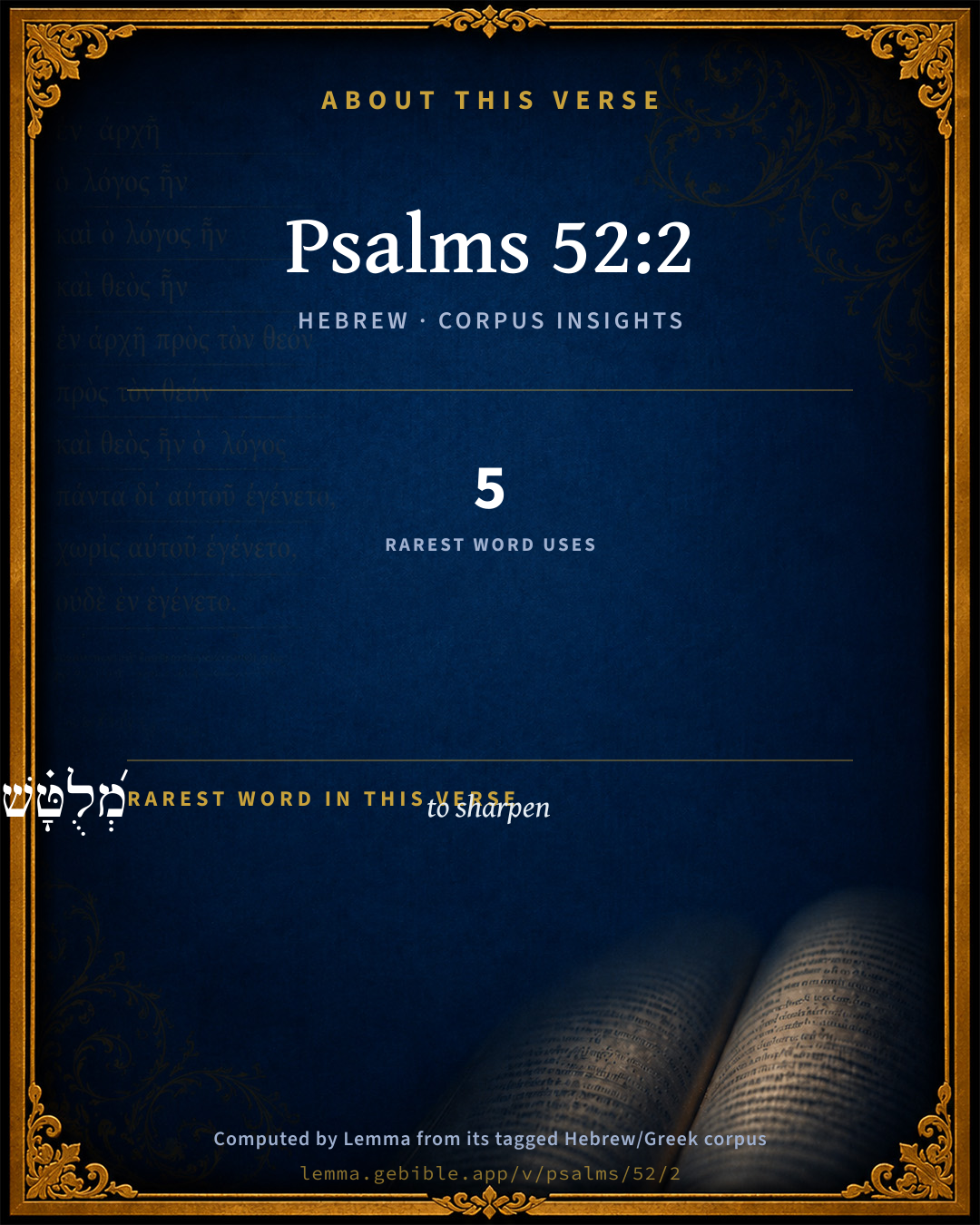
The rarest word here is מְ֝לֻטָּ֗שׁ to sharpen H3913 — appearing just 5 times in the whole Hebrew Bible.

Shared distinctive vocabulary

מְ֝לֻטָּ֗שׁ to sharpen H3913 occurs in 5 verses of the Hebrew Bible. Also found in:

Grammatical profile

  • 3 verbs
  • 4 nouns

Verb forms

  • תַּחְשֹׁ֣ב Qal · Imperfect
  • מְ֝לֻטָּ֗שׁ Pual · Participle Passive
  • עֹשֵׂ֥ה Qal · Participle Active

Hebrew & Septuagint length

In English translation the verse runs 10 words from the Hebrew and 13 from the Septuagint (LXX English) — closely comparable.

A rough comparison of the two English renderings, which tokenize alike — not a word-level alignment.

Word counts can differ between the Hebrew and the Greek without any difference in meaning — e.g. the Hebrew direct-object marker אֵת has no separate Greek word, and Greek often adds the article ὁ.

Cross-references

20

Topical passages linked to Psalms 52:2 in the Treasury of Scripture Knowledge — connected by theme and wording, ordered by reader-vote popularity; previews shown in the World English Bible.

  • Proverbs 18:21 Death and life are in the power of the tongue; Those who love it will eat its fruit.
  • Proverbs 6:16–19 There are six things which Yahweh hates; Yes, seven which are an abomination to him:
  • Psalms 57:4 My soul is among lions. I lie among those who are set on fire, Even the sons of men, whose teeth are spears and arrows, And their tongue a sharp sword.
  • Proverbs 12:18 There is one who speaks rashly like the piercing of a sword, But the tongue of the wise heals.
  • Psalms 59:7 Behold, they spew with their mouth. Swords are in their lips, "For," they say, "who hears us?"
  • Jeremiah 9:3–4 They bend their tongue, [as it were] their bow, for falsehood; and they are grown strong in the land, but not for truth: for they proceed from evil to evil, and they don't know me, says Yahweh.
  • Psalms 50:19 "You give your mouth to evil. You harnesses your tongue for deceit.
  • Psalms 64:2–6 Hide me from the conspiracy of the wicked, From the noisy crowd of the ones doing evil;
  • Psalms 109:2 For they have opened the mouth of the wicked and the mouth of deceit against me. They have spoken to me with a lying tongue.
  • Psalms 120:2 Deliver my soul, Yahweh, from lying lips, From a deceitful tongue.
  • Psalms 140:2–3 Those who devise mischief in their hearts. They continually gather themselves together for war.
  • Proverbs 30:14 There is a generation whose teeth are like swords, And their jaws like knives, To devour the poor from the earth, and the needy from among men.
  • Jeremiah 18:18 Then said they, Come, and let us devise devices against Jeremiah; for the law shall not perish from the priest, nor counsel from the wise, nor the word from the prophet. Come, and let us strike him with the tongue, and let us not give heed to any of his words.
  • Matthew 26:59 Now the chief priests, the elders, and the whole council sought false testimony against Jesus, that they might put him to death;
  • Acts 6:11–13 Then they secretly induced men to say, "We have heard him speak blasphemous words against Moses and God."
  • Acts 24:1 After five days, the high priest, Ananias, came down with certain elders and an orator, one Tertullus. They informed the governor against Paul.
  • Acts 24:5 For we have found this man to be a plague, an instigator of insurrections among all the Jews throughout the world, and a ringleader of the sect of the Nazarenes.
  • 2 Corinthians 4:2 But we have renounced the hidden things of shame, not walking in craftiness, nor handling the word of God deceitfully; but by the manifestation of the truth commending ourselves to every man's conscience in the sight of God.
  • 2 Corinthians 11:13 For such men are false apostles, deceitful workers, masquerading as Christ's apostles.
  • Revelation 12:10 I heard a loud voice in heaven, saying, "Now is come the salvation, the power, and the Kingdom of our God, and the authority of his Christ; for the accuser of our brothers has been thrown down, who accuses them before our God day and night.

Cross-references courtesy of OpenBible.info (CC BY 4.0).

Hebrew and Greek witnesses Masoretic Hebrew ↔ Greek Septuagint

The same verse in the two great witnesses to the Old Testament, shown verse-for-verse.

You’re reading Greek Psalm 51 (Hebrew Psalm 52). The Septuagint counts the superscription, so verse numbers can differ from the Hebrew — chapter-level alignment, not verse-by-verse. Numbering follows Rahlfs.

These are two independent witnesses, not word-aligned to each other, and the Septuagint is shown in lemma (dictionary) form.

Hebrew Psalms 52:2 Masoretic · Westminster Leningrad Codex

הַ֭וּוֹת תַּחְשֹׁ֣ב לְשׁוֹנֶ֑ךָ כְּתַ֥עַר מְ֝לֻטָּ֗שׁ עֹשֵׂ֥ה רְמִיָּֽה

Your tongue plots destruction, Like a sharp razor, working deceitfully.

World English Bible · Public Domain

Greek LXX Greek Psalm 51:2 Septuagint · lemma form

ἐν ὁ ἔρχομαι δωηκ ὁ ιδουμαῖος καί ἀναἀγγέλλω ὁ σαούλ καί εἶπον αὐτός ἔρχομαι δαυίδ εἰς ὁ οἶκος αβιμελεχ

your tongue has devised unrighteousness; like a sharpened razor you have wrought deceit.

LXX2012 (modern English Septuagint) · Public Domain

Hebrew: Westminster Leningrad Codex (CC BY 4.0). Greek: Septuagint (public domain); English from LXX2012 (modern English Septuagint) (Public Domain). How the Septuagint differs from the Hebrew →

Commentary

Notes on Psalms 52:2 from classic Christian and Jewish commentators (each source and its license shown beneath its notes). The classic Christian expositions comment on the surrounding passage and are grouped to its opening verse, so a note may address several verses; the Jewish commentaries on the Tanakh (Rashi and others) are per-verse, so they appear only where the commentator wrote on this verse.

Lemma curates 59 commentaries, every one of them public domain or Creative Commons licensed, each selected and text-cleaned for this edition rather than reprinted as found. About our sources →

Trapp's Complete Commentary

John Trapp

Psa 52:2 Thy tongue deviseth mischiefs; like a sharp razor, working deceitfully.

Ver. 2. Thy tongue deviseth mischiefs] i.e. Venteth the mischievous devices of thy mind, being an interpreter and an instrument fit for such a purpose, Cogitat, id est eructat. Such another Doeg was Nicholas Saunders, priest, the firebrand of Earl Desmond’s rebellion in Ireland, A. D. 1580, a restless and wretched man, whose foul mouth was at length stopped with famine that had been ever open to stir up rebellions against the state; that had uttered so many blasphemies against God and his holy truth, and invented so many loud and lewd lies against men.

Like a sharp razor, working deceitfully] That, instead of shaving the hair, lanceth the flesh, Exscindit carnem cure crinibus (R. Solomon); or, missing the beard, cutteth the throat, Consulto aberrans iugulum petit, when Dionysius the tyrant would not trust any barber (no, not his own daughters) to shave him; but singed off his own hair with hot coals. The slanderer’s tongue, as sharp as a razor or as the quills of a porcupine, slasheth and gasheth the good names of others, and that many ways, viz. both by denying, disguising, lessening, concealing, misconstruing things of good report; and also by forging, increasing, aggravating, or uncharitable spreading things of evil report; not for any love to the truth nor for respect of justice, nor yet for the bettering of the hearer or the delinquent; but only to prejudice the one, and to incense the other. This was Doeg’s sin, and denominateth him a liar, Psa 52:3, though he had spoken only the truth.

John Trapp, A Commentary or Exposition upon All the Books of the Old and New Testament (1647–1656) — public domain. Text from a community e-Sword module.

The Biblical Illustrator

Joseph S. Exell

Psa_52:2-4

Thy tongue deviseth mischiefs; like a sharp razor, working deceitfully.

Sins of speech

The prominence given to sins of speech is peculiar. We should have expected high-handed violence rather than these. But the psalmist is tracking the deeds to their source; and it is not so much the tyrants words as his love of a certain kind of words which is adduced as proof of his wickedness. These words have two characteristics in addition to boastfulness. They are false and destructive. They are, according to the forcible literal meaning in Psa_52:4, words of swallowing. They are, according to the literal meaning of destructions in Psa_52:2, yawning gulfs. Such words lead to acts which make a tyrant. They flow from perverted preference of evil to good. Thus the deeds of oppression are followed up to their den and birthplace. (A. Maclaren, D. D.)

The Biblical Illustrator, edited by Joseph S. Exell (c. 1880s–1900s) — public domain. Text from a community e-Sword module.

Joseph Benson's Commentary

Psa 52:2. Thy tongue deviseth mischief — That is, expresses what thy wicked mind had devised. Thus skilfulness is ascribed to those hands which are governed by a skilful man, Psa 78:72. Like a sharp razor, working deceitfully — Wherewith a person, pretending only to shave off the hair, doth suddenly and unexpectedly cut a man’s throat. So Doeg, pretending only to vindicate himself from the imputation of disloyalty, 1Sa 22:8, really intended to expose the priests, who were friends to David, to the king’s fury and cruelty.

Joseph Benson's Commentary on the Old and New Testaments (1811–1818) — public domain. Text from a community e-Sword module.

J. A. Alexander on Psalms

Joseph Addison Alexander

2. When Doeg the Edomite came and told Saul, and said unto him, David is come to the house of Ahimelech. This is merely the beginning of the story, which is supposed to be familiar to the reader of the psalm, and which is given at length in 1 Sam. xxii. Doeg is mentioned only as the witness or informer, by whose means the matter came to Saul's knowledge. When he came, literally in his coming, the same form of expression as in Psa 51:2.

4. (Psa 52:2). Mischiefs will thy tongue devise, like a razor whetted, working deceitfully. The first word means calamitous events, brought on one man by the malice of another. See above, on Psa 5:10 (9), Psa 38:13 (12), and below, on Psa 57:2 (1). The distinctive meaning of the future is the same as in Psa 52:3 (1). The tongue is here said to meditate or devise mischief, because it is personified, or poetically substituted for the speaker. The allusion is to Saul's cutting words when he accused Ahimelech and David of conspiracy against him (1Sa 22:13). This false charge, or the tongue which uttered it, is likened to a razor, not merely sharp but sharpened, whetted, for the purpose or occasion. See above, on Psa 45:6 (5). Similar comparisons occur in Psa 57:5 (4), Psa 59:8 (7), Psa 64:4 (3), Jer 9:2; Jer 9:7 (3, 8). Working deceitfully, literally deceit or fraud. These words may be grammatically referred to the speaker or his tongue as practising deceit; but it yields a more striking sense to understand them of the razor, as working deceitfully, i.e. moving silently and smoothly, when it cuts most keenly.

Joseph Addison Alexander, The Psalms Translated and Explained (1850) — public domain. Text from a community e-Sword module.

Geneva Bible (1599)

Geneva Bible translators

Thy malice moveth thee by crafty flatteries and lies to accuse and destroy the innocents.

Geneva Bible (1599) marginal notes — public domain. Text via Bolls.life.

Jamieson, Fausset & Brown

Robert Jamieson, A. R. Fausset & David Brown

tongue--for self.

mischiefs--evil to others (Psa 5:9; Psa 38:12).

working deceitfully-- (Psa 10:7), as a keen, smoothly moving razor, cutting quietly, but deeply.

Jamieson, Fausset & Brown — Commentary Critical and Explanatory on the Whole Bible (1871) — public domain (CC PDM 1.0). Text via the HelloAO Bible API.

Adam Clarke's Commentary

Verse 2. Deviseth mischiefs] Lies and slanders proceeding from the tongue argue the desperate wickedness of the heart.

Like a sharp razor, working deceitfully.] Which instead of taking off the beard, cuts and wounds the flesh; or as the operator who, when pretending to trim the beard, cuts the throat.

Adam Clarke's Commentary on the Bible (1810–1826) — public domain. Text from a community e-Sword/MySword module.

John Calvin's Commentaries

2. Thy tongue reckons up mischiefs David is not to be considered as here venting a flood of reproaches against his adversary, as many who have been unjustly injured are in the habit of doing, merely to gratify a feeling of revenge. He brings these charges against him in the sight of God, with a view to encourage himself in the hopefulness of his own cause: for it is plain that the farther our enemies proceed in the practice of iniquity, they proportionally provoke the anger of the Lord, and are nearer to that destruction which must issue in our deliverance. His object, therefore, is not to blacken the character of Doeg in the estimation of the world, but rather to set before his own eyes the divine punishment which the flagrant offenses he specifies were certain to draw down upon his head. Amongst these he singles out, as more especially worthy of reprobation, the hidden treachery with which he had been chargeable in accomplishing the destruction of the priesthood. Adverting to his secret and malicious information, he likens his tongue to a sharp razor, as elsewhere, Psalm 120:4, the tongues of the wicked are compared to “sharp arrows.” It is added, working deceitfully, which words are considered by some as referring to the razor which cuts subtilely, and not with an open wound like a sword; but perhaps they may be construed with more propriety as applying to the tongue, although there can be no doubt of the reason of the comparison.

John Calvin's Commentaries (1540-1563) — public domain. Text from the Calvin Translation Society English edition (1840s-50s) via the Christian Classics Ethereal Library (ccel.org). Calvin's coverage is partial (roughly two-thirds of the Bible); uncommented books and verses are honest gaps, never fabricated. The 19th-century editor's footnotes and remarks are omitted so the notes are faithfully Calvin's own voice.

Ellicott's Commentary for English Readers

(2) Working deceitfully.—Better, working guile. (For the metaphor, see Psa_55:21; Psa_57:4, &c)

A Bible Commentary for English Readers, edited by Charles John Ellicott (1878–1897) — public domain. Text from a community e-Sword module.

The Cambridge Bible for Schools and Colleges

gen. ed. J. J. S. Perowne

2. Thy tongue deviseth] Cp. Psa_35:20. Sins of the tongue—falsehood, slander, false witness, and the like—are frequently denounced in the Psalms and by the Prophets. See Psa_5:9; Psa_10:7; Psa_12:2 ff; Mic_6:12; Jer_9:3; &c.

mischiefs] R.V., very wickedness (as in Psa_5:9); or destruction, perhaps not without a reminiscence of the original meaning of the word, a yawning gulf, for his tongue is ready to swallow up (Psa_52:4) the righteous. The plur. denotes mischief or destructiveness of every kind.

like a sharp rasor] Lit., like a whetted rasor, which cuts you before you are aware, as you handle it incautiously. The tongue and its words are elsewhere compared to swords and spears and arrows (Psa_55:21, Psa_57:4, Psa_59:7, Psa_64:3; cp. Pro_26:18). Comp. Shakespeare, Cymbeline, iii.4,

“’Tis slander,

Whose edge is sharper than the sword.”

working deceitfully] The partic. cannot, unless we assume a laxity of construction, be in agreement with thy tongue; nor can it well be referred to the sharp rasor. It is best to take it as a vocative, O thou worker of deceit. Cp. Psa_101:7.

The Cambridge Bible for Schools and Colleges (gen. ed. J. J. S. Perowne; Cambridge University Press, 1878–1918) — public domain. Text from a community e-Sword module.

John Gill's Exposition

Thy tongue deviseth mischiefs,.... Abundance of mischiefs, in a variety of ways, against many persons, even all good men. What properly belongs to the heart is here ascribed to the tongue; because, as Aben Ezra observes, it is the interpreter and discoverer of the thoughts of the heart: out of the abundance of that the tongue speaks and declares the mischief it has devised. Doeg intended mischief to David, when he spoke to Saul, Sa1 22:9; so antichrist devises mischiefs against the saints of the most High, to wear them out, and thinks to change times and laws, Dan 7:25;

like a sharp razor, working deceitfully; that is, his tongue was like a razor; the razor is but a small instrument, and the tongue is but a little member: the razor is a sharp and cutting one, and so is the tongue; and therefore compared to a sharp sword, Psa 57:4; see Jer 18:18; the razor takes off the beard cleanly and wholly; Doeg's tongue was the cause of the utter ruin of Ahimelech's family and the city of Nob; and as a razor may be said to "work deceitfully", when it turns aside in the hand of him that useth it, and with the hair takes off more than it should, even skin and flesh, or cuts the man's throat; so in a deceitful and insidious manner did Doeg work the destruction of Ahimelech and the priests of the Lord.

John Gill's Exposition of the Whole Bible (1746–1763) — public domain (CC PDM 1.0). Text via the HelloAO Bible API.

Albert Barnes' Notes on the Bible

Thy tongue deviseth mischiefs - The word rendered “mischiefs” means

(a) desire, cupidity: Pro 10:3; then

(b) fall, ruin, destruction, wickedness: Psa 5:9; Psa 38:12.

The meaning here is, that he made use of his tongue to ruin others. Compare Psa 50:19. The particular thing referred to here is the fact that Doeg sought the ruin of others by giving “information” in regard to them. He “informed” Saul of what Ahimelech had done; he informed him where David had been, thus giving him, also, information in what way he might be found and apprehended. All this was “designed” to bring ruin upon David and his followers. It “actually” brought ruin on Ahimelech and those associated with him, 1Sa 22:17-19.

Like a sharp razor - See the notes at Isa 7:20. His slanders were like a sharp knife with which one stabs another. So we stay of a slanderer that he “stabs” another in the dark.

Working deceitfully - literally, making deceit. That is, it was by deceit that he accomplished his purpose. There was no open and fair dealing in what he did.

Albert Barnes' Notes on the Bible (1834–1885) — public domain. Text from a community e-Sword/MySword module.

Matthew Poole's English Annotations

Deviseth i.e. expresseth what thy wicked mind had devised. Thus skilfulness is ascribed to those hands which are governed by a skilful or prudent man, Psa 78:72. This word implies that Doeg’s words were not uttered rashly and unadvisedly, but with premeditated malice, and a mischievous design, which he waited for an opportunity to execute; and therefore he readily took the first occasion which offered itself.

Like a sharp razor, working deceitfully; wherewith a man pretending only to shave off the hair, doth suddenly and unexpectedly cut the throat. So Doeg pretended only to vindicate himself from the imputation of disloyalty, 1Sa 22:8, but really intended to expose the priests, who were friends to David, to the king’s fury and cruelty.

Matthew Poole's English Annotations on the Holy Bible (1683–1685) — public domain. Text from a community e-Sword/MySword module.

The Treasury of David

Charles H. Spurgeon

Ver. 2. Thy tongue deviseth mischiefs. Thou speakest with an ulterior design. The information given was for Saul's assistance apparently, but in very deed in his heart the Edomite hated the priests of the God of Jacob. It is a mark of deep depravity, when the evil spoken is craftily intended to promote a yet greater evil. Like a sharp razor, working deceitfully. David represents the false tongue as being effectual for mischief, like a razor which, unawares to the person operated on, is making him bald; so softly and deftly do Oriental barbers perform their work. Or he may mean that as with a razor a man's throat may be cut very speedily, under the pretence of shaving him, even thus keenly, basely, but effectually Doeg destroyed the band of the priests. Whetted by malice, and guided by craft, he did his cruel work with accursed thoroughness.

Ver. 2. Thy tongue deviseth mischiefs, like a sharp razor, working deceitfully. Thus our version. But I do not very well understand the propriety of the tongue's devising mischief, and devising it like a sharp razor. But we may easily avoid this harsh comparison by rendering the words: You contrive mischiefs with thy tongue, as with a sharp razor, O thou dealer in deceit: i.e., you contrive with thy smooth and flattering tongue to wound the reputation and character of others, as though thou wast cutting their throats with a smooth razor. Samuel Chandler.

Ver. 2. Like a sharp razor, that instead of shaving the hair lances the flesh; or missing the beard cutteth the throat. John Trapp.

Ver. 2. The smooth adroit manner of executing a wicked device neither hides not abates its wickedness. Murder with a sharp razor is as wicked as murder with a meat axe or bludgeon. A lie very ingeniously framed and rehearsed in an oily manner, is as great a sin, and in the end will be seen to be as great a folly as the most bungling attempt at deception. William S. Plumer.

None.

Psalms 52:3*

Charles H. Spurgeon's The Treasury of David (1869–1885) — public domain. Psalms only. Text from a community e-Sword/MySword module.

The Pulpit Commentary

Thy tongue deviseth mischiefs; or, malignities evils of the worst kind. It was Doeg"s "tongue" that brought about the entire ghastly massacre. (see 1Sa_22:9, 1Sa_22:10) Like a sharp razor, working deceitfully. Doeg had "worked deceitfully," since he had not told Saul the circumstances that made Ahimelech"s giving aid to David no disloyalty to the king. (1Sa_21:2, 1Sa_21:8) The suppressio veri is a suggestio falsi.

The Pulpit Commentary (1880–1919), ed. H.D.M. Spence-Jones & Joseph S. Exell — public domain. Text from a community e-Sword module.

John Wesley's Explanatory Notes

Deviseth - Expresses what thy wicked mind had devised. Deceitfully - Doeg pretended only to vindicate himself from disloyalty, 1 Sam. xxii, 8, but he really intended to expose the priests, to the king's fury.

John Wesley, Explanatory Notes Upon the Whole Bible (1754–1765) — public domain. Text via the GEBible commentary corpus.

Lesson kit

Teaching starters — assembled from the data on this page, not authored interpretation. Every prompt links to the verse data it draws on. Edit before teaching.

Psalms, in the Wisdom, opens this verse with 7 words (7 distinct Hebrew lemmas). Its most distinctive word is lâṭash (“to sharpen”). A historical commentator’s framing appears above. Read the whole chapter for the surrounding context.

Discussion questions

  1. How does “to sharpen” (lâṭash) shape what this verse is saying?
  2. How does Genesis 4:22, which shares the word «to sharpen», read alongside this verse?
  3. These translations render this verse differently. What is at stake in choosing one wording over another?
  4. «תַּחְשֹׁ֣ב» is a Qal Imperfect verb. How does that grammatical form shape the action described?
  5. Compare how Trapp's Complete Commentary and The Biblical Illustrator read this verse. Where do they agree or differ?

Things to notice

Reading settings

Reading text

Shown beneath each verse's original-language words.

Old Testament
Old Testament edition

Read the OT as the Masoretic Hebrew (MT) or the Greek Septuagint (LXX).

English shown for the Greek Septuagint (in the Hebrew ↔ Greek comparison).

Comparing translations? Open the Compare panel on any verse page to stack up to four side by side.