
Psalms 64:8

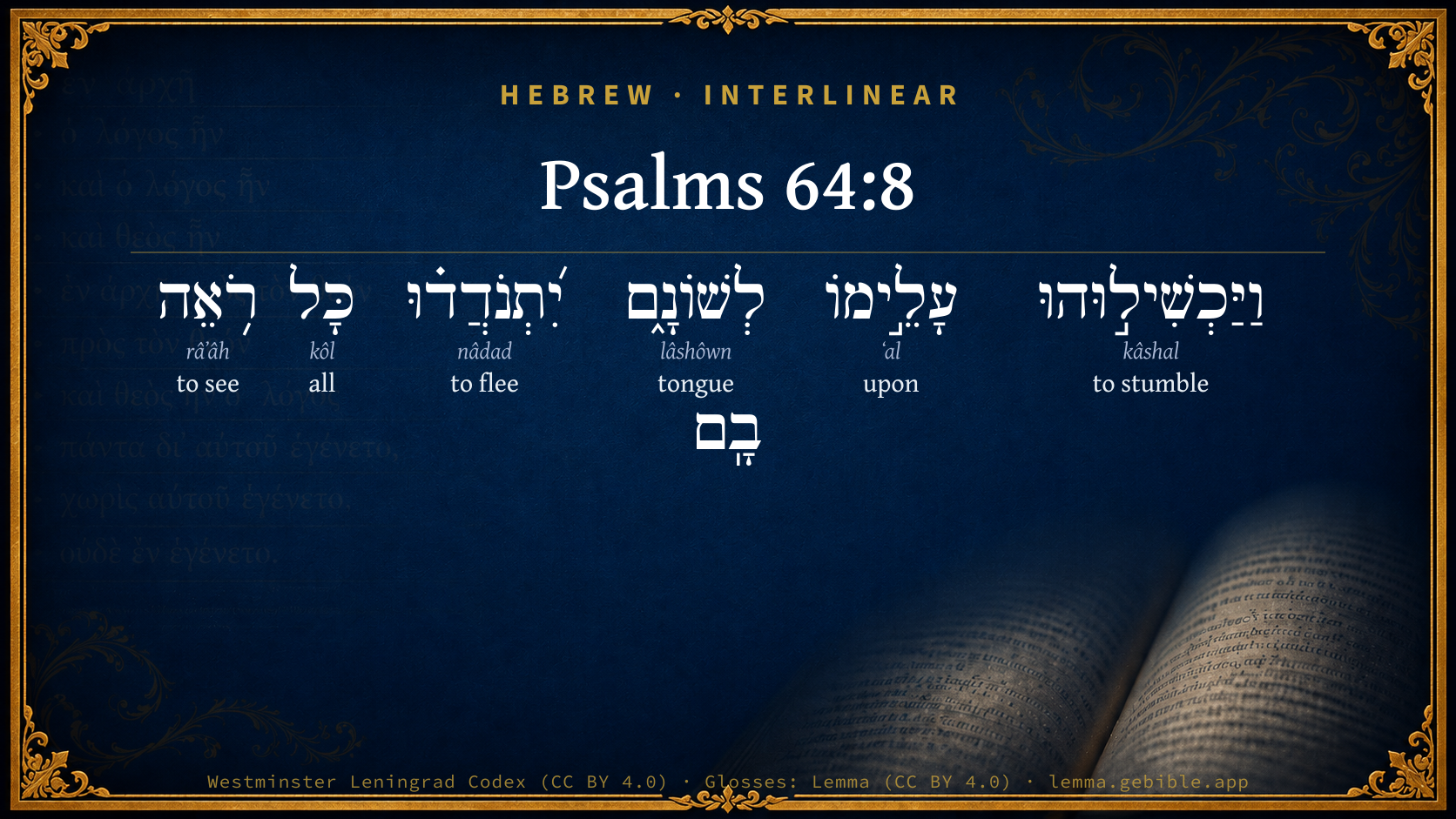
Hebrew (Westminster Leningrad Codex) Psalms 64:8 appears in the Hebrew Old Testament. The text above is from the Westminster Leningrad Codex. Each word links to its Strong’s number, a concise gloss, and parsing drawn from the Open Scriptures Hebrew Bible morphology. Click any word for its full Brown-Driver-Briggs (BDB) entry.
Download image
Cite this verse

Psalms 64:8 (World English Bible). Public Domain. Lemma interlinear Bible study tool, https://lemma.gebible.app/v/psalms/64/8.

Show BibTeX & RIS
BibTeX
RIS
English Translation
Their own tongues shall ruin them. All who see them will shake their heads.
World English Bible · Public Domain
Download a study sheet

One document with this verse’s original text, its word-by-word gloss line, the meaning frame, cross-references with their text, attributed commentary, and full source and license credits — printable, and it pastes into notes with its structure intact.

This verse Autodidact and up

Study sheet (.html) Plain text (.txt)

A passage Seminary Student

Up to 50 verses in one chapter. A passage sheet keeps up to 6 commentary sources and 12 cross-references per verse, in the order this page ranks them, and says so on the sheet whenever that leaves anything out. Ask for a single verse and you get the Autodidact verse sheet above.

Everything on this page stays free to read, with no account — the sheet is a download of what is already on screen, not access to it.

Want to remove ads? Support Godless Engineer
Compare translations 3

The same verse in 3 English versions, stacked beneath the original-language interlinear above. Click any original word for its lexicon entry.

Each is an independent rendering of the whole verse — the interlinear is not word-aligned to these translations.

Highlighted words mark where these versions differ — a whole-verse word diff, not a word-by-word alignment.

  • World English Bible Public Domain
    Their own tongues shall ruin them. All who see them will shake their heads.
  • King James Version Public Domain
    So they shall make their own tongue to fall upon themselves: all that see them shall flee away.
  • unfoldingWord Literal Text CC BY-SA 4.0
    And they will make it stumble over them, their tongue. Everyone seeing them will flee.

unfoldingWord Literal Text — © unfoldingWord, licensed CC BY-SA 4.0. Word-aligned USFM3 via Door43 (git.door43.org/unfoldingWord/en_ult).

Versions to compare (up to 4)

3 of 4 selected

Show all 18 translations

Every available English version of this verse, each an independent rendering of the whole verse.

  • World English Bible Public Domain
    Their own tongues shall ruin them. All who see them will shake their heads.
  • Berean Standard Bible Public Domain
    They will be made to stumble, their own tongues turned against them. All who see will shake their heads.
  • Majority Standard Bible Public Domain
    They will be made to stumble, their own tongues turned against them. All who see will shake their heads.
  • King James Version Public Domain
    So they shall make their own tongue to fall upon themselves: all that see them shall flee away.
  • American Standard Version (1901) Public Domain
    So they shall be made to stumble, their own tongue being against them: All that see them shall wag the head.
  • Revised Version (1885) Public Domain
    So they shall be made to stumble, their own tongue being against them: all that see them shall wag the head.
  • Geneva Bible (1599) Public Domain
    They shall cause their owne tongue to fall vpon them: and whosoeuer shall see them, shall flee away.
  • Douay-Rheims (1899) Public Domain
    and God shall be exalted. The arrows of children are their wounds:
  • Young's Literal Translation Public Domain
    And they cause him to stumble, Against them `is' their own tongue, Every looker on them fleeth away.
  • Literal Standard Version CC BY-SA 4.0
    And they cause him to stumble, || Their own tongue [is] against them, || Every looker on them flees away.
  • Unlocked Literal Bible CC BY-SA 4.0
    They will be made to stumble, since their own tongues are against them; all who see them will wag their heads.
  • unfoldingWord Literal Text CC BY-SA 4.0
    And they will make it stumble over them, their tongue. Everyone seeing them will flee.
  • Darby Bible Public Domain
    By their own tongue they are made to fall over one another: all that see them shall flee away.
  • World Messianic Bible Public Domain
    Their own tongues shall ruin them. All who see them will shake their heads.
  • Webster's Bible Public Domain
    \\64:7\\But God shall shoot at them with an arrow; suddenly shall they be wounded.
  • Free Bible Version CC BY-SA 4.0
    What they themselves say will trip them up; people who see them will mock them, shaking their heads at them.
  • Bible in Basic English Public Domain
    The evil of their tongues is the cause of their fall; all those who see them are shaking their heads at them.
  • JPS Tanakh (1917) Public Domain
    (64-9) So they make their own tongue a stumbling unto themselves; all that see them shake the head.

Literal Standard Version (2020), Covenant Press — licensed CC BY-SA 4.0. Text via the HelloAO Bible API (eBible.org). Unlocked Literal Bible (unfoldingWord) — licensed CC BY-SA 4.0. Text via the HelloAO Bible API (eBible.org). unfoldingWord Literal Text — © unfoldingWord, licensed CC BY-SA 4.0. Word-aligned USFM3 via Door43 (git.door43.org/unfoldingWord/en_ult). Free Bible Version, Dr. Jonathan Gallagher — licensed CC BY-SA 4.0. Text via the HelloAO Bible API (eBible.org).

Word by word

More ways to search: Search by grammar → Find every occurrence → Compare this word →

Practice this passage: Drill this verse → Learn its vocabulary →

יִ֝תְנֹדֲד֗וּ
nâdad
H5074
“to flee”
Verb, Hithpolel, Imperfect, 3rd Person, Masculine, Plural
Part of Speech
Verb
Stem
Hithpolel
Form
Imperfect
Person
3rd Person
Gender
Masculine
Number
Plural
Full BDB Definition

Origin: a primitive root

TWOT: 1300

to retreat, flee, depart, move, wander abroad, stray, flutter - (Qal) - to retreat, flee - to flee, depart - to wander, stray - to flutter (of birds) - (Poal) to flee away, be chased - (Hiphil) to chase away - (Hophal) to be chased away - (Hithpolel) to flee away
  1. וַיַּכְשִׁיל֣וּהוּ kâshal H3782 “and · to stumble · him” Conjunction + Verb, Hiphil, Sequential Imperfect, 3rd Person, Masculine, Plural + Suffix, Personal, 3rd Person, Masculine, Singular
  2. עָלֵ֣ימוֹ ʻal H5921 “upon · them” Preposition + Suffix, Personal, 3rd Person, Masculine, Plural
  3. לְשׁוֹנָ֑ם lâshôwn H3956 “tongue · their” Noun, Common, Both, Singular, Construct + Suffix, Personal, 3rd Person, Masculine, Plural
  4. כָּל kôl H3605 “all of” Noun, Common, Masculine, Singular, Construct
  5. רֹ֥אֵה râʼâh H7200 “seeing” Verb, Qal, Participle Active, Masculine, Singular, Absolute

About this verse

These counts appear in no published source. They are computed here, from the morphology-tagged text and Lemma’s own curated glosses. What Lemma adds →

7
words
6
distinct lemmas
Wisdom
section

Shared distinctive vocabulary

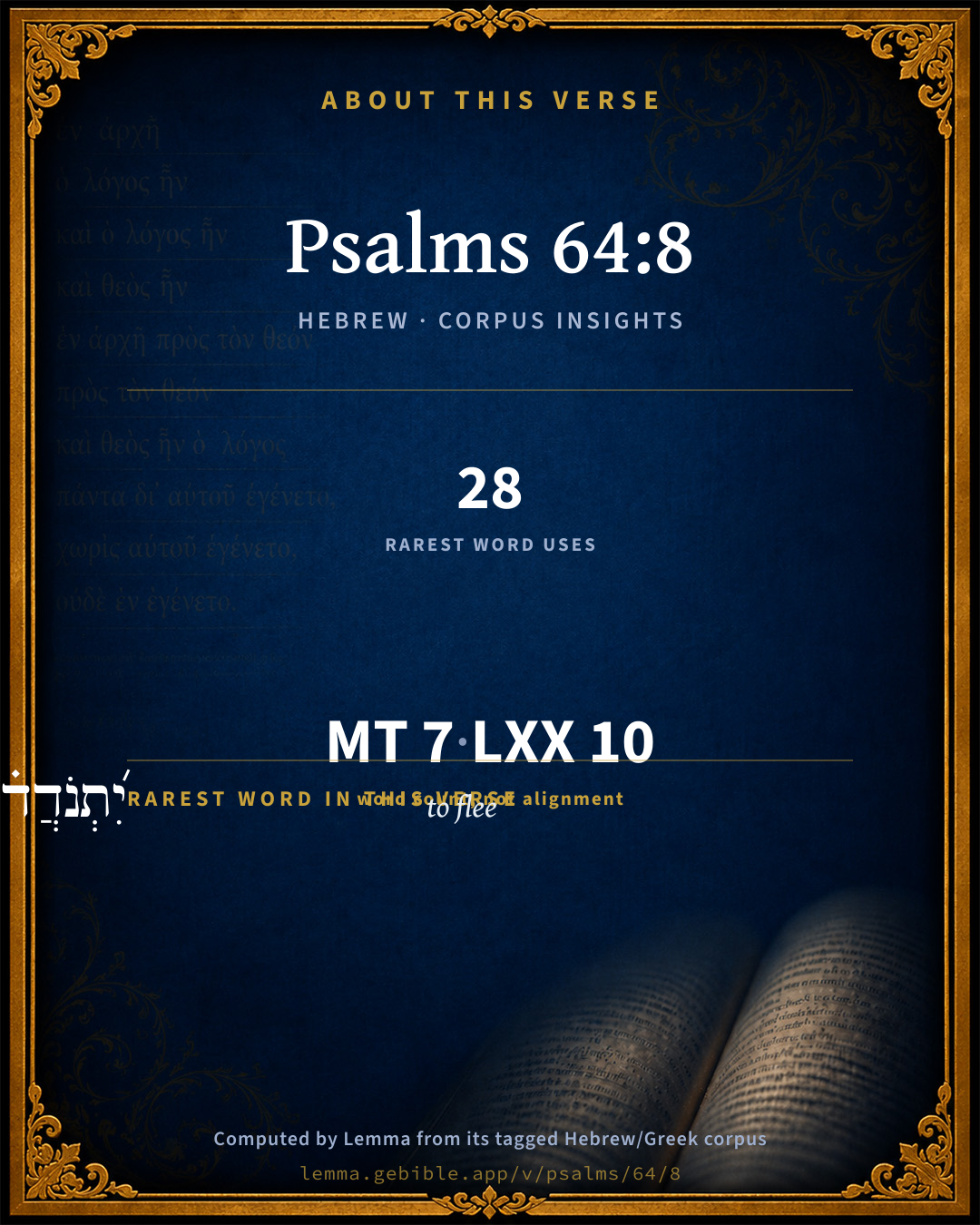
יִ֝תְנֹדֲד֗וּ to flee H5074 occurs in 26 verses of the Hebrew Bible. Also found in:

Grammatical profile

  • 3 verbs
  • 2 nouns
  • 2 prepositions

Verb forms

  • וַיַּכְשִׁיל֣וּהוּ Hiphil · Sequential Imperfect
  • יִ֝תְנֹדֲד֗וּ Hithpolel · Imperfect
  • רֹ֥אֵה Qal · Participle Active

Hebrew & Septuagint length

In English translation the verse runs 14 words from the Hebrew and 14 from the Septuagint (LXX English) — the same length.

A rough comparison of the two English renderings, which tokenize alike — not a word-level alignment.

Word counts can differ between the Hebrew and the Greek without any difference in meaning — e.g. the Hebrew direct-object marker אֵת has no separate Greek word, and Greek often adds the article ὁ.

In the original languages it is 7 Hebrew tokens and 10 Greek tokens — but the two are counted differently (Hebrew bundles its prefixes and suffixes into one token; the Greek is in lemma form), so that isn’t a like-for-like length.

Cross-references

18

Topical passages linked to Psalms 64:8 in the Treasury of Scripture Knowledge — connected by theme and wording, ordered by reader-vote popularity; previews shown in the World English Bible.

  • Proverbs 18:7 A fool's mouth is his destruction, And his lips are a snare to his soul.
  • Proverbs 12:13 An evil man is trapped by sinfulness of lips, But the righteous shall come out of trouble.
  • Psalms 140:9 As for the head of those who surround me, Let the mischief of their own lips cover them.
  • Job 15:6 Your own mouth condemns you, and not I; Yes, your own lips testify against you.
  • Psalms 22:7 All those who see me mock me. They insult me with their lips. They shake their heads, saying,
  • Psalms 31:11 Because of all my adversaries I have become utterly contemptible to my neighbors, A fear to my acquaintances. Those who saw me on the street fled from me.
  • Jeremiah 18:16 to make their land an astonishment, and a perpetual hissing; everyone who passes thereby shall be astonished, and shake his head.
  • Jeremiah 48:27 For wasn't Israel a derision to you? was he found among thieves? for as often as you speak of him, you wag the head.
  • Nahum 3:7 It will happen that all those who look at you will flee from you, and say, 'Nineveh is laid waste Who will mourn for her?' Where will I seek comforters for you?"
  • Matthew 21:41 They told him, "He will miserably destroy those miserable men, and will lease out the vineyard to other farmers, who will give him the fruit in its season."
  • Luke 19:22 "He said to him, 'Out of your own mouth will I judge you, you wicked servant! You knew that I am an exacting man, taking up that which I didn't lay down, and reaping that which I didn't sow.
  • Numbers 16:34 All Israel that were round about them fled at the cry of them; for they said, Lest the earth swallow us up.
  • 1 Samuel 31:3–7 The battle went sore against Saul, and the archers overtook him; and he was greatly distressed by reason of the archers.
  • Psalms 9:3 When my enemies turn back, They stumble and perish in your presence.
  • Psalms 52:6 The righteous also will see it, and fear, And laugh at him, saying,
  • Psalms 59:12 For the sin of their mouth, and the words of their lips, Let them be caught in their pride, For the curses and lies which they utter.
  • Revelation 18:4 I heard another voice from heaven, saying, "Come out of her, my people, that you have no participation in her sins, and that you don't receive of her plagues,
  • Revelation 18:10 standing far away for the fear of her torment, saying, 'Woe, woe, the great city, Babylon, the strong city! For your judgment has come in one hour.'

Cross-references courtesy of OpenBible.info (CC BY 4.0).

Hebrew and Greek witnesses Masoretic Hebrew ↔ Greek Septuagint

The same verse in the two great witnesses to the Old Testament, shown verse-for-verse.

You’re reading Greek Psalm 63 (Hebrew Psalm 64). The Septuagint counts the superscription, so verse numbers can differ from the Hebrew — chapter-level alignment, not verse-by-verse. Numbering follows Rahlfs.

These are two independent witnesses, not word-aligned to each other, and the Septuagint is shown in lemma (dictionary) form.

Hebrew Psalms 64:8 Masoretic · Westminster Leningrad Codex

וַיַּכְשִׁיל֣וּהוּ עָלֵ֣ימוֹ לְשׁוֹנָ֑ם יִ֝תְנֹדֲד֗וּ כָּל רֹ֥אֵה בָֽם

Their own tongues shall ruin them. All who see them will shake their heads.

World English Bible · Public Domain

Greek LXX Greek Psalm 63:8 Septuagint · lemma form

καί ὑψόω ὁ θεός βέλος νήπιος γίγνομαι ὁ πληγή αὐτός

and their tongues have set him at nothing, all that saw them were troubled;

LXX2012 (modern English Septuagint) · Public Domain

Hebrew: Westminster Leningrad Codex (CC BY 4.0). Greek: Septuagint (public domain); English from LXX2012 (modern English Septuagint) (Public Domain). How the Septuagint differs from the Hebrew →

Commentary

Notes on Psalms 64:8 from classic Christian and Jewish commentators (each source and its license shown beneath its notes). The classic Christian expositions comment on the surrounding passage and are grouped to its opening verse, so a note may address several verses; the Jewish commentaries on the Tanakh (Rashi and others) are per-verse, so they appear only where the commentator wrote on this verse.

Lemma curates 59 commentaries, every one of them public domain or Creative Commons licensed, each selected and text-cleaned for this edition rather than reprinted as found. About our sources →

Trapp's Complete Commentary

John Trapp

Psa 64:8 So they shall make their own tongue to fall upon themselves: all that see them shall flee away.

Ver. 8. So they shall make their own tongue, &c.] According to Pro 12:13 Psa 59:12. {See Trapp on "Pro 12:13"} {See Trapp on "Psa 59:12"}

And all that see them shall flee away] With horror and astonishment. Heb. They shall wander about in their flight; this is spoken of their favourites and abetters fearing to fall under the like punishment, and being agitated by the furies of their own evil consciences.

John Trapp, A Commentary or Exposition upon All the Books of the Old and New Testament (1647–1656) — public domain. Text from a community e-Sword module.

Joseph Benson's Commentary

Psa 64:8-9. They shall make their own tongue, &c. — The mischief of their hard speeches, and threats, and crafty counsels against me, shall be turned against themselves. All that see them shall flee away — Partly through abhorrence of them, and partly through fear of being involved in their destruction. Some think this was fulfilled in the death of Saul, when not only his army was dispersed, but the inhabitants of the neighbouring country were so terrified with his fall, and with that of his three sons, that they quitted their cities and fled, 1Sa 31:7. And all men shall fear — A great number of those who shall see this event shall be affected with a holy awe of God upon the consideration of it, and shall fear and tremble because of his judgments; shall fear being found persecutors of God’s people. And shall declare the work of God — His admirable work of divine wisdom, power, and faithfulness; they shall speak one to another, and to all about them, of the justice of God in punishing persecutors. For they shall wisely consider of his doing — Learning wisdom by the folly and misery of these persecutors, and avoiding those evil courses which brought ruin upon them. There is need of consideration and serious thought, rightly to take up such a matter of fact, and need of wisdom to put a true interpretation upon it. What God does is well worth our considering, Ecc 7:13. But it must be considered wisely, that we do not mistake the design of it, and the instruction it is intended to convey.

Joseph Benson's Commentary on the Old and New Testaments (1811–1818) — public domain. Text from a community e-Sword module.

J. A. Alexander on Psalms

Joseph Addison Alexander

9. (Psa 64:8). And he has cast them down; upon them (comes) their own tongue; all shall flee gazing at them. Cast down, literally made to fall or stumble. See the use of the same verb in historical prose, 2Ch 25:8, and compare the original in 2 Chron. 27. The construction is indefinite, as in Psa 63:10, they have cast him down, i.e. he is cast down, meaning the enemy as an ideal person, who, according to the usage of these psalms, is immediately afterwards referred to in the plural number. Their tongue, i.e. the consequences of their false, malignant speeches, and their mischievous deliberations. The verb in the last clause is an intensive form of the one used in Psa 31:11; Psa 55:7. Gazing at them, not simply seeing them, but seeing with emotion, whether that of wonder, joy, or terror. See above, on Psa 54:7; Psa 59:10. The clause seems to contain an allusion to the flight of the people, when the earth opened to devour Korah and his company, Num 16:34.

Joseph Addison Alexander, The Psalms Translated and Explained (1850) — public domain. Text from a community e-Sword module.

Geneva Bible (1599)

Geneva Bible translators

To see God’s heavy judgments against them, and how he hath caught them in their own snares.

Geneva Bible (1599) marginal notes — public domain. Text via Bolls.life.

Jamieson, Fausset & Brown

Robert Jamieson, A. R. Fausset & David Brown

their . . . tongue to fall, &c.--that is, the consequences of their slanders, &c. (compare Psa 10:2; Psa 31:16).

all that see . . . away--Their partners in evil shall be terrified.

Jamieson, Fausset & Brown — Commentary Critical and Explanatory on the Whole Bible (1871) — public domain (CC PDM 1.0). Text via the HelloAO Bible API.

Adam Clarke's Commentary

Verse 8. Their own tongue to fall upon them-selves] All the plottings, counsels, and curses, they have formed against me, shall come upon themselves.

Adam Clarke's Commentary on the Bible (1810–1826) — public domain. Text from a community e-Sword/MySword module.

John Calvin's Commentaries

8 And they shall make their own tongue to fall upon themselves Pursuing the same subject, he remarks, that the poison concocted in their secret counsels, and which they revealed with their tongues, would prove to have a deadly effect upon themselves. The sentiment is the same with that expressed elsewhere by another figure, when they are said to be caught in their own snares, and to fall into the pit which they have digged themselves, (Psalm 57:6.) It is just that Heaven should make the mischiefs which they had devised against innocent and upright men to recoil upon their own heads. The judgment is one which we see repeatedly and daily exemplified before our eyes, and yet we find much difficulty in believing that it can take place. We should feel ourselves bound the more to impress the truth upon our hearts, that God is ever watching, as it were, his opportunity of converting the stratagems of the wicked into means just as completely effective of their destruction, as if they had intentionally employed them for that end. In the close of the verse, to point out the striking severity of their punishment, it is said that all who saw them should flee away The judgments of God are lifted above out of the sight of an ignorant world, and ere it can be roused to fear and dismay, these must be such as to bear signal marks indeed of a divine hand.

John Calvin's Commentaries (1540-1563) — public domain. Text from the Calvin Translation Society English edition (1840s-50s) via the Christian Classics Ethereal Library (ccel.org). Calvin's coverage is partial (roughly two-thirds of the Bible); uncommented books and verses are honest gaps, never fabricated. The 19th-century editor's footnotes and remarks are omitted so the notes are faithfully Calvin's own voice.

The Cambridge Bible for Schools and Colleges

gen. ed. J. J. S. Perowne

8. So they shall make their own tongue to fall upon themselves] An untenable rendering of an obscure sentence. It is best to render, substantially as R.V., And they are made to stumble, their own tongue being against them. Lit. they make him stumble: the plural subject to the verb suggesting, as in Psa_63:10, the idea of mysterious agents in God’s service, and the singular object regarding ‘the enemy’ (as in Psa_64:1 b) collectively as a body. For the sense cp. Psa_140:9; Psa_7:15 f (note that v. 12 f are parallel to v. 7 here); Psa_57:6. Their tongue, the weapon with which they sought to destroy others, is turned against themselves. Ahithophel’s fate may serve for illustration. Possible, but less satisfactory, is the rendering of R.V. marg.: So shall they against whom their tongue was make them to stumble. The context does not hint that their victims become their executioners.

shall flee away] For fear of sharing their fate (Num_16:34). But the right rendering certainly is, All that see their desire upon them shall wag the head, in scornful triumph, as Jer_48:27, R.V.; cp. Psa_22:7. See Psa_52:6 ff.; Psa_54:7; Psa_59:10, and for the light in which such expressions of satisfaction are to be regarded see note on Psa_58:11.

The Cambridge Bible for Schools and Colleges (gen. ed. J. J. S. Perowne; Cambridge University Press, 1878–1918) — public domain. Text from a community e-Sword module.

John Gill's Exposition

So shall they make their own tongue to fall upon themselves,.... The evil things they have wished for, threatened unto, and imprecated on others, shall come upon themselves; the curses they have cursed others with shall come upon themselves; the pit they have dug for others, they fall into. So Haman, to whom some apply the psalm, was hanged on the gallows he made for Mordecai; and the accusers of Daniel, to whom others apply it, were cast into the same den of lions they procured for him; and Babylon, who has been drunk with the blood of the saints, shall have blood given her to drink.

all that see them shall flee away; not being able to help them, nor to bear the horrible sight, and fearing the same judgments should fall on themselves; see Num 16:34. Or, "they shall move themselves" (d); shake their heads in a way of derision, as Jarchi interprets it; or skip for joy, as the word is rendered in Jer 48:27; and then it must be understood of the righteous; who, seeing the vengeance on the wicked, rejoice, as in Psa 52:6; though, as they are afterwards particularly mentioned, others seem to be designed. The word is used for lamenting and bemoaning one's self, in Jer 31:18; and so may be applied to the friends of the wicked lamenting and bemoaning their ruin, and their being bereaved of them, Rev 18:9.

(d) "amovebunt se", Montanus; "commovebuntur", Vatablus.

John Gill's Exposition of the Whole Bible (1746–1763) — public domain (CC PDM 1.0). Text via the HelloAO Bible API.

Albert Barnes' Notes on the Bible

So they shall make their own tongue to fall upon themselves - In Psa 64:3, their tongue is represented as a sword; and here, keeping up the figure, the tongue, as a sword, is represented as falling on them, or as inflicting the wound on themselves which they had intended to inflict on others. This might be rendered, “And they have cast him down; upon them is their own tongue;” or, “Upon them their own tongue has come.” That is, someone would cast them down, and they would fall as if smitten by their own tongue like a sword. It is not said who would do this, but the most natural interpretation is that it would be done by God. The idea is, that the instrument which they had employed to injure others would be the means of their own ruin.

All that see them shall flee away - Compare Psa 31:11. That is, they shall flee in consternation from those who are so fearfully overthrown. They shall see that God is just, and that He will punish the wicked; and they will desire to escape from a ruin so dreadful as that which comes upon the ungodly. The idea is, that when God punishes sinners, the effect on others is, and should be, to lead them to wish not to be associated with such people, but to escape from a doom so fearful.

Albert Barnes' Notes on the Bible (1834–1885) — public domain. Text from a community e-Sword/MySword module.

Matthew Poole's English Annotations

The mischief of their hard speeches, and threats, and crafty counsels against me shall be turned against themselves.

Shall flee away; partly through abhorrency of them, and partly through fear of being involved in their destruction.

Matthew Poole's English Annotations on the Holy Bible (1683–1685) — public domain. Text from a community e-Sword/MySword module.

The Treasury of David

Charles H. Spurgeon

Ver. 8. So they shall make their own tongue to fall upon themselves. Their slander shall recoil. Their curses shall come home to roost. Their tongue shall cut their throats. It was both sword, and bow and arrow; it shall be turned against them, and bring home to them full punishment.

All that see them shall flee away. Afraid, both of them and their overthrow, their former friends shall give them wide space, lest they perish with them. Who cares to go near to Herod when the worms are eating him? or to be in the same chariot with Pharaoh when the waves roar round him? Those who crowded around a powerful persecutor, and cringed at his feet, are among the first to desert him in the day of wrath. Woe unto you, ye liars! "Who will desire fellowship with you in your seething lake of fire?"

Ver. 8. (first clause).

In these cases,

We still have judgment here, that we but teach

Bloody instructions, which, being taught, return

To plague the inventor: This even handed justice

Commends the ingredients of our poisoned chalice

To our own lips. William Shakespeare.

Ver. 8. Their own tongue to fall upon themselves. That is, their own words shall be brought as a testimony against them, and condemn them. "The tongue is a little member" (Jas 3:5), and therefore a light member; yet it falls heavy, as heavy as lead. A man were better have his house fall upon him, than that, in this sense, his tongue should fall upon him. Some have been pressed to death because they would not speak, but stood mute before the judge; but more have been pressed to death by their sinful freedom, or rather licentiousness in speaking; this hath brought them to judgment, and cast them in judgment... A strange thing, that the fall of a man's tongue should oppress his body and whole estate; yet so it is, the weight of a man's tongue falling upon him crushes him to powder. Joseph Caryl.

Ver. 8. Their own tongue to fall upon themselves. The arrows of idle words, though shot out of sight, and possibly quite forgotten, will hereafter drop down upon the heads of such as drew the bow. Words are but wind, is the common saying, but they are such wind as will either blow the soul to its haven of rest, if holy, wholesome, savoury, spiritual, and tending to edification, or else sink it into the Dead Sea and bottomless gulf of eternal misery, if idle, profane, frothy, and unprofitable. Edward Reyner (1600-1670) in "Rules for the Government of the Tongue."

None.

Psalms 64:9*

Charles H. Spurgeon's The Treasury of David (1869–1885) — public domain. Psalms only. Text from a community e-Sword/MySword module.

Whedon's Commentary on the Bible

Daniel D. Whedon

8. Make their own tongue to fall upon themselves—The evil which they had proposed to bring upon the righteous by false testimony and vile slander, shall be visited back upon themselves to their ruin. Psa_7:16; Pro_12:13; Pro_18:7. “They were thinking of wounding the upright, but behold they are wounded themselves.”—Hengstenberg.

All that see them shall flee—As the people fled at the cry of Korah and his company when they saw them swallowed up alive. Num_16:34. But the word translated flee, signifies, radically, to move to and fro, to shake; and hence, also, to wag or shake the head in derisive triumph, as in Jer_18:16; Jer_48:27, in which latter it is translated in our English Bible, “skippedst for joy.” See also Psalm 14:14. So Furst translates the text, “All that look upon them shake [the head].” In this sense the looking upon them signifies, “the gratification of looking upon those who are justly punished, and rendered harmless.”—Delitzsch. See Psa_59:10; Psa_92:11

Daniel D. Whedon (gen. ed.), Commentary on the Old and New Testaments (1874–1909) — public domain. Text from a community e-Sword module.

The Pulpit Commentary

So they shall make their own tongue to fall upon themselves; rather, so shall they be made to stumble; their own tongue shall be against them. The tongue, which they "whetted like a sword," shall be the principal means of bringing them into trouble. (see 2Sa_17:1-23) All that see them shall flee away; rather, shall wag the head (Cheyne, Revised Version) in derision.

The Pulpit Commentary (1880–1919), ed. H.D.M. Spence-Jones & Joseph S. Exell — public domain. Text from a community e-Sword module.

John Wesley's Explanatory Notes

Flee - Through fear of being involved in their destruction.

John Wesley, Explanatory Notes Upon the Whole Bible (1754–1765) — public domain. Text via the GEBible commentary corpus.

Rashi

Rabbi Shlomo Yitzchaki (Rashi)

And God cast them down He cast them into the lions’ den, as it is written (Dan. 6:25): “And the king commanded, and they brought these men who had slandered Daniel, and they cast them into the lions’ den, etc.”

Rashi on the Tanakh — English translations: “The Judaica Press complete Tanach with Rashi, translated by A. J. Rosenberg” (CC BY 4.0); “Pentateuch with Rashi's commentary by M. Rosenbaum and A.M. Silbermann, 1929-1934” (public domain); “The Metsudah Tanach series, Lakewood, N.J” (CC BY 4.0); and “The Book of Joshua, Metsudah Publications, 1997” (CC BY 4.0). Text via Sefaria.

Lesson kit

Teaching starters — assembled from the data on this page, not authored interpretation. Every prompt links to the verse data it draws on. Edit before teaching.

Psalms, in the Wisdom, opens this verse with 7 words (6 distinct Hebrew lemmas). Its most distinctive word is nâdad (“to flee”). A historical commentator’s framing appears above. Read the whole chapter for the surrounding context.

Discussion questions

  1. What does “to flee” (nâdad) contribute to the verse as a whole?
  2. Genesis 31:40 shares the word «to flee» with this verse. How do the two illuminate each other?
  3. These translations render this verse differently; the difference is in the English rendering, not the original. What questions does that raise?
  4. The verb «וַיַּכְשִׁיל֣וּהוּ» is Hiphil Sequential Imperfect. How does its form color the action?
  5. Reading how Trapp's Complete Commentary and Joseph Benson's Commentary read this verse, where do the two commentators agree and where do they part?

Things to notice

Reading settings

Reading text

Shown beneath each verse's original-language words.

Old Testament
Old Testament edition

Read the OT as the Masoretic Hebrew (MT) or the Greek Septuagint (LXX).

English shown for the Greek Septuagint (in the Hebrew ↔ Greek comparison).

Comparing translations? Open the Compare panel on any verse page to stack up to four side by side.