
Psalms 37:30

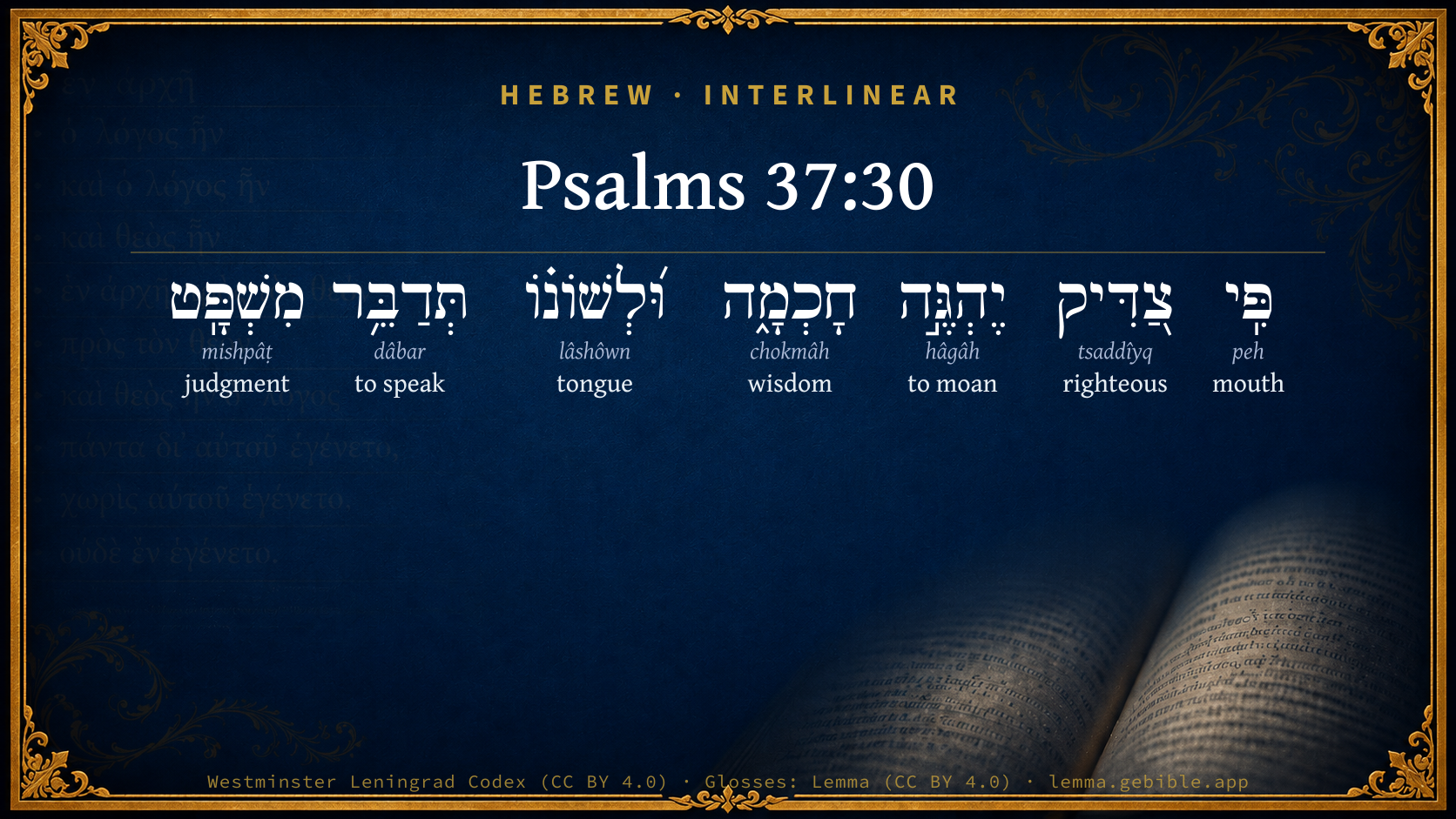
Hebrew (Westminster Leningrad Codex) Psalms 37:30 appears in the Hebrew Old Testament. The text above is from the Westminster Leningrad Codex. Each word links to its Strong’s number, a concise gloss, and parsing drawn from the Open Scriptures Hebrew Bible morphology. Click any word for its full Brown-Driver-Briggs (BDB) entry.
Download image
Cite this verse

Psalms 37:30 (World English Bible). Public Domain. Lemma interlinear Bible study tool, https://lemma.gebible.app/v/psalms/37/30.

Show BibTeX & RIS
BibTeX
RIS
English Translation
The mouth of the righteous talks of wisdom. His tongue speaks justice.
World English Bible · Public Domain
Download a study sheet

One document with this verse’s original text, its word-by-word gloss line, the meaning frame, cross-references with their text, attributed commentary, and full source and license credits — printable, and it pastes into notes with its structure intact.

This verse Autodidact and up

Study sheet (.html) Plain text (.txt)

A passage Seminary Student

Up to 50 verses in one chapter. A passage sheet keeps up to 6 commentary sources and 12 cross-references per verse, in the order this page ranks them, and says so on the sheet whenever that leaves anything out. Ask for a single verse and you get the Autodidact verse sheet above.

Everything on this page stays free to read, with no account — the sheet is a download of what is already on screen, not access to it.

Want to remove ads? Support Godless Engineer
Compare translations 3

The same verse in 3 English versions, stacked beneath the original-language interlinear above. Click any original word for its lexicon entry.

Each is an independent rendering of the whole verse — the interlinear is not word-aligned to these translations.

Highlighted words mark where these versions differ — a whole-verse word diff, not a word-by-word alignment.

  • World English Bible Public Domain
    The mouth of the righteous talks of wisdom. His tongue speaks justice.
  • King James Version Public Domain
    The mouth of the righteous speaketh wisdom, and his tongue talketh of judgment.
  • unfoldingWord Literal Text CC BY-SA 4.0
    The mouth of the righteous murmurs wisdom, and his tongue speaks justice.

unfoldingWord Literal Text — © unfoldingWord, licensed CC BY-SA 4.0. Word-aligned USFM3 via Door43 (git.door43.org/unfoldingWord/en_ult).

Versions to compare (up to 4)

3 of 4 selected

Show all 18 translations

Every available English version of this verse, each an independent rendering of the whole verse.

  • World English Bible Public Domain
    The mouth of the righteous talks of wisdom. His tongue speaks justice.
  • Berean Standard Bible Public Domain
    The mouth of the righteous man utters wisdom, and his tongue speaks justice.
  • Majority Standard Bible Public Domain
    The mouth of the righteous man utters wisdom, and his tongue speaks justice.
  • King James Version Public Domain
    The mouth of the righteous speaketh wisdom, and his tongue talketh of judgment.
  • American Standard Version (1901) Public Domain
    The mouth of the righteous talketh of wisdom, And his tongue speaketh justice.
  • Revised Version (1885) Public Domain
    The mouth of the righteous talketh of wisdom, and his tongue speaketh judgment.
  • Geneva Bible (1599) Public Domain
    The mouth of the righteous will speake of wisedome, and his tongue will talke of iudgement.
  • Douay-Rheims (1899) Public Domain
    The mouth of the just shall meditate wisdom: and his tongue shall speak judgment.
  • Young's Literal Translation Public Domain
    The mouth of the righteous uttereth wisdom, And his tongue speaketh judgment.
  • Literal Standard Version CC BY-SA 4.0
    The mouth of the righteous utters wisdom, || And his tongue speaks judgment.
  • Unlocked Literal Bible CC BY-SA 4.0
    The mouth of the righteous person speaks wisdom and increases justice.
  • unfoldingWord Literal Text CC BY-SA 4.0
    The mouth of the righteous murmurs wisdom, and his tongue speaks justice.
  • Darby Bible Public Domain
    The mouth of the righteous proffereth wisdom, and his tongue speaketh judgment;
  • World Messianic Bible Public Domain
    The mouth of the righteous talks of wisdom. His tongue speaks justice.
  • Webster's Bible Public Domain
    The mouth of the righteous speaketh wisdom, and his tongue talketh of judgment.
  • Free Bible Version CC BY-SA 4.0
    People who do right give good advice, explaining what is fair.
  • Bible in Basic English Public Domain
    The mouth of the good man says words of wisdom; the talk of his tongue is of righteousness.
  • JPS Tanakh (1917) Public Domain
    The mouth of the righteous uttereth wisdom, and his tongue speaketh justice.

Literal Standard Version (2020), Covenant Press — licensed CC BY-SA 4.0. Text via the HelloAO Bible API (eBible.org). Unlocked Literal Bible (unfoldingWord) — licensed CC BY-SA 4.0. Text via the HelloAO Bible API (eBible.org). unfoldingWord Literal Text — © unfoldingWord, licensed CC BY-SA 4.0. Word-aligned USFM3 via Door43 (git.door43.org/unfoldingWord/en_ult). Free Bible Version, Dr. Jonathan Gallagher — licensed CC BY-SA 4.0. Text via the HelloAO Bible API (eBible.org).

Word by word

More ways to search: Search by grammar → Find every occurrence → Compare this word →

Practice this passage: Drill this verse → Learn its vocabulary →

About this verse

These counts appear in no published source. They are computed here, from the morphology-tagged text and Lemma’s own curated glosses. What Lemma adds →

7
words
7
distinct lemmas
Wisdom
section

Notable vocabulary

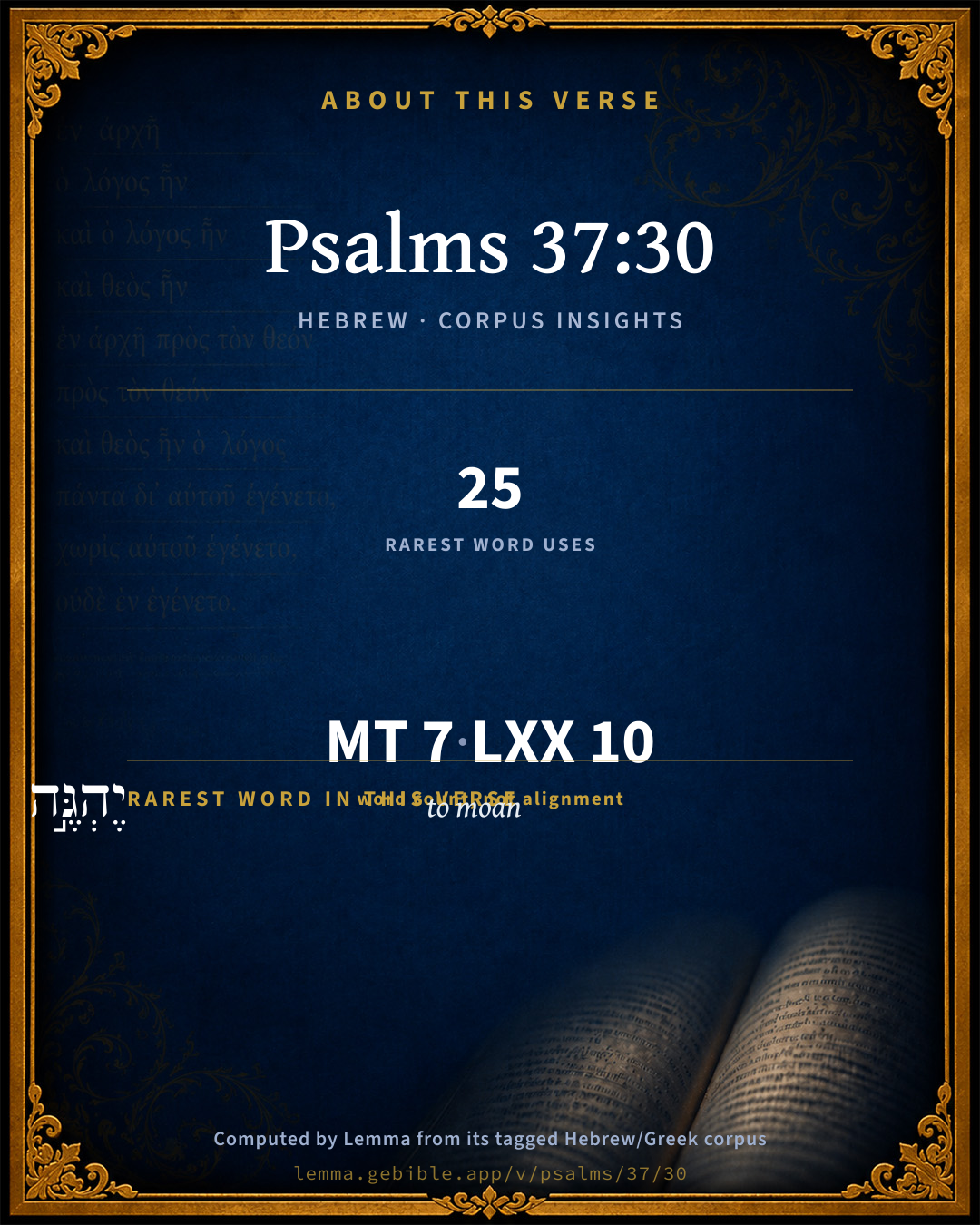
The rarest word here is יֶהְגֶּ֣ה to moan H1897 — appearing just 25 times in the whole Hebrew Bible.

Shared distinctive vocabulary

יֶהְגֶּ֣ה to moan H1897 occurs in 24 verses of the Hebrew Bible. Also found in:

Grammatical profile

  • 2 verbs
  • 4 nouns
  • 1 adjective

Verb forms

  • יֶהְגֶּ֣ה Qal · Imperfect
  • תְּדַבֵּ֥ר Piel · Imperfect

Hebrew & Septuagint length

In English translation the verse runs 12 words from the Hebrew and 15 from the Septuagint (LXX English) — closely comparable.

A rough comparison of the two English renderings, which tokenize alike — not a word-level alignment.

Word counts can differ between the Hebrew and the Greek without any difference in meaning — e.g. the Hebrew direct-object marker אֵת has no separate Greek word, and Greek often adds the article ὁ.

In the original languages it is 7 Hebrew tokens and 10 Greek tokens — but the two are counted differently (Hebrew bundles its prefixes and suffixes into one token; the Greek is in lemma form), so that isn’t a like-for-like length.

Cross-references

11

Topical passages linked to Psalms 37:30 in the Treasury of Scripture Knowledge — connected by theme and wording, ordered by reader-vote popularity; previews shown in the World English Bible.

  • Colossians 4:6 Let your speech always be with grace, seasoned with salt, that you may know how you ought to answer each one.
  • Proverbs 25:11–13 A word fitly spoken Is like apples of gold in settings of silver.
  • Proverbs 15:7 The lips of the wise spread knowledge; Not so with the heart of fools.
  • Ephesians 4:29 Let no corrupt speech proceed out of your mouth, but such as is good for building up as the need may be, that it may give grace to those who hear.
  • Proverbs 10:31 The mouth of the righteous brings forth wisdom, But the perverse tongue will be cut off.
  • Matthew 12:35 The good man out of his good treasure brings out good things, and the evil man out of his evil treasure brings out evil things.
  • Proverbs 10:21 The lips of the righteous feed many, But the foolish die for lack of understanding.
  • Psalms 71:15 My mouth will tell about your righteousness, And of your salvation all day, Though I don't know its full measure.
  • Deuteronomy 6:7–9 and you shall teach them diligently to your children, and shall talk of them when you sit in your house, and when you walk by the way, and when you lie down, and when you rise up.
  • Psalms 71:24 My tongue will also talk about your righteousness all day long, For they are disappointed, and they are confounded, who want to harm me.
  • Proverbs 27:9 Perfume and incense bring joy to the heart; So does earnest counsel from a man's friend.

Cross-references courtesy of OpenBible.info (CC BY 4.0).

Hebrew and Greek witnesses Masoretic Hebrew ↔ Greek Septuagint

The same verse in the two great witnesses to the Old Testament, shown verse-for-verse.

You’re reading Greek Psalm 36 (Hebrew Psalm 37). The Septuagint counts the superscription, so verse numbers can differ from the Hebrew — chapter-level alignment, not verse-by-verse. Numbering follows Rahlfs.

These are two independent witnesses, not word-aligned to each other, and the Septuagint is shown in lemma (dictionary) form.

Hebrew Psalms 37:30 Masoretic · Westminster Leningrad Codex

פִּֽי צַ֭דִּיק יֶהְגֶּ֣ה חָכְמָ֑ה וּ֝לְשׁוֹנ֗וֹ תְּדַבֵּ֥ר מִשְׁפָּֽט

The mouth of the righteous talks of wisdom. His tongue speaks justice.

World English Bible · Public Domain

Greek LXX Greek Psalm 36:30 Septuagint · lemma form

στόμα δίκαιος μελετάω σοφία καί ὁ γλῶσσα αὐτός λαλέω κρίσις

The mouth of the righteous will meditate wisdom, and his tongue will speak of judgment.

LXX2012 (modern English Septuagint) · Public Domain

Hebrew: Westminster Leningrad Codex (CC BY 4.0). Greek: Septuagint (public domain); English from LXX2012 (modern English Septuagint) (Public Domain). How the Septuagint differs from the Hebrew →

Commentary

Notes on Psalms 37:30 from classic Christian and Jewish commentators (each source and its license shown beneath its notes). The classic Christian expositions comment on the surrounding passage and are grouped to its opening verse, so a note may address several verses; the Jewish commentaries on the Tanakh (Rashi and others) are per-verse, so they appear only where the commentator wrote on this verse.

Lemma curates 59 commentaries, every one of them public domain or Creative Commons licensed, each selected and text-cleaned for this edition rather than reprinted as found. About our sources →

Trapp's Complete Commentary

John Trapp

Psa 37:30 The mouth of the righteous speaketh wisdom, and his tongue talketh of judgment.

Ver. 30. The mouth of the righteous speaketh wisdom] Having spoken of the privileges of the righteous, he now describeth them, Tales autem sunt non quicunque nomen iustorum praetexunt, &c. Such are not all they that pretend to righteousness, or can talk of it; but that can speak of it fruitfully, feelingly, and from an outward principle. And as he talketh, so he walketb, ne dicta factis erubescant, as Tertullian hath it; lest his life should seem to give the lie to his lips.

John Trapp, A Commentary or Exposition upon All the Books of the Old and New Testament (1647–1656) — public domain. Text from a community e-Sword module.

Joseph Benson's Commentary

Psa 37:30. The mouth of the righteous speaketh wisdom — And that freely, customarily, and from his heart, as the next verse shows. Having showed, in divers verses, God’s singular care over and respect to the righteous, he proceeds to give a character of them, and withal to assign one reason of the great difference of God’s way of dealing with them, and with other men. And his tongue talketh of judgment — This respects either, 1st, The manner of his discourse: it is with wisdom and judgment; or, rather, 2d, The matter of it, which is God’s judgment, word, or law, as it follows, Psa 37:31. While the discourses of other men are either wicked, or vain and useless, his are serious, pious, and edifying, concerning the word and ways of God.

Joseph Benson's Commentary on the Old and New Testaments (1811–1818) — public domain. Text from a community e-Sword module.

J. A. Alexander on Psalms

Joseph Addison Alexander

30. (Psa 37:30) The mouth of the righteous will utter wisdom. Lest the foregoing promises should be appropriated by the wicked, he lays down a test of character by which the righteous man may be distinguished. He is one whose mouth utters wisdom, in the high religious sense. For the meaning of the verb, see above, on Psa 35:28.—And his tongue will speak judgment, i.e. justice, rectitude, here used as an equivalent to wisdom, both denoting true religion, in its intellectual and moral aspects, with particular reference to its effects upon the speech or conversation of its subjects.

Joseph Addison Alexander, The Psalms Translated and Explained (1850) — public domain. Text from a community e-Sword module.

Tyndale Open Study Notes

Tyndale Open Resources

37:30 The godly base their counsel on the Lord’s wisdom.

Tyndale Open Study Notes — © Tyndale Open Resources, licensed CC BY-SA 4.0. Text via the HelloAO Bible API.

Geneva Bible (1599)

Geneva Bible translators

These three points are required of the faithful, that their talk be godly, that God’s law be in their heart, and that their life be upright.

Geneva Bible (1599) marginal notes — public domain. Text via Bolls.life.

Jamieson, Fausset & Brown

Robert Jamieson, A. R. Fausset & David Brown

The righteous described as to the elements of character, thought, word, and action.

Jamieson, Fausset & Brown — Commentary Critical and Explanatory on the Whole Bible (1871) — public domain (CC PDM 1.0). Text via the HelloAO Bible API.

Adam Clarke's Commentary

Verse 30. The mouth of the righteous speaketh wisdom] Foolish and corrupt conversation cannot come out of their mouth. They are taught of God, and they speak according to the wisdom that is from above.

Adam Clarke's Commentary on the Bible (1810–1826) — public domain. Text from a community e-Sword/MySword module.

John Calvin's Commentaries

30 The mouth of the righteous will speak wisdom As it is customary with hypocrites confidently to draw to their own advantage whatever the Spirit of God declares concerning the just and upright, David here gives a definition of the righteousness which God requires on the part of his children, and divides it into three principal parts — that their speech should be in sincerity and truth; that the law of God should reign in their heart; and that they should order their conversation aright. Some give a different exposition of the first part from what we have given: they say that the righteous serve as teachers and guides, by instructing others to live well, and leading them in the way; and, therefore, to speak wisdom, and to utter judgment, is, in their view, of the same import as to instruct others in holy doctrine, and to train them to the fear of God. I do not altogether disapprove of this exposition, but I fear it is too restricted. Wisdom and uprightness are here opposed as much to the profane and filthy language by which the wicked endeavor to blot out the name of God, as to cunning and fraud, and every species of stratagem and deceit; and also to the threats and terrors by which they endeavor to frighten the simple. The meaning therefore is, first, that the righteous speak honourably and reverently of the righteousness of God, that they may cherish in themselves and others, to a large extent, the knowledge and the fear of God; secondly, that both in their own affairs and those of others, they approve, without disguise or deceit, of what is just and reasonable, and are not given to justify what is wrong under the color and varnish of sophistry; and, finally, that they never depart from the truth.

John Calvin's Commentaries (1540-1563) — public domain. Text from the Calvin Translation Society English edition (1840s-50s) via the Christian Classics Ethereal Library (ccel.org). Calvin's coverage is partial (roughly two-thirds of the Bible); uncommented books and verses are honest gaps, never fabricated. The 19th-century editor's footnotes and remarks are omitted so the notes are faithfully Calvin's own voice.

The Cambridge Bible for Schools and Colleges

gen. ed. J. J. S. Perowne

30. The mouth of the righteous meditateth wisdom,

And his tongue speaketh judgement.

Cp. Pro_10:31-32. The word rendered meditateth combines the ideas of meditation and meditative discourse. Vulg. meditabitur sapientiam. Cp. Psa_1:2; Psa_35:28; Jos_1:8.

30, 31. Stanza of Pç. The secret of security.

The Cambridge Bible for Schools and Colleges (gen. ed. J. J. S. Perowne; Cambridge University Press, 1878–1918) — public domain. Text from a community e-Sword module.

John Gill's Exposition

The law of his God is in his heart,.... Which may be understood of the moral law, which was written in the heart of Adam an his creation, and continued there during his state of innocence, but was greatly obliterated by sin: there are some remains of it in fallen man, even in the very Gentiles; who, though without the law, do some things contained in it, which shows the work of it to be written in them; though in some it is scarcely legible, having lost all distinction between good and evil: but in regeneration the law of God is reinscribed, according to the promise of the covenant of grace, Jer 31:33; and such have a real knowledge of the spirituality and perfection of it; of the impossibility of justification by it; and of Christ being the fulfilling end of it: and they have a strong affection for it; they love it; and delight in it after the inward man, and serve it with their minds; in which lies part of their conformity to Christ, and is a branch of their character as good men; see Psa 40:8; moreover, the word here used, signifies any doctrine or instruction, and is sometimes used for the doctrine of the Gospel, Isa 2:3, and may have this sense here, and the meaning be, that that has a place in the hearts or righteous men, dwells richly there, and works effectually in them; and particularly the doctrine of grace which relates to covenant interest in God; for it is the law or doctrine of "his God" that is in his heart;

none of his steps shall slide; not that he shall never slip nor fall; for that is supposed Psa 37:24; but he shall never finally and totally go out of the paths of truth, holiness, and righteousness: the Lord keeps the feet of his saints, and orders their steps, and directs them in the way they should go, and preserves them in it; and enables them to walk uprightly, according to the rule of the divine word, and in all his commandments and ordinances; and to hold on and out unto the end: or the clause may be rendered, "it", the law, "shall not cause his steps to slide" (b); neither the law of God, nor the Gospel of Christ, but shall guide him in the right way, and be a lamp unto his feet, and a light unto his path.

(b) "non vacillat gressus ejus", Cocceius.

John Gill's Exposition of the Whole Bible (1746–1763) — public domain (CC PDM 1.0). Text via the HelloAO Bible API.

Albert Barnes' Notes on the Bible

The mouth of the righteous speaketh wisdom - That is, It is a characteristic of the righteous to speak “wise things;” not to utter folly. His conversation is serious, earnest, true, pure; and his words are faithful, kind, and just. This, as a part of human conduct, is one of the reasons why God will bless him with prosperity and length of days.

And his tongue talketh of judgment - That is, of just or righteous things. See Mat 12:35.

Albert Barnes' Notes on the Bible (1834–1885) — public domain. Text from a community e-Sword/MySword module.

Matthew Poole's English Annotations

Speaketh; and that freely, and customarily, and from his heart, as the next verse shows. Having showed in divers verses God’s singular care over and respect to the righteous, he proceeds to give a character of them, and withal to assign one reason of the great difference of God’s dealings with them and with other men. Wisdom and judgment; either,

1. For the manner of it, with wisdom and judgment. Or rather,

2. For the matter of it, heavenly wisdom, and God’s judgment, or word, or law, as it follows, Psa 37:31. When the discourses of other men are either wicked, or vain and useless, his are serious, and edifying, and pious, concerning the word and ways of God.

Matthew Poole's English Annotations on the Holy Bible (1683–1685) — public domain. Text from a community e-Sword/MySword module.

The Treasury of David

Charles H. Spurgeon

Ver. 30. The mouth of the righteous speaketh wisdom. Where the whole Psalm is dedicated to a description of the different fates of the just and the wicked, it was meet to give a test by which they could be known. A man's tongue is no ill index of his character. The mouth betrays the heart. Good men, as a rule, speak that which is to edifying, sound speech, religious conversation, consistent with the divine illumination which they have received. Righteousness is wisdom in action, hence all good men are practically wise men, and well may the speech be wise. His tongue talketh of judgment. He advocates justice, gives an honest verdict on things and men, and he foretells that God's judgments will come upon the wicked, as in the former days. His talk is neither foolish nor ribald, neither vapid nor profane. Our conversation is of far more consequence than some men imagine.

None

Ver. 30. Our speech as a test of godliness.

Psalms 37:31*

Charles H. Spurgeon's The Treasury of David (1869–1885) — public domain. Psalms only. Text from a community e-Sword/MySword module.

The Pulpit Commentary

The mouth of the righteous speaketh wisdom. (On the essential union of wisdom with goodness, see the Proverbs, passim. ) And his tongue talketh of judgment; i.e. utters only what is morally right, and, in accordance with truth and goodness. "Out of the abundance of the heart the mouth speaketh." A good man out of the good treasure of his heart can only bring forth good things. (Mat_12:34, Mat_12:35)

The Pulpit Commentary (1880–1919), ed. H.D.M. Spence-Jones & Joseph S. Exell — public domain. Text from a community e-Sword module.

John Wesley's Explanatory Notes

The mouth - Having shewed, God's singular care over the righteous, he proceeds to give a character of them. Judgment - Of God's judgment, word or law.

John Wesley, Explanatory Notes Upon the Whole Bible (1754–1765) — public domain. Text via the GEBible commentary corpus.

Keil & Delitzsch

C. F. Keil & F. Delitzsch

The verb הגה unites in itself the two meanings of meditating and of meditative utterance (vid., Psa 2:1), just as אמר those of thinking and speaking. Psa 37:31 in this connection affirms the stability of the moral nature. The walk of the righteous has a fixed inward rule, for the Tפra is to him not merely an external object of knowledge and a compulsory precept; it is in his heart, and, because it is the Tפra of his God whom he loves, as the motive of his actions closely united with his own will. On תּמעד, followed by the subject in the plural, compare Psa 18:35; Psa 73:2 Chethמb.

Keil & Delitzsch — Biblical Commentary on the Old Testament (1861–1891) — public domain (CC PDM 1.0). Text via the HelloAO Bible API. (Old Testament only.)

Rashi

Rabbi Shlomo Yitzchaki (Rashi)

The righteous man’s mouth utters at first words of wisdom in his heart to see the law that the Torah decided for each thing, and afterwards his tongue speaks judgment.

Rashi on the Tanakh — English translations: “The Judaica Press complete Tanach with Rashi, translated by A. J. Rosenberg” (CC BY 4.0); “Pentateuch with Rashi's commentary by M. Rosenbaum and A.M. Silbermann, 1929-1934” (public domain); “The Metsudah Tanach series, Lakewood, N.J” (CC BY 4.0); and “The Book of Joshua, Metsudah Publications, 1997” (CC BY 4.0). Text via Sefaria.

Lesson kit

Teaching starters — assembled from the data on this page, not authored interpretation. Every prompt links to the verse data it draws on. Edit before teaching.

Psalms, in the Wisdom, opens this verse with 7 words (7 distinct Hebrew lemmas). Its most distinctive word is hâgâh (“to moan”). A historical commentator’s framing appears above. Read the whole chapter for the surrounding context.

Discussion questions

  1. What does “to moan” (hâgâh) contribute to the verse as a whole?
  2. How does Joshua 1:8, which shares the word «to moan», read alongside this verse?
  3. These translations render this verse differently. What is at stake in choosing one wording over another?
  4. «יֶהְגֶּ֣ה» is a Qal Imperfect verb. How does that grammatical form shape the action described?
  5. Compare how Trapp's Complete Commentary and Joseph Benson's Commentary read this verse. Where do they agree or differ?

Things to notice

Reading settings

Reading text

Shown beneath each verse's original-language words.

Old Testament
Old Testament edition

Read the OT as the Masoretic Hebrew (MT) or the Greek Septuagint (LXX).

English shown for the Greek Septuagint (in the Hebrew ↔ Greek comparison).

Comparing translations? Open the Compare panel on any verse page to stack up to four side by side.