
Job 20:12

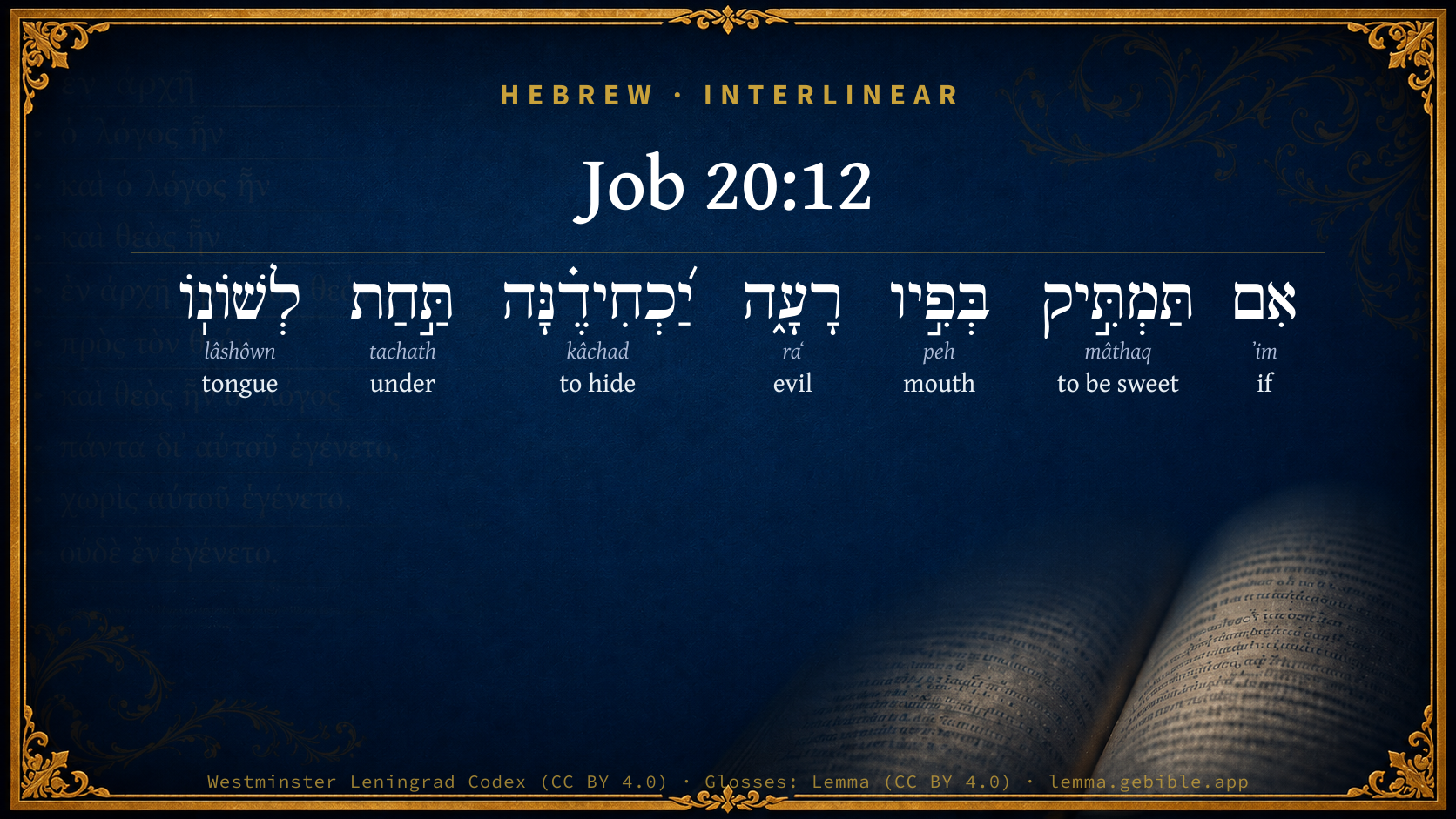
Hebrew (Westminster Leningrad Codex) Job 20:12 appears in the Hebrew Old Testament. The text above is from the Westminster Leningrad Codex. Each word links to its Strong’s number, a concise gloss, and parsing drawn from the Open Scriptures Hebrew Bible morphology. Click any word for its full Brown-Driver-Briggs (BDB) entry.
Download image
Cite this verse

Job 20:12 (World English Bible). Public Domain. Lemma interlinear Bible study tool, https://lemma.gebible.app/v/job/20/12.

Show BibTeX & RIS
BibTeX
RIS
English Translation
"Though wickedness is sweet in his mouth, Though he hide it under his tongue,
World English Bible · Public Domain
Download a study sheet

One document with this verse’s original text, its word-by-word gloss line, the meaning frame, cross-references with their text, attributed commentary, and full source and license credits — printable, and it pastes into notes with its structure intact.

This verse Autodidact and up

Study sheet (.html) Plain text (.txt)

A passage Seminary Student

Up to 50 verses in one chapter. A passage sheet keeps up to 6 commentary sources and 12 cross-references per verse, in the order this page ranks them, and says so on the sheet whenever that leaves anything out. Ask for a single verse and you get the Autodidact verse sheet above.

Everything on this page stays free to read, with no account — the sheet is a download of what is already on screen, not access to it.

Want to remove ads? Support Godless Engineer
Compare translations 3

The same verse in 3 English versions, stacked beneath the original-language interlinear above. Click any original word for its lexicon entry.

Each is an independent rendering of the whole verse — the interlinear is not word-aligned to these translations.

Highlighted words mark where these versions differ — a whole-verse word diff, not a word-by-word alignment.

  • World English Bible Public Domain
    "Though wickedness is sweet in his mouth, Though he hide it under his tongue,
  • King James Version Public Domain
    Though wickedness be sweet in his mouth, though he hide it under his tongue;
  • unfoldingWord Literal Text CC BY-SA 4.0
    Although wickedness is sweet in his mouth, he hides it under his tongue,

unfoldingWord Literal Text — © unfoldingWord, licensed CC BY-SA 4.0. Word-aligned USFM3 via Door43 (git.door43.org/unfoldingWord/en_ult).

Versions to compare (up to 4)

3 of 4 selected

Show all 18 translations

Every available English version of this verse, each an independent rendering of the whole verse.

  • World English Bible Public Domain
    "Though wickedness is sweet in his mouth, Though he hide it under his tongue,
  • Berean Standard Bible Public Domain
    Though evil is sweet in his mouth and he conceals it under his tongue,
  • Majority Standard Bible Public Domain
    Though evil is sweet in his mouth and he conceals it under his tongue,
  • King James Version Public Domain
    Though wickedness be sweet in his mouth, though he hide it under his tongue;
  • American Standard Version (1901) Public Domain
    Though wickedness be sweet in his mouth, Though he hide it under his tongue,
  • Revised Version (1885) Public Domain
    Though wickedness be sweet in his mouth, though he hide it under his tongue;
  • Geneva Bible (1599) Public Domain
    When wickednesse was sweete in his mouth, and he hid it vnder his tongue,
  • Douay-Rheims (1899) Public Domain
    For when evil shall be sweet in his mouth, he will hide it under his tongue.
  • Young's Literal Translation Public Domain
    Though he doth sweeten evil in his mouth, Doth hide it under his tongue,
  • Literal Standard Version CC BY-SA 4.0
    Though he sweetens evil in his mouth, hides it under his tongue,
  • Unlocked Literal Bible CC BY-SA 4.0
    Although wickedness is sweet in his mouth, although he hides it under his tongue,
  • unfoldingWord Literal Text CC BY-SA 4.0
    Although wickedness is sweet in his mouth, he hides it under his tongue,
  • Darby Bible Public Domain
    Though wickedness be sweet in his mouth [and] he hide it under his tongue,
  • World Messianic Bible Public Domain
    “Though wickedness is sweet in his mouth, though he hide it under his tongue,
  • Webster's Bible Public Domain
    Though wickedness may be sweet in his mouth, though he may hide it under his tongue;
  • Free Bible Version CC BY-SA 4.0
    Though evil tastes sweet in their mouths and they hide it under their tongues,
  • Bible in Basic English Public Domain
    Though evil-doing is sweet in his mouth, and he keeps it secretly under his tongue;
  • JPS Tanakh (1917) Public Domain
    Though wickedness be sweet in his mouth, though he hide it under his tongue;

Literal Standard Version (2020), Covenant Press — licensed CC BY-SA 4.0. Text via the HelloAO Bible API (eBible.org). Unlocked Literal Bible (unfoldingWord) — licensed CC BY-SA 4.0. Text via the HelloAO Bible API (eBible.org). unfoldingWord Literal Text — © unfoldingWord, licensed CC BY-SA 4.0. Word-aligned USFM3 via Door43 (git.door43.org/unfoldingWord/en_ult). Free Bible Version, Dr. Jonathan Gallagher — licensed CC BY-SA 4.0. Text via the HelloAO Bible API (eBible.org).

Word by word

More ways to search: Search by grammar → Find every occurrence → Compare this word →

Practice this passage: Drill this verse → Learn its vocabulary →

About this verse

These counts appear in no published source. They are computed here, from the morphology-tagged text and Lemma’s own curated glosses. What Lemma adds →

7
words
7
distinct lemmas
Wisdom
section

Notable vocabulary

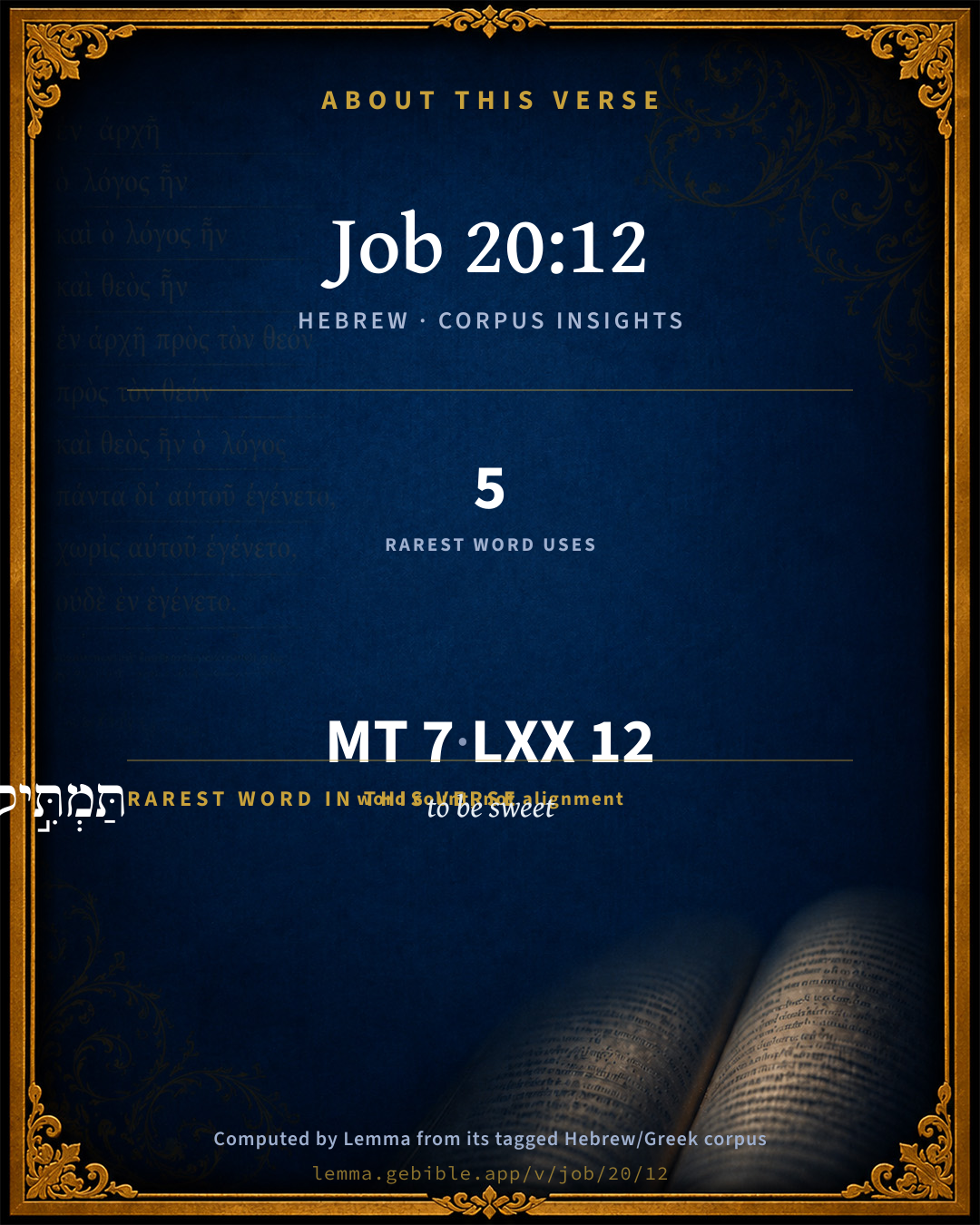
The rarest word here is תַּמְתִּ֣יק to be sweet H4985 — appearing just 5 times in the whole Hebrew Bible.

Shared distinctive vocabulary

תַּמְתִּ֣יק to be sweet H4985 occurs in 5 verses of the Hebrew Bible. Also found in:

Grammatical profile

  • 2 verbs
  • 3 nouns
  • 1 preposition
  • 1 conjunction

Verb forms

  • תַּמְתִּ֣יק Hiphil · Imperfect
  • יַ֝כְחִידֶ֗נָּה Hiphil · Imperfect

Hebrew & Septuagint length

In English translation the verse runs 14 words from the Hebrew and 15 from the Septuagint (LXX English) — closely comparable.

A rough comparison of the two English renderings, which tokenize alike — not a word-level alignment.

Word counts can differ between the Hebrew and the Greek without any difference in meaning — e.g. the Hebrew direct-object marker אֵת has no separate Greek word, and Greek often adds the article ὁ.

In the original languages it is 7 Hebrew tokens and 12 Greek tokens — but the two are counted differently (Hebrew bundles its prefixes and suffixes into one token; the Greek is in lemma form), so that isn’t a like-for-like length.

Cross-references

7

Topical passages linked to Job 20:12 in the Treasury of Scripture Knowledge — connected by theme and wording, ordered by reader-vote popularity; previews shown in the World English Bible.

  • Job 15:16 How much less one who is abominable and corrupt, A man who drinks iniquity like water!
  • Psalms 10:7 His mouth is full of cursing, deceit, and oppression. Under his tongue is mischief and iniquity.
  • Ecclesiastes 11:9 Rejoice, young man, in your youth, And let your heart cheer you in the days of your youth, And walk in the ways of your heart, And in the sight of your eyes; But know that for all these things God will bring you into judgment.
  • Genesis 3:6 When the woman saw that the tree was good for food, and that it was a delight to the eyes, and that the tree was to be desired to make one wise, she took of the fruit of it, and ate; and she gave some to her husband with her, and he ate.
  • Psalms 109:17–18 Yes, he loved cursing, and it came to him. He didn't delight in blessing, and it was far from him.
  • Proverbs 9:17–18 "Stolen water is sweet. Food eaten in secret is pleasant."
  • Proverbs 20:17 Fraudulent food is sweet to a man, But afterwards his mouth is filled with gravel.

Cross-references courtesy of OpenBible.info (CC BY 4.0).

Hebrew and Greek witnesses Masoretic Hebrew ↔ Greek Septuagint

The same verse in the two great witnesses to the Old Testament, shown verse-for-verse.

These are two independent witnesses, not word-aligned to each other, and the Septuagint is shown in lemma (dictionary) form.

Hebrew Job 20:12 Masoretic · Westminster Leningrad Codex

אִם תַּמְתִּ֣יק בְּפִ֣יו רָעָ֑ה יַ֝כְחִידֶ֗נָּה תַּ֣חַת לְשׁוֹנֽוֹ

"Though wickedness is sweet in his mouth, Though he hide it under his tongue,

World English Bible · Public Domain

Greek LXX Job 20:12 Septuagint · lemma form

ἐάν γλυκαίνω ἐν στόμα αὐτός κακία κρύπτω αὐτός ὑπό ὁ γλῶσσα αὐτός

Though evil be sweet in his mouth, though he will hide it under his tongue;

LXX2012 (modern English Septuagint) · Public Domain

On this verse, Keil & Delitzsch discusses the Septuagint’s reading. Read the note in Commentary ↓

Hebrew: Westminster Leningrad Codex (CC BY 4.0). Greek: Septuagint (public domain); English from LXX2012 (modern English Septuagint) (Public Domain). How the Septuagint differs from the Hebrew →

Commentary

Notes on Job 20:12 from classic Christian and Jewish commentators (each source and its license shown beneath its notes). The classic Christian expositions comment on the surrounding passage and are grouped to its opening verse, so a note may address several verses; the Jewish commentaries on the Tanakh (Rashi and others) are per-verse, so they appear only where the commentator wrote on this verse.

Lemma curates 59 commentaries, every one of them public domain or Creative Commons licensed, each selected and text-cleaned for this edition rather than reprinted as found. About our sources →

Trapp's Complete Commentary

John Trapp

Job 20:12 Though wickedness be sweet in his mouth, [though] he hide it under his tongue;

Ver. 12. Though wickedness be sweet in his mouth] As poison swallowed in some pleasing meat or drink. Agrippina, in poisoning her husband, Claudius the emperor, tempered it in meat he most delighted in. Poison given in wine works more furiously, as did that wassail {The liquor in which healths were drunk; esp. the spiced ale used in Twelfth-night and Christmas-eve celebrations.} the monk drank to King John of England. That wickedness with a witness here meant is oppression, and is said to be held in the mouth, and hid under the tongue, as some think, because it is oft covered with godly speeches, whereby he seeketh to circumvent and deceive his neighbour. Others by these expressions will have understood continuance in sin and complacency therein, rolling it under his tongue, as a child doth a piece of sugar, which he is loth to part with, and retaining it a long time in his mouth, that he may taste it with more pleasure. Philoxenus wished his neck were as long as a crane’s, that he might the longer keep the taste of his sweetmeats and dainty morsels. Such is the wicked man’s wish, and his practice is answerable; for under his tongue is mischief and vanity, Psa 10:7. He licks his lips with the remembrance of his former sins, and so recommitteth them in his desires, at least, while he recalleth former acts with delight. Thus the rebellious Israelites called to mind the flesh-pots of Egypt, and were moved; and thus afterwards they multiplied their whoredoms by calling to remembrance the days of their youth, wherein they had gone a whoring in the land of Egypt, Eze 23:21.

John Trapp, A Commentary or Exposition upon All the Books of the Old and New Testament (1647–1656) — public domain. Text from a community e-Sword module.

The Biblical Illustrator

Joseph S. Exell

Job_20:12-14

Though wickedness be sweet in his mouth.

The woe of the wicked

I. The disposition of a wicked man in regard to sin.

1. His complacency in it. It is sweet to his mouth. A metaphor taken from natural food, which is pleasing and delightful to the taste, which is seated in the mouth or palate. So is sin to the carnal heart. It is very sweet and refreshing to it. Especially in the first embracing or entertaining of it. The ground hereof is this. It is suitable and connatural to him. We may judge of the delight which a wicked person has in sin, by the measure of a gracious persons delight in goodness. Satan enlarges and advances things to them, and makes them seem greater than they are.

2. His concealment of it. He hides it under his tongue. This wicked persons do, either by speaking for sin, or by speaking against it. They speak for it by denying it, or diminishing it, or defending it.

3. His indulgence or favourableness towards it. He spares it, and does not forsake it. He spares it, as to matter of search and inquiry; as to matter of resistance and opposition; as to matter of expulsion, and ejection, and mortification. He does not forsake it. He never forsakes his sin, till his sin forsake him, and he can keep it no longer. A man cannot be said to forsake any sin in particular, who does not forsake the way of sin in general.

II. The effect of sin to a wicked man. Yet his meat, etc. In the general, His meat within his bowels is turned. In the particular, It is as the gall of asps within him. This figure represents the bitterness and the perniciousness of sin. Use and improvement.

1. Beware of being taken with any sinful way or course whatsoever, from the seeming sweetness that is in it.

2. Do not please thyself in the covering and concealing of sin.

3. Or in self-security and presumption.

4. Use Christian prudence to see the plague afar off, to hide yourselves from it. (T. Horton, D.D.)

The Biblical Illustrator, edited by Joseph S. Exell (c. 1880s–1900s) — public domain. Text from a community e-Sword module.

Joseph Benson's Commentary

Job 20:12-14. Though wickedness be sweet in his mouth — Though it greatly please him while he is committing it; though he hide it under his tongue — As an epicure doth a sweet morsel, which he keeps and rolls about his mouth, that he may longer enjoy the pleasure of it. Though he be highly pleased with the gratification of his lusts, and cleave to his sinful pleasures in hearty love, resolving to hold them fast, and improve them to the greatest delight and advantage; though he spare it — Will not part with his sin, but gratifies and obeys his sinful inclinations, instead of subduing and mortifying them; but keeps it still within his mouth — That he may enjoy all the sweetness of it. Yet his meat in his bowels is turned — From sweet to bitter; it is the gall of asps within him — Exceeding bitter and pernicious. Gall is most bitter; the gall of serpents is full of poison; and the poison of asps is most dangerous, and, within a few hours, kills without remedy.

Joseph Benson's Commentary on the Old and New Testaments (1811–1818) — public domain. Text from a community e-Sword module.

Keil & Delitzsch

C. F. Keil & F. Delitzsch

12 If wickedness tasted sweet in his mouth,

He hid it under his tongue;

13 He carefully cherished it and did not let it go,

And retained it in his palate:

14 His bread is now changed in his bowels,

It is the gall of vipers within him.

15 He hath swallowed down riches and now he spitteth them out,

God shall drive them out of his belly.

16 He sucked in the poison of vipers,

The tongue of the adder slayeth him.

The evil-doer is, in Job 20:12, likened to an epicure; he keeps hold of wickedness as long as possible, like a delicate morsel that is retained in the mouth (Renan: comme un bonbon qu'on laisse fondre dans la bouche), and seeks to enjoy it to the very last. המתּיק, to make sweet, has here the intransitive signification dulcescere, Ew. 122, c. הכחיד, to remove from sight, signifies elsewhere to destroy, here to conceal (as the Piel, Job 6:10; Job 15:18). חמל, to spare, is construed with על, which is usual with verbs of covering and protecting. The conclusion of the hypothetical antecedent clauses begins with Job 20:14; the perf. נהפּך (with Kametz by Athnach) describes the suddenness of the change; the מרורת which follows is not equivalent to למרורת (Luther: His food shall be turned to adder's gall in his body), but Job 20:14 expresses the result of the change in a substantival clause. The bitter and poisonous are synonymous in the ancient languages; hence we find the meanings poison and gall (Job 20:25) in מררה, and ראשׁ signifies both a poisonous plant which is known by its bitterness, and the poison of plants like to the poison of serpents (Job 20:16; Deu 32:33). חיל (Job 20:15) is property, without the accompanying notion of forcible acquisition (Hirz.), which, on the contrary, is indicated by the בּלע. The following fut. consec. is here not aor., but expressive of the inevitable result which the performance of an act assuredly brings: he must vomit back the property which he has swallowed down; God casts it out of his belly, i.e., (which is implied in בּלע, expellere) forcibly, and therefore as by the pains of colic. The lxx, according to whose taste the mention of God here was contrary to decorum, trans. ἐξ οἰκίας (read κοιλίας, according to Cod. Alex.) αὐτοῦ ἐξελκύσει αὐτὸν ἄγγελος (Theod. δυνάστης). The perf., Job 20:15, is in Job 20:16 changed into the imperf. fut. יינק, which more strongly represents the past action as that which has gone before what is now described; and the ασυνδέτως, fut. which follows, describes the consequence which is necessarily and directly involved in it. Psa 140:4 may be compared with Job 20:16, Pro 23:32 with Job 20:16. He who sucked in the poison of low desire with a relish, will meet his punishment in that in which he sinned: he is destroyed by the poisonous deadly bite of the serpent, for the punishment of sin is fundamentally nothing but the nature of sin itself brought fully out.

Keil & Delitzsch — Biblical Commentary on the Old Testament (1861–1891) — public domain (CC PDM 1.0). Text via the HelloAO Bible API. (Old Testament only.)

Geneva Bible (1599)

Geneva Bible translators

As poison that is sweet in the mouth, bringeth destruction when it cometh into the body: so all vice at the first is pleasant, but afterward God turneth it to destruction.

Geneva Bible (1599) marginal notes — public domain. Text via Bolls.life.

Jamieson, Fausset & Brown

Robert Jamieson, A. R. Fausset & David Brown

be--"taste sweet." Sin's fascination is like poison sweet to the taste, but at last deadly to the vital organs (Pro 20:17; Job 9:17-18).

hide . . . tongue--seek to prolong the enjoyment by keeping the sweet morsel long in the mouth (so Job 20:13).

Jamieson, Fausset & Brown — Commentary Critical and Explanatory on the Whole Bible (1871) — public domain (CC PDM 1.0). Text via the HelloAO Bible API.

Adam Clarke's Commentary

Verse 12. Though wickedness be sweet in his mouth] This seems to refer to the secret sins mentioned above.

Hide it under his tongue] This and the four following verses contain an allegory; and the reference is to a man who, instead of taking wholesome food, takes what is poisonous, and is so delighted with it because it is sweet, that he rolls it under his tongue, and will scarcely let it down into his stomach, he is so delighted with the taste; "he spares it, and forsakes it not, but keeps it still within his mouth," Job 20:13. "But when he swallows it, it is turned to the gall of asps within him," Job 20:14, which shall corrode and torture his bowels.

Adam Clarke's Commentary on the Bible (1810–1826) — public domain. Text from a community e-Sword/MySword module.

Ellicott's Commentary for English Readers

(12) Though wickedness be sweet in his mouth.—He draws a picture of the wicked man after the pattern of a gourmand or glutton, which, if it were intended to apply to Job, was a fresh instance of heartless cruelty, as well as of an entire want of discernment of character, and of unfitness for the office of judge he was so ready to assume. It is possible that the reproach here aimed at Job was that of inordinate love of riches, which Zophar extracts from the bare fact of his having been a wealthy man.

A Bible Commentary for English Readers, edited by Charles John Ellicott (1878–1897) — public domain. Text from a community e-Sword module.

The Cambridge Bible for Schools and Colleges

gen. ed. J. J. S. Perowne

12. Sin is spoken of under the figure of a dainty which tickles the palate, and which one retains and turns in his mouth with delight.

12–22. His sin changes into his punishment.

The Cambridge Bible for Schools and Colleges (gen. ed. J. J. S. Perowne; Cambridge University Press, 1878–1918) — public domain. Text from a community e-Sword module.

John Gill's Exposition

Though wickedness be sweet in his mouth,.... Which may respect some particular sin, and by the context it seems to be the sin of covetousness, or of getting riches in an unlawful way, which is very sweet and pleasing to wicked men, while they are in such pursuits that succeed; and so Mr. Broughton renders it by "wrong"; though it may be applied to sin in general, which is "wickedness", or an evil (q), being contrary to the pure and holy nature, will, and law of God; and it is evil in its effects on men, it having deprived them of the image and glory of God, and exposed them to his wrath, to the curses of his law, and to eternal deaths. Now this is "sweet" to an unregenerate man, who minds and savours the things of the flesh, whose taste is not changed, but is as it was from his birth, and who calls sweet bitter, and bitter sweet; such a man has the same delight in sin as a man has in his food, drinks up iniquity like water, and commits sin with greediness; for it is natural to him, he is conceived, born, and brought up in it; besides, some sins are what are more particularly called constitution sins, which some are peculiarly addicted to, and in which they take a peculiar delight and pleasure; these are like the right hand or right eye, and they cannot be persuaded, at any rate, to part with them:

though he hide it under his tongue; not for the sake of concealing it, nor by denying, dissembling, or excusing it, but for the sake of enjoying more pleasure in it; as a gluttonous man, when he has got a sweet morsel in his mouth, do not let it go down his throat immediately, but rolls it under his tongue, that he may have all the pleasure of it he can; so a wicked man devises sin in his heart, keeps it on his mind, revolves it in his thoughts, and his meditation on it is sweet; and he is so far from hiding it from others, that he openly declares it, freely tells of it, and takes pleasure in so doing: "fools make a mock at sin"; it is their diversion and recreation.

(q) "malum", Pagninus, Montanus, Junius & Tremellius, Piscator, &c.

John Gill's Exposition of the Whole Bible (1746–1763) — public domain (CC PDM 1.0). Text via the HelloAO Bible API.

Albert Barnes' Notes on the Bible

Though wickedness be sweet in his mouth - Though he has pleasure in committing it, as he has in pleasant food. The sense of this and the following verses is, that though a man may have pleasure in indulgence in sin, and may find happiness of a certain kind in it, yet that the consequences will be bitter - as if the food which he ate should become like gall, and he should cast it up with loathing. There are many sins which, from the laws of our nature, are attended with a kind of pleasure. Such, for illustration, are the sins of gluttony and of intemperance in drinking; the sins of ambition and vanity; the sins of amusement and of fashionable life. To such we give the name of “pleasures.” We do not speak of them as “happiness.” That is a word which would not express their nature. It denotes rather substantial, solid, permanent joy - such joy as the “pleasures of sin for a season” do not furnish. It is this temporary “pleasure” which the lovers of vanity, fashion and dress, seek, and which, it cannot be denied, they often find. As long ago as the time of Zophar, it was admitted that such pleasure might be found in some forms of sinful indulgence and yet even in his time that was seen, which all subsequent observation has proved true, that such indulgence must lead to bitter results.

Though he hide it under his tongue - It is from this passage, probably, that we have derived the phrase, “to roll sin as a sweet morsel under the tongue,” which is often quoted as if it were a part of Scripture. The “meaning” here is, that a man would find pleasure in sin, and would seek to prolong it, as one does the pleasure of eating that which is grateful to the palate by holding it long in the mouth, or by placing it under the tongue.

Albert Barnes' Notes on the Bible (1834–1885) — public domain. Text from a community e-Sword/MySword module.

Haydock's Catholic Bible Commentary

Evil of any king, and particularly (Haydock) injustice, which at first seems sweet, but will prove in the end a mortal poison. (Calmet) --- The unjust will be forced to restore his ill-gotten goods, or suffer eternally for the neglect, ver. 14, 18. (Haydock) --- Habitual sins are also overcome with most difficulty, ver. 11. (Menochius)

George Leo Haydock (1774–1849), Haydock's Catholic Family Bible and Commentary, 1859 edition — public domain. Excludes Psalms (Douay-Rheims chapter numbering differs from Protestant) and Deuterocanonical books (Catholic canon only).

Matthew Poole's English Annotations

In his mouth, i.e. to his taste, though it greatly please him for the present.

Though he hide it under his tongue; as an epicure doth a sweet morsel, which he is loth to swallow, and therefore keeps and rolls it about his mouth that he may longer enjoy the pleasure of it: though he be highly pleased with his lusts, and cleave to them in hearty love, and resolve to hold them fast, and improve them to the greatest delight and advantage.

Matthew Poole's English Annotations on the Holy Bible (1683–1685) — public domain. Text from a community e-Sword/MySword module.

The Pulpit Commentary

Vers. 12, 13. Though wickedness be sweet in his mouth; i.e. though the wicked man delight in his wickedness, and gloat over it, and keep the thought of it in his mind, as a gourmand keeps, so long as he can, a delicious taste in his mouth; though he, as it were, hide it under his tongue, in order not to let it escape him; though he spare it, and forsake it not; but keep it still within his mouth, yet, notwithstanding all this, disgust and nausea arrive in course of time (see the next two verses). It is, perhaps, the most surprising among the phenomena of wickedness that men can gloat over it, voluntarily recur to it, make a boast of it, recount signal instances of it to their friends, and seem to find a satisfaction in the recollection. One would have expected that shame and self-disapproval and fear of retribution would have led them to dismiss their wicked acts from their thoughts as soon as possible. But certainly the fact is otherwise.

Vers. 12-17. The sweet taste of sin and its bitter after-taste.

I THE SWEET TASTE OF SIN. How can we account for the fact that if sin is essentially an evil thing it should ever be attractive to us? Surely its natural hatefulness should make it repulsive. If it is hideous in the sight of God, by what witchery can it be made to appear fascinating to our eyes?

1. It appeals to our lower desires. It makes its first appeal to nature. There was no evil at first in Adam and Eve, and yet sin was made attractive to them. Christ could not have been tempted unless sin had been made to wear a fair mask in his presence. The bodily appetites and the self-seeking desires are natural and innocent in themselves. But they should be kept under by our higher nature. If, however, the tempter appeals to them directly, he appeals to the prospect of natural pleasure.

2. It is aided by our selfish nature. We are all fallen creatures. If the fall has not taken the form of sensuality, it has certainly been accomplished in selfishness. Now sin appeals to our selfish nature, and promises personal gratification at the expense of righteousness.

3. It is intensified by corrupted desires. Sin perverts the natural appetites and corrupts the most innocent desires. The wicked thing which is first sought because of some promised result comes to be loved on its own account. As the miser loves his money, so the sinner loves his sin first for what it can purchase, then on its own account. He is like a hypnotized person, to whom gall tastes like sugar, because he is deluded into believing evil to be his good.

II THE BITTER AFTER-TASTE OF SIN. Zophar rightly enlarges upon this subject. We do not need any amplification of the delights of sin. The very presentation of them to the imagination is degrading. The soul is soiled by contemplating them. We are quite ready to admit their strength. But it is not so easy to imagine vividly and to keep well in view the dreadful after-results. They are remote, unattractive, uncongenial. Therefore we need to be forced to see the results of sin in detail. Zophar narrates them with graphic ragout. Let us, then, consider the disagreeable details of the bitter after-taste.

1. It is pain within. The morsel is sweet in the mouth, and it is hidden under the tongue to keep it safe and to prolong the delicious enjoyment of it; yet when it is swallowed it becomes like the gall of asps. The recollection of past sin is a pain of conscience. Its very delights are turned to bitterness in the after-thought. Just in proportion to their tempting fascination before the deed is their repulsiveness after it has been committed. The foolish victim of temptation looks back on his orgies with disgust. He loathes himself, he grovels in humiliation. How could he have been such a fool as to sink to this shame and degradation?

2. It results in the loss of future delights. The sinner is made to give up his fiches. He is denied "the brooks, the rivers, the torrents of honey and butter," which he was greedily looking forward to. The justice of God will not permit him to revel for ever in wickedness. By his indulgence in sinful pleasures he has destroyed the faculty of innocent joy. His debauch has turned the garden of innocent delights into a desert. For such a man there is no hope but in complete regeneration. Yet that is possible. Even he can be converted, and made a new creature in Christ Jesus. W.F.A.

The Pulpit Commentary (1880–1919), ed. H.D.M. Spence-Jones & Joseph S. Exell — public domain. Text from a community e-Sword module.

John Wesley's Explanatory Notes

Mouth - To his taste; though it greatly please him for the present. Hide - As an epicure doth a sweet morsel, which he keeps and rolls about his mouth, that he may longer enjoy the pleasure of it.

John Wesley, Explanatory Notes Upon the Whole Bible (1754–1765) — public domain. Text via the GEBible commentary corpus.

unfoldingWord translationNotes

Door43 World Missions Community

General Information:

Zophar continues speaking to Job.

Although wickedness is sweet in his mouth

Here "wickedness is sweet" represents a person enjoying doing wicked things. AT: "Although doing wicked things is pleasurable like tasting sweet food in the mouth" (See: Metaphor)

although he hides ... does not let it go

This represents wanting to continue to enjoy the wickedness as one wants to continue enjoying tasty food by keeping it in the mouth. (See: Metaphor)

the food in his intestines turns bitter

When food turns bitter in the stomach, it causes pain and a bitter taste. This is a metaphor for a person experiencing the painful consequences of doing wicked things. AT: "those wicked things become like food that has turned bitter in the stomach" or "the consequences of those wicked things are painful like food that becomes sour in the stomach" (See: Metaphor)

it becomes the poison of asps inside him

This image is even worse than sour food in the stomach. This is a metaphor for a person experiencing the terrible consequences of doing wicked things. AT: "the consequences of doing those wicked things are painful like the poison of asps inside him" (See: Metaphor)

asps

poisonous snakes

translationWords

evil

unfoldingWord translationNotes — © Distant Shores Media and the Door43 World Missions Community, licensed CC BY-SA 4.0. Source: git.door43.org/Door43/en_tn.

Rashi

Rabbi Shlomo Yitzchaki (Rashi)

be sweet So is the custom of a wicked man: if evil is sweet in his mouth and he does not see now the moment for it to take effect. though he hide it under his tongue until the time comes when it will prosper.

Rashi on the Tanakh — English translations: “The Judaica Press complete Tanach with Rashi, translated by A. J. Rosenberg” (CC BY 4.0); “Pentateuch with Rashi's commentary by M. Rosenbaum and A.M. Silbermann, 1929-1934” (public domain); “The Metsudah Tanach series, Lakewood, N.J” (CC BY 4.0); and “The Book of Joshua, Metsudah Publications, 1997” (CC BY 4.0). Text via Sefaria.

Lesson kit

Teaching starters — assembled from the data on this page, not authored interpretation. Every prompt links to the verse data it draws on. Edit before teaching.

Job, in the Wisdom, opens this verse with 7 words (7 distinct Hebrew lemmas). Its most distinctive word is mâthaq (“to be sweet”). A historical commentator’s framing appears above. Read the whole chapter for the surrounding context.

Discussion questions

  1. How does “to be sweet” (mâthaq) shape what this verse is saying?
  2. Exodus 15:25 shares the word «to be sweet» with this verse. How do the two illuminate each other?
  3. The translations on this page render this verse differently — a whole-verse word diff, not a word-by-word alignment. What might account for the different wordings?
  4. The verb «תַּמְתִּ֣יק» is Hiphil Imperfect. How does its form color the action?
  5. Reading how Trapp's Complete Commentary and The Biblical Illustrator read this verse, where do the two commentators agree and where do they part?

Things to notice

Reading settings

Reading text

Shown beneath each verse's original-language words.

Old Testament
Old Testament edition

Read the OT as the Masoretic Hebrew (MT) or the Greek Septuagint (LXX).

English shown for the Greek Septuagint (in the Hebrew ↔ Greek comparison).

Comparing translations? Open the Compare panel on any verse page to stack up to four side by side.