
Jeremiah 23:31

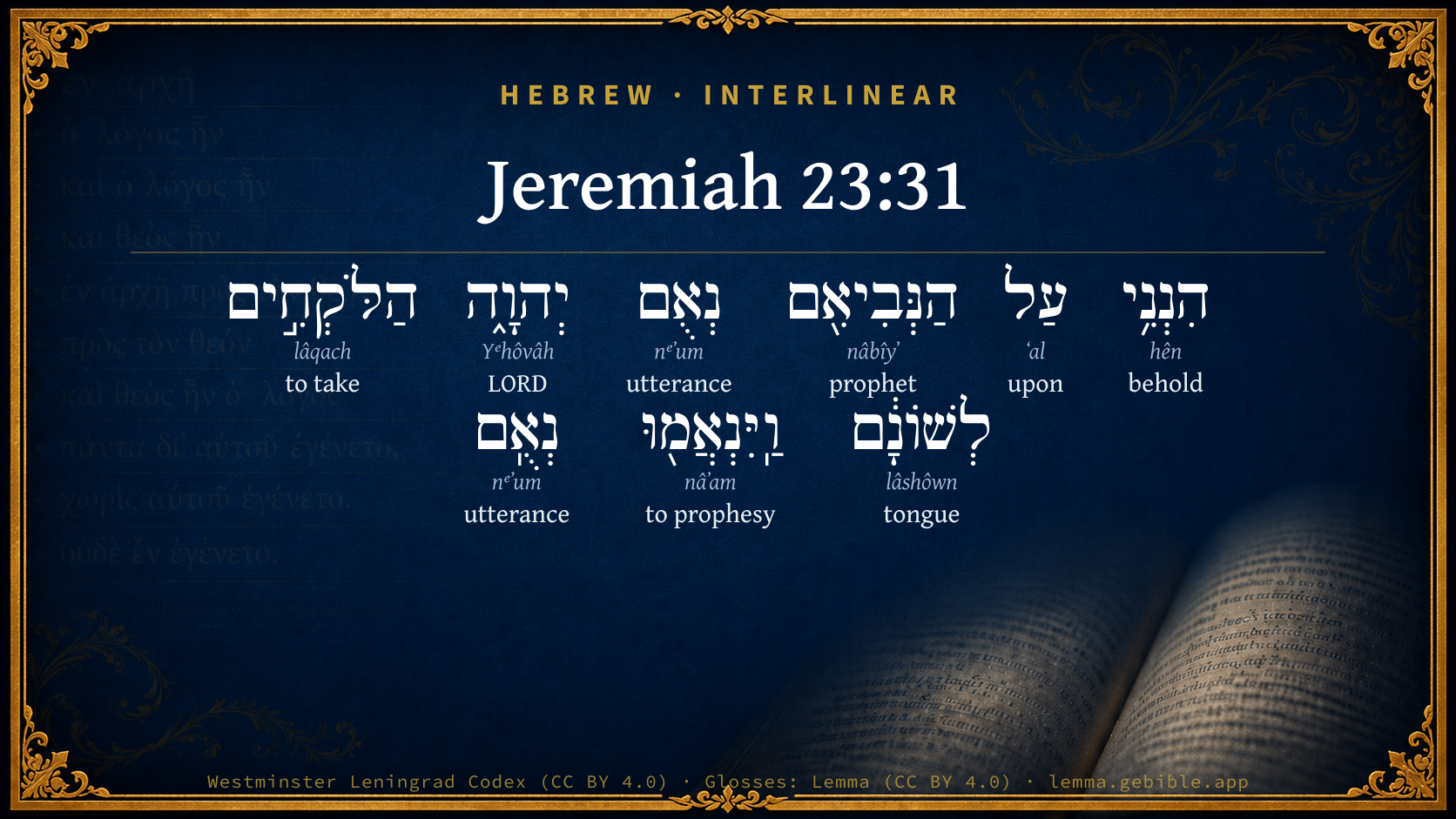
Hebrew (Westminster Leningrad Codex) Jeremiah 23:31 appears in the Hebrew Old Testament. The text above is from the Westminster Leningrad Codex. Each word links to its Strong’s number, a concise gloss, and parsing drawn from the Open Scriptures Hebrew Bible morphology. Click any word for its full Brown-Driver-Briggs (BDB) entry.
Download image
Cite this verse

Jeremiah 23:31 (World English Bible). Public Domain. Lemma interlinear Bible study tool, https://lemma.gebible.app/v/jeremiah/23/31.

Show BibTeX & RIS
BibTeX
RIS
English Translation
Behold, I am against the prophets, says Yahweh, who use their tongues, and say, He says.
World English Bible · Public Domain
Highlights
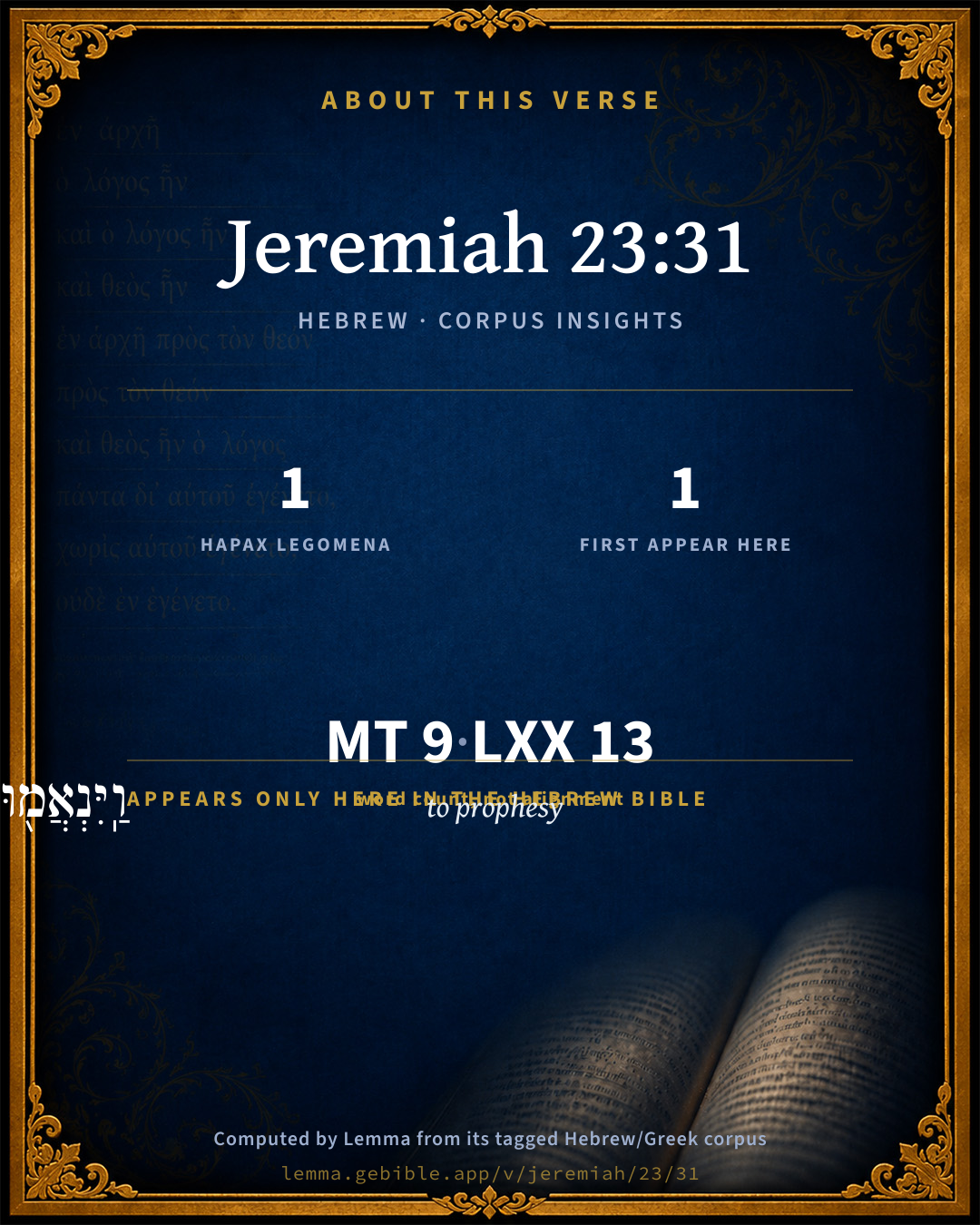
  • 1 hapax legomenon — only here in the Hebrew Bible
  • 1 first appearance in the Hebrew Bible
Full analysis ↓
Download a study sheet

One document with this verse’s original text, its word-by-word gloss line, the meaning frame, cross-references with their text, attributed commentary, and full source and license credits — printable, and it pastes into notes with its structure intact.

This verse Autodidact and up

Study sheet (.html) Plain text (.txt)

A passage Seminary Student

Up to 50 verses in one chapter. A passage sheet keeps up to 6 commentary sources and 12 cross-references per verse, in the order this page ranks them, and says so on the sheet whenever that leaves anything out. Ask for a single verse and you get the Autodidact verse sheet above.

Everything on this page stays free to read, with no account — the sheet is a download of what is already on screen, not access to it.

Want to remove ads? Support Godless Engineer
Compare translations 3

The same verse in 3 English versions, stacked beneath the original-language interlinear above. Click any original word for its lexicon entry.

Each is an independent rendering of the whole verse — the interlinear is not word-aligned to these translations.

Highlighted words mark where these versions differ — a whole-verse word diff, not a word-by-word alignment.

  • World English Bible Public Domain
    Behold, I am against the prophets, says Yahweh, who use their tongues, and say, He says.
  • King James Version Public Domain
    Behold, I am against the prophets, saith the LORD, that use their tongues, and say, He saith.
  • unfoldingWord Literal Text CC BY-SA 4.0
    Behold, I against the prophets”—the declaration of Yahweh—“the ones taking their tongue and declaring a declaration.

unfoldingWord Literal Text — © unfoldingWord, licensed CC BY-SA 4.0. Word-aligned USFM3 via Door43 (git.door43.org/unfoldingWord/en_ult).

Versions to compare (up to 4)

3 of 4 selected

Show all 18 translations

Every available English version of this verse, each an independent rendering of the whole verse.

  • World English Bible Public Domain
    Behold, I am against the prophets, says Yahweh, who use their tongues, and say, He says.
  • Berean Standard Bible Public Domain
    “Yes,” declares the LORD, “I am against the prophets who wag their own tongues and proclaim, ‘The LORD declares it.’”
  • Majority Standard Bible Public Domain
    “Yes,” declares the LORD, “I am against the prophets who wag their own tongues and proclaim, ‘The LORD declares it.’”
  • King James Version Public Domain
    Behold, I am against the prophets, saith the LORD, that use their tongues, and say, He saith.
  • American Standard Version (1901) Public Domain
    Behold, I am against the prophets, saith Jehovah, that use their tongues, and say, He saith.
  • Revised Version (1885) Public Domain
    Behold, I am against the prophets, saith the LORD, that use their tongues, and say, He saith.
  • Geneva Bible (1599) Public Domain
    Beholde, I will come against the prophets, saith the Lord, which haue sweete tongues, and say, He saith.
  • Douay-Rheims (1899) Public Domain
    Behold I am against the prophets, saith the Lord: who use their tongues, and say: The Lord saith it.
  • Young's Literal Translation Public Domain
    Lo, I `am' against the prophets, An affirmation of Jehovah, Who are making smooth their tongue, And they affirm -- an affirmation.
  • Literal Standard Version CC BY-SA 4.0
    Behold, I [am] against the prophets,” || A declaration of YHWH, || “Who are making their tongue smooth, || And they affirm—an affirmation.
  • Unlocked Literal Bible CC BY-SA 4.0
    See, I am against the prophets—this is Yahweh's declaration—who use their tongues to prophesy proclamations.
  • unfoldingWord Literal Text CC BY-SA 4.0
    Behold, I against the prophets”—the declaration of Yahweh—“the ones taking their tongue and declaring a declaration.
  • Darby Bible Public Domain
    Behold, I am against the prophets, saith Jehovah, that use their tongues, and say, He hath said.
  • World Messianic Bible Public Domain
    Behold, I am against the prophets,” says the LORD, “who use their tongues, and say, ‘He says.’
  • Webster's Bible Public Domain
    Behold, I am against the prophets, saith the LORD, that use their tongues, and say, He saith.
  • Free Bible Version CC BY-SA 4.0
    Pay attention to this, declares the Lord. I'm opposed to those prophets who make up their own stories and then announce, “This is what the Lord says.”
  • Bible in Basic English Public Domain
    See, I am against the prophets, says the Lord, who let their tongues say, He has said.
  • JPS Tanakh (1917) Public Domain
    Behold, I am against the prophets, saith the LORD, that use their tongues and say: 'He saith.'

Literal Standard Version (2020), Covenant Press — licensed CC BY-SA 4.0. Text via the HelloAO Bible API (eBible.org). Unlocked Literal Bible (unfoldingWord) — licensed CC BY-SA 4.0. Text via the HelloAO Bible API (eBible.org). unfoldingWord Literal Text — © unfoldingWord, licensed CC BY-SA 4.0. Word-aligned USFM3 via Door43 (git.door43.org/unfoldingWord/en_ult). Free Bible Version, Dr. Jonathan Gallagher — licensed CC BY-SA 4.0. Text via the HelloAO Bible API (eBible.org).

Word by word

More ways to search: Search by grammar → Find every occurrence → Compare this word →

Practice this passage: Drill this verse → Learn its vocabulary →

וַֽיִּנְאֲמ֖וּ
nâʼam
H5001
“and · to prophesy”
Conjunction + Verb, Qal, Sequential Imperfect, 3rd Person, Masculine, Plural
Part of Speech
Conjunction + Verb
Stem
Qal
Form
Sequential Imperfect
Person
3rd Person
Gender
Masculine
Number
Plural
Full BDB Definition

Origin: a primitive root

TWOT: 1272

to prophesy, utter a prophecy, speak as prophet, say - (Qal) to utter a prophecy, speak as prophet
  1. הִנְנִ֥י hên H2005 “behold · me” Particle, Demonstrative + Suffix, Personal, 1st Person, Common, Singular
  2. עַל ʻal H5921 “upon” Preposition
  3. הַנְּבִיאִ֖ם nâbîyʼ H5030 “the · prophets” Particle, Definite Article + Noun, Common, Masculine, Plural, Absolute
  4. נְאֻם nᵉʼum H5002 “utterance of” Noun, Common, Masculine, Singular, Construct
  5. יְהוָ֑ה Yᵉhôvâh H3068 “LORD” Noun, Proper
  6. הַלֹּקְחִ֣ים lâqach H3947 “the · taking” Particle, Definite Article + Verb, Qal, Participle Active, Masculine, Plural, Absolute
  7. לְשׁוֹנָ֔ם lâshôwn H3956 “tongue · their” Noun, Common, Both, Singular, Construct + Suffix, Personal, 3rd Person, Masculine, Plural
  8. נְאֻֽם nᵉʼum H5002 “utterance” Noun, Common, Masculine, Singular, Absolute

About this verse

These counts appear in no published source. They are computed here, from the morphology-tagged text and Lemma’s own curated glosses. What Lemma adds →

9
words
8
distinct lemmas
Prophets
section

Notable vocabulary

1 hapax legomenon — a word that appears only here in the entire Hebrew Bible:

  • וַֽיִּנְאֲמ֖וּ to prophesy H5001

First appearance in Scripture

This word makes its first canonical appearance in the Hebrew Bible here:

  • וַֽיִּנְאֲמ֖וּ to prophesy H5001

Grammatical profile

  • 2 verbs
  • 5 nouns
  • 1 preposition
  • 1 particle

Verb forms

  • הַלֹּקְחִ֣ים Qal · Participle Active
  • וַֽיִּנְאֲמ֖וּ Qal · Sequential Imperfect

Repetition

A word recurs within this verse — often emphatic in Hebrew:

  • נְאֻם utterance H5002 ×2

Hebrew & Septuagint length

In the original languages it is 9 Hebrew tokens and 13 Greek tokens — but the two are counted differently (Hebrew bundles its prefixes and suffixes into one token; the Greek is in lemma form), so that isn’t a like-for-like length.

Cross-references

6

Topical passages linked to Jeremiah 23:31 in the Treasury of Scripture Knowledge — connected by theme and wording, ordered by reader-vote popularity; previews shown in the World English Bible.

  • Jeremiah 23:17 They say continually to those who despise me, Yahweh has said, You shall have peace; and to everyone who walks in the stubbornness of his own heart they say, No evil shall come on you.
  • 2 Chronicles 18:5 Then the king of Israel gathered the prophets together, four hundred men, and said to them, Shall we go to Ramoth-gilead to battle, or shall I forbear? They said, Go up; for God will deliver it into the hand of the king.
  • 2 Chronicles 18:10–12 Zedekiah the son of Chenaanah made him horns of iron, and said, Thus says Yahweh, With these shall you push the Syrians, until they be consumed.
  • Isaiah 30:10 who tell the seers, "Don't see;" and to the prophets, "Don't prophesy to us right things, speak to us smooth things, prophesy deceits,
  • 2 Chronicles 18:19–21 Yahweh said, Who shall entice Ahab king of Israel, that he may go up and fall at Ramoth-gilead? One spoke saying after this manner, and another saying after that manner.
  • Micah 2:11 If a man walking in a spirit of falsehood lies: 'I will prophesy to you of wine and of strong drink;' He would be the prophet of this people.

Cross-references courtesy of OpenBible.info (CC BY 4.0).

Hebrew and Greek witnesses Masoretic Hebrew ↔ Greek Septuagint

The same verse in the two great witnesses to the Old Testament, shown verse-for-verse.

These are two independent witnesses, not word-aligned to each other, and the Septuagint is shown in lemma (dictionary) form.

Hebrew Jeremiah 23:31 Masoretic · Westminster Leningrad Codex

הִנְנִ֥י עַל הַנְּבִיאִ֖ם נְאֻם יְהוָ֑ה הַלֹּקְחִ֣ים לְשׁוֹנָ֔ם וַֽיִּנְאֲמ֖וּ נְאֻֽם

Behold, I am against the prophets, says Yahweh, who use their tongues, and say, He says.

World English Bible · Public Domain

Greek LXX Structure differs

In the Septuagint, Jeremiah is about an eighth shorter than the Hebrew and arranges its material differently — the Oracles Against the Nations (Hebrew chapters 46–51) appear in the middle of the Greek book, after 25:13. Because the chapter and verse boundaries do not line up, a verse-for-verse comparison with the Hebrew is not shown.

A verse-for-verse comparison isn’t shown here because the chapters and verses don’t line up. Switch to the LXX edition with the MT / LXX toggle above to read the Greek directly.

Hebrew: Westminster Leningrad Codex (CC BY 4.0). Greek: Septuagint (public domain); English from a public-domain English Septuagint. How the Septuagint differs from the Hebrew →

Targum (Aramaic paraphrase)

1

The Targum is the ancient Jewish Aramaic paraphrase of the Hebrew Scriptures — an interpretive translation, not the Hebrew text itself. Onkelos (literal) and Pseudo-Jonathan (expansive) render the Torah, and Jonathan the Prophets. Coverage is partial: where no permissively-licensed English translation exists for a verse, only the Aramaic is shown. This is verse-level text, not a word-by-word alignment to the Hebrew.

  1. Targum Jonathan Prophets (Joshua–Malachi)
    בְּכֵן הָא אֲנָא שְׁלַח רוּגְזִי עַל נְבִיֵי שִׁקְרָא אֲמַר יְיָ דְמִתְנַבָּן כִּרְעוּת לִבְּהוֹן וְאָמְרִין כֵּן אֲמַר:

    (no public-domain English translation for this verse)

    Targum Jonathan — Aramaic: “Mikraot Gedolot” (public domain). English: “Sefaria Community Translation” (CC0 1.0 (public-domain dedication)); “London "Chaldee Paraphrase," 1871” (public domain). Text via Sefaria.

Commentary

Notes on Jeremiah 23:31 from classic Christian and Jewish commentators (each source and its license shown beneath its notes). The classic Christian expositions comment on the surrounding passage and are grouped to its opening verse, so a note may address several verses; the Jewish commentaries on the Tanakh (Rashi and others) are per-verse, so they appear only where the commentator wrote on this verse.

Lemma curates 59 commentaries, every one of them public domain or Creative Commons licensed, each selected and text-cleaned for this edition rather than reprinted as found. About our sources →

Trapp's Complete Commentary

John Trapp

Jer 23:31 Behold, I [am] against the prophets, saith the LORD, that use their tongues, and say, He saith.

Ver. 31. That use their tongues.] Or, Abuse them rather, to smoothing and soothing up people in their sins: lenificant linguas, id est, blando sermone alliciunt plebem, they flatter and collogue; or tollunt linguam, they lift up their tongues, viz., by extolling themselves, and speaking magnifically of their own doing. As one hath observed of some sectarians among us, that they often call upon their hearers to mark - for it may be they shall hear that which they never heard before - when the thing is either false, or if true, no more than is ordinarily taught by others, and which they have stolen out of the writings of others. {a}

And say, He saith.] See on Jer 23:30.

{a} Dulcorantium, mollificantium. - False prophets soothe and sweeten men.

John Trapp, A Commentary or Exposition upon All the Books of the Old and New Testament (1647–1656) — public domain. Text from a community e-Sword module.

Geneva Bible (1599)

Geneva Bible translators

To wit, the Lord.

Geneva Bible (1599) marginal notes — public domain. Text via Bolls.life.

Jamieson, Fausset & Brown

Robert Jamieson, A. R. Fausset & David Brown

use--rather, "take" their tongue: a second class (compare Jer 23:30) require, in order to bring forth a revelation, nothing more than their tongues, wherewith they say, He (Jehovah) saith: they bungle in the very formula instead of the usual "Jehovah saith," being only able to say "(He) saith."

Jamieson, Fausset & Brown — Commentary Critical and Explanatory on the Whole Bible (1871) — public domain (CC PDM 1.0). Text via the HelloAO Bible API.

John Calvin's Commentaries

He adds, secondly, Behold, I am against the prophets, who mollify their own tongue Almost all interpreters take לקה, lekech, as signifying to render sweet or soft; and they understand that the false prophets are condemned, because they flattered the wicked for the sake of gain; for had they offended or exasperated them, they could not have attached them to themselves. They then think that to mollify their tongue means here that they used their tongue in speaking smooth and flattering things. But others give another explanation, — that they mollified their tongue because they polished their words in imitation of God’s servants, so that their speech was sweeter than honey. But as לקה, lekech, means to receive and to take, and sometimes to raise on high, and sometimes to carry, I see not why it should not be taken in its proper meaning. I certainly see no reason to turn its meaning to a metaphor, when it can be taken in its plain sense of raising their tongue; they elevated themselves, and in high terms boasted that the office of teaching had been committed to them, for we know how haughtily false teachers elevate themselves. Therefore the verse may be taken thus, that God would punish those impostors who raised their tongue, that is, who proudly boasted and boldly arrogated to themselves authority, as though they were messengers from heaven.

It afterwards follows, And they say, נאם, nam, he saith. We know that it was a common thing for all the prophets to add, נאם יהוה, nam Jeve, the saying of Jehovah, or the word of Jehovah, in order to shew that they said nothing but what they had received from above. And if we read this verse as connected together, we shall find true what I have said — that the verb לקה, lekech, does not mean the smoothness or adulation used, but, the lofty vaunting of the false teachers, who wished to be deemed the organs of the Holy Spirit, and assumed to themselves all the authority of God. For their elation was this, that they confidently boasted that God himself had spoken, and said that it was the word; and they did this, that whatever they prattled might appear indisputed, though it was sufficiently evident that they falsely pretended the name of God.

John Calvin's Commentaries (1540-1563) — public domain. Text from the Calvin Translation Society English edition (1840s-50s) via the Christian Classics Ethereal Library (ccel.org). Calvin's coverage is partial (roughly two-thirds of the Bible); uncommented books and verses are honest gaps, never fabricated. The 19th-century editor's footnotes and remarks are omitted so the notes are faithfully Calvin's own voice.

Ellicott's Commentary for English Readers

(31) That use their tongues, and say, He saith.—Literally, that take their tongues. There is no adequate evidence for the marginal rendering “that smooth their tongues.” The scornful phrase indicates the absence of a true inspiration. These false prophets plan their schemes, and take their tongue as an instrument for carrying them into effect. The formula which they used, “He saith,” was not the word for common speaking, but that which indicated that the speaker was delivering an oracle from God. (See Note on Jer_23:17.) Elsewhere the word is only used of God, but the prophet, in his stern irony, uses it of the false prophets, they say oracularly. This is an oracle.

A Bible Commentary for English Readers, edited by Charles John Ellicott (1878–1897) — public domain. Text from a community e-Sword module.

The Cambridge Bible for Schools and Colleges

gen. ed. J. J. S. Perowne

31. use] The tongue is all of which they can avail themselves. There is no first-hand knowledge behind it.

He saith] This phrase, borrowed from the true prophets, will, they expect, help their sayings to pass as genuine.

By the side of the Party of the Nobles “perhaps opposed to them, perhaps allied with them, in that strange combination which often brings together, for purposes of political or religious animosity, parties themselves most alien to each other, was the great body of the Sacerdotal, and even of the Prophetic order. There were those who directly lent themselves to magical rites … who recited the old prophetic phrases, often careless of what they meant.” Stanley’s J. Ch. II. 438.

The Cambridge Bible for Schools and Colleges (gen. ed. J. J. S. Perowne; Cambridge University Press, 1878–1918) — public domain. Text from a community e-Sword module.

John Gill's Exposition

Behold, I am against the prophets, saith the Lord,.... Not another sort of prophets distinct from the former, or those that follow; but the same under another character, and against whom he was, and set his face on another occasion;

that use their tongues; at their pleasure, their lips being their own. So the Targum,

"who prophesy according to the will of their own hearts;''

talk in a haughty and insolent manner, speaking bold and daring things of the divine Being; or in a boasting bragging manner, extolling themselves, and speaking highly in their own commendations; or rather in a flattering way to the people: so some read it, by a transposition of a radical letter (r), "that smooth their tongues", as Kimchi; or speak smooth things with their tongues, to please the people:

and say, he saith; that is, "the Lord", as the Vulgate Latin and Syriac versions express it; that so they, night be the more easily believed by the people; but this was highly provoking to God, to father their lies and falsehoods upon him.

(r) "hic pro" "qui lenificant linguam suam", Pagninus, Gataker; "sumentes blandam linguan suam", Schmidt.

John Gill's Exposition of the Whole Bible (1746–1763) — public domain (CC PDM 1.0). Text via the HelloAO Bible API.

Albert Barnes' Notes on the Bible

That use their tongues - literally, that take their tongues. Their second characteristic. They have no message from God, but they take their tongues, their only implement, and say, He saith, using the solemn formula by which Yahweh affirms the truth of His words. Solemn asseverations seemed to give reality to their emptiness.

Albert Barnes' Notes on the Bible (1834–1885) — public domain. Text from a community e-Sword/MySword module.

Haydock's Catholic Bible Commentary

Use. Hebrew also, "sharpen, or render smooth," and insinuating, Psalm xlix. 16. (Calmet)

George Leo Haydock (1774–1849), Haydock's Catholic Family Bible and Commentary, 1859 edition — public domain. Excludes Psalms (Douay-Rheims chapter numbering differs from Protestant) and Deuterocanonical books (Catholic canon only).

Matthew Poole's English Annotations

Some think the Hebrew words were more properly translated smooth their tongues: see the English Annotations. But the next words seem to assure us that the crime for which God here by the prophet reflecteth upon the false prophets, was not so much their flattering people, and speaking to them such smooth things as pleased them, as their entitling of God to their lies, saying,

He, that is, the Lord,

saith. So it may be, though the word might be translated smooth, yet it is her, better translated use.

Matthew Poole's English Annotations on the Holy Bible (1683–1685) — public domain. Text from a community e-Sword/MySword module.

The Pulpit Commentary

That use their tongues; literally, that take their tongue, like a workman"s tool as if prophecy could be turned out to order. And say, He saith. The word rendered "he saith" is one which the prophets habitually used to affirm the revealed character of their teaching. It is the participle of the verb rendered "say." Adopting a Miltonic verb, we might render, and oracle oracles." The "false prophets" adopt the same forms as the true; but they are to them only forms.

The Pulpit Commentary (1880–1919), ed. H.D.M. Spence-Jones & Joseph S. Exell — public domain. Text from a community e-Sword module.

John Wesley's Explanatory Notes

He - That is, the Lord saith.

John Wesley, Explanatory Notes Upon the Whole Bible (1754–1765) — public domain. Text via the GEBible commentary corpus.

unfoldingWord translationNotes

Door43 World Missions Community

Connecting Statement:

Yahweh continues to deliver his message about the false prophets and priests that he began in Jeremiah 23:9 and completes in Jeremiah 23:40.

See

This alerts the reader to pay special attention to what follows. AT: "Pay attention"

against the prophets

"opposed to the prophets"

this is Yahweh's declaration

Yahweh speaks of himself by name to express the certainty of what he is declaring. See how you translated this in Jeremiah 1:8. AT: "this is what Yahweh has declared" or "this is what I, Yahweh, have declared" (See: First, Second, or Third Person)

who use their tongues

Here "tongues" is a metonym for the ability to speak. (See: Metonymy)

who dream deceitfully

"who claim to have dreams from God, but they are not from God"

translationWords

tongue

preach

people of God

command

unfoldingWord translationNotes — © Distant Shores Media and the Door43 World Missions Community, licensed CC BY-SA 4.0. Source: git.door43.org/Door43/en_tn.

Rashi

Rabbi Shlomo Yitzchaki (Rashi)

those who train their tongues who teach their tongues to say their falsehoods with the expression, “Says the Lord,” like the true prophets, so that they should believe them.

Rashi on the Tanakh — English translations: “The Judaica Press complete Tanach with Rashi, translated by A. J. Rosenberg” (CC BY 4.0); “Pentateuch with Rashi's commentary by M. Rosenbaum and A.M. Silbermann, 1929-1934” (public domain); “The Metsudah Tanach series, Lakewood, N.J” (CC BY 4.0); and “The Book of Joshua, Metsudah Publications, 1997” (CC BY 4.0). Text via Sefaria.

Lesson kit

Teaching starters — assembled from the data on this page, not authored interpretation. Every prompt links to the verse data it draws on. Edit before teaching.

Jeremiah, in the Prophets, opens this verse with 9 words (8 distinct Hebrew lemmas). Its most distinctive word is nâʼam (“to prophesy”). A historical commentator’s framing appears above. Read the whole chapter for the surrounding context.

Discussion questions

  1. The word nâʼam carries the sense “to prophesy.” How does it shape the verse?
  2. This verse holds 1 word here found nowhere else in the Hebrew Bible. What might the rare word draw attention to?
  3. The word “to prophesy” first appears here in Scripture. What is being introduced at this debut?
  4. Jeremiah 23:17 shares this passage’s theme. How do the two illuminate each other?
  5. “utterance” occurs 2× in this one verse. What is the effect of the repetition?
  6. The translations on this page render this verse differently — a whole-verse word diff, not a word-by-word alignment. What might account for the different wordings?
  7. The verb «הַלֹּקְחִ֣ים» is Qal Participle Active. How does its form color the action?
  8. Reading how Trapp's Complete Commentary and Geneva Bible (1599) read this verse, where do the two commentators agree and where do they part?

Things to notice

  • 1 word in this verse appears nowhere else in the Hebrew Bible.
  • 1 word makes its first canonical appearance in Scripture here.
  • This verse counts 9 Hebrew ↔ 13 Greek words.
  • These translations choose different wording for 16 words in this verse.
  • “utterance” occurs 2× in this single verse.

Reading settings

Reading text

Shown beneath each verse's original-language words.

Old Testament
Old Testament edition

Read the OT as the Masoretic Hebrew (MT) or the Greek Septuagint (LXX).

English shown for the Greek Septuagint (in the Hebrew ↔ Greek comparison).

Comparing translations? Open the Compare panel on any verse page to stack up to four side by side.