Ezekiel 3:26

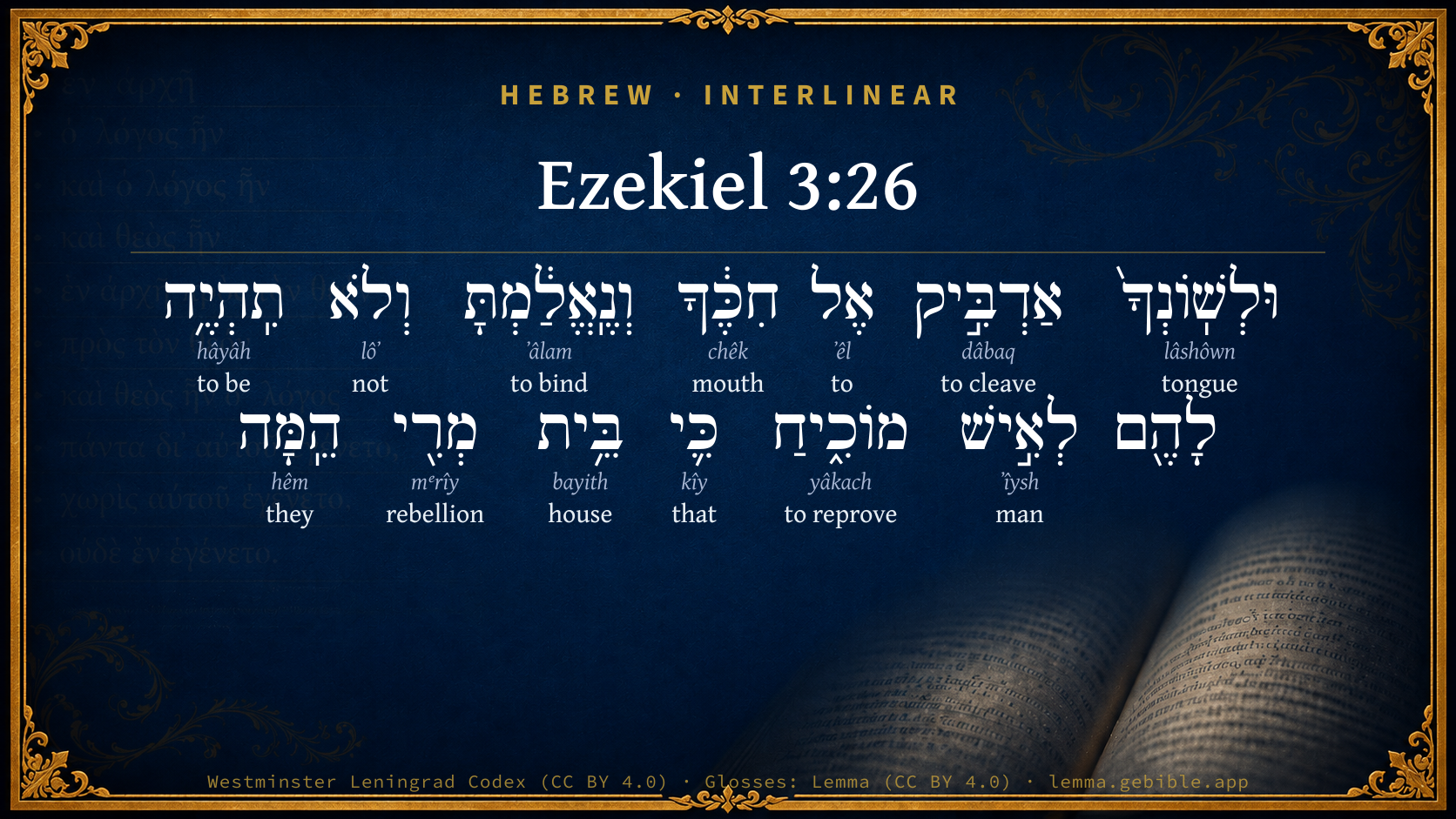
Hebrew (Westminster Leningrad Codex) Ezekiel 3:26 appears in the Hebrew Old Testament. The text above is from the Westminster Leningrad Codex. Each word links to its Strong’s number, a concise gloss, and parsing drawn from the Open Scriptures Hebrew Bible morphology. Click any word for its full Brown-Driver-Briggs (BDB) entry.
Download image
Cite this verse

Ezekiel 3:26 (World English Bible). Public Domain. Lemma interlinear Bible study tool, https://lemma.gebible.app/v/ezekiel/3/26.

Show BibTeX & RIS
BibTeX
RIS
English Translation
and I will make your tongue cleave to the roof of your mouth, that you shall be mute, and shall not be to them a reprover; for they are a rebellious house.
World English Bible · Public Domain
Download a study sheet

One document with this verse’s original text, its word-by-word gloss line, the meaning frame, cross-references with their text, attributed commentary, and full source and license credits — printable, and it pastes into notes with its structure intact.

This verse Autodidact and up

Study sheet (.html) Plain text (.txt)

A passage Seminary Student

Up to 50 verses in one chapter. A passage sheet keeps up to 6 commentary sources and 12 cross-references per verse, in the order this page ranks them, and says so on the sheet whenever that leaves anything out. Ask for a single verse and you get the Autodidact verse sheet above.

Everything on this page stays free to read, with no account — the sheet is a download of what is already on screen, not access to it.

Want to remove ads? Support Godless Engineer
Compare translations 3

The same verse in 3 English versions, stacked beneath the original-language interlinear above. Click any original word for its lexicon entry.

Each is an independent rendering of the whole verse — the interlinear is not word-aligned to these translations.

Highlighted words mark where these versions differ — a whole-verse word diff, not a word-by-word alignment.

  • World English Bible Public Domain
    and I will make your tongue cleave to the roof of your mouth, that you shall be mute, and shall not be to them a reprover; for they are a rebellious house.
  • King James Version Public Domain
    And I will make thy tongue cleave to the roof of thy mouth, that thou shalt be dumb, and shalt not be to them a reprover: for they are a rebellious house.
  • unfoldingWord Literal Text CC BY-SA 4.0
    I will make your tongue stick to the roof of your mouth, so you will be mute, and you will not be able to rebuke them, since they are a rebellious house.

unfoldingWord Literal Text — © unfoldingWord, licensed CC BY-SA 4.0. Word-aligned USFM3 via Door43 (git.door43.org/unfoldingWord/en_ult).

Versions to compare (up to 4)

3 of 4 selected

Show all 18 translations

Every available English version of this verse, each an independent rendering of the whole verse.

  • World English Bible Public Domain
    and I will make your tongue cleave to the roof of your mouth, that you shall be mute, and shall not be to them a reprover; for they are a rebellious house.
  • Berean Standard Bible Public Domain
    I will make your tongue stick to the roof of your mouth, and you will be silent and unable to rebuke them, though they are a rebellious house.
  • Majority Standard Bible Public Domain
    I will make your tongue stick to the roof of your mouth, and you will be silent and unable to rebuke them, though they are a rebellious house.
  • King James Version Public Domain
    And I will make thy tongue cleave to the roof of thy mouth, that thou shalt be dumb, and shalt not be to them a reprover: for they are a rebellious house.
  • American Standard Version (1901) Public Domain
    and I will make thy tongue cleave to the roof of thy mouth, that thou shalt be dumb, and shalt not be to them a reprover; for they are a rebellious house.
  • Revised Version (1885) Public Domain
    and I will make thy tongue cleave to the roof of thy mouth, that thou shalt be dumb, and shalt not be to them a reprover: for they are a rebellious house.
  • Geneva Bible (1599) Public Domain
    And I will make thy tongue cleaue to the roofe of thy mouth, that thou shalt be dume, and shalt not be to them as a man that rebuketh: for they are a rebellious house.
  • Douay-Rheims (1899) Public Domain
    And I will make thy tongue stick fast to the roof of thy mouth, and thou shalt be dumb, and not as a man that reproveth: because they are a provoking house.
  • Young's Literal Translation Public Domain
    and thy tongue I cause to cleave unto thy palate, and thou hast been dumb, and art not to them for a reprover, for a rebellious house `are' they.
  • Literal Standard Version CC BY-SA 4.0
    and I cause your tongue to cleave to your palate, and you have been mute, and are not for a reprover to them, for they [are] a house of rebellion.
  • Unlocked Literal Bible CC BY-SA 4.0
    I will make your tongue stick to the roof of your mouth, so you will be mute, and you will not be able to rebuke them, since they are a rebellious house.
  • unfoldingWord Literal Text CC BY-SA 4.0
    I will make your tongue stick to the roof of your mouth, so you will be mute, and you will not be able to rebuke them, since they are a rebellious house.
  • Darby Bible Public Domain
    And I will make thy tongue cleave to the roof of thy mouth, that thou shalt be dumb, and shalt not be to them a reprover; for they are a rebellious house.
  • World Messianic Bible Public Domain
    I will make your tongue stick to the roof of your mouth so that you will be mute and will not be able to correct them, for they are a rebellious house.
  • Webster's Bible Public Domain
    And I will make thy tongue cleave to the roof of thy mouth, that thou shalt be dumb, and shalt not be to them a reprover: for they are a rebellious house.
  • Free Bible Version CC BY-SA 4.0
    I'll make your tongue stick to the roof of your mouth. You won't be able to speak and complain to them, even though they are a rebellious people.
  • Bible in Basic English Public Domain
    And I will make your tongue fixed to the roof of your mouth, so that you have no voice and may not make protests to them: for they are an uncontrolled people.
  • JPS Tanakh (1917) Public Domain
    and I will make thy tongue cleave to the roof of thy mouth, that thou shalt be dumb, and shalt not be to them a reprover; for they are a rebellious house.

Literal Standard Version (2020), Covenant Press — licensed CC BY-SA 4.0. Text via the HelloAO Bible API (eBible.org). Unlocked Literal Bible (unfoldingWord) — licensed CC BY-SA 4.0. Text via the HelloAO Bible API (eBible.org). unfoldingWord Literal Text — © unfoldingWord, licensed CC BY-SA 4.0. Word-aligned USFM3 via Door43 (git.door43.org/unfoldingWord/en_ult). Free Bible Version, Dr. Jonathan Gallagher — licensed CC BY-SA 4.0. Text via the HelloAO Bible API (eBible.org).

Word by word

More ways to search: Search by grammar → Find every occurrence → Compare this word →

Practice this passage: Drill this verse → Learn its vocabulary →

וְנֶֽאֱלַ֔מְתָּ
ʼâlam
H481
“and · to bind”
Conjunction + Verb, Niphal, Sequential Perfect, 2nd Person, Masculine, Singular
Part of Speech
Conjunction + Verb
Stem
Niphal
Form
Sequential Perfect
Person
2nd Person
Gender
Masculine
Number
Singular
Full BDB Definition

Origin: a primitive root

TWOT: 102

to bind - (Niphal) - to be dumb - to be bound - (Piel) binding (participle)
  1. וּלְשֽׁוֹנְךָ֙ lâshôwn H3956 “and · tongue · your” Conjunction + Noun, Common, Both, Singular, Construct + Suffix, Personal, 2nd Person, Masculine, Singular
  2. אַדְבִּ֣יק dâbaq H1692 “to cleave” Verb, Hiphil, Imperfect, 1st Person, Common, Singular
  3. אֶל ʼêl H413 “to” Preposition
  4. חִכֶּ֔ךָ chêk H2441 “mouth · your” Noun, Common, Masculine, Singular, Construct + Suffix, Personal, 2nd Person, Masculine, Singular
  5. וְלֹא lôʼ H3808 “and · not” Conjunction + Particle, Negative
  6. תִֽהְיֶ֥ה hâyâh H1961 “to be” Verb, Qal, Imperfect, 2nd Person, Masculine, Singular
  7. לְאִ֣ישׁ ʼîysh H376 “to/for · man” Preposition + Noun, Common, Masculine, Singular, Absolute
  8. מוֹכִ֑יחַ yâkach H3198 “reproving” Verb, Hiphil, Participle Active, Masculine, Singular, Absolute
  9. כִּ֛י kîy H3588 “that” Conjunction
  10. בֵּ֥ית bayith H1004 “house of” Noun, Common, Masculine, Singular, Construct
  11. מְרִ֖י mᵉrîy H4805 “rebellion” Noun, Common, Masculine, Singular, Absolute
  12. הֵֽמָּה hêm H1992 “they” Pronoun, Personal, 3rd Person, Masculine, Plural

About this verse

These counts appear in no published source. They are computed here, from the morphology-tagged text and Lemma’s own curated glosses. What Lemma adds →

14
words
13
distinct lemmas
Prophets
section

Notable vocabulary

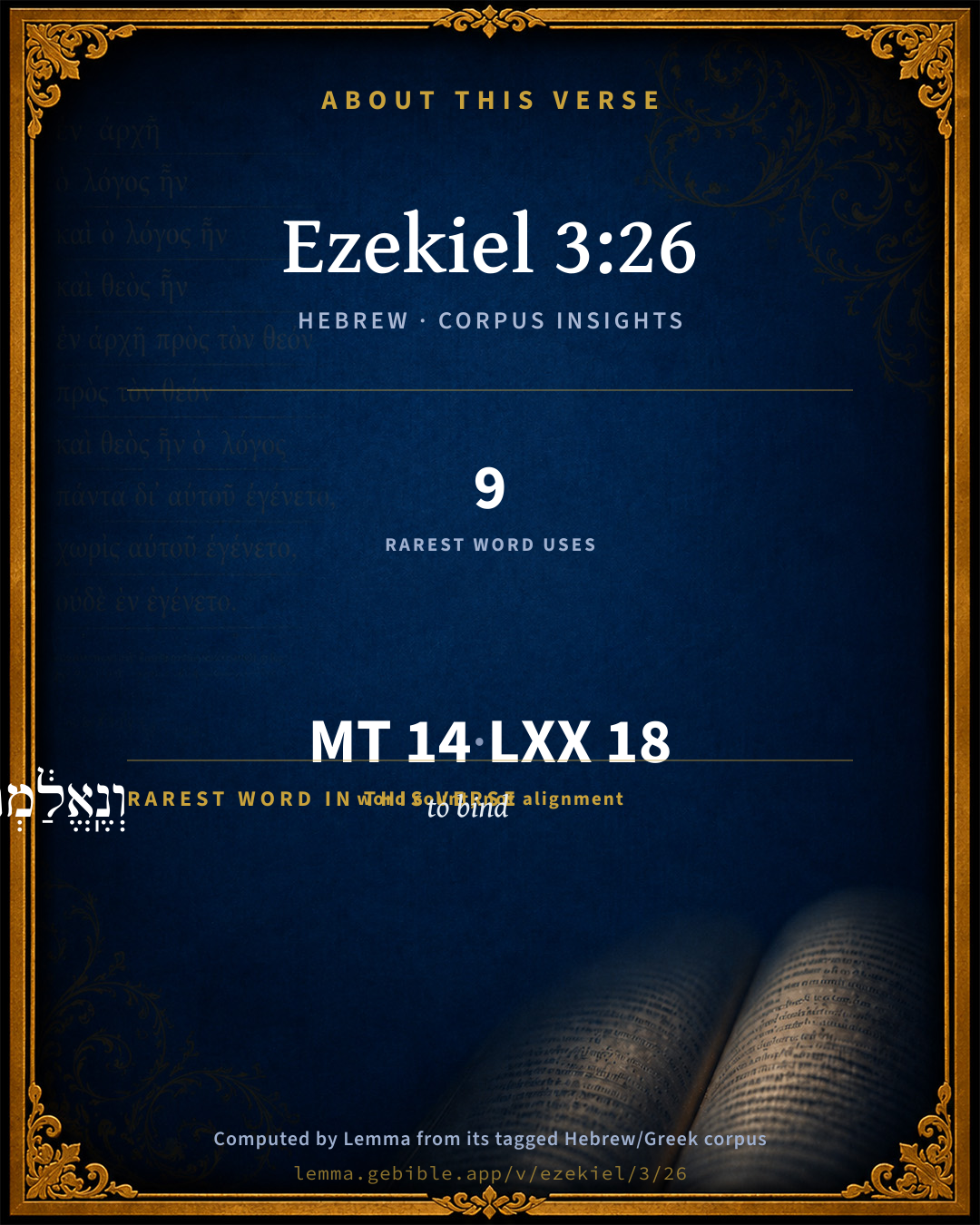
The rarest word here is וְנֶֽאֱלַ֔מְתָּ to bind H481 — appearing just 9 times in the whole Hebrew Bible.

Shared distinctive vocabulary

וְנֶֽאֱלַ֔מְתָּ to bind H481 occurs in 9 verses of the Hebrew Bible. Also found in:

Grammatical profile

  • 4 verbs
  • 5 nouns
  • 1 pronoun
  • 2 prepositions
  • 1 conjunction
  • 1 particle

Verb forms

  • אַדְבִּ֣יק Hiphil · Imperfect
  • וְנֶֽאֱלַ֔מְתָּ Niphal · Sequential Perfect
  • תִֽהְיֶ֥ה Qal · Imperfect
  • מוֹכִ֑יחַ Hiphil · Participle Active

Hebrew & Septuagint length

In English translation the verse runs 32 words from the Hebrew and 25 from the Septuagint (LXX English) — closely comparable.

A rough comparison of the two English renderings, which tokenize alike — not a word-level alignment.

Word counts can differ between the Hebrew and the Greek without any difference in meaning — e.g. the Hebrew direct-object marker אֵת has no separate Greek word, and Greek often adds the article ὁ.

In the original languages it is 14 Hebrew tokens and 18 Greek tokens — but the two are counted differently (Hebrew bundles its prefixes and suffixes into one token; the Greek is in lemma form), so that isn’t a like-for-like length.

Cross-references

13

Topical passages linked to Ezekiel 3:26 in the Treasury of Scripture Knowledge — connected by theme and wording, ordered by reader-vote popularity; previews shown in the World English Bible.

  • Ezekiel 24:27 In that day shall your mouth be opened to him who is escaped, and you shall speak, and be no more mute: so shall you be a sign to them; and they shall know that I am Yahweh.
  • Psalms 51:15 Lord, open my lips. My mouth shall declare your praise.
  • Psalms 137:6 Let my tongue stick to the roof of my mouth if I don't remember you; If I don't prefer Jerusalem above my chief joy.
  • Amos 8:11–12 Behold, the days come," says the Lord Yahweh, "That I will send a famine in the land, Not a famine of bread, Nor a thirst for water, But of hearing the words of Yahweh.
  • Micah 3:6–7 "Therefore night is over you, with no vision, And it is dark to you, that you may not divine; And the sun will go down on the prophets, And the day will be black over them.
  • Luke 1:20–22 Behold, you will be silent and not able to speak, until the day that these things will happen, because you didn't believe my words, which will be fulfilled in their proper time."
  • Psalms 36:11–12 Don't let the foot of pride come against me. Don't let the hand of the wicked drive me away.
  • Isaiah 1:2 Hear, heavens, And listen, earth; for Yahweh has spoken: I have nourished and brought up children, And they have rebelled against me.
  • Jeremiah 1:17 You therefore gird up your loins, and arise, and speak to them all that I command you: don't be dismayed at them, lest I dismay you before them.
  • Lamentations 2:9 Her gates are sunk into the ground; he has destroyed and broken her bars: Her king and her princes are among the nations where the law is not; Yes, her prophets find no vision from Yahweh.
  • Ezekiel 2:3–8 He said to me, Son of man, I send you to the children of Israel, to nations that are rebellious, which have rebelled against me: they and their fathers have transgressed against me even to this very day.
  • Hosea 4:17 Ephraim is joined to idols. Leave him alone!
  • Amos 5:10 They hate him who reproves in the gate, And they abhor him who speaks blamelessly.

Cross-references courtesy of OpenBible.info (CC BY 4.0).

Hebrew and Greek witnesses Masoretic Hebrew ↔ Greek Septuagint

The same verse in the two great witnesses to the Old Testament, shown verse-for-verse.

These are two independent witnesses, not word-aligned to each other, and the Septuagint is shown in lemma (dictionary) form.

Hebrew Ezekiel 3:26 Masoretic · Westminster Leningrad Codex

וּלְשֽׁוֹנְךָ֙ אַדְבִּ֣יק אֶל חִכֶּ֔ךָ וְנֶֽאֱלַ֔מְתָּ וְלֹא תִֽהְיֶ֥ה לָהֶ֖ם לְאִ֣ישׁ מוֹכִ֑יחַ כִּ֛י בֵּ֥ית מְרִ֖י הֵֽמָּה

and I will make your tongue cleave to the roof of your mouth, that you shall be mute, and shall not be to them a reprover; for they are a rebellious house.

World English Bible · Public Domain

Greek LXX Ezekiel 3:26 Septuagint · lemma form

καί ὁ γλῶσσα σύ συνδέω καί ἀποκωφόω καί οὐ εἰμί αὐτός εἰς ἀνήρ ἐλέγχω διότι οἶκος παραπικραίνω εἰμί

Also I will bind your tongue, and you shall be dumb, and shall not be to them a reprover: because it is a provoking house.

LXX2012 (modern English Septuagint) · Public Domain

On this verse, John Gill's Exposition discusses the Septuagint’s reading. Read the note in Commentary ↓

Hebrew: Westminster Leningrad Codex (CC BY 4.0). Greek: Septuagint (public domain); English from LXX2012 (modern English Septuagint) (Public Domain). How the Septuagint differs from the Hebrew →

Targum (Aramaic paraphrase)

1

The Targum is the ancient Jewish Aramaic paraphrase of the Hebrew Scriptures — an interpretive translation, not the Hebrew text itself. Onkelos (literal) and Pseudo-Jonathan (expansive) render the Torah, and Jonathan the Prophets. Coverage is partial: where no permissively-licensed English translation exists for a verse, only the Aramaic is shown. This is verse-level text, not a word-by-word alignment to the Hebrew.

  1. Targum Jonathan Prophets (Joshua–Malachi)
    וְלִישָׁנָךְ אַדְבֵּיק לְחִכֵּךְ וְתִשְׁתּוֹק וְלָא תְהֵי לְהוֹן לִגְבַר מוֹכַח אֲרֵי עַם סַרְבָן אִינוּן:

    (no public-domain English translation for this verse)

    Targum Jonathan — Aramaic: “Mikraot Gedolot” (public domain). English: “Sefaria Community Translation” (CC0 1.0 (public-domain dedication)); “London "Chaldee Paraphrase," 1871” (public domain). Text via Sefaria.

Commentary

Notes on Ezekiel 3:26 from classic Christian and Jewish commentators (each source and its license shown beneath its notes). The classic Christian expositions comment on the surrounding passage and are grouped to its opening verse, so a note may address several verses; the Jewish commentaries on the Tanakh (Rashi and others) are per-verse, so they appear only where the commentator wrote on this verse.

Lemma curates 59 commentaries, every one of them public domain or Creative Commons licensed, each selected and text-cleaned for this edition rather than reprinted as found. About our sources →

Trapp's Complete Commentary

John Trapp

Eze 3:26 And I will make thy tongue cleave to the roof of thy mouth, that thou shalt be dumb, and shalt not be to them a reprover: for they [are] a rebellious house.

Ver. 26. And I will make thy tongue.] A spiritual and a special judgment upon the people, thus to silence the prophet. So he dealt by our ancestors, upon the setting up of Queen Mary.

John Trapp, A Commentary or Exposition upon All the Books of the Old and New Testament (1647–1656) — public domain. Text from a community e-Sword module.

The Biblical Illustrator

Joseph S. Exell

Eze_3:26-27

That thou shalt be dumb.

The silent system

After so many years of uninterrupted activity, to be imprisoned, to be silenced, and almost incapable of writing or reading, is mere wearisome than even the pain that often accompanies it; and yet, hence the following instruction may be gathered:--

1. How much activity belongs to some natures, and that this nature is often mistaken for grace.

2. How much we are called to suffer, as well as to do, the will of God. When I have bid one of my children to sit down quietly, and remain silent during my pleasure, I enjoin him a more difficult task than the most active service; and yet I expected it to be done, because I ordered it. How is it that I have not yet learned to sit still, when I am told? (R. Cecil.)

He that heareth let him hear.--

The Word of God not to be altered

The prescriptions of a physician must not be altered, either by the apothecary or the patient; so we, the preachers, must not alter Gods prescriptions, neither must you, the hearers. We must not shun to declare, nor you to receive, The whole counsel of God..

The Biblical Illustrator, edited by Joseph S. Exell (c. 1880s–1900s) — public domain. Text from a community e-Sword module.

Tyndale Open Study Notes

Tyndale Open Resources

3:26-27 Even Ezekiel’s tongue was under arrest, bound to the roof of his mouth except when God freed it to speak his words of judgment. He was not physiologically incapable of speaking, but his communication was so restricted by God that he could only deliver the message of disaster that God gave him; all other speech was prohibited. This made Ezekiel’s role more limited than that of most prophets, who were free to intercede for and mediate between God and his people. Ezekiel could not speak on their behalf because the time for dialogue between God and his people had passed. No further appeal was possible against the coming judgment. Ezekiel’s speech would be restricted until the news of Jerusalem’s fall arrived (24:27). At that point, with the completion of God’s judgment on his people, the prophet’s tongue would be freed to intercede for them again.

Tyndale Open Study Notes — © Tyndale Open Resources, licensed CC BY-SA 4.0. Text via the HelloAO Bible API.

Geneva Bible (1599)

Geneva Bible translators

Which declareth the terrible plague of the Lord, when God stoppeth the mouths of his ministers, and that all such are the rods of his vengeance that do it.

Geneva Bible (1599) marginal notes — public domain. Text via Bolls.life.

Jamieson, Fausset & Brown

Robert Jamieson, A. R. Fausset & David Brown

I will make my tongue . . . dumb--Israel had rejected the prophets; therefore God deprives Israel of the prophets and of His word--God's sorest judgment (Sa1 7:2; Amo 8:11-12).

Jamieson, Fausset & Brown — Commentary Critical and Explanatory on the Whole Bible (1871) — public domain (CC PDM 1.0). Text via the HelloAO Bible API.

Adam Clarke's Commentary

Verse 26. I will make thy tongue cleave to the roof of thy mouth] I will not give thee any message to deliver to them. They are so rebellious, it is useless to give them farther warning.

Adam Clarke's Commentary on the Bible (1810–1826) — public domain. Text from a community e-Sword/MySword module.

John Calvin's Commentaries

But he now adds, I will fix thy tongue to thy palate — or I will make thy tongue adhere to thy palate — so that thou shalt not be to them a reprover, because they are a rebellious house What God ascribed to the Israelites he now transfers to himself. He had said, They will bind thee with ropes: he now says, I will make thy tongue cleave to thy palate But these two things are easily reconciled, because in truth the Israelites rejected prophecies through their intemperance, and God thus deprived them of this benefit, because he saw they were unworthy of it. But this place shows that it is a sign of God’s vengeance, when all prophecies cease, and opportunity for hearing is taken away. For as God shines upon us by his instruction, and we have thereby a certain pledge of his fatherly grace and favor, so also when instruction is removed, it is just as if God hid his face, nay, even turned his back upon us. We must consider, therefore, what is here said — because the house of Israel was rebellious: hence the Prophet was dumb, and refrained from teaching those impious ones. God therefore desists, when he sees that he is dealing with the stupid and deaf; but. not on the first occasion of their wearying him, because he rather contends with man’s ingratitude, and never ceases, as we see in Jeremiah, to rise in the morning, and to keep watch even while it is yet night; (Jeremiah 7:2; Jeremiah 11:7; Jeremiah 35:14; Psalm 74:9;) he never ceases to call to himself even those who are slow and sluggish, nay, even the utterly rebellious: but at length, when he sees that he does not succeed by long-suffering, he takes away his instruction, as we have said. And therefore the Church complains that it is destitute of Prophets, and places that slaughter among the extreme signs of God’s anger: “We do not see our signs, and Prophets do not appear among us.” In this way they understand that they are alienated from God, and that no consolation remains to them, when God does not give them any taste of his goodness by Prophets. The ungodly indeed wish this, because nothing is more troublesome to them than to hear God continually exclaiming. Hence, as far as they can, they seek hiding-places, and think nothing better for themselves than to be torpid amidst their vices, and to be deaf to every voice of reproach; but yet nothing is more destructive to them, because God offers himself as a physician who cures our diseases, while he exhorts us to wisdom. But when he is silent, he deserts us as if abandoned to de-st, ruction, and hence I said that nothing is more destructive than when no reproach sounds in our ears, but we are sweetly flattered, because in this way Satan deprives us of our senses, and this is his final poisoning, when he so soothes us with his blandishments, that all reproach which may alarm our security altogether ceases. Now it follows: —

John Calvin's Commentaries (1540-1563) — public domain. Text from the Calvin Translation Society English edition (1840s-50s) via the Christian Classics Ethereal Library (ccel.org). Calvin's coverage is partial (roughly two-thirds of the Bible); uncommented books and verses are honest gaps, never fabricated. The 19th-century editor's footnotes and remarks are omitted so the notes are faithfully Calvin's own voice.

Ellicott's Commentary for English Readers

(26) I will make thy tongue cleave to the roof of thy mouth.—Here, under another figure, this enforced silence is attributed, not to “the rebellious house,” by whom it was immediately brought about, but to God Himself, whose providence was the ultimate cause by which the prophet was placed in such circumstances. It is a way of expressing strongly the difficulties under which he was to exercise his ministry.

A Bible Commentary for English Readers, edited by Charles John Ellicott (1878–1897) — public domain. Text from a community e-Sword module.

The Cambridge Bible for Schools and Colleges

gen. ed. J. J. S. Perowne

26. I will make thy tongue cleave] The restraint imposed by the opposition of the people is acquiesced in by God, it is part of his purpose. His providence will meantime be the best teacher of the people. The prophet’s “dumbness,” however, is compatible with much speaking at least by signs to those who will hear. He is “dumb” in the sense of the Psalmist, “I was dumb, not opening my mouth, because thou didst it” (Psa_39:9; Isa_53:7; cf. Eze_24:27; Eze_33:22).

The Cambridge Bible for Schools and Colleges (gen. ed. J. J. S. Perowne; Cambridge University Press, 1878–1918) — public domain. Text from a community e-Sword module.

John Gill's Exposition

And I will make thy tongue cleave to the roof of thy mouth,

that thou shall be dumb,.... Which is to be understood not literally, as if he was really struck dumb, as Zechariah was; see Eze 4:9; but that such silence should be charged upon him by the Lord, that he should be as if his tongue cleaved to the roof of his mouth, as Kimchi interprets it, and as if he was a dumb man: and so the Septuagint version renders it, "I will bind thy tongue"; lay an embargo upon it, that is, it shall be silent; and this sense is confirmed by what follows:

and shall not be to them a reprover; which was in judgment to them, and a giving them up to their own hearts' lusts; for, though reproofs were disagreeable to them, and they chose to be without them, yet they were necessary for them, and might have been useful to them; but they provoking the Lord, he takes away his word from them, and commands his prophet to be silent, and let them alone, to go on in their sins without control; which was a sore judgment upon them:

for they are a rebellious house; See Gill on Eze 2:5.

John Gill's Exposition of the Whole Bible (1746–1763) — public domain (CC PDM 1.0). Text via the HelloAO Bible API.

Albert Barnes' Notes on the Bible

And I will make - Rather, Then will I “make.” One action is the consequence of the other. Because the people would silence the prophet, God to punish them will close his mouth (compare Isa 6:9; Mat 13:14).

Albert Barnes' Notes on the Bible (1834–1885) — public domain. Text from a community e-Sword/MySword module.

Haydock's Catholic Bible Commentary

House. "When there is a multitude of sins, (or sinners; peccatorum) the offenders are unworthy of being corrected by the Lord." (St. Jerome) --- The prophet’s silence might suffice to admonish them. (Calmet) --- He heard the Lord’s commands to chap. xi. 24., before he spoke to the people. (Menochius)

George Leo Haydock (1774–1849), Haydock's Catholic Family Bible and Commentary, 1859 edition — public domain. Excludes Psalms (Douay-Rheims chapter numbering differs from Protestant) and Deuterocanonical books (Catholic canon only).

Matthew Poole's English Annotations

Either by forbidding thee to speak, I will make thee as dumb as if thy tongue did cleave to the roof of thy mouth; or possibly God did suspend his influence, and leave the prophet dumb, as one who could not move his tongue, the use whereof is taken away.

A reprover; a man to reprove (as Heb.); shalt tell them as little of their faults and danger as a dumb man can do. God hereby giving the prophet some respite, signifying the future state of the Jews would be such they should no more dare to mutter or whisper; and punishing the refractory deafness of the Jews with taking away their reprover, &c.

A rebellious house: see Eze 2:5,7.

Matthew Poole's English Annotations on the Holy Bible (1683–1685) — public domain. Text from a community e-Sword/MySword module.

Whedon's Commentary on the Bible

Daniel D. Whedon

26. Thou shalt be dumb — He who had previously refused to speak now finds himself unable to speak (compare Luk_1:20), and this dumbness is also to teach both himself and the people the lesson that his tongue is now fully controlled by Jehovah. God can speak through obedient silence as truly as through the most eloquent tongue. It is only disobedient silence which is condemned (Eze_3:15). When the preacher is so moved by “the spirit” that he cannot speak, the sermon becomes impressive. This verse explains why, unlike other prophets, almost all Ezekiel’s sermons are preached in sign language. Not until after the capture of Jerusalem did Ezekiel fully recover the use of the tongue which he had so despised (Eze_24:27; Eze_33:22). Was this dumbness produced by physical disease (Klostermann, Orelli), or was it merely the sealing of the prophet’s lips by the divine commandment? Probably the latter; as in that case the lesson to the people would have been more certainly recognized.

Daniel D. Whedon (gen. ed.), Commentary on the Old and New Testaments (1874–1909) — public domain. Text from a community e-Sword module.

The Pulpit Commentary

Vers. 26, 27. Dumbness sad speech.

The wise man has said, "There is a time to keep silence, and a time to speak." There are those who speak when they would do well to hold their peace; there are those who are speechless when it becomes them to utter their mind with boldness. A prophet is emphatically one who speaks for God; a silent prophet is a paradox. Yet, as Ezekiel was, of all his order, the one whose ministry was especially a ministry of symbol, it is only in harmony with his peculiar vocation that, for a time and for a purpose, he should be as one dumb. On the other hand, the abundance of his utterances is apparent from the length to which the book of his prophecies extends. There were reasons fur both his dumbness and his speech.

I THE TESTIMONY OF SILENCE. That God should enjoin one of his own prophets to silence is certainly a very remarkable fact, and one that needs explanation.

1. It is evidence of Israel"s unbelief and inattention. When the peoplerefused to hear, there was a solemn dignity in the refusal of the prophet any longer to speak.

2. It is in rebuke of Israel"s attempt to silence the Lord"s messenger. Thepeople would have their monitor hold his peace; and God gave them their will. The oracle was dumb.

3. The silencing of the prophet was judicial. Punishment is a reality; and severe indeed is the penalty inflicted upon that nation in which the voice of God"s prophets is silenced. The effects of such sin recoil upon the sinners" heads.

4. Such silencing was suggestive. It offered opportunity for reflection; itcalled for consideration regarding the future; it may well have appeared to the thoughtful premonitory of worse calamities to follow.

II THE TESTIMONY OF SPEECH.

1. This is the result of Divine preparation: "When I speak with thee, I willopen thy mouth." The same power which, at one time and for one purpose, closes the lips, at another time and lot another purpose, opens them. So long as God withholds the message, the prophet is silenced; no sooner is the message conveyed to the prophet than he is empowered to utter it.

2. This is in fulfilment of a Divine commission: "Thou shalt say unto Them,thus saith the Lord God." A command like this may well unseal the lips. The man who is convinced that he is justified in thus prefacing his utterances may well speak, whether his message be palatable or unpalatable, whether it bring the messenger praise or blame from his fellow men. 3 This accompanied by Divine authority: "He that heareth, let him hear; and he that forbeareth, let him forbear." It is for the people"s own advantage that the prophet witnesses; if he warns, it is that they may escape threatened danger; if he promises, it is that they may obtain blessings; if he commands, it is that they may obey, and secure the rewards of obedience. Accordingly, it is for the people to consult their own highest interests. But in any case they are subject to Divine authority; from that, and all that it involves, there is no escape.

APPLICATION.

1. God has different ways of dealing with men; sometimes not onlydifferent, but apparently opposite ways, as in the case before us. And indeed, one man may be reached and benefited by speech; another man, by silence.

2. In whatever way God deals with us, we are equally and inevitablyresponsible. It is indeed in our power to hear or to forbear, i.e. to obey or to disobey. But to every man faith and obedience bring blessing; and moreover (which is still more important), they are in themselves right and becoming. Ours is the privilege; ours is the accountability for its proper use. T.

The Pulpit Commentary (1880–1919), ed. H.D.M. Spence-Jones & Joseph S. Exell — public domain. Text from a community e-Sword module.

John Wesley's Explanatory Notes

I - I will make thee as dumb as if thy tongue clave to the roof of thy mouth.

John Wesley, Explanatory Notes Upon the Whole Bible (1754–1765) — public domain. Text via the GEBible commentary corpus.

unfoldingWord translationNotes

Door43 World Missions Community

General Information:

The Spirit continues speaking to Ezekiel.

the roof of your mouth

"the top of your mouth"

you will be mute

"you will not be able to speak"

house

This is a metonym for the family that lives in the house, in this case the Israelites, the descendants of Jacob over many years. See how you translated this in Ezekiel 2:5. AT: "people group" (See: Metonymy)

I will open your mouth

"I will make you able to speak"

the one who will not listen will not listen

"the one who refuses to listen will not listen"

Lord Yahweh

See how you translated this in Ezekiel 2:4.

translationWords

rebuke

Lord Yahweh

house

unfoldingWord translationNotes — © Distant Shores Media and the Door43 World Missions Community, licensed CC BY-SA 4.0. Source: git.door43.org/Door43/en_tn.

Lesson kit

Teaching starters — assembled from the data on this page, not authored interpretation. Every prompt links to the verse data it draws on. Edit before teaching.

Ezekiel, in the Prophets, opens this verse with 14 words (13 distinct Hebrew lemmas). Its most distinctive word is ʼâlam (“to bind”). A historical commentator’s framing appears above. Read the whole chapter for the surrounding context.

Discussion questions

  1. The word ʼâlam carries the sense “to bind.” How does it shape the verse?
  2. Genesis 37:7 shares the word «to bind» with this verse. How do the two illuminate each other?
  3. These translations render this verse differently; the difference is in the English rendering, not the original. What questions does that raise?
  4. The verb «אַדְבִּ֣יק» is Hiphil Imperfect. How does its form color the action?
  5. Reading how Trapp's Complete Commentary and The Biblical Illustrator read this verse, where do the two commentators agree and where do they part?

Things to notice

Reading settings

Reading text

Shown beneath each verse's original-language words.

Old Testament
Old Testament edition

Read the OT as the Masoretic Hebrew (MT) or the Greek Septuagint (LXX).

English shown for the Greek Septuagint (in the Hebrew ↔ Greek comparison).

Comparing translations? Open the Compare panel on any verse page to stack up to four side by side.