Song of Solomon 4:11

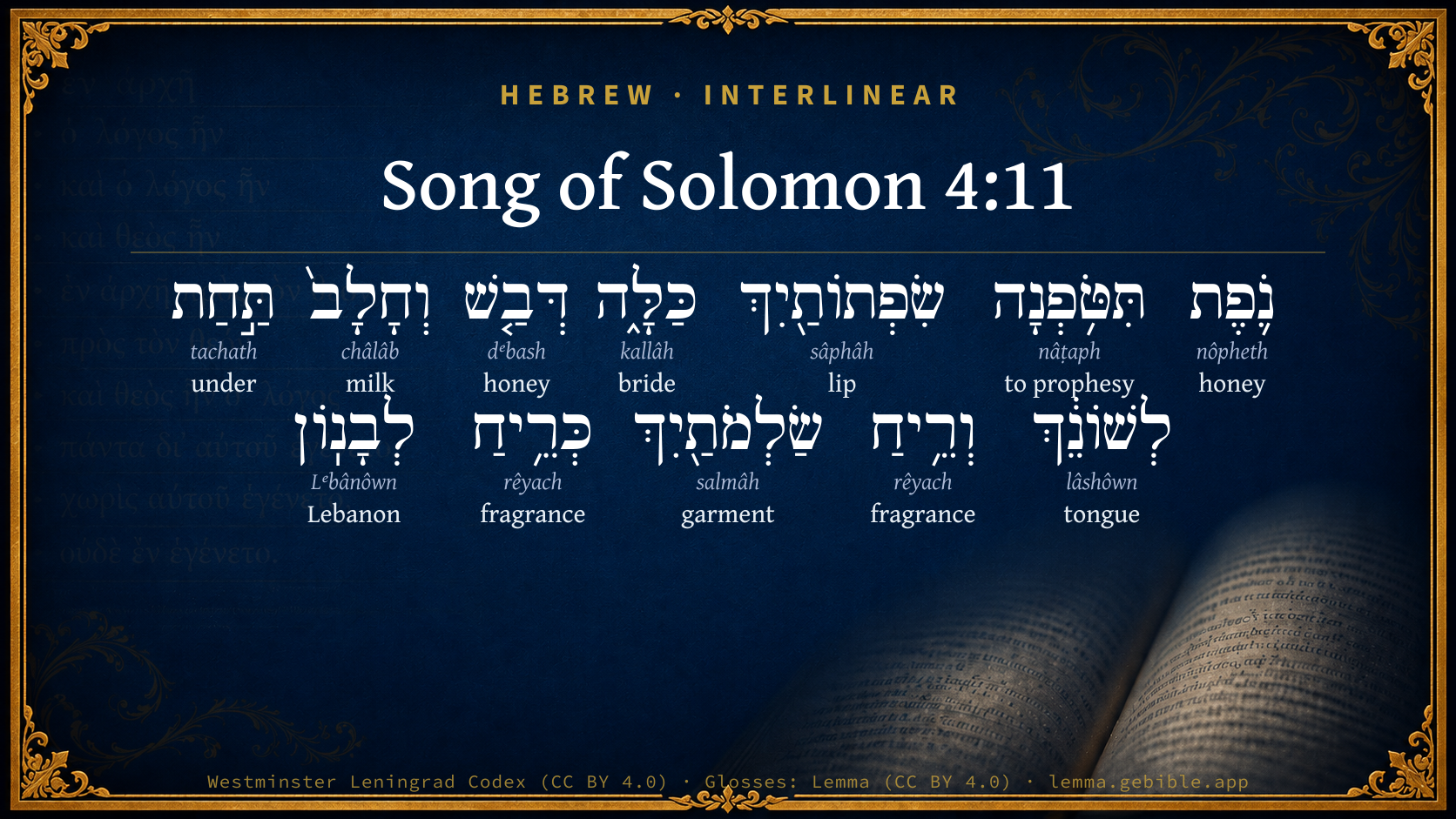
Hebrew (Westminster Leningrad Codex) Song of Solomon 4:11 appears in the Hebrew Old Testament. The text above is from the Westminster Leningrad Codex. Each word links to its Strong’s number, a concise gloss, and parsing drawn from the Open Scriptures Hebrew Bible morphology. Click any word for its full Brown-Driver-Briggs (BDB) entry.
Download image
Cite this verse

Song of Solomon 4:11 (World English Bible). Public Domain. Lemma interlinear Bible study tool, https://lemma.gebible.app/v/song-of-solomon/4/11.

Show BibTeX & RIS
BibTeX
RIS
English Translation
Your lips, my bride, drip like the honeycomb. Honey and milk are under your tongue. The smell of your garments is like the smell of Lebanon.
World English Bible · Public Domain
Download a study sheet

One document with this verse’s original text, its word-by-word gloss line, the meaning frame, cross-references with their text, attributed commentary, and full source and license credits — printable, and it pastes into notes with its structure intact.

This verse Autodidact and up

Study sheet (.html) Plain text (.txt)

A passage Seminary Student

Up to 50 verses in one chapter. A passage sheet keeps up to 6 commentary sources and 12 cross-references per verse, in the order this page ranks them, and says so on the sheet whenever that leaves anything out. Ask for a single verse and you get the Autodidact verse sheet above.

Everything on this page stays free to read, with no account — the sheet is a download of what is already on screen, not access to it.

Want to remove ads? Support Godless Engineer
Compare translations 3

The same verse in 3 English versions, stacked beneath the original-language interlinear above. Click any original word for its lexicon entry.

Each is an independent rendering of the whole verse — the interlinear is not word-aligned to these translations.

Highlighted words mark where these versions differ — a whole-verse word diff, not a word-by-word alignment.

  • World English Bible Public Domain
    Your lips, my bride, drip like the honeycomb. Honey and milk are under your tongue. The smell of your garments is like the smell of Lebanon.
  • King James Version Public Domain
    Thy lips, O my spouse, drop as the honeycomb: honey and milk are under thy tongue; and the smell of thy garments is like the smell of Lebanon.
  • unfoldingWord Literal Text CC BY-SA 4.0
    Your lips drip nectar, bride; honey and milk under your tongue and the smell of your garments like the smell of Lebanon.

unfoldingWord Literal Text — © unfoldingWord, licensed CC BY-SA 4.0. Word-aligned USFM3 via Door43 (git.door43.org/unfoldingWord/en_ult).

Versions to compare (up to 4)

3 of 4 selected

Show all 18 translations

Every available English version of this verse, each an independent rendering of the whole verse.

  • World English Bible Public Domain
    Your lips, my bride, drip like the honeycomb. Honey and milk are under your tongue. The smell of your garments is like the smell of Lebanon.
  • Berean Standard Bible Public Domain
    Your lips, my bride, drip sweetness like the honeycomb; honey and milk are under your tongue, and the fragrance of your garments is like the aroma of Lebanon.
  • Majority Standard Bible Public Domain
    Your lips, my bride, drip sweetness like the honeycomb; honey and milk are under your tongue, and the fragrance of your garments is like the aroma of Lebanon.
  • King James Version Public Domain
    Thy lips, O my spouse, drop as the honeycomb: honey and milk are under thy tongue; and the smell of thy garments is like the smell of Lebanon.
  • American Standard Version (1901) Public Domain
    Thy lips, O `my' bride, drop `as' the honeycomb: Honey and milk are under thy tongue; And the smell of thy garments is like the smell of Lebanon.
  • Revised Version (1885) Public Domain
    Thy lips, O my bride, drop as the honeycomb: honey and milk are under thy tongue; and the smell of thy garments is like the smell of Lebanon.
  • Geneva Bible (1599) Public Domain
    Thy lippes, my spouse, droppe as honie combes: honie and milke are vnder thy tongue, and the sauoure of thy garments is as the sauoure of Lebanon.
  • Douay-Rheims (1899) Public Domain
    Thy lips, my spouse, are as a dropping honeycomb, honey and milk are under thy tongue; and the smell of thy garments, as the smell of frankincense.
  • Young's Literal Translation Public Domain
    Thy lips drop honey, O spouse, Honey and milk `are' under thy tongue, And the fragrance of thy garments `Is' as the fragrance of Lebanon.
  • Literal Standard Version CC BY-SA 4.0
    Your lips drop honey, O spouse, || Honey and milk [are] under your tongue, || And the fragrance of your garments || [Is] as the fragrance of Lebanon.
  • Unlocked Literal Bible CC BY-SA 4.0
    Your lips, my bride, drip honey; honey and milk are under your tongue; the fragrance of your garments is like the fragrance of Lebanon.
  • unfoldingWord Literal Text CC BY-SA 4.0
    Your lips drip nectar, bride; honey and milk under your tongue and the smell of your garments like the smell of Lebanon.
  • Darby Bible Public Domain
    Thy lips, [my] spouse, drop [as] the honeycomb; Honey and milk are under thy tongue; And the smell of thy garments is like the smell of Lebanon.
  • World Messianic Bible Public Domain
    Your lips, my bride, drip like the honeycomb. Honey and milk are under your tongue. The smell of your garments is like the smell of Lebanon.
  • Webster's Bible Public Domain
    Thy lips, O my spouse, drop as the honey-comb; honey and milk are under thy tongue; and the smell of thy garments is like the smell of Lebanon.
  • Free Bible Version CC BY-SA 4.0
    Nectar drips from your lips; milk and honey are under your tongue. The smell of your clothes is like the fragrance of Lebanon.
  • Bible in Basic English Public Domain
    Your lips are dropping honey; honey and milk are under your tongue; and the smell of your clothing is like the smell of Lebanon.
  • JPS Tanakh (1917) Public Domain
    Thy lips, O my bride, drop honey — honey and milk are under thy tongue; and the smell of thy garments is like the smell of Lebanon.

Literal Standard Version (2020), Covenant Press — licensed CC BY-SA 4.0. Text via the HelloAO Bible API (eBible.org). Unlocked Literal Bible (unfoldingWord) — licensed CC BY-SA 4.0. Text via the HelloAO Bible API (eBible.org). unfoldingWord Literal Text — © unfoldingWord, licensed CC BY-SA 4.0. Word-aligned USFM3 via Door43 (git.door43.org/unfoldingWord/en_ult). Free Bible Version, Dr. Jonathan Gallagher — licensed CC BY-SA 4.0. Text via the HelloAO Bible API (eBible.org).

Word by word

More ways to search: Search by grammar → Find every occurrence → Compare this word →

Practice this passage: Drill this verse → Learn its vocabulary →

נֹ֛פֶת
nôpheth
H5317
“honey”
Noun, Common, Masculine, Singular, Absolute
Part of Speech
Noun
Type
Common
Gender
Masculine
Number
Singular
State
Absolute
Full BDB Definition

Origin: from H5130 in the sense of shaking to pieces

TWOT: 1396

flowing honey, honey from the comb, a dropping down, honey, honeycomb
  1. תִּטֹּ֥פְנָה nâṭaph H5197 “to prophesy” Verb, Qal, Imperfect, 3rd Person, Feminine, Plural
  2. שִׂפְתוֹתַ֖יִךְ sâphâh H8193 “lips · your” Noun, Common, Feminine, Plural, Construct + Suffix, Personal, 2nd Person, Feminine, Singular
  3. כַּלָּ֑ה kallâh H3618 “bride” Noun, Common, Feminine, Singular, Absolute
  4. דְּבַ֤שׁ dᵉbash H1706 “honey” Noun, Common, Masculine, Singular, Absolute
  5. וְחָלָב֙ châlâb H2461 “and · milk” Conjunction + Noun, Common, Masculine, Singular, Absolute
  6. תַּ֣חַת tachath H8478 “under” Preposition
  7. לְשׁוֹנֵ֔ךְ lâshôwn H3956 “tongue · your” Noun, Common, Both, Singular, Construct + Suffix, Personal, 2nd Person, Feminine, Singular
  8. וְרֵ֥יחַ rêyach H7381 “and · fragrance of” Conjunction + Noun, Common, Masculine, Singular, Construct
  9. שַׂלְמֹתַ֖יִךְ salmâh H8008 “garments · your” Noun, Common, Feminine, Plural, Construct + Suffix, Personal, 2nd Person, Feminine, Singular
  10. כְּרֵ֥יחַ rêyach H7381 “like/as · fragrance of” Preposition + Noun, Common, Masculine, Singular, Construct
  11. לְבָנֽוֹן Lᵉbânôwn H3844 “Lebanon” Noun, Proper

About this verse

These counts appear in no published source. They are computed here, from the morphology-tagged text and Lemma’s own curated glosses. What Lemma adds →

12
words
11
distinct lemmas
Wisdom
section

Notable vocabulary

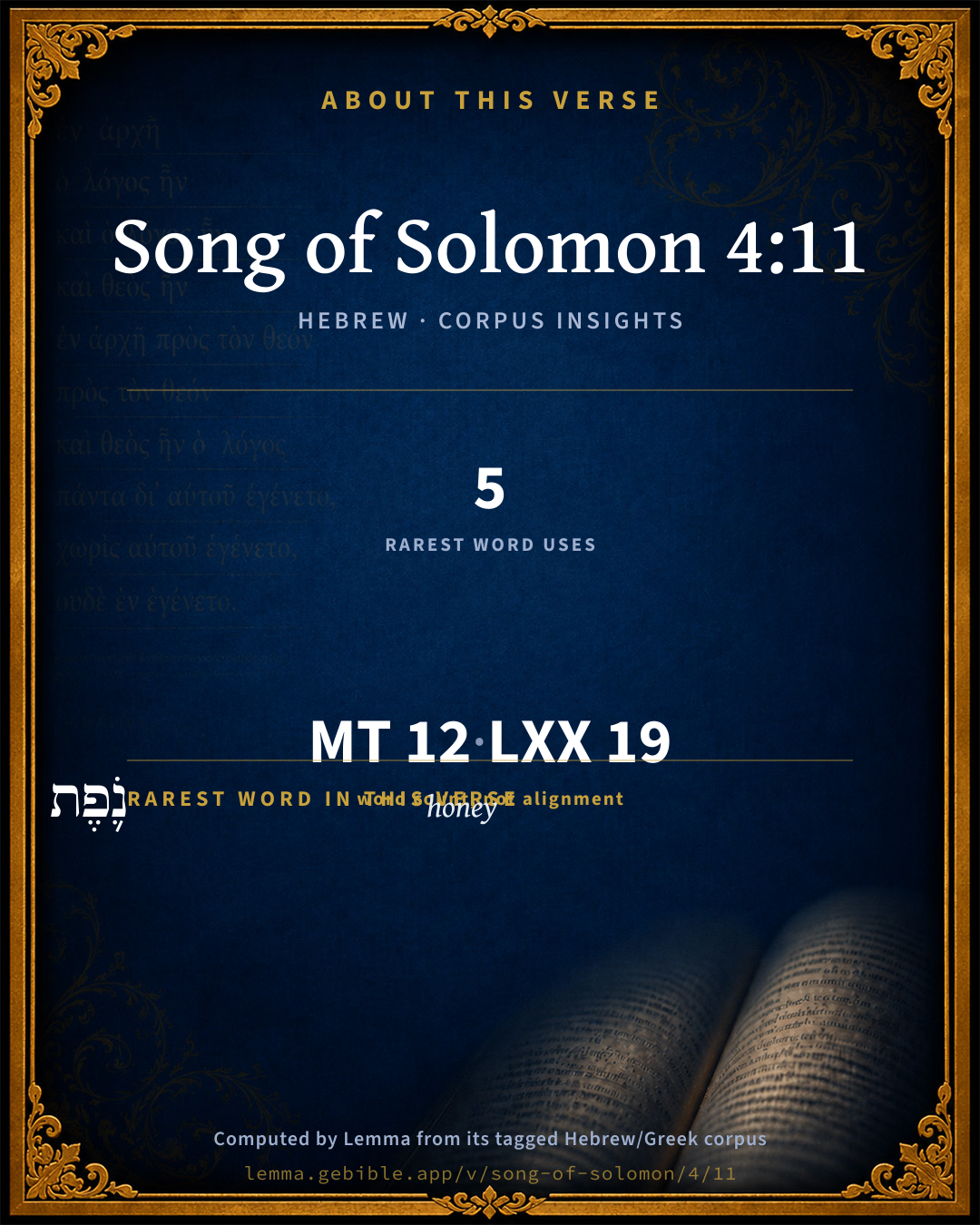
The rarest word here is נֹ֛פֶת honey H5317 — appearing just 5 times in the whole Hebrew Bible.

Shared distinctive vocabulary

נֹ֛פֶת honey H5317 occurs in 5 verses of the Hebrew Bible. Also found in:

Grammatical profile

  • 1 verb
  • 10 nouns
  • 1 preposition

Verb forms

  • תִּטֹּ֥פְנָה Qal · Imperfect

Repetition

A word recurs within this verse — often emphatic in Hebrew:

  • וְרֵ֥יחַ fragrance H7381 ×2

Hebrew & Septuagint length

In English translation the verse runs 26 words from the Hebrew and 25 from the Septuagint (LXX English) — closely comparable.

A rough comparison of the two English renderings, which tokenize alike — not a word-level alignment.

Word counts can differ between the Hebrew and the Greek without any difference in meaning — e.g. the Hebrew direct-object marker אֵת has no separate Greek word, and Greek often adds the article ὁ.

In the original languages it is 12 Hebrew tokens and 19 Greek tokens — but the two are counted differently (Hebrew bundles its prefixes and suffixes into one token; the Greek is in lemma form), so that isn’t a like-for-like length.

Cross-references

17

Topical passages linked to Song of Solomon 4:11 in the Treasury of Scripture Knowledge — connected by theme and wording, ordered by reader-vote popularity; previews shown in the World English Bible.

  • Song of Solomon 5:1 I have come into my garden, my sister, my bride. I have gathered my myrrh with my spice; I have eaten my honeycomb with my honey; I have drunk my wine with my milk. Friends Eat, friends! Drink, yes, drink abundantly, beloved. Beloved
  • Genesis 27:27 He came near, and kissed him. He smelled the smell of his clothing, and blessed him, and said, "Behold, the smell of my son Is as the smell of a field which Yahweh has blessed.
  • Song of Solomon 5:13 His cheeks are like a bed of spices with towers of perfumes. His lips are like lilies, dropping liquid myrrh.
  • Song of Solomon 7:9 Your mouth like the best wine, That goes down smoothly for my beloved, Gliding through the lips of those who are asleep.
  • Hosea 14:6–7 His branches will spread, And his beauty will be like the olive tree, And his fragrance like Lebanon.
  • Psalms 19:10 More to be desired are they than gold, yes, than much fine gold; Sweeter also than honey and the extract of the honeycomb.
  • Psalms 45:8 All your garments smell like myrrh, aloes, and cassia. Out of ivory palaces stringed instruments have made you glad.
  • Psalms 71:14–15 But I will always hope, And will add to all of your praise.
  • Psalms 71:23–24 My lips shall shout for joy! My soul, which you have redeemed, sings praises to you!
  • Proverbs 5:3 For the lips of an adulteress drip honey. Her mouth is smoother than oil,
  • Proverbs 16:24 Pleasant words are a honeycomb, Sweet to the soul, and health to the bones.
  • Proverbs 24:13–14 My son, eat honey, for it is good; The droppings of the honeycomb, which are sweet to your taste:
  • Song of Solomon 4:3 Your lips are like scarlet thread. Your mouth is lovely. Your temples are like a piece of a pomegranate behind your veil.
  • Isaiah 7:15 He shall eat butter and honey when he knows to refuse the evil, and choose the good.
  • Hosea 14:2 Take words with you, and return to Yahweh. Tell him, "Forgive all our sins, And accept that which is good: So we offer like bulls our lips.
  • Hebrews 13:15 Through him, then, let us offer up a sacrifice of praise to God continually, that is, the fruit of lips which make confession to his name.
  • Song of Solomon 4:10 How beautiful is your love, my sister, my bride! How much better is your love than wine! The fragrance of your perfumes than all manner of spices!

Cross-references courtesy of OpenBible.info (CC BY 4.0).

Hebrew and Greek witnesses Masoretic Hebrew ↔ Greek Septuagint

The same verse in the two great witnesses to the Old Testament, shown verse-for-verse.

These are two independent witnesses, not word-aligned to each other, and the Septuagint is shown in lemma (dictionary) form.

Hebrew Song of Solomon 4:11 Masoretic · Westminster Leningrad Codex

נֹ֛פֶת תִּטֹּ֥פְנָה שִׂפְתוֹתַ֖יִךְ כַּלָּ֑ה דְּבַ֤שׁ וְחָלָב֙ תַּ֣חַת לְשׁוֹנֵ֔ךְ וְרֵ֥יחַ שַׂלְמֹתַ֖יִךְ כְּרֵ֥יחַ לְבָנֽוֹן

Your lips, my bride, drip like the honeycomb. Honey and milk are under your tongue. The smell of your garments is like the smell of Lebanon.

World English Bible · Public Domain

Greek LXX Song of Solomon 4:11 Septuagint · lemma form

κηρίον ἀποστάζω χεῖλος σύ νύμφη μέλι καί γάλα ὑπό ὁ γλῶσσα σύ καί ὀσμή ἱμάτιον σύ ὡς ὀσμή λίβανος

Your lips drop honeycomb, my spouse: honey and milk are under your tongue; and the smell of your garments is as the smell of Libanus.

LXX2012 (modern English Septuagint) · Public Domain

Hebrew: Westminster Leningrad Codex (CC BY 4.0). Greek: Septuagint (public domain); English from LXX2012 (modern English Septuagint) (Public Domain). How the Septuagint differs from the Hebrew →

Commentary

Notes on Song of Solomon 4:11 from classic Christian and Jewish commentators (each source and its license shown beneath its notes). The classic Christian expositions comment on the surrounding passage and are grouped to its opening verse, so a note may address several verses; the Jewish commentaries on the Tanakh (Rashi and others) are per-verse, so they appear only where the commentator wrote on this verse.

Lemma curates 59 commentaries, every one of them public domain or Creative Commons licensed, each selected and text-cleaned for this edition rather than reprinted as found. About our sources →

Trapp's Complete Commentary

John Trapp

Son 4:11 Thy lips, O [my] spouse, drop [as] the honeycomb: honey and milk [are] under thy tongue; and the smell of thy garments [is] like the smell of Lebanon.

Ver. 11. Thy lips, O my spouse, drop as an honeycomb.] Heb., Drop the honeycomb. So Christ calls the doctrines and prayers of the Church, her thanksgivings, confessions, conferences, &c., which are things most pleasing to Christ, and do much comfort and edify the faithful. That golden mouthed preacher did so please the people, that it was grown to a proverb, Better the sun shine not, than Chrysostom preach not. Bilney the martyr, a little before he was burned, entreated much on that text, {Isa 43:2} "Fear not; when thou walkest through the fire, thou shalt not be burnt, neither shall the flame kindle upon thee"; so that some of his friends present took such sweet fruit thereby, saith Mr Foxe, {a} that they caused the whole sentence to be fair written in tables, and some in their books; the comfort whereof in several of them was never taken away from them to their dying day. The same author saith {b} of Bishop Ridley, martyr, that he usually preached every Sunday and holiday, to whose sermons the people resorted, swarming about him like bees, and coveting the sweet juice of his heavenly doctrine. How pleasant and profitable to Latimer was the private conference he had with Bilney! and the like benefit had Ridley by Bradford, Luther by Staupicius, Galeacius by Peter Martyr, Junius by a countryman of his not far from Florence. Oο και απο γλωττης μελιτος γλυκιων ρεεν αυδη. {c}

Honey and milk are under thy tongue.] The language of Canaan is thy proper dialect; for Canaan was a land that flowed with milk and honey - with things both pleasant and profitable. Yea, I doubt not, saith an interpreter, but that under these terms the Holy Ghost meaneth fit food, as well for strong men as for weak ones in the Church. Milk most properly belongs to children; {1Co 3:2 Heb 5:12-13} and honey to them of more strength, as examples of the word and reason itself teacheth sufficiently, in Jonathan, {1Sa 14:27} and John Baptist. {Mat 3:4} By these comparisons also may well be understood the good housekeeping that is in Christ’s Church. Honey and milk she hath ever at hand. And why hath he put these provisions under her tongue, but that she should look to lip feeding? {Pro 10:22} Let our words be "always with grace." {Col 4:6} Mel in ore, verba lactis, this becomes the Church’s children. Fel in corde, fraus in factis, is for those brats of fathomless perdition, that have adders’ poison under their lips, {Psa 140:3} that being "in the gall of bitterness and bond of perdition," show themselves by their words and actions to be the sons of the sorceress, the seed of the adulterer and of the whore, whose lips also drop the honeycomb, but her end is bitter as wormwood. {Pro 5:3-4 Isa 57:3}

And the smell of thy garments is like the smell of Lebanon.] Which was passing pleasant, by reason of the odoriferous and sweet smelling trees that grew there. Now what are these garments but the Church’s inward graces, say some; outward behaviour, say others, which is most gracious, amiable, and sweet, as far above all worldly grace as the smell of Lebanon is above the savour of common woods.

{a} Acts and Mon., 923.

{b} Ibid., 1559.

{c} Homer.

John Trapp, A Commentary or Exposition upon All the Books of the Old and New Testament (1647–1656) — public domain. Text from a community e-Sword module.

Joseph Benson's Commentary

Son 4:11. Thy lips drop as the honey-comb — Thy speeches both to me in prayer and praises, and to men for their edification, are highly acceptable to me. Honey and milk are under thy tongue — Words more sweet and comfortable than honey or milk. The smell of thy garments — Of that righteousness wherewith I have adorned thee; is like the smell of Lebanon — Which was very sweet and grateful in regard of the great number of sweet-smelling spices and trees which grew on that mountain.

Joseph Benson's Commentary on the Old and New Testaments (1811–1818) — public domain. Text from a community e-Sword module.

Geneva Bible (1599)

Geneva Bible translators

Because of thy confession and thanksgiving.

Geneva Bible (1599) marginal notes — public domain. Text via Bolls.life.

Adam Clarke's Commentary

Verse 11. Thy lips - drop as the honey-comb] Thy words are as delicious to my heart as the first droppings of the honey-comb are to the palate.

Honey and milk are under thy tongue] Eloquence and persuasive speech were compared among the ancients to honey and milk.

Thus Homer, Iliad, lib. i., ver. 247: -

Τοισι δε Νεστωρ

Ηδυεπης ανορουσε, λιγυς Πυλιων αγορητης.

Του και απο γλωσσης μελιτος γλυκιων ῥεεν αυδη.

Experienced Nestor, in persuasion skill'd,

Words sweet as honey from his lips distill'd.

But the figure is common to all writers and languages. A similar expression will be seen in the Gitagovinda.

Adam Clarke's Commentary on the Bible (1810–1826) — public domain. Text from a community e-Sword/MySword module.

The Cambridge Bible for Schools and Colleges

gen. ed. J. J. S. Perowne

11. drop as the honeycomb] Rather, drop virgin honey. Nôpheth is honey that drops from the comb of itself. Budde understands this verse of the sweetness of kisses. Oettli and others think the ‘virgin honey’ means loving words. Analogy, both in the Scriptures and in profane poetry, is in favour of the second view. In Pro_5:3 we have the very same phrase as here. “The lips of the strange woman drop honey.” That kisses are not meant there, is clear from the second clause, “and her palate is smoother than oil.” Cp. Theocritus, Idyll xx. 26, quoted by Ginsburg:

“More sweet my lips than milk in luscious rills,

Lips whence the honey, as I speak, distils.”

Cp. also Pro_16:24, “Pleasant words are as a honeycomb.”

the smell of Lebanon] Owing to the aromatic shrubs of a peculiarly penetrating and pleasant odour which grow everywhere in Lebanon, anyone who has once lived there would recognise where he was, even if he had been suddenly transported thither again blindfold. This odour, and not the perfume of the cedars, is probably the ‘smell of Lebanon’ here referred to.

The Cambridge Bible for Schools and Colleges (gen. ed. J. J. S. Perowne; Cambridge University Press, 1878–1918) — public domain. Text from a community e-Sword module.

Haydock's Catholic Bible Commentary

CHAPTER IV.

Lips. Teachers who accommodate their instructions to the capacity of their audience, (Calmet) giving milk to children, Hebrews v. 13., (Haydock) and 1 Corinthians iii. 2. --- In allusion, perhaps, to this passage, (Calmet) it was customary to give milk and honey to the new baptized. (Tertullian, coron.) --- Garments. Which were perfumed, (Genesis xxvii. 17., and Psalm xliv. 9.) and imply good works, (2 Corinthians v. 3., and Romans xiii. 14.; Calmet) and the external service and prayers of the Church, which ascend like incense, Psalm cxl. 2. (Menochius)

George Leo Haydock (1774–1849), Haydock's Catholic Family Bible and Commentary, 1859 edition — public domain. Excludes Psalms (Douay-Rheims chapter numbering differs from Protestant) and Deuterocanonical books (Catholic canon only).

Matthew Poole's English Annotations

Thy lips drop as the honey-comb; thy speeches both to me in prayer and praises, and to men for their edification, are highly acceptable to me.

Honey and milk; words more sweet and comfortable than honey or milk.

Under thy tongue; by which phrase he may possibly intimate that her words were not uttered in hypocrisy, or with evil design, as many fair and smooth speeches are, but proceed from her very heart, which is under her tongue, as mischief is said to be under his tongue, Psa 10:7, who devised it in his heart. The smell of thy garments; of that righteousness wherewith I have clothed and adorned thee. Christ and the graces of the Spirit are oft, compared to garments, as Rom 13:14; Eph 4:24; 1Pe 5:5.

The smell of Lebanon; which is also mentioned and commended Hos 14:6, which must needs be very sweet and grateful in regard of the great numbers of sweet-smelling spices and trees which grew in that mountain.

Matthew Poole's English Annotations on the Holy Bible (1683–1685) — public domain. Text from a community e-Sword/MySword module.

Whedon's Commentary on the Bible

Daniel D. Whedon

11. Drop as the honeycomb — If her breath was like “incense on the air,” her words were most luscious. Some Arabian legends illustrate, incidentally, the extravagant fondness of Orientals for honey, and the hazards and adventures encountered in obtaining it among desert cliffs and in hostile territory. It was the only available sweet. The Scriptures speak of it in the same way. It was one of the “goodly things” of the Promised Land.

The smell of thy garments — As the Enamoured was now the guest of the king, she had received, as the eastern usage was, apparel fitting the place and occasion. (See the parable of the Wedding Garment.) This, as for a palace, would be sumptuous, and, as in the East, nothing if not fragrant. The perfume “of Lebanon” is like that of an American pine forest.

Daniel D. Whedon (gen. ed.), Commentary on the Old and New Testaments (1874–1909) — public domain. Text from a community e-Sword module.

John Wesley's Explanatory Notes

Thy lips - Thy speeches both to me in prayer and praises, and to men for their edification, are highly acceptable to me. Milk - Words more sweet and comfortable than honey or milk. Garments - Of that righteousness wherewith I have adorned thee. Lebanon - Which was very sweet and grateful in regard of the great numbers of sweet-smelling spices and trees which grow on that mountain.

John Wesley, Explanatory Notes Upon the Whole Bible (1754–1765) — public domain. Text via the GEBible commentary corpus.

Rashi

Rabbi Shlomo Yitzchaki (Rashi)

flowing honey which is sweet.

Your lips drip the reasons of Torah.

and the fragrance of your garments the proper commandments that pertain to your garments: ritual fringes, the blue thread, the priestly raiments, and the prohibition of shaatnez (the mingling of wool and linen).

Rashi on the Tanakh — English translations: “The Judaica Press complete Tanach with Rashi, translated by A. J. Rosenberg” (CC BY 4.0); “Pentateuch with Rashi's commentary by M. Rosenbaum and A.M. Silbermann, 1929-1934” (public domain); “The Metsudah Tanach series, Lakewood, N.J” (CC BY 4.0); and “The Book of Joshua, Metsudah Publications, 1997” (CC BY 4.0). Text via Sefaria.

Lesson kit

Teaching starters — assembled from the data on this page, not authored interpretation. Every prompt links to the verse data it draws on. Edit before teaching.

Song of Solomon, in the Wisdom, opens this verse with 12 words (11 distinct Hebrew lemmas). Its most distinctive word is nôpheth (“honey”). A historical commentator’s framing appears above. Read the whole chapter for the surrounding context.

Discussion questions

  1. The word nôpheth carries the sense “honey.” How does it shape the verse?
  2. How does Psalms 19:10, which shares the word «honey», read alongside this verse?
  3. What does the repetition of “fragrance” (2× in this one verse) do in this verse?
  4. These translations render this verse differently. What is at stake in choosing one wording over another?
  5. «תִּטֹּ֥פְנָה» is a Qal Imperfect verb. How does that grammatical form shape the action described?
  6. Compare how Trapp's Complete Commentary and Joseph Benson's Commentary read this verse. Where do they agree or differ?

Things to notice

Reading settings

Reading text

Shown beneath each verse's original-language words.

Old Testament
Old Testament edition

Read the OT as the Masoretic Hebrew (MT) or the Greek Septuagint (LXX).

English shown for the Greek Septuagint (in the Hebrew ↔ Greek comparison).

Comparing translations? Open the Compare panel on any verse page to stack up to four side by side.