
Zechariah 8:23

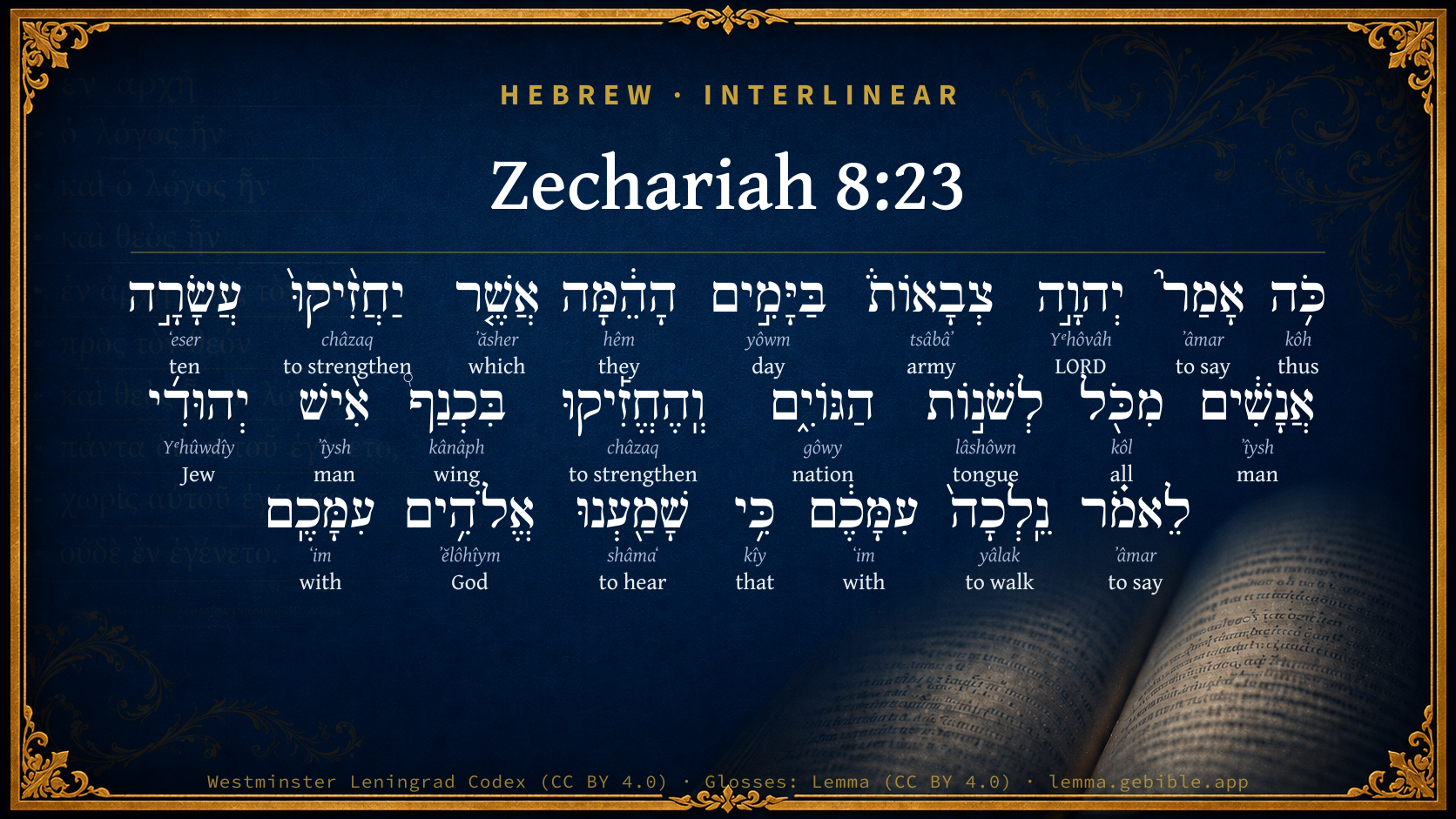
Hebrew (Westminster Leningrad Codex) Zechariah 8:23 appears in the Hebrew Old Testament. The text above is from the Westminster Leningrad Codex. Each word links to its Strong’s number, a concise gloss, and parsing drawn from the Open Scriptures Hebrew Bible morphology. Click any word for its full Brown-Driver-Briggs (BDB) entry.
Download image
Cite this verse

Zechariah 8:23 (World English Bible). Public Domain. Lemma interlinear Bible study tool, https://lemma.gebible.app/v/zechariah/8/23.

Show BibTeX & RIS
BibTeX
RIS
English Translation
Thus says Yahweh of Hosts: "In those days, ten men will take hold, out of all the languages of the nations, they will take hold of the skirt of him who is a Jew, saying, 'We will go with you, for we have heard that God is with you.'"
World English Bible · Public Domain
Download a study sheet

One document with this verse’s original text, its word-by-word gloss line, the meaning frame, cross-references with their text, attributed commentary, and full source and license credits — printable, and it pastes into notes with its structure intact.

This verse Autodidact and up

Study sheet (.html) Plain text (.txt)

A passage Seminary Student

Up to 50 verses in one chapter. A passage sheet keeps up to 6 commentary sources and 12 cross-references per verse, in the order this page ranks them, and says so on the sheet whenever that leaves anything out. Ask for a single verse and you get the Autodidact verse sheet above.

Everything on this page stays free to read, with no account — the sheet is a download of what is already on screen, not access to it.

Want to remove ads? Support Godless Engineer
Compare translations 3

The same verse in 3 English versions, stacked beneath the original-language interlinear above. Click any original word for its lexicon entry.

Each is an independent rendering of the whole verse — the interlinear is not word-aligned to these translations.

Highlighted words mark where these versions differ — a whole-verse word diff, not a word-by-word alignment.

  • World English Bible Public Domain
    Thus says Yahweh of Hosts: "In those days, ten men will take hold, out of all the languages of the nations, they will take hold of the skirt of him who is a Jew, saying, 'We will go with you, for we have heard that God is with you.'"
  • King James Version Public Domain
    Thus saith the LORD of hosts; In those days it shall come to pass, that ten men shall take hold out of all languages of the nations, even shall take hold of the skirt of him that is a Jew, saying, We will go with you: for we have heard that God is with you.
  • unfoldingWord Literal Text CC BY-SA 4.0
    Yahweh of hosts says this: In those days ten men from every language and nation will grasp the hem of your robe and say, ‘Let us go with you, for we have heard God with you!’”

unfoldingWord Literal Text — © unfoldingWord, licensed CC BY-SA 4.0. Word-aligned USFM3 via Door43 (git.door43.org/unfoldingWord/en_ult).

Versions to compare (up to 4)

3 of 4 selected

Show all 18 translations

Every available English version of this verse, each an independent rendering of the whole verse.

  • World English Bible Public Domain
    Thus says Yahweh of Hosts: "In those days, ten men will take hold, out of all the languages of the nations, they will take hold of the skirt of him who is a Jew, saying, 'We will go with you, for we have heard that God is with you.'"
  • Berean Standard Bible Public Domain
    This is what the LORD of Hosts says: “In those days ten men from the nations of every tongue will tightly grasp the robe of a Jew, saying, ‘Let us go with you, for we have heard that God is with you.’”
  • Majority Standard Bible Public Domain
    This is what the LORD of Hosts says: “In those days ten men from the nations of every tongue will tightly grasp the robe of a Jew, saying, ‘Let us go with you, for we have heard that God is with you.’”
  • King James Version Public Domain
    Thus saith the LORD of hosts; In those days it shall come to pass, that ten men shall take hold out of all languages of the nations, even shall take hold of the skirt of him that is a Jew, saying, We will go with you: for we have heard that God is with you.
  • American Standard Version (1901) Public Domain
    Thus saith Jehovah of hosts: In those days `it shall come to pass', that ten men shall take hold, out of all the languages of the nations, they shall take hold of the skirt of him that is a Jew, saying, We will go with you, for we have heard that God is with you.
  • Revised Version (1885) Public Domain
    Thus saith the LORD of hosts: In those days it shall come to pass, that ten men shall take hold, out of all the languages of the nations, shall even take hold of the skirt of him that is a Jew, saying, We will go with you, for we have heard that God is with you.
  • Geneva Bible (1599) Public Domain
    Thus sayth the Lord of hostes, In those dayes shall ten men take holde out of all languages of the nations, euen take holde of the skirt of him that is a Iewe, and say, We will go with you: for we haue heard that God is with you.
  • Douay-Rheims (1899) Public Domain
    Thus saith the Lord of hosts: In those days, wherein ten men of all languages of the Gentiles shall take hold, and shall hold fast the shirt of one that is a Jew, saying: We will go with you: for we have heard that God is with you.
  • Young's Literal Translation Public Domain
    Thus said Jehovah of Hosts: In those days take hold do ten men of all languages of the nations, Yea, they have taken hold on the skirt of a man, a Jew, saying: We go with you, for we heard God `is' with you!
  • Literal Standard Version CC BY-SA 4.0
    Thus said YHWH of Hosts: In those days ten men of all languages of the nations take hold, || Indeed, they have taken hold on the skirt of a man, a Jew, saying, || We go with you, for we heard God [is] with you!”
  • Unlocked Literal Bible CC BY-SA 4.0
    Yahweh of hosts says this: In those days ten men from every language and nation will grasp the hem of your robe and say, 'Let us go with you, for we have heard that God is with you!'”
  • unfoldingWord Literal Text CC BY-SA 4.0
    Yahweh of hosts says this: In those days ten men from every language and nation will grasp the hem of your robe and say, ‘Let us go with you, for we have heard God with you!’”
  • Darby Bible Public Domain
    Thus saith Jehovah of hosts: In those days shall ten men take hold, out of all languages of the nations, shall even take hold of the skirt of him that is a Jew, saying, We will go with you; for we have heard [that] God is with you.
  • World Messianic Bible Public Domain
    The LORD of Hosts says: “In those days, ten men out of all the languages of the nations will take hold of the skirt of him who is a Jew, saying, ‘We will go with you, for we have heard that God is with you.’”
  • Webster's Bible Public Domain
    Thus saith the LORD of hosts: In those days it shall come to pass, that ten men out of all languages of the nations, shall take hold, shall even take hold of the skirt of him that is a Jew, saying, We will go with you: for we have heard that God is with you.
  • Free Bible Version CC BY-SA 4.0
    This is what the Lord Almighty says: At that time ten men from different nations and languages will grab hold of the hem of a Jewish man's robe and plead, “Please take us with you for we have heard that God is with you.”
  • Bible in Basic English Public Domain
    This is what the Lord of armies has said: In those days, ten men from all the languages of the nations will put out their hands and take a grip of the skirt of him who is a Jew, saying, We will go with you, for it has come to our ears that God is with you.
  • JPS Tanakh (1917) Public Domain
    Thus saith the LORD of hosts: In those days it shall come to pass, that ten men shall take hold, out of all the languages of the nations, shall even take hold of the skirt of him that is a Jew, saying: We will go with you, for we have heard that God is with you.'

Literal Standard Version (2020), Covenant Press — licensed CC BY-SA 4.0. Text via the HelloAO Bible API (eBible.org). Unlocked Literal Bible (unfoldingWord) — licensed CC BY-SA 4.0. Text via the HelloAO Bible API (eBible.org). unfoldingWord Literal Text — © unfoldingWord, licensed CC BY-SA 4.0. Word-aligned USFM3 via Door43 (git.door43.org/unfoldingWord/en_ult). Free Bible Version, Dr. Jonathan Gallagher — licensed CC BY-SA 4.0. Text via the HelloAO Bible API (eBible.org).

Word by word

More ways to search: Search by grammar → Find every occurrence → Compare this word →

Practice this passage: Drill this verse → Learn its vocabulary →

יְהוּדִ֜י
Yᵉhûwdîy
H3064
“Jew”
Noun, Proper
Part of Speech
Noun
Type
Proper
Full BDB Definition

Origin: patronymically from H3063

TWOT: 850a

Jew
  1. כֹּ֥ה kôh H3541 “thus” Adverb
  2. אָמַר֮ ʼâmar H559 “to say” Verb, Qal, Perfect, 3rd Person, Masculine, Singular
  3. יְהוָ֣ה Yᵉhôvâh H3068 “LORD” Noun, Proper
  4. צְבָאוֹת֒ tsâbâʼ H6635 “armies” Noun, Common, Both, Plural, Absolute
  5. בַּיָּמִ֣ים yôwm H3117 “in/at the · days” Preposition, Determined + Noun, Common, Masculine, Plural, Absolute
  6. הָהֵ֔מָּה hêm H1992 “the · they” Particle, Definite Article + Pronoun, Personal, 3rd Person, Masculine, Plural
  7. אֲשֶׁ֤ר ʼăsher H834 “which” Particle, Relative
  8. יַחֲזִ֨יקוּ֙ châzaq H2388 “to strengthen” Verb, Hiphil, Imperfect, 3rd Person, Masculine, Plural
  9. עֲשָׂרָ֣ה ʻeser H6235 “ten” Adjective, Cardinal number, Masculine, Singular, Absolute
  10. אֲנָשִׁ֔ים ʼîysh H376 “men” Noun, Common, Masculine, Plural, Absolute
  11. מִכֹּ֖ל kôl H3605 “from · all of” Preposition + Noun, Common, Masculine, Singular, Construct
  12. לְשֹׁנ֣וֹת lâshôwn H3956 “tongues of” Noun, Common, Both, Plural, Construct
  13. הַגּוֹיִ֑ם gôwy H1471 “the · nations” Particle, Definite Article + Noun, Common, Masculine, Plural, Absolute
  14. וְֽהֶחֱזִ֡יקוּ châzaq H2388 “and · to strengthen” Conjunction + Verb, Hiphil, Perfect, 3rd Person, Common, Plural
  15. בִּכְנַף֩ kânâph H3671 “in/at · wing of” Preposition + Noun, Common, Feminine, Singular, Construct
  16. אִ֨ישׁ ʼîysh H376 “man” Noun, Common, Masculine, Singular, Absolute
  17. לֵאמֹ֗ר ʼâmar H559 “to say” Preposition + Verb, Qal, Infinitive Construct
  18. נֵֽלְכָה֙ yâlak H3212 “to walk” Verb, Qal, Cohortative, 1st Person, Common, Plural
  19. עִמָּכֶ֔ם ʻim H5973 “with · you” Preposition + Suffix, Personal, 2nd Person, Masculine, Plural
  20. כִּ֥י kîy H3588 “that” Conjunction
  21. שָׁמַ֖עְנוּ shâmaʻ H8085 “to hear” Verb, Qal, Perfect, 1st Person, Common, Plural
  22. אֱלֹהִ֥ים ʼĕlôhîym H430 “God(s)” Noun, Common, Masculine, Plural, Absolute
  23. עִמָּכֶֽם ʻim H5973 “with · you” Preposition + Suffix, Personal, 2nd Person, Masculine, Plural

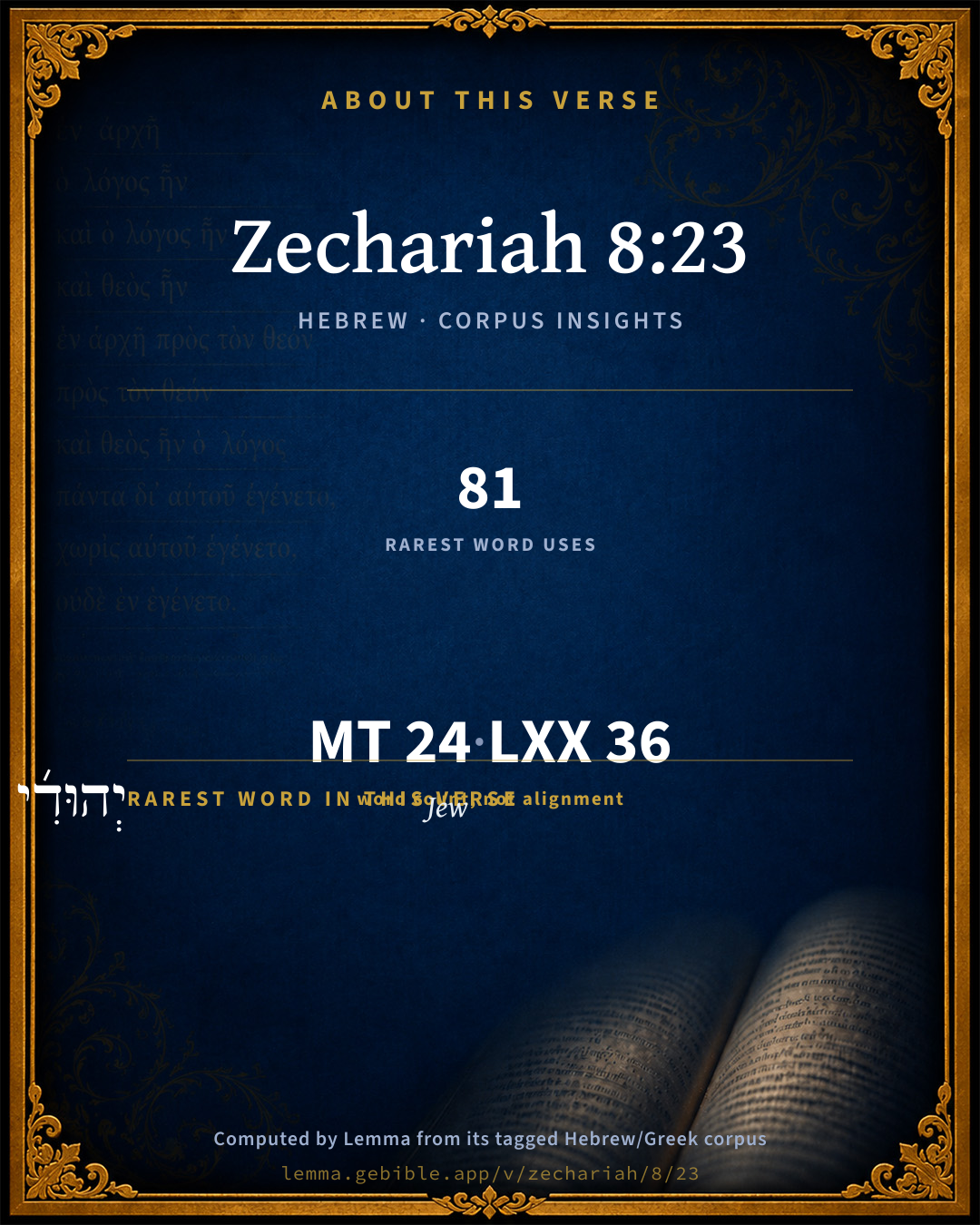
About this verse

These counts appear in no published source. They are computed here, from the morphology-tagged text and Lemma’s own curated glosses. What Lemma adds →

24
words
20
distinct lemmas
Prophets
section

Grammatical profile

  • 6 verbs
  • 11 nouns
  • 1 adjective
  • 1 pronoun
  • 2 prepositions
  • 1 conjunction
  • 1 adverb
  • 1 particle

Verb forms

  • אָמַר֮ Qal · Perfect
  • יַחֲזִ֨יקוּ֙ Hiphil · Imperfect
  • וְֽהֶחֱזִ֡יקוּ Hiphil · Perfect
  • לֵאמֹ֗ר Qal · Infinitive Construct
  • נֵֽלְכָה֙ Qal · Cohortative
  • שָׁמַ֖עְנוּ Qal · Perfect

Repetition

Words recur within this verse — often emphatic in Hebrew:

  • אָמַר֮ to say H559 ×2
  • יַחֲזִ֨יקוּ֙ to strengthen H2388 ×2
  • אֲנָשִׁ֔ים man H376 ×2
  • עִמָּכֶ֔ם with H5973 ×2

Hebrew & Septuagint length

In English translation the verse runs 49 words from the Hebrew and 49 from the Septuagint (LXX English) — the same length.

A rough comparison of the two English renderings, which tokenize alike — not a word-level alignment.

Word counts can differ between the Hebrew and the Greek without any difference in meaning — e.g. the Hebrew direct-object marker אֵת has no separate Greek word, and Greek often adds the article ὁ.

In the original languages it is 24 Hebrew tokens and 36 Greek tokens — but the two are counted differently (Hebrew bundles its prefixes and suffixes into one token; the Greek is in lemma form), so that isn’t a like-for-like length.

Cross-references

29

Topical passages linked to Zechariah 8:23 in the Treasury of Scripture Knowledge — connected by theme and wording, ordered by reader-vote popularity; previews shown in the World English Bible.

  • Isaiah 55:5 Behold, you shall call a nation that you don't know; and a nation that didn't know you shall run to you, because of Yahweh your God, and for the Holy One of Israel; for he has glorified you.
  • 1 Corinthians 14:25 And thus the secrets of his heart are revealed. So he will fall down on his face and worship God, declaring that God is among you indeed.
  • Isaiah 45:14 Thus says Yahweh: "The labor of Egypt, and the merchandise of Ethiopia, and the Sabeans, men of stature, shall come over to you, and they shall be yours. They shall go after you. In chains they shall come over; and they shall fall down to you. They shall make supplication to you: 'Surely God is in you; and there is none else, there is no other god.
  • Isaiah 60:3 Nations shall come to your light, and kings to the brightness of your rising.
  • Acts 13:47–48 For so has the Lord commanded us, saying, 'I have set you as a light for the Gentiles, That you should bring salvation to the uttermost parts of the earth.'"
  • Isaiah 66:18 For I [know] their works and their thoughts: [the time] comes, that I will gather all nations and languages; and they shall come, and shall see my glory.
  • Joshua 2:9–13 and she said to the men, I know that Yahweh has given you the land, and that the fear of you is fallen on us, and that all the inhabitants of the land melt away before you.
  • Ruth 1:16–17 Ruth said, "Don't entreat me to leave you, and to return from following after you, for where you go, I will go; and where you lodge, I will lodge; your people shall be my people, and your God my God;
  • 1 Kings 8:42–43 (for they shall hear of your great name, and of your mighty hand, and of your outstretched arm); when he shall come and pray toward this house;
  • Revelation 14:6–7 I saw an angel flying in mid heaven, having an eternal Gospel to proclaim to those who dwell on the earth, and to every nation, tribe, language, and people.
  • Genesis 31:7 Your father has deceived me, and changed my wages ten times, but God didn't allow him to hurt me.
  • Acts 19:12 so that even handkerchiefs or aprons were carried away from his body to the sick, and the evil spirits went out.
  • Isaiah 4:1 Seven women shall take hold of one man in that day, saying, "We will eat our own bread, and wear our own clothing: only let us be called by your name. Take away our reproach."
  • Revelation 7:9–10 After these things I looked, and behold, a great multitude, which no man could number, out of every nation and of all tribes, peoples, and languages, standing before the throne and before the Lamb, dressed in white robes, with palm branches in their hands.
  • Numbers 10:29–32 Moses said to Hobab, the son of Reuel the Midianite, Moses' father-in-law, We are journeying to the place of which Yahweh said, I will give it you: come you with us, and we will do you good; for Yahweh has spoken good concerning Israel.
  • Numbers 14:14–16 and they will tell it to the inhabitants of this land. They have heard that you Yahweh are in the midst of this people; for you Yahweh are seen face to face, and your cloud stands over them, and you go before them, in a pillar of cloud by day, and in a pillar of fire by night.
  • Deuteronomy 4:6–7 Keep therefore and do them; for this is your wisdom and your understanding in the sight of the peoples, who shall hear all these statutes, and say, Surely this great nation is a wise and understanding people.
  • 1 Samuel 15:27–28 As Samuel turned about to go away, [Saul] laid hold on the skirt of his robe, and it tore.
  • 2 Kings 2:6 Elijah said to him, "Please wait here, for Yahweh has sent me to the Jordan." He said, "As Yahweh lives, and as your soul lives, I will not leave you." They two went on.
  • 1 Chronicles 12:18 Then the Spirit came on Amasai, who was chief of the thirty, [and he said], "We are yours, David, and on your side, you son of Jesse: peace, peace be to you, and peace be to your helpers; for your God helps you." Then David received them, and made them captains of the band.
  • Job 19:3 You have reproached me ten times. You aren't ashamed that you attack me.
  • Ecclesiastes 11:2 Give a portion to seven, yes, even to eight; For you don't know what evil will be on the earth.
  • Isaiah 3:6 Indeed a man shall take hold of his brother in the house of his father, saying, "You have clothing, you be our ruler, And let this ruin be under your hand."
  • Genesis 31:41 These twenty years have I been in your house. I served you fourteen years for your two daughters, and six years for your flock, and you have changed my wages ten times.
  • Micah 5:5 He will be our peace when Assyria invades our land, And when he marches through our fortresses, Then we will raise against him seven shepherds, And eight leaders of men.
  • Luke 8:44 came behind him, and touched the fringe of his cloak, and immediately the flow of her blood stopped.
  • Numbers 14:22 because all those men who have seen my glory, and my signs, which I worked in Egypt and in the wilderness, yet have tempted me these ten times, and have not listened to my voice;
  • 2 Samuel 15:19–22 Then said the king to Ittai the Gittite, Why go you also with us? return, and abide with the king: for you are a foreigner, and also an exile; [return] to your own place.
  • Matthew 18:21–22 Then Peter came and said to him, "Lord, how often shall my brother sin against me, and I forgive him? Until seven times?"

Cross-references courtesy of OpenBible.info (CC BY 4.0).

Hebrew and Greek witnesses Masoretic Hebrew ↔ Greek Septuagint

The same verse in the two great witnesses to the Old Testament, shown verse-for-verse.

These are two independent witnesses, not word-aligned to each other, and the Septuagint is shown in lemma (dictionary) form.

Hebrew Zechariah 8:23 Masoretic · Westminster Leningrad Codex

כֹּ֥ה אָמַר֮ יְהוָ֣ה צְבָאוֹת֒ בַּיָּמִ֣ים הָהֵ֔מָּה אֲשֶׁ֤ר יַחֲזִ֨יקוּ֙ עֲשָׂרָ֣ה אֲנָשִׁ֔ים מִכֹּ֖ל לְשֹׁנ֣וֹת הַגּוֹיִ֑ם וְֽהֶחֱזִ֡יקוּ בִּכְנַף֩ אִ֨ישׁ יְהוּדִ֜י לֵאמֹ֗ר נֵֽלְכָה֙ עִמָּכֶ֔ם כִּ֥י שָׁמַ֖עְנוּ אֱלֹהִ֥ים עִמָּכֶֽם

Thus says Yahweh of Hosts: "In those days, ten men will take hold, out of all the languages of the nations, they will take hold of the skirt of him who is a Jew, saying, 'We will go with you, for we have heard that God is with you.'"

World English Bible · Public Domain

Greek LXX Zechariah 8:23 Septuagint · lemma form

ὅδε λέγω κύριος παντοκράτωρ ἐν ὁ ἡμέρα ἐκεῖνος ἐάν ἐπιλαμβάνω δέκα ἀνήρ ἐκ πᾶς ὁ γλῶσσα ὁ ἔθνος καί ἐπιλαμβάνω ὁ κράσπεδον ἀνήρ ἰουδαῖος λέγω πορεύομαι μετά σύ διότι ἀκούω ὅτι ὁ θεός μετά σύ εἰμί

Thus says the Lord Almighty; In those days my word shall be fulfilled if ten men of all the languages of the nations should take hold—even take hold of the hem of a Jew, saying, We will go with you; for we have heard that God is with you.

LXX2012 (modern English Septuagint) · Public Domain

On this verse, Jamieson, Fausset & Brown discusses the Septuagint’s reading. Read the note in Commentary ↓

Hebrew: Westminster Leningrad Codex (CC BY 4.0). Greek: Septuagint (public domain); English from LXX2012 (modern English Septuagint) (Public Domain). How the Septuagint differs from the Hebrew →

Targum (Aramaic paraphrase)

1

The Targum is the ancient Jewish Aramaic paraphrase of the Hebrew Scriptures — an interpretive translation, not the Hebrew text itself. Onkelos (literal) and Pseudo-Jonathan (expansive) render the Torah, and Jonathan the Prophets. Coverage is partial: where no permissively-licensed English translation exists for a verse, only the Aramaic is shown. This is verse-level text, not a word-by-word alignment to the Hebrew.

  1. Targum Jonathan Prophets (Joshua–Malachi)
    כִּדְנַן אֲמַר יְיָ צְבָאוֹת בְּיוֹמַיָא הָאִינוּן דִי יִתְקְפוּן עַשְׂרִין גַבְרָא מִכָּל לִישְׁנֵי עַמְמַיָא וְיִתְקְפוּן בִּכְנַף גְבַר יְהוּדִי לְמֵימַר נֵיזֵיל עִמְכוֹן אֲרֵי שְׁמַעְנָא דְמֵימְרָא דַייָ בְּסַעְדְכוֹן:

    (no public-domain English translation for this verse)

    Targum Jonathan — Aramaic: “Mikraot Gedolot” (public domain). English: “Sefaria Community Translation” (CC0 1.0 (public-domain dedication)); “London "Chaldee Paraphrase," 1871” (public domain). Text via Sefaria.

Commentary

Notes on Zechariah 8:23 from classic Christian and Jewish commentators (each source and its license shown beneath its notes). The classic Christian expositions comment on the surrounding passage and are grouped to its opening verse, so a note may address several verses; the Jewish commentaries on the Tanakh (Rashi and others) are per-verse, so they appear only where the commentator wrote on this verse.

Lemma curates 59 commentaries, every one of them public domain or Creative Commons licensed, each selected and text-cleaned for this edition rather than reprinted as found. About our sources →

Trapp's Complete Commentary

John Trapp

Zec 8:23 Thus saith the LORD of hosts; In those days [it shall come to pass], that ten men shall take hold out of all languages of the nations, even shall take hold of the skirt of him that is a Jew, saying, We will go with you: for we have heard [that] God [is] with you.

Ver. 23. Ten men shall take hold out of all languages] Ten, that is, many, "out of all languages," therefore not by compact, or fraudulent convention; for they were far asunder and of diverse languages ( nam quisquo aliis barbarus, saith Calvin).

Of the nations] For God manifested in the flesh was preached unto the Gentiles, believed on in the world, &c., 1Ti 3:16.

Shall take hold, even take hold] As children do on their mother’s garments.

Of him that is a Jew] Who shall not shake them off, as bastard Gentiles, worthy (even the very best of them) to have their heads bruised with the serpent, as the modern Jews say of us. "Come unto me," saith Christ. "Therefore, my brethren dearly beloved and longed for, my joy and crown, so stand fast in the Lord, my dearly beloved," saith Paul, Php 4:1.

We will go with you] Be of your religion; not for fear, or any other alterior motive, as those Persians, Est 8:17. Josephus relates of the Jews, that they were very careful how they received proselytes in Solomon’s time (because then their state flourished), but out of sound conviction, and good affection.

For we have heard] And by hearing tasted, 1Pe 2:3.

That God is with you] "Of a truth," as that plain Corinthian confesseth, 1Co 14:25.

John Trapp, A Commentary or Exposition upon All the Books of the Old and New Testament (1647–1656) — public domain. Text from a community e-Sword module.

The Biblical Illustrator

Joseph S. Exell

Zec_8:23

We will go with you, for we have heard that God is with you

A wise and good resolution

The kingdom of God was to be no longer confined to one nation or people; but multitudes in different climates, and the most distant parts of the earth, should submit to Christ as their ruler, and trust Him as their Saviour.

The term Jew in this connection is descriptive of character rather than of person, and is to be understood of any one who is an Israelite indeed, in whom there is no guile; any humble and sincere believer, who adorns the doctrine of God our Saviour in all things. In the days here predicted such characters shall be highly esteemed.

I. The resolution--We will go with you. This language implies--

1. Approbation and affectionate regard. When grace opens the eyes of a sinner, and takes possession of his heart, those persons and things are contemplated with delight, which before were the objects of aversion and scorn.

2. Earnest desire and a holy determination, is permitted, to associate with the people of God. The same disposition of mind which causes us to cleave to the Lord makes us of one heart with His people.

3. It implies an union of interests as well as of affection. True religion teaches us to renounce all other interests and attachments, to forsake our own people and our fathers house, and cast in our lot with the people of God.

4. A holy ambition to learn of the people of God and to imitate their example. Congeniality of sentiment and feeling is the foundation of religious union, and where that union subsists there will be a desire after a nearer assimilation.

5. Fellowship and communion in Gospel worship and discipline are also included. To those who properly consult their own interest and the glory of God, fellowship with the saints will not only be an article of faith, but an object of fervent desire. One of the ancient fathers thought it a greater honour to be the member of a Christian Church than head of the Roman Empire. This will not only contribute to our safety, by providing a defence against apostasy, but also to our comfort and usefulness; for communion with the saints is oftentimes a step towards communion with God.

II. The ground of the resolution. For we have heard that God is with you. We have heard from the Divine Word, wherein this blessing is promised and declared. We have heard it from yourselves. You have acknowledged His protection and the consolation arising from the Divine presence. We have heard it from others, who observed how your faces shone when you came down from the mount. God is naturally and necessarily present with all His creatures; but He is in a gracious and special manner present with His own people. He draws near and manifests Himself unto them as He does not unto the world. They experience the care of His providence, and enjoy the smiles of His Countenance. He walks with them through the wilderness, He communes with them by the way, He puts His everlasting arms underneath them, and they doubt not of their interest in His favour. Then they can glory in tribulation, bid defiance to the powers of darkness, and look death in the face without fear. We may hence learn--

1. That seclusion from all society is neither the Christians duty nor his privilege.

2. As the presence of God with His people is the principal inducement for others to join themselves to their society, how solicitous should they be to improve this sacred privilege, by seeking much communion with God. The ways of Zion would not So often mourn, if Zions God were more frequently in the midst of her. When primitive believers were edified, walking in the fear of the Lord, and in the comfort of the Holy Ghost, the Churches were greatly multiplied (Act_9:31).

3. Young converts will learn from hence that it is their duty to unite in Christian society, when the Word and ordinances are faithfully administered. (B. Beddome, M. A.)

Christian attraction

I. The attractors. They are called Jews. Generally a very despised people. Were all the countries to come to learn of them? Yes, to learn of them the knowledge of Him whom to know is life eternal. Jesus Christ, His disciples, the writers of the New Testament, etc., were all Jews. The word Jew is not used here so as to distinguish Israelites from Gentiles, so much as saints from sinners; the Church of God, whose members may be derived from any nation, as they may live in any period.

II. The subjects of this attraction. Ten men, etc. This marks the number and also the variety of the proselytes or converts. It means simply a large and not a definite number. Among the Jews ten was the number of perfection. When they would render a number countless, they did it by attaching the word ten. By the ignorance of some, and the sneers of others, and the bigotry of still more, the people of God are now often improperly diminished. If there be a sense in which they may be considered a few, there is a sense also in which they are many, very many. A time is coming when a nation shall be born in a day. Whatever croakers may think or do, there are better days for the world before us, than the world has ever yet seen. Variety is indicated as well as number. Out of the languages of the nations. The Jewish religion, though of Divine origin, never could, in the nature of things, have become a general or universal religion. There is nothing in Christianity that is local, nothing that is restrictive. It regards man, not so much circumstantially considered, as essentially. It regards man in his grand wants. The Gospel provides for the whole of these wants.

III. The grounds of the attraction. The Divine presence. As to His essential presence God is with all His creatures. Gods presence in the Way of promise or privilege means something distinguishable from the perfection of His nature. God is surely with such persons as He was not once; surely He is with such persons as these, as He is not now with others.

IV. The medium of this attraction. It is the knowledge of their state and privilege. Nothing can affect us unless it be known. Though others may make known their religion, they must principally make it known themselves; and for this purpose they must not only be religious, but they must appear religious. Never be ashamed of your religion. If you have any religion, it will not be easy to conceal it; it will break out some way or other. Repentance will get into the eye, and be seen in tears. Meekness will sit in a mans face, and smile like a fine morning in May. It is not easy to restrain powerful emotion. Practically make known your religion to others: actions speak louder than words. Let your tempers tell; let your humility under applause tell; let your liberality with growing wealth tell; let your patience under affliction tell; let your readiness to forgive injuries tell. Let all these tell whose you are, what you are, whence you are born, and whither you are bound.

V. The effect of the attraction. Knowledge is necessary to influence, but all knowledge is not influential. Uninfluential knowledge is worse than none. The knowledge of these people was effective; it constrained them to lay hold, etc. This is a simple and striking expression. It reminds of the little child pulling at his mothers clothes. Man is a social creature as soon as he comes under the power of religion: the social principle will be sanctified as well as other things; and the man will now be able easily enough (though you could not pull him away before) to give up the scenes of vice and vanity. Conclusion--

1. See what it is that makes people valuable, and which should render them interesting and inviting to us.

2. Think of those who, instead of feeling the Divine presence an attraction, feel it to be a repulsion.

3. If such advantages are derivable from connection with the pious, be you concerned to obtain union with them.

4. Let your religion be not only impressive but attractive. Some professors have so much of the repulsive about them that it is not likely any person will ever take hold of their skirts, saying, We will go with you. Whitfield says, God lives with some that I should not live with, and that I could not live with. (William Jay.)

Our obligations to the Jews

So far from joining in the illiberal scorn, too generally poured by men, called Christians, on the dispersed Jews, I feel for them as I should for a father, who had, indeed, disgraced himself, and whose conduct could not even be palliated; but who, after all, was still a father.

I. Explain and illustrate this wonderful prophecy. The God of the Jews, long unknown, except to that obscure and oppressed people, is now the professed object of worship throughout the mightiest and most distinguished nations in the world! This is a fact which cannot be denied or doubted. Such an extraordinary revolution has taken place; and the prophecy of our text was suited to excite the expectation of it. But in what way, and by what means and instruments was it effected? Unless these also accord with the prediction, the fulfilment must be allowed to be imperfect and dubious. From the text we see that whatever means should be employed by the Jews, compulsion was not one of them; the conduct of the persons concerned was perfectly voluntary and the effect of conviction. Even the persuasion and fascination of oratory, as separated from the conviction of the understanding and conscience, producing the outward profession, would not be an unequivocal completion of the prophecy. The instances of Gentiles converted to Judaism, before the coming of Christ, can by no means be considered as fulfilling this prophecy. But reflect on the events which followed the crucifixion, resurrection, and ascension of our Divine Redeemer, the Light of the Gentiles, and the glory of His people Israel. Not only did the apostles, and especially the great apostle of the Gentiles, attract the attention of immense multitudes among the heathen, by faithful preaching; by stupendous miracles, as benevolent as powerful; by a holy example; by patient sufferings, not counting their lives dear unto themselves; and by indefatigable labours, without any other recompense from man than additional sufferings; not only did evangelists and subordinate ministers prosper, but Jews, converted to Christianity, though not ministers, though obscure in station and of slender abilities, by an union of universal conscientiousness, cheerfulness in poverty, patience under persecution and in the most distressing circumstances, and meekness, with persevering benevolence, amidst all manner of provocations and injuries, won over multitudes of the idolaters to go with them. At what other time, or in what other way, has this prophecy been actually fulfilled?

II. The accomplishment of the prophecy has laid us under obligations to the Jews which exceed all calculation. We owe even our own selves to the Jews; in addition to the common debt of goodwill, and compassion, and liberal, active love, which we owe to men in general. Shall we then make only feeble and heartless exertions, where the salvation of the Jewish people is concerned?

III. A still more signal fulfilment of the prophecy in the text will most certainly take place, and at no very remote period. In the final event the nation of Israel shall be restored from their dispersions, placed under the government of their promised Messiah, and (as far as I can judge) reinstated in their own land. (Thomas Scott.)

Purpose of God regarding the Jews

Curious inquiry into the future, and confident prediction as to times and seasons, are both to be eschewed. The former is unprofitable; the latter is most presumptuous. But we must not run from one extreme to another. It is as much our duty now to discern this time, as it was the duty in our Lords day to discern that time. We ought to look behind us, before us, and anticipate the next act of the worlds mighty drama. The dispensation of Gentile mercy has now lasted for nearly 2000 years. But it is not designed to be eternal. We have plainly laid down for us in Holy Scripture the signs which shall mark its closing in, when God shall turn Himself to the Jew again. And we are as much bound to look at these signs now as the Jew was in his day. These signs are four in number. Two given by our Lord Himself, and two by the prophet Daniel.

1. This Gospel of the kingdom shall be preached in all the world for a witness unto all nations; and then shall the end come (Mat_24:14). Our Lords second sign is a painful one. Iniquity shall abound (Mat_24:12). Daniels first sign is, Many shall run to and fro. His second is like unto it. Knowledge shall be increased, Let us look around us, behind us, before us; do we see anything like the fulfilment of these predicted signs? He must be blind indeed who does not see the first sign advancing rapidly to its fulfilment, in the Gospel of the kingdom published to all nations. There are now afloat in the world about two hundred million copies, of a translated Bible. This enormous circulation is seconded by corresponding preaching. But the world is not yet converted? No, for Christs sign is not its conversion, but His Gospel preached as a witness. The Christian Church is now gathering the first fruits of the earth. Everyone has the fulfilment before him of Daniels sign, Many shall run to and fro. In this the prophet gives us exactly the characteristic of the present age. Daniels second sign is equally manifest in our time. It is the amazing progress of science which has enabled us to avail ourselves of the powers of nature. With all this running to and fro, and all this advance of knowledge, is the world to go on improving in its spiritual and moral character? Our Lords last sign, iniquity shall abound, affirms the contrary, And His apostle explains in detail the meaning of His Masters words (2Ti_3:1-4). There are too many signs that these perilous times are already upon us. Never in the experience of civilised Christendom has crime been so audacious as now. As the times of the Gentiles seem closing in, the Jew is coming again into prominence. May we then expect that the Jew will come up once more as a nation, to act his part in the worlds great drama? Distinguished expositors tell us that the prophecies respecting the Jews have all been fulfilled in the past, and no prophecy whatever respects the Jews in the future. When were the solemn words of the text fulfilled? Judah returned from Babylon, indeed, but it was to remain in the midst of the nations, a humbled and despised people. But they shall be fulfilled when, in the words of St. Paul, the Jews shall be as life from the dead to the nations of the earth, and a worlds love and gratitude and devotion shall be their spontaneous and most abundant recompense. (William Tait, D. D.)

Uniting with Gods people

The passage seems primarily to refer to the general conversion of Gentile nations. We consider the text as it may apply to those who, having been awakened to a sense of their ruined condition, resolve to consecrate themselves to God and His people.

I. What is implied in God being with His people?

1. Gods essential presence is everywhere.

2. Gods glorious presence is in heaven.

3. His terrible presence is felt in the abodes of the lost.

4. His providential presence is seen in the government and regulation of the world.

5. His presence referred to in the text is His gracious presence.

He is with His Church in the exercise of His love and favour. As their Head, Friend, Prophet, Mediator, and King.

II. The evidences of Gods presence. External splendour, great wealth, a multitude of members, are not evidence.

1. Scriptural doctrine is an evidence.

2. So is purity of ordinances.

3. So is brotherly love.

4. When Divine changes are produced in the power of the Gospel.

5. When the reproach of the Cross is endured.

III. The influence the presence of God in the Church shall produce on those who are without. We will go with you, etc. This resolution implies--

1. Dissatisfaction with their present condition.

2. Earnest desire to be united with Gods people. (J. Burns.)

The supernatural in religion

By supernatural is meant that which is above nature, above and beyond what natural causes, coupled with human agency, might produce. The reason why effort is made to take the supernatural out of religion is that already God is taken out of the universe. Having already taken an intelligent, reasoning, personal God out of the universe, as a matter of course everything supernatural must come out of the Bible, and out of the character of the Lord Jesus Christ; and there is nothing anywhere above nature, and above the power of human agency. This is the philosophy--this is the religion that modern rationalism proposes to give to mankind. But in taking all that is supernatural out of religion, it takes away religion itself. The supernatural may be predicated of religion in two distinct senses.

1. Historical. Every system of religion that has claimed the assent of the human mind, and the acceptance of the human heart, has claimed a supernatural origin. This claim arises out of a law of mind. The effect must be in harmony with the cause. The supernatural of the Christian religion is evinced in the two great branches of evidence--miracles and prophecy.

2. Another depart in religion is more important. Its intrinsic character as it now is. All that is supernatural in religion, whether it be considered historically or intrinsically, arises out of the being or presence of God in it, or with it. If there is a God He may surely do that which is above nature itself; for if He created all things, that act of creation was something above nature. God is the author of nature, the author of its laws, and of its being. The great underlying cause of the supernatural, historically and intrinsically in religion, is, God present with His people. The idea of the Divine coming down to mankind and communing with men runs through every form of religion. If there be a God, He is somewhere, in some relationship; He is with or without the power of fellowship. If He be without it, He is below the lowest living creatures He has made. If He be with it, He is above all. He can speak to an archangel; He can speak to my heart. There is only one possible reason why God should withdraw Himself from men, and that reason is sin. Gods presence among His people will be manifested, will assert itself.

There are several ways in which the presence of God among His people indicates itself.

1. In the superior knowledge of God that prevails among His people. How come we to have a more accurate knowledge of God than the pagan nations?

2. There is an indication of Gods presence among His people in their superior, intellectual, moral, and religious condition. Compare Christian and pagan nations in this regard.

3. There is a manifestation of Gods presence with His people in the direct impression that is made upon the consciousness of men. In the olden time, God revealed Himself under visible forms. God has been educating the race away from its dependence on the senses. Our Lord Jesus Christ formed a point of transition. Now, there is a manifestation of God to the human consciousness, so that when God comes into my soul I can recognise Him, and know that it is God who is coming in.

4. Gods presence among His people is manifested in the works of power accomplished. No man can do these miracles which Thou doest, except God be with Him.

5. God manifests His presence and power in the singular experience that He gives to human souls. Take as a practical lesson from this subject, that our greatest need is God, God in Jesus Christ, God by the Holy Ghost dwelling within us, shining out of the eye and out of the life, and God living in us, so that we form part of the Divine life, so that it shall shine out of us. O for the presence of God to be more and more distinctly apprehended among His people. (Dr. Kynett.)

Admission of the Gentiles

The form of this prophecy is highly dramatic. The scope of it is to predict the introduction of the Gentiles into the theocracy, and the consequent enlargement of the Church. This is described by a bold and beautiful personification. To seize the hem of the garment is a gesture of earnestness, importunity, and perseverance, which is emphatic were it done by only a single person, but when done by ten persons, it becomes significant of an intensity of anxiety, and a depth of conviction, of the very highest grade. When this prediction was uttered nothing seemed more hopelessly improbable than its fulfilment. The Jews were a poor, despised, obscure tribe in the heart of Syria, whose existence was only known to the mighty world by their furnishing a trophy to the victorious arms of Babylon. Greece was just rising in the firmament of human history, and as she ascended to her brilliant zenith, her track was marked by the sweeping of the phalanxes of Alexander, and the legions of Antiochus, over the hills and valleys of Judea. And yet this prophecy remained unfulfilled. At length the time arrived, and there came to Jerusalem men out of every nation under heaven; see Act_2:1-47. Learn, that all true piety is instinct with the missionary spirit, desire for the salvation of others. (T. V. Moore, D. D.)

.

The Biblical Illustrator, edited by Joseph S. Exell (c. 1880s–1900s) — public domain. Text from a community e-Sword module.

Joseph Benson's Commentary

Zec 8:23. In those days ten men — That is, many men, a definite number being put for an indefinite. Out of all languages of the nations — From many different and remote countries, no nation being any longer excluded; shall take hold of the skirt of him that is a Jew — Christians are sometimes called by the name of Jews, as being confessors of the true religion, and those to whom the promises, made to the fathers of the Jewish nation, chiefly belong. In this sense especially the word is here to be taken. To take hold of another is a gesture of entreating his friendly assistance: see the notes on Isa 3:6; Isa 4:1. The meaning of the passage, therefore, is, that the heathen should apply themselves to the Christians, particularly to Christian pastors and ministers, for instruction, in order to qualify themselves for admittance into the church.

Joseph Benson's Commentary on the Old and New Testaments (1811–1818) — public domain. Text from a community e-Sword module.

Scofield Reference Notes

C. I. Scofield

those days

i.e. in the days when Jerusalem has been made the centre of the earth’s worship. Zec 8:23 explains: the Jew (see "Remnant,"; Isa 1:9; Rom 11:5 will then be the missionary, and to the very "nations" now called "Christian"!

For Another Point of View: See Topic 301242

The Scofield Reference Bible (1917 edition), notes by C. I. Scofield — public domain. Text from a community e-Sword module.

Tyndale Open Study Notes

Tyndale Open Resources

8:23 God is with you: God’s presence restored the ideal of fellowship between God and human beings (Gen 3:8; Exod 24:9-11; 25:8; Isa 7:14; 57:15; Ezek 43:7; John 1:14).

Tyndale Open Study Notes — © Tyndale Open Resources, licensed CC BY-SA 4.0. Text via the HelloAO Bible API.

Jamieson, Fausset & Brown

Robert Jamieson, A. R. Fausset & David Brown

ten--a definite number for an indefinite. So in Lev 22:26; Num 14:22.

of all languages of the nations--that is, of nations of all languages (compare Isa 66:18; Rev 7:9).

take hold of the skirt--a gesture of suppliant entreaty as to a superior. Compare Isa 3:6; Isa 4:1, on a different occasion. The Gentiles shall eagerly seek to share the religious privileges of the Jew. The skirt with a fringe and blue ribbon upon it (Num 15:38; Deu 22:12) was a distinguishing badge of a Jew.

God is with you--the effect produced on unbelievers in entering the assemblies of the Church (Co1 14:25). But primarily, that produced on the nations in witnessing the deliverance of the Jews by Cyrus. Finally, that to be produced on the nations by the future grand interposition of Messiah in behalf of His people.

Written long after the previous portions of the book, whence arise the various features which have been made grounds for attacking their authenticity, notwithstanding the testimony of the Septuagint and of the compilers of the Jewish canon in their favor. See Introduction.

ALEXANDER'S CONQUESTS IN SYRIA (Zac 9:1-8). GOD'S PEOPLE SAFE BECAUSE HER COMETH LOWLY, BUT A SAVIOUR (Zac 9:9-10). THE MACCABEAN DELIVERANCE A TYPE THEREOF (Zac 9:11-17).

Next: Zechariah Chapter 9

Jamieson, Fausset & Brown — Commentary Critical and Explanatory on the Whole Bible (1871) — public domain (CC PDM 1.0). Text via the HelloAO Bible API.

Adam Clarke's Commentary

Verse 23. Ten men - shall take hold of the skirt of him that is a Jew] The converts from among the Gentiles shall be to the Jews as ten to one. But ten may here signify a great number, without comparison. And from this scripture it appears as if the Jews, converted to God, should be the instruments of converting many Gentiles. See on Isa 3:6. Catching hold of the skirt is a gesture naturally used to entreat assistance and protection. This and the three foregoing verses, says Abp. Newcome, refer to the great accession of converts which the Jewish Church received between the captivity and the coming of Christ; to the number of Christian disciples which the Jewish preachers made, and to the future conversions of which the restoration of the Jews will be an eminent cause.

Adam Clarke's Commentary on the Bible (1810–1826) — public domain. Text from a community e-Sword/MySword module.

John Calvin's Commentaries

He pursues the same subject in this verse; for as he had before said, that the nations would willingly come to worship God, and that each would encourage his brother to undertake this pious and holy expedition, so he now adds, that ten men would lay hold on the border of a Jew’s garment: Ten men shall then take hold of the skirt of a Jew. He shows here more clearly what I have briefly referred to — that there would be no need of arms, or of any compulsion, in order to draw or compel the nations to engage in God’s service; for even ten would of themselves accompany one Jew; and it is a proof of a very great readiness when ten surrender themselves to be ruled by one. As one Jew could not be sufficient to draw so many nations, the Prophet declares that there would be everywhere a union of faith, so that those, before wholly alienated from God, would desire to join themselves as friends, or rather as companions to the Jews.

He says, From all languages. By these words he amplifies the miracle; for there cannot be a union between men far distant, especially when they are of different languages, as they are barbarians to one another. When the Prophet then says that they would come from all languages, and unite together, it more fully appears to be God’s work; for there is nothing here to be ascribed to human contrivances. It must then be that the hearts of those who cannot express their minds, and can hardly give a sign, are united together by the hidden power of the Spirit. We now perceive the Prophet’s object in this verse.

But he uses in the last clause a phrase different from the one he employed before — Let us go with you, for we have heard that with you is God. He had said, “Let us go to seek Jehovah, and to entreat his face;” but now he says “Let us go with you.” But yet he handles and confirms the same thing; for the nations could not have sought God without following the Jews going before them. For when any one separates himself from others, it so happens that he is led astray, and feeds on much that is very absurd, as we see to be the case with proud and morose men, who invent strange and monstrous things; for they shun society, and seem not to themselves to be wise, until they put off every feeling of humanity. The character then of faith has also this in it — that the elect, while they themselves obey God, desire to have many associates in this obedience, and many fellow-disciples in true religion. The Prophet thus intended to point out two things: be had said before — “Let us go to seek God;” and now — “We will go with you.” What else is this but to seek God? But he expresses more now — that the nations declare that they would come to seek God for this end — that they might learn from others, like rude beginners, who have their fellow-scholars as their teachers; so that every one who had made some progress, was to preside over others, and those as yet commencing, and still in the first elements of knowledge, were humbly to connect themselves with others better informed. Shame prevents many from making in this manner any advancement, and so they ever remain sunk in ignorance.

The Prophet at the same time not only commends humility, but also exhorts all God’s children to cultivate unity and concord. For whosoever tears asunder the Church of God, disunites himself from Christ, who is the head, and who would have all his members to be united together.

We now then understand that God ought to be sought in order to be rightly worshipped by us; and also, that he ought to be thus sought, not that each may have his own peculiar religion, but that we may be united together, and that every one who sees his brethren going before, and excelling in gifts, may be prepared to follow them, and to seek benefit from their labors. It is indeed true that we ought to disregard the whole world; and to embrace only the truth of God; for it is a hundred times better to renounce the society of all mortals, and union with them, then to withdraw ourselves from God; but when God shows himself as our leader, the Prophet teaches us that we ought mutually to stretch forth our hand and unitedly to follow him.

We have again to notice at the end of the verse what I have already referred to — that the nations would come, not compelled by force of arms or by violence, but drawn by hearing alone. We have heard. By hearing the Prophet means here the doctrine of salvation everywhere diffused; for there would be no care nor concern for worshipping were we not taught; for faith, as Paul says, is by hearing; and so prayer proceeds from faith. (Romans 10:17.) In short, the Prophet means that the knowledge of religion would be through the preaching of the truth, which would rouse all nations to the duty of worshipping God.

He now again confirms what we have also mentioned — that the Jews would have the precedence of all nations; for it appears that God would be among them. We hence see that primacy is not ascribed to the Jews in being leaders to others, because they excelled others by their own virtue or dignity, but because God presided over them. Then God is ever to be sought, though we may avail ourselves of the labors of men, and follow them when they show us the right way. We must ever bear this in mind — that those only exhort truly and honestly, who not only do so by word, but who really prove what they feel by their conduct; according to what the Prophet has said — Go will I also; and he says the same now — Let us go, or, we shall go with you. For many there are who are strenuous enough in stimulating others; but their vain garrulity appears evident; for while they bid others to run, they are standing still; and while they vehemently encourage others, they themselves delay and take their rest. Now follows —

John Calvin's Commentaries (1540-1563) — public domain. Text from the Calvin Translation Society English edition (1840s-50s) via the Christian Classics Ethereal Library (ccel.org). Calvin's coverage is partial (roughly two-thirds of the Bible); uncommented books and verses are honest gaps, never fabricated. The 19th-century editor's footnotes and remarks are omitted so the notes are faithfully Calvin's own voice.

Ellicott's Commentary for English Readers

(23) Ten.—This number is used indefinitely, to express a large number (comp. Gen_31:7); the number “seven” is used in a like sense in Isa_4:1.

A Bible Commentary for English Readers, edited by Charles John Ellicott (1878–1897) — public domain. Text from a community e-Sword module.

The Cambridge Bible for Schools and Colleges

gen. ed. J. J. S. Perowne

23. ten men] i.e. a large number. Comp. Gen_31:7; Lev_26:26; Num_14:22; Neh_4:12.

take hold of the skirt] See Hag_2:12, and comp. Isa_4:1.

The Cambridge Bible for Schools and Colleges (gen. ed. J. J. S. Perowne; Cambridge University Press, 1878–1918) — public domain. Text from a community e-Sword module.

Albert Barnes' Notes on the Bible

Ten men of all languages of the nations - Ten is the symbol of a whole, all the numbers before it meeting in it and starting again from it. The day of Pentecost was to be the reversal of the confusion of Babel; all were to have one voice, as God had said, “It (the time) shall come to gather all nations and tongues, and they shall come and see My glory” Isa 66:18.

They shall lay hold of the skirt of one man who is a Jew - Jerome: “That is, of the Lord and Saviour, of whom it is said, “A prince shall not depart from Judah, nor a lawgiver from between his feet, until He shall come, for whom it is laid up, and for Him shall the Gentiles wait” Gen 49:8-10; for “there shall be a rod of Jesse, and He who shall arise to rule over the Gentiles, to Him shall the Gentiles seek” Isa 11:10. And when they shall lay hold of Him, they shall desire to tread in His steps, since God is with Him. Or else, whosoever shall believe out of all nations, shall lay hold of a man who is a Jew, the Apostles who are from the Jews, and shall say, Let us go with you; for we have known through the prophets and from the voice of all the Scriptures, that the Son of God, Christ, God and Lord, is with you. Where there is a most manifest prophecy, and the coming of Christ and His Apostles and the faith of all nations is preached, let us seek for nothing more.”

Cyril: “Christ turning our sorrow into joy and a feast and good days and gladness, and transferring lamentation into cheerfulness, the accession to the faith and union to God by sanctification in those called to salvation shall not henceforth be individually; but the cities shall exhort each other thereto, and all nations shall come in multitudes, the later ever calling out to those before them, “I too will go.” For it is written, “iron sharpeneth iron, so doth a man the countenence of another” Pro 27:17. For the zeal of some is ever found to call forth others to fulfill what is good. But what is the aim proposed to the cities, that is, the Gentiles? “To entreat and to seek the face of the Lord,” that is, Christ, who is the exact image of God the Father, and, as is written, “the brightness of His glory, and the express image of His Person” Heb 1:3, of whom also the divine David saith, “Shew Thy countenance to Thy servant” Psa 119:135.

For the Image and Countenance of God the Father hath shone upon us. Having Him propitious and kind, we lay aside the injury from sin, being justified through faith, “not by works of righteousness, which we have done, but according to His great mercy” Tit 3:5. But how they shall come, he explains. By the ten men you are to understand time perfect number of those who come. For the number ten is the symbol of perfection. But that those of the Gentiles, who cleave to the holy Apostles, took in hand to go the same way with them, being justified by the faith in Christ, he sets evidently before us. For little children, if they would follow their fathers, lay hold of the hem of their dress, and, aided by the touch and hanging from their dress, walk steadily and safely. In like way, they too who “worshiped the creature rather than the Creator” Rom 1:25, choosing as their true fathers the bringers-in of the Gospel-doctrines, and joining themselves by like-mindedness to them, follow them, being still of childlike minds, and go the same way, ever showing themselves zealous followers of their life, and by continued progress advancing “to a perfect man, to the measure of the stature of the fullness of Christ” Eph 4:13.

But why do they follow them? Being persuaded that God is with them, that is, Emmanuel, God with us. But that this calling belongs not only to those of the blood of Israel but to all nations throughout the world, he indicated by saying, that those who laid hold of that hem should be of all languages. But when were the nations called to the knowledge of the truth, and when did they desire to seek the face of the Lord and to entreat it, and to go the same way, as it were, as the holy Apostles, except when the Only-Begotten came to us, who is “the expectations of the nations” Gen 49:10; to whom also the divine David singeth, “All the naions, whom Thou hast made, shall come and worship before Thee, O Lord?” Psa 86:9. For the multitude of the nations also is saved through Him.”

The startling condescension of this passage is, that our Lord is spoken of as “a man, a Jew.” Yet of His human Nature it is not only the simple truth, but essential to the truth. Pilate said to Him in scorn, “Am I a Jew? Thine own nation and the chief priests have delivered Thee unto me” Joh 18:35. But it was essential to the fulfillment of God’s promises. The Christ was to be “the Son of David” Mat 1:1; Mat 22:42. “Hath not the Scripture said, That Christ cometh of the seed of David, and out of the linen of Bethlehem, where David was?” Joh 7:42. David, “being a prophet and knowing that God had sworn with an oath to him, that of the fruit of his loins according to the flesh, He would raise up Christ to sit on his throne Act 2:30; “Of this man’s seed hath God, according to promise, raised unto Israel a Savior, Jesus” Act 13:23. Whence Paul begins his great doctrinal Epistle with this contrast, “the Gospel of God concerning His Son Jesus Christ, which was made of the seed of David according to the flesh, and declared to be the Son of God with power” Rom 1:1-4. He was that “one Man among a thousand, whom Solomon says, I found; but a woman among all those have I not found” Ecc 7:28; the one in the whole human race. It was fulfilled in the very letter when “they brought to Him all that were diseased, and besought Him that they might only touch the hem of His garment: and as many as touched were made perfectly whole” Mat 14:35-36. “The whole multitude sought to touch Him, for there went virtue out of Him and healed all” (Luk 6:19, add Luk 8:46; Mar 5:30).

Even the Jews saw the reference to the Messiah. : “All nations shall come, falling on their faces before the Messiah and the Israelites, saying, Grant, that we may be Thy servants and of Israel. For as relates to the doctrine and the knowledge of the law, the Gentiles shall be their servants, according to that, “In those days ten men etc.””

Albert Barnes' Notes on the Bible (1834–1885) — public domain. Text from a community e-Sword/MySword module.

Haydock's Catholic Bible Commentary

Ten men, &c. Many of the Gentiles became proselytes to the Jewish religion before Christ; but many more were converted to Christ by the apostles and other preachers of the Jewish nation. (Challoner) --- Skirt, or hem, by which the Jews were distinguished, Numbers xv. 38., and Matthew ix. 20. (Calmet)

George Leo Haydock (1774–1849), Haydock's Catholic Family Bible and Commentary, 1859 edition — public domain. Excludes Psalms (Douay-Rheims chapter numbering differs from Protestant) and Deuterocanonical books (Catholic canon only).

Matthew Poole's English Annotations

The Lord seems delighted with the reporting what should be done in those days of the building up his Jerusalem, and therefore he bids his prophet report it again, as he doth in this last verse of the chapter.

Thus saith the Lord of hosts: once more the Lord avows this as his design, so his work as his purpose, so he would effect it.

In those days it shall come to pass; in the days which shall be the shadow of better, that shall be brought to pass which shall be proportioned to them: thus in the deliverance of the church from Haman’s conspiracy, many in the provinces of that mighty kingdom became Jews; but in the gospel days it shall be more full.

Ten men, that is, many men,

shall take hold; as children lay hold on the nurse’s or mother’s skirt to go with them.

Out of all languages; no nation any longer excluded.

Of him that is a Jew; to whom the gospel was first preached, nay, who were the first preachers of it, as the apostles, and the seventy disciples.

We will go with you; we will go, that we may learn your religion, and be of it.

For we have heard, and now see, believe, and are assured,

that God, the true God, the only true God, whom to know is life eternal,

is with you. Our gods are vanity, a doctrine of lies, and a pernicious cheat; we will cast them off. and no more trust to lies: God is with you only, and we must be with you, and of you, that God the Saviour may be with us too: having hold on you, we will not let you go without us; we seek your God and our God.

Matthew Poole's English Annotations on the Holy Bible (1683–1685) — public domain. Text from a community e-Sword/MySword module.

The Pulpit Commentary

Ten men. The number ten is used for a large indefinite number. (comp. Gen_31:7 Lev_26:26 1Sa_1:8) Out of all languages (the languages) of the nations. The diversity of languages shall not hinder the unity in the faith. (comp. Isa_66:18 Rev_5:9 Rev_7:9) Shall take hold of the skirt of him that is a Jew. Taking hold of the skirt implies a desire to share the privileges, and to be united in fellowship with. (comp. Isa_4:1 Hag_2:12) St. Cyril considers the idea to be that the heathen shall cling to the Jews like children holding their fathers" dress for support and guidance. In "the man that is a Jew" St. Jerome discerns the Messiah. We will go with you. The picture presented to the mind by this verse is of a Jew journeying to Jerusalem from some distant country to keep a solemn festival, and a number of Gentiles clinging round him, asking permission to accompany him on his journey, because they have learned how good the Lord has been to his countrymen. But the ideal intended is much more than this. Salvation, indeed, is of the Jews; it began to be announced at Jerusalem; it was preached by the Jewish apostles; its founder was of the seed of David. But the true Israelites are not merely those who are of the natural posterity of Abraham, but all true Christians united under Christ, the Head. To their number all who would be saved must be joined. (comp. Rom_4:11 Gal_3:7, 29 4:26, etc.)

Right representation.

Much depends on whether religion is rightly represented. In order to be attractive, the representation should be

I AGREEABLE TO REASON. An irrational religion cannot stand. Christ and his apostles constantly appeal to the moral judgment.

II CONGRUOUS TO MAN"S NECESSITIES. There is a certain condition of things. The feeling and the cry of sin. The craving for reconciliation with God. Aspirations after holiness. The longing for confirmed tranquillity. The gospel must be shown to meet these needs.

III IN HARMONY WITH THE SPIRIT OF CHRIST. Christ"s the gospel. Those who witness for Christ must take heed that their witness is true. We behold in Christ utter truth, disinterested love, self-sacrificing earnestness, supreme sympathy with God.

IV CONFIRMED BY THE CHARACTER AND LIFE OF ITS PROFESSORS. Conduct is the test of faith. The truth is identified with its advocates. To get others to believe, we must show that we believe ourselves. Life is better than doctrine. To do good, we must be good. Gehazi would never have won Naaman. Lot failed to move his sons-in-law. At home and abroad, Christianity is suffering from the faithlessness of Christians.

V VERIFIED BY THE DIVINE EFFECTS WHICH IT PRODUCES. "God is with you". (cf. 1Co_14:25) The gospel is its own best witness. F.

The Pulpit Commentary (1880–1919), ed. H.D.M. Spence-Jones & Joseph S. Exell — public domain. Text from a community e-Sword module.

John Wesley's Explanatory Notes

Ten men - That is, many men. All languages - No nation is any longer excluded. A Jew - To whom the gospel was first preached. We have heard - And now see, and are assured. That God - The true God, the only true God, whom to know is life eternal.

John Wesley, Explanatory Notes Upon the Whole Bible (1754–1765) — public domain. Text via the GEBible commentary corpus.

Keil & Delitzsch

C. F. Keil & F. Delitzsch

"Thus saith Jehovah of hosts: In those days ten men out of all languages of the nations take hold; they will take hold of the skirt of a Jewish man, saying, We will go with you; for we have heard God is with you." Not only will the heathen then flow to Jerusalem to seek the God of Israel, but they will crowd together to Israel and Judah to be received into fellowship with them as a nation. Ten men from the heathen nations to one Jewish man: so great will be the pressure of the heathen. Ten is used as an indefinite number, denoting a great and complete multitude, as in Gen 31:7; Lev 26:26; Num 14:22, and Sa1 1:8. For the figure, compare Isa 4:1. והחזיקוּ is a resumption of יחזיקוּ in the form of an apodosis. The unusual combination כּל לשׁנות הגּוים, "all the tongues of the nations," is formed after Isa 66:18 (הגּוים והלּשׁנות, "all nations and tongues," i.e., nations of all languages), and on the basis of Gen 10:20 and Gen 10:31. For נלכה עמּכם, compare Rut 1:16; and for אלהים עמּכם, Ch2 15:9.

The promise, that the Lord would change the fast-days in the future into days of rejoicing and cheerful feasts, if Israel only loved truth and peace (Zac 8:20), when taken in connection with what is said in Zac 7:5-6 concerning fasting, left the decision of the question, whether the fast-days were to be given up or to be still observed, in the hands of the people. We have no historical information as to the course adopted by the inhabitants of Judah in consequence of the divine answer. All that we know is, that even to the present day the Jews observe the four disastrous days as days of national mourning. The talmudic tradition in Rosh-hashana (f. 18, a, b), that the four fast-days were abolished in consequence of the answer of Jehovah, and were not restored again till after the destruction of the second temple, is not only very improbable, but is no doubt erroneous, inasmuch as, although the restoration of the days for commemorating the destruction of Jerusalem and the burning of the temple could easily be explained, on the supposition that the second destruction occurred at the same time as the first, it is not so easy to explain the restoration of the fast-days in commemoration of events for which there was no link of connection whatever in the destruction of Jerusalem by the Romans. In all probability, the matter stands rather thus: that after the receipt of this verbal answer, the people did not venture formally to abolish the fast-days before the appearance of the promised salvation, but let them remain, even if they were not always strictly observed; and that at a later period the Jews, who rejected the Messiah, began again to observe them with greater stringency after the second destruction of Jerusalem, and continue to do so to the present time, not because "the prophecy of the glory intended for Israel (Zac 8:18-23) is still unfulfilled" (Koehler), but because "blindness in part is happened to Israel," so that it has not discerned the fulfilment, which commenced with the appearance of Christ upon earth.

Keil & Delitzsch — Biblical Commentary on the Old Testament (1861–1891) — public domain (CC PDM 1.0). Text via the HelloAO Bible API. (Old Testament only.)

unfoldingWord translationNotes

Door43 World Missions Community

will grasp the hem of your robe

The implied information is that the foreigners will grab their robe to get their attention. AT: "will grasp the hem of your robe to get your attention" (See: Assumed Knowledge and Implicit Information)

Let us go with you

The implied information is that people of God are going to Jerusalem. AT: "Let us go to Jerusalem with you" (See: Assumed Knowledge and Implicit Information)

God is with you

"God is with you people"

translationWords

robe

unfoldingWord translationNotes — © Distant Shores Media and the Door43 World Missions Community, licensed CC BY-SA 4.0. Source: git.door43.org/Door43/en_tn.

Rashi

Rabbi Shlomo Yitzchaki (Rashi)

ten men from the seventy nations. This equals seven hundred for each corner. For the four corners of the tallith there will be two thousand and eight hundred.

Rashi on the Tanakh — English translations: “The Judaica Press complete Tanach with Rashi, translated by A. J. Rosenberg” (CC BY 4.0); “Pentateuch with Rashi's commentary by M. Rosenbaum and A.M. Silbermann, 1929-1934” (public domain); “The Metsudah Tanach series, Lakewood, N.J” (CC BY 4.0); and “The Book of Joshua, Metsudah Publications, 1997” (CC BY 4.0). Text via Sefaria.

Lesson kit

Teaching starters — assembled from the data on this page, not authored interpretation. Every prompt links to the verse data it draws on. Edit before teaching.

Zechariah, in the Prophets, opens this verse with 24 words (20 distinct Hebrew lemmas). Its most distinctive word is Yᵉhûwdîy (“Jew”). A historical commentator’s framing appears above. Read the whole chapter for the surrounding context.

Discussion questions

  1. What does “Jew” (Yᵉhûwdîy) contribute to the verse as a whole?
  2. Isaiah 55:5 shares this passage’s theme. How do the two illuminate each other?
  3. “to say” occurs 2× in this one verse. What is the effect of the repetition?
  4. The translations on this page render this verse differently — a whole-verse word diff, not a word-by-word alignment. What might account for the different wordings?
  5. The verb «אָמַר֮» is Qal Perfect. How does its form color the action?
  6. Reading how Trapp's Complete Commentary and The Biblical Illustrator read this verse, where do the two commentators agree and where do they part?

Things to notice

Reading settings

Reading text

Shown beneath each verse's original-language words.

Old Testament
Old Testament edition

Read the OT as the Masoretic Hebrew (MT) or the Greek Septuagint (LXX).

English shown for the Greek Septuagint (in the Hebrew ↔ Greek comparison).

Comparing translations? Open the Compare panel on any verse page to stack up to four side by side.