
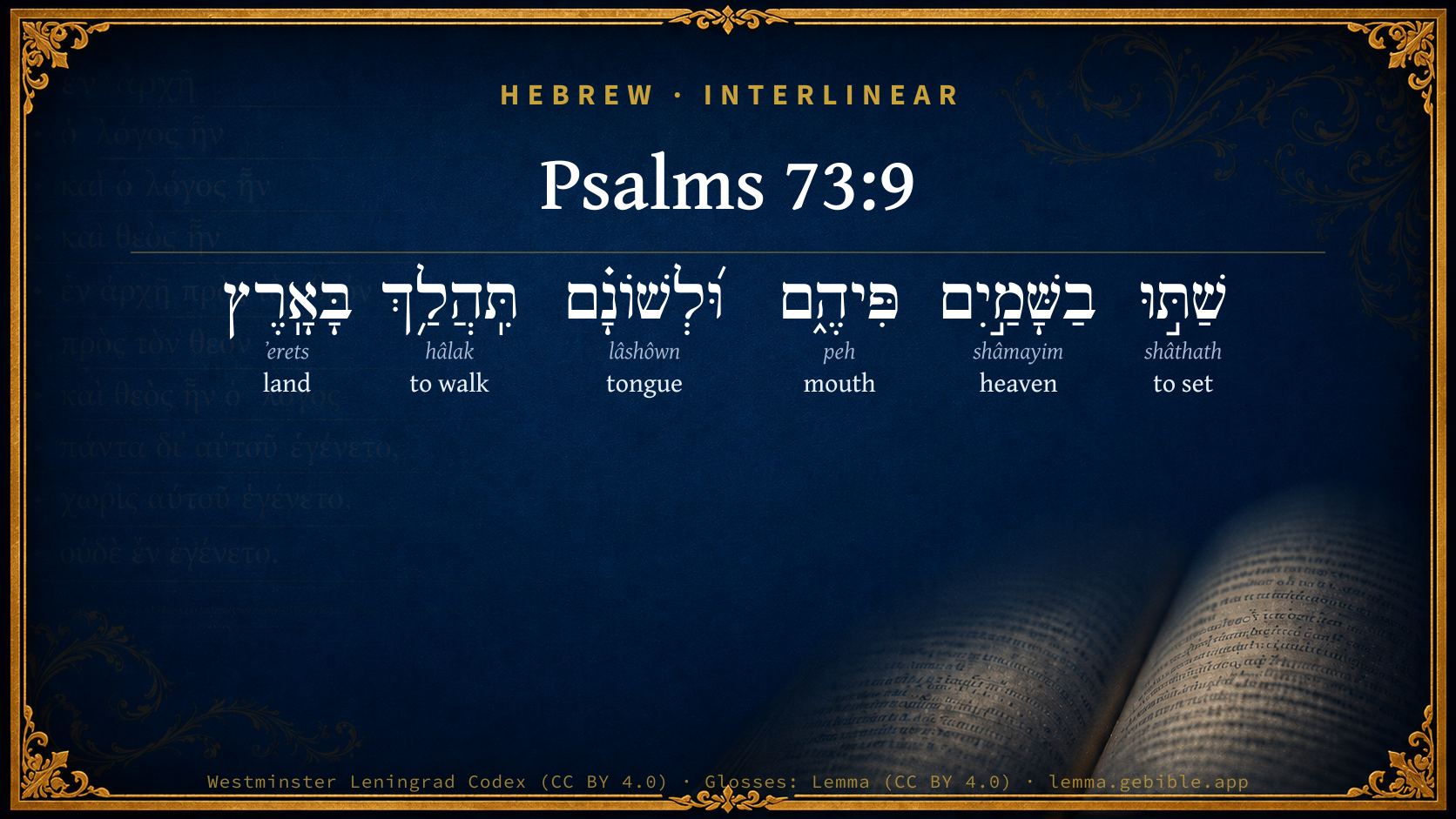
Psalms 73:9

Hebrew (Westminster Leningrad Codex) Psalms 73:9 appears in the Hebrew Old Testament. The text above is from the Westminster Leningrad Codex. Each word links to its Strong’s number, a concise gloss, and parsing drawn from the Open Scriptures Hebrew Bible morphology. Click any word for its full Brown-Driver-Briggs (BDB) entry.
Download image
Cite this verse

Psalms 73:9 (World English Bible). Public Domain. Lemma interlinear Bible study tool, https://lemma.gebible.app/v/psalms/73/9.

Show BibTeX & RIS
BibTeX
RIS
English Translation
They have set their mouth in the heavens. Their tongue walks through the earth.
World English Bible · Public Domain
Download a study sheet

One document with this verse’s original text, its word-by-word gloss line, the meaning frame, cross-references with their text, attributed commentary, and full source and license credits — printable, and it pastes into notes with its structure intact.

This verse Autodidact and up

Study sheet (.html) Plain text (.txt)

A passage Seminary Student

Up to 50 verses in one chapter. A passage sheet keeps up to 6 commentary sources and 12 cross-references per verse, in the order this page ranks them, and says so on the sheet whenever that leaves anything out. Ask for a single verse and you get the Autodidact verse sheet above.

Everything on this page stays free to read, with no account — the sheet is a download of what is already on screen, not access to it.

Want to remove ads? Support Godless Engineer
Compare translations 3

The same verse in 3 English versions, stacked beneath the original-language interlinear above. Click any original word for its lexicon entry.

Each is an independent rendering of the whole verse — the interlinear is not word-aligned to these translations.

Highlighted words mark where these versions differ — a whole-verse word diff, not a word-by-word alignment.

  • World English Bible Public Domain
    They have set their mouth in the heavens. Their tongue walks through the earth.
  • King James Version Public Domain
    They set their mouth against the heavens, and their tongue walketh through the earth.
  • unfoldingWord Literal Text CC BY-SA 4.0
    They set their mouth in the heavens, and their tongue goes through the earth.

unfoldingWord Literal Text — © unfoldingWord, licensed CC BY-SA 4.0. Word-aligned USFM3 via Door43 (git.door43.org/unfoldingWord/en_ult).

Versions to compare (up to 4)

3 of 4 selected

Show all 18 translations

Every available English version of this verse, each an independent rendering of the whole verse.

  • World English Bible Public Domain
    They have set their mouth in the heavens. Their tongue walks through the earth.
  • Berean Standard Bible Public Domain
    They set their mouths against the heavens, and their tongues strut across the earth.
  • Majority Standard Bible Public Domain
    They set their mouths against the heavens, and their tongues strut across the earth.
  • King James Version Public Domain
    They set their mouth against the heavens, and their tongue walketh through the earth.
  • American Standard Version (1901) Public Domain
    They have set their mouth in the heavens, And their tongue walketh through the earth.
  • Revised Version (1885) Public Domain
    They have set their mouth in the heavens, and their tongue walketh through the earth.
  • Geneva Bible (1599) Public Domain
    They set their mouth against heauen, and their tongue walketh through the earth.
  • Douay-Rheims (1899) Public Domain
    They have set their mouth against heaven: and their tongue hath passed through the earth.
  • Young's Literal Translation Public Domain
    They have set in the heavens their mouth, And their tongue walketh in the earth.
  • Literal Standard Version CC BY-SA 4.0
    They have set their mouth in the heavens, || And their tongue walks in the earth.
  • Unlocked Literal Bible CC BY-SA 4.0
    They set their mouth against the heavens, and their tongues march through the earth.
  • unfoldingWord Literal Text CC BY-SA 4.0
    They set their mouth in the heavens, and their tongue goes through the earth.
  • Darby Bible Public Domain
    They set their mouth in the heavens, and their tongue walketh through the earth.
  • World Messianic Bible Public Domain
    They have set their mouth in the heavens. Their tongue walks through the earth.
  • Webster's Bible Public Domain
    They set their mouth against the heavens, and their tongue walketh through the earth.
  • Free Bible Version CC BY-SA 4.0
    They talk irreverently against heaven above, and defame people here on earth.
  • Bible in Basic English Public Domain
    Their mouth goes up to heaven; their tongues go walking through the earth.
  • JPS Tanakh (1917) Public Domain
    They have set their mouth against the heavens, and their tongue walketh through the earth.

Literal Standard Version (2020), Covenant Press — licensed CC BY-SA 4.0. Text via the HelloAO Bible API (eBible.org). Unlocked Literal Bible (unfoldingWord) — licensed CC BY-SA 4.0. Text via the HelloAO Bible API (eBible.org). unfoldingWord Literal Text — © unfoldingWord, licensed CC BY-SA 4.0. Word-aligned USFM3 via Door43 (git.door43.org/unfoldingWord/en_ult). Free Bible Version, Dr. Jonathan Gallagher — licensed CC BY-SA 4.0. Text via the HelloAO Bible API (eBible.org).

Word by word

More ways to search: Search by grammar → Find every occurrence → Compare this word →

Practice this passage: Drill this verse → Learn its vocabulary →

About this verse

These counts appear in no published source. They are computed here, from the morphology-tagged text and Lemma’s own curated glosses. What Lemma adds →

6
words
6
distinct lemmas
Wisdom
section

Notable vocabulary

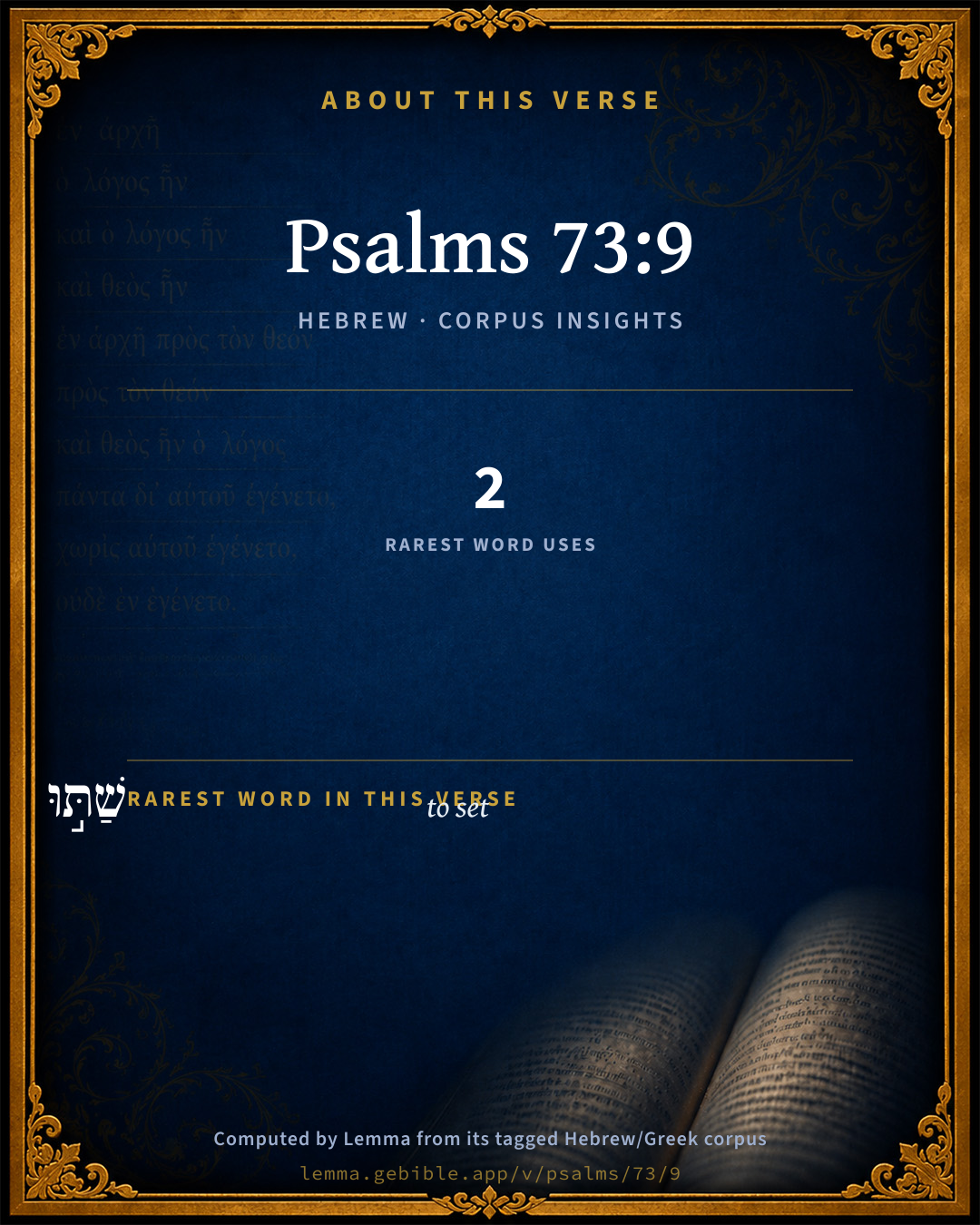
The rarest word here is שַׁתּ֣וּ to set H8371 — appearing just 2 times in the whole Hebrew Bible.

Shared distinctive vocabulary

שַׁתּ֣וּ to set H8371 occurs in 2 verses of the Hebrew Bible. Also found in:

Grammatical profile

  • 2 verbs
  • 4 nouns

Verb forms

  • שַׁתּ֣וּ Qal · Perfect
  • תִּֽהֲלַ֥ךְ Qal · Imperfect

Hebrew & Septuagint length

In English translation the verse runs 14 words from the Hebrew and 16 from the Septuagint (LXX English) — closely comparable.

A rough comparison of the two English renderings, which tokenize alike — not a word-level alignment.

Word counts can differ between the Hebrew and the Greek without any difference in meaning — e.g. the Hebrew direct-object marker אֵת has no separate Greek word, and Greek often adds the article ὁ.

Cross-references

9

Topical passages linked to Psalms 73:9 in the Treasury of Scripture Knowledge — connected by theme and wording, ordered by reader-vote popularity; previews shown in the World English Bible.

  • Revelation 13:6 He opened his mouth for blasphemy against God, to blaspheme his name, and his dwelling, those who dwell in heaven.
  • Exodus 5:2 Pharaoh said, "Who is Yahweh, that I should listen to his voice to let Israel go? I don't know Yahweh, and moreover I will not let Israel go."
  • James 3:6 And the tongue is a fire. The world of iniquity among our members is the tongue, which defiles the whole body, and sets on fire the course of nature, and is set on fire by Gehenna.
  • 2 Chronicles 32:15 Now therefore don't let Hezekiah deceive you, nor persuade you after this manner, neither believe you him; for no god of any nation or kingdom was able to deliver his people out of my hand, and out of the hand of my fathers: how much less shall your God deliver you out of my hand?
  • Daniel 3:15 Now if you are ready whenever you hear the sound of the horn, flute, zither, lyre, harp, pipe, and all kinds of music to you fall down and worship the image which I have made, [well]: but if you don't worship, you shall be cast the same hour into the midst of a burning fiery furnace; and who is that god that shall deliver you out of my hands?
  • Daniel 7:25 He shall speak words against the Most High, and shall wear out the saints of the Most High; and he shall think to change the times and the law; and they shall be given into his hand until a time and times and half a time.
  • Luke 18:4 He wouldn't for a while, but afterward he said to himself, 'Though I neither fear God, nor respect man,
  • Job 21:14 They tell God, 'Depart from us, For we don't want to know about your ways.
  • Psalms 52:4 You love all devouring words, You deceitful tongue.

Cross-references courtesy of OpenBible.info (CC BY 4.0).

Hebrew and Greek witnesses Masoretic Hebrew ↔ Greek Septuagint

The same verse in the two great witnesses to the Old Testament, shown verse-for-verse.

You’re reading Greek Psalm 72 (Hebrew Psalm 73). The Septuagint counts the superscription, so verse numbers can differ from the Hebrew — chapter-level alignment, not verse-by-verse. Numbering follows Rahlfs.

These are two independent witnesses, not word-aligned to each other, and the Septuagint is shown in lemma (dictionary) form.

Hebrew Psalms 73:9 Masoretic · Westminster Leningrad Codex

שַׁתּ֣וּ בַשָּׁמַ֣יִם פִּיהֶ֑ם וּ֝לְשׁוֹנָ֗ם תִּֽהֲלַ֥ךְ בָּאָֽרֶץ

They have set their mouth in the heavens. Their tongue walks through the earth.

World English Bible · Public Domain

Greek LXX Greek Psalm 72:9 Septuagint · lemma form

τίθημι εἰς οὐρανός ὁ στόμα αὐτός καί ὁ γλῶσσα αὐτός διαἔρχομαι ἐπί ὁ γῆ

They have set their mouth against heaven, and their tongue has gone through upon the earth.

LXX2012 (modern English Septuagint) · Public Domain

Hebrew: Westminster Leningrad Codex (CC BY 4.0). Greek: Septuagint (public domain); English from LXX2012 (modern English Septuagint) (Public Domain). How the Septuagint differs from the Hebrew →

Commentary

Notes on Psalms 73:9 from classic Christian and Jewish commentators (each source and its license shown beneath its notes). The classic Christian expositions comment on the surrounding passage and are grouped to its opening verse, so a note may address several verses; the Jewish commentaries on the Tanakh (Rashi and others) are per-verse, so they appear only where the commentator wrote on this verse.

Lemma curates 59 commentaries, every one of them public domain or Creative Commons licensed, each selected and text-cleaned for this edition rather than reprinted as found. About our sources →

Trapp's Complete Commentary

John Trapp

Psa 73:9 They set their mouth against the heavens, and their tongue walketh through the earth.

Ver. 9. They set their mouth against the heavens] They howl upward, as wolves; bark at the moon, as dogs; piss against the sun; belch out blasphemies against God, as did Pharaoh, Sennacherib, Nebuchadnezzar, Dionysius the tyrant, Antiochus, antichrist, Rev 13:6 (Pope Julius III for instance, who would have his pork meat, forbidden him by his physicians, al despito di Dio); the Great Turk at the siege of Scodra, and again at the Rhodes; besides Hacker, in Queen Elizabeth’s time, and the ranters in ours Dionysius commisso sacrilegio Deum dicebat sacrilegis bonam navigationem concedere.

And their tongue walketh through the earth] Snapping at every one they meet, like a mad dog; and not sparing to speak, or rather to spue out, whatsoever lieth uppermost. Thou shalt not walk up and down as a slanderer, or pedlar with his pack, which he opens soon, and disperseth his wares, Lev 19:16. That is a true saying of Seneca, Ut quisque est dissolutissimae vitro, ita est solutissimae linguae, As any one is more dissolute in his life, so he is more heedless of his speeches.

John Trapp, A Commentary or Exposition upon All the Books of the Old and New Testament (1647–1656) — public domain. Text from a community e-Sword module.

J. A. Alexander on Psalms

Joseph Addison Alexander

Psa 73:9. They set their mouth in heaven, and their tongue goes on earth. The idea in the first clause is the same as in the last clause of the foregoing verse. They speak as if they thought themselves superior beings, their mouth in heaven and their tongue on earth. Goes, runs, is actively employed.

Joseph Addison Alexander, The Psalms Translated and Explained (1850) — public domain. Text from a community e-Sword module.

Tyndale Open Study Notes

Tyndale Open Resources

73:9 The proud boast, claiming that they own everything and are not subject to anyone (see 2:1-3).

Tyndale Open Study Notes — © Tyndale Open Resources, licensed CC BY-SA 4.0. Text via the HelloAO Bible API.

Geneva Bible (1599)

Geneva Bible translators

They blaspheme God, and fear not his power and rail upon men, because they esteem themselves above all others.

Geneva Bible (1599) marginal notes — public domain. Text via Bolls.life.

Adam Clarke's Commentary

Verse 9. Set their mouth against the heavens] They blaspheme God, ridicule religion, mock at Providence, and laugh at a future state.

Their tongue walketh through the earth.] They find fault with every thing; they traduce the memory of the just in heaven, and ridicule the saints that are upon earth. They criticize every dispensation of God.

Adam Clarke's Commentary on the Bible (1810–1826) — public domain. Text from a community e-Sword/MySword module.

John Calvin's Commentaries

9. They have set their mouth against the heavens. Here it is declared that they utter their contumelious speeches as well against God as against men; for they imagine that nothing is too arduous for them to attempt, and flatter themselves that heaven and earth are subject to them. If any should endeavor to alarm them by setting before them the power of God, they audaciously break through this barrier; and, with respect to men, they have no idea of any difficulty arising from such a quarter. Thus, there is no obstacle to repress their proud and vaunting speeches, but their tongue walketh through the whole earth. This form of expression seems to be hyperbolical; but when we consider how great and unbounded their presumption is, we will admit that the Psalmist teaches nothing but what experience shows to be matter of fact.

John Calvin's Commentaries (1540-1563) — public domain. Text from the Calvin Translation Society English edition (1840s-50s) via the Christian Classics Ethereal Library (ccel.org). Calvin's coverage is partial (roughly two-thirds of the Bible); uncommented books and verses are honest gaps, never fabricated. The 19th-century editor's footnotes and remarks are omitted so the notes are faithfully Calvin's own voice.

Ellicott's Commentary for English Readers

(9) They set.—The last clause is repeated here under a figure more defined:

“They have set their mouth in [not against] the heavens,

While their tongue walketh through the earth.”

an image very expressive of a towering pride, vaunting itself to the skies, and trumpeting its own praises through the world.

A Bible Commentary for English Readers, edited by Charles John Ellicott (1878–1897) — public domain. Text from a community e-Sword module.

The Cambridge Bible for Schools and Colleges

gen. ed. J. J. S. Perowne

9. The A.V. gives a good sense: they blaspheme God and dictate to men. Cp. Dan_7:25. But probably the R.V. is right in rendering,

They have set their mouth In the heavens.

The clause expands the words of the preceding verse “from on high.” They make an impious claim of divine authority, and dictate to men as though the earth belonged to them.

The Cambridge Bible for Schools and Colleges (gen. ed. J. J. S. Perowne; Cambridge University Press, 1878–1918) — public domain. Text from a community e-Sword module.

John Gill's Exposition

They set their mouth against the heavens,.... Against God in heaven, see Dan 4:26, against his being, saying, there is no God; against his perfections, thinking him to be such an one as themselves; against his purposes and decrees, replying against him, and charging him with insincerity, cruelty, and unrighteousness; and against his providence, either denying it, or affirming it to be unequal; and against his doctrines, ordinances, and ministers. Aben Ezra interprets it also of the angels of heaven, who are spoken against, when it is denied that there are any such beings, as were by the Sadducees; and blasphemed, when the worshipping of them is introduced. The Targum understands it of the saints of heaven, with which compare Rev 13:6 it may be applied to civil magistrates, the higher powers, who represent on earth God in heaven; and there are some that despise dominion, and speak evil of such dignities:

and their tongue walketh through the earth: sparing none, high nor low, but injures all sorts of persons with their lies and calumnies. This denotes the unbridled liberty which wicked men take with their tongues; there is no restraint upon them, no stopping of them; see Psa 12:5 the universal mischief they are continually doing, and the diabolical influence of their detraction and falsehood; like Satan, their tongues walk to and fro in the earth, doing all the injury to the credit and characters of men they possibly can.

John Gill's Exposition of the Whole Bible (1746–1763) — public domain (CC PDM 1.0). Text via the HelloAO Bible API.

Albert Barnes' Notes on the Bible

They set their mouth against the heavens - Compare Rev 13:6. Literally, “They set their mouth in heaven,” or in the heavens. The idea is, they speak as if they were “in” the heavens; as if they were clothed with all authority; as if they were superior beings, and had a right to command the universe.

And their tongue walketh through the earth - It has no limit; it is as if it roamed over all the earth. They speak without any restraint of law, or propriety; without any regard to the command of God, or to what is due to people, In other words, they seem to set themselves above all law, and to act as if there were no one in heaven or in earth to control them.

Albert Barnes' Notes on the Bible (1834–1885) — public domain. Text from a community e-Sword/MySword module.

Matthew Poole's English Annotations

Against the heavens, i.e. against God, blaspheming his name, denying or deriding his providence, reviling his saints and servants.

Walketh through the earth; using all manner of liberty, introducing and reproaching all sorts of persons, not caring whom they displease or hurt by it.

Matthew Poole's English Annotations on the Holy Bible (1683–1685) — public domain. Text from a community e-Sword/MySword module.

The Treasury of David

Charles H. Spurgeon

Ver. 9. They set their mouth against the heavens. Against God himself they aim their blasphemies. One would think, to hear them, that they were demigods themselves, and held their heads above the clouds, for they speak down upon other men as from a sublime elevation peculiar to themselves. Yet they might let God alone, for their pride will make them enemies enough without their defying him.

And their tongue walketh through the earth. Leisurely and habitually they traverse the whole world to find victims for their slander and abuse. Their tongue prowls in every corner far and near, and spares none. They affect to be universal censors, and are in truth perpetual vagrants. Like the serpent, they go nowhere without leaving their slime behind them; if there were another Eden to be found, its innocence and beauty would not preserve it from their filthy trail. They themselves are, beyond measure, worthy of all honour, and all the rest of mankind, except a few of their parasites, are knaves, fools, hypocrites, or worse. When these men's tongues are out for a walk, they are unhappy who meet them, for they push all travellers into the kennel: it is impossible altogether to avoid them, for in both hemispheres they take their perambulations, both on land and sea they make their voyages. The city is not free from them, and the village swarms with them. They waylay men in the king's highway, but they are able to hunt across country, too. Their whip has a long lash, and reaches both high and low.

Ver. 9. Their tongue walketh through the earth. This shows the boundless and unlimited disorder of the tongue. The earth carries a numerous offspring of men, who are of several habits, states, and conditions, which give occasion of variety of discourses and different kinds of language. These men spare none: Their tongue walketh through the earth, and leaves nothing unspoken of. If men be poor, they talk of oppressing and mastering of them; if they oppose, they discourse of violence and suppressing... If in this perambulation they meet with truth, they darken it with lies and home made inventions; if with innocence, they brand it with false accusations and bitter aspersions; if with a strict government and good laws, then they cry, "Let us break their bands asunder, and cast away their cords from us; "if with religion, they term it heresy, or superstition; if with patience, they term it obstinacy and perverseness; if with the church, they think of nothing less than devouring it, and cry, "Let us take the houses of God in possession; "if with the thoughts of a resurrection, and of future hopes, "Let us eat and drink, "cry they, "for tomorrow we shall die." Thus no corner is left unsearched by their abusive tongue, which walks through the earth.... They may walk over the earth, but they will set their mouth against the heavens. Here they stay, stand fixed and resolute, and take that place, as a special white they would hit. Edward Parry.

None.

Psalms 73:10*

Charles H. Spurgeon's The Treasury of David (1869–1885) — public domain. Psalms only. Text from a community e-Sword/MySword module.

Whedon's Commentary on the Bible

Daniel D. Whedon

9. Against the heavens—More properly, in the heavens. They have ascended to the abode of God. Their haughtiness (Psa_73:8) has now assumed and usurped divine prerogative, (as Isa_14:13-14,) and they speak as from the throne of God.

Walketh through the earth—That is, walketh proudly, stalketh. As they have blasphemed God by placing their mouth in the heavens, so they stalk through the earth, speaking contemptuously against the innocent and holy.

Daniel D. Whedon (gen. ed.), Commentary on the Old and New Testaments (1874–1909) — public domain. Text from a community e-Sword module.

The Pulpit Commentary

They set their mouth against the heavens. So Hupfeld and Canon Cook, who understand the expression of blasphemy; but most modern critics translate, "They have set their mouth in the heavens," and regard the meaning as nearly allied to that of the second clause of the preceding verse, "They speak as though they were inhabitants of the heavens." And their tongue walketh through the earth. Their tongue is always busily employed boasting (ver. 3), lying, backbiting.

The Pulpit Commentary (1880–1919), ed. H.D.M. Spence-Jones & Joseph S. Exell — public domain. Text from a community e-Sword module.

John Wesley's Explanatory Notes

Against - Against God, blaspheming his name, and deriding his providence. Walketh - Using all manner of liberty, reproaching all sorts of persons.

John Wesley, Explanatory Notes Upon the Whole Bible (1754–1765) — public domain. Text via the GEBible commentary corpus.

Lesson kit

Teaching starters — assembled from the data on this page, not authored interpretation. Every prompt links to the verse data it draws on. Edit before teaching.

Psalms, in the Wisdom, opens this verse with 6 words (6 distinct Hebrew lemmas). Its most distinctive word is shâthath (“to set”). A historical commentator’s framing appears above. Read the whole chapter for the surrounding context.

Discussion questions

  1. What does “to set” (shâthath) contribute to the verse as a whole?
  2. How does Psalms 49:14, which shares the word «to set», read alongside this verse?
  3. These translations render this verse differently; the difference is in the English rendering, not the original. What questions does that raise?
  4. «שַׁתּ֣וּ» is a Qal Perfect verb. How does that grammatical form shape the action described?
  5. Compare how Trapp's Complete Commentary and J. A. Alexander on Psalms read this verse. Where do they agree or differ?

Things to notice

Reading settings

Reading text

Shown beneath each verse's original-language words.

Old Testament
Old Testament edition

Read the OT as the Masoretic Hebrew (MT) or the Greek Septuagint (LXX).

English shown for the Greek Septuagint (in the Hebrew ↔ Greek comparison).

Comparing translations? Open the Compare panel on any verse page to stack up to four side by side.