Nehemiah 13:24

Hebrew (Westminster Leningrad Codex) Nehemiah 13:24 appears in the Hebrew Old Testament. The text above is from the Westminster Leningrad Codex. Each word links to its Strong’s number, a concise gloss, and parsing drawn from the Open Scriptures Hebrew Bible morphology. Click any word for its full Brown-Driver-Briggs (BDB) entry.
Download image
Cite this verse

Nehemiah 13:24 (World English Bible). Public Domain. Lemma interlinear Bible study tool, https://lemma.gebible.app/v/nehemiah/13/24.

Show BibTeX & RIS
BibTeX
RIS
English Translation
and their children spoke half in the speech of Ashdod, and could not speak in the Jews' language, but according to the language of each people.
World English Bible · Public Domain
Highlights
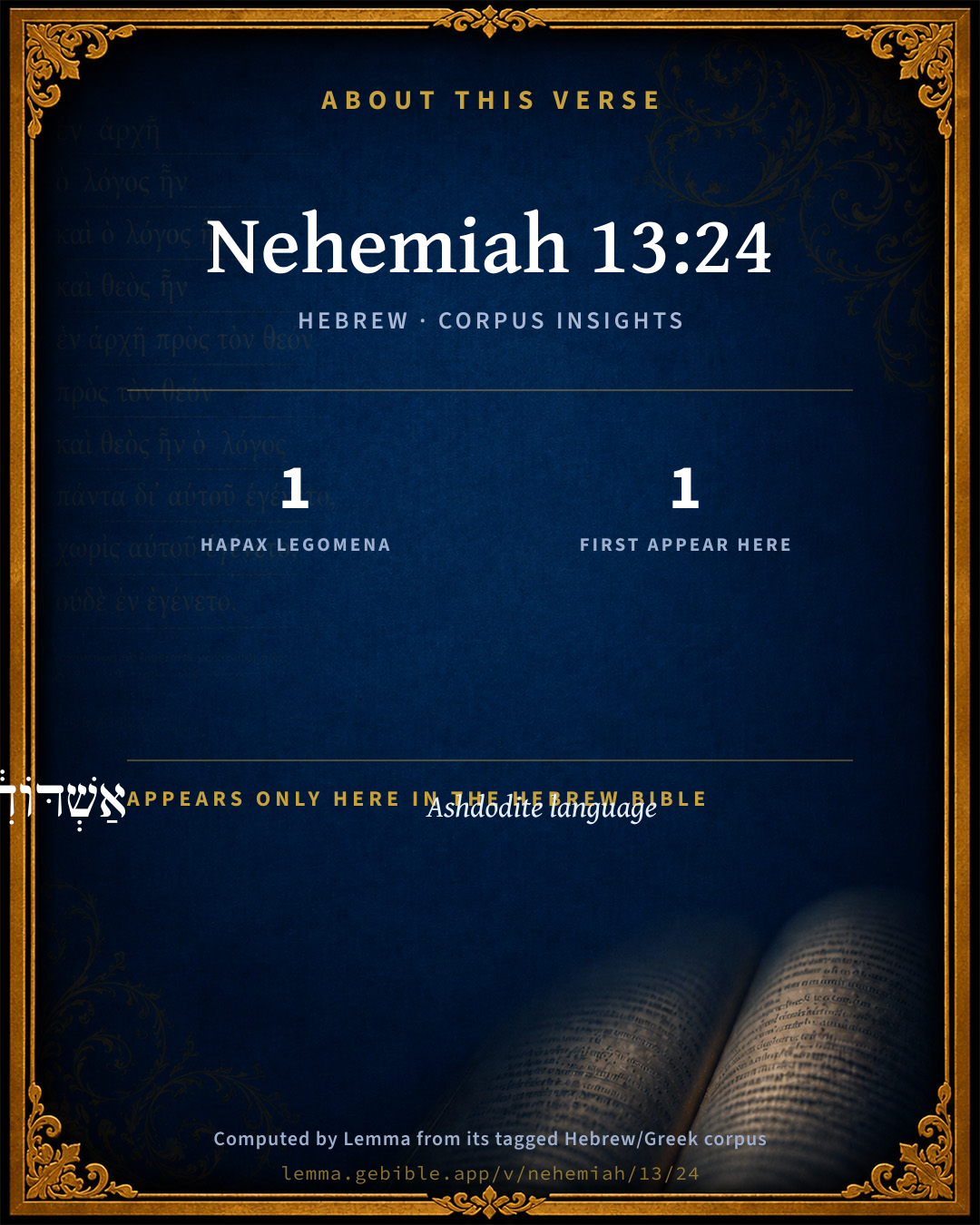
  • 1 hapax legomenon — only here in the Hebrew Bible
  • 1 first appearance in the Hebrew Bible
Full analysis ↓
Download a study sheet

One document with this verse’s original text, its word-by-word gloss line, the meaning frame, cross-references with their text, attributed commentary, and full source and license credits — printable, and it pastes into notes with its structure intact.

This verse Autodidact and up

Study sheet (.html) Plain text (.txt)

A passage Seminary Student

Up to 50 verses in one chapter. A passage sheet keeps up to 6 commentary sources and 12 cross-references per verse, in the order this page ranks them, and says so on the sheet whenever that leaves anything out. Ask for a single verse and you get the Autodidact verse sheet above.

Everything on this page stays free to read, with no account — the sheet is a download of what is already on screen, not access to it.

Want to remove ads? Support Godless Engineer
Compare translations 3

The same verse in 3 English versions, stacked beneath the original-language interlinear above. Click any original word for its lexicon entry.

Each is an independent rendering of the whole verse — the interlinear is not word-aligned to these translations.

Highlighted words mark where these versions differ — a whole-verse word diff, not a word-by-word alignment.

  • World English Bible Public Domain
    and their children spoke half in the speech of Ashdod, and could not speak in the Jews' language, but according to the language of each people.
  • King James Version Public Domain
    And their children spake half in the speech of Ashdod, and could not speak in the Jews' language, but according to the language of each people.
  • unfoldingWord Literal Text CC BY-SA 4.0
    And their sons, half were speaking Ashdodite, and none of them were knowing to speak Hebrew, but according to the tongue of people group by people group.

unfoldingWord Literal Text — © unfoldingWord, licensed CC BY-SA 4.0. Word-aligned USFM3 via Door43 (git.door43.org/unfoldingWord/en_ult).

Versions to compare (up to 4)

3 of 4 selected

Show all 18 translations

Every available English version of this verse, each an independent rendering of the whole verse.

  • World English Bible Public Domain
    and their children spoke half in the speech of Ashdod, and could not speak in the Jews' language, but according to the language of each people.
  • Berean Standard Bible Public Domain
    Half of their children spoke the language of Ashdod or of the other peoples, but could not speak the language of Judah.
  • Majority Standard Bible Public Domain
    Half of their children spoke the language of Ashdod or of the other peoples, but could not speak the language of Judah.
  • King James Version Public Domain
    And their children spake half in the speech of Ashdod, and could not speak in the Jews' language, but according to the language of each people.
  • American Standard Version (1901) Public Domain
    and their children spake half in the speech of Ashdod, and could not speak in the Jews' language, but according to the language of each people.
  • Revised Version (1885) Public Domain
    and their children spake half in the speech of Ashdod, and could not speak in the Jews’ language, but according to the language of each people.
  • Geneva Bible (1599) Public Domain
    And their children spake halfe in ye speach of Ashdod, and could not speake in the Iewes language, and according to the language of the one people, and of the other people.
  • Douay-Rheims (1899) Public Domain
    And their children spoke half in the speech of Azotus, and could not speak the Jews' language, but they spoke according to the language of this and that people.
  • Young's Literal Translation Public Domain
    And of their sons, half are speaking Ashdoditish -- and are not knowing to speak Jewish -- and according to the language of people and people.
  • Literal Standard Version CC BY-SA 4.0
    And of their sons, half are speaking Ashdoditish—and are not knowing to speak Jewish—and according to the language of people and people.
  • Unlocked Literal Bible CC BY-SA 4.0
    Half of their children spoke the language of Ashdod. None of them could speak the language of Judah, but only the language of one of the other peoples.
  • unfoldingWord Literal Text CC BY-SA 4.0
    And their sons, half were speaking Ashdodite, and none of them were knowing to speak Hebrew, but according to the tongue of people group by people group.
  • Darby Bible Public Domain
    And their children spoke half in the language of Ashdod, and could not speak in the Jews' language, but according to the language of each people.
  • World Messianic Bible Public Domain
    and their children spoke half in the speech of Ashdod, and could not speak in the Jews’ language, but according to the language of each people.
  • Webster's Bible Public Domain
    And their children spoke half in the speech of Ashdod, and could not speak in the Jews language, but according to the language of each people.
  • Free Bible Version CC BY-SA 4.0
    Half their children could only speak the language of Ashdod or that of another people, and didn't know how to speak the language of Judah.
  • Bible in Basic English Public Domain
    And their children were talking half in the language of Ashdod; they had no knowledge of the Jews' language, but made use of the language of the two peoples.
  • JPS Tanakh (1917) Public Domain
    and their children spoke half in the speech of Ashdod, and could not speak in the Jews' language, but according to the language of each people.

Literal Standard Version (2020), Covenant Press — licensed CC BY-SA 4.0. Text via the HelloAO Bible API (eBible.org). Unlocked Literal Bible (unfoldingWord) — licensed CC BY-SA 4.0. Text via the HelloAO Bible API (eBible.org). unfoldingWord Literal Text — © unfoldingWord, licensed CC BY-SA 4.0. Word-aligned USFM3 via Door43 (git.door43.org/unfoldingWord/en_ult). Free Bible Version, Dr. Jonathan Gallagher — licensed CC BY-SA 4.0. Text via the HelloAO Bible API (eBible.org).

Word by word

More ways to search: Search by grammar → Find every occurrence → Compare this word →

Practice this passage: Drill this verse → Learn its vocabulary →

אַשְׁדּוֹדִ֔ית
ʼAshdôwdîyth
H797
“Ashdodite language”
Noun, Gentilic, Feminine, Singular, Absolute
Part of Speech
Noun
Type
Gentilic
Gender
Feminine
Number
Singular
State
Absolute
Full BDB Definition

Origin: feminine of H796

TWOT: None

Ashdodites = "I will spoil" - language of Ashdod
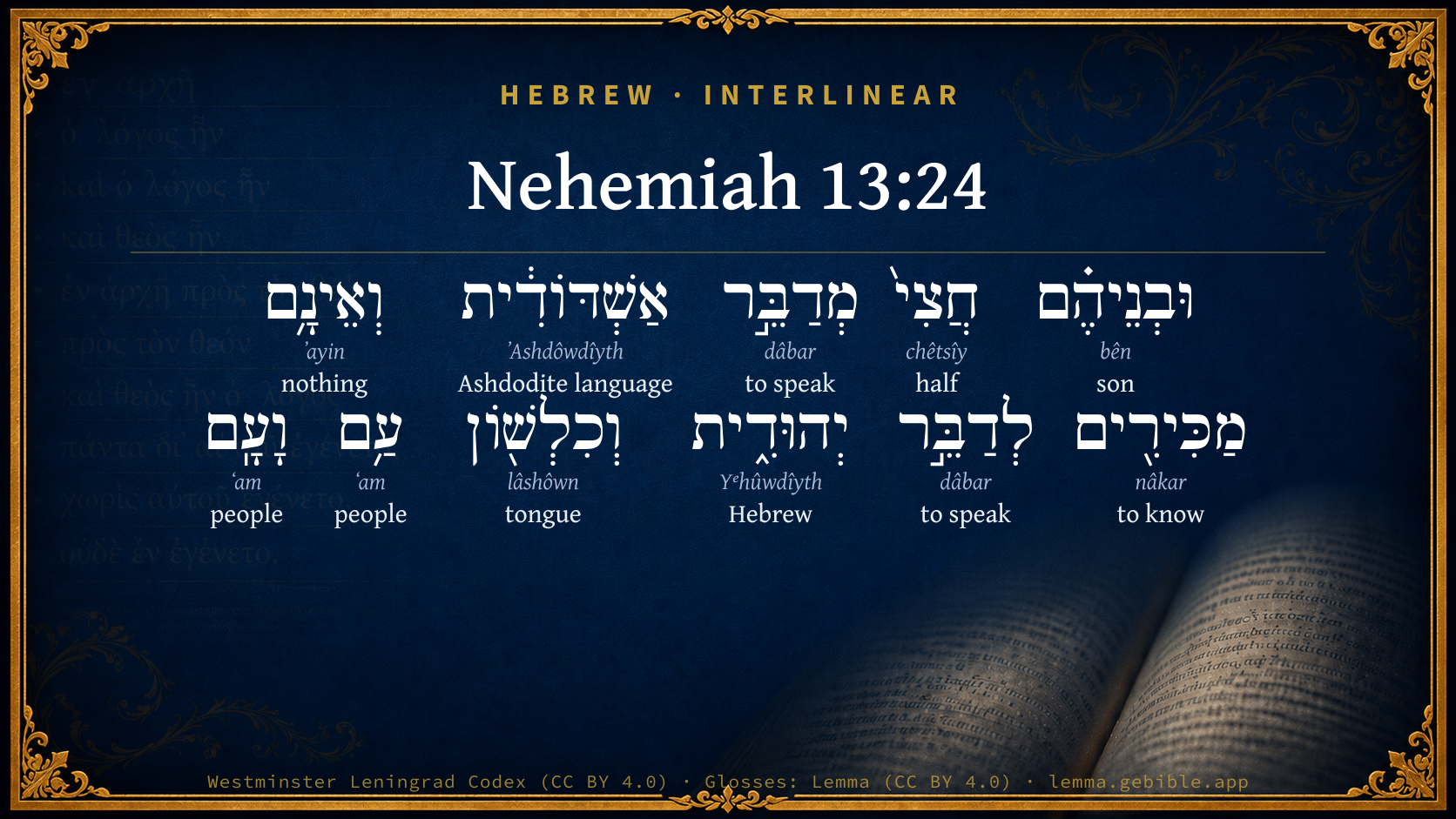
  1. וּבְנֵיהֶ֗ם bên H1121 “and · sons · their” Conjunction + Noun, Common, Masculine, Plural, Construct + Suffix, Personal, 3rd Person, Masculine, Plural
  2. חֲצִי֙ chêtsîy H2677 “half” Noun, Common, Masculine, Singular, Absolute
  3. מְדַבֵּ֣ר dâbar H1696 “speaking” Verb, Piel, Participle Active, Masculine, Singular, Absolute
  4. וְאֵינָ֥ם ʼayin H369 “and · nothing · them” Conjunction + Particle, Negative + Suffix, Personal, 3rd Person, Masculine, Plural
  5. מַכִּירִ֖ים nâkar H5234 “knowing” Verb, Hiphil, Participle Active, Masculine, Plural, Absolute
  6. לְדַבֵּ֣ר dâbar H1696 “to speak” Preposition + Verb, Piel, Infinitive Construct
  7. יְהוּדִ֑ית Yᵉhûwdîyth H3066 “Hebrew” Noun, Gentilic, Feminine, Singular, Absolute
  8. וְכִלְשׁ֖וֹן lâshôwn H3956 “and · like/as · tongue of” Conjunction + Preposition + Noun, Common, Both, Singular, Construct
  9. עַ֥ם ʻam H5971 “people” Noun, Common, Masculine, Singular, Absolute
  10. וָעָֽם ʻam H5971 “and · people” Conjunction + Noun, Common, Masculine, Singular, Absolute

About this verse

These counts appear in no published source. They are computed here, from the morphology-tagged text and Lemma’s own curated glosses. What Lemma adds →

11
words
9
distinct lemmas
Historical
section

Notable vocabulary

1 hapax legomenon — a word that appears only here in the entire Hebrew Bible:

  • אַשְׁדּוֹדִ֔ית Ashdodite language H797

First appearance in Scripture

This word makes its first canonical appearance in the Hebrew Bible here:

  • אַשְׁדּוֹדִ֔ית Ashdodite language H797

Shared distinctive vocabulary

יְהוּדִ֑ית Hebrew H3066 occurs in 6 verses of the Hebrew Bible. Also found in:

Grammatical profile

  • 3 verbs
  • 7 nouns
  • 1 particle

Verb forms

  • מְדַבֵּ֣ר Piel · Participle Active
  • מַכִּירִ֖ים Hiphil · Participle Active
  • לְדַבֵּ֣ר Piel · Infinitive Construct

Repetition

Words recur within this verse — often emphatic in Hebrew:

  • מְדַבֵּ֣ר to speak H1696 ×2
  • עַ֥ם people H5971 ×2

Cross-references

1

Topical passages linked to Nehemiah 13:24 in the Treasury of Scripture Knowledge — connected by theme and wording, ordered by reader-vote popularity; previews shown in the World English Bible.

  • Zephaniah 3:9 For then I will purify the lips of the peoples, that they may all call on the name of Yahweh, to serve him shoulder to shoulder.

Cross-references courtesy of OpenBible.info (CC BY 4.0).

Hebrew and Greek witnesses Masoretic Hebrew ↔ Greek Septuagint

The same verse in the two great witnesses to the Old Testament, shown verse-for-verse.

These are two independent witnesses, not word-aligned to each other, and the Septuagint is shown in lemma (dictionary) form.

Hebrew Nehemiah 13:24 Masoretic · Westminster Leningrad Codex

וּבְנֵיהֶ֗ם חֲצִי֙ מְדַבֵּ֣ר אַשְׁדּוֹדִ֔ית וְאֵינָ֥ם מַכִּירִ֖ים לְדַבֵּ֣ר יְהוּדִ֑ית וְכִלְשׁ֖וֹן עַ֥ם וָעָֽם

and their children spoke half in the speech of Ashdod, and could not speak in the Jews' language, but according to the language of each people.

World English Bible · Public Domain

Greek LXX Structure differs

The Septuagint has no separate book of Nehemiah. Its Greek text is the second half of Esdras B (2 Esdras), chapters 11–23; Ezra is the first half (1–10).

A verse-for-verse comparison isn’t shown here because the chapters and verses don’t line up. Switch to the LXX edition with the MT / LXX toggle above to read the Greek directly.

On this verse, The Cambridge Bible for Schools and Colleges discusses the Septuagint’s reading. Read the note in Commentary ↓

Hebrew: Westminster Leningrad Codex (CC BY 4.0). Greek: Septuagint (public domain); English from a public-domain English Septuagint. How the Septuagint differs from the Hebrew →

Commentary

Notes on Nehemiah 13:24 from classic Christian and Jewish commentators (each source and its license shown beneath its notes). The classic Christian expositions comment on the surrounding passage and are grouped to its opening verse, so a note may address several verses; the Jewish commentaries on the Tanakh (Rashi and others) are per-verse, so they appear only where the commentator wrote on this verse.

Lemma curates 59 commentaries, every one of them public domain or Creative Commons licensed, each selected and text-cleaned for this edition rather than reprinted as found. About our sources →

Trapp's Complete Commentary

John Trapp

Neh 13:24 And their children spake half in the speech of Ashdod, and could not speak in the Jews’ language, but according to the language of each people.

Ver. 24. And their children spake half in the speech of Ashdod] They had a mixture of their mother’s both speech and spirit: the birth followed the belly, the conclusion followed the weaker proposition.

And could not speak in the Jews’ language] Though it were that of their fathers. Mothers are most about children, and have the greater advantage to perfume them, or poison them. But what mad fellows were those old Britons or Welshmen, who driven out of their own country by the Saxons, came into Little Britain in France; where, when they had married wives, they are said to have cut out their tongues, lest they should corrupt the language of their children! Hence the British or Welsh language remaineth still in that country.

John Trapp, A Commentary or Exposition upon All the Books of the Old and New Testament (1647–1656) — public domain. Text from a community e-Sword module.

Joseph Benson's Commentary

Neh 13:24. And their children spake half in the speech of Ashdod, &c. — What the natural language of the Jews at this time was, whether Hebrew or Chaldee, is matter of some inquiry among the learned. Those who suppose it was Hebrew, produce the books of Nehemiah, Ezra, and Esther, besides the prophecies of Daniel, which, for the most part, were written in Hebrew, and which they suppose the authors of them would not have composed in that language, if at that time it had not been the vulgar language. But to this it is replied, that the Jewish authors might make use of the Hebrew language in what they wrote, not only because the things which they recorded concerned the Jewish nation only, among whom there were learned men enough to explain them; but, chiefly, because they were inclined to conceal what they wrote from the Chaldeans, who at that time were their lords and masters, and, considering all circumstances, might not, perhaps, have been so well pleased with them, had they understood the contents of their writings. Since it appears then, say they, by several words recurring in the book of Maccabees, the New Testament, and Josephus, that the language which the Jews then spoke was Chaldee, that this language they learned in their captivity, and after their return never assumed their ancient Hebrew tongue so as to speak it vulgarly; it must hence follow, that what is here termed the language of the Jews, was at that time no other than the Chaldee, for the ancient Hebrew was only preserved among the learned. See Le Clerc and Dodd.

Joseph Benson's Commentary on the Old and New Testaments (1811–1818) — public domain. Text from a community e-Sword module.

Jamieson, Fausset & Brown

Robert Jamieson, A. R. Fausset & David Brown

could not speak in the Jews' language, but according to the language of each people--a mongrel dialect imbibed from their mothers, together with foreign principles and habits.

Jamieson, Fausset & Brown — Commentary Critical and Explanatory on the Whole Bible (1871) — public domain (CC PDM 1.0). Text via the HelloAO Bible API.

Adam Clarke's Commentary

Verse 24. Half in the speech of Ashdod] There were children in the same family by Jewish and Philistine mothers. As the Jewish mother would always speak to her children in Hebrew or Chaldee, so they learnt to speak these languages; and as the Ashdod mother would always speak to her children in the Ashdod language, so they learnt that tongue. Thus there were, in the same family, children who could not understand each other; half, or one part, speaking one language, and the other part another. Children of different wives did not ordinarily mingle together; and the wives had separate apartments. This is a better explanation than that which intimates that the same child spoke a jargon, half Ashdod and half Hebrew.

Adam Clarke's Commentary on the Bible (1810–1826) — public domain. Text from a community e-Sword/MySword module.

Ellicott's Commentary for English Readers

(24) Half in the speech of Ashdod.—A mixture of Philistine and Aramaic.

A Bible Commentary for English Readers, edited by Charles John Ellicott (1878–1897) — public domain. Text from a community e-Sword module.

The Cambridge Bible for Schools and Colleges

gen. ed. J. J. S. Perowne

24. spake half in the speech of Ashdod] LXX. οἱ υἱοὶ αὐτῶν ἥμισυ λαλοῦσιν Ἀζωτιστί. Vulg. ‘filii eorum ex media parte loquebantur Azotice,’ half their words were framed in the dialect of Philistia. This dialect would be very similar to Hebrew, but from accent and the use of peculiar words almost unintelligible to the Jews.

On the relations of the Jews with Ashdod, see on Neh_4:7, and compare Zec_9:6.

in the Jews’ language] i.e. Hebrew (‘Yehudîth’) LXX. Ἰουδαϊστί. Vulg. ‘Judaice’ as in 2Ki_18:26; 2Ki_18:28; Isa_36:11; Isa_36:13; 2Ch_32:18. The language of Hezekiah’s reign was still spoken by the Jews after the Return, as indeed would be abundantly shown by these memorials of Ezra and Nehemiah and by the writings of Haggai, Zechariah and Malachi.

On the mistaken idea that during the Captivity the Jews had exchanged Hebrew for Chaldee, i.e. Aramaic, see Introd. § 8.

but according to the language of each people] Referring to the Ammonites and Moabites, who represented dialectical varieties.

The Cambridge Bible for Schools and Colleges (gen. ed. J. J. S. Perowne; Cambridge University Press, 1878–1918) — public domain. Text from a community e-Sword module.

John Gill's Exposition

Shall we then hearken unto you to do all this great evil,.... To suffer it to be done, and connive at it, and not punish for it:

to transgress against our God; his law, his mind, and will:

in marrying strange wives? forbidden by him, Deu 7:1.

John Gill's Exposition of the Whole Bible (1746–1763) — public domain (CC PDM 1.0). Text via the HelloAO Bible API.

Albert Barnes' Notes on the Bible

The speech of Ashdod - The Philistine language, which was akin to that of Egypt.

According to the language of each people - The children spoke a mixed dialect - half-Philistine, half-Hebrew.

Albert Barnes' Notes on the Bible (1834–1885) — public domain. Text from a community e-Sword/MySword module.

Haydock's Catholic Bible Commentary

Half. In the same family, some spoke the Philistine (Vatable) or Phenician language: others the Hebrew; which, though it resembled the other very much, was still sufficiently distinct to be noticed. The children might also speak a jargon, composed of both languages. It is probable that, at this time, many of the common people spoke the Chaldean language, so that it was necessary to interpret pure Hebrew to them, chap. viii. 8.

George Leo Haydock (1774–1849), Haydock's Catholic Family Bible and Commentary, 1859 edition — public domain. Excludes Psalms (Douay-Rheims chapter numbering differs from Protestant) and Deuterocanonical books (Catholic canon only).

Matthew Poole's English Annotations

Which their mothers instilled into them, together with their principles and manners.

Matthew Poole's English Annotations on the Holy Bible (1683–1685) — public domain. Text from a community e-Sword/MySword module.

Whedon's Commentary on the Bible

Daniel D. Whedon

24. The speech of Ashdod — Supposed to have been an Indo-Germanic language.

Not speak… Jews’ language — Hebrew, and none of them knowing to speak Jewish. The children would naturally speak the language of their mothers.

According to the language of each people — Better, as margin, of people and people; that is, of this or that people to whichsoever the mother belonged. “From the circumstance that a portion of the children of these marriages were not able to speak the language of the Jews, but spoke the language of Ashdod, or of this or that nation from which their mothers were descended, we may conclude with tolerable certainty that these people dwelt neither in Jerusalem nor in the midst of the Jewish community, but on the borders of the nations to which their wives belonged.” — Keil.

Daniel D. Whedon (gen. ed.), Commentary on the Old and New Testaments (1874–1909) — public domain. Text from a community e-Sword module.

The Pulpit Commentary

Their children spake half in the speech of Ashdod. Some understand the writer to mean that half of the children in a family spoke the tongue of the father, and half that of the mother. But many of the best Hebraists prefer the sense expressed by our translators, viz., that all the children spoke a jargon half Ashdodite and half Aramaic. The Philistine language is said to have resembled the Egyptian (Hieronym., "Comment. in Esaiam," 19:18).

The Pulpit Commentary (1880–1919), ed. H.D.M. Spence-Jones & Joseph S. Exell — public domain. Text from a community e-Sword module.

Rashi

Rabbi Shlomo Yitzchaki (Rashi)

And half...were speaking Many of their children spoke the Ashdodite language like their mothers.

Rashi on the Tanakh — English translations: “The Judaica Press complete Tanach with Rashi, translated by A. J. Rosenberg” (CC BY 4.0); “Pentateuch with Rashi's commentary by M. Rosenbaum and A.M. Silbermann, 1929-1934” (public domain); “The Metsudah Tanach series, Lakewood, N.J” (CC BY 4.0); and “The Book of Joshua, Metsudah Publications, 1997” (CC BY 4.0). Text via Sefaria.

Lesson kit

Teaching starters — assembled from the data on this page, not authored interpretation. Every prompt links to the verse data it draws on. Edit before teaching.

Nehemiah, in the Historical, opens this verse with 11 words (9 distinct Hebrew lemmas). Its most distinctive word is ʼAshdôwdîyth (“Ashdodite language”). A historical commentator’s framing appears above. Read the whole chapter for the surrounding context.

Discussion questions

  1. The word ʼAshdôwdîyth carries the sense “Ashdodite language.” How does it shape the verse?
  2. 1 word here appears nowhere else in the Hebrew Bible. Why might the author reach for such rare wording?
  3. This is the first place “Ashdodite language” appears in Scripture (first appears here). What does its debut here establish?
  4. How does 2 Kings 18:26, which shares the word «Hebrew», read alongside this verse?
  5. What does the repetition of “to speak” (2× in this one verse) do in this verse?
  6. The translations on this page render this verse differently — a whole-verse word diff, not a word-by-word alignment. What might account for the different wordings?
  7. «מְדַבֵּ֣ר» is a Piel Participle Active verb. How does that grammatical form shape the action described?
  8. Compare how Trapp's Complete Commentary and Joseph Benson's Commentary read this verse. Where do they agree or differ?

Things to notice

  • 1 word in this verse appears nowhere else in the Hebrew Bible.
  • 1 word makes its first canonical appearance in Scripture here.
  • These translations choose different wording for 17 words in this verse.
  • “to speak” occurs 2× in this single verse.
  • 9 distinct Hebrew lemmas span 11 words in this verse.

Reading settings

Reading text

Shown beneath each verse's original-language words.

Old Testament
Old Testament edition

Read the OT as the Masoretic Hebrew (MT) or the Greek Septuagint (LXX).

English shown for the Greek Septuagint (in the Hebrew ↔ Greek comparison).

Comparing translations? Open the Compare panel on any verse page to stack up to four side by side.