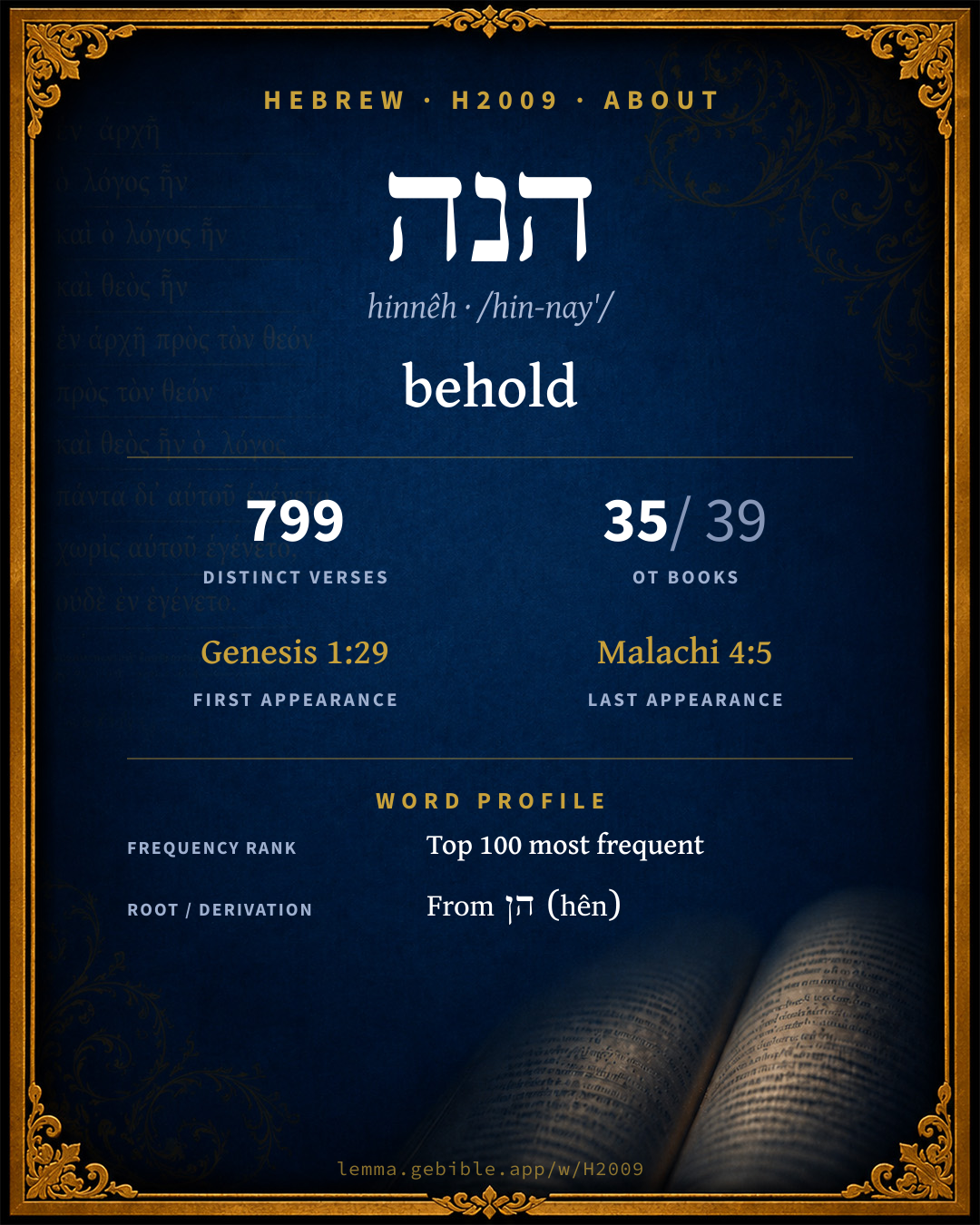
הִנֵּה
behold
Full lexicon entry — Brown-Driver-Briggs (BDB)
From Brown-Driver-Briggs (BDB)
Where this word appears
Grammar key — what these labels mean
Part of speech
- Particle
- A short function word — article, negation, interrogative, the sign of the direct object, and the like.
Every verse where H2009 appears in the Book of 2 Kings — 46 distinct verses. Click any verse to open its interlinear word-by-word view. Verse text shown in the World English Bible for context — . Each verse’s Hebrew form is shown with its reference; the English is not keyword-highlighted, since the data carries no word-level English alignment. Use “Compare translations” on any verse to read it across multiple English versions. This concordance covers the Hebrew Bible; Septuagint (Greek Old Testament) occurrences are not indexed here.
2 Kings
- 2 Kings 1:9 וְ/הִנֵּה֙ conj + ptcl dem Then [the king] sent to him a captain of fifty with his fifty. He went up to him: and, behold, he was sitting on the top of the hill. He spoke to him, man of God, the king has said, Come down.
- 2 Kings 1:14 הִ֠נֵּה ptcl dem Behold, fire came down from the sky, and consumed the two former captains of fifty with their fifties; but now let my life be precious in your sight.
- 2 Kings 2:11 וְ/הִנֵּ֤ה conj + ptcl dem It happened, as they still went on, and talked, that behold, [there appeared] a chariot of fire, and horses of fire, which parted them both apart; and Elijah went up by a whirlwind into heaven.
- 2 Kings 2:16 הִנֵּה ptcl dem They said to him, See now, there are with your servants fifty strong men; let them go, we pray you, and seek your master, lest the Spirit of Yahweh has taken him up, and cast him on some mountain, or into some valley. He said, You shall not send.
- 2 Kings 2:19 הִנֵּה ptcl dem The men of the city said to Elisha, Behold, we pray you, the situation of this city is pleasant, as my lord sees: but the water is bad, and the land miscarries.
- 2 Kings 3:20 וְ/הִנֵּה conj + ptcl dem It happened in the morning, about the time of offering the offering, that behold, there came water by the way of Edom, and the country was filled with water.
- 2 Kings 4:9 הִנֵּה ptcl dem She said to her husband, See now, I perceive that this is a holy man of God, that passes by us continually.
- 2 Kings 4:13 הִנֵּ֣ה ptcl dem He said to him, Say now to her, Behold, you have been careful for us with all this care; what is to be done for you? would you be spoken for to the king, or to the captain of the host? She answered, I dwell among my own people.
- 2 Kings 4:25 הִנֵּ֖ה ptcl dem So she went, and came to the man of God to Mount Carmel. It happened, when the man of God saw her afar off, that he said to Gehazi his servant, Behold, yonder is the Shunammite:
- 2 Kings 4:32 וְ/הִנֵּ֤ה conj + ptcl dem When Elisha was come into the house, behold, the child was dead, and laid on his bed.
- 2 Kings 5:6 הִנֵּ֨ה ptcl dem He brought the letter to the king of Israel, saying, Now when this letter is come to you, behold, I have sent Naaman my servant to you, that you may recover him of his leprosy.
- 2 Kings 5:11 הִנֵּ֨ה ptcl dem But Naaman was angry, and went away, and said, Behold, I thought, He will surely come out to me, and stand, and call on the name of Yahweh his God, and wave his hand over the place, and recover the leper.
- 2 Kings 5:15 הִנֵּה ptcl dem He returned to the man of God, he and all his company, and came, and stood before him; and he said, See now, I know that there is no God in all the earth, but in Israel: now therefore, please take a present from your servant.
- 2 Kings 5:20 הִנֵּ֣ה ptcl dem But Gehazi the servant of Elisha the man of God, said, Behold, my master has spared this Naaman the Syrian, in not receiving at his hands that which he brought: as Yahweh lives, I will run after him, and take somewhat of him.
- 2 Kings 5:22 הִנֵּ֣ה ptcl dem He said, All is well. My master has sent me, saying, Behold, even now there are come to me from the hill-country of Ephraim two young men of the sons of the prophets; please give them a talent of silver, and two changes of clothing.
- 2 Kings 6:1 הִנֵּֽה ptcl dem The sons of the prophets said to Elisha, See now, the place where we dwell before you is too strait for us.
- 2 Kings 6:13 הִנֵּ֥ה ptcl dem He said, Go and see where he is, that I may send and get him. It was told him, saying, Behold, he is in Dothan.
- 2 Kings 6:15 וְ/הִנֵּה conj + ptcl dem When the servant of the man of God was risen early, and gone forth, behold, a host with horses and chariots was round about the city. His servant said to him, Alas, my master! how shall we do?
- 2 Kings 6:17 וְ/הִנֵּ֨ה conj + ptcl dem Elisha prayed, and said, Yahweh, Please open his eyes, that he may see. Yahweh opened the eyes of the young man; and he saw: and, behold, the mountain was full of horses and chariots of fire round about Elisha.
- 2 Kings 6:20 וְ/הִנֵּ֖ה conj + ptcl dem It happened, when they were come into Samaria, that Elisha said, Yahweh, open the eyes of these men, that they may see. Yahweh opened their eyes, and they saw; and, behold, they were in the midst of Samaria.
- 2 Kings 6:25 וְ/הִנֵּ֖ה conj + ptcl dem There was a great famine in Samaria: and, behold, they besieged it, until a donkey's head was sold for eighty [pieces] of silver, and the fourth part of a kab of dove's dung for five [pieces] of silver.
- 2 Kings 6:30 וְ/הִנֵּ֥ה conj + ptcl dem It happened, when the king heard the words of the woman, that he tore his clothes (now he was passing by on the wall); and the people looked, and, behold, he had sackcloth within on his flesh.
- 2 Kings 6:33 וְ/הִנֵּ֥ה הִנֵּֽה conj + ptcl dem ptcl dem While he was yet talking with them, behold, the messenger came down to him: and he said, Behold, this evil is of Yahweh; why should I wait for Yahweh any longer?
- 2 Kings 7:2 הִנֵּ֣ה ptcl dem Then the captain on whose hand the king leaned answered the man of God, and said, Behold, if Yahweh should make windows in heaven, might this thing be? He said, Behold, you shall see it with your eyes, but shall not eat of it.
- 2 Kings 7:5 וְ/הִנֵּ֥ה conj + ptcl dem They rose up in the twilight, to go to the camp of the Syrians; and when they were come to the outermost part of the camp of the Syrians, behold, there was no man there.
- 2 Kings 7:6 הִנֵּ֣ה ptcl dem For the Lord had made the host of the Syrians to hear a noise of chariots, and a noise of horses, even the noise of a great host: and they said one to another, Behold, the king of Israel has hired against us the kings of the Hittites, and the kings of the Egyptians, to come on us.
- 2 Kings 7:10 וְ/הִנֵּ֥ה conj + ptcl dem So they came and called to the porter of the city; and they told them, saying, We came to the camp of the Syrians, and, behold, there was no man there, neither voice of man, but the horses tied, and the donkeys tied, and the tents as they were.
- 2 Kings 7:13 הִנָּ֗/ם ptcl dem + sfx pers 3mp One of his servants answered, Please let some take five of the horses that remain, which are left in the city (behold, they are as all the multitude of Israel who are left in it; behold, they are as all the multitude of Israel who are consumed); and let us send and see.
- 2 Kings 7:15 וְ/הִנֵּ֣ה conj + ptcl dem They went after them to the Jordan: and, behold, all the way was full of garments and vessels, which the Syrians had cast away in their haste. The messengers returned, and told the king.
- 2 Kings 7:19 וְ/הִנֵּ֣ה conj + ptcl dem and that captain answered the man of God, and said, Now, behold, if Yahweh should make windows in heaven, might such a thing be? and he said, Behold, you shall see it with your eyes, but shall not eat of it:
- 2 Kings 8:5 וְ/הִנֵּ֨ה conj + ptcl dem It happened, as he was telling the king how he had restored to life him who was dead, that behold, the woman, whose son he had restored to life, cried to the king for her house and for her land. Gehazi said, My lord, O king, this is the woman, and this is her son, whom Elisha restored to life.
- 2 Kings 9:5 וְ/הִנֵּ֨ה conj + ptcl dem When he came, behold, the captains of the host were sitting; and he said, I have an errand to you, captain. Jehu said, To which of us all? He said, To you, O captain.
- 2 Kings 10:4 הִנֵּה֙ ptcl dem But they were exceedingly afraid, and said, Behold, the two kings didn't stand before him: how then shall we stand?
- 2 Kings 10:9 הִנֵּ֨ה ptcl dem It happened in the morning, that he went out, and stood, and said to all the people, You are righteous: behold, I conspired against my master, and killed him; but who struck all these?
- 2 Kings 11:14 וְ/הִנֵּ֣ה conj + ptcl dem and she looked, and, behold, the king stood by the pillar, as the manner was, and the captains and the trumpets by the king; and all the people of the land rejoiced, and blew trumpets. Then Athaliah tore her clothes, and cried, Treason! treason!
- 2 Kings 13:21 וְ/הִנֵּה֙ conj + ptcl dem It happened, as they were burying a man, that behold, they spied a band; and they cast the man into the tomb of Elisha: and as soon as the man touched the bones of Elisha, he revived, and stood up on his feet.
- 2 Kings 15:11 הִנָּ֣/ם ptcl dem + sfx pers 3mp Now the rest of the acts of Zechariah, behold, they are written in the book of the chronicles of the kings of Israel.
- 2 Kings 15:15 הִנָּ֣/ם ptcl dem + sfx pers 3mp Now the rest of the acts of Shallum, and his conspiracy which he made, behold, they are written in the book of the chronicles of the kings of Israel.
- 2 Kings 15:26 הִנָּ֣/ם ptcl dem + sfx pers 3mp Now the rest of the acts of Pekahiah, and all that he did, behold, they are written in the book of the chronicles of the kings of Israel.
- 2 Kings 15:31 הִנָּ֣/ם ptcl dem + sfx pers 3mp Now the rest of the acts of Pekah, and all that he did, behold, they are written in the book of the chronicles of the kings of Israel.
- 2 Kings 17:26 וְ/הִנָּ/ם֙ conj + ptcl dem + sfx pers 3mp Therefore they spoke to the king of Assyria, saying, The nations which you have carried away, and placed in the cities of Samaria, don't know the law of the god of the land: therefore he has sent lions among them, and, behold, they kill them, because they don't know the law of the god of the land.
- 2 Kings 18:21 הִנֵּ֣ה ptcl dem Now, behold, you trust on the staff of this bruised reed, even on Egypt; whereon if a man lean, it will go into his hand, and pierce it: so is Pharaoh king of Egypt to all who trust on him.
- 2 Kings 19:9 הִנֵּ֥ה ptcl dem When he heard say of Tirhakah king of Ethiopia, Behold, he is come out to fight against you, he sent messengers again to Hezekiah, saying,
- 2 Kings 19:11 הִנֵּ֣ה ptcl dem Behold, you have heard what the kings of Assyria have done to all lands, by destroying them utterly: and shall you be delivered?
- 2 Kings 19:35 וְ/הִנֵּ֥ה conj + ptcl dem It happened that night, that the angel of Yahweh went forth, and struck in the camp of the Assyrians one hundred eighty-five thousand: and when men arose early in the morning, behold, these were all dead bodies.
- 2 Kings 20:17 הִנֵּה֮ ptcl dem Behold, the days come, that all that is in your house, and that which your fathers have laid up in store to this day, shall be carried to Babylon: nothing shall be left, says Yahweh.
About this entry
At a glance — auto-summarized from this page’s data, not written by a person. Every figure links to its source below. This summary describes the numbers; it doesn’t interpret them.
At its core, הנה (hinnêh) means “behold.” First canonically at Genesis 1:29, it enters the text early. With 799 verses in 35 books, it is one of the most common word in the Hebrew Bible. From the same root come הן, הן and להן. Dig into 799-verse concordance and the renderings breakdown below.
Gloss history
Strong's 1890 vs modern scholarship
About this word
Strong's H2009 catalogs a Hebrew word from the Hebrew Old Testament.
These counts are not copied from any lexicon or concordance. They are computed here, from the morphology-tagged Hebrew Old Testament. What Lemma adds →
- 799
- distinct verses
- The word appears in 799 distinct verses.
- 35 / 39
- OT books
- The word appears in 35 of 39 Old Testament books.
- #53
- by frequency
- Top 100 most frequent Hebrew words (rank 53 of 8,640 Hebrew words by occurrence).
View all 799 occurrences in the concordance →
By section of the Old Testament
By traditional corpus
Conventional, traditional groupings — biblical authorship is debated, so this is a traditional corpus grouping, not an authorship claim. Each share is this word’s portion of its verses in that division of the Hebrew canon. Each figure is a share of the word’s 799 distinct verses.
- Prophets (Nevi'im) 491 verses · 61%
- Torah (Pentateuch) 203 verses · 25%
- Writings (Ketuvim) 105 verses · 13%
How translations render this word
Counts come from each version’s own published word-to-Strong’s tagging or interlinear alignment — an approximate guide to how each version renders this word, not a word-level alignment the data otherwise carries. Because each total is that version’s own tagged count, the per-version totals vary from one another and need not match the appearance or distinct-verse counts above. These counts may also differ from a printed concordance because Lemma counts each distinctly tagged rendering and does not collapse phrase taggings into a single head-word total. This is a fixed set of word-tagged versions (KJV, ASV, BSB, ULT) and does not change with the reading translation you choose elsewhere. Each version’s license is shown beside its name below (and on Sources).
- King James Version: Behold 9×, Lo 5×
- American Standard Version: Behold 7×, And 3×, Lo 2×
- Berean Standard Bible: Behold 169×, Look 75×, There 36×
- unfoldingWord Literal Text: Behold 767×, Behold me 65×, Behold i 27×
King James Version Public Domain
Renders H2009 across 17 tagged occurrences — most commonly:
Plus 3 renderings that appear only once — usually multi-word phrases or single function words the recovered tagging swept in, not distinct renderings.
American Standard Version Public Domain
Renders H2009 across 17 tagged occurrences — most commonly:
Plus 5 renderings that appear only once — usually multi-word phrases or single function words the recovered tagging swept in, not distinct renderings.
Berean Standard Bible Public Domain
Renders H2009 across 685 tagged occurrences — most commonly:
Plus other, less common renderings. Plus 77 renderings that appear only once — usually multi-word phrases or single function words the recovered tagging swept in, not distinct renderings. Not rendered by a distinct English word in 154 further occurrences.
unfoldingWord Literal Text CC BY-SA 4.0
Renders H2009 across 947 tagged occurrences — most commonly:
Plus other, less common renderings. Plus 12 renderings that appear only once — usually multi-word phrases or single function words the recovered tagging swept in, not distinct renderings.
Senses in the full BDB
What do BDB’s symbols mean?
BDB uses these scholarly abbreviations:
| Symbol | Meaning |
|---|---|
| 𝔊 | the Septuagint (the ancient Greek translation, LXX) |
| 𝔙 | the Vulgate (the Latin translation) |
| 𝔖 | the Syriac version (the Peshitta) |
| 𝔗 | the Targum (the Aramaic translation) |
| ψ | the Psalms |
| √ | root (the underlying root or stem) |
| ‖ | parallel passage (a synonymous or contrasted parallel) |
| † | the dagger: every passage where the word occurs is cited |
The 4 senses and sub-senses the full Brown-Driver-Briggs lexicon distinguishes for this word, in lexicon order (not ranked by frequency), with BDB’s own verbatim wording and sub-sense lettering. Shown in Hebrew script with BDB’s own scholarly abbreviations. The condensed entry is in the Lexicon Entry tab. See also the Forms in the corpus table below.
- a. pointing to persons or things, Gn 12:19 and now הִנֵּה אִשְׁתְּךָ behold thy wife! 18:9 הִנֵּה בָאֹהֶל behold (she is) in the tent (the suffix, when the noun to which הנה refers has immediately preceded, being not unfrequently omitted, 16:14: cf. Dr§ 135. 6, 2), 30:3; 31:51(×2) Ex 24:8 1 K 2:29. With sf. of 1 ps., especially in response to a call, indicating the readiness of the person addressed to listen or obey, Here I am! (lit. Behold me!) Gn 22:1, 7, 11; 27:1, 18; 31:11; 37:13; 46:2 Ex 3:4 1 S 3:4, 5, 6, 8, 16; 22:12 2 S 1:7 Is, 6:8, cf. 1 S 12:3 הִנְנִי עֲנוּ בִי here I am, answer against me, 14:43 (cf. Drp. 292), 2 S 15:26 (in resignation: cf. Gn 44:16; 50:18 Jos 9:25 Ezr 9:15): of God Is 52:6; 58:9; 65:1(×2) (repeated for emphasis). In the pl. הננו Nu 14:40 Je 3:22 Jb 38:35.—Emph. הִנְנִי אָ֕נִי Ez 34:11, 20, cf. 6:3. On הִנְנִי אֶל …, v. אל 4, p. 40. e.g. Genesis 12:19
- b. introducing clauses involving predication: (a) with ref. to the past or present, it points generally to some truth either newly asserted, or newly recognised, Gn 1:29 behold! I have given to you all herbs etc. 17:20; 27:6 1 S 14:33 etc.; often one upon which some proposal or suggestion is to be founded, Ex 1:9 (cf. הן Gn 11:6) 1 S 20:2, 5; 2 K 5:20. When the proposal is to be of the nature of an entreaty or request, הִנֵּה־נָא is often used, instead of the simple הִנֵּה Gn 12:11; 16:2; 18:27 1 K 20:31; 22:13 al. (v. נָא). (b) with ref. to the future. Here it serves to introduce a solemn or important declaration Ex 32:34; 34:10 Is 7:14; and is used especially with the ptcp. (the fut. instans, Dr§ 135, 3) in predictions or threats, Gn 20:3 הִנְּךָ מֵת (lit.) behold thee (accus.) about to die, thou art about to die, Ex 4:23; 7:17; 9:3 Dt 31:16 1 S 3:11 1 K 20:35; 22:25 Is 3:1; 10:33; 17:1; 19:1; 22:17; 24:1 + often; in the phrase הנה ימים באים †1 S 2:31 2 K 20:17 = Is 39:6 Am 4:2; 8:11; 9:13 + Je 15 times; very often with the suffix of 1 ps. sg., as הִנְנִי מֵבִיא Behold, I bring (lit. behold me bringing, or about to bring) … Gn 6:17 Ex 10:4 & often, especially in Je; Gn 9:9 Ex 8:17; 9:18; 34:11 2 K 22:20 Is 13:17; 29:14; 43:19 Je 8:17; 11:22 (הִנְנִי פֹקֵד; so 23:2 +) 16:16; 20:4, etc.; anomalously, with change of person, Is 28:16 הִנְנִי יִסַּד (according to points) behold me, one who has founded, 29:14 הִנְנִי יוֹסִף behold me, one who will add (so 38:5); but it is dub. whether the ptcp. יֹסֵד, יוֹסֵף should not be read. e.g. Genesis 1:29
- c. וְהִנֵּה … very freq. in historical style, especially (but not exclusively) after verbs of seeing or discovering, making the narrative graphic and vivid, and enabling the reader to enter into the surprise or satisfaction of the speaker or actor concerned: Gn 1:31 and behold, it was very good, 6:12; 8:13; 15:12; 18:2; 37:29 Ex 2:6 Dt 9:13 etc.: in the description of a dream Gn 37:7, 9; 40:9, 16; 41:1, 2, 3 Is 29:8, or of a vision Am 7:1, 4; 8:1 etc. With a ptcp. (the context fixing the sense to the past), Gn 24:30; 37:15 (both without suffix); Ju 9:43; 11:34 1 K 19:5, 11 +. e.g. Genesis 1:31
- d. like II. הֵן (b), nearly = if (rare): Lv 13:5, 6, 8, 10 (& elsewhere in this and the next ch.) וְהִנֵּה and behold = and if, Dt 13:15 and 17:4 וְהִנֵּה אֱמֶת and behold it is true = and if it be true, 19:18 1 S 20:12; cf. 1 S 9:7 2 S 18:11 Ho 9:6; with ו׳ in apod. 2 K 10:9. e.g. Leviticus 13:5
Senses from the full Brown-Driver-Briggs lexicon (Brown, Driver, Briggs; Oxford 1906 — public domain), digitized via Sefaria, supplemented by the OpenScriptures HebrewLexicon (CC BY 4.0). Full attribution on Sources.
Word origin
Once הִנֶּה־ Gn 19:2, demonstr. part. lo! behold! (Arabic إِنَّ certainly, surely, lit. lo!), with sf. (the pron. being conceived as accus., Ew§ 262 c; cf. إِنَّ, which takes an accus., whether of a noun or pron. sf.) הִנְנִי Gn 6:13 + often (also הִנֶּ֣נִּי Gn 22:7), הִנֵּ֑נִי Gn 22:1, 11 +, (הִנֶּ֔נִּי Gn 27:18), †Is 65:1 הִנֵּ֣נִי הִנֵּ֔נִי (but הִנֵּה אָנֹכִי is also said Gn 24:13, 43; 25:32; 48:21 Ex 4:23; 7:17 +; and, more rarely, הִנֵּה אֲנִי Ez 37:5, 12, 19, 21 2 Ch 2:3, cf. 2 K 10:9 Je 32:27); הִנְּךָ Gn 20:3 + (†2 K 7:2 הִנְּכָה), הִנֶּ֑ךָּ †ψ139:8, fem. הִנָּךְ Gn 16:11 + 6 times; הִנּוֹ †Nu 23:17 Jb 2:6 1 Ch 11:25, הִנֵּ֫הוּ †Je 18:3 Kt (הִנֵּה הוּא is more usual, as Gn 20:16; 42:27; 1 S 10:22 Je 38:5 Ru 3:2): 1 pl. הִנְנוּ †Jos 9:25 2 S 5:1 Je 3:22 Ezr 9:15, הִנֶּ֫נּוּ †Gn 44:16; 50:18 Nu 14:40, הִנֵּ֑נוּ Jb 38:35; הִנְּכֶם †Dt 1:10 Je 16:12; הִנָּם Gn 40:6 + often (37 times)—lo! behold!
— Brown-Driver-Briggs (Oxford 1906, public domain), digitized via Sefaria, supplemented by the OpenScriptures HebrewLexicon (CC BY 4.0). See Sources.
Derived from הן (hên) (H2005) — behold.
Jastrow Dictionary
A second Hebrew/Aramaic lexicon for comparison, covering Aramaic and post-biblical (Talmudic, Targumic, Midrashic) usage that the biblical-Hebrew BDB does not. Matched by lemma rather than by Strong’s number, so a lemma may carry more than one Jastrow headword (shown separately below), and the entries cover usage well beyond the Bible.
הַנָּה
- , v. הָן
הִנֵּה
- v. הֵן) behold, here is. Koh. R. to V, 6 ה׳ של בו"ד the ‘here is’ of a human being (Esth. VIII, 7), ה׳ של הק"בה the ‘here is’ of the Lord (Zech. XIV, 1).—הִנֵּנִי here am I. Gen. R. s. 55 ה׳ לכהונה I am ready for priesthood; a. fr. e.g. Esther 8:7
הָנָה
- , v. הני
הני
- (denom. of הֲנָאָה), Nif. נֶהֱנֶה (= נֵאוֹת, v. אוֹת I)
- 1. to be pleased, to enjoy, to profit. B. Kam. 20ᵃ, a. fr. זה נה׳ the one is benefitted &c., opp. חָסֵר. Ib. II, 2 משלם מה שנֶהֱנֵית he must pay for what the animal has enjoyed (eaten or drunk), contrad. to מה שהזיקה what she has damaged. Ber. 10ᵇ הרוצה לֵהָנוֹת יהָנֶה וכ׳ (Rashi לֵיהָ׳) he who desires to make use (of people’s hospitalities), may do so following the example of Elisha. R. Hash. 28ᵃ, a. fr. מצות לא ליהנות ניתנו religious ceremonies are not considered an enjoyment (as regards the use of sacred property &c.); a. v. fr.
- 2. to be enjoyed. Ber. 35ᵃ דבר שנ׳ something which is enjoyable (can be eaten &c.).
- to benefit, to entertain, to cause to share. Snh. 92ᵃ אינו מְהַנֶּה ת"ח וכ׳ allows no scholar to share his wealth. Ber. 63ᵇ bot. ומְהַנֵּהוּ וכ׳ and invites him to partake of his wealth. Yad. IV, 3 הרי אתה כמְהַנָּן וכ׳ you appear to benefit them pecuniarily, but &c. Ab. Zar. 16ᵇ sq. שמא דבר מינית … והִנָּאֲךָ (v. Rabb. D. S. a. l. note 20) perhaps a heretical idea was communicated to thee and it pleased thee; Yalk. Prov. 937; a. fr. [Snh. 102ᵇ הֶהֱנָה Hif., marginal note היה מְהַנֶּה; v. Yalk. Kings 207.]
A Dictionary of the Targumim, the Talmud Babli and Yerushalmi, and the Midrashic Literature (Marcus Jastrow; London, Luzac, 1903) — Public Domain. Digitized via Sefaria. Digitized via Sefaria. Full attribution on Sources.
Forms in the corpus
The 60 distinct written forms H2009 takes in the Hebrew Bible, most frequent first — each parse links to that state’s occurrences in the concordance. Hebrew forms include their vowel points and cantillation, so a single lemma takes many written forms.
| Form | Parsing | Example | Uses |
|---|---|---|---|
| הִנֵּ֣ה | Particle, Demonstrative | Amos 8:11 | 70 |
| הִנֵּ֤ה | Particle, Demonstrative | Amos 6:11 | 66 |
| הִנֵּ֥ה | Particle, Demonstrative | Amos 4:2 | 62 |
| הִנֵּ֨ה | Particle, Demonstrative | Amos 9:13 | 60 |
| וְ/הִנֵּ֥ה | Particle, Demonstrative | Amos 7:4 | 60 |
| הִנֵּה | Particle, Demonstrative | Daniel 11:2 | 56 |
| וְ/הִנֵּ֣ה | Particle, Demonstrative | Daniel 8:3 | 48 |
| וְ/הִנֵּ֤ה | Particle, Demonstrative | Daniel 8:5 | 43 |
| וְ/הִנֵּה | Particle, Demonstrative | Daniel 10:10 | 43 |
| וְ/הִנֵּ֨ה | Particle, Demonstrative | Ecclesiastes 2:11 | 37 |
| וְ/הִנֵּה֙ | Particle, Demonstrative | Amos 7:1 | 31 |
| הִנֵּ֛ה | Particle, Demonstrative | Amos 2:13 | 26 |
| וְ/הִנֵּ֛ה | Particle, Demonstrative | Daniel 8:15 | 26 |
| הִנֵּה֙ | Particle, Demonstrative | Exodus 4:23 | 24 |
| הִנֵּֽה | Particle, Demonstrative | Genesis 18:31 | 16 |
| וְ/הִנֵּ֖ה | Particle, Demonstrative | Amos 8:1 | 16 |
| הִנֵּה֩ | Particle, Demonstrative | Amos 4:13 | 15 |
| וְ/הִנֵּ֧ה | Particle, Demonstrative | Amos 7:7 | 13 |
| הִנֵּ֧ה | Particle, Demonstrative | Exodus 31:6 | 11 |
| הִנֵּ֖ה | Particle, Demonstrative | Exodus 8:20 | 10 |
| וְ/הִנֵּה֩ | Particle, Demonstrative | Ezekiel 1:4 | 10 |
| הִ֠נֵּה | Particle, Demonstrative | Genesis 22:20 | 9 |
| וְ/הִנֵּ֗ה | Particle, Demonstrative | Daniel 10:16 | 8 |
| הִנָּ֣/ם | Particle, Demonstrative | 1 Chronicles 29:29 | 7 |
| וְ֠/הִנֵּה | Particle, Demonstrative | Genesis 37:7 | 7 |
| וְ/הִ֨נֵּה | Particle, Demonstrative | Amos 7:1 | 5 |
| וְ/הִנֵּֽה | Particle, Demonstrative | Ezekiel 37:8 | 5 |
| הִנֵּ֗ה | Particle, Demonstrative | Exodus 1:9 | 4 |
| הִנֵּ֞ה | Particle, Demonstrative | Amos 9:8 | 4 |
| הִנֵּֽנִ/י | Particle, Demonstrative | Genesis 22:1 | 4 |
| וְ/הִנֵּ֞ה | Particle, Demonstrative | Exodus 16:14 | 4 |
| הִ֭נֵּה | Particle, Demonstrative | Job 4:3 | 3 |
| הִנֵּ֪ה | Particle, Demonstrative | Psalms 11:2 | 3 |
| הִנֵּֽ/נִי | Particle, Demonstrative | Exodus 3:4 | 3 |
| וְ/הִנָּ֛/ם | Particle, Demonstrative | Ezekiel 13:10 | 3 |
| הִֽנֵּה | Particle, Demonstrative | 1 Samuel 20:5 | 2 |
| הִנְּ/ךָ֥ | Particle, Demonstrative | Deuteronomy 31:16 | 2 |
| הִנֵּה֮ | Particle, Demonstrative | 2 Kings 20:17 | 2 |
| הִנָּ֥/ךְ | Particle, Demonstrative | Genesis 16:11 | 2 |
| וְ/הִנֵּ֡ה | Particle, Demonstrative | 2 Chronicles 19:11 | 2 |
| וְ/הִנָּ/ם֙ | Particle, Demonstrative | 2 Chronicles 20:2 | 2 |
| הִנְ/נִ֨י | Particle, Demonstrative | Ezekiel 6:3 | 1 |
| הִנְ/נִי֩ | Particle, Demonstrative | Genesis 6:17 | 1 |
| הִנֵּ֑ה | Particle, Demonstrative | Job 9:19 | 1 |
| הִנֵּ֔ה | Particle, Demonstrative | Habakkuk 2:13 | 1 |
| הִנֵּ֕ה | Particle, Demonstrative | Judges 18:12 | 1 |
| הִנֵּ֡ה | Particle, Demonstrative | 1 Samuel 20:2 | 1 |
| הִנֶּ֔נִּ/י | Particle, Demonstrative | Genesis 27:18 | 1 |
| הִנֶּ֣ה | Particle, Demonstrative | Genesis 19:2 | 1 |
| הִנֶּ֣נִּֽ/י | Particle, Demonstrative | Genesis 22:7 | 1 |
| הִנֶּ֥/נּֽוּ | Particle, Demonstrative | Genesis 50:18 | 1 |
| הִנָּ֗/ם | Particle, Demonstrative | 2 Kings 7:13 | 1 |
| הִנָּ֨/ךְ | Particle, Demonstrative | Judges 13:5 | 1 |
| ו/הנ/הו | Particle, Demonstrative | Jeremiah 18:3 | 1 |
| וְ/הְנֵּ֛ה | Particle, Demonstrative | Judges 3:25 | 1 |
| וְ/הִֽנֵּה | Particle, Demonstrative | Isaiah 49:12 | 1 |
| וְ/הִנּ֤/וֹ | Particle, Demonstrative | Numbers 23:17 | 1 |
| וְ/הִנְּ/כֶ֣ם | Particle, Demonstrative | Deuteronomy 1:10 | 1 |
| וְ/הִנָּ֣/ם | Particle, Demonstrative | 1 Chronicles 9:1 | 1 |
| וְ/הִנָּ֨/ם | Particle, Demonstrative | Joshua 7:21 | 1 |
Same root — word family
Other BDB entries built from the same root as H2009, grouped by Strong’s listed origin. These share a root / origin per the lexicon — not necessarily a shared meaning. Each links to that word’s own entry.
Derives from
Shares the same root
Compare all same-root words → They share a root, not necessarily a meaning.
Septuagint verse parallels
This word appears in 769 verses that also exist in the Greek Old Testament (Septuagint), out of the 799 Hebrew verses it occurs in. You can read those verses in Greek by switching the Old Testament edition to the Septuagint.
Read these verses in the Septuagint
- Genesis 1:29
- Exodus 1:9
- Leviticus 10:16
- Numbers 3:12
- Deuteronomy 1:10
- Joshua 2:2
- Judges 1:2
- Ruth 1:15
- 1 Samuel 2:31
- 2 Samuel 1:2
- 1 Kings 1:14
- 2 Kings 1:9
This is a verse-level parallel only — the same verses exist in both the Hebrew and Greek Old Testaments. No word-level Hebrew↔Greek correspondence is claimed: the data carries no such alignment, so no Greek word is shown as this Hebrew word’s translation. Coverage is not total — the Septuagint omits the deuterocanon and renumbers the Psalms, so some Hebrew verses have no direct Greek parallel.