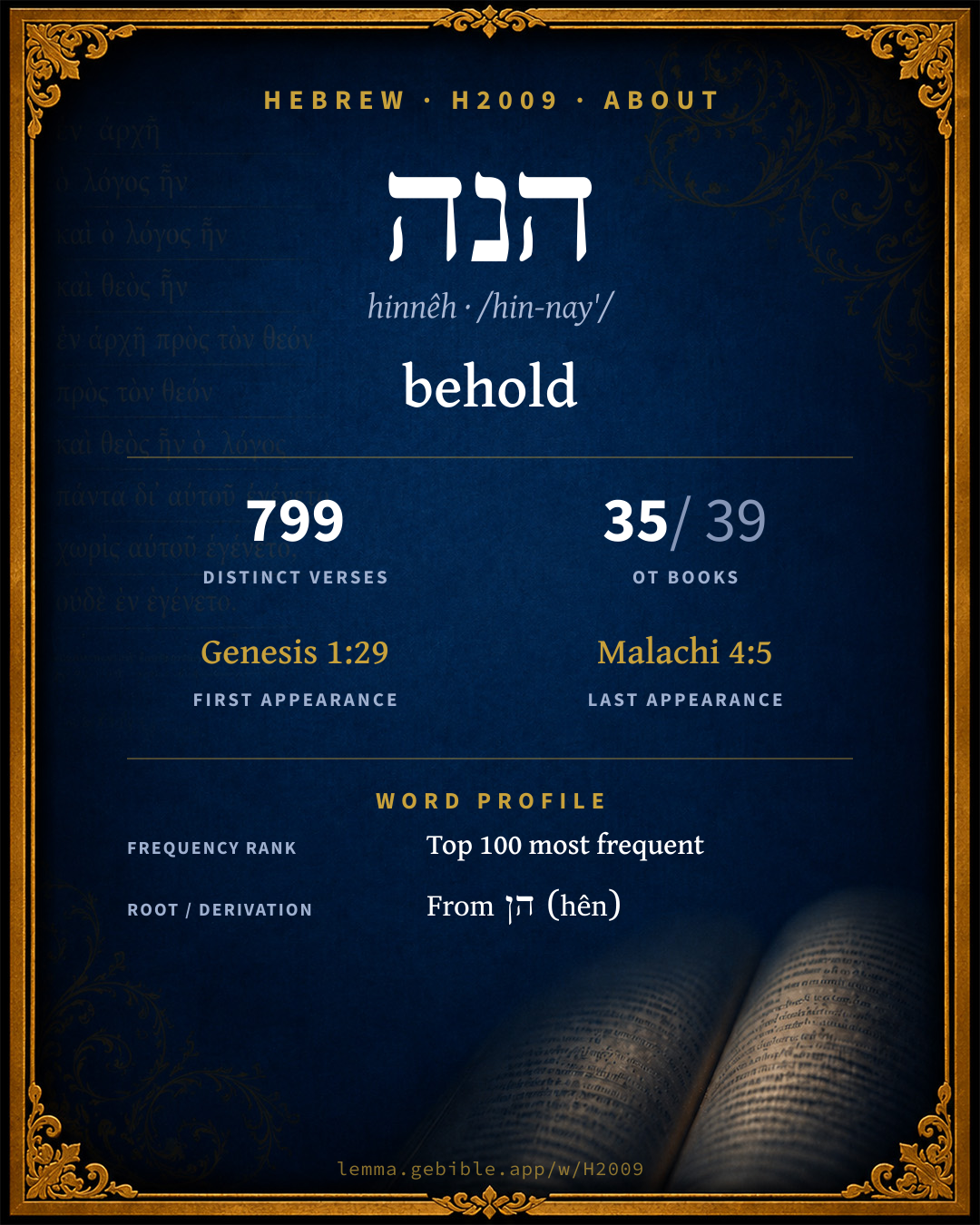
הִנֵּה
behold
Full lexicon entry — Brown-Driver-Briggs (BDB)
From Brown-Driver-Briggs (BDB)
Where this word appears
Grammar key — what these labels mean
Part of speech
- Particle
- A short function word — article, negation, interrogative, the sign of the direct object, and the like.
Every verse where H2009 appears in the Book of Exodus — 34 distinct verses. Click any verse to open its interlinear word-by-word view. Verse text shown in the World English Bible for context — . Each verse’s Hebrew form is shown with its reference; the English is not keyword-highlighted, since the data carries no word-level English alignment. Use “Compare translations” on any verse to read it across multiple English versions. This concordance covers the Hebrew Bible; Septuagint (Greek Old Testament) occurrences are not indexed here.
Exodus
- Exodus 1:9 הִנֵּ֗ה ptcl dem He said to his people, "Behold, the people of the children of Israel are more and mightier than we.
- Exodus 2:6 וְ/הִנֵּה conj + ptcl dem She opened it, and saw the child, and, behold, the baby cried. She had compassion on him, and said, "This is one of the Hebrews' children."
- Exodus 2:13 וְ/הִנֵּ֛ה conj + ptcl dem He went out the second day, and, behold, two men of the Hebrews were fighting with each other. He said to him who did the wrong, "Why do you strike your fellow?"
- Exodus 3:2 וְ/הִנֵּ֤ה conj + ptcl dem The angel of Yahweh appeared to him in a flame of fire out of the midst of a bush. He looked, and behold, the bush burned with fire, and the bush was not consumed.
- Exodus 3:4 הִנֵּֽ/נִי ptcl dem + sfx pers 1cs When Yahweh saw that he turned aside to see, God called to him out of the midst of the bush, and said, "Moses! Moses!" He said, "Here I am."
- Exodus 3:9 הִנֵּ֛ה ptcl dem Now, behold, the cry of the children of Israel has come to me. Moreover I have seen the oppression with which the Egyptians oppress them.
- Exodus 3:13 הִנֵּ֨ה ptcl dem Moses said to God, "Behold, when I come to the children of Israel, and tell them, 'The God of your fathers has sent me to you;' and they ask me, 'What is his name?' What should I tell them?"
- Exodus 4:6 וְ/הִנֵּ֥ה conj + ptcl dem Yahweh said furthermore to him, "Now put your hand inside your cloak." He put his hand inside his cloak, and when he took it out, behold, his hand was leprous, as white as snow.
- Exodus 4:7 וְ/הִנֵּה conj + ptcl dem He said, "Put your hand inside your cloak again." He put his hand inside his cloak again, and when he took it out of his cloak, behold, it had turned again as his other flesh.
- Exodus 4:14 הִנֵּה ptcl dem The anger of Yahweh was kindled against Moses, and he said, "What about Aaron, your brother, the Levite? I know that he can speak well. Also, behold, he comes forth to meet you. When he sees you, he will be glad in his heart.
- Exodus 4:23 הִנֵּה֙ ptcl dem and I have said to you, "Let my son go, that he may serve me;" and you have refused to let him go. Behold, I will kill your son, your firstborn.'"
- Exodus 5:16 וְ/הִנֵּ֧ה conj + ptcl dem No straw is given to your servants, and they tell us, 'Make brick!' and, behold, your servants are beaten; but the fault is in your own people."
- Exodus 7:15 הִנֵּה֙ ptcl dem Go to Pharaoh in the morning. Behold, he goes out to the water; and you shall stand by the river's bank to meet him; and the rod which was turned to a serpent you shall take in your hand.
- Exodus 7:16 וְ/הִנֵּ֥ה conj + ptcl dem You shall tell him, 'Yahweh, the God of the Hebrews, has sent me to you, saying, "Let my people go, that they may serve me in the wilderness:" and, behold, until now you haven't listened.
- Exodus 7:17 הִנֵּ֨ה ptcl dem Thus says Yahweh, "In this you shall know that I am Yahweh. Behold, I will strike with the rod that is in my hand on the waters which are in the river, and they shall be turned to blood.
- Exodus 8:2 הִנֵּ֣ה ptcl dem If you refuse to let them go, behold, I will plague all your borders with frogs:
- Exodus 8:20 הִנֵּ֖ה ptcl dem Yahweh said to Moses, "Rise up early in the morning, and stand before Pharaoh; behold, he comes forth to the water; and tell him, 'This is what Yahweh says, "Let my people go, that they may serve me.
- Exodus 8:29 הִנֵּ֨ה ptcl dem Moses said, "Behold, I go out from you, and I will pray to Yahweh that the swarms of flies may depart from Pharaoh, from his servants, and from his people, tomorrow; only don't let Pharaoh deal deceitfully any more in not letting the people go to sacrifice to Yahweh."
- Exodus 9:3 הִנֵּ֨ה ptcl dem behold, the hand of Yahweh is on your cattle which are in the field, on the horses, on the donkeys, on the camels, on the herds, and on the flocks with a very grievous pestilence.
- Exodus 9:7 וְ/הִנֵּ֗ה conj + ptcl dem Pharaoh sent, and, behold, there was not so much as one of the cattle of the Israelites dead. But the heart of Pharaoh was stubborn, and he didn't let the people go.
- Exodus 14:10 וְ/הִנֵּ֥ה conj + ptcl dem When Pharaoh drew near, the children of Israel lifted up their eyes, and behold, the Egyptians were marching after them; and they were very afraid. The children of Israel cried out to Yahweh.
- Exodus 16:10 וְ/הִנֵּה֙ conj + ptcl dem It happened, as Aaron spoke to the whole congregation of the children of Israel, that they looked toward the wilderness, and, behold, the glory of Yahweh appeared in the cloud.
- Exodus 16:14 וְ/הִנֵּ֞ה conj + ptcl dem When the dew that lay had gone, behold, on the surface of the wilderness was a small round thing, small as the hoar-frost on the ground.
- Exodus 19:9 הִנֵּ֨ה ptcl dem Yahweh said to Moses, "Behold, I come to you in a thick cloud, that the people may hear when I speak with you, and may also believe you forever." Moses told the words of the people to Yahweh.
- Exodus 23:20 הִנֵּ֨ה ptcl dem "Behold, I send an angel before you, to keep you by the way, and to bring you into the place which I have prepared.
- Exodus 24:8 הִנֵּ֤ה ptcl dem Moses took the blood, and sprinkled it on the people, and said, "Look, this is the blood of the covenant, which Yahweh has made with you concerning all these words."
- Exodus 24:14 וְ/הִנֵּ֨ה conj + ptcl dem He said to the elders, "Wait here for us, until we come again to you. Behold, Aaron and Hur are with you. Whoever is involved in a dispute can go to them."
- Exodus 31:6 הִנֵּ֧ה ptcl dem I, behold, I have appointed with him Oholiab, the son of Ahisamach, of the tribe of Dan; and in the heart of all who are wise-hearted I have put wisdom, that they may make all that I have commanded you:
- Exodus 32:9 וְ/הִנֵּ֥ה conj + ptcl dem Yahweh said to Moses, "I have seen these people, and, behold, they are a stiff-necked people.
- Exodus 32:34 הִנֵּ֥ה ptcl dem Now go, lead the people to the place of which I have spoken to you. Behold, my angel shall go before you. Nevertheless in the day when I punish, I will punish them for their sin."
- Exodus 33:21 הִנֵּ֥ה ptcl dem Yahweh also said, "Behold, there is a place by me, and you shall stand on the rock.
- Exodus 34:10 הִנֵּ֣ה ptcl dem He said, "Behold, I make a covenant: before all your people I will do marvels, such as have not been worked in all the earth, nor in any nation; and all the people among which you are shall see the work of Yahweh; for it is an awesome thing that I do with you.
- Exodus 34:30 וְ/הִנֵּ֥ה conj + ptcl dem When Aaron and all the children of Israel saw Moses, behold, the skin of his face shone; and they were afraid to come near him.
- Exodus 39:43 וְ/הִנֵּה֙ conj + ptcl dem Moses saw all the work, and, behold, they had done it as Yahweh had commanded, even so had they done it: and Moses blessed them.
About this entry
At a glance — auto-summarized from this page’s data, not written by a person. Every figure links to its source below. This summary describes the numbers; it doesn’t interpret them.
At its core, הנה (hinnêh) means “behold.” First canonically at Genesis 1:29, it enters the text early. With 799 verses in 35 books, it is one of the most common word in the Hebrew Bible. From the same root come הן, הן and להן. Dig into 799-verse concordance and the renderings breakdown below.
Gloss history
Strong's 1890 vs modern scholarship
About this word
Strong's H2009 catalogs a Hebrew word from the Hebrew Old Testament.
These counts are not copied from any lexicon or concordance. They are computed here, from the morphology-tagged Hebrew Old Testament. What Lemma adds →
- 799
- distinct verses
- The word appears in 799 distinct verses.
- 35 / 39
- OT books
- The word appears in 35 of 39 Old Testament books.
- #53
- by frequency
- Top 100 most frequent Hebrew words (rank 53 of 8,640 Hebrew words by occurrence).
View all 799 occurrences in the concordance →
By section of the Old Testament
By traditional corpus
Conventional, traditional groupings — biblical authorship is debated, so this is a traditional corpus grouping, not an authorship claim. Each share is this word’s portion of its verses in that division of the Hebrew canon. Each figure is a share of the word’s 799 distinct verses.
- Prophets (Nevi'im) 491 verses · 61%
- Torah (Pentateuch) 203 verses · 25%
- Writings (Ketuvim) 105 verses · 13%
How translations render this word
Counts come from each version’s own published word-to-Strong’s tagging or interlinear alignment — an approximate guide to how each version renders this word, not a word-level alignment the data otherwise carries. Because each total is that version’s own tagged count, the per-version totals vary from one another and need not match the appearance or distinct-verse counts above. These counts may also differ from a printed concordance because Lemma counts each distinctly tagged rendering and does not collapse phrase taggings into a single head-word total. This is a fixed set of word-tagged versions (KJV, ASV, BSB, ULT) and does not change with the reading translation you choose elsewhere. Each version’s license is shown beside its name below (and on Sources).
- King James Version: Behold 9×, Lo 5×
- American Standard Version: Behold 7×, And 3×, Lo 2×
- Berean Standard Bible: Behold 169×, Look 75×, There 36×
- unfoldingWord Literal Text: Behold 767×, Behold me 65×, Behold i 27×
King James Version Public Domain
Renders H2009 across 17 tagged occurrences — most commonly:
Plus 3 renderings that appear only once — usually multi-word phrases or single function words the recovered tagging swept in, not distinct renderings.
American Standard Version Public Domain
Renders H2009 across 17 tagged occurrences — most commonly:
Plus 5 renderings that appear only once — usually multi-word phrases or single function words the recovered tagging swept in, not distinct renderings.
Berean Standard Bible Public Domain
Renders H2009 across 685 tagged occurrences — most commonly:
Plus other, less common renderings. Plus 77 renderings that appear only once — usually multi-word phrases or single function words the recovered tagging swept in, not distinct renderings. Not rendered by a distinct English word in 154 further occurrences.
unfoldingWord Literal Text CC BY-SA 4.0
Renders H2009 across 947 tagged occurrences — most commonly:
Plus other, less common renderings. Plus 12 renderings that appear only once — usually multi-word phrases or single function words the recovered tagging swept in, not distinct renderings.
Senses in the full BDB
What do BDB’s symbols mean?
BDB uses these scholarly abbreviations:
| Symbol | Meaning |
|---|---|
| 𝔊 | the Septuagint (the ancient Greek translation, LXX) |
| 𝔙 | the Vulgate (the Latin translation) |
| 𝔖 | the Syriac version (the Peshitta) |
| 𝔗 | the Targum (the Aramaic translation) |
| ψ | the Psalms |
| √ | root (the underlying root or stem) |
| ‖ | parallel passage (a synonymous or contrasted parallel) |
| † | the dagger: every passage where the word occurs is cited |
The 4 senses and sub-senses the full Brown-Driver-Briggs lexicon distinguishes for this word, in lexicon order (not ranked by frequency), with BDB’s own verbatim wording and sub-sense lettering. Shown in Hebrew script with BDB’s own scholarly abbreviations. The condensed entry is in the Lexicon Entry tab. See also the Forms in the corpus table below.
- a. pointing to persons or things, Gn 12:19 and now הִנֵּה אִשְׁתְּךָ behold thy wife! 18:9 הִנֵּה בָאֹהֶל behold (she is) in the tent (the suffix, when the noun to which הנה refers has immediately preceded, being not unfrequently omitted, 16:14: cf. Dr§ 135. 6, 2), 30:3; 31:51(×2) Ex 24:8 1 K 2:29. With sf. of 1 ps., especially in response to a call, indicating the readiness of the person addressed to listen or obey, Here I am! (lit. Behold me!) Gn 22:1, 7, 11; 27:1, 18; 31:11; 37:13; 46:2 Ex 3:4 1 S 3:4, 5, 6, 8, 16; 22:12 2 S 1:7 Is, 6:8, cf. 1 S 12:3 הִנְנִי עֲנוּ בִי here I am, answer against me, 14:43 (cf. Drp. 292), 2 S 15:26 (in resignation: cf. Gn 44:16; 50:18 Jos 9:25 Ezr 9:15): of God Is 52:6; 58:9; 65:1(×2) (repeated for emphasis). In the pl. הננו Nu 14:40 Je 3:22 Jb 38:35.—Emph. הִנְנִי אָ֕נִי Ez 34:11, 20, cf. 6:3. On הִנְנִי אֶל …, v. אל 4, p. 40. e.g. Genesis 12:19
- b. introducing clauses involving predication: (a) with ref. to the past or present, it points generally to some truth either newly asserted, or newly recognised, Gn 1:29 behold! I have given to you all herbs etc. 17:20; 27:6 1 S 14:33 etc.; often one upon which some proposal or suggestion is to be founded, Ex 1:9 (cf. הן Gn 11:6) 1 S 20:2, 5; 2 K 5:20. When the proposal is to be of the nature of an entreaty or request, הִנֵּה־נָא is often used, instead of the simple הִנֵּה Gn 12:11; 16:2; 18:27 1 K 20:31; 22:13 al. (v. נָא). (b) with ref. to the future. Here it serves to introduce a solemn or important declaration Ex 32:34; 34:10 Is 7:14; and is used especially with the ptcp. (the fut. instans, Dr§ 135, 3) in predictions or threats, Gn 20:3 הִנְּךָ מֵת (lit.) behold thee (accus.) about to die, thou art about to die, Ex 4:23; 7:17; 9:3 Dt 31:16 1 S 3:11 1 K 20:35; 22:25 Is 3:1; 10:33; 17:1; 19:1; 22:17; 24:1 + often; in the phrase הנה ימים באים †1 S 2:31 2 K 20:17 = Is 39:6 Am 4:2; 8:11; 9:13 + Je 15 times; very often with the suffix of 1 ps. sg., as הִנְנִי מֵבִיא Behold, I bring (lit. behold me bringing, or about to bring) … Gn 6:17 Ex 10:4 & often, especially in Je; Gn 9:9 Ex 8:17; 9:18; 34:11 2 K 22:20 Is 13:17; 29:14; 43:19 Je 8:17; 11:22 (הִנְנִי פֹקֵד; so 23:2 +) 16:16; 20:4, etc.; anomalously, with change of person, Is 28:16 הִנְנִי יִסַּד (according to points) behold me, one who has founded, 29:14 הִנְנִי יוֹסִף behold me, one who will add (so 38:5); but it is dub. whether the ptcp. יֹסֵד, יוֹסֵף should not be read. e.g. Genesis 1:29
- c. וְהִנֵּה … very freq. in historical style, especially (but not exclusively) after verbs of seeing or discovering, making the narrative graphic and vivid, and enabling the reader to enter into the surprise or satisfaction of the speaker or actor concerned: Gn 1:31 and behold, it was very good, 6:12; 8:13; 15:12; 18:2; 37:29 Ex 2:6 Dt 9:13 etc.: in the description of a dream Gn 37:7, 9; 40:9, 16; 41:1, 2, 3 Is 29:8, or of a vision Am 7:1, 4; 8:1 etc. With a ptcp. (the context fixing the sense to the past), Gn 24:30; 37:15 (both without suffix); Ju 9:43; 11:34 1 K 19:5, 11 +. e.g. Genesis 1:31
- d. like II. הֵן (b), nearly = if (rare): Lv 13:5, 6, 8, 10 (& elsewhere in this and the next ch.) וְהִנֵּה and behold = and if, Dt 13:15 and 17:4 וְהִנֵּה אֱמֶת and behold it is true = and if it be true, 19:18 1 S 20:12; cf. 1 S 9:7 2 S 18:11 Ho 9:6; with ו׳ in apod. 2 K 10:9. e.g. Leviticus 13:5
Senses from the full Brown-Driver-Briggs lexicon (Brown, Driver, Briggs; Oxford 1906 — public domain), digitized via Sefaria, supplemented by the OpenScriptures HebrewLexicon (CC BY 4.0). Full attribution on Sources.
Word origin
Once הִנֶּה־ Gn 19:2, demonstr. part. lo! behold! (Arabic إِنَّ certainly, surely, lit. lo!), with sf. (the pron. being conceived as accus., Ew§ 262 c; cf. إِنَّ, which takes an accus., whether of a noun or pron. sf.) הִנְנִי Gn 6:13 + often (also הִנֶּ֣נִּי Gn 22:7), הִנֵּ֑נִי Gn 22:1, 11 +, (הִנֶּ֔נִּי Gn 27:18), †Is 65:1 הִנֵּ֣נִי הִנֵּ֔נִי (but הִנֵּה אָנֹכִי is also said Gn 24:13, 43; 25:32; 48:21 Ex 4:23; 7:17 +; and, more rarely, הִנֵּה אֲנִי Ez 37:5, 12, 19, 21 2 Ch 2:3, cf. 2 K 10:9 Je 32:27); הִנְּךָ Gn 20:3 + (†2 K 7:2 הִנְּכָה), הִנֶּ֑ךָּ †ψ139:8, fem. הִנָּךְ Gn 16:11 + 6 times; הִנּוֹ †Nu 23:17 Jb 2:6 1 Ch 11:25, הִנֵּ֫הוּ †Je 18:3 Kt (הִנֵּה הוּא is more usual, as Gn 20:16; 42:27; 1 S 10:22 Je 38:5 Ru 3:2): 1 pl. הִנְנוּ †Jos 9:25 2 S 5:1 Je 3:22 Ezr 9:15, הִנֶּ֫נּוּ †Gn 44:16; 50:18 Nu 14:40, הִנֵּ֑נוּ Jb 38:35; הִנְּכֶם †Dt 1:10 Je 16:12; הִנָּם Gn 40:6 + often (37 times)—lo! behold!
— Brown-Driver-Briggs (Oxford 1906, public domain), digitized via Sefaria, supplemented by the OpenScriptures HebrewLexicon (CC BY 4.0). See Sources.
Derived from הן (hên) (H2005) — behold.
Jastrow Dictionary
A second Hebrew/Aramaic lexicon for comparison, covering Aramaic and post-biblical (Talmudic, Targumic, Midrashic) usage that the biblical-Hebrew BDB does not. Matched by lemma rather than by Strong’s number, so a lemma may carry more than one Jastrow headword (shown separately below), and the entries cover usage well beyond the Bible.
הַנָּה
- , v. הָן
הִנֵּה
- v. הֵן) behold, here is. Koh. R. to V, 6 ה׳ של בו"ד the ‘here is’ of a human being (Esth. VIII, 7), ה׳ של הק"בה the ‘here is’ of the Lord (Zech. XIV, 1).—הִנֵּנִי here am I. Gen. R. s. 55 ה׳ לכהונה I am ready for priesthood; a. fr. e.g. Esther 8:7
הָנָה
- , v. הני
הני
- (denom. of הֲנָאָה), Nif. נֶהֱנֶה (= נֵאוֹת, v. אוֹת I)
- 1. to be pleased, to enjoy, to profit. B. Kam. 20ᵃ, a. fr. זה נה׳ the one is benefitted &c., opp. חָסֵר. Ib. II, 2 משלם מה שנֶהֱנֵית he must pay for what the animal has enjoyed (eaten or drunk), contrad. to מה שהזיקה what she has damaged. Ber. 10ᵇ הרוצה לֵהָנוֹת יהָנֶה וכ׳ (Rashi לֵיהָ׳) he who desires to make use (of people’s hospitalities), may do so following the example of Elisha. R. Hash. 28ᵃ, a. fr. מצות לא ליהנות ניתנו religious ceremonies are not considered an enjoyment (as regards the use of sacred property &c.); a. v. fr.
- 2. to be enjoyed. Ber. 35ᵃ דבר שנ׳ something which is enjoyable (can be eaten &c.).
- to benefit, to entertain, to cause to share. Snh. 92ᵃ אינו מְהַנֶּה ת"ח וכ׳ allows no scholar to share his wealth. Ber. 63ᵇ bot. ומְהַנֵּהוּ וכ׳ and invites him to partake of his wealth. Yad. IV, 3 הרי אתה כמְהַנָּן וכ׳ you appear to benefit them pecuniarily, but &c. Ab. Zar. 16ᵇ sq. שמא דבר מינית … והִנָּאֲךָ (v. Rabb. D. S. a. l. note 20) perhaps a heretical idea was communicated to thee and it pleased thee; Yalk. Prov. 937; a. fr. [Snh. 102ᵇ הֶהֱנָה Hif., marginal note היה מְהַנֶּה; v. Yalk. Kings 207.]
A Dictionary of the Targumim, the Talmud Babli and Yerushalmi, and the Midrashic Literature (Marcus Jastrow; London, Luzac, 1903) — Public Domain. Digitized via Sefaria. Digitized via Sefaria. Full attribution on Sources.
Forms in the corpus
The 60 distinct written forms H2009 takes in the Hebrew Bible, most frequent first — each parse links to that state’s occurrences in the concordance. Hebrew forms include their vowel points and cantillation, so a single lemma takes many written forms.
| Form | Parsing | Example | Uses |
|---|---|---|---|
| הִנֵּ֣ה | Particle, Demonstrative | Amos 8:11 | 70 |
| הִנֵּ֤ה | Particle, Demonstrative | Amos 6:11 | 66 |
| הִנֵּ֥ה | Particle, Demonstrative | Amos 4:2 | 62 |
| הִנֵּ֨ה | Particle, Demonstrative | Amos 9:13 | 60 |
| וְ/הִנֵּ֥ה | Particle, Demonstrative | Amos 7:4 | 60 |
| הִנֵּה | Particle, Demonstrative | Daniel 11:2 | 56 |
| וְ/הִנֵּ֣ה | Particle, Demonstrative | Daniel 8:3 | 48 |
| וְ/הִנֵּ֤ה | Particle, Demonstrative | Daniel 8:5 | 43 |
| וְ/הִנֵּה | Particle, Demonstrative | Daniel 10:10 | 43 |
| וְ/הִנֵּ֨ה | Particle, Demonstrative | Ecclesiastes 2:11 | 37 |
| וְ/הִנֵּה֙ | Particle, Demonstrative | Amos 7:1 | 31 |
| הִנֵּ֛ה | Particle, Demonstrative | Amos 2:13 | 26 |
| וְ/הִנֵּ֛ה | Particle, Demonstrative | Daniel 8:15 | 26 |
| הִנֵּה֙ | Particle, Demonstrative | Exodus 4:23 | 24 |
| הִנֵּֽה | Particle, Demonstrative | Genesis 18:31 | 16 |
| וְ/הִנֵּ֖ה | Particle, Demonstrative | Amos 8:1 | 16 |
| הִנֵּה֩ | Particle, Demonstrative | Amos 4:13 | 15 |
| וְ/הִנֵּ֧ה | Particle, Demonstrative | Amos 7:7 | 13 |
| הִנֵּ֧ה | Particle, Demonstrative | Exodus 31:6 | 11 |
| הִנֵּ֖ה | Particle, Demonstrative | Exodus 8:20 | 10 |
| וְ/הִנֵּה֩ | Particle, Demonstrative | Ezekiel 1:4 | 10 |
| הִ֠נֵּה | Particle, Demonstrative | Genesis 22:20 | 9 |
| וְ/הִנֵּ֗ה | Particle, Demonstrative | Daniel 10:16 | 8 |
| הִנָּ֣/ם | Particle, Demonstrative | 1 Chronicles 29:29 | 7 |
| וְ֠/הִנֵּה | Particle, Demonstrative | Genesis 37:7 | 7 |
| וְ/הִ֨נֵּה | Particle, Demonstrative | Amos 7:1 | 5 |
| וְ/הִנֵּֽה | Particle, Demonstrative | Ezekiel 37:8 | 5 |
| הִנֵּ֗ה | Particle, Demonstrative | Exodus 1:9 | 4 |
| הִנֵּ֞ה | Particle, Demonstrative | Amos 9:8 | 4 |
| הִנֵּֽנִ/י | Particle, Demonstrative | Genesis 22:1 | 4 |
| וְ/הִנֵּ֞ה | Particle, Demonstrative | Exodus 16:14 | 4 |
| הִ֭נֵּה | Particle, Demonstrative | Job 4:3 | 3 |
| הִנֵּ֪ה | Particle, Demonstrative | Psalms 11:2 | 3 |
| הִנֵּֽ/נִי | Particle, Demonstrative | Exodus 3:4 | 3 |
| וְ/הִנָּ֛/ם | Particle, Demonstrative | Ezekiel 13:10 | 3 |
| הִֽנֵּה | Particle, Demonstrative | 1 Samuel 20:5 | 2 |
| הִנְּ/ךָ֥ | Particle, Demonstrative | Deuteronomy 31:16 | 2 |
| הִנֵּה֮ | Particle, Demonstrative | 2 Kings 20:17 | 2 |
| הִנָּ֥/ךְ | Particle, Demonstrative | Genesis 16:11 | 2 |
| וְ/הִנֵּ֡ה | Particle, Demonstrative | 2 Chronicles 19:11 | 2 |
| וְ/הִנָּ/ם֙ | Particle, Demonstrative | 2 Chronicles 20:2 | 2 |
| הִנְ/נִ֨י | Particle, Demonstrative | Ezekiel 6:3 | 1 |
| הִנְ/נִי֩ | Particle, Demonstrative | Genesis 6:17 | 1 |
| הִנֵּ֑ה | Particle, Demonstrative | Job 9:19 | 1 |
| הִנֵּ֔ה | Particle, Demonstrative | Habakkuk 2:13 | 1 |
| הִנֵּ֕ה | Particle, Demonstrative | Judges 18:12 | 1 |
| הִנֵּ֡ה | Particle, Demonstrative | 1 Samuel 20:2 | 1 |
| הִנֶּ֔נִּ/י | Particle, Demonstrative | Genesis 27:18 | 1 |
| הִנֶּ֣ה | Particle, Demonstrative | Genesis 19:2 | 1 |
| הִנֶּ֣נִּֽ/י | Particle, Demonstrative | Genesis 22:7 | 1 |
| הִנֶּ֥/נּֽוּ | Particle, Demonstrative | Genesis 50:18 | 1 |
| הִנָּ֗/ם | Particle, Demonstrative | 2 Kings 7:13 | 1 |
| הִנָּ֨/ךְ | Particle, Demonstrative | Judges 13:5 | 1 |
| ו/הנ/הו | Particle, Demonstrative | Jeremiah 18:3 | 1 |
| וְ/הְנֵּ֛ה | Particle, Demonstrative | Judges 3:25 | 1 |
| וְ/הִֽנֵּה | Particle, Demonstrative | Isaiah 49:12 | 1 |
| וְ/הִנּ֤/וֹ | Particle, Demonstrative | Numbers 23:17 | 1 |
| וְ/הִנְּ/כֶ֣ם | Particle, Demonstrative | Deuteronomy 1:10 | 1 |
| וְ/הִנָּ֣/ם | Particle, Demonstrative | 1 Chronicles 9:1 | 1 |
| וְ/הִנָּ֨/ם | Particle, Demonstrative | Joshua 7:21 | 1 |
Same root — word family
Other BDB entries built from the same root as H2009, grouped by Strong’s listed origin. These share a root / origin per the lexicon — not necessarily a shared meaning. Each links to that word’s own entry.
Derives from
Shares the same root
Compare all same-root words → They share a root, not necessarily a meaning.
Septuagint verse parallels
This word appears in 769 verses that also exist in the Greek Old Testament (Septuagint), out of the 799 Hebrew verses it occurs in. You can read those verses in Greek by switching the Old Testament edition to the Septuagint.
Read these verses in the Septuagint
- Genesis 1:29
- Exodus 1:9
- Leviticus 10:16
- Numbers 3:12
- Deuteronomy 1:10
- Joshua 2:2
- Judges 1:2
- Ruth 1:15
- 1 Samuel 2:31
- 2 Samuel 1:2
- 1 Kings 1:14
- 2 Kings 1:9
This is a verse-level parallel only — the same verses exist in both the Hebrew and Greek Old Testaments. No word-level Hebrew↔Greek correspondence is claimed: the data carries no such alignment, so no Greek word is shown as this Hebrew word’s translation. Coverage is not total — the Septuagint omits the deuterocanon and renumbers the Psalms, so some Hebrew verses have no direct Greek parallel.