
Judges 18:12

Hebrew (Westminster Leningrad Codex) Judges 18:12 appears in the Hebrew Old Testament. The text above is from the Westminster Leningrad Codex. Each word links to its Strong’s number, a concise gloss, and parsing drawn from the Open Scriptures Hebrew Bible morphology. Click any word for its full Brown-Driver-Briggs (BDB) entry.
Download image
Cite this verse

Judges 18:12 (World English Bible). Public Domain. Lemma interlinear Bible study tool, https://lemma.gebible.app/v/judges/18/12.

Show BibTeX & RIS
BibTeX
RIS
English Translation
They went up, and encamped in Kiriath Jearim, in Judah: therefore they called that place Mahaneh-dan, to this day; behold, it is behind Kiriath Jearim.
World English Bible · Public Domain
Highlights
  • 1 first appearance in the Hebrew Bible
Full analysis ↓
Download a study sheet

One document with this verse’s original text, its word-by-word gloss line, the meaning frame, cross-references with their text, attributed commentary, and full source and license credits — printable, and it pastes into notes with its structure intact.

This verse Autodidact and up

Study sheet (.html) Plain text (.txt)

A passage Seminary Student

Up to 50 verses in one chapter. A passage sheet keeps up to 6 commentary sources and 12 cross-references per verse, in the order this page ranks them, and says so on the sheet whenever that leaves anything out. Ask for a single verse and you get the Autodidact verse sheet above.

Everything on this page stays free to read, with no account — the sheet is a download of what is already on screen, not access to it.

Want to remove ads? Support Godless Engineer
Compare translations 3

The same verse in 3 English versions, stacked beneath the original-language interlinear above. Click any original word for its lexicon entry.

Each is an independent rendering of the whole verse — the interlinear is not word-aligned to these translations.

Highlighted words mark where these versions differ — a whole-verse word diff, not a word-by-word alignment.

  • World English Bible Public Domain
    They went up, and encamped in Kiriath Jearim, in Judah: therefore they called that place Mahaneh-dan, to this day; behold, it is behind Kiriath Jearim.
  • King James Version Public Domain
    And they went up, and pitched in Kirjathjearim, in Judah: wherefore they called that place Mahanehdan unto this day: behold, it is behind Kirjathjearim.
  • unfoldingWord Literal Text CC BY-SA 4.0
    And they went up and camped at Kiriath Jearim in Judah. Upon this they call that place Mahaneh Dan to this day. Behold, beside Kiriath Jearim.

unfoldingWord Literal Text — © unfoldingWord, licensed CC BY-SA 4.0. Word-aligned USFM3 via Door43 (git.door43.org/unfoldingWord/en_ult).

Versions to compare (up to 4)

3 of 4 selected

Show all 18 translations

Every available English version of this verse, each an independent rendering of the whole verse.

  • World English Bible Public Domain
    They went up, and encamped in Kiriath Jearim, in Judah: therefore they called that place Mahaneh-dan, to this day; behold, it is behind Kiriath Jearim.
  • Berean Standard Bible Public Domain
    They went up and camped at Kiriath-jearim in Judah. That is why the place west of Kiriath-jearim is called Mahaneh-dan to this day.
  • Majority Standard Bible Public Domain
    They went up and camped at Kiriath-jearim in Judah. That is why the place west of Kiriath-jearim is called Mahaneh-dan to this day.
  • King James Version Public Domain
    And they went up, and pitched in Kirjathjearim, in Judah: wherefore they called that place Mahanehdan unto this day: behold, it is behind Kirjathjearim.
  • American Standard Version (1901) Public Domain
    And they went up, and encamped in Kiriath-jearim, in Judah: wherefore they called that place Mahaneh-dan, unto this day; behold, it is behind Kiriath-jearim.
  • Revised Version (1885) Public Domain
    And they went up, and encamped in Kiriath-jearim, in Judah: wherefore they called that place Mahaneh-dan unto this day: behold, it is behind Kirjath-jearim.
  • Geneva Bible (1599) Public Domain
    And they went vp, and pitched in Kiriath-iearim in Iudah: wherefore they called that place, Mahaneh-Dan vnto this day: and it is behinde Kiriath-iearim.
  • Douay-Rheims (1899) Public Domain
    And going up they lodged in Cariathiarim of Juda: which place from that time is called the camp of Dan, and is behind Cariathiarim.
  • Young's Literal Translation Public Domain
    And they go up and encamp in Kirjath-Jearim, in Judah, therefore they have called that place, `Camp of Dan,' till this day; lo, behind Kirjath-Jearim.
  • Literal Standard Version CC BY-SA 4.0
    And they go up and encamp in Kirjath-Jearim, in Judah, therefore they have called that place, “Camp of Dan,” until this day; behold, behind Kirjath-Jearim.
  • Unlocked Literal Bible CC BY-SA 4.0
    They went up and camped at Kiriath Jearim, in Judah. This is why people called that place Mahaneh Dan to this day; it is west of Kiriath Jearim.
  • unfoldingWord Literal Text CC BY-SA 4.0
    And they went up and camped at Kiriath Jearim in Judah. Upon this they call that place Mahaneh Dan to this day. Behold, beside Kiriath Jearim.
  • Darby Bible Public Domain
    and went up and encamped at Kir'iath-je'arim in Judah. On this account that place is called Ma'haneh-dan to this day; behold, it is west of Kir'iath-je'arim.
  • World Messianic Bible Public Domain
    They went up and encamped in Kiriath Jearim in Judah. Therefore they call that place Mahaneh Dan to this day. Behold, it is behind Kiriath Jearim.
  • Webster's Bible Public Domain
    And they went up, and encamped in Kirjath-jearim, in Judah: wherefore they called that place Mahaneh-dan to this day: behold, it is behind Kirjath-jearim.
  • Free Bible Version CC BY-SA 4.0
    En route they camped at Kiriath-jearim in Judah. That's why the place west of Kiriath-jearim is called the Camp of Dan to this very day.
  • Bible in Basic English Public Domain
    And they went up and put up their tents in Kiriath-jearim in Judah: so that place is named Mahaneh-dan to this day. It is to the west of Kiriath-jearim.
  • JPS Tanakh (1917) Public Domain
    And they went up, and encamped in Kiriath-jearim, in Judah; wherefore that place was called Mahaneh-dan unto this day; behold, it is behind Kiriath-jearim.

Literal Standard Version (2020), Covenant Press — licensed CC BY-SA 4.0. Text via the HelloAO Bible API (eBible.org). Unlocked Literal Bible (unfoldingWord) — licensed CC BY-SA 4.0. Text via the HelloAO Bible API (eBible.org). unfoldingWord Literal Text — © unfoldingWord, licensed CC BY-SA 4.0. Word-aligned USFM3 via Door43 (git.door43.org/unfoldingWord/en_ult). Free Bible Version, Dr. Jonathan Gallagher — licensed CC BY-SA 4.0. Text via the HelloAO Bible API (eBible.org).

Word by word

More ways to search: Search by grammar → Find every occurrence → Compare this word →

Practice this passage: Drill this verse → Learn its vocabulary →

מַחֲנֵה
Machănêh-Dân
H4265
“Mahaneh-dan”
Noun, Proper
Part of Speech
Noun
Type
Proper
Full BDB Definition

Origin: from H4264 and H1835

TWOT: None

Mahaneh-dan = "camp of Dan" - campsite of the tribe of Dan; place behind Kirjath-jearim and between Zorah and Eshtaol
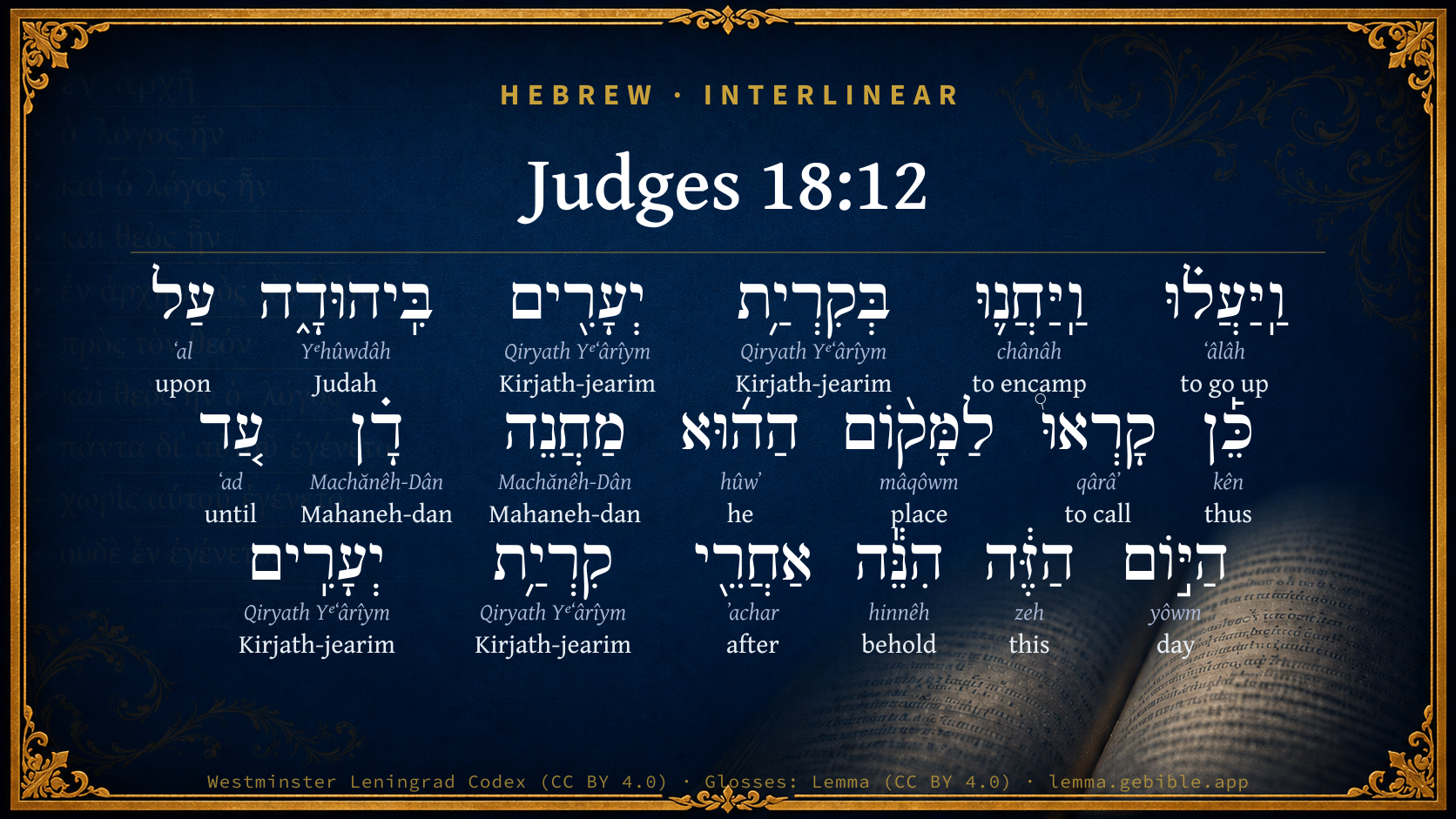
  1. וַֽיַּעֲל֗וּ ʻâlâh H5927 “and · to go up” Conjunction + Verb, Qal, Sequential Imperfect, 3rd Person, Masculine, Plural
  2. וַֽיַּחֲנ֛וּ chânâh H2583 “and · to encamp” Conjunction + Verb, Qal, Sequential Imperfect, 3rd Person, Masculine, Plural
  3. בְּקִרְיַ֥ת Qiryath Yᵉʻârîym H7157 “in/at · Kirjath-jearim” Preposition + Noun, Proper
  4. יְעָרִ֖ים Qiryath Yᵉʻârîym H7157 “Kirjath-jearim” Noun, Proper
  5. בִּֽיהוּדָ֑ה Yᵉhûwdâh H3063 “in/at · Judah” Preposition + Noun, Proper
  6. עַל ʻal H5921 “upon” Preposition
  7. כֵּ֡ן kên H3651 “thus” Particle, Demonstrative
  8. קָרְאוּ֩ qârâʼ H7121 “to call” Verb, Qal, Perfect, 3rd Person, Common, Plural
  9. לַמָּק֨וֹם mâqôwm H4725 “to/for the · place” Preposition, Determined + Noun, Common, Masculine, Singular, Absolute
  10. הַה֜וּא hûwʼ H1931 “the · he” Particle, Definite Article + Pronoun, Personal, 3rd Person, Masculine, Singular
  11. דָ֗ן Machănêh-Dân H4265 “Mahaneh-dan” Noun, Proper
  12. עַ֚ד ʻad H5704 “until” Preposition
  13. הַיּ֣וֹם yôwm H3117 “the · day” Particle, Definite Article + Noun, Common, Masculine, Singular, Absolute
  14. הַזֶּ֔ה zeh H2088 “the · this” Particle, Definite Article + Pronoun, Demonstrative, Masculine, Singular
  15. הִנֵּ֕ה hinnêh H2009 “behold” Particle, Demonstrative
  16. אַחֲרֵ֖י ʼachar H310 “after” Preposition
  17. קִרְיַ֥ת Qiryath Yᵉʻârîym H7157 “Kirjath-jearim” Noun, Proper
  18. יְעָרִֽים Qiryath Yᵉʻârîym H7157 “Kirjath-jearim” Noun, Proper

About this verse

These counts appear in no published source. They are computed here, from the morphology-tagged text and Lemma’s own curated glosses. What Lemma adds →

19
words
15
distinct lemmas
Historical
section

Notable vocabulary

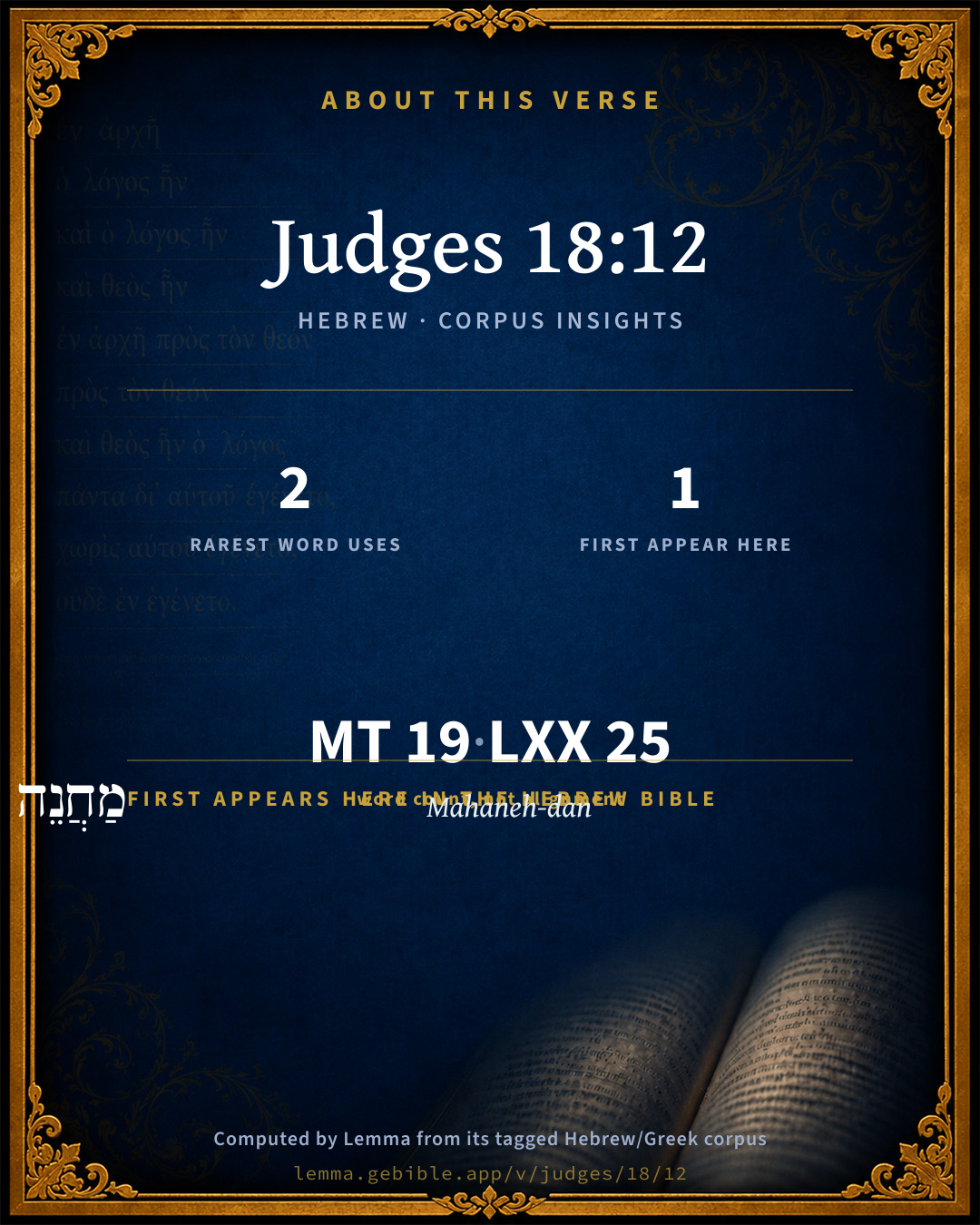
The rarest word here is מַחֲנֵה Mahaneh-dan H4265 — appearing just 2 times in the whole Hebrew Bible.

First appearance in Scripture

This word makes its first canonical appearance in the Hebrew Bible here:

  • מַחֲנֵה Mahaneh-dan H4265

Grammatical profile

  • 3 verbs
  • 9 nouns
  • 2 pronouns
  • 3 prepositions
  • 2 particles

Verb forms

  • וַֽיַּעֲל֗וּ Qal · Sequential Imperfect
  • וַֽיַּחֲנ֛וּ Qal · Sequential Imperfect
  • קָרְאוּ֩ Qal · Perfect

Repetition

Words recur within this verse — often emphatic in Hebrew:

  • בְּקִרְיַ֥ת Kirjath-jearim H7157 ×4
  • מַחֲנֵה Mahaneh-dan H4265 ×2

Hebrew & Septuagint length

In English translation the verse runs 25 words from the Hebrew and 29 from the Septuagint (LXX English) — closely comparable.

A rough comparison of the two English renderings, which tokenize alike — not a word-level alignment.

Word counts can differ between the Hebrew and the Greek without any difference in meaning — e.g. the Hebrew direct-object marker אֵת has no separate Greek word, and Greek often adds the article ὁ.

In the original languages it is 19 Hebrew tokens and 25 Greek tokens — but the two are counted differently (Hebrew bundles its prefixes and suffixes into one token; the Greek is in lemma form), so that isn’t a like-for-like length.

Cross-references

5

Topical passages linked to Judges 18:12 in the Treasury of Scripture Knowledge — connected by theme and wording, ordered by reader-vote popularity; previews shown in the World English Bible.

  • Judges 13:25 The Spirit of Yahweh began to move him in Mahaneh-dan, between Zorah and Eshtaol.
  • Joshua 15:60 Kiriath Baal (the same is Kiriath Jearim), and Rabbah; two cities with their villages.
  • 1 Chronicles 13:5–6 So David assembled all Israel together, from the Shihor [the brook] of Egypt even to the entrance of Hamath, to bring the ark of God from Kiriath Jearim.
  • 1 Samuel 7:1 The men of Kiriath Jearim came, and fetched up the ark of Yahweh, and brought it into the house of Abinadab in the hill, and sanctified Eleazar his son to keep the ark of Yahweh.
  • 2 Chronicles 1:4 But David had brought the ark of God up from Kiriath Jearim to [the place] that David had prepared for it; for he had pitched a tent for it at Jerusalem.

Cross-references courtesy of OpenBible.info (CC BY 4.0).

Hebrew and Greek witnesses Masoretic Hebrew ↔ Greek Septuagint

The same verse in the two great witnesses to the Old Testament, shown verse-for-verse.

These are two independent witnesses, not word-aligned to each other, and the Septuagint is shown in lemma (dictionary) form.

Hebrew Judges 18:12 Masoretic · Westminster Leningrad Codex

וַֽיַּעֲל֗וּ וַֽיַּחֲנ֛וּ בְּקִרְיַ֥ת יְעָרִ֖ים בִּֽיהוּדָ֑ה עַל כֵּ֡ן קָרְאוּ֩ לַמָּק֨וֹם הַה֜וּא מַחֲנֵה דָ֗ן עַ֚ד הַיּ֣וֹם הַזֶּ֔ה הִנֵּ֕ה אַחֲרֵ֖י קִרְיַ֥ת יְעָרִֽים

They went up, and encamped in Kiriath Jearim, in Judah: therefore they called that place Mahaneh-dan, to this day; behold, it is behind Kiriath Jearim.

World English Bible · Public Domain

Greek LXX Judges 18:12 Septuagint · lemma form

καί ἀναβαίνω καί παρα ἐνβάλλω ἐν καριαθιαριμ ἐν ιουδα διά οὗτος καλέω ἐν ἐκεῖνος ὁ τόπος παρεμβολή δαν ἕως ὁ ἡμέρα οὗτος ἰδού ὀπίσω καριαθιαριμ

And they went up, and encamped in Cariathiarim in Juda; therefore it was called in that place the camp of Dan, until this day: behold, it is behind Cariathiarim.

LXX2012 (modern English Septuagint) · Public Domain

Hebrew: Westminster Leningrad Codex (CC BY 4.0). Greek: Septuagint (public domain); English from LXX2012 (modern English Septuagint) (Public Domain). How the Septuagint differs from the Hebrew →

Targum (Aramaic paraphrase)

1

The Targum is the ancient Jewish Aramaic paraphrase of the Hebrew Scriptures — an interpretive translation, not the Hebrew text itself. Onkelos (literal) and Pseudo-Jonathan (expansive) render the Torah, and Jonathan the Prophets. Coverage is partial: where no permissively-licensed English translation exists for a verse, only the Aramaic is shown. This is verse-level text, not a word-by-word alignment to the Hebrew.

  1. Targum Jonathan Prophets (Joshua–Malachi)
    וּסְלִיקוּ וּשְׁרוֹ בְּקִרְיַת יְעָרִים בְּאַרְעָא דְבֵית יְהוּדָה עַל כֵּן קְרוֹ לְאַתְרָא הַהוּא מַשִׁרְיַת דָן עַד יוֹמָא הָדֵין הָא הוּא אֲחוֹרֵי קִרְיַת יְעָרִים:

    (no public-domain English translation for this verse)

    Targum Jonathan — Aramaic: “Mikraot Gedolot” (public domain). English: “Sefaria Community Translation” (CC0 1.0 (public-domain dedication)); “London "Chaldee Paraphrase," 1871” (public domain). Text via Sefaria.

Commentary

Notes on Judges 18:12 from classic Christian and Jewish commentators (each source and its license shown beneath its notes). The classic Christian expositions comment on the surrounding passage and are grouped to its opening verse, so a note may address several verses; the Jewish commentaries on the Tanakh (Rashi and others) are per-verse, so they appear only where the commentator wrote on this verse.

Lemma curates 59 commentaries, every one of them public domain or Creative Commons licensed, each selected and text-cleaned for this edition rather than reprinted as found. About our sources →

Trapp's Complete Commentary

John Trapp

Jdg 18:12 And they went up, and pitched in Kirjathjearim, in Judah: wherefore they called that place Mahanehdan unto this day: behold, [it is] behind Kirjathjearim.

Ver. 12. Called that place Mahanehdan.] That is, The camp of Dan. See Jdg 13:25. Here dwelt Samson’s parents, and here were his Specimina et tyrocinia edita.

John Trapp, A Commentary or Exposition upon All the Books of the Old and New Testament (1647–1656) — public domain. Text from a community e-Sword module.

Joseph Benson's Commentary

Jdg 18:12-14. Mahaneh-dan — That is, the camp of Dan. They came unto the house of Micah — That is, to the town in which his house was, for they had not yet entered into it. Then answered the five men — That is, they spake; the word answering being often used in Scripture of the first speaker. There is in these houses — That is, in one of these houses. Consider what ye have to do — Whether it be not expedient to take them for your further use. Perhaps the remembrance of the ark being carried before their ancestors in former times, in all their expeditions, as a mark of God’s presence being among them, might incline them to the foolish and impious thought of taking with them Micah’s ephod and teraphim.

Joseph Benson's Commentary on the Old and New Testaments (1811–1818) — public domain. Text from a community e-Sword module.

Geneva Bible (1599)

Geneva Bible translators

Or, the tents of Dan.

Geneva Bible (1599) marginal notes — public domain. Text via Bolls.life.

Adam Clarke's Commentary

Verse 12. Mahaneh-dan] "The camp of Dan;" so called from the circumstance of this armament encamping there. See Jdg 13:25, which affords some proof that this transaction was previous to the days of Samson.

Adam Clarke's Commentary on the Bible (1810–1826) — public domain. Text from a community e-Sword/MySword module.

Ellicott's Commentary for English Readers

(12) In Kirjath-jearim.—Jos_9:17. The name means “city of forests.” The modern name is “city of grapes” (Kuriet el Enab). It is nine miles from Jerusalem, on the Jaffa road. Its original names were Baalah and Kirjath-Baal (Jos_15:9; Jos_15:60). It was here that the ark remained for twenty years when sent back by the Philistines (1Sa_6:20-21; 1Sa_7:2). “We found it in the fields of the wood” (Psa_132:6).

Mahaneh – dan—i.e., the camp of Dan (Jdg_13:25). They must have probably encamped here for some little time, as we can hardly suppose that the place would have received the name permanently from the bivouac of one night.

Behind—i.e., to the west of. So “the hinder sea” is the western or Mediterranean Sea (Deu_9:24; Zec_14:8). The site of Mahaneh-dan cannot be identified with certainty, as the position of Eshtaol is unknown.

A Bible Commentary for English Readers, edited by Charles John Ellicott (1878–1897) — public domain. Text from a community e-Sword module.

The Cambridge Bible for Schools and Colleges

gen. ed. J. J. S. Perowne

12. Kiriath-jĕârim] i.e. city of woods; cf. Jos_9:17 P and 1Sa_6:21; 1Sa_7:1 f. Eusebius (Onom. 109, 27. 271, 40) places it 9 Roman miles from Jerusalem on the road to Lydda; hence it is generally identified with Ḳirjat el-‘enab, which is just this distance. The site would fit in well with the present narrative, making the first encampment a short day’s march from the Danite seats. The identification cannot be regarded as certain; but there is more to be said for Ḳirjat el-‘enab than for ‘Erma, a ruined site to the S.W., which some prefer. ‘Erma has nothing whatever to do with jearim. The camp of Dan is said to have been behind, i.e. west of Kiriath-jearim; contrast Jdg_13:25, where it is placed between Zorah and Eshtaol. Local tradition may well have preserved the memory of this first halting-place in an expedition which involved a lasting effect upon the life of the district.

The Cambridge Bible for Schools and Colleges (gen. ed. J. J. S. Perowne; Cambridge University Press, 1878–1918) — public domain. Text from a community e-Sword module.

John Gill's Exposition

And they went up and pitched in Kirjathjearim in Judah,.... Of which place see Jos 15:9. According to Bunting (a) it was sixteen miles from Zorah and Eshtaol, and this was their first day's march:

wherefore they called the name of that place Mahanehdan unto this day; which signifies the camp of Dan, or of the Danites; so it was called in the times of Samson, Jdg 13:25 and is a proof that this expedition was before his time; and it was so called, it seems, in the time of Samuel, the writer of this book:

behold, it is behind Kirjathjearim; to the west of it; for though they are said to pitch in that place, the meaning is, that they pitched near it, in the fields adjacent to it, which were the most proper and convenient for a camp.

(a) Ut supra. (Travels of the Patriarchs, &c. p. 112.)

John Gill's Exposition of the Whole Bible (1746–1763) — public domain (CC PDM 1.0). Text via the HelloAO Bible API.

Albert Barnes' Notes on the Bible

Kurjath-jearim - “City of forests,” otherwise called “Kirjath-Baal” (marginal reference.), identified by Robinson with the modern “Kurit-el-Enab,” on the road from Jaffa to Jerusalem and by Conder with Soba.

Albert Barnes' Notes on the Bible (1834–1885) — public domain. Text from a community e-Sword/MySword module.

Haydock's Catholic Bible Commentary

Behind, on the west. (Calmet)

George Leo Haydock (1774–1849), Haydock's Catholic Family Bible and Commentary, 1859 edition — public domain. Excludes Psalms (Douay-Rheims chapter numbering differs from Protestant) and Deuterocanonical books (Catholic canon only).

Matthew Poole's English Annotations

Kirjath-jearim, called Kirjath-baal, Jos 15:60; a city lying in the northern parts of Judah, in the road to Laish; yet not in the city, but in the fields belonging to it, as the following words evince.

Behind Kirjath-jearim, i.e. westward from it, as the western sea is called the hindermost sea, Deu 11:24; and as, on the contrary, the east is called Keedem, which signifies the forepart.

Matthew Poole's English Annotations on the Holy Bible (1683–1685) — public domain. Text from a community e-Sword/MySword module.

Whedon's Commentary on the Bible

Daniel D. Whedon

12. Kirjath-jearim — Identified by Dr. Robinson with the modern Kuriet el-Enab, which lies about ten miles northeast of Zorah and five northwest of Jerusalem. See on Jos_9:17. They pitched in Kirjath does not mean that they encamped within the city of this name, but, as the context shows, in the open country behind the city.

Called that place — The place where they encamped, not the city Kirjath-jearim.

Mahaneh-dan — That is, the camp of Dan. It probably lay some distance west or southwest of the city of Kirjath, and hence is said to be behind it. Compare note on Jdg_13:25.

Daniel D. Whedon (gen. ed.), Commentary on the Old and New Testaments (1874–1909) — public domain. Text from a community e-Sword module.

The Pulpit Commentary

Kirjath-jearim (city of forests), otherwise called Kirjath-Baal and Baalah, in the hill country of Judah. (Jos_15:60) It, lay on the border of Benjamin. (Jos_18:14, Jos_18:15) Its modern representative in all probability is Kurit-el-enab, nine miles from Jerusalem, on the road to Joppa. The district is still very woody. Mahaneh-dan, i.e. the camp of Dan. (see Jud_1:13:25) Behind, i.e. to the west of. The exact site of Mahaneh-dan has not been identified with certainty. Mr. Williams was shown a site called Beit-Mahanem in the Wady Ismail which answers well in position, but it has not been noticed by any other traveller ("Dictionary of Bible").

The Pulpit Commentary (1880–1919), ed. H.D.M. Spence-Jones & Joseph S. Exell — public domain. Text from a community e-Sword module.

John Wesley's Explanatory Notes

Mahaneh-dan - That is, the camp of Daniel.

John Wesley, Explanatory Notes Upon the Whole Bible (1754–1765) — public domain. Text via the GEBible commentary corpus.

Lesson kit

Teaching starters — assembled from the data on this page, not authored interpretation. Every prompt links to the verse data it draws on. Edit before teaching.

Judges, in the Historical, opens this verse with 19 words (15 distinct Hebrew lemmas). Its most distinctive word is Machănêh-Dân (“Mahaneh-dan”). A historical commentator’s framing appears above. Read the whole chapter for the surrounding context.

Discussion questions

  1. What does “Mahaneh-dan” (Machănêh-Dân) contribute to the verse as a whole?
  2. The word “Mahaneh-dan” first appears here in Scripture. What is being introduced at this debut?
  3. Judges 13:25 shares this passage’s theme. How do the two illuminate each other?
  4. “Kirjath-jearim” occurs 4× in this one verse. What is the effect of the repetition?
  5. These translations render this verse differently. What is at stake in choosing one wording over another?
  6. The verb «וַֽיַּעֲל֗וּ» is Qal Sequential Imperfect. How does its form color the action?
  7. Reading how Trapp's Complete Commentary and Joseph Benson's Commentary read this verse, where do the two commentators agree and where do they part?

Things to notice

Reading settings

Reading text

Shown beneath each verse's original-language words.

Old Testament
Old Testament edition

Read the OT as the Masoretic Hebrew (MT) or the Greek Septuagint (LXX).

English shown for the Greek Septuagint (in the Hebrew ↔ Greek comparison).

Comparing translations? Open the Compare panel on any verse page to stack up to four side by side.