
2 Kings 6:25

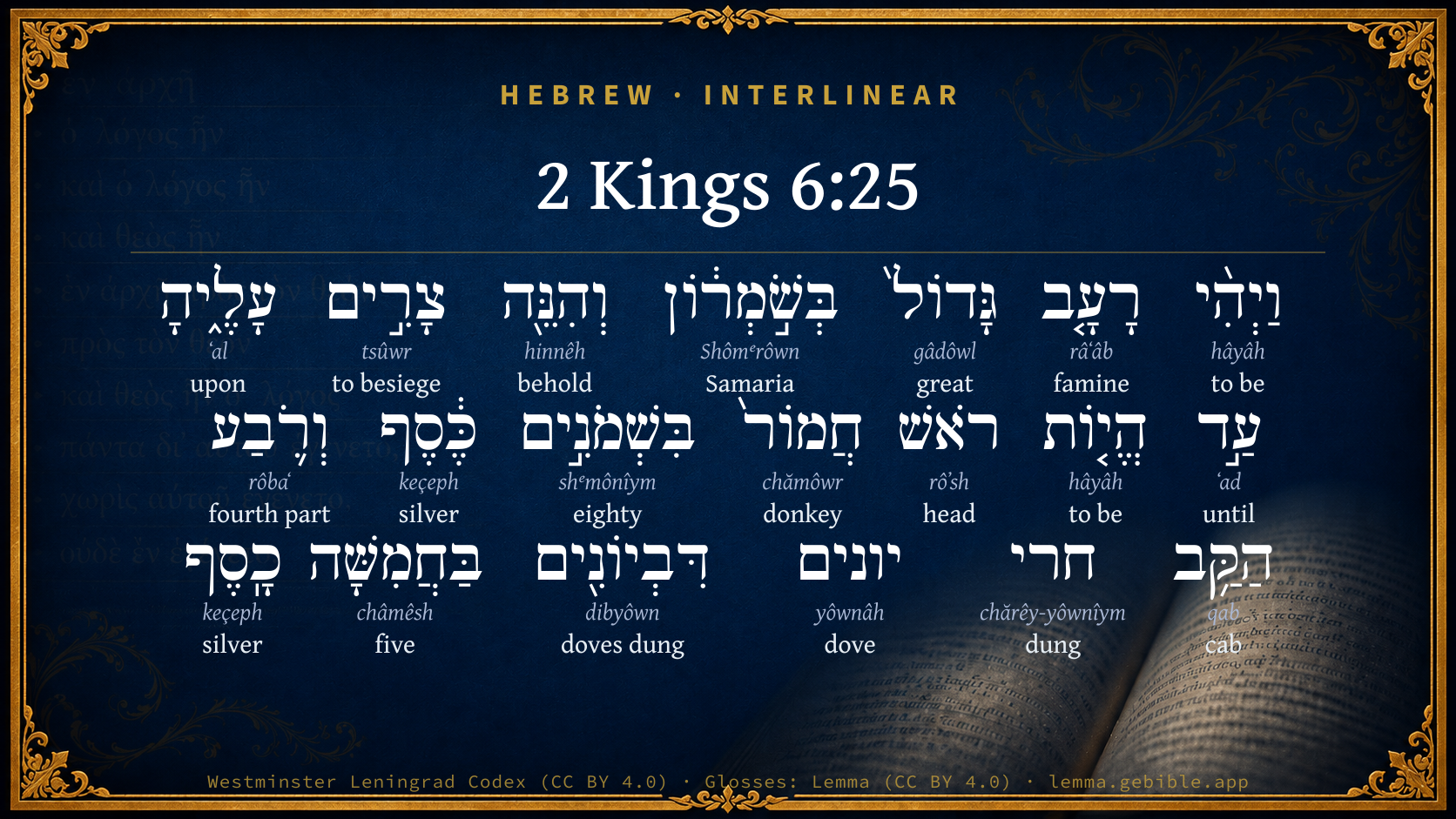
Hebrew (Westminster Leningrad Codex) 2 Kings 6:25 appears in the Hebrew Old Testament. The text above is from the Westminster Leningrad Codex. Each word links to its Strong’s number, a concise gloss, and parsing drawn from the Open Scriptures Hebrew Bible morphology. Click any word for its full Brown-Driver-Briggs (BDB) entry.
Download image
Cite this verse

2 Kings 6:25 (World English Bible). Public Domain. Lemma interlinear Bible study tool, https://lemma.gebible.app/v/2-kings/6/25.

Show BibTeX & RIS
BibTeX
RIS
English Translation
There was a great famine in Samaria: and, behold, they besieged it, until a donkey's head was sold for eighty [pieces] of silver, and the fourth part of a kab of dove's dung for five [pieces] of silver.
World English Bible · Public Domain
Highlights
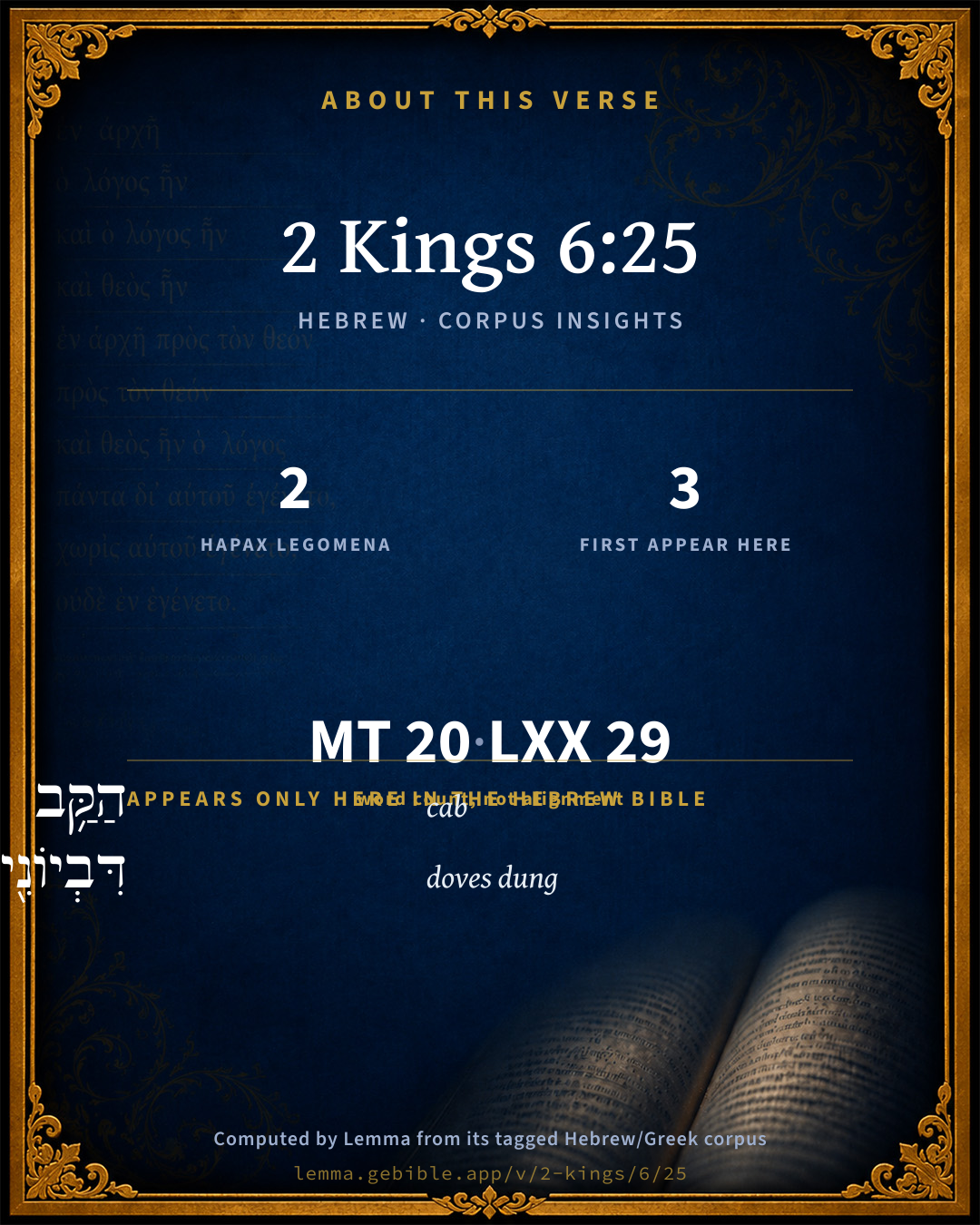
  • 2 hapax legomena — only here in the Hebrew Bible
  • 3 first appearances in the Hebrew Bible
Full analysis ↓
Download a study sheet

One document with this verse’s original text, its word-by-word gloss line, the meaning frame, cross-references with their text, attributed commentary, and full source and license credits — printable, and it pastes into notes with its structure intact.

This verse Autodidact and up

Study sheet (.html) Plain text (.txt)

A passage Seminary Student

Up to 50 verses in one chapter. A passage sheet keeps up to 6 commentary sources and 12 cross-references per verse, in the order this page ranks them, and says so on the sheet whenever that leaves anything out. Ask for a single verse and you get the Autodidact verse sheet above.

Everything on this page stays free to read, with no account — the sheet is a download of what is already on screen, not access to it.

Want to remove ads? Support Godless Engineer
Compare translations 3

The same verse in 3 English versions, stacked beneath the original-language interlinear above. Click any original word for its lexicon entry.

Each is an independent rendering of the whole verse — the interlinear is not word-aligned to these translations.

Highlighted words mark where these versions differ — a whole-verse word diff, not a word-by-word alignment.

  • World English Bible Public Domain
    There was a great famine in Samaria: and, behold, they besieged it, until a donkey's head was sold for eighty [pieces] of silver, and the fourth part of a kab of dove's dung for five [pieces] of silver.
  • King James Version Public Domain
    And there was a great famine in Samaria: and, behold, they besieged it, until an ass's head was sold for fourscore pieces of silver, and the fourth part of a cab of dove's dung for five pieces of silver.
  • unfoldingWord Literal Text CC BY-SA 4.0
    And a great famine was in Samaria, and behold, besieging against it, until the head of a donkey was at 80 silver, and a fourth of a kab of dung of doves at 5 silver.

unfoldingWord Literal Text — © unfoldingWord, licensed CC BY-SA 4.0. Word-aligned USFM3 via Door43 (git.door43.org/unfoldingWord/en_ult).

Versions to compare (up to 4)

3 of 4 selected

Show all 18 translations

Every available English version of this verse, each an independent rendering of the whole verse.

  • World English Bible Public Domain
    There was a great famine in Samaria: and, behold, they besieged it, until a donkey's head was sold for eighty [pieces] of silver, and the fourth part of a kab of dove's dung for five [pieces] of silver.
  • Berean Standard Bible Public Domain
    So there was a great famine in Samaria. Indeed, they besieged the city so long that a donkey’s head sold for eighty shekels of silver, and a quarter cab of dove’s dung sold for five shekels of silver.
  • Majority Standard Bible Public Domain
    So there was a great famine in Samaria. Indeed, they besieged the city so long that a donkey’s head sold for eighty shekels of silver, and a quarter cab of dove’s dung sold for five shekels of silver.
  • King James Version Public Domain
    And there was a great famine in Samaria: and, behold, they besieged it, until an ass's head was sold for fourscore pieces of silver, and the fourth part of a cab of dove's dung for five pieces of silver.
  • American Standard Version (1901) Public Domain
    And there was a great famine in Samaria: and, behold, they besieged it, until an ass's head was sold for fourscore `pieces' of silver, and the fourth part of a kab of dove's dung for five `pieces' of silver.
  • Revised Version (1885) Public Domain
    And there was a great famine in Samaria: and, behold, they besieged it, until an ass’s head was sold for fourscore pieces of silver, and the fourth part of a kab of dove’s dung for five pieces of silver.
  • Geneva Bible (1599) Public Domain
    So there was a great famine in Samaria: for loe, they besieged it vntill an asses head was at foure score pieces of siluer, and the fourth part of a kab of doues doung at fiue pieces of siluer.
  • Douay-Rheims (1899) Public Domain
    And there was a great famine in Samaria: and so long did the siege continue, till the head of an ass was sold for fourscore pieces of silver, and the fourth part of a cabe of pigeon's dung, for five pieces of silver.
  • Young's Literal Translation Public Domain
    and there is a great famine in Samaria, and lo, they are laying siege to it, till the head of an ass is at eighty silverlings, and a forth of the cab of dovesdung at five silverlings.
  • Literal Standard Version CC BY-SA 4.0
    and there is a great famine in Samaria, and behold, they are laying siege to it, until the head of a donkey is at eighty pieces of silver, and a forth of the cab of dove’s dung at five pieces of silver.
  • Unlocked Literal Bible CC BY-SA 4.0
    So there was a great famine in Samaria. Behold, they besieged it until a donkey's head was sold for eighty pieces of silver, and the fourth part of a kab of dove's dung for five pieces of silver.
  • unfoldingWord Literal Text CC BY-SA 4.0
    And a great famine was in Samaria, and behold, besieging against it, until the head of a donkey was at 80 silver, and a fourth of a kab of dung of doves at 5 silver.
  • Darby Bible Public Domain
    And there was a great famine in Samaria; and behold, they besieged it, until an ass's head was worth eighty silver-pieces, and the fourth part of a cab of dove's dung five silver-pieces.
  • World Messianic Bible Public Domain
    There was a great famine in Samaria. Behold, they besieged it until a donkey’s head was sold for eighty pieces of silver, and the fourth part of a kab of dove’s dung for five pieces of silver.
  • Webster's Bible Public Domain
    And there was a great famine in Samaria: and behold, they besieged it, until an ass's head was sold for eighty pieces of silver, and the fourth part of a cab of dove's dung for five pieces of silver.
  • Free Bible Version CC BY-SA 4.0
    So there was a major famine in Samaria. In fact the siege lasted so long that a donkey's head cost eighty shekels of silver, and a quarter cab of dove's dung cost five shekels of silver.
  • Bible in Basic English Public Domain
    And they became very short of food in Samaria; for they kept it shut in till the price of an ass's head was eighty shekels of silver, and a small measure of doves' droppings was five shekels of silver.
  • JPS Tanakh (1917) Public Domain
    And there was a great famine in Samaria; and, behold, they besieged it, until an ass's head was sold for fourscore pieces of silver, and the fourth part of a kab of dove's dung for five pieces of silver.

Literal Standard Version (2020), Covenant Press — licensed CC BY-SA 4.0. Text via the HelloAO Bible API (eBible.org). Unlocked Literal Bible (unfoldingWord) — licensed CC BY-SA 4.0. Text via the HelloAO Bible API (eBible.org). unfoldingWord Literal Text — © unfoldingWord, licensed CC BY-SA 4.0. Word-aligned USFM3 via Door43 (git.door43.org/unfoldingWord/en_ult). Free Bible Version, Dr. Jonathan Gallagher — licensed CC BY-SA 4.0. Text via the HelloAO Bible API (eBible.org).

Word by word

More ways to search: Search by grammar → Find every occurrence → Compare this word →

Practice this passage: Drill this verse → Learn its vocabulary →

הַקַּ֥ב
qab
H6894
“the · cab”
Particle, Definite Article + Noun, Common, Masculine, Singular, Absolute
Part of Speech
Particle + Noun
Type
Common
Gender
Masculine
Number
Singular
State
Absolute
Full BDB Definition

Origin: from H6895

TWOT: 1977a

a dry measure - cab, kab - about 1.5 litres, 1/6 of a seah, or 1/18 of an ephah
  1. וַיְהִ֨י hâyâh H1961 “and · to be” Conjunction + Verb, Qal, Sequential Imperfect, 3rd Person, Masculine, Singular
  2. רָעָ֤ב râʻâb H7458 “famine” Noun, Common, Masculine, Singular, Absolute
  3. גָּדוֹל֙ gâdôwl H1419 “great” Adjective, Adjective, Masculine, Singular, Absolute
  4. בְּשֹׁ֣מְר֔וֹן Shômᵉrôwn H8111 “in/at · Samaria” Preposition + Noun, Proper
  5. וְהִנֵּ֖ה hinnêh H2009 “and · behold” Conjunction + Particle, Demonstrative
  6. צָרִ֣ים tsûwr H6696 “besieging” Verb, Qal, Participle Active, Masculine, Plural, Absolute
  7. עָלֶ֑יהָ ʻal H5921 “upon · her” Preposition + Suffix, Personal, 3rd Person, Feminine, Singular
  8. עַ֣ד ʻad H5704 “until” Preposition
  9. הֱי֤וֹת hâyâh H1961 “to be” Verb, Qal, Infinitive Construct
  10. רֹאשׁ rôʼsh H7218 “head of” Noun, Common, Masculine, Singular, Construct
  11. חֲמוֹר֙ chămôwr H2543 “donkey” Noun, Common, Both, Singular, Absolute
  12. בִּשְׁמֹנִ֣ים shᵉmônîym H8084 “in/at · eighty” Preposition + Adjective, Cardinal number, Both, Plural, Absolute
  13. כֶּ֔סֶף keçeph H3701 “silver” Noun, Common, Masculine, Singular, Absolute
  14. וְרֹ֛בַע rôbaʻ H7255 “and · fourth part of” Conjunction + Noun, Common, Masculine, Singular, Construct
  15. חרי chărêy-yôwnîym H2755 “dung of” Noun, Common, Masculine, Singular, Construct
  16. יונים yôwnâh H3123 “doves” Noun, Common, Feminine, Plural, Absolute
  17. דִּבְיוֹנִ֖ים dibyôwn H1686 “doves dung” Noun, Common, Masculine, Plural, Absolute
  18. בַּחֲמִשָּׁה châmêsh H2568 “in/at the · five” Preposition, Determined + Adjective, Cardinal number, Masculine, Singular, Absolute
  19. כָֽסֶף keçeph H3701 “silver” Noun, Common, Masculine, Singular, Absolute

About this verse

These counts appear in no published source. They are computed here, from the morphology-tagged text and Lemma’s own curated glosses. What Lemma adds →

20
words
18
distinct lemmas
Historical
section

Notable vocabulary

2 hapax legomena — words that appear only here in the entire Hebrew Bible:

  • הַקַּ֥ב cab H6894
  • דִּבְיוֹנִ֖ים doves dung H1686

First appearance in Scripture

These words make their first canonical appearance in the Hebrew Bible here:

  • הַקַּ֥ב cab H6894
  • חרי dung H2755
  • דִּבְיוֹנִ֖ים doves dung H1686

Shared distinctive vocabulary

וְרֹ֛בַע fourth part H7255 occurs in 2 verses of the Hebrew Bible. Also found in:

Grammatical profile

  • 3 verbs
  • 11 nouns
  • 3 adjectives
  • 2 prepositions
  • 1 particle

Verb forms

  • וַיְהִ֨י Qal · Sequential Imperfect
  • צָרִ֣ים Qal · Participle Active
  • הֱי֤וֹת Qal · Infinitive Construct

Repetition

Words recur within this verse — often emphatic in Hebrew:

  • וַיְהִ֨י to be H1961 ×2
  • כֶּ֔סֶף silver H3701 ×2

Hebrew & Septuagint length

In English translation the verse runs 38 words from the Hebrew and 39 from the Septuagint (LXX English) — closely comparable.

A rough comparison of the two English renderings, which tokenize alike — not a word-level alignment.

Word counts can differ between the Hebrew and the Greek without any difference in meaning — e.g. the Hebrew direct-object marker אֵת has no separate Greek word, and Greek often adds the article ὁ.

In the original languages it is 20 Hebrew tokens and 29 Greek tokens — but the two are counted differently (Hebrew bundles its prefixes and suffixes into one token; the Greek is in lemma form), so that isn’t a like-for-like length.

Cross-references

10

Topical passages linked to 2 Kings 6:25 in the Treasury of Scripture Knowledge — connected by theme and wording, ordered by reader-vote popularity; previews shown in the World English Bible.

  • 2 Kings 6:28–29 The king said to her, What ails you? She answered, This woman said to me, Give your son, that we may eat him today, and we will eat my son tomorrow.
  • Jeremiah 14:13–15 Then said I, Ah, Lord Yahweh! behold, the prophets tell them, You shall not see the sword, neither shall you have famine; but I will give you assured peace in this place.
  • Jeremiah 14:18 If I go forth into the field, then, behold, the slain with the sword! and if I enter into the city, then, behold, those who are sick with famine! for both the prophet and the priest go about in the land, and have no knowledge.
  • Jeremiah 52:6 In the fourth month, in the ninth day of the month, the famine was sore in the city, so that there was no bread for the people of the land.
  • Jeremiah 32:24 Behold, the mounds, they are come to the city to take it; and the city is given into the hand of the Chaldeans who fight against it, because of the sword, and of the famine, and of the pestilence; and what you have spoken has happened; and, behold, you see it.
  • 1 Kings 18:2 Elijah went to show himself to Ahab. The famine was sore in Samaria.
  • 2 Kings 7:4 If we say, We will enter into the city, then the famine is in the city, and we shall die there; and if we sit still here, we die also. Now therefore come, and let us fall to the host of the Syrians: if they save us alive, we shall live; and if they kill us, we shall but die.
  • 2 Kings 25:3 On the ninth day of the [fourth] month the famine was sore in the city, so that there was no bread for the people of the land.
  • Ezekiel 4:13–16 Yahweh said, Even thus shall the children of Israel eat their bread unclean, among the nations where I will drive them.
  • Leviticus 26:26 When I break your staff of bread, ten women shall bake your bread in one oven, and they shall deliver your bread again by weight: and you shall eat, and not be satisfied.

Cross-references courtesy of OpenBible.info (CC BY 4.0).

Hebrew and Greek witnesses Masoretic Hebrew ↔ Greek Septuagint

The same verse in the two great witnesses to the Old Testament, shown verse-for-verse.

These are two independent witnesses, not word-aligned to each other, and the Septuagint is shown in lemma (dictionary) form.

Hebrew 2 Kings 6:25 Masoretic · Westminster Leningrad Codex

וַיְהִ֨י רָעָ֤ב גָּדוֹל֙ בְּשֹׁ֣מְר֔וֹן וְהִנֵּ֖ה צָרִ֣ים עָלֶ֑יהָ עַ֣ד הֱי֤וֹת רֹאשׁ חֲמוֹר֙ בִּשְׁמֹנִ֣ים כֶּ֔סֶף וְרֹ֛בַע הַקַּ֥ב חרי יונים דִּבְיוֹנִ֖ים בַּחֲמִשָּׁה כָֽסֶף

There was a great famine in Samaria: and, behold, they besieged it, until a donkey's head was sold for eighty [pieces] of silver, and the fourth part of a kab of dove's dung for five [pieces] of silver.

World English Bible · Public Domain

Greek LXX 2 Kings 6:25 Septuagint · lemma form

καί γίγνομαι λιμός μέγας ἐν σαμαρεία καί ἰδού περι καταἧμαι ἐπί αὐτός ἕως ὅς γίγνομαι κεφαλή ὄνος πεντήκοντα σίκλος ἀργύριον καί τέταρτος ὁ κάβος κόπρος περιστερά πέντε σίκλος ἀργύριον

And there was a great famine in Samaria: and, behold, they besieged it, until an ass's head was valued at fifty pieces of silver, and the fourth part of a cab of dove's dung at five pieces of silver.

LXX2012 (modern English Septuagint) · Public Domain

Hebrew: Westminster Leningrad Codex (CC BY 4.0). Greek: Septuagint (public domain); English from LXX2012 (modern English Septuagint) (Public Domain). How the Septuagint differs from the Hebrew →

Targum (Aramaic paraphrase)

1

The Targum is the ancient Jewish Aramaic paraphrase of the Hebrew Scriptures — an interpretive translation, not the Hebrew text itself. Onkelos (literal) and Pseudo-Jonathan (expansive) render the Torah, and Jonathan the Prophets. Coverage is partial: where no permissively-licensed English translation exists for a verse, only the Aramaic is shown. This is verse-level text, not a word-by-word alignment to the Hebrew.

  1. Targum Jonathan Prophets (Joshua–Malachi)
    וַהֲוָה כַפְנָא רַבָּא בְּשֹׁמְרוֹן וְהָא צָיְרִין עֲלָהּ עַד דַהֲוָה רֵישָׁא דַחֲמְרָא מִזְדַבֵּן בְּתַמְנָן כְּסַף וְרִבְעַת קַבָּא דְזֶבֶל מַפְקַת יוֹנַיָא בְּחַמְשָׁא סִלְעִין דִכְסַף:

    (no public-domain English translation for this verse)

    Targum Jonathan — Aramaic: “Mikraot Gedolot” (public domain). English: “Sefaria Community Translation” (CC0 1.0 (public-domain dedication)); “London "Chaldee Paraphrase," 1871” (public domain). Text via Sefaria.

Commentary

Notes on 2 Kings 6:25 from classic Christian and Jewish commentators (each source and its license shown beneath its notes). The classic Christian expositions comment on the surrounding passage and are grouped to its opening verse, so a note may address several verses; the Jewish commentaries on the Tanakh (Rashi and others) are per-verse, so they appear only where the commentator wrote on this verse.

Lemma curates 59 commentaries, every one of them public domain or Creative Commons licensed, each selected and text-cleaned for this edition rather than reprinted as found. About our sources →

Trapp's Complete Commentary

John Trapp

2Ki 6:25 And there was a great famine in Samaria: and, behold, they besieged it, until an ass’s head was [sold] for fourscore [pieces] of silver, and the fourth part of a cab of dove’s dung for five [pieces] of silver.

Ver. 25. And there was a great famine in Samaria.] Like as there was afterwards at Potidea in the Peloponesian war; at Utica, besieged by Hamilcar, the father of Hannibal; at Saguntum, also; yea, at Rome, when this voice was heard in the market, Pone precium humanae carni. {a} The miserable straits the Jews were put to at the last siege of Jerusalem by Titus, who hath not read of? That I speak not of Scodra, Munster, Sancerre, Haarlem, besieged by the Duke de Alva, &c. This of Samaria was just upon them, saith Pellican, for their contempt of the heavenly manna, that precious food of the soul.

An ass’s head sold for fourscore pieces of silver,] i.e., For four or five pounds: some say, ten. When Hannibal besieged Casiline, one mouse was sold for two hundred pence. {b} Puddings made of dogs’ guts were dear bought at the siege of Scodra. {c}

The fourth part of a cab.] A pint of doves’ dung. See 2Ki 18:27. The hunger-bit wolf eateth dirt.

{a} Thucyd. Polyb. Sub Honor. Imp.

{b} Val. Max., lib. vii. cap. 6.

{c} Turk. Hist.

John Trapp, A Commentary or Exposition upon All the Books of the Old and New Testament (1647–1656) — public domain. Text from a community e-Sword module.

The Biblical Illustrator

Joseph S. Exell

2Ki_6:25-33

And there was a great famine in Samaria.

Famine, a judgment of God

The language of truth, you perceive, formed the first portion of his words, and the language of despair the conclusion.

I. That whatever evil is sent upon a country, is sent by God. This is confirmed by a passage in the prophet Amos (Amo_3:6), in which the prophet says, Shall there be evil in a city, and the Lord hath not done it? Here is a great king, with a mighty army, to beset a nation, nominally for his own purpose, after the designs of his own heart, without any reference to God at all; but in reality, simply and plainly accomplishing what God has commanded and declared beforehand should be done. Then you know the history of the plagues of Egypt, the manner in which the locusts were sent upon the land, and the way in which there were lice in all their quarters. God sent them there; He having determined that evil should come upon the people.

II. That wherever sin abounds, judgment is to be expected. But God has positively declared that sin shall be punished. Though hand join in hand, the wicked shall not be unpunished. Men may use all their wisdom; but their wisdom is utter folly.

III. That notwithstanding sin is to be followed by judgment, yet judgment is Gods strange work.

IV. That doubting Gods willingness to show mercy, provokes the lord. So that you perceive, the determination of God is, that men shall, sooner or later, acknowledge Him: while on the other hand, we know that belief honours Him. (H. M. Villiers, M. A.)

.

The Biblical Illustrator, edited by Joseph S. Exell (c. 1880s–1900s) — public domain. Text from a community e-Sword module.

Joseph Benson's Commentary

2Ki 6:25. There was a great famine in Samaria — Probably the dearth, which had of late been in the land, was the cause of their stores being so empty; or the siege was so sudden, that they had no time to lay in provisions. An ass’s head was sold for fourscore pieces of silver — Supposed to be shekels, and the common shekel being valued at fifteen pence of English money, they amount to five pounds: a vast price, especially for that which had on it so little meat, and was unwholesome, and unclean according to the law, Lev 11:26. In times of famine, however, and extreme necessity, the Jews themselves were absolved from observing the law with regard to meats. There are not wanting instances, in history, where other people, upon the same occasion, have been reduced to the like distress, and been glad to purchase an ass’s head at an enormous price. See Plutarch’s Life of Artaxerxes. The fourth part of a cab — A measure which, according to the Jews, contained as much as the shells of twenty-four eggs. Of dove’s dung — Bochart has shown that there is among the Arabians a kind of vetches or pulse called by this name, which is undoubtedly here meant, for we can scarcely suppose that they used the excrements of doves for food. These vetches were a very coarse food, and yet much in use among the poorer Israelites, and therefore fit to be joined here with the ass’s heads: and a cab was the usual measure of all kinds of grain, and fruits of that sort. In confirmation of the above it may be observed, some travellers tell us, that at Grand Cairo and Damascus there are magazines where they constantly fry this kind of grain, which those who go on pilgrimage buy, and take with them, as part of the provision for their journey. The Arabs, it appears, to this day call this kind of pulse or vetches by the name of dove’s dung. — See Bochart Hieroz., p. 2, 50:1, c. 7.

Joseph Benson's Commentary on the Old and New Testaments (1811–1818) — public domain. Text from a community e-Sword module.

Geneva Bible (1599)

Geneva Bible translators

The Hebrews write, that they burned it in the siege for lack of wood.

Geneva Bible (1599) marginal notes — public domain. Text via Bolls.life.

Jamieson, Fausset & Brown

Robert Jamieson, A. R. Fausset & David Brown

an ass's head was sold for fourscore pieces of silver--Though the ass was deemed unclean food, necessity might warrant their violation of a positive law when mothers, in their extremity, were found violating the law of nature. The head was the worst part of the animal. Eighty pieces of silver, equal to £5 5s.

the fourth part of a cab--A cab was the smallest dry measure. The proportion here stated was nearly half a pint for 12s. 6d.

dove's dung--is thought by BOCHART to be a kind of pulse or pea, common in Judea, and still kept in the storehouses of Cairo and Damascus, and other places, for the use of it by pilgrim-caravans; by LINNÆUS, and other botanists, it is said to be the root or white bulb of the plant Ornithogalum umbellatum, Star of Beth-lehem. The sacred historian does not say that the articles here named were regularly sold at the rates described, but only that instances were known of such high prices being given.

Jamieson, Fausset & Brown — Commentary Critical and Explanatory on the Whole Bible (1871) — public domain (CC PDM 1.0). Text via the HelloAO Bible API.

Adam Clarke's Commentary

Verse 25. And, behold, they besieged it] They had closed it in on every side, and reduced it to the greatest necessity.

An ass's head was sold for fourscore pieces of silver] I suppose we are to take the ass's head literally; and if the head sold for so much, what must other parts sell for which were much to be preferred? The famine must be great that could oblige them to eat any part of an animal that was proscribed by the law; and it must be still greater that could oblige them to purchase so mean a part of this unclean animal at so high a price. The piece of silver was probably the drachm, worth about seven pence three farthings of our money; the whole amounting to about two pounds nine shillings.

And the fourth part of a cab of dove's dung] The cab was about a quart or three pints. Dove's dung, חריונים chiriyonim. Whether this means pigeon's dung literally, or a kind of pulse, has been variously disputed by learned men. After having written much upon the subject, illustrated with quotations from east, west, north, and south, I choose to spare my reader the trouble of wading through them, and shall content myself with asserting that it is probable a sort of pease are meant, which the Arabs to this day call by this name. "The garvancos, cicer, or chick pea," says Dr. Shaw, "has been taken for the pigeon's dung, mentioned in the siege of Samaria; and as the cicer is pointed at one end, and acquires an ash colour in parching, the first of which circumstances answers to the figure, the second to the usual colour of dove's dung, the supposition is by no means to be disregarded."

I should not omit saying that dove's dung is of great value in the East, for its power in producing cucumbers, melons, &c., which has induced many learned men to take the words literally. Bochart has exhausted this subject, and concludes that a kind of pulse is meant. Most learned men are of his opinion.

Adam Clarke's Commentary on the Bible (1810–1826) — public domain. Text from a community e-Sword/MySword module.

Ellicott's Commentary for English Readers

(25) And there was.—There arose. In consequence of the siege.

Besieged.—Were besieging.

Fourscore pieces.—Eighty shekels—i.e., about £10. Ass’s flesh would not ordinarily be eaten at all, and the head of any animal would be the cheapest part. Plutarch mentions that during a famine among the Cadusians an ass’s head could hardly be got for sixty drachms (about £2. 10s.), though ordinarily the entire animal could be bought for about half that sum. And Pliny relates that when Hannibal was besieging Casalinum, a mouse was sold for 200 denarii (£6 5s.).

The fourth part of a cab of dove’s dung.—The cab was the smallest Hebrew dry measure. It held, according to the Rabbis, one-sixth of a seah (2Ki_7:1), or a little over a quart (ξέστης.—Josephus, Antt. ix. 4, § 4). The term dove’s dung, in all probability, denotes some kind of common vegetable produce, perhaps a sort of pulse or pease, which was ordinarily very cheap. Such a designation is not unparalleled. The Arabs call the herb kali “sparrow’s dung;” and Assafœtida is in German “devil’s dung.” In some places in England a species of wild hyacinth is called “dead man’s hands,” from the livid markings on the flower. The shape and colour of the species of pulse mentioned in the text may similarly account for its name. It naturally occurs that so long as there were any “doves” left in the city it would not be necessary to eat their dung. When Josephus wrote that dung was eaten in the siege of Jerusalem, he probably had the present passage in his mind.

Five pieces of silver.—Five (shekels in) silver; about 12s. 6d.

A Bible Commentary for English Readers, edited by Charles John Ellicott (1878–1897) — public domain. Text from a community e-Sword module.

The Cambridge Bible for Schools and Colleges

gen. ed. J. J. S. Perowne

25. a great famine in Samaria] The walls were protection enough, but the enemy lay outside, and the provisions came to an end.

an ass’s head] This would not, except in dire extremity, be taken for food, but they were in such straits in Samaria that 80 shekels of silver were now given for it.

a kab] So R.V. The measure is not mentioned elsewhere, but is said to have been the sixth part of a seah, which is more frequently spoken of. The kab is put as an equivalent to the Greek χοῖνιξ.

dove’s dung] Supposed by some to be the name of a very worthless kind of pulse, which in ordinary times nobody dreamt of eating, but of which now a small quantity fetched a large price. That excrement has been used for food in times of famine we have examples (Joseph. B. F. v. 2Ki_13:7), but that dove’s dung should have been specially gathered for this purpose would be very strange. There could be but so small a supply. It appears better therefore to take the words as the name of some vegetable. The Germans call ‘assafœtida’ Teufelsdreck = devil’s dung. Josephus says, without any warrant, that this ‘dove’s dung was bought by the people instead of salt’.

The Cambridge Bible for Schools and Colleges (gen. ed. J. J. S. Perowne; Cambridge University Press, 1878–1918) — public domain. Text from a community e-Sword module.

John Gill's Exposition

And he said, if the Lord do not help thee, whence shall I help thee?.... Mistaking her meaning, as if she prayed him to relieve her hunger; the margin of our Bible is, "let not the Lord save thee"; and so some understand it as a wish that she might perish; and so Josephus (o), that being wroth, he cursed her in the name of God:

out of the barn floor, or out of the winepress? when neither of them afforded anything; no corn was to be had from the one, nor wine from the other, no, not for his own use, and therefore how could he help her out of either?

(o) Ut supra. (Antiqu. l. 9. c. 4. sect. 4.)

John Gill's Exposition of the Whole Bible (1746–1763) — public domain (CC PDM 1.0). Text via the HelloAO Bible API.

Albert Barnes' Notes on the Bible

As the donkey was “unclean,” it would not be eaten except in the last resort; and its head would be its worst and cheapest part.

Cab - This measure is not mentioned elsewhere in Scripture. According to the rabbinical writers it was the smallest of all the dry measures in use among the Jews, being the sixth part of a seah, which was the third part of an ephah. If it was about equal to two of our quarts, the “fourth part of a cab” would be about a pint.

Dove’s dung - Most commentators understand by this expression a sort of pulse which is called “dove’s dung,” or “sparrow’s dung” in Arabic. But it is possible that the actual excrement of pigeons is meant. The records of sieges show that both animal and human excrement have been used as food - under circumstances of extreme necessity.

Albert Barnes' Notes on the Bible (1834–1885) — public domain. Text from a community e-Sword/MySword module.

Haydock's Catholic Bible Commentary

In Samaria. It had raged in all the country above three years, (Salien) and continued other four, chap. viii. 1. The continuance of the siege added fresh horrors. --- Pieces is not expressed in Hebrew: a sicle is understood. (Haydock) --- Lyranus supposes that the whole ass was sold for about 38 crowns, (Haydock) or 130 livres; as we say commonly, "so much a head." But interpreters generally assert that the price of the head alone is given; which shews more forcibly the greatness of the famine. On other occasions the animal could not be eaten by the Jews. Artaxerxes was forced to kill his beasts of burden; and an ass’s head was then sold for 60 drachms, or 25 livres. When Hannibal besieged Casilinum, a mouse (or rat) was sold for above 70, or for 200 denari. (Pliny, [Natural History?] viii. 57.) (V. Max. vii. 6, 3.) --- Cabe. Sufficient measure of corn for a man’s daily sustenance. (Menochius) --- The fourth part would be about a gill. (Haydock) --- Dung. Bochart maintains that "chick-peas" are designated. The Arabic usnen and kali, "pigeon or sparrows’ dung," are real eatables. Those who suppose that the Samaritans bought the dung of pigeons to use as salt or for food, or to burn, or to manure the earth, &c., produce not satisfactory reasons; no more than the Rabbins, who pretend that the corn which they had picked up was taken from their crop. (Tr. Megil. 3., and the Scholastic History.) Junius and Fuller would translate "belly," which is refuted by Bochart. (Anim. T. ii. B. i. 7.) Very disgusting things have often been used through extreme hunger, (Grotius) and some sort of birds’ dung is said to fatten oxen and swine. (Varro 38.; Pliny xvii. 9.) --- But what nutriment can there be in that of pigeons, that people should go to buy it? (Calmet) --- Houbigant understands a sort of peas is meant. (Haydock) --- The Hebrews called them kali when they were parched; and such food was very common, 2 Kings xvii. 28. (Bellon. ii. 53, and 99.) (Calmet)

George Leo Haydock (1774–1849), Haydock's Catholic Family Bible and Commentary, 1859 edition — public domain. Excludes Psalms (Douay-Rheims chapter numbering differs from Protestant) and Deuterocanonical books (Catholic canon only).

Matthew Poole's English Annotations

Pieces of silver, supposed to be shekels; and the common shekel being valued at fifteen pence of English money, this amounts to five pounds; a vast price, especially for that which had on it so little meat, and that unwholesome, and unclean by law, Lev 11:3; though necessity might seem to excuse their violation of that law.

A cab; a measure containing twenty-four eggs.

Dove’s dung; which they used not for fire, (for he is speaking here only of the scarcity of food,) but for food; which, if it seem incredible, it must be considered, first, That famine hath constrained people to eat things as improper and unfit for nourishment as this, as dry leather, and man’s dung, as is implied Isa 36:12, and affirmed by grave historians. Secondly, That some creatures do usually eat the dung of others. Thirdly, That doves’ dung, though it be hotter than ordinary, might in other respects be fitter for nourishment than other, as being made of the best and purest grains, and having some moisture in it, &c. Fourthly, That this Hebrew word being of an obscure and doubtful signification, and no where else used, may be, and is by learned men, otherwise rendered and understood; either, first, of the corn which is found in the crops of doves; or, secondly, of the guts and other inwards of doves; or rather, thirdly, of a sort of cicer or pease, which in the Arabic language (which is near akin to the Hebrew, and from which many words are explained) is called dove’s dung; for this was a food much in use amongst the poorer Israelites, and was by all esteemed a very coarse food, and therefore fit to be joined with an ass’s head; and a cab was the usual measure of all sorts-of grains and fruits of that sort.

Matthew Poole's English Annotations on the Holy Bible (1683–1685) — public domain. Text from a community e-Sword/MySword module.

Whedon's Commentary on the Bible

Daniel D. Whedon

25. A great famine in Samaria — In consequence of the siege, which cut off all means of supply to the city.

An ass’s head — According to the law (Lev_11:3) the ass was an unclean animal, and therefore forbidden to be eaten at all. The head of the animal is, besides, the worst part of all to eat. But necessity knows no law; and how terrible must have been that famine which caused this part of an unclean animal to sell for such a fabulous price! The supposition of some, that the term ass’s head means a certain weight or measure, is too much wanting in evidence. An ass of bread, in 1Sa_16:20, is quite different from an ass’s head, and most naturally means, as the English version has it, an ass laden with bread. Surely if women ate their dead children, as 2Ki_6:29 shows, we need not scruple to believe that an ass’s head would sell for a great price.

Fourscore pieces of silver — Silver shekels are probably meant, in which case this amount would be about forty-five dollars of our currency.

A cab — A hollow vessel capable of holding about two quarts.

Dove’s dung — This is a literal translation of the Hebrew words חרי יונים, chire-yonim.

Josephus says it was used instead of salt; others think it was used for fuel, or for quickening the growth of garden vegetables. But the context seems clearly to show that it was used for feed, and hence some have, very naturally, supposed that the word denotes some vegetable food, inasmuch as the Arabs call the herb alkali, sparrow’s dung. Thomson says: “I believe that the Hebrew chir-yonim was the name of a coarse and cheap sort of food, a kind of bean, to which this whimsical title was given on account of some fancied resemblance between the two. Nor am I at all surprised at it, for the Arabs give the most quaint, obscure, and ridiculous names to their extraordinary edible mixtures. I would therefore not translate at all, but read thus, ‘A fourth part of a cab of chir-yonim for five pieces of silver,’ and be content with that, until we know what chir-yonim really is.” But after all, it is still more probable that literal dove’s dung is meant. Similar instances of human extremity in famine are not unknown in history. Josephus relates that in the siege of Jerusalem “some persons were driven to that terrible distress that they searched the common sewers and old dung-hills of cattle, and ate the dung which they got there.” During a famine in Egypt in 1200 the poor were driven to the necessity of eating dogs, and the carcasses of animals and men, and even the excrements of both. In England in 1316, during the reign of Edward II., there was a famine in which many of the people are said to have eaten their own children, together with dogs, mice, and pigeon’s dung. During the late civil war in the United States, the starving prisoners at Andersonville are said to have eaten, at times, their own excrement. Compare 2Ki_18:27.

Five pieces of silver — About three dollars.

Daniel D. Whedon (gen. ed.), Commentary on the Old and New Testaments (1874–1909) — public domain. Text from a community e-Sword module.

The Pulpit Commentary

And there was a great famine in Samaria. It was Benhadad"s design to capture the place, not by battering down its walls with military engines, but by blockading it, and cutting off all its supplies, as Josephus tells us ( l.s.c. ). And, behold, they besieged it, until an ass"s head was sold for fourscore pieces of silver, and the fourth part of a cab of dove"s dung for five pieces of silver. The ass, being an unclean animal, (Lev_11:4) would not be eaten at all except in the last extremity, and the head was the worst and so the cheapest part; yet it sold for "eighty pieces" (rather, shekels) of silver, or about of our money; as in the Cadusian famine mentioned by Plutarch ("Wit. Artaxerx.," where an ass"s head was sold for sixty drachmas (about forty shillings). "Dove"s dung" is thought by some to be the name of a plant; but it is better to understand the term literally. Both animal and human excrement have been eaten in sieges (Josephus, "Bell. Jud:," 5:13. Cels., "Hierobot.," 2. p. 233), when a city was in the last extremity.

The Pulpit Commentary (1880–1919), ed. H.D.M. Spence-Jones & Joseph S. Exell — public domain. Text from a community e-Sword module.

John Wesley's Explanatory Notes

Famine in Samaria - Probably the siege was so sudden, that they had no time to lay in provisions. Pieces - Supposed to be shekels; and the common shekel being valued at fifteen pence of English money, this amounts to five pounds. A vast price, especially for that which had on it so little meat, and that unwholesome and unclean. A kab - A measure containing twenty- four eggs. Dung - This Hebrew word is of a doubtful signification, and no where else used, probably it means a sort of pease, which in the Arabick language (near a-kin to the Hebrew) is called doves dung: for this was a food much in use amongst the poorer Israelites, and was a very coarse food, and therefore fit to be joined with the asses head: and a kab was the usual measure of all sorts of grains and fruits of that sort.

John Wesley, Explanatory Notes Upon the Whole Bible (1754–1765) — public domain. Text via the GEBible commentary corpus.

Rashi

Rabbi Shlomo Yitzchaki (Rashi)

Pigeon dung. Dung that flows from the doves.

Rashi on the Tanakh — English translations: “The Judaica Press complete Tanach with Rashi, translated by A. J. Rosenberg” (CC BY 4.0); “Pentateuch with Rashi's commentary by M. Rosenbaum and A.M. Silbermann, 1929-1934” (public domain); “The Metsudah Tanach series, Lakewood, N.J” (CC BY 4.0); and “The Book of Joshua, Metsudah Publications, 1997” (CC BY 4.0). Text via Sefaria.

Lesson kit

Teaching starters — assembled from the data on this page, not authored interpretation. Every prompt links to the verse data it draws on. Edit before teaching.

2 Kings, in the Historical, opens this verse with 20 words (18 distinct Hebrew lemmas). Its most distinctive word is qab (“cab”). A historical commentator’s framing appears above. Read the whole chapter for the surrounding context.

Discussion questions

  1. The word qab carries the sense “cab.” How does it shape the verse?
  2. 2 words here appear nowhere else in the Hebrew Bible. Why might the author reach for such rare wording?
  3. 3 words make their first appearance in Scripture here. What does this debut establish?
  4. How does Numbers 23:10, which shares the word «fourth part», read alongside this verse?
  5. What does the repetition of “to be” (2× in this one verse) do in this verse?
  6. The translations on this page render this verse differently — a whole-verse word diff, not a word-by-word alignment. What might account for the different wordings?
  7. «וַיְהִ֨י» is a Qal Sequential Imperfect verb. How does that grammatical form shape the action described?
  8. Compare how Trapp's Complete Commentary and The Biblical Illustrator read this verse. Where do they agree or differ?

Things to notice

  • 2 words in this verse appear nowhere else in the Hebrew Bible.
  • 3 words make their first canonical appearance in Scripture here.
  • This verse counts 20 Hebrew ↔ 29 Greek words.
  • These translations choose different wording for 19 words in this verse.
  • “to be” occurs 2× in this single verse.

Reading settings

Reading text

Shown beneath each verse's original-language words.

Old Testament
Old Testament edition

Read the OT as the Masoretic Hebrew (MT) or the Greek Septuagint (LXX).

English shown for the Greek Septuagint (in the Hebrew ↔ Greek comparison).

Comparing translations? Open the Compare panel on any verse page to stack up to four side by side.