1 Chronicles 9:26

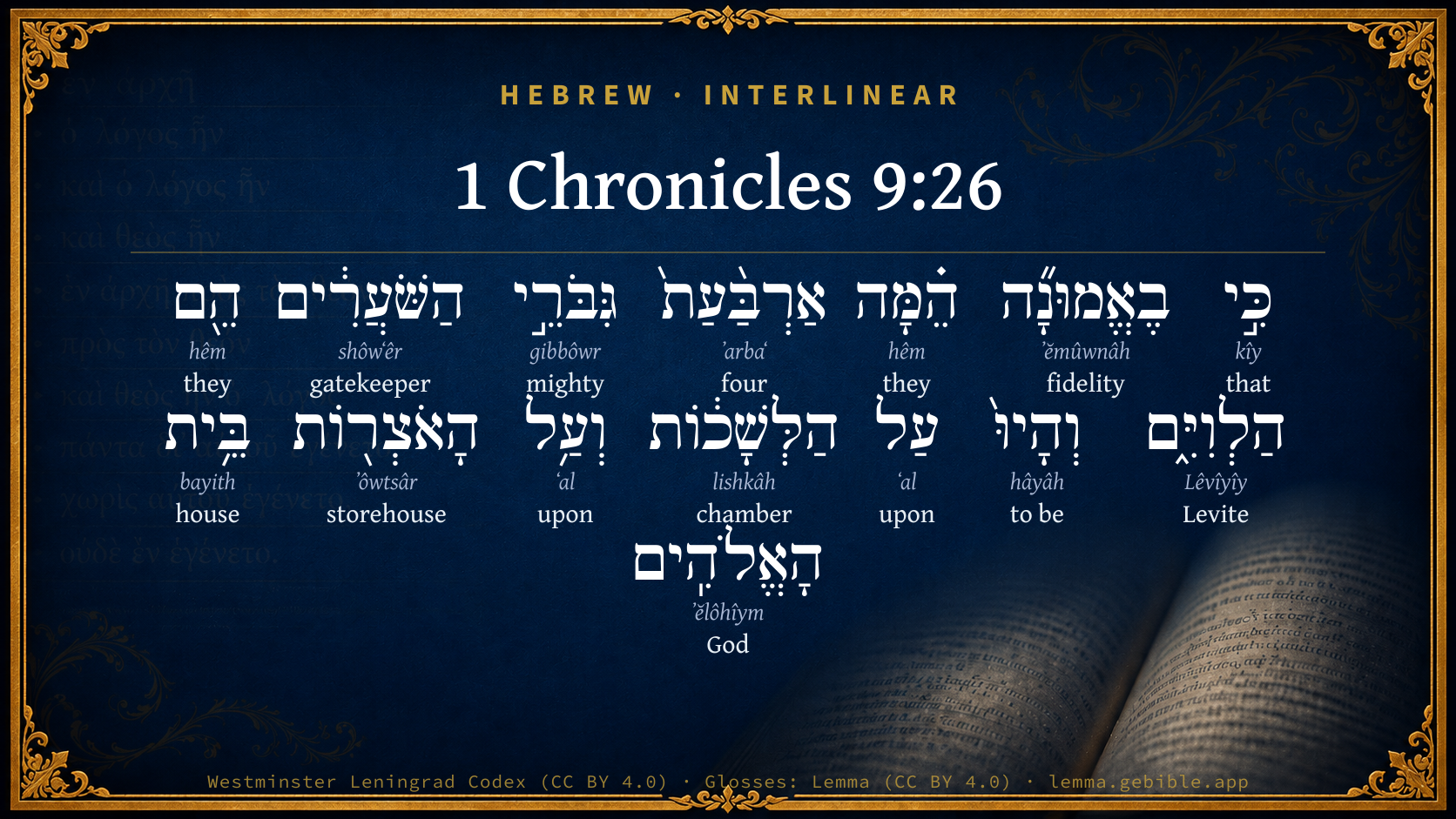
Hebrew (Westminster Leningrad Codex) 1 Chronicles 9:26 appears in the Hebrew Old Testament. The text above is from the Westminster Leningrad Codex. Each word links to its Strong’s number, a concise gloss, and parsing drawn from the Open Scriptures Hebrew Bible morphology. Click any word for its full Brown-Driver-Briggs (BDB) entry.
Download image
Cite this verse

1 Chronicles 9:26 (World English Bible). Public Domain. Lemma interlinear Bible study tool, https://lemma.gebible.app/v/1-chronicles/9/26.

Show BibTeX & RIS
BibTeX
RIS
English Translation
for the four chief porters, who were Levites, were in an office of trust, and were over the chambers and over the treasuries in the house of God.
World English Bible · Public Domain
Download a study sheet

One document with this verse’s original text, its word-by-word gloss line, the meaning frame, cross-references with their text, attributed commentary, and full source and license credits — printable, and it pastes into notes with its structure intact.

This verse Autodidact and up

Study sheet (.html) Plain text (.txt)

A passage Seminary Student

Up to 50 verses in one chapter. A passage sheet keeps up to 6 commentary sources and 12 cross-references per verse, in the order this page ranks them, and says so on the sheet whenever that leaves anything out. Ask for a single verse and you get the Autodidact verse sheet above.

Everything on this page stays free to read, with no account — the sheet is a download of what is already on screen, not access to it.

Want to remove ads? Support Godless Engineer
Compare translations 3

The same verse in 3 English versions, stacked beneath the original-language interlinear above. Click any original word for its lexicon entry.

Each is an independent rendering of the whole verse — the interlinear is not word-aligned to these translations.

Highlighted words mark where these versions differ — a whole-verse word diff, not a word-by-word alignment.

  • World English Bible Public Domain
    for the four chief porters, who were Levites, were in an office of trust, and were over the chambers and over the treasuries in the house of God.
  • King James Version Public Domain
    For these Levites, the four chief porters, were in their set office, and were over the chambers and treasuries of the house of God.
  • unfoldingWord Literal Text CC BY-SA 4.0
    For in trust, they, the four chiefs of the gatekeepers, they Levites, and they were over the chambers and over the treasuries of the house of God.

unfoldingWord Literal Text — © unfoldingWord, licensed CC BY-SA 4.0. Word-aligned USFM3 via Door43 (git.door43.org/unfoldingWord/en_ult).

Versions to compare (up to 4)

3 of 4 selected

Show all 18 translations

Every available English version of this verse, each an independent rendering of the whole verse.

  • World English Bible Public Domain
    for the four chief porters, who were Levites, were in an office of trust, and were over the chambers and over the treasuries in the house of God.
  • Berean Standard Bible Public Domain
    But the four chief gatekeepers, who were Levites, were entrusted with the rooms and the treasuries of the house of God.
  • Majority Standard Bible Public Domain
    But the four chief gatekeepers, who were Levites, were entrusted with the rooms and the treasuries of the house of God.
  • King James Version Public Domain
    For these Levites, the four chief porters, were in their set office, and were over the chambers and treasuries of the house of God.
  • American Standard Version (1901) Public Domain
    for the four chief porters, who were Levites, were in an office of trust, and were over the chambers and over the treasuries in the house of God.
  • Revised Version (1885) Public Domain
    for the four chief porters, who were Levites, were in a set office, and were over the chambers and over the treasuries in the house of God.
  • Geneva Bible (1599) Public Domain
    For these foure chiefe porters were in perpetuall office, and were of the Leuites and had charge of the chambers, and of the treasures in the house of God.
  • Douay-Rheims (1899) Public Domain
    To these four Levites were committed the whole number of the porters, and they were over the chambers, and treasures, of the house of the Lord.
  • Young's Literal Translation Public Domain
    For in office `are' the four chiefs of the gatekeepers, they are Levites, and they have been over the chambers, and over the treasuries of the house of God,
  • Literal Standard Version CC BY-SA 4.0
    For the four chiefs of the gatekeepers in office, they are Levites, and they have been over the chambers, and over the treasuries of the house of God,
  • Unlocked Literal Bible CC BY-SA 4.0
    But the four leaders of the gatekeepers, who were Levites, were assigned to guard the rooms and storerooms in the house of God.
  • unfoldingWord Literal Text CC BY-SA 4.0
    For in trust, they, the four chiefs of the gatekeepers, they Levites, and they were over the chambers and over the treasuries of the house of God.
  • Darby Bible Public Domain
    For in their trust these four were the chief doorkeepers: they were Levites; and they were over the chambers and over the treasuries of the house of God;
  • World Messianic Bible Public Domain
    for the four chief gatekeepers, who were Levites, were in an office of trust, and were over the rooms and over the treasuries in God’s house.
  • Webster's Bible Public Domain
    For these Levites, the four chief porters, were in their set office, and were over the chambers and treasuries of the house of God.
  • Free Bible Version CC BY-SA 4.0
    The four chief gatekeepers, who were Levites, were given the responsibility of looking after the rooms and treasuries in the house of God.
  • Bible in Basic English Public Domain
    For the four chief door-keepers, who were Levites, had a special position, looking after the rooms and the store-houses of the house of God.
  • JPS Tanakh (1917) Public Domain
    for the four chief porters were in a set office. These were the Levites. They were also over the chambers and over the treasuries in the house of God.

Literal Standard Version (2020), Covenant Press — licensed CC BY-SA 4.0. Text via the HelloAO Bible API (eBible.org). Unlocked Literal Bible (unfoldingWord) — licensed CC BY-SA 4.0. Text via the HelloAO Bible API (eBible.org). unfoldingWord Literal Text — © unfoldingWord, licensed CC BY-SA 4.0. Word-aligned USFM3 via Door43 (git.door43.org/unfoldingWord/en_ult). Free Bible Version, Dr. Jonathan Gallagher — licensed CC BY-SA 4.0. Text via the HelloAO Bible API (eBible.org).

Word by word

More ways to search: Search by grammar → Find every occurrence → Compare this word →

Practice this passage: Drill this verse → Learn its vocabulary →

הַשֹּׁעֲרִ֔ים
shôwʻêr
H7778
“the · gatekeepers”
Particle, Definite Article + Noun, Common, Masculine, Plural, Absolute
Part of Speech
Particle + Noun
Type
Common
Gender
Masculine
Number
Plural
State
Absolute
Full BDB Definition

Origin: from H8179

TWOT: 2437b

gatekeeper, porter
  1. כִּ֣י kîy H3588 “that” Conjunction
  2. בֶאֱמוּנָ֞ה ʼĕmûwnâh H530 “in/at · fidelity” Preposition + Noun, Common, Feminine, Singular, Absolute
  3. הֵ֗מָּה hêm H1992 “they” Pronoun, Personal, 3rd Person, Masculine, Plural
  4. אַרְבַּ֨עַת֙ ʼarbaʻ H702 “four” Adjective, Cardinal number, Masculine, Singular, Construct
  5. גִּבֹּרֵ֣י gibbôwr H1368 “mighty of” Adjective, Adjective, Masculine, Plural, Construct
  6. הֵ֖ם hêm H1992 “they” Pronoun, Personal, 3rd Person, Masculine, Plural
  7. הַלְוִיִּ֑ם Lêvîyîy H3881 “the · Levites” Particle, Definite Article + Noun, Gentilic, Masculine, Plural, Absolute
  8. וְהָיוּ֙ hâyâh H1961 “and · to be” Conjunction + Verb, Qal, Sequential Perfect, 3rd Person, Common, Plural
  9. עַל ʻal H5921 “upon” Preposition
  10. הַלְּשָׁכ֔וֹת lishkâh H3957 “the · chambers” Particle, Definite Article + Noun, Common, Feminine, Plural, Absolute
  11. וְעַ֥ל ʻal H5921 “and · upon” Conjunction + Preposition
  12. הָאֹצְר֖וֹת ʼôwtsâr H214 “the · storehouses of” Particle, Definite Article + Noun, Common, Masculine, Plural, Construct
  13. בֵּ֥ית bayith H1004 “house of” Noun, Common, Masculine, Singular, Construct
  14. הָאֱלֹהִֽים ʼĕlôhîym H430 “the · God(s)” Particle, Definite Article + Noun, Common, Masculine, Plural, Absolute

About this verse

These counts appear in no published source. They are computed here, from the morphology-tagged text and Lemma’s own curated glosses. What Lemma adds →

15
words
13
distinct lemmas
Historical
section

Shared distinctive vocabulary

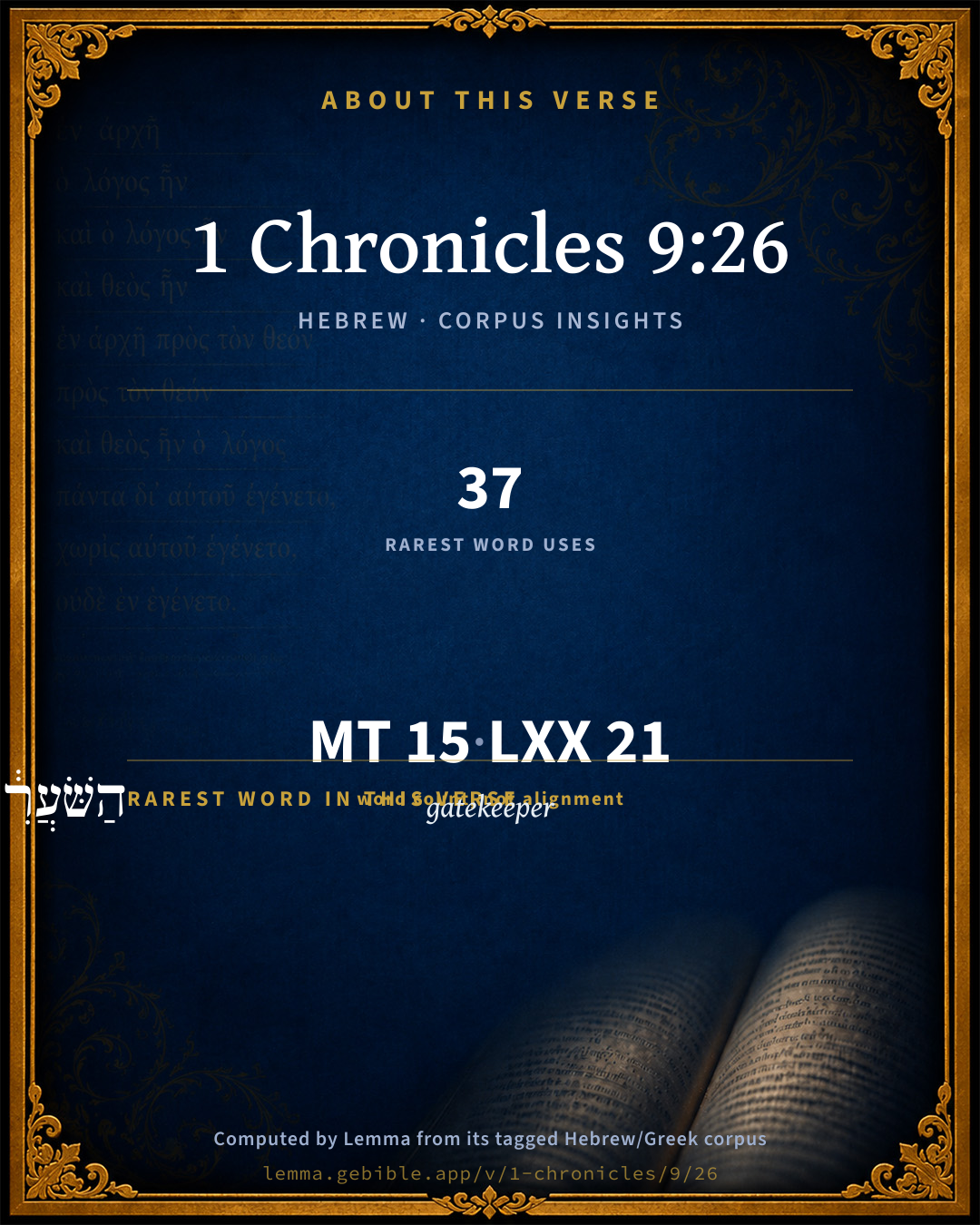
הַשֹּׁעֲרִ֔ים gatekeeper H7778 occurs in 37 verses of the Hebrew Bible. Also found in:

Grammatical profile

  • 1 verb
  • 7 nouns
  • 2 adjectives
  • 2 pronouns
  • 2 prepositions
  • 1 conjunction

Verb forms

  • וְהָיוּ֙ Qal · Sequential Perfect

Repetition

Words recur within this verse — often emphatic in Hebrew:

  • עַל upon H5921 ×2
  • הֵ֗מָּה they H1992 ×2

Hebrew & Septuagint length

In English translation the verse runs 28 words from the Hebrew and 29 from the Septuagint (LXX English) — closely comparable.

A rough comparison of the two English renderings, which tokenize alike — not a word-level alignment.

Word counts can differ between the Hebrew and the Greek without any difference in meaning — e.g. the Hebrew direct-object marker אֵת has no separate Greek word, and Greek often adds the article ὁ.

In the original languages it is 15 Hebrew tokens and 21 Greek tokens — but the two are counted differently (Hebrew bundles its prefixes and suffixes into one token; the Greek is in lemma form), so that isn’t a like-for-like length.

Cross-references

4

Topical passages linked to 1 Chronicles 9:26 in the Treasury of Scripture Knowledge — connected by theme and wording, ordered by reader-vote popularity; previews shown in the World English Bible.

  • 1 Chronicles 26:20–27 Of the Levites, Ahijah was over the treasures of the house of God, and over the treasures of the dedicated things.
  • 2 Chronicles 31:5–12 As soon as the commandment came abroad, the children of Israel gave in abundance the first fruits of grain, new wine, and oil, and honey, and of all the increase of the field; and the tithe of all things brought they in abundantly.
  • Nehemiah 10:38–39 The priest the son of Aaron shall be with the Levites, when the Levites take tithes: and the Levites shall bring up the tithe of the tithes to the house of our God, to the chambers, into the treasure-house.
  • Nehemiah 13:5 had prepared for him a great chamber, where before they laid the meal-offerings, the frankincense, and the vessels, and the tithes of the grain, the new wine, and the oil, which were given by commandment to the Levites, and the singers, and the porters; and the heave-offerings for the priests.

Cross-references courtesy of OpenBible.info (CC BY 4.0).

Hebrew and Greek witnesses Masoretic Hebrew ↔ Greek Septuagint

The same verse in the two great witnesses to the Old Testament, shown verse-for-verse.

These are two independent witnesses, not word-aligned to each other, and the Septuagint is shown in lemma (dictionary) form.

Hebrew 1 Chronicles 9:26 Masoretic · Westminster Leningrad Codex

כִּ֣י בֶאֱמוּנָ֞ה הֵ֗מָּה אַרְבַּ֨עַת֙ גִּבֹּרֵ֣י הַשֹּׁעֲרִ֔ים הֵ֖ם הַלְוִיִּ֑ם וְהָיוּ֙ עַל הַלְּשָׁכ֔וֹת וְעַ֥ל הָאֹצְר֖וֹת בֵּ֥ית הָאֱלֹהִֽים

for the four chief porters, who were Levites, were in an office of trust, and were over the chambers and over the treasuries in the house of God.

World English Bible · Public Domain

Greek LXX 1 Chronicles 9:26 Septuagint · lemma form

ὅτι ἐν πίστις εἰμί τέσσαρες δυνατός ὁ πύλη ὁ λευίτης εἰμί ἐπί ὁ παστοφόριον καί ἐπί ὁ θησαυρός οἶκος ὁ θεός

For four strong men have the charge of the gates; and the Levites were over the chambers, and they keep watch over the treasures of the house of God.

LXX2012 (modern English Septuagint) · Public Domain

Hebrew: Westminster Leningrad Codex (CC BY 4.0). Greek: Septuagint (public domain); English from LXX2012 (modern English Septuagint) (Public Domain). How the Septuagint differs from the Hebrew →

Commentary

Notes on 1 Chronicles 9:26 from classic Christian and Jewish commentators (each source and its license shown beneath its notes). The classic Christian expositions comment on the surrounding passage and are grouped to its opening verse, so a note may address several verses; the Jewish commentaries on the Tanakh (Rashi and others) are per-verse, so they appear only where the commentator wrote on this verse.

Lemma curates 59 commentaries, every one of them public domain or Creative Commons licensed, each selected and text-cleaned for this edition rather than reprinted as found. About our sources →

Ellicott's Commentary for English Readers

(26) For these Levites, the four chief porters, were in their set office.—The Heb. says, or seems to say, “For in fixed position (or trust) were they, viz., the four heroes of the warders.” (See 1Ch_9:17 which apparently names four chief “porters.”) The temporary chiefs of the warder guilds abode in the Temple; the mass of their members was settled in the neighbouring villages, and occupied with pastoral pursuits.

And were over the chambers and treasuries of the house of God.—This statement belongs to the following verse. The preceding account of the porters or warders seems to terminate with the words. “For in fixed position are they, the four stalwart warders; they are the Levites;” that is, the Levites par excellence. And they were over the cells and over the treasuries of the house of God (viz., the warders); and they used to pass the night (1Ch_9:27) in the places round the house of God, for upon them was the ward, and they were over the opening (key) every morning—a brief recapitulation of the main duty of the Levitical warders. Some have proposed to alter the text of 1Ch_9:26 b, and to read, “And some of the Levites were over the cells,” &c, thus constituting a new paragraph, although 1Ch_9:27 obviously recurs to the warders. Probably the paragraph mark should be transferred to 1Ch_9:28. From this point to 1Ch_9:34 we have a review of the other special charges of the Levites.

A Bible Commentary for English Readers, edited by Charles John Ellicott (1878–1897) — public domain. Text from a community e-Sword module.

Joseph Benson's Commentary

1Ch 9:26-27. These Levites were in their set office — These were constantly upon the place, in the execution of their office, that they might oversee the inferior porters in their work. Were over the treasuries — In which the sacred utensils, and other treasures belonging to the temple, were kept. They lodged round about the house of God — They were not permitted to dwell in the villages as their brethren were, but were obliged to constant residence in the place, because their office required it.

Joseph Benson's Commentary on the Old and New Testaments (1811–1818) — public domain. Text from a community e-Sword module.

Geneva Bible (1599)

Geneva Bible translators

Or, opening of the doors.

Geneva Bible (1599) marginal notes — public domain. Text via Bolls.life.

The Cambridge Bible for Schools and Colleges

gen. ed. J. J. S. Perowne

26. For these Levites, the four chief porters, were in their set office] R.V. For the four chief porters, who were Levites, were in a set office. It seems from this passage (and also from the structure of this chapter; cp. 1Ch_9:10; 1Ch_14:17) that the doorkeepers were not, as a body, Levites. Their leaders however, being Levites, were placed in positions of greater trust; cp. 1Ch_26:20-28. In 2Ch_34:9 Levites appear exercising the duties of doorkeepers, but this does not prove that all doorkeepers were Levites.

chambers] i.e. store-chambers in which tithes and sacred vessels were kept; cp. 2Ch_31:5; 2Ch_31:11-12; Neh_13:4-9. The chambers were probably built as outbuildings round the Court of the Temple; cp. 1Ch_23:28; 1Ch_28:12.

The Cambridge Bible for Schools and Colleges (gen. ed. J. J. S. Perowne; Cambridge University Press, 1878–1918) — public domain. Text from a community e-Sword module.

John Gill's Exposition

And certain of them had the charge of the ministering vessels, that they should bring them in and out by tale. Which the priests used in sacrificing, and which the Levites brought to them, and returned again to their proper places.

And certain of them had the charge of the ministering vessels, that they should bring them in and out by tale. Which the priests used in sacrificing, and which the Levites brought to them, and returned again to their proper places.

1 Chronicles 9:29

ch1 9:29

ch1 9:29

ch1 9:29Some of them also were appointed to oversee the vessels, and all the instruments of the sanctuary,.... They were committed to their care; they delivered them out on occasion, and their business was to see that they were returned when they had done their use and service:

and the fine flour, and the wine, and the oil, and the frankincense, and the spices; which were used in meat offerings, drink offerings, &c. see Ch1 26:20 under the second temple, Ahiah was over the libations or drink offerings (x).

(x) Ibid. (Misn. Shekalim, c. 5. sect. 1.)

John Gill's Exposition of the Whole Bible (1746–1763) — public domain (CC PDM 1.0). Text via the HelloAO Bible API.

Albert Barnes' Notes on the Bible

Rather, “For the four chief porters, who were themselves Levites, were in trust, who also had the charge of the chambers, etc.” A contrast seems intended between the four chief porters, whose charge was constant, and the remainder, who kept watch by turns.

Albert Barnes' Notes on the Bible (1834–1885) — public domain. Text from a community e-Sword/MySword module.

Haydock's Catholic Bible Commentary

To these. Hebrew, "for these Levites, (Sellum, &c.; ver. 17) four chief porters were in their set office," for life, or as long as they were able to serve, and did not change every week like the rest. --- Lord: the apartments of the priests, and the storehouses, (Haydock) where all precious ornaments, wine, &c., were kept. (Calmet)

George Leo Haydock (1774–1849), Haydock's Catholic Family Bible and Commentary, 1859 edition — public domain. Excludes Psalms (Douay-Rheims chapter numbering differs from Protestant) and Deuterocanonical books (Catholic canon only).

Matthew Poole's English Annotations

Were in their set office, i. e. these were constantly upon the place, and in the execution of their office, that so they might oversee and direct the inferior porters in their work. Or, as others render the words, agreeably to the Hebrew text, For these (i.e. their brethren, 1Ch 9:25) were under the charge, or committed to the trust of the

four chief porters, who also were Levites, as their brethren were; whereas the chief of all of them was a priest. Either way these words contain a reason of what was said, 1Ch 9:25, why the rest were to come to these, and to be with them.

Treasuries; in which the sacred utensils, and other treasures belonging to the temple, were kept.

Matthew Poole's English Annotations on the Holy Bible (1683–1685) — public domain. Text from a community e-Sword/MySword module.

The Pulpit Commentary

Vers. 26-32.

Ministers of the sanctuary.

The arrangements for the service of the Levites in the Lord"s house seem to have been made, or at all events settled, by Samuel and by David. The same arrangements, substantially, were adopted by Solomon, in connection with the first temple, and by Ezra and Nehemiah in the second temple erected by Zerubbabel. For the custody of the holy house, four chief warders were appointed, under whom were a hundred and sixty-eight porters, who, in turn, fulfilled their important and sacred office. These attendants had their homes in certain villages in the neighbourhood of Jerusalem. A course of twenty-four of them seem to have attended the sanctuary every week, commencing with the sabbath, and the turn of each course would come round once in seven weeks.

I OBSERVE THE VARIETY AND UNITY OF THE LEVITICAL SERVICE.

1. The variety. Some were entrusted with the duty of opening and closing the doors. Others had charge of the treasury, where coin, sacred vessels and vestments, etc., were kept in security. Others had the custody of the various vessels and instruments used in sacrificial services. Others made ready the sacrifices, manufactured the incense, or prepared the sacred cakes and shewbread.

2. The unity. One God appointed them all, by the same law and ordinance, to their several ministries. One sanctuary occupied their attention and called forth their activity. One nation and people were served by all the ministrations of the priests and Levites. One object was before them all to serve Jehovah, to obey his Law, to seek his favour.

II REMARK THE STRIKING FIGURE WHICH WE HAVE IN THESE MINISTRATIONS OF THE CHURCH OF THE LIVING AND DIVINE CHRIST.

1. There are "diversities of gifts" and trusts and services. According to theability and opportunity is the occupation.

2. Beneath all these diversities there is an admirable unity. It is "the oneSpirit" who qualifies and appoints all. There is one body, one temple, one brotherhood. And there is one aim the service and glory of the one God and Saviour.

PRACTICAL LESSONS.

1. Let each Christian fulfil his own vocation.

2. And, at the same time, regard with sympathy and affection his fellow-workers in the same service.

3. And ever look to the one end the service of his redeeming God. T.

The Pulpit Commentary (1880–1919), ed. H.D.M. Spence-Jones & Joseph S. Exell — public domain. Text from a community e-Sword module.

John Wesley's Explanatory Notes

Set office - These were constantly upon the place, in the execution of their office, that they might oversee the inferior porters in their work. Treasuries - In which the sacred utensils and other treasures belonging to the temple, were kept.

John Wesley, Explanatory Notes Upon the Whole Bible (1754–1765) — public domain. Text via the GEBible commentary corpus.

Keil & Delitzsch

C. F. Keil & F. Delitzsch

And certain of them had the charge of the ministering vessels, that they should bring them in and out by tale. Which the priests used in sacrificing, and which the Levites brought to them, and returned again to their proper places.

And certain of them had the charge of the ministering vessels, that they should bring them in and out by tale. Which the priests used in sacrificing, and which the Levites brought to them, and returned again to their proper places.

1 Chronicles 9:29

ch1 9:29

ch1 9:29

ch1 9:29Some of them also were appointed to oversee the vessels, and all the instruments of the sanctuary,.... They were committed to their care; they delivered them out on occasion, and their business was to see that they were returned when they had done their use and service:

and the fine flour, and the wine, and the oil, and the frankincense, and the spices; which were used in meat offerings, drink offerings, &c. see Ch1 26:20 under the second temple, Ahiah was over the libations or drink offerings (x).

(x) Ibid. (Misn. Shekalim, c. 5. sect. 1.)

Keil & Delitzsch — Biblical Commentary on the Old Testament (1861–1891) — public domain (CC PDM 1.0). Text via the HelloAO Bible API. (Old Testament only.)

Scofield Reference Notes

C. I. Scofield

chambers

i.e. storehouses.

The Scofield Reference Bible (1917 edition), notes by C. I. Scofield — public domain. Text from a community e-Sword module.

Lesson kit

Teaching starters — assembled from the data on this page, not authored interpretation. Every prompt links to the verse data it draws on. Edit before teaching.

1 Chronicles, in the Historical, opens this verse with 15 words (13 distinct Hebrew lemmas). Its most distinctive word is shôwʻêr (“gatekeeper”). A historical commentator’s framing appears above. Read the whole chapter for the surrounding context.

Discussion questions

  1. The word shôwʻêr carries the sense “gatekeeper.” How does it shape the verse?
  2. 2 Samuel 18:26 shares the word «gatekeeper» with this verse. How do the two illuminate each other?
  3. “upon” occurs 2× in this one verse. What is the effect of the repetition?
  4. These translations render this verse differently. What is at stake in choosing one wording over another?
  5. The verb «וְהָיוּ֙» is Qal Sequential Perfect. How does its form color the action?
  6. Reading how Ellicott's Commentary for English Readers and Joseph Benson's Commentary read this verse, where do the two commentators agree and where do they part?

Things to notice

Reading settings

Reading text

Shown beneath each verse's original-language words.

Old Testament
Old Testament edition

Read the OT as the Masoretic Hebrew (MT) or the Greek Septuagint (LXX).

English shown for the Greek Septuagint (in the Hebrew ↔ Greek comparison).

Comparing translations? Open the Compare panel on any verse page to stack up to four side by side.