
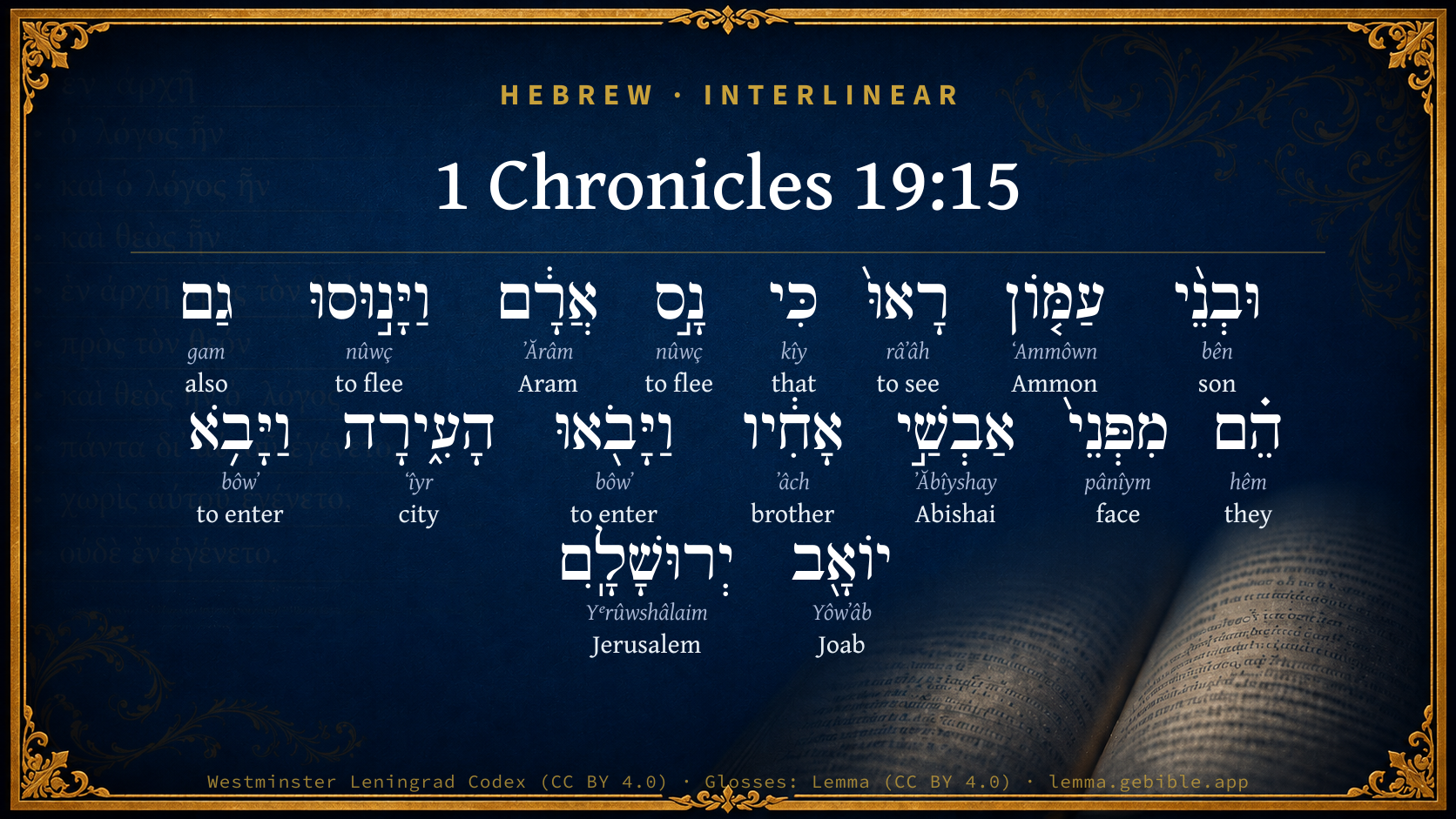
1 Chronicles 19:15

Hebrew (Westminster Leningrad Codex) 1 Chronicles 19:15 appears in the Hebrew Old Testament. The text above is from the Westminster Leningrad Codex. Each word links to its Strong’s number, a concise gloss, and parsing drawn from the Open Scriptures Hebrew Bible morphology. Click any word for its full Brown-Driver-Briggs (BDB) entry.
Download image
Cite this verse

1 Chronicles 19:15 (World English Bible). Public Domain. Lemma interlinear Bible study tool, https://lemma.gebible.app/v/1-chronicles/19/15.

Show BibTeX & RIS
BibTeX
RIS
English Translation
When the children of Ammon saw that the Syrians were fled, they likewise fled before Abishai his brother, and entered into the city. Then Joab came to Jerusalem.
World English Bible · Public Domain
Download a study sheet

One document with this verse’s original text, its word-by-word gloss line, the meaning frame, cross-references with their text, attributed commentary, and full source and license credits — printable, and it pastes into notes with its structure intact.

This verse Autodidact and up

Study sheet (.html) Plain text (.txt)

A passage Seminary Student

Up to 50 verses in one chapter. A passage sheet keeps up to 6 commentary sources and 12 cross-references per verse, in the order this page ranks them, and says so on the sheet whenever that leaves anything out. Ask for a single verse and you get the Autodidact verse sheet above.

Everything on this page stays free to read, with no account — the sheet is a download of what is already on screen, not access to it.

Want to remove ads? Support Godless Engineer
Compare translations 3

The same verse in 3 English versions, stacked beneath the original-language interlinear above. Click any original word for its lexicon entry.

Each is an independent rendering of the whole verse — the interlinear is not word-aligned to these translations.

Highlighted words mark where these versions differ — a whole-verse word diff, not a word-by-word alignment.

  • World English Bible Public Domain
    When the children of Ammon saw that the Syrians were fled, they likewise fled before Abishai his brother, and entered into the city. Then Joab came to Jerusalem.
  • King James Version Public Domain
    And when the children of Ammon saw that the Syrians were fled, they likewise fled before Abishai his brother, and entered into the city. Then Joab came to Jerusalem.
  • unfoldingWord Literal Text CC BY-SA 4.0
    And the sons of Ammon saw that Aram had fled, and they fled, they also, from the face of Abishai his brother. And they came to the city, and Joab came Jerusalem.

unfoldingWord Literal Text — © unfoldingWord, licensed CC BY-SA 4.0. Word-aligned USFM3 via Door43 (git.door43.org/unfoldingWord/en_ult).

Versions to compare (up to 4)

3 of 4 selected

Show all 18 translations

Every available English version of this verse, each an independent rendering of the whole verse.

  • World English Bible Public Domain
    When the children of Ammon saw that the Syrians were fled, they likewise fled before Abishai his brother, and entered into the city. Then Joab came to Jerusalem.
  • Berean Standard Bible Public Domain
    When the Ammonites saw that the Arameans had fled, they too fled before Joab’s brother Abishai, and they entered the city. So Joab went back to Jerusalem.
  • Majority Standard Bible Public Domain
    When the Ammonites saw that the Arameans had fled, they too fled before Joab’s brother Abishai, and they entered the city. So Joab went back to Jerusalem.
  • King James Version Public Domain
    And when the children of Ammon saw that the Syrians were fled, they likewise fled before Abishai his brother, and entered into the city. Then Joab came to Jerusalem.
  • American Standard Version (1901) Public Domain
    And when the children of Ammon saw that the Syrians were fled, they likewise fled before Abishai his brother, and entered into the city. Then Joab came to Jerusalem.
  • Revised Version (1885) Public Domain
    And when the children of Ammon saw that the Syrians were fled, they likewise fled before Abishai his brother, and entered into the city. Then Joab came to Jerusalem.
  • Geneva Bible (1599) Public Domain
    And when the children of Ammon sawe that the Aramites fled, they fled also before Abishai his brother, and entred into the citie: so Ioab came to Ierusalem.
  • Douay-Rheims (1899) Public Domain
    And the children of Ammon seeing that the Syrians were fled, they likewise fled from Abisai his brother, and went into the city: and Joab also returned to Jerusalem.
  • Young's Literal Translation Public Domain
    and the sons of Ammon have seen that Aram hath fled, and they flee -- they also -- from the face of Abishai his brother, and go in to the city. And Joab cometh in to Jerusalem.
  • Literal Standard Version CC BY-SA 4.0
    and the sons of Ammon have seen that Aram has fled, and they flee—they also—from the face of his brother Abishai, and go into the city. And Joab comes to Jerusalem.
  • Unlocked Literal Bible CC BY-SA 4.0
    When the army of Ammon saw that the Arameans had fled, they also fled from Joab's brother Abishai and went back into the city. Then Joab returned from the people of Ammon and went back to Jerusalem.
  • unfoldingWord Literal Text CC BY-SA 4.0
    And the sons of Ammon saw that Aram had fled, and they fled, they also, from the face of Abishai his brother. And they came to the city, and Joab came Jerusalem.
  • Darby Bible Public Domain
    And when the children of Ammon saw that the Syrians fled, they likewise fled before Abishai his brother, and entered into the city. And Joab came to Jerusalem.
  • World Messianic Bible Public Domain
    When the children of Ammon saw that the Syrians had fled, they likewise fled before Abishai his brother, and entered into the city. Then Joab came to Jerusalem.
  • Webster's Bible Public Domain
    And when the children of Ammon saw that the Syrians had fled, they likewise fled before Abishai his brother, and entered into the city. Then Joab came to Jerusalem.
  • Free Bible Version CC BY-SA 4.0
    When the Ammonites saw that the Arameans had run away, they also ran away from Abishai, Joab's brother, and retreated into the town. So Joab went back to Jerusalem.
  • Bible in Basic English Public Domain
    And when the children of Ammon saw the flight of the Aramaeans, they themselves went in flight from Abishai, his brother, and came into the town. Then Joab came back to Jerusalem.
  • JPS Tanakh (1917) Public Domain
    And when the children of Ammon saw that the Arameans were fled, they likewise fled before Abishai his brother, and entered into the city. Then Joab came to Jerusalem.

Literal Standard Version (2020), Covenant Press — licensed CC BY-SA 4.0. Text via the HelloAO Bible API (eBible.org). Unlocked Literal Bible (unfoldingWord) — licensed CC BY-SA 4.0. Text via the HelloAO Bible API (eBible.org). unfoldingWord Literal Text — © unfoldingWord, licensed CC BY-SA 4.0. Word-aligned USFM3 via Door43 (git.door43.org/unfoldingWord/en_ult). Free Bible Version, Dr. Jonathan Gallagher — licensed CC BY-SA 4.0. Text via the HelloAO Bible API (eBible.org).

Word by word

More ways to search: Search by grammar → Find every occurrence → Compare this word →

Practice this passage: Drill this verse → Learn its vocabulary →

אַבְשַׁ֣י
ʼĂbîyshay
H52
“Abishai”
Noun, Proper
Part of Speech
Noun
Type
Proper
Full BDB Definition

Origin: from H1 and H7862

TWOT: None

Abishai = "my father is Jesse" or " my father is a gift" - grandson of Jesse, nephew of David via his sister Zeruiah, brother of Joab
  1. וּבְנֵ֨י bên H1121 “and · sons of” Conjunction + Noun, Common, Masculine, Plural, Construct
  2. עַמּ֤וֹן ʻAmmôwn H5983 “Ammon” Noun, Proper
  3. רָאוּ֙ râʼâh H7200 “to see” Verb, Qal, Perfect, 3rd Person, Common, Plural
  4. כִּי kîy H3588 “that” Conjunction
  5. נָ֣ס nûwç H5127 “to flee” Verb, Qal, Perfect, 3rd Person, Masculine, Singular
  6. אֲרָ֔ם ʼĂrâm H758 “Aram” Noun, Proper
  7. וַיָּנ֣וּסוּ nûwç H5127 “and · to flee” Conjunction + Verb, Qal, Sequential Imperfect, 3rd Person, Masculine, Plural
  8. גַם gam H1571 “also” Adverb
  9. הֵ֗ם hêm H1992 “they” Pronoun, Personal, 3rd Person, Masculine, Plural
  10. מִפְּנֵי֙ pânîym H6440 “from · face(s) of” Preposition + Noun, Common, Both, Plural, Construct
  11. אָחִ֔יו ʼâch H251 “brother · his” Noun, Common, Masculine, Singular, Construct + Suffix, Personal, 3rd Person, Masculine, Singular
  12. וַיָּבֹ֖אוּ bôwʼ H935 “and · to enter” Conjunction + Verb, Qal, Sequential Imperfect, 3rd Person, Masculine, Plural
  13. הָעִ֑ירָה ʻîyr H5892 “the · city · toward” Particle, Definite Article + Noun, Common, Feminine, Singular, Absolute + Suffix, Demonstrative
  14. וַיָּבֹ֥א bôwʼ H935 “and · to enter” Conjunction + Verb, Qal, Sequential Imperfect, 3rd Person, Masculine, Singular
  15. יוֹאָ֖ב Yôwʼâb H3097 “Joab” Noun, Proper
  16. יְרוּשָׁלִָֽם Yᵉrûwshâlaim H3389 “Jerusalem” Noun, Proper

About this verse

These counts appear in no published source. They are computed here, from the morphology-tagged text and Lemma’s own curated glosses. What Lemma adds →

17
words
15
distinct lemmas
Historical
section

Notable vocabulary

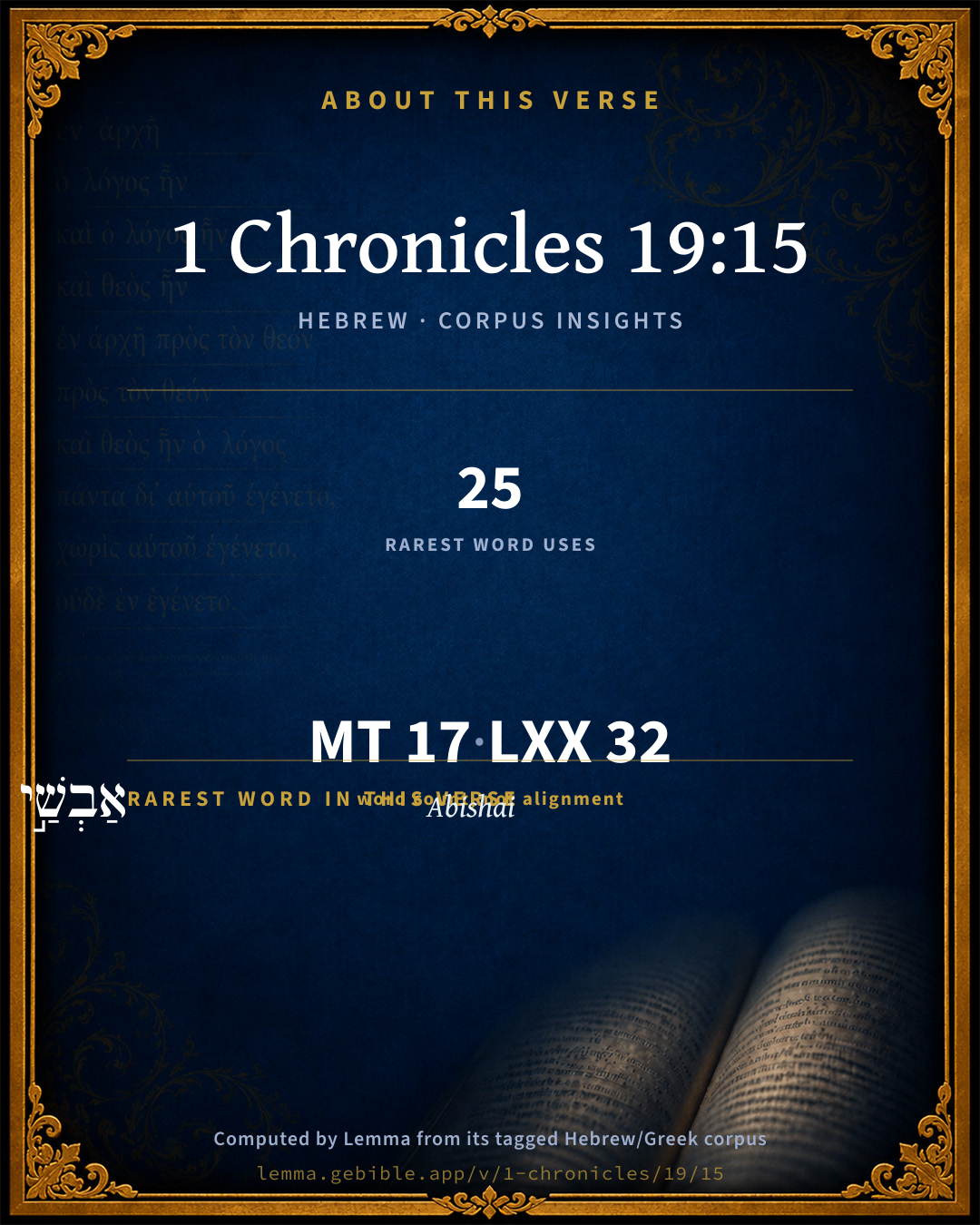
The rarest word here is אַבְשַׁ֣י Abishai H52 — appearing just 25 times in the whole Hebrew Bible.

Shared distinctive vocabulary

אַבְשַׁ֣י Abishai H52 occurs in 24 verses of the Hebrew Bible. Also found in:

Grammatical profile

  • 5 verbs
  • 9 nouns
  • 1 pronoun
  • 1 conjunction
  • 1 adverb

Verb forms

  • רָאוּ֙ Qal · Perfect
  • נָ֣ס Qal · Perfect
  • וַיָּנ֣וּסוּ Qal · Sequential Imperfect
  • וַיָּבֹ֖אוּ Qal · Sequential Imperfect
  • וַיָּבֹ֥א Qal · Sequential Imperfect

Repetition

Words recur within this verse — often emphatic in Hebrew:

  • נָ֣ס to flee H5127 ×2
  • וַיָּבֹ֖אוּ to enter H935 ×2

Hebrew & Septuagint length

In English translation the verse runs 28 words from the Hebrew and 34 from the Septuagint (LXX English) — closely comparable.

A rough comparison of the two English renderings, which tokenize alike — not a word-level alignment.

Word counts can differ between the Hebrew and the Greek without any difference in meaning — e.g. the Hebrew direct-object marker אֵת has no separate Greek word, and Greek often adds the article ὁ.

In the original languages it is 17 Hebrew tokens and 32 Greek tokens — but the two are counted differently (Hebrew bundles its prefixes and suffixes into one token; the Greek is in lemma form), so that isn’t a like-for-like length.

Cross-references

2

Topical passages linked to 1 Chronicles 19:15 in the Treasury of Scripture Knowledge — connected by theme and wording, ordered by reader-vote popularity; previews shown in the World English Bible.

  • Leviticus 26:7 You shall chase your enemies, and they shall fall before you by the sword.
  • Romans 8:31 What then shall we say about these things? If God is for us, who can be against us?

Cross-references courtesy of OpenBible.info (CC BY 4.0).

Hebrew and Greek witnesses Masoretic Hebrew ↔ Greek Septuagint

The same verse in the two great witnesses to the Old Testament, shown verse-for-verse.

These are two independent witnesses, not word-aligned to each other, and the Septuagint is shown in lemma (dictionary) form.

Hebrew 1 Chronicles 19:15 Masoretic · Westminster Leningrad Codex

וּבְנֵ֨י עַמּ֤וֹן רָאוּ֙ כִּי נָ֣ס אֲרָ֔ם וַיָּנ֣וּסוּ גַם הֵ֗ם מִפְּנֵי֙ אַבְשַׁ֣י אָחִ֔יו וַיָּבֹ֖אוּ הָעִ֑ירָה וַיָּבֹ֥א יוֹאָ֖ב יְרוּשָׁלִָֽם

When the children of Ammon saw that the Syrians were fled, they likewise fled before Abishai his brother, and entered into the city. Then Joab came to Jerusalem.

World English Bible · Public Domain

Greek LXX 1 Chronicles 19:15 Septuagint · lemma form

καί ὁ υἱός αμμων ὁράω ὅτι φεύγω σύρος καί φεύγω καί αὐτός ἀπό πρόσωπον ιωαβ καί ἀπό πρόσωπον αβεσσα ὁ ἀδελφός αὐτός καί ἔρχομαι εἰς ὁ πόλις καί ἔρχομαι ιωαβ εἰς ἰερουσαλήμ

And the children of Ammon saw that the Syrians fled, and they also fled from before Abesai, and from before Joab his brother, and they came to the city: and Joab came to Jerusalem.

LXX2012 (modern English Septuagint) · Public Domain

Hebrew: Westminster Leningrad Codex (CC BY 4.0). Greek: Septuagint (public domain); English from LXX2012 (modern English Septuagint) (Public Domain). How the Septuagint differs from the Hebrew →

Commentary

Notes on 1 Chronicles 19:15 from classic Christian and Jewish commentators (each source and its license shown beneath its notes). The classic Christian expositions comment on the surrounding passage and are grouped to its opening verse, so a note may address several verses; the Jewish commentaries on the Tanakh (Rashi and others) are per-verse, so they appear only where the commentator wrote on this verse.

Lemma curates 59 commentaries, every one of them public domain or Creative Commons licensed, each selected and text-cleaned for this edition rather than reprinted as found. About our sources →

Ellicott's Commentary for English Readers

(15) And when the children of Amnion saw.—The Hebrew construction is quite different from that of 1Ch_19:6. Render, Now the sons of Ammon had seen that Aram was routed.

They likewise.—An explanatory addition to the text, as read in Samuel. So also “his brother.”

Then Joab came . . .—Abridged. (Comp. Samuel.)

A Bible Commentary for English Readers, edited by Charles John Ellicott (1878–1897) — public domain. Text from a community e-Sword module.

The Cambridge Bible for Schools and Colleges

gen. ed. J. J. S. Perowne

15. Joab came to Jerusalem] Probably because he was wanted for the new danger gathering in the North.

The Cambridge Bible for Schools and Colleges (gen. ed. J. J. S. Perowne; Cambridge University Press, 1878–1918) — public domain. Text from a community e-Sword module.

The Pulpit Commentary

Then Joab came to Jerusalem. This is equivalent to saying that, for what he deemed sufficient reasons, Joab did not stay to besiege the Ammonites in the city, within the wails of which they had taken refuge, nor to pursue the Syrians. Hence we find these latter soon made bold to rally and to get additional aid.

The Pulpit Commentary (1880–1919), ed. H.D.M. Spence-Jones & Joseph S. Exell — public domain. Text from a community e-Sword module.

Lesson kit

Teaching starters — assembled from the data on this page, not authored interpretation. Every prompt links to the verse data it draws on. Edit before teaching.

1 Chronicles, in the Historical, opens this verse with 17 words (15 distinct Hebrew lemmas). Its most distinctive word is ʼĂbîyshay (“Abishai”). A historical commentator’s framing appears above. Read the whole chapter for the surrounding context.

Discussion questions

  1. The word ʼĂbîyshay carries the sense “Abishai.” How does it shape the verse?
  2. How does 1 Samuel 26:6, which shares the word «Abishai», read alongside this verse?
  3. What does the repetition of “to flee” (2× in this one verse) do in this verse?
  4. These translations render this verse differently. What is at stake in choosing one wording over another?
  5. «רָאוּ֙» is a Qal Perfect verb. How does that grammatical form shape the action described?
  6. Compare how Ellicott's Commentary for English Readers and The Cambridge Bible for Schools and Colleges read this verse. Where do they agree or differ?

Things to notice

Reading settings

Reading text

Shown beneath each verse's original-language words.

Old Testament
Old Testament edition

Read the OT as the Masoretic Hebrew (MT) or the Greek Septuagint (LXX).

English shown for the Greek Septuagint (in the Hebrew ↔ Greek comparison).

Comparing translations? Open the Compare panel on any verse page to stack up to four side by side.