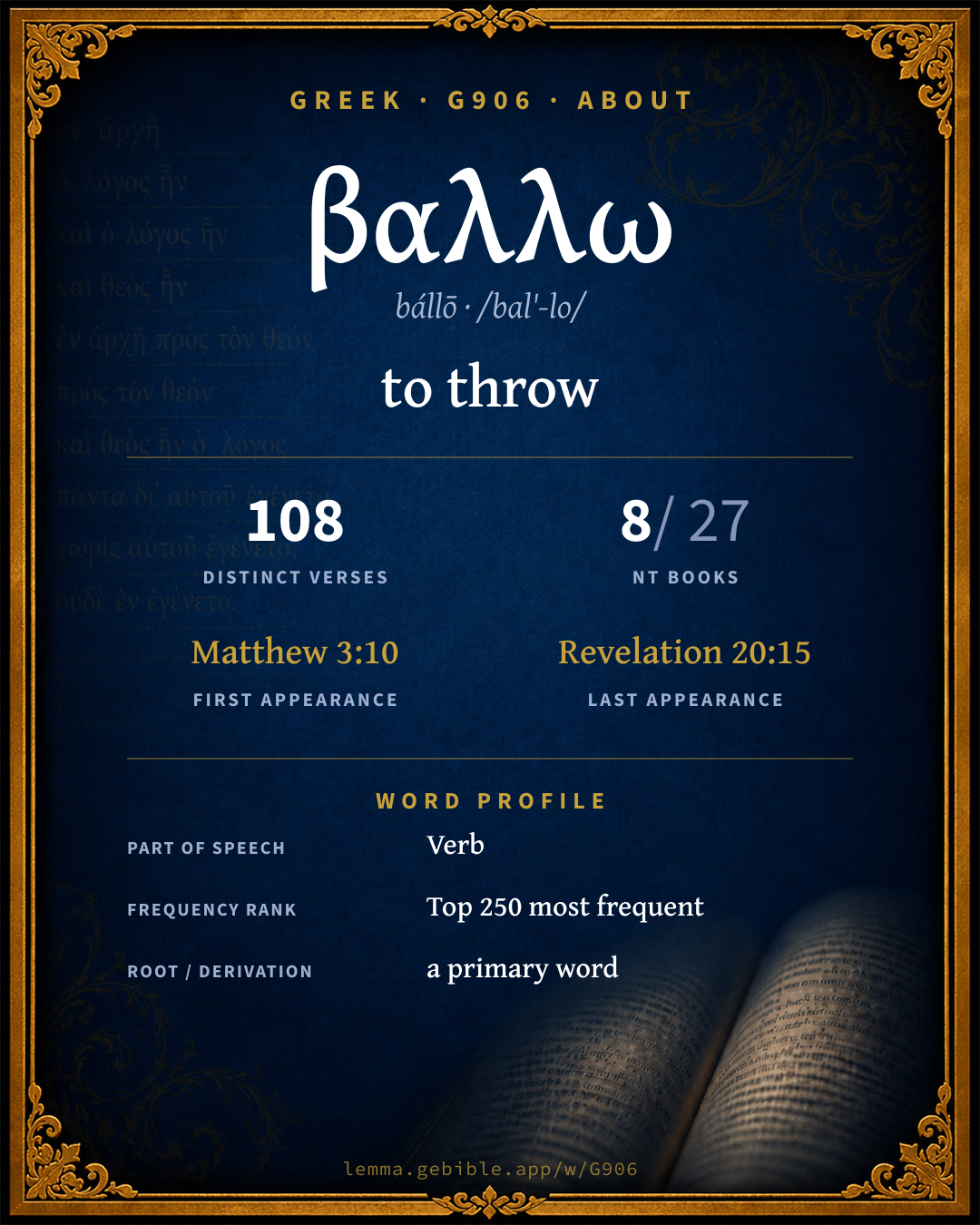
βάλλω
to throw
‘to throw’ is one of 2 main senses fuller range ↓
Full lexicon entry — Thayer's Greek Lexicon
From Thayer's Greek Lexicon
Where this word appears
See every Aorist-tense verb in the Greek New Testament →
Grammar key — what these labels mean
Part of speech
- Verb
- An action or state-of-being word.
Tense
- Aorist
- Action viewed as a simple whole, without regard to duration — often past (perfective aspect).
- Present
- Ongoing or general action in present time (imperfective aspect).
- Future
- Action expected in future time.
- Perfect
- A completed past action with continuing present results.
- Imperfect
- Continuous or repeated action in past time (“was writing”).
- Pluperfect
- A past action completed before another past point (“had written”).
Voice
- Active
- The subject performs the action.
- Passive
- The subject receives the action.
Mood
- Indicative
- States a fact or asks a factual question (the mood of reality).
- Imperative
- Expresses a command or request.
- Infinitive
- A verbal noun (“to write”), unmarked for person or number.
- Subjunctive
- Expresses probability, purpose, or possibility (the mood of contingency).
- Participle
- A verbal adjective (“writing,” “having written”).
Case
- Accusative
- The case of the direct object and of extent.
- Genitive
- The case of source, possession, or “of” — answers “whose / from what.”
- Nominative
- The case of the subject (and the predicate nominative).
- Dative
- The case of the indirect object, means, or location — “to / for / with / in.”
Person
- 3rd person
- The one spoken about (“he / she / it / they”).
- 2nd person
- The one addressed (“you”).
- 1st person
- The speaker (“I / we”).
Gender
- Masculine
- Grammatically masculine.
- Feminine
- Grammatically feminine.
- Neuter
- Grammatically neuter.
Number
- Singular
- One.
- Plural
- More than one.
Grammatical forms 45 distinct
- Verb, Aorist, Active, Indicative, 3rd person, Singular 21 times (17%)
- Verb, Aorist, Active, Indicative, 3rd person, Plural 9 times (7%)
- Verb, Aorist, Active, Imperative, 2nd person, Singular 9 times (7%)
- Verb, Aorist, Active, Infinitive 9 times (7%)
- Verb, Aorist, Passive, Indicative, 3rd person, Singular 9 times (7%)
- Verb, Present, Active, Indicative, 3rd person, Singular 5 times (4%)
- Verb, Aorist, Passive, Infinitive 4 times (3%)
- Verb, Present, Active, Indicative, 3rd person, Plural 4 times (3%)
+37 more forms (54 occurrences)
Parsed forms decoded from the imported morphology (Robinson–Tischendorf, public domain), counted across 124 parsed occurrences — not distinct verses.
Every verse where G906 appears — 108 distinct verses across 8 books. Click any verse to open its interlinear word-by-word view. Verse text shown in the World English Bible for context — . Each verse’s Greek form is shown with its reference; the English is not keyword-highlighted, since the data carries no word-level English alignment. Use “Compare translations” on any verse to read it across multiple English versions. This concordance covers the Greek New Testament; Septuagint (Greek Old Testament) occurrences of this word are not indexed here.
Matthew 29 verses
- Matthew 3:10 βάλλεται pres pass ind 3sg "Even now the axe lies at the root of the trees. Therefore, every tree that doesn't bring forth good fruit is cut down, and cast into the fire.
- Matthew 4:6 βάλε aor act impv 2sg and said to him, "If you are the Son of God, throw yourself down, for it is written, 'He will give his angels charge concerning you.' and, 'On their hands they will bear you up, So that you don't dash your foot against a stone.'"
- Matthew 4:18 βάλλοντας pres act ptcp acc pl masc Walking by the sea of Galilee, he saw two brothers: Simon, who is called Peter, and Andrew, his brother, casting a net into the sea; for they were fishermen.
- Matthew 5:13 βληθὲν aor pass ptcp nom sg neut "You are the salt of the earth, but if the salt has lost its flavor, with what will it be salted? It is then good for nothing, but to be cast out and trodden under the feet of men.
- Matthew 5:25 βληθήσῃ fut pass ind 2sg Agree with your adversary quickly, while you are with him in the way; lest perhaps the prosecutor deliver you to the judge, and the judge deliver you to the officer, and you be cast into prison.
- Matthew 5:29 βάλε βληθῇ aor act impv 2sg aor pass subj 3sg If your right eye causes you to stumble, pluck it out and throw it away from you. For it is more profitable for you that one of your members should perish, than for your whole body to be cast into Gehenna.
- Matthew 5:30 βάλε aor act impv 2sg If your right hand causes you to stumble, cut it off, and throw it away from you: for it is profitable for you that one of your members should perish, and not your whole body be thrown into Gehenna.
- Matthew 6:30 βαλλόμενον pres pass ptcp acc sg masc But if God so clothes the grass of the field, which today exists, and tomorrow is thrown into the oven, won't he much more clothe you, you of little faith?
- Matthew 7:6 βάλητε aor act subj 2pl "Don't give that which is holy to the dogs, neither throw your pearls before the pigs, lest perhaps they trample them under their feet, and turn and tear you to pieces.
- Matthew 7:19 βάλλεται pres pass ind 3sg Every tree that doesn't grow good fruit is cut down, and thrown into the fire.
- Matthew 8:6 βέβληται perf pass ind 3sg and saying, "Lord, my servant lies in the house paralyzed, grievously tormented."
- Matthew 8:14 βεβλημένην perf pass ptcp acc sg fem When Jesus came into Peter's house, he saw his wife's mother lying sick with a fever.
- Matthew 9:2 βεβλημένον perf pass ptcp acc sg masc Behold, they brought to him a man who was paralyzed, lying on a bed. Jesus, seeing their faith, said to the paralytic, "Son, cheer up! Your sins are forgiven you."
- Matthew 9:17 βάλλουσιν βάλλουσιν pres act ind 3pl pres act ind 3pl Neither do people put new wine into old wineskins, or else the skins would burst, and the wine be spilled, and the skins ruined. No, they put new wine into fresh wineskins, and both are preserved."
- Matthew 10:34 βαλεῖν βαλεῖν aor act inf aor act inf "Don't think that I came to send peace on the earth. I didn't come to send peace, but a sword.
- Matthew 13:42 βαλοῦσιν fut act ind 3pl and will cast them into the furnace of fire. There will be weeping and the gnashing of teeth.
- Matthew 13:47 βληθείσῃ aor pass ptcp dat sg fem "Again, the Kingdom of Heaven is like a dragnet, that was cast into the sea, and gathered some fish of every kind,
- Matthew 13:48 ἔβαλον aor act ind 3pl which, when it was filled, they drew up on the beach. They sat down, and gathered the good into containers, but the bad they threw away.
- Matthew 13:50 βαλοῦσιν fut act ind 3pl and will cast them into the furnace of fire. There will be the weeping and the gnashing of teeth."
- Matthew 15:26 βαλεῖν aor act inf But he answered, "It is not appropriate to take the children's bread and throw it to the dogs."
- Matthew 17:27 βάλε aor act impv 2sg But, lest we cause them to stumble, go to the sea, and cast a hook, and take up the first fish that comes up. When you have opened its mouth, you will find a stater coin. Take that, and give it to them for me and you."
- Matthew 18:8 βάλε βληθῆναι aor act impv 2sg aor pass inf If your hand or your foot causes you to stumble, cut it off, and cast it from you. It is better for you to enter into life maimed or crippled, rather than having two hands or two feet to be cast into the eternal fire.
- Matthew 18:9 βάλε βληθῆναι aor act impv 2sg aor pass inf If your eye causes you to stumble, pluck it out, and cast it from you. It is better for you to enter into life with one eye, rather than having two eyes to be cast into the Gehenna of fire.
- Matthew 18:30 ἔβαλεν aor act ind 3sg He would not, but went and cast him into prison, until he should pay back that which was due.
- Matthew 21:21 βλήθητι aor pass impv 2sg Jesus answered them, "Most assuredly I tell you, if you have faith, and don't doubt, you will not only do what is done to the fig tree, but even if you told this mountain, 'Be taken up and cast into the sea,' it would be done.
- Matthew 25:27 βαλεῖν aor act inf You ought therefore to have deposited my money with the bankers, and at my coming I should have received back my own with interest.
- Matthew 26:12 βαλοῦσα aor act ptcp nom sg fem For in pouring this ointment on my body, she did it to prepare me for burial.
- Matthew 27:6 βαλεῖν aor act inf The chief priests took the pieces of silver, and said, "It's not lawful to put them into the treasury, since it is the price of blood."
- Matthew 27:35 βαλόντες aor act ptcp nom pl masc When they had crucified him, they divided his clothing among them, casting lots,
Mark 16 verses
- Mark 1:16 ἀμφιβάλλοντας pres act ptcp acc pl masc Passing along by the sea of Galilee, he saw Simon and Andrew the brother of Simon casting a net in the sea, for they were fishermen.
- Mark 2:22 βάλλει pres act ind 3sg No one puts new wine into old wineskins, or else the new wine will burst the skins, and the wine pours out, and the skins will be destroyed; but they put new wine into fresh wineskins."
- Mark 4:26 βάλῃ aor act subj 3sg He said, "The Kingdom of God is as if a man should cast seed on the earth,
- Mark 7:27 βαλεῖν aor act inf But Jesus said to her, "Let the children be filled first, for it is not appropriate to take the children's bread and throw it to the dogs."
- Mark 7:30 βεβλημένον perf pass ptcp acc sg neut She went away to her house, and found the child having been laid on the bed, with the demon gone out.
- Mark 7:33 ἔβαλεν aor act ind 3sg He took him aside from the multitude, privately, and put his fingers into his ears, and he spat, and touched his tongue.
- Mark 9:22 ἔβαλεν aor act ind 3sg Often it has cast him both into the fire and into the water, to destroy him. But if you can do anything, have compassion on us, and help us."
- Mark 9:42 βέβληται perf pass ind 3sg Whoever will cause one of these little ones who believe in me to stumble, it would be better for him if he was thrown into the sea with a millstone hung around his neck.
- Mark 9:45 βληθῆναι aor pass inf If your foot causes you to stumble, cut it off. It is better for you to enter into life lame, rather than having your two feet to be cast into Gehenna, into the fire that will never be quenched--
- Mark 9:47 βληθῆναι aor pass inf If your eye causes you to stumble, cast it out. It is better for you to enter into the Kingdom of God with one eye, rather than having two eyes to be cast into the Gehenna of fire,
- Mark 11:23 βλήθητι aor pass impv 2sg For most assuredly I tell you, whoever may tell this mountain, 'Be taken up and cast into the sea,' and doesn't doubt in his heart, but believes that what he says is happening; he shall have whatever he says.
- Mark 12:41 βάλλει ἔβαλλον pres act ind 3sg impf act ind 3pl Jesus sat down opposite the treasury, and saw how the multitude cast money into the treasury. Many who were rich cast in much.
- Mark 12:42 ἔβαλεν aor act ind 3sg A poor widow came, and she cast in two small brass coins, which equal a quadrans coin.
- Mark 12:43 βέβληκεν βαλλόντων perf act ind 3sg pres act ptcp gen pl masc He called his disciples to himself, and said to them, "Most assuredly I tell you, this poor widow gave more than all those who are giving into the treasury,
- Mark 12:44 ἔβαλον ἔβαλεν aor act ind 3pl aor act ind 3sg for they all gave out of their abundance, but she, out of her poverty, gave all that she had to live on."
- Mark 15:24 βάλλοντες pres act ptcp nom pl masc Crucifying him, they parted his garments among them, casting lots on them, what each should take.
Luke 17 verses
- Luke 3:9 βάλλεται pres pass ind 3sg Even now the axe also lies at the root of the trees. Every tree therefore that doesn't bring forth good fruit is cut down, and thrown into the fire."
- Luke 4:9 βάλε aor act impv 2sg He led him to Jerusalem, and set him on the pinnacle of the temple, and said to him, "If you are the Son of God, cast yourself down from here,
- Luke 5:37 βάλλει pres act ind 3sg No one puts new wine into old wineskins, or else the new wine will burst the skins, and it will be spilled, and the skins will be destroyed.
- Luke 12:28 βαλλόμενον pres pass ptcp acc sg masc But if this is how God clothes the grass in the field, which today exists, and tomorrow is cast into the oven, how much more will he clothe you, O you of little faith?
- Luke 12:49 βαλεῖν aor act inf "I came to throw fire on the earth. I wish it were already kindled.
- Luke 12:58 βαλεῖ fut act ind 3sg For when you are going with your adversary before the magistrate, try diligently on the way to be released from him, lest perhaps he drag you to the judge, and the judge deliver you to the officer, and the officer throw you into prison.
- Luke 13:8 βάλω aor act subj 1sg He answered, 'Lord, leave it alone this year also, until I dig around it, and fertilize it.
- Luke 13:19 ἔβαλεν aor act ind 3sg It is like a grain of mustard seed, which a man took, and put in his own garden. It grew, and became a large tree, and the birds of the sky lodged in its branches."
- Luke 14:35 βάλλουσιν pres act ind 3pl It is fit neither for the soil nor for the manure pile. It is thrown out. He who has ears to hear, let him hear."
- Luke 16:20 ἐβέβλητο plup pass ind 3sg A certain beggar, named Lazarus, was laid at his gate, full of sores,
- Luke 21:1 βάλλοντας pres act ptcp acc pl masc He looked up, and saw the rich people who were putting their gifts into the treasury.
- Luke 21:2 βάλλουσαν pres act ptcp acc sg fem He saw a certain poor widow casting in two small brass coins.
- Luke 21:3 ἔβαλεν aor act ind 3sg He said, "Truly I tell you, this poor widow put in more than all of them,
- Luke 21:4 ἔβαλον ἔβαλεν aor act ind 3pl aor act ind 3sg for all these put in gifts for God from their abundance, but she, out of her poverty, put in all that she had to live on."
- Luke 23:19 βληθεὶς aor pass ptcp nom sg masc one who was thrown into prison for a certain revolt in the city, and for murder.
- Luke 23:25 βεβλημένον perf pass ptcp acc sg masc He released him who had been thrown into prison for insurrection and murder, for whom they asked, but he delivered Jesus up to their will.
- Luke 23:34 ἔβαλον aor act ind 3pl Jesus said, "Father, forgive them, for they don't know what they are doing." Dividing his garments among them, they cast lots.
John 15 verses
- John 3:24 βεβλημένος perf pass ptcp nom sg masc For John was not yet thrown into prison.
- John 5:7 βάλῃ aor act subj 3sg The sick man answered him, "Sir, I have no one to put me into the pool when the water is stirred up, but while I'm coming, another steps down before me."
- John 7:44 ἔβαλεν aor act ind 3sg Some of them would have arrested him, but no one laid hands on him.
- John 8:7 βαλέτω aor act impv 3sg But when they continued asking him, he looked up and said to them, "He who is without sin among you, let him throw the first stone at her."
- John 8:59 βάλωσιν aor act subj 3pl Therefore they took up stones to throw at him, but Jesus was hidden, and went out of the temple, having gone through the midst of them, and so passed by.
- John 12:6 βαλλόμενα pres pass ptcp acc pl neut Now he said this, not because he cared for the poor, but because he was a thief, and having the money box, used to steal what was put into it.
- John 13:2 βεβληκότος perf act ptcp gen sg masc After supper, the devil having already put into the heart of Judas Iscariot, Simon's son, to betray him,
- John 13:5 βάλλει pres act ind 3sg Then he poured water into the basin, and began to wash the disciples' feet, and to wipe them with the towel that was wrapped around him.
- John 15:6 ἐβλήθη βάλλουσιν aor pass ind 3sg pres act ind 3pl If a man doesn't remain in me, he is thrown out as a branch, and is withered; and they gather them, throw them into the fire, and they are burned.
- John 18:11 βάλε aor act impv 2sg Jesus therefore said to Peter, "Put the sword into its sheath. The cup which the Father has given me, shall I not surely drink it?"
- John 19:24 ἔβαλον aor act ind 3pl Then they said to one another, "Let's not tear it, but cast lots for it to decide whose it will be," that the Scripture might be fulfilled, which says, "They parted my garments among them. For my cloak they cast lots." Therefore the soldiers did these things.
- John 20:25 βάλω βάλω aor act subj 1sg aor act subj 1sg The other disciples therefore said to him, "We have seen the Lord!" But he said to them, "Unless I see in his hands the print of the nails, and put my hand into his side, I will not believe."
- John 20:27 βάλε aor act impv 2sg Then he said to Thomas, "Reach here your finger, and see my hands. Reach here your hand, and put it into my side. Don't be unbelieving, but believing."
- John 21:6 βάλετε ἔβαλον aor act impv 2pl aor act ind 3pl He said to them, "Cast the net on the right side of the boat, and you will find some." They cast it therefore, and now they weren't able to draw it in for the multitude of fish.
- John 21:7 ἔβαλεν aor act ind 3sg That disciple therefore whom Jesus loved said to Peter, "It's the Lord!" So when Simon Peter heard that it was the Lord, he wrapped his coat around him (for he was naked), and threw himself into the sea.
Acts 5 verses
- Acts 16:23 ἔβαλον aor act ind 3pl When they had laid many stripes on them, they threw them into prison, charging the jailer to keep them safely,
- Acts 16:24 ἔβαλεν aor act ind 3sg who, having received such a charge, threw them into the inner prison, and secured their feet in the stocks.
- Acts 16:37 ἔβαλαν aor act ind 3pl But Paul said to them, "They have beaten us publicly, without a trial, men who are Romans, and have cast us into prison! Do they now release us secretly? No, most assuredly, but let them come themselves and bring us out!"
- Acts 22:23 βαλλόντων pres act ptcp gen pl masc As they cried out, and threw off their cloaks, and threw dust into the air,
- Acts 27:14 ἔβαλεν aor act ind 3sg But before long, a tempestuous wind beat down from shore, which is called Euroclydon.
James 1 verse
1 John 1 verse
Revelation 24 verses
- Revelation 2:10 βαλεῖν aor act inf Don't be afraid of the things which you are about to suffer. Behold, the devil is about to throw some of you into prison, that you may be tested; and you will have oppression for ten days. Be faithful to death, and I will give you the crown of life.
- Revelation 2:14 βαλεῖν aor act inf But I have a few things against you, because you have there some who hold the teaching of Balaam, who taught Balak to throw a stumbling block before the children of Israel, to eat things sacrificed to idols, and to commit sexual immorality.
- Revelation 2:22 βάλλω pres act ind 1sg Behold, I will throw her into a bed, and those who commit adultery with her into great oppression, unless they repent of her works.
- Revelation 2:24 βάλλω pres act ind 1sg But to you I say, to the rest who are in Thyatira, as many as don't have this teaching, who don't know what some call 'the deep things of Satan,' to you I say, I am not putting any other burden on you.
- Revelation 4:10 βαλοῦσιν fut act ind 3pl the twenty-four elders fall down before him who sits on the throne, and worship him who lives forever and ever, and throw their crowns before the throne, saying,
- Revelation 6:13 βάλλουσα pres act ptcp nom sg fem The stars of the sky fell to the earth, like a fig tree dropping its unripe figs when it is shaken by a great wind.
- Revelation 8:5 ἔβαλεν aor act ind 3sg The angel took the censer, and he filled it with the fire of the altar, and threw it on the earth. There followed thunders, sounds, lightnings, and an earthquake.
- Revelation 8:7 ἐβλήθη aor pass ind 3sg The first sounded, and there followed hail and fire, mixed with blood, and they were thrown to the earth. One third of the earth was burnt up, and one third of the trees were burnt up, and all green grass was burnt up.
- Revelation 8:8 ἐβλήθη aor pass ind 3sg The second angel sounded, and something like a great burning mountain was thrown into the sea. One third of the sea became blood,
- Revelation 12:4 ἔβαλεν aor act ind 3sg His tail drew one third of the stars of the sky, and threw them to the earth. The dragon stood before the woman who was about to give birth, so that when she gave birth he might devour her child.
- Revelation 12:9 ἐβλήθη ἐβλήθη ἐβλήθησαν aor pass ind 3sg aor pass ind 3sg aor pass ind 3pl The great dragon was thrown down, the old serpent, he who is called the devil and Satan, the deceiver of the whole world. He was thrown down to the earth, and his angels were thrown down with him.
- Revelation 12:10 ἐβλήθη aor pass ind 3sg I heard a loud voice in heaven, saying, "Now is come the salvation, the power, and the Kingdom of our God, and the authority of his Christ; for the accuser of our brothers has been thrown down, who accuses them before our God day and night.
- Revelation 12:13 ἐβλήθη aor pass ind 3sg When the dragon saw that he was thrown down to the earth, he persecuted the woman who gave birth to the male child.
- Revelation 12:15 ἔβαλεν aor act ind 3sg The serpent spewed water out of his mouth after the woman like a river, that he might cause her to be carried away by the stream.
- Revelation 12:16 ἔβαλεν aor act ind 3sg The earth helped the woman, and the earth opened its mouth and swallowed up the river which the dragon spewed out of his mouth.
- Revelation 14:16 ἔβαλεν aor act ind 3sg He who sat on the cloud thrust his sickle on the earth, and the earth was reaped.
- Revelation 14:19 ἔβαλεν ἔβαλεν aor act ind 3sg aor act ind 3sg The angel thrust his sickle into the earth, and gathered the vintage of the earth, and threw it into the great winepress of the wrath of God.
- Revelation 18:19 ἔβαλον aor act ind 3pl They cast dust on their heads, and cried, weeping and mourning, saying, 'Woe, woe, the great city, in which all who had their ships in the sea were made rich by reason of her great wealth!' For in one hour is she made desolate.
- Revelation 18:21 ἔβαλεν βληθήσεται aor act ind 3sg fut pass ind 3sg A mighty angel took up a stone like a great millstone and cast it into the sea, saying, "Thus with violence will Babylon, the great city, be thrown down, and will be found no more at all.
- Revelation 19:20 ἐβλήθησαν aor pass ind 3pl The beast was taken, and with him the false prophet who worked the signs in his sight, with which he deceived those who had received the mark of the beast and those who worshiped his image. These two were thrown alive into the lake of fire that burns with sulfur.
- Revelation 20:3 ἔβαλεν aor act ind 3sg and cast him into the abyss, and shut it, and sealed it over him, that he should deceive the nations no more, until the thousand years were finished. After this, he must be freed for a short time.
- Revelation 20:10 ἐβλήθη aor pass ind 3sg The devil who deceived them was thrown into the lake of fire and sulfur, where the beast and the false prophet are also. They will be tormented day and night forever and ever.
- Revelation 20:14 ἐβλήθησαν aor pass ind 3pl Death and Hades were thrown into the lake of fire. This is the second death, the lake of fire.
- Revelation 20:15 ἐβλήθη aor pass ind 3sg If anyone was not found written in the book of life, he was cast into the lake of fire.
About this entry
At a glance — auto-summarized from this page’s data, not written by a person. Every figure links to its source below. This summary describes the numbers; it doesn’t interpret them.
The Greek verb βαλλω centers on the idea of “to throw.” Its English rendering has broadened — “cast” classically, “put” (Berean Standard Bible) and “throw” (unfoldingWord Literal Text) in modern versions; see the renderings breakdown. The Greek New Testament uses it across 108 verses — common. Matthew dominates its distribution — 29 of 108 verses. Thayer's distinguishes 2 senses for it. Dig into 108-verse concordance and the renderings breakdown below.
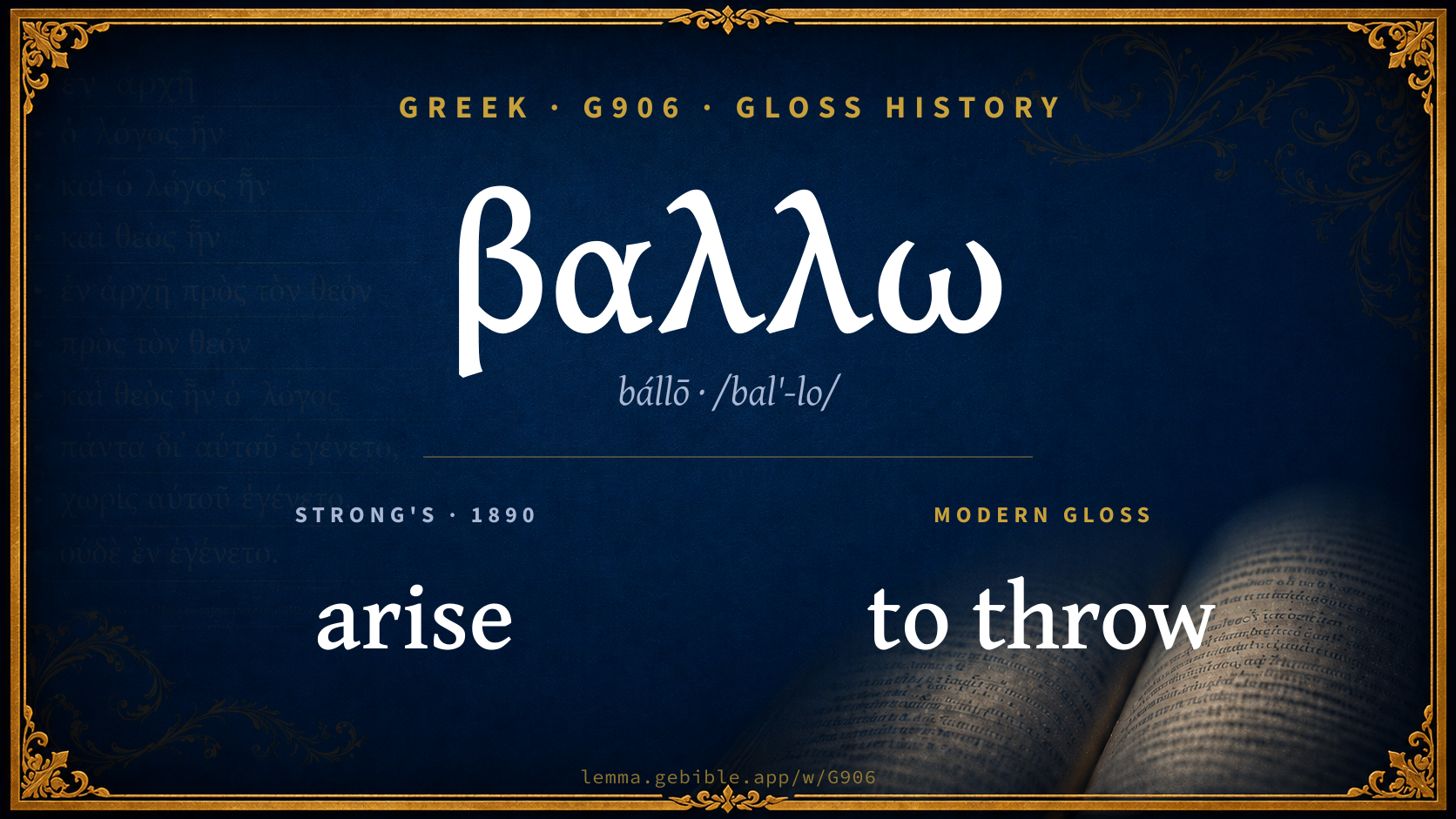
Gloss history
Strong's 1890 vs modern scholarship
About this word
Strong's G906 catalogs a Greek word from the Greek New Testament.
These counts are not copied from any lexicon or concordance. They are computed here, from the morphology-tagged Greek New Testament. What Lemma adds →
- 108
- distinct verses
- The word appears in 108 distinct verses.
- 8 / 27
- NT books
- The word appears in 8 of 27 New Testament books.
- #132
- by frequency
- Top 250 most frequent Greek words (rank 132 of 5,347 Greek words by occurrence).
View all 108 occurrences in the concordance →
Most concentrated in
- Matthew 29 verses 27%
- Revelation 24 verses 22%
- Luke 17 verses 16%
By section of the New Testament
By traditional corpus
Conventional, traditional groupings — biblical authorship is debated, so this is a traditional corpus grouping, not an authorship claim. Some books belong to more than one corpus (Luke is in both the Gospels and the Lukan corpus, and so on), so these shares overlap and need not total 100%. Each figure is a share of the word’s 108 distinct verses.
- Gospels 77 verses · 71%
- Johannine 40 verses · 37%
- Revelation 24 verses · 22%
- Lukan (Luke–Acts) 22 verses · 20%
- General (Catholic) Epistles 2 verses · 2%
How translations render this word
Counts come from each version’s own published word-to-Strong’s tagging or interlinear alignment — an approximate guide to how each version renders this word, not a word-level alignment the data otherwise carries. Because each total is that version’s own tagged count, the per-version totals vary from one another and need not match the appearance or distinct-verse counts above. These counts may also differ from a printed concordance because Lemma counts each distinctly tagged rendering and does not collapse phrase taggings into a single head-word total. This is a fixed set of word-tagged versions (KJV, ASV, BSB, ULT) and does not change with the reading translation you choose elsewhere. Each version’s license is shown beside its name below (and on Sources).
- King James Version: Cast 34×, Casting 6×, Was cast 6×
- American Standard Version: Cast 37×, Be cast 6×, Put 5×
- Berean Standard Bible: Put 9×, Throw 8×, Thrown 8×
- unfoldingWord Literal Text: Throw 16×, It 8×, Put 8×
King James Version Public Domain
Renders G906 across 128 tagged occurrences — most commonly:
Plus other, less common renderings. Plus 39 renderings that appear only once — usually multi-word phrases or single function words the recovered tagging swept in, not distinct renderings.
American Standard Version Public Domain
Renders G906 across 124 tagged occurrences — most commonly:
Plus other, less common renderings. Plus 43 renderings that appear only once — usually multi-word phrases or single function words the recovered tagging swept in, not distinct renderings.
Berean Standard Bible Public Domain
Renders G906 across 120 tagged occurrences — most commonly:
Plus other, less common renderings. Plus 45 renderings that appear only once — usually multi-word phrases or single function words the recovered tagging swept in, not distinct renderings. Not rendered by a distinct English word in 2 further occurrences.
unfoldingWord Literal Text CC BY-SA 4.0
Renders G906 across 141 tagged occurrences — most commonly:
Plus other, less common renderings. Plus 56 renderings that appear only once — usually multi-word phrases or single function words the recovered tagging swept in, not distinct renderings.
Senses in Thayer's
The 2 senses Thayer's distinguishes for this word, in lexicon order (not ranked by frequency or importance). The full entry — with sub-senses — is in the Lexicon Entry tab.
- to throw or let go of a thing without caring where it falls
- to put into, insert
Word origin
Origin: a primary word
A primary verb; to throw (in various applications more or less violent or intense): - arise cast (out) X dung lay lie pour put (up) send strike throw (down) thrust. Compare G4496 .
— Strong’s Exhaustive Concordance (1890), public domain.
Forms in the corpus
The 46 distinct written forms G906 takes in the Greek New Testament, most frequent first — each parse links to that tense’s occurrences in the concordance.
Same root — word family
Other Thayer's entries built from the same root as G906, grouped by Strong’s listed origin. These share a root / origin per the lexicon — not necessarily a shared meaning. Each links to that word’s own entry.
Derived from this word
- βαλαντιον balántion G905 purse
- βελος bélos G956 arrow
- βελτιον beltíon G957 better
- βλητεος blētéos G992 to be cast
- βολη bolḗ G1000 throw
- βολις bolís G1002 dart
- παλη pálē G3823 wrestling
Compare all same-root words → Showing 4 of 8 — not the complete family. They share a root, not necessarily a meaning.
Septuagint usage
The same Greek word βαλλω appears 46 times in the Greek Old Testament (Septuagint), across 41 verses in 24 books.
- 46
- LXX occurrences
- Tagged occurrences of this Greek word in the Septuagint.
- 41
- verses
- Distinct Septuagint verses containing this word.
- 24 / 39
- OT books
- The word appears in 24 of the 39 Old Testament books.
Sample Septuagint occurrences
- Numbers 22:38 βάλλω
- Judges 6:19 βάλλω
- 1 Samuel 14:42 βάλλω
- 2 Samuel 20:22 βάλλω
- 1 Kings 6:1 βάλλω
- 1 Chronicles 25:8 βάλλω
- 2 Chronicles 26:15 βάλλω
- Ezra 20:35 βάλλω
- Esther 3:7 βάλλω
- Job 5:3 βάλλω
- Psalms 21:19 βάλλω
- Proverbs 1:14 βάλλω
Septuagint occurrences (same lexeme)
Every verse where the same Strong’s number (G906) appears in the Greek Septuagint. Verse text shown in the World English Bible for context; the Greek form is the matched word — the English is not keyword-highlighted.
- Numbers 22:38 βάλλω Balaam said to Balak, Behold, I have come to you: have I now any power at all to speak anything? the word that God puts in my mouth, that shall I speak.
- Judges 6:19 βάλλω Gideon went in, and made ready a kid, and unleavened cakes of an ephah of meal: the flesh he put in a basket, and he put the broth in a pot, and brought it out to him under the oak, and presented it.
- Judges 7:12 βάλλω The Midianites and the Amalekites and all the children of the east lay along in the valley like locusts for multitude; and their camels were without number, as the sand which is on the sea-shore for multitude.
- Judges 8:25 βάλλω They answered, We will willingly give them. They spread a garment, and did cast therein every man the ear-rings of his spoil.
- 1 Samuel 14:42 βάλλω Saul said, Cast [lots] between me and Jonathan my son. Jonathan was taken.
- 2 Samuel 20:22 βάλλω Then the woman went to all the people in her wisdom. They cut off the head of Sheba the son of Bichri, and threw it out to Joab. He blew the trumpet, and they were dispersed from the city, every man to his tent. Joab returned to Jerusalem to the king.
- 1 Kings 6:1 βάλλω It happened in the four hundred and eightieth year after the children of Israel were come out of the land of Egypt, in the fourth year of Solomon's reign over Israel, in the month Ziv, which is the second month, that he began to build the house of Yahweh.
- 1 Chronicles 25:8 βάλλω They cast lots for their offices, all alike, as well the small as the great, the teacher as the scholar.
- 1 Chronicles 26:13 βάλλω They cast lots, the small as well as the great, according to their fathers' houses, for every gate.
- 1 Chronicles 26:14 βάλλω The lot eastward fell to Shelemiah. Then for Zechariah his son, a wise counselor, they cast lots; and his lot came out northward.
- 2 Chronicles 26:15 βάλλω He made in Jerusalem engines, invented by skillful men, to be on the towers and on the battlements, with which to shoot arrows and great stones. His name spread far abroad; for he was marvelously helped, until he was strong.
- Ezra 20:35 βάλλω
- Ezra 21:1 βάλλω
- Esther 3:7 βάλλω In the first month, which is the month Nisan, in the twelfth year of king Ahasuerus, they cast Pur, that is, the lot, before Haman from day to day, and from month to month, [to] the twelfth [month], which is the month Adar.
- Job 5:3 βάλλω I have seen the foolish taking root, But suddenly I cursed his habitation.
- Job 15:29 βάλλω He shall not be rich, neither shall his substance continue, Neither shall their possessions be extended on the earth.
- Job 16:13 βάλλω His archers surround me. He splits my kidneys apart, and does not spare. He pours out my gall on the ground.
- Job 38:6 βάλλω Whereupon were the foundations of it fastened? Or who laid its cornerstone,
- Psalms 21:19 βάλλω
- Psalms 77:9 βάλλω Has God forgotten to be gracious? Has he, in anger, withheld his compassion?" Selah.
- Psalms 147:6 βάλλω Yahweh upholds the humble. He brings the wicked down to the ground.
- Proverbs 1:14 βάλλω You shall cast your lot among us. We'll all have one purse."
- Ecclesiastes 3:5 βάλλω A time to cast away stones, And a time to gather stones together; A time to embrace, And a time to refrain from embracing;
- Isaiah 19:8 βάλλω The fishermen shall lament, and all those who cast angle into the Nile shall mourn, and those who spread nets on the waters shall languish.
- Isaiah 29:3 βάλλω I will encamp against you round about, and will lay siege against you with posted troops, and I will raise siege works against you.
- Isaiah 37:33 βάλλω Therefore thus says Yahweh concerning the king of Assyria, He shall not come to this city, nor shoot an arrow there, neither shall he come before it with shield, nor cast up a mound against it.
- Jeremiah 17:8 βάλλω For he shall be as a tree planted by the waters, who spreads out its roots by the river, and shall not fear when heat comes, but its leaf shall be green; and shall not be careful in the year of drought, neither shall cease from yielding fruit.
- Jeremiah 47:10 βάλλω
- Ezekiel 21:27 βάλλω I will overturn, overturn, overturn it: this also shall be no more, until he come whose right it is; and I will give it [him].
- Ezekiel 23:24 βάλλω They shall come against you with weapons, chariots, and wagons, and with a company of peoples; they shall set themselves against you with buckler and shield and helmet round about; and I will commit the judgment to them, and they shall judge you according to their judgments.
- Ezekiel 47:22 βάλλω It shall happen, that you shall divide it by lot for an inheritance to you and to the strangers who sojourn among you, who shall father children among you; and they shall be to you as the home-born among the children of Israel; they shall have inheritance with you among the tribes of Israel.
- Ezekiel 48:29 βάλλω This is the land which you shall divide by lot to the tribes of Israel for inheritance, and these are their several portions, says the Lord Yahweh.
- Daniel 3:21 βάλλω Then these men were bound in their pants, their tunics, and their mantles, and their [other] garments, and were cast into the midst of the burning fiery furnace.
- Hosea 14:6 βάλλω His branches will spread, And his beauty will be like the olive tree, And his fragrance like Lebanon.
- Joel 4:3 βάλλω
- Obadiah 1:11 βάλλω In the day that you stood on the other side, in the day that strangers carried away his substance, and foreigners entered into his gates, and cast lots for Jerusalem, even you were like one of them.
- Jonah 1:7 βάλλω They all said to each other, "Come, let us cast lots, that we may know for whose cause this evil is on us." So they cast lots, and the lot fell on Jonah.
- Micah 2:5 βάλλω Therefore you will have no one who divides the land by lot in the assembly of Yahweh.
- Nahum 3:10 βάλλω Yet was she carried away. She went into captivity. Her young children also were dashed in pieces at the head of all the streets, and they cast lots for her honorable men, and all her great men were bound in chains.
- Habakkuk 1:10 βάλλω Yes, he scoffs at kings, and princes are a derision to him. He laughs at every stronghold, for he builds up an earthen ramp, and takes it.
- Habakkuk 3:13 βάλλω You went forth for the salvation of your people, For the salvation of your anointed. You crushed the head of the land of wickedness. You stripped them head to foot. Selah.
These are occurrences of the same Greek lexeme (G906) in the Septuagint — not a translation of any one Hebrew word. The store carries no word-level Hebrew↔Greek alignment, so no Hebrew original is asserted here. Counts come from the recovered LXX Strong's tagging — high-frequency vocabulary is well covered, while rare or late forms may be untagged — so they reflect tagged occurrences and may slightly undercount.