
Obadiah 1:11

Hebrew (Westminster Leningrad Codex) Obadiah 1:11 appears in the Hebrew Old Testament. The text above is from the Westminster Leningrad Codex. Each word links to its Strong’s number, a concise gloss, and parsing drawn from the Open Scriptures Hebrew Bible morphology. Click any word for its full Brown-Driver-Briggs (BDB) entry.
Download image
Cite this verse

Obadiah 1:11 (World English Bible). Public Domain. Lemma interlinear Bible study tool, https://lemma.gebible.app/v/obadiah/1/11.

Show BibTeX & RIS
BibTeX
RIS
English Translation
In the day that you stood on the other side, in the day that strangers carried away his substance, and foreigners entered into his gates, and cast lots for Jerusalem, even you were like one of them.
World English Bible · Public Domain
Download a study sheet

One document with this verse’s original text, its word-by-word gloss line, the meaning frame, cross-references with their text, attributed commentary, and full source and license credits — printable, and it pastes into notes with its structure intact.

This verse Autodidact and up

Study sheet (.html) Plain text (.txt)

A passage Seminary Student

Up to 50 verses in one chapter. A passage sheet keeps up to 6 commentary sources and 12 cross-references per verse, in the order this page ranks them, and says so on the sheet whenever that leaves anything out. Ask for a single verse and you get the Autodidact verse sheet above.

Everything on this page stays free to read, with no account — the sheet is a download of what is already on screen, not access to it.

Want to remove ads? Support Godless Engineer
Compare translations 3

The same verse in 3 English versions, stacked beneath the original-language interlinear above. Click any original word for its lexicon entry.

Each is an independent rendering of the whole verse — the interlinear is not word-aligned to these translations.

Highlighted words mark where these versions differ — a whole-verse word diff, not a word-by-word alignment.

  • World English Bible Public Domain
    In the day that you stood on the other side, in the day that strangers carried away his substance, and foreigners entered into his gates, and cast lots for Jerusalem, even you were like one of them.
  • King James Version Public Domain
    In the day that thou stoodest on the other side, in the day that the strangers carried away captive his forces, and foreigners entered into his gates, and cast lots upon Jerusalem, even thou wast as one of them.
  • unfoldingWord Literal Text CC BY-SA 4.0
    On the day that you stood opposite, on the day that strangers took captive his wealth, and foreigners entered his gates and cast lots for Jerusalem, you also were like one of them.

unfoldingWord Literal Text — © unfoldingWord, licensed CC BY-SA 4.0. Word-aligned USFM3 via Door43 (git.door43.org/unfoldingWord/en_ult).

Versions to compare (up to 4)

3 of 4 selected

Show all 18 translations

Every available English version of this verse, each an independent rendering of the whole verse.

  • World English Bible Public Domain
    In the day that you stood on the other side, in the day that strangers carried away his substance, and foreigners entered into his gates, and cast lots for Jerusalem, even you were like one of them.
  • Berean Standard Bible Public Domain
    On the day you stood aloof while strangers carried off his wealth and foreigners entered his gate and cast lots for Jerusalem, you were just like one of them.
  • Majority Standard Bible Public Domain
    On the day you stood aloof while strangers carried off his wealth and foreigners entered his gate and cast lots for Jerusalem, you were just like one of them.
  • King James Version Public Domain
    In the day that thou stoodest on the other side, in the day that the strangers carried away captive his forces, and foreigners entered into his gates, and cast lots upon Jerusalem, even thou wast as one of them.
  • American Standard Version (1901) Public Domain
    In the day that thou stoodest on the other side, in the day that strangers carried away his substance, and foreigners entered into his gates, and cast lots upon Jerusalem, even thou wast as one of them.
  • Revised Version (1885) Public Domain
    In the day that thou stoodest on the other side, in the day that strangers carried away his substance, and foreigners entered into his gates, and cast lots upon Jerusalem, even thou wast as one of them.
  • Geneva Bible (1599) Public Domain
    When thou stoodest on the other side, in the day that the strangers caried away his substance, and straungers entred into his gates, and cast lots vpon Ierusalem, euen thou wast as one of them.
  • Douay-Rheims (1899) Public Domain
    In the day when thou stoodest against him, when strangers carried away his army captive, and foreigners entered into his gates, and cast lots upon Jerusalem: thou also wast as one of them.
  • Young's Literal Translation Public Domain
    In the day of thy standing over-against, In the day of strangers taking captive his force, And foreigners have entered his gates, And for Jerusalem have cast a lot, Even thou `art' as one of them!
  • Literal Standard Version CC BY-SA 4.0
    In the day of your standing aloof from the opposite [side], || In the day of strangers taking his force captive, || And foreigners have entered his gates, || And have cast a lot for Jerusalem, || Even you [are] as one of them!
  • Unlocked Literal Bible CC BY-SA 4.0
    On the day you stood aloof, on the day strangers carried away his wealth, and foreigners entered into his gates, and cast lots for Jerusalem, you were like one of them.
  • unfoldingWord Literal Text CC BY-SA 4.0
    On the day that you stood opposite, on the day that strangers took captive his wealth, and foreigners entered his gates and cast lots for Jerusalem, you also were like one of them.
  • Darby Bible Public Domain
    In the day that thou stoodest on the other side, in the day that strangers carried away captive his substance, and foreigners entered into his gates, and cast lots upon Jerusalem, even thou wast as one of them.
  • World Messianic Bible Public Domain
    In the day that you stood on the other side, in the day that strangers carried away his substance and foreigners entered into his gates and cast lots for Jerusalem, even you were like one of them.
  • Webster's Bible Public Domain
    In the day that thou stoodst on the other side, in the day that the strangers carried away captive his forces, and foreigners entered into his gates, and cast lots upon Jerusalem, even thou wast as one of them.
  • Free Bible Version CC BY-SA 4.0
    On that day you stood aside, on that day strangers plundered their wealth and foreigners entered their gates, and divided up Jerusalem by casting lots—and you were like one of them.
  • Bible in Basic English Public Domain
    Because you were there watching when men from other lands took away his goods, and strange men came into his doors, and put the fate of Jerusalem to the decision of chance; you were like one of them.
  • JPS Tanakh (1917) Public Domain
    In the day that thou didst stand aloof, in the day that strangers carried away his substance, and foreigners entered into his gates, and cast lots upon Jerusalem, even thou wast as one of them.

Literal Standard Version (2020), Covenant Press — licensed CC BY-SA 4.0. Text via the HelloAO Bible API (eBible.org). Unlocked Literal Bible (unfoldingWord) — licensed CC BY-SA 4.0. Text via the HelloAO Bible API (eBible.org). unfoldingWord Literal Text — © unfoldingWord, licensed CC BY-SA 4.0. Word-aligned USFM3 via Door43 (git.door43.org/unfoldingWord/en_ult). Free Bible Version, Dr. Jonathan Gallagher — licensed CC BY-SA 4.0. Text via the HelloAO Bible API (eBible.org).

Word by word

More ways to search: Search by grammar → Find every occurrence → Compare this word →

Practice this passage: Drill this verse → Learn its vocabulary →

יַדּ֣וּ
yâdad
H3032
“to cast lots”
Verb, Qal, Perfect, 3rd Person, Common, Plural
Part of Speech
Verb
Stem
Qal
Form
Perfect
Person
3rd Person
Gender
Common
Number
Plural
Full BDB Definition

Origin: a primitive root

TWOT: 845 , 846

(Qal) to throw lots, cast lots (verb) - love, loving-one, friend (noun)
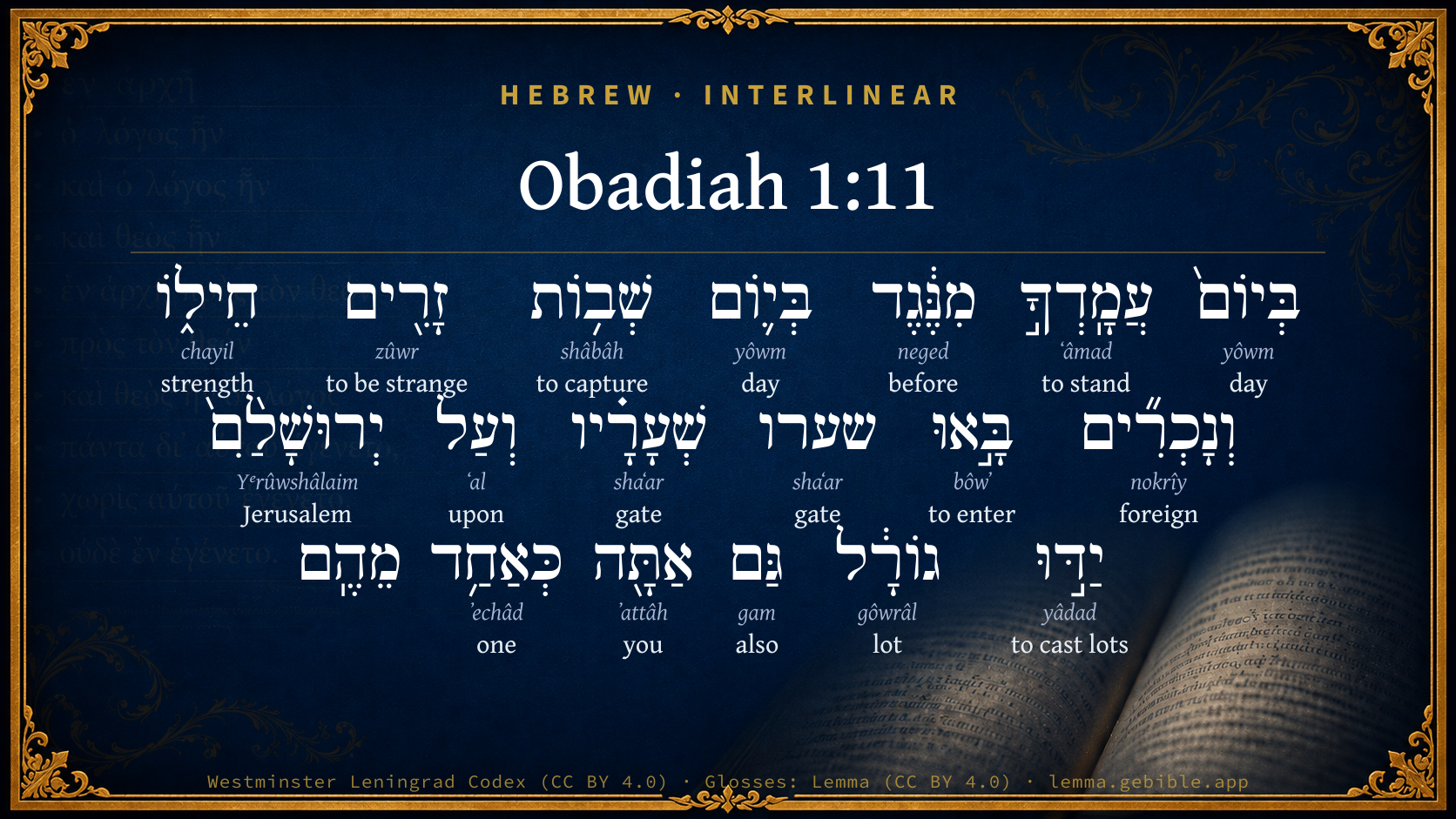
  1. בְּיוֹם֙ yôwm H3117 “in/at · day of” Preposition + Noun, Common, Masculine, Singular, Construct
  2. עֲמָֽדְךָ֣ ʻâmad H5975 “to stand · you” Verb, Qal, Infinitive Construct + Suffix, Personal, 2nd Person, Masculine, Singular
  3. מִנֶּ֔גֶד neged H5048 “from · before” Preposition + Preposition
  4. בְּי֛וֹם yôwm H3117 “in/at · day of” Preposition + Noun, Common, Masculine, Singular, Construct
  5. שְׁב֥וֹת shâbâh H7617 “to capture” Verb, Qal, Infinitive Construct
  6. זָרִ֖ים zûwr H2114 “strange” Adjective, Adjective, Masculine, Plural, Absolute
  7. חֵיל֑וֹ chayil H2428 “strength · his” Noun, Common, Masculine, Singular, Construct + Suffix, Personal, 3rd Person, Masculine, Singular
  8. וְנָכְרִ֞ים nokrîy H5237 “and · foreign” Conjunction + Adjective, Adjective, Masculine, Plural, Absolute
  9. בָּ֣אוּ bôwʼ H935 “to enter” Verb, Qal, Perfect, 3rd Person, Common, Plural
  10. שערו shaʻar H8179 “gate · his” Noun, Common, Masculine, Singular, Construct + Suffix, Personal, 3rd Person, Masculine, Singular
  11. שְׁעָרָ֗יו shaʻar H8179 “gates · his” Noun, Common, Masculine, Plural, Construct + Suffix, Personal, 3rd Person, Masculine, Singular
  12. וְעַל ʻal H5921 “and · upon” Conjunction + Preposition
  13. יְרוּשָׁלִַ֨ם֙ Yᵉrûwshâlaim H3389 “Jerusalem” Noun, Proper
  14. גוֹרָ֔ל gôwrâl H1486 “lot” Noun, Common, Masculine, Singular, Absolute
  15. גַּם gam H1571 “also” Particle, Accusative
  16. אַתָּ֖ה ʼattâh H859 “you” Pronoun, Personal, 2nd Person, Masculine, Singular
  17. כְּאַחַ֥ד ʼechâd H259 “like/as · one” Preposition + Adjective, Cardinal number, Masculine, Singular, Construct

About this verse

These counts appear in no published source. They are computed here, from the morphology-tagged text and Lemma’s own curated glosses. What Lemma adds →

19
words
16
distinct lemmas
Prophets
section

Notable vocabulary

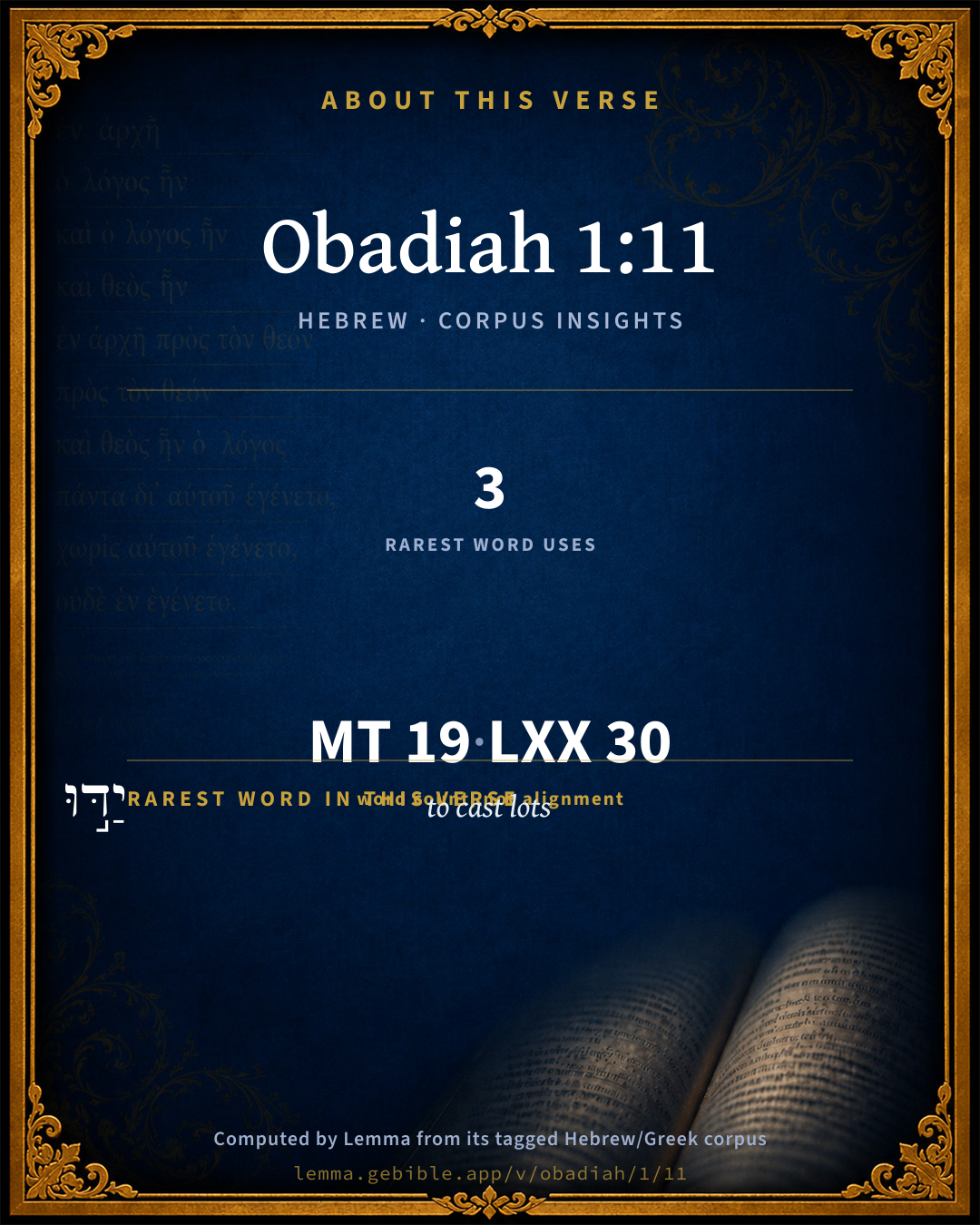
The rarest word here is יַדּ֣וּ to cast lots H3032 — appearing just 3 times in the whole Hebrew Bible.

Shared distinctive vocabulary

יַדּ֣וּ to cast lots H3032 occurs in 3 verses of the Hebrew Bible. Also found in:

Grammatical profile

  • 4 verbs
  • 7 nouns
  • 3 adjectives
  • 1 pronoun
  • 3 prepositions
  • 1 particle

Verb forms

  • עֲמָֽדְךָ֣ Qal · Infinitive Construct
  • שְׁב֥וֹת Qal · Infinitive Construct
  • בָּ֣אוּ Qal · Perfect
  • יַדּ֣וּ Qal · Perfect

Repetition

Words recur within this verse — often emphatic in Hebrew:

  • בְּיוֹם֙ day H3117 ×2
  • שערו gate H8179 ×2

Hebrew & Septuagint length

In English translation the verse runs 37 words from the Hebrew and 38 from the Septuagint (LXX English) — closely comparable.

A rough comparison of the two English renderings, which tokenize alike — not a word-level alignment.

Word counts can differ between the Hebrew and the Greek without any difference in meaning — e.g. the Hebrew direct-object marker אֵת has no separate Greek word, and Greek often adds the article ὁ.

In the original languages it is 19 Hebrew tokens and 30 Greek tokens — but the two are counted differently (Hebrew bundles its prefixes and suffixes into one token; the Greek is in lemma form), so that isn’t a like-for-like length.

Cross-references

7

Topical passages linked to Obadiah 1:11 in the Treasury of Scripture Knowledge — connected by theme and wording, ordered by reader-vote popularity; previews shown in the World English Bible.

  • Psalms 137:7 Remember, Yahweh, against the children of Edom, The day of Jerusalem; Who said, "Raze it! Raze it even to its foundation!"
  • Nahum 3:10 Yet was she carried away. She went into captivity. Her young children also were dashed in pieces at the head of all the streets, and they cast lots for her honorable men, and all her great men were bound in chains.
  • Joel 3:3 And have cast lots for my people, And have given a boy for a prostitute, And sold a girl for wine, that they may drink.
  • 2 Kings 25:11 The residue of the people who were left in the city, and those who fell away, who fell to the king of Babylon, and the residue of the multitude, did Nebuzaradan the captain of the guard carry away captive.
  • Psalms 50:18 When you saw a thief, you consented with him, And have participated with adulterers.
  • Jeremiah 52:28–30 This is the people whom Nebuchadrezzar carried away captive: in the seventh year three thousand twenty-three Jews;
  • 2 Kings 24:10–16 At that time the servants of Nebuchadnezzar king of Babylon came up to Jerusalem, and the city was besieged.

Cross-references courtesy of OpenBible.info (CC BY 4.0).

Hebrew and Greek witnesses Masoretic Hebrew ↔ Greek Septuagint

The same verse in the two great witnesses to the Old Testament, shown verse-for-verse.

These are two independent witnesses, not word-aligned to each other, and the Septuagint is shown in lemma (dictionary) form.

Hebrew Obadiah 1:11 Masoretic · Westminster Leningrad Codex

בְּיוֹם֙ עֲמָֽדְךָ֣ מִנֶּ֔גֶד בְּי֛וֹם שְׁב֥וֹת זָרִ֖ים חֵיל֑וֹ וְנָכְרִ֞ים בָּ֣אוּ שערו שְׁעָרָ֗יו וְעַל יְרוּשָׁלִַ֨ם֙ יַדּ֣וּ גוֹרָ֔ל גַּם אַתָּ֖ה כְּאַחַ֥ד מֵהֶֽם

In the day that you stood on the other side, in the day that strangers carried away his substance, and foreigners entered into his gates, and cast lots for Jerusalem, even you were like one of them.

World English Bible · Public Domain

Greek LXX Obadiah 1:11 Septuagint · lemma form

ἀπό ὅς ἡμέρα ἀντιἵστημι ἐκ ἐναντίος ἐν ἡμέρα αἰχμαλωτεύω ἀλλογενής δύναμις αὐτός καί ἀλλότριος εἰςἔρχομαι εἰς πύλη αὐτός καί ἐπί ἰερουσαλήμ βάλλω κλῆρος καί σύ εἰμί ὡς εἷς ἐκ αὐτός

From the day that you stood in opposition to him, in the days when foreigners were taking captive his forces, and strangers entered into his gates, and cast lots on Jerusalem, you also was as one of them.

LXX2012 (modern English Septuagint) · Public Domain

Hebrew: Westminster Leningrad Codex (CC BY 4.0). Greek: Septuagint (public domain); English from LXX2012 (modern English Septuagint) (Public Domain). How the Septuagint differs from the Hebrew →

Targum (Aramaic paraphrase)

1

The Targum is the ancient Jewish Aramaic paraphrase of the Hebrew Scriptures — an interpretive translation, not the Hebrew text itself. Onkelos (literal) and Pseudo-Jonathan (expansive) render the Torah, and Jonathan the Prophets. Coverage is partial: where no permissively-licensed English translation exists for a verse, only the Aramaic is shown. This is verse-level text, not a word-by-word alignment to the Hebrew.

  1. Targum Jonathan Prophets (Joshua–Malachi)
    בְּיוֹם מְקִימָךְ מִקְבֵיל בְּיוֹמָא דְבָזוּ עַמְמַיָא נִכְסוֹהִי וְנִכְרָאִין עָלוּ בְקִרְוֹהִי וְעַל יְרוּשְׁלֵם רְמוֹ עַדְבִין אַף אַתְּ כְּחַד מִנְהוֹן:

    (no public-domain English translation for this verse)

    Targum Jonathan — Aramaic: “Mikraot Gedolot” (public domain). English: “Sefaria Community Translation” (CC0 1.0 (public-domain dedication)); “London "Chaldee Paraphrase," 1871” (public domain). Text via Sefaria.

Commentary

Notes on Obadiah 1:11 from classic Christian and Jewish commentators (each source and its license shown beneath its notes). The classic Christian expositions comment on the surrounding passage and are grouped to its opening verse, so a note may address several verses; the Jewish commentaries on the Tanakh (Rashi and others) are per-verse, so they appear only where the commentator wrote on this verse.

Lemma curates 59 commentaries, every one of them public domain or Creative Commons licensed, each selected and text-cleaned for this edition rather than reprinted as found. About our sources →

Trapp's Complete Commentary

John Trapp

Oba 1:11 In the day that thou stoodest on the other side, in the day that the strangers carried away captive his forces, and foreigners entered into his gates, and cast lots upon Jerusalem, even thou [wast] as one of them.

Ver. 11. In the day that thou stoodest on the other side] Over beside, curiously eyeing and maliciously promoting, by thy virulent tongue and violent hands, the downfal of Israel. Nemo curiosus quin malevolus, saith an ancient. These Edomites fed their eyes with their brethren’s miseries, as with a pleasant spectacle. At first perhaps they were only onlookers, but afterwards they "stood against them in battle" (when they saw them worsted) and took part with their enemies. See Est 8:2 Psa 9:6 Eph 6:11. The Samaritans afterwards served them in like sort, as Josephus reporteth; especially when Antiochus tormented the Jews, they wrote to him to excuse themselves as no Jews; and (offering him their service) basely styled him Antiochus, the mighty God.

In the day that the strangers carried away captive, &c.] Edom’s malice is here aggravated by the circumstance of time they took to express it; viz. when God’s people were at worst, and when their extreme misery should have moved pity. This was a dog-like, devil-like practice, to fall upon those that are down before; "to add affliction to the afflicted," Psa 69:26; to push the wounded out of the herd, as they say deer do. Of such barbarous and savage usage David often complaineth, and Job, and Jeremiah, and Jesus, Psa 22:1-31; such shall one day cry out at God’s bar, as Joseph’s brethren did, Gen 42:21, and find no mercy, Jas 2:21, no more than cruel Haman did, Est 7:10, it being just with God to set off all hearts from him who had been so unreasonably merciless. This Job well knew, and therefore so studiously purgeth himself of this heinous wickedness, Job 31:29. Ausonius also out of Pittacus Mytilenaeus affirmeth him to be a beast and worse that maketh himself merry in another man’s misery. The beastliest among brute creatures, even swine, seem to be affected with the outcries of their kind. Men only, more brutish than they, triumph in the calamities of each other, and are not moved with their outcries, albeit as bitter as that of Hezekiah, Isa 38:14, "O Lord, I am oppressed, help me." This Solomon calleth oppression of a high nature, Ecc 4:1; see Psa 142:4.

And foreigners entered into his gates] Having taken the city; then did the Edomites set fire to the temple, 1Esther 4:45. Citizens in a siege fortify their gates, and defend them to the utmost; for if the gates be gained the city is lost; as it was at Jerusalem, and as it had like to have been at the city of Coccinum, in the island of Lemnos, which the Turks had surprised suddenly, but that they were happily prevented by the courage of one Marulla, a maiden of that city, who seeing her father slain in the gate, took up the weapons that lay by him, and like a fierce Amazon, notably revenged his death, desperately fighting in defence of her country with those few that were in the gate at the first, and so kept the Turks out until the rest of the citizens, moved with the alarm, came to the gate.

And cast lots upon Jerusalem] i.e. upon the plunder of Jerusalem; according to the custom of old soldiers, Num 26:56. See this fulfilled 2Ki 24:13-14; 2Ki 25:13-17 See also more of this practice, Nah 3:10 Joe 3:3; and how grievous it is to the ingenuous, hear Andromache (Virg. Aeneid. III 323),

“ O foelix una ante alias Priameia virgo,

Hostilem ad tumulum, Troiae sub moenibus altis

Iussa mort, quae sortitus non pertulit ullos,

Nec victoris heri tetigit captiva cubile. ”

Even thou wast as one of them] The emphasis lieth in the word "thou"; as in that of Julius Caesar, beholding Brutus among the conspirators that took away his life, What? Thou my son Brutus? Kαι συ τεκνον βρουτε (Dio Cass.). Even thou, brother Edom, whom we spared in our passage through the wilderness, when we destroyed other nations, Deu 2:5; thou, who hast from David’s days, for the most part, been our vassal and tributary. Jerome applieth this to heretics; Mercer, to that arch-heretic antichrist, an utter opposite to Christ, yet a pretended friend, as was Judas; a servant of God’s servants (if you will believe him), but a most bloody persecutor of the Church, in whose ruins he yet revelleth, and will do, till Christ shall punish him, with "his sore, and great, and strong sword," Isa 27:2, and dung his vineyard with the flesh of that wild boar.

John Trapp, A Commentary or Exposition upon All the Books of the Old and New Testament (1647–1656) — public domain. Text from a community e-Sword module.

Tyndale Open Study Notes

Tyndale Open Resources

1:11 Outside of this book, nothing specific is known of Edom’s role during the various Babylonian invasions of Judah (in 605, 597, and 586 BC). Responsibility toward one’s neighbor is a specific requirement of God’s law (e.g., Deut 22:1-4; cp. Matt 25:41-46), especially when there is either a specific “treaty of brotherhood” (Amos 1:9) or a historical relationship that is regarded as fraternal (see study note on Obad 1:6).

Tyndale Open Study Notes — © Tyndale Open Resources, licensed CC BY-SA 4.0. Text via the HelloAO Bible API.

Geneva Bible (1599)

Geneva Bible translators

When Nebuchadnezzar came against Jerusalem, thou joinedest with him, and hadest part of the spoil, and so didst rejoice when my people, that is, thy brother were afflicted, whereas thou shouldest have pitied and helped thy brother.

Geneva Bible (1599) marginal notes — public domain. Text via Bolls.life.

Jamieson, Fausset & Brown

Robert Jamieson, A. R. Fausset & David Brown

thou stoodest on the other side--in an attitude of hostility, rather than the sympathy which became a brother, feasting thine eyes (see ) with the misery of Jacob, and eagerly watching for his destruction. So Messiah, the antitype to Jerusalem, abandoned by His kinsmen ().

strangers--the Philistines, Arabians in the reign of Jehoram, &c. (); the Syrians in the reign of Joash of Judah (); the Chaldeans (2Ch. 36:1-23).

carried . . . captive his forces--his "host" (): the multitude of Jerusalem's inhabitants.

cast lots upon Jerusalem-- (). So Messiah, Jerusalem's antitype, had lots cast for His only earthly possessions ().

Jamieson, Fausset & Brown — Commentary Critical and Explanatory on the Whole Bible (1871) — public domain (CC PDM 1.0). Text via the HelloAO Bible API.

Adam Clarke's Commentary

Verse 11. Thou stoodest on the other side] Thou not only didst not help thy brother when thou mightest, but thou didst assist his foes against him.

And cast lots] When the Chaldeans cast lots on the spoils of Jerusalem, thou didst come in for a share of the booty; "thou wast as one of them."

Adam Clarke's Commentary on the Bible (1810–1826) — public domain. Text from a community e-Sword/MySword module.

John Calvin's Commentaries

In the day, he says, in which thou didst stand on the opposite side”. But the Idumeans might have made this objection, “Why dost thou accuse us for having violently oppressed our brother? for we were not the cause why they were destroyed: they had a quarrel with the Assyrians, we labored to protect our own interest in the midst of these disturbances; we sought peace with the Assyrians, and if necessity so compelled us, that ought not to be ascribed to us as a crime or blame.” In this way the Idumeans might have made a defense: but the Prophet dissipates all such pretenses by saying, In the day in which thou didst stand on the opposite side, in the day in which strangers took away his substance, and aliens entered his gates, and cast lots on Jerusalem — were not thou there? Even thou were as one of them. Now this is emphatically introduced — Even thou or, thou also; (Tu etiam) for the Prophet exhibits it here as a hateful omen: “It was no wonder that the Assyrians and Chaldeans shed the blood of thy brethren, for they were enemies, they were foreigners, they were a very distant people: but thou, who were of the same blood, thou, whom the bond of religion ought to have restrained, and further, even thou, who oughtest by the very claims of vicinity either to have helped thy brethren, or at least to have condoled with them — yea, thou were so cruel as to have been as one of his enemies: this surely can by no means be endured.”

We now perceive what the Prophet meant by saying, In the day in which thou didst stand on the opposite side: it is then as it were, an explanation of the former sentence, lest the Idumeans should make a false excuse by objecting that they had not been violent against their brethren. It was indeed the worst oppression, when they stood over against them; though they were not armed they yet took pleasure in a spectacle so mournful; besides they not only were idle spectators of the calamity of their brethren but were also as it were a part of their enemies. “Hast thou then not been as one of them?” I shall not proceed farther now.

John Calvin's Commentaries (1540-1563) — public domain. Text from the Calvin Translation Society English edition (1840s-50s) via the Christian Classics Ethereal Library (ccel.org). Calvin's coverage is partial (roughly two-thirds of the Bible); uncommented books and verses are honest gaps, never fabricated. The 19th-century editor's footnotes and remarks are omitted so the notes are faithfully Calvin's own voice.

The Cambridge Bible for Schools and Colleges

gen. ed. J. J. S. Perowne

11. In the day that thou stoodest] lit. in the day of thy standing. Nothing can certainly be decided from the language of this and the following verses, as to whether the conduct here ascribed to the Edomites was a thing of the past when Obadiah wrote, or was still future. The phrase “in the day of thy standing” obviously determines nothing as to time; nor does the phrase at the end of this verse, “thou, as one of them,” in itself considered. In Oba_1:12 the only grammatical rendering is, “do not look,” instead of “thou shouldest not have looked,” and the same is true of all the similar expressions in Oba_1:12-14. In this 11th verse two past tenses do indeed occur: “foreigners entered into his gates, and cast lots upon Jerusalem.” And the use of these might be held to favour what is the most natural and obvious impression conveyed by the whole passage, viz. that the prophet is describing a past event. But inasmuch as his description may relate to a prophetic vision which had been vouchsafed to him, and not to an actual scene which he had witnessed, the time indicated remains uncertain, and the question of date must be decided on other grounds. (See Introd. § II.)

on the other side] comp. Psa_38:11 [Hebrews 12]. “My lovers and my friends stand aloof from my sore,” where the Hebrew expression is the same. It may however be a charge of direct opposition rather than of culpable neutrality. The same expression occurs in this sense in 2Sa_18:13, “Thou thyself wouldest have set thyself against me.” Comp. Dan_10:13, “withstood me,” lit. “stood over against me,” where the Hebrew phrase is similar.

strangers, foreigners] This therefore cannot refer to the defeat of Amaziah by Jehoash. (See Introd. § II.)

his forces] If this rendering be adopted it will mean, not so much the army which fled with the king and was overtaken and scattered (2Ki_25:4-5), as the bulk of the people, who formed the strength of the nation and who were carried captive, leaving only the “poor of the land” behind. (2Ki_25:11-12; Jer_39:9-10.) In this sense the same Hebrew word is rendered “host” in Oba_1:20 below. The rendering of the margin, and of R.V., “carried away his substance,” is supported by Oba_1:13, where the word evidently means substance or wealth.

cast lots upon Jerusalem] i. e. divided its spoil and captives by lot. Comp. Joe_3:3 [Heb_4:3]; Nah_3:10.

thou, as one of them] “thou,” the brother, and that too in dark contrast to Samaria the alien. “In the remains of the population of the Samaritan kingdom it is affecting to see that all sense of ancient rivalry was lost in the grief of the common calamity. Pilgrims from the ancient capitals of Ephraim, Samaria, Shechem, and Shiloh came flocking with shorn beards, gashed faces, torn clothes, and loud wailings, to offer incense on the ruined Temple, which was not their own.” Stanley. (Jer_41:5).

The Cambridge Bible for Schools and Colleges (gen. ed. J. J. S. Perowne; Cambridge University Press, 1878–1918) — public domain. Text from a community e-Sword module.

John Gill's Exposition

In the day thou stoodest on the other side,.... Aloof off, as a spectator of the ruin of Jerusalem, and that with delight and pleasure; when they should, as brethren and neighbours, have assisted against the common enemy; but instead of this they stood at a distance; or they went over to the other side, and joined the enemy, and stood in opposition to their brethren the Jews:

in the day that the strangers carried away captive his forces; that is, at the time that the Chaldeans took Jerusalem, and carried captive as many of the forces of the Jews as fell into their hands; or when

"the people spoiled his substance,''

as the Targum; plundered the city of all its wealth and riches:

and foreigners entered into his gates; the gates of their cities, particularly Jerusalem; even such who came from a far country, the Babylonians, who were aliens and strangers from the commonwealth of Israel; whereas the Edomites were their near neighbours, and allied to them by blood, though not of the same religion; and by whom they helped against a foreign enemy, instead of being used by them as they were:

and cast lots upon Jerusalem; either to know when they should make their attack upon it; or else, having taken it, the generals of the Chaldean army cast lots upon the captives, to divide them among them, so Kimchi; see Joe 3:3; or rather, the soldiers cast lots for the division of the plunder of the city, as was usual at such times:

even thou wast as one of them; the Edomites joined the Chaldeans, entered into the city with them, showed as much wrath, spite, and malice, as they did, and were as busy in dividing the spoil. So Aben Ezra interprets these and the following verses of the destruction of the city and temple of Jerusalem by Nebuchadnezzar; but Kimchi expounds them of the destruction of them by the Romans, at which he supposes many Edomites to be present, and rejoiced at it: could this be supported, the connection would be more clear and close between these words and those that follow, which respect the Gospel dispensation, beginning at Oba 1:17; but the Edomites were not in being then; and that there were many of them in the Roman army, and that Titus himself was one, is all fabulous.

John Gill's Exposition of the Whole Bible (1746–1763) — public domain (CC PDM 1.0). Text via the HelloAO Bible API.

Albert Barnes' Notes on the Bible

In the day that thou stoodest on the other side - The time when they so stood, is not defined in itself, as a past or future. It is literally; “In the day of thy standing over against,” i. e., to gaze on the calamities of God’s people; “in the day of strangers carrying away his strength,” i. e., “the strength of thy brother Jacob,” of whom he had just spoken, “and foreigners entered into his gates, and cast lots on Jerusalem, thou too as one of them. One of them” they were not. Edom was no stranger, no alien, no part of the invading army; he whose strength they carried away, was, he had just said, his “brother Jacob.” Edom burst the bonds of nature, to become what he was not, “as one of them.” He purposely does not say, “thou too wast (הית hayı̂tha) as of them;” as he would have said, had he wished to express what was past. Obadiah seeing, in prophetic vision, the destruction of Jerusalem, and the share which the Edomites took there at, describes it as it is before his eyes, as past.

We see before us, the enemy carrying off all in which the human strength of Judah lay, his forces and his substance, and casting lots on Jerusalem its people and its possessions. He describes it as past, yet, not more so, than the visitation itself which was to follow, some centuries afterward. Of both, he speaks alike as past; of both, as future. He speaks of them as past, as being so beheld in “His” mind in whose name he speaks. God’s certain knowledge does not interfere with our free agency. “God compelleth no one to sin; yet, foreseeth all who shall sin of their own will. How then should He not justly avenge what, foreknowing, He does not compel them to do? For as no one, by his memory, compelleth to be done things which pass, so God, by His foreknowledge, doth not compel to be done things which will be. And as man remembereth some things which he hath done, and yet, hath not done all which he remembereth; so God foreknoweth all things whereof He is Himself the Author, and yet, is not Himself the Author of all which He foreknoweth. Of those things then, of which He is no evil Author, He is the just Avenger.

Albert Barnes' Notes on the Bible (1834–1885) — public domain. Text from a community e-Sword/MySword module.

Haydock's Catholic Bible Commentary

Captive. He alludes to the taking of Sedecias. --- Lots, for the booty, or whether they should burn the city or not. All was regulated by lots. (Calmet)

George Leo Haydock (1774–1849), Haydock's Catholic Family Bible and Commentary, 1859 edition — public domain. Excludes Psalms (Douay-Rheims chapter numbering differs from Protestant) and Deuterocanonical books (Catholic canon only).

Matthew Poole's English Annotations

In the day; during the war which the Babylonians made upon Judea, or in the day of battle when Jews fought with Chaldeans.

That thou stoodest on the other side; tookest up thy stand over-right them, observing with delight how they were worsted, slaughtered. and routed; or didst set thyself in battle-array against thy brother Jacob. The strangers; the Babylonians. and the mixed nations which joined with them.

Carried away captive; first mastered the Jews, and then made them captives. and sent them away out of their own land, a sight which should have moved compassions in thee.

His forces; his strength, his troops, or multitudes that survived and were taken, and their wealth and riches too.

Foreigners entered into his gates; that invaded, slew the inhabitants, and forced the besieged places to open their gates; or took the fortresses by assault.

Cast lots; so robbers divided their prey, and conquerors, Pro 1:14; Joe 3:3, which see.

Upon Jerusalem; upon the citizens and their goods, which were found in Jerusalem when it was taken by the Chaldeans.

Even thou, a neighbour, who wast not molested by Israel when they marched through other nations from Egypt to Canaan, who wast a brother by descent, Oba 1:10,

wast as one of them, as merciless and insolent as any of those barbarous foreigners.

Matthew Poole's English Annotations on the Holy Bible (1683–1685) — public domain. Text from a community e-Sword/MySword module.

The Pulpit Commentary

The injuries complained of were committed lately, and the prophet could speak of them as well known (see note on ver. 10). In the day that thou stoodest; literally, in the day of thy standing, without note of time, but implying a past event here. On the other side. The words may denote either malicious unconcern, as Psa_38:11, or hostile opposition, as 2Sa_18:13. Besides the direct application to recent events, the clause intimates the usual attitude of the Edomites toward Israel. In the day that the strangers Philistines and Arabians (2Ch_21:16) carried away captive his forces; rather, carried array his substance, as ver. 13; Gen_34:29 Deu_8:17 Isa_8:4. Foreigners. The same as "strangers." Both words are usually applied to heathen enemies. Cast lots upon Jerusalem. Divided the captives and spoil of Jerusalem by lot. (2Ch_21:17; comp. Joe_3:3 Nah_3:10) Nothing is said of the total destruction of Jerusalem or the wholesale deportation of the inhabitants to Babylon, So that Obadiah cannot be referring to the Chaldean conquest. Thou wast as one of them; literally, thou, too, as one of them. In this expression the past is set before the mind as present.

Edom as Babylon.

"Even thou wast as one of them." Edom, although claiming Abraham and Isaac for his forefathers, was so unfraternal to Israel that when Jerusalem was captured by the Babylonians, he shared in the hostility. His cry was, "Rase it, rase it, even to the ground!" To this our text makes reference, "Even thou wast as one of them." And what Obadiah thus says to Edom, he might often stand and say to some of us. How many who have been nursed in privileges and taken a place as servants of the God of Abraham, have been found, like Balaam, amongst the enemies of the Lord! "Even thou wast as one of them." How often the inquiry might come to those who ought to be bearing holy witness for God, "What doest thou here, Elijah?" The words may well convey a warning to us, for even the most godly have often fallen from their steadfastness. Let us note some examples by way of fixing this warning upon our hearts.

I WE ALL DENOUNCE DRUNKENNESS. We all sadly mourn the condition of inebriates. Alas! there was a time when Obadiah might have stood in attitude of condemnation before the Patriarch Noah, and said, "Even thou wast as one of them.

II WE SCORN THE LIAR. But there was a time when Abraham became untruthful. Obadiah might have appeared before him, and said, "Even thou wast as one of them.

III WE ABOMINATE IMPURITY. But there was a time when Obadiah might have stood before David, as did the Prophet Nathan, and said, "Thou art the man!" "Even thou wast as one of them.

IV WE DEPLORE RASH SPEAKING AND HOT AND HASTY WORDS. Time was when Obadiah might have come to the meek and holy Moses, and said, "Even thou wast as one of them.

V WE OFTEN LOOK WITH FEELINGS OF DISDAIN UPON THE PROUD. And yet there was a time when Obadiah might have said to the good King Hezekiah, "Even thou wast as one of them.

VI WE ARE EVER READY TO ADMIT THE TURPITUDE OF DENYING CHRIST. But see Obadiah standing before Simon Peter, and we catch his awful words, "Even thou wast as one of them.

VII CONTENTION AMONGST BRETHREN IS ANOTHER EVIL WHICH WE DEPRECATE. Obadiah might have pointed to Barnabas, the "son of consolation," and said to him, "Even thou wast as one of them.

VIII THE SIN OF UNBELIEF IS ANOTHER FEARFUL EVIL. But all the early disciples fell for a time into this sin. Obadiah might have said first to one, then another, "Even thou wast as one of them.

IX A MURMURING SPIRIT IS ANOTHER EVIL WHICH THE CHRISTIAN SHOULD AVOID. St. Paul learned in whatsoever state he was, therewith to be content. The psalmist says his soul was as a weaned child. But we turn to the prophet of fire. We find the great Elijah under a juniper tree, murmuring at his lot. "Even thou wast as one of them.

Enough. We see plainly that the Scriptures warn us of the frailty of our nature and the deceitfulness of our hearts. And, if we reflect at all, we must see that repeatedly Christian professors lack consistency. Christian principle and Christian practice should never be at variance. But what is the fact? How often the Christian in business walks so unworthy of his high calling that our prophet seems to speak to him, "Even thou wast as one of them." Or we look into society, and we find in some Christians so much worldly conformity, that to one after another Obadiah might come, and exclaim, "Even thou wast as one of them" Let me ask those Christians who spend several afternoons in the week in visiting, and yet scarcely ever drop a word for their Lord and Master Do you think that Obadiah"s expostulation is not for you: "Even thou wast as one of them"?

Let us learn, therefore, these three lessons.

1. First, to live watchfully, "Let him that thinketh he standeth take heed lest he fall." Snares and dangers will beset us as long as we are in the world. What some may call only the shadows upon the mountains may prove conquering foes. (Jud_1:9:36) We all need the restraining grace of Christ. "Hold thou me up in my goings, that my footsteps slip not.

2. Secondly, to be careful about companionship. Edom"s unfraternal antagonism was fed by the company he kept, till he was even "as one of them." Those who "mingle with the heathen" will not be slow to "learn their works." "Blessed is the man that walketh not in the counsel of the ungodly... but his delight is in the Law of the Lord.

3. Lastly, to walk holily before God. St. Peter"s exhortation should be kept in mind, "Giving all diligence, add to your faith faith is the root add to the root heroic, manly courage; and to courage knowledge selfknowledge, Bible knowledge, the knowledge of Christ; for knowledge is power for working and for waiting, for doing and for suffering; and to knowledge temperance temperance, or self-control, is an urgently needed grace; and to temperance patience we are all called to endure; we must not expect that we can be Christians without any trouble; Christ"s soldiers must learn to endure hardness; and to patience godliness piety, devotion; and to godliness brotherly kindness Edom knew nothing of brotherly kindness; this brotherly kindness is love to the brethren love to the godly." And one more grace is enjoined, "Add to brotherly kindness charity love to everybody." Thus, in walking holily before God, we shall, by the power of his Spirit, keep from the sin of Edom, "Even thou wast as one of them one of the Babylonians; and all will take knowledge of us that we are the God-Man"s disciples. The ointment of the right hand bewrayeth itself. We are Christ"s. His we are, and him we serve. He was as one of us (sin only excepted), that we might be one with him forever. A.C.T.

The Pulpit Commentary (1880–1919), ed. H.D.M. Spence-Jones & Joseph S. Exell — public domain. Text from a community e-Sword module.

John Wesley's Explanatory Notes

In the day - During the war which the Babylonians made upon Judea. Stoodest - Didst set thyself in battle array against thy brother. Jerusalem - Upon the citizens and their goods. As one of them - As merciless and insolent as any of them.

John Wesley, Explanatory Notes Upon the Whole Bible (1754–1765) — public domain. Text via the GEBible commentary corpus.

Rashi

Rabbi Shlomo Yitzchaki (Rashi)

On the day you stood from afar—that you did not come to aid him.

you, too, are like one of them—I account it for you as though you were one of their attackers.

Rashi on the Tanakh — English translations: “The Judaica Press complete Tanach with Rashi, translated by A. J. Rosenberg” (CC BY 4.0); “Pentateuch with Rashi's commentary by M. Rosenbaum and A.M. Silbermann, 1929-1934” (public domain); “The Metsudah Tanach series, Lakewood, N.J” (CC BY 4.0); and “The Book of Joshua, Metsudah Publications, 1997” (CC BY 4.0). Text via Sefaria.

Lesson kit

Teaching starters — assembled from the data on this page, not authored interpretation. Every prompt links to the verse data it draws on. Edit before teaching.

Obadiah, in the Prophets, opens this verse with 19 words (16 distinct Hebrew lemmas). Its most distinctive word is yâdad (“to cast lots”). A historical commentator’s framing appears above. Read the whole chapter for the surrounding context.

Discussion questions

  1. The word yâdad carries the sense “to cast lots.” How does it shape the verse?
  2. How does Joel 3:3, which shares the word «to cast lots», read alongside this verse?
  3. What does the repetition of “day” (2× in this one verse) do in this verse?
  4. These translations render this verse differently; the difference is in the English rendering, not the original. What questions does that raise?
  5. «עֲמָֽדְךָ֣» is a Qal Infinitive Construct verb. How does that grammatical form shape the action described?
  6. Compare how Trapp's Complete Commentary and Tyndale Open Study Notes read this verse. Where do they agree or differ?

Things to notice

Reading settings

Reading text

Shown beneath each verse's original-language words.

Old Testament
Old Testament edition

Read the OT as the Masoretic Hebrew (MT) or the Greek Septuagint (LXX).

English shown for the Greek Septuagint (in the Hebrew ↔ Greek comparison).

Comparing translations? Open the Compare panel on any verse page to stack up to four side by side.