
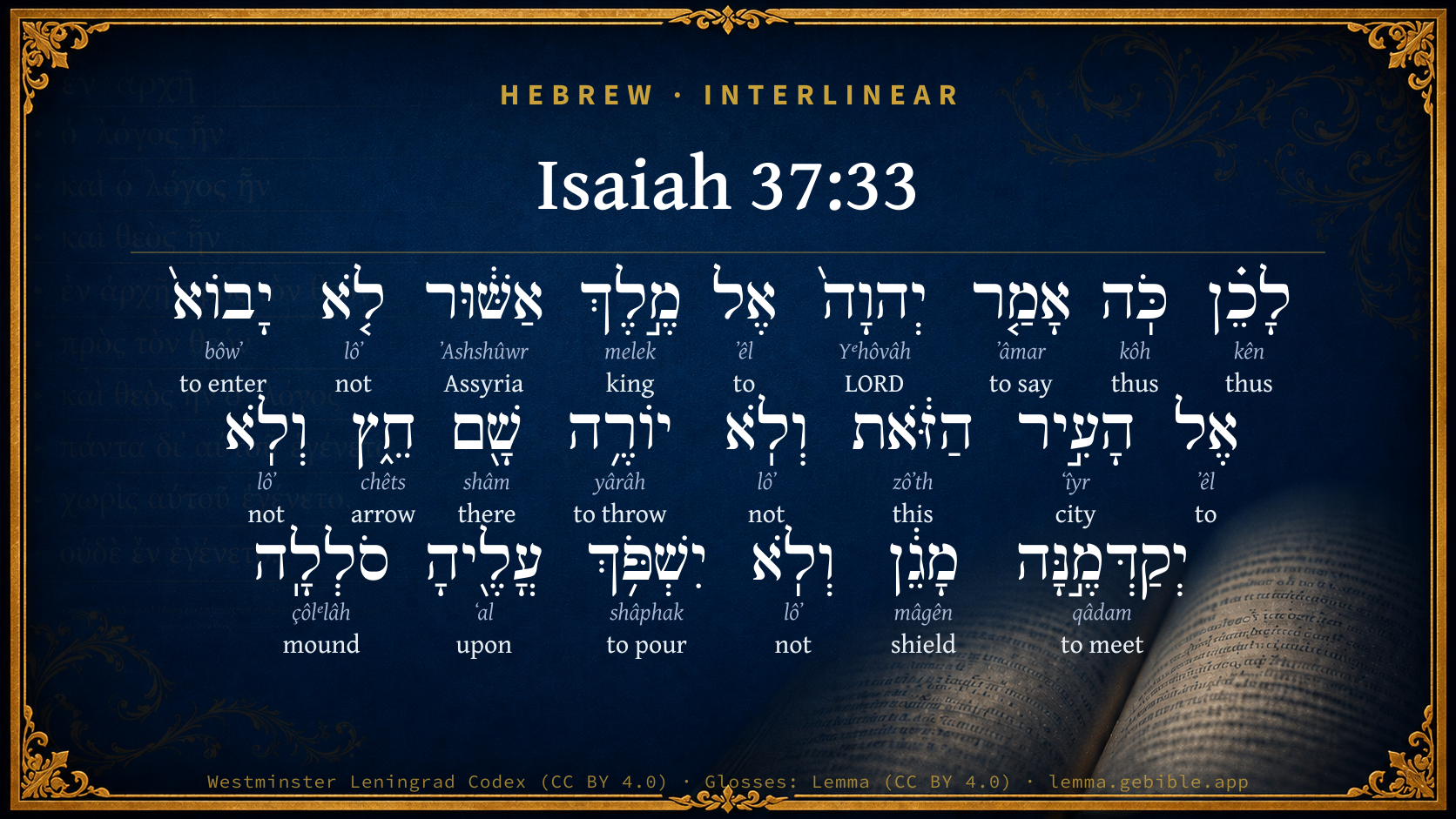
Isaiah 37:33

Hebrew (Westminster Leningrad Codex) Isaiah 37:33 appears in the Hebrew Old Testament. The text above is from the Westminster Leningrad Codex. Each word links to its Strong’s number, a concise gloss, and parsing drawn from the Open Scriptures Hebrew Bible morphology. Click any word for its full Brown-Driver-Briggs (BDB) entry.
Download image
Cite this verse

Isaiah 37:33 (World English Bible). Public Domain. Lemma interlinear Bible study tool, https://lemma.gebible.app/v/isaiah/37/33.

Show BibTeX & RIS
BibTeX
RIS
English Translation
Therefore thus says Yahweh concerning the king of Assyria, He shall not come to this city, nor shoot an arrow there, neither shall he come before it with shield, nor cast up a mound against it.
World English Bible · Public Domain
Download a study sheet

One document with this verse’s original text, its word-by-word gloss line, the meaning frame, cross-references with their text, attributed commentary, and full source and license credits — printable, and it pastes into notes with its structure intact.

This verse Autodidact and up

Study sheet (.html) Plain text (.txt)

A passage Seminary Student

Up to 50 verses in one chapter. A passage sheet keeps up to 6 commentary sources and 12 cross-references per verse, in the order this page ranks them, and says so on the sheet whenever that leaves anything out. Ask for a single verse and you get the Autodidact verse sheet above.

Everything on this page stays free to read, with no account — the sheet is a download of what is already on screen, not access to it.

Want to remove ads? Support Godless Engineer
Compare translations 3

The same verse in 3 English versions, stacked beneath the original-language interlinear above. Click any original word for its lexicon entry.

Each is an independent rendering of the whole verse — the interlinear is not word-aligned to these translations.

Highlighted words mark where these versions differ — a whole-verse word diff, not a word-by-word alignment.

  • World English Bible Public Domain
    Therefore thus says Yahweh concerning the king of Assyria, He shall not come to this city, nor shoot an arrow there, neither shall he come before it with shield, nor cast up a mound against it.
  • King James Version Public Domain
    Therefore thus saith the LORD concerning the king of Assyria, He shall not come into this city, nor shoot an arrow there, nor come before it with shields, nor cast a bank against it.
  • unfoldingWord Literal Text CC BY-SA 4.0
    Therefore, thus says Yahweh about the king of Assyria: ‘He will not come to this city, and he will not shoot an arrow there, and he will not come before it a shield, and he will not pour out a mound against it.

unfoldingWord Literal Text — © unfoldingWord, licensed CC BY-SA 4.0. Word-aligned USFM3 via Door43 (git.door43.org/unfoldingWord/en_ult).

Versions to compare (up to 4)

3 of 4 selected

Show all 18 translations

Every available English version of this verse, each an independent rendering of the whole verse.

  • World English Bible Public Domain
    Therefore thus says Yahweh concerning the king of Assyria, He shall not come to this city, nor shoot an arrow there, neither shall he come before it with shield, nor cast up a mound against it.
  • Berean Standard Bible Public Domain
    So this is what the LORD says about the king of Assyria: ‘He will not enter this city or shoot an arrow into it. He will not come before it with a shield or build up a siege ramp against it.
  • Majority Standard Bible Public Domain
    So this is what the LORD says about the king of Assyria: ‘He will not enter this city or shoot an arrow into it. He will not come before it with a shield or build up a siege ramp against it.
  • King James Version Public Domain
    Therefore thus saith the LORD concerning the king of Assyria, He shall not come into this city, nor shoot an arrow there, nor come before it with shields, nor cast a bank against it.
  • American Standard Version (1901) Public Domain
    Therefore thus saith Jehovah concerning the king of Assyria, He shall not come unto this city, nor shoot an arrow there, neither shall he come before it with shield, nor cast up a mound against it.
  • Revised Version (1885) Public Domain
    Therefore thus saith the LORD concerning the king of Assyria, He shall not come unto this city, nor shoot an arrow there, neither shall he come before it with shield, nor cast a mount against it.
  • Geneva Bible (1599) Public Domain
    Therefore thus sayth the Lord, concerning the King of Asshur, He shall not enter into this citie, nor shoote an arrow there, nor come before it with shield, nor cast a mount against it.
  • Douay-Rheims (1899) Public Domain
    Wherefore thus saith the Lord concerning the king of the Assyrians: He shall not come into this city, nor shoot an arrow into it, nor come before it with shield, nor cast a trench about it.
  • Young's Literal Translation Public Domain
    Therefore, thus said Jehovah, Concerning the king of Asshur: He doth not come in unto this city, Nor doth he shoot there an arrow, Nor doth he come before it `with' shield, Nor doth he pour out against it a mount.
  • Literal Standard Version CC BY-SA 4.0
    Therefore, thus said YHWH, || Concerning the king of Asshur: He does not come into this city, || Nor does he shoot an arrow there, || Nor does he come before it [with] shield, || Nor does he pour out a mound against it.
  • Unlocked Literal Bible CC BY-SA 4.0
    Therefore Yahweh says this about the king of Assyria: “He will not come into this city and he will not shoot an arrow here. He will not come before it with shield or build up a siege ramp against it.
  • unfoldingWord Literal Text CC BY-SA 4.0
    Therefore, thus says Yahweh about the king of Assyria: ‘He will not come to this city, and he will not shoot an arrow there, and he will not come before it a shield, and he will not pour out a mound against it.
  • Darby Bible Public Domain
    Therefore thus saith Jehovah concerning the king of Assyria: He shall not come into this city, nor shoot an arrow there, nor come before it with shield, nor cast a bank against it.
  • World Messianic Bible Public Domain
    “Therefore the LORD says concerning the king of Assyria, ‘He will not come to this city, nor shoot an arrow there, neither will he come before it with shield, nor cast up a mound against it.
  • Webster's Bible Public Domain
    Therefore thus saith the LORD concerning the king of Assyria, He shall not come into this city, nor shoot an arrow there, nor come before it with shields, nor cast a mound against it.
  • Free Bible Version CC BY-SA 4.0
    This is what the Lord says about the king of Assyria: He shall not enter this city or shoot an arrow at it. He shall not advance towards it with a shield, or build a siege ramp against it.
  • Bible in Basic English Public Domain
    For this cause the Lord says about the king of Assyria, He will not come into this town, or send an arrow against it; he will not come before it with arms, or put up an earthwork against it.
  • JPS Tanakh (1917) Public Domain
    Therefore thus saith the LORD concerning the king of Assyria: He shall not come unto this city, nor shoot an arrow there, neither shall he come before it with shield, nor cast a mound against it.

Literal Standard Version (2020), Covenant Press — licensed CC BY-SA 4.0. Text via the HelloAO Bible API (eBible.org). Unlocked Literal Bible (unfoldingWord) — licensed CC BY-SA 4.0. Text via the HelloAO Bible API (eBible.org). unfoldingWord Literal Text — © unfoldingWord, licensed CC BY-SA 4.0. Word-aligned USFM3 via Door43 (git.door43.org/unfoldingWord/en_ult). Free Bible Version, Dr. Jonathan Gallagher — licensed CC BY-SA 4.0. Text via the HelloAO Bible API (eBible.org).

Word by word

More ways to search: Search by grammar → Find every occurrence → Compare this word →

Practice this passage: Drill this verse → Learn its vocabulary →

סֹלְלָֽה
çôlᵉlâh
H5550
“mound”
Noun, Common, Feminine, Singular, Absolute
Part of Speech
Noun
Type
Common
Gender
Feminine
Number
Singular
State
Absolute
Full BDB Definition

Origin: from H5549 , but used passively

TWOT: 1506b

mound
  1. לָכֵ֗ן kên H3651 “to/for · thus” Preposition + Adverb
  2. כֹּֽה kôh H3541 “thus” Adverb
  3. אָמַ֤ר ʼâmar H559 “to say” Verb, Qal, Perfect, 3rd Person, Masculine, Singular
  4. יְהוָה֙ Yᵉhôvâh H3068 “LORD” Noun, Proper
  5. אֶל ʼêl H413 “to” Preposition
  6. מֶ֣לֶךְ melek H4428 “king of” Noun, Common, Masculine, Singular, Construct
  7. אַשּׁ֔וּר ʼAshshûwr H804 “Assyria” Noun, Proper
  8. לֹ֤א lôʼ H3808 “not” Particle, Negative
  9. יָבוֹא֙ bôwʼ H935 “to enter” Verb, Qal, Imperfect, 3rd Person, Masculine, Singular
  10. אֶל ʼêl H413 “to” Preposition
  11. הָעִ֣יר ʻîyr H5892 “the · city” Particle, Definite Article + Noun, Common, Feminine, Singular, Absolute
  12. הַזֹּ֔את zôʼth H2063 “the · this” Particle, Definite Article + Pronoun, Demonstrative, Feminine, Singular
  13. וְלֹֽא lôʼ H3808 “and · not” Conjunction + Particle, Negative
  14. יוֹרֶ֥ה yârâh H3384 “to throw” Verb, Hiphil, Imperfect, 3rd Person, Masculine, Singular
  15. שָׁ֖ם shâm H8033 “there” Adverb
  16. חֵ֑ץ chêts H2671 “arrow” Noun, Common, Masculine, Singular, Absolute
  17. וְלֹֽא lôʼ H3808 “and · not” Conjunction + Particle, Negative
  18. יְקַדְּמֶ֣נָּה qâdam H6923 “to meet · her” Verb, Piel, Imperfect, 3rd Person, Masculine, Singular + Suffix, Personal, 3rd Person, Feminine, Singular
  19. מָגֵ֔ן mâgên H4043 “shield” Noun, Common, Both, Singular, Absolute
  20. וְלֹֽא lôʼ H3808 “and · not” Conjunction + Particle, Negative
  21. יִשְׁפֹּ֥ךְ shâphak H8210 “to pour” Verb, Qal, Imperfect, 3rd Person, Masculine, Singular
  22. עֳלֶ֖יהָ ʻal H5921 “upon · her” Preposition + Suffix, Personal, 3rd Person, Feminine, Singular

About this verse

These counts appear in no published source. They are computed here, from the morphology-tagged text and Lemma’s own curated glosses. What Lemma adds →

23
words
19
distinct lemmas
Prophets
section

Notable vocabulary

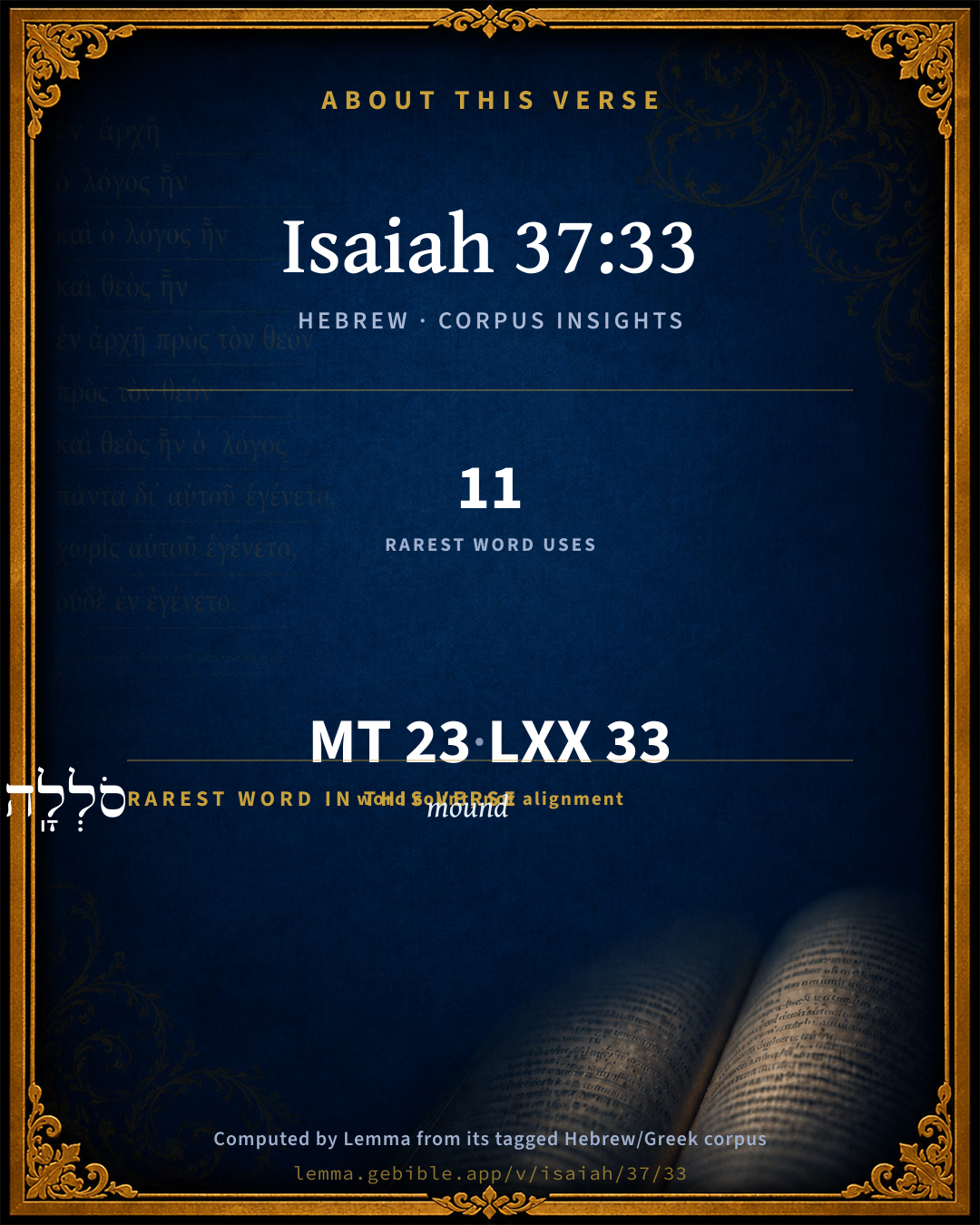
The rarest word here is סֹלְלָֽה mound H5550 — appearing just 11 times in the whole Hebrew Bible.

Shared distinctive vocabulary

סֹלְלָֽה mound H5550 occurs in 11 verses of the Hebrew Bible. Also found in:

Grammatical profile

  • 5 verbs
  • 7 nouns
  • 1 pronoun
  • 3 prepositions
  • 3 adverbs
  • 4 particles

Verb forms

  • אָמַ֤ר Qal · Perfect
  • יָבוֹא֙ Qal · Imperfect
  • יוֹרֶ֥ה Hiphil · Imperfect
  • יְקַדְּמֶ֣נָּה Piel · Imperfect
  • יִשְׁפֹּ֥ךְ Qal · Imperfect

Repetition

Words recur within this verse — often emphatic in Hebrew:

Hebrew & Septuagint length

In English translation the verse runs 36 words from the Hebrew and 36 from the Septuagint (LXX English) — the same length.

A rough comparison of the two English renderings, which tokenize alike — not a word-level alignment.

Word counts can differ between the Hebrew and the Greek without any difference in meaning — e.g. the Hebrew direct-object marker אֵת has no separate Greek word, and Greek often adds the article ὁ.

In the original languages it is 23 Hebrew tokens and 33 Greek tokens — but the two are counted differently (Hebrew bundles its prefixes and suffixes into one token; the Greek is in lemma form), so that isn’t a like-for-like length.

Cross-references

8

Topical passages linked to Isaiah 37:33 in the Treasury of Scripture Knowledge — connected by theme and wording, ordered by reader-vote popularity; previews shown in the World English Bible.

  • 2 Kings 19:32–35 Therefore thus says Yahweh concerning the king of Assyria, He shall not come to this city, nor shoot an arrow there, neither shall he come before it with shield, nor cast up a mound against it.
  • Isaiah 8:7–10 now therefore, behold, the Lord brings up on them the waters of the River, strong and many, [even] the king of Assyria and all his glory: and it shall come up over all its channels, and go over all its banks;
  • Isaiah 10:32–34 This very day shall he halt at Nob: he shakes his hand at the mountain of the daughter of Zion, the hill of Jerusalem.
  • Isaiah 17:12 Ah, the uproar of many peoples, who roar like the roaring of the seas; and the rushing of nations, that rush like the rushing of mighty waters!
  • Isaiah 17:14 At evening, behold, terror; [and] before the morning they are no more. This is the portion of those who despoil us, and the lot of those who rob us.
  • Isaiah 33:20 Look on Zion, the city of our solemnities: your eyes shall see Jerusalem a quiet habitation, a tent that shall not be removed, the stakes of it shall never be plucked up, neither shall any of the cords of it be broken.
  • Ezekiel 21:22 In his right hand was the divination [for] Jerusalem, to set battering rams, to open the mouth in the slaughter, to lift up the voice with shouting, to set battering rams against the gates, to cast up mounds, to build forts.
  • Luke 19:43–44 For the days will come on you, when your enemies will throw up a barricade against you, surround you, hem you in on every side,

Cross-references courtesy of OpenBible.info (CC BY 4.0).

Hebrew and Greek witnesses Masoretic Hebrew ↔ Greek Septuagint

The same verse in the two great witnesses to the Old Testament, shown verse-for-verse.

These are two independent witnesses, not word-aligned to each other, and the Septuagint is shown in lemma (dictionary) form.

Hebrew Isaiah 37:33 Masoretic · Westminster Leningrad Codex

לָכֵ֗ן כֹּֽה אָמַ֤ר יְהוָה֙ אֶל מֶ֣לֶךְ אַשּׁ֔וּר לֹ֤א יָבוֹא֙ אֶל הָעִ֣יר הַזֹּ֔את וְלֹֽא יוֹרֶ֥ה שָׁ֖ם חֵ֑ץ וְלֹֽא יְקַדְּמֶ֣נָּה מָגֵ֔ן וְלֹֽא יִשְׁפֹּ֥ךְ עֳלֶ֖יהָ סֹלְלָֽה

Therefore thus says Yahweh concerning the king of Assyria, He shall not come to this city, nor shoot an arrow there, neither shall he come before it with shield, nor cast up a mound against it.

World English Bible · Public Domain

Greek LXX Isaiah 37:33 Septuagint · lemma form

διά οὗτος οὕτως λέγω κύριος ἐπί βασιλεύς ἀσσύριος οὐ μή εἰςἔρχομαι εἰς ὁ πόλις οὗτος οὐδέ μή βάλλω ἐπί αὐτός βέλος οὐδέ μή ἐπιβάλλω ἐπί αὐτός θυρεός οὐδέ μή κυκλόω ἐπί αὐτός χάραξ

Therefore thus says the Lord concerning the king of the Assyrians, He shall not enter into this city, nor cast a weapon against it, nor bring a shield against it, nor make a rampart round it.

LXX2012 (modern English Septuagint) · Public Domain

Hebrew: Westminster Leningrad Codex (CC BY 4.0). Greek: Septuagint (public domain); English from LXX2012 (modern English Septuagint) (Public Domain). How the Septuagint differs from the Hebrew →

Targum (Aramaic paraphrase)

1

The Targum is the ancient Jewish Aramaic paraphrase of the Hebrew Scriptures — an interpretive translation, not the Hebrew text itself. Onkelos (literal) and Pseudo-Jonathan (expansive) render the Torah, and Jonathan the Prophets. Coverage is partial: where no permissively-licensed English translation exists for a verse, only the Aramaic is shown. This is verse-level text, not a word-by-word alignment to the Hebrew.

  1. Targum Jonathan Prophets (Joshua–Malachi)
    בְּכֵן כִּדְנָן אֲמַר יְיָ עַל מַלְכָּא דְאַתּוּר לָא יֵעוּל לְקַרְתָּא הָדָא וְלָא יַקְשֵׁית תַּמָן נִיר וְלָא יְקַדְמִינֵהּ בִּתְרֵיסִין וְלָא יִצְבּוֹר עֲלָה מִלֵיתָא:

    Therefore thus saith the Lord concerning the king of Assyria, He shall not come into this city, nor shoot an arrow there, nor come before it with shields, nor shall be cast up a mound against it.

    Targum Jonathan — Aramaic: “Mikraot Gedolot” (public domain). English: “Sefaria Community Translation” (CC0 1.0 (public-domain dedication)); “London "Chaldee Paraphrase," 1871” (public domain). Text via Sefaria.

Commentary

Notes on Isaiah 37:33 from classic Christian and Jewish commentators (each source and its license shown beneath its notes). The classic Christian expositions comment on the surrounding passage and are grouped to its opening verse, so a note may address several verses; the Jewish commentaries on the Tanakh (Rashi and others) are per-verse, so they appear only where the commentator wrote on this verse.

Lemma curates 59 commentaries, every one of them public domain or Creative Commons licensed, each selected and text-cleaned for this edition rather than reprinted as found. About our sources →

The Biblical Illustrator

Joseph S. Exell

Isa_37:33

He shall not come into this city

The momentous issues involved in Sennacheribs defeat

We do not, perhaps, realise the magnitude of the crisis, not alone in the life and fortunes of Isaiah, but in the history of the Jews, and, inbreed, of the world at large.

It is not too much to say that if Sennacherib had taken Jerusalem, in all human probability the Jews would have ceased to exist as a nation, and the world would not have been prepared for the coming of Christ. They had not yet reached a point in their training at which the national life and religion could have survived such a calamity as that which a century later overtook Jerusalem in the time of Jeremiah; and there is every reason to believe that had they been carried captives now, they would simply have been absorbed into heathenism, as the ten tribes doubtless were. (Edward Grubb, M. A.)

Jerusalem and Leyden

The siege of Jerusalem reminds us of the siege of Leyden in later days. William the Silent (as Hezekiah had done before him) put his sole trust for deliverance in God. On the last night of the siege, and when help from man seemed hopeless, God came to their aid, and with His ocean and tempest delivered Leyden, and struck such terror into their enemies, that when the morning dawned, the Spaniards had fled, panic-struck, during the darkness. Leyden was relieved, and every person within its walls repaired to the great church to return thanks to Almighty God. (Sunday School Chronicle.)

Deliverance

The history of Gods people is one oft-repeated story of deliverance. Years ago, the Sultan of Turkey declared that every Christian missionary would be banished on a certain day. The Christians met in earnest prayer, and one said, The great Sultan of the universe can change all this. He did. The Sultan of Turkey died on the very day he had named for the expulsion of the missionaries, and they were allowed to remain. (J. S.Drummond.)

The Biblical Illustrator, edited by Joseph S. Exell (c. 1880s–1900s) — public domain. Text from a community e-Sword module.

MacLaren's Expositions of Holy Scripture

Alexander MacLaren

Isaiah

THE TRIUMPH OF FAITH

Isa 37:14 - Isa 37:21, Isa 37:33 - Isa 37:38.

Is trust in Jehovah folly or wisdom? That was the question raised by Sennacherib’s invasion. A glance at the preceding chapters will show how the high military official, ‘the rabshakeh,’ or chief of the officers, shaped all his insolent and yet skilful mixture of threats and promises so as to demonstrate the vanity of trust in Egypt or in Jehovah, or in any but ‘the great king.’ Isaiah had been labouring to lift his countrymen to the height of reliance on Jehovah alone, and now the crucial test of the truth of his contention had come. On the one hand were Sennacherib and his host, flushed with victory, and sure of crushing this puny kinglet Hezekiah and his obstinate little city, perched on its rock. On the other was nothing but a prophet’s word. Where is the stronger force? And does political prudence dictate reliance on the Unseen or on the visible? The moment is the crisis of Isaiah’s work, and this narrative has been placed, with true insight into its importance, at the close of the first half of this book.

To grasp the significance of the text the preceding events have to be remembered. Hezekiah’s kingdom had been overrun, and tribute exacted from him. The rabshakeh had been sent from the main body of the Assyrian army, which was down at Lachish in the Philistine low country on the road to Egypt, in order to try to secure Jerusalem by promises and threats, since it was too important a post to leave in the rear, if Egypt was to be invaded. That attempt having failed, and the Egyptian forces being in motion, this new effort was made to induce Hezekiah to surrender. A letter was sent, whether accompanied by any considerable armed force or no does not appear. At this point the narrative begins. It may be best studied as an illustration of the trial of faith, its refuge, its pleading, and its deliverance.

I. Note the trial of faith. Rabshakeh had derided the obstinate confidence in Jehovah, which kept these starving men on the walls grimly silent in spite of his coaxing. The letter of Sennacherib harps on the same string. It is written in a tone of assumed friendly remonstrance, and lays out with speciousness the apparent grounds for calling trust in Jehovah absurdity. There are no threats in it. It is all an appeal to common sense and political prudence. It marshals undeniable facts. Experience has shown the irresistible power of Assyria. There have been plenty of other little nations which have trusted in their local deities, and what has become of them? Barbarous names are flourished in Hezekiah’s face, and their wasted dominions are pointed to as warnings against his committing a parallel folly. There is nothing in the letter which might not have been said by a friend, and nothing which was not said by the Jews who had lost their faith in their God. It was but the putting into plain words of what ‘common-sense’ and faint faith had often whispered to Hezekiah. The very absence of temper or demand in the letter gives it an aspect of that ‘sweet reasonableness’ so dear to sense-bound souls.

Mutatis mutandis, the letter may stand for a specimen of the arguments which worldly prudence brings to shake faith, in all ages. We, too, are assailed by much that sounds most forcible from the point of view of mere earthly calculation. Sennacherib does not lie in boasting of his victories. He and his shoals of soldiers are very real and potent. It does seem madness for one little kingdom to stand out, and all the more so because its king is cooped up in his city, as the cuneiform inscription proudly tells, ‘like a bird in a cage,’ and all the rest of his land is in the conqueror’s grip. They who look only at the things seen cannot but think the men of faith mad. They who look at the things unseen cannot but know that the men of sense are fools. The latter elaborately prove that the former are impotent, but they have left out one factor in their calculations, and that is God. One man and God at his back are stronger than Sennacherib and all his mercenaries.

II. Note the refuge of tempted faith. What was Hezekiah to do with the crafty missive? It was hoped that he would listen to reason, and come down from his perch. But he neither yielded nor took counsel with his servants, but, like a devout man, went into the house of the Lord, and spread the letter before the Lord. It would have gone hard with him if he had not been to the house of the Lord many a time before. It is not easy to find our way thither for the first time, when our eyes are blinded by tears or our way darkened by calamities. But faith instinctively turns to God when anything goes wrong, because it has been accustomed to turn to Him when all was right, according to the world’s estimate of right and wrong. Whither should the burdened heart betake itself but to Him who daily bears our burdens? The impulse to tell God all troubles is as truly a mark of the faithful soul as the impulse to tell everything to the beloved is the life-breath of love.

The act of spreading the letter before the Lord is an eloquent symbol, which some prosaic and learned commentators have been dull enough to call gross, and to compare to Buddhist praying-mills! Its meaning is expressed in the prayer which follows. It is faith’s appeal to His knowledge. It is faith’s casting of its burden on the Lord. Our faith is of little power to bless, unless it impels us to take God into confidence in regard to everything which troubles us. If the letter is not grave enough to be spread before Him, it is too small to annoy us. If we truly live in fellowship with God, we shall find ourselves in His house, with the cause of our trouble in our hands, before we have time to think. Instinct acts more quickly than reason, and, if our faith be vital, it will not need to be argued into speaking to God of all that weighs upon us.

III. Note the pleading of faith. Hezekiah’s address to God is no mere formal recapitulation of divine names, but is the effort of faith to grasp firmly the truths which the enemy denies, and on which it builds. So considered, the accumulation of titles in Isa 37:16 is very instructive, and shows how a trustful soul puts forth the energy of its faith in summoning to mind the great aspects of the divine name as bulwarks against suggested fears, and bases of supplication. Hezekiah appeals to ‘the God of Hosts,’ the Ruler of all the embattled forces of the universe, as well as of the armies of angels. What is Sennacherib’s array compared with these? He appeals to the ‘God of Israel,’ as pleading the ancient relationship, which binds the unchangeable Guardian of the people to be still what He has been, and casts the responsibility of Israel’s preservation upon Him. He appeals to Him ‘who sits between the cherubim,’ as thence defending and filling the threatened city. He grasps the thought that Jehovah is ‘God alone’ with a vividness which is partly due no doubt to Isaiah’s teaching, but is also the indignant recoil of faith from the assumption of the letter, that Jehovah was but as the beaten deities of Gozan and the rest. Faith clings the more tenaciously to truths denied, as a dog will hold on to the stick that one tries to pull from it.

Thus, having heartened himself and pled with God by all these names, Hezekiah comes to his petition. It is but translating into words the symbol of spreading the letter before God. He asks God to behold and to hear the defiant words. Prayer tells God what it knows that He knows already, for it relieves the burdened heart to tell Him. It asks Him to see and hear what it knows that He does see and hear. But the prayer is not for mere observance followed by no divine act, but for taking knowledge as the precursor of the appropriate help. Of such seeing and hearing by God, believing prayer is the appointed condition. ‘Your Father knoweth what things ye have need of, before ye ask Him’; but that is not a reason for silence, but for supplication.

Hezekiah rightly regarded Sennacherib’s words as meant to reproach the living God, for the point of the letter was to dissuade from trust in Him, as no more powerful than the petty deities of already conquered cities. The prayer, therefore, pleads that God would take care of His own honour, and by delivering Jerusalem, show His sole sovereignty. It is a high and wonderful level for faith to reach, when it regards personal deliverance mainly in its aspect as vindicating God and warranting faith. We may too easily conclude that God’s honour is involved in our deliverance, and it is well to be on our guard against that.

But it is possible to die to self so fully as to feel that our cause is His, because His is so entirely ours; and then we may come to that heroic faith which seeks even personal good more for God’s sake than for our own. It was noble that this man should have no word to say about self but ‘Save us, that all the kingdoms of the earth may know that Thou art God alone.’ Like him, we may each feel that our defence is more God’s affair than ours, in proportion as we feel we are His rather than our own. That siege of Jerusalem was indeed as a duel between faith and unbelief on the one hand, and between Jehovah and the gods who were ‘no gods’ on the other. Sennacherib’s letter was a defiant challenge to Jehovah to do His best for this people, and when faith repeated in prayer the insolence of unbelief only one result was possible. It came.

IV. Note the deliverance of faith. Isaiah’s grand prophecy tempts us to linger over its many beauties and magnificent roll of triumphant scorn, but it falls outside our purpose. As for the catastrophe, it should be noted that its place and time are not definitely stated, and that probably the notion that the Assyrian army was annihilated before Jerusalem is a mistake. Sennacherib and his troops were at Libnah, on their way to meet the Egyptian forces. If there were any of them before Jerusalem, they would at most be a small detachment, sufficient to invest it. Probably the course of events was that, at some time not specified, soon after the dismissal of the messengers who brought the letter, the awful destruction fell, and that, when the news of the disaster reached the detachment at Jerusalem, as the psalm which throbs with the echoes of the triumph says, ‘They were troubled, and hasted away.’

How complete was the crushing blow the lame record of this campaign in the inscriptions shows, in which the failure of the attempt to capture the city is covered up by vapouring about tribute and the like. If it had not failed, however, the success would certainly have been told, as all similar cases are told, with abundant boasting. The other fact is also to be remembered, that Sennacherib tried no more conclusions with Jerusalem and Jehovah, and though he lived for some twenty years afterwards, never again ventured on to the soil where that mighty God fought for His people.

The appended notice of Sennacherib’s death has been added by some narrator, since it probably occurred after Isaiah’s martyrdom. ‘All they that take the sword shall perish with the sword.’ Such a career as his could not but give taste for violence and bloodshed, and dimmish regard for human life. Retribution comes slowly, for twenty years intervened between the catastrophe to the army and the murder of the king. Its penalties increase as its fall delays; for first came the blotting out of the army, and then, when that had no effect, at last the sword in his own heart. ‘He that being often reproved hardeneth his neck shall suddenly be destroyed, and that without remedy.’

But the great lesson of that death is the same as that of the other king’s deliverance. Hezekiah ‘went unto the house of the Lord,’ and found Him a very present help in trouble. Sennacherib was slain in the house of his god. The two pictures of the worshippers and their fates are symbolic of the meaning of the whole story. Sennacherib had dared Jehovah to try His strength against him and his deities. The challenge was accepted, and that bloody corpse before the idol that could not help preaches a ghastly sermon on the text, ‘They that make them are like unto them; so is every one that trusteth in them. O Israel, trust thou in the Lord: He is their help and their shield.’

Alexander MacLaren, Expositions of Holy Scripture (1904–1910) — public domain. Text from a community e-Sword module.

Tyndale Open Study Notes

Tyndale Open Resources

37:33 armies . . . arrow . . . shields . . . banks of earth: Despite their advanced military technology and great power, the Assyrians would not succeed against Jerusalem.

Tyndale Open Study Notes — © Tyndale Open Resources, licensed CC BY-SA 4.0. Text via the HelloAO Bible API.

Jamieson, Fausset & Brown

Robert Jamieson, A. R. Fausset & David Brown

with shields--He did come near it, but was not allowed to conduct a proper siege.

bank--a mound to defend the assailants in attacking the walls.

Jamieson, Fausset & Brown — Commentary Critical and Explanatory on the Whole Bible (1871) — public domain (CC PDM 1.0). Text via the HelloAO Bible API.

Ellicott's Commentary for English Readers

(33) Nor come before it with shields.—The clause points to the two forms of attack: (1) the invaders marching to the assault, protected by their serried shields against the darts and stones which were flung by hand or from engines by the besieged; and (2) the earthworks which were piled up to make the attack on the walls more feasible. (Comp. Hab_1:10; Eze_4:2.) Isaiah’s prediction is not only that Jerusalem will not be taken, but that the enemy, though now encamped around it, will not even proceed to the usual operations of a siege.

A Bible Commentary for English Readers, edited by Charles John Ellicott (1878–1897) — public domain. Text from a community e-Sword module.

The Cambridge Bible for Schools and Colleges

gen. ed. J. J. S. Perowne

33. Therefore probably attaches itself to “whereas” in Isa_37:21 (see the note on that verse).

33–35. An assurance that Jehovah will protect Jerusalem, in answer to Hezekiah’s prayer.

The Cambridge Bible for Schools and Colleges (gen. ed. J. J. S. Perowne; Cambridge University Press, 1878–1918) — public domain. Text from a community e-Sword module.

John Gill's Exposition

For I will defend this city to save it,.... Or, "shield it"; and if God will be the shield and protection of any place or people, they must needs be safe; who can hurt them?

For my own sake, and for my servant David's sake; not for the merits of the inhabitants of it, but for the sake of his own name and glory, who had been blasphemed by the Assyrian monarch, and his general; and for the sake of his servant David, in whose seed he had promised the kingdom should be established; see Sa2 7:12 and chiefly for the sake of the Messiah, David's son, and the Lord's servant, who was to spring from Hezekiah's race, and therefore must not be cut off.

John Gill's Exposition of the Whole Bible (1746–1763) — public domain (CC PDM 1.0). Text via the HelloAO Bible API.

Albert Barnes' Notes on the Bible

He shall not come into this city - Sennacherib encamped probably on the northeast side of the city, and his army was destroyed there (see the notes at Isa 10:28 ff.)

Nor shoot an arrow there - That is, nor shoot an arrow within the walls of the city.

Nor come before it with shields - (See the note at Isa 21:5). The meaning here is, that the army should not be permitted to come before the city defended with shields, and prepared with the means of attack and defense.

Nor cast a bank against it - A mound; a pile of earth thrown up in the manner of a fort to defend the assailants, or to give them an advantage in attacking the walls. Sieges were conducted by throwing up banks or fortifications, behind which the army of attack could be secure to carry on their operations. Towers filled with armed men were also constructed, covered with hides and other impenetrable materials, which could be made to approach the walls, and from which those who were within could safely conduct the attack.

Albert Barnes' Notes on the Bible (1834–1885) — public domain. Text from a community e-Sword/MySword module.

Whedon's Commentary on the Bible

Daniel D. Whedon

33-36. Thus far strongly assuring Hezekiah, Isaiah here gives definite details of the grounds of this assurance.

The king of Assyria… shall not come into this city… nor cast a bank — A familiar mode of describing an ancient siege.

By the way that he came… shall he return — Without even an attack on Egypt, though that was the chief point of Sennacherib’s intended assault. He shall keep to the thoroughfare on the plains, over the pass of Megiddo, onward northeasterly, etc. This is said in pursuance of God’s plan, on that very night, (2Ki_19:35,) to smite with death from plague or otherwise, one hundred and eighty-five thousand of this great army. The history of this event is so fragmentary that facts are wanting to decide where, how, in what proportions — whether united in one body again or still separated in parts — this army received this catastrophe.

Daniel D. Whedon (gen. ed.), Commentary on the Old and New Testaments (1874–1909) — public domain. Text from a community e-Sword module.

The Pulpit Commentary

Therefore, etc. A new clause is commenced the concluding clause of the prophecy. For Hezekiah"s satisfaction and consolation something more definite is needed than the vague assurances that "the daughter of Jerusalem shook her head at Sennacherib" (ver. 22), and that God would "put a bridle in Sennacherib"s mouth" (ver. 29). Accordingly, it is now declared, in the plainest terms, that he shall not even lay siege to the city, but shall return by the way by which he came the coast route leaving Jerusalem untouched, nay, unattempted. He shall not come into this city; rather, unto the city. He was at Libnah, in the Shefeleh, thirty or forty miles from Jerusalem, when we last heard of him (ver. 8); and, having then been just informed of the advance of Tirhakah, he is likely to have proceeded on towards Egypt. There is, at any rate, not the slightest intimation of his having made a retrograde movement towards the Jewish capital. Nor shoot an arrow there, nor come before it with shields, nor cast a bank against it. The main points of an Assyrian siege are happily seized. The first assailants were the archers. They boldly approached in large bodies, and strove to clear the battlements of the defenders. Then shields were brought into play. Under their cover the archers drew nearer; the scaling parties brought up their ladders; the miners attacked the foundations of the walls; and the torch-bearers endeavoured to fire the gates. Finally, if these tactics did not avail, banks were raised against the walls, which were then assailed with battering-rams till they were breached and the assailants could cuter. God promises that Jerusalem shall experience none of these things at Sennacherib"s hands.

The Pulpit Commentary (1880–1919), ed. H.D.M. Spence-Jones & Joseph S. Exell — public domain. Text from a community e-Sword module.

Keil & Delitzsch

C. F. Keil & F. Delitzsch

The prophecy concerning the protection of Jerusalem becomes more definite in the last turn than it ever has been before. "Therefore thus saith Jehovah concerning the king of Asshur, He will not enter into this city, nor shoot off an arrow there; nor do they assault it with a shield, nor cast up earthworks against it. By the way by which he came (K. will come) will he return; and he will not enter into this city, saith Jehovah. And I shield this city (על, K. אל), to help it, for mine own sake, and for the sake of David my servant." According to Hitzig, this conclusion belongs to the later reporter, on account of its "suspiciously definite character." Knobel, on the other hand, sees no reason for disputing the authorship of Isaiah, inasmuch as in all probability the pestilence had already set in (Isa 33:24), and threatened to cripple the Assyrian army very considerably, so that the prophet began to hope that Sennacherib might now be unable to stand against the powerful Ethiopian king. To us, however, the words "Thus saith Jehovah" are something more than a flower of speech; and we hear the language of a man exalted above the standard of the natural man, and one how has been taken, as Amos says (Amo 3:7), by God, the moulder of history into "His secret." Here also we see the prophecy at its height, towards which it has been ascending from Isa 6:13 and Isa 10:33-34 onwards, through the midst of obstacles accumulated by the moral condition of the nation, but with the same goal invariably in view. The Assyrian will not storm Jerusalem; there will not even be preparations for a siege. The verb qiddēm is construed with a double accusative, as in Psa 21:4 : sōlelâh refers to the earthworks thrown up for besieging purposes, as in Jer 32:24. The reading יבא instead of בּא has arisen in consequence of the eye having wandered to the following יבא. The promise in Isa 37:35 sounds like Isa 31:5. The reading אל for על is incorrect. One motive assigned ("for my servant David's sake") is the same as in Kg1 15:4, etc.; and the other ("for mine own sake") the same as in Isa 43:25; Isa 48:11 (compare, however, Isa 55:3 also). On the one hand, it is in accordance with the honour and faithfulness of Jehovah, that Jerusalem is delivered; and, on the other hand, it is the worth of David, or, what is the same thing, the love of Jehovah turned towards him, of which Jerusalem reaps the advantage.

Keil & Delitzsch — Biblical Commentary on the Old Testament (1861–1891) — public domain (CC PDM 1.0). Text via the HelloAO Bible API. (Old Testament only.)

J. A. Alexander on Isaiah

Joseph Addison Alexander

“Therefore (because Jehovah has determined to fulfil these promises), thus saith Jehovah (with respect) to the king of Assyria, he shall not come to this city, and shall not shoot an arrow there, and shall not come before it with a shield (or a shield shall not come before it), and shall not cast up a mound against it.” Some understand this as meaning simply that he should not take the city, others that he should not even attack it. This verse seems to show that Jerusalem was not actually besieged by the Assyrians, or at least not by the main body of the army under Sennacherib himself, unless we assume that he had already done so and retreated, and regard this as a promise that the attempt should not be repeated.

Joseph Addison Alexander, The Prophecies of Isaiah (1846–1847; New York: Scribner, 1870–1878) — public domain. Text from a community e-Sword module.

unfoldingWord translationNotes

Door43 World Missions Community

He will not come ... He will not come

Here the Assyrian king refers to both him and his army. AT: "His army will not come ... They will not come" (See: Synecdoche)

with shield

"with shields"

siege ramp

a large mound of dirt built against the wall of a city that better enables an army to attach the city

he came ... he will not enter

Here the Assyrian king refers to both him and his army. AT: "they came ... they will not enter" (See: Synecdoche)

this is Yahweh's declaration

Yahweh speaks of himself by name to express the certainty of what he is declaring. Translate as in Isaiah 30:1. AT: "this is what Yahweh has declared" or "this is what I, Yahweh, have declared" (See: First, Second, or Third Person)

translationWords

Yahweh

king

Assyria

bow and arrow

shield

declare

unfoldingWord translationNotes — © Distant Shores Media and the Door43 World Missions Community, licensed CC BY-SA 4.0. Source: git.door43.org/Door43/en_tn.

Rashi

Rabbi Shlomo Yitzchaki (Rashi)

nor shall he advance upon it with a shield (Heb. יְקַדְּמֶנָּה.) He shall not set a shield before it, since the Aramaic of “before” is קֳדָם.

nor shall he pile up a siege mound against it [Targum renders:] He should not pile up against it a landfill. I say that they pour out earth and pile it up against the walls and towers so that they can build a rampart.

a siege mound (סֹלְלָה) since it is trodden (סוֹלְלִים) and pressed down with sledge hammers in order that it harden. The Targum renders: מִלֵּיתָא, since they first make for it two walls of a fence of reeds and pour the earth between them and press it down there after they have filled (מִלְאוּ) the walls. And I heard that they interpret it as the throwing of huge stones, called perere in O.F., but the expression of piling up, lit., spilling, does not apply to stones, neither is the expression of pressing down, nor the rendering of the Targum, appropriately for this interpretation.

Rashi on the Tanakh — English translations: “The Judaica Press complete Tanach with Rashi, translated by A. J. Rosenberg” (CC BY 4.0); “Pentateuch with Rashi's commentary by M. Rosenbaum and A.M. Silbermann, 1929-1934” (public domain); “The Metsudah Tanach series, Lakewood, N.J” (CC BY 4.0); and “The Book of Joshua, Metsudah Publications, 1997” (CC BY 4.0). Text via Sefaria.

Lesson kit

Teaching starters — assembled from the data on this page, not authored interpretation. Every prompt links to the verse data it draws on. Edit before teaching.

Isaiah, in the Prophets, opens this verse with 23 words (19 distinct Hebrew lemmas). Its most distinctive word is çôlᵉlâh (“mound”). A historical commentator’s framing appears above. Read the whole chapter for the surrounding context.

Discussion questions

  1. How does “mound” (çôlᵉlâh) shape what this verse is saying?
  2. How does 2 Samuel 20:15, which shares the word «mound», read alongside this verse?
  3. What does the repetition of “not” (4× in this one verse) do in this verse?
  4. The translations on this page render this verse differently — a whole-verse word diff, not a word-by-word alignment. What might account for the different wordings?
  5. «אָמַ֤ר» is a Qal Perfect verb. How does that grammatical form shape the action described?
  6. Compare how The Biblical Illustrator and MacLaren's Expositions of Holy Scripture read this verse. Where do they agree or differ?

Things to notice

Reading settings

Reading text

Shown beneath each verse's original-language words.

Old Testament
Old Testament edition

Read the OT as the Masoretic Hebrew (MT) or the Greek Septuagint (LXX).

English shown for the Greek Septuagint (in the Hebrew ↔ Greek comparison).

Comparing translations? Open the Compare panel on any verse page to stack up to four side by side.