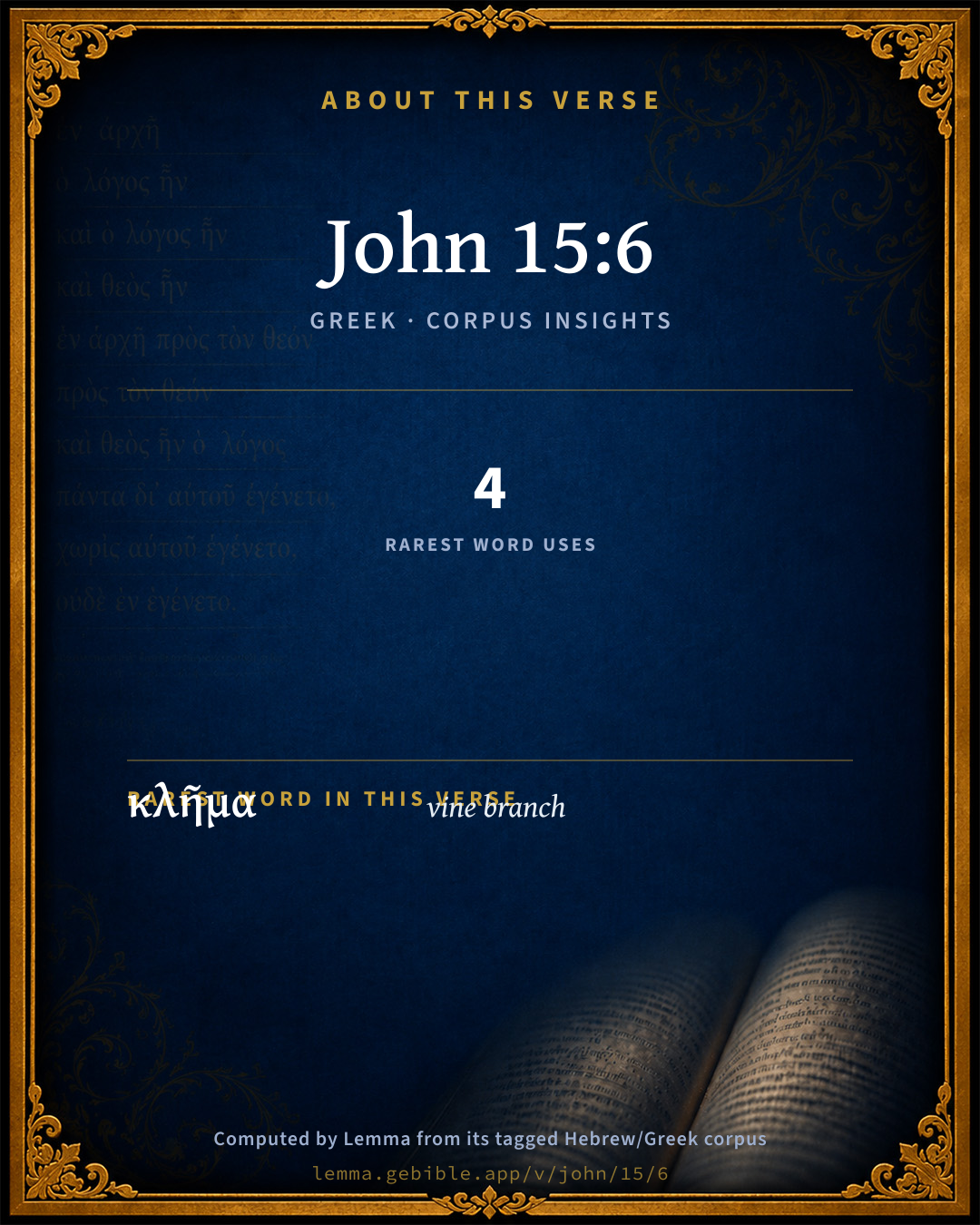
John 15:6

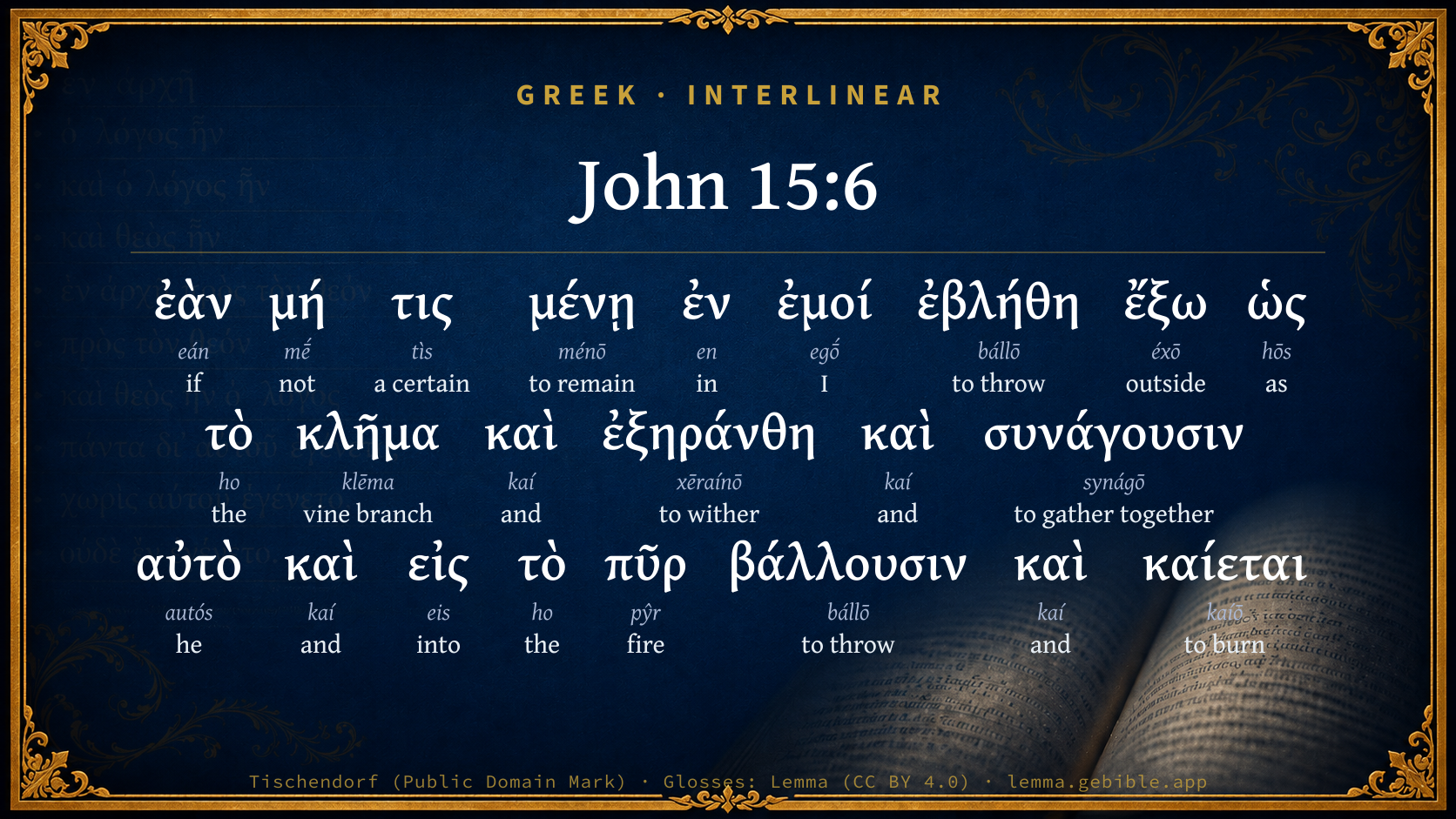
Greek (Tischendorf 8th ed.) John 15:6 appears in the Greek New Testament. The text above is from the Tischendorf 8th edition. Each word links to its Strong’s number and a concise gloss. Click any word for its full Thayer’s Greek Lexicon entry.
Download image
Cite this verse

John 15:6 (World English Bible). Public Domain. Lemma interlinear Bible study tool, https://lemma.gebible.app/v/john/15/6.

Show BibTeX & RIS
BibTeX
RIS
English Translation
If a man doesn't remain in me, he is thrown out as a branch, and is withered; and they gather them, throw them into the fire, and they are burned.
World English Bible · Public Domain
Download a study sheet

One document with this verse’s original text, its word-by-word gloss line, the meaning frame, cross-references with their text, attributed commentary, and full source and license credits — printable, and it pastes into notes with its structure intact.

This verse Autodidact and up

Study sheet (.html) Plain text (.txt)

A passage Seminary Student

Up to 50 verses in one chapter. A passage sheet keeps up to 6 commentary sources and 12 cross-references per verse, in the order this page ranks them, and says so on the sheet whenever that leaves anything out. Ask for a single verse and you get the Autodidact verse sheet above.

Everything on this page stays free to read, with no account — the sheet is a download of what is already on screen, not access to it.

Want to remove ads? Support Godless Engineer
Compare translations 3

The same verse in 3 English versions, stacked beneath the original-language interlinear above. Click any original word for its lexicon entry.

Each is an independent rendering of the whole verse — the interlinear is not word-aligned to these translations.

Highlighted words mark where these versions differ — a whole-verse word diff, not a word-by-word alignment.

  • World English Bible Public Domain
    If a man doesn't remain in me, he is thrown out as a branch, and is withered; and they gather them, throw them into the fire, and they are burned.
  • King James Version Public Domain
    If a man abide not in me, he is cast forth as a branch, and is withered; and men gather them, and cast them into the fire, and they are burned.
  • unfoldingWord Literal Text CC BY-SA 4.0
    If anyone does not remain in me, he is thrown outside like a branch and is dried up, and they gather them and throw into the fire, and they are burned up.

unfoldingWord Literal Text — © unfoldingWord, licensed CC BY-SA 4.0. Word-aligned USFM3 via Door43 (git.door43.org/unfoldingWord/en_ult).

Versions to compare (up to 4)

3 of 4 selected

Show all 18 translations

Every available English version of this verse, each an independent rendering of the whole verse.

  • World English Bible Public Domain
    If a man doesn't remain in me, he is thrown out as a branch, and is withered; and they gather them, throw them into the fire, and they are burned.
  • Berean Standard Bible Public Domain
    If anyone does not remain in Me, he is like a branch that is thrown away and withers. Such branches are gathered up, thrown into the fire, and burned.
  • Majority Standard Bible Public Domain
    If anyone does not remain in Me, he is like a branch that is thrown away and withers. Such branches are gathered up, thrown into the fire, and burned.
  • King James Version Public Domain
    If a man abide not in me, he is cast forth as a branch, and is withered; and men gather them, and cast them into the fire, and they are burned.
  • American Standard Version (1901) Public Domain
    If a man abide not in me, he is cast forth as a branch, and is withered; and they gather them, and cast them into the fire, and they are burned.
  • Revised Version (1885) Public Domain
    If a man abide not in me, he is cast forth as a branch, and is withered; and they gather them, and cast them into the fire, and they are burned.
  • Geneva Bible (1599) Public Domain
    If a man abide not in me, he is cast forth as a branche, and withereth: and men gather them, and cast them into the fire, and they burne.
  • Young's Literal Translation Public Domain
    if any one may not remain in me, he was cast forth without as the branch, and was withered, and they gather them, and cast to fire, and they are burned;
  • Literal Standard Version CC BY-SA 4.0
    if anyone may not remain in Me, he was cast forth outside as the branch, and was withered, and they gather them, and cast into fire, and they are burned;
  • Unlocked Literal Bible CC BY-SA 4.0
    If anyone does not remain in me, he is thrown away like a branch and dries up, and they gather the branches and throw them into the fire, and they are burned up.
  • unfoldingWord Literal Text CC BY-SA 4.0
    If anyone does not remain in me, he is thrown outside like a branch and is dried up, and they gather them and throw into the fire, and they are burned up.
  • Darby Bible Public Domain
    Unless any one abide in me he is cast out as the branch, and is dried up; and they gather them and cast them into the fire, and they are burned.
  • World Messianic Bible Public Domain
    If a man doesn’t remain in me, he is thrown out as a branch and is withered; and they gather them, throw them into the fire, and they are burned.
  • Webster's Bible Public Domain
    If a man abideth not in me, he is cast forth as a branch, and is withered: and men gather them, and cast them into the fire, and they are burned.
  • Free Bible Version CC BY-SA 4.0
    Anyone who doesn't remain in me is like a branch that is thrown out and dries up. Such branches are gathered together, thrown into the fire and burned.
  • Bible in Basic English Public Domain
    If a man does not keep himself in me, he becomes dead and is cut off like a dry branch; such branches are taken up and put in the fire and burned.
  • Text-Critical English NT CC BY 4.0
    If anyone does not abide in me, he is thrown out like a branch and withers. Such branches are gathered up, thrown into the fire, and burned.
  • Tyndale New Testament (1534) Public Domain
    Yf a man byde not in me he ys cast forthe as a braunche and is wyddered: and men gadder it and cast it into the fyre and it burneth.

Literal Standard Version (2020), Covenant Press — licensed CC BY-SA 4.0. Text via the HelloAO Bible API (eBible.org). Unlocked Literal Bible (unfoldingWord) — licensed CC BY-SA 4.0. Text via the HelloAO Bible API (eBible.org). unfoldingWord Literal Text — © unfoldingWord, licensed CC BY-SA 4.0. Word-aligned USFM3 via Door43 (git.door43.org/unfoldingWord/en_ult). Free Bible Version, Dr. Jonathan Gallagher — licensed CC BY-SA 4.0. Text via the HelloAO Bible API (eBible.org).

Word by word

More ways to search: Search by grammar → Find every occurrence → Compare this word →

Practice this passage: Drill this verse → Learn its vocabulary →

κλῆμα
klēma
G2814
“vine branch”
Noun, Nominative, Singular, Neuter
Part of Speech
Noun
Case
Nominative
Number
Singular
Gender
Neuter
Full Thayer's Definition

Origin: from G2806

TDNT: 15:37,4

1. a tender and flexible branch 2. spec. the shoot or branch of a vine, a vine sprout
  1. ἐὰν eán G1437 “if” Conditional
  2. μή mḗ G3361 “not” Particle, Negative
  3. τις tìs G5100 “a certain” Indefinite pronoun, Nominative, Singular, Masculine
  4. μένῃ ménō G3306 “to remain” Verb, Present, Active, Subjunctive, 3rd person, Singular
  5. ἐν en G1722 “in” Preposition
  6. ἐμοί egṓ G1473 “I” Personal pronoun, 1st person, Dative, Singular
  7. ἐβλήθη bállō G906 “to throw” Verb, Aorist, Passive, Indicative, 3rd person, Singular
  8. ἔξω éxō G1854 “outside” Adverb
  9. ὡς hōs G5613 “as” Adverb
  10. τὸ ho G3588 “the” Article, Nominative, Singular, Neuter
  11. καὶ kaí G2532 “and” Conjunction
  12. ἐξηράνθη xēraínō G3583 “to wither” Verb, Aorist, Passive, Indicative, 3rd person, Singular
  13. καὶ kaí G2532 “and” Conjunction
  14. συνάγουσιν synágō G4863 “to gather together” Verb, Present, Active, Indicative, 3rd person, Plural
  15. αὐτὸ autós G846 “he” Personal pronoun, Accusative, Singular, Neuter
  16. καὶ kaí G2532 “and” Conjunction
  17. εἰς eis G1519 “into” Preposition
  18. τὸ ho G3588 “the” Article, Accusative, Singular, Neuter
  19. πῦρ pŷr G4442 “fire” Noun, Accusative, Singular, Neuter
  20. βάλλουσιν bállō G906 “to throw” Verb, Present, Active, Indicative, 3rd person, Plural
  21. καὶ kaí G2532 “and” Conjunction
  22. καίεται kaíō G2545 “to burn” Verb, Present, Passive, Indicative, 3rd person, Singular

About this verse

These counts appear in no published source. They are computed here, from the morphology-tagged text and Lemma’s own curated glosses. What Lemma adds →

23
words
18
distinct lemmas
Gospels
section

Notable vocabulary

The rarest word here is κλῆμα vine branch G2814 — appearing just 4 times in the whole Greek New Testament.

Shared distinctive vocabulary

κλῆμα vine branch G2814 occurs in 4 verses of the Greek New Testament. Also found in:

Repetition

Words recur within this verse:

  • ἐβλήθη to throw G906 ×2
  • καὶ and G2532 ×4
  • τὸ the G3588 ×2

Cross-references

18

Topical passages linked to John 15:6 in the Treasury of Scripture Knowledge — connected by theme and wording, ordered by reader-vote popularity; previews shown in the World English Bible.

  • Matthew 7:19 Every tree that doesn't grow good fruit is cut down, and thrown into the fire.
  • Hebrews 6:7–8 For the land which has drunk the rain that comes often on it, and brings forth a crop suitable for them for whose sake it is also tilled, receives blessing from God;
  • Matthew 13:41 The Son of Man will send out his angels, and they will gather out of his Kingdom all things that cause stumbling, and those who do iniquity,
  • John 15:2 Every branch in me that doesn't bear fruit, he takes away. Every branch that bears fruit, he prunes, that it may bear more fruit.
  • Matthew 3:10 "Even now the axe lies at the root of the trees. Therefore, every tree that doesn't bring forth good fruit is cut down, and cast into the fire.
  • Hebrews 10:27 but a certain fearful expectation of judgment, and a fierceness of fire which will devour the adversaries.
  • 2 Peter 2:20 For if, after they have escaped the defilement of the world through the knowledge of the Lord and Savior Jesus Christ, they are again entangled therein and overcome, the last state has become worse with them than the first.
  • Ezekiel 19:12–14 But it was plucked up in fury, it was cast down to the ground, and the east wind dried up its fruit: its strong rods were broken off and withered; the fire consumed them.
  • 1 John 2:19 They went out from us, but they didn't belong to us; for if they had belonged to us, they would have continued with us. But they left, that they might be revealed that none of them belong to us.
  • Revelation 20:15 If anyone was not found written in the book of life, he was cast into the lake of fire.
  • Ezekiel 15:3–7 Shall wood be taken of it to make any work? or will men take a pin of it to hang any vessel thereon?
  • Ezekiel 17:9 Say you, Thus says the Lord Yahweh: Shall it prosper? shall he not pull up the roots of it, and cut off the fruit of it, that it may wither; that all its fresh springing leaves may wither? and not by a strong arm or much people can it be raised from the roots of it.
  • Jude 1:12–13 These are hidden rocky reefs in your love feasts when they feast with you, shepherds who without fear feed themselves; clouds without water, carried along by winds; autumn leaves without fruit, twice dead, plucked up by the roots;
  • Job 15:30 He shall not depart out of darkness; The flame shall dry up his branches, By the breath of God's mouth shall he go away.
  • Psalms 80:15 The stock which your right hand planted, The branch that you made strong for yourself.
  • Isaiah 14:19 But you are cast forth away from your tomb like an abominable branch, clothed with the slain, who are thrust through with the sword, who go down to the stones of the pit; as a dead body trodden under foot.
  • Isaiah 27:10 For the fortified city is solitary, a habitation deserted and forsaken, like the wilderness: there shall the calf feed, and there shall he lie down, and consume the branches of it.
  • Matthew 27:5 He threw down the pieces of silver in the sanctuary, and departed. He went away and hanged himself.

Cross-references courtesy of OpenBible.info (CC BY 4.0).

Commentary

Notes on John 15:6 from classic Christian and Jewish commentators (each source and its license shown beneath its notes). The classic Christian expositions comment on the surrounding passage and are grouped to its opening verse, so a note may address several verses; the Jewish commentaries on the Tanakh (Rashi and others) are per-verse, so they appear only where the commentator wrote on this verse.

Lemma curates 59 commentaries, every one of them public domain or Creative Commons licensed, each selected and text-cleaned for this edition rather than reprinted as found. About our sources →

The Biblical Illustrator

Joseph S. Exell

Joh_15:6

If a man abide not in Me he is cast forth

Jesus and the only means of righteousness

God is the author of righteousness, and Jesus is the Son of God, because He gives the method and secret by which alone righteousness is possible, And that He does give this, we can verify from experience.

It is so I try, and you will find it to be so! Try all the ways to righteousness you can think of, and you will find no way brings you to it except the way of Jesus, but that this way does bring you to it. This is a thing that can prove itself, if it is so; and it will prove itself, because it is so. (Matthew Arnold.)

Five steps to judgment

Just as abiding in Christ infers grace for grace, fruit for fruit, so not abiding in Christ draws after it the judgment of being rejected, the successive steps to which are presented to us in the words: cast forth, wither, gather, cast into the fire, burn. These are the five steps in the judgment; the complete execution of which is, by Gods long suffering, delayed. (R. Besser, D. D.)

Cast forth

One year when I was travelling towards my usual winter resting place I halted at Marseilles, and there was overtaken by great pain. In my room in the hotel I found it cold so I asked for a fire. The porter came in, and he had in his hand a bundle of twigs. I called to him to let me look at it. He was about to push it into the stove as fuel with which to kindle the fire. As I took the bundle into my hand, I found it was made of vine branches--branches that had been cut off now that the pruning time was come. I solemnly thought, will this be my portion? Here I am, away from home, unable to bear fruit, as I love to do. Shall I end with this as my portion? Shall I be gathered for the fire? Those vine shoots were parts of a good vine, no doubt, branches that once looked fair and green; but now they were fuel for the flame. They had been cut off and cast off as useless things, and then men gathered them and tied them in bundles, and they were ignobly thrust into the fire. (C. H. Spurgeon.)

And is withered

Withered

The cast-out branch withers; whatever remains of sap it might have had so long as it hung on ever so slightly to the vine, now quickly dries up; it becomes a hard piece of wood, which can no longer be bent, only broken. A man may refuse to be bent by grace, but he cannot hinder himself from being broken by wrath. Judas is a fearful example of this: he withered in one day. We may indeed place a cast-off branch in water, and by that means keep it for a time from completely withering; but it is of no lasting good: so it is no use for a man inwardly dead and forsaken by the Holy Ghost to force forward for a while the appearance of a pious life from his own strength; it cannot last long, seldom until his end, and then his withered state is manifest. (R. Besser, D. D.)

The Biblical Illustrator, edited by Joseph S. Exell (c. 1880s–1900s) — public domain. Text from a community e-Sword module.

Whedon's Commentary on the Bible

Daniel D. Whedon

Contrast between the apostate and the persevering adherent, Joh_15:6-11.

The contrast consists of five particulars on each side.

I. The five stages of judgment upon the apostate: 1, he is cast forth; 2, withered; 3, bundled; 4, cast into the fire; 5, and burned.

II. Five stages of blessing for the persevering disciple: 1, answer to prayer, Joh_15:7; John 2, glorification of the Father; 3, supreme love from Christ; 4, supreme obedience to Christ; 5, permanence and fulness of joy.

6. Abide not in me—The assumption is that his union with Christ is not merely apparent, but real. For surely Christ would not require in any part of this passage a false and hypocritical abiding in or adherence to him. Such a requirement would be an injunction to hypocrisy; and an apostacy therefrom would be an apostacy not from holiness, but an apostacy from hypocrisy, that is, from the worst of sin, which would be no apostacy at all. The Calvinistic comment, therefore, which implies that this disunion is but a seeming one is preposterous.

He is cast forth as a branch—Separated from Christ; no longer justified through his blood.

Withered—The last spark of spiritual life extinct; the last susceptibility to renewal destroyed. The apostacy is, therefore, total.

Men gather them—We have now the apostates as a class, them, collected like withered branches into the bundle. It cannot, therefore, plausibly be said that no apostates have ever existed. Their collective existence is here described as an actual reality, and their destiny depicted under the most terrible imagery. For they are next cast into the fire, and, finally, there burned. Surely, from such apostacy there is no recovery. This description of the dark side of possible destiny is brief and terrible. It stands opposed to the fuller picture, drawn for the encouragement of the apostles, of their possible advancement in Christian grace and happiness.

Daniel D. Whedon (gen. ed.), Commentary on the Old and New Testaments (1874–1909) — public domain. Text from a community e-Sword module.

Tyndale Open Study Notes

Tyndale Open Resources

15:6 Anyone who does not remain in Christ is separated from the vine and its life. A living branch produces clusters of grapes (15:5). Connection with the vine allows the life of Jesus to flow fruitfully through the disciple. Those who claim to be attached to Christ but yield no fruit are useless and will be burned.

Tyndale Open Study Notes — © Tyndale Open Resources, licensed CC BY-SA 4.0. Text via the HelloAO Bible API.

Bengel's Gnomon

Johann Albrecht Bengel

Joh 15:6. Ἐν ἐμοὶ, in Me) as in the vine.—ἐβλήθη) By that very fact he is (he renders himself) deserving of being cast out: and accordingly he shall surely be cast out. The first Aorist. The expression ἐὰν μὴ μείνῃ, if a man shall not abide in Me, is in the Future: and so in the Apodosis the ἐβλήθη, [“He is at once cast out”] denotes that which forthwith ensues. A similar Aorist, ἐκέρδησας, “If he shall hear thee, thou hast (by the very fact) gained thy brother,” occurs in Mat 18:15.—ἔξω, out) from the vineyard.—ἐξηράνθη, he is withered) as a branch cast into the highway. See Mat 13:12.—συνάγουσιν, gather together) Mat 13:40-41.—αὐτὰ, them) viz. all the rejected (worthless) branches.—καίεται, they are burned) The simple verb is here employed with great force and striking majesty.

Bengel's Gnomon of the New Testament — English translation (T&T Clark, Edinburgh, 1860) — public domain. Text from a community e-Sword module.

Meyer's Critical & Exegetical Commentary

Heinrich August Wilhelm Meyer

Joh_15:6. Νῦν λέγει καὶ τὸν κίνδυνον τοῦ μὴ ἐν αὐτῷ μένοντος, Euth. Zigabenus; and how terrible in its tragic simplicity!

ἐὰν μή τις] nisi quis manserit. See Baeumlein, Partik. p. 289. Comp. Joh_3:3; Joh_3:5.

ἐβλήθη ἔξω, κ.τ.λ.] The representation is highly vivid and pictorial. Jesus places Himself at the point of time of the execution of the last judgment, when those who have fallen away from Him are gathered together and cast into the fire, after they have been previously already cast out of His communion, and become withered (having completely lost the higher true ζωή). Hence the graphic lively change of tense: In case any one shall not have abided on me; he has been cast out like the branch, and is withered (already before the judgment), and (now what takes place at the last day itself) they gather them together, etc. The aorists therefore neither denote what is wont to be (Grotius), nor do they stand for futures (Kuinoel, B. Crusius, and older expositors), nor are they to be explained par la répétition de lacte aussi longtemps que dure lopération de la taille (Godet); nor are they designed, as in Mat_18:15, to express that which is at once done or appointed to be done with the non-abiding (so most expositors, including Lücke, Winer, Tholuck, De Wette, Luthardt, Weiss, Hengstenberg; comp. Hermann, de emend. Grammat. p. 192 f.; Buttmann, N. T. Gram. p. 172 [E. T. p. 199]). To the latter interpretation is opposed the circumstance that, in point of fact, the being cast out and being withered cannot be appointed or effected immediately at and with the falling away, but that conversion and re-adoption must remain open (comp. ἡ πρόσληψις, Rom_11:15), if ἐὰν μή τις, κ.τ.λ. is not to have in view the time of the judgment at the last day. The ἐβλήθη, κ.τ.λ. appears as a definite result and as a completed act of the past,[162] and that, as the further pictorial description, κ. συνάγουσιν, κ.τ.λ., shows, from the standpoint of the last day (comp. also Heb_6:8; Heb_10:27), and further in such a way that it is accomplished between the beginning of the falling away and the last day on which the gathering together and burning is now performed.[163]

ὡς τὸ κλῆμα] as the branch, which has not remained on the vine, but has been broken off or cut off, and cast out of the vineyard. But the vineyard represents the fellowship of the Messianic people of God, out of which he who has fallen away from Christ has been thrust. Hence ἔξω refers to the vineyard, so far as this is the community. Outside it, the ζωή of the man who has fallen away, which he had derived from Christ, has completely perished and is dead. This is expressed by ἘΞΗΡΆΝΘΗ, by which the man is identified with the withered branch, which is his image. Euth. Zigabenus well remarks: ἈΠΏΛΕΣΕΝ ἫΝ ΕἾΧΕΝ ἘΚ Τῆς ῬΊΖΗς ἸΚΜΆΔΑ ΧΆΡΙΤΟς.

ΚΑῚ ΣΥΝΆΓ. ΑὐΤᾺ, Κ.Τ.Λ.] Jesus now represents as present what is done with these cast-out and withered branches at the last day. The polysyndeton (comp. Joh_10:3; Joh_10:12; Mat_7:27, et al.) and the simply solemn expression has much in it that seizes the imagination. The subject of συνάγ. and ΒΆΛΛ. is understood of itself; in the figure it is the servants of the γεωργός, as to the thing, the ΑἸΘΈΡΙΟΙ ΔΡΗΣΤῆΡΕς (Nonnus), the angels, are intended (Mat_13:41).

εἰς τὸ πῦρ (see critical notes): into the fire, already burning for this purpose, by which, in the interpretation of the figure, Gehenna is intended (Mat_13:42; Mat_25:41; Mat_3:10; Mat_7:19; Mat_5:22, et al.), not also the fire of the divine anger generally (Hengstenberg).

καὶ καίεταΙ] and they burn! The simple form (οὐ μὴν κατακαίονται, Euth. Zigabenus) as in Mat_13:40. Magna vi positum eximia cum majestate, Bengel.

[162] Hence the aorist, instead of which the perfect was not required, as Luthardt objects. The ἤδη κέκριται of Joh_3:18 is conceived of differently.

[163] The reading μένῃ (see critical notes) would not essentially alter the sense; it expresses: nisi quis manet, i.e. until the judgment.

Meyer — Critical and Exegetical Commentary on the New Testament — English translation by Peter Christie, edited by Frederick Crombie (T&T Clark, 1880) — public domain. Text from a community e-Sword module.

Expositor's Greek Testament

ed. W. Robertson Nicoll

Joh 15:6 . ἐὰν μή τις μείνῃ , “if any one shall not have abided in me”. ἐβλήθη … ἐξηράνθη , the gnomic aorist, cf. 1Pe 1:24 ; and see Burton, M. and T. , 43, and Grotius: “Hi aoristi sine designatione temporis significant quid fieri soleat, pro quo et praesens saepe usurpatur”. The whole process undergone by the fruitless branch is described in these six verbs, αἴρει Joh 15:2 , ἐβλήθη , ἐξηράνθη , συνάγουσιν , βάλλουσι , καίεται , and each detail is thus given for the sake of emphasising the inevitableness and the completeness of the destruction. ἐβλήθη ἔξω ὡς τὸ κλῆμα , “is cast out,” i.e. , from the vineyard, as the next words show; here this means hopeless rejection. The result is ἐξηράνθη , the natural capacity for fruit-bearing is destroyed. The figure derived from the treatment of the fruitless branch is continued in συνάγουσιν … καίεται , cf. Mat 13:49-50 ; and Mat 13:41-42 . On καίεται , Euthymius remarks οὐ μὴν κατακαίονται “but are not consumed”. And in Exo 3:2 , the bush καίεται , but οὐ κατεκαίετο “burns, but was not consumed”. But this only shows that without the miraculous interposition it would have been consumed.

The Expositor's Greek Testament, edited by W. Robertson Nicoll (1897–1910) — public domain. Text from a community e-Sword module.

Godet's Commentaries

Frédéric Louis Godet

Ver. 6. “If any one abides not in me, he is cast forth as the branch, and is withered; then they gather these branches, they throw them into the fire, and they burn.”

It was in Palestine precisely the season of the vine-dressing; perhaps, as Lange observes, Jesus had before His eyes at this very moment the fires which were consuming the branches recently cut off.

The threatening of Joh 15:6 cannot be referred to the Jewish nation and its destruction by the Romans, as Hengstenberg has asserted. Jesus is thinking of the unfaithful believer; it is a warning which the disciples should recall to mind after they had received the gifts of Pentecost.

The aorists ἐβλήθη, has been cast forth (out of the vine), ἐξηράνθη, has been withered, are explained, according to Baumlein, as in the numerous cases where this tense serves to designate a truth of daily experience. Meyer thinks rather that Jesus transports Himself in thought to the time when the judgment shall have been already pronounced. Is it not more simple to suppose that the punishment is so regarded as forming only one thing with the fault (not abiding), that it seems already accomplished in it?

As subject of συνάγουσι, they gather, we must understand the servants of the vine-dresser; in the application, the angels (Luk 12:20, Mat 13:41).

The fire, emblem of the judgment; comp. another image in Luk 14:34-35.— Καίεται, they burn, the present of duration takes here its full force. The thought remains suspended in view of this fire which burns, and burns always.

It appears clearly from Eze 15:5 that the wood of the vine, when once cut, was regarded as no longer able to serve any use except for burning. Hence the expression of Augustine: aut vitis, aut ignis.

Joh 15:7-8 describe the glorious results of the perseverance of the believer in the communion with Christ.

Frédéric Louis Godet — Commentaries on Luke, John, Romans, and 1 Corinthians — English translation (T&T Clark, Edinburgh, 1870s–1890s) — public domain. Text from a community e-Sword module.

Jamieson, Fausset & Brown

Robert Jamieson, A. R. Fausset & David Brown

If a man abide not in me, he is cast forth as a branch . . . withered . . . cast into the fire . . . burned--The one proper use of the vine is to bear fruit; failing this, it is good for one other thing--fuel. (See Eze 15:1-5). How awfully striking the figure, in this view of it!

Jamieson, Fausset & Brown — Commentary Critical and Explanatory on the Whole Bible (1871) — public domain (CC PDM 1.0). Text via the HelloAO Bible API.

Adam Clarke's Commentary

Verse 6. If a man abide not in me] Our Lord in the plainest manner intimates that a person may as truly be united to him as the branch is to the tree that produces it, and yet be afterwards cut off and cast into the fire; because he has not brought forth fruit to the glory of his God. No man can cut off a branch from a tree to which that branch was never united: it is absurd, and contrary to the letter and spirit of the metaphor, to talk of being seemingly in Christ-because this means nothing. If there was only a seeming union, there could be only a seeming excision: so the matter is just where it began; nothing is done on either side, and nothing said to any purpose.

He is cast forth] Observe, that person who abides not in Christ, in a believing loving, obedient spirit, is -

1. Cut off from Jesus, having no longer any right or title to him or to his salvation.

2. He is withered - deprived of all the influences of God's grace and Spirit; loses all his heavenly unction; becomes indifferent, cold, and dead to every holy and spiritual word and work.

3. He is gathered - becomes (through the judgment of God) again united with backsliders like himself and other workers of iniquity; and, being abandoned to his own heart and Satan, he is,

4. Cast into the fire - separated from God's people, from God himself, and from the glory of his power. And,

5. He is burned - is eternally tormented with the devil and his angels, and with all those who have lived and died in their iniquity. Reader! pray God that this may never be thy portion.

Adam Clarke's Commentary on the Bible (1810–1826) — public domain. Text from a community e-Sword/MySword module.

John Calvin's Commentaries

6. If any one abide not in me. He again lays before them the punishment of ingratitude, and, by doing so, excites and urges them to perseverance. It is indeed the gift of God, but the exhortation to fear is not uncalled for, lest our flesh, through too great indulgence, should root us out.

He is cast out, and withered, like a branch. Those who are cut off from Christ are said to wither like a dead branch; because, as the commencement of strength is from him, so also is its uninterrupted continuance. Not that it ever happens that any one of the elect is dried up, but because there are many hypocrites who, in outward appearance, flourish and are green for a time, but who afterwards, when they ought to yield fruit, show the very opposite of that which the Lord expects and demands from his people.

John Calvin's Commentaries (1540-1563) — public domain. Text from the Calvin Translation Society English edition (1840s-50s) via the Christian Classics Ethereal Library (ccel.org). Calvin's coverage is partial (roughly two-thirds of the Bible); uncommented books and verses are honest gaps, never fabricated. The 19th-century editor's footnotes and remarks are omitted so the notes are faithfully Calvin's own voice.

Ellicott's Commentary for English Readers

(6) If a man abide not in me, he is cast forth as a branch . . .—The thought passes from the fruitful to the sterile branch, from the man who abideth to the man who will not abide in Christ. In the natural vineyard such a branch was cast forth, and then withered, and was gathered with others into bundles, and burned. The vivid picture illustrates the fearful history of a man who willeth not to abide in Christ.

And they are burned.—Better, and they burn. The tenses of this verse should be carefully observed. The burning of the withered branches of the natural vine suggests the final judgment, and the whole is thought of from that time. Hence the earlier verbs are in the past, and the later in the present tense.

A Bible Commentary for English Readers, edited by Charles John Ellicott (1878–1897) — public domain. Text from a community e-Sword module.

The Cambridge Bible for Schools and Colleges

gen. ed. J. J. S. Perowne

6. he is cast forth] The verb is in a past tense; he is already cast forth by the very fact of not abiding in Christ. This consequence follows so inevitably that to state the one is to state the other. The same remark applies to ‘is withered.’ But the cast-out branch may be grafted in again (Rom_11:23) and the dead branch may be raised to life again (Joh_5:21; Joh_5:25). The rest of the picture looks forward to the day of judgment. ‘Men gather’ should be quite indefinitely, they gather (see on Luk_12:20).

they are burned] Or, they burn.

The Cambridge Bible for Schools and Colleges (gen. ed. J. J. S. Perowne; Cambridge University Press, 1878–1918) — public domain. Text from a community e-Sword module.

John Gill's Exposition

If ye abide in me, and my words abide in you,.... Abiding in Christ is here explained by his words or doctrines abiding in his disciples; by which are meant his Gospel, and the truths of it. This abides when it comes in power, and becomes the engrafted word; and may be said to do so, when such, in whose hearts it has a place, and has taken deep root, continue to have a relish and savour of it, a true and hearty affection for it, esteeming it above their necessary food; when they hold fast the profession of it, stand fast in it, steadfastly abide by it, and constantly attend on it; all which is a considerable evidence that they do, yea, there is a promise that they "shall continue in the Son and in the Father", Jo1 2:24; The blessing and privilege that such shall enjoy is,

ye shall ask what ye will, and it shall be done unto you; or, as some copies read it, "it shall be given you": but this must be understood not of temporal things, as riches, honours, profits, pleasures, or whatever even the carnal mind of a believer himself may sometimes desire; but of things spiritual, and with such limitations and restrictions as these; whatever is according to the will of God, for the Spirit of God himself asks for no other for the saints; whatever is for the glory of God, and for their own spiritual profit and edification; and whatever is agreeably to the words and doctrines of Christ, which abide in them. Every thing of this kind they ask in faith, and with a submission to the divine will, they may expect to receive.

John Gill's Exposition of the Whole Bible (1746–1763) — public domain (CC PDM 1.0). Text via the HelloAO Bible API.

Trapp's Complete Commentary

John Trapp

6 If a man abide not in me, he is cast forth as a branch, and is withered; and men gather them, and cast them into the fire, and they are burned.

Ver. 6. Cast them into the fire, and they are burned] So they must needs be, may some say; but his meaning is, that temporaries, of all others, make the fiercest, hottest fire, because they are trees most seared and fuel fully dry. Nahum tells us that such are but as stubble laid out in the sun to dry, that it may burn the better, Joh 1:10; or like grapes, let to hang in the sunshine till they be ripe, for the winepress of God’s wrath, Rev 19:15.

John Trapp, A Commentary or Exposition upon All the Books of the Old and New Testament (1647–1656) — public domain. Text from a community e-Sword module.

Albert Barnes' Notes on the Bible

If a man, abide not in me - See Joh 15:4. If a man is not truly united to him by faith, and does not live with a continual sense of his dependence on him. This doubtless refers to those who are professors of religion, but who have never known anything of true and real connection with him.

Is cast forth - See the notes at Joh 15:2. Also Mat 8:12; Mat 22:13.

Is withered - Is dried up. A branch cut off withers. So of a soul unconnected with Christ, however fair it may have appeared. and however flourishing when a profession of religion was first made, yet when it is tried, and it is seen that there was no true grace, everything withers and dies. The zeal languishes, the professed love is gone, prayer is neglected, the sanctuary is forsaken, and the soul becomes like a withered branch reserved for the fire of the last great day. See a beautiful illustration of this in Eze 15:1-8.

Men gather them - The word “men” is not in the original, and should not have been in the translation. The Greek is “they gather them,” a form of expression denoting simply they are gathered, without specifying by whom it is done. From Mat 13:40-42, it seems that it will be done by the angels. The expression means, as the withered and useless branches of trees are gathered for fuel, so shall it be with all hypocrites and false professors of religion.

Are burned - See Mat 13:42.

Albert Barnes' Notes on the Bible (1834–1885) — public domain. Text from a community e-Sword/MySword module.

Matthew Poole's English Annotations

Our Lord yet pursueth the metaphor of the vine, the branches, and the husbandman: Look (saith he) its it is with a vine, when the time of pruning the vine cometh, the vine dresser cutteth off the fruitless, luxuriant branches, and throws them by; which being done, their greenness presently abates, and they wither, and after a time some come and gather them up, and cast them into some fire, where they are burned: so it will be with you; if you do not bring forth fruit, God will take from you his common influences, which have for a while made you to look speciously; and your profession, or your parts and gifts, will wither and decay; and in the day of judgment the angels shall gather you up, and God shall cast you into hell, Mat 13:40,41, where you shall perish as miserably, nay, infinitely more miserably, than if you were burned with fire.

Matthew Poole's English Annotations on the Holy Bible (1683–1685) — public domain. Text from a community e-Sword/MySword module.

The Pulpit Commentary

If any one abide net in me, he is cast forth as the branch perhaps away from the vineyard, as well as from proximity to the vineand is withered. The two aorists, eblhyh and exhranyh , are simply cases of a common daily experience. These are the inevitable consequences of not abiding in the Vine. We may imagine two ways in which this non-abiding in Christ, this severance from him, may be effected:

(1) the pruning-knife may have lopped them off because of their lack of fruitfulness; or,

(2) they may have withered on the stem, and, by their deficiency of strength and life, have suffered from some external assault which they have not had energy to resist. Lucke, Winer, Tholuck, and Hengstenberg regard the aorists as indicative of what will happen should branches in Christ cease to derive limb from him. Calvin is satisfied that the expression cannot refer to the elect, but to the hypocrite, while Alford is as confident of its repudiation of unconditional election. In my opinion it keeps clear of both suggestions. And they gather them, and cast them into the fire, and they are burned. The vine is one of the noblest of all trees, and produces the most abundant fruit; but it is one of its peculiarities that all its strength is spent on the fruit, and that its branches are utterly valueless for all other purposes. Heaps of burning vine-prunings may have suggested the awful image which the embodied Love of God here adopts. Some have supposed (Meyer and Alford) that the fire is here the last judgment, which our Lord looks upon as come. But the present tense, following the two aorists, suggests the immediate consequence of such severance from Christ the fiery trials, the fierce temptations, the terrible judgments, always overtaking the unfruitful and unfaithful servants, and preluding the awful consummation of Divine judgment, of which our Lord had often spoken, (Mat_13:42, 50 25:41 Luk_16:24) and which the apostle of love described in Rev_20:15 Rev_21:8.

The Pulpit Commentary (1880–1919), ed. H.D.M. Spence-Jones & Joseph S. Exell — public domain. Text from a community e-Sword module.

John Wesley's Explanatory Notes

If any one abide not in me - By living faith; not by Church communion only. He may thus abide in Christ, and be withered all the time, and cast into the fire at last. He is cast out - Of the vineyard, the invisible Church. Therefore he was in it once.

John Wesley, Explanatory Notes Upon the Whole Bible (1754–1765) — public domain. Text via the GEBible commentary corpus.

Kretzmann's Popular Commentary

Paul E. Kretzmann

The earnest application:

v. 6. If a man abide not in Me, he is cast forth as a branch and is withered; and men gather them and cast them into the fire, and they are burned.

v. 7. If ye abide in Me and My words abide in you, ye shall ask what ye will, and it shall be done unto you.

v. 8. Herein is My Father glorified, that ye bear much fruit; so shall ye be My disciples.

v. 9. As the Father hath loved Me, so have I loved you; continue ye in My love.

v. 10. If ye keep My commandments, ye shall abide in My love; even as I have kept My Father’s commandments, and abide in His love.

Ten times in these ten verses is the necessity of abiding in Christ emphasized, the need of keeping a firm hold on the Savior by love. So much depends upon that fact that every believer, having once been implanted into the true Vine, maintain his close connection. For if anyone does not remain in Christ, the consequences are disastrous. He is thrown out as a useless branch, for he is withered. There can be no dead wood lying about in the vineyard of God’s Church; so all the dead branches are heaped on a pile and thrown into the fire, and it burns. According to the common usage in such cases, there is inevitable and complete destruction for the dead branches. Every person that does not remain in Christ, after once having gained the saving knowledge, thereby becomes a dead member. He cuts off his own supply of spiritual life and power. And as for real fruit, actual good works, he no longer is able to perform them. There may be some Christian show and semblance, but the reality of Christian virtue is lost. "So long as the branch remains rooted in the stem or stock and its sap and power remains in him, his fruits must be and remain good, though they may in some way be stung by a worm or be attacked by caterpillars or some other vermin. Thus also, if a man abides in Christ and receives and keeps energy and power from Him by faith, that Jesus works in him with His power and the gifts of the Holy Spirit, then the remaining weakness, which is incited by the devil and this sinful nature, will do no harm, only that he oppose such weakness with the continual battle of faith and sweep out such vermin. But if thou wouldst give up the doctrine of faith or subvert it and, leaving Christ, depend upon thine own sanctity, or publicly live in sin and shame, and yet glory in the Gospel and in the Christian name: then thou shalt know that thou art a false branch and hast no part in the Vine, but, cast out and condemned with wood and fruits, belongest to eternal hell-fire. " But to those that abide in Jesus, or, what is identical with that condition, to those that abide in the Word of the Lord, a further beneficial effect and result of that blessed intimacy is the hearing of prayer by Jesus and the Father. By means of His teaching, of His Gospel, Jesus abides in His disciples, and by the power of that same Word they are enabled to bear fruit which is acceptable to Him. But this same relationship also teaches them to pray in the proper manner. For the words: You may pray what you will, are not to be taken in an absolute sense, in the sense of arbitrary choice. The relation of the believers to Christ precludes such an understanding. The prayer of Christians will always be made in the way of love and of God’s Word, in accordance with the new life which governs their every thought and action. Such prayers are the expression of the intimacy between Christ and His disciples, and are heard as a matter of natural consequence. For by this granting of prayer, flowing out of the intimate relationship between Christ and the believers, the Father is glorified. And the result is a strengthening of the bonds of love, an increase in the amount and in the quality of the good works, and a confirming of discipleship. The obedience of Christians is not a galling servitude, but a cheerful, joyful expression of their love. The same measure of love that the Father has toward the Son the latter has toward His own, and so the union and intimacy is a most perfect one, and should be kept by all means. Every person that abides in the love which Christ has for him and for the whole world is safe by reason of that love. But this abiding is done and accomplished by keeping and observing the commandments of Jesus; this rings the full possession and enjoyment of Christ’s love. Just as Christ kept the will of His Father and carried it into execution, so the Christians will naturally find their delight in observing all the commandments, all the sayings of their Master, above all that one concerning the clinging to the Word of the Gospel as the one Word of salvation. This abiding in Christ, in the Word of the Gospel, faithfulness in confessing; is the result and working of God’s grace. He that began the good work in us by planting us into the true Vine, Jesus Christ, will also perform it until the great day of glory.

Paul E. Kretzmann, Popular Commentary of the Bible (1921–1924) — public domain. Text from a community e-Sword module.

Burkitt's Expository Notes on the New Testament

William Burkitt

Here our holy Lord discovers the sad and deplorable condition of such professors, who pretending relation to Christ, do yet bring forth no fruit unto him: he calls them withered branches, fit only for the fire.

Learn hence, That such as have had a long standing in God’s vineyard, and contented themselves with a withered profession, are in great danger of having God’s blasting added to their barrenness. All their parts and gifts, and common graces, will wither, and their fair blossoms of profession will drop off, and at the great day the angels will gather these fruitless branches together, and cast them into hell-fire.

William Burkitt's Expository Notes on the New Testament (1700–1703) — public domain. Text from a community e-Sword module.

The People's New Testament

B. W. Johnson

6. If a man abide not in me, he is cast forth as a branch, and is withered. The lifeless, fruitless branches in the vineyard are lopped off and carried out, and wither and are burned. So, too, any one who does not abide in Christ, is severed from the Vine, and they (the angels at the great day; not men, as in the Common Version. See Revision) cast them into the fire and they are burned.

B. W. Johnson's The People's New Testament with Notes (1889–1891) — public domain. Electronic text from the Christian Classics Ethereal Library (CCEL) ThML edition.

Cambridge Greek Testament for Schools and Colleges

6. τὸ should probably be inserted before πῦρ with אAB: omitted as less usual; comp. Mat 3:10; Mat 7:19; Luk 3:9.

6. ἐβλήθη ἔξω. Is cast out of the vineyard. The vineyard is a further enlargement of the idea. The aorist shews the inevitable nature of the consequence: he is already cast out and withered by the very fact of not abiding in Christ. Winer, p. 345. These words were spoken in spring, the time for pruning vines. Heaps of burning twigs may have been in sight. This part of the picture looks forward to the day of judgment. Meanwhile the cast-out branch may be grafted in again (Rom 11:23) and the dead branch may be raised to life again (Joh 5:21; Joh 5:25). With συνάγουσιν, they gather, comp. αἰτοῦσιν, Luk 12:20: the nominative is quite indefinite. Αὐτά refers to τὰ κλήματα implied in ἐάν τις.

Cambridge Greek Testament for Schools and Colleges (Cambridge University Press, 1896; 21 vols, various authors incl. Carr, Maclear, Plummer, Farrar, Lumby, Moule, M. R. James, Simcox) — public domain. Text from a community e-Sword module.

Alford’s Greek Testament

Henry Alford

6.] This verse is a most important testimony against supra-lapsarian error, shewing us that falling from grace is possible, and pointing out the steps of the fall. Observe this is not said of the unfruitful branch, which the Father takes away (in judgment): but of one who will not abide in Christ, becomes separate from Him: (1) is cast out (of the vineyard, or of the Vine) like a (τὸ κλῆμα, scil. τὸ ἄχρηστον, Euth.) branch in such a case: (2) becomes dried up, having lost the supply of life-giving sap (“quenched the Spirit,” 1Th 5:19): (3) is gathered up with other such (Mat 13:40) by the angels at the great day: (4) is cast into the fire, as the result of that judgment; and finally (5) ‘burneth;’ not ‘is burned,’ in any sense of being consumed; und muss brennen, Luther.

The aorists I take with Meyer as a consequence of the whole being spoken by our Lord as if the great day were come: hence also the presents, βάλλουσιν and καίεται.

Henry Alford, The Greek Testament (1849–1861) — public domain. Text from a community e-Sword module.

International Critical Commentary

6. ἐὰν μή τις μένῃ κτλ. μένῃ is the true reading (א*ABD) as against the rec. μείνῃ. ἐὰν μή with the pres. subj. is rare in the N.T., but we have it three times in vv. 4, 6.

ἐβλήθη ἔξω. The branch that does not bear grapes is cast out (apparently, out of the vineyard). The aorists ἐβλήθη, ἐξηράνθη, seem to look forward to the future Judgment of mankind, and treat it as already past, so certain and inevitable is it. Abbott (Diat. 2445) compares Isa 40:7, Isa 40:8 ἐξηράνθη ὁ χόρτος καὶ τὸ ἄνθος ἐξέπεσεν, τὸ δὲ ῥῆμα τοῦ θεοῦ ἡμῶν μένει, where the aorists are used in the same way. But a Greek aorist may be used without reference to any special moment of time.

ἐξηράνθη (it does not occur again in Jn.) is the word used, Mar 4:6, of the withering of the seed that had no root, as here of the vine shoot that is no longer “in” the vine.

καὶ συνάγουσιν αὐτό. So אDLΔ fam. 13; the rec. has αὐτά with ABΓΘ. “They” (sc. the servants of the Lord of the Vineyard, the subject being understood. but not expressed) “collect” the useless branches.

καὶ εἰς τὸ πῦρ βάλλουσιν κτλ., “and fling them into the fire.” Cf. Eze 15:4, where the prophet says of the vine branch, “it is cast into the fire for fuel.” The vivid picture of the labourers burning at the harvest all that is worthless, appears also in Mat 13:40 as an illustration of the Last Judgment.

International Critical Commentary — older volumes (1896–1929), various authors — public domain. Text from a community e-Sword module.

Vincent's Word Studies in the New Testament

Marvin R. Vincent

He is cast forth [εβληθη εξω] . The aorist tense. Literally, was cast forth. The aorist, denoting a momentary act, indicates that it was cast forth at the moment it ceased to abide in the vine. Forth signifies from the vineyard; exw, outside.

As a branch [ως το κλημα] . Strictly, the branch : the unfruitful branch.

Is withered [εξηρανθη] . The aorist, as in was cast forth. Wyc, shall wax dry.

Men gather. Or, as Rev., they gather. Indefinite. Compare Isa 27:11; Eze 14:5.

Marvin R. Vincent, Word Studies in the New Testament (1887–1900) — public domain. Text from a community e-Sword/MySword module.

Lesson kit

Teaching starters — assembled from the data on this page, not authored interpretation. Every prompt links to the verse data it draws on. Edit before teaching.

John, in the Gospels, opens this verse with 23 words (18 distinct Greek lemmas). Its most distinctive word is klēma (“vine branch”). A historical commentator’s framing appears above. Read the whole chapter for the surrounding context.

Discussion questions

  1. How does “vine branch” (klēma) shape what this verse is saying?
  2. How does John 15:2, which shares the word «vine branch», read alongside this verse?
  3. What does the repetition of “to throw” (2× in this one verse) do in this verse?
  4. These translations render this verse differently; the difference is in the English rendering, not the original. What questions does that raise?
  5. Compare how The Biblical Illustrator and Whedon's Commentary on the Bible read this verse. Where do they agree or differ?

Things to notice

  • These translations choose different wording for 17 words in this verse.
  • “to throw” occurs 2× in this single verse.
  • 18 distinct Greek lemmas span 23 words in this verse.

Reading settings

Reading text

Shown beneath each verse's original-language words.

Old Testament
Old Testament edition

Read the OT as the Masoretic Hebrew (MT) or the Greek Septuagint (LXX).

English shown for the Greek Septuagint (in the Hebrew ↔ Greek comparison).

Comparing translations? Open the Compare panel on any verse page to stack up to four side by side.