
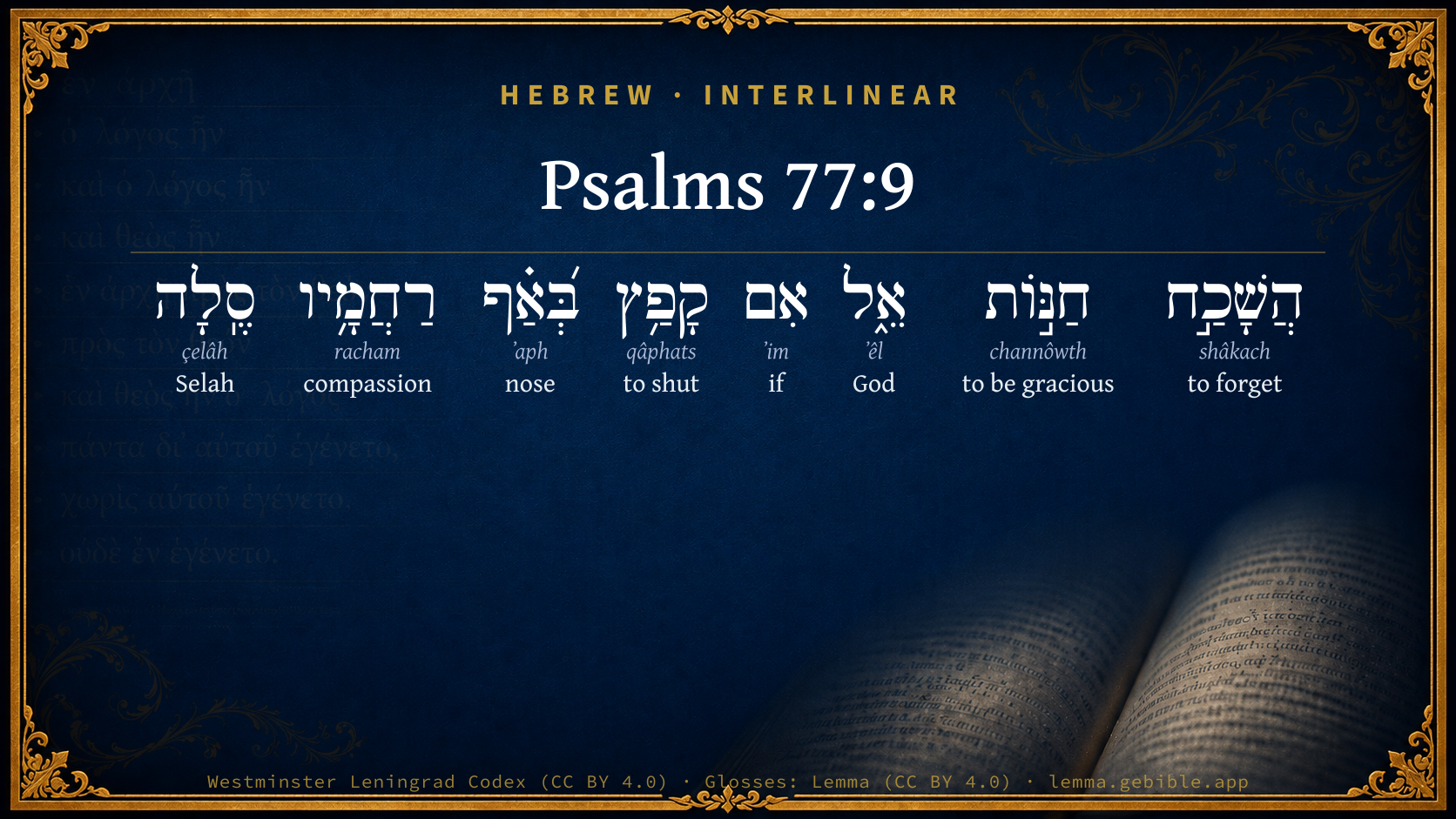
Psalms 77:9

Hebrew (Westminster Leningrad Codex) Psalms 77:9 appears in the Hebrew Old Testament. The text above is from the Westminster Leningrad Codex. Each word links to its Strong’s number, a concise gloss, and parsing drawn from the Open Scriptures Hebrew Bible morphology. Click any word for its full Brown-Driver-Briggs (BDB) entry.
Download image
Cite this verse

Psalms 77:9 (World English Bible). Public Domain. Lemma interlinear Bible study tool, https://lemma.gebible.app/v/psalms/77/9.

Show BibTeX & RIS
BibTeX
RIS
English Translation
Has God forgotten to be gracious? Has he, in anger, withheld his compassion?" Selah.
World English Bible · Public Domain
Highlights
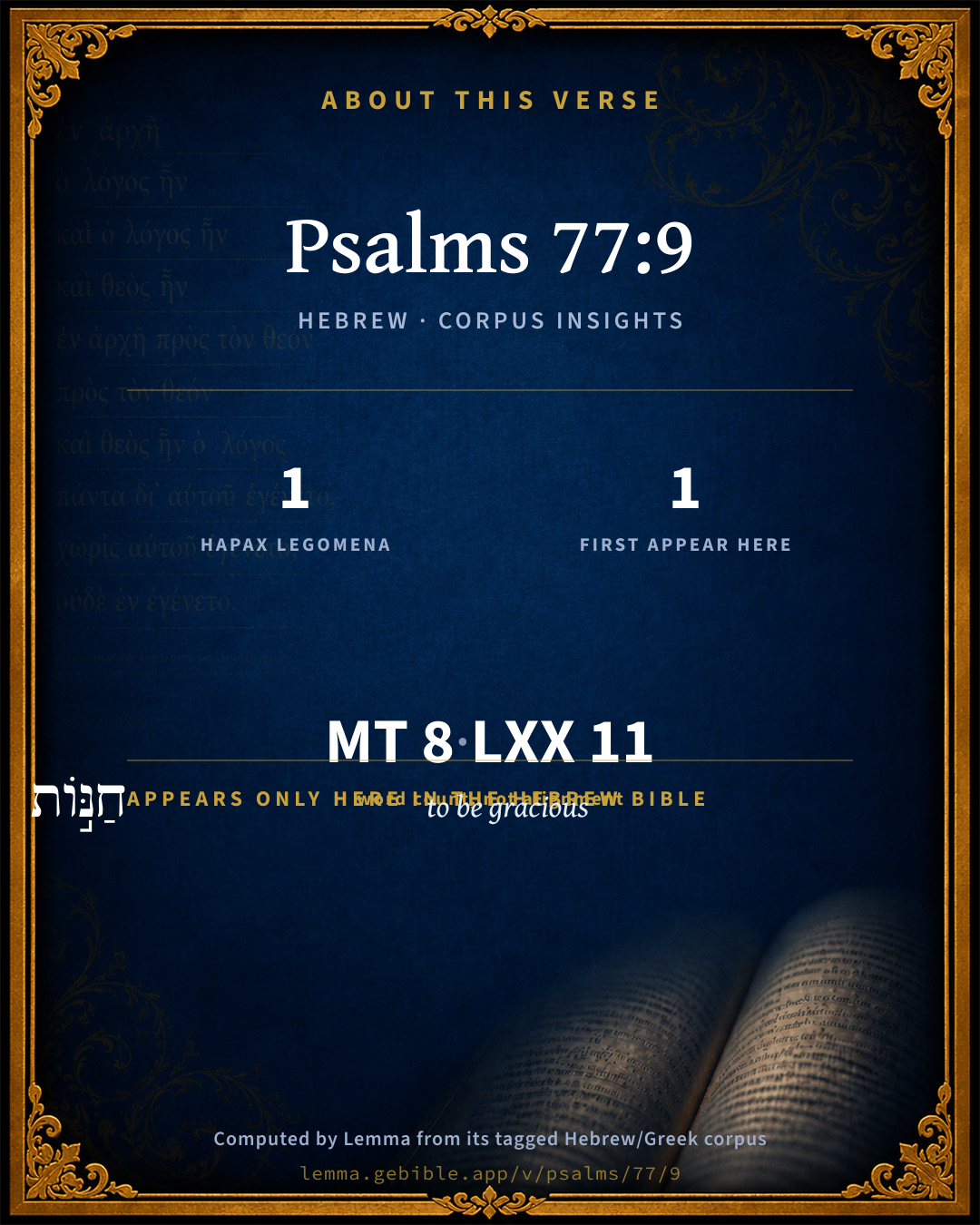
  • 1 hapax legomenon — only here in the Hebrew Bible
  • 1 first appearance in the Hebrew Bible
Full analysis ↓
Download a study sheet

One document with this verse’s original text, its word-by-word gloss line, the meaning frame, cross-references with their text, attributed commentary, and full source and license credits — printable, and it pastes into notes with its structure intact.

This verse Autodidact and up

Study sheet (.html) Plain text (.txt)

A passage Seminary Student

Up to 50 verses in one chapter. A passage sheet keeps up to 6 commentary sources and 12 cross-references per verse, in the order this page ranks them, and says so on the sheet whenever that leaves anything out. Ask for a single verse and you get the Autodidact verse sheet above.

Everything on this page stays free to read, with no account — the sheet is a download of what is already on screen, not access to it.

Want to remove ads? Support Godless Engineer
Compare translations 3

The same verse in 3 English versions, stacked beneath the original-language interlinear above. Click any original word for its lexicon entry.

Each is an independent rendering of the whole verse — the interlinear is not word-aligned to these translations.

Highlighted words mark where these versions differ — a whole-verse word diff, not a word-by-word alignment.

  • World English Bible Public Domain
    Has God forgotten to be gracious? Has he, in anger, withheld his compassion?" Selah.
  • King James Version Public Domain
    Hath God forgotten to be gracious? hath he in anger shut up his tender mercies? Selah.
  • unfoldingWord Literal Text CC BY-SA 4.0
    Has God forgotten to be gracious? Or has he shut up his compassions in nose? Selah

unfoldingWord Literal Text — © unfoldingWord, licensed CC BY-SA 4.0. Word-aligned USFM3 via Door43 (git.door43.org/unfoldingWord/en_ult).

Versions to compare (up to 4)

3 of 4 selected

Show all 18 translations

Every available English version of this verse, each an independent rendering of the whole verse.

  • World English Bible Public Domain
    Has God forgotten to be gracious? Has he, in anger, withheld his compassion?" Selah.
  • Berean Standard Bible Public Domain
    Has God forgotten to be gracious? Has His anger shut off His compassion?” Selah
  • Majority Standard Bible Public Domain
    Has God forgotten to be gracious? Has His anger shut off His compassion?” Selah
  • King James Version Public Domain
    Hath God forgotten to be gracious? hath he in anger shut up his tender mercies? Selah.
  • American Standard Version (1901) Public Domain
    Hath God forgotten to be gracious? Hath he in anger shut up his tender mercies? Selah
  • Revised Version (1885) Public Domain
    Hath God forgotten to be gracious? hath he in anger shut up his tender mercies? Selah
  • Geneva Bible (1599) Public Domain
    Hath God forgotten to be mercifull? hath he shut vp his teder mercies in displeasure? Selah.
  • Douay-Rheims (1899) Public Domain
    Or will he cut off his mercy for ever, from generation to generation?
  • Young's Literal Translation Public Domain
    Hath God forgotten `His' favours? Hath He shut up in anger His mercies? Selah.
  • Literal Standard Version CC BY-SA 4.0
    Has God forgotten [His] favors? Has He shut up His mercies in anger? Selah.
  • Unlocked Literal Bible CC BY-SA 4.0
    Had God forgotten to be gracious? Had his anger shut off his compassion? Selah
  • unfoldingWord Literal Text CC BY-SA 4.0
    Has God forgotten to be gracious? Or has he shut up his compassions in nose? Selah
  • Darby Bible Public Domain
    Hath ùGod forgotten to be gracious? or hath he in anger shut up his tender mercies? Selah.
  • World Messianic Bible Public Domain
    Has God forgotten to be gracious? Has he, in anger, withheld his compassion?” Selah.
  • Webster's Bible Public Domain
    \\77:8\\Is his mercy wholly gone for ever? doth his promise fail for evermore?
  • Free Bible Version CC BY-SA 4.0
    Has God forgotten to be kind? Has he angrily slammed the door shut on his compassion? Selah.
  • Bible in Basic English Public Domain
    Has God put away the memory of his pity? are his mercies shut up by his wrath? (Selah.)
  • JPS Tanakh (1917) Public Domain
    (77-10) Hath God forgotten to be gracious? Hath He in anger shut up his compassions?' Selah

Literal Standard Version (2020), Covenant Press — licensed CC BY-SA 4.0. Text via the HelloAO Bible API (eBible.org). Unlocked Literal Bible (unfoldingWord) — licensed CC BY-SA 4.0. Text via the HelloAO Bible API (eBible.org). unfoldingWord Literal Text — © unfoldingWord, licensed CC BY-SA 4.0. Word-aligned USFM3 via Door43 (git.door43.org/unfoldingWord/en_ult). Free Bible Version, Dr. Jonathan Gallagher — licensed CC BY-SA 4.0. Text via the HelloAO Bible API (eBible.org).

Word by word

More ways to search: Search by grammar → Find every occurrence → Compare this word →

Practice this passage: Drill this verse → Learn its vocabulary →

About this verse

These counts appear in no published source. They are computed here, from the morphology-tagged text and Lemma’s own curated glosses. What Lemma adds →

8
words
8
distinct lemmas
Wisdom
section

Notable vocabulary

1 hapax legomenon — a word that appears only here in the entire Hebrew Bible:

  • חַנּ֣וֹת to be gracious H2589

First appearance in Scripture

This word makes its first canonical appearance in the Hebrew Bible here:

  • חַנּ֣וֹת to be gracious H2589

Shared distinctive vocabulary

קָפַ֥ץ to shut H7092 occurs in 7 verses of the Hebrew Bible. Also found in:

Grammatical profile

  • 3 verbs
  • 3 nouns
  • 1 conjunction
  • 1 particle

Verb forms

  • הֲשָׁכַ֣ח Qal · Perfect
  • חַנּ֣וֹת Piel · Infinitive Construct
  • קָפַ֥ץ Qal · Perfect

Hebrew & Septuagint length

In English translation the verse runs 14 words from the Hebrew and 16 from the Septuagint (LXX English) — closely comparable.

A rough comparison of the two English renderings, which tokenize alike — not a word-level alignment.

Word counts can differ between the Hebrew and the Greek without any difference in meaning — e.g. the Hebrew direct-object marker אֵת has no separate Greek word, and Greek often adds the article ὁ.

In the original languages it is 8 Hebrew tokens and 11 Greek tokens — but the two are counted differently (Hebrew bundles its prefixes and suffixes into one token; the Greek is in lemma form), so that isn’t a like-for-like length.

Cross-references

9

Topical passages linked to Psalms 77:9 in the Treasury of Scripture Knowledge — connected by theme and wording, ordered by reader-vote popularity; previews shown in the World English Bible.

  • Isaiah 49:14–15 But Zion said, Yahweh has forsaken me, and the Lord has forgotten me.
  • Psalms 40:11 Don't withhold your tender mercies from me, Yahweh. Let your loving kindness and your truth continually preserve me.
  • Psalms 25:6 Yahweh, remember your tender mercies and your loving kindness, For they are from old times.
  • Psalms 51:1 Have mercy on me, God, according to your loving kindness. According to the multitude of your tender mercies, blot out my transgressions.
  • Isaiah 40:27 Why say you, Jacob, and speak, Israel, My way is hid from Yahweh, and the justice [due] to me is passed away from my God?
  • Isaiah 63:15 Look down from heaven, and see from the habitation of your holiness and of your glory: where are your zeal and your mighty acts? the yearning of your heart and your compassion is restrained toward me.
  • Luke 13:25–28 When once the master of the house has risen up, and has shut the door, and you begin to stand outside, and to knock at the door, saying, 'Lord, Lord, open to us!' then he will answer and tell you, 'I don't know you or where you come from.'
  • Romans 11:32 For God has shut up all to disobedience, that he might have mercy on all.
  • 1 John 3:17 But whoever has the world's goods, and sees his brother in need, and closes his heart of compassion against him, how does the love of God remain in him?

Cross-references courtesy of OpenBible.info (CC BY 4.0).

Hebrew and Greek witnesses Masoretic Hebrew ↔ Greek Septuagint

The same verse in the two great witnesses to the Old Testament, shown verse-for-verse.

You’re reading Greek Psalm 76 (Hebrew Psalm 77). The Septuagint counts the superscription, so verse numbers can differ from the Hebrew — chapter-level alignment, not verse-by-verse. Numbering follows Rahlfs.

These are two independent witnesses, not word-aligned to each other, and the Septuagint is shown in lemma (dictionary) form.

Hebrew Psalms 77:9 Masoretic · Westminster Leningrad Codex

הֲשָׁכַ֣ח חַנּ֣וֹת אֵ֑ל אִם קָפַ֥ץ בְּ֝אַ֗ף רַחֲמָ֥יו סֶֽלָה

Has God forgotten to be gracious? Has he, in anger, withheld his compassion?" Selah.

World English Bible · Public Domain

Greek LXX Greek Psalm 76:9 Septuagint · lemma form

ἤ εἰς τέλος ὁ ἔλεος αὐτός ἀποκόπτω ἀπό γενεά εἰς γενεά

Will God forget to pity? or will he shut up his compassions in his wrath? Pause.

LXX2012 (modern English Septuagint) · Public Domain

Hebrew: Westminster Leningrad Codex (CC BY 4.0). Greek: Septuagint (public domain); English from LXX2012 (modern English Septuagint) (Public Domain). How the Septuagint differs from the Hebrew →

Commentary

Notes on Psalms 77:9 from classic Christian and Jewish commentators (each source and its license shown beneath its notes). The classic Christian expositions comment on the surrounding passage and are grouped to its opening verse, so a note may address several verses; the Jewish commentaries on the Tanakh (Rashi and others) are per-verse, so they appear only where the commentator wrote on this verse.

Lemma curates 59 commentaries, every one of them public domain or Creative Commons licensed, each selected and text-cleaned for this edition rather than reprinted as found. About our sources →

Trapp's Complete Commentary

John Trapp

Psa 77:9 Hath God forgotten to be gracious? hath he in anger shut up his tender mercies? Selah.

Ver. 9. Hath God forgotten to be gracious?] So it seemeth sometimes to those that are long afflicted and short-spirited; but what saith the prophet? Can a woman forget her sucking child, that she should not have compassion on the son of her womb? yea, they may forget, they may prove unnatural, and grow out of kind, as Medea, and those Suevian women (Heyl. Geog.), who threw their young children at the Romans, under the conduct of Drusus, son-in-law to Augustus, instead of darts, yet God will not forget his people, Isa 49:15. Indeed, he can as soon forget himself, and change his nature.

Hath he in anger shut up his tender mercies?] These things the psalmist speaketh not as utterly despairing, but as one courageously, wrestling against an old manslayer, and a misgiving heart of his own. Homines vero securi, et voluptatibus ebrii, nihil horum intelllgunt. This is little understood by profane sensualists, who, therefore, reap no great benefit by the reading of these psalms.

John Trapp, A Commentary or Exposition upon All the Books of the Old and New Testament (1647–1656) — public domain. Text from a community e-Sword module.

The Biblical Illustrator

Joseph S. Exell

Psa_77:9

Hath God forgotten to be gracious?

A question for a questioner

The question before us is what the logician would call a reductio ad absurdum; it reduces doubt to an absurdity; it puts into plain words the thought of an unbelieving mind, and at once it is seen to be a horrible notion. Hath God forgotten? We stumble at the first word. How can God forget? Hath God forgotten to be? We snap the question at that point, and it is blasphemous. It is no better when we give it as a whole--Hath God forgotten to be gracious? The bare idea is bold, ridiculous and blasphemous.

I. To the man of God in distress this question is commended, Hath God forgotten to be gracious? What kind of distress is that which suggests such a question? Where had Asaph been? In what darkness had he wandered? I answer, first, this good man had been troubled by unanswered prayers. In the day of my trouble I sought the Lord; and he seems to say that though he sought the Lord his griefs were not removed. He was in darkness, and he craved for light, but not a star shone forth. Nothing is more grievous to the sincere pleader than to feel that his petitions are not heeded by his God. Besides that, he was enduring continual suffering. My sore ran in the night. When Asaph had prayed for relief, and the relief did not come, the temptation came to him to ask, Am I always to suffer? Will the Lord never relieve me? It is written, He healeth the broken in heart, and bindeth up their wounds; has He ceased from that sacred surgery? Hath God forgotten to be gracious? In addition to this, the man of God was in a state of mind in which his depression had become inveterate. He says, My soul refused to be comforted. Many plasters were at hand, but he could not lay them upon the wound. More than that, there seemed to be a failure of the means of grace for him. I remembered God, and was troubled. Some of Gods people go up to the house of the Lord where they were accustomed to unite in worship with delight, but they have no delight now; they even go to the communion-table, and eat the bread and drink the wine, but they do not receive the body and blood of Christ to the joy of their faith. At the back of all this there was another trouble for Asaph, namely, that he could not sleep. He says, Thou holdest mine eyes waking. It seemed as if the Lord Himself held up his eyelids, and would not let them close in sleep. Moreover, there was one thing more: he lost the faculty of telling out his grief: I am so troubled that I cannot speak. To be compelled to silence is a terrible increase to anguish: the torrent is swollen when its free course is prevented. A dumb sorrow is sorrow indeed. Now, let us attend to the amendment of the question. Shall I tell thee what the true question is which thou oughtest to ask thyself? It is not, Hath God forgotten to be gracious? but Hast thou forgotten to be grateful? Why, thou enjoyest many mercies even now. Grace is all around thee, if thou wilt but open thine eyes, or thine ears. Thou hadst not been spared after so much sin if God had forgotten to be gracious.

II. The seeking sinner in despondency. He makes you nothing that He may be all in all to you. He grinds you to the dust that He may lift you out of it for ever. Meanwhile, I do not wonder that the question crosses your mind, Hath God forgotten to be gracious? Let me show how wrong the question is. Hath God forgotten to be gracious? If He has, He has forgotten what He used to know right well. Hath God forgotten to be gracious? Then, why are all the old arrangements for grace still standing? There is the mercy-seat; surely that would have been taken away if God had forgotten to be gracious. The Gospel is preached to you, and this is its assurance, Whosoever believeth in Him is not condemned.

III. The disappointed worker. You say, I do not feel as if I could preach; the matter does not flow. I do not feel as if I could teach; I search for instruction, and the more I pull the more I cannot get it. Hath God forgotten to be gracious? Can He not fill thine empty vessel again? Can He not give thee stores of thought, emotion, and language? Oh, perhaps you say, I work in a back street, and everybody is moving out into the suburbs. You have lost your friends, and they have forgotten you; but, Hath God forgotten to be gracious? You can succeed so long as the Lord is with you. Be of good courage; your best friend is left. He who made a speech in the Academy found that all his hearers had gone except Plato; but as Plato remained, the orator finished his address. They asked him how he could continue under the circumstances, and he replied that Plato was enough for an audience. So, if God be pleased with you, go on; the Divine pleasure is more than sufficient. The Lord of hosts is with us; the God of Jacob is our refuge. Did not Wesley say when he was dying, The best of all is, God is with us? (C. H. Spurgeon.)

Hath God forgotten to be gracious?

I. All complaints against providence proceed from weakness and the infirmity of human reason.

1. The first of this sort, which naturally presents itself to the mind, when we consider God and ourselves, is this, That God is too great and too excellent a Being to humble Himself to behold the things that are on earth Epicurus and his followers, who denied Gods government of the world, denied also that He made it. So far, at least, they were consistent; for, if they thought it too much trouble for God to govern the world, they could not consistently put Him to the trouble of making it. But if we turn the argument, and begin with considering the works of the creation and call to remembrance those years of the right hand of the Most High, we shall from these works of God be led to just conclusions with respect to the methods of Divine Providence, less obvious to our observation, in the government of the world.

2. Another reason which some have for suspecting that the affairs of the world are not under the conduct of Providence, is, that they cannot discern any certain marks of God.s interposing. On the contrary, they think it evident that, all the inanimate and irrational parts of the world follow a certain course of nature invariably; and that men act with all the signs of being given up to follow their own devices, without being either directed or restrained by a superior power. But in this way of reasoning there are two great mistakes--

(1) That the conclusion is not, rightly drawn from the observation, supposing the observation to be true.

(2) Supposing the conclusion to be true, it, will not answer the purpose intended. And whatever inequalities may appear to us in the distribution of good or evil in this life, they cannot stand as objections to Gods government over the world, unless you can prove that there will be no day of reckoning hereafter.

II. A settled peace of mind, with respect to God, must arise from a due contemplation of the great works of providence, which God has laid open to our view for our consideration and instruction. Happy are they who listen to this still voice! they will act not only the safest, but the most rational part; whilst others, full of themselves and their own wisdom, are daily condemning what they do not understand. And if ever they recover their right reason, the first, step must be to see their weakness, and to join wit.h the psalmist, in his humble confession, It is my own infirmity. (Bp. Sherlock.)

Adversity comes not always from Divine displeasure

Let us rest assured of this, that the roughest of Gods proceedings do not always issue from an angry intention: it is very possible, because very usual, that they may proceed from the clean contrary. The same clouds which God made use of heretofore to drown the earth, He employs now to refresh it. He may use the same means to correct and to better some that He does to plague and punish others. The same hand and hatchet that cuts some trees for the fire may cut others into growth, verdure, and fertility. (R. South, D. D.)

The Biblical Illustrator, edited by Joseph S. Exell (c. 1880s–1900s) — public domain. Text from a community e-Sword module.

J. A. Alexander on Psalms

Joseph Addison Alexander

10. (Psa 77:9). Has the Mighty (One) forgotten to be gracious, or closed in wrath, his mercies? Selah. The use of the divine name El is here significant, as if it had been asked, does the goodness of God no longer bear proportion to his greatness? The verb translated closed is one found only in poetical style. The original expression for his mercies suggests the idea of his bowels, according to the idiom which represents the viscera as the seat of the ten-derest affections.

Joseph Addison Alexander, The Psalms Translated and Explained (1850) — public domain. Text from a community e-Sword module.

Adam Clarke's Commentary

Verse 9. Hath God - in anger shut up his tender mercies?] The tender mercies of God are the source whence all his kindness to the children of men flows. The metaphor here is taken from a spring, the mouth of which is closed, so that its waters can no longer run in the same channel; but, being confined, break out, and take some other course. Wilt thou take thy mercy from the Israelites, and give it to some other people? This he most certainly did. He took it from the Jews, and gave it to the Gentiles.

Adam Clarke's Commentary on the Bible (1810–1826) — public domain. Text from a community e-Sword/MySword module.

John Calvin's Commentaries

9. Hath God forgotten to be merciful? The prophet still continues debating with himself the same subject. His object, however, is not to overthrow his faith, but rather to raise it up. He does not put this question, as if the point to which it refers were a doubtful matter. It is as if he had said, Hath God forgotten himself? or, hath he changed his nature? for he cannot be God unless he is merciful. I indeed admit that he did not remain unshaken as if he had had a heart of steel. But the more violently he was assailed, the more firmly did he lean upon the truth, That the goodness of God is so inseparably connected with his essence as to render it impossible for him not to be merciful. Whenever, therefore, doubts enter into our minds upon our being harassed with cares, and oppressed with sorrows, let us learn always to endeavor to arrive at a satisfactory answer to this question, Has God changed his nature so as to be no longer merciful? The last clause, Hath he shut up or restrained his compassions in his anger? is to the same effect. It was a very common and notable observation among the holy patriarchs, That God is long — suffering, slow to wrath, ready to forgive, and easy to be entreated. It was from them that Habakkuk derived the statement which he makes in his song,

“Even in his anger he will be mindful of his mercy.” (Habakkuk 3:2)

The prophet, then, here comes to the conclusion, that the chastisement which he felt would not prevent God from being again reconciled to him, and returning to his wonted manner of bestowing blessings upon him, since his anger towards his own people endures only for a moment. Yea, although God manifests the tokens of his anger, he does not cease most tenderly to love those whom he chastises. His wrath, it its true, rests continually upon the reprobate; but the prophet, accounting himself among the number of God’s children, and speaking of other genuine believers, justly argues from the impossibility of the thing, that the temporary displeasure of God cannot break off the course of his goodness and mercy.

John Calvin's Commentaries (1540-1563) — public domain. Text from the Calvin Translation Society English edition (1840s-50s) via the Christian Classics Ethereal Library (ccel.org). Calvin's coverage is partial (roughly two-thirds of the Bible); uncommented books and verses are honest gaps, never fabricated. The 19th-century editor's footnotes and remarks are omitted so the notes are faithfully Calvin's own voice.

The Cambridge Bible for Schools and Colleges

gen. ed. J. J. S. Perowne

9. Has He forgotten or deliberately abandoned those attributes which He once proclaimed as the essence of His Nature (Exo_34:6)? Cp. Hab_3:2, “In wrath wilt thou remember mercy.”

The Cambridge Bible for Schools and Colleges (gen. ed. J. J. S. Perowne; Cambridge University Press, 1878–1918) — public domain. Text from a community e-Sword module.

John Gill's Exposition

Hath God forgotten to be gracious,.... He has not, is it possible that he should? as the Targum; it is not; he cannot forget the purposes of his grace and mercy, nor the covenant and promises of it, nor people the objects of it; and much less can he for his grace and mercy itself, so agreeable to his nature, what he delights in, and which he has proclaimed in Christ:

hath he in anger shut up his tender mercies?; as an avaricious man shuts up his hand, and will not communicate liberally; or as the sea is shut up with doors, that its waters may not overflow; no, the mercies of God are not restrained, though unbelief says they are, at least queries if they are not, Isa 63:15, but Faith says they flow freely through Christ, and the people of God are crowned with lovingkindness and tender mercies; God gives liberally, and upbraideth not; and though he may hide his face in a little seeming wrath for a moment, yet with great mercies will he gather, and with everlasting kindness will he have mercy.

Selah. See Gill on Psa 3:2.

John Gill's Exposition of the Whole Bible (1746–1763) — public domain (CC PDM 1.0). Text via the HelloAO Bible API.

Albert Barnes' Notes on the Bible

Hath God forgotten to be gracious? - Has he passed over mercy in administering his government? Has he ceased to remember that man needs mercy? Has he forgotten that this is an attribute of his own nature?

Hath he in anger shut up his tender mercies? - The original word here rendered “tender mercies” refers to the “bowels,” as the seat of compassion or mercy, in accordance with a usage common in Hebrew. See Psa 25:6, note; Isa 16:11, note; Isa 63:15, note. Compare Luk 1:78 (in Greek); Phi 1:8; Phi 2:1; 1Jo 3:17. We speak of the “heart” as the seat of affection and kindness. The Hebrews included the heart, but they used a more general word. The word rendered “shut up” means “closed;” and the question is whether his mercy was closed, or had ceased forever. The psalmist concludes that if this were done, it must be as the result of anger - anger in view of the sins of people.

Albert Barnes' Notes on the Bible (1834–1885) — public domain. Text from a community e-Sword/MySword module.

Matthew Poole's English Annotations

Hath God forgotten to be gracious, because he hath so long disused it?

Hath he in anger shut up his tender mercies, so as they can never flow forth, no, not to his own people?

Matthew Poole's English Annotations on the Holy Bible (1683–1685) — public domain. Text from a community e-Sword/MySword module.

The Treasury of David

Charles H. Spurgeon

Ver. 9. Hath God forgotten to be gracious? Has El, the Mighty One, become great in everything but grace? Does he know how to afflict, but not how to uphold? Can he forget anything? Above all, can he forget to exercise that attribute which lies nearest to his essence, for he is love?

Hath he in anger shut up his tender mercies? Are the pipes of goodness choked up so that love can no more flow through them? Do the bowels of Jehovah no longer yearn towards his own beloved children? Thus with cord after cord unbelief is smitten and driven out of the soul; it raises questions and we will meet it with questions: it makes us think and act ridiculously, and we will heap scorn upon it. The argument of this passage assumes very much the form of a reductio ad absurdam. Strip it naked, and mistrust is a monstrous piece of folly.

Selah. Here rest awhile, for the battle of questions needs a lull.

Whole Psalm. See Psalms on "Ps 77:1" for further information.

Ver. 9. Hath God forgotten to be gracious? In what pangs couldest thou be, O Asaph, that so woeful a word should fall from thee: Hath God forgotten to be gracious? Surely, the temptation went so high, that the next step had been blasphemy. Had not that good God, whom thy bold weakness questions for forgetfulness, in great mercies remembered thee, and brought thee speedily to remember thyself and him; that, which you confess to have been infirmity, had proved a sinful despair. I dare say for thee, that word washed thy cheeks with many a tear, and was worthy of more; for, O God, what can be so dear to thee, as the glory of thy mercy? There is none of thy blessed attributes, which thou desirest to set forth so much unto the sons of men, and so much abhorrest to be disparaged by our detraction, as thy mercy. Thou canst, O Lord, forget thy displeasure against thy people; thou canst forget our iniquities, and cast our sins out of thy remembrance, Mic 7:18-19; but thou canst no more forget to be gracious, than thou canst cease to be thyself. O my God, I sin against thy justice hourly, and thy mercy interposes for my remission: but, oh, keep me from sinning against thy mercy. What plea can I hope for, when I have made my advocate my enemy? Joseph Hall.

Ver. 9. Hath God forgotten to be gracious? The poor child crieth after the mother. What shall I do for my mother! Oh, my mother, my mother, what shall I do for my mother! And it may be the mother stands behind the back of the child, only she hides herself, to try the affection of the child: so the poor soul cries after God, and complains, Oh my Father! my Father! Where is my heavenly Father? Hath he forgotten to be gracious? Hath he shut up his lovingkindness in displeasure? when, (all the while), God is nearer than they think for, shining upon them in "a spirit of grace and supplications, "with sighs and "groans that cannot be uttered." Thus the gracious woman, weeps: My dear Saviour, my dear Lord and Master, he is "taken out of the sepulchre, and I know not where they have laid him!" Thus she complains to the disciples, and thus she complains to the angels, when Christ stood at her very back and overheard all: nay, when she turned her about and saw him, yet at first she did not know him; nay, when he spoke to her and she to him, yet she knew him not, but thought he had been the gardener, Joh 20:15. Thus it is with many a gracious soul; though God speaks home to their hearts in his Word, and they speak to him by prayer, and they cannot say but the Spirit "helps their infirmities; "yet they complain for want of his presence, as if there were nothing of God in them. Matthew Lawrence.

Ver. 9. Hath he in anger shut up his tender mercies? The metaphor here is taken from a spring, the mouth of which is closed, so that its waters can no longer run in the same channel; but, being confined, break out and take some other course. Wilt thou take thy mercy from the Israelites and give it to some other people? Adam Clarke.

Ver. 9. Selah. Thus was he going on with his dark and dismal apprehensions, when on a sudden he first checked himself with that word, Selah; stop there; go no further; let us hear no more of these unbelieving surmises; and then he chid himself, Ps 77:10: This is mine infirmity. Matthew Henry.

None.

Psalms 77:10*

Charles H. Spurgeon's The Treasury of David (1869–1885) — public domain. Psalms only. Text from a community e-Sword/MySword module.

Whedon's Commentary on the Bible

Daniel D. Whedon

9. Forgotten to be gracious… shut up his tender mercies— “He asks whether it is, then, all at an end with God’s loving-kindness and promise, at the same time saying to himself that this, nevertheless, is at variance with the unchangeableness of his nature and the inviolability of his covenant.”— Delitzsch. Here end the dark questionings of his agitated mind.

Daniel D. Whedon (gen. ed.), Commentary on the Old and New Testaments (1874–1909) — public domain. Text from a community e-Sword module.

The Pulpit Commentary

Hath God forgotten to be gracious? Can God, who forgets nothing and no one, (Isa_49:15) have forgotten his own nature, which is to be "merciful and gracious, long suffering, and abundant in goodness"? (Exo_34:6) Assuredly not. The higher nature in the psalmist, as Professor Cheyne observes, expostulates with the lower one. Hath he in anger shut up his tender mercies? Has he shut them up, "as in a closed hand" (Kay, Canon Cook)? (comp. Deu_15:7)

The Pulpit Commentary (1880–1919), ed. H.D.M. Spence-Jones & Joseph S. Exell — public domain. Text from a community e-Sword module.

Rashi

Rabbi Shlomo Yitzchaki (Rashi)

Has...ended forever Perhaps His kind acts have ended?

Has He issued a decree a perpetual decree that He will never again repent of His anger?

Rashi on the Tanakh — English translations: “The Judaica Press complete Tanach with Rashi, translated by A. J. Rosenberg” (CC BY 4.0); “Pentateuch with Rashi's commentary by M. Rosenbaum and A.M. Silbermann, 1929-1934” (public domain); “The Metsudah Tanach series, Lakewood, N.J” (CC BY 4.0); and “The Book of Joshua, Metsudah Publications, 1997” (CC BY 4.0). Text via Sefaria.

Lesson kit

Teaching starters — assembled from the data on this page, not authored interpretation. Every prompt links to the verse data it draws on. Edit before teaching.

Psalms, in the Wisdom, opens this verse with 8 words (8 distinct Hebrew lemmas). Its most distinctive word is channôwth (“to be gracious”). A historical commentator’s framing appears above. Read the whole chapter for the surrounding context.

Discussion questions

  1. What does “to be gracious” (channôwth) contribute to the verse as a whole?
  2. 1 word here appears nowhere else in the Hebrew Bible. Why might the author reach for such rare wording?
  3. This is the first place “to be gracious” appears in Scripture (first appears here). What does its debut here establish?
  4. How does Deuteronomy 15:7, which shares the word «to shut», read alongside this verse?
  5. These translations render this verse differently; the difference is in the English rendering, not the original. What questions does that raise?
  6. «הֲשָׁכַ֣ח» is a Qal Perfect verb. How does that grammatical form shape the action described?
  7. Compare how Trapp's Complete Commentary and The Biblical Illustrator read this verse. Where do they agree or differ?

Things to notice

Reading settings

Reading text

Shown beneath each verse's original-language words.

Old Testament
Old Testament edition

Read the OT as the Masoretic Hebrew (MT) or the Greek Septuagint (LXX).

English shown for the Greek Septuagint (in the Hebrew ↔ Greek comparison).

Comparing translations? Open the Compare panel on any verse page to stack up to four side by side.