
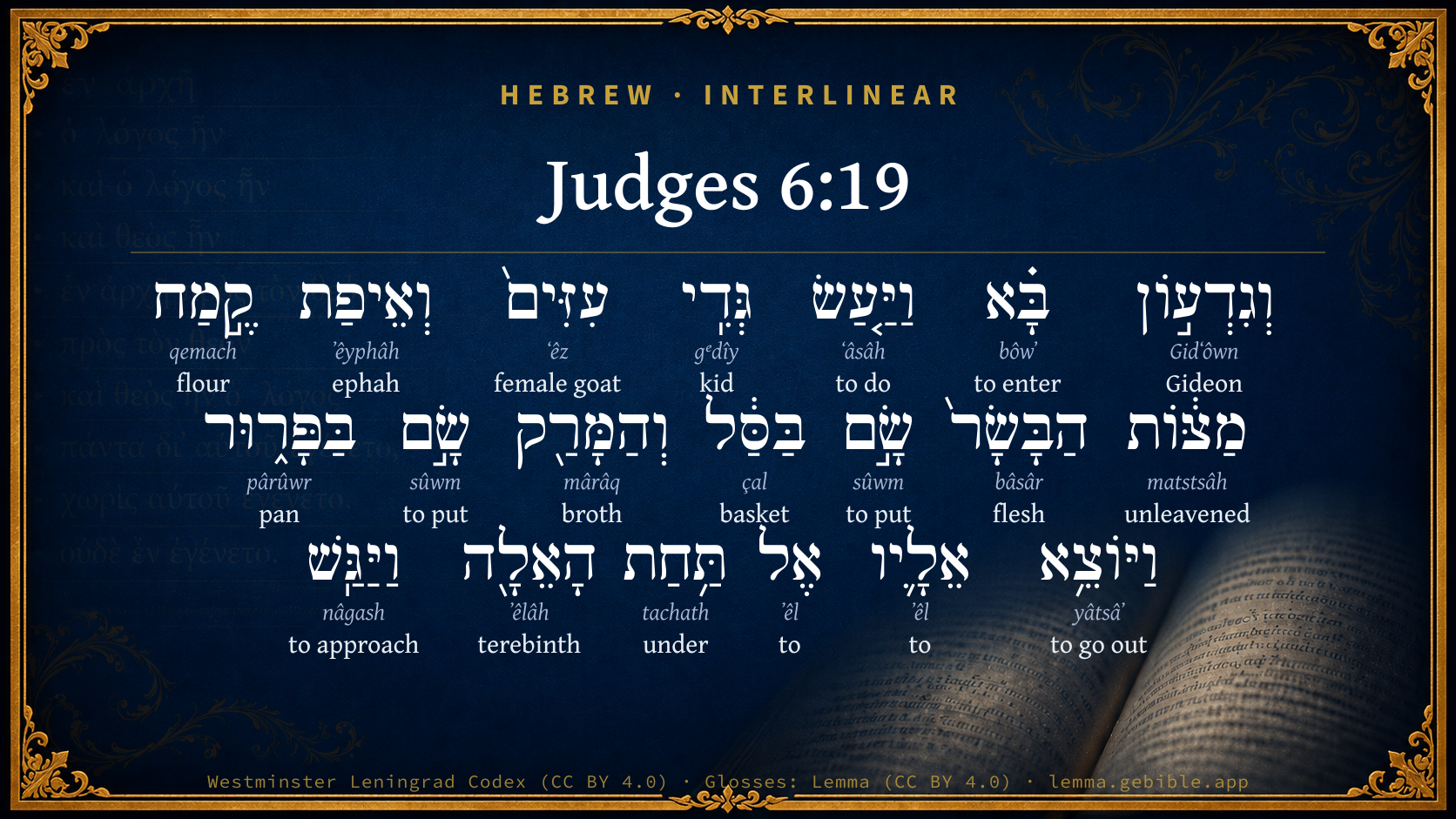
Judges 6:19

Hebrew (Westminster Leningrad Codex) Judges 6:19 appears in the Hebrew Old Testament. The text above is from the Westminster Leningrad Codex. Each word links to its Strong’s number, a concise gloss, and parsing drawn from the Open Scriptures Hebrew Bible morphology. Click any word for its full Brown-Driver-Briggs (BDB) entry.
Download image
Cite this verse

Judges 6:19 (World English Bible). Public Domain. Lemma interlinear Bible study tool, https://lemma.gebible.app/v/judges/6/19.

Show BibTeX & RIS
BibTeX
RIS
English Translation
Gideon went in, and made ready a kid, and unleavened cakes of an ephah of meal: the flesh he put in a basket, and he put the broth in a pot, and brought it out to him under the oak, and presented it.
World English Bible · Public Domain
Highlights
  • 1 first appearance in the Hebrew Bible
Full analysis ↓
Download a study sheet

One document with this verse’s original text, its word-by-word gloss line, the meaning frame, cross-references with their text, attributed commentary, and full source and license credits — printable, and it pastes into notes with its structure intact.

This verse Autodidact and up

Study sheet (.html) Plain text (.txt)

A passage Seminary Student

Up to 50 verses in one chapter. A passage sheet keeps up to 6 commentary sources and 12 cross-references per verse, in the order this page ranks them, and says so on the sheet whenever that leaves anything out. Ask for a single verse and you get the Autodidact verse sheet above.

Everything on this page stays free to read, with no account — the sheet is a download of what is already on screen, not access to it.

Want to remove ads? Support Godless Engineer
Compare translations 3

The same verse in 3 English versions, stacked beneath the original-language interlinear above. Click any original word for its lexicon entry.

Each is an independent rendering of the whole verse — the interlinear is not word-aligned to these translations.

Highlighted words mark where these versions differ — a whole-verse word diff, not a word-by-word alignment.

  • World English Bible Public Domain
    Gideon went in, and made ready a kid, and unleavened cakes of an ephah of meal: the flesh he put in a basket, and he put the broth in a pot, and brought it out to him under the oak, and presented it.
  • King James Version Public Domain
    And Gideon went in, and made ready a kid, and unleavened cakes of an ephah of flour: the flesh he put in a basket, and he put the broth in a pot, and brought it out unto him under the oak, and presented it.
  • unfoldingWord Literal Text CC BY-SA 4.0
    Then Gideon went and he prepared a kid of goats and, an ephah of flour, unleavened bread. The meat, he put in a basket, and the broth, he put in a pot. And he brought out to him at under the oak tree, and he presented.

unfoldingWord Literal Text — © unfoldingWord, licensed CC BY-SA 4.0. Word-aligned USFM3 via Door43 (git.door43.org/unfoldingWord/en_ult).

Versions to compare (up to 4)

3 of 4 selected

Show all 18 translations

Every available English version of this verse, each an independent rendering of the whole verse.

  • World English Bible Public Domain
    Gideon went in, and made ready a kid, and unleavened cakes of an ephah of meal: the flesh he put in a basket, and he put the broth in a pot, and brought it out to him under the oak, and presented it.
  • Berean Standard Bible Public Domain
    So Gideon went in and prepared a young goat and unleavened bread and an ephah of flour. He placed the meat in a basket and the broth in a pot and brought them out to present to Him under the oak.
  • Majority Standard Bible Public Domain
    So Gideon went in and prepared a young goat and unleavened bread and an ephah of flour. He placed the meat in a basket and the broth in a pot and brought them out to present to Him under the oak.
  • King James Version Public Domain
    And Gideon went in, and made ready a kid, and unleavened cakes of an ephah of flour: the flesh he put in a basket, and he put the broth in a pot, and brought it out unto him under the oak, and presented it.
  • American Standard Version (1901) Public Domain
    And Gideon went in, and made ready a kid, and unleavened cakes of an ephah of meal: the flesh he put in a basket, and he put the broth in a pot, and brought it out unto him under the oak, and presented it.
  • Revised Version (1885) Public Domain
    And Gideon went in, and made ready a kid, and unleavened cakes of an ephah of meal: the flesh he put in a basket, and he put the broth in a pot, and brought it out unto him under the oak, and presented it.
  • Geneva Bible (1599) Public Domain
    Then Gideon went in, and made ready a kidde, and vnleauened bread of an Ephah of floure, and put the flesh in a basket, and put the broth in a pot, and brought it out vnto him vnder the oke, and presented it.
  • Douay-Rheims (1899) Public Domain
    And depart not hence, till I return to thee, and bring a sacrifice, and offer it to thee. And he answered: I will wait thy coming.
  • Young's Literal Translation Public Domain
    And Gideon hath gone in, and prepareth a kid of the goats, and of an ephah of flour unleavened things; the flesh he hath put in a basket, and the broth he hath put in a pot, and he bringeth out unto Him, unto the place of the oak, and bringeth `it' nigh.
  • Literal Standard Version CC BY-SA 4.0
    And Gideon has gone in, and prepares a kid of the goats, and an ephah of flour [worth] of unleavened things; he has put the flesh in a basket, and he has put the broth in a pot, and he brings [them] out to Him, to the place of the oak, and brings [them] near.
  • Unlocked Literal Bible CC BY-SA 4.0
    Gideon went and prepared a young goat and from an ephah of flour he made unleavened bread. He put the meat in a basket, and he put the broth in a pot and brought them to him under the oak tree, and presented them.
  • unfoldingWord Literal Text CC BY-SA 4.0
    Then Gideon went and he prepared a kid of goats and, an ephah of flour, unleavened bread. The meat, he put in a basket, and the broth, he put in a pot. And he brought out to him at under the oak tree, and he presented.
  • Darby Bible Public Domain
    So Gideon went into his house and prepared a kid, and unleavened cakes from an ephah of flour; the meat he put in a basket, and the broth he put in a pot, and brought them to him under the oak and presented them.
  • World Messianic Bible Public Domain
    Gideon went in and prepared a young goat and unleavened cakes of an efah of meal. He put the meat in a basket and he put the broth in a pot, and brought it out to him under the oak, and presented it.
  • Webster's Bible Public Domain
    And Gideon went in, and made ready a kid, and unleavened cakes of an ephah of flour: the flesh he put in a basket, and he put the broth in a pot, and brought it out to him under the oak, and presented it.
  • Free Bible Version CC BY-SA 4.0
    Gideon went and cooked a young goat, and baked some unleavened bread from an ephah of flour. He put the meat in a basket and the broth in a pot. He carried them out and presented them to the angel under the oak tree.
  • Bible in Basic English Public Domain
    Then Gideon went in and made ready a young goat, and with an ephah of meal he made unleavened cakes: he put the meat in a basket and the soup in which it had been cooked he put in a pot, and he took it out to him under the oak-tree and gave it to him there.
  • JPS Tanakh (1917) Public Domain
    And Gideon went in, and made ready a kid, and unleavened cakes of an ephah of meal; the flesh he put in a basket, and he put the broth in a pot, and brought it out unto him under the terebinth, and presented it.

Literal Standard Version (2020), Covenant Press — licensed CC BY-SA 4.0. Text via the HelloAO Bible API (eBible.org). Unlocked Literal Bible (unfoldingWord) — licensed CC BY-SA 4.0. Text via the HelloAO Bible API (eBible.org). unfoldingWord Literal Text — © unfoldingWord, licensed CC BY-SA 4.0. Word-aligned USFM3 via Door43 (git.door43.org/unfoldingWord/en_ult). Free Bible Version, Dr. Jonathan Gallagher — licensed CC BY-SA 4.0. Text via the HelloAO Bible API (eBible.org).

Word by word

More ways to search: Search by grammar → Find every occurrence → Compare this word →

Practice this passage: Drill this verse → Learn its vocabulary →

וְהַמָּרַ֖ק
mârâq
H4839
“and · the · broth”
Conjunction + Particle, Definite Article + Noun, Common, Masculine, Singular, Absolute
Part of Speech
Conjunction + Particle + Noun
Type
Common
Gender
Masculine
Number
Singular
State
Absolute
Full BDB Definition

Origin: from H4838

TWOT: 1247a

broth, juice cooked from meat
  1. וְגִדְע֣וֹן Gidʻôwn H1439 “and · Gideon” Conjunction + Noun, Proper
  2. בָּ֗א bôwʼ H935 “to enter” Verb, Qal, Perfect, 3rd Person, Masculine, Singular
  3. וַיַּ֤עַשׂ ʻâsâh H6213 “and · to do” Conjunction + Verb, Qal, Sequential Imperfect, 3rd Person, Masculine, Singular
  4. גְּדִֽי gᵉdîy H1423 “kid of” Noun, Common, Masculine, Singular, Construct
  5. עִזִּים֙ ʻêz H5795 “female goats” Noun, Common, Feminine, Plural, Absolute
  6. וְאֵיפַת ʼêyphâh H374 “and · ephah of” Conjunction + Noun, Common, Feminine, Singular, Construct
  7. קֶ֣מַח qemach H7058 “flour of” Noun, Common, Masculine, Singular, Construct
  8. מַצּ֔וֹת matstsâh H4682 “unleavened bread” Noun, Common, Feminine, Plural, Absolute
  9. הַבָּשָׂר֙ bâsâr H1320 “the · flesh” Particle, Definite Article + Noun, Common, Masculine, Singular, Absolute
  10. שָׂ֣ם sûwm H7760 “to put” Verb, Qal, Perfect, 3rd Person, Masculine, Singular
  11. בַּסַּ֔ל çal H5536 “in/at the · basket” Preposition, Determined + Noun, Common, Masculine, Singular, Absolute
  12. שָׂ֣ם sûwm H7760 “to put” Verb, Qal, Perfect, 3rd Person, Masculine, Singular
  13. בַּפָּר֑וּר pârûwr H6517 “in/at the · pan” Preposition, Determined + Noun, Common, Masculine, Singular, Absolute
  14. וַיּוֹצֵ֥א yâtsâʼ H3318 “and · to go out” Conjunction + Verb, Hiphil, Sequential Imperfect, 3rd Person, Masculine, Singular
  15. אֵלָ֛יו ʼêl H413 “to · him” Preposition + Suffix, Personal, 3rd Person, Masculine, Singular
  16. אֶל ʼêl H413 “to” Preposition
  17. תַּ֥חַת tachath H8478 “under” Preposition
  18. הָאֵלָ֖ה ʼêlâh H424 “the · terebinth” Particle, Definite Article + Noun, Common, Feminine, Singular, Absolute
  19. וַיַּגַּֽשׁ nâgash H5066 “and · to approach” Conjunction + Verb, Hiphil, Sequential Imperfect, 3rd Person, Masculine, Singular

About this verse

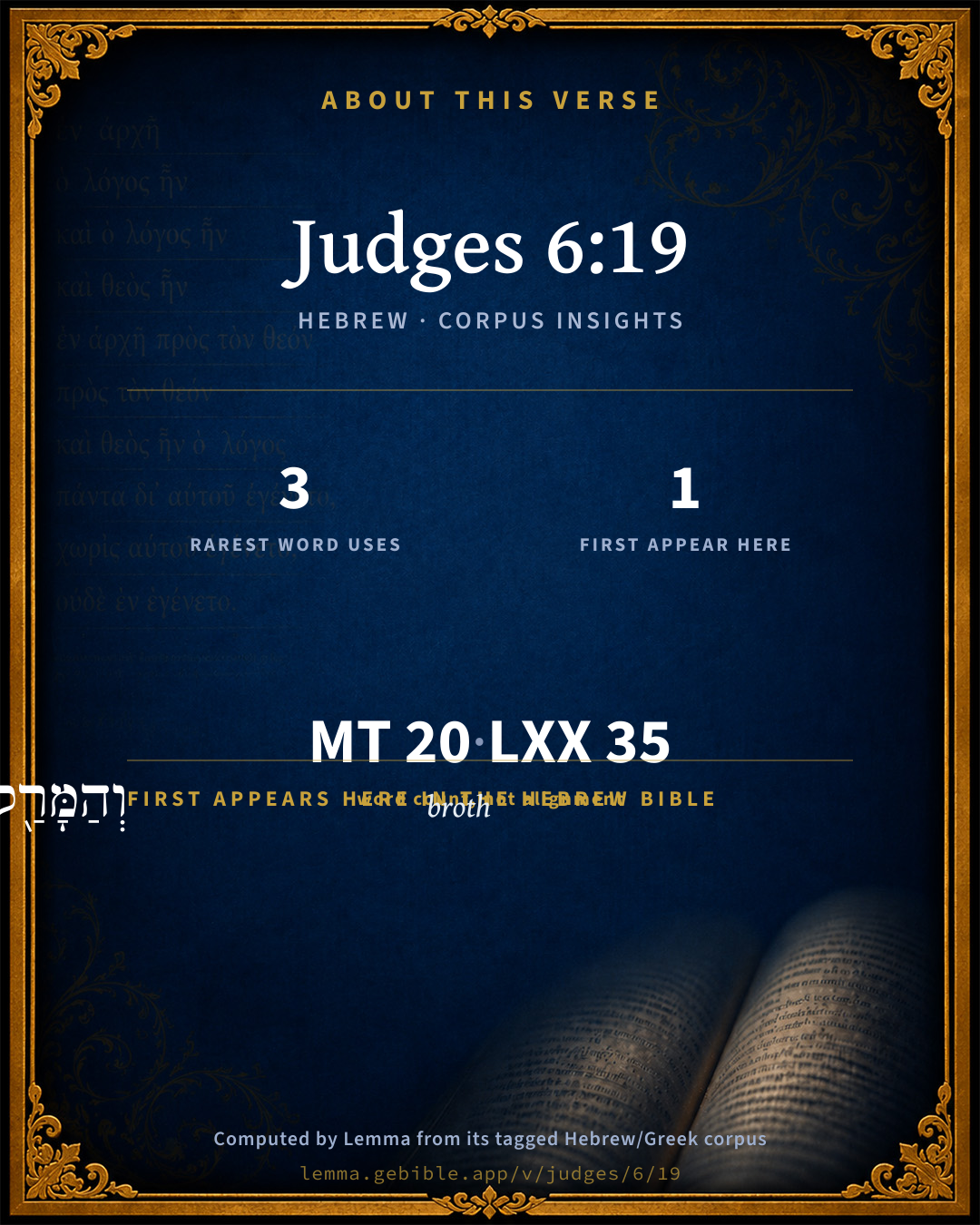
These counts appear in no published source. They are computed here, from the morphology-tagged text and Lemma’s own curated glosses. What Lemma adds →

20
words
18
distinct lemmas
Historical
section

Notable vocabulary

The rarest word here is וְהַמָּרַ֖ק broth H4839 — appearing just 3 times in the whole Hebrew Bible.

First appearance in Scripture

This word makes its first canonical appearance in the Hebrew Bible here:

  • וְהַמָּרַ֖ק broth H4839

Shared distinctive vocabulary

וְהַמָּרַ֖ק broth H4839 occurs in 3 verses of the Hebrew Bible. Also found in:

Grammatical profile

  • 6 verbs
  • 11 nouns
  • 3 prepositions

Verb forms

  • בָּ֗א Qal · Perfect
  • וַיַּ֤עַשׂ Qal · Sequential Imperfect
  • שָׂ֣ם Qal · Perfect
  • שָׂ֣ם Qal · Perfect
  • וַיּוֹצֵ֥א Hiphil · Sequential Imperfect
  • וַיַּגַּֽשׁ Hiphil · Sequential Imperfect

Repetition

Words recur within this verse — often emphatic in Hebrew:

  • שָׂ֣ם to put H7760 ×2
  • אֵלָ֛יו to H413 ×2

Hebrew & Septuagint length

In English translation the verse runs 43 words from the Hebrew and 46 from the Septuagint (LXX English) — closely comparable.

A rough comparison of the two English renderings, which tokenize alike — not a word-level alignment.

Word counts can differ between the Hebrew and the Greek without any difference in meaning — e.g. the Hebrew direct-object marker אֵת has no separate Greek word, and Greek often adds the article ὁ.

In the original languages it is 20 Hebrew tokens and 35 Greek tokens — but the two are counted differently (Hebrew bundles its prefixes and suffixes into one token; the Greek is in lemma form), so that isn’t a like-for-like length.

Cross-references

3

Topical passages linked to Judges 6:19 in the Treasury of Scripture Knowledge — connected by theme and wording, ordered by reader-vote popularity; previews shown in the World English Bible.

  • Genesis 18:6–8 Abraham hurried into the tent to Sarah, and said, "Quickly make ready three measures of fine meal, knead it, and make cakes."
  • Leviticus 2:4 "'When you offer an offering of a meal offering baked in the oven, it shall be unleavened cakes of fine flour mixed with oil, or unleavened wafers anointed with oil.
  • Judges 13:15–19 Manoah said to the angel of Yahweh, I pray you, let us detain you, that we may make ready a kid for you.

Cross-references courtesy of OpenBible.info (CC BY 4.0).

Hebrew and Greek witnesses Masoretic Hebrew ↔ Greek Septuagint

The same verse in the two great witnesses to the Old Testament, shown verse-for-verse.

These are two independent witnesses, not word-aligned to each other, and the Septuagint is shown in lemma (dictionary) form.

Hebrew Judges 6:19 Masoretic · Westminster Leningrad Codex

וְגִדְע֣וֹן בָּ֗א וַיַּ֤עַשׂ גְּדִֽי עִזִּים֙ וְאֵיפַת קֶ֣מַח מַצּ֔וֹת הַבָּשָׂר֙ שָׂ֣ם בַּסַּ֔ל וְהַמָּרַ֖ק שָׂ֣ם בַּפָּר֑וּר וַיּוֹצֵ֥א אֵלָ֛יו אֶל תַּ֥חַת הָאֵלָ֖ה וַיַּגַּֽשׁ

Gideon went in, and made ready a kid, and unleavened cakes of an ephah of meal: the flesh he put in a basket, and he put the broth in a pot, and brought it out to him under the oak, and presented it.

World English Bible · Public Domain

Greek LXX Judges 6:19 Septuagint · lemma form

καί γεδεων εἰςἔρχομαι καί ποιέω ἔριφος αἴξ καί οιφι ἄλευρον ἄζυμος καί ὁ κρέας τίθημι ἐν ὁ κόφινος καί ὁ ζωμός βάλλω ἐν ὁ χύτρα καί ἐκφέρω αὐτός πρός αὐτός ὑπό ὁ τερεμίνθος καί προςἐγγίζω

And Gedeon went in, and prepared a kid of the goats, and an ephah of fine flour unleavened; and he put the flesh in the basket, and poured the broth into the pot, and brought them forth to him under the turpentine tree, and drew near.

LXX2012 (modern English Septuagint) · Public Domain

On this verse, Ellicott's Commentary for English Readers discusses the Septuagint’s reading. Read the note in Commentary ↓

Hebrew: Westminster Leningrad Codex (CC BY 4.0). Greek: Septuagint (public domain); English from LXX2012 (modern English Septuagint) (Public Domain). How the Septuagint differs from the Hebrew →

Targum (Aramaic paraphrase)

1

The Targum is the ancient Jewish Aramaic paraphrase of the Hebrew Scriptures — an interpretive translation, not the Hebrew text itself. Onkelos (literal) and Pseudo-Jonathan (expansive) render the Torah, and Jonathan the Prophets. Coverage is partial: where no permissively-licensed English translation exists for a verse, only the Aramaic is shown. This is verse-level text, not a word-by-word alignment to the Hebrew.

  1. Targum Jonathan Prophets (Joshua–Malachi)
    וְגִדְעוֹן אָתָא וַעֲבַד גַדְיָא בַּר עִזֵי וּמְכִילְתָּא דְקִמְחָא אָפָה פַּטֵיר בִּסְרָא שַׁוִי בְּסַלָא וְתַבְשִׁילָא שַׁוִי בְּקִדְרָא וְאַפֵּיק לְוָתֵיה לִתְחוֹת אִילָנָא וְקָרֵב:

    (no public-domain English translation for this verse)

    Targum Jonathan — Aramaic: “Mikraot Gedolot” (public domain). English: “Sefaria Community Translation” (CC0 1.0 (public-domain dedication)); “London "Chaldee Paraphrase," 1871” (public domain). Text via Sefaria.

Commentary

Notes on Judges 6:19 from classic Christian and Jewish commentators (each source and its license shown beneath its notes). The classic Christian expositions comment on the surrounding passage and are grouped to its opening verse, so a note may address several verses; the Jewish commentaries on the Tanakh (Rashi and others) are per-verse, so they appear only where the commentator wrote on this verse.

Lemma curates 59 commentaries, every one of them public domain or Creative Commons licensed, each selected and text-cleaned for this edition rather than reprinted as found. About our sources →

Trapp's Complete Commentary

John Trapp

Jdg 6:19 And Gideon went in, and made ready a kid, and unleavened cakes of an ephah of flour: the flesh he put in a basket, and he put the broth in a pot, and brought [it] out unto him under the oak, and presented [it].

Ver. 19. Under the oak.] Where, as a wayfaring man, he had reposed himself. {Jdg 6:11}

John Trapp, A Commentary or Exposition upon All the Books of the Old and New Testament (1647–1656) — public domain. Text from a community e-Sword module.

Geneva Bible (1599)

Geneva Bible translators

Of Ephah, read Exod. 16:37.

Geneva Bible (1599) marginal notes — public domain. Text via Bolls.life.

Jamieson, Fausset & Brown

Robert Jamieson, A. R. Fausset & David Brown

Gideon went in, and made ready a kid; . . . the flesh he put in a basket, and he put the broth in a pot--(See on Gen 18:7). The flesh seems to have been roasted, which is done by cutting it into kobab, that is, into small pieces, fixed on a skewer, and put before the fire. The broth was for immediate use; the other, brought in a hand-basket was intended to be a future supply to the traveller. The miraculous fire that consumed it and the vanishing of the stranger, not by walking, but as a spirit in the fire, filled Gideon with awe. A consciousness of demerit fills the heart of every fallen man at the thought of God, with fear of His wrath; and this feeling was increased by a belief prevalent in ancient times, that whoever saw an angel would forthwith die. The acceptance of Gideon's sacrifice betokened the acceptance of his person; but it required an express assurance of the divine blessing, given in some unknown manner, to restore his comfort and peace of mind.

Jamieson, Fausset & Brown — Commentary Critical and Explanatory on the Whole Bible (1871) — public domain (CC PDM 1.0). Text via the HelloAO Bible API.

Adam Clarke's Commentary

Verse 19. Made ready a kid - the flesh he put in a basket, and he put the broth in a pot] The manner in which the Arabs entertain strangers will cast light on this verse. Dr. Shaw observes: "Besides a bowl of milk, and a basket of figs, raisins, or dates, which upon our arrival were presented to us to stay our appetite, the master of the tent fetched us from his flock according to the number of our company, a kid or a goat, a lamb or a sheep; half of which was immediately seethed by his wife, and served up with cucasoe; the rest was made kab-ab, i.e., cut to pieces and roasted, which we reserved for our breakfast or dinner next day." May we not suppose, says Mr. Harmer, that Gideon, presenting some slight refreshment to the supposed prophet, according to the present Arab mode, desired him to stay till he could provide something more substantial; that he immediately killed a kid, seethed part of it, and, when ready, brought out the stewed meat in a pot, with unleavened cakes of bread which he had baked; and the other part, the kab-ab, in a basket, for him to carry with him for some after-repast in his journey. See Shaw's and Pococke's Travels, and Harmer's Observations.

Brought it out unto him under the oak] Probably where he had a tent, which, with the shade of the oak, sheltered them from the heat of the sun, and yet afforded the privilege of the refreshing breeze. Under a shade in the open air the Arabs, to the present day, are accustomed to receive their guests.

Adam Clarke's Commentary on the Bible (1810–1826) — public domain. Text from a community e-Sword/MySword module.

Ellicott's Commentary for English Readers

(19) Unleavened cakes.—Because these were most quickly made, as by Lot for the angels, and by the Witch of Endor for Saul (Gen_19:3; 1Sa_28:24).

Of an ephah of flour.—About 22½ lbs. A homer would have been sufficient, as we see from Exo_16:16. An ephah is ten homers; but Eastern hospitality considers nothing to be too lavish.

Presented it.—See Jdg_13:19. The Vatican MS. of the LXX. renders it “approached,” which is inadequate, and the other MSS. “worshipped,” which is too strong. The word has a middle sense: “offered it with respect and reverence.”

A Bible Commentary for English Readers, edited by Charles John Ellicott (1878–1897) — public domain. Text from a community e-Sword module.

The Cambridge Bible for Schools and Colleges

gen. ed. J. J. S. Perowne

19. a kid] Cf. Jdg_13:15; Jdg_13:19 and Gen_18:7 (a calf). An ephah was approximately equivalent to our bushel; in Gen_18:6 Abraham orders the same quantity, ‘three seahs’ (= one ephah, cf. Isa_5:10 ephah in LXX = μέτρα τρία). Unleavened cakes could be made rapidly, 1Sa_28:24; for the basket and pot cf. Gen_40:16 ff., 1Sa_2:14.

and presented it] lit. ‘brought it near,’ cf. Gen_27:25. Perhaps we should read with the LXX and drew near (involving only a change of vowels), for the meal has not yet passed out of Gideon’s hands; he is expecting to be told what to do with it.

The Cambridge Bible for Schools and Colleges (gen. ed. J. J. S. Perowne; Cambridge University Press, 1878–1918) — public domain. Text from a community e-Sword module.

John Gill's Exposition

And the angel of God said unto him,.... Instead of sitting down and partaking of the entertainment made for him, he bid him do as follows:

take the flesh, and the unleavened cakes, and lay them upon this rock; not as a table to eat it from, but as an altar to offer it upon; and which rock and altar might be typical of Christ, who sanctities every gift, present, and offering of his people: this rock was undoubtedly in sight, and very probably the oak, under which they were, grew upon it, or at the bottom of it, where it was no unusual thing for oaks to grow, Gen 35:8, but it was upon the top of the rock that these were to be laid, where afterwards an altar was built, Jdg 6:26.

and pour out the broth; upon the flesh and cakes, and upon the rock also, which by bringing from his house must have been cool and it became cooler by being poured out, and cooler still by being poured upon a cold rock:

and he did so; he readily obeyed his orders; though he had reason to wonder he should have so ordered the food he brought for his entertainment to be thus made use of; perhaps he might expect that he intended to give him a sign, as he desired, and therefore the more readily, without any objection, complied with his order.

John Gill's Exposition of the Whole Bible (1746–1763) — public domain (CC PDM 1.0). Text via the HelloAO Bible API.

Albert Barnes' Notes on the Bible

Unleavened cakes - As being much more quickly baked (compare Gen 19:3) (and as connected with the meat offering). An ephah, containing 3 measures, was the quantity of flour commonly used at one baking Gen 18:6; Exo 16:16.

Presented it - A word especially, though not exclusively, proper for offerings to God. See Amo 5:25, where the same word is rendered offered.

Albert Barnes' Notes on the Bible (1834–1885) — public domain. Text from a community e-Sword/MySword module.

Haydock's Catholic Bible Commentary

Measure. Hebrew, "epha," containing ten gomors, each of which was sufficient for the daily maintenance of a man; so that Gedeon brought as much as would have sufficed for ten men. Abraham presented no more before the three angels, Genesis xviiii. 6. The magnificence of the ancients consisted rather in producing great abundance, than in multiplying dishes. --- Broth. Syriac and Arabic translate, "a good (old) wine."

George Leo Haydock (1774–1849), Haydock's Catholic Family Bible and Commentary, 1859 edition — public domain. Excludes Psalms (Douay-Rheims chapter numbering differs from Protestant) and Deuterocanonical books (Catholic canon only).

Matthew Poole's English Annotations

Of an ephah of flour, to wit, out of the choicest part of a whole ephah; as also he brought to him the best part of a kid dressed; for a whole ephah and a whole kid had been very superfluous, and improper to provide for and set before one man.

Matthew Poole's English Annotations on the Holy Bible (1683–1685) — public domain. Text from a community e-Sword/MySword module.

Whedon's Commentary on the Bible

Daniel D. Whedon

19. A kid… cakes — Compare the similar meal which Abraham prepared for his divine guests under the oak of Mamre. Gen_18:5-8.

An ephah — A measure of about four and one half pecks.

Flesh he put in a basket… broth in a pot — “The Orientals do not, as we do, use broth in which meat has been boiled as a soup. But they do use stews, such as the pottage for which Esau sold his birthright, and such as the sons of the prophet were preparing when they put into it by mistake some poisonous herb. Thus, we apprehend, part of the kid was prepared, and this was the part brought out in the pot. While this was in preparation over the fire, the other part had been cut up into slips and roasted before the fire upon skewers, in which way meat is very rapidly dressed in the East into what is called kaboobs, which stand in the same place as chops and steaks with us, only that the pieces are very much smaller. This, we apprehend, was what was brought in the basket.” — Kitto.

Daniel D. Whedon (gen. ed.), Commentary on the Old and New Testaments (1874–1909) — public domain. Text from a community e-Sword module.

The Pulpit Commentary

Unleavened cakes. (Gen_19:3 1Sa_28:24) The necessary haste gave no time for the use of leaven, which is one explanation of the unleavened bread at the passover. (Exo_12:33, Exo_12:34, Exo_12:39) Presented it. A word specially used of sacrifices and offerings. (Amo_5:25)

The Pulpit Commentary (1880–1919), ed. H.D.M. Spence-Jones & Joseph S. Exell — public domain. Text from a community e-Sword module.

John Wesley's Explanatory Notes

An ephah - The choicest part of a whole ephah; as also he brought to him the best part of a kid dressed; for a whole ephah, and a whole kid had been superfluous, and improper to provide for one man.

John Wesley, Explanatory Notes Upon the Whole Bible (1754–1765) — public domain. Text via the GEBible commentary corpus.

unfoldingWord translationNotes

Door43 World Missions Community

from an ephah of flour

If it is necessary to use a modern measurement; here is one way of doing it. AT: "with 22 liters of flour" (See: Biblical Volume)

broth

water that has had food, such as meat, cooked in it

them to him

"them to the angel of God"

angel of God

This is the same as the angel of Yahweh. AT: "God, who was in the form of an angel" or "God"

translationWords

Gideon

goat

unleavened bread

basket

oak

angel

God

unfoldingWord translationNotes — © Distant Shores Media and the Door43 World Missions Community, licensed CC BY-SA 4.0. Source: git.door43.org/Door43/en_tn.

Rashi

Rabbi Shlomo Yitzchaki (Rashi)

Matzos containing flour. We learn that it was Pesach, the day the Omer offering was waved. This is why it is said, "Behold, a toasted barley bread was careening, etc."

Soup. Broth.

Rashi on the Tanakh — English translations: “The Judaica Press complete Tanach with Rashi, translated by A. J. Rosenberg” (CC BY 4.0); “Pentateuch with Rashi's commentary by M. Rosenbaum and A.M. Silbermann, 1929-1934” (public domain); “The Metsudah Tanach series, Lakewood, N.J” (CC BY 4.0); and “The Book of Joshua, Metsudah Publications, 1997” (CC BY 4.0). Text via Sefaria.

Lesson kit

Teaching starters — assembled from the data on this page, not authored interpretation. Every prompt links to the verse data it draws on. Edit before teaching.

Judges, in the Historical, opens this verse with 20 words (18 distinct Hebrew lemmas). Its most distinctive word is mârâq (“broth”). A historical commentator’s framing appears above. Read the whole chapter for the surrounding context.

Discussion questions

  1. The word mârâq carries the sense “broth.” How does it shape the verse?
  2. The word “broth” first appears here in Scripture. What is being introduced at this debut?
  3. Judges 6:20 shares the word «broth» with this verse. How do the two illuminate each other?
  4. “to put” occurs 2× in this one verse. What is the effect of the repetition?
  5. These translations render this verse differently. What is at stake in choosing one wording over another?
  6. The verb «בָּ֗א» is Qal Perfect. How does its form color the action?
  7. Reading how Trapp's Complete Commentary and Geneva Bible (1599) read this verse, where do the two commentators agree and where do they part?

Things to notice

Reading settings

Reading text

Shown beneath each verse's original-language words.

Old Testament
Old Testament edition

Read the OT as the Masoretic Hebrew (MT) or the Greek Septuagint (LXX).

English shown for the Greek Septuagint (in the Hebrew ↔ Greek comparison).

Comparing translations? Open the Compare panel on any verse page to stack up to four side by side.