
Daniel 3:21

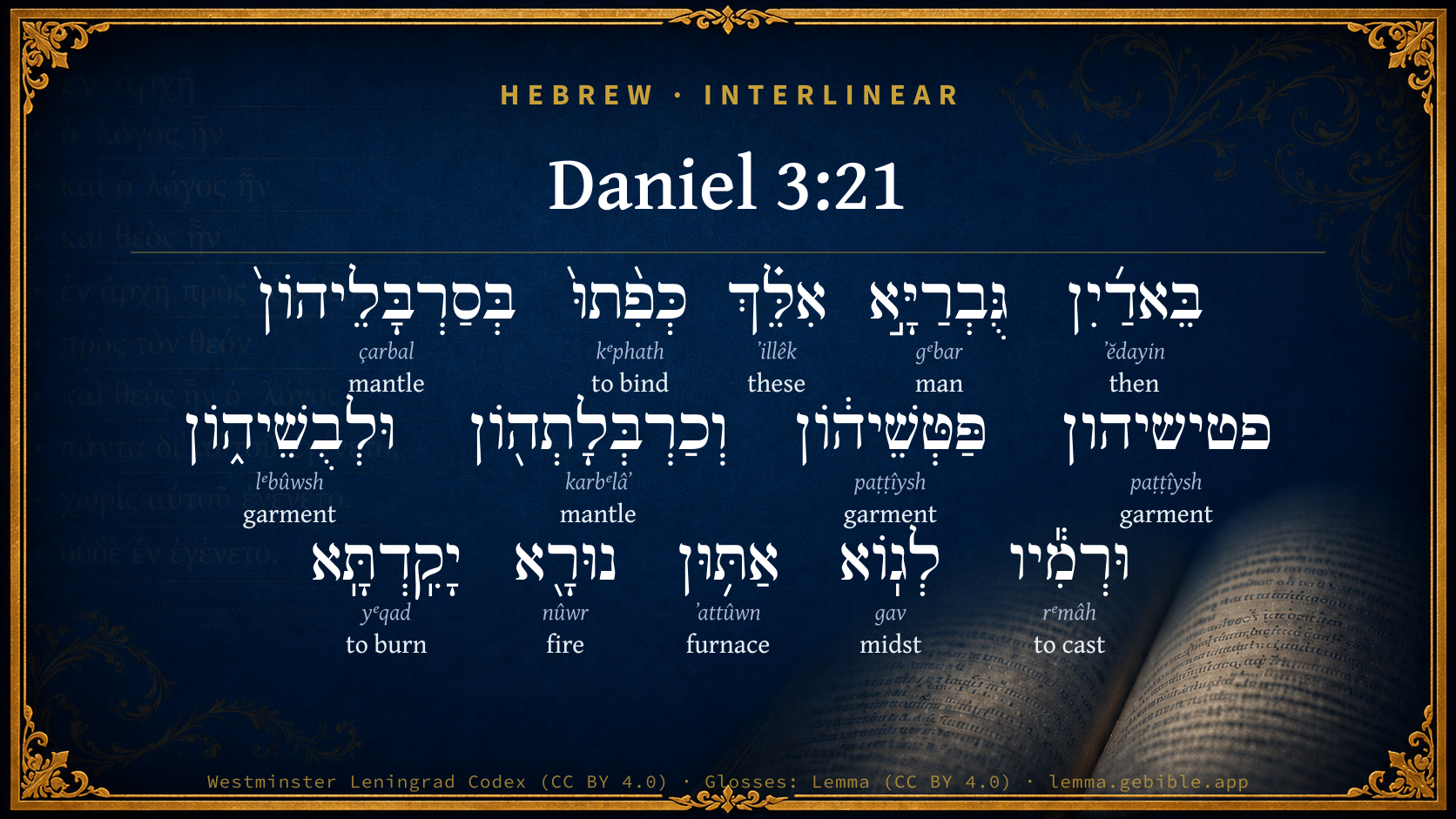
Hebrew (Westminster Leningrad Codex) Daniel 3:21 appears in the Hebrew Old Testament. The text above is from the Westminster Leningrad Codex. Each word links to its Strong’s number, a concise gloss, and parsing drawn from the Open Scriptures Hebrew Bible morphology. Click any word for its full Brown-Driver-Briggs (BDB) entry.
Download image
Cite this verse

Daniel 3:21 (World English Bible). Public Domain. Lemma interlinear Bible study tool, https://lemma.gebible.app/v/daniel/3/21.

Show BibTeX & RIS
BibTeX
RIS
English Translation
Then these men were bound in their pants, their tunics, and their mantles, and their [other] garments, and were cast into the midst of the burning fiery furnace.
World English Bible · Public Domain
Highlights
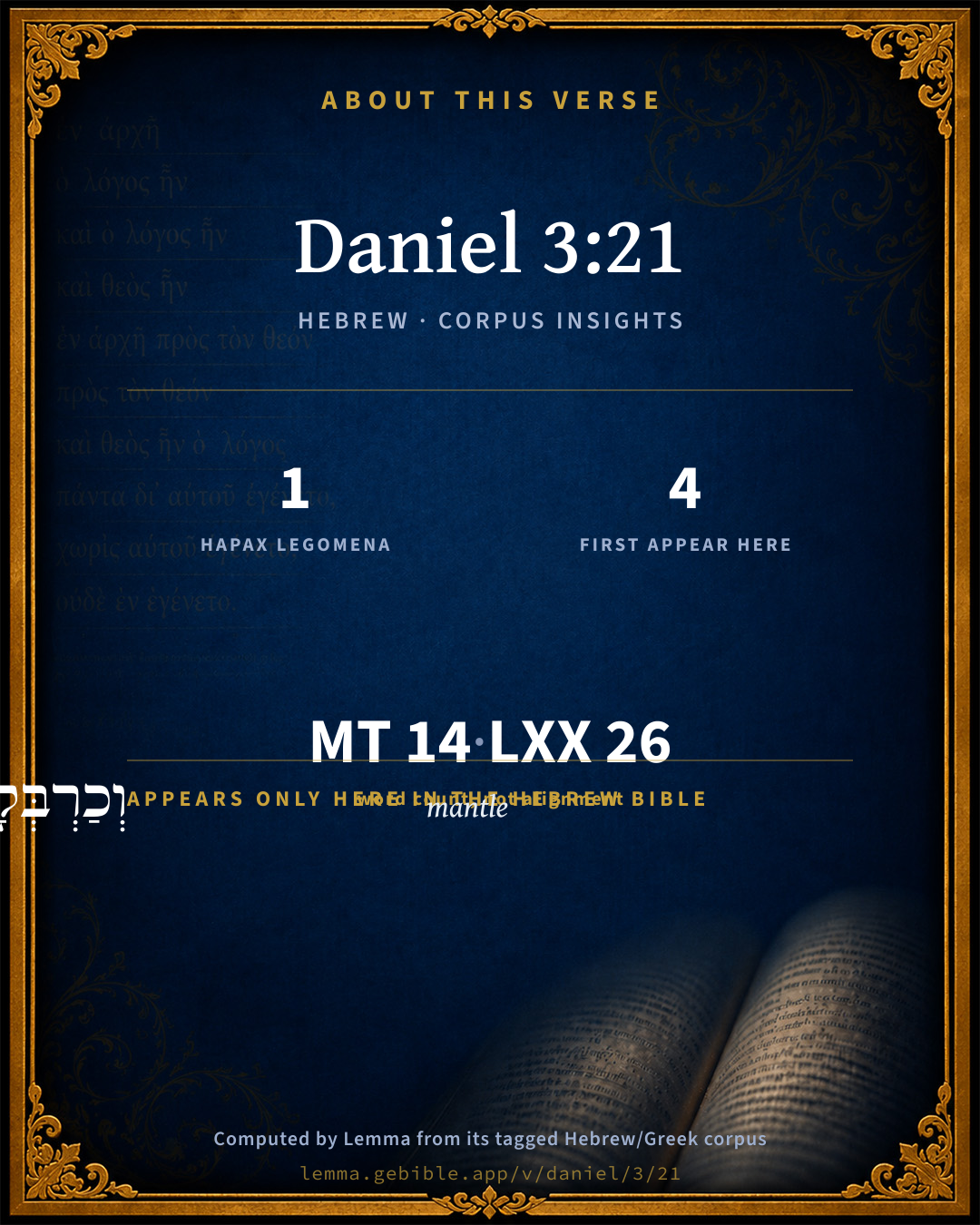
  • 1 hapax legomenon — only here in the Hebrew Bible
  • 4 first appearances in the Hebrew Bible
Full analysis ↓
Download a study sheet

One document with this verse’s original text, its word-by-word gloss line, the meaning frame, cross-references with their text, attributed commentary, and full source and license credits — printable, and it pastes into notes with its structure intact.

This verse Autodidact and up

Study sheet (.html) Plain text (.txt)

A passage Seminary Student

Up to 50 verses in one chapter. A passage sheet keeps up to 6 commentary sources and 12 cross-references per verse, in the order this page ranks them, and says so on the sheet whenever that leaves anything out. Ask for a single verse and you get the Autodidact verse sheet above.

Everything on this page stays free to read, with no account — the sheet is a download of what is already on screen, not access to it.

Want to remove ads? Support Godless Engineer
Compare translations 3

The same verse in 3 English versions, stacked beneath the original-language interlinear above. Click any original word for its lexicon entry.

Each is an independent rendering of the whole verse — the interlinear is not word-aligned to these translations.

Highlighted words mark where these versions differ — a whole-verse word diff, not a word-by-word alignment.

  • World English Bible Public Domain
    Then these men were bound in their pants, their tunics, and their mantles, and their [other] garments, and were cast into the midst of the burning fiery furnace.
  • King James Version Public Domain
    Then these men were bound in their coats, their hosen, and their hats, and their other garments, and were cast into the midst of the burning fiery furnace.
  • unfoldingWord Literal Text CC BY-SA 4.0
    Then these men were tied up in their cloaks, their tunics, their hats, and their other clothing, and they were thrown into the midst of the furnace of blazing fire.

unfoldingWord Literal Text — © unfoldingWord, licensed CC BY-SA 4.0. Word-aligned USFM3 via Door43 (git.door43.org/unfoldingWord/en_ult).

Versions to compare (up to 4)

3 of 4 selected

Show all 18 translations

Every available English version of this verse, each an independent rendering of the whole verse.

  • World English Bible Public Domain
    Then these men were bound in their pants, their tunics, and their mantles, and their [other] garments, and were cast into the midst of the burning fiery furnace.
  • Berean Standard Bible Public Domain
    So they were tied up, wearing robes, trousers, turbans, and other clothes, and they were thrown into the blazing fiery furnace.
  • Majority Standard Bible Public Domain
    So they were tied up, wearing robes, trousers, turbans, and other clothes, and they were thrown into the blazing fiery furnace.
  • King James Version Public Domain
    Then these men were bound in their coats, their hosen, and their hats, and their other garments, and were cast into the midst of the burning fiery furnace.
  • American Standard Version (1901) Public Domain
    Then these men were bound in their hosen, their tunics, and their mantles, and their `other' garments, and were cast into the midst of the burning fiery furnace.
  • Revised Version (1885) Public Domain
    Then these men were bound in their hosen, their tunics, and their mantles, and their other garments, and were cast into the midst of the burning fiery furnace.
  • Geneva Bible (1599) Public Domain
    So these men were bounde in their coates, their hosen, and their clokes, with their other garments, and cast into the middes of the hote fierie fornace.
  • Douay-Rheims (1899) Public Domain
    And immediately these men were bound and were cast into the furnace of burning fire, with their coats, and their caps, and their shoes, and their garments.
  • Young's Literal Translation Public Domain
    Then these men have been bound in their coats, their tunics, and their turbans, and their clothing, and have been cast into the midst of the burning fiery furnace.
  • Literal Standard Version CC BY-SA 4.0
    Then these men have been bound in their coats, their tunics, and their turbans, and their clothing, and have been cast into the midst of the burning fiery furnace.
  • Unlocked Literal Bible CC BY-SA 4.0
    They were tied up still wearing their robes, tunics, turbans, and other clothing, and they were thrown into the blazing furnace.
  • unfoldingWord Literal Text CC BY-SA 4.0
    Then these men were tied up in their cloaks, their tunics, their hats, and their other clothing, and they were thrown into the midst of the furnace of blazing fire.
  • Darby Bible Public Domain
    Then these men were bound in their hosen, their tunics, and their cloaks, and their garments, and were cast into the midst of the burning fiery furnace.
  • World Messianic Bible Public Domain
    Then these men were bound in their pants, their tunics, and their mantles, and their other clothes, and were cast into the middle of the burning fiery furnace.
  • Webster's Bible Public Domain
    Then these men were bound in their coats, their hose, and their hats, and their other garments, and were cast into the midst of the burning fiery furnace.
  • Free Bible Version CC BY-SA 4.0
    So they were tied up, fully dressed in their coats, trousers, turbans, and other clothes, and thrown into the furnace of blazing fire.
  • Bible in Basic English Public Domain
    Then these men had cords put round them as they were, in their coats, their trousers, their hats, and their clothing, and were dropped into the burning and flaming fire.
  • JPS Tanakh (1917) Public Domain
    Then these men were bound in their cloaks, their tunics, and their robes, and their other garments, and were cast into the midst of the burning fiery furnace.

Literal Standard Version (2020), Covenant Press — licensed CC BY-SA 4.0. Text via the HelloAO Bible API (eBible.org). Unlocked Literal Bible (unfoldingWord) — licensed CC BY-SA 4.0. Text via the HelloAO Bible API (eBible.org). unfoldingWord Literal Text — © unfoldingWord, licensed CC BY-SA 4.0. Word-aligned USFM3 via Door43 (git.door43.org/unfoldingWord/en_ult). Free Bible Version, Dr. Jonathan Gallagher — licensed CC BY-SA 4.0. Text via the HelloAO Bible API (eBible.org).

Word by word

More ways to search: Search by grammar → Find every occurrence → Compare this word →

Practice this passage: Drill this verse → Learn its vocabulary →

וְכַרְבְּלָתְה֖וֹן
karbᵉlâʼ
H3737
“and · mantles · their”
Adjective, C + Noun, Common, Feminine, Plural, Construct + Suffix, Personal, 3rd Person, Masculine, Plural
Part of Speech
Adjective + Noun
Type
Common
Gender
Feminine
Number
Plural
State
Construct
Full BDB Definition

Origin: from a verb corresponding to that of H3736

TWOT: 2800

mantle, robe, cap, turban, helmet
  1. בֵּאדַ֜יִן ʼĕdayin H116 “in/at · then” Adjective, R + Adverb
  2. גֻּבְרַיָּ֣א gᵉbar H1400 “men · the” Adjective, N, Common + Particle, Definite Article
  3. אִלֵּ֗ךְ ʼillêk H479 “these” Adjective, P, Construct
  4. כְּפִ֨תוּ֙ kᵉphath H3729 “to bind” Adjective, V, Plural
  5. בְּסַרְבָּלֵיהוֹן֙ çarbal H5622 “in/at · mantles · their” Adjective, R + Noun, Common, Masculine, Plural, Construct + Suffix, Personal, 3rd Person, Masculine, Plural
  6. פטישיהון paṭṭîysh H6361 “garments · their” Adjective, N, Common + Suffix, Personal, 3rd Person, Masculine, Plural
  7. פַּטְּשֵׁיה֔וֹן paṭṭîysh H6361 “garments · their” Adjective, N, Common + Suffix, Personal, 3rd Person, Masculine, Plural
  8. וּלְבֻשֵׁיה֑וֹן lᵉbûwsh H3831 “and · garments · their” Adjective, C + Noun, Common, Masculine, Plural, Construct + Suffix, Personal, 3rd Person, Masculine, Plural
  9. וּרְמִ֕יו rᵉmâh H7412 “and · to cast” Adjective, C + Verb, Qal Passive, Perfect, 3rd Person, Masculine, Plural
  10. לְגֽוֹא gav H1459 “to/for · midst of” Adjective, R + Noun, Common, Masculine, Singular, Construct
  11. אַתּ֥וּן ʼattûwn H861 “furnace of” Adjective, N, Common
  12. נוּרָ֖א nûwr H5135 “fire · the” Adjective, N, Common + Particle, Definite Article
  13. יָקִֽדְתָּֽא yᵉqad H3345 “burning · the” Adjective, V + Particle, Definite Article

About this verse

These counts appear in no published source. They are computed here, from the morphology-tagged text and Lemma’s own curated glosses. What Lemma adds →

14
words
13
distinct lemmas
Prophets
section

Notable vocabulary

1 hapax legomenon — a word that appears only here in the entire Hebrew Bible:

  • וְכַרְבְּלָתְה֖וֹן mantle H3737

First appearance in Scripture

These words make their first canonical appearance in the Hebrew Bible here:

  • בְּסַרְבָּלֵיהוֹן֙ mantle H5622
  • פטישיהון garment H6361
  • וְכַרְבְּלָתְה֖וֹן mantle H3737
  • וּלְבֻשֵׁיה֑וֹן garment H3831

Shared distinctive vocabulary

בְּסַרְבָּלֵיהוֹן֙ mantle H5622 occurs in 2 verses of the Hebrew Bible. Also found in:

Grammatical profile

  • 1 verb
  • 4 nouns
  • 5 adjectives
  • 1 adverb
  • 3 particles

Verb forms

  • וּרְמִ֕יו Qal Passive · Perfect

Repetition

A word recurs within this verse — often emphatic in Hebrew:

  • פטישיהון garment H6361 ×2

Hebrew & Septuagint length

In English translation the verse runs 28 words from the Hebrew and 23 from the Septuagint (LXX English) — closely comparable.

A rough comparison of the two English renderings, which tokenize alike — not a word-level alignment.

Word counts can differ between the Hebrew and the Greek without any difference in meaning — e.g. the Hebrew direct-object marker אֵת has no separate Greek word, and Greek often adds the article ὁ.

In the original languages it is 14 Hebrew tokens and 26 Greek tokens — but the two are counted differently (Hebrew bundles its prefixes and suffixes into one token; the Greek is in lemma form), so that isn’t a like-for-like length.

Hebrew and Greek witnesses Masoretic Hebrew ↔ Greek Septuagint

The same verse in the two great witnesses to the Old Testament, shown verse-for-verse.

These are two independent witnesses, not word-aligned to each other, and the Septuagint is shown in lemma (dictionary) form.

Hebrew Daniel 3:21 Masoretic · Westminster Leningrad Codex

בֵּאדַ֜יִן גֻּבְרַיָּ֣א אִלֵּ֗ךְ כְּפִ֨תוּ֙ בְּסַרְבָּלֵיהוֹן֙ פטישיהון פַּטְּשֵׁיה֔וֹן וְכַרְבְּלָתְה֖וֹן וּלְבֻשֵׁיה֑וֹן וּרְמִ֕יו לְגֽוֹא אַתּ֥וּן נוּרָ֖א יָקִֽדְתָּֽא

Then these men were bound in their pants, their tunics, and their mantles, and their [other] garments, and were cast into the midst of the burning fiery furnace.

World English Bible · Public Domain

Greek LXX Daniel 3:21 Septuagint · lemma form

τότε ὁ ἀνήρ ἐκεῖνος συνποδίζω ἔχω ὁ ὑπόδημα αὐτός καί ὁ τιάρα αὐτός ἐπί ὁ κεφαλή αὐτός σύν ὁ ἱματισμός αὐτός καί βάλλω εἰς ὁ κάμινος

Then those men were bound with their coats, and caps, and hose, and were cast into the midst of the burning fiery furnace,

LXX2012 (modern English Septuagint) · Public Domain

On this verse, The Cambridge Bible for Schools and Colleges discusses the Septuagint’s reading. Read the note in Commentary ↓

Hebrew: Westminster Leningrad Codex (CC BY 4.0). Greek: Septuagint (public domain); English from LXX2012 (modern English Septuagint) (Public Domain). How the Septuagint differs from the Hebrew →

Commentary

Notes on Daniel 3:21 from classic Christian and Jewish commentators (each source and its license shown beneath its notes). The classic Christian expositions comment on the surrounding passage and are grouped to its opening verse, so a note may address several verses; the Jewish commentaries on the Tanakh (Rashi and others) are per-verse, so they appear only where the commentator wrote on this verse.

Lemma curates 59 commentaries, every one of them public domain or Creative Commons licensed, each selected and text-cleaned for this edition rather than reprinted as found. About our sources →

The Cambridge Bible for Schools and Colleges

gen. ed. J. J. S. Perowne

21. coats] The meaning of the Aram. sarbâl (only here and Dan_3:27) is uncertain (see the very full discussion in Ges. Thesaurus); but on the whole mantles is the most probable. This is the sense which the word has in the Talmud[230], in which it occurs frequently (Ges. p. 971; Levy, NHWB[231], s.v.), so that it has ancient usage in its favour. On the other hand, Aq. and Theod. (σαράβαρα), LXX. in Dan_3:27 (94), Symm. (ἀναξυρίδες), Pesh., express the meaning trousers (though of a looser kind than those worn by us),—an article of dress known independently (from Herod., and other authorities) to have been worn at least by the ancient Scythians and Persians, and to have been called by them σαράβαρα. The word, in the same sense, passed into Arabic, in the form sirwâl (e.g. in Saadyah’s version of Lev_6:3), as well as into several of the Romance languages. In both these senses the word may be originally Persian: in that of mantle, meaning properly (according to Andreas) a head-covering (* sarabâra), for which in Persia the peasants often use their mantle; in that of trousers, corresponding to the Mod. Pers. shalwâr, ‘under-breeches.’ The Syriac form of σαράβαρα has however a different sibilant from the one which is here used; and, as Mr Stanley A. Cook remarks[232], ‘mantles, long flowing robes, and therefore extremely liable to catch the flames,’ are more likely to be specially mentioned in the present connexion than trousers, or (R.V.) hosen.

[230] And so also, as a loan-word from the Aram., the Arabic sirbâl: see Fränkel, Aram. Fremdwörter im Arab. (1886), p. 47.

[231] HWB. M. Levy, Neuhebräisches und Chaldäisches Wörterbuch, 1876–89.

[232] ‘On the articles of dress mentioned in Dan_3:21,’ in the Journ. of Philology, xxvi. (1899), p. 306 ff.

their hosen] Another uncertain word (Aram. paṭṭish). Sept. and Theod. render τιάραι, ‘turbans’; Pesh. uses the same word, which, however, seems otherwise to be known only to the Syriac lexicographers, who explain it sometimes as a ‘tunic,’ sometimes as ‘trousers,’ sometimes as a kind of ‘gaiter’ (Payne Smit[233] Thes. Syr. col. 3098). R.V. tunics; marg. ‘Or, turbans.’

[233] yne Smith R. Payne Smith, Thesaurus Syriacus.

hats] The rendering hats (or caps) is supported by the fact that the same word karbâl (in the fem.) seems in post-Bibl. Hebrew (Levy, s.v.) to denote some kind of covering for the head, and means certainly, both in the Talmud and in Syriac (P.S[234] 1810), the comb of a cock. Others, comparing what is apparently the cognate verb in 1Ch_15:27, render mantle; but the text of the passage quoted is uncertain.

[234] .S. R. Payne Smith, Thesaurus Syriacus.

The Cambridge Bible for Schools and Colleges (gen. ed. J. J. S. Perowne; Cambridge University Press, 1878–1918) — public domain. Text from a community e-Sword module.

Trapp's Complete Commentary

John Trapp

Dan 3:21 Then these men were bound in their coats, their hosen, and their hats, and their [other] garments, and were cast into the midst of the burning fiery furnace.

Ver. 21. So these men were bound in their coats, &c.] Which, for haste of the execution, were never taken off, as is usually done. But these executioners were swift to shed blood, and had blood again to drink, for they were worthy.

John Trapp, A Commentary or Exposition upon All the Books of the Old and New Testament (1647–1656) — public domain. Text from a community e-Sword module.

Ibn Ezra

Rabbi Abraham ibn Ezra

[Daniel 3:21] Then (בֵּאדַיִן - Be'adayin)... in their shirts/mantles (בְּסַרְבָּלֵיהוֹן - b'sarbaleyhon): These are the outer garment/mantle (ha-simlah ha-elyonah). And it is the custom of the nations to burn people [while still] in their garments, which are [considered] worth nothing [in this context].

And their hats/turbans (וְכַרְבְּלָתְהוֹן - v'kharbelatehon): Like [the related verb k-r-b-l used in the verse] “and David was clothed/wrapped (mekhurbal) with a robe of fine linen” [I Chronicles 15:27].

And their trousers/tunics (וּפַטְּשֵׁיהוֹן - u'patt'sheihon): [Means] shirts/tunics (challukin) or trousers (mikhnasayim).

And their garments (וּלְבוּשֵׁיהוֹן - ul'vusheihon): [Means] other/remaining garments (sh'ar begadim).

Ibn Ezra on the Tanakh — English translations: “Sefaria Community Translation” (CC0 1.0 (public-domain dedication)); “Yalkut, Sifsei Chachomim Chumash, Metsudah Publications, 2009” (CC BY 4.0); and “Commentary of Ibn Ezra on Isaiah - trans. by M. Friedlander, 1873” (public domain). Text via Sefaria.

Jamieson, Fausset & Brown

Robert Jamieson, A. R. Fausset & David Brown

coats . . . hosen . . . hats--HERODOTUS [1.195] says that the Babylonian costume consisted of three parts: (1) wide, long pantaloons; (2) a woollen shirt; (3) an outer mantle with a girdle round it. So these are specified [GESENIUS], "their pantaloons, inner tunics (hosen, or stockings, are not commonly worn in the East), and outer mantles." Their being cast in so hurriedly, with all their garments on, enhanced the miracle in that not even the smell of fire passed on their clothes, though of delicate, inflammable material.

Jamieson, Fausset & Brown — Commentary Critical and Explanatory on the Whole Bible (1871) — public domain (CC PDM 1.0). Text via the HelloAO Bible API.

Adam Clarke's Commentary

Verse 21. Their hats] This word, hat, is found only in this place in the Old Testament. The word סרבל sarbal properly means an outer garment. Herodotus, who lived about one hundred years after Daniel, says, "the dress of the Babylonians consisted of a tunic of linen reaching down to the feet; over this a tunic of woollen; and over all a white short cloak or mantle, χλανιδιον; and on their heads they wore turbans, μιτρησι." Following this, Mr. Parkhurst translates the verse thus: "Then these three men were bound [בסרבליהון besarbaleyhon] in their CLOAKS, [פמישיהון patesheyhon] their TURBANS, [וכרבלתהון vecharbelathehon] and in their UPPER (woollen) TUNICS, [ולבושיהון ulebushehon] and their UNDER (linen) TUNICS." And as, according to this interpretation, their sarbaley were their outermost garments, we see the propriety with which it is observed at Da 3:27 that these were not changed by the fire.

Adam Clarke's Commentary on the Bible (1810–1826) — public domain. Text from a community e-Sword/MySword module.

John Calvin's Commentaries

Here Daniel relates the miracle by which God liberated his servants. He has two parts: first, these three holy men walked untouched in the midst of the flame; and the fires consumed those attendants who east them into the furnace. The Prophet diligently enumerates whatever tends to prove the power of God. He says, since the king’s command was urgent, that is, since the king ordered in such anger the furnace to be heated, the flames devour the men who executed his orders. For in Job, (Job 18:5,) שביב, shebib, means “spark,” or the extremity of a flame. The sense of the Prophet is by no means obscure, since the extremity of the flame consumed those strong attendants by playing round them, while Shadrach, Meshach, and Abed-nego walked through the fuel in the fire and flame. They were not in the extremity of the flame; for it is as if the Prophet had said — the king’s slaves were consumed by the very smoke, and the fire was without the slightest effect on the servants of God. Hence he says, these three fell down in the furnace of fire By saying they fell, it means they could not take care of themselves or attempt to escape; for he adds, they were bound. This might at first naturally suffocate them, till they were immediately consumed; but they remained untouched, and then walked about the furnace loose. We hereby see how conspicuous was God’s power, and how no falsehood of Satan’s could obscure it. And next, when the very points of the flame, or the fiery sparks, devour the servants, here again the deed is proved to be of God. Meanwhile, the result of the history is the preservation of these three holy men, so surprisingly beyond their expectation.

This example is set before us, to show us how nothing can be safer than to make God the guardian and protector of our life. For we ought not to expect to be preserved from every danger because we see those holy men delivered; for we ought to hope for liberation from death, if it be useful, and yet we ought not to hesitate to meet it without fear, if God so please it. But we should gather from our present narrative the sufficiency of God’s protection, if he wishes to prolong our lives, since we know our life to be precious to him; and it is entirely in his power, either to snatch us from danger, or to withdraw us to a better existence, according to his pleasure. We have an example of this in the case of Peter; for he was on one day led forth from prison, and the next day put to death. Even then God shewed his care of his servant’s life, although Peter at length suffered death. How so? Because he had finished his course. Hence, as often as God pleases, he will exert his power to preserve us; if he leads us onwards to death, we must be assured it is best for us to die, and injurious to us to enjoy life any longer. This is the substance of the instruction which we may receive from this narrative. It now follows: —

John Calvin's Commentaries (1540-1563) — public domain. Text from the Calvin Translation Society English edition (1840s-50s) via the Christian Classics Ethereal Library (ccel.org). Calvin's coverage is partial (roughly two-thirds of the Bible); uncommented books and verses are honest gaps, never fabricated. The 19th-century editor's footnotes and remarks are omitted so the notes are faithfully Calvin's own voice.

Ellicott's Commentary for English Readers

(21) Their coats.—The dresses spoken of here correspond with what Herodotus tells us (i. 195) of the Babylonian costume. As far as can be determined from the etymology of the words, the “coat” was an under-clothing, which covered the whole body; the “hose” was some species of tunic—something “spread out” over the under-clothing; the “hat” (the only one of the three words of which no Hebrew root exists (see 1Ch_15:27), was a sort of cloak, used probably for State occasions only.

A Bible Commentary for English Readers, edited by Charles John Ellicott (1878–1897) — public domain. Text from a community e-Sword module.

John Gill's Exposition

Then these men were bound in their coats,.... Their upper coats, cloaks, or mantles, as Aben Ezra and Jacchiades; though, according to the use of the word in the Arabic language, the "femoralia" (r) or breeches are meant:

their hosen, and their hats, and their other garments: their turbants on their heads, which were usually wore in those countries; and their stockings and shoes, and other under garments, as waistcoats and shirts; which through haste or negligence, or with design, were kept on them, to make their torment the greater; but were intended by the Lord to make the miracle the more conspicuous. According to Cocceius (s) and Bynaeus (t), the first of these words signifies the outward covering of the body, as cloaks, &c.; the second the covering of the feet, as socks, shoes, and sandals; and the third the covering of the head, as caps, turbants, helmets, &c.; the last the inner garments that were under the upper ones:

and were cast into the midst of the burning fiery furnace; in the manner and circumstances before related.

(r) "cum femoralibus", Pagninus; so Syr. Ar.; "cum braccis suis", V. L. (s) Expos. Dict. Chald. col. 1022. rad (t) De Calceis Hebr. l. 2. c. 10. sect 4, 5, 6, 7.

John Gill's Exposition of the Whole Bible (1746–1763) — public domain (CC PDM 1.0). Text via the HelloAO Bible API.

Albert Barnes' Notes on the Bible

Then these men were bound in their coats - They were seized just as they were. No time was given them for preparation; no change was made in their dress. In “autos-da-fe” of later times, it has been usual to array those who were to suffer in a peculiar dress, indicative of the fact that they were heretics, and that they deserved the flame. Here, however, the anger of the king was so great, that no delay was allowed for any such purpose, and they proceeded to execute the sentence upon them just as they were. The fact that they were thus thrown into the furnace, however, only made the miracle the more conspicuous, since not even their garments were affected by the fire. The word rendered “coats,” is in the margin rendered “mantles.” The Chaldee word (סרבלין sarbâlı̂yn) means, according to Gesenius, the long and wide pantaloons which are worn by the Orientals, from סרבל sarbēl, to cover. The Greek word used in the translation is derived from this - σαράβαρα sarabara - and the word σαρβαρίδες sarbarides is still used in modern Greek. The Chaldee word is used only in this chapter. The Vulgate renders this, cum braccis suis - hence, the word “breeches,” and “brogues.” The garment referred to, therefore, seems rather to be what covered the lower part of their person than either a coat or mantle.

Their hosen - This word was evidently designed by our translators to denote drawers, or trousers - not stockings, for that was the common meaning of the word when the translation was made. It is not probable that the word is designed to denote “stockings,” as they are not commonly worn in the East. Harmer supposes that the word here used means properly “a hammer,” and that the reference is to a hammer that was carried as a symbol of office, and he refers in illustration of this to the plates of Sir John Chardin of carvings found in the ruins of Persepolis, among which a man is represented with a hammer or mallet in each hand. He supposes that this was some symbol of office. The more common and just representation, however, is to regard this as referring to an article of dress. The Chaldee word (פטישׁ paṭṭı̂ysh) is from פטשׁ pâṭash, to break, to hammer (πατάσσω patassō); to spread out, to expand; and the noun means

(1) a hammer; Isa 41:7; Jer 23:29; Jer 50:23; and

(2) a garment, probably with the idea of its being “spread out,” and perhaps referring to a tunic or under-garment.

Compare Gesenius on the word. The Greek is, τιάραις tiarais, and so the Latin Vulgate, tiaris: the tiara, or covering for the head, turban. The probable reference, however, is to the under-garment worn by the Orientals; the tunic, not a little resembling a shirt with us.

And their hats - Margin, or “turbans.” The Chaldee word (כרבלא karbelâ') is rendered by Gesenius mantle, pallium. So the version called the “Breeches” Bible, renders it “clokes.” Coverdale renders it “shoes,” and so the Vulgate, calceamentis, sandals; and the Greek, περικνηυίσιν periknēmisin, greaves, or a garment enclosing the lower limbs; pantaloons. There is certainly no reason for rendering the word “hats” - as hats were then unknown; nor is there any evidence that it refers to a turban. Buxtorf (“Chaldee Lex.”) regards it as meaning a garment, particularly an outer garment, a cloak, and this is probably the correct idea. We should then have in these three words the principal articles of dress in which the Orientals appear, as is shown by the preceding engraving, and from the ruins of Persepolis - the large and loose trousers; the tunic, or inner garment; and the outer garment, or cloak, that was commonly thrown over all.

And their other garments - Whatever they had on, whether turban, belt, sandals, etc.

Albert Barnes' Notes on the Bible (1834–1885) — public domain. Text from a community e-Sword/MySword module.

Haydock's Catholic Bible Commentary

Coats, or various coloured bandages for the thighs, used by men and women. Aquila and Th. retain the original term, Greek: Sarabarois. Chaldee: saraballa. (Calmet) --- Caps: "tiaras." (Haydock) --- The king alone wore them upright.

George Leo Haydock (1774–1849), Haydock's Catholic Family Bible and Commentary, 1859 edition — public domain. Excludes Psalms (Douay-Rheims chapter numbering differs from Protestant) and Deuterocanonical books (Catholic canon only).

Matthew Poole's English Annotations

This is observable and wonderful, that the fire should not catch their garments, being the most obnoxious to it.

Matthew Poole's English Annotations on the Holy Bible (1683–1685) — public domain. Text from a community e-Sword/MySword module.

Whedon's Commentary on the Bible

Daniel D. Whedon

21. “Then these men were bound in their hosen [‘coats,’ Dan_3:27; rather ‘cloaks,’ or perhaps ‘trousers,’ Syr.], their tunics [margin, ‘turbans’], and their mantles, and their other garments” (R.V.). It was from the “hats” spoken of in the A.V. that George Fox drew his conclusion that no man should remove his hat in the presence of royalty (Bevan). The ancient Greek translators did not seem to know exactly what the garments were corresponding to these Aramaic words. The main point is that these articles of ordinary clothing which would naturally burn easily were preserved, as also the “other garments,” which may possibly refer to the flowing robes so common as the state dress of Babylonian officials (Meinhold).

Daniel D. Whedon (gen. ed.), Commentary on the Old and New Testaments (1874–1909) — public domain. Text from a community e-Sword module.

The Pulpit Commentary

Then these men were bound in their coats, their hosen, and their hats, and their other garments, and were cast into the midst of the burning fiery furnace. The LXX omits the complexity of garments, and translates, "Thus these men were bound, having their sandals, and their hats upon their heads, with their other garments, and were cast into the burning fiery furnace." It would seem that karbelatheon was either not in the text before the translator or was omitted by him. The latter hypothesis seems a hazardous one to adopt without good ground. We have no reason to accuse the Septuagint translator of this practice. Theodotion also presents signs of omission. ylib; rs is not translated, but simply transliterated, sarabaroiv. Under this word Schleusner says, "Vestis Medica sou Babylonica ad genus pertingens." Aquila, it may be not,d, also transliterates, saraballa. Theodotion"s rendering is, "Then those men were bound in their coats(?), and hats, and hosen, and were cast into the midst of the burning fiery furnace." The Peshitta does as Theodotion, anti transliterates with the change of a shin fur a samech, in regard to the first word, and instead of leboosheen, "garments," has qoobeeen, which is rendered by Castelli pileus, or g,lea, a "military cap," or a "helmet." He wrongly says that qoob"o is used to translate karbelathElon; the word used for that is nihtho. We need not go into a discussion of the various garments named here. It is to be observed that, by the time of the Septuagint and the original of the version edited and revised by Theodotion, the moaning of the terms was lost a thing hardly possible on the critical supposition that the date of Daniel is B.C. 168, if, as seems necessary to suppose from the Greek prologue to Ecclesiasticus, it was already translated into Greek by, at latest, B.C. 130. The point brought out by these garments being mentioned is in order to show the power of God manifested on them. They were all of an inflammable material, therefore emphasis was given to the miracle by this. But, further, it shows they were taken as they were, without opportunity of putting on any specially medicated robes, if such could be imagined (but see Longmans, August, 1894, reference to Basil Thomson"s" South Sea Yarns").

The Pulpit Commentary (1880–1919), ed. H.D.M. Spence-Jones & Joseph S. Exell — public domain. Text from a community e-Sword module.

Keil & Delitzsch

C. F. Keil & F. Delitzsch

Of the different parts of clothing named, סרבּלין are not hose, short stockings, from which Hitz. concludes that the enumeration proceeds from the inner to the outer clothing. This remark, correct in itself, proves nothing as to the covering for the legs. This meaning is given to the word only from the New Persian shalwâr, which in the Arabic is sarâwîl; cf. Haug in Ew.'s bibl. Jahrbb. v. p. 162. But the word corresponds with the genuine Semitic word sirbal, which means tunica or indusium; cf. Ges. Thes.

(Note: The lxx have omitted סרבּלין in their translation. Theodot. has rendered it by σαράβαρα, and the third-named piece of dress כּרבּלן by περικνημῖδες, which the lxx have rendered by τιάρας ἐπὶ τῶν κεφαλῶν. Theodoret explains it: περικνημῖδας δὲ τὰς καλουμένας ἀναξυρίδας λέγει. These are, according to Herod. vii. 161, the αναχυρίδες, i.e., braccae, worn by the Persians περὶ τὰ σκέλεα. Regarding Σαράβαρα Theodoret remarks: ἔστι Περσικῶν περιβολαίων εἴδη. Thus Theodot. and Theodor. expressly distinguish the σαράβαρα (סרבּלין) from the περικνημῖδες; but the false interpretation of סרבּלין by breeches has given rise to the confounding of that word with כּרבּלן, and the identification of the two, the περικνημῖδες being interpreted of covering for the feet; and the Vulg. translates the passage: "cum braccis suis et tiaris et calceamentis et vestibus," while Luther has "cloaks, shoes, and hats." This confounding of the two words was authorized by the Greek scholiasts, to which the admission of the Persian shalwâr into the Arabic saravilu may have contributed. In Suidas we find the right interpretation along with the false one when he says: Σαράβαρα ἐσθὴς Περσικὴ ἔνιοι δὲ λέγουσι βρακία. Hesychius, on the other hand, briefly explains σαράβαρα by βρακία, κνημῖδες, σκελέαι. Hence the word in the forms sarabara, siravara, saravara or saraballa, sarabela, is commonly used in the middle ages for hose, and has been transferred into various modern languages; cf. Gesen. Thes. p. 971.)

p. 970, and Heb. Lex. s. v. Accordingly, סרבּלין denotes under-clothing which would be worn next the body as our shirt. פּטישׁיהון, for which the Keri uses the form פּטשׁיהון, corresponding to the Syriac petšayhūn, is explained in the Hebr. translation of the Chald. portions of Daniel by כּתנת, tunica, and is derived from פשׁט, expandit (by the transposition of the second and third radicals). Thus the Syriac word is explained by Syr. lexicographers. Theodotion's translation, τιάραι, is probably only hit upon from the similarity of the sound of the Greek πέτασος, the covering for the head worn by the ἔφηβοι. כּרבּלן are mantles, from כּרבּל, R. כּבל, to bind, to lay around, with r intercalated, which occurs Ch1 15:27 of the putting around or putting on of the מעיל (upper garment). לבוּשׁיהון are the other pieces of clothing (Aben Ezra and others), not mantles. For that לבוּשׁ was specially used of over-clothes (Hitz.) cannot be proved from Job 24:7 and Kg2 10:22. We have here, then, the threefold clothing which, according to Herodotus, i. 195, the Babylonians wore, namely, the סרבּלין, the κιθῶν ποδηνεκὴς λίνεος, the פּטישׁא worn above it, ἄλλον εἰρίνεον κιθῶνα, and the כּרבּלא thrown above that, χλανίδιον λευκόν; while under the word לבוּשׁיהון the other articles of clothing, coverings for the feet and the head, are to be understood.

(Note: With the setting aside of the false interpretation we have disposed of the objection against the historical character of the narrative which v. Leng. and Hitz. have founded on the statement of Herodotus l.c., that the Babylonians wore no hose, but that they were first worn by the Persians, who adopted them from the Medes.)

The separate articles of clothing, consisting of easily inflammable material, are doubtlessly mentioned with reference to the miracle that followed, that even these remained unchanged (Dan 3:27) in the fiery furnace. In the easily inflammable nature of these materials, namely, of the fine κιθῶν ποδηνεκὴς λίνεος, we have perhaps to seek the reason on account of which the accused were bound in their clothes, and not, as Theodoret and most others think, in the haste with which the sentence against them was carried out.

Keil & Delitzsch — Biblical Commentary on the Old Testament (1861–1891) — public domain (CC PDM 1.0). Text via the HelloAO Bible API. (Old Testament only.)

unfoldingWord translationNotes

Door43 World Missions Community

turbans

A turban is a head covering made of wrapped cloth.

blazing furnace

This is a large room filled with a hot fire. See how you translated this in Daniel 3:6.

Because the king's command was strictly followed

This can be stated in active form. AT: "Because the men did exactly what the king commanded" (See: Active or Passive)

translationWords

robe

tunic

king

command

unfoldingWord translationNotes — © Distant Shores Media and the Door43 World Missions Community, licensed CC BY-SA 4.0. Source: git.door43.org/Door43/en_tn.

Rashi

Rabbi Shlomo Yitzchaki (Rashi)

these men [as translated,] these men.

were bound in their cloaks They were bound in the garments in which they enwrapped themselves.

their trousers, their robes types of royal raiment that they had; and although they were going forth to be judged before Nebuchadnezzar regarding their death sentence, they did not change their clothes to humble their greatness. From here the Sages learned that even in times of danger, a person should not change from the ruling position to which he has become accustomed.

their robes Aram. וְכַרְבְּלָתְהוֹן. There is a word similar to this (in I Chron. 15: 27): “And David was clothed (מְכֻרְבָּל).

and they were cast into the burning, fiery furnce [as translated,] and they were cast into the burning, fiery furnace.

Rashi on the Tanakh — English translations: “The Judaica Press complete Tanach with Rashi, translated by A. J. Rosenberg” (CC BY 4.0); “Pentateuch with Rashi's commentary by M. Rosenbaum and A.M. Silbermann, 1929-1934” (public domain); “The Metsudah Tanach series, Lakewood, N.J” (CC BY 4.0); and “The Book of Joshua, Metsudah Publications, 1997” (CC BY 4.0). Text via Sefaria.

Lesson kit

Teaching starters — assembled from the data on this page, not authored interpretation. Every prompt links to the verse data it draws on. Edit before teaching.

Daniel, in the Prophets, opens this verse with 14 words (13 distinct Hebrew lemmas). Its most distinctive word is karbᵉlâʼ (“mantle”). A historical commentator’s framing appears above. Read the whole chapter for the surrounding context.

Discussion questions

  1. How does “mantle” (karbᵉlâʼ) shape what this verse is saying?
  2. 1 word here appears nowhere else in the Hebrew Bible. Why might the author reach for such rare wording?
  3. 4 words make their first appearance in Scripture here. What does this debut establish?
  4. How does Daniel 3:27, which shares the word «mantle», read alongside this verse?
  5. What does the repetition of “garment” (2× in this one verse) do in this verse?
  6. These translations render this verse differently; the difference is in the English rendering, not the original. What questions does that raise?
  7. «וּרְמִ֕יו» is a Qal Passive Perfect verb. How does that grammatical form shape the action described?
  8. Compare how The Cambridge Bible for Schools and Colleges and Trapp's Complete Commentary read this verse. Where do they agree or differ?

Things to notice

  • 1 word in this verse appears nowhere else in the Hebrew Bible.
  • 4 words make their first canonical appearance in Scripture here.
  • This verse counts 14 Hebrew ↔ 26 Greek words.
  • These translations choose different wording for 18 words in this verse.
  • “garment” occurs 2× in this single verse.

Reading settings

Reading text

Shown beneath each verse's original-language words.

Old Testament
Old Testament edition

Read the OT as the Masoretic Hebrew (MT) or the Greek Septuagint (LXX).

English shown for the Greek Septuagint (in the Hebrew ↔ Greek comparison).

Comparing translations? Open the Compare panel on any verse page to stack up to four side by side.