
Hosea 14:6

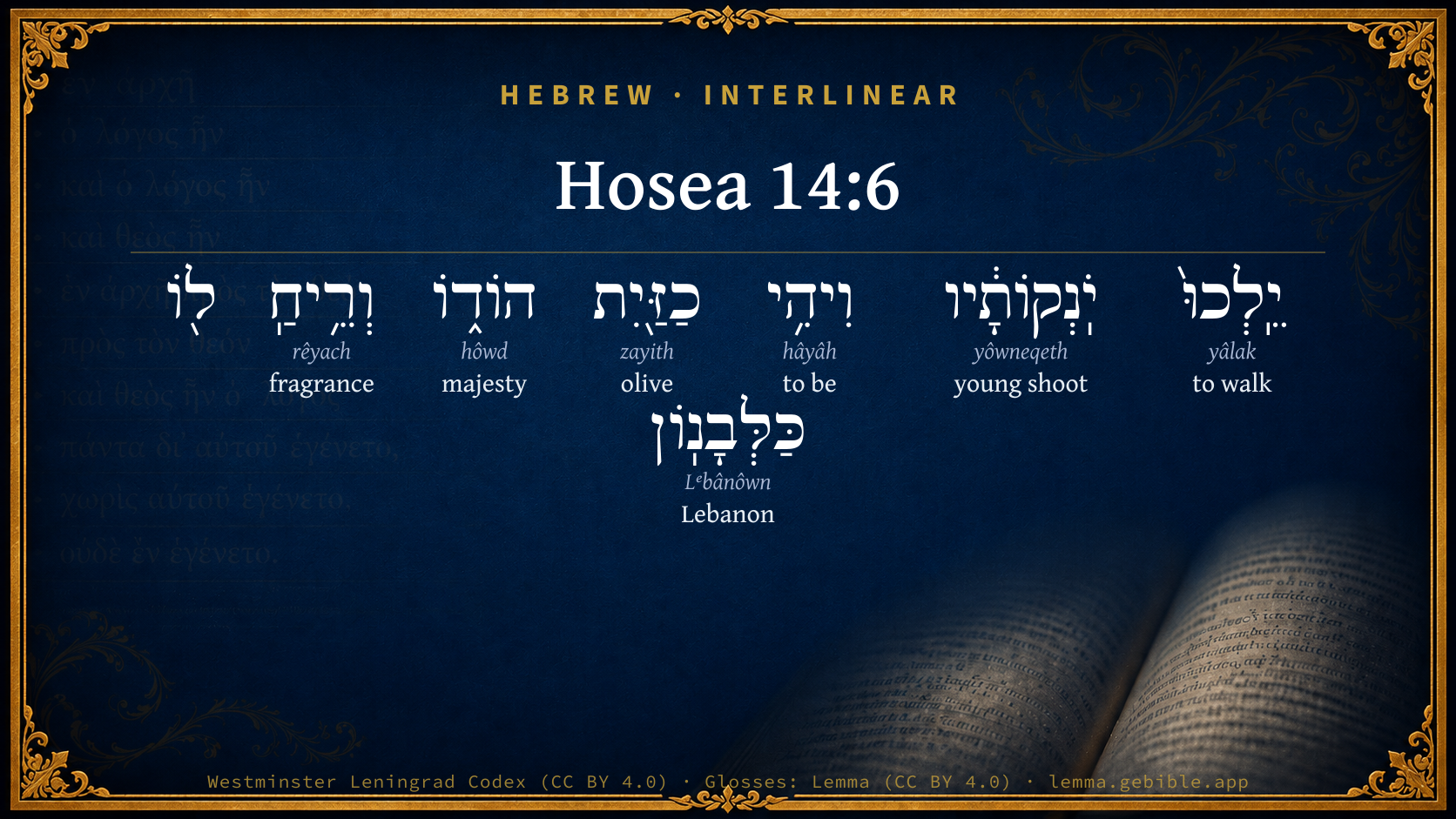
Hebrew (Westminster Leningrad Codex) Hosea 14:6 appears in the Hebrew Old Testament. The text above is from the Westminster Leningrad Codex. Each word links to its Strong’s number, a concise gloss, and parsing drawn from the Open Scriptures Hebrew Bible morphology. Click any word for its full Brown-Driver-Briggs (BDB) entry.
Download image
Cite this verse

Hosea 14:6 (World English Bible). Public Domain. Lemma interlinear Bible study tool, https://lemma.gebible.app/v/hosea/14/6.

Show BibTeX & RIS
BibTeX
RIS
English Translation
His branches will spread, And his beauty will be like the olive tree, And his fragrance like Lebanon.
World English Bible · Public Domain
Download a study sheet

One document with this verse’s original text, its word-by-word gloss line, the meaning frame, cross-references with their text, attributed commentary, and full source and license credits — printable, and it pastes into notes with its structure intact.

This verse Autodidact and up

Study sheet (.html) Plain text (.txt)

A passage Seminary Student

Up to 50 verses in one chapter. A passage sheet keeps up to 6 commentary sources and 12 cross-references per verse, in the order this page ranks them, and says so on the sheet whenever that leaves anything out. Ask for a single verse and you get the Autodidact verse sheet above.

Everything on this page stays free to read, with no account — the sheet is a download of what is already on screen, not access to it.

Want to remove ads? Support Godless Engineer
Compare translations 3

The same verse in 3 English versions, stacked beneath the original-language interlinear above. Click any original word for its lexicon entry.

Each is an independent rendering of the whole verse — the interlinear is not word-aligned to these translations.

Highlighted words mark where these versions differ — a whole-verse word diff, not a word-by-word alignment.

  • World English Bible Public Domain
    His branches will spread, And his beauty will be like the olive tree, And his fragrance like Lebanon.
  • King James Version Public Domain
    His branches shall spread, and his beauty shall be as the olive tree, and his smell as Lebanon.
  • unfoldingWord Literal Text CC BY-SA 4.0
    His shoots will go forth, and his splendor will be like the olive tree, and the scent of him like Lebanon.”

unfoldingWord Literal Text — © unfoldingWord, licensed CC BY-SA 4.0. Word-aligned USFM3 via Door43 (git.door43.org/unfoldingWord/en_ult).

Versions to compare (up to 4)

3 of 4 selected

Show all 18 translations

Every available English version of this verse, each an independent rendering of the whole verse.

  • World English Bible Public Domain
    His branches will spread, And his beauty will be like the olive tree, And his fragrance like Lebanon.
  • Berean Standard Bible Public Domain
    His shoots will sprout, and his splendor will be like the olive tree, his fragrance like the cedars of Lebanon.
  • Majority Standard Bible Public Domain
    His shoots will sprout, and his splendor will be like the olive tree, his fragrance like the cedars of Lebanon.
  • King James Version Public Domain
    His branches shall spread, and his beauty shall be as the olive tree, and his smell as Lebanon.
  • American Standard Version (1901) Public Domain
    His branches shall spread, and his beauty shall be as the olive-tree, and his smell as Lebanon.
  • Revised Version (1885) Public Domain
    His branches shall spread, and his beauty shall be as the olive tree, and his smell as Lebanon.
  • Geneva Bible (1599) Public Domain
    I will be as the dewe vnto Israel: he shall grow as the lilie and fasten his rootes, as the trees of Lebanon.
  • Douay-Rheims (1899) Public Domain
    I will be as the dew, Israel shall spring as the lily, and his root shall shoot forth as that of Libanus.
  • Young's Literal Translation Public Domain
    Go on do his sucklings, And his beauty is as an olive, And he hath fragrance as Lebanon.
  • Literal Standard Version CC BY-SA 4.0
    His shoots go on, || And his splendor is as an olive, || And he has fragrance as Lebanon.
  • Unlocked Literal Bible CC BY-SA 4.0
    His branches will spread out; his beauty will be like the olive trees, and his fragrance like the cedars in Lebanon.
  • unfoldingWord Literal Text CC BY-SA 4.0
    His shoots will go forth, and his splendor will be like the olive tree, and the scent of him like Lebanon.”
  • Darby Bible Public Domain
    His shoots shall spread, and his beauty shall be as the olive-tree, and his smell as Lebanon.
  • World Messianic Bible Public Domain
    His branches will spread, and his beauty will be like the olive tree, and his fragrance like Lebanon.
  • Webster's Bible Public Domain
    \\14:5\\I will be as the dew to Israel: he shall grow as the lily and cast forth his roots as Lebanon.
  • Free Bible Version CC BY-SA 4.0
    They will send out new shoots, their splendor will be like the olive tree, and their scent will be like the cedars of Lebanon.
  • Bible in Basic English Public Domain
    I will be as the dew to Israel; he will put out flowers like a lily, and send out his roots like Lebanon.
  • JPS Tanakh (1917) Public Domain
    (14-7) His branches shall spread, and his beauty shall be as the olive-tree, and his fragrance as Lebanon.

Literal Standard Version (2020), Covenant Press — licensed CC BY-SA 4.0. Text via the HelloAO Bible API (eBible.org). Unlocked Literal Bible (unfoldingWord) — licensed CC BY-SA 4.0. Text via the HelloAO Bible API (eBible.org). unfoldingWord Literal Text — © unfoldingWord, licensed CC BY-SA 4.0. Word-aligned USFM3 via Door43 (git.door43.org/unfoldingWord/en_ult). Free Bible Version, Dr. Jonathan Gallagher — licensed CC BY-SA 4.0. Text via the HelloAO Bible API (eBible.org).

Word by word

More ways to search: Search by grammar → Find every occurrence → Compare this word →

Practice this passage: Drill this verse → Learn its vocabulary →

About this verse

These counts appear in no published source. They are computed here, from the morphology-tagged text and Lemma’s own curated glosses. What Lemma adds →

8
words
7
distinct lemmas
Prophets
section

Notable vocabulary

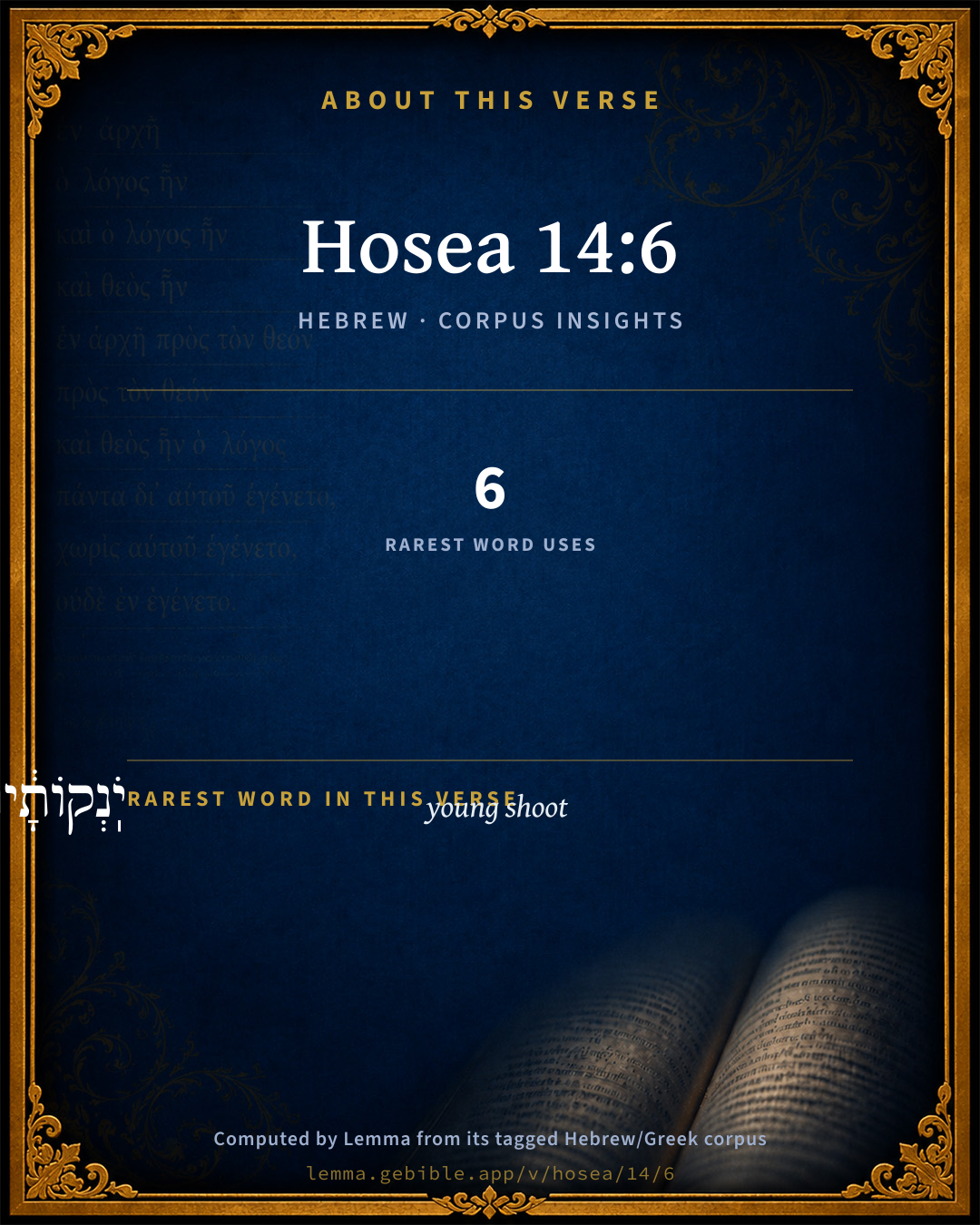
The rarest word here is יֹֽנְקוֹתָ֔יו young shoot H3127 — appearing just 6 times in the whole Hebrew Bible.

Shared distinctive vocabulary

יֹֽנְקוֹתָ֔יו young shoot H3127 occurs in 6 verses of the Hebrew Bible. Also found in:

Grammatical profile

  • 2 verbs
  • 5 nouns
  • 1 preposition

Verb forms

  • יֵֽלְכוּ֙ Qal · Jussive
  • וִיהִ֥י Qal · Jussive

Hebrew & Septuagint length

In English translation the verse runs 18 words from the Hebrew and 20 from the Septuagint (LXX English) — closely comparable.

A rough comparison of the two English renderings, which tokenize alike — not a word-level alignment.

Word counts can differ between the Hebrew and the Greek without any difference in meaning — e.g. the Hebrew direct-object marker אֵת has no separate Greek word, and Greek often adds the article ὁ.

Cross-references

14

Topical passages linked to Hosea 14:6 in the Treasury of Scripture Knowledge — connected by theme and wording, ordered by reader-vote popularity; previews shown in the World English Bible.

  • Psalms 52:8 But as for me, I am like a green olive tree in God's house. I trust in God's loving kindness forever and ever.
  • Psalms 128:3 Your wife will be as a fruitful vine, In the innermost parts of your house; Your children like olive plants, Around your table.
  • Philippians 4:18 But I have all things, and abound. I am filled, having received from Epaphroditus the things that came from you, a sweet-smelling fragrance, an acceptable and well-pleasing sacrifice to God.
  • Genesis 27:27 He came near, and kissed him. He smelled the smell of his clothing, and blessed him, and said, "Behold, the smell of my son Is as the smell of a field which Yahweh has blessed.
  • Psalms 80:9–11 You cleared the ground for it. It took deep root, and filled the land.
  • Song of Solomon 4:11–15 Your lips, my bride, drip like the honeycomb. Honey and milk are under your tongue. The smell of your garments is like the smell of Lebanon.
  • Jeremiah 11:16 Yahweh called your name, A green olive tree, beautiful with goodly fruit: with the noise of a great tumult he has kindled fire on it, and the branches of it are broken.
  • Ezekiel 17:5–8 He took also of the seed of the land, and planted it in a fruitful soil; he placed it beside many waters; he set it as a willow tree.
  • Ezekiel 31:3–10 Behold, the Assyrian was a cedar in Lebanon with beautiful branches, and with a forest-like shade, and of high stature; and its top was among the thick boughs.
  • Daniel 4:10–15 Thus were the visions of my head on my bed: I saw, and, behold, a tree in the midst of the earth; and the height of it was great.
  • Matthew 13:31 He set another parable before them, saying, "The Kingdom of Heaven is like a grain of mustard seed, which a man took, and sowed in his field;
  • John 15:1 "I am the true vine, and my Father is the farmer.
  • Romans 11:16–24 If the first fruit is holy, so is the lump. If the root is holy, so are the branches.
  • 2 Corinthians 2:14–15 Now thanks be to God, who always leads us in triumph in Christ, and reveals through us the sweet aroma of his knowledge in every place.

Cross-references courtesy of OpenBible.info (CC BY 4.0).

Hebrew and Greek witnesses Masoretic Hebrew ↔ Greek Septuagint

The same verse in the two great witnesses to the Old Testament, shown verse-for-verse.

These are two independent witnesses, not word-aligned to each other, and the Septuagint is shown in lemma (dictionary) form.

Hebrew Hosea 14:6 Masoretic · Westminster Leningrad Codex

יֵֽלְכוּ֙ יֹֽנְקוֹתָ֔יו וִיהִ֥י כַזַּ֖יִת הוֹד֑וֹ וְרֵ֥יחַֽ ל֖וֹ כַּלְּבָנֽוֹן

His branches will spread, And his beauty will be like the olive tree, And his fragrance like Lebanon.

World English Bible · Public Domain

Greek LXX Hosea 14:6 Septuagint · lemma form

εἰμί ὡς δρόσος ὁ ἰσραήλ ἀνθέω ὡς κρίνον καί βάλλω ὁ ῥίζα αὐτός ὡς ὁ λίβανος

I will be as dew to Israel: he shall bloom as the lily, and cast forth his roots as Libanus.

LXX2012 (modern English Septuagint) · Public Domain

Hebrew: Westminster Leningrad Codex (CC BY 4.0). Greek: Septuagint (public domain); English from LXX2012 (modern English Septuagint) (Public Domain). How the Septuagint differs from the Hebrew →

Targum (Aramaic paraphrase)

1

The Targum is the ancient Jewish Aramaic paraphrase of the Hebrew Scriptures — an interpretive translation, not the Hebrew text itself. Onkelos (literal) and Pseudo-Jonathan (expansive) render the Torah, and Jonathan the Prophets. Coverage is partial: where no permissively-licensed English translation exists for a verse, only the Aramaic is shown. This is verse-level text, not a word-by-word alignment to the Hebrew.

  1. Targum Jonathan Prophets (Joshua–Malachi)
    יְהֵי מֵימְרִי כְּטַלָא לְיִשְׂרָאֵל יִזְהַרוּן כְּשׁוֹשַׁנָא וְיַתְבוּן עַל תְּקוֹף אַרְעֲהוֹן כְּאִילָן לִבְנָן דִמְשַׁלַח עוֹבַרְתֵּיהּ:

    (no public-domain English translation for this verse)

    Targum Jonathan — Aramaic: “Mikraot Gedolot” (public domain). English: “Sefaria Community Translation” (CC0 1.0 (public-domain dedication)); “London "Chaldee Paraphrase," 1871” (public domain). Text via Sefaria.

Commentary

Notes on Hosea 14:6 from classic Christian and Jewish commentators (each source and its license shown beneath its notes). The classic Christian expositions comment on the surrounding passage and are grouped to its opening verse, so a note may address several verses; the Jewish commentaries on the Tanakh (Rashi and others) are per-verse, so they appear only where the commentator wrote on this verse.

Lemma curates 59 commentaries, every one of them public domain or Creative Commons licensed, each selected and text-cleaned for this edition rather than reprinted as found. About our sources →

Trapp's Complete Commentary

John Trapp

Hos 14:6 His branches shall spread, and his beauty shall be as the olive tree, and his smell as Lebanon.

Ver. 6. His branches shall spread] Heb. shall walk, or expatiate; shall reach out, and stretch themselves all abroad: so shall the Church be propagated all the earth over; she shall flourish as the palm tree, which though it have many weights hung on the top, and many snakes hissing at the root, yet it still saith, Nec premor, nec perimor, I am insuperable: "I am like a green olive tree in the house of God: I trust in the mercy of God for ever and ever," Psa 52:8.

And his beauty shall be as the olive tree] That goodly tree, Lev 23:40, that retaineth her greenness in the depth of winter; yea, in that universal deluge, Noah’s dove met with an olive leaf. "The Lord hath called thy name," saith the prophet to the Church, Jer 11:16, "a green olive tree, fair, and of goodly fruit." The cypress is fair, but not fruitful; the fig tree fruitful, but not fair and flourishing. But the olive tree is both fair and fruitful; her fruit also is of singular use to mankind, both for food and medicine and light for the lamp, Exo 29:20 Lev 6:15-16. In one respect it is an emblem of peace, it maketh the face shine, Psa 104:15; and in the other, it is an emblem of grace and spiritual gifts, 1Jn 2:20, of increasing with the increase of God, by the Spirit, and of reigning with him in eternal glory.

And his smell as Lebanon] Whereby is meant the sweet savour of the gospel, which spreadeth itself abroad in the ministry of the word, and in the lives of believers, 2Co 2:14-15, who besides their continual offering up to God spiritual incense and services in prayers, thanksgivings, alms, and good works, they perfume the very air they breathe upon by their gracious and savoury communication, Eph 4:29; yea, the very company they come into: as a man cannot come where sweet spices and odours are beaten to the smell but he shall carry away the scent thereof in his clothes. When the Spirit of Christ blows upon them, and grace is poured into their hearts, then their lips drop sweet-smelling myrrh, Son 5:13; Son 4:16, then also their "good name is better than a precious ointment," Ecc 7:1; see the note there; when the wicked stink alive and dead, Nihil nisi foetidum et foedum exhalavit (Rivet.).

John Trapp, A Commentary or Exposition upon All the Books of the Old and New Testament (1647–1656) — public domain. Text from a community e-Sword module.

Jamieson, Fausset & Brown

Robert Jamieson, A. R. Fausset & David Brown

branches--shoots, or suckers.

beauty . . . as the olive--which never loses its verdure. One plant is not enough to express the graces of God's elect people. The lily depicts its lovely growth; but as it wants duration and firmness, the deeply rooted cedars of Lebanon are added; these, however, are fruitless, therefore the fruitful, peace-bearing, fragrant, ever green olive is added.

smell as Lebanon--which exhaled from it the fragrance of odoriferous trees and flowers. So Israel's name shall be in good savor with all (Gen 27:27; Sol 4:11).

Jamieson, Fausset & Brown — Commentary Critical and Explanatory on the Whole Bible (1871) — public domain (CC PDM 1.0). Text via the HelloAO Bible API.

John Calvin's Commentaries

The Prophet goes on with the same subject, but joins the beginning of the first verse with the second clause of the former verse. He had said that the roots of the people would be deep when God should restore them. Now he adds, that their branches shall go on He mentions here “to go on” metaphorically for extending far; for branches of trees seem to go on, when they extend and spread themselves far and wide. His branches, then, shall go on; which means, that a tree, after striking roots, remains not in the same state, but grows and spreads forth its branches in all directions. In short, God promises a daily increase to his blessing, after he has once begun to show himself bountiful to the people of Israel. “I will then be bountiful at the beginning; and further, he says, my blessing shall, as time passes, increase and be multiplied.”

He afterwards adds, His comeliness shall be like the olive The Prophet accumulates similitudes, that he might more fully confirm the people. And we certainly see that the minds of men grow faint, when they look for prosperity from this or that quarter; for there is hardly one in a hundred who is fully persuaded that when God is propitious, all things turn out well and happily: for men regard not the love of God when they wish things to be well with them, but wander here and there through the whole world; and now they seek prosperity from themselves, then from the earth, now from the air, then from the sea. Since then it is so difficult to impress this truth fully on the hearts of men, that the love of God is the fountain of all blessings, the Prophet has collected together a number of similitudes to confirm what he teaches. Then his comeliness, he says, shall be like the olive; and further, his fragrance like that of Libanus: and odoriferous trees, we know, grow on Mount Libanus. But by these various similes the Prophet shows that the state of the people would be prosperous and happy as soon as they should be received by God into favour. He afterwards adds, the dwellers under his shadow shall return; but I defer this till to-morrow.

John Calvin's Commentaries (1540-1563) — public domain. Text from the Calvin Translation Society English edition (1840s-50s) via the Christian Classics Ethereal Library (ccel.org). Calvin's coverage is partial (roughly two-thirds of the Bible); uncommented books and verses are honest gaps, never fabricated. The 19th-century editor's footnotes and remarks are omitted so the notes are faithfully Calvin's own voice.

The Cambridge Bible for Schools and Colleges

gen. ed. J. J. S. Perowne

6. I will be as the dew] Rather, as the night-mist, i.e. the masses of vapour (Hebr. tal) brought by the damp westerly winds of summer (see on Hos_6:4). ‘In the strict scientific sense of the word, this is rain, and not dew at all, since the vapour becomes condensed in the air before touching the ground’ (Neil, Palestine Explored, p. 135). The promise comes very appropriately after the ‘I will heal’ of Hos_14:4. The baleful effects of the sirocco are often felt in Palestine during the rainless heat of summer, but by the beautiful provision of night-mist all hardy forms of vegetable life are preserved. But to the ‘east-wind’ described in Hos_13:15 there was no such counteracting force. A ‘dew’ (‘night-mist’) of supernatural energy (like Gideon’s) was required to vivify that which Assyria had destroyed—what another prophet calls (Isa_26:19) ‘a dew of lights’, i.e. an influence from the divine Light, could alone undo so complete a catastrophe. Observe how nearly coincident are the conceptions of land and people in Hosea’s mind (see on Hos_2:3).

grow [blossom] as the lily] So Sir_39:14. The image suggests the ideas of profusion and beauty. There is nothing to bind us down to any single individual of the lily species. Indeed, the application of the Hebrew shôshan was probably as wide as that of the Arabic sûsan still is, if we may argue from the mention of ‘lilies [oleanders?] by the rivers of waters’ in Sir_50:8. Dr Thomson’s ‘Hûleh lily’, which abounds in the woods north of Tabor (The Land and the Book, p. 256), is at least as likely a flower to be meant as any other. Dr Tristram prefers the not less gorgeous than abundant Anemone coronaria (Nat. Hist. of Bible, p. 464).

and cast forth] Lit., ‘and let it strike.’ A change of the verbal form for the sake of colour and variety.

as Lebanon] The slender roots of the lily supply no fit image for stability; for this Hosea turns to the ‘cedars of God’ (Psa_80:10, A. V. ‘goodly cedars’), or perhaps he means the mountains of Lebanon themselves (for the ‘roots’ of a mountain, comp. Job_28:9).

6. His branches shall spread] For ‘branches’ render saplings. It is the same word as in Isa_53:2 (where A. V. ‘tender branch’). There the prophet’s idea is that after Israel’s vine has been cut down, a slender plant will spring up from the root; here, that the root of the living tree shall send forth many fresh plants. In fact, Israel is to be like not merely a tree, but a garden.

as the olive-tree] Beautiful doubtless in itself, but with a beauty enhanced by the serviceableness of the fruits. Jeremiah compares Israel to ‘a fresh-green olive-tree, fair, and of goodly fruit’ (Jer_11:16).

his smell as Lebanon] As the balsamic odour of the cedars and of aromatic shrubs. Comp. Son_4:11.

The Cambridge Bible for Schools and Colleges (gen. ed. J. J. S. Perowne; Cambridge University Press, 1878–1918) — public domain. Text from a community e-Sword module.

John Gill's Exposition

His branches shall spread,.... As the well rooted cedars in Lebanon; see Num 24:6. This respects the propagation of the church of God, and the interest of Christ in the world, as in the first times of the Gospel, and will be in the latter day; when the Gospel shall be spread everywhere; churches set up in all places; the Jews converted, and the fulness of the Gentiles brought in; and these like spreading branches, and fruitful boughs, abounding in grace and good works. The Targum is,

"they shall multiply or increase with sons and daughters:''

and his beauty shall be as the olive tree; which lies in its being laden with excellent fruit, and being always green; for which reasons particular believers, and the whole church of God, are sometimes compared to it; having that fatness in them, with which God and men are honoured; and that true grace, which is signified by oil in the vessels of the heart, and is called the unction and anointing of the Holy One; and they persevering in this grace to the end, which is evergreen and durable, immortal, and dies not; see Psa 52:8. Here again it may be observed, that the trees of Lebanon, though they had strong roots, and spreading branches, yet were not fruitful; and the deficiency of that metaphor is supplied by this of the olive:

and his smell as Lebanon; as the trees of Lebanon, the cedars, trees of frankincense, and other odoriferous trees and plants, which grew upon it; here what is wanting in the olive tree, whose smell is not so grateful, is made up by this simile of the trees of Lebanon, and the smell of them; which may denote the sweet and grateful smell the Lord smells in his people, or his gracious acceptance of them in Christ; whose garments of righteousness and salvation on them are as the smell of Lebanon; and whose graces in them exceed the smell of all spices; and whose prayers are odours, and their praises a sacrifice of a sweet smelling savour to God; see Sol 4:10. Some render it, "as incense" (d) called "lebonah" in Hebrew, from whence the mountain is thought to have its name, frankincense growing upon it. So the Targum,

"and their smell as the smell of the incense of spices.''

Jarchi says, as the sanctuary, which was made of the cedars of Lebanon.

(d) "Ut thuris", Grotius.

John Gill's Exposition of the Whole Bible (1746–1763) — public domain (CC PDM 1.0). Text via the HelloAO Bible API.

Haydock's Catholic Bible Commentary

Dew. Israel has been like a plant dried up, chap. xiii. 15. --- Libanus. The cedars were tall and bulky, being well rooted.

George Leo Haydock (1774–1849), Haydock's Catholic Family Bible and Commentary, 1859 edition — public domain. Excludes Psalms (Douay-Rheims chapter numbering differs from Protestant) and Deuterocanonical books (Catholic canon only).

Matthew Poole's English Annotations

His branches, his tenderest branches which are new sprung out, shall gather strength, not be broken off, but by these shall they multiply in number of boughs.

Shall spread; grow great and beautiful, and excellent for shade.

As the olive tree; which retains its verdure all the winter, and is rich in fruit; so the true Israel of God shall flourish, pot in fruitless beauty and stateliness, but in desirable and lovely fruit, even in winters of affliction and troubles.

As Lebanon; the mountain famous for cedars, where also were the trees that afford the frankincense, which sweat out that excellent aromatic, and where many more sweetest flowers grow and perfume the air; such shall the spiritual fragrance of the church be to God and man.

Matthew Poole's English Annotations on the Holy Bible (1683–1685) — public domain. Text from a community e-Sword/MySword module.

John Wesley's Explanatory Notes

His branches - His branches which are new sprung out, shall gather strength, and shall multiply in number. The olive-tree - Which retains its verdure all the winter and is rich in fruit; so the true Israel of God shall flourish not in fruitless beauty, but in lovely fruit, even in winter's of affliction and trouble. As Lebanon - The mountain famous for cedars, where also were the trees that afford the frankincense, and many flowers which perfume the air; such shall the spiritual fragrance of the church be to God and man.

John Wesley, Explanatory Notes Upon the Whole Bible (1754–1765) — public domain. Text via the GEBible commentary corpus.

Rashi

Rabbi Shlomo Yitzchaki (Rashi)

and it shall strike I.e. the dew shall strike its roots and cause them to prosper like the Lebanon like the roots of the trees of the Lebanon, which are large.

Rashi on the Tanakh — English translations: “The Judaica Press complete Tanach with Rashi, translated by A. J. Rosenberg” (CC BY 4.0); “Pentateuch with Rashi's commentary by M. Rosenbaum and A.M. Silbermann, 1929-1934” (public domain); “The Metsudah Tanach series, Lakewood, N.J” (CC BY 4.0); and “The Book of Joshua, Metsudah Publications, 1997” (CC BY 4.0). Text via Sefaria.

Lesson kit

Teaching starters — assembled from the data on this page, not authored interpretation. Every prompt links to the verse data it draws on. Edit before teaching.

Hosea, in the Prophets, opens this verse with 8 words (7 distinct Hebrew lemmas). Its most distinctive word is yôwneqeth (“young shoot”). A historical commentator’s framing appears above. Read the whole chapter for the surrounding context.

Discussion questions

  1. How does “young shoot” (yôwneqeth) shape what this verse is saying?
  2. How does Job 8:16, which shares the word «young shoot», read alongside this verse?
  3. These translations render this verse differently. What is at stake in choosing one wording over another?
  4. «יֵֽלְכוּ֙» is a Qal Jussive verb. How does that grammatical form shape the action described?
  5. Compare how Trapp's Complete Commentary and Jamieson, Fausset & Brown read this verse. Where do they agree or differ?

Things to notice

Reading settings

Reading text

Shown beneath each verse's original-language words.

Old Testament
Old Testament edition

Read the OT as the Masoretic Hebrew (MT) or the Greek Septuagint (LXX).

English shown for the Greek Septuagint (in the Hebrew ↔ Greek comparison).

Comparing translations? Open the Compare panel on any verse page to stack up to four side by side.