Matthew 27:35

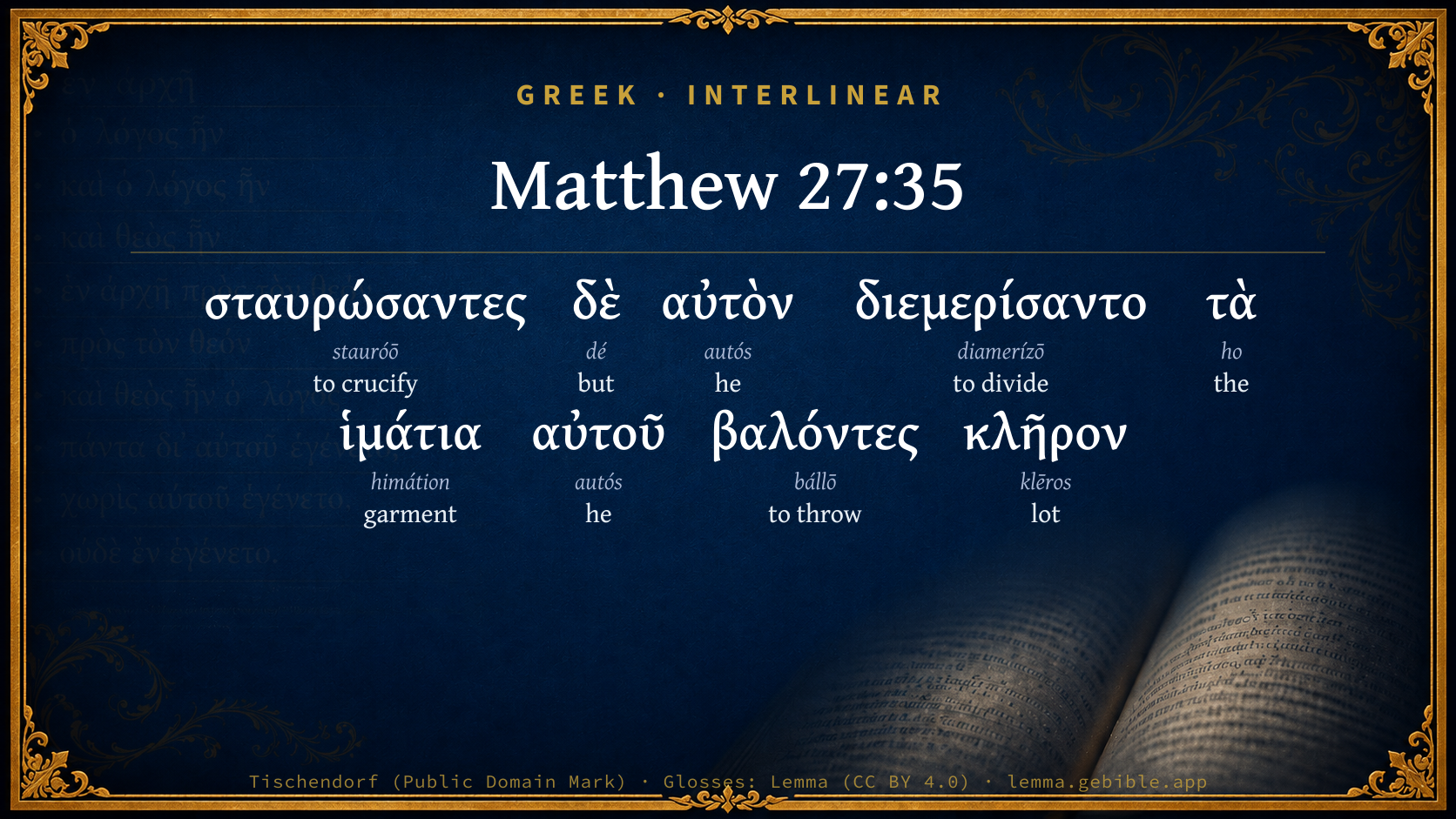
Greek (Tischendorf 8th ed.) Matthew 27:35 appears in the Greek New Testament. The text above is from the Tischendorf 8th edition. Each word links to its Strong’s number and a concise gloss. Click any word for its full Thayer’s Greek Lexicon entry.
Download image
Cite this verse

Matthew 27:35 (World English Bible). Public Domain. Lemma interlinear Bible study tool, https://lemma.gebible.app/v/matthew/27/35.

Show BibTeX & RIS
BibTeX
RIS
English Translation
When they had crucified him, they divided his clothing among them, casting lots,
World English Bible · Public Domain
Highlights
  • 2 first appearances in the Greek New Testament
Full analysis ↓
Download a study sheet

One document with this verse’s original text, its word-by-word gloss line, the meaning frame, cross-references with their text, attributed commentary, and full source and license credits — printable, and it pastes into notes with its structure intact.

This verse Autodidact and up

Study sheet (.html) Plain text (.txt)

A passage Seminary Student

Up to 50 verses in one chapter. A passage sheet keeps up to 6 commentary sources and 12 cross-references per verse, in the order this page ranks them, and says so on the sheet whenever that leaves anything out. Ask for a single verse and you get the Autodidact verse sheet above.

Everything on this page stays free to read, with no account — the sheet is a download of what is already on screen, not access to it.

Want to remove ads? Support Godless Engineer
Compare translations 3

The same verse in 3 English versions, stacked beneath the original-language interlinear above. Click any original word for its lexicon entry.

Each is an independent rendering of the whole verse — the interlinear is not word-aligned to these translations.

Highlighted words mark where these versions differ — a whole-verse word diff, not a word-by-word alignment.

  • World English Bible Public Domain
    When they had crucified him, they divided his clothing among them, casting lots,
  • King James Version Public Domain
    And they crucified him, and parted his garments, casting lots: that it might be fulfilled which was spoken by the prophet, They parted my garments among them, and upon my vesture did they cast lots.
  • unfoldingWord Literal Text CC BY-SA 4.0
    Now, having crucified him, they divided up his robes, casting a lot,

unfoldingWord Literal Text — © unfoldingWord, licensed CC BY-SA 4.0. Word-aligned USFM3 via Door43 (git.door43.org/unfoldingWord/en_ult).

Versions to compare (up to 4)

3 of 4 selected

Show all 19 translations

Every available English version of this verse, each an independent rendering of the whole verse.

  • World English Bible Public Domain
    When they had crucified him, they divided his clothing among them, casting lots,
  • Berean Standard Bible Public Domain
    When they had crucified Him, they divided up His garments by casting lots.
  • Majority Standard Bible Public Domain
    When they had crucified Him, they divided up His garments by casting lots.
  • King James Version Public Domain
    And they crucified him, and parted his garments, casting lots: that it might be fulfilled which was spoken by the prophet, They parted my garments among them, and upon my vesture did they cast lots.
  • American Standard Version (1901) Public Domain
    And when they had crucified him, they parted his garments among them, casting lots;
  • Revised Version (1885) Public Domain
    And when they had crucified him, they parted his garments among them, casting lots:
  • Geneva Bible (1599) Public Domain
    And when they had crucified him, they parted his garments, and did cast lottes, that it might be fulfilled, which was spoken by the Prophet, They deuided my garments among them, and vpon my vesture did cast lottes.
  • Douay-Rheims (1899) Public Domain
    And after they had crucified him, they divided his garments, casting lots; that it might be fulfilled which was spoken by the prophet, saying: They divided my garments among them; and upon my vesture they cast lots.
  • Young's Literal Translation Public Domain
    And having crucified him, they divided his garments, casting a lot, that it might be fulfilled that was spoken by the prophet, `They divided my garments to themselves, and over my vesture they cast a lot;'
  • Literal Standard Version CC BY-SA 4.0
    And having crucified Him, they divided His garments, casting a lot, [[that it might be fulfilled which was spoken by the prophet: “They divided My garments to themselves, and they cast a lot over My clothing”;]]
  • Unlocked Literal Bible CC BY-SA 4.0
    When they had crucified him, they divided up his garments by casting lots,
  • unfoldingWord Literal Text CC BY-SA 4.0
    Now, having crucified him, they divided up his robes, casting a lot,
  • Darby Bible Public Domain
    And having crucified him, they parted his clothes amongst [themselves], casting lots.
  • World Messianic Bible Public Domain
    When they had crucified him, they divided his clothing among them, casting lots,
  • Webster's Bible Public Domain
    And they crucified him, and parted his garments, casting lots: that it might be fulfilled which was spoken by the prophet, They parted my garments among them, and upon my vesture they cast lots.
  • Free Bible Version CC BY-SA 4.0
    After they had crucified him, they rolled dice to divide his clothes between them.
  • Bible in Basic English Public Domain
    And when they had put him on the cross, they made division of his clothing among them by the decision of chance.
  • Text-Critical English NT CC BY 4.0
    After crucifying him, they divided his garments among themselves by casting lots.
  • Tyndale New Testament (1534) Public Domain
    When they had crucified him they parted his garmentes and did cast lottes: to fulfyll that was spoken by the prophet. They deuyded my garmetes amonge them: and apon my vesture did cast loottes.

Literal Standard Version (2020), Covenant Press — licensed CC BY-SA 4.0. Text via the HelloAO Bible API (eBible.org). Unlocked Literal Bible (unfoldingWord) — licensed CC BY-SA 4.0. Text via the HelloAO Bible API (eBible.org). unfoldingWord Literal Text — © unfoldingWord, licensed CC BY-SA 4.0. Word-aligned USFM3 via Door43 (git.door43.org/unfoldingWord/en_ult). Free Bible Version, Dr. Jonathan Gallagher — licensed CC BY-SA 4.0. Text via the HelloAO Bible API (eBible.org).

Word by word

More ways to search: Search by grammar → Find every occurrence → Compare this word →

Practice this passage: Drill this verse → Learn its vocabulary →

About this verse

These counts appear in no published source. They are computed here, from the morphology-tagged text and Lemma’s own curated glosses. What Lemma adds →

9
words
8
distinct lemmas
Gospels
section

Notable vocabulary

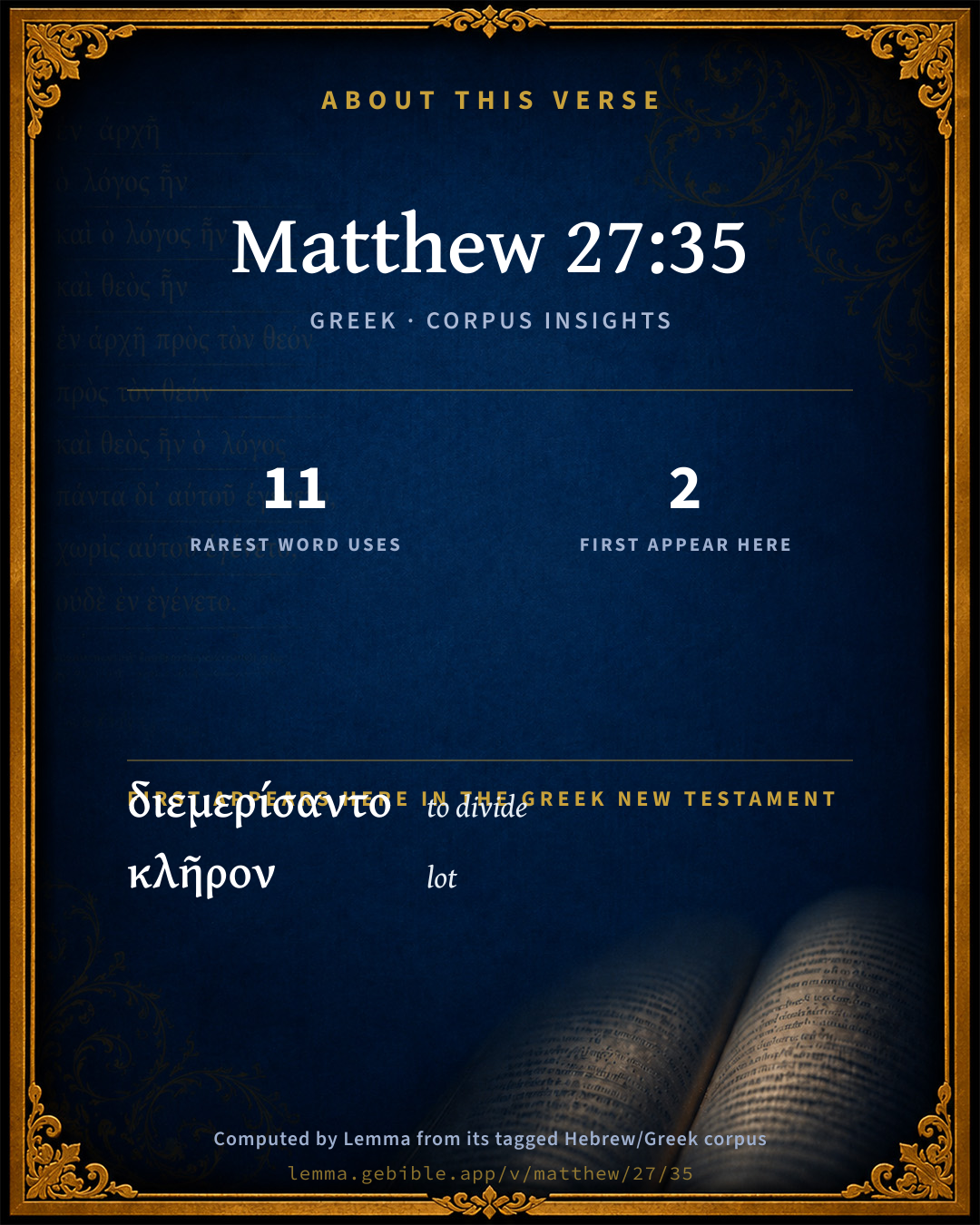
The rarest word here is διεμερίσαντο to divide G1266 — appearing just 11 times in the whole Greek New Testament.

First appearance in Scripture

These words make their first canonical appearance in the Greek New Testament here:

  • διεμερίσαντο to divide G1266
  • κλῆρον lot G2819

Shared distinctive vocabulary

διεμερίσαντο to divide G1266 occurs in 11 verses of the Greek New Testament. Also found in:

Repetition

A word recurs within this verse:

  • αὐτὸν he G846 ×2

Cross-references

9

Topical passages linked to Matthew 27:35 in the Treasury of Scripture Knowledge — connected by theme and wording, ordered by reader-vote popularity; previews shown in the World English Bible.

  • Psalms 22:18 They divide my garments among them. They cast lots for my clothing.
  • Mark 15:24–32 Crucifying him, they parted his garments among them, casting lots on them, what each should take.
  • Luke 23:34 Jesus said, "Father, forgive them, for they don't know what they are doing." Dividing his garments among them, they cast lots.
  • John 19:23–24 Then the soldiers, when they had crucified Jesus, took his garments and made four parts, to every soldier a part; and also the coat. Now the coat was without seam, woven from the top throughout.
  • Acts 4:10 be it known to you all, and to all the people of Israel, that in the name of Jesus Christ of Nazareth, whom you crucified, whom God raised from the dead, in him does this man stand here before you whole.
  • Psalms 22:16 For dogs have surrounded me. A company of evil-doers have enclosed me. They pierced my hands and my feet.
  • John 20:20 When he had said this, he showed them his hands and his side. The disciples therefore were glad when they saw the Lord.
  • John 20:27 Then he said to Thomas, "Reach here your finger, and see my hands. Reach here your hand, and put it into my side. Don't be unbelieving, but believing."
  • John 20:25 The other disciples therefore said to him, "We have seen the Lord!" But he said to them, "Unless I see in his hands the print of the nails, and put my hand into his side, I will not believe."

Cross-references courtesy of OpenBible.info (CC BY 4.0).

Where the printed editions differ

1 variant

Places in this verse where the major printed Greek editions disagree on the wording in a way that affects the translation — a comparison of editions, not a manuscript-by-manuscript collation. The editions are the modern critical texts (Nestlé-Aland 28/27, SBL, Westcott-Hort, Tregelles, Tyndale House) and the traditional texts behind the KJV (the Textus Receptus and the Byzantine/Majority text). It is not a claim about which reading is original.

  1. Extra text
    ἵνα πληρωθῇ τὸ ῥηθὲν ὑπὸ τοῦ προφήτου διεμερίσαντο τὰ ἱμάτια μου ἑαυτοῖς καὶ ἐπὶ τὸν ἱματισμόν μου ἔβαλον κλῆρον

    “so that may be fulfilled which having been spoken by <the> prophet they divided the garments of mine themselves and upon the clothing of mine they cast lots”

    In TR Not in NA28NA27TynSBLWHTregByz

    ἵνα πληρωθῇ τὸ ῥηθὲν ὑπὸ τοῦ προφήτου διεμερίσαντο τὰ ἱμάτια μου ἑαυτοῖς καὶ ἐπὶ τὸν ἱματισμόν μου ἔβαλον κλῆρον (ina plērōthēa to rhēthen hupo tou prophētou diemerisanto ta himatia mou he'autois kai epi ton himatismon mou ebalon klēron) 'so that may be fulfilled which having been spoken by prophet they divided the garments of mine themselves and upon the clothing of mine they cast lots' is only in traditional manuscripts (TR)

Textual data: Translators Amalgamated Greek New Testament (STEPBible TAGNT) · CC BY 4.0.

Commentary

Notes on Matthew 27:35 from classic Christian and Jewish commentators (each source and its license shown beneath its notes). The classic Christian expositions comment on the surrounding passage and are grouped to its opening verse, so a note may address several verses; the Jewish commentaries on the Tanakh (Rashi and others) are per-verse, so they appear only where the commentator wrote on this verse.

Lemma curates 59 commentaries, every one of them public domain or Creative Commons licensed, each selected and text-cleaned for this edition rather than reprinted as found. About our sources →

Joseph Benson's Commentary

Mat 27:35-36. And they crucified him — The person crucified was nailed to the cross as it lay on the ground, through each hand, extended to the utmost stretch, and through both the feet together. Then the cross was raised up, and the foot of it thrust with a violent shock into a hole in the ground prepared for it. This shock disjointed the body, whose whole weight hung upon the nails, till the person expired through mere dint of pain. This kind of death was used only by the Romans, and by them inflicted only on slaves and the vilest criminals. With regard to Jesus, therefore, as soon as he refused the liquor offered him, the soldiers, according to custom, stripped him quite naked, and in that condition began to fasten him to the tree. But while they were piercing his hands and his feet with the nails, instead of crying out through the acuteness of his pain according to Luk 23:34, he calmly, though fervently prayed for them, and for all who had any hand in his death, beseeching God to forgive them, and excusing them by the only circumstance that could alleviate their guilt — their ignorance. Saying, Father, forgive them, for they know not what they do. This was infinite meekness and goodness, truly worthy of God’s only-begotten Son; an example of forgiveness which, though it never can be equalled by any, is fit to be imitated by all. Dr. Heylin (Theolog. Lect, p. 103) has well described our Lord’s passion, as follows: “The appointed soldiers dig the hole in which the cross was to be erected. The nails and the hammer are ready. The cross is placed on the ground, and Jesus lies down upon the bed of sorrows. They nail him to it. They erect it. His nerves crack. His blood distils. He hangs upon his wounds,” naked, “a spectacle to heaven and earth.” Thus was the only-begotten Son of God, who came down to save the world, crucified by his own creatures! Hear, O heavens!

O earth, earth, earth, hear! The Lord hath nourished and brought up children, and they have rebelled against him!

And parted his garments, casting lots — When the soldiers had nailed his naked body to the cross, and raised him up upon it, they divided his garments into four parts, Joh 19:23, and cast lots for the shares. This was according to the Roman custom; among whom soldiers performed the office of executioners, and divided among them the spoils of the criminals. His coat was excepted out of this division, because, as it was without seam, they agreed to cast lots for it by itself. That it might be fulfilled which was spoken by the prophets, &c. — This clause, though wanting in many valuable copies of this gospel, and in several early versions, is, however, found in the parallel place of John’s gospel, to the text of which it unquestionably belongs, not being omitted by one MS. or version, or ancient commentator. As it was a practice with some transcribers to correct, and, as they imagined, improve one gospel by another, Dr. Campbell thinks it probable, that it was at first copied by some one out of John’s gospel, and inserted in this. The prophet here referred to is David, who, Psalms 22., foretold this, and several other circumstances of the Messiah’s sufferings, upward of a thousand years before they took place. And sitting down, they watched him — The Romans used also to appoint a guard to stay by the crucified persons, that none might come and take them away. And the chief priests, doubtless, would take care that this guard was set, lest any of the people, of whom they were still jealous, should rise and rescue Jesus. But Providence so ordered it, that those who were appointed to watch him, became thereby unexceptionable witnesses for him; having the opportunity to see and hear those things which extorted from them that noble confession, Mat 27:54, Truly this was the Son of God.

Joseph Benson's Commentary on the Old and New Testaments (1811–1818) — public domain. Text from a community e-Sword module.

Whedon's Commentary on the Bible

Daniel D. Whedon

§ 141. — TRANSACTIONS WHILE ON THE CROSS, Mat_27:35-50.

35. And they crucified him — The victim was nailed to the wooden post, with his arms extended upon the cross beam, his four limbs being pierced by the spikes. The post sunk into the ground with a sudden shock, producing an agonizing torture. By pain, by loss of blood, and by mental suffering, death slowly and wearily would come. The cross was a Roman mode of execution, reserved for slaves and the vilest of the race, and therefore selected by the Jews, although not a Jewish punishment, as a proof of their contempt. The halter among us is scarce so ignominious a term of shameful suffering. Thence the cross became in the apostolic writings a symbol, not only of the atonement, but of the offence and contempt with which the Jews and Pagans viewed Christianity. At the same time it was the symbol of the suffering fidelity with which Christians adhered to their religion. It is now the ensign of Christian nations, and is a badge of Christian honour. It floats upon commercial banners and hangs upon the neck of beauty. The Romanists have carried their reverence for the material and formal cross too far; but as a visible symbol of Christianity it is worthy of Christian use, nor should there be a superstitious extreme in the very act of rejecting the superstitious use of the symbol.

The order of facts in the crucifixion of Jesus may be stated as follows: The two thieves are elevated on crosses by his side. Pilate fixes upon the cross of Jesus the superscription. The soldiers divide his garments. The passers-by and others revile him; while his mother and John and the women survey the scene at a distance with sorrow.

As the criminal was usually crucified naked, as far as decency permitted, the executioners divided his garments among themselves. It seems by John that there were four soldiers; and when they came to the coat of Jesus, inasmuch as it was seamless, they would not rend it, but cast lots for its possession. Casting lots — Each man’s name was written upon a ballot and cast into a vessel or receiver of some kind; the vessel was shaken, and he whose name leaped out was the winner.

Parted his garments — Of the parting of his garments, the fullest account is given by John.

Daniel D. Whedon (gen. ed.), Commentary on the Old and New Testaments (1874–1909) — public domain. Text from a community e-Sword module.

The Preacher's Complete Homiletical Commentary

Joseph S. Exell (gen. ed.)

CRITICAL NOTES

Mat_27:35. That it might be fulfilled, etc.—Omitted in R.V. It ought not to be questioned that the words were interpolated by the copyists, from Joh_19:24 (Scrivener).

Mat_27:36. They watched Him there.—See R.V. They remained on guard over Him.

Mat_27:37. His accusation—This was what was technically known as the titulus—the bill, or placard, showing who the condemned person was, and why he was punished (Plumptre).

MAIN HOMILETICS OF THE PARAGRAPH.—Mat_27:35-44

On the cross.—After a long approach to the cross, we stand, in this passage, as it were, at its foot. What is the real nature—what was the supposed nature—of the Sight we see there?

I. Its true nature and force.—On the one side, this is almost too plain. The cross itself, for example, tells of nothing but shame. It was the death of the outlaw, the villain, the slave. No Roman citizen, do what he might, could be put to death in that way. Every one recognised it as involving a “curse” (Gal_3:13). What was seen in front of the cross also testified the same thing. The garments belonging to a crucified man were the usual perquisites of those who put him to death. This mark of shame also was not omitted in the case of our Lord. As prophecy had noted of Him beforehand in this particular as in so many others, so it was done (Mat_27:35). Nor was there wanting testimony of the same kind on each side of His cross. On either side of Him there hung those who were known to be guilty of crime (Mat_27:38); and guilty of such crime, moreover, as made them fully worthy even of that infamous death (Luk_23:41). So plain was it so far that He was being treated then as one of the worst of mankind. On the other side, however, there was that in this sight which was correspondingly dark and occult. What was the meaning, e.g., of that conspicuous “title” which stood over His head? The usual purport of such inscriptions was an affirmation of guilt. They set forth in plain language the particular enormity for which the culprit beneath them had been condemned to that death. In this case, however, there was in reality (Mat_27:37) no “accusation” at all. The chief priests, we are told (Joh_19:21), had noted this with no little concern. They had even besought Pilate in consequence—but besought him in vain—to have that “title” changed in some way (ibid., Mat_27:22). So significant did this peculiarity seem as well in his eyes as in theirs. It was simply repeating what he had said all along (Mat_27:23-24). That is why he kept to it still. Nor does it seem to have been less important, it is to be noticed next, in the eyes of all who tell us the tale. The precise words objected to and yet retained, are put down as these: “THIS IS THE KING OF THE JEWS.” It is worthy of note that all the four Evangelists, comparatively brief as all their accounts are, tell us of this title. It is as worthy of note that no two of them do so in quite the same words. It is more worthy of note that, notwithstanding these obvious dissimilarities between them, they all agree in comprising in their descriptions of the title, the above-specified words. In all these ways, therefore, we are pointed to them as specially worthy of note. And we can see, also, for ourselves, that they are so in a kind of mysterious way, when we compare them with those other plain points which we noted before. Taken in combination with these, how surprising indeed is the language spoken by this virtual acquittal of Christ! How extraordinary and perplexing the announcement it makes! An acknowledged King numbered with malefactors! Perfect innocence dying as guilt! God’s Holy One in the position of the worst of mankind!

II. Its supposed nature, as seen at the time.—What was thought of it, in the first place, by the ordinary observer? Such would be those mere “passers-by” of whom we read in Mat_27:39—men who had taken no special part in bringing about the crucifixion of Jesus, but had heard something of the particulars of the case from common report, and had connected these with what they now saw. To them the contrast would be so violent as to be even a matter of jest (see Mat_27:40). That is all that they would see in that sight; a pretentious career, brought to an ignominious—not to say a ridiculous—end. Not unlike this were the thoughts of those who were most accountable for that sight. To them what they saw was only convincing proof of what they had all along said. A complete answer, e.g., to all the miracles which were said to have been wrought by His power. Even if such things were true, they were fully disposed of as proofs of His mission by this total absence of miraculous power at a time like the present, which clearly called for it most. So also of His recent pretension (ch. 21, etc.) to be King of the Jews. That was equally disposed of by His present inability to come down from the cross. And so, finally, even of the very piety that had been heard in His words. If that were a real thing, why did God now let Him remain on that cross (see Mat_27:42-43)? All that they saw, in short, was, in their judgment, simply condemnation of Him! And even those, lastly, who were suffering with Him saw nothing more in that sight; nothing more, at first, although one of the two saw much more indeed in the end (Luk_23:39-43). But, for the time present, in the eyes of both of them, there was nothing but despair in that “sight.” Even these miscreants only saw in it evidence that He was as bad as themselves! Did they not imply, indeed, by the “reproaches” they “cast on Him,” that He was even worse than themselves?

The story furnishes us with illustrations:—

1. Of the utter blindness of sin.—Two vivid truths, as we have seen, were inscribed on that cross: innocence, on the one hand; guilt, on the other. All the eyes of all the sinners who gazed on it, saw only the latter. The light of the former was but darkness to them.

2. Of the partial blindness, even of faith.—How many Christians there are who do not see to this day the full “guilt” of the cross! The guilt implied in the fact that Christ ever came to that cross! And that, being there, He was allowed to remain there, both by God and Himself? Why else was it that He did not reply to His enemies by coming down from the cross? Surely it was sin, though not His own sin, which kept Him up there!

HOMILIES ON THE VERSES

Mat_27:35. Christ’s sufferings unique.—The unique character of Christ’s sufferings lies—

1. In the contrast between His heavenly healthiness and sensibility and this hellish torture.

2. In the contrast between His holiness, innocence, philanthropy and Divine dignity, and this experiencing of human contempt, rejection, and of apparent abandonment by God. Above all,

3. In His sympathy with humanity, which changes this judgment to which the world was surrendered into His own, and so transforms it into a vicarious suffering.—J. P. Lange, D.D.

Crucifixion.—Dr. Christian F. G. Richter, a pious physician of the Orphan House in Halle, who died in 1711, thus describes the physical sufferings of the crucifixion:

1. On account of the unnatural and immovable position of the body and the violent extension of the arms, the least motion produced the most painful sensation all over the body, but especially on the lacerated back and the pierced members.

2. The nails caused constantly increasing pain on the most sensitive parts of the hands and feet.

3. Inflammation set in at the pierced members and wherever the circulation of the blood was obstructed by the violent tension of the body, and increased the agony and an intolerable thirst.

4. The blood rushed to the head and produced the most violent headache.

5. The blood in the lungs accumulated, pressing the heart, swelling all the veins, and caused nameless anguish. Loss of blood through the open wounds would have shortened the pain; but the blood clotted and ceased flowing. Death generally set in slowly, the muscles, veins, and nerves gradually growing stiff, and the vital powers shrinking from exhaustion.

Gambling.—Look upon the picture presented in this verse, and endeavour to realise its frightful significance. There is nothing that can subdue the passion of the hardened gambler. Never, perhaps, did the hideousness of the gambling mania receive a more tragic illustration. We are apt to think that the more frantic forms of gambling are past incidents in the world’s history. Whenever we wish to glorify the nineteenth century we choose the eighteenth as a convenient preface. The picture of gambling in the eighteenth century is as bad as it is possible to conceive. It was the century in which Charles James Fox ruined himself with gambling debts, the century in which family after family with historic names were dishonoured, broken up, destroyed, by gambling follies. Gambling, no doubt, at the present day is more decorously conducted, but it is even more universally practised now than in the eighteenth century. But what is gambling? Here is the definition of it which is given us by the first philosopher of our time; and you who do not respect the Bible will at least respect, perhaps, the intellectual thoughts of Herbert Spencer. “Gambling is a kind of action by which pleasure is obtained at the cost of pain to another. It affords no equivalent to the general good; the happiness of the winner implies the misery of the loser.” The desire to possess money is a natural and not necessarily a pernicious desire. But two things must be remembered: first, to get money by honourable means; and second, that any possession of money which does not contribute to the common social good is infamous and evil. This is the indictment that I would bring against gambling:—

I. It renders men morally callous.—hardens them as no other vice does; it shuts their eyes to almost all the things that are beautiful in life; it fills them with a frantic passion for gain.

II. It destroys the very radical principles of honour and honesty.—There is a form of business—if it may be called by that honoured name—on the Stock Exchange, which is nothing but gambling.

III. It excites the fatal passion of cupidity.

Conclusion.—To get money without work is always a perilous thing. You see it in the spendthrift who inherits money from a penurious father, and who gets rid of it with all the rapidity he can. There is a proverb in Lancashire that “From shirt-sleeves to shirt-sleeves is only three generations,” and it is a proverb which applies to many places besides Lancashire. But it is far worse to get money by gambling. All sense of pleasure or value in the possession of money is lost when it is got by gambling, when a man finds by a little craft and cunning it is possible for him to float like scum on the surface of society and to have no root down in anything. It unsettles the mind, it destroys intellectual taste. I defy any youth who has once acquired a passion for gambling to apply his mind to any study, any hard task that will better him in mind and which will raise him in society. It destroys self-respect. It renders you, sooner or later, morally callous, spiritually deaf. And it is not surprising that it does all this when we recollect that in the light of the teaching of Jesus Christ it is a profoundly immoral act; for the teaching of Jesus Christ is that money is a stewardship.—W. J. Dawson.

The degradation of gambling.—Charles Dickens was not a Puritanical or Pharisaical writer, was he? Read what he has to say upon Doncaster races as he saw them. George Eliot was not a Puritanical or a Pharisaical writer. Read her description of the gambling tables which you will find in Daniel Deronda. Robert Louis Stevenson and Thomas Hardy are novelists who have not yet been accused of being Puritanical or Pharisaical. Two of the most extraordinary chapters in the greatest books of these artists are chapters which describe what Stevenson calls “the disgusting vice of gambling.” And the daily papers are not over Puritanical or Pharisaical; they simply chronicle the time. But even the Press has become frightened at last with the horrible growth of cupidity which is being fostered at the present hour by those who ought to know better, for they profess to provide journals which elevate and instruct and amuse. Or, if you do not care to take evidence of this kind, go and see for yourselves. Look at the sort of faces that one sees on the racecourse—the bestial, the foxy, the degraded. Travel in the same railway-carriage with habitual gamblers and hear what their talk is like. I stayed, some time ago, in one of the fairest of English cathedral cities. My friend, who is certainly not a Puritan, looking at the broad stretch beyond the city wall, said, “In a few weeks that green turf will be covered with the scum of the earth, with faces which haunt you afterwards like a dream of hell.” Is that strong language? No stronger than the language which Charles Dickens used about Doncaster racecourse. I have known such mad debauches after races, such diabolical impurities, that they are unnameable; they are all but unutterable. The gambling passion is the most insensate of all passions; it does more to render the heart callous than any other; it does not end with itself, but incites into diabolical activity every lust and passion of depravity; and the soldiers gambling at the feet of the dying Christ afford us just the type of moral deformity to which the lust of unearned gain reduces men.—Ibid.

Mat_27:34-35. The inhumanity of man.—The Roman soldiers sat down at the foot of the cross. Some one of them took the dice out of his pocket, which was carried commonly by all Romans of that class. Another produced a bottle of cheap sour wine. There, beneath the shadow of the cross, with the blood trickling down from the burning arms and feet of the Crucified, they drank and gambled for the garments of the One that died to save them. I know not where you will find in history a more striking illustration of the inhumanity of man than in that scene—the drinking and the gambling at the foot of Christ’s cross.—L. Abbott, D.D.

Mat_27:36. The Roman soldiers on guard.—They were a little tired with their march and their work, and they had to stop there on guard for an indefinite time, with nothing to do but two more prisoners to crucify; so they take a rest, and idly keep watch over Him till He shall die. How possible it is to look at Christ’s sufferings, and see nothing! These rude legionaries gazed for hours on what has touched the world ever since, and what angels desired to look into, and saw nothing but a dying Jew. They thought about the worth of the clothes, or about how long they would have to stop there, and, in the presence of the most stupendous fact in the world’s history, were all unmoved. We, too, may gaze on the cross, and see nothing.—A. Maclaren, D.D.

Mat_27:37. The inscription on the cross.—A better inscription for the cross the Apostles themselves could not have devised. “This is Jesus,” the Saviour—the Name above every name. How it must have cheered the Saviour’s heart to know that it was there! “This is Jesus, the King,” never more truly King than when this writing was His only crown. “This is Jesus, the King of the Jews,” despised and rejected of them now, but Son of David none the less, and yet to be claimed and crowned and rejoiced in, when at last “all Israel shall be saved.”—J. M. Gibson, D.D.

Mat_27:39-43. The scoffing wayfarers.—The passers-by were representative men.—

I. Reason of their conduct.—

1. Christ was unpopular—they went with the stream.

2. It gratified their vanity—“we are wise, open-eyed men.”

3. They felt the bitterest hatred—practical Christianity always repulsive.

II. The heinousness of their conduct.—

1. They misrepresented His words.

2. They derided His claims.

3. They jested at His agonies.

III. The folly of their conduct.—

1. Thought there was force in their argument.

2. Imagined themselves secure.

3. What did they gain?

IV. Treatment their conduct received.—Silence.

1. The disciples did not denounce them.

2. Nor did the crowd protest.

3. Nor did Jesus speak—His public sayings were ended; He is silent, but observant (see Mat_12:36.)—Stems and Twigs.

Mat_27:39. Running with the stream!—How many of these scoffers, to whom death cast no shield round the Object of their poor taunts, had shouted themselves hoarse on the Monday, and waved palm branches that were not withered yet! What had made the change? There was no change. They were running with the stream in both their hosannas and their jeers, and the one were worth as much as the other. They had been tutored to cry, “Blessed is He that cometh!” and now they were tutored to repeat what had been said at the trial about destroying the temple. The worshippers of success are true to themselves when they mock at failure.—A. Maclaren, D.D.

Mat_27:40. The first prayer to the Crucified One.—I. Think of the speech as spoken by those who were passing by.—Their complete phrase was, “If Thou be the Son of God, come down from the cross.” It was no easy thing for these men to believe that Christ was the Son of God.

II. Think of this challenge as spoken by the leaders of the people.—It is plain that their minds were not easy. The mental questions would arise: “Have we gone too far? Is it possible that we have made a tremendous mistake? What if, after all, this should be the Christ of God, the King of Israel?” To keep down their doubts, to keep up their courage, they drew together in close conference, and talked one to another in answer to unspoken language of horrible misgiving and surmise. “Is that the Saviour? He cannot save Himself—that the King! He is not even King over that cross.”

III. Think of the cry as spoken by the soldiers.—For them the word “Christ” was jargon; the word “Israel” had no meaning; but the word “King” roused them to a rough and terrible play. To them it was rare sport to make believe that this was a coronation day, and grimly ridiculous to speak of a king crowned with thorns, and nailed upon his throne; and they, therefore, caught up the banter, and joined in the chorus of infamy.

IV. Think of this cry as joined in by one, if not both, of the malefactors.—It is at least certain that one of the dying men struck in with the cruel cry.

A storm of voices rang out the call, “Come down from the cross.” The only answer to this exasperating demand was a kingly, expressive silence.

1. It was the silence of power.

2. The silence of intensity in resistance of temptation.

3. He was silent because it was a moral impossibility that He should have come down from the cross.

4. It was the silence of One who was doing a great work, and who would not stop to answer trivial words about it.—C. Stanford, D.D.

Mat_27:42. Christ’s enemies condemned out of their own mouth.—

I. Their affirmation.—Sublimely true, and it condemns them. “He saved others.” This testimony condemns them:—

1. For their base ingratitude.

2. For their daring impiety.

II. Their denial.—Gloriously true, and it condemns them. “Himself He cannot save.” In the Divinest sense He could not save Himself. His moral weakness here is His glory. He could not, because He had undertaken to die, and He could not break His word. He could not, because the salvation of the world depended upon His death. The greatest man on earth is the man who cannot be unkind, etc. The glory of the omnipotent God is that He cannot lie. Learn:

1. The worst men may give utterance to the greatest truths. These murderers of Christ here proclaim

(1) Christ as a Saviour: “He saved others “;

(2) Christ as a Sacrifice: “Himself He cannot save.” Not a coerced sacrifice, but a voluntary one.

2. The best men are often most glorious in their weakness. “Himself He cannot save.” Godly tradesmen are too weak to make fortunes at the expense of honesty, etc. The grandest man on earth is the man who is too weak to be untrue, ungenerous, and self-seeking.—Homilist.

The cross a throne.—O blind leaders of the blind! that death which seemed to them to shatter His royalty really established it. His cross is His throne of saving power, by which He sways hearts and wills, and because of it He receives from the Father universal dominion, and every knee shall bow to Him. It is just because He did not come down from it that we believe on Him. On His head are many crowns; but, however many they be, they all grow out of the crown of thorns. The true kingship is absolute command over willingly submitted spirits; and it is His death which bows us before Him in raptures of glad love; which counts submission, liberty, and sacrifice blessed. He has the right to command because He has given Himself for us, and His death wakes all-surrendering and all-expecting faith.—A. Maclaren, D.D.

The Preacher's Complete Homiletical Commentary (gen. ed. Joseph S. Exell; Funk & Wagnalls, c. 1892) — public domain (pre-1929). A full-Bible homiletical/sermon-outline anthology covering 65 of 66 books (2 John is absent from the source module). Text from a community e-Sword module.

Godbey's Commentary on the New Testament

William B. Godbey

THE CRUCIFIXION

Mat 27:35-38; Luk 23:33-38; Joh 19:18-24; Mar 15:24-28. “And it was the third hour, and they crucified Him.” Here you see the bloody work of death began at 9 A.M., and they remained on the cross till 3 P.M. “And they crucify along with Him two thieves; the one on His fight, and the one on His left. And the Scripture was fulfilled, saying, He was numbered with the transgressors.” Thus the high priests maneuvered to do their utmost to cover Him with ineffaceable disgrace, having Him crucified between two robbers. N.B. — If you would follow Him up to heaven, you must go with Him to Gethsemane, and there give up all the world, your will sinking away into the Divine. Then you must go with Him to Calvary, and be crucified between two robbers; i. e., if you would get sanctified, you may expect the people to pronounce you a thief robber, or some other vile reprobate. They will so misunderstand and misjudge you as to identify you with the worst people. All this you must bear patiently and unmurmuringly, like Jesus, if you are going up to live with Him in heaven.

Luk 23:34. “And Jesus said, Father, forgive them; for they know not what they are doing.” How true! If those preachers had known that they were killing their own Christ, they would not have done it for a million of worlds. They were so blinded by the devil that they did not know what they were doing. So have the people claiming to be God’s elect slaughtered about two hundred millions of God’s people. They killed them all under criminal charges, believing them to be bad people. What is the solution of this wonderful mystery? Satan, as in the case of the Jews when they crucified Jesus, had so deluded them as to make them follow him, thinking he is God. Amid these delusions, are the people inculpatory? Certainly they are. Having rejected the light and believed Satan’s lies, they have drifted into the awful dilemma where they call evil good, and good evil.

Joh 19:23-24. “Then the soldiers, when they crucified Jesus, took His garments, and divided them into four parts, a part for each soldier; also His tunic. For the tunic was seamless, woven from the top throughout. Then they said to one another, Let us not tear it, but gamble for it, whose it shall be; in order that the Scriptures may be fulfilled, saying, They parted My garments among themselves, and upon My vesture they did cast the lot. Indeed, then, the soldiers did these things.” Roman law gave the garments of the crucified to the quaternion, consisting of four soldiers, who took charge of each criminal and executed the bloody work. In that day, when there were no factories, clothing was not only very valuable, but quite scarce. The vesture or tunic was the inner garment, and, as you see here, it was seamless throughout, beautifully illustrating the absolute unity of the true Church, the body of Christ, the divisions all having been made by Satan, and, so far as they go, represent the Satanic phase of the true Church. The soldiers having divided all of His other garments, now recognized this seamless vesture, and concluded that it will spoil it to tear it into pieces; consequently they agreed to settle the ownership by a game of dice. O that all religious people could only have the gumption of these heathen barbarians, and see that they can not divide up the Church of Christ without serious detriment! Luk 23:38 : “And the superscription was written over Him in Greek, Roman, and Hebrew letters, THIS IS THE KING OF THE JEWS.” Roman law claimed pre-eminent justice in all things. Consequently the crime for which every culprit was crucified was written on the cross over his head, so the multitudes could all read it and know the reason why he suffered this awful death. Though the Jews had condemned Him for blasphemy, they could not use that charge against Him under Roman administration, as their law knew no such a crime. Though both Pilate and Herod had positively vetoed the charge of treason against Caesar which the Jews tried so hard to get them to recognize, yet in the finale, Pilate had it written over Him simply to fill a vacancy, as he had nothing else. As you pass by Roman Catholic cemeteries and churches, you frequently see a cross, superscribed I.N.R.I. This is an abbreviation of Jesus Nasarenus Rex Judaeorum, “Jesus of Nazereth, King of the Jews.”

These are the very words which were superscribed on the cross above the head of Jesus, in Hebrew, Greek, and Latin, the language of religion, learning, and law, for the convenience of all the multitudes, as they could all find it out from these three languages.

Joh 19:20-21. “Then many of the Jews read this title; because the place was near the city where Jesus was crucified.” Calvary overlooks the city, the prominence rising only about one hundred yards from the north wall, the Jericho road running between, and then the hill about one hundred yards more to its summit, which is somewhat level on top, uniformly and gradually descending, actually resembling a human, skull, for which it is named, and is the most conspicuous place about Jerusalem, lying in the angle of the two most important roads — i. e., those leading to Damascus and Jericho — in harmony with the Roman policy of crucifying criminals in the most conspicuous places. I emphasize these, specifications because the Greek, Roman, and all other Oriental Churches, locate Calvary some distance within the present wall of the city, where there is no mountain, but rather a subsidence, between Zion and Akra, within the great Church of the Holy Sepulcher, which has stood there since the days of Constantine, the most magnetic pilgrim-resort in all the Holy Land, as they believe that Jesus there laid down His life to save a guilty world. I believe they are mistaken as to the location of Calvary; and this lonely hill, outside of the wall, for more than a thousand years a Moslem cemetery, is, beyond doubt, the true Calvary. You remember that the Romans utterly destroyed the city, A. D. 73, verifying the prophecy of Jesus, leaving it utterly desolate fifty years. Then the Emperor Adrian went there, and founded a Roman colony, using the ruins to rebuild the city, calling it Elia Capitolina, thus even burying the name “Jerusalem” in (as they supposed). hopeless oblivion. So two hundred years rolled away during the nonexistence of Jerusalem, this Roman city occupying the site. When the Emperor Constantine was converted to Christianity, A. D. 325, he and his royal mother, Queen Helena, came to this sacred spot, revived and rebuilt the city, and restored the heaven-born name, Jerusalem. During these three hundred years there were no people there who knew the sacred places. Hence the confusion with reference to the locations. For an exhaustive elucidation of this matter, see “Footprints of Jesus.”

“Then the high priest of the Jews said to Pilate, Write not, The King of the Jews; but that He said, I am the King of the Jews. Pilate responded, What I have written, I have written.” In Oriental dialect, this is the very strongest negative, bluntly and stubbornly muttered out by the impatient proconsul. The truth of the matter is, they had browbeaten Pilate from the beginning, and run over him like a dog. Fearful of official depreciation, deposition, arraignment before the emperor, and untold humiliation, with which the high priests and elders threatened him, despite all his protestation of the innocence of Jesus, and the diversity of stratagems to which he resorted for His release, they treated all his efforts with utter contempt; having yielded to their imperious clamors again and again, and finally, though with the utmost reluctance, signed His death-warrant, and, pursuant to the Roman custom, superscribed the only accusation they had brought against Him on the cross above His head, “Jesus of Nazareth, King of the Jews,” and still they are dissatisfied and clamored for a change, — his patience broke down, and he positively and abruptly refused. No wonder Pilate refused to change that writing. He could not change it; Jesus is King of tile Jews, and will be forever. In coming eternity, as well as through the bright millennial centuries, when God will honor the patriarch and prophets, the elect custodians of His Revealed Oracles, amid a world of darkness and sin, Jesus will be King of the Jews forever, encumbering and honoring the Theocratic throne of David.

William B. Godbey, Commentary on the New Testament (1896–1900) — public domain. Text from a community e-Sword module.

Tyndale Open Study Notes

Tyndale Open Resources

27:35 they . . . nailed him to the cross: Crucifixion, though not generally practiced by Jews, was a widespread Roman punishment for military and political offenders, particularly slaves, rebels, and insurrectionists. The sheer cruelty and the public spectacle of crucifixion worked as a powerful social deterrent. Victims were flogged and then crucified naked, adding to the humiliation. It was seen as the most painful of all possible deaths; it involved intense suffering, exposure to weather and insects, suffocation, and often a final violent thrust of a spear to end life. Further, since crucifixion was a curse from God (Deut 21:22-23), the act was particularly heinous to Jewish sensibilities. Paradoxically, what was so despicable among humans has become the instrument of our salvation. Jesus previously had instructed his disciples to take up their crosses and follow him (Matt 16:24).

Tyndale Open Study Notes — © Tyndale Open Resources, licensed CC BY-SA 4.0. Text via the HelloAO Bible API.

Meyer's Critical & Exegetical Commentary

Heinrich August Wilhelm Meyer

Mat_27:35 Σταυρώσαντες] The cross consisted of the upright post and the horizontal beam (called by Justin and Tertullian: antenna), the former usually projecting some distance beyond the latter (as was also the case, according to the tradition of the early church, with the cross of Jesus, see Friedlieb, p. 130 ff.; Langen, p. 321 ff.). As a rule, it was first of all set up, and then the person to be crucified was hoisted on to it with his body resting upon a peg (πῆγμα) that passed between his legs (ἐφʼ ᾧ ἐποχοῦνται οἱ σταυρούμενοι, Justin, c. Tryph. 91; Iren. Haer. ii. 24. 4), after which the hands were nailed to the cross-beam. Paulus (see his Komment., exeg. Handb., and Skizzen aus m. Bildungsgesch. 1839, p. 146 ff.), following Clericus on Joh_20:27 and Dathe on Psa_22:7, firmly maintains that the feet were not nailed as well;[37] an opinion which is likewise held more or less decidedly by Lücke, Fritzsche, Ammon, Baumgarten-Crusius, Winer, de pedum in cruce affixione, 1845; Schleiermacher, L. J. p. 447. In answer to Paulus, see Hug in the Freib. Zeitschr. III. p. 167 ff., and V. p. 102 ff., VII. p. 153 ff.; Gutacht. II. p. 174; and especially Bähr in Heydenreich and Hüffells Zeitschr. 1830, 2, p. 308 ff., and in Tholucks liter. Anz. 1835, Nos. 16. For the history of this dispute, see Tholucks liter. Anz. 1834, Nos. 5355, and Langen, p. 312 ff. That the feet were usually nailed, and that the case of Jesus was no exception to the general rule, may be regarded as beyond doubt, and that for the following reasons: (1) Because nothing can be more evident than that Plautus, Mostell. ii. 1. 13 (ego dabo ei talentum, primus qui in crucem excucurrerit, sed ea lege, ut offigantur bis pedes, bis brachia), presupposes that to nail the feet as well as the hands was the ordinary practice, and that he intends the bis to point to something of an exceptional character; (2) because Justin, c. Tryph. 97, expressly maintains (comp. Apol. I. 35), and that in a polemical treatise, at a time when crucifixion was still in vogue, that the feet of Jesus were pierced with nails, and treats the circumstance as a fulfilment of Psa_22:17, without the slightest hint that in this there was any departure from the usual custom; (3) because Tertullian (c. Marc. iii. 19), in whose day also crucifixion was universally practised (Constantine having been the first to abolish it), agrees with Justin in seeing Psa_22:17 verified in Christ, and would hardly have said, with reference to the piercing of our Lords hands and feet: quae proprie atrocitas crucis est unless it had been generally understood that the feet were nailed as well; (4) because Lucian, Prometh. 2 (where, moreover, it is not crucifying in the proper sense of the word that is alluded to), and Lucan, Phars. vi. 547 (insertum manibus chalybem), furnish nothing but arguments a silentio, which have the less weight that these passages do not pretend to give a full account of the matter; (5) because we nowhere find in ancient literature any distinct mention of a case in which the feet hung loose or were merely tied to the cross, for Xen. Eph_4:2 merely informs us that the binding of the hands and the feet was a practice peculiar to the Egyptians; (6) and lastly, because in Luk_24:39 f. itself the piercing of the feet is taken for granted, for only by means of the pierced hands and feet was Christ to be identified (His corporeality was also to be proved, but that was to be done by the handling which followed). It is probable that each foot was nailed separately.[38] The most plausible arguments in addition to the above against the view that the feet were nailed are: (1) what is said in Joh_20:25 (see Lücke, II. p. 798), where, however, the absence of any mention of the feet on the part of Thomas entirely accord with is natural sense of propriety. He assumes the Lord, who had been seen by his fellow-disciples, to be standing before him; and so, with a view to identification, he wishes to feel the prints of the nails in his hands and the wound in His side, those being the marks that could then be most conveniently got at; and that is enough. To have stooped down to examine the feet as well would have been going rather far, would have seemed somewhat indecent, somewhat undignified, nay, we should say that the introduction of such a feature into the narrative would have had an apocryphal air; (2) the fact that while Socrates, H. E. i. 17, speaks of the Empress Helena, who found the cross, as having also discovered τους ἥλους οἳ ταῖς χερσὶ τοῦ Χριστοῦ κατὰ τὸν σταυρὸν ἐνεπάγησαν, he makes no mention of the nails for the feet. But, according to the context, the nails for the hands are to be understood as forming merely a part of what was discovered along with the cross, as forming a portion, that is, of what the empress gave as a present to her son. This passage, however, has all the less force as an argument against the supposition that the feet were nailed, that Ambrose, Or. de obitu Theodos. § 47, while also stating that two nails belonging to the cross that was discovered were presented to Constantine, clearly indicates at the same time that they were the nails for the feet (ferro pedum). It would appear, then, that two nails were presented to Constantine, but opinion was divided as to whether they were those for the feet or those for the hands, there being also a third view, to the effect that the two pairs were presented together (Rufinus, H. E. ii. 8; Theodoret, H. E. i. 17). This diversity of opinion bears, however, a united testimony, not against, but in favour of the practice of nailing the feet, and that a testimony belonging to a time when there were many still living who had a vivid recollection of the days when crucifixion was quite common.

διεμερίσαντο τὰ ἱμάτια αὐτοῦ] The criminal when affixed to the cross was absolutely naked (Artemid. ii. 58; Lipsius, de cruce, ii. 7), and his clothes fell, as a perquisite, to the executioners (Wetstein on our passage). The supposition that there was a cloth for covering the loins has at least no early testimony to support it. See Thilo, ad Evang. Nicod. x. p. 582 f.

βάλλοντες κλῆρον] more precisely in Joh_19:23 f. Whether this was done by means of dice or by putting the lots into something or other (a helmet) and then shaking them out (comp. on Act_1:26), it is impossible to say.

[37] This question possesses an interest not merely antiquarian; it is of essential importance in enabling us to judge of the view held by Dr. Paulus, that the death of Jesus was only apparent and not real.

[38] This view is borne out not only by the simple fact that it would be somewhat impracticable to pierce both the feet when lying one above the other (as they usually appear in pictures, and as they are already represented by Nonnus, Joh_20:19), because in order to secure the necessary firmness, the nail would require to be so long and thick that there would be a danger of dislocating, if not of shattering the feet, but it is still further confirmed by the ancient tradition respecting the two pairs of nails that were used to fasten Jesus to the cross. See below under No. 2. And how is it possible to understand aright what Plautus says about feet twice-nailed, if we are to conceive of them as lying one upon the other! Probably they were placed alongside of each other, and then nailed with the soles flat upon the upright beam of the cross. A board for the feet (suppedaneum) was not used, being unnecessary.

Meyer — Critical and Exegetical Commentary on the New Testament — English translation by Peter Christie, edited by Frederick Crombie (T&T Clark, 1880) — public domain. Text from a community e-Sword module.

Expositor's Greek Testament

ed. W. Robertson Nicoll

Mat 27:35 . σταυρώσαντες (from σταυρόω , to drive stakes; in later Greek, and in N. T., to impale on a stake, σταυρός ). All the evangelists touch lightly the fact of crucifixion, hurrying over the painful subject as quickly as possible; Mt., most of all, disposing of it in a participial clause. Many questions on which there has been much discussion suggest themselves, e.g. , as to the structure and form of the cross: did it consist of an upright beam ( palus, stipes ) and a cross beam ( patibulum, antenna ), or of the former only, the hands being nailed to the beam above the head? (so Fulda, Das Kreuz und die Kreuzigung , 1878). Was Christ’s cross a crux commissa (T) or a crux immissa (†)? Or is this distinction a purely imaginary one, as Fulda (p. 126) maintains against Justus Lipsius, till Fulda the great authority on the subject of crucifixion? The work of the more recent writer should certainly be consulted before coming to a final decision on the form of the cross or the method of crucifixion. Another question is, what did Jesus carry to the place of execution: the upright post or the cross beam? (the latter according to Marquhardt, Röm. Alter. vii. 1, 1). And how was His body fixed to the cross: were the feet, e.g. , nailed as well as the hands, or only tied to the beam with a rope or with wands or left free? The passages cited from ancient authors bearing on the subject, Artemidorus, Plautus, Seneca, are diversely interpreted, and the practice does not seem to have been invariable. Crucifixion was at best a rude mode of executing justice, and, especially in time of war, seems to have been performed by soldiers in diverse fashions, according to their whim ( ἄλλον ἄλλῳ σχήματι πρὸς χλεύην , Joseph., Mat 27:11 ; Mat 27:1 ; plates showing various forms in Fulda). Still there would be a normal mode, and in the case of Jesus, when only one or two were put to death, it would probably be followed. His cross has generally been supposed to have been a crux immissa , with the accusation on the point of the upright post above the cross beam, with a peg whereon to sit. Whether His feet were pierced with nails cannot be certainly determined. Paulus took the negative side in the interest of the hypothesis that Jesus did not really die on the cross; Meyer strongly maintains the contrary, vide ad loc . The fragment of the Gospel of Peter speaks of nails in the hands only: “then they drew the nails from the hands of the Lord”. Fulda takes the same view, representing the hands as nailed, the feet as tied to the beam. τὰ ἱμάτια : the probability is that Jesus had been stript absolutely naked ( γυμνοὶ σταυροῦνται , Artemid., Oneirocritica , ii. 58). On the dividing of the garments vide Joh 19:23 f. The prophetic reference ἵνα πληρωθῇ in T. R. has little authority, and seems inserted from Joh 19:24 , by a scribe who thought it what the first evangelist should say. This is a second instance where a chance of prophetic citation is not taken advantage of.

The Expositor's Greek Testament, edited by W. Robertson Nicoll (1897–1910) — public domain. Text from a community e-Sword module.

Geneva Bible (1599)

Geneva Bible translators

He is made a curse, that in him we may be blessed: he is spoiled of his garments, that we might be enriched by his nakedness.

Geneva Bible (1599) marginal notes — public domain. Text via Bolls.life.

Adam Clarke's Commentary

Verse 35. And they crucified him] Crucifixion properly means the act of nailing or tying to a cross. The cross was made of two beams, either crossing at the top at right angles, like a T, or in the middle of their length, like an X. There was, besides, a piece on the centre of the transverse beam, to which the accusation or statement of the crime of the culprit was attached, and a piece of wood which projected from the middle, on which the person sat, as on a sort of saddle; and by which the whole body was supported. Tertullian mentions this particularly: Nobis, says he, tota crux imputatur, cum antenna scilicet sua, et cum illo SEDILIS excessu. Advers. Nationes, lib. ii. Justin Martyr, in his dialogue with Trypho the Jew, gives precisely the same description of the cross; and it is worthy of observation that both he and Tertullian flourished before the punishment of the cross had been abolished. The cross on which our Lord suffered was of the former kind; being thus represented in all old monuments, coins, and crosses. St. Jerome compares it to a bird flying, a man swimming, or praying with his arms extended. The punishment of the cross was inflicted among the ancient Hindoos from time immemorial for various species of theft; see Halhead's Code of Gentoo Laws, p. 248, and was common among the Syrians, Egyptians, Persians, Africans, Greeks, and Romans: it is also still in use among the Chinese, who do not nail, but tie the criminal to it. It was probably the Romans who introduced it among the Jews. Before they became subject to the Romans, they used hanging or gibbeting, but not the cross. This punishment was the most dreadful of all others, both for the shame and pain of it: and so scandalous, that it was inflicted as the last mark of detestation upon the vilest of people. It was the punishment of robbers and murderers, provided they were slaves; but if they were free, it was thought too infamous a punishment for such, let their crimes be what they might.

The body of the criminal was fastened to the upright beam, by nailing or tying the feet to it, and on the transverse piece by nailing, and sometimes tying the hands to it. As the hands and feet are the grand instruments of motion, they are provided with a greater quantity of nerves; and the nerves in those places, especially the hands, are peculiarly sensible. Now, as the nerves are the instruments of all sensation or feeling, wounds in the parts where they abound must be peculiarly painful; especially when inflicted with such rude instruments as large nails, forced through the places by the violence of a hammer; thus tearing asunder the nervous fibrillae, delicate tendons, and small bones of those parts. This punishment will appear dreadful enough, when it is considered that the person was permitted to hang (the whole weight of his body being borne up by his nailed hands and the projecting piece which passed between the thighs) till he perished through agony and lack of food. Some, we are informed, have lived three whole days in this state. It is true that, in some cases, there was a kind of mercy shown to the sufferer, which will appear sufficiently horrid, when it is known that it consisted in breaking the bones of their legs and thighs to pieces with a large hammer, in order to put them the sooner out of pain! Such a coup de grace as this could only spring from those tender mercies of the wicked which God represents as cruelty itself. Some were permitted to hang on the cross till eaten up by birds of prey, which often began to tear them before life was extinct. Horace alludes to this punishment, and from what he says, it seems to have been inflicted on slaves, c., not on trifling occasions, but for the most horrible crimes.

Si quis eum servum, patinam qui tollere jussus

Semesos pisces tepidumque ligurrierit jus,

In CRUCE suffigat. HOR. Satyr. l. i. s. 3. v. 80.

If a poor slave who takes away your plate,

Lick the warm sauce, or half cold fragments eat,

Yet should you crucify the wretch! ---- FRANCIS.

Non hominem occidi: non pasces in CRUCE corvos.

"I have not committed murder: Then thou shalt not be nailed to the cross, to feed the ravens." HOR. Epist. l. i. s. 16. v. 48.

The anguish occasioned by crucifixion was so intense, that crucio, (a cruce,) among the Romans, was the common word by which they expressed suffering and torment in general.

And parted his garments, casting lots] These were the Roman soldiers, who had crucified him: and it appears from this circumstance, that in those ancient times the spoils of the criminal were claimed by the executioners, as they are to the present day. It appears that they divided a part, and cast lots for the rest: viz. for his seamless coat, Joh 19:23-24.

That it might be fulfilled which was spoken by the prophet, saying, They parted my garments among them, and upon my vesture did they cast lots.] The whole of this quotation should be omitted, as making no part originally of the genuine text of this evangelist. It is omitted by almost every MS. of worth and importance, by almost all the versions, and the most reputable of the primitive fathers, who have written or commented on the place. The words are plainly an interpolation, borrowed from Joh 19:24, in which place they will be properly noticed.

Adam Clarke's Commentary on the Bible (1810–1826) — public domain. Text from a community e-Sword/MySword module.

Ellicott's Commentary for English Readers

(35) They crucified him.—The cross employed in capital punishment varied in its form, being sometimes simply a stake on which the sufferer was impaled, sometimes consisting of two pieces of timber put together in the form of a T or an X (as in what we know as the St. Andrew’s cross); sometimes in that familiar to us in Christian art as the Latin cross. In this instance, the fact that the title or superscription was placed over our Lord’s head, implies that the last was the kind of cross employed. In carrying the sentence of crucifixion into effect, the cross was laid on the ground, the condemned man stripped and laid upon it. Sometimes he was simply tied; sometimes, as here, nails driven through the hands and feet; sometimes a projecting ledge was put for the feet to rest on; sometimes the whole weight of the body hung upon the limbs that were thus secured. The clothes of the criminal were the usual perquisites of the executioners, and in this case included (as we find from Joh_19:23) the tunic worn next the body as well as the outer garment. It was as the soldiers were thus nailing Him to the cross that He prayed, “Father, forgive them” (Luk_23:34).

They parted my garments among them.—St. John (Joh_19:24) emphatically records a yet more literal fulfilment of the words than that noted by St. Matthew. The thoughts of both disciples, we may believe, were turned to Psa_22:18 by our Lord’s utterance of its opening words (Mat_27:46), and thus led to dwell on the manifold coincidences of its language with the facts of the Passion.

A Bible Commentary for English Readers, edited by Charles John Ellicott (1878–1897) — public domain. Text from a community e-Sword module.

The Cambridge Bible for Schools and Colleges

gen. ed. J. J. S. Perowne

35. they crucified him] From the fact of the titulus or inscription being placed over the Saviour’s head, it is inferred that the cross on which He suffered was such as is usually shewn in pictures, the crux immissa (†) or Latin cross as distinguished from the crux commissa (T) or the crux decussata (×) the form of cross on which St Andrew is said to have suffered. The height was from 9 to 12 feet; at a short distance from the ground a projecting rest supported the sufferer’s feet, which, as well as the hands, were nailed to the cross.

According to St Mark (Mar_15:25) the Crucifixion took place at the third hour—nine o’clock. St John (Joh_19:14) says it was about the sixth hour when Pilate delivered Jesus to be crucified.

This discrepancy has received no entirely satisfactory solution. It has however been suggested that St John, writing at a later period and in a different part of the world, may have followed a different mode of reckoning time.

parted his garments, casting lots] St John describes the division more accurately; they divided His himatia, or outer garments, but cast lots for the seamless chiton, or tunic. The latter is said to have been a dress peculiar to Galilæan peasants.

The Greek of the quotation from Psa_22:18 (see below) does not convey the same distinction.

They parted my garments among them, &c.] Psa_22:18. The same psalm is quoted Mat_27:39; Mat_27:43; Mat_27:46. It is not a psalm of David, but was probably “composed by one of the exiles during the Babylonish captivity … who would cling to the thought that he suffered not only as an individual, but as one of the chosen of God. But it has more than an individual reference. It looks forward to Christ.” Canon Perowne on Psalms 22. The leading MSS. omit this quotation, which has probably been inserted from Mark.

The Cambridge Bible for Schools and Colleges (gen. ed. J. J. S. Perowne; Cambridge University Press, 1878–1918) — public domain. Text from a community e-Sword module.

John Gill's Exposition

And sitting down, they watched him there. That is, the soldiers, after they had crucified Jesus, and parted his garments, sat down on the ground at the foot of the cross, and there watched him, lest his disciples should take him down; though there was no need to fear that, since they were few, and weak, and wanted courage, and were in the utmost dread and consternation themselves; or lest the people, who were very changeable with respect to Christ, one day saying Hosanna to the son of David, and another day crucify him, crucify him, should once more change their sentiments of him, and through pity to him rise and take him down; or rather, lest Jesus himself should, by his miraculous power, unloose himself, come down, and make his escape. It was usual with the Romans to set a soldier, or soldiers, to watch those that were crucified, not only before they expired, but after they were dead, lest they should be took down and buried; as appears from Petronius, Plutarch, and others (w). This seems to be the watch Pilate refers to, Mat 27:65, and over which there was a centurion, Mat 27:54.

(w) Vid. Lipsium de Cruce, l. 2. c. 16. & Lydium. de re militari, l. 5. c. 4. p. 191. Kirchman. de funeribus Rom. append. c. 9. p. 726.

John Gill's Exposition of the Whole Bible (1746–1763) — public domain (CC PDM 1.0). Text via the HelloAO Bible API.

Trapp's Complete Commentary

John Trapp

35 And they crucified him, and parted his garments, casting lots: that it might be fulfilled which was spoken by the prophet, They parted my garments among them, and upon my vesture did they cast lots.

Ver. 35. Parted his garments] Let us likewise suffer with joy the spoiling of our goods, &c., Heb 10:34; yea, the spoiling of our persons, to have our clothes also taken and torn from off our backs: Christ will say, "Bring forth the best robe, ring," &c. If a heathen could say, when he saw a sudden shipwreck of all his wealth, Well, fortune, I see thy intent, thou wouldst have me be a philosopher: should not a Christian conclude, Surely Christ would have me look after heavenly, that thus strips me of all earthly comforts?

John Trapp, A Commentary or Exposition upon All the Books of the Old and New Testament (1647–1656) — public domain. Text from a community e-Sword module.

Albert Barnes' Notes on the Bible

And they crucified him - To “crucify” means to put to death on a cross. The “cross” has been described at Mat 27:32. The usual manner of the crucifixion was as follows: After the criminal had carried the cross, attended with every possible gibe and insult, to the place of execution, a hole was dug in the earth to receive the foot of it. The cross was laid on the ground; the person condemned to suffer was stripped and was extended on it, and the soldiers fastened the hands and feet either by nails or thongs. After they had driven the nails deeply in the wood, they elevated the cross with the agonizing sufferer on it, and, in order to fix it more firmly in the earth, they let it fall violently into the hole which they had dug to receive it. This sudden fall gave to the person that was nailed to it a violent and convulsive shock, and greatly increased his sufferings. The crucified person was then suffered to hang, commonly, until pain, exhaustion, thirst, and hunger ended his life. Sometimes the sufferings continued for days; and when friendly death terminated the life, the body was often suffered to remain - a loathsome object, putrefying in the sun or devoured by birds.

This punishment was deemed the most disgraceful and ignominious that was practiced among the Romans. It was the way in which slaves, robbers, and the most notorious and abandoned wretches were commonly put to death. It was this, among other things, that exposed those who preached the gospel to so much shame and contempt among the Greeks and Romans. They despised everything that was connected with the death of one who had been put to death as a slave and an outlaw.

Since it was the most ignominious punishment known, so it was the most painful. The following circumstances made it a death of special pain:

1. The position of the arms and the body was unnatural, the arms being extended back and almost immovable. The least motion gave violent pain in the hands and feet, and in the back, which was lacerated with stripes.

2. The nails, being driven through the parts of the hands and feet which abound with “nerves,” created the most exquisite anguish.

3. The exposure of so many wounds to the air brought on a violent inflammation, which greatly increased the poignancy of the suffering.

4. The free circulation of the blood was prevented. More blood was carried out in the arteries than could be returned by the veins. The consequence was, that there was a great increase of blood in the veins of the head, producing an intense pressure and violent pain. The same was true of other parts of the body. This intense pressure in the blood-vessels was the source of inexpressible misery.

5. The pain gradually increased. There was no relaxation and no rest. There was no prospect but death. The sufferer was commonly able to endure it until the third, and sometimes even to the seventh day. The intense sufferings of the Saviour, however, were sooner terminated. This was caused, perhaps, in some measure, by his previous fatigue and exhaustion, but still more by the intense sufferings of his soul in bearing our griefs and carrying our sorrows in making an atonement for the sins of the world.

And parted his garments - It was customary to crucify a person naked. The clothes of the sufferer belonged to those who were executioners. John says (Joh 19:23) that they divided his garments into four parts, to each soldier a part, but for his coat they cast lots. See the notes at the place. When Matthew says, therefore, that they parted his garments, casting lots, it is to be understood that they “divided” one part of them, and for the other part of them they cast lots.

That it might be fulfilled ... - The words here quoted are found in Psa 22:18. The whole psalm is usually referred to Christ, and is a most striking description of his sufferings and death.

Albert Barnes' Notes on the Bible (1834–1885) — public domain. Text from a community e-Sword/MySword module.

Haydock's Catholic Bible Commentary

The divided his garments. This was accounted with the ancients the greatest infamy. It was never done with any but the most vile and worthless wretches; with men who possessed nothing more then their garments. This they did to our blessed Saviour; a punishment they did not think the two thieves deserving of. (St. John Chrysostom)

George Leo Haydock (1774–1849), Haydock's Catholic Family Bible and Commentary, 1859 edition — public domain. Excludes Psalms (Douay-Rheims chapter numbering differs from Protestant) and Deuterocanonical books (Catholic canon only).

Matthew Poole's English Annotations

Mark saith, Mar 15:24-28, When they had crucified him, they parted his garments, casting lots upon them, what every man should take. And it was the third hour, and they crucified him. And the superscription of his accusation was written over, The King of the Jews. And with him they crucified two thieves; the one on his right hand, and the other on his left. And the scripture was fulfilled, which saith, And he was numbered with the transgressors.

Luke saith, Luk 23:33,34, And when they were come to the place which is called Calvary, there they crucified him, and the malefactors, one on the right hand, and the other on the left. Then said Jesus, Father, forgive them; for they know not what they do. And they parted his raiment, and cast lots.

John telleth us some further circumstances, Joh 19:18-24 Where they crucified him, and two other with him, on either side one, and Jesus in the midst. And Pilate wrote a title, and put it on the cross. And the writing was, Jesus of Nazareth the King of the Jews. This title then read many of the Jews: for the place where Jesus was crucified was nigh to the city: and it was written in Hebrew, and Greek, and Latin. Then said the chief priests of the Jews to Pilate, Write not, The King of the Jews; but that he said, I am King of the Jews. Pilate answered, What I have written I have written. Then the soldiers, when they had crucified Jesus, took his garments, and made four parts, to every soldier a part; and also his coat: now the coat was without seam, woven from the top throughout. They said therefore among themselves, Let us not rend it, but cast lots for it, whose it shall be: that the Scripture might be fulfilled, which saith, They parted my raiment among them, and for my vesture they did cast lots. These things therefore the soldiers did. And they crucified him; that is, four soldiers, as we learn from John’s narration of this matter of fact; it seemeth this business was assigned to four more especially.

This crucifying was a bitter and shameful kind of death, not in use amongst the Jews, but amongst the Romans. The manner of it is not particularly known to us: but, as it is described by writers, a piece of wood was erected which was crossed with a bar upon the top. The body of the person being fastened to the main piece of wood, his arms were extended, and nailed to the cross bar, or piece of timber, and his hands and feet were nailed. Mark saith, it was the third hour, which with us was about nine of the clock: so hasty they were in destroying this just person, that between midnight and nine of the clock in the morning, they apprehended him, tried and condemned him in the sanhedrim, or at least in a court of high priests and elders, and then before Pilate the Roman governor, and led him to be crucified, and nailed him to his cross. The evangelists tell us, he was crucified in the middle between two thieves, of whom we shall read more afterward. Several scriptures of the Old Testament were fulfilled in this crucifixion of Christ. They pierced my hands and my feet, Psa 22:16, was fulfilled in his nailing to the cross. In his being crucified betwixt two thieves was fulfilled that, Isa 53:12, He was numbered with the transgressors. That of the psalmist, Psa 22:18, They parted my garments among them, and cast lots upon my vesture, was fulfilled in the soldiers’ parting of our Saviour’s garments, as their fee. But how could they part them, and yet not rend them? Possibly they parted his other garments, and only did cast lots for his coat, or upper garment. Or, it may be, they valued it, and agreed each man’s share, and then cast lots for the whole. I see no ground for their assertion, who say, that in such cases they only stripped the condemned person of his upper garment. John’s relation seemeth to oppose it; he saith, and also his coat. Matthew, Mark, and John all agree in the inscription which Pilate drew to be put upon his cross, signifying the crime for which he died; only John puts in those words, of Nazareth. Thus Christ died in the attestation of his kingly office. This inscription angered the Jews; they solicit Pilate to alter it, and that it might be, Who said he was the King of the Jews. But Pilate refused, saying, What I have written I have written. There was nothing more pleasing to Pilate than this, (as he thought), to deride the Jews, as having such a despicable person (as he judged him) their King. In the mean time the counsels of God have their effect; Christ in his death is declared to be the King of the Jews. Luke saith, that Christ said, Father, forgive them; for they know what they do. Whether these words were spoken when our Lord was first nailed to the cross, or afterward, is not much material. Luke relates them before the soldiers’ parting his garments. Our Saviour by them declares himself a true Pastor and Shepherd of souls, teaching his disciples no more than he himself did practise. Mat 5:44, he had taught his disciples to pray for them who despitefully used and persecuted them. Himself here practises it. The malice of men ought not to quench in Christians the grace of God. Let us now consider the passage that happened from the time he was nailed to the cross until the time of his expiration, which was more than three entire hours.

Matthew Poole's English Annotations on the Holy Bible (1683–1685) — public domain. Text from a community e-Sword/MySword module.

The Pulpit Commentary

They crucified him. We should try to realize the utter degradation as well as the anguish of such a death. No modern form of punishment carries with it the abhorred ignominy with which crucifixion was regarded, and we must put ourselves back eighteen centuries, and enter into the feelings of Jews and Romans, if we would view it in its genuine aspect. The narrative of this harrowing scene could not be simpler. The writer leaves it reverently to speak for itself, without any attempt at sensational adjuncts or rhetorical amplification. There is no indignation at the outrage, no compassion for the Sufferer, no commendation of the Divine patience. These are suppressed, because they needed no words; the unvarnished details are more than sufficient to place the reader by the Saviour"s side, and make him feel every pang, sympathize with the grief, the shame, the horror, that rent the heart of Jesus. The sacred authors have said little about the mode of crucifixion, and have left untold many particulars which we should have liked to hear. This horrid punishment was too well known at that time to need description, and they saw no necessity for dwelling on its revolting details. (For some of these, see on ver. 32) Whether in the present case the upright beam of the cross was fixed in its position before the Prisoner was fastened to it, or whether it was laid flat on the ground, set in order, and the Sufferer was nailed thereto before it was raised and settled in its place, we are not informed. The former was the method commonly employed. To carry out the execution a quaternion of soldiers (Act_12:4) was appointed under the command of a centurion (ver. 54) Parted his garments, casting lots. The clothes of criminals were the perquisite of the soldiers charged with the execution. They divided these amongst the four, casting lots to determine what each should take. Further details are supplied by St. John. (Joh_19:23, Joh_19:24) That it might be fulfilled...they cast lots. These words are retained in the Clementine Vulgate and a few cursives, but omitted by the best uncials and most other manuscripts. Modern editors almost universally have rejected them as an interpolation from the parallel passage in St. John. There can be no doubt, however, that, whether genuine or not in this place, they represent the truth. The soldiers" act did fulfil in marvellous fashion the psalmist"s enunciation, (Psa_22:18) where the stripping of the Lord"s Anointed and the disposal of his raiment are prophetically stated.

Vers. 35-50. The Crucifixion.

I THE ROMAN SOLDIERS.

1. They crucified him. The evangelists relate the awful deed with that grand simplicity which is characteristic of Holy Scripture. There is no rhetorical description, nothing sensational in their accounts. But it was beyond all comparison the most stupendous event that has ever happened on this earth of ours. They crucified him. He was the Son of God, the Word of the Father, by whom all things were made. He was the Brightness of the Father"s glory, and the express Image of his Person; and they crucified him. He gave himself to die. That tremendous sacrifice must imply tremendous necessities, deep incomprehensible causes hidden in the mysteries of the awful holiness of God, and the terrible corruption of humanity. It must mean that the accumulated guilt of the sin of the world was a burden which none could bear, a curse which none could take away, but God himself. It must involve issues deep-reaching and mysterious, very blessed and sacred, but very, very awful. And oh, it sets before us a love beautiful above all beauty, holy above all holiness, tender, compassionate, intense, above all that our selfish hearts can conceive of sweetest pity and most entire self-sacrifice. The cross is the central point of the world"s history; all the great lines of our deepest moral and spiritual interests meet in it or radiate from it. It was once a thing most hateful and most horrible, far more suggestive of shame and horror then than the gibbet is now. But the Lord most holy died thereon for our salvation; and the glory of his precious love has shed an aureole of golden light around the tree of shame. And now the cross is to Christian hearts of all things dear the dearest and the most sacred; for it tells us with its silent eloquence the blessed story of the exceeding great love of our Master and only Saviour Jesus Christ. They crucified him, the four Roman soldiers; they knew not what they did; they knew nothing, probably, of the Lord"s life, of his holiness, of his works of power and love; they were but obeying orders; they were less guilty than Pilate, than Caiaphas, than Judas. Perhaps they took a wicked pleasure in that deed of blood. They may probably have taken part in the insults and mockery which preceded the Crucifixion; they had no awe for Christ at first. Afterwards the centurion in command, and (it seems from St. Matthew"s account) the soldiers also, recognized the Divine majesty of the awful Sufferer. It may be, we cannot tell, that that centurion, that those very soldiers, were saved by the precious blood which was shed by their hands. They pierced the Lord; they pierced his hands and his feet; in another and a more guilty sense it was the Jews who pierced him; in another sense, a true and deep sense, it was all sinners, especially those who have sinned against his cross, against light, and against knowledge. But it is written, "They shall look upon me whom they have pierced, and they shall mourn for him;" "Blessed are they that mourn: for they shall be comforted." We have pierced the Lord by our sins and hardness; but if the great love of the crucified Lord brings us to penitence, he will forgive, he will comfort, he will save. They crucified him. We can scarcely conceive the horrors which that word expresses, the shame, the cruel pain, the protracted torture. Thank God, those dreadful sights are seen no longer; the cross of the Lord saved humanity from the cross. The first Christian emperor forbade the infliction of that dreadful punishment. Christianity has done much to soften the hardness of human nature; that cruelty which was once so common seems to us now horrible and revolting. But the dear Lord suffered all that the most atrocious brutality could inflict, unrelieved by any touch of pity except the offer of the stupefying draught, and the sponge full of vinegar; unrelieved by any offices of love save the silent sympathy of the five, or four, faithful ones who "stood by the cross of Jesus." We should think much of those sufferings, and bring them home to our hearts, and try to realize them in all their touching details. The daily, constant thought of the cross is a great safeguard against wilful sin, against ingratitude, against ambitious dreams, against murmuring and repining. In our sufferings, when we are oppressed and ready to sink, let us remember the sufferings of the Lord Jesus Christ. Let us, by an act of faith, offer our sufferings to God, uniting them by faith with the one great acceptable Sacrifice, that he may make us accepted in the Beloved, that through faith in the crucified Saviour our sufferings may become a cross; for the cross, we know, raises the Christian man nearer to God, nearer to heaven.

2. They parted his garments. Virtue had come out of those garments, and had healed those who had touched the very hem. They would have been regarded by Christians as most sacred relics. But the rough soldiers thought nothing of the dignity of him who had worn them. Perhaps they despised them as poor and valueless; but, such as they were, they were their perquisites; they divided them, and cast lots upon the seamless tunic. Thus they fulfilled the prophecy of the twenty-second psalm that psalm which describes sufferings such as were never borne by David or by any of the Old Testament worthies, but which was so wonderfully fulfilled in the circumstances of the death of Christ. The soldiers little thought that they were doing what God had foreordained. How strange it seems to us that they could cast lots, perhaps shake the dice in their brazen helmets, at the very foot of the cross! Sacred symbols will inspire reverence only in those who have a reverent spirit. They will not keep careless men from irreverent talk, or even from drinking or gambling.

3. They watched him. They watched lest his disciples should take him down. They sat there and watched, whiling away the tedious hours with vulgar jests and rough talk and idle games. Not for a long time did the awful scene touch their stern uncultured hearts. It seems to us a marvellous thing that that great sight should have had at first so little influence on the surrounding multitude. But human nature is the same in all ages. Men"s hearts are as hard now as they were then. Those who read in vain, without sympathy and without emotion, the gospel story of the blessed Saviour"s death, in vain had seen him die. Let us watch the dying Lord, but not as those soldiers watched him. Let us live much under the shadow of the cross, watching that precious death with sorrow and contrition and adoring thankful love. We know what was not known to those Roman soldiers it is "the Son of God who loved me, and gave himself for me.

4. The title. Pilate wrote a title, and put it on the cross. The four evangelists give the title with slight differences. They did not heed the exact form of the expression. They all give the essential words, "The King of the Jews." It was not the accusation of blasphemy which caused the Saviour"s death. That would have had no weight with Pilate. It was the charge of making himself a King which forced the Roman governor to condemn the Innocent. Pilate, by this writing, showed at once the real grounds on which his consent had been wrung from him, and his own angry contempt of the Jews. This was their King this poor, bleeding, crucified One. And, it may be, he meant to imply his secret half belief that the Lord was in some sense a King, far more noble, high souled, king like, than those hypocritical chief priests whom he so thoroughly despised, who had driven him to a deed which he so utterly hated. We know that he is the King, the King of God"s ancient people, the King of the Israel of God, the King who shall one day sit on the throne of his glory to judge the world. He reigneth from the cross. The cross is the throne which has raised him to a more than royal empire an empire over the hearts of men, over all the best and honest and holiest human souls from that time ever onwards.

5. They crucified two robbers with him. Robbers they were rather than thieves perhaps accomplices of Barabbas possibly insurgents against the Roman government. And thus the Lord, the Most Holy One, was numbered with the transgressors, for they were punished justly. One was set on the right hand of Christ, the other on the left an anticipation of the great gathering on the right and left of the Judge in the awful day. In the centre was the cross of atonement; on the right, the cross of repentance; on the left, the cross of despair. Man is born to sorrow. All of us must bear, in some form, at some time, the cross of suffering. But in the midst of a suffering world rises the cross of atonement, the cross which the holy Son of God alone could bear. The cross of atonement draws many by its constraining power to take up the cross of repentance repentance not to be repented of. But alas! there are some who reject and despise the atoning love of Christ; and their portion must be, at the last, the awful cross of despair.

II THE MOCKERS.

1. The passers-by. Mockery was a bitter ingredient in the Lord"s cup of sorrow. He had been mocked by the servants of the high priest, by Herod and his men of war, by the Roman soldiers, and now, alas, that cruel mockery was renewed and intensified as he hung dying on the cross. Surely, we think, a crucified man might be left alone to die; surely that cruelty must be truly Satanic which in the presence of that intense suffering was not only without pity, but sought to embitter by insulting taunts the agonies of the dying. The indifference of others is very distressing to sufferers. "Is it nothing to you, all ye that pass by? Behold, and see it there be any sorrow like unto my sorrow." But how much worse was that heartless, wicked scorn! And the dear Lord, we are sure, must have felt it all the more deeply, because he was dying there for the souls of men, for the souls of those very men who were mocking him in his anguish; and he knew that that mocking meant that their hearts were hardened against his dying love, that for most of them that tremendous sacrifice was offered up in vain. This mockery was prophesied; (Psa_22:6-8) it is mentioned again and again in the predictions of the Saviour"s sufferings. This shows its importance. The Lord must drink to the dregs the cup which the Father had given him; every element of woe in that cup has its part, we may be sure, in working out our redemption; nothing was in vain. The Lord must suffer scorn and contempt as well as bodily pain, cruelty of the lips as well as of the hands, that, suffering all the forms of anguish, he might make an atonement for all the forms of sin. He listened in silence; his followers must learn of their dying Lord the Christian lesson of meekness. "When thou art reviled," says Chrysostom, "set the sign of the cross upon thine heart; think how the Lord upon the cross endured that cruel scorn, and learn of him." The passers-by reviled him; they fulfilled unconsciously the predictions of the twenty-second psalm; they repeated the misrepresentations of the false witnesses; they repeated the taunt of the tempter, "If thou be the Son of God." The Son of God, the tempter had suggested, should not suffer pain and hunger; the Son of God, the mockers said, could not hang and die upon the cross. They little thought that it was because he was the Son of God that he would patiently suffer, that he would meekly die. None other than the Son of God could suffer that anguish, could die that death Son of God, who loved me, and gave himself for me.

2. The chief priests. They came too with the scribes and elders; they did not think it unbecoming to join in the shameless insults of the vulgar crowd; they forgot the dignity of their sacred office; they taunted the dying Saviour with his seeming helplessness. "He saved others," they said; they acknowledged the truth of his miracles, his works of love; and in their blind wickedness they upbraided him with those very works, with that very love. In their ignorance they proclaimed a great truth, though they knew it not. "He saved others; himself he cannot save." Yes, it was because he would save others that he could not save himself He was laying down his life of himself; at any moment during those long hours of torture he might have put forth his almighty power; but how, then, should the Scriptures be fulfilled? How should God and man be reconciled? How should sin be put away, and sinful man be saved? He who would save others must forget himself. The Lord is the Divine example of the most entire self-sacrifice: let us adore him; let us imitate him. "He is the King of Israel," they said in their biting, wicked irony; they said the truth, though they said it in mockery. They bade him come down front the cross; then, they said, they would believe on him. But he knew their hearts; they would not have believed had he done so. He had raised Lazarus; he did afterwards raise himself from the dead; but they would not be persuaded. Faith and love cannot be forced by a display of power. The Lord would win the love of men by his own constraining love. Love is free; it springs from the true heart to meet the love which calls it forth. It was his blessed death upon the cross, not a descent from the cross in awful majesty, which was to draw all men to him. The chief priests derided him for his seeming weakness; they dared even to deride him for his trust in God. "He trusted in God," they said, and then unconsciously used the very words of prophecy, the words of the twenty-second psalm, in their wickedness, "Let him deliver him now. if he will have him;" repeating the insults of the passers-by, and taunting him with his assertion of his Divine nature; for he said, "I am the Son of God.

3. The crucified thieves. They too reviled him, "If thou be Christ, save thyself and us." Affliction does not always soften; sometimes it leads to discontent, murmuring, rebellion. The near approach of death does not always bring men to repentance; sin hardens the heart; men commonly die as they have lived. The outward cross cannot save the soul; in the very presence of the cross of atonement, in the very sight of the precious blood, there was one miserable death a death of agony without hope, without repentance, without forgiveness. The cross of the Lord Jesus is very awful, but his most blessed love sheds around it a glory of unearthly radiance. The cross of the penitent thief is awful too; but his repentance, faith, and hope are full of sweet comfort for the contrite sinner. The cross on the left hand is dreadful beyond all words; for, alas! there is nothing to relieve the horror of that death of agony and blasphemy. Let us beware and take heed to ourselves; there is but one case of deathbed repentance recorded in Holy Scripture. There is one; then we may hope for others even against hope: there is only one; then we may not dare to trust for ourselves to a hope so slender.

III THE END.

1. The three hoursdarkness. It was about the sixth hour. The noonday sun should have been pouring its full light upon Jerusalem. But there was a horror of great darkness a darkness that could be felt. It might well be so. He was hanging on the cross by whom all things were made. He was dying who upholdeth all things by the word of his power. So stupendous an event, the death of him who is the Life of the world, must be attended by wonders, by strange and awful signs. That fearful darkness was a stern rebuke to the cruel brutal mockers. Nature was mourning for the Lord of nature, whom man, his noblest creature, was thus maltreating. The supernatural blackness of the sky figured the black wickedness of that fearful crime. The great darkness wrapt the dying Lord like a funeral pall, hiding from unsympathizing eyes that most awful spiritual conflict by which the loving Saviour wrought out our salvation. It seems to warn us that we may not pry too curiously into the mysterious secrets of his atoning work. It is his work; he alone can accomplish it. "I have trodden the winepress alone: and of the people there was none with me". (Isa_63:3) We stand afar off, and beat our breasts in the consciousness of great sin and utter unworthiness, and adore the most gracious Redeemer, who loved us with that exceeding love which passeth knowledge.

2. The great cry. The ninth hour was almost come. The Lord"s last moments were now very near, when an exceeding loud cry pealed through the encompassing darkness. The Lord"s holy human soul was emerging from the awful struggle. He had been bearing, we may reverently and sorrowfully believe, the extreme burden of the sins of the whole world. They had been pressed upon him, in all their horror and loathsomeness, in that hour when he was made "to be sin for us, who knew no sin." The Lord looked back in clear consciousness upon the fearful strife. "My God," he said. He quoted that wonderful twenty-second psalm, in which, ages before, he had by his Spirit depicted his own future sufferings. He teaches us by his own example to use the blessed words of Holy Scripture in our distress, in our death agony. "My God." The Son of God never lost his trustfulness in his heavenly Father. Never for one moment could there be a darkening of the perfect love, of the ineffable communion, of the Father and the only begotten Son; and then came those mysterious words, "Why didst thou forsake me?" Did those words relate to some strange awful experience of the Lord"s human soul? Was that soul left as it were alone for a while in the presence of sin the sin of the whole world? Had that blessed soul to bear (we may say each one to himself) the guilt of my sin, and to fee! that horror of great darkness when the face of God is hidden from the sinner? We cannot but ask ourselves these and such-like questions. We cannot answer them. It is a subject less suitable for words than for prayer and solemn meditation. But if it is most awful, it is also full of precious comfort. In the extreme anguish of spiritual depression the Christian soul is not cut off from Christ. There is no sorrow so great as this; and sometimes God"s holiest children seem very severely tried by it. Yes, in those saddest hours when we seem well nigh hopeless, when we have lost heart, and there is no joy, but only darkness all around, even then let us draw closer to the cress, and strain our eyes to see the Crucified One, and think of the great darkness that hung around his cross, and listen to his dying words. Let us say, "My God, mine ever in gloom and spiritual dryness and chill joyless depression my God, why hast thou forsaken me?" Only let us trust him, and we shall know at last, even in that bitterest of sorrows, that "whom he loveth he chasteneth." We shall hear at last in our inmost hearts the words of comfort, "I will never leave thee, nor forsake thee.

3. The vinegar. A strange dread came upon the souls of the surrounding multitude; there was no mockery now, but awful expectation. They thought that the Lord had called for the great prophet Elijah, the prophet who was to appear before the coming of the great and dreadful day of the Lord. Would he come? they said to one another, in excited whispers. And now there was some sympathy, perhaps springing from fear, for the dying Lord. One of them gave him to drink. The Lord did not refuse the vinegar as he had refused the medicated potion, he received it in gracious condescension. He had nothing of that haughtiness which prompts men to reject acts of kindness from those who have wronged them. There was a solemn hush among the crowd, a stillness of awe, such as we feel sometimes when a great darkness comes over the heavens at the approach of some tremendous storm. Would Elijah come? they whispered one to another. He came not. The Lord needed him not; he was giving his life for the love of souls.

4. The Lord"s death. The Lord cried again with a great voice. Perhaps that cry was the word of triumph recorded by St. John, "It is finished!" He had finished the work which the Father had given him to do; he looked back upon his finished work, and summed it up in that one loud cry of victory. That loud cry from the cross peals through the world; still its echoes fall upon our ears. It calls for our devout contemplation of that finished life of holiness and beauty. It calls upon each Christian so to live, in the imitation of that perfect life, that he too may, through the grace of the Holy Spirit and the cleansing power of the precious blood, look back in some poor measure on a work in some sense finished, when his last hour is come. That loud cry spoke not of exhaustion; but at once, when his work was finished, the Lord bowed his head, and yielded up the ghost. The physical antecedent of his death was probably a broken heart; the true cause was his own sovereign will. He yielded up the ghost; he let his human soul pass from the body. It was his act, his will; none took his life from him; none could take it from him; he laid it down of himself. The holy body hung lifeless on the cross; the holy soul passed into Paradise.

LESSONS.

1. The cross is the central fact in the world"s history. Let it be the central motive in our hearts.

2. The Lord suffered cruel pain. Let us lift up our hearts to him in our anguish.

3. He is the King of the Jews. Let us take him for the King of our hearts.

4. He was cruelly derided. Let us take insults patiently.

5. He died. Let us learn of him how to die.

The Crucifixion.

"And they crucified him." There is a way of regarding the crucifixion of our Lord which we may be sure he himself must disapprove of. This is to paint it in all its horrors of physical torment, so as to harrow the feelings of the spectator, and to excite the deepest commiseration for the Sufferer. Jesus bade the women of Jerusalem not to weep for him, but to weep for themselves and their children, (Luk_23:28) and this he did when in all his human weakness he was just going to his death. Much more would he say the stone now that he has risen from the dead and ascended to the right hand of God. He does not want our pity. This would be a wasted and mistaken sentiment. How, then, should we today regard the crucifixion of our Lord?

I IT IS THE CONDEMNATION OF SIN.

1. Sin killed Christ.

(1) The immediate cause was the wickedness of the Jews, who would not submit to his reforming and spiritual reign. Judas"s treason, Caiaphas"s rage, Herod"s jealousy, Pilate"s weakness, were all wicked things. Christ"s death was a murder, an awful crime.

(2) Behind these particular causes the world"s sin led to the rejection and crucifixion of Christ. Our sin crucifies him afresh. Thus his cross bears witness to the exceeding wickedness and the awful results of sin.

2. Christ kills sin. He condemned sin by dying under its assault. He bore the crushing weight of the world"s sin in his own Person. But in so doing he faced and conquered the spirit of evil. Christ on the cross makes our sin look hideous and hateful; thus he slays it.

II IT IS THE REVELATION OF LOVE. Never before or after has so great a love been tested so severely, or revealed so truly in its absolute purity, in its invincible strength. God crowned the love that is shown in creation, providence, and his merciful spiritual work in our consciences, by the supreme gift of his Son. Thus Christ, as the manifestation of One whose name is Love, makes the love of God known to us. He does this throughout his life by the graciousness of his ministry to the sick and suffering and sinful, by his kindness to little children, by his mercy to weeping penitents. But here at the cross is the crown of love. He loves his sheep so much that he will lay down his life fur them. His love is stronger than death. He chooses death rather than the sacrificing of his love.

III IT IS THE REDEMPTION OF THE WORLD. There is a great purpose in Christ"s death. The wicked men who bring it about have their low, selfish objects. But behind and above these is God"s great plan, Christ"s glorious aim. This is no less than the saving of the world that rejected him we may say that of the very men who nailed him to the cross; for he died for his enemies as well as for his friends. We must not be satisfied with contemplating the tragic scene of the Crucifixion by itself. We must look at its deep meaning. Here is the sacrifice for sin the cross, the altar; Christ, the willing Victim. Here, then, is the hope and promise of our salvation.

IV IT IS THE INSPIRATION OF SACRIFICE. The apostles rarely point to the cross without speaking of the example of Christ for our following. "Let this mind be in you which was also in Christ Jesus," says St. Paul. (Php_2:5) Christ suffered for us, leaving us an example, is St. Peter"s teaching. (1Pe_2:21) His fidelity, his unselfishness, his courage, his patience, his love in giving himself for others, are the great models for Christians to follow. W.F.A.

The Pulpit Commentary (1880–1919), ed. H.D.M. Spence-Jones & Joseph S. Exell — public domain. Text from a community e-Sword module.

John Wesley's Explanatory Notes

They parted his garments - This was the custom of the Romams. The soldiers performed the office of executioners, and divided among them the spoils of the criminals. My vesture - That is, my inner garment. Psalm xxii, 18.

John Wesley, Explanatory Notes Upon the Whole Bible (1754–1765) — public domain. Text via the GEBible commentary corpus.

McGarvey & Pendleton's Commentaries

J. W. McGarvey

J. W. McGarvey's The Fourfold Gospel [CXXXIII. B. Jesus Crucified and Reviled].

CXXXIII. THE CRUCIFIXION. Subdivision B. JESUS CRUCIFIED AND REVILED. HIS THREE \line SAYINGS DURING FIRST THREE HOURS. (Friday morning from 9 o'clock till noon.) aMATT. XXVII. 35-44; bMARK XV. 24-32; cLUKE XXIII. 33-43; dJOHN XIX. 18-27.

b25 And it was the third hour, and cthere d18 where cthey crucified him. b27 And a38 Then are there crucified bthey crucify awith him dtwo others, cthe malefactors, arobbers, one on the right hand, and one cthe other on the bhis left. don either side one, and Jesus in the midst. [These were doubtless robbers of the class of Barabbas. They were those who, led on by fanatical patriotism, had become insurrectionists and then outlaws. Large numbers of them were crucified during the Jewish wars (Jos. Wars, xiii. 2. 3). These two may have been crucified at this time for convenience' sake, but the fact that Jesus was placed between them suggests that they were crucified with him to heighten his shame and indignity. For, though Pilate had no personal ill will toward Jesus, he wished to show contempt for Judah's King.] c34 And Jesus said, Father, forgive them; for they know not what they do. [Our Lord's prayer here reminds us of the word at Isa_53:12. It accords with his own teachings ( Mat_5:44), and it was echoed by Stephen ( Act_7:59, Act_7:60). Peter and Paul both speak of the Jewish ignorance ( Act_3:17, 1Co_2:8). Ignorance mitigates, but does not excuse, crime.] b24 And they crucify him, d23 The soldiers therefore, when they had crucified Jesus, took his garments and made four parts, to every soldier a part [A quaternion or band of four soldiers did the work of the actual crucifixion. The Roman law awarded them the garments of the condemned as their perquisites]; band part aparted cparting bhis garments among them, casting cthey cast lots. [725] bupon them, what each should take. [The sandals, girdle, outer robe, head-dress, etc., of Jesus were divided into four parts and lots were cast of the parts.] dand also the coat: now the coat was without seam, woven from the top throughout. [This was the tunic or undergarment. It reached from the shoulders to the knees. Ordinarily it was in two pieces, which were fastened at the shoulders by clasps; but Josephus tells us that the tunic of the high priest was an exception to this rule, being woven without seam (Ant. iii. 7. 4). Thus in dividing the Lord's garments, they found a suggestion of his high priesthood.] 24 They said therefore one to another, Let us not rend it, but cast lots for it, whose it shall be: that the scripture might be fulfilled, which saith, They parted my garments among them, And upon my vesture did they cast lots. [See Psa_22:18.] 25 These things therefore the soldiers did. [Even their small part was the subject of minute prophecy.] a36 and they sat and watched him there. [They were on guard to prevent any attempt at rescue.] d19 And Pilate wrote a title also, and put it on the cross. cover him, a37 And they set up over his head bthe ca superscription bof his accusation written, aAnd there was written, cTHIS IS aJESUS dOF NAZARETH, bTHE KING OF THE JEWS. [It was a well-established Roman custom to thus place a writing above the heads of the crucified to indicate the cause for which they died. Pilate writes the accusation so as to clear his own skirts before Cæsar and so as to show his contempt for the Jewish people. They had forced him to crucify an innocent man, and he retaliates by giving to that man the title which his enemies accused him of professing.] d20 This title therefore read many of the Jews, for the place where Jesus was crucified was nigh to the city; and it was written in Hebrew, and in Latin, and in Greek. [These three languages were respectively those of religion, law and philosophy; but Pilate made use of them because all three were spoken by people then in Jerusalem.] 21 The chief priests of the Jews therefore said to [726] Pilate, Write not, The King of the Jews; but that he said, I am King of the Jews. 22 Pilate answered, What I have written I have written. [The rulers smarted under this title which Pilate had tauntingly written. They had insisted that Jesus' kingship was dangerous enough to justify his crucifixion; but now (if politically and temporally interpreted) they admit that his kingship was an idle claim, a mere matter of words.] c35 And the people stood beholding. [The scene had an awful fascination which they could not resist.] a39 And they that passed by [Jesus was evidently crucified near the highway] railed on him, wagging their heads, 40 and saying, bHa! Thou that destroyest the temple, and buildest it in three days, 30 save thyself, aif thou art the Son of God, band come down from the cross. 31 In like manner also the chief priests cAnd the rulers also scoffed at him, bmocking him among themselves with the scribes aand elders, said, csaying, He saved others; bhimself he cannot save. clet him save himself, if this is the Christ of God, his chosen. aHe is the King of Israel; let him now come down from the cross, and we will believe on him. b32 Let the Christ, the King of Israel, now come down from the cross, that we may see and believe. a43 He trusteth on God; let him deliver him now, if he desireth him: for he said, I am the Son of God. c36 And the soldiers also mocked him, coming to him, offering him vinegar, 37 and saying, If thou art the King of the Jews, save thyself. [Thus one and all unite in mocking Jesus, using both word and gesture. They bring forth echoes from the trial of Jesus and take other incidents from his life, little dreaming the deep significance of what they utter. They reminded Jesus of his words about destroying the temple, when they were committing that very act. They speak of his building it again when Jesus was about to die that he might rise. They taunt him with saving others, yet being unable to save himself, which is the great truth of the atonement which the Lord [727] was then making. They promised to believe if he will come down from the cross, yet his being lifted upon the cross was the very act which would convince them-- Joh_8:28.] a44 And the robbers also that were crucified with him breproached him. acast upon him the same reproach. c39 And one of the malefactors that were hanged railed on him, saying, Art not thou the Christ? save thyself and us. 40 But the other answered, and rebuking him said, Dost thou not even fear God, seeing thou art in the same condemnation? 41 And we indeed justly; for we receive the due reward of our deeds: but this man hath done nothing amiss. 42 And he said, Jesus, remember me when thou comest in thy kingdom. 43 And he said unto him, Verily I say unto thee, To-day shalt thou be with me in Paradise. [It seems that at first both robbers reviled Christ, but one repenting spoke in his favor and prayed to him. It is not likely that this robber had any conception of the spiritual kingdom of Jesus, but he somehow arrived at the conclusion that Jesus was the Messiah, and would come into his kingdom despite his crucifixion. Jesus answered his prayer by a solemn promise that they would, that day, be together in that portion of the invisible world where those who are accepted of God await the resurrection. Many thoughtlessly make this dying robber the model of death-bed repentance, arguing that others may also be saved in this irregular manner. But Christ had not yet died, and the new testament or covenant was not sealed. Jesus then could change its terms to suit the occasion. It is therefore no evidence whatever that after his death and in his present glorified state our Lord will in any way change the covenant so as to do away with a single one of the terms required for obtaining remission of sins ( Heb_9:15-18). Moreover, the example of the penitent robber is a difficult one to follow; he professed faith in Christ and his kingdom when there was no other voice in the whole wide world willing to do such a thing. Any one having such a faith in Christ will not put off his confession until the hour of [728] death.] dBut there were standing by the cross of Jesus his mother, and his mother's sister, Mary the wife of Clopas, and Mary Magdalene. [For comment on these four women, see note on Joh_2:4). Thus he cut her off from all parental authority over him. In this last hour our Lord bestows upon his helpless mother the disciple whom he loved, who was then in the flower of his manhood. All of Christ's disciples are thus appointed by him protectors of the helpless, but few recognize the behest as John did.]

[FFG 725-729]

J. W. McGarvey (with Philip Y. Pendleton), Commentaries on the New Testament (The Fourfold Gospel, 1914; Acts; and the epistles) — public domain. Text from a community e-Sword/MySword module.

The People's New Testament

B. W. Johnson

35. They crucified him. This was the most dreadful, terrible and shameful death known to antiquity. The Jews never crucified Jews, nor the Romans, Romans. That the Jews should demand of the Romans to inflict it on Jesus shows the intensity of their hate. And parted his garments. From John 19:23 we learn that there were four soldiers at the cross, and the garments were the perquisite of the soldiers. The outer garments were divided into four parts, one to each, but the coat, rather the “tunic,” an inner garment, was seamless, woven in one piece, probably of wool. As it would have been spoiled by dividing it, the soldiers decided to cast lots for it, thus fulfilling another prophecy (Psalm 22:18).

B. W. Johnson's The People's New Testament with Notes (1889–1891) — public domain. Electronic text from the Christian Classics Ethereal Library (CCEL) ThML edition.

unfoldingWord translationNotes

Door43 World Missions Community

his garments

These were the clothes Jesus had been wearing. (See: Assumed Knowledge and Implicit Information)

the charge against him

"a written explanation of why he was being crucified"

translationWords

crucify

lots

King of the Jews

unfoldingWord translationNotes — © Distant Shores Media and the Door43 World Missions Community, licensed CC BY-SA 4.0. Source: git.door43.org/Door43/en_tn.

Cambridge Greek Testament for Schools and Colleges

35. Here the textus receptus has: ἵνα πληρωθῇ τὸ ῥηθὲν ὑπὸ τοῦ προφήτου· Διεμερίσαντο τὰ ἱμάτιά μου ἑαυτοῖς καὶ ἐπὶ τὸν ἱματισμόν μου ἔβαλον κλῆρον. The omission is made on quite decisive evidence, the authorities being headed by אABDL.

35. σταυρώσαντες. From the fact of the titulus or inscription being placed over the Saviour’s head, it is inferred that the cross on which He suffered was such as is usually shewn in pictures, the crux immissa (†) or Latin cross as distinguished from the crux commissa (T) or the crux decussata (X), the form of cross on which St Andrew is said to have suffered. The height was from 9 to 12 feet; at a short distance from the ground a projecting rest supported the sufferer’s feet, which, as well as the hands, were nailed to the cross.

According to St Mark (Mar 15:25) the Crucifixion took place at the third hour—nine o’clock. St. John (Joh 19:14) says it was about the sixth hour when Pilate delivered Jesus to be crucified.

This discrepancy has received no entirely satisfactory solution. It has however been suggested that St John, writing at a later period and in a different part of the world, may have followed a different mode of reckoning time. How easily such difficulties may arise can be seen by the curious fact that noon, which means the ninth hour (nona hora) or three o’clock, is now used for twelve o’clock. The explanation would be difficult to those who did not know the historical facts.

διεμερίσαντο κ.τ.λ. St John describes the division more accurately; they divided His ἱμάτια, or outer garments, but cast lots for the seamless χιτών, or tunic. The latter is said to have been a dress peculiar to Galilæan peasants.

The Greek of the quotation from Psa 22:18 (see below) does not convey the same distinction.

Cambridge Greek Testament for Schools and Colleges (Cambridge University Press, 1896; 21 vols, various authors incl. Carr, Maclear, Plummer, Farrar, Lumby, Moule, M. R. James, Simcox) — public domain. Text from a community e-Sword module.

Alford’s Greek Testament

Henry Alford

35-38.] He is crucified. Mar 15:24-28. Luk 23:32-34, Luk 23:38. Joh 19:18-24. The four accounts are distinct from one another, and independent of any one source in common.

35. σταυρώσαντες] The cross was an upright pale or beam, intersected by a transverse one at right angles, generally in the shape of a ┬. In this case, from the ‘title’ being placed over the Head, the upright beam probably projected above the horizontal one, as usually represented ┼. To this cross the criminal, being stripped of his clothes, was fixed by nails driven through the hands and (not always, nor perhaps generally, though certainly not seldom—see note at Luk 24:39) through the feet, separate or united. The body was not supported by the nails, but by a piece of wood which passed between the legs—ἐφʼ ᾧ ἐποχοῦνται οἱ σταυρούμενοι, Justin Mart. dial. c. Tryph. § 91, p. 188. On the rest of the verse, see notes on John. The words omitted in the text are clearly interpolated from John, ver. 24, with just the phrase τὸ ῥηθὲν ὑπὸ (or διὰ) τοῦ προφήτου assimilated to Matthew’s usual form of citation.

Henry Alford, The Greek Testament (1849–1861) — public domain. Text from a community e-Sword module.

International Critical Commentary

(M) 35. And they crucified Him, and divided His garments by casting lot.] Mk. has: “And they crucify Him, and divide His garments, casting lot over them (to determine) what each should take.”—σταυρώσαντες—διεμερίσαντο] avoiding, as often, Mk.’s hist. presents. For διεμερίσαντο, cf. Ps 21:19.

International Critical Commentary — older volumes (1896–1929), various authors — public domain. Text from a community e-Sword module.

Lesson kit

Teaching starters — assembled from the data on this page, not authored interpretation. Every prompt links to the verse data it draws on. Edit before teaching.

Matthew, in the Gospels, opens this verse with 9 words (8 distinct Greek lemmas). Its most distinctive word is diamerízō (“to divide”). A historical commentator’s framing appears above. Read the whole chapter for the surrounding context.

Discussion questions

  1. The word diamerízō carries the sense “to divide.” How does it shape the verse?
  2. 2 words make their first appearance in Scripture here. What does this debut establish?
  3. How does Mark 15:24, which shares the word «to divide», read alongside this verse?
  4. What does the repetition of “he” (2× in this one verse) do in this verse?
  5. These translations render this verse differently; the difference is in the English rendering, not the original. What questions does that raise?
  6. Compare how Joseph Benson's Commentary and Whedon's Commentary on the Bible read this verse. Where do they agree or differ?

Things to notice

  • 2 words make their first canonical appearance in Scripture here.
  • These translations choose different wording for 22 words in this verse.
  • “he” occurs 2× in this single verse.
  • 8 distinct Greek lemmas span 9 words in this verse.

Reading settings

Reading text

Shown beneath each verse's original-language words.

Old Testament
Old Testament edition

Read the OT as the Masoretic Hebrew (MT) or the Greek Septuagint (LXX).

English shown for the Greek Septuagint (in the Hebrew ↔ Greek comparison).

Comparing translations? Open the Compare panel on any verse page to stack up to four side by side.