Isaiah 29:3

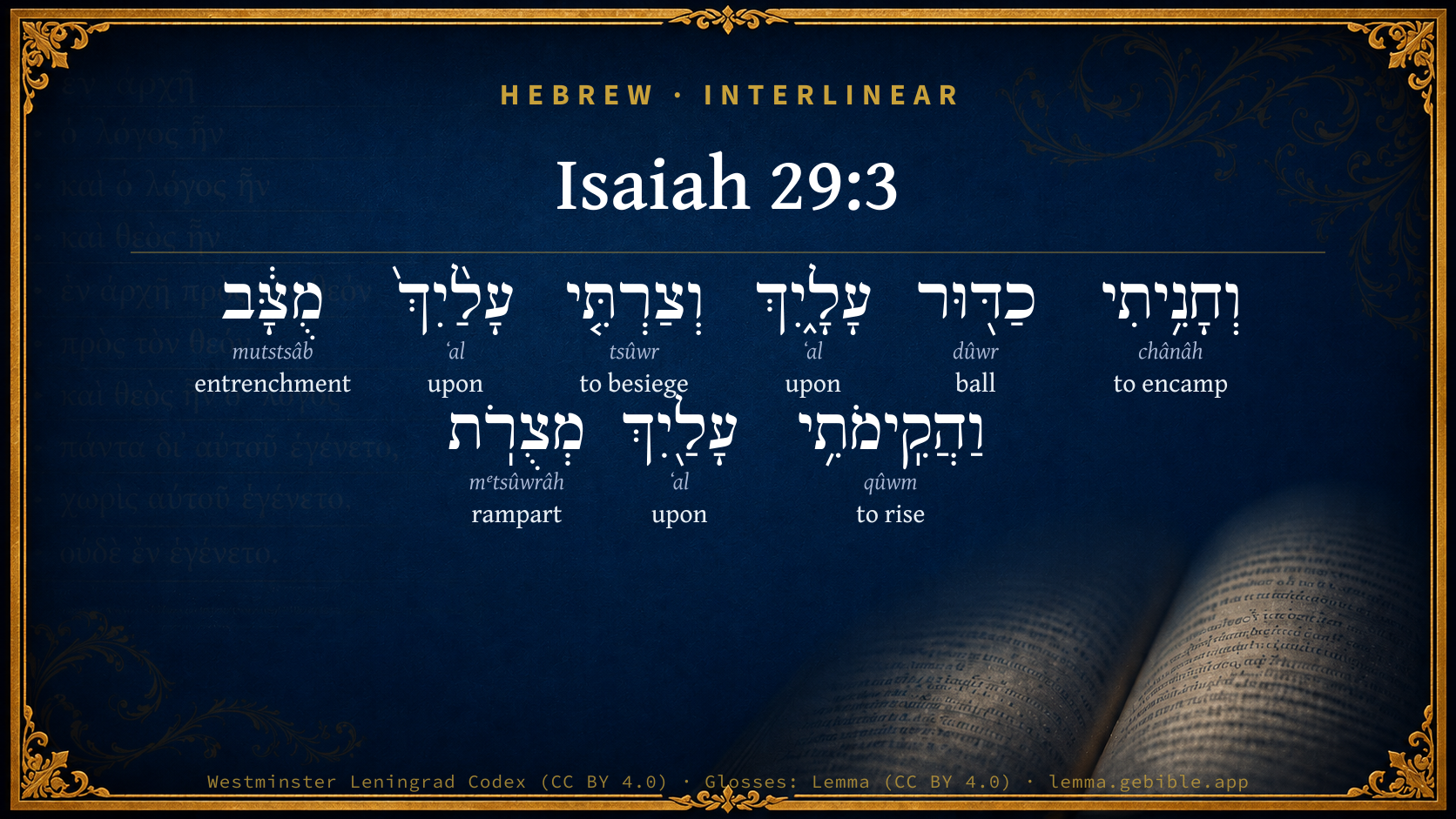
Hebrew (Westminster Leningrad Codex) Isaiah 29:3 appears in the Hebrew Old Testament. The text above is from the Westminster Leningrad Codex. Each word links to its Strong’s number, a concise gloss, and parsing drawn from the Open Scriptures Hebrew Bible morphology. Click any word for its full Brown-Driver-Briggs (BDB) entry.
Download image
Cite this verse

Isaiah 29:3 (World English Bible). Public Domain. Lemma interlinear Bible study tool, https://lemma.gebible.app/v/isaiah/29/3.

Show BibTeX & RIS
BibTeX
RIS
English Translation
I will encamp against you round about, and will lay siege against you with posted troops, and I will raise siege works against you.
World English Bible · Public Domain
Highlights
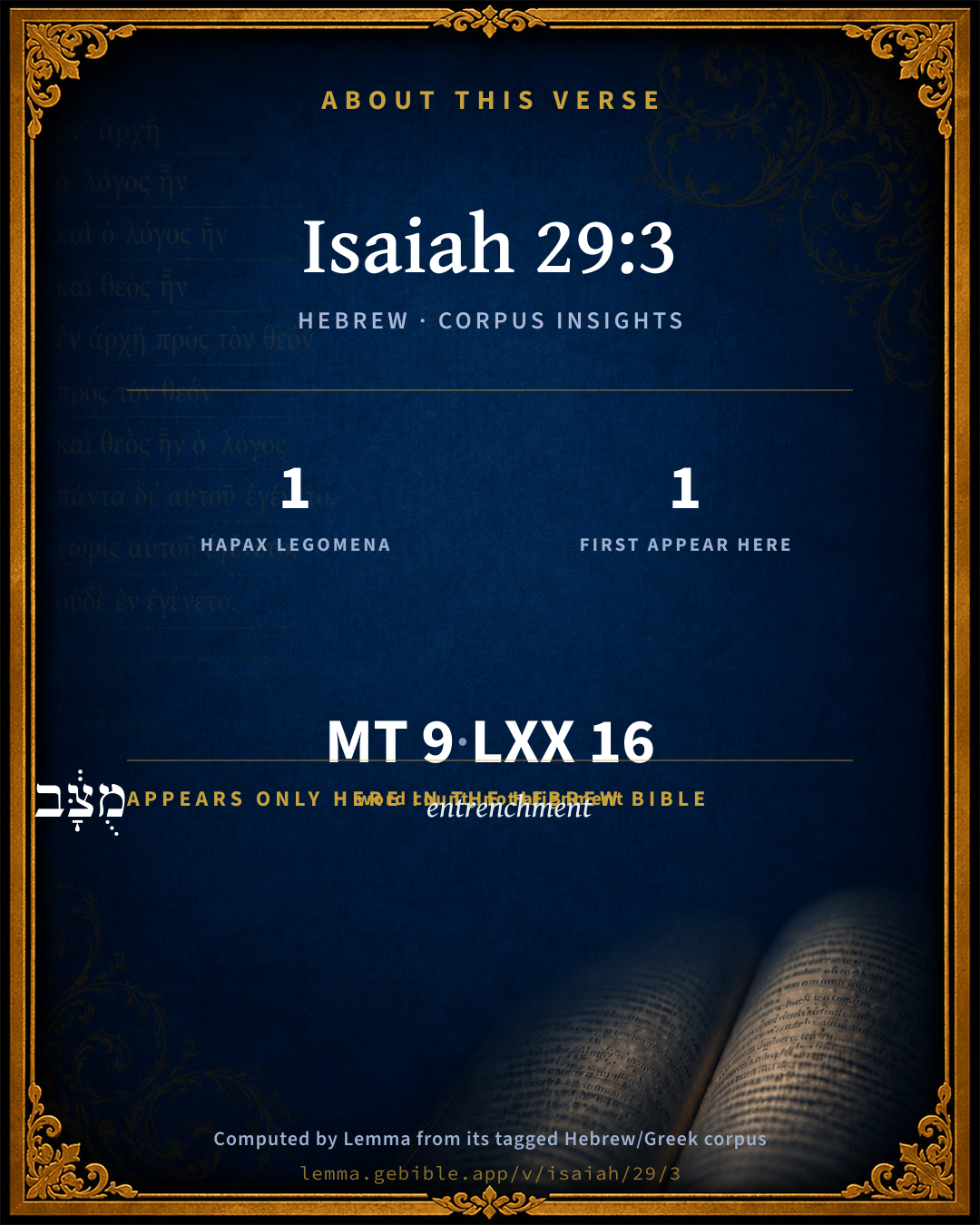
  • 1 hapax legomenon — only here in the Hebrew Bible
  • 1 first appearance in the Hebrew Bible
Full analysis ↓
Download a study sheet

One document with this verse’s original text, its word-by-word gloss line, the meaning frame, cross-references with their text, attributed commentary, and full source and license credits — printable, and it pastes into notes with its structure intact.

This verse Autodidact and up

Study sheet (.html) Plain text (.txt)

A passage Seminary Student

Up to 50 verses in one chapter. A passage sheet keeps up to 6 commentary sources and 12 cross-references per verse, in the order this page ranks them, and says so on the sheet whenever that leaves anything out. Ask for a single verse and you get the Autodidact verse sheet above.

Everything on this page stays free to read, with no account — the sheet is a download of what is already on screen, not access to it.

Want to remove ads? Support Godless Engineer
Compare translations 3

The same verse in 3 English versions, stacked beneath the original-language interlinear above. Click any original word for its lexicon entry.

Each is an independent rendering of the whole verse — the interlinear is not word-aligned to these translations.

Highlighted words mark where these versions differ — a whole-verse word diff, not a word-by-word alignment.

  • World English Bible Public Domain
    I will encamp against you round about, and will lay siege against you with posted troops, and I will raise siege works against you.
  • King James Version Public Domain
    And I will camp against thee round about, and will lay siege against thee with a mount, and I will raise forts against thee.
  • unfoldingWord Literal Text CC BY-SA 4.0
    And I will encamp against you like a circle, and I will besiege against you a station, and I will raise fortifications against you.

unfoldingWord Literal Text — © unfoldingWord, licensed CC BY-SA 4.0. Word-aligned USFM3 via Door43 (git.door43.org/unfoldingWord/en_ult).

Versions to compare (up to 4)

3 of 4 selected

Show all 18 translations

Every available English version of this verse, each an independent rendering of the whole verse.

  • World English Bible Public Domain
    I will encamp against you round about, and will lay siege against you with posted troops, and I will raise siege works against you.
  • Berean Standard Bible Public Domain
    I will camp in a circle around you; I will besiege you with towers and set up siege works against you.
  • Majority Standard Bible Public Domain
    I will camp in a circle around you; I will besiege you with towers and set up siege works against you.
  • King James Version Public Domain
    And I will camp against thee round about, and will lay siege against thee with a mount, and I will raise forts against thee.
  • American Standard Version (1901) Public Domain
    And I will encamp against thee round about, and will lay siege against thee with posted troops, and I will raise siege works against thee.
  • Revised Version (1885) Public Domain
    And I will camp against thee round about, and will lay siege against thee with a fort, and I will raise siege works against thee.
  • Geneva Bible (1599) Public Domain
    And I wil besiege thee as a circle, and fight against thee on a mount, and will cast vp ramparts against thee.
  • Douay-Rheims (1899) Public Domain
    And I will make a circle round about thee, and will cast up a rampart against thee, and raise up bulwarks to besiege thee.
  • Young's Literal Translation Public Domain
    And I encamped, O babbler, against thee, And I laid siege against thee -- a camp. And I raised up against thee bulwarks.
  • Literal Standard Version CC BY-SA 4.0
    And I encamped, O babbler, against you, || And I laid siege against you—a camp. And I raised up bulwarks against you.
  • Unlocked Literal Bible CC BY-SA 4.0
    I will encamp against you in a circle and will lay siege against you with a palisade, and I will raise siege works against you.
  • unfoldingWord Literal Text CC BY-SA 4.0
    And I will encamp against you like a circle, and I will besiege against you a station, and I will raise fortifications against you.
  • Darby Bible Public Domain
    And I will camp against thee round about, and will lay siege against thee with watch-posts, and I will raise forts against thee.
  • World Messianic Bible Public Domain
    I will encamp against you all around you, and will lay siege against you with posted troops. I will raise siege works against you.
  • Webster's Bible Public Domain
    And I will encamp against thee round about, and will lay siege against thee with a mount, and I will raise forts against thee.
  • Free Bible Version CC BY-SA 4.0
    I will surround you, I will besiege you with towers and build ramps to attack you.
  • Bible in Basic English Public Domain
    And I will make war on you like David, and you will be shut in by earthworks, and I will make towers round you.
  • JPS Tanakh (1917) Public Domain
    And I will encamp against thee round about, and will lay siege against thee with a mound, and I will raise siege works against thee.

Literal Standard Version (2020), Covenant Press — licensed CC BY-SA 4.0. Text via the HelloAO Bible API (eBible.org). Unlocked Literal Bible (unfoldingWord) — licensed CC BY-SA 4.0. Text via the HelloAO Bible API (eBible.org). unfoldingWord Literal Text — © unfoldingWord, licensed CC BY-SA 4.0. Word-aligned USFM3 via Door43 (git.door43.org/unfoldingWord/en_ult). Free Bible Version, Dr. Jonathan Gallagher — licensed CC BY-SA 4.0. Text via the HelloAO Bible API (eBible.org).

Word by word

More ways to search: Search by grammar → Find every occurrence → Compare this word →

Practice this passage: Drill this verse → Learn its vocabulary →

מֻצָּ֔ב
mutstsâb
H4674
“entrenchment”
Noun, Common, Masculine, Singular, Absolute
Part of Speech
Noun
Type
Common
Gender
Masculine
Number
Singular
State
Absolute
Full BDB Definition

Origin: from H5324

TWOT: 1398d

entrenchment, siege-work, palisade, post
  1. וְחָנִ֥יתִי chânâh H2583 “and · to encamp” Conjunction + Verb, Qal, Sequential Perfect, 1st Person, Common, Singular
  2. כַדּ֖וּר dûwr H1754 “like/as the · ball” Preposition, Determined + Noun, Common, Masculine, Singular, Absolute
  3. עָלָ֑יִךְ ʻal H5921 “upon · you” Preposition + Suffix, Personal, 2nd Person, Feminine, Singular
  4. וְצַרְתִּ֤י tsûwr H6696 “and · to besiege” Conjunction + Verb, Qal, Sequential Perfect, 1st Person, Common, Singular
  5. עָלַ֨יִךְ֙ ʻal H5921 “upon · you” Preposition + Suffix, Personal, 2nd Person, Feminine, Singular
  6. וַהֲקִֽימֹתִ֥י qûwm H6965 “and · to rise” Conjunction + Verb, Hiphil, Sequential Perfect, 1st Person, Common, Singular
  7. עָלַ֖יִךְ ʻal H5921 “upon · you” Preposition + Suffix, Personal, 2nd Person, Feminine, Singular
  8. מְצֻרֹֽת mᵉtsûwrâh H4694 “ramparts” Noun, Common, Feminine, Plural, Absolute

About this verse

These counts appear in no published source. They are computed here, from the morphology-tagged text and Lemma’s own curated glosses. What Lemma adds →

9
words
7
distinct lemmas
Prophets
section

Notable vocabulary

1 hapax legomenon — a word that appears only here in the entire Hebrew Bible:

  • מֻצָּ֔ב entrenchment H4674

First appearance in Scripture

This word makes its first canonical appearance in the Hebrew Bible here:

  • מֻצָּ֔ב entrenchment H4674

Shared distinctive vocabulary

כַדּ֖וּר ball H1754 occurs in 3 verses of the Hebrew Bible. Also found in:

Grammatical profile

  • 3 verbs
  • 3 nouns
  • 3 prepositions

Verb forms

  • וְחָנִ֥יתִי Qal · Sequential Perfect
  • וְצַרְתִּ֤י Qal · Sequential Perfect
  • וַהֲקִֽימֹתִ֥י Hiphil · Sequential Perfect

Repetition

A word recurs within this verse — often emphatic in Hebrew:

  • עָלָ֑יִךְ upon H5921 ×3

Hebrew & Septuagint length

In English translation the verse runs 24 words from the Hebrew and 21 from the Septuagint (LXX English) — closely comparable.

A rough comparison of the two English renderings, which tokenize alike — not a word-level alignment.

Word counts can differ between the Hebrew and the Greek without any difference in meaning — e.g. the Hebrew direct-object marker אֵת has no separate Greek word, and Greek often adds the article ὁ.

In the original languages it is 9 Hebrew tokens and 16 Greek tokens — but the two are counted differently (Hebrew bundles its prefixes and suffixes into one token; the Greek is in lemma form), so that isn’t a like-for-like length.

Cross-references

7

Topical passages linked to Isaiah 29:3 in the Treasury of Scripture Knowledge — connected by theme and wording, ordered by reader-vote popularity; previews shown in the World English Bible.

  • Luke 19:43–44 For the days will come on you, when your enemies will throw up a barricade against you, surround you, hem you in on every side,
  • Ezekiel 21:22 In his right hand was the divination [for] Jerusalem, to set battering rams, to open the mouth in the slaughter, to lift up the voice with shouting, to set battering rams against the gates, to cast up mounds, to build forts.
  • 2 Kings 18:17 The king of Assyria sent Tartan and Rabsaris and Rabshakeh from Lachish to king Hezekiah with a great army to Jerusalem. They went up and came to Jerusalem. When they were come up, they came and stood by the conduit of the upper pool, which is in the highway of the fuller's field.
  • 2 Kings 19:32 Therefore thus says Yahweh concerning the king of Assyria, He shall not come to this city, nor shoot an arrow there, neither shall he come before it with shield, nor cast up a mound against it.
  • 2 Kings 24:11–12 Nebuchadnezzar king of Babylon came to the city, while his servants were besieging it;
  • 2 Kings 25:1–4 It happened in the ninth year of his reign, in the tenth month, in the tenth day of the month, that Nebuchadnezzar king of Babylon came, he and all his army, against Jerusalem, and encamped against it; and they built forts against it round about.
  • Matthew 22:7 When the king heard that, he was angry, and he sent his armies, destroyed those murderers, and burned their city.

Cross-references courtesy of OpenBible.info (CC BY 4.0).

Hebrew and Greek witnesses Masoretic Hebrew ↔ Greek Septuagint

The same verse in the two great witnesses to the Old Testament, shown verse-for-verse.

These are two independent witnesses, not word-aligned to each other, and the Septuagint is shown in lemma (dictionary) form.

Hebrew Isaiah 29:3 Masoretic · Westminster Leningrad Codex

וְחָנִ֥יתִי כַדּ֖וּר עָלָ֑יִךְ וְצַרְתִּ֤י עָלַ֨יִךְ֙ מֻצָּ֔ב וַהֲקִֽימֹתִ֥י עָלַ֖יִךְ מְצֻרֹֽת

I will encamp against you round about, and will lay siege against you with posted troops, and I will raise siege works against you.

World English Bible · Public Domain

Greek LXX Isaiah 29:3 Septuagint · lemma form

καί κυκλόω ὡς δαυίδ ἐπί σύ καί βάλλω περί σύ χάραξ καί τίθημι περί σύ πύργος

And I will compass you about like David, and will raise a mound about you, and set up towers round you.

LXX2012 (modern English Septuagint) · Public Domain

On this verse, Adam Clarke's Commentary discusses the Septuagint’s reading. Read the note in Commentary ↓

Hebrew: Westminster Leningrad Codex (CC BY 4.0). Greek: Septuagint (public domain); English from LXX2012 (modern English Septuagint) (Public Domain). How the Septuagint differs from the Hebrew →

Targum (Aramaic paraphrase)

1

The Targum is the ancient Jewish Aramaic paraphrase of the Hebrew Scriptures — an interpretive translation, not the Hebrew text itself. Onkelos (literal) and Pseudo-Jonathan (expansive) render the Torah, and Jonathan the Prophets. Coverage is partial: where no permissively-licensed English translation exists for a verse, only the Aramaic is shown. This is verse-level text, not a word-by-word alignment to the Hebrew.

  1. Targum Jonathan Prophets (Joshua–Malachi)
    וְאַשְׁרֵי עֲלָיִךְ מַשִׁרְיָן וְאַבְנֵי עֲלָיִךְ כַּרְקוֹם וְאֶצְבּוֹר עֲלָיִךְ מְלֵיתָא:

    And I will encamp against thee with armies; and I will build a fortified camp against thee, and I will cast up a mound against thee.

    Targum Jonathan — Aramaic: “Mikraot Gedolot” (public domain). English: “Sefaria Community Translation” (CC0 1.0 (public-domain dedication)); “London "Chaldee Paraphrase," 1871” (public domain). Text via Sefaria.

Commentary

Notes on Isaiah 29:3 from classic Christian and Jewish commentators (each source and its license shown beneath its notes). The classic Christian expositions comment on the surrounding passage and are grouped to its opening verse, so a note may address several verses; the Jewish commentaries on the Tanakh (Rashi and others) are per-verse, so they appear only where the commentator wrote on this verse.

Lemma curates 59 commentaries, every one of them public domain or Creative Commons licensed, each selected and text-cleaned for this edition rather than reprinted as found. About our sources →

Trapp's Complete Commentary

John Trapp

Isa 29:3 And I will camp against thee round about, and will lay siege against thee with a mount, and I will raise forts against thee.

Ver. 3. And I will camp against thee round about.] I will bring the woe of war upon thee - a woe that no words, how wide soever, can possibly express. See this accomplished. {2Ki 25:4}

And will lay siege.] As the captain general of the Chaldees.

John Trapp, A Commentary or Exposition upon All the Books of the Old and New Testament (1647–1656) — public domain. Text from a community e-Sword module.

Joseph Benson's Commentary

Isa 29:3-4. And I will camp against thee, &c. — That is, by those enemies whom I will assist and enable to take and destroy thee. The prophet may here refer to different sieges of Jerusalem, that of Sennacherib, that of the Chaldeans, or even to that of the Romans. Thou shalt be brought down — thy speech shall be low — Thou, who now speakest so loftily, shalt be humbled, and in a submissive manner, and with a low voice, shalt beg the favour of thine enemies. As of one that hath a familiar spirit, out of the ground — “That the souls of the dead uttered a feeble, stridulous sound, very different from the natural human voice, was a popular notion among the heathen, as well as among the Jews. This appears from several passages of their poets, Homer, Virgil, Horace. The pretenders to the art of necromancy, who were chiefly women, had an art of speaking with a reigned voice, so as to deceive those who applied to them, by making them believe that it was the voice of the ghost. They had a way of uttering sounds, as if they were formed, not by the organs of speech, but deep in the chest, or in the belly, and were thence called εγγαστριμυθοι, ventriloqui. They could make the voice seem to come from beneath the ground, from a distant part, in another direction, and not from themselves, the better to impose upon those who consulted them. From these arts of the necromancers, the popular notion seems to have arisen that the ghost’s voice was a weak, stridulous, almost an inarticulate sort of sound, very different from the speech of the living.” — Bishop Lowth.

Joseph Benson's Commentary on the Old and New Testaments (1811–1818) — public domain. Text from a community e-Sword module.

Tyndale Open Study Notes

Tyndale Open Resources

29:3 The Lord himself would come against Jerusalem, surrounding and attacking it.

Tyndale Open Study Notes — © Tyndale Open Resources, licensed CC BY-SA 4.0. Text via the HelloAO Bible API.

Jamieson, Fausset & Brown

Robert Jamieson, A. R. Fausset & David Brown

I--Jehovah, acting through the Assyrian, &c., His instruments (Isa 10:5).

mount--an artificial mound formed to out-top high walls (Isa 37:33); else a station, namely, of warriors, for the siege.

round about--not fully realized under Sennacherib, but in the Roman siege (Luk 19:43; Luk 21:20).

forts--siege-towers (Deu 20:20).

Jamieson, Fausset & Brown — Commentary Critical and Explanatory on the Whole Bible (1871) — public domain (CC PDM 1.0). Text via the HelloAO Bible API.

Adam Clarke's Commentary

Verse 3. And I will camp against thee round about - "And I will encamp against thee like David"] For כדור caddur, some kind of military engine, כדוד kedavid, like David, is the reading of the Septuagint, two MSS. of Kennicott's, if not two more: but though Bishop Lowth adopts this reading, I think it harsh and unnecessary.

Forts - "Towers"] For מצרת metsuroth, read מצדות metsudoth: so the Septuagint and five MSS. of Dr. Kennicott's, one of them ancient, and four of De Rossi's.

Adam Clarke's Commentary on the Bible (1810–1826) — public domain. Text from a community e-Sword/MySword module.

Ellicott's Commentary for English Readers

(3) I will encamp against thee . . .—The words describe the strategy of an Eastern siege, as we see it in the Assyrian sculptures—the mound raised against the walls of the city, the battering-ram placed upon the mound, and brought to bear upon the walls. (See Jer_33:4; Eze_4:2.)

A Bible Commentary for English Readers, edited by Charles John Ellicott (1878–1897) — public domain. Text from a community e-Sword module.

The Cambridge Bible for Schools and Colleges

gen. ed. J. J. S. Perowne

3. I will camp against thee round about] see Isa_29:1. LXX. carries the parallel still further by reading “I will encamp … like David,” a reading which would be plausible if “against which” could be fairly supplied in Isa_29:1. “Round about” is the same word as “like a ball” in Isa_22:18.

with a mount] R.V. with a fort; perhaps lines of circumvallation. For forts, read siege-works, as R.V. Comp. Eze_4:1-3.

4 explains the “moaning and bemoaning” of Isa_29:2. The verse reads: And thou shalt be laid low, speaking from (beneath) the earth, and thy speech shall come humbly from the dust; and thy voice shall be like (that of) a ghost (coming) from the earth, and thy speech shall squeak from the dust. The allusions in the latter half of the verse are explained under ch. Isa_8:19. The figures signify the utter abasement and exhaustion of the “joyous city.”

The Cambridge Bible for Schools and Colleges (gen. ed. J. J. S. Perowne; Cambridge University Press, 1878–1918) — public domain. Text from a community e-Sword module.

John Gill's Exposition

And I will camp against thee round about,.... Or as a "ball" or "globe" (o); a camp all around; the Lord is said to do that which the enemy should do, because it was by his will, and according to his order, and which he would succeed and prosper, and therefore the prophecy of it is the more terrible; and it might be concluded that it would certainly be fulfilled, as it was; see Luk 19:43,

and will lay siege against thee with a mount: raised up for soldiers to get up upon, and cast their arrows into the city from, and scale the walls; Kimchi and Ben Melech interpret it a wooden tower. This cannot be understood of Sennacherib's siege, for he was not suffered to raise a bank against the city, nor shoot an arrow into it, Isa 37:33 but well agrees with the siege of Jerusalem by the Romans, as related by Josephus (p):

and I will raise forts against thee; from whence to batter the city; the Romans had their battering rams.

(o) "quasi pila", Piscator; "instar globi", Gataker. (p) Joseph. de Bello Jud. l. 5. c. 7. sect. 1. & c. 12. sect. 1, 2.

John Gill's Exposition of the Whole Bible (1746–1763) — public domain (CC PDM 1.0). Text via the HelloAO Bible API.

Albert Barnes' Notes on the Bible

And I will camp against thee - That is, I will cause an army to pitch their tents there for a siege. God regards the armies which he would employ as under his control, and speaks of them as if he would do it himself (see the note at Isa 10:5).

Round about - (כדוּר kadûr). As in a circle; that is, he would encompass or encircle the city. The word used here דור dûr in Isa 22:18, means a ball, but here it evidently means a circle; and the sense is, that the army of the besiegers would encompass the city. A similar form of expression occurs in regard to Jerusalem in Luk 19:43 : ‘For the days shall come upon thee, than thine enemies shall cast a trench (χάρακα charaka - “a rampart,” a “mound”) about thee σοί soi “against thee”), and “compass thee round” περικυκλώτονσί σε perikuklōsousi se, “encircle thee”).’ So also Luk 21:20. The Septuagint renders this, ‘I will encompass thee as David did;’ evidently reading it as if it were כדוּד kadûd; and Lowth observes that two manuscripts thus read it, and he himself adopts it. But the authority for correcting the Hebrew text in this way is not sufficient, nor is it necessary. The idea in the present reading is a clear one, and evidently means that the armies of Sennacherib would encompass the city.

With a mount - A rampart; a fortification. Or, rather, perhaps, the word מצב mutsâb means a post, a military station, from יצב yâtsab, “to place, to station.” The word in this form occurs nowhere else in the Scriptures, but the word מצב matsâb occurs in 1Sa 13:23; 1Sa 14:1, 1Sa 14:4; 2Sa 23:14, in the sense of a military post, or garrison.

I will rise forts - That is, ramparts, such as were usually thrown up against a besieged city, meaning that it should be subjected to the regular process of a siege. The Septuagint reads, Πύργου Purgou; ‘Towers;’ and so also two manuscripts by changing the Hebrew letter ד (d) into the Hebrew letter ר (r). But there is no necessity for altering the Hebrew text. Lowth prefers the reading of the Septuagint.

Albert Barnes' Notes on the Bible (1834–1885) — public domain. Text from a community e-Sword/MySword module.

Haydock's Catholic Bible Commentary

Circle. Thus provisions were cut off. (Calmet)

George Leo Haydock (1774–1849), Haydock's Catholic Family Bible and Commentary, 1859 edition — public domain. Excludes Psalms (Douay-Rheims chapter numbering differs from Protestant) and Deuterocanonical books (Catholic canon only).

Matthew Poole's English Annotations

By those enemies whom I will assist and enable to destroy thee. This was fulfilled either,

1. By Sennacherib, as some learned men think. But what is here affirmed of these enemies is expressly denied concerning Sennacherib, Isa 37:3. Or rather,

2. By the Chaldeans, 2Ki 25:1, &c.

Matthew Poole's English Annotations on the Holy Bible (1683–1685) — public domain. Text from a community e-Sword/MySword module.

The Pulpit Commentary

I will camp against thee round about; i.e. "I will bring armed men against thee who shall encamp around the entire circuit of thy walls." There was small chance of forcing an entrance into Jerusalem on any side except the north; but, order to distress and harass her, an enemy with numerous forces would dispose them all round the walls, thus preventing all ingress or egress. (see Luk_19:43) And... lay siege against thee with a mount ; or, with a mound. Artificial mounds were raised up against the walls of cities by the Assyrians, as a foundation from which to work their battering rams with greater advantage against the upper and weaker portion of the defenses (see "Ancient Monarchies," vol. 2. p. 80). And... raise forts against thee. "Forts" were usually movable, and accompanied the battering-ram for its better protection. Archers in the forts cleared the walls of their defenders, while the ram was employed in making a breach (see Layard, "Monuments of Nineveh," Second Series, p. 21).

The Pulpit Commentary (1880–1919), ed. H.D.M. Spence-Jones & Joseph S. Exell — public domain. Text from a community e-Sword module.

J. A. Alexander on Isaiah

Joseph Addison Alexander

“And I will camp against thee round about (literally, as a ring or circle), and push against thee (or press upon thee with) a post (or body of troops), and raise against thee ramparts (or entrenchments).” The siege of Ariel is now represented as the work of God Himself, which, although it admits of explanation as referring merely to His providential oversight and control, seems here to be significant, as intimating that the siege described is not a literal one.

Joseph Addison Alexander, The Prophecies of Isaiah (1846–1847; New York: Scribner, 1870–1878) — public domain. Text from a community e-Sword module.

Scofield Reference Notes

C. I. Scofield

And I will camp

Here, as often in prophecy, and especially in Isaiah, the near and far horizons blend. The near view is of Sennacherib’s invasion and the destruction of the Assyrian host by the angel of the Lord (Isaiah 36, 37.); the far view is that of the final gathering of the Gentile hosts against Jerusalem at the end of the great tribulation Psa 2:5; Rev 7:14 when a still greater deliverance will be wrought. (See "Times of the Gentiles,"; Luk 21:24; Rev 16:14. The same remark applies also to Isa 28:14-18 where there is a near reference to the Egyptian alliance ("we have made a covenant," etc.), while the reference to the stone Isa 29:16 carries the meaning forward to the end-time, and the covenant of unbelieving Israel with the Beast. Dan 9:27.

The Scofield Reference Bible (1917 edition), notes by C. I. Scofield — public domain. Text from a community e-Sword module.

unfoldingWord translationNotes

Door43 World Missions Community

I will encamp against you

The word "I" refers to Yahweh. This represents Yahweh causing an enemy army to surround Jerusalem. AT: "I will command the army of your enemies to surround you" (See: Metonymy)

palisade ... siege works

A "palisade" is a tower armies would build to attack cities with high walls. Also "siege works" refers to other various weapons armies would build to attack cities. (See: Translate Unknowns)

You will be brought down

This can be stated in active form. AT: "Your enemy will bring you down" or "Your enemy will humble you" (See: Active or Passive)

will speak from the ground; your speech will be low from the dust. Your voice will sound like a spirit that speaks from the ground, and out of the dust your speech will whisper

All of these statements mean basically the same thing. They emphasize that the people who once spoke with proud words will be weak and grieving after the enemy defeats them. AT: "you will only be able to speak with weak whispers like a spirit speaking from where dead people dwell" (See: Simile and Parallelism)

translationWords

siege

voice

unfoldingWord translationNotes — © Distant Shores Media and the Door43 World Missions Community, licensed CC BY-SA 4.0. Source: git.door43.org/Door43/en_tn.

Rashi

Rabbi Shlomo Yitzchaki (Rashi)

in a circle like a row of surrounding troops. ([Other editions read:] In a row of surrounding troops.) ([Some manuscripts read:] An expression of the encampment of surrounding troops.)

a camp of siege (מֻצַּב, lit. stationed,) an expression of a camp of siege stationed against the towns.

siege works (מְצֻרוֹת) an expression of מָצוֹר, a siege.

Rashi on the Tanakh — English translations: “The Judaica Press complete Tanach with Rashi, translated by A. J. Rosenberg” (CC BY 4.0); “Pentateuch with Rashi's commentary by M. Rosenbaum and A.M. Silbermann, 1929-1934” (public domain); “The Metsudah Tanach series, Lakewood, N.J” (CC BY 4.0); and “The Book of Joshua, Metsudah Publications, 1997” (CC BY 4.0). Text via Sefaria.

Ibn Ezra

Rabbi Abraham ibn Ezra

כדור Suddenly. Comp. 22:18.

מגדל מצב ═ מצב A tower set up.

Ibn Ezra on the Tanakh — English translations: “Sefaria Community Translation” (CC0 1.0 (public-domain dedication)); “Yalkut, Sifsei Chachomim Chumash, Metsudah Publications, 2009” (CC BY 4.0); and “Commentary of Ibn Ezra on Isaiah - trans. by M. Friedlander, 1873” (public domain). Text via Sefaria.

Lesson kit

Teaching starters — assembled from the data on this page, not authored interpretation. Every prompt links to the verse data it draws on. Edit before teaching.

Isaiah, in the Prophets, opens this verse with 9 words (7 distinct Hebrew lemmas). Its most distinctive word is mutstsâb (“entrenchment”). A historical commentator’s framing appears above. Read the whole chapter for the surrounding context.

Discussion questions

  1. How does “entrenchment” (mutstsâb) shape what this verse is saying?
  2. 1 word here appears nowhere else in the Hebrew Bible. Why might the author reach for such rare wording?
  3. This is the first place “entrenchment” appears in Scripture (first appears here). What does its debut here establish?
  4. How does Isaiah 22:18, which shares the word «ball», read alongside this verse?
  5. What does the repetition of “upon” (3× in this one verse) do in this verse?
  6. The translations on this page render this verse differently — a whole-verse word diff, not a word-by-word alignment. What might account for the different wordings?
  7. «וְחָנִ֥יתִי» is a Qal Sequential Perfect verb. How does that grammatical form shape the action described?
  8. Compare how Trapp's Complete Commentary and Joseph Benson's Commentary read this verse. Where do they agree or differ?

Things to notice

  • 1 word in this verse appears nowhere else in the Hebrew Bible.
  • 1 word makes its first canonical appearance in Scripture here.
  • This verse counts 9 Hebrew ↔ 16 Greek words.
  • These translations choose different wording for 17 words in this verse.
  • “upon” occurs 3× in this single verse.

Reading settings

Reading text

Shown beneath each verse's original-language words.

Old Testament
Old Testament edition

Read the OT as the Masoretic Hebrew (MT) or the Greek Septuagint (LXX).

English shown for the Greek Septuagint (in the Hebrew ↔ Greek comparison).

Comparing translations? Open the Compare panel on any verse page to stack up to four side by side.