Revelation 20:14

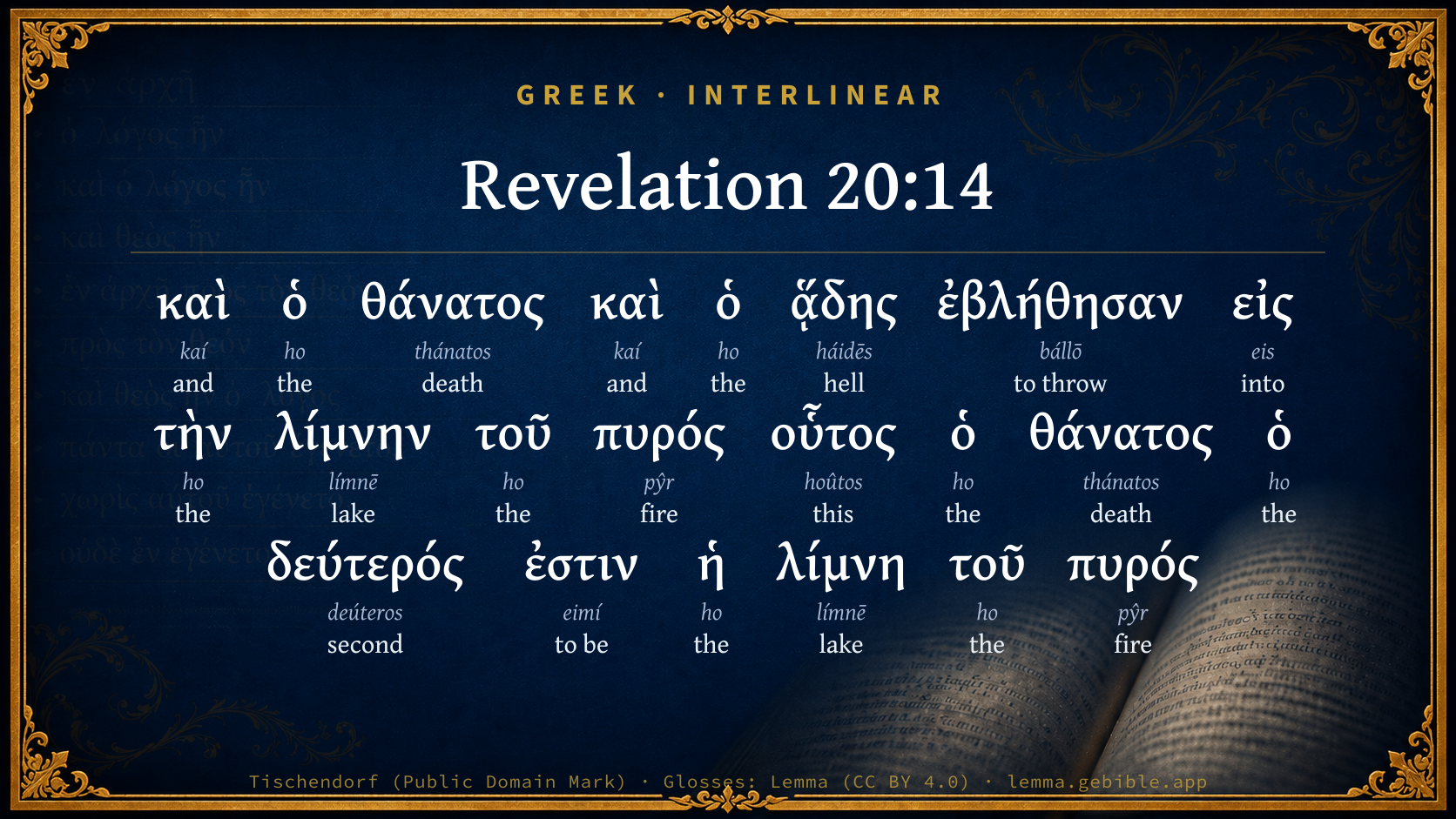
Greek (Tischendorf 8th ed.) Revelation 20:14 appears in the Greek New Testament. The text above is from the Tischendorf 8th edition. Each word links to its Strong’s number and a concise gloss. Click any word for its full Thayer’s Greek Lexicon entry.
Download image
Cite this verse

Revelation 20:14 (World English Bible). Public Domain. Lemma interlinear Bible study tool, https://lemma.gebible.app/v/revelation/20/14.

Show BibTeX & RIS
BibTeX
RIS
English Translation
Death and Hades were thrown into the lake of fire. This is the second death, the lake of fire.
World English Bible · Public Domain
Download a study sheet

One document with this verse’s original text, its word-by-word gloss line, the meaning frame, cross-references with their text, attributed commentary, and full source and license credits — printable, and it pastes into notes with its structure intact.

This verse Autodidact and up

Study sheet (.html) Plain text (.txt)

A passage Seminary Student

Up to 50 verses in one chapter. A passage sheet keeps up to 6 commentary sources and 12 cross-references per verse, in the order this page ranks them, and says so on the sheet whenever that leaves anything out. Ask for a single verse and you get the Autodidact verse sheet above.

Everything on this page stays free to read, with no account — the sheet is a download of what is already on screen, not access to it.

Want to remove ads? Support Godless Engineer
Compare translations 3

The same verse in 3 English versions, stacked beneath the original-language interlinear above. Click any original word for its lexicon entry.

Each is an independent rendering of the whole verse — the interlinear is not word-aligned to these translations.

Highlighted words mark where these versions differ — a whole-verse word diff, not a word-by-word alignment.

  • World English Bible Public Domain
    Death and Hades were thrown into the lake of fire. This is the second death, the lake of fire.
  • King James Version Public Domain
    And death and hell were cast into the lake of fire. This is the second death.
  • unfoldingWord Literal Text CC BY-SA 4.0
    And Death and Hades were thrown into the lake of fire. This is the second death, the lake of fire.

unfoldingWord Literal Text — © unfoldingWord, licensed CC BY-SA 4.0. Word-aligned USFM3 via Door43 (git.door43.org/unfoldingWord/en_ult).

Versions to compare (up to 4)

3 of 4 selected

Show all 19 translations

Every available English version of this verse, each an independent rendering of the whole verse.

  • World English Bible Public Domain
    Death and Hades were thrown into the lake of fire. This is the second death, the lake of fire.
  • Berean Standard Bible Public Domain
    Then Death and Hades were thrown into the lake of fire. This is the second death—the lake of fire.
  • Majority Standard Bible Public Domain
    Then Death and Hades were thrown into the lake of fire. This is the second death—the lake of fire.
  • King James Version Public Domain
    And death and hell were cast into the lake of fire. This is the second death.
  • American Standard Version (1901) Public Domain
    And death and Hades were cast into the lake of fire. This is the second death, `even' the lake of fire.
  • Revised Version (1885) Public Domain
    And death and Hades were cast into the lake of fire. This is the second death, even the lake of fire.
  • Geneva Bible (1599) Public Domain
    And death and hell were cast into the lake of fire: this is the second death.
  • Douay-Rheims (1899) Public Domain
    And hell and death were cast into the pool of fire. This is the second death.
  • Young's Literal Translation Public Domain
    and the death and the hades were cast to the lake of the fire -- this `is' the second death;
  • Literal Standard Version CC BY-SA 4.0
    and death and Hades were cast into the lake of the fire—this [is] the second death;
  • Unlocked Literal Bible CC BY-SA 4.0
    Death and Hades were thrown into the lake of fire. This is the second death—the lake of fire.
  • unfoldingWord Literal Text CC BY-SA 4.0
    And Death and Hades were thrown into the lake of fire. This is the second death, the lake of fire.
  • Darby Bible Public Domain
    and death and hades were cast into the lake of fire. This is the second death, [even] the lake of fire.
  • World Messianic Bible Public Domain
    Death and Sheol were thrown into the lake of fire. This is the second death, the lake of fire.
  • Webster's Bible Public Domain
    And death and hell were cast into the lake of fire. This is the second death.
  • Free Bible Version CC BY-SA 4.0
    Then death and Hades were thrown into the lake of fire. The lake of fire is the second death.
  • Bible in Basic English Public Domain
    And death and Hell were put into the sea of fire. This is the second death, even the sea of fire.
  • Text-Critical English NT CC BY 4.0
    Then Death and Hades were thrown into the lake of fire. This is the second death, the lake of fire.
  • Tyndale New Testament (1534) Public Domain
    And deth and hell were cast into the lake of fyre. This is that second deeth.

Literal Standard Version (2020), Covenant Press — licensed CC BY-SA 4.0. Text via the HelloAO Bible API (eBible.org). Unlocked Literal Bible (unfoldingWord) — licensed CC BY-SA 4.0. Text via the HelloAO Bible API (eBible.org). unfoldingWord Literal Text — © unfoldingWord, licensed CC BY-SA 4.0. Word-aligned USFM3 via Door43 (git.door43.org/unfoldingWord/en_ult). Free Bible Version, Dr. Jonathan Gallagher — licensed CC BY-SA 4.0. Text via the HelloAO Bible API (eBible.org).

Word by word

More ways to search: Search by grammar → Find every occurrence → Compare this word →

Practice this passage: Drill this verse → Learn its vocabulary →

ᾅδης
háidēs
G86
“hell”
Noun, Nominative, Singular, Masculine
Part of Speech
Noun
Case
Nominative
Number
Singular
Gender
Masculine
Full Thayer's Definition

Origin: from G1 (as negative particle) and G1492

TDNT: 03:26,2

1. name Hades or Pluto, the god of the lower regions 2. Orcus, the nether world, the realm of the dead 3. later use of this word: the grave, death, hell
  1. καὶ kaí G2532 “and” Conjunction
  2. ὁ ho G3588 “the” Article, Nominative, Singular, Masculine
  3. θάνατος thánatos G2288 “death” Noun, Nominative, Singular, Masculine
  4. καὶ kaí G2532 “and” Conjunction
  5. ὁ ho G3588 “the” Article, Nominative, Singular, Masculine
  6. ἐβλήθησαν bállō G906 “to throw” Verb, Aorist, Passive, Indicative, 3rd person, Plural
  7. εἰς eis G1519 “into” Preposition
  8. τὴν ho G3588 “the” Article, Accusative, Singular, Feminine
  9. λίμνην límnē G3041 “lake” Noun, Accusative, Singular, Feminine
  10. τοῦ ho G3588 “the” Article, Genitive, Singular, Neuter
  11. πυρός pŷr G4442 “fire” Noun, Genitive, Singular, Neuter
  12. οὗτος hoûtos G3778 “this” Demonstrative pronoun, Nominative, Singular, Masculine
  13. ὁ ho G3588 “the” Article, Nominative, Singular, Masculine
  14. θάνατος thánatos G2288 “death” Noun, Nominative, Singular, Masculine
  15. ὁ ho G3588 “the” Article, Nominative, Singular, Masculine
  16. δεύτερός deúteros G1208 “second” Adjective, Nominative, Singular, Masculine
  17. ἐστιν eimí G1510 “to be” Verb, Present, Active, Indicative, 3rd person, Singular
  18. ἡ ho G3588 “the” Article, Nominative, Singular, Feminine
  19. λίμνη límnē G3041 “lake” Noun, Nominative, Singular, Feminine
  20. τοῦ ho G3588 “the” Article, Genitive, Singular, Neuter
  21. πυρός pŷr G4442 “fire” Noun, Genitive, Singular, Neuter

About this verse

These counts appear in no published source. They are computed here, from the morphology-tagged text and Lemma’s own curated glosses. What Lemma adds →

22
words
11
distinct lemmas
Revelation
section

Notable vocabulary

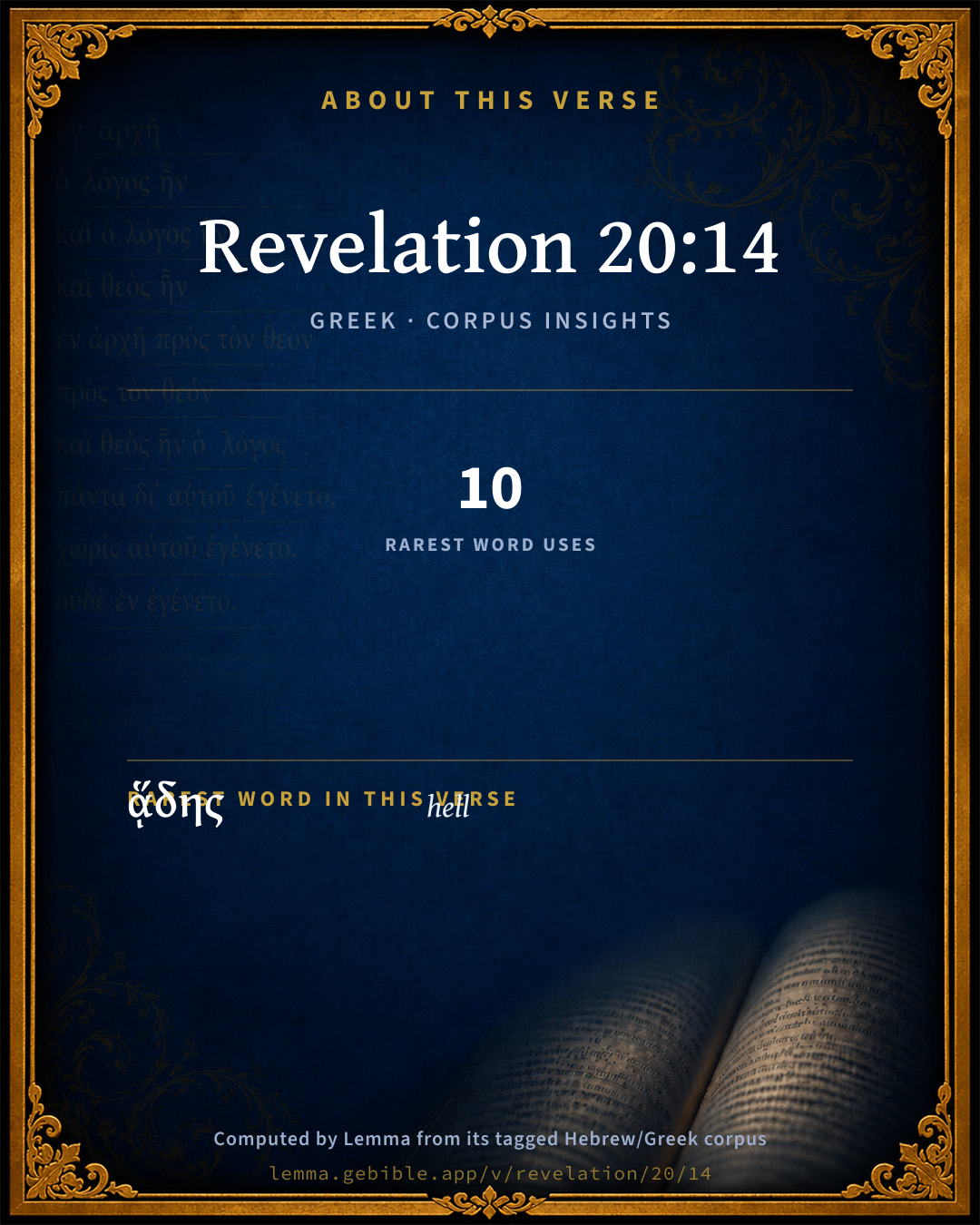
The rarest word here is ᾅδης hell G86 — appearing just 10 times in the whole Greek New Testament.

Shared distinctive vocabulary

ᾅδης hell G86 occurs in 10 verses of the Greek New Testament. Also found in:

Repetition

Words recur within this verse:

  • θάνατος death G2288 ×2
  • λίμνην lake G3041 ×2
  • πυρός fire G4442 ×2
  • ὁ the G3588 ×8
  • καὶ and G2532 ×2

Cross-references

11

Topical passages linked to Revelation 20:14 in the Treasury of Scripture Knowledge — connected by theme and wording, ordered by reader-vote popularity; previews shown in the World English Bible.

  • 1 Corinthians 15:26 The last enemy that will be abolished is death.
  • Revelation 20:6 Blessed and holy is he who has part in the first resurrection. Over these, the second death has no power, but they will be priests of God and of Christ, and will reign with him one thousand years.
  • Revelation 21:8 But for the cowardly, unbelieving, sinners, abominable, murderers, sexually immoral, sorcerers, idolaters, and all liars, their part is in the lake that burns with fire and sulfur, which is the second death."
  • Revelation 1:18 and the Living one. I was dead, and behold, I am alive forevermore. Amen. I have the keys of Death and of Hades.
  • Revelation 19:20 The beast was taken, and with him the false prophet who worked the signs in his sight, with which he deceived those who had received the mark of the beast and those who worshiped his image. These two were thrown alive into the lake of fire that burns with sulfur.
  • Hosea 13:14 I will ransom them from the power of Sheol. I will redeem them from death! Death, where are your plagues? Sheol, where is your destruction? Compassion will be hidden from my eyes.
  • Revelation 20:10 The devil who deceived them was thrown into the lake of fire and sulfur, where the beast and the false prophet are also. They will be tormented day and night forever and ever.
  • Revelation 20:13 The sea gave up the dead who were in it. Death and Hades gave up the dead who were in them. They were judged, each one according to his works.
  • Revelation 21:4 He will wipe away from them every tear from their eyes. Death will be no more; neither will there be mourning, nor crying, nor pain, any more. The first things have passed away."
  • 1 Corinthians 15:53 For this corruptible must put on incorruption, and this mortal must put on immortality.
  • Revelation 20:15 If anyone was not found written in the book of life, he was cast into the lake of fire.

Cross-references courtesy of OpenBible.info (CC BY 4.0).

Where the printed editions differ

1 variant

Places in this verse where the major printed Greek editions disagree on the wording in a way that affects the translation — a comparison of editions, not a manuscript-by-manuscript collation. The editions are the modern critical texts (Nestlé-Aland 28/27, SBL, Westcott-Hort, Tregelles, Tyndale House) and the traditional texts behind the KJV (the Textus Receptus and the Byzantine/Majority text). It is not a claim about which reading is original.

  1. Extra text
    ἡ λίμνη τοῦ πυρός.

    “the lake <the> of fire.”

    In NA28NA27TynSBLWHTregByz Not in TR

    ἡ λίμνη τοῦ πυρός. (hē limnē tou puros) 'the lake of fire.' is only in older manuscripts (NA28+NA27+Tyn+SBL+WH+Treg+Byz)

Textual data: Translators Amalgamated Greek New Testament (STEPBible TAGNT) · CC BY 4.0.

Commentary

Notes on Revelation 20:14 from classic Christian and Jewish commentators (each source and its license shown beneath its notes). The classic Christian expositions comment on the surrounding passage and are grouped to its opening verse, so a note may address several verses; the Jewish commentaries on the Tanakh (Rashi and others) are per-verse, so they appear only where the commentator wrote on this verse.

Lemma curates 59 commentaries, every one of them public domain or Creative Commons licensed, each selected and text-cleaned for this edition rather than reprinted as found. About our sources →

Scofield Reference Notes

C. I. Scofield

second death

Second death, Summary: "The second death" and the "lake of fire" are identical terms Rev 20:14 and are used of the eternal state of the wicked. It is "second" relative to the preceding physical death of the wicked in unbelief and rejection of God; their eternal state is one of eternal "death" (i.e. separation from God) in sins Joh 8:21; Joh 8:24. That the second death is not annihilation is shown by a comparison of; Rev 19:20; Rev 20:10. After one thousand years in the lake of fire the Beast and False Prophet are still there, undestroyed. The words "forever and forever" ("to the ages of the ages") are used in Heb 1:8 for the duration of the throne of God, eternal in the sense of unending.

The Scofield Reference Bible (1917 edition), notes by C. I. Scofield — public domain. Text from a community e-Sword module.

Tyndale Open Study Notes

Tyndale Open Resources

20:14 The expression death and the grave refers to the reality of death; it is the last enemy that God will destroy (see 21:4; 1 Cor 15:26). • The lake of fire portrays the horrible end of God’s enemies who will not experience the “first resurrection” (see Rev 20:5-6; cp. Matt 25:41; Luke 16:24; Jude 1:7).

Tyndale Open Study Notes — © Tyndale Open Resources, licensed CC BY-SA 4.0. Text via the HelloAO Bible API.

Geneva Bible (1599)

Geneva Bible translators

The last enemy which is death shall be abolished by Christ (that he may no more make any attempt against us), 1 Cor. 15:16, and death shall feed upon the reprobate in hell for evermore, according to the righteous judgment of God, in the next verse.

Geneva Bible (1599) marginal notes — public domain. Text via Bolls.life.

Jamieson, Fausset & Brown

Robert Jamieson, A. R. Fausset & David Brown

Death and Hades, as personified representatives of the enemies of Christ' and His Church, are said to be cast into the lake of fire to express the truth that Christ and His people shall never more die, or be in the state of disembodied spirits.

This is the second death--"the lake of fire" is added in A, B, and ANDREAS. English Version, which omits the clause, rests on inferior manuscripts. In hell the ancient form of death, which was one of the enemies destroyed by Christ, shall not continue, but a death of a far different kind reigns there, "everlasting destruction from the presence of the Lord": an abiding testimony of the victory of Christ.

Jamieson, Fausset & Brown — Commentary Critical and Explanatory on the Whole Bible (1871) — public domain (CC PDM 1.0). Text via the HelloAO Bible API.

Adam Clarke's Commentary

Verse 14. And death and hell were cast into the lake] Death himself is now abolished, and the place for separate spirits no longer needful. All dead bodies and separated souls being rejoined, and no more separation of bodies and souls by death to take place, consequently the existence of these things is no farther necessary.

This is the second death.] The first death consisted in the separation of the soul from the body for a season; the second death in the separation of body and soul from God for ever. The first death is that from which there may be a resurrection; the second death is that from which there can be no recovery. By the first the body is destroyed during time; by the second, body and soul are destroyed through eternity.

Adam Clarke's Commentary on the Bible (1810–1826) — public domain. Text from a community e-Sword/MySword module.

Ellicott's Commentary for English Readers

(14, 15) And death and hell were cast . . .—Better, And death and Hades were cast into the lake of fire. The latter part of the verse contains, according to the best MS. authority, the additional words “the lake of fire.” We then read, not “This is the second death”—as though the reference were to what went before—but, This is the second death, the lake of fire. The last verse then follows, And if any was not found written in the book (or, roll) of life, he was cast into the lake of fire. Thus, three times in these two short verses, like a refrain at the close of each clause, we have the terrible words “the lake of fire.” Into this lake of fire Death and Hades are thrown. It is clearly figurative language, implying that Death, the last enemy (1Co_15:26) is destroyed, together with Hades, who was personified as Death’s escort (Rev_6:8). So we read in the next chapter (Rev_21:4) “there shall be no more death.” The lake of fire into which Death is thrown is the second death! We have read of this before in this book (Rev_2:11; Rev_20:6). It is a death of which the first death—the physical death, now destroyed—was but a faint figure. It is a condition which needs no coarse exaggeration, or vulgar literalisation of the prophetic imagery, to heighten the horror of. Very awful is that spiritual death, which knows not and loves not God, and from which Christ has come to arouse us; more awful must be that second death, in which the spirit, no longer the sinning victim of hereditary evil, has become the victim of habitual choice of wrong, loving darkness rather than light, and choosing alienation rather than reconciliation—the husks of the swine rather than the Father’s house. Of the full meaning of the words in their true and future force we can have little conception. It is enough for us to remember two things: they are figurative, but they are figurative of something.

A Bible Commentary for English Readers, edited by Charles John Ellicott (1878–1897) — public domain. Text from a community e-Sword module.

The Cambridge Bible for Schools and Colleges

gen. ed. J. J. S. Perowne

14. And death and hell were cast &c.] They are enemies of God, 1Co_15:26, and to be destroyed at Christ’s triumph, ib. 54. But though no doubt presented to St John as individual demon figures (see Rev_6:8), we are probably not to understand that they are real persons, like the Devil and those represented by the Beast and the False Prophet: and hence we are not told that, like them, they continue to exist in torment in the lake of fire.

This is the second death] Add, the Lake of Fire. We have learnt already, that temporal death does not hinder eternal life, nay, may secure a better and an earlier resurrection thereto. We now learn the opposite doctrine, that there is a resurrection not to life, but to a death far more terrible than that which ends this life. Cf. St Joh_5:29. It is quite true, however, that both in popular Jewish belief, and in the language of the N. T., when the Resurrection is spoken of, it is ordinarily conceived as one to life. This does not prevent the more terrible side of the doctrine from being also taught in the Gospel, but it does indicate which side is the healthier, as well as the pleasanter, for our thoughts to dwell on.

The Cambridge Bible for Schools and Colleges (gen. ed. J. J. S. Perowne; Cambridge University Press, 1878–1918) — public domain. Text from a community e-Sword module.

John Gill's Exposition

And death and hell were cast into the lake of fire,.... Death cannot be taken properly, nor hell be the place of torment, for devils and damned spirits; since that is that lake of fire, for then the sense would be, hell is cast into hell; but either by these the devil is meant, who has the power of death, and is the prince of hell, were it not that the casting of him into this lake is mentioned before in Rev 20:10 or it denotes the destruction and abolition of death and the grave, that from henceforth they should no more have power over men, nor have any under their dominion, and in their hands; and so what has been promised will now be fully performed, Hos 13:14 see Rev 21:4 or rather the wicked dead, which they shall have delivered up, and will be judged and sentenced to eternal death, Rev 20:13

this is the second death; or the destruction of the soul and body in hell, which will consist in an eternal separation of both from God, and in a continual sense of his wrath and displeasure. The Alexandrian copy and the Complutensian edition read, "this second death is the lake of fire"; and so the Arabic version, "and this is the second death, even the lake of fire"; and not much different is the Ethiopic version, "the second death, which is the fire of hell".

John Gill's Exposition of the Whole Bible (1746–1763) — public domain (CC PDM 1.0). Text via the HelloAO Bible API.

Trapp's Complete Commentary

John Trapp

14 And death and hell were cast into the lake of fire. This is the second death.

Ver. 14. And death and hell] There shall be an utter end of all evils and enemies, nothing left to disquiet the Church. She shall see them afar off, as Lazarus did the rich man, and be able to say of them, as she did of her accusers, Joh 8:10-11 "they are all gone."

John Trapp, A Commentary or Exposition upon All the Books of the Old and New Testament (1647–1656) — public domain. Text from a community e-Sword module.

Albert Barnes' Notes on the Bible

And death and hell were cast into the lake of fire - Death and Hades (hell) are here personified, as they are in the previous verse. The declaration is equivalent to the statement in 1Co 15:26; “The last enemy that shall be destroyed is death.” See the notes on that passage. The idea is, that death, considered as the separation of soul and body, with all the attendant woes, will exist no more. The righteous will live forever, and the wicked will linger on in a state never to be terminated by death. The reign of Death and Hades, as such, would come to an end, and a new order of things would commence where this would be unknown. There might be what would be properly called death, but it would not be death in this form; the soul would live forever, but it would not be in that condition represented by the word ᾅδης hadēs - “hades.” There would be “death” still, but a “second death differs from the first, in the fact that it is not a separation of the soul and body, but a state of “continual agony” like what the first death inflicts - like that in intensity, but not in kind” (Prof. Stuart).

This is the second death - That is, this whole process here described - the condemnation, and the final death and ruin of those whose names are “not found written in the book of life” - properly constitutes the second death. This proves that when it is said that “death and hell were cast into the lake of fire,” it cannot be meant that all punishment will cease forever, and that all will be saved, for the writer goes on to describe what he calls “the second death” as still existing. See Rev 20:15. John describes this as the second death, not because it in all respects resembles the first death, but because it has so many points of resemblance that it may be properly called “death.” Death, in any form, is the penalty of law; it is attended with pain; it cuts off from hope, from friends, from enjoyment; it subjects him who dies to a much-dreaded condition, and in all these respects it was proper to call the final condition of the wicked “death” - though it would still be true that the soul would live. There is no evidence that John meant to affirm that the second death would imply an extinction of “existence.” Death never does that; the word does not naturally and properly convey that idea.

Albert Barnes' Notes on the Bible (1834–1885) — public domain. Text from a community e-Sword/MySword module.

Matthew Poole's English Annotations

And death and hell were cast into lake of fire; there shall be no more natural death, nor any more separate state of souls, (so αδης signifies), they shall all be swallowed up in the issue of the last judgment, where some shall go into life, some into eternal condemnation. Dr. More expoundeth it of the whole region of mortality being set on fire at the last thunder.

This, as to the wicked of the earth, is the second death, mentioned Rev 2:11.

Matthew Poole's English Annotations on the Holy Bible (1683–1685) — public domain. Text from a community e-Sword/MySword module.

Whedon's Commentary on the Bible

Daniel D. Whedon

14. Death and hades—Not personification, but the submergence of the two conditions in the dark finality is expressed. Condemnation of both is implied; for both are the results of the fall; since without the fall man would have passed into the glorified state without death or an intermediate state. Death is a disorganization of the man into two parts; and hades is a continuation of that separation and a detention from full final bliss.

Lake of fire—The most awful thought that can occupy the human mind.

This is the second death—Alford well says, “As there is a second and higher life, so there is also a second and deeper death. And as after that life there is no more death, (Rev_21:4,) so after that death there is no more life. Rev_20:10; Mat_25:41.” There is a deathless life, and a resurrectionless death.

Daniel D. Whedon (gen. ed.), Commentary on the Old and New Testaments (1874–1909) — public domain. Text from a community e-Sword module.

The Pulpit Commentary

And death and hell were cast into the lake of fire; death and Hades (see on ver. 13). Lake of fire (see on ver. 10). This is described in accordance with St. Paul"s teaching. "The last enemy that shall be abolished is death". (1Co_15:26, Revised Version) Death and Hades, though in reality abstractions, are here personified. This is the second death. Add even the lake of fire. St. John has not used the phrase, "the first death," but he has alluded to the fact. The first death is the actual death of the body, and which is the natural result of that spiritually dead state into which, since the Fall, man is horn, and which is therefore, as it were, his normal state. In a similar manner, the first resurrection is the risen spiritual life of conversion; while the second resurrection is the resurrection of all men, and the bestowal of eternal life upon the just.

The Pulpit Commentary (1880–1919), ed. H.D.M. Spence-Jones & Joseph S. Exell — public domain. Text from a community e-Sword module.

John Wesley's Explanatory Notes

And death and hades were cast into the lake of fire - That is, were abolished forever; for neither the righteous nor the wicked were to die any more: their souls and bodies were no more to be separated. Consequently, neither death nor hades could any more have a being.

John Wesley, Explanatory Notes Upon the Whole Bible (1754–1765) — public domain. Text via the GEBible commentary corpus.

The People's New Testament

B. W. Johnson

14. And death and hades were cast into the lake of fire. After this judgment day “death and hades” also, death and the unseen land of the dead, disappear forever. This is the significance of being cast into the lake of fire, the eternal prison house. Until the end of the Millennium and the final judgment men shall die, but after the grand epoch in the history of the Universe, there shall be no more death. The last enemy, death, shall be destroyed. Then shall come to pass the saying that is written, “O! death, where is thy sting? O! grave, where is thy victory?”

B. W. Johnson's The People's New Testament with Notes (1889–1891) — public domain. Electronic text from the Christian Classics Ethereal Library (CCEL) ThML edition.

Expositor's Greek Testament

ed. W. Robertson Nicoll

Death as Sin’s ally must be destroyed along with Sin, while Hades, the grim receptacle of Death’s prey (the intermediate rendezvous for the dead, except for martyrs, cf. Rev 6:10 ), naturally ceases to have any function. This was the cherished hope of early Christianity as of Judaism (Isa 25:8 ). John’s idea of the second death is much more realistic and severe than the Hellenic or the Philonic ( cf. de Proem, et Poen . §12, etc.).

The Expositor's Greek Testament, edited by W. Robertson Nicoll (1897–1910) — public domain. Text from a community e-Sword module.

Cambridge Greek Testament for Schools and Colleges

14. οὗτος. א reads καὶ οὗτος. 1 cop[781] and Primas[782] transcript of Augustin omit οὗτος … πυρός, nor does Augustin anywhere quote this definition of the second death, though he gives many of his own; when he says that in the second death soul and body are tormented together by eternal fire he is obviously thinking of the synoptic Gospels; Text. Rec[783] omits ἡ λἱμνη τοῦ πυρός with the later vulgate, the older MSS. of which recognise the words in whole or in part.

[781] Coptic.

[782] Primasius, edited by Haussleiter.

[783] Rec. Textus Receptus as printed by Scrivener.

14. ὁ θάνατος καὶ ὁ ᾅδης ἐβλήθησαν. They are enemies of God, 1Co 15:26, and to be destroyed at Christ’s triumph, ib. 54. But though no doubt presented to St John as individual demon figures (see Rev 6:8), we are not to understand that they are real persons, like the Devil and those represented by the Beast and the False Prophet: and hence we are not told that, like them, they continue to exist in torment in the lake of fire.

οὗτος … πυρός. We have learnt already, that temporal death does not hinder eternal life, nay, may secure a better and an earlier resurrection thereto. We now learn the opposite doctrine, that there is a resurrection not to life, but to a death far more terrible than that which ends this life. Cf. St Joh 5:29. It is quite true, however, that both in popular Jewish belief, and in the language of the N.T., when the Resurrection is spoken of, it is ordinarily conceived as one to life. This does not prevent the more terrible side of the doctrine from being also taught in the Gospel, but it does indicate which side is the healthier, as well as the pleasanter, for our thoughts to dwell on.

Cambridge Greek Testament for Schools and Colleges (Cambridge University Press, 1896; 21 vols, various authors incl. Carr, Maclear, Plummer, Farrar, Lumby, Moule, M. R. James, Simcox) — public domain. Text from a community e-Sword module.

Vincent's Word Studies in the New Testament

Marvin R. Vincent

This is the second death. Add even the lake of fire.

Marvin R. Vincent, Word Studies in the New Testament (1887–1900) — public domain. Text from a community e-Sword/MySword module.

Lesson kit

Teaching starters — assembled from the data on this page, not authored interpretation. Every prompt links to the verse data it draws on. Edit before teaching.

Revelation, in the Revelation, opens this verse with 22 words (11 distinct Greek lemmas). Its most distinctive word is háidēs (“hell”). A historical commentator’s framing appears above. Read the whole chapter for the surrounding context.

Discussion questions

  1. How does “hell” (háidēs) shape what this verse is saying?
  2. Matthew 11:23 shares the word «hell» with this verse. How do the two illuminate each other?
  3. “death” occurs 2× in this one verse. What is the effect of the repetition?
  4. These translations render this verse differently. What is at stake in choosing one wording over another?
  5. Reading how Scofield Reference Notes and Tyndale Open Study Notes read this verse, where do the two commentators agree and where do they part?

Things to notice

  • These translations choose different wording for 4 words in this verse.
  • “death” occurs 2× in this single verse.
  • 11 distinct Greek lemmas span 22 words in this verse.

Reading settings

Reading text

Shown beneath each verse's original-language words.

Old Testament
Old Testament edition

Read the OT as the Masoretic Hebrew (MT) or the Greek Septuagint (LXX).

English shown for the Greek Septuagint (in the Hebrew ↔ Greek comparison).

Comparing translations? Open the Compare panel on any verse page to stack up to four side by side.