Ezekiel 21:27

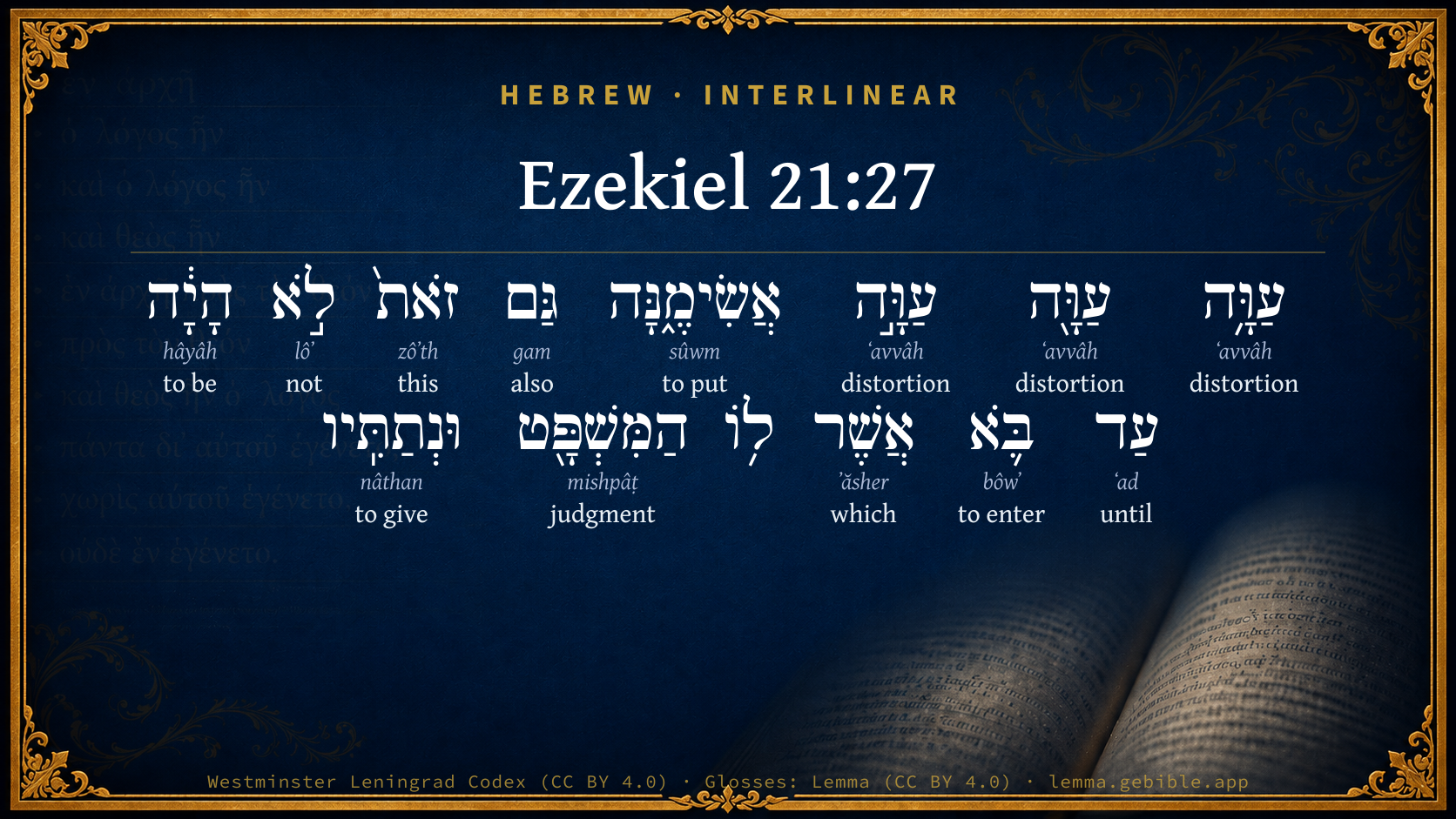
Hebrew (Westminster Leningrad Codex) Ezekiel 21:27 appears in the Hebrew Old Testament. The text above is from the Westminster Leningrad Codex. Each word links to its Strong’s number, a concise gloss, and parsing drawn from the Open Scriptures Hebrew Bible morphology. Click any word for its full Brown-Driver-Briggs (BDB) entry.
Download image
Cite this verse

Ezekiel 21:27 (World English Bible). Public Domain. Lemma interlinear Bible study tool, https://lemma.gebible.app/v/ezekiel/21/27.

Show BibTeX & RIS
BibTeX
RIS
English Translation
I will overturn, overturn, overturn it: this also shall be no more, until he come whose right it is; and I will give it [him].
World English Bible · Public Domain
Highlights
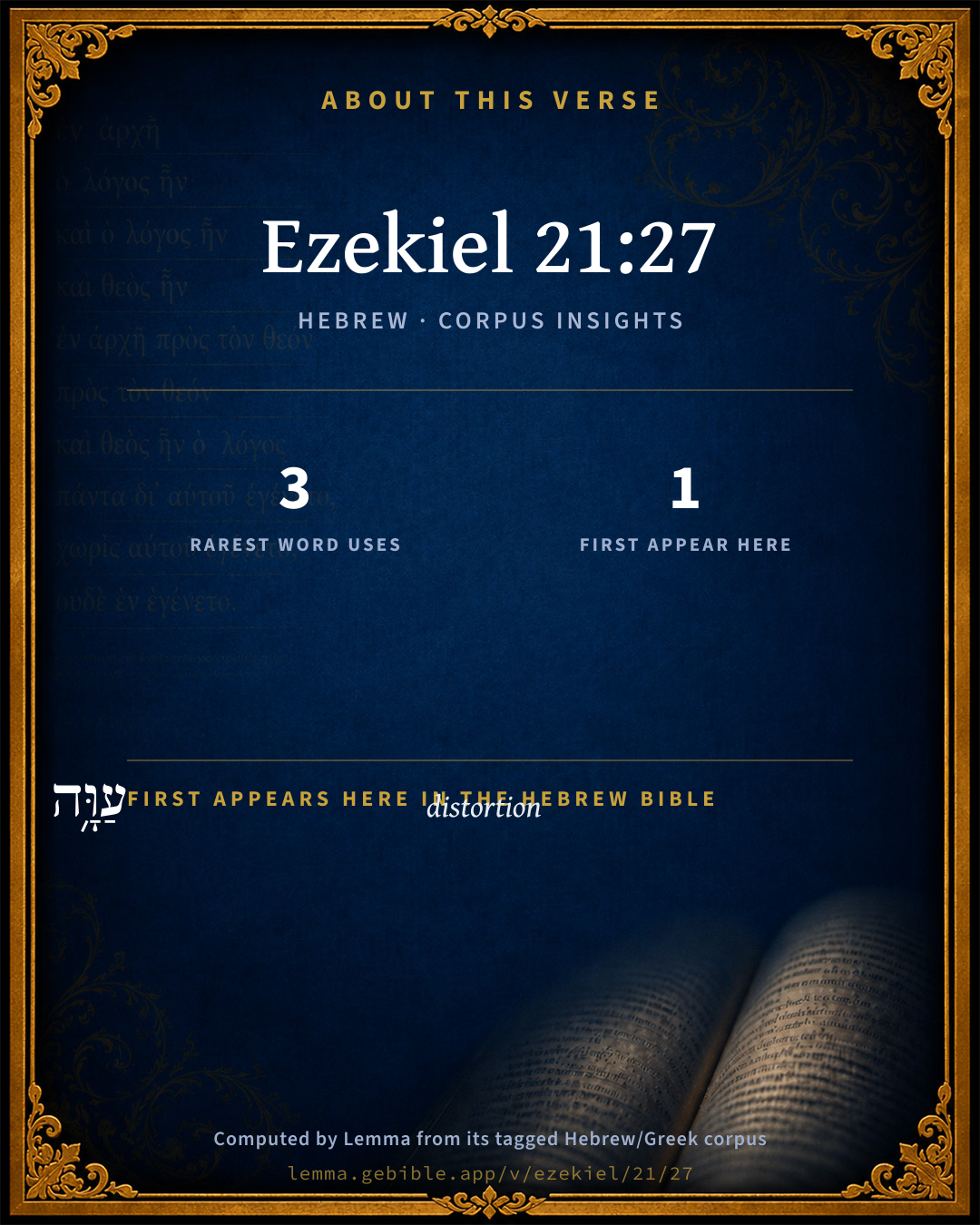
  • 1 first appearance in the Hebrew Bible
Full analysis ↓
Download a study sheet

One document with this verse’s original text, its word-by-word gloss line, the meaning frame, cross-references with their text, attributed commentary, and full source and license credits — printable, and it pastes into notes with its structure intact.

This verse Autodidact and up

Study sheet (.html) Plain text (.txt)

A passage Seminary Student

Up to 50 verses in one chapter. A passage sheet keeps up to 6 commentary sources and 12 cross-references per verse, in the order this page ranks them, and says so on the sheet whenever that leaves anything out. Ask for a single verse and you get the Autodidact verse sheet above.

Everything on this page stays free to read, with no account — the sheet is a download of what is already on screen, not access to it.

Want to remove ads? Support Godless Engineer
Compare translations 3

The same verse in 3 English versions, stacked beneath the original-language interlinear above. Click any original word for its lexicon entry.

Each is an independent rendering of the whole verse — the interlinear is not word-aligned to these translations.

Highlighted words mark where these versions differ — a whole-verse word diff, not a word-by-word alignment.

  • World English Bible Public Domain
    I will overturn, overturn, overturn it: this also shall be no more, until he come whose right it is; and I will give it [him].
  • King James Version Public Domain
    I will overturn, overturn, overturn, it: and it shall be no more, until he come whose right it is; and I will give it him.
  • unfoldingWord Literal Text CC BY-SA 4.0
    A ruin! A ruin! I will make it a ruin! It will not be restored until the one comes who is assigned to execute judgment.

unfoldingWord Literal Text — © unfoldingWord, licensed CC BY-SA 4.0. Word-aligned USFM3 via Door43 (git.door43.org/unfoldingWord/en_ult).

Versions to compare (up to 4)

3 of 4 selected

Show all 18 translations

Every available English version of this verse, each an independent rendering of the whole verse.

  • World English Bible Public Domain
    I will overturn, overturn, overturn it: this also shall be no more, until he come whose right it is; and I will give it [him].
  • Berean Standard Bible Public Domain
    A ruin, a ruin, I will make it a ruin! And it will not be restored until the arrival of Him to whom it belongs, to whom I have assigned the right of judgment.’
  • Majority Standard Bible Public Domain
    A ruin, a ruin, I will make it a ruin! And it will not be restored until the arrival of Him to whom it belongs, to whom I have assigned the right of judgment.’
  • King James Version Public Domain
    I will overturn, overturn, overturn, it: and it shall be no more, until he come whose right it is; and I will give it him.
  • American Standard Version (1901) Public Domain
    I will overturn, overturn, overturn it: this also shall be no more, until he come whose right it is; and I will give it `him'.
  • Revised Version (1885) Public Domain
    I will overturn, overturn, overturn it: this also shall be no more, until he come whose right it is; and I will give it him.
  • Geneva Bible (1599) Public Domain
    I wil ouerturne, ouerturne, ouerturne it, and it shall be no more vntill he come, whose right it is, and I will giue it him.
  • Douay-Rheims (1899) Public Domain
    I will shew it to be iniquity, iniquity, iniquity: but this was not done till he came to whom judgment belongeth, and I will give it him.
  • Young's Literal Translation Public Domain
    An overturn, overturn, overturn, I make it, Also this hath not been till the coming of Him, Whose `is' the judgment, and I have given it.
  • Literal Standard Version CC BY-SA 4.0
    An overturn, overturn, overturn, I make it, || Also this has not been until the coming of Him, || Whose [is] the judgment, and I have given it.
  • Unlocked Literal Bible CC BY-SA 4.0
    A ruin! A ruin! I will make it a ruin! It will not be restored until the one comes who is assigned to execute judgment.
  • unfoldingWord Literal Text CC BY-SA 4.0
    A ruin! A ruin! I will make it a ruin! It will not be restored until the one comes who is assigned to execute judgment.
  • Darby Bible Public Domain
    I will overturn, overturn, overturn it! This also shall be no [more], until he come whose right it is; and I will give it [to him].
  • World Messianic Bible Public Domain
    I will overturn, overturn, overturn it. This also will be no more, until he comes whose right it is; and I will give it.”’
  • Webster's Bible Public Domain
    I will overturn, overturn, overturn it: and it shall be no more, until he cometh whose right it is; and I will give it him.
  • Free Bible Version CC BY-SA 4.0
    I'm going to destroy everything, make it all a ruin! It won't be restored until its owner arrives, the one I've given the authority to judge.
  • Bible in Basic English Public Domain
    I will let it be overturned, overturned, overturned: this will not be again till he comes whose right it is; and I will give it to him.
  • JPS Tanakh (1917) Public Domain
    (21-32) A ruin, a ruin, a ruin, will I make it; this also shall be no more, until he come whose right it is, and I will give it him.

Literal Standard Version (2020), Covenant Press — licensed CC BY-SA 4.0. Text via the HelloAO Bible API (eBible.org). Unlocked Literal Bible (unfoldingWord) — licensed CC BY-SA 4.0. Text via the HelloAO Bible API (eBible.org). unfoldingWord Literal Text — © unfoldingWord, licensed CC BY-SA 4.0. Word-aligned USFM3 via Door43 (git.door43.org/unfoldingWord/en_ult). Free Bible Version, Dr. Jonathan Gallagher — licensed CC BY-SA 4.0. Text via the HelloAO Bible API (eBible.org).

Word by word

More ways to search: Search by grammar → Find every occurrence → Compare this word →

Practice this passage: Drill this verse → Learn its vocabulary →

עַוָּ֥ה
ʻavvâh
H5754
“distortion”
Noun, Common, Feminine, Singular, Absolute
Part of Speech
Noun
Type
Common
Gender
Feminine
Number
Singular
State
Absolute
Full BDB Definition

Origin: intensive from H5753 abbreviated

TWOT: 1577b

distortion, ruin
  1. עַוָּ֖ה ʻavvâh H5754 “distortion” Noun, Common, Feminine, Singular, Absolute
  2. עַוָּ֣ה ʻavvâh H5754 “distortion” Noun, Common, Feminine, Singular, Absolute
  3. אֲשִׂימֶ֑נָּה sûwm H7760 “to put · her” Verb, Qal, Imperfect, 1st Person, Common, Singular + Suffix, Personal, 3rd Person, Feminine, Singular
  4. גַּם gam H1571 “also” Particle, Accusative
  5. זֹאת֙ zôʼth H2063 “this” Pronoun, Demonstrative, Feminine, Singular
  6. לֹ֣א lôʼ H3808 “not” Particle, Negative
  7. הָיָ֔ה hâyâh H1961 “to be” Verb, Qal, Perfect, 3rd Person, Masculine, Singular
  8. עַד ʻad H5704 “until” Preposition
  9. בֹּ֛א bôwʼ H935 “to enter” Verb, Qal, Infinitive Construct
  10. אֲשֶׁר ʼăsher H834 “which” Particle, Relative
  11. הַמִּשְׁפָּ֖ט mishpâṭ H4941 “the · judgment” Particle, Definite Article + Noun, Common, Masculine, Singular, Absolute
  12. וּנְתַתִּֽיו nâthan H5414 “and · to give · him” Conjunction + Verb, Qal, Sequential Perfect, 1st Person, Common, Singular + Suffix, Personal, 3rd Person, Masculine, Singular

About this verse

These counts appear in no published source. They are computed here, from the morphology-tagged text and Lemma’s own curated glosses. What Lemma adds →

14
words
11
distinct lemmas
Prophets
section

Notable vocabulary

The rarest word here is עַוָּ֥ה distortion H5754 — appearing just 3 times in the whole Hebrew Bible.

First appearance in Scripture

This word makes its first canonical appearance in the Hebrew Bible here:

  • עַוָּ֥ה distortion H5754

Grammatical profile

  • 4 verbs
  • 4 nouns
  • 1 pronoun
  • 2 prepositions
  • 3 particles

Verb forms

  • אֲשִׂימֶ֑נָּה Qal · Imperfect
  • הָיָ֔ה Qal · Perfect
  • בֹּ֛א Qal · Infinitive Construct
  • וּנְתַתִּֽיו Qal · Sequential Perfect

Repetition

A word recurs within this verse — often emphatic in Hebrew:

  • עַוָּ֥ה distortion H5754 ×3

Hebrew & Septuagint length

In English translation the verse runs 25 words from the Hebrew and 28 from the Septuagint (LXX English) — closely comparable.

A rough comparison of the two English renderings, which tokenize alike — not a word-level alignment.

Word counts can differ between the Hebrew and the Greek without any difference in meaning — e.g. the Hebrew direct-object marker אֵת has no separate Greek word, and Greek often adds the article ὁ.

Cross-references

36

Topical passages linked to Ezekiel 21:27 in the Treasury of Scripture Knowledge — connected by theme and wording, ordered by reader-vote popularity; previews shown in the World English Bible.

  • Micah 5:2 But you, Bethlehem Ephrathah, Being small among the clans of Judah, Out of you one will come forth to me that is to be ruler in Israel; Whose goings forth are from of old, from everlasting.
  • Jeremiah 23:5–6 Behold, the days come, says Yahweh, that I will raise to David a righteous Branch, and he shall reign as king and deal wisely, and shall execute justice and righteousness in the land.
  • Zechariah 9:9 Rejoice greatly, daughter of Zion! Shout, daughter of Jerusalem! Behold, your king comes to you! He is righteous, and having salvation; Lowly, and riding on a donkey, Even on a colt, the foal of a donkey.
  • Luke 1:32 He will be great, and will be called the Son of the Most High. The Lord God will give him the throne of his father, David,
  • Psalms 2:6 "Yet I have set my king on my holy hill of Zion."
  • Genesis 49:10 The scepter will not depart from Judah, Nor the ruler's staff from between his feet, Until he comes to whom it belongs. To him will the obedience of the peoples be.
  • Haggai 2:21–22 "Speak to Zerubbabel, governor of Judah, saying, 'I will shake the heavens and the earth.
  • Malachi 3:1 "Behold, I send my messenger, and he will prepare the way before me; and the Lord, whom you seek, will suddenly come to his temple; and the messenger of the covenant, whom you desire, behold, he comes!" says Yahweh of hosts.
  • Matthew 28:18 Jesus came to them and spoke to them, saying, "All authority has been given to me in heaven and on earth.
  • John 1:9 The true light that enlightens everyone was coming into the world.
  • 1 Peter 3:22 who is at the right hand of God, having gone into heaven, angels and authorities and powers being made subject to him.
  • Hosea 3:5 Afterward the children of Israel shall return, and seek Yahweh their God, and David their king, and shall come with trembling to Yahweh and to his blessings in the last days.
  • Malachi 4:2 But to you who fear my name shall the sun of righteousness arise with healing in its wings. You will go out, and leap like calves of the stall.
  • Revelation 19:11–16 I saw the heaven opened, and behold, a white horse, and he who sat on it is called Faithful and True. In righteousness he judges and makes war.
  • Jeremiah 33:15–16 In those days, and at that time, will I cause a Branch of righteousness to grow up to David; and he shall execute justice and righteousness in the land.
  • Ezekiel 21:13 For there is a trial; and what if even the rod that condemns shall be no more? says the Lord Yahweh.
  • Zechariah 6:12–13 and speak to him, saying, 'Thus says Yahweh of Hosts, "Behold, the man whose name is the Branch: and he shall grow up out of his place; and he shall build the temple of Yahweh;
  • Psalms 72:7–10 In his days, the righteous shall flourish, And abundance of peace, until the moon is no more.
  • Jeremiah 30:21 Their prince shall be of themselves, and their ruler shall proceed from the midst of them; and I will cause him to draw near, and he shall approach to me: for who is he who has had boldness to approach to me? says Yahweh.
  • Jeremiah 33:26 then will I also cast away the seed of Jacob, and of David my servant, so that I will not take of his seed to be rulers over the seed of Abraham, Isaac, and Jacob: for I will cause their captivity to return, and will have mercy on them.
  • Ezekiel 34:23 I will set up one shepherd over them, and he shall feed them, even my servant David; he shall feed them, and he shall be their shepherd.
  • Ezekiel 37:24–25 My servant David shall be king over them; and they all shall have one shepherd: they shall also walk in my ordinances, and observe my statutes, and do them.
  • Daniel 2:44 In the days of those kings shall the God of heaven set up a kingdom which shall never be destroyed, nor shall the sovereignty of it be left to another people; but it shall break in pieces and consume all these kingdoms, and it shall stand forever.
  • Daniel 9:25 Know therefore and discern, that from the going forth of the commandment to restore and to build Jerusalem to the Anointed One, the prince, shall be seven weeks, and sixty-two weeks: it shall be built again, with street and moat, even in troubled times.
  • Amos 9:11–12 In that day I will raise up the tent of David who is fallen, and close up its breaches, and I will raise up its ruins, and I will build it as in the days of old;
  • Luke 2:11 For there is born to you, this day, in the city of David, a Savior, who is Christ the Lord.
  • Philippians 2:9–10 Therefore God also highly exalted him, and gave to him the name which is above every name;
  • Isaiah 9:6–7 For to us a child is born, to us a son is given; and the government shall be on his shoulder: and his name shall be called Wonderful, Counselor, Mighty God, Everlasting Father, Prince of Peace.
  • Ezekiel 17:22–23 Thus says the Lord Yahweh: I will also take of the lofty top of the cedar, and will set it; I will crop off from the topmost of its young twigs a tender one, and I will plant it on a high and lofty mountain:
  • Numbers 24:19 Out of Jacob shall one have dominion, Shall destroy the remnant from the city.
  • Jeremiah 33:21 then may also my covenant be broken with David my servant, that he shall not have a son to reign on his throne; and with the Levites the priests, my ministers.
  • Haggai 2:7 and I will shake all nations. The precious things of all nations will come, and I will fill this house with glory, says Yahweh of Hosts.
  • Luke 1:69 And has raised up a horn of salvation for us in the house of his servant David
  • John 1:4 In him was life, and the life was the light of men.
  • Ephesians 1:20–22 which he worked in Christ, when he raised him from the dead, and made him to sit at his right hand in the heavenly places,
  • Hebrews 12:26–27 whose voice shook the earth, then, but now he has promised, saying, "Yet once more I will shake not only the earth, but also the heavens."

Cross-references courtesy of OpenBible.info (CC BY 4.0).

Hebrew and Greek witnesses Masoretic Hebrew ↔ Greek Septuagint

The same verse in the two great witnesses to the Old Testament, shown verse-for-verse.

These are two independent witnesses, not word-aligned to each other, and the Septuagint is shown in lemma (dictionary) form.

Hebrew Ezekiel 21:27 Masoretic · Westminster Leningrad Codex

עַוָּ֥ה עַוָּ֖ה עַוָּ֣ה אֲשִׂימֶ֑נָּה גַּם זֹאת֙ לֹ֣א הָיָ֔ה עַד בֹּ֛א אֲשֶׁר ל֥וֹ הַמִּשְׁפָּ֖ט וּנְתַתִּֽיו

I will overturn, overturn, overturn it: this also shall be no more, until he come whose right it is; and I will give it [him].

World English Bible · Public Domain

Greek LXX Ezekiel 21:27 Septuagint · lemma form

γίγνομαι ὁ μαντεῖον ἐπί ἰερουσαλήμ ὁ βάλλω χάραξ ὁ δια ἀναοἴγω στόμα ἐν βοή ὑψόω φωνή μετά κραυγή ὁ βάλλω χάραξ ἐπί ὁ πύλη αὐτός καί βάλλω χῶμα καί οἰκοδομέω βελόστασις

Injustice, injustice, injustice, will I make it: woe to it: such shall it be until he comes to whom it belongs; and I will deliver it to him.

LXX2012 (modern English Septuagint) · Public Domain

On this verse, The Pulpit Commentary discusses the Septuagint’s reading. Read the note in Commentary ↓

Hebrew: Westminster Leningrad Codex (CC BY 4.0). Greek: Septuagint (public domain); English from LXX2012 (modern English Septuagint) (Public Domain). How the Septuagint differs from the Hebrew →

Targum (Aramaic paraphrase)

1

The Targum is the ancient Jewish Aramaic paraphrase of the Hebrew Scriptures — an interpretive translation, not the Hebrew text itself. Onkelos (literal) and Pseudo-Jonathan (expansive) render the Torah, and Jonathan the Prophets. Coverage is partial: where no permissively-licensed English translation exists for a verse, only the Aramaic is shown. This is verse-level text, not a word-by-word alignment to the Hebrew.

  1. Targum Jonathan Prophets (Joshua–Malachi)
    בִימִינֵיהּ הֲוָה קִסְמָא נָפִיל לִמְהַךְ לִירוּשְׁלֵם לְמַנְאָה אָפְרוּרְוָן לְפַתָּרָא תַרְעִין דְיַעֲלוּן בְּהוֹן קָטוֹלִין לַאֲרָמָא קַל בְּאַצְוָחַת קַרְנָא לְמַנְאָה אָפְרוּרְוָן עַל תַּרְעֵן לְמִצְבַּר מִלַיְתָא וּלְמִבְנֵי כַרְקוֹם:

    (no public-domain English translation for this verse)

    Targum Jonathan — Aramaic: “Mikraot Gedolot” (public domain). English: “Sefaria Community Translation” (CC0 1.0 (public-domain dedication)); “London "Chaldee Paraphrase," 1871” (public domain). Text via Sefaria.

Commentary

Notes on Ezekiel 21:27 from classic Christian and Jewish commentators (each source and its license shown beneath its notes). The classic Christian expositions comment on the surrounding passage and are grouped to its opening verse, so a note may address several verses; the Jewish commentaries on the Tanakh (Rashi and others) are per-verse, so they appear only where the commentator wrote on this verse.

Lemma curates 59 commentaries, every one of them public domain or Creative Commons licensed, each selected and text-cleaned for this edition rather than reprinted as found. About our sources →

John Gill's Exposition

Whiles they see vanity unto thee, whiles they divine a lie unto thee,.... The Ammonites had their seers, soothsayers, diviners, and false prophets, which they are bid to be aware of, and are cautioned against hearkening to, Jer 27:3, these told them they were in the utmost safety, and that the king of Babylon would not come against them; or, if he did, would not succeed, when his sword was drawn and furbished for the destruction of them:

to bring thee upon the necks of the slain, of the wicked; that is, of the Jews who were slain by the sword of the Chaldeans for their wickedness; and these diviners by their vain divination and lies would bring the Ammonites into the same condition, to be slain as they were; and as it were to fall upon their necks, as one slain person upon another; and so the Targum,

"to deliver thy neck as the necks of the slain, of the wicked:''

it may be rendered, "to put thee to the necks of the slain" (w); or, as Kimchi, "with the necks of the slain"; though some understand it, as if the diviners by their lies, promising peace and prosperity, encouraged the Ammonites to insult the Jews, and as it were to trample upon the necks of the dead:

whose day is come, when their iniquity shall have an end; along with Zedekiah their king; a description of the Jews; See Gill on Eze 21:27.

(w) "ut ponant te cum cervicibus interfectorum", Munster, Tigurine version; "applicando te ad cervices confossorum", Junius & Tremellius, Polanus.

John Gill's Exposition of the Whole Bible (1746–1763) — public domain (CC PDM 1.0). Text via the HelloAO Bible API.

Trapp's Complete Commentary

John Trapp

Eze 21:27 I will overturn, overturn, overturn, it: and it shall be no [more], until he come whose right it is; and I will give it [him].

Ver. 27. I will overturn, overturn, overturn it.] Curvam, curvam, curvam ponam eam, so the Tigurines translate. A crown there shall be still, but such as shall hang on one side of the head, as it were. Princes of the people there were. Those three high priests, Alexander, Aristobulus, and Hircanus, who called themselves kings, had very ill Success.

Until he come.] Christ the rightful King of Israel. To this text alludeth Nathanael. {Joh 1:49}

John Trapp, A Commentary or Exposition upon All the Books of the Old and New Testament (1647–1656) — public domain. Text from a community e-Sword module.

The Biblical Illustrator

Joseph S. Exell

Eze_21:27

I will overturn, overturn, overturn it: and it shall be no more, until He come whose right it is; and I will give it Him.

War, a means of advancing the kingdom of Christ

I. War.

1. War has its own work to accomplish. It is not a chance. It is of God (1Ch_5:22). War, like pestilence or famine, is under His command, and warriors are the executioners of His will, though they know Him not. Jehovah hath a work to do, which war is the fittest instrument to accomplish. He saves by the Gospel; He overturns by the sword.

2. The foundation of all true religion lies in obedience to the first commandment of the law (Exo_20:2-3). But the heathen nations have gods many, and lords many (1Co_8:5). Idolatry has been more prevalent than the worship of the true God in all ages and nations, since the time of the patriarchs. And idolaters outnumber the worshippers of the living God in the present day. This wide defection from truth is not to be attributed to ignorance, but to depravity (Rom_1:21; Rom_1:28). Ignorance is not the chief evil in our race, but sin,--all have sinned (Rom_3:23,--so that every mouth must be stopped, and all the world become guilty before God (Rom_3:19).

3. Now it is necessary that this matter be thoroughly understood, in order that we may vindicate the righteousness of God in permitting the nations of the earth to remain so long unsaved while He has visited them so often with His sore judgments, of which the sword has not been the least. Heart depravity gave birth to idolatry, and idolatry ministers to that depravity. When the light becomes darkness, how great is that darkness! (Mat_6:23). When God is rejected, the devil reigns. Crime is everywhere the religion of Paganism, and its universal fruits are envy, lust, rapine, misery, murder, death, hell. It is nothing that the Gospel of Jesus has; it hath everything the Gospel has not. It is directly antagonistic to Christ. And if the power of heathenism were not brought down by the sword, the whole of its institutions, laws, priesthood, and systems of government, combined with the sinfulness of the human heart, would present an impenetrable barrier to the admission of the truth. War must throw that barrier down. Christian churches are not to furnish the warriors; Christian missionaries are not to lead on a band of holy crusaders; but God will find the instruments, and by them He will do the work. I will overturn, overturn, overturn.

4. Here let us pause, and survey the events of the present and preceding century in heathen lands, that we may declare the work of God, and wisely consider of His doing (Psa_64:9).

II. Its issue.

1. We know not what events may lie before us, nor how God may work by divers instrumentalities, both good and evil; but the ultimate result of the unsheathed sword, and of His overturning, He hath plainly declared. I will overturn, overturn, overturn it; and it shall be no more, until He come whose right it is.

2. This design of God cannot be frustrated; His purposes shall assuredly stand. Every war has been hitherto made subservient to the kingdom of His Son.

3. But in what way, some might inquire, can the war in which we are now unhappily engaged conduce to the coming of His kingdom, whose right it is to reign? It may not be easy to answer that question. How God will work we know not, nor do we wish to know; it is sufficient that our faith at present should rest upon His Word. Still, however, without venturing beyond our line in the way of predictions, we may argue on probabilities that present themselves to a reflecting mind.

4. It only remains that we notice, with commendation, those peculiar features of this war which demand our grateful acknowledgments to Almighty God. The first is, the extreme reluctance with which we entered upon it. Every method diplomacy could prevent to avoid conflict was exhausted. It was not always thus with nations. It was not always thus with England. We hail the change, even while we hear a proclamation of war, as indicating the approach of that blessed period when war shall be no more. Secondly, the humane manner of conducting the war is worthy of the highest praise. (W. J. Shrewsbury.)

Social changes subservient to the kingdom of Christ

There is a well-known phrase which has been applied by one and another to various things in the world, just as anything happened to be a favourite of prejudice or fancy, Esto perpetua. But methinks a sober and enlightened looker on the world will not find very many things on which he can deliberately pronounce it. He certainly cannot begin with the state of his own mind, taken entire and as it is. And if he cast a rapid glance of survey over the world, his attention will soon be arrested by many things which he would not wish exempted from such a denunciation as that of the text. Perhaps we should not proceed without first protesting against the passion for mere change and commotion; a restless discontent that everything should continue as it is. Yet Providence may occasionally make use even of this for its great purposes; may let loose the wild violence, and direct its operation, on what is decreed to be demolished. However, a good man wants not to excite to activity any such spirit while he beholds the things he wishes overturned. What things? At different times you have been moved with regret and indignation and almost horror as the several grand evils that are oppressing and blasting the world have unfolded their deformity and malignant effects to your view.

I. Perhaps the first that will occur to the mind is--false, pernicious religion. Religion! the light of the world! turned into error, delusion, and darkness! Religion! the sacred bond of the creature to the glorious Creator! rent and reformed into a bondage to all that is in opposition to Him! Religion! designed as the purifier and elevator of man,--transformed into the promoter, even the creator and the sanction, of his corruption and degradation! Religion, in short, the happiness of man on earth, and the preparation for eternal happiness, converted into a cause of misery here and hereafter! Then, overturn! overturn! Imagine, in any country, a mighty fortress of a cruel tyrant, constituting the main strength of his occupancy,--even the most dreadful earthquake would be almost welcome to the people, if they saw that it was prostrating the massive walls, the impregnable towers of this fortress; their own humble abodes might be seen falling, but look yonder! something else is also falling!

II. Again, what ruinations there must be on earth before Christianity is set quite clear and pure from all the corruptions of worldly policy. Overturn! will still be his prayer with respect to all systems and institutions, which, by their principle, put religion on any ground where it must be necessarily and primarily a secular affair; where the spiritual interests shall be made formally subsidiary and servile to the secular; where secular regards will necessarily have the ascendancy; where the leading considerations will naturally be those of emolument and ambition.

III. The history of the world presents, almost over its whole vast breadth, one melancholy spectacle of mankind subjected to the uncontrolled will of a few individuals, assuming the station of deities, and very many of them the worst of their race, the basest of men! Such a system resolutely maintained must come to a tremendous result. It will ultimately compel two vast orders of will and force into awful conflict; like that of the fire and water of the last day. For it cannot be that God has appointed the general human mind to subside in a quiet enslavement and stagnation. There will be mighty commotions; a shaking of the nations, in all probability. But the omens are very dark as to any speedy results from them of a hind to satisfy a Christian and philanthropic spirit. The gloomy omens arise from this,--that God has His own controversy with all the nations. (John Foster.)

Revolution and reformation

I. What things do now stand in the way of Christs glorious reign.

1. Every species of tyranny.

2. Idolatry, or the worship of false gods.

3. Infidelity.

4. Heresy, or the disbelief of the great and fundamental doctrines of the Gospel.

II. By what means we may suppose God will overturn or remove all these things which stand in the way of the glorious reign of Christ.

1. By public calamities or desolating judgments.

2. We may suppose that God will employ human learning to enlighten the minds of ignorant, barbarous, tyrannical, and erroneous nations in respect to their civil and religious tyranny, and their absurd and vicious customs and manners.

3. We may be confident that God will employ the Gospel as the principal external instrument to overthrow and remove all obstacles in the way of Christs final and most glorious reign upon earth. This is suited at once to enlighten the understandings, awaken the consciences, and subdue the hearts of all who are opposed to the kingdom of Christ.

4. God will pour out His Spirit as the efficient cause of making all the other means that have been mentioned effectual, to the pulling down of strongholds, etc.

III. Why may we confidently expect that God will accomplish His gracious design of giving the kingdom to His Son by the means that have been mentioned.

1. Because these are the means which He has hitherto usually employed for accomplishing this purpose.

2. Because He can make the means which have been mentioned effectually answer his great purpose in view.

3. He has expressly promised to do it.

Improvement--

1. If the things which now stand in the way of the glorious reign of Christ must be removed in the manner that has been mentioned before His reign commences, we have no reason to think that His kingdom will soon come.

2. If God has done so much already, and will do a great deal more to prepare the way for the coming of Christ in His millennial glory, then we may justly expect that the world will be very happy under the reign of the Prince of Peace.

3. If God will remove the obstacles which still tie in the way of the latter-day glory of Christ in the manner that has been mentioned, then good men have a great deal to do to promote this great and good design.

4. It appears from what has been said, that Christians have great encouragement to exert themselves vigorously and wisely in preparing the way for the glorious reign of Christ.

5. This subject calls upon all to rejoice in what God has done and is doing, by the instrumentality of man, to fill the earth with His glory, under the reign of the Prince of Peace. (N. Emmons, D. D.)

Human revolutions

I. They have a sad successiveness. They do not run out and expend themselves; but one makes place for another. All mutations in schools, markets, churches, kingdoms, only pass away as waves on the shore, to be succeeded by other advancing billows. There is nothing settled.

II. They transpire by Divine arrangement. There must be perpetual fermentation where evil is. How does God effect these changes?--

1. By the revelation of right and truth to human consciousness.

2. By the procedure of His providence.

III. They will only be terminated by the advent of the rightful King. The world is Christs. He has a right to rule. So truthful, benevolent, and just will be His sway that all opposition will be subdued. (Homilist.)

The three-fold overthrow of sell

I. The Lord repeats three times the expression, I will overturn it. It may indeed be said with respect to this repetition of the words three times, that it may signify the positiveness and certainty of Gods determination. But still I believe, if we come to look at it in a closer point of view, we shall find that it is literally true,--that the repetition of it three times does not merely intend to express the certainty of Gods overthrow of self in the soul, but that there are three distinct occasions--three clear, positive, and direct overturnings of self, and bringing it into utter ruin, in order to the setting up of Christ in His glory and beauty upon the wreck and ruins of the creature.

1. The first prominent feature of self is in some cases profane self; that is, many of Gods elect, before they are called by the blessed Spirit, are living in open profanity, in drunkenness, swearing, and the barefaced practice of notorious sins. But whenever the Spirit of God begins to work in the heart, He overturns profane self, that is, He brings such solemn convictions into the conscience--He shoots such arrows from the bow of God into the soul, that self in its profane shape is overcome and overthrown thereby.

2. Here, then, is a soul which stands overturned before God; a wreck and ruin before the eyes of Him with whom we have to do. But what will a man do when he is reduced to these circumstances? Why, he will begin to build, and will endeavour to set up a temple in which he believes God will take pleasure, of which He may approve, and which shall, in some measure, recommend him to Jehovahs favour. A second overturning, then, is necessary, an overthrow of righteous or holy self. And what is the Lords lever to overturn this second temple, built out of the ruins of the first, but not the place of His rest, as being still the work of mens hands? A spiritual discovery of the deep pollution of our hearts and natures before Him. Profanity is overturned by the application of the law with power to the conscience; but this false holiness, this mock spirituality, is overturned by the discovery to our consciences of the deep pollution that lurks in our carnal minds; this is more or less the breaking up of the fountains of the great deep, and discovering with power to the conscience the truth of those words: The heart is deceitful above all things, and desperately wicked. As we try, then, to be holy, sin rises up from the depths of our carnal mind, and overturns that fabric which we are seeking to erect.

3. Now let us trace a little what course self will steer. Why, this restless wretch now runs in another channel, which is to slight the solemn inward teachings of God, and to take hold of the doctrines of grace by the hand of nature, without waiting to have these heavenly truths applied, from time to time, by the mouth of God to our hearts. And as some sweetness has been felt in them there seems to be some warrant for so doing. But presumption creeps upon us in such imperceptible and subtle ways, that we scarcely know we are in thus delusive path before we find a precipice at the end of the road. And what has led us there? Our pride and ambition, which are not satisfied with being nothing, with occupying the place where God puts us, and being in that posture where He Himself sets us down. We must needs grasp at something beyond Gods special teachings in the soul; we must needs exalt our stature beyond the height which God Himself has given us, adding a cubit to our dwarfish proportions. Here, then, is the third form of self which is to be overturned, as much as the two preceding forms, and that is presumptuous self.

II. The setting up of the kingdom of God on the ruins of self. I will overturn, overturn, overturn it: and it shall be no more, until He come whose right it is; and I will give it Him. There is one then to come whose right it is, there is a King who has a right to the throne, and to the allegiance of His subjects; a right to all that they are and to all that they have. But whence has He gained this right? Until He come whose right it is. It is His right, then, first, by original donation and gift, the Father having given to the Son all the elect. Here am I, says Jesus, and the children that Thou hast given Me. All that the Father giveth Me shall come to Me. Then, so far as we are His, Jesus has a right to our persons; and in having a right to our persons, He has, by the same original donation of God the Father, a right to our hearts and affections. But He has another right, and that is by purchase and redemption, He having redeemed His people by His own blood--having laid down His life for them, and thus bought and purchased them, and so established a right to them by the full and complete price which He Himself paid down upon the cross for them. This two-fold right He exercises every time that He lays a solemn claim to any one of the people whom He has purchased. Until He come whose right it is. Then there is a coming of Jesus into the souls of His people; not a coming into their judgments to inform their heads; not a coming into their minds merely to enable them to speak with their tongues concerning them, but there is a solemn coming of Christ, with power and glory and grace and majesty into the souls and consciences of His elect family, whereby He sets up His kingdom upon its basis, erects a temple for Himself, and builds up His own throne of mercy and truth upon the ruins of self. But this is not a work which is once done, and needs no more repetition. For we must bear in mind that this wreck and ruin of self is not a heap of dead stones. Self is a living principle; not a slaughtered and buried rebel, but a breathing antagonist to the Lord of life and glory. Self will ever work, then, against His supreme authority, and will ever rebel against His sovereign dominion. And therefore if we look into our hearts we shall find that day by day we need this overturning work to be done afresh, and again and again repeated in us. (J. C. Philpot.)

Messiahs final triumph

I. Jehovah has given universal empire to Jesus (Psa_72:1-11; Psa_2:8; Psa_89:27; Dan_7:14; Zec_9:10; Php_2:10; Act_2:32, etc.) Christs dominion is to embrace the whole world,--every empire, kingdom, continent, and island.

II. It is Christs right thus to reign. Whose right it is.

1. On His creative property in all things (Col_1:16). Satan is an usurper,--the world is alienated from its rightful Lord. But the right of Christ remains unaffected, and that right He will demand and obtain.

2. On His supreme authority as universal Lord. He is Lord of all, King of kings, etc. This authority is seen in controlling all events, in upholding all things, etc. In His infinite outgoings of benevolence and love.

3. He has a redeeming right. He became incarnate, He descended into the world, He brought the light of heaven into it, He gave His own life for it, He is the proprietor, etc. Here then is a right, ratified with His precious blood. He was willingly lifted up that He might draw all men unto Him.

III. God will overturn every obstacle until this be effected. I will overturn, etc. Ignorance must give place to light, error to truth, sin to holiness. Satan must be driven from his strongholds, and thus Jesus will enlarge His empire and extend His domains. There are, however, four mighty impediments which must be overthrown, entirely overturned.

1. Paganism, and all its multifarious rites.

2. Mohammedanism in all its earthly gratifications.

3. Judaism, with its obsolete rites.

4. Antichristian Rome.

Every thing that exalteth itself against God, or attempts the division of Christs merits, must be consumed before the brightness of Messiahs countenance and the power of His truth. But you ask, How will God overturn, etc.? Doubtless His providence will subserve the purposes of His grace. He may cause science and commerce to open a passage for the message of truth. He may even overrule war, and may allow the military hero to pioneer the ambassador of peace. But he will do it by the power of the Gospel of truth. The doctrines of the cross are to effect it. We preach Christ crucified, etc. Not by might, nor by power, etc. (J. Burns, D. D.)

.

The Biblical Illustrator, edited by Joseph S. Exell (c. 1880s–1900s) — public domain. Text from a community e-Sword module.

Joseph Benson's Commentary

Eze 21:27. I will overturn, overturn, overturn it — By several degrees I will utterly overthrow the kingdom of Judah; and it shall be no more — It shall never recover its former lustre and dignity; until he come, &c. — Till the Messiah come to take his kingdom. To the same purpose is Lowth’s paraphrase on the verse: “After that Zedekiah is deprived of his regal authority, there shall be no more kings of that family till Christ come, the King so often foretold and promised, who in due time shall reign upon the throne of his father David, and of whose kingdom there shall be no end, Luk 1:32-33. After the captivity, some of the priests of the Asmonean race assumed the style and title of kings; but not being of the tribe of Judah, they could have no just right to that honour. The expression, Whose right it is, seems to be peculiarly characteristic of the Messiah, who is always spoken of by the prophets as the true and right heir to the throne of David, and as one who was in an eminent manner to inherit the kingdom. His indeed the right was; for him was reserved the kingly dominion, not only over Judea, but the whole earth. The repetition of the word overturn, in the beginning of this verse, or, as the Hebrew expression עוהmay be more literally rendered, an overturning, may probably be intended to predict the repeated subversions which the Jewish state was to undergo in future times, by the Chaldeans, Macedonians, Romans, and many others, and the multiplied destructions of their nation, by which they would be punished for their sins; which subversions and destructions will not come to any happy termination, till they submit to the easy yoke of their long- rejected Messiah, and in humility, faith, and gratitude, accept the salvation which he waits to confer upon them. Nay, and the expression might be intended “to predict all the convulsions in states and kingdoms, which shall make way for the establishment of his kingdom throughout the earth.” — Scott.

Joseph Benson's Commentary on the Old and New Testaments (1811–1818) — public domain. Text from a community e-Sword module.

Geneva Bible (1599)

Geneva Bible translators

That is, unto the coming of Messiah: for though the Jews had some sign of government afterward under the Persians, Greeks and Romans, yet this restitution was not till Christ’s coming, and at length should be accomplished, as was promised, Gen. 49:10.

Geneva Bible (1599) marginal notes — public domain. Text via Bolls.life.

Jamieson, Fausset & Brown

Robert Jamieson, A. R. Fausset & David Brown

Literally, "An overturning, overturning, overturning, will I make it." The threefold repetition denotes the awful certainty of the event; not as ROSENMULLER explains, the overthrow of the three, Jehoiakim, Jeconiah, and Zedekiah; for Zedekiah alone is referred to.

it shall be no more, until he come whose fight it is--strikingly parallel to Gen 49:10. Nowhere shall there be rest or permanence; all things shall be in fluctuation until He comes who, as the rightful Heir, shall restore the throne of David that fell with Zedekiah. The Hebrew for "right" is "judgment"; it perhaps includes, besides the right to rule, the idea of His rule being one in righteousness (Psa 72:2; Isa 9:6-7; Isa 11:4; Rev 19:11). Others (Nebuchadnezzar, &c.), who held the rule of the earth delegated to them by God, abused it by unrighteousness, and so forfeited the "right." He both has the truest "right" to the rule, and exercises it in "right." It is true the tribal "scepter" continued with Judah "till Shiloh came" (Gen 49:10); but there was no kingly scepter till Messiah came, as the spiritual King then (Joh 18:36-37); this spiritual kingdom being about to pass into the literal, personal kingdom over Israel at His second coming, when, and not before, this prophecy shall have its exhaustive fulfilment (Luk 1:32-33; Jer 3:17; Jer 10:7; "To thee doth it appertain").

Jamieson, Fausset & Brown — Commentary Critical and Explanatory on the Whole Bible (1871) — public domain (CC PDM 1.0). Text via the HelloAO Bible API.

Adam Clarke's Commentary

Verse 27. I will overturn] I will utterly destroy the Jewish government. Perverted will I make it. See the margin.

Until he come whose - is] משפט mishpat, the judgment; i.e., till the coming of the son of David, the Lord Jesus; who, in a mystic and spiritual sense, shall have the throne of Israel, and whose right it is. See the famous prophecy, Ge 49:10, and Lu 1:32. The avah, which we translate overturn, is thrice repeated here; to point out, say the rabbins, the three conquests of Jerusalem, in which Jehoiakim, Jeconiah, and Zedekiah were overthrown.

Adam Clarke's Commentary on the Bible (1810–1826) — public domain. Text from a community e-Sword/MySword module.

Ellicott's Commentary for English Readers

(27) And it shall be no more.—Literally, this also shall not be. After the emphatic repetition of “over-turn” at the beginning of the verse, it is now added that the condition which follows the overthrow shall not be permanent; “the foundations” shall be put “out of course,” and everything thrown into that condition of flux and change, without permanent settlement, which was so characteristic of the state of Judaea until the coming of Christ.

Until he come whose right it is.—This is generally acknowledged as a reference to Gen_49:10, “until Shiloh come” even by those who reject the interpretation of Shiloh as meaning “he to whom it belongs.” The promise here made refers plainly both to the priestly and to the royal prerogatives, and a still more distinct foretelling of the union of both in the Messiah may be found in Zec_6:12-13. In Him, and in Him alone, will all this confusion and uncertainty come to an end; for, as Ezekiel’s contemporary declared, “His dominion is an everlasting dominion, which shall not pass away, and His kingdom that which shall not be destroyed” (Dan_7:14).

A Bible Commentary for English Readers, edited by Charles John Ellicott (1878–1897) — public domain. Text from a community e-Sword module.

The Cambridge Bible for Schools and Colleges

gen. ed. J. J. S. Perowne

27. and it shall be no more] Or, yea this—it shall not be (or, it is gone!). “This” does not refer to the condition introduced by the overturning, but goes back and resumes the present condition of things, which shall be overturned till he comes who hath the right, the Messiah. On verb, cf. Isa_15:6; Job_6:21.

until he come … give it him] Rather: and I will give it him. He whose right it is, or, he who hath the right, is the Messiah. Reference is possibly to Gen_49:10, where Ezek. read shelloh (whose), not as now Shiloh.

The Cambridge Bible for Schools and Colleges (gen. ed. J. J. S. Perowne; Cambridge University Press, 1878–1918) — public domain. Text from a community e-Sword module.

Haydock's Catholic Bible Commentary

Iniquity. Or, I will overturn it, viz., the crown of Juda, for the manifold iniquities of the kings: but it shall not be utterly removed till Christ come, whose right it is; and who shall reign in the spiritual house of Jacob (that is, in his Church,) for evermore. (Challoner) --- Hebrew also, "sideways." Thou shalt no more wear the tiara erect, (Haydock) like a king: (Hesychius) or rather, thy iniquity or punishment shall be most grievous. --- Him; Christ, or (Calmet) Nabuchodonosor. (Vatable) (Menochius)

George Leo Haydock (1774–1849), Haydock's Catholic Family Bible and Commentary, 1859 edition — public domain. Excludes Psalms (Douay-Rheims chapter numbering differs from Protestant) and Deuterocanonical books (Catholic canon only).

Matthew Poole's English Annotations

This triplication of the threat speaks the certainty of the event, and also the gradual, successive troubles and overthrows that this kingdom should ever after be afflicted with.

It shall be no more; never recover its former glory and strength, but consume, till the sceptre be quite taken away from Judah, and way be made for the Messiah, who is he that is to come, whose is the dominion, and to whom the Father will give it. So the final desolation of the temporal kingdom of the seed of David, which was most heavy tidings to the carnal Jews, is threatened, and the eternal kingdom of the Messiah, most joyful tidings to the believing Jews, is promised.

Matthew Poole's English Annotations on the Holy Bible (1683–1685) — public domain. Text from a community e-Sword/MySword module.

Whedon's Commentary on the Bible

Daniel D. Whedon

27. I will overturn, overturn, overturn — The threefold repetition of divine emphasis. It is not Nebuchadnezzar who overturns the throne of Judah, but Jehovah.

And it shall be no more — Or, yea, this — it is gone (Davidson). The upheaval is sure! The present order of things is looked upon as having already passed away. Prince Zedekiah has lost his high place and another has taken it, but he in turn shall disappear and the kingdoms of Judah shall have no permanent ruler until he come whose right it is; and I will give it him (Gen_49:10).

Daniel D. Whedon (gen. ed.), Commentary on the Old and New Testaments (1874–1909) — public domain. Text from a community e-Sword module.

The Pulpit Commentary

I will overthrow. The sentence of destruction is emphasized, after the Hebrew manner, by a threefold iteration. (Isa_6:3; Jer_22:29) It shall be no more. The pronoun in both clauses probably refers to the established order of the kingdom and the priesthood. "That order," Ezekiel says, "shall be no more." Keil, however, takes the second "it the "this" of the Revised Version as meaning the fact of the overthrow. That also was not final; all things were as in a state of flux till the Messianic kingdom hinted at in the next clause should restore the true order. Until he come whose right it is. The words contain a singularly suggestive allusion to Gen_49:10, where a probable interpretation of the word "Shiloh" is "he to whom it belongs;" or, as the LXX gives it, tamena aujta. The passage is noticeable as being Ezekiel"s first distinct utterance of the hope of a personal Messiah. Afterwards, in Eze_34:23, it is definite enough.

Revolution and restoration.

I REVOLUTION. God overturns Israel and its institutions by repeated acts in the successive invasions of Nebuchadnezzar. The ruin is utter. No city has sustained so many sieges as Jerusalem, or has been so often sacked and destroyed. Now, we are reminded that these terrible disasters are elements in a Divine judgment and discipline. It is God who overturns. There is, therefore, a providential purpose in the event.

1. Revolution must precede restoration. The Divine education of mankind is not a continuous, unbroken development. The earthquake has its mission as truly as the April shower. Evil must be overthrown before good can be built up. This may mean a violent process. We are too mild in some of our methods of treating sin. Undoubtedly, God has not committed his sword of judgment to us, but he expects his servants to testify against sin, and so to pull down the strong walls of Satan. Aggressive work is absolutely necessary. While we preach the gospel of peace, we have also to fight against intemperance, commercial corruption, and all evil customs and institutions.

2. This revolution must be universal. There is a sweeping comprehensiveness in our text. Political revolutions, indeed, may not be called for, for now we have to engage in spiritual work. But there must be revolution in every region of life.

(1) In the heart. Old prejudices and habits must be thrown down every mountain made low.

(2) In the Church. Christ cleansed the temple. The Reformation was a great overturning. Much in the Church now needs to be overturned; e.g. worldly practices, human inventions, false ideas, Christless journalism, etc.

(3) In society. The apostles were regarded as firebrand revolutionists, who "turned the world upside down." Social injustice must be overturned, not, perhaps by "Red Republicanism," but by Christian brotherhood. We must not suppose that God will let the monstrous evils of Christendom go on forever. He will overturn much before we can see the millennium. The new wine cannot be contained in the old bottles.

II RESTORATION.

1. The revolution prepares for a restoration. Mere destruction perfects nothing. It is necessary only as preliminary to something constructive. Blank nihilism is the most barren philosophy. The "everlasting no" is not a gospel for hungry humanity. After the revolution there must be a new order, and after repentance there must be a new life.

2. The restoration can only be accomplished by Christ. Until Christ came the Jews were never truly restored, though they had returned to their land. In Christ Israel had its long hoped for redemption, (Luk_2:29, Luk_2:30) though, alas! most of the nation rejected it, and left it to others. It is easy to demolish an ancient effete system. The difficulties begin with building up a new and better one. We cannot establish a new social order, nor can we even stir up a better life in our own breasts. The weary world waits for the full coming of Christ to restore its overturned peace and order.

3. This restoration will be fully satisfactory.

(1) Christ has a right to enjoy the headship over it: "Whose right it is." He is not only the Son of David, and Heir to the old throne; he is the Son of God, vested with Divine rights.

(2) Christ receives his kingdom worn his Father: (Php_2:9-11) "I will give it him.

(3) This restoration will not be a return to the old position. If it were so, the whole process would be a profitless cycle. But Christ"s kingdom of heaven is infinitely better than David"s kingdom of Israel.

Mundane revolutions.

will overturn, overturn, overturn it; and it shall be no more," etc.

I THE CONTINUITY OF MUNDANE REVOLUTIONS. "I will overturn, overturn, overturn it." The Lord thus declares his determination to overthrow again and again the government of the Jews, until the coming of the Messiah, their rightful Sovereign. The words may also point, as Scott remarks, to "the repeated subversions of the Jewish nation by the Chaldeans, Macedonians, Romans, and many others to the present day; which will not come to any happy termination fill they submit to their long rejected Messiah. Nay, they seem to predict all the convulsions in states and kingdoms, which shall make way for the establishment of his kingdom throughout the earth." Revolutions in governments, in society, in science, have always been. They are rife at present. While men continue ignorant, selfishly ambitious, and wicked, they will continue. These overturnings will not cease until human character is radically altered, until it is fashioned after the Divine model. It is not one overturning, and then settled order and progress. In our world change succeeds change as wave follows after wave on the face of old ocean. Unsettledness characterizes all things here.

II THE DIVINE AGENCY IN MUNDANE REVOLUTIONS. "Thus saith the Lord God...I will overturn, overturn, overturn it." These revolutions are not accidental; they do not occur by chance. They are brought about under Divine arrangements. God being the great "Ruler over the nations," they cannot take place, to say the least, without his permission. Being Supreme, all things are either originated or allowed by him. The sacred Scriptures assert this. "Neither from the east, nor from the west, nor yet from the south, cometh lifting up. But God is the Judge. He putteth down one, and lifteth up another;" "He bringeth princes to nothing; he maketh the judges of the earth as vanity;" "The Most High ruleth in the kingdom of men, and giveth it to whomsoever he will;" "His kingdom ruleth over all." He removes the leader of a nation"s affairs, and disorder, disturbance, and immense change follow. He sends the light of truth to oppressed peoples, and they arise and claim their freedom. But what shall we say of dark and terrible changes? Let us take an example the carrying of the Jews captive into Babylon. Whether we look at the sacred temple, or the celebrated city, or the fertile country, or the favoured people, how dark and sad it was! But look again. It saved the people, of whom the Messiah was to come, from idolatry, and so from utter ruin. Viewed in their Divine aspect, these revolutions are benevolent. Holy beings may advance calmly and evenly towards perfection. But disordered, sinful beings need great changes and rude shocks to banish hoary superstitions, and abolish cruel despotisms, and prevent ruinous inaction. While sin is here there must be unrest and change.

III THE END OF MUNDANE REVOLUTIONS. "This also shall be no more, until he come whose right it is; and I will give it him." Until our Lord shall reign over the whole world, these revolutions will occur with greater or less frequency. But when he, the rightful Sovereign, shall take possession of the kingdoms of this world, these over-turnings will forever cease. The reign of the Christ precludes revolution. The character of his reign shows this. Under it the sacredness of human life will be practically recognized, and thus war will be precluded. Under his reign the universal brotherhood of man will also be practically recognized; and thus the cruel oppressions and base wrongs of man by man, which have often led to terrible revolutions, will be precluded. The reign of the "strong Son of God" is the sovereignty of his Spirit and principles in the hearts and lives of men; and these are entirely opposed to the crimes and ills which generate revolutions. His perpetual and universal sovereignty is founded upon his mercifulness and kindness, his justice and love. (cf. Psa_72:11-17) Such a sovereignty is incompatible with revolution. Under it men will have neither cause nor occasion for anything of the kind. Animated and governed by his Spirit and principles, they will advance calmly and regularly towards perfection.

CONCLUSION.

1. Our subject supplies an argument for promulgating the gospel of Jesus Christ. International exhibitions, commercial interests, peace treaties, political economics, can never bring about the abolition of revolution, because they are not able to curb and conquer the strong and stormy passions of evil men. The gospel of the Lord Jesus is the only power that can abolish revolution, and bring in a state of peaceful and blessed progress. When it is heartily accepted it becomes a power in the heart, making man true and righteous, pure and loving, and so promotes peace on earth and good will toward men.

2. Our subject supplies encouragement for promulgating the gospel of Jesus Christ. We see that painful changes, wicked and cruel persecutions, and criminal and sanguinary strife, are being graciously overruled to bring in the worldwide empire of him "whose right it is." All changes, all overturnings, are bringing his glorious universal reign nearer. Be encouraged, then, in your efforts to promote it. "Men shall be blessed in him; all nations shall call him blessed;" "His dominion is an everlasting dominion, and his kingdom from generation to generation. W.J.

The Pulpit Commentary (1880–1919), ed. H.D.M. Spence-Jones & Joseph S. Exell — public domain. Text from a community e-Sword module.

John Wesley's Explanatory Notes

Shall be no more - Never recover its former glory, 'till the scepter be quite taken away from Judah, and way be made for the Messiah. He hath an incontestable right to the dominion both in the church and in the world. And in due time he shall have the possession of it, all adverse power being overturned.

John Wesley, Explanatory Notes Upon the Whole Bible (1754–1765) — public domain. Text via the GEBible commentary corpus.

Rashi

Rabbi Shlomo Yitzchaki (Rashi)

At his right was the divination to Jerusalem All his lots gave divinistic indication to come to Jerusalem.

to appoint officers Heb. כָּרִים, appointed officers, heads of troops.

to station officers over the gates You and your troop, take position by such-and-such a gate.

to pour a siege mound They pour earth and tread it down and pile up a high mound and press it down, in a fashion similar to the way they press down the mound of the towers, to stand on it and to wage war against the people of the city.

Rashi on the Tanakh — English translations: “The Judaica Press complete Tanach with Rashi, translated by A. J. Rosenberg” (CC BY 4.0); “Pentateuch with Rashi's commentary by M. Rosenbaum and A.M. Silbermann, 1929-1934” (public domain); “The Metsudah Tanach series, Lakewood, N.J” (CC BY 4.0); and “The Book of Joshua, Metsudah Publications, 1997” (CC BY 4.0). Text via Sefaria.

Lesson kit

Teaching starters — assembled from the data on this page, not authored interpretation. Every prompt links to the verse data it draws on. Edit before teaching.

Ezekiel, in the Prophets, opens this verse with 14 words (11 distinct Hebrew lemmas). Its most distinctive word is ʻavvâh (“distortion”). A historical commentator’s framing appears above. Read the whole chapter for the surrounding context.

Discussion questions

  1. What does “distortion” (ʻavvâh) contribute to the verse as a whole?
  2. This is the first place “distortion” appears in Scripture (first appears here). What does its debut here establish?
  3. How does Micah 5:2, which shares this passage’s theme, read alongside this verse?
  4. What does the repetition of “distortion” (3× in this one verse) do in this verse?
  5. These translations render this verse differently; the difference is in the English rendering, not the original. What questions does that raise?
  6. «אֲשִׂימֶ֑נָּה» is a Qal Imperfect verb. How does that grammatical form shape the action described?
  7. Compare how John Gill's Exposition and Trapp's Complete Commentary read this verse. Where do they agree or differ?

Things to notice

  • 1 word makes its first canonical appearance in Scripture here.
  • These translations choose different wording for 18 words in this verse.
  • “distortion” occurs 3× in this single verse.
  • 11 distinct Hebrew lemmas span 14 words in this verse.

Reading settings

Reading text

Shown beneath each verse's original-language words.

Old Testament
Old Testament edition

Read the OT as the Masoretic Hebrew (MT) or the Greek Septuagint (LXX).

English shown for the Greek Septuagint (in the Hebrew ↔ Greek comparison).

Comparing translations? Open the Compare panel on any verse page to stack up to four side by side.