

Revelation 18:19
Greek (Tischendorf 8th ed.) Revelation 18:19 appears in the Greek New Testament. The text above is from the Tischendorf 8th edition. Each word links to its Strong’s number and a concise gloss. Click any word for its full Thayer’s Greek Lexicon entry.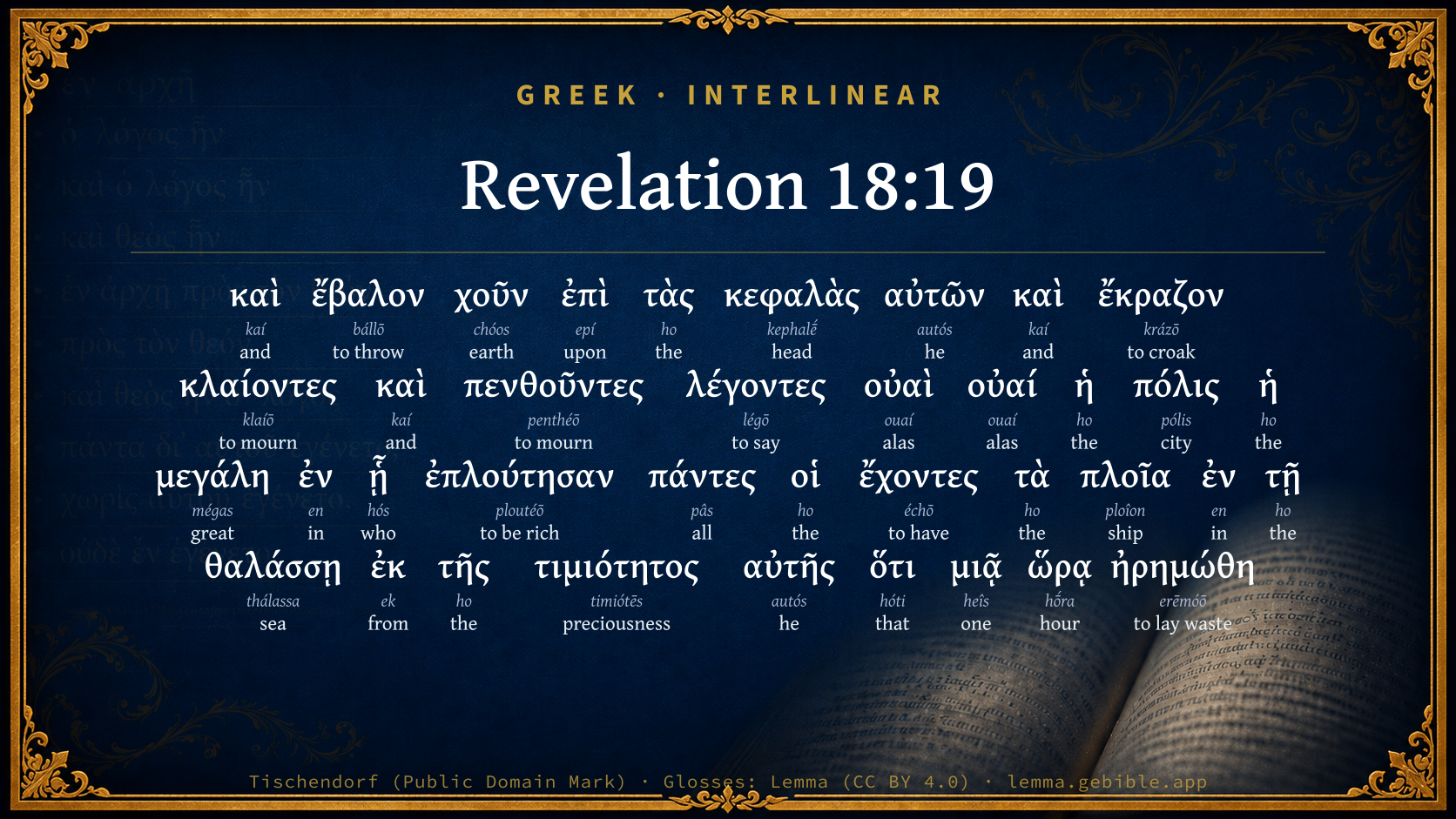
They cast dust on their heads, and cried, weeping and mourning, saying, 'Woe, woe, the great city, in which all who had their ships in the sea were made rich by reason of her great wealth!' For in one hour is she made desolate.
- 1 hapax legomenon — only here in the Greek New Testament
- 1 first appearance in the Greek New Testament
Download a study sheet
One document with this verse’s original text, its word-by-word gloss line, the meaning frame, cross-references with their text, attributed commentary, and full source and license credits — printable, and it pastes into notes with its structure intact.
This verse Autodidact and up
A passage Seminary Student
Up to 50 verses in one chapter. A passage sheet keeps up to 6 commentary sources and 12 cross-references per verse, in the order this page ranks them, and says so on the sheet whenever that leaves anything out. Ask for a single verse and you get the Autodidact verse sheet above.
Everything on this page stays free to read, with no account — the sheet is a download of what is already on screen, not access to it.
Compare translations 3
The same verse in 3 English versions, stacked beneath the original-language interlinear above. Click any original word for its lexicon entry.
Each is an independent rendering of the whole verse — the interlinear is not word-aligned to these translations.
Highlighted words mark where these versions differ — a whole-verse word diff, not a word-by-word alignment.
-
World English Bible Public Domain
They cast dust on their heads, and cried, weeping and mourning, saying, 'Woe, woe, the great city, in which all who had their ships in the sea were made rich by reason of her great wealth!' For in one hour is she made desolate.
-
King James Version Public Domain
And they cast dust on their heads, and cried, weeping and wailing, saying, Alas, alas that great city, wherein were made rich all that had ships in the sea by reason of her costliness! for in one hour is she made desolate.
-
unfoldingWord Literal Text CC BY-SA 4.0
And they threw dust on their heads and cried out, weeping and mourning, saying, “Woe, woe, the great city, by which all the ones having ships in the sea became rich from her wealth, for in one hour she has been destroyed.”
unfoldingWord Literal Text — © unfoldingWord, licensed CC BY-SA 4.0. Word-aligned USFM3 via Door43 (git.door43.org/unfoldingWord/en_ult).
Show all 19 translations
Every available English version of this verse, each an independent rendering of the whole verse.
-
World English Bible Public Domain
They cast dust on their heads, and cried, weeping and mourning, saying, 'Woe, woe, the great city, in which all who had their ships in the sea were made rich by reason of her great wealth!' For in one hour is she made desolate.
-
Berean Standard Bible Public Domain
Then they will throw dust on their heads as they weep and mourn and cry out: “Woe, woe to the great city, where all who had ships on the sea were enriched by her wealth! For in a single hour she has been destroyed.”
-
Majority Standard Bible Public Domain
Then they will throw dust on their heads as they weep and mourn and cry out: “Woe, woe to the great city, where all who had ships on the sea were enriched by her wealth! For in a single hour she has been destroyed.”
-
King James Version Public Domain
And they cast dust on their heads, and cried, weeping and wailing, saying, Alas, alas that great city, wherein were made rich all that had ships in the sea by reason of her costliness! for in one hour is she made desolate.
-
American Standard Version (1901) Public Domain
And they cast dust on their heads, and cried, weeping and mourning, saying, Woe, woe, the great city, wherein all that had their ships in the sea were made rich by reason of her costliness! for in one hour is she made desolate.
-
Revised Version (1885) Public Domain
And they cast dust on their heads, and cried, weeping and mourning, saying, Woe, woe, the great city, wherein were made rich all that had their ships in the sea by reason of her costliness! for in one hour is she made desolate.
-
Geneva Bible (1599) Public Domain
And they shall cast dust on their heads, and crie, weeping, and wayling, and say, Alas, alas, that great citie, wherein were made rich all that had ships on the sea by her costlinesse: for in one houre she is made desolate.
-
Douay-Rheims (1899) Public Domain
And they cast dust upon their heads, and cried, weeping and mourning, saying: Alas! alas! that great city, wherein all were made rich, that had ships at sea, by reason of her prices: for in one hour she is made desolate.
-
Young's Literal Translation Public Domain
and they did cast dust upon their heads, and were crying out, weeping and sorrowing, saying, Wo, wo, the great city! in which were made rich all having ships in the sea, out of her costliness -- for in one hour was she made waste.
-
Literal Standard Version CC BY-SA 4.0
And they cast dust on their heads, and were crying out, weeping and mourning, saying, Woe, woe, the great city! In which were made rich all having ships in the sea, out of her costliness—for in one hour was she made desolate.
-
Unlocked Literal Bible CC BY-SA 4.0
They threw dust on their heads, and cried out, weeping and mourning, “Woe, woe to the great city where all who had their ships at sea became rich from her wealth. For in a single hour she has been destroyed.”
-
unfoldingWord Literal Text CC BY-SA 4.0
And they threw dust on their heads and cried out, weeping and mourning, saying, “Woe, woe, the great city, by which all the ones having ships in the sea became rich from her wealth, for in one hour she has been destroyed.”
-
Darby Bible Public Domain
and cast dust upon their heads, and cried, weeping and grieving, saying, Woe, woe, the great city, in which all that had ships in the sea were enriched through her costliness! for in one hour she has been made desolate.
-
World Messianic Bible Public Domain
They cast dust on their heads, and cried, weeping and mourning, saying, ‘Woe, woe, the great city, in which all who had their ships in the sea were made rich by reason of her great wealth!’ For she is made desolate in one hour.
-
Webster's Bible Public Domain
And they cast dust on their heads, and cried, weeping and wailing, saying, Alas, alas, that great city, in which were made rich all that had ships in the sea by reason of her opulence! for in one hour is she made desolate.
-
Free Bible Version CC BY-SA 4.0
They threw dust on their heads, shouting and crying and grieving, ‘Disaster, disaster has struck the great city that made every ship-owner rich because of her extravagance! In just one hour she was destroyed!’
-
Bible in Basic English Public Domain
And they put dust on their heads, and were sad, weeping and crying, and saying, Sorrow, sorrow for the great town, in which was increased the wealth of all who had their ships on the sea because of her great stores! for in one hour she is made waste.
-
Text-Critical English NT CC BY 4.0
They threw dust on their heads and cried out, weeping and mourning aloud, “Alas, alas, for the great city, where all who had ships at sea grew rich from her valuable merchandise! For in a single hour she has been laid waste.
-
Tyndale New Testament (1534) Public Domain
And they cast dust on their heddes and cryed wepynge and waylinge and sayed: Alas Alas that greate cite wherin were made ryche all that had shyppes in the see by the reason of her costlynes for atone houre is she made desolate
Literal Standard Version (2020), Covenant Press — licensed CC BY-SA 4.0. Text via the HelloAO Bible API (eBible.org). Unlocked Literal Bible (unfoldingWord) — licensed CC BY-SA 4.0. Text via the HelloAO Bible API (eBible.org). unfoldingWord Literal Text — © unfoldingWord, licensed CC BY-SA 4.0. Word-aligned USFM3 via Door43 (git.door43.org/unfoldingWord/en_ult). Free Bible Version, Dr. Jonathan Gallagher — licensed CC BY-SA 4.0. Text via the HelloAO Bible API (eBible.org).
Word by word
More ways to search: Search by grammar → Find every occurrence → Compare this word →
Practice this passage: Drill this verse → Learn its vocabulary →
- Appears 1× in the Greek New Testament
- First appears here
- Part of Speech
- Noun
- Case
- Genitive
- Number
- Singular
- Gender
- Feminine
Full Thayer's Definition
- καὶ kaí G2532 “and” Conjunction
- ἔβαλον bállō G906 “to throw” Verb, Aorist, Active, Indicative, 3rd person, Plural
- χοῦν chóos G5522 “earth” Noun, Accusative, Singular, Masculine
- ἐπὶ epí G1909 “upon” Preposition
- τὰς ho G3588 “the” Article, Accusative, Plural, Feminine
- κεφαλὰς kephalḗ G2776 “head” Noun, Accusative, Plural, Feminine
- αὐτῶν autós G846 “he” Personal pronoun, Genitive, Plural, Masculine
- καὶ kaí G2532 “and” Conjunction
- ἔκραζον krázō G2896 “to croak” Verb, Imperfect, Active, Indicative, 3rd person, Plural
- κλαίοντες klaíō G2799 “to mourn” Verb, Present, Active, Participle, Nominative, Plural, Masculine
- καὶ kaí G2532 “and” Conjunction
- πενθοῦντες penthéō G3996 “to mourn” Verb, Present, Active, Participle, Nominative, Plural, Masculine
- λέγοντες légō G3004 “to say” Verb, Present, Active, Participle, Nominative, Plural, Masculine
- οὐαὶ ouaí G3759 “alas” Interjection
- οὐαί ouaí G3759 “alas” Interjection
- ἡ ho G3588 “the” Article, Nominative, Singular, Feminine
- πόλις pólis G4172 “city” Noun, Nominative, Singular, Feminine
- ἡ ho G3588 “the” Article, Nominative, Singular, Feminine
- μεγάλη mégas G3173 “great” Adjective, Nominative, Singular, Feminine
- ἐν en G1722 “in” Preposition
- ᾗ hós G3739 “who” Relative pronoun, Dative, Singular, Feminine
- ἐπλούτησαν ploutéō G4147 “to be rich” Verb, Aorist, Active, Indicative, 3rd person, Plural
- πάντες pâs G3956 “all” Adjective, Nominative, Plural, Masculine
- οἱ ho G3588 “the” Article, Nominative, Plural, Masculine
- ἔχοντες échō G2192 “to have” Verb, Present, Active, Participle, Nominative, Plural, Masculine
- τὰ ho G3588 “the” Article, Accusative, Plural, Neuter
- πλοῖα ploîon G4143 “ship” Noun, Accusative, Plural, Neuter
- ἐν en G1722 “in” Preposition
- τῇ ho G3588 “the” Article, Dative, Singular, Feminine
- θαλάσσῃ thálassa G2281 “sea” Noun, Dative, Singular, Feminine
- ἐκ ek G1537 “from” Preposition
- τῆς ho G3588 “the” Article, Genitive, Singular, Feminine
- τιμιότητος timiótēs G5094 “preciousness” Noun, Genitive, Singular, Feminine
- αὐτῆς autós G846 “he” Personal pronoun, Genitive, Singular, Feminine
- ὅτι hóti G3754 “that” Conjunction
- μιᾷ heîs G1520 “one” Adjective, Dative, Singular, Feminine
- ὥρᾳ hṓra G5610 “hour” Noun, Dative, Singular, Feminine
- ἠρημώθη erēmóō G2049 “to lay waste” Verb, Aorist, Passive, Indicative, 3rd person, Singular
About this verse
These counts appear in no published source. They are computed here, from the morphology-tagged text and Lemma’s own curated glosses. What Lemma adds →
- 38
- words
- 27
- distinct lemmas
- Revelation
- section
Notable vocabulary
1 hapax legomenon — a word that appears only here in the entire Greek New Testament:
- τιμιότητος preciousness G5094
First appearance in Scripture
This word makes its first canonical appearance in the Greek New Testament here:
- τιμιότητος preciousness G5094
Shared distinctive vocabulary
χοῦν earth G5522 occurs in 2 verses of the Greek New Testament. Also found in:
Cross-references
11Topical passages linked to Revelation 18:19 in the Treasury of Scripture Knowledge — connected by theme and wording, ordered by reader-vote popularity; previews shown in the World English Bible.
- Revelation 18:10 standing far away for the fear of her torment, saying, 'Woe, woe, the great city, Babylon, the strong city! For your judgment has come in one hour.'
- Joshua 7:6 Joshua tore his clothes, and fell to the earth on his face before the ark of Yahweh until the evening, he and the elders of Israel; and they put dust on their heads.
- Ezekiel 27:30 and shall cause their voice to be heard over you, and shall cry bitterly, and shall cast up dust on their heads, they shall wallow themselves in the ashes:
- Job 2:12 When they lifted up their eyes from a distance, and didn't recognize him, they raised their voices, and wept; and they each tore his robe, and sprinkled dust on their heads toward the sky.
- Revelation 18:3 For all the nations have drunk of the wine of the wrath of her sexual immorality, the kings of the earth committed sexual immorality with her, and the merchants of the earth grew rich from the abundance of her luxury."
- 1 Samuel 4:12 There ran a man of Benjamin out of the army, and came to Shiloh the same day, with his clothes torn, and with earth on his head.
- Revelation 18:8 Therefore in one day her plagues will come: death, mourning, and famine; and she will be utterly burned with fire; for the Lord God who has judged her is strong.
- 2 Samuel 13:19 Tamar put ashes on her head, and tore her garment of various colors that was on her; and she laid her hand on her head, and went her way, crying aloud as she went.
- Nehemiah 9:1 Now in the twenty-fourth day of this month the children of Israel were assembled with fasting, and with sackcloth, and earth on them.
- Revelation 18:15–17 The merchants of these things, who were made rich by her, will stand far away for the fear of her torment, weeping and mourning;
- Revelation 17:16 The ten horns which you saw, and the beast, these will hate the prostitute, and will make her desolate, and will make her naked, and will eat her flesh, and will burn her utterly with fire.
Cross-references courtesy of OpenBible.info (CC BY 4.0).
Lesson kit
Teaching starters — assembled from the data on this page, not authored interpretation. Every prompt links to the verse data it draws on. Edit before teaching.
Revelation, in the Revelation, opens this verse with 38 words (27 distinct Greek lemmas). Its most distinctive word is timiótēs (“preciousness”). A historical commentator’s framing appears above. Read the whole chapter for the surrounding context.
Discussion questions
- How does “preciousness” (timiótēs) shape what this verse is saying?
- This verse holds 1 word here found nowhere else in the Greek New Testament. What might the rare word draw attention to?
- The word “preciousness” first appears here in Scripture. What is being introduced at this debut?
- Mark 6:11 shares the word «earth» with this verse. How do the two illuminate each other?
- “alas” occurs 2× in this one verse. What is the effect of the repetition?
- These translations render this verse differently. What is at stake in choosing one wording over another?
- Reading how Jamieson, Fausset & Brown and Adam Clarke's Commentary read this verse, where do the two commentators agree and where do they part?
Things to notice
- 1 word in this verse appears nowhere else in the Greek New Testament.
- 1 word makes its first canonical appearance in Scripture here.
- These translations choose different wording for 22 words in this verse.
- “alas” occurs 2× in this single verse.
- 27 distinct Greek lemmas span 38 words in this verse.
Commentary
Notes on Revelation 18:19 from classic Christian and Jewish commentators (each source and its license shown beneath its notes). The classic Christian expositions comment on the surrounding passage and are grouped to its opening verse, so a note may address several verses; the Jewish commentaries on the Tanakh (Rashi and others) are per-verse, so they appear only where the commentator wrote on this verse.
Lemma curates 59 commentaries, every one of them public domain or Creative Commons licensed, each selected and text-cleaned for this edition rather than reprinted as found. About our sources →
Jamieson, Fausset & Brown
Robert Jamieson, A. R. Fausset & David Brown
Jamieson, Fausset & Brown — Commentary Critical and Explanatory on the Whole Bible (1871) — public domain (CC PDM 1.0). Text via the HelloAO Bible API.
Adam Clarke's Commentary
Adam Clarke's Commentary on the Bible (1810–1826) — public domain. Text from a community e-Sword/MySword module.
Ellicott's Commentary for English Readers
A Bible Commentary for English Readers, edited by Charles John Ellicott (1878–1897) — public domain. Text from a community e-Sword module.
The Cambridge Bible for Schools and Colleges
gen. ed. J. J. S. Perowne
The Cambridge Bible for Schools and Colleges (gen. ed. J. J. S. Perowne; Cambridge University Press, 1878–1918) — public domain. Text from a community e-Sword module.
John Gill's Exposition
John Gill's Exposition of the Whole Bible (1746–1763) — public domain (CC PDM 1.0). Text via the HelloAO Bible API.
Trapp's Complete Commentary
John Trapp
John Trapp, A Commentary or Exposition upon All the Books of the Old and New Testament (1647–1656) — public domain. Text from a community e-Sword module.
Albert Barnes' Notes on the Bible
Albert Barnes' Notes on the Bible (1834–1885) — public domain. Text from a community e-Sword/MySword module.
Whedon's Commentary on the Bible
Daniel D. Whedon
Daniel D. Whedon (gen. ed.), Commentary on the Old and New Testaments (1874–1909) — public domain. Text from a community e-Sword module.
The Pulpit Commentary
The Pulpit Commentary (1880–1919), ed. H.D.M. Spence-Jones & Joseph S. Exell — public domain. Text from a community e-Sword module.
John Wesley's Explanatory Notes
John Wesley, Explanatory Notes Upon the Whole Bible (1754–1765) — public domain. Text via the GEBible commentary corpus.
Cambridge Greek Testament for Schools and Colleges
Cambridge Greek Testament for Schools and Colleges (Cambridge University Press, 1896; 21 vols, various authors incl. Carr, Maclear, Plummer, Farrar, Lumby, Moule, M. R. James, Simcox) — public domain. Text from a community e-Sword module.
Vincent's Word Studies in the New Testament
Marvin R. Vincent
Marvin R. Vincent, Word Studies in the New Testament (1887–1900) — public domain. Text from a community e-Sword/MySword module.