John 3:24

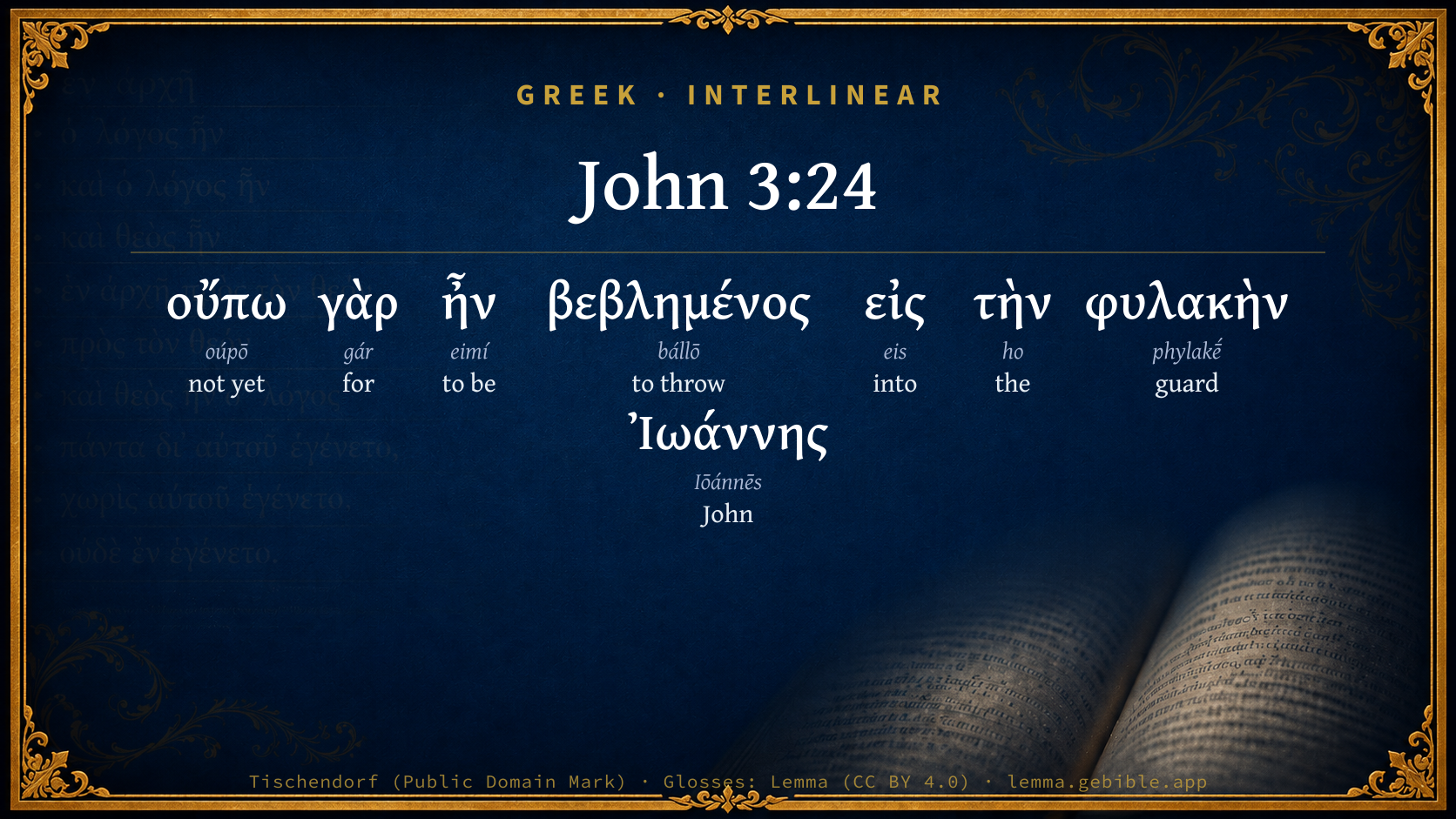
Greek (Tischendorf 8th ed.) John 3:24 appears in the Greek New Testament. The text above is from the Tischendorf 8th edition. Each word links to its Strong’s number and a concise gloss. Click any word for its full Thayer’s Greek Lexicon entry.
Download image
Cite this verse

John 3:24 (World English Bible). Public Domain. Lemma interlinear Bible study tool, https://lemma.gebible.app/v/john/3/24.

Show BibTeX & RIS
BibTeX
RIS
English Translation
For John was not yet thrown into prison.
World English Bible · Public Domain
Download a study sheet

One document with this verse’s original text, its word-by-word gloss line, the meaning frame, cross-references with their text, attributed commentary, and full source and license credits — printable, and it pastes into notes with its structure intact.

This verse Autodidact and up

Study sheet (.html) Plain text (.txt)

A passage Seminary Student

Up to 50 verses in one chapter. A passage sheet keeps up to 6 commentary sources and 12 cross-references per verse, in the order this page ranks them, and says so on the sheet whenever that leaves anything out. Ask for a single verse and you get the Autodidact verse sheet above.

Everything on this page stays free to read, with no account — the sheet is a download of what is already on screen, not access to it.

Want to remove ads? Support Godless Engineer
Compare translations 3

The same verse in 3 English versions, stacked beneath the original-language interlinear above. Click any original word for its lexicon entry.

Each is an independent rendering of the whole verse — the interlinear is not word-aligned to these translations.

Highlighted words mark where these versions differ — a whole-verse word diff, not a word-by-word alignment.

  • World English Bible Public Domain
    For John was not yet thrown into prison.
  • King James Version Public Domain
    For John was not yet cast into prison.
  • unfoldingWord Literal Text CC BY-SA 4.0
    for John had not yet been thrown into prison.

unfoldingWord Literal Text — © unfoldingWord, licensed CC BY-SA 4.0. Word-aligned USFM3 via Door43 (git.door43.org/unfoldingWord/en_ult).

Versions to compare (up to 4)

3 of 4 selected

Show all 19 translations

Every available English version of this verse, each an independent rendering of the whole verse.

  • World English Bible Public Domain
    For John was not yet thrown into prison.
  • Berean Standard Bible Public Domain
    (For John had not yet been thrown into prison.)
  • Majority Standard Bible Public Domain
    (For John had not yet been thrown into prison.)
  • King James Version Public Domain
    For John was not yet cast into prison.
  • American Standard Version (1901) Public Domain
    For John was not yet cast into prison.
  • Revised Version (1885) Public Domain
    For John was not yet cast into prison.
  • Geneva Bible (1599) Public Domain
    For Iohn was not yet cast into prison.
  • Douay-Rheims (1899) Public Domain
    For John was not yet cast into prison.
  • Young's Literal Translation Public Domain
    for John was not yet cast into the prison --
  • Literal Standard Version CC BY-SA 4.0
    for John was not yet cast into the prison—
  • Unlocked Literal Bible CC BY-SA 4.0
    for John had not yet been thrown in prison.
  • unfoldingWord Literal Text CC BY-SA 4.0
    for John had not yet been thrown into prison.
  • Darby Bible Public Domain
    for John was not yet cast into prison.
  • World Messianic Bible Public Domain
    for Yochanan was not yet thrown into prison.
  • Webster's Bible Public Domain
    For John was not yet cast into prison.
  • Free Bible Version CC BY-SA 4.0
    (This was before John was imprisoned.)
  • Bible in Basic English Public Domain
    For at this time John had not been put into prison.
  • Text-Critical English NT CC BY 4.0
    (For John had not yet been thrown into prison.)
  • Tyndale New Testament (1534) Public Domain
    For Iohn was not yet cast into preson.

Literal Standard Version (2020), Covenant Press — licensed CC BY-SA 4.0. Text via the HelloAO Bible API (eBible.org). Unlocked Literal Bible (unfoldingWord) — licensed CC BY-SA 4.0. Text via the HelloAO Bible API (eBible.org). unfoldingWord Literal Text — © unfoldingWord, licensed CC BY-SA 4.0. Word-aligned USFM3 via Door43 (git.door43.org/unfoldingWord/en_ult). Free Bible Version, Dr. Jonathan Gallagher — licensed CC BY-SA 4.0. Text via the HelloAO Bible API (eBible.org).

Word by word

More ways to search: Search by grammar → Find every occurrence → Compare this word →

Practice this passage: Drill this verse → Learn its vocabulary →

About this verse

These counts appear in no published source. They are computed here, from the morphology-tagged text and Lemma’s own curated glosses. What Lemma adds →

8
words
8
distinct lemmas
Gospels
section

Notable vocabulary

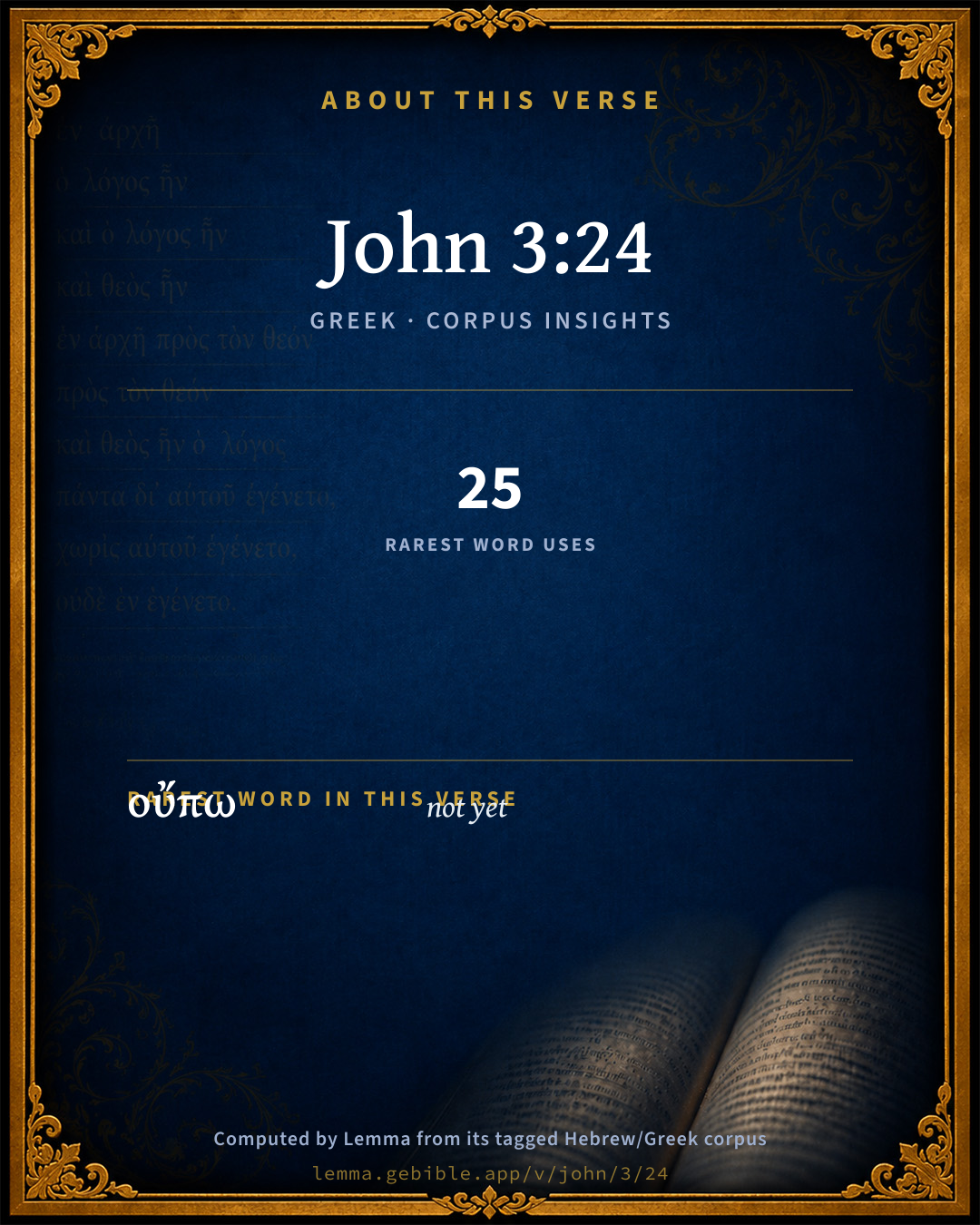
The rarest word here is οὔπω not yet G3768 — appearing just 25 times in the whole Greek New Testament.

Shared distinctive vocabulary

οὔπω not yet G3768 occurs in 25 verses of the Greek New Testament. Also found in:

Cross-references

5

Topical passages linked to John 3:24 in the Treasury of Scripture Knowledge — connected by theme and wording, ordered by reader-vote popularity; previews shown in the World English Bible.

  • Matthew 4:12 Now when Jesus heard that John was delivered up, he withdrew into Galilee.
  • Matthew 14:3 For Herod had laid hold of John, and bound him, and put him in prison for the sake of Herodias, his brother Philip's wife.
  • Mark 6:17 For Herod himself had sent out and arrested John, and bound him in prison for the sake of Herodias, his brother Philip's wife, for he had married her.
  • Luke 3:19–20 but Herod the tetrarch, being reproved by him for Herodias, his brother's wife, and for all the evil things which Herod had done,
  • Luke 9:7–9 Now Herod the tetrarch heard of all that was done by him; and he was very perplexed, because it was said by some that John had risen from the dead,

Cross-references courtesy of OpenBible.info (CC BY 4.0).

Commentary

Notes on John 3:24 from classic Christian and Jewish commentators (each source and its license shown beneath its notes). The classic Christian expositions comment on the surrounding passage and are grouped to its opening verse, so a note may address several verses; the Jewish commentaries on the Tanakh (Rashi and others) are per-verse, so they appear only where the commentator wrote on this verse.

Lemma curates 59 commentaries, every one of them public domain or Creative Commons licensed, each selected and text-cleaned for this edition rather than reprinted as found. About our sources →

Tyndale Open Study Notes

Tyndale Open Resources

3:24 Before John was thrown into prison (see Matt 14:1-12; Mark 1:14; 6:14-29; Luke 3:19-20), he and Jesus worked in close proximity at the Jordan River. Once John was arrested, Jesus moved north into Galilee (Mark 1:14).

Tyndale Open Study Notes — © Tyndale Open Resources, licensed CC BY-SA 4.0. Text via the HelloAO Bible API.

Bengel's Gnomon

Johann Albrecht Bengel

Joh 3:24. Οὔτω, not yet) Here the Evangelist takes for granted, what the others [Matthew, Mark, and Luke] bad written concerning the imprisonment of John the Baptist.—γάρ, for) Therefore John ceased to baptize, when he was cast into prison; not before.

Bengel's Gnomon of the New Testament — English translation (T&T Clark, Edinburgh, 1860) — public domain. Text from a community e-Sword module.

Meyer's Critical & Exegetical Commentary

Heinrich August Wilhelm Meyer

corrects, in passing, the synoptic tradition,[169] which John knew as being widely spread, and the discrepancy in which is not to be explained either by placing the imprisonment between Joh_4:2-3, and by taking the journey of Jesus to Galilee there related as the same with that mentioned in Matt

[169] It is supposed, indeed, that John simply wishes to intimate that what he records, vv. 2236, must be placed before Mat_4:12 (Hengstenberg). But in the connection of Matthew, there is no place for it before Joh_4:12.

Joh_3:24 corrects, in passing, the synoptic tradition,[170] which John knew as being widely spread, and the discrepancy in which is not to be explained either by placing the imprisonment between Joh_4:2-3, and by taking the journey of Jesus to Galilee there related as the same with that mentioned in Mat_4:12 (Lücke, Tholuck, Olshausen, B. Crusius, Ebrard, Hengstenberg, and many others), or by making the journey of Mat_4:12 to coincide with that named in Joh_6:1 (Wieseler). See on Mat_4:12. Apart from that purpose of correction, which is specially apparent if we compare Mat_4:17 (subtleties to the contrary in Ebrard), the remark, which was quite intelligible of itself, would be, to say the least, superfluous,unnecessary even to gain space for bringing Jesus and the Baptist again alongside each other (Keim), even if we were to venture to propose the suggestion, of which the text says nothing, that Jesus felt himself obliged, as the time of the Baptist was not yet expired, to bring the kingdom of God near, in keeping with the form which the Baptist had adopted (Luthardt, p. 79).

[170] It is supposed, indeed, that John simply wishes to intimate that what he records, vv. 2236, must be placed before Mat_4:12 (Hengstenberg). But in the connection of Matthew, there is no place for it before Joh_4:12.

Meyer — Critical and Exegetical Commentary on the New Testament — English translation by Peter Christie, edited by Frederick Crombie (T&T Clark, 1880) — public domain. Text from a community e-Sword module.

Expositor's Greek Testament

ed. W. Robertson Nicoll

Joh 3:24 . οὔπω γὰρ … ὁ Ἰωάννης , “for not yet had John been cast into prison”: a clause inserted for the sake of those who might have gathered from the synoptic narrative that John was cast into prison immediately after the temptation of Jesus, Mar 1:14 , Mat 4:12 . John having been present with Jesus through all this period can give the sequence of the events with chronological precision.

The Expositor's Greek Testament, edited by W. Robertson Nicoll (1897–1910) — public domain. Text from a community e-Sword module.

Godet's Commentaries

Frédéric Louis Godet

Ver. 24. “For John had not yet been cast into prison.”

This remark of the evangelist is surprising, because there is nothing in what precedes which is adapted to occasion it. The fact of the incarceration of John the Baptist, as already accomplished, was not, in any way, implied in the preceding narrative. It is therefore elsewhere than in our Gospel that we must seek for the reason why the evangelist thinks that he must correct a misapprehension existing on this subject, as he evidently does by the remark of Joh 3:24. This reason is easily discovered in the narrative of our first two Synoptics: Mat 4:12 : “Jesus, having heard that John was delivered up, withdrew into Galilee.” Mar 1:14 :

“After that John was delivered up, Jesus came into Galilee.” These words immediately follow the account of the baptism and temptation; they would necessarily produce on the reader the impression that the imprisonment of John the Baptist had followed very closely upon the baptism of Jesus, and preceded—even occasioned—His first return to Galilee; thus precisely the opinion which the remark of John sets aside. The account in Luk 3:19-20 is different; the imprisonment of the Baptist is there evidently mentioned only by way of anticipation. Hengstenberg thought that the narrative of Matthew and Mark might be explained by the fact that the first return of Jesus to Galilee— the one which John relates in Joh 1:44—was simply omitted by them. But we have seen (Joh 2:11) that the first visit of Jesus to Capernaum coincided with certain scenes of the very first period of the Galilean ministry related by the Synoptics.

It only remains, therefore, to acknowledge that frequently in the primitive oral tradition the first two returns from Judea to Galilee (Joh 1:44 and Joh 4:1-3) were blended together. From this identification would, naturally, result the suppression of the entire interval which had separated them—that is to say, of almost a whole year of Jesus’ ministry. To recover this ground which had disappeared, John was thus obliged expressly to restore the distinction between the two returns. He was especially obliged to do this on reaching the fact which he is about to relate, a fact which falls precisely in this interval.Hilgenfeld himself, speaking of this passage, says: “Involuntarily the fourth evangelist bears witness here of his acquaintance with the Synoptical narrative.”

There is nothing to criticise in this remark except the word involuntarily. For the intentional character of this parenthesis, Joh 3:24, is obvious. We have already proved in John the evident intention of distinguishing these two returns to Galilee by the manner in which he spoke of the miracle of Cana, Joh 2:11; we shall have occasion to make a similar remark of the same character, with reference to Joh 4:54. As for the way in which this confusion arose in the tradition written out by the Synoptics, we may remember that it was only after the second return to Galilee that Jesus began that uninterrupted prophetic ministry which the first three Gospels portray for us very particularly and which was the beginning of the foundation of the Church. However important were the attempts made in Judea, up to this time, in the description of the development of Jewish unbelief which John traced, they could just as easily be omitted in the narrative of the actual establishment of the kingdom of God, and of the foundation of the Church which was the result of the Galilean ministry, related especially by the Synoptics.

We can draw from this twenty-fourth verse an important conclusion with respect to the position of the author of the fourth Gospel in the midst of the primitive Church. Who else but an apostle, but an apostle of the first rank, but an apostle recognized as such, could have taken in his writing a position so sovereign with regard to the tradition received in the Church, emanating from the Twelve, and recorded in the Gospels which were anterior to his own? By a stroke of the pen to introduce so considerable a modification in a narrative clothed with such authority, he must have been, and have felt himself to be, possessed of an authority which was altogether incontestable.

Frédéric Louis Godet — Commentaries on Luke, John, Romans, and 1 Corinthians — English translation (T&T Clark, Edinburgh, 1870s–1890s) — public domain. Text from a community e-Sword module.

Jamieson, Fausset & Brown

Robert Jamieson, A. R. Fausset & David Brown

John not yet cast into prison--Hence it is plain that our Lord's ministry did not commence with the imprisonment of John, though, but for this, we should have drawn that inference from Mat 4:12 and Mark's (Mar 1:14) express statement.

Jamieson, Fausset & Brown — Commentary Critical and Explanatory on the Whole Bible (1871) — public domain (CC PDM 1.0). Text via the HelloAO Bible API.

Ellicott's Commentary for English Readers

(24) Was not yet cast into prison.—This Judæan ministry, then, preceded the Galilean ministry of the earlier Gospels. (See Joh_4:3, and Note on Mat_4:12.)

A Bible Commentary for English Readers, edited by Charles John Ellicott (1878–1897) — public domain. Text from a community e-Sword module.

The Cambridge Bible for Schools and Colleges

gen. ed. J. J. S. Perowne

24. This corrects the impression, naturally derived from the Synoptists, that Christ’s public ministry did not commence till after the imprisonment of the Baptist. The whole of these first three chapters and part of the fourth must be placed before Mat_4:12, where there are great gaps in the history.

The Cambridge Bible for Schools and Colleges (gen. ed. J. J. S. Perowne; Cambridge University Press, 1878–1918) — public domain. Text from a community e-Sword module.

Trapp's Complete Commentary

John Trapp

24 For John was not yet cast into prison.

Ver. 24. Cast into prison] The primitive bishops were found more frequently in prisons than palaces. Bocardo became a college of Quondams, {a} as the Marian martyrs merrily called it. If Petronius could tell Caesar that he had rather be with Cato in the prison house than with him in the senate house; why should it grieve any to suffer bonds with and for Christ? Chrysostom had rather be Paul a prisoner of Jesus Christ than Paul rapped up into tbe third heaven. (Homil. in Eph 3:1) Μετα Κατωνος εν οικηματι, μαλλον η μετα σου ενταυθα ειναι βουλομαι. (Dio Cass.)

{a} The former holder of some office or position; one who has been deposed or ejected; ŒD

John Trapp, A Commentary or Exposition upon All the Books of the Old and New Testament (1647–1656) — public domain. Text from a community e-Sword module.

Albert Barnes' Notes on the Bible

For John was not yet cast into prison - See Luk 3:20. The mention of this shows that John was not imprisoned until some time after our Lord entered on his ministry. The design of John was to call men to repentance, and to prepare them for the Messiah, and this he continued to do after our Saviour commenced his work. It shows that a minister of religion should be industrious to the day of his death. John still toiled in his work not the “less” because the Messiah had come. So ministers should not labor less when Christ appears by his Spirit, and takes the work into his own hands, and turns many to himself.

Albert Barnes' Notes on the Bible (1834–1885) — public domain. Text from a community e-Sword/MySword module.

Matthew Poole's English Annotations

For John was yet in the exercise of his public ministry, not cast into prison, as he was soon after.

Matthew Poole's English Annotations on the Holy Bible (1683–1685) — public domain. Text from a community e-Sword/MySword module.

Whedon's Commentary on the Bible

Daniel D. Whedon

24. John… not… prison—This verse is a remarkable indication that our Evangelist writes for a body of readers who had a previous general acquaintance with the facts of Christian history. He assumes that they were aware that John was imprisoned, and knew about the time.

Occasion and delivery of John’s closing testimony, 25-36. Compare notes on Joh_1:19-37.

Daniel D. Whedon (gen. ed.), Commentary on the Old and New Testaments (1874–1909) — public domain. Text from a community e-Sword module.

The Pulpit Commentary

For John had not yet been cast into the prison. This clause shows that the evangelist was alive to the apparent discrepancy which his account of a Judaean ministry might otherwise have suggested with the synoptic chronological initium of the Galilaean ministry. The remark shows that all that happened preceded that ministry, and equates the journey through Samaria with that mentioned in Mat_4:12. Even Hilgenfeld says, Involuntarily the fourth evangelist here testifies to his acquaintance with the synoptical narrative." In our opinion it was designed and spontaneous. The first journey to Galilee, mentioned in Joh_1:43, was not the commencement of a public prophetic ministry, and the synoptists are silent about it. The anecwrhsen , he withdrew," shows that there was some reason for his abrupt departure, over and above what was stated. John gives the reason for the departure by Joh_4:1, Joh_4:2, where the conduct of the Pharisees was becoming more watchful and jealous. The authority which John here assumes to correct and enlarge apostolic tradition, reveals the claim of one who professed unique knowledge of inexpugnable facts.

The Pulpit Commentary (1880–1919), ed. H.D.M. Spence-Jones & Joseph S. Exell — public domain. Text from a community e-Sword module.

Cambridge Greek Testament for Schools and Colleges

24. The Evangelist has not said a word that could imply that the Baptist was in prison. This remark refers to the Synoptists, and guards us against the inference easily drawn from them (Mat 4:12; Mar 1:14) that John’s imprisonment followed close on the Temptation and preceded the beginning of Christ’s ministry. The whole of John 1-3 precedes Mat 4:12. In this magisterial interpretation of earlier Gospels we trace the hand of an Apostle writing with sure knowledge and conscious authority.

Cambridge Greek Testament for Schools and Colleges (Cambridge University Press, 1896; 21 vols, various authors incl. Carr, Maclear, Plummer, Farrar, Lumby, Moule, M. R. James, Simcox) — public domain. Text from a community e-Sword module.

Alford’s Greek Testament

Henry Alford

24.] There is much difficulty, which probably never will be cleared up, about the date of the imprisonment of John, and its reference to the course of our Lord’s ministry. Between Mat 4:11 and 12, there seems to be a wide hiatus, in which (see note there) the first chapters of this Gospel should be inserted. But the records from which the three synoptic Gospels have arisen were apparently unconscious of any such interval. Our Evangelist seems here to refer to such records, and to insert this remark, that it might not be imagined, as it would be from them, that our Lord’s public ministry (in the wider sense, see below on ver. 26) began with the imprisonment of the Baptist.

Henry Alford, The Greek Testament (1849–1861) — public domain. Text from a community e-Sword module.

International Critical Commentary

24. This verse is a parenthetical comment of Jn. (see Introd., p. xxxiv), which indicates the time at which the events happened which he records (see p. cii). The Synoptists tell nothing of this ministry of Jesus in Judæa, and Jn. is careful to remark that it was exercised in the earlier days of His public activity, before John the Baptist had been imprisoned. It is quite in his manner to assume that his readers know of the arrest of John and his martyrdom (cf. Introd., p. xciv). See also on 5:35.

All that has been mentioned in the Fourth Gospel up to this point seems to be precedent to the wonderful ministry in Galilee (Mar 1:14-6), which culminated in the choice of the Twelve (Mar 3:13) and their subsequent mission (Mar 6:7). Indeed Mk. expressly says that all this was “after John was delivered up” (Mar 1:14). When, therefore, Jn. speaks of the “disciples” who were with Jesus in this early ministry in Judaea, we cannot assume that the “Twelve” are indicated, the presumption being the other way (see on 2:2 above). That episodes like those in c. 3 and the beginning of c. 4 are not recorded by Mk. may be due to the fact that Peter, upon whose reminiscences Mk. has largely based his narrative, was not present; while their appearance in the Fourth Gospel is explicable, if the authority behind it was one of the disciples who witnessed the ministry in Judaea and Samaria. He may have been John the son of Zebedee.

International Critical Commentary — older volumes (1896–1929), various authors — public domain. Text from a community e-Sword module.

Vincent's Word Studies in the New Testament

Marvin R. Vincent

Prison [την φυλακην] . See on Act 5:18, 21.

Marvin R. Vincent, Word Studies in the New Testament (1887–1900) — public domain. Text from a community e-Sword/MySword module.

Lesson kit

Teaching starters — assembled from the data on this page, not authored interpretation. Every prompt links to the verse data it draws on. Edit before teaching.

John, in the Gospels, opens this verse with 8 words (8 distinct Greek lemmas). Its most distinctive word is oúpō (“not yet”). A historical commentator’s framing appears above. Read the whole chapter for the surrounding context.

Discussion questions

  1. How does “not yet” (oúpō) shape what this verse is saying?
  2. Matthew 16:9 shares the word «not yet» with this verse. How do the two illuminate each other?
  3. The translations on this page render this verse differently — a whole-verse word diff, not a word-by-word alignment. What might account for the different wordings?
  4. Reading how Tyndale Open Study Notes and Bengel's Gnomon read this verse, where do the two commentators agree and where do they part?

Things to notice

Reading settings

Reading text

Shown beneath each verse's original-language words.

Old Testament
Old Testament edition

Read the OT as the Masoretic Hebrew (MT) or the Greek Septuagint (LXX).

English shown for the Greek Septuagint (in the Hebrew ↔ Greek comparison).

Comparing translations? Open the Compare panel on any verse page to stack up to four side by side.