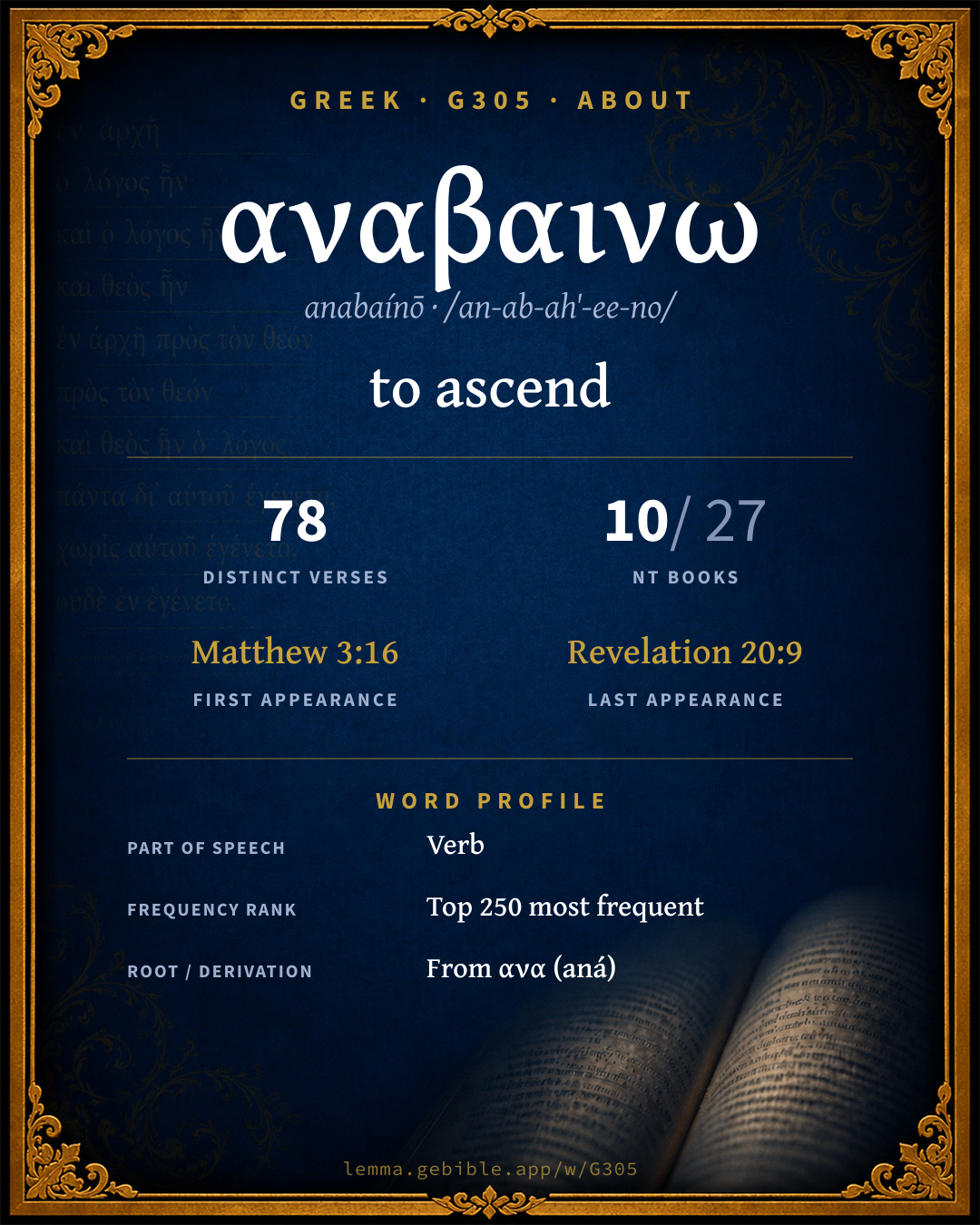
ἀναβαίνω
to ascend
Full lexicon entry — Thayer's Greek Lexicon
From Thayer's Greek Lexicon
Where this word appears
See every Aorist-tense verb in the Greek New Testament →
Grammar key — what these labels mean
Part of speech
- Verb
- An action or state-of-being word.
Tense
- Aorist
- Action viewed as a simple whole, without regard to duration — often past (perfective aspect).
- Present
- Ongoing or general action in present time (imperfective aspect).
- Future
- Action expected in future time.
- Imperfect
- Continuous or repeated action in past time (“was writing”).
- Perfect
- A completed past action with continuing present results.
Voice
- Active
- The subject performs the action.
- Middle deponent
- Middle in form but active in meaning.
Mood
- Indicative
- States a fact or asks a factual question (the mood of reality).
- Participle
- A verbal adjective (“writing,” “having written”).
- Infinitive
- A verbal noun (“to write”), unmarked for person or number.
- Imperative
- Expresses a command or request.
Case
- Nominative
- The case of the subject (and the predicate nominative).
- Accusative
- The case of the direct object and of extent.
- Genitive
- The case of source, possession, or “of” — answers “whose / from what.”
Person
- 3rd person
- The one spoken about (“he / she / it / they”).
- 1st person
- The speaker (“I / we”).
- 2nd person
- The one addressed (“you”).
Gender
- Masculine
- Grammatically masculine.
- Neuter
- Grammatically neuter.
Number
- Singular
- One.
- Plural
- More than one.
Grammatical forms 28 distinct
- Verb, Aorist, Active, Indicative, 3rd person, Singular 22 times (27%)
- Verb, Aorist, Active, Indicative, 3rd person, Plural 10 times (12%)
- Verb, Aorist, Active, Participle, Nominative, Singular, Masculine 7 times (9%)
- Verb, Present, Active, Indicative, 3rd person, Singular 4 times (5%)
- Verb, Present, Active, Participle, Nominative, Singular, Masculine 4 times (5%)
- Verb, Aorist, Active, Indicative, 1st person, Singular 3 times (4%)
- Verb, Present, Active, Indicative, 1st person, Plural 3 times (4%)
- Verb, Present, Active, Infinitive 3 times (4%)
+20 more forms (26 occurrences)
Parsed forms decoded from the imported morphology (Robinson–Tischendorf, public domain), counted across 82 parsed occurrences — not distinct verses.
Every verse where G305 appears — 78 distinct verses across 10 books. Click any verse to open its interlinear word-by-word view. Verse text shown in the World English Bible for context — . Each verse’s Greek form is shown with its reference; the English is not keyword-highlighted, since the data carries no word-level English alignment. Use “Compare translations” on any verse to read it across multiple English versions. This concordance covers the Greek New Testament; Septuagint (Greek Old Testament) occurrences of this word are not indexed here.
Matthew 9 verses
- Matthew 3:16 ἀνέβη aor act ind 3sg Jesus, when he was baptized, went up directly from the water: and behold, the heavens were opened to him. He saw the Spirit of God descending as a dove, and coming on him.
- Matthew 5:1 ἀνέβη aor act ind 3sg Seeing the multitudes, he went up onto the mountain. When he had sat down, his disciples came to him.
- Matthew 13:7 ἀνέβησαν aor act ind 3pl Others fell among thorns. The thorns grew up and choked them:
- Matthew 14:23 ἀνέβη aor act ind 3sg After he had sent the multitudes away, he went up into the mountain by himself to pray. When evening had come, he was there alone.
- Matthew 14:32 ἀναβάντων aor act ptcp gen pl masc When they got up into the boat, the wind ceased.
- Matthew 15:29 ἀναβὰς aor act ptcp nom sg masc Jesus departed there, and came near to the sea of Galilee; and he went up into the mountain, and sat there.
- Matthew 17:27 ἀναβάντα aor act ptcp acc sg masc But, lest we cause them to stumble, go to the sea, and cast a hook, and take up the first fish that comes up. When you have opened its mouth, you will find a stater coin. Take that, and give it to them for me and you."
- Matthew 20:17 ἀναβαίνων pres act ptcp nom sg masc As Jesus was going up to Jerusalem, he took the twelve disciples aside, and on the way he said to them,
- Matthew 20:18 ἀναβαίνομεν pres act ind 1pl "Behold, we are going up to Jerusalem, and the Son of Man will be delivered to the chief priests and scribes, and they will condemn him to death,
Mark 9 verses
- Mark 1:10 ἀναβαίνων pres act ptcp nom sg masc Immediately coming up from the water, he saw the heavens parting, and the Spirit descending on him like a dove.
- Mark 3:13 ἀναβαίνει pres act ind 3sg He went up into the mountain, and called to himself those whom he wanted, and they went to him.
- Mark 4:7 ἀνέβησαν aor act ind 3pl Others fell among the thorns, and the thorns grew up, and choked it, and it yielded no fruit.
- Mark 4:8 ἀναβαίνοντα pres act ptcp nom pl neut Others fell into the good ground, and yielded fruit, growing up and increasing. Some brought forth thirty times, some sixty times, and some one hundred times as much."
- Mark 4:32 ἀναβαίνει pres act ind 3sg yet when it is sown, grows up, and becomes greater than all the herbs, and puts out great branches, so that the birds of the sky can lodge under its shadow."
- Mark 6:51 ἀνέβη aor act ind 3sg He got into the boat with them; and the wind ceased, and they were very amazed among themselves, and marveled;
- Mark 10:32 ἀναβαίνοντες pres act ptcp nom pl masc They were on the way, going up to Jerusalem; and Jesus was going in front of them, and they were amazed; and those who followed were afraid. He again took the twelve, and began to tell them the things that were going to happen to him.
- Mark 10:33 ἀναβαίνομεν pres act ind 1pl "Behold, we are going up to Jerusalem. The Son of Man will be delivered to the chief priests and the scribes. They will condemn him to death, and will deliver him to the Gentiles.
- Mark 15:8 ἀναβὰς aor act ptcp nom sg masc The multitude, crying aloud, began to ask him to do as he always did for them.
Luke 9 verses
- Luke 2:4 ἀνέβη aor act ind 3sg Joseph also went up from Galilee, out of the city of Nazareth, into Judea, to the city of David, which is called Bethlehem, because he was of the house and family of David;
- Luke 2:42 ἀναβαινόντων pres act ptcp gen pl masc When he was twelve years old, they went up to Jerusalem according to the custom of the feast,
- Luke 5:19 ἀναβάντες aor act ptcp nom pl masc Not finding a way to bring him in because of the multitude, they went up to the housetop, and let him down through the tiles with his cot into the midst before Jesus.
- Luke 9:28 ἀνέβη aor act ind 3sg It happened about eight days after these sayings, that he took with him Peter, John, and James, and went up onto the mountain to pray.
- Luke 18:10 ἀνέβησαν aor act ind 3pl "Two men went up into the temple to pray; one was a Pharisee, and the other was a tax collector.
- Luke 18:31 ἀναβαίνομεν pres act ind 1pl He took the twelve aside, and said to them, "Behold, we are going up to Jerusalem, and all the things that are written through the prophets concerning the Son of Man will be completed.
- Luke 19:4 ἀνέβη aor act ind 3sg He ran on ahead, and climbed up into a sycamore tree to see him, for he was to pass that way.
- Luke 19:28 ἀναβαίνων pres act ptcp nom sg masc Having said these things, he went on ahead, going up to Jerusalem.
- Luke 24:38 ἀναβαίνουσιν pres act ind 3pl He said to them, "Why are you troubled? Why do doubts arise in your hearts?
John 13 verses
- John 1:52 ἀναβαίνοντας pres act ptcp acc pl masc
- John 2:13 ἀνέβη aor act ind 3sg The Passover of the Jews was at hand, and Jesus went up to Jerusalem.
- John 3:13 ἀναβέβηκεν perf act ind 3sg No one has ascended into heaven, but he who descended out of heaven, the Son of Man, who is in heaven.
- John 5:1 ἀνέβη aor act ind 3sg After these things, there was a feast of the Jews, and Jesus went up to Jerusalem.
- John 6:62 ἀναβαίνοντα pres act ptcp acc sg masc Then what if you would see the Son of Man ascending to where he was before?
- John 7:8 ἀνάβητε ἀναβαίνω aor act impv 2pl pres act ind 1sg You go up to the feast. I am not yet going up to this feast, because my time is not yet fulfilled."
- John 7:10 ἀνέβησαν ἀνέβη aor act ind 3pl aor act ind 3sg But when his brothers had gone up to the feast, then he also went up, not publicly, but as it were in secret.
- John 7:14 ἀνέβη aor act ind 3sg But when it was now the midst of the feast, Jesus went up into the temple and taught.
- John 10:1 ἀναβαίνων pres act ptcp nom sg masc "Most assuredly, I tell you, one who doesn't enter by the door into the sheep fold, but climbs up some other way, the same is a thief and a robber.
- John 11:55 ἀνέβησαν aor act ind 3pl Now the Passover of the Jews was at hand. Many went up from the country to Jerusalem before the Passover, to purify themselves.
- John 12:20 ἀναβαινόντων pres act ptcp gen pl masc Now there were certain Greeks among those that went up to worship at the feast.
- John 20:17 ἀναβέβηκα ἀναβαίνω perf act ind 1sg pres act ind 1sg Jesus said to her, "Don't touch me, for I haven't yet ascended to my Father; but go to my brothers, and tell them, 'I am ascending to my Father and your Father, to my God and your God.'"
- John 21:11 ἀνέβη aor act ind 3sg Simon Peter went up, and drew the net to land, full of great fish, one hundred fifty-three; and even though there were so many, the net wasn't torn.
Acts 19 verses
- Acts 1:13 ἀνέβησαν aor act ind 3pl When they had come in, they went up into the upper room, where they were staying; that is Peter, John, James, Andrew, Philip, Thomas, Bartholomew, Matthew, James the son of Alphaeus, Simon the Zealot, and Judas the son of James.
- Acts 2:34 ἀνέβη aor act ind 3sg For David didn't ascend into the heavens, but he says himself, 'The Lord said to my Lord, "Sit by my right hand,
- Acts 3:1 ἀνέβαινον impf act ind 3pl Peter and John were going up into the temple at the hour of prayer, the ninth hour.
- Acts 7:23 ἀνέβη aor act ind 3sg But when he was forty years old, it came into his heart to visit his brothers, the children of Israel.
- Acts 8:31 ἀναβάντα aor act ptcp acc sg masc He said, "How can I, unless someone explains it to me?" He begged Philip to come up and sit with him.
- Acts 8:39 ἀνέβησαν aor act ind 3pl When they came up out of the water, the Spirit of the Lord caught Philip away, and the eunuch didn't see him any more, for he went on his way rejoicing.
- Acts 10:4 ἀνέβησαν aor act ind 3pl He, fastening his eyes on him, and being frightened, said, "What is it, Lord?" He said to him, "Your prayers and your gifts to the needy have gone up for a memorial before God.
- Acts 10:9 ἀνέβη aor act ind 3sg Now on the next day as they were on their journey, and got close to the city, Peter went up on the housetop to pray at about noon.
- Acts 11:2 ἀνέβη aor act ind 3sg When Peter had come up to Jerusalem, those who were of the circumcision contended with him,
- Acts 15:2 ἀναβαίνειν pres act inf Therefore when Paul and Barnabas had no small discord and discussion with them, they appointed Paul and Barnabas, and some others of them, to go up to Jerusalem to the apostles and elders about this question.
- Acts 18:22 ἀναβὰς aor act ptcp nom sg masc When he had landed at Caesarea, he went up and greeted the assembly, and went down to Antioch.
- Acts 20:11 ἀναβὰς aor act ptcp nom sg masc When he had gone up, and had broken bread, and eaten, and had talked with them a long while, even until break of day, he departed.
- Acts 21:6 ἀνέβημεν aor act ind 1pl After saying goodbye to each other, we went on board the ship, and they returned home again.
- Acts 21:12 ἀναβαίνειν pres act inf When we heard these things, both we and they of that place begged him not to go up to Jerusalem.
- Acts 21:15 ἀνεβαίνομεν impf act ind 1pl After these days we took up our baggage and went up to Jerusalem.
- Acts 21:31 ἀνέβη aor act ind 3sg As they were trying to kill him, news came up to the commanding officer of the regiment that all Jerusalem was in an uproar.
- Acts 24:11 ἀνέβην aor act ind 1sg seeing that you can recognize that it is not more than twelve days since I went up to worship at Jerusalem.
- Acts 25:1 ἀνέβη aor act ind 3sg Festus therefore, having come into the province, after three days went up to Jerusalem from Caesarea.
- Acts 25:9 ἀναβὰς aor act ptcp nom sg masc But Festus, desiring to gain favor with the Jews, answered Paul and said, "Are you willing to go up to Jerusalem, and be judged by me there concerning these things?"
Romans 1 verse
1 Corinthians 1 verse
Galatians 2 verses
- Galatians 2:1 ἀνέβην aor act ind 1sg Then after a period of fourteen years I went up again to Jerusalem with Barnabas, taking Titus also with me.
- Galatians 2:2 ἀνέβην aor act ind 1sg I went up by revelation, and I laid before them the Gospel which I preach among the Gentiles, but privately before those who were respected, for fear that I might be running, or had run, in vain.
Ephesians 3 verses
- Ephesians 4:8 ἀναβὰς aor act ptcp nom sg masc Therefore he says, "When he ascended on high, he led captivity captive, and gave gifts to men."
- Ephesians 4:9 ἀνέβη aor act ind 3sg Now this, "He ascended," what is it but that he also first descended into the lower parts of the earth?
- Ephesians 4:10 ἀναβὰς aor act ptcp nom sg masc He who descended is the one who also ascended far above all the heavens, that he might fill all things.
Revelation 12 verses
- Revelation 4:1 ἀνάβα aor act impv 2sg After these things I looked and saw a door opened in heaven, and the first voice that I heard, like a trumpet speaking with me, was one saying, "Come up here, and I will show you the things which must happen after this."
- Revelation 7:2 ἀναβαίνοντα pres act ptcp acc sg masc I saw another angel ascend from the sunrise, having the seal of the living God. He cried with a loud voice to the four angels to whom it was given to harm the earth and the sea,
- Revelation 8:4 ἀνέβη aor act ind 3sg The smoke of the incense, with the prayers of the saints, went up before God out of the angel's hand.
- Revelation 9:2 ἀνέβη aor act ind 3sg He opened the pit of the abyss, and smoke went up out of the pit, like the smoke from a burning furnace. The sun and the air were darkened because of the smoke from the pit.
- Revelation 11:7 ἀναβαῖνον pres act ptcp nom sg neut When they have finished their testimony, the beast that comes up out of the abyss will make war with them, and overcome them, and kill them.
- Revelation 11:12 ἀνάβατε ἀνέβησαν aor act impv 2pl aor act ind 3pl I heard a loud voice from heaven saying to them, "Come up here!" They went up into heaven in the cloud, and their enemies saw them.
- Revelation 13:1 ἀναβαῖνον pres act ptcp acc sg neut Then I stood on the sand of the sea. I saw a beast coming up out of the sea, having ten horns and seven heads. On his horns were ten crowns, and on his heads, blasphemous names.
- Revelation 13:11 ἀναβαῖνον pres act ptcp acc sg neut I saw another beast coming up out of the earth. He had two horns like a lamb, and he spoke like a dragon.
- Revelation 14:11 ἀναβαίνει pres act ind 3sg The smoke of their torment goes up forever and ever. They have no rest day and night, those who worship the beast and his image, and whoever receives the mark of his name.
- Revelation 17:8 ἀναβαίνειν pres act inf The beast that you saw was, and is not; and is about to come up out of the abyss and to go into destruction. Those who dwell on the earth and whose names have not been written in the book of life from the foundation of the world will marvel when they see that the beast was, and is not, and shall be present.
- Revelation 19:3 ἀναβαίνει pres act ind 3sg A second said, "Hallelujah! Her smoke goes up forever and ever."
- Revelation 20:9 ἀνέβησαν aor act ind 3pl They went up over the breadth of the earth, and surrounded the camp of the saints, and the beloved city. Fire came down out of heaven from God, and devoured them.
About this entry
At a glance — auto-summarized from this page’s data, not written by a person. Every figure links to its source below. This summary describes the numbers; it doesn’t interpret them.
“to ascend” is the headline sense of the Greek verb αναβαινω (anabaínō). First canonically at Matthew 3:16, it enters the text early. The Greek New Testament uses it across 78 verses — moderately common. It shares a root with ανα, αναβαλλομαι and αναβιβαζω. See the sense tree, 78-verse concordance, and the renderings breakdown below.
Gloss history
Strong's 1890 vs modern scholarship

About this word
Strong's G305 catalogs a Greek word from the Greek New Testament.
These counts are not copied from any lexicon or concordance. They are computed here, from the morphology-tagged Greek New Testament. What Lemma adds →
- 78
- distinct verses
- The word appears in 78 distinct verses.
- 10 / 27
- NT books
- The word appears in 10 of 27 New Testament books.
- #207
- by frequency
- Top 250 most frequent Greek words (rank 207 of 5,347 Greek words by occurrence).
View all 78 occurrences in the concordance →
Most concentrated in
- Acts 19 verses 24%
- John 13 verses 17%
- Revelation 12 verses 15%
By section of the New Testament
By traditional corpus
Conventional, traditional groupings — biblical authorship is debated, so this is a traditional corpus grouping, not an authorship claim. Some books belong to more than one corpus (Luke is in both the Gospels and the Lukan corpus, and so on), so these shares overlap and need not total 100%. Each figure is a share of the word’s 78 distinct verses.
- Gospels 40 verses · 51%
- Lukan (Luke–Acts) 28 verses · 36%
- Johannine 25 verses · 32%
- Revelation 12 verses · 15%
- Pauline corpus 7 verses · 9%
How translations render this word
Counts come from each version’s own published word-to-Strong’s tagging or interlinear alignment — an approximate guide to how each version renders this word, not a word-level alignment the data otherwise carries. Because each total is that version’s own tagged count, the per-version totals vary from one another and need not match the appearance or distinct-verse counts above. These counts may also differ from a printed concordance because Lemma counts each distinctly tagged rendering and does not collapse phrase taggings into a single head-word total. This is a fixed set of word-tagged versions (KJV, ASV, BSB, ULT) and does not change with the reading translation you choose elsewhere. Each version’s license is shown beside its name below (and on Sources).
- King James Version: Went up 14×, Go up 3×, He ascended 3×
- American Standard Version: Went up 14×, Ascended 4×, He went up 4×
- Berean Standard Bible: Went up 15×, Come up 4×, Go up 4×
- unfoldingWord Literal Text: Went up 12×, Coming up 5×, Going up 5×
King James Version Public Domain
Renders G305 across 87 tagged occurrences — most commonly:
Plus other, less common renderings. Plus 36 renderings that appear only once — usually multi-word phrases or single function words the recovered tagging swept in, not distinct renderings. Not rendered by a distinct English word in 1 further occurrence.
American Standard Version Public Domain
Renders G305 across 83 tagged occurrences — most commonly:
Plus other, less common renderings. Plus 30 renderings that appear only once — usually multi-word phrases or single function words the recovered tagging swept in, not distinct renderings.
Berean Standard Bible Public Domain
Renders G305 across 82 tagged occurrences — most commonly:
Plus other, less common renderings. Plus 33 renderings that appear only once — usually multi-word phrases or single function words the recovered tagging swept in, not distinct renderings.
unfoldingWord Literal Text CC BY-SA 4.0
Renders G305 across 88 tagged occurrences — most commonly:
Plus other, less common renderings. Plus 30 renderings that appear only once — usually multi-word phrases or single function words the recovered tagging swept in, not distinct renderings.
Senses in Thayer's
The 1 sense Thayer's distinguishes for this word, in lexicon order (not ranked by frequency or importance). The full entry — with sub-senses — is in the Lexicon Entry tab.
- ascend
Word origin
Derived from ανα (aná) (G303) — among.
Forms in the corpus
The 27 distinct written forms G305 takes in the Greek New Testament, most frequent first — each parse links to that tense’s occurrences in the concordance.
Same root — word family
Other Thayer's entries built from the same root as G305, grouped by Strong’s listed origin. These share a root / origin per the lexicon — not necessarily a shared meaning. Each links to that word’s own entry.
Derives from
Shares the same root
- αναβαλλομαι anabállomai G306 to delay
- αναβιβαζω anabibázō G307 to draw up
- αναβλεπω anablépō G308 to look up
- αναβοαω anaboáō G310 to cry out
- αναγγελλω anangéllō G312 to announce
- αναγενναω anagennáō G313 to be born again
- αναγινωσκω anaginṓskō G314 to recognize
- αναγκη anánkē G318 necessity
- αναγνωριζομαι anagnōrízomai G319 to recognize
- αναγω anágō G321 to lead up
- αναδεικνυμι anadeíknymi G322 to proclaim
- αναδεχομαι anadéchomai G324 to take up
- αναδιδωμι anadídōmi G325 to give forth
- αναζαω anazáō G326 to live again
- αναζητεω anazētéō G327 to search out
- αναζωννυμι anazṓnnymi G328 to gird up
- αναζωπυρεω anazōpyréō G329 to inflame
- αναθαλλω anathállō G330 to sprout up
- αναθεωρεω anatheōréō G333 to observe
- αναιρεω anairéō G337 to take away
- ανακαθιζω anakathízō G339 to sit up
- ανακαινιζω anakainízō G340 to renew
- ανακαινοω anakainóō G341 to make new
- ανακαλυπτω anakalýptō G343 to uncover
+51 more words share this root (not shown).
Derived from this word
Compare all same-root words → Showing 4 of 78 — not the complete family. They share a root, not necessarily a meaning.
Septuagint usage
The same Greek word αναβαινω appears 581 times in the Greek Old Testament (Septuagint), across 526 verses in 35 books.
- 581
- LXX occurrences
- Tagged occurrences of this Greek word in the Septuagint.
- 526
- verses
- Distinct Septuagint verses containing this word.
- 35 / 39
- OT books
- The word appears in 35 of the 39 Old Testament books.
Sample Septuagint occurrences
- Genesis 2:6 ἀναβαίνω
- Exodus 2:23 ἀναβαίνω
- Leviticus 25:5 ἀναβαίνω
- Numbers 9:17 ἀναβαίνω
- Deuteronomy 1:21 ἀναβαίνω
- Joshua 2:1 ἀναβαίνω
- Judges 1:1 ἀναβαίνω
- Ruth 3:3 ἀναβαίνω
- 1 Samuel 1:3 ἀναβαίνω
- 2 Samuel 2:1 ἀναβαίνω
- 1 Kings 1:40 ἀναβαίνω
- 2 Kings 1:4 ἀναβαίνω
Septuagint occurrences (same lexeme)
Every verse where the same Strong’s number (G305) appears in the Greek Septuagint — showing the first 50 of 526. Verse text shown in the World English Bible for context; the Greek form is the matched word — the English is not keyword-highlighted.
- Genesis 2:6 ἀναβαίνω but a mist went up from the earth, and watered the whole surface of the ground.
- Genesis 13:1 ἀναβαίνω Abram went up out of Egypt: he, his wife, all that he had, and Lot with him, into the South.
- Genesis 17:22 ἀναβαίνω When he finished talking with him, God went up from Abraham.
- Genesis 19:28 ἀναβαίνω He looked toward Sodom and Gomorrah, and toward all the land of the plain, and looked, and saw that the smoke of the land went up as the smoke of a furnace.
- Genesis 19:30 ἀναβαίνω Lot went up out of Zoar, and lived in the mountain, and his two daughters with him; for he was afraid to live in Zoar. He lived in a cave with his two daughters.
- Genesis 24:16 ἀναβαίνω The young lady was very beautiful to look at, a virgin, neither had any man known her. She went down to the spring, filled her pitcher, and came up.
- Genesis 26:23 ἀναβαίνω He went up from there to Beersheba.
- Genesis 28:12 ἀναβαίνω He dreamed. Behold, a stairway set up on the earth, and the top of it reached to heaven. Behold, the angels of God ascending and descending on it.
- Genesis 31:10 ἀναβαίνω It happened at the time that the flock conceive, that I lifted up my eyes, and saw in a dream, and behold, the male goats which leaped on the flock were streaked, speckled, and grizzled.
- Genesis 31:12 ἀναβαίνω He said, 'Now lift up your eyes, and behold, all the male goats which leap on the flock are streaked, speckled, and grizzled, for I have seen all that Laban does to you.
- Genesis 32:27 ἀναβαίνω He said to him, "What is your name?" He said, "Jacob."
- Genesis 35:1 ἀναβαίνω God said to Jacob, "Arise, go up to Bethel, and live there. Make there an altar to God, who appeared to you when you fled from the face of Esau your brother."
- Genesis 35:3 ἀναβαίνω Let us arise, and go up to Bethel. I will make there an altar to God, who answered me in the day of my distress, and was with me in the way which I went."
- Genesis 35:13 ἀναβαίνω God went up from him in the place where he spoke with him.
- Genesis 38:12 ἀναβαίνω After many days, Shua's daughter, the wife of Judah, died. Judah was comforted, and went up to his sheep-shearers to Timnah, he and his friend Hirah, the Adullamite.
- Genesis 38:13 ἀναβαίνω It was told Tamar, saying, "Behold, your father-in-law is going up to Timnah to shear his sheep."
- Genesis 41:2 ἀναβαίνω Behold, there came up out of the river seven cattle, well-favored and fat-fleshed, and they fed in the reed-grass.
- Genesis 41:3 ἀναβαίνω Behold, seven other cattle came up after them out of the river, ill-favored and lean-fleshed, and stood by the other cattle on the brink of the river.
- Genesis 41:5 ἀναβαίνω He slept and dreamed a second time: and, behold, seven heads of grain came up on one stalk, healthy and good.
- Genesis 41:18 ἀναβαίνω and, behold, there came up out of the river seven cattle, fat-fleshed and well-favored. They fed in the reed-grass,
- Genesis 41:19 ἀναβαίνω and, behold, seven other cattle came up after them, poor and very ill-favored and lean-fleshed, such as I never saw in all the land of Egypt for ugliness.
- Genesis 41:22 ἀναβαίνω I saw in my dream, and, behold, seven heads of grain came up on one stalk, full and good:
- Genesis 41:27 ἀναβαίνω The seven lean and ill-favored cattle that came up after them are seven years, and also the seven empty heads of grain blasted with the east wind; they will be seven years of famine.
- Genesis 44:17 ἀναβαίνω He said, "Far be it from me that I should do so. The man in whose hand the cup is found, he will be my bondservant; but as for you, go up in peace to your father."
- Genesis 44:24 ἀναβαίνω It happened when we came up to your servant my father, we told him the words of my lord.
- Genesis 44:33 ἀναβαίνω Now therefore, please let your servant stay instead of the boy, a bondservant to my lord; and let the boy go up with his brothers.
- Genesis 44:34 ἀναβαίνω For how will I go up to my father, if the boy isn't with me? Lest I see the evil that will come on my father."
- Genesis 45:9 ἀναβαίνω Hurry, and go up to my father, and tell him, 'This is what your son Joseph says, "God has made me lord of all Egypt. Come down to me. Don't wait.
- Genesis 45:25 ἀναβαίνω They went up out of Egypt, and came into the land of Canaan, to Jacob their father.
- Genesis 46:29 ἀναβαίνω Joseph made ready his chariot, and went up to meet Israel, his father, in Goshen. He presented himself to him, and fell on his neck, and wept on his neck a good while.
- Genesis 46:31 ἀναβαίνω Joseph said to his brothers, and to his father's house, "I will go up, and speak with Pharaoh, and will tell him, 'My brothers, and my father's house, who were in the land of Canaan, have come to me.
- Genesis 49:4 ἀναβαίνω Boiling over as water, you shall not have the pre-eminence; Because you went up to your father's bed; Then defiled it. He went up to my couch.
- Genesis 49:9 ἀναβαίνω Judah is a lion's cub. From the prey, my son, you have gone up. He stooped down, he crouched as a lion, As a lioness. Who will rouse him up?
- Genesis 50:5 ἀναβαίνω 'My father made me swear, saying, "Behold, I am dying. Bury me in my grave which I have dug for myself in the land of Canaan." Now therefore, please let me go up and bury my father, and I will come again.'"
- Genesis 50:6 ἀναβαίνω Pharaoh said, "Go up, and bury your father, just like he made you swear."
- Genesis 50:7 ἀναβαίνω Joseph went up to bury his father; and with him went up all the servants of Pharaoh, the elders of his house, all the elders of the land of Egypt,
- Genesis 50:9 ἀναβαίνω There went up with him both chariots and horsemen. It was a very great company.
- Genesis 50:14 ἀναβαίνω Joseph returned into Egypt--he, and his brothers, and all that went up with him to bury his father, after he had buried his father.
- Exodus 2:23 ἀναβαίνω It happened in the course of those many days, that the king of Egypt died, and the children of Israel sighed because of the bondage, and they cried, and their cry came up to God because of the bondage.
- Exodus 7:28 ἀναβαίνω
- Exodus 7:29 ἀναβαίνω
- Exodus 10:12 ἀναβαίνω Yahweh said to Moses, "Stretch out your hand over the land of Egypt for the locusts, that they may come up on the land of Egypt, and eat every herb of the land, even all that the hail has left."
- Exodus 12:38 ἀναβαίνω A mixed multitude went up also with them, with flocks, herds, and even very much cattle.
- Exodus 13:18 ἀναβαίνω but God led the people around by the way of the wilderness by the Red Sea; and the children of Israel went up armed out of the land of Egypt.
- Exodus 16:13 ἀναβαίνω It happened at evening that quail came up and covered the camp; and in the morning the dew lay around the camp.
- Exodus 17:10 ἀναβαίνω So Joshua did as Moses had told him, and fought with Amalek; and Moses, Aaron, and Hur went up to the top of the hill.
- Exodus 19:3 ἀναβαίνω Moses went up to God, and Yahweh called to him out of the mountain, saying, "This is what you shall tell the house of Jacob, and tell the children of Israel:
- Exodus 19:12 ἀναβαίνω You shall set bounds to the people round about, saying, 'Be careful that you don't go up onto the mountain, or touch its border. Whoever touches the mountain shall be surely put to death.
- Exodus 19:13 ἀναβαίνω No hand shall touch him, but he shall surely be stoned or shot through; whether it is animal or man, he shall not live.' When the trumpet sounds long, they shall come up to the mountain."
- Exodus 19:18 ἀναβαίνω Mount Sinai, the whole of it, smoked, because Yahweh descended on it in fire; and its smoke ascended like the smoke of a furnace, and the whole mountain quaked greatly.
These are occurrences of the same Greek lexeme (G305) in the Septuagint — not a translation of any one Hebrew word. The store carries no word-level Hebrew↔Greek alignment, so no Hebrew original is asserted here. Counts come from the recovered LXX Strong's tagging — high-frequency vocabulary is well covered, while rare or late forms may be untagged — so they reflect tagged occurrences and may slightly undercount.