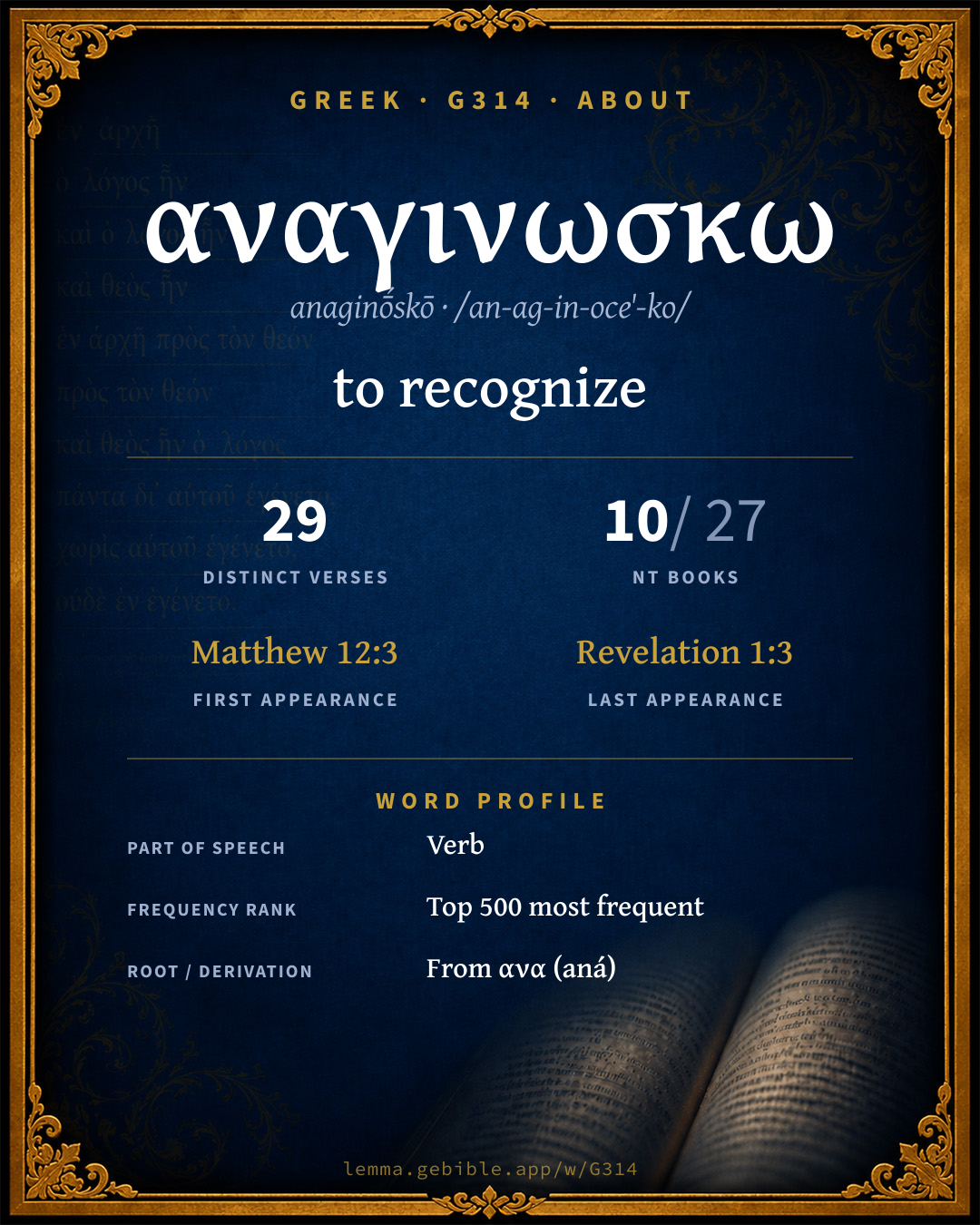
ἀναγινώσκω
to recognize
‘to recognize’ is one of 2 main senses fuller range ↓
Full lexicon entry — Thayer's Greek Lexicon
From Thayer's Greek Lexicon
Where this word appears
See every Aorist-tense verb in the Greek New Testament →
Grammar key — what these labels mean
Part of speech
- Verb
- An action or state-of-being word.
Tense
- Aorist
- Action viewed as a simple whole, without regard to duration — often past (perfective aspect).
- Present
- Ongoing or general action in present time (imperfective aspect).
- Imperfect
- Continuous or repeated action in past time (“was writing”).
Voice
- Active
- The subject performs the action.
- Passive
- The subject receives the action.
Mood
- Indicative
- States a fact or asks a factual question (the mood of reality).
- Participle
- A verbal adjective (“writing,” “having written”).
- Subjunctive
- Expresses probability, purpose, or possibility (the mood of contingency).
- Infinitive
- A verbal noun (“to write”), unmarked for person or number.
Case
- Nominative
- The case of the subject (and the predicate nominative).
- Genitive
- The case of source, possession, or “of” — answers “whose / from what.”
- Accusative
- The case of the direct object and of extent.
Person
- 2nd person
- The one addressed (“you”).
- 3rd person
- The one spoken about (“he / she / it / they”).
Gender
- Masculine
- Grammatically masculine.
- Feminine
- Grammatically feminine.
Number
- Plural
- More than one.
- Singular
- One.
Grammatical forms 18 distinct
- Verb, Aorist, Active, Indicative, 2nd person, Plural 10 times (31%)
- Verb, Present, Active, Participle, Nominative, Singular, Masculine 3 times (9%)
- Verb, Aorist, Passive, Subjunctive, 3rd person, Singular 2 times (6%)
- Verb, Imperfect, Active, Indicative, 3rd person, Singular 2 times (6%)
- Verb, Present, Active, Indicative, 2nd person, Singular 2 times (6%)
- Verb, Aorist, Active, Indicative, 3rd person, Plural 1 time (3%)
- Verb, Aorist, Active, Infinitive 1 time (3%)
- Verb, Aorist, Active, Participle, Nominative, Plural, Masculine 1 time (3%)
+10 more forms (10 occurrences)
Parsed forms decoded from the imported morphology (Robinson–Tischendorf, public domain), counted across 32 parsed occurrences — not distinct verses.
Every verse where G314 appears — 29 distinct verses across 10 books. Click any verse to open its interlinear word-by-word view. Verse text shown in the World English Bible for context — . Each verse’s Greek form is shown with its reference; the English is not keyword-highlighted, since the data carries no word-level English alignment. Use “Compare translations” on any verse to read it across multiple English versions. This concordance covers the Greek New Testament; Septuagint (Greek Old Testament) occurrences of this word are not indexed here.
Matthew 7 verses
- Matthew 12:3 ἀνέγνωτε aor act ind 2pl But he said to them, "Haven't you read what David did, when he was hungry, and those who were with him;
- Matthew 12:5 ἀνέγνωτε aor act ind 2pl Or have you not read in the law, that on the Sabbath day, the priests in the temple profane the Sabbath, and are guiltless?
- Matthew 19:4 ἀνέγνωτε aor act ind 2pl He answered, "Haven't you read that he who made them from the beginning made them male and female,
- Matthew 21:16 ἀνέγνωτε aor act ind 2pl and said to him, "Do you hear what these are saying?" Jesus said to them, "Yes. Did you never read, 'Out of the mouth of babes and nursing babies you have perfected praise?'"
- Matthew 21:42 ἀνέγνωτε aor act ind 2pl Jesus said to them, "Did you never read in the Scriptures, 'The stone which the builders rejected, The same was made the head of the corner. This was from the Lord. It is marvelous in our eyes?'
- Matthew 22:31 ἀνέγνωτε aor act ind 2pl But concerning the resurrection of the dead, haven't you read that which was spoken to you by God, saying,
- Matthew 24:15 ἀναγινώσκων pres act ptcp nom sg masc "When, therefore, you see the abomination of desolation, which was spoken of through Daniel the prophet, standing in the holy place (let the reader understand),
Mark 4 verses
- Mark 2:25 ἀνέγνωτε aor act ind 2pl He said to them, "Did you never read what David did, when he had need, and was hungry--he, and they who were with him?
- Mark 12:10 ἀνέγνωτε aor act ind 2pl Haven't you even read this Scripture: 'The stone which the builders rejected, The same was made the head of the corner.
- Mark 12:26 ἀνέγνωτε aor act ind 2pl But about the dead, that they are raised; haven't you read in the book of Moses, about the Bush, how God spoke to him, saying, 'I am the God of Abraham, the God of Isaac, and the God of Jacob?'
- Mark 13:14 ἀναγινώσκων pres act ptcp nom sg masc But when you see the abomination of desolation, spoken of by Daniel the prophet, standing where it ought not (let the reader understand), then let those who are in Judea flee to the mountains,
Luke 3 verses
- Luke 4:16 ἀναγνῶναι aor act inf He came to Nazareth, where he had been brought up. He entered, as was his custom, into the synagogue on the Sabbath day, and stood up to read.
- Luke 6:3 ἀνέγνωτε aor act ind 2pl Jesus, answering them, said, "Haven't you read what David did when he was hungry, he, and those who were with him;
- Luke 10:26 ἀναγινώσκεις pres act ind 2sg He said to him, "What is written in the law? How do you read it?"
John 1 verse
Acts 7 verses
- Acts 8:28 ἀνεγίνωσκεν impf act ind 3sg He was returning and sitting in his chariot, and was reading the prophet Isaiah.
- Acts 8:30 ἀναγινώσκοντος ἀναγινώσκεις pres act ptcp gen sg masc pres act ind 2sg Philip ran to him, and heard him reading Isaiah the prophet, and said, "Do you understand what you are reading?"
- Acts 8:32 ἀνεγίνωσκεν impf act ind 3sg Now the passage of the Scripture which he was reading was this, "He was led as a sheep to the slaughter. As a lamb before his shearer is silent, So he doesn't open his mouth.
- Acts 13:27 ἀναγινωσκομένας pres pass ptcp acc pl fem For those who dwell in Jerusalem, and their rulers, because they didn't know him, nor the voices of the prophets which are read every Sabbath, fulfilled them by condemning him.
- Acts 15:21 ἀναγινωσκόμενος pres pass ptcp nom sg masc For Moses from generations of old has in every city those who preach him, being read in the synagogues every Sabbath."
- Acts 15:31 ἀναγνόντες aor act ptcp nom pl masc When they had read it, they rejoiced over the encouragement.
- Acts 23:34 ἀναγνοὺς aor act ptcp nom sg masc When the governor had read it, he asked what province he was from. When he understood that he was from Cilicia, he said,
2 Corinthians 3 verses
- 2 Corinthians 1:13 ἀναγινώσκετε pres act ind 2pl For we write no other things to you, than what you read or even acknowledge, and I hope you will acknowledge to the end;
- 2 Corinthians 3:2 ἀναγινωσκομένη pres pass ptcp nom sg fem You are our letter, written in our hearts, known and read by all men;
- 2 Corinthians 3:15 ἀναγινώσκηται pres pass subj 3sg But to this day, when Moses is read, a veil lies on their heart.
Ephesians 1 verse
Colossians 1 verse
1 Thessalonians 1 verse
Revelation 1 verse
About this entry
At a glance — auto-summarized from this page’s data, not written by a person. Every figure links to its source below. This summary describes the numbers; it doesn’t interpret them.
αναγινωσκω (anaginṓskō) is a Greek verb most often rendered “to recognize.” Scripture first uses it in Matthew 12:3. Spanning 29 verses in 10 books, it ranks among the moderately common words of the Greek New Testament. Ranging over 2 senses, it is not a single-sense word. Sharing its root, it stands alongside ανα, αναβαινω and αναβαλλομαι. The sections below give every sense, occurrence, and version rendering.
Gloss history
Strong's 1890 vs modern scholarship

About this word
Strong's G314 catalogs a Greek word from the Greek New Testament.
These counts are not copied from any lexicon or concordance. They are computed here, from the morphology-tagged Greek New Testament. What Lemma adds →
- 29
- distinct verses
- The word appears in 29 distinct verses.
- 10 / 27
- NT books
- The word appears in 10 of 27 New Testament books.
- #438
- by frequency
- Top 500 most frequent Greek words (rank 438 of 5,347 Greek words by occurrence).
View all 29 occurrences in the concordance →
By section of the New Testament
By traditional corpus
Conventional, traditional groupings — biblical authorship is debated, so this is a traditional corpus grouping, not an authorship claim. Some books belong to more than one corpus (Luke is in both the Gospels and the Lukan corpus, and so on), so these shares overlap and need not total 100%. Each figure is a share of the word’s 29 distinct verses.
- Gospels 15 verses · 52%
- Lukan (Luke–Acts) 10 verses · 34%
- Pauline corpus 6 verses · 21%
- Johannine 2 verses · 7%
- Revelation 1 verse · 3%
How translations render this word
Counts come from each version’s own published word-to-Strong’s tagging or interlinear alignment — an approximate guide to how each version renders this word, not a word-level alignment the data otherwise carries. Because each total is that version’s own tagged count, the per-version totals vary from one another and need not match the appearance or distinct-verse counts above. These counts may also differ from a printed concordance because Lemma counts each distinctly tagged rendering and does not collapse phrase taggings into a single head-word total. This is a fixed set of word-tagged versions (KJV, ASV, BSB, ULT) and does not change with the reading translation you choose elsewhere. Each version’s license is shown beside its name below (and on Sources).
- King James Version: Read 17×, Have ye 7×, Be read 2×
- American Standard Version: Read 13×, Have ye 7×, Be read 2×
- Berean Standard Bible: Read 7×, Have you not read 5×, Have you never read 4×
- unfoldingWord Literal Text: Read 13×, Have you 8×, Reading 4×
King James Version Public Domain
Renders G314 across 41 tagged occurrences — most commonly:
Plus 11 renderings that appear only once — usually multi-word phrases or single function words the recovered tagging swept in, not distinct renderings. Not rendered by a distinct English word in 1 further occurrence.
American Standard Version Public Domain
Renders G314 across 42 tagged occurrences — most commonly:
Plus 16 renderings that appear only once — usually multi-word phrases or single function words the recovered tagging swept in, not distinct renderings.
Berean Standard Bible Public Domain
Renders G314 across 32 tagged occurrences — most commonly:
Plus 9 renderings that appear only once — usually multi-word phrases or single function words the recovered tagging swept in, not distinct renderings.
unfoldingWord Literal Text CC BY-SA 4.0
Renders G314 across 45 tagged occurrences — most commonly:
Plus 12 renderings that appear only once — usually multi-word phrases or single function words the recovered tagging swept in, not distinct renderings.
Senses in Thayer's
The 2 senses Thayer's distinguishes for this word, in lexicon order (not ranked by frequency or importance). The full entry — with sub-senses — is in the Lexicon Entry tab.
- to distinguish between, to recognise, to know accurately, to acknowledge
- to read
Word origin
Derived from ανα (aná) (G303) — among.
Forms in the corpus
The 18 distinct written forms G314 takes in the Greek New Testament, most frequent first — each parse links to that tense’s occurrences in the concordance.
Same root — word family
Other Thayer's entries built from the same root as G314, grouped by Strong’s listed origin. These share a root / origin per the lexicon — not necessarily a shared meaning. Each links to that word’s own entry.
Derives from
Shares the same root
- αναβαινω anabaínō G305 to ascend
- αναβαλλομαι anabállomai G306 to delay
- αναβιβαζω anabibázō G307 to draw up
- αναβλεπω anablépō G308 to look up
- αναβοαω anaboáō G310 to cry out
- αναγγελλω anangéllō G312 to announce
- αναγενναω anagennáō G313 to be born again
- αναγκη anánkē G318 necessity
- αναγνωριζομαι anagnōrízomai G319 to recognize
- αναγω anágō G321 to lead up
- αναδεικνυμι anadeíknymi G322 to proclaim
- αναδεχομαι anadéchomai G324 to take up
- αναδιδωμι anadídōmi G325 to give forth
- αναζαω anazáō G326 to live again
- αναζητεω anazētéō G327 to search out
- αναζωννυμι anazṓnnymi G328 to gird up
- αναζωπυρεω anazōpyréō G329 to inflame
- αναθαλλω anathállō G330 to sprout up
- αναθεωρεω anatheōréō G333 to observe
- αναιρεω anairéō G337 to take away
- ανακαθιζω anakathízō G339 to sit up
- ανακαινιζω anakainízō G340 to renew
- ανακαινοω anakainóō G341 to make new
- ανακαλυπτω anakalýptō G343 to uncover
+51 more words share this root (not shown).
Derived from this word
Compare all same-root words → Showing 4 of 78 — not the complete family. They share a root, not necessarily a meaning.
Septuagint usage
The same Greek word αναγινωσκω appears 46 times in the Greek Old Testament (Septuagint), across 42 verses in 13 books.
- 46
- LXX occurrences
- Tagged occurrences of this Greek word in the Septuagint.
- 42
- verses
- Distinct Septuagint verses containing this word.
- 13 / 39
- OT books
- The word appears in 13 of the 39 Old Testament books.
Sample Septuagint occurrences
- Exodus 24:7 ἀναγιγνώσκω
- Deuteronomy 17:19 ἀναγιγνώσκω
- Joshua 9:2 ἀναγιγνώσκω
- 2 Kings 5:7 ἀναγιγνώσκω
- 2 Chronicles 34:18 ἀναγιγνώσκω
- Ezra 4:23 ἀναγιγνώσκω
- Esther 6:1 ἀναγιγνώσκω
- Job 31:36 ἀναγιγνώσκω
- Isaiah 29:11 ἀναγιγνώσκω
- Jeremiah 3:12 ἀναγιγνώσκω
- Daniel 5:15 ἀναγιγνώσκω
- Amos 4:5 ἀναγιγνώσκω
Septuagint occurrences (same lexeme)
Every verse where the same Strong’s number (G314) appears in the Greek Septuagint. Verse text shown in the World English Bible for context; the Greek form is the matched word — the English is not keyword-highlighted.
- Exodus 24:7 ἀναγιγνώσκω He took the book of the covenant and read it in the hearing of the people, and they said, "All that Yahweh has spoken will we do, and be obedient."
- Deuteronomy 17:19 ἀναγιγνώσκω and it shall be with him, and he shall read therein all the days of his life; that he may learn to fear Yahweh his God, to keep all the words of this law and these statutes, to do them;
- Deuteronomy 31:11 ἀναγιγνώσκω when all Israel is come to appear before Yahweh your God in the place which he shall choose, you shall read this law before all Israel in their hearing.
- Joshua 9:2 ἀναγιγνώσκω that they gathered themselves together, to fight with Joshua and with Israel, with one accord.
- 2 Kings 5:7 ἀναγιγνώσκω It happened, when the king of Israel had read the letter, that he tore his clothes, and said, Am I God, to kill and to make alive, that this man does send to me to recover a man of his leprosy? but consider, I pray you, and see how he seeks a quarrel against me.
- 2 Kings 19:14 ἀναγιγνώσκω Hezekiah received the letter from the hand of the messengers, and read it; and Hezekiah went up to the house of Yahweh, and spread it before Yahweh.
- 2 Kings 22:8 ἀναγιγνώσκω Hilkiah the high priest said to Shaphan the scribe, I have found the book of the law in the house of Yahweh. Hilkiah delivered the book to Shaphan, and he read it.
- 2 Kings 22:10 ἀναγιγνώσκω Shaphan the scribe told the king, saying, Hilkiah the priest has delivered me a book. Shaphan read it before the king.
- 2 Kings 22:16 ἀναγιγνώσκω Thus says Yahweh, Behold, I will bring evil on this place, and on the inhabitants of it, even all the words of the book which the king of Judah has read.
- 2 Kings 23:2 ἀναγιγνώσκω The king went up to the house of Yahweh, and all the men of Judah and all the inhabitants of Jerusalem with him, and the priests, and the prophets, and all the people, both small and great: and he read in their ears all the words of the book of the covenant which was found in the house of Yahweh.
- 2 Chronicles 34:18 ἀναγιγνώσκω Shaphan the scribe told the king, saying, Hilkiah the priest has delivered me a book. Shaphan read therein before the king.
- 2 Chronicles 34:24 ἀναγιγνώσκω Thus says Yahweh, Behold, I will bring evil on this place, and on the inhabitants of it, even all the curses that are written in the book which they have read before the king of Judah.
- 2 Chronicles 34:30 ἀναγιγνώσκω The king went up to the house of Yahweh, and all the men of Judah and the inhabitants of Jerusalem, and the priests, and the Levites, and all the people, both great and small: and he read in their ears all the words of the book of the covenant that was found in the house of Yahweh.
- Ezra 4:23 ἀναγιγνώσκω Then when the copy of king Artaxerxes' letter was read before Rehum, and Shimshai the scribe, and their companions, they went in haste to Jerusalem to the Jews, and made them to cease by force and power.
- Ezra 18:3 ἀναγιγνώσκω
- Ezra 18:8 ἀναγιγνώσκω
- Ezra 18:18 ἀναγιγνώσκω
- Ezra 19:3 ἀναγιγνώσκω
- Ezra 23:1 ἀναγιγνώσκω
- Esther 6:1 ἀναγιγνώσκω On that night the king couldn't sleep; and he commanded to bring the book of records of the chronicles, and they were read before the king.
- Job 31:36 ἀναγιγνώσκω Surely I would carry it on my shoulder; And I would bind it to me as a crown.
- Isaiah 29:11 ἀναγιγνώσκω All vision is become to you as the words of a book that is sealed, which men deliver to one who is learned, saying, Read this, I pray you; and he says, I can't, for it is sealed:
- Isaiah 29:12 ἀναγιγνώσκω and the book is delivered to him who is not learned, saying, Read this, I pray you; and he says, I am not learned.
- Jeremiah 3:12 ἀναγιγνώσκω Go, and proclaim these words toward the north, and say, Return, you backsliding Israel, says Yahweh; I will not look in anger on you; for I am merciful, says Yahweh, I will not keep [anger] forever.
- Jeremiah 11:6 ἀναγιγνώσκω Yahweh said to me, Proclaim all these words in the cities of Judah, and in the streets of Jerusalem, saying, Hear you the words of this covenant, and do them.
- Jeremiah 19:2 ἀναγιγνώσκω and go forth to the valley of the son of Hinnom, which is by the entry of the gate Harsith, and proclaim there the words that I shall tell you;
- Jeremiah 28:61 ἀναγιγνώσκω
- Jeremiah 28:63 ἀναγιγνώσκω
- Jeremiah 36:24 ἀναγιγνώσκω They were not afraid, nor tore their garments, neither the king, nor any of his servants who heard all these words.
- Jeremiah 39:11 ἀναγιγνώσκω Now Nebuchadrezzar king of Babylon gave charge concerning Jeremiah to Nebuzaradan the captain of the guard, saying,
- Jeremiah 39:14 ἀναγιγνώσκω they sent, and took Jeremiah out of the court of the guard, and committed him to Gedaliah the son of Ahikam, the son of Shaphan, that he should carry him home: so he lived among the people.
- Jeremiah 43:6 ἀναγιγνώσκω the men, and the women, and the children, and the king's daughters, and every person who Nebuzaradan the captain of the guard had left with Gedaliah the son of Ahikam, the son of Shaphan; and Jeremiah the prophet, and Baruch the son of Neriah;
- Jeremiah 43:8 ἀναγιγνώσκω Then came the word of Yahweh to Jeremiah in Tahpanhes, saying,
- Jeremiah 43:10 ἀναγιγνώσκω and tell them, Thus says Yahweh of Hosts, the God of Israel: Behold, I will send and take Nebuchadrezzar the king of Babylon, my servant, and will set his throne on these stones that I have hidden; and he shall spread his royal pavilion over them.
- Jeremiah 43:13 ἀναγιγνώσκω He shall also break the pillars of Beth-shemesh, that is in the land of Egypt; and the houses of the gods of Egypt shall he burn with fire.
- Jeremiah 43:14 ἀναγιγνώσκω
- Jeremiah 43:15 ἀναγιγνώσκω
- Jeremiah 43:21 ἀναγιγνώσκω
- Jeremiah 43:23 ἀναγιγνώσκω
- Daniel 5:15 ἀναγιγνώσκω Now the wise men, the enchanters, have been brought in before me, that they should read this writing, and make known to me the interpretation of it; but they could not show the interpretation of the thing.
- Amos 4:5 ἀναγιγνώσκω Offer a sacrifice of thanksgiving of that which is leavened, And proclaim free will offerings and brag about them: For this pleases you, you children of Israel," says the Lord Yahweh.
- Habakkuk 2:2 ἀναγιγνώσκω Yahweh answered me, "Write the vision, and make it plain on tablets, that he may run who reads it.
These are occurrences of the same Greek lexeme (G314) in the Septuagint — not a translation of any one Hebrew word. The store carries no word-level Hebrew↔Greek alignment, so no Hebrew original is asserted here. Counts come from the recovered LXX Strong's tagging — high-frequency vocabulary is well covered, while rare or late forms may be untagged — so they reflect tagged occurrences and may slightly undercount.