Leviticus 25:5

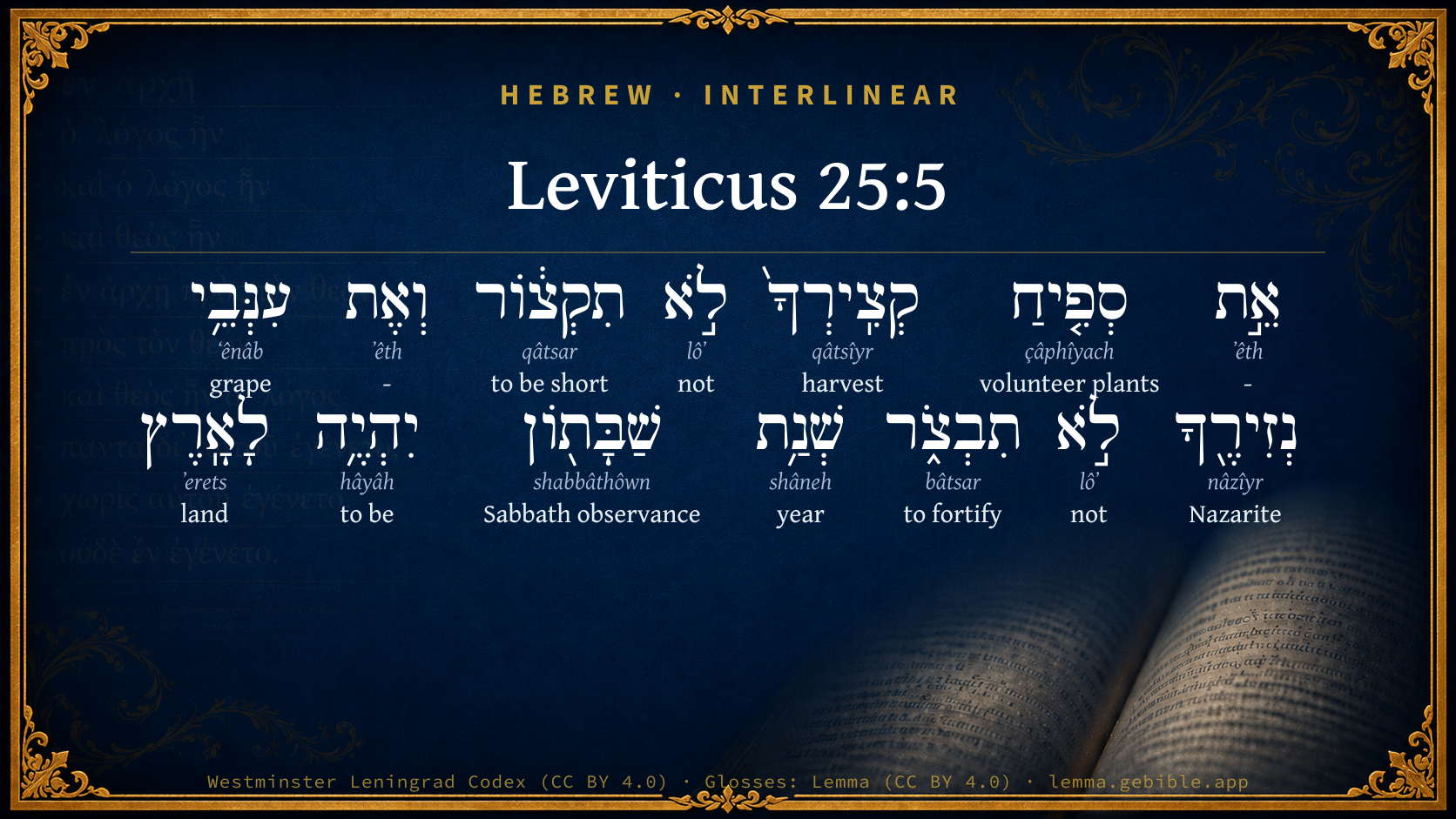
Hebrew (Westminster Leningrad Codex) Leviticus 25:5 appears in the Hebrew Old Testament. The text above is from the Westminster Leningrad Codex. Each word links to its Strong’s number, a concise gloss, and parsing drawn from the Open Scriptures Hebrew Bible morphology. Click any word for its full Brown-Driver-Briggs (BDB) entry.
Download image
Cite this verse

Leviticus 25:5 (World English Bible). Public Domain. Lemma interlinear Bible study tool, https://lemma.gebible.app/v/leviticus/25/5.

Show BibTeX & RIS
BibTeX
RIS
English Translation
What grows of itself in your harvest you shall not reap, and the grapes of your undressed vine you shall not gather. It shall be a year of solemn rest for the land.
World English Bible · Public Domain
Highlights
  • 1 first appearance in the Hebrew Bible
Full analysis ↓
Download a study sheet

One document with this verse’s original text, its word-by-word gloss line, the meaning frame, cross-references with their text, attributed commentary, and full source and license credits — printable, and it pastes into notes with its structure intact.

This verse Autodidact and up

Study sheet (.html) Plain text (.txt)

A passage Seminary Student

Up to 50 verses in one chapter. A passage sheet keeps up to 6 commentary sources and 12 cross-references per verse, in the order this page ranks them, and says so on the sheet whenever that leaves anything out. Ask for a single verse and you get the Autodidact verse sheet above.

Everything on this page stays free to read, with no account — the sheet is a download of what is already on screen, not access to it.

Want to remove ads? Support Godless Engineer
Compare translations 3

The same verse in 3 English versions, stacked beneath the original-language interlinear above. Click any original word for its lexicon entry.

Each is an independent rendering of the whole verse — the interlinear is not word-aligned to these translations.

Highlighted words mark where these versions differ — a whole-verse word diff, not a word-by-word alignment.

  • World English Bible Public Domain
    What grows of itself in your harvest you shall not reap, and the grapes of your undressed vine you shall not gather. It shall be a year of solemn rest for the land.
  • King James Version Public Domain
    That which groweth of its own accord of thy harvest thou shalt not reap, neither gather the grapes of thy vine undressed: for it is a year of rest unto the land.
  • unfoldingWord Literal Text CC BY-SA 4.0
    The self-grown of your harvest you shall not reap, and the grapes of your untrimmed you shall not gather. It shall be a year of sabbath for the land.

unfoldingWord Literal Text — © unfoldingWord, licensed CC BY-SA 4.0. Word-aligned USFM3 via Door43 (git.door43.org/unfoldingWord/en_ult).

Versions to compare (up to 4)

3 of 4 selected

Show all 18 translations

Every available English version of this verse, each an independent rendering of the whole verse.

  • World English Bible Public Domain
    What grows of itself in your harvest you shall not reap, and the grapes of your undressed vine you shall not gather. It shall be a year of solemn rest for the land.
  • Berean Standard Bible Public Domain
    You are not to reap the aftergrowth of your harvest or gather the grapes of your untended vines. The land must have a year of complete rest.
  • Majority Standard Bible Public Domain
    You are not to reap the aftergrowth of your harvest or gather the grapes of your untended vines. The land must have a year of complete rest.
  • King James Version Public Domain
    That which groweth of its own accord of thy harvest thou shalt not reap, neither gather the grapes of thy vine undressed: for it is a year of rest unto the land.
  • American Standard Version (1901) Public Domain
    That which groweth of itself of thy harvest thou shalt not reap, and the grapes of thy undressed vine thou shalt not gather: it shall be a year of solemn rest for the land.
  • Revised Version (1885) Public Domain
    That which groweth of itself of thy harvest thou shalt not reap, and the grapes of thy undressed vine thou shalt not gather: it shall be a year of solemn rest for the land.
  • Geneva Bible (1599) Public Domain
    That which groweth of it owne accorde of thy haruest, thou shalt not reape, neither gather the grapes that thou hast left vnlaboured: for it shalbe a yeere of rest vnto the land.
  • Douay-Rheims (1899) Public Domain
    What the ground shall bring forth of itself, thou shalt not reap: neither shalt thou gather the grapes of the firstfruits as a vintage: for it is a year of rest to the land:
  • Young's Literal Translation Public Domain
    the spontaneous growth of thy harvest thou dost not reap, and the grapes of thy separated thing thou dost not gather, a year of rest it is to the land.
  • Literal Standard Version CC BY-SA 4.0
    you do not reap the spontaneous growth of your harvest, and you do not gather the grapes of your separated thing; it is a year of rest for the land.
  • Unlocked Literal Bible CC BY-SA 4.0
    You must not conduct an organized harvest of whatever grows by itself, and you must not conduct an organized harvest of whatever grapes grow on your unpruned vines. This will be a year of solemn rest for the land.
  • unfoldingWord Literal Text CC BY-SA 4.0
    The self-grown of your harvest you shall not reap, and the grapes of your untrimmed you shall not gather. It shall be a year of sabbath for the land.
  • Darby Bible Public Domain
    That which springeth up from the scattered seed of thy harvest thou shalt not reap, and the grapes of thine undressed vines thou shalt not gather: a year of rest shall it be for the land.
  • World Messianic Bible Public Domain
    What grows of itself in your harvest you shall not reap, and you shall not gather the grapes of your undressed vine. It shall be a year of solemn rest for the land.
  • Webster's Bible Public Domain
    That which groweth of its own accord of thy harvest, thou shalt not reap, neither gather the grapes of thy vine undressed: for it is a year of rest to the land.
  • Free Bible Version CC BY-SA 4.0
    Don't harvest what may have grown up in your fields, or collect the grapes from your vineyards that you haven't cared for. The land is to have a year of complete rest.
  • Bible in Basic English Public Domain
    That which comes to growth of itself may not be cut, and the grapes of your uncared-for vines may not be taken off; let it be a year of rest for the land.
  • JPS Tanakh (1917) Public Domain
    That which groweth of itself of thy harvest thou shalt not reap, and the grapes of thy undressed vine thou shalt not gather; it shall be a year of solemn rest for the land.

Literal Standard Version (2020), Covenant Press — licensed CC BY-SA 4.0. Text via the HelloAO Bible API (eBible.org). Unlocked Literal Bible (unfoldingWord) — licensed CC BY-SA 4.0. Text via the HelloAO Bible API (eBible.org). unfoldingWord Literal Text — © unfoldingWord, licensed CC BY-SA 4.0. Word-aligned USFM3 via Door43 (git.door43.org/unfoldingWord/en_ult). Free Bible Version, Dr. Jonathan Gallagher — licensed CC BY-SA 4.0. Text via the HelloAO Bible API (eBible.org).

Word by word

More ways to search: Search by grammar → Find every occurrence → Compare this word →

Practice this passage: Drill this verse → Learn its vocabulary →

סְפִ֤יחַ
çâphîyach
H5599
“volunteer plants of”
Noun, Common, Masculine, Singular, Construct
Part of Speech
Noun
Type
Common
Gender
Masculine
Number
Singular
State
Construct
Full BDB Definition

Origin: from H5596

TWOT: 1533a , 1533b

outpouring - growth from spilled kernels, after-growth, volunteer plants
  1. אֵ֣ת ʼêth H853 “-” Particle, Direct Object
  2. קְצִֽירְךָ֙ qâtsîyr H7105 “harvest · your” Noun, Common, Masculine, Singular, Construct + Suffix, Personal, 2nd Person, Masculine, Singular
  3. לֹ֣א lôʼ H3808 “not” Particle, Negative
  4. תִקְצ֔וֹר qâtsar H7114 “to be short” Verb, Qal, Imperfect, 2nd Person, Masculine, Singular
  5. וְאֶת ʼêth H853 “and · -” Conjunction + Particle, Direct Object
  6. עִנְּבֵ֥י ʻênâb H6025 “grapes of” Noun, Common, Masculine, Plural, Construct
  7. נְזִירֶ֖ךָ nâzîyr H5139 “Nazarites · your” Noun, Common, Masculine, Plural, Construct + Suffix, Personal, 2nd Person, Masculine, Singular
  8. לֹ֣א lôʼ H3808 “not” Particle, Negative
  9. תִבְצֹ֑ר bâtsar H1219 “to fortify” Verb, Qal, Imperfect, 2nd Person, Masculine, Singular
  10. שְׁנַ֥ת shâneh H8141 “year of” Noun, Common, Feminine, Singular, Construct
  11. שַׁבָּת֖וֹן shabbâthôwn H7677 “Sabbath observance” Noun, Common, Masculine, Singular, Absolute
  12. יִהְיֶ֥ה hâyâh H1961 “to be” Verb, Qal, Imperfect, 3rd Person, Masculine, Singular
  13. לָאָֽרֶץ ʼerets H776 “to/for the · land” Preposition, Determined + Noun, Common, Both, Singular, Absolute

About this verse

These counts appear in no published source. They are computed here, from the morphology-tagged text and Lemma’s own curated glosses. What Lemma adds →

14
words
12
distinct lemmas
Pentateuch
section

Notable vocabulary

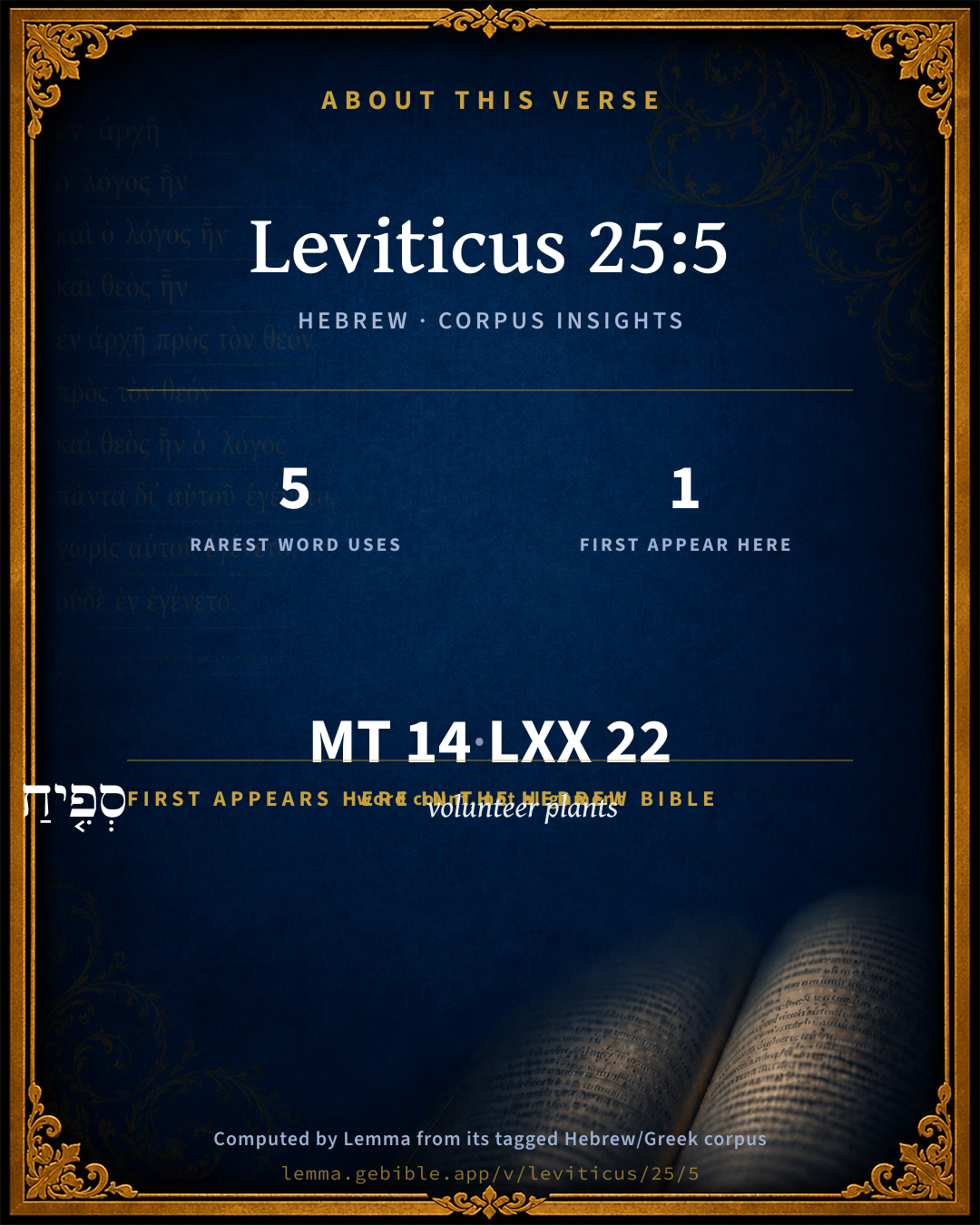
The rarest word here is סְפִ֤יחַ volunteer plants H5599 — appearing just 5 times in the whole Hebrew Bible.

First appearance in Scripture

This word makes its first canonical appearance in the Hebrew Bible here:

  • סְפִ֤יחַ volunteer plants H5599

Shared distinctive vocabulary

סְפִ֤יחַ volunteer plants H5599 occurs in 5 verses of the Hebrew Bible. Also found in:

Grammatical profile

  • 3 verbs
  • 7 nouns
  • 4 particles

Verb forms

  • תִקְצ֔וֹר Qal · Imperfect
  • תִבְצֹ֑ר Qal · Imperfect
  • יִהְיֶ֥ה Qal · Imperfect

Repetition

A word recurs within this verse — often emphatic in Hebrew:

Hebrew & Septuagint length

In English translation the verse runs 33 words from the Hebrew and 32 from the Septuagint (LXX English) — closely comparable.

A rough comparison of the two English renderings, which tokenize alike — not a word-level alignment.

Word counts can differ between the Hebrew and the Greek without any difference in meaning — e.g. the Hebrew direct-object marker אֵת has no separate Greek word, and Greek often adds the article ὁ.

In the original languages it is 14 Hebrew tokens and 22 Greek tokens — but the two are counted differently (Hebrew bundles its prefixes and suffixes into one token; the Greek is in lemma form), so that isn’t a like-for-like length.

Cross-references

2

Topical passages linked to Leviticus 25:5 in the Treasury of Scripture Knowledge — connected by theme and wording, ordered by reader-vote popularity; previews shown in the World English Bible.

  • 2 Kings 19:29 This shall be the sign to you: You shall eat this year that which grows of itself, and in the second year that which springs of the same; and in the third year sow you, and reap, and plant vineyards, and eat the fruit of it.
  • Isaiah 37:30 This shall be the sign to you: you shall eat this year that which grows of itself, and in the second year that which springs of the same; and in the third year sow you, and reap, and plant vineyards, and eat the fruit of it.

Cross-references courtesy of OpenBible.info (CC BY 4.0).

Hebrew and Greek witnesses Masoretic Hebrew ↔ Greek Septuagint

The same verse in the two great witnesses to the Old Testament, shown verse-for-verse.

These are two independent witnesses, not word-aligned to each other, and the Septuagint is shown in lemma (dictionary) form.

Hebrew Leviticus 25:5 Masoretic · Westminster Leningrad Codex

אֵ֣ת סְפִ֤יחַ קְצִֽירְךָ֙ לֹ֣א תִקְצ֔וֹר וְאֶת עִנְּבֵ֥י נְזִירֶ֖ךָ לֹ֣א תִבְצֹ֑ר שְׁנַ֥ת שַׁבָּת֖וֹן יִהְיֶ֥ה לָאָֽרֶץ

What grows of itself in your harvest you shall not reap, and the grapes of your undressed vine you shall not gather. It shall be a year of solemn rest for the land.

World English Bible · Public Domain

Greek LXX Leviticus 25:5 Septuagint · lemma form

καί ὁ αὐτόματος ἀναβαίνω ὁ ἀγρός σύ οὐ ἐκθερίζω καί ὁ σταφυλή ὁ ἁγίασμα σύ οὐ ἐκτρυγάω ἐνιαυτός ἀνάπαυσις εἰμί ὁ γῆ

And you shall not gather the spontaneous produce of your field, and you shall not gather fully the grapes of your dedication: it shall be a year of rest to the land.

LXX2012 (modern English Septuagint) · Public Domain

On this verse, Ellicott's Commentary for English Readers discusses the Septuagint’s reading. Read the note in Commentary ↓

Hebrew: Westminster Leningrad Codex (CC BY 4.0). Greek: Septuagint (public domain); English from LXX2012 (modern English Septuagint) (Public Domain). How the Septuagint differs from the Hebrew →

Targum (Aramaic paraphrase)

2

The Targum is the ancient Jewish Aramaic paraphrase of the Hebrew Scriptures — an interpretive translation, not the Hebrew text itself. Onkelos (literal) and Pseudo-Jonathan (expansive) render the Torah, and Jonathan the Prophets. Coverage is partial: where no permissively-licensed English translation exists for a verse, only the Aramaic is shown. This is verse-level text, not a word-by-word alignment to the Hebrew.

  1. Targum Onkelos Torah (Genesis–Deuteronomy)
    יָת כַּתֵּי דַחֲצָדָךְ לָא תֶחֱצַד וְיָת עִנְבֵי שִׁבְקָךְ לָא תִקְטוֹף שְׁנַת שְׁמִטְתָא יְהֵי לְאַרְעָא

    (no public-domain English translation for this verse)

    Targum Onkelos — Aramaic: “Onkelos Genesis” (public domain); “Onkelos Exodus” (public domain); “Onkelos Leviticus” (public domain); “Onkelos Numbers” (public domain); “Onkelos Deuteronomy” (public domain). English: “Sefaria Community Translation” (CC0 1.0 (public-domain dedication)); “J.W. Etheridge. The Targums of Onkelos and Jonathan Ben Uzziel on the Pentateuch. London: Longmans, Green, 1862” (public domain). Text via Sefaria.

  2. Targum Pseudo-Jonathan Torah (Genesis–Deuteronomy)
    יַת כַּתֵּי שָׁבֵיק חַצְדְכוֹן לָא תְחַצְדוּן וְיַת עִינְבֵי רְדוּפֵיכוֹן צ"ל פרודיכון לָא תִקְטְפוּן שְׁנַת שְׁמִיטָתָא יְהֵי לְאַרְעָא

    The after crop which remaineth from your harvests you may not reap, nor of your later grapes make a vintage; a year of remission it shall be unto the earth;

    Targum Pseudo-Jonathan — Aramaic: “Targum Jonathan on Genesis” (public domain); “Targum Jonathan on Exodus” (public domain); “Targum Jonathan on Leviticus” (public domain); “Targum Jonathan on Numbers” (public domain); “Targum Jonathan on Deuteronomy” (public domain). English: “The Targum of Jonathan ben Uzziel, trans. J. W. Etheridge, London, 1862” (public domain). Text via Sefaria.

Commentary

Notes on Leviticus 25:5 from classic Christian and Jewish commentators (each source and its license shown beneath its notes). The classic Christian expositions comment on the surrounding passage and are grouped to its opening verse, so a note may address several verses; the Jewish commentaries on the Tanakh (Rashi and others) are per-verse, so they appear only where the commentator wrote on this verse.

Lemma curates 59 commentaries, every one of them public domain or Creative Commons licensed, each selected and text-cleaned for this edition rather than reprinted as found. About our sources →

Trapp's Complete Commentary

John Trapp

Lev 25:5 That which groweth of its own accord of thy harvest thou shalt not reap, neither gather the grapes of thy vine undressed: [for] it is a year of rest unto the land.

Ver. 5. Thou shalt not reap,] sc., All at once, as other years: but now some, and then some, for thy necessary food. {a}

{a} Maimon., in Jobel.

John Trapp, A Commentary or Exposition upon All the Books of the Old and New Testament (1647–1656) — public domain. Text from a community e-Sword module.

unfoldingWord translationNotes

Door43 World Missions Community

You must not conduct ... who live with you may gather food

In Lev 25:5-6 Yahweh means he will not allow the owner of a field to organize his workers and harvest the land as he does the other six years. However, Yahweh will allow individuals to go through the fields to pick and eat the fruit they find.

your unpruned vines

This means that no one has taken care of the vines and cut them as they do during the other six years. This can be stated in active form. AT: "your vines that you do not prune" (See: Active or Passive)

Whatever the unworked land grows

"whatever grows on the unworked land"

the unworked land

This means that no one has taken care of the gardens or farms as they do during the other six years. This can be stated in active form. AT: "your gardens that you do not tend" (See: Active or Passive)

whatever the land produces

"whatever grows on the land"

translationWords

harvest

grape

vine

rest

Sabbath

servant

alien

life

livestock

unfoldingWord translationNotes — © Distant Shores Media and the Door43 World Missions Community, licensed CC BY-SA 4.0. Source: git.door43.org/Door43/en_tn.

Geneva Bible (1599)

Geneva Bible translators

Or, which thou hast separated from thyself, and consecrated to God for the poor.

By reason of the corn that fell out of the ears the year past.

Geneva Bible (1599) marginal notes — public domain. Text via Bolls.life.

Ellicott's Commentary for English Readers

(5) That which groweth of its own accord.—Not only is every owner of land to desist from cultivating it, but the spontaneous growth of the fields from seeds which accidentally fell down at the harvest, as well as from old roots, are not to be gathered, or no harvest is to be made of it.

Neither gather the grapes of thy vine undressed.—Literally, thy Nazarite vine, the vine which bears the character of a Nazarite, or of being separated or consecrated to God. As the seventh year is the sabbath of the Lord, being consecrated to Him, the vine of this year is consecrated to Him. Hence the Greek version (LXX.) translates it “the grapes of thy consecration,” and hence, too, the marginal rendering “of thy separations.” The passage is also interpreted “thou shalt not gather the grapes from which thou hast separated and debarred other people, and which thou hast not declared common property.”

A Bible Commentary for English Readers, edited by Charles John Ellicott (1878–1897) — public domain. Text from a community e-Sword module.

The Cambridge Bible for Schools and Colleges

gen. ed. J. J. S. Perowne

5. undressed] untrimmed by lopping and hence consecrated. The Heb. word is the same as that denoting the Nazirite, who in token of his consecration wore his hair uncut (Num_6:5).

The Cambridge Bible for Schools and Colleges (gen. ed. J. J. S. Perowne; Cambridge University Press, 1878–1918) — public domain. Text from a community e-Sword module.

John Gill's Exposition

That which groweth of its own accord of thy harvest thou shalt not reap,.... That which sprung up of itself from grains of corn, shed in the harvest of the preceding year, without any ploughing or sowing; he might reap it, but not as at other times, the whole of it, and gather it as his own property, but only somewhat of it in common with others for his, present use:

neither gather the grapes of thy vine undressed; which was on this year forbid to be dressed; the grapes of which he might gather in common with others, but not as in other years, all of them, and as peculiarly his own: the words may be rendered, "the grapes of thy separations" (p); either such as in other years he used to separate for himself, and forbid others gathering them, but now made them common; or which he did not labour in the cultivation of, but abstained from it:

for it is a year of rest unto the land; which is repeated, that it may be observed.

(p) "uvas tuarum separationum", Pagninus, Montanus; so Drusius & Ainsworth.

John Gill's Exposition of the Whole Bible (1746–1763) — public domain (CC PDM 1.0). Text via the HelloAO Bible API.

Albert Barnes' Notes on the Bible

Vine undressed - That is, “unpruned”; literally “Nazarite vine”, the figure being taken from the unshorn locks of the Nazarite. Num 6:5.

Albert Barnes' Notes on the Bible (1834–1885) — public domain. Text from a community e-Sword/MySword module.

Haydock's Catholic Bible Commentary

Reap entirely, but only take a part, ver. 6. --- First-fruits. None shall be this year presented to the Lord. Hebrew has the word Nezireka, "Nazareat," alluding to the custom of those who, out of devotion, let their hair grow; as here only the spontaneous fruits of the unpruned vine were to be eaten; they were separated, as the word also means, or "sanctified," (Septuagint) being abandoned indifferently for the use of any one that pleased to eat of them, and no longer fenced in by the proprietor, (Calmet) though he might take the first, or choicest fruits for his own use, (Menochius,) or at least he might take his share like the rest. (Tirinus)

George Leo Haydock (1774–1849), Haydock's Catholic Family Bible and Commentary, 1859 edition — public domain. Excludes Psalms (Douay-Rheims chapter numbering differs from Protestant) and Deuterocanonical books (Catholic canon only).

Matthew Poole's English Annotations

Of its own accord; from the grains that fell out of the ears the last reaping time.

Thou shalt not reap, i.e. as thy own peculiarly, but only so as others may reap it with thee, for present food.

The grapes of thy vine undressed, Heb. the grapes of thy separation, i.e. the grapes which thou hast separated or set apart to the honour of God, and to the ends and uses appointed by God; or the grapes of that year, which are in this like the Nazarites’ hair, not cut off by thee, but suffered to grow to the use of the poor.

Matthew Poole's English Annotations on the Holy Bible (1683–1685) — public domain. Text from a community e-Sword/MySword module.

Whedon's Commentary on the Bible

Daniel D. Whedon

5. Vine undressed — Hebrew, consecrated or Nazarite, because he left his hair unshorn. Num_6:5. The Roman poets speak of the viridis coma, the green hair of the vine.

Shalt not reap — This prohibits reaping to garner or to sell, but not for immediate eating. It will be observed that in Lev_25:3-5 all labor is not forbidden, but only that which is strictly agricultural. Mechanical pursuits, such as tool-making, carpentry, the manufacture of cloth and of clothing, and the making and repair of furniture, were admissible, as well as certain semi-agricultural labors, as ditching, fence-building, terrace-making, sheep-shearing, care of bees and flocks, to which may be added hunting, fishing, and trafficking.

Daniel D. Whedon (gen. ed.), Commentary on the Old and New Testaments (1874–1909) — public domain. Text from a community e-Sword module.

John Wesley's Explanatory Notes

Of its own accord - From the grains that fell out of the ears the last reaping time. Thou shalt not reap - That is, as thy own peculiarly, but only so as others may reap it with thee, for present food. Undressed - Not cut off by thee, but suffered to grow for the use of the poor.

John Wesley, Explanatory Notes Upon the Whole Bible (1754–1765) — public domain. Text via the GEBible commentary corpus.

Keil & Delitzsch

C. F. Keil & F. Delitzsch

"That which has fallen out (been shaken out) of thy harvest (i.e., the corn which had grown from the grains of the previous harvest that had fallen out) thou shalt not reap, and the grapes of thine uncut thou shalt not gather." נזיר, the Nazarite, who let his hair grow freely without cutting it (Num 6:5), is used figuratively, both here and in Lev 25:11, to denote a vine not pruned, since by being left to put forth all its productive power it was consecrated to the Lord. The Roman poets employ a similar figure, and speak of the viridis coma of the vine (Tibull. i. 7, 34; Propert. ii. 15, 12).

Keil & Delitzsch — Biblical Commentary on the Old Testament (1861–1891) — public domain (CC PDM 1.0). Text via the HelloAO Bible API. (Old Testament only.)

Rashi

Rabbi Shlomo Yitzchaki (Rashi)

את ספיח קצירך THAT WHICH GROW OF ITS OWN ACCORD OF THY HARVEST — i. e. even if you have not sown it but it grew from the seed which fell into it (into the ground) at the time of the last harvest — and that is what the term ספיח denotes.

לא תקצור THOU SHALT NOT REAP [IT] — to take it as your exclusive property as you do with other harvests (with the harvest in another year) but it shall be free (הפקר) to all and then thou also may reap of it.

נזירך [AND THE GRAPES OF THY VINE] WHICH ARE נזירים — i. e. those from which you barred people (שהנזרת) and from which you have kept them away, not having declared them free to everybody.

לא תבצר THOU SHALT NOT GATHER — them thou must not gather, but you may gather from that which has been declared free to everybody (Sifra, Behar, Chapter 1 3).

Rashi on the Tanakh — English translations: “The Judaica Press complete Tanach with Rashi, translated by A. J. Rosenberg” (CC BY 4.0); “Pentateuch with Rashi's commentary by M. Rosenbaum and A.M. Silbermann, 1929-1934” (public domain); “The Metsudah Tanach series, Lakewood, N.J” (CC BY 4.0); and “The Book of Joshua, Metsudah Publications, 1997” (CC BY 4.0). Text via Sefaria.

Ramban (Nachmanides)

Rabbi Moshe ben Nachman (Ramban / Nachmanides)

ETH S’FIACH K’TZIRCHA’ (THAT WHICH GROWETH OF ITSELF OF THY HARVEST) THOU SHALT NOT REAP. “Even if you did not sow it, but it grew from the seed that had fallen [into the ground] at the time of the harvest [of the sixth year], and it is that which is called ‘s’fiach’ (aftergrowth) — thou shalt not reap, to take possession of it like other harvests, but is to be free for everyone. AND THE GRAPES OF ‘N’ZIRECHA’ — which you have barred and separated from people, and not declared ownerless — THOU SHALT NOT GATHER them. You may only gather them after they have been declared free for all.” Thus the language of Rashi.The Rabbi’s [i.e., Rashi’s] meaning by [writing] this is because he is of the opinion that if a person guards his field and his fruits in the Sabbatical year [at the time of growth, and afterwards he declares them free for all], the produce does not become prohibited [as food]. So also did he [Rashi] write in his commentaries to Tractate Yebamoth and to Tractate Succah. This is indeed so according to the law of the Torah, as is established by clear proofs. And that which is taught in the Torath Kohanim: 1:3. “And the grapes of ‘n’zirecha’ thou shalt not gather. From that which was guarded when in the soil [i.e., when it is in the process of growth] you shall not gather, but you may gather from that which was made free for all” — the Rabbi [Rashi] will explain it in the following way: “Grapes which have been kept away from people you may not gather as long as they are so barred; you must rather declare them all ownerless, and then you may gather them together with the poor.”The correct interpretation of the verse is that the expression the grapes of ‘n’zirecha’ is like ‘s’fiach’ of thy harvest, and thou shalt not gather is like thou shalt not reap, for the purport of the whole section is to state a twofold law to the Israelites — warning with respect to fields and warning again with reference to vineyards. Thus: thou shalt sow thy field … thou shalt prune thy vineyard; thou shalt neither sow thy field, nor prune thy vineyard. Similarly, And six years thou shalt sow thy Land … but the seventh year thou shalt let it rest and lie fallow … In like manner thou shalt deal with thy vineyard. And the meaning of the verse [here] is that that which grows by itself in a field without intentional plowing and sowing is called “s’fiach of the harvest,” because it is “attached” to the harvest of the past year, this term being of the root, ‘v’nispechu’ (and they shall cleave) to the house of Jacob. Likewise the vine which has not been cultivated, nor hoed or pruned, is called nazir, because [the owner] “held himself aloof and put it away from him” as if it were not his, of the root, because ‘nazoru’ from Me through their idols, [which means] “they separated themselves from Me.” Similarly, ‘v’yinazru’ (and they separate themselves) from the holy things of the children of Israel. And Onkelos [also] translates here [and the grapes of ‘n’zirecha’] as shivkach, which means [those grapes that] “you have left” to be for briers and thorns. It is possible that the custom in Israel was that a vineyard which was uncultivated, neither pruned nor hoed, and in which briers and thorns, 5:6. grew up, they called nazir, that is to say, it is a vineyard of the Nazirite, since the Nazirite is forbidden to drink wine nor eat fresh grapes or dried, and he does not cultivate his vineyard. They also gave a name to long hair derived from the Nazirite, as it is said, Cut off ‘nizreich’ (thy hair) and cast it away. This then is the sense of [the expression here] the grapes of ‘n’zirecha,’ the general purport thereof being that they are the grapes which grow without cultivation of the vineyard. Thus Scripture is stating that that which grows by itself in the field he may not reap, and the grapes which grow in the vineyard without work he may not gather. And the meaning of these negative commandments is that you may not reap them alone for your own needs, nor are you to gather the grapes for yourself [only], but it shall be a year of solemn rest for the Land from sowing and pruning, and the Sabbath-produce of the Land, that is, whatever the Land brings forth in its rest, whether s’fiach or nazir [as explained above] shall be unto all of you together for food, for thee, and for thy poor, and for the beast and for the cattle. Now I will return to explain the Beraithoth taught in the Torath Kohanim on this subject, because they are misleading [in their plain sense]. On the verse, And if ye shall say: ‘What shall we eat the seventh year? behold, we may not sow, nor gather in our increase, the Rabbis taught there [in the Torath Kohanim]: 4:5. “If people do not sow, what is there to gather? [So why then did Scripture prohibit gathering the increase, since there can be none to gather without sowing?] Said Rabbi Akiba: It is from here that the Sages found a Scriptural source for s’fichin (aftergrowths), [indicating] that they are forbidden in the Sabbatical year.” This Beraitha is quoted in the Gemara [of Tractate Pesachim] in the Chapter Makom Shenahagu (“A place where the custom is”). And it is further taught in the Torath Kohanim: 4:5. “But the Sages say: Aftergrowths are not forbidden by law of the Torah, but only by decree of the Scribes. If so, why is it said, behold, we may not sow, nor gather? [It means as follows:] You have told us not to sow, and what there is for us to gather — [the aftergrowths] — we may not bring in for storage [after the time of the Removal]; and then You have told us, ‘Remove it [from the house],’ what then shall we eat from the time of the Removal onwards?” Thus far [are the words of the Torath Kohanim].Thus it is clear that according to the words of the Sages the prohibition of aftergrowths is only by law of the Rabbis, that is to say, it is they who decreed that they be prohibited altogether, because of the suspicion that the owners might sow and say that these are aftergrowths. It is for this reason that the Rabbis have said in the Yerushalmi: “Rabbi Yannai said: All aftergrowths are forbidden [under the law forbidding theft, i.e., since they belong to the owner of the field, they may not be taken by a stranger during the non-Sabbatical years], except for those which come up in an uncultivated field, a plowed field, a field containing a vineyard, or a field sowed [with fenugreek]. [The aftergrowths of] an uncultivated field [are permissible to a stranger] because the owner pays no attention to such a field [and therefore it is considered ownerless]. A plowed field — the owner desires to clear of all growths. A field containing a vineyard — the owner does not want to forfeit his vineyard [because the aftergrowths of the grain in the vineyard constitute diverse kinds which are forbidden, and so he welcomes their being taken out by anyone]. A field sowed [with fenugreek] — the owner does not want to maintain aftergrowths therein [because they harm the fenugreek].” It is on the basis of this division of opinion [between Rabbi Akiba, who says that aftergrowths are forbidden in the Sabbatical year by law of the Torah, and the Sages, who are of the opinion that they are forbidden only by Rabbinical decree], that it is taught there in the Torath Kohanim: 1:3. “That which groweth of itself of thy harvest thou shalt not reap. It is from here that they found a Scriptural source for forbidding aftergrowths in the Sabbatical year.” They thus gave their teaching in accordance with the words of Rabbi Akiba, [who explains the phrase] thou shalt not reap as [prohibiting] altogether [any reaping, even of aftergrowths, by law of the Torah], But according to the words of the Sages [the verse means] that you are not to reap them [solely] for yourself, nor are you to gather the grapes [of your undressed vine solely] for yourself, but you are to treat them as if they were ownerless property. Similarly, and we do not gather in our increase means that we do not gather [entirely] into our homes the fruits of the tree [which grow by themselves] nor the aftergrowths [of crops], because we must declare them ownerless for the poor, the beasts and the cattle, and at the time of Removal, [and therefore one might say that] we are not able to live on them [since we cannot use them entirely as our own possession.]!Now these aftergrowths which are forbidden according to Rabbi Akiba are those which have grown in the forbidden season. [i.e., the Sabbatical year]: in grain, all that has reached a third of its growth in the Sabbatical year, and in the case of vegetables, whatever has sprouted in the Sabbatical year are forbidden by law of the Torah. But according to the Sages they are forbidden by decree of the Scribes, except for those [aftergrowths] which come up in any of those [four kinds of] fields mentioned in the Yerushalmi which we have quoted above. However, vegetables that sprouted in the sixth year but were harvested in the seventh, are also subject to all the laws of the sanctity of the Sabbatical year [regarding Seventh year produce, which are as follows]: they must not be wasted [as they were given for food; their money substitute may not be used] for [obligatory] offerings; [they may not be used] for the purpose of trade, and they are subject to the law of Removal. For even though these vegetables grew completely in the sixth year [nonetheless if they were harvested in the seventh year, they are subject to the laws of the Sabbatical year], because we follow in the case of vegetables the time of collecting them in, whether for tithes or for the Sabbatical year. But the law of aftergrowths does not apply to them, for they are not aftergrowths of the Sabbatical year since they grew in the sixth year, and even if they continued [their growth] in the seventh year, the law of aftergrowths does not apply to them. It is with reference to such vegetables that we were taught [in the Mishnah]: “If a man said to a laborer [in the Sabbatical year], ‘Here you have an issar [a coin equivalent to one twenty-fourth of the silver dinar], and gather me vegetables today’, his payment is permitted etc.” ] gather me vegetables today,’ his payment is forbidden” [i.e., he is restricted to using the money only for the above-mentioned purposes]. The difference between these two cases is generally explained to be that the latter transaction resembles a sale [in exchange for the coin he gathers for him the vegetables], and it is forbidden to sell Seventh-year produce; therefore the money is “seized” with the sanctity of the original produce. And similarly we were taught [there] in a Mishnah: “A man may not gather in the [wild] vegetables in a field and sell them in the market; but he may gather them in and his son may sell them for him;” and we were also taught there:, 9:1. “Rue, goosefoot, etc. may be bought from anyone in the Sabbatical year, since no watch is kept over the like of these” [wild vegetables, and, since they are ownerless, the sanctity of the Sabbatical year does not apply to them].Now some [scholars] say 4:3. See my Hebrew commentary p. 170 for the text. that [in the case of] these vegetables mentioned [in the above Mishnah] and all similar ones, which people do not usually sow, but which grow by themselves on mountains and near rivers, the prohibition of aftergrowths does not apply to them at all even though they grew in the Sabbatical year, since the Rabbis only forbade [the aftergrowths of] those things which are normally planted, in order that one should not plant them [in the Sabbatical year and then say that they grew by themselves]. And so it appears from the Gemara of the Yerushalmi [mentioned above]. This is the subject of “aftergrowths” whenever the Sages mention it [in the Talmud].Similarly it is [forbidden by law] of the Torah for a person to guard his field and lock it up from the poor in the Sabbatical year, even if he intends to declare them free for all at the time of gathering them in; instead, the field is to be ready and free for the poor throughout the year. Thus the Sages taught in the Mechilta: 20. “That the poor of thy people may eat. ‘Why did the Torah say this? Was it not so that the poor may eat it? If so, I am going to gather in the fruit and distribute it among the poor’. Therefore Scripture states, But the seventh year thou shalt let it rest and lie fallow. This teaches that the owner is even [obliged] to make breaches in the fence [so that everyone may come and take]. The Sages, however, as a precaution for the general good, allowed him to keep the fence.” Now the restraining measure which the Sages established was only that he need not make breaches in the fences of his field and vineyard, but not that he may guard his field and gather in the fruits, thereby transgressing the words of the Torah. Moreover, the Sages even decreed against buying fruits which have been guarded, or even from one who is under suspicion of so [guarding]. It is with reference to this that we have been taught in the Mishnah:, 9:1. “[The wild vegetables mentioned] may be bought from anyone in the Sabbatical year, since no watch is kept over the like of these.” And in Tractate Succah the Rabbis have said: “One may not hand over to those ignorant of the law more of the monetary equivalent of fruits of the Sabbatical year than that needed for three meals. ). See also the following note for fuller explanation. This applies only where he buys [the fruits] from a field which was free for all, (a person who is faithful in observing the law) sees the owner [who is ignorant of the law] taking the fruits from an unguarded field, he may give him the monetary equivalent of three meals’ worth of fruits; but he is not permitted to give the owner more money than that required for three meals, for since such money must be spent according to the restrictions of the sanctity of the Sabbatical year [i.e., he must spend it only for food, drink or unguent] it is feared that the seller receiving such money may not do so. But the Sages permitted the chaver to give him the monetary equivalent of three meals so that he may have sufficient food for himself [for a day] (Rashi, ibid.). but if he buys from a guarded field, even the value of half an issar is forbidden.” And the reason for this is as follows: When the purchaser buys it from a field which was free for all — that is to say, from things which people usually bring from ownerless property, or if it is known that he brought them from a place which was declared free for all — then [the purchaser who knows and observes the law] is permitted to buy the fruit. However, if he gives the owner more money than is needed for his [three] meals on that day, we suspect that the [seller who is] ignorant of the law might use [this money] for the purpose of business [which he is forbidden to do]. But if he buys things which it is customary to guard, then even if it is [no more than the value of] half an issar, we suspect that [the seller, being ignorant of the law], guarded them, in which case it is forbidden to buy from him. However if he buys a perutah’s worth of fruits, or less than half an issar, the Sages did not prohibit this, because it is customary for people to gather them in from any [unguarded] place, even during the other years of the Sabbatical cycle.It is referring to this that the Sages have taught: “If a non-Jew was selling fruits in the market, and he said [by way of praising his products], ‘These fruits are orlah [of the first three years’ growth, and are therefore better than the fruit of an old tree], or ‘they are of azeikah’ [a term explained further on], he has said nought [i.e., we do not believe his statement that the fruits are orlah etc., and hence forbidden; instead we say that these fruits come from the majority of trees which are nor orlah, and they therefore may be eaten]. For the seller only intended to praise his products.” Now Rashi explained there in the name of the early scholars, Note 485. [that the term azeikah means that the fruits come] from an orchard “that is enclosed” with a fence around it, and it happens to be the Sabbatical year. Now if we were to believe him [the non-Jewish seller], it would be forbidden to buy the fruits from him in a city wherein most [of the inhabitants] are Jews, lest he is a tenant-laborer of a Jew and guards the field for him; or we would suspect that he may have gathered [these fruits] from a field belonging to a Jew [who has not declared them free for all] and he sells them; or that the fruits belong to a Jew and he is selling them for him. Or perhaps [even if the land belongs to the seller], a gentile cannot make such an acquisition in the Land of Israel as to negate the laws of the Sabbatical year [from his produce]. The Rabbis therefore decreed that the fruits of his field are to be regarded as those of an Israelite [and hence subject to all the laws of the Sabbatical year]. Nonetheless, the Sages did not prohibit the fruits of a guarded field [in the Sabbatical year] to everybody, but only [decreed] that one should not buy them directly from the owner who guarded them [but it is not the fruits themselves of a guarded field which are prohibited; thus if they have already been sold to a first purchaser, another Jew may buy them from him]. Therefore the Rabbis taught in the Torath Kohanim: 1:3. “And the grapes of thy undressed vine thou shalt not gather. From that which was guarded when in the land you are not to gather, but you may gather from that which was free for all. Thou shalt not gather, in the [ordinary] manner of those who gather grapes. It was on the basis of this that the Sages said: ‘Seventh-year figs may not be cut with a special fig-knife [but may be cut with an ordinary knife]; grapes may not be pressed in a wine-press, but one may press them in a vat.’” And the meaning thereof is as follows: Since it is not written “the grapes of the undressed vine thou shalt not reap,” but instead it is written ‘thy’ undressed vine, it is to be interpreted that you are not to gather them in the way you usually gather your grapes, but you may gather them together with the poor in the way that they gather them, meaning to say that he is not to guard them for himself, but he is to gather them with the poor as if they were ownerless. Similarly he is to treat them [after he has gathered them in] as the poor do, and press them in a vat. And it is further taught there [in the Torath Kohanim]:, 1:5. “And the Sabbath-produce of the Land shall be for food for you. You are to eat from that which rested in the land [as will be explained], but you may not eat from that which was guarded. Hence the dictum of the Sages: The School of Shammai say, one may not eat from the produce of a field which has been industriously tilled. in the Sabbatical year in order to enable the people to pay the Roman government the tax imposed on land, as failure to do so could have led to mortal danger. But if the owner tilled the land twice, the question arises whether the produce thereof may be eaten, since a field which was tilled twice is treated as a field that was guarded. But the School of Hillel say that one may eat of it.’” That is to say, since the Torah stated that the produce of the Sabbath should be for us for food, and not that which was guarded, the School of Shammai say that the fruits themselves become prohibited [and therefore the produce of a field which was tilled twice, and considered as a field that was guarded, may not be eaten]; but the School of Hillel are of the opinion that the fruits themselves are not prohibited, for Scripture’s intention is only to forbid us to guard [our produce], in order that our crops should be from a field in which the Sabbatical rest was observed. Similarly when the Rabbis have said 1:3) mentioned above. that seventh-year figs may not be cut with a [special] fig-knife, and grapes may not be pressed in a wine-press, [these laws are] a “fence” and guard of Rabbinic origin, in order that people should not come to guard and gather in their crops, and rob them from the poor. This is [the meaning of] that which is taught here in these Beraithoth [of the Torath Kohanim], and it is the best and clearest exposition of the discussions in the Babylonian and Jerusalem Gemara. The scholar who is acquainted [with the Talmud] will succeed in finding these texts.

Ramban (Nachmanides) on the Tanakh — English translation: “Commentary on the Torah by Ramban (Nachmanides). Translated and annotated by Charles B. Chavel. New York, Shilo Pub. House, 1971-1976” (CC BY 4.0). Text via Sefaria.

Lesson kit

Teaching starters — assembled from the data on this page, not authored interpretation. Every prompt links to the verse data it draws on. Edit before teaching.

Leviticus, in the Pentateuch, opens this verse with 14 words (12 distinct Hebrew lemmas). Its most distinctive word is çâphîyach (“volunteer plants”). A historical commentator’s framing appears above. Read the whole chapter for the surrounding context.

Discussion questions

  1. The word çâphîyach carries the sense “volunteer plants.” How does it shape the verse?
  2. The word “volunteer plants” first appears here in Scripture. What is being introduced at this debut?
  3. Leviticus 25:11 shares the word «volunteer plants» with this verse. How do the two illuminate each other?
  4. “not” occurs 2× in this one verse. What is the effect of the repetition?
  5. These translations render this verse differently. What is at stake in choosing one wording over another?
  6. The verb «תִקְצ֔וֹר» is Qal Imperfect. How does its form color the action?
  7. Reading how Trapp's Complete Commentary and unfoldingWord translationNotes read this verse, where do the two commentators agree and where do they part?

Things to notice

Reading settings

Reading text

Shown beneath each verse's original-language words.

Old Testament
Old Testament edition

Read the OT as the Masoretic Hebrew (MT) or the Greek Septuagint (LXX).

English shown for the Greek Septuagint (in the Hebrew ↔ Greek comparison).

Comparing translations? Open the Compare panel on any verse page to stack up to four side by side.