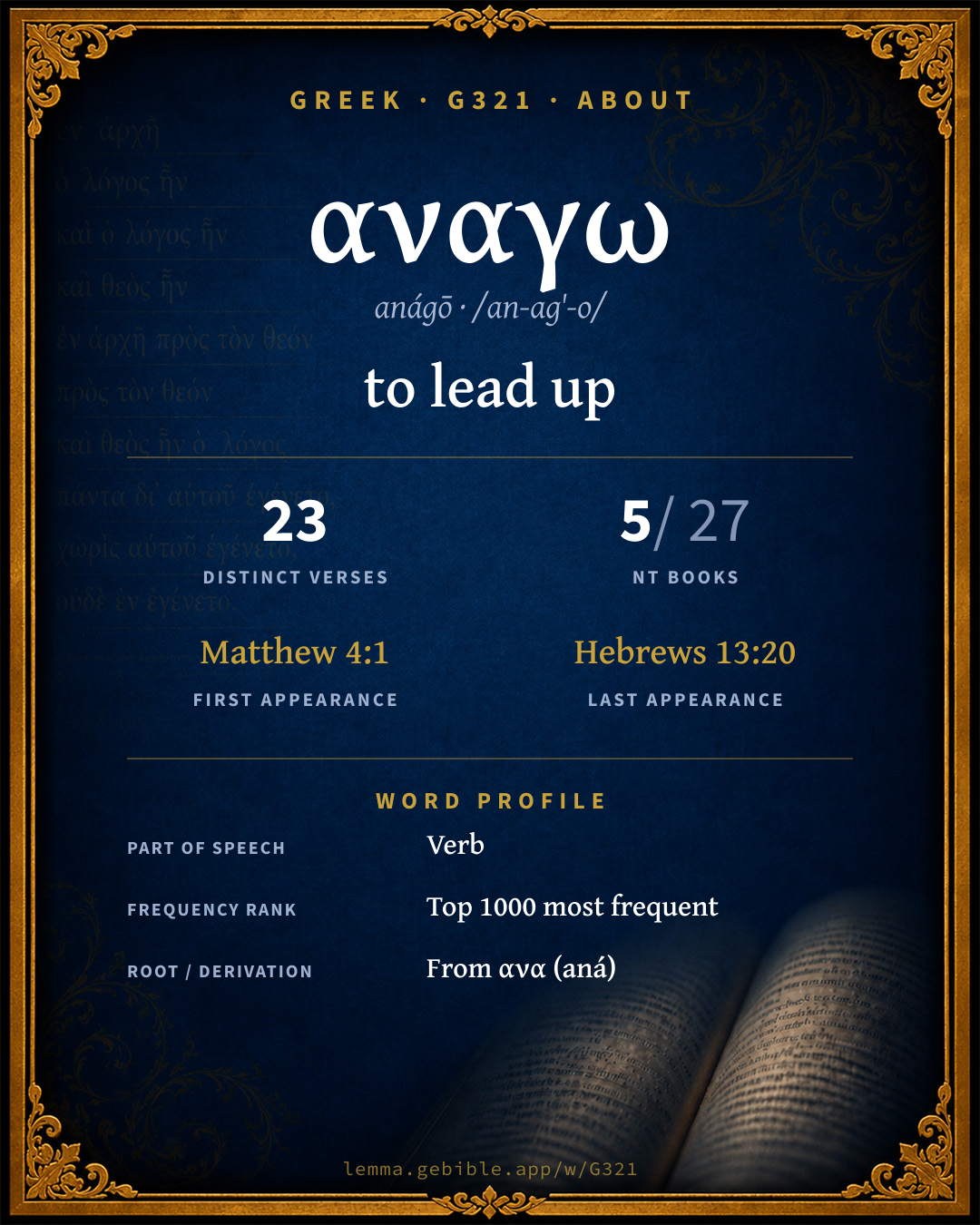
ἀνάγω
to lead up
‘to lead up’ is one of 2 main senses fuller range ↓
Full lexicon entry — Thayer's Greek Lexicon
From Thayer's Greek Lexicon
Where this word appears
See every Aorist-tense verb in the Greek New Testament →
Grammar key — what these labels mean
Part of speech
- Verb
- An action or state-of-being word.
Tense
- Aorist
- Action viewed as a simple whole, without regard to duration — often past (perfective aspect).
- Present
- Ongoing or general action in present time (imperfective aspect).
Voice
- Passive
- The subject receives the action.
- Active
- The subject performs the action.
Mood
- Indicative
- States a fact or asks a factual question (the mood of reality).
- Participle
- A verbal adjective (“writing,” “having written”).
- Infinitive
- A verbal noun (“to write”), unmarked for person or number.
Case
- Nominative
- The case of the subject (and the predicate nominative).
- Dative
- The case of the indirect object, means, or location — “to / for / with / in.”
Person
- 1st person
- The speaker (“I / we”).
- 3rd person
- The one spoken about (“he / she / it / they”).
Gender
- Masculine
- Grammatically masculine.
Number
- Plural
- More than one.
- Singular
- One.
Grammatical forms 10 distinct
- Verb, Aorist, Passive, Indicative, 1st person, Plural 4 times (17%)
- Verb, Aorist, Active, Indicative, 3rd person, Plural, Attic form 3 times (13%)
- Verb, Aorist, Active, Participle, Nominative, Singular, Masculine 3 times (13%)
- Verb, Aorist, Passive, Participle, Nominative, Plural, Masculine 3 times (13%)
- Verb, Aorist, Active, Infinitive 2 times (9%)
- Verb, Aorist, Passive, Indicative, 3rd person, Singular 2 times (9%)
- Verb, Aorist, Passive, Infinitive 2 times (9%)
- Verb, Present, Passive, Infinitive 2 times (9%)
+2 more forms (2 occurrences)
Parsed forms decoded from the imported morphology (Robinson–Tischendorf, public domain), counted across 23 parsed occurrences — not distinct verses.
Every verse where G321 appears — 23 distinct verses across 5 books. Click any verse to open its interlinear word-by-word view. Verse text shown in the World English Bible for context — . Each verse’s Greek form is shown with its reference; the English is not keyword-highlighted, since the data carries no word-level English alignment. Use “Compare translations” on any verse to read it across multiple English versions. This concordance covers the Greek New Testament; Septuagint (Greek Old Testament) occurrences of this word are not indexed here.
Matthew 1 verse
Luke 3 verses
- Luke 2:22 ἀνήγαγον aor act ind 3pl attic When the days of their purification according to the law of Moses were fulfilled, they brought him up to Jerusalem, to present him to the Lord
- Luke 4:5 ἀναγαγὼν aor act ptcp nom sg masc The devil, leading him up on a high mountain, showed him all the kingdoms of the world in a moment of time.
- Luke 8:22 ἀνήχθησαν aor pass ind 3pl Now it happened on one of those days, that he entered into a boat, himself and his disciples, and he said to them, "Let's go over to the other side of the lake." So they launched out.
Acts 17 verses
- Acts 7:41 ἀνήγαγον aor act ind 3pl attic They made a calf in those days, and brought a sacrifice to the idol, and rejoiced in the works of their hands.
- Acts 9:39 ἀνήγαγον aor act ind 3pl attic Peter got up and went with them. When he had come, they brought him into the upper chamber. All the widows stood by him weeping, and showing the coats and garments which Dorcas had made while she was with them.
- Acts 12:4 ἀναγαγεῖν aor act inf When he had arrested him, he put him in prison, and delivered him to four squads of four soldiers each to guard him, intending to bring him out to the people after the Passover.
- Acts 13:13 Ἀναχθέντες aor pass ptcp nom pl masc Now Paul and his company set sail from Paphos, and came to Perga in Pamphylia. John departed from them and returned to Jerusalem.
- Acts 16:11 Ἀναχθέντες aor pass ptcp nom pl masc Setting sail therefore from Troas, we made a straight course to Samothrace, and the day following to Neapolis;
- Acts 16:34 ἀναγαγών aor act ptcp nom sg masc He brought them up into his house, and set food before them, and rejoiced greatly, with all his household, having believed in God.
- Acts 18:21 ἀνήχθη aor pass ind 3sg but taking his leave of them, and saying, "I must by all means keep this coming feast in Jerusalem, but I will return again to you if God wills," he set sail from Ephesus.
- Acts 20:3 ἀνάγεσθαι pres pass inf When he had spent three months there, and a plot was made against him by Jews as he was about to set sail for Syria, he determined to return through Macedonia.
- Acts 20:13 ἀνήχθημεν aor pass ind 1pl But we who went ahead to the ship set sail for Assos, intending to take Paul aboard there, for he had so arranged, intending himself to go by land.
- Acts 21:1 ἀναχθῆναι aor pass inf When it happened that we had parted from them and had set sail, we came with a straight course to Cos, and the next day to Rhodes, and from there to Patara.
- Acts 21:2 ἀνήχθημεν aor pass ind 1pl Having found a ship crossing over to Phoenicia, we went aboard, and set sail.
- Acts 27:2 ἀνήχθημεν aor pass ind 1pl Embarking in a ship of Adramyttium, which was about to sail to places on the coast of Asia, we put to sea; Aristarchus, a Macedonian of Thessalonica, being with us.
- Acts 27:4 ἀναχθέντες aor pass ptcp nom pl masc Putting to sea from there, we sailed under the lee of Cyprus, because the winds were contrary.
- Acts 27:12 ἀναχθῆναι aor pass inf Because the haven was not suitable to winter in, the majority advised going to sea from there, if by any means they could reach Phoenix, and winter there, which is a port of Crete, looking northeast and southeast.
- Acts 27:21 ἀνάγεσθαι pres pass inf When they had been long without food, Paul stood up in the middle of them, and said, "Sirs, you should have listened to me, and not have set sail from Crete, and have gotten this injury and loss.
- Acts 28:10 ἀναγομένοις pres pass ptcp dat pl masc They also honored us with many honors, and when we sailed, they put on board the things that we needed.
- Acts 28:11 ἀνήχθημεν aor pass ind 1pl After three months, we set sail in a ship of Alexandria which had wintered in the island, whose sign was "The Twin Brothers."
Romans 1 verse
Hebrews 1 verse
About this entry
At a glance — auto-summarized from this page’s data, not written by a person. Every figure links to its source below. This summary describes the numbers; it doesn’t interpret them.
At its core, αναγω (anágō) means “to lead up.” Its uses cluster heavily in Acts (74% of all occurrences). With 23 verses in 5 books, it is an uncommon word in the Greek New Testament. Debuting at Matthew 4:1, it then recurs through the corpus. Thayer's distinguishes 2 senses for it. Each statement above links to its evidence; the full detail follows below.
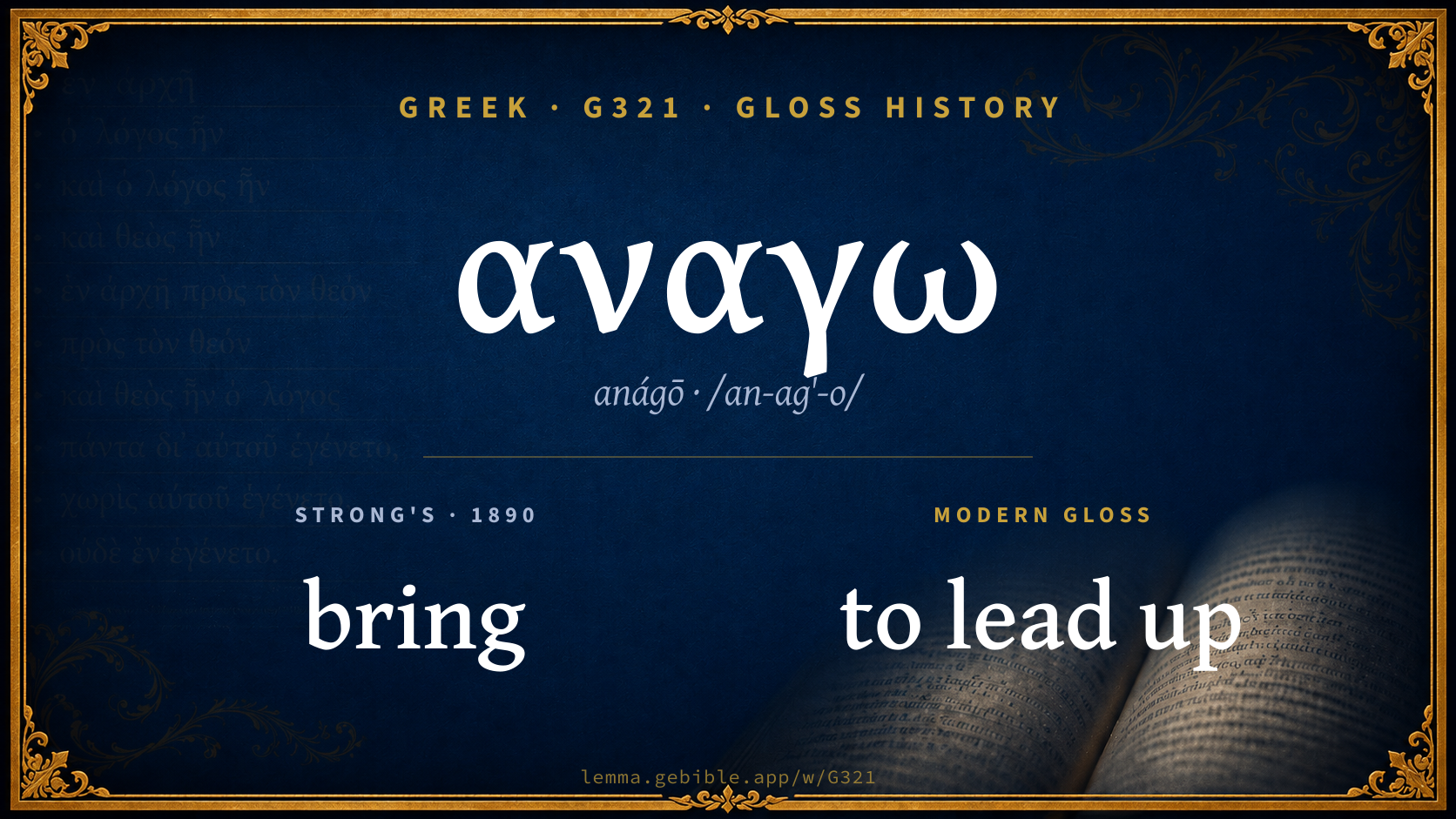
Gloss history
Strong's 1890 vs modern scholarship
About this word
Strong's G321 catalogs a Greek word from the Greek New Testament.
These counts are not copied from any lexicon or concordance. They are computed here, from the morphology-tagged Greek New Testament. What Lemma adds →
- 23
- distinct verses
- The word appears in 23 distinct verses.
- 5 / 27
- NT books
- The word appears in 5 of 27 New Testament books.
- #563
- by frequency
- Top 1000 most frequent Greek words (rank 563 of 5,347 Greek words by occurrence).
View all 23 occurrences in the concordance →
By section of the New Testament
By traditional corpus
Conventional, traditional groupings — biblical authorship is debated, so this is a traditional corpus grouping, not an authorship claim. Some books belong to more than one corpus (Luke is in both the Gospels and the Lukan corpus, and so on), so these shares overlap and need not total 100%. Each figure is a share of the word’s 23 distinct verses.
- Lukan (Luke–Acts) 20 verses · 87%
- Gospels 4 verses · 17%
- Pauline corpus 1 verse · 4%
- Hebrews 1 verse · 4%
How translations render this word
Counts come from each version’s own published word-to-Strong’s tagging or interlinear alignment — an approximate guide to how each version renders this word, not a word-level alignment the data otherwise carries. Because each total is that version’s own tagged count, the per-version totals vary from one another and need not match the appearance or distinct-verse counts above. These counts may also differ from a printed concordance because Lemma counts each distinctly tagged rendering and does not collapse phrase taggings into a single head-word total. This is a fixed set of word-tagged versions (KJV, ASV, BSB, ULT) and does not change with the reading translation you choose elsewhere. Each version’s license is shown beside its name below (and on Sources).
- King James Version: We departed 2×
- American Standard Version: Set sail 5×, We sailed 2×
- Berean Standard Bible: Sail 4×, Brought 2×, Sailed 2×
- unfoldingWord Literal Text: Up 4×, We put to sea 3×, Bring 2×
King James Version Public Domain
Renders G321 across 27 tagged occurrences — most commonly:
Plus 25 renderings that appear only once — usually multi-word phrases or single function words the recovered tagging swept in, not distinct renderings.
American Standard Version Public Domain
Renders G321 across 24 tagged occurrences — most commonly:
Plus 17 renderings that appear only once — usually multi-word phrases or single function words the recovered tagging swept in, not distinct renderings.
Berean Standard Bible Public Domain
Renders G321 across 23 tagged occurrences — most commonly:
Plus 15 renderings that appear only once — usually multi-word phrases or single function words the recovered tagging swept in, not distinct renderings.
unfoldingWord Literal Text CC BY-SA 4.0
Renders G321 across 28 tagged occurrences — most commonly:
Plus 13 renderings that appear only once — usually multi-word phrases or single function words the recovered tagging swept in, not distinct renderings.
Senses in Thayer's
The 2 senses Thayer's distinguishes for this word, in lexicon order (not ranked by frequency or importance). The full entry — with sub-senses — is in the Lexicon Entry tab.
- to lead up, to lead or bring into a higher place
- of navigators: launch out, set sail, put to sea
Word origin
Derived from ανα (aná) (G303) — among.
Forms in the corpus
The 12 distinct written forms G321 takes in the Greek New Testament, most frequent first — each parse links to that tense’s occurrences in the concordance.
Same root — word family
Other Thayer's entries built from the same root as G321, grouped by Strong’s listed origin. These share a root / origin per the lexicon — not necessarily a shared meaning. Each links to that word’s own entry.
Derives from
Shares the same root
- αναβαινω anabaínō G305 to ascend
- αναβαλλομαι anabállomai G306 to delay
- αναβιβαζω anabibázō G307 to draw up
- αναβλεπω anablépō G308 to look up
- αναβοαω anaboáō G310 to cry out
- αναγγελλω anangéllō G312 to announce
- αναγενναω anagennáō G313 to be born again
- αναγινωσκω anaginṓskō G314 to recognize
- αναγκη anánkē G318 necessity
- αναγνωριζομαι anagnōrízomai G319 to recognize
- αναδεικνυμι anadeíknymi G322 to proclaim
- αναδεχομαι anadéchomai G324 to take up
- αναδιδωμι anadídōmi G325 to give forth
- αναζαω anazáō G326 to live again
- αναζητεω anazētéō G327 to search out
- αναζωννυμι anazṓnnymi G328 to gird up
- αναζωπυρεω anazōpyréō G329 to inflame
- αναθαλλω anathállō G330 to sprout up
- αναθεωρεω anatheōréō G333 to observe
- αναιρεω anairéō G337 to take away
- ανακαθιζω anakathízō G339 to sit up
- ανακαινιζω anakainízō G340 to renew
- ανακαινοω anakainóō G341 to make new
- ανακαλυπτω anakalýptō G343 to uncover
+51 more words share this root (not shown).
Compare all same-root words → Showing 4 of 77 — not the complete family. They share a root, not necessarily a meaning.
Septuagint usage
The same Greek word αναγω appears 101 times in the Greek Old Testament (Septuagint), across 96 verses in 21 books.
- 101
- LXX occurrences
- Tagged occurrences of this Greek word in the Septuagint.
- 96
- verses
- Distinct Septuagint verses containing this word.
- 21 / 39
- OT books
- The word appears in 21 of the 39 Old Testament books.
Sample Septuagint occurrences
- Genesis 42:37 ἀναἄγω
- Exodus 8:1 ἀναἄγω
- Leviticus 11:3 ἀναἄγω
- Numbers 14:13 ἀναἄγω
- Deuteronomy 14:6 ἀναἄγω
- Joshua 7:3 ἀναἄγω
- Judges 6:8 ἀναἄγω
- 1 Samuel 2:6 ἀναἄγω
- 2 Samuel 6:2 ἀναἄγω
- 1 Kings 3:15 ἀναἄγω
- 2 Kings 2:1 ἀναἄγω
- 1 Chronicles 13:6 ἀναἄγω
Septuagint occurrences (same lexeme)
Every verse where the same Strong’s number (G321) appears in the Greek Septuagint — showing the first 50 of 96. Verse text shown in the World English Bible for context; the Greek form is the matched word — the English is not keyword-highlighted.
- Genesis 42:37 ἀναἄγω Reuben spoke to his father, saying, "Kill my two sons, if I don't bring him to you. Deliver him into my hand, and I will bring him to you again."
- Genesis 50:24 ἀναἄγω Joseph said to his brothers, "I am dying, but God will surely visit you, and bring you up out of this land to the land which he swore to Abraham, to Isaac, and to Jacob."
- Exodus 8:1 ἀναἄγω Yahweh spoke to Moses, Go in to Pharaoh, and tell him, "This is what Yahweh says, 'Let my people go, that they may serve me.
- Exodus 8:2 ἀναἄγω If you refuse to let them go, behold, I will plague all your borders with frogs:
- Exodus 8:3 ἀναἄγω and the river shall swarm with frogs, which shall go up and come into your house, and into your bedchamber, and on your bed, and into the house of your servants, and on your people, and into your ovens, and into your kneading-troughs:
- Exodus 10:14 ἀναἄγω The locusts went up over all the land of Egypt, and rested in all the borders of Egypt. They were very grievous. Before them there were no such locusts as they, neither after them shall be such.
- Exodus 33:12 ἀναἄγω Moses said to Yahweh, "Behold, you tell me, 'Bring up this people:' and you haven't let me know whom you will send with me. Yet you have said, 'I know you by name, and you have also found favor in my sight.'
- Exodus 33:15 ἀναἄγω He said to him, "If your presence doesn't go with me, don't carry us up from here.
- Leviticus 11:3 ἀναἄγω Whatever parts the hoof, and is cloven-footed, and chews the cud among the animals, that you may eat.
- Leviticus 11:4 ἀναἄγω "'Nevertheless these you shall not eat of those that chew the cud, or of those who part the hoof: the camel, because he chews the cud but doesn't have a parted hoof, he is unclean to you.
- Leviticus 11:5 ἀναἄγω The coney, because he chews the cud but doesn't have a parted hoof, he is unclean to you.
- Leviticus 11:6 ἀναἄγω The hare, because she chews the cud but doesn't part the hoof, she is unclean to you.
- Leviticus 11:7 ἀναἄγω The pig, because he has a split hoof, and is cloven-footed, but doesn't chew the cud, he is unclean to you.
- Leviticus 11:45 ἀναἄγω For I am Yahweh who brought you up out of the land of Egypt, to be your God. You shall therefore be holy, for I am holy.
- Numbers 14:13 ἀναἄγω Moses said to Yahweh, Then the Egyptians will hear it; for you brought up this people in your might from among them;
- Numbers 16:13 ἀναἄγω is it a small thing that you have brought us up out of a land flowing with milk and honey, to kill us in the wilderness, but you must needs make yourself also a prince over us?
- Numbers 20:4 ἀναἄγω Why have you brought the assembly of Yahweh into this wilderness, that we should die there, we and our animals?
- Numbers 20:5 ἀναἄγω Why have you made us to come up out of Egypt, to bring us in to this evil place? it is no place of seed, or of figs, or of vines, or of pomegranates; neither is there any water to drink.
- Deuteronomy 14:6 ἀναἄγω Every animal that parts the hoof, and has the hoof cloven in two, [and] chews the cud, among the animals, that may you eat.
- Deuteronomy 14:7 ἀναἄγω Nevertheless these you shall not eat of them that chew the cud, or of those who have the hoof cloven: the camel, and the hare, and the rabbit; because they chew the cud but don't part the hoof, they are unclean to you.
- Joshua 7:3 ἀναἄγω They returned to Joshua, and said to him, Don't let all the people go up; but let about two or three thousand men go up and strike Ai; don't make all the people to toil there; for they are but few.
- Joshua 7:24 ἀναἄγω Joshua, and all Israel with him, took Achan the son of Zerah, and the silver, and the mantle, and the wedge of gold, and his sons, and his daughters, and his oxen, and his donkeys, and his sheep, and his tent, and all that he had: and they brought them up to the valley of Achor.
- Joshua 24:17 ἀναἄγω for Yahweh our God, he it is who brought us and our fathers up out of the land of Egypt, from the house of bondage, and who did those great signs in our sight, and preserved us in all the way in which we went, and among all the peoples through the midst of whom we passed;
- Joshua 24:32 ἀναἄγω The bones of Joseph, which the children of Israel brought up out of Egypt, buried they in Shechem, in the parcel of ground which Jacob bought of the sons of Hamor the father of Shechem for a hundred pieces of money: and they became the inheritance of the children of Joseph.
- Judges 6:8 ἀναἄγω that Yahweh sent a prophet to the children of Israel: and he said to them, Thus says Yahweh, the God of Israel, I brought you up from Egypt, and brought you forth out of the house of bondage;
- Judges 6:13 ἀναἄγω Gideon said to him, Oh, my lord, if Yahweh is with us, why then has all this happened to us? and where are all his wondrous works which our fathers told us of, saying, Did not Yahweh bring us up from Egypt? but now Yahweh has cast us off, and delivered us into the hand of Midian.
- 1 Samuel 2:6 ἀναἄγω Yahweh kills, and makes alive: He brings down to Sheol, and brings up.
- 1 Samuel 6:21 ἀναἄγω They sent messengers to the inhabitants of Kiriath Jearim, saying, The Philistines have brought back the ark of Yahweh; come you down, and bring it up to you.
- 1 Samuel 7:1 ἀναἄγω The men of Kiriath Jearim came, and fetched up the ark of Yahweh, and brought it into the house of Abinadab in the hill, and sanctified Eleazar his son to keep the ark of Yahweh.
- 1 Samuel 8:8 ἀναἄγω According to all the works which they have done since the day that I brought them up out of Egypt even to this day, in that they have forsaken me, and served other gods, so do they also to you.
- 1 Samuel 10:18 ἀναἄγω and he said to the children of Israel, Thus says Yahweh, the God of Israel, I brought up Israel out of Egypt, and I delivered you out of the hand of the Egyptians, and out of the hand of all the kingdoms that oppressed you:
- 1 Samuel 12:6 ἀναἄγω Samuel said to the people, It is Yahweh who appointed Moses and Aaron, and that brought your fathers up out of the land of Egypt.
- 1 Samuel 28:8 ἀναἄγω Saul disguised himself, and put on other clothing, and went, he and two men with him, and they came to the woman by night: and he said, Please divine to me by the familiar spirit, and bring me up whoever I shall name to you.
- 1 Samuel 28:11 ἀναἄγω Then said the woman, Whom shall I bring up to you? He said, Bring me up Samuel.
- 2 Samuel 6:2 ἀναἄγω David arose, and went with all the people who were with him, from Baale Judah, to bring up from there the ark of God, which is called by the Name, even the name of Yahweh of Hosts who sits [above] the cherubim.
- 2 Samuel 6:12 ἀναἄγω It was told king David, saying, Yahweh has blessed the house of Obed-edom, and all that pertains to him, because of the ark of God. David went and brought up the ark of God from the house of Obed-edom into the city of David with joy.
- 2 Samuel 6:15 ἀναἄγω So David and all the house of Israel brought up the ark of Yahweh with shouting, and with the sound of the trumpet.
- 2 Samuel 7:6 ἀναἄγω for I have not lived in a house since the day that I brought up the children of Israel out of Egypt, even to this day, but have walked in a tent and in a tent.
- 1 Kings 3:15 ἀναἄγω Solomon awoke; and, behold, it was a dream: and he came to Jerusalem, and stood before the ark of the covenant of Yahweh, and offered up burnt offerings, and offered peace-offerings, and made a feast to all his servants.
- 1 Kings 9:9 ἀναἄγω and they shall answer, Because they forsook Yahweh their God, who brought forth their fathers out of the land of Egypt, and laid hold on other gods, and worshiped them, and served them: therefore has Yahweh brought all this evil on them.
- 1 Kings 10:22 ἀναἄγω For the king had at sea a navy of Tarshish with the navy of Hiram: once every three years came the navy of Tarshish, bringing gold, and silver, ivory, and apes, and peacocks.
- 1 Kings 12:28 ἀναἄγω Whereupon the king took counsel, and made two calves of gold; and he said to them, It is too much for you to go up to Jerusalem: see your gods, Israel, which brought you up out of the land of Egypt.
- 1 Kings 18:44 ἀναἄγω It happened at the seventh time, that he said, "Behold, a small cloud, like a man's hand, is rising out of the sea." He said, Go up, tell Ahab, Make ready [your chariot], and get you down, that the rain not stop you.
- 2 Kings 2:1 ἀναἄγω It happened, when Yahweh would take up Elijah by a whirlwind into heaven, that Elijah went with Elisha from Gilgal.
- 2 Kings 10:24 ἀναἄγω They went in to offer sacrifices and burnt offerings. Now Jehu had appointed him eighty men outside, and said, If any of the men whom I bring into your hands escape, [he who lets him go], his life shall be for the life of him.
- 2 Kings 17:7 ἀναἄγω It was so, because the children of Israel had sinned against Yahweh their God, who brought them up out of the land of Egypt from under the hand of Pharaoh king of Egypt, and had feared other gods,
- 2 Kings 17:36 ἀναἄγω but Yahweh, who brought you up out of the land of Egypt with great power and with an outstretched arm, him shall you fear, and to him shall you bow yourselves, and to him shall you sacrifice:
- 2 Kings 23:8 ἀναἄγω He brought all the priests out of the cities of Judah, and defiled the high places where the priests had burned incense, from Geba to Beersheba; and he broke down the high places of the gates that were at the entrance of the gate of Joshua the governor of the city, which were on a man's left hand at the gate of the city.
- 1 Chronicles 13:6 ἀναἄγω David went up, and all Israel, to Baalah, [that is], to Kiriath Jearim, which belonged to Judah, to bring up from there the ark of God Yahweh that sits [above] the cherubim, that is called by the Name.
- 1 Chronicles 15:25 ἀναἄγω So David, and the elders of Israel, and the captains over thousands, went to bring up the ark of the covenant of Yahweh out of the house of Obed-edom with joy.
These are occurrences of the same Greek lexeme (G321) in the Septuagint — not a translation of any one Hebrew word. The store carries no word-level Hebrew↔Greek alignment, so no Hebrew original is asserted here. Counts come from the recovered LXX Strong's tagging — high-frequency vocabulary is well covered, while rare or late forms may be untagged — so they reflect tagged occurrences and may slightly undercount.