
Ephesians 4:8

Greek (Tischendorf 8th ed.) Ephesians 4:8 appears in the Greek New Testament. The text above is from the Tischendorf 8th edition. Each word links to its Strong’s number and a concise gloss. Click any word for its full Thayer’s Greek Lexicon entry.
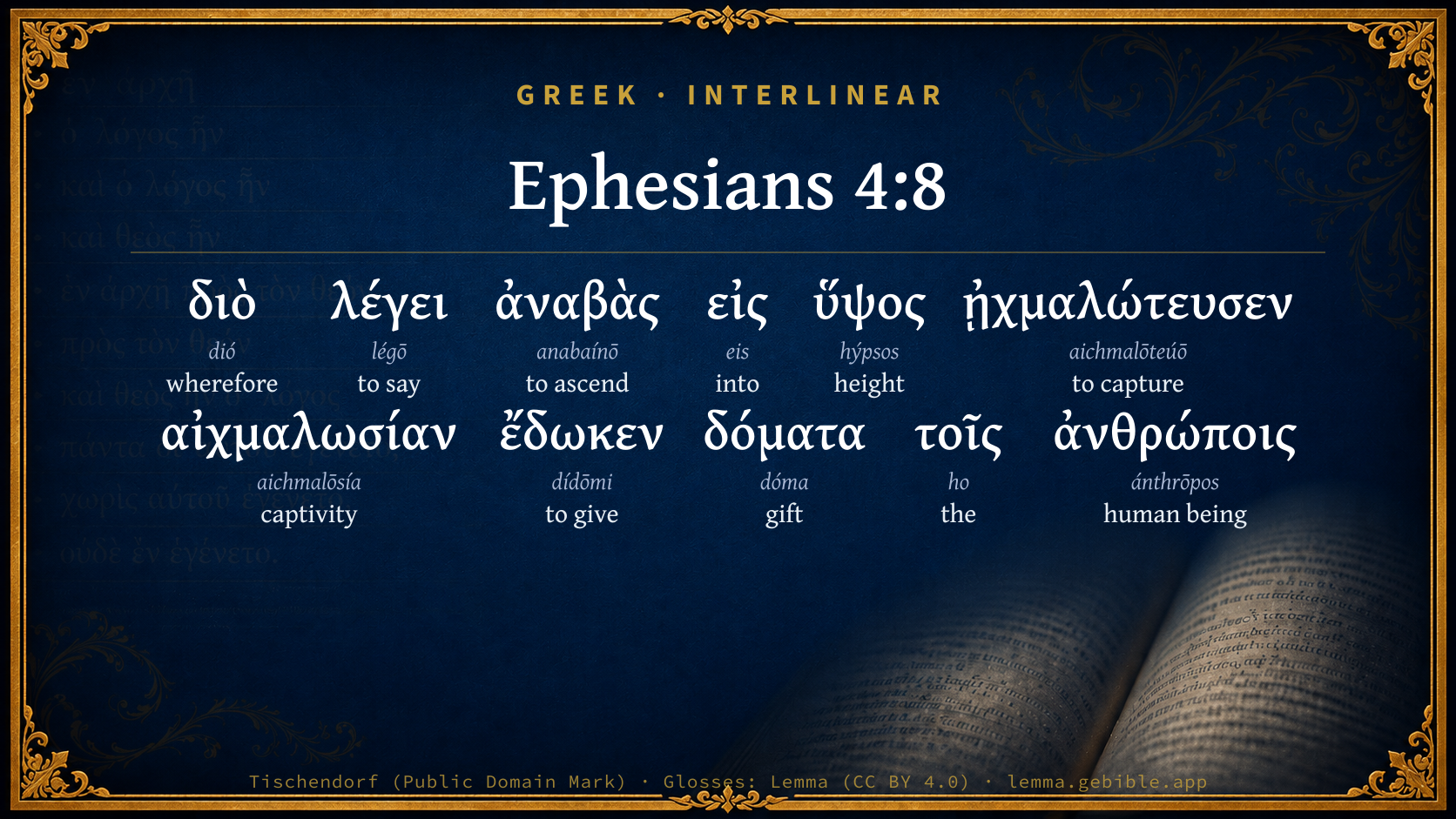
Download image
Cite this verse

Ephesians 4:8 (World English Bible). Public Domain. Lemma interlinear Bible study tool, https://lemma.gebible.app/v/ephesians/4/8.

Show BibTeX & RIS
BibTeX
RIS
English Translation
Therefore he says, "When he ascended on high, he led captivity captive, and gave gifts to men."
World English Bible · Public Domain
Highlights
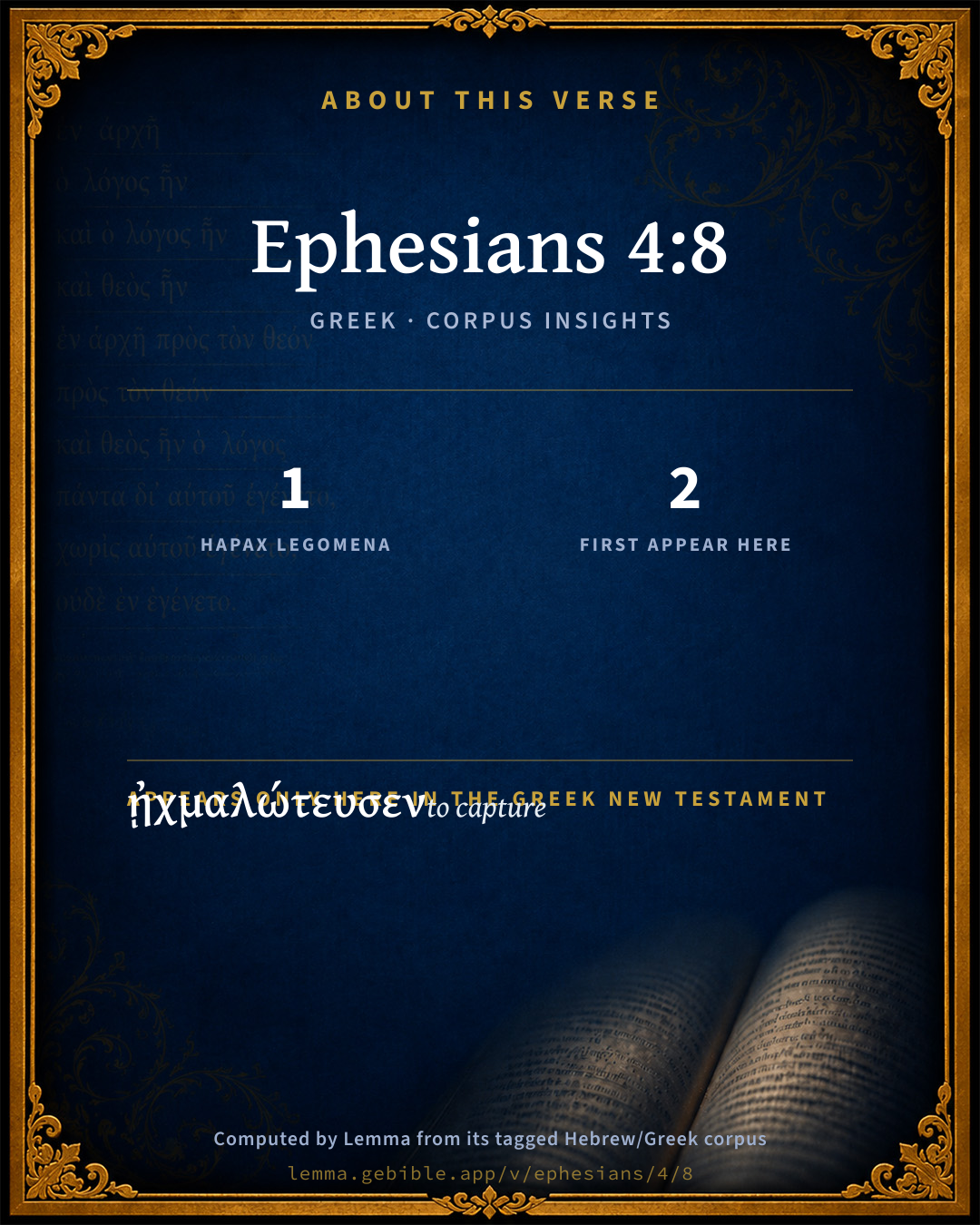
  • 1 hapax legomenon — only here in the Greek New Testament
  • 2 first appearances in the Greek New Testament
Full analysis ↓
Download a study sheet

One document with this verse’s original text, its word-by-word gloss line, the meaning frame, cross-references with their text, attributed commentary, and full source and license credits — printable, and it pastes into notes with its structure intact.

This verse Autodidact and up

Study sheet (.html) Plain text (.txt)

A passage Seminary Student

Up to 50 verses in one chapter. A passage sheet keeps up to 6 commentary sources and 12 cross-references per verse, in the order this page ranks them, and says so on the sheet whenever that leaves anything out. Ask for a single verse and you get the Autodidact verse sheet above.

Everything on this page stays free to read, with no account — the sheet is a download of what is already on screen, not access to it.

Want to remove ads? Support Godless Engineer
Compare translations 3

The same verse in 3 English versions, stacked beneath the original-language interlinear above. Click any original word for its lexicon entry.

Each is an independent rendering of the whole verse — the interlinear is not word-aligned to these translations.

Highlighted words mark where these versions differ — a whole-verse word diff, not a word-by-word alignment.

  • World English Bible Public Domain
    Therefore he says, "When he ascended on high, he led captivity captive, and gave gifts to men."
  • King James Version Public Domain
    Wherefore he saith, When he ascended up on high, he led captivity captive, and gave gifts unto men.
  • unfoldingWord Literal Text CC BY-SA 4.0
    Therefore it says: “Having ascended to the heights, he led captives into captivity, he gave gifts to men.”

unfoldingWord Literal Text — © unfoldingWord, licensed CC BY-SA 4.0. Word-aligned USFM3 via Door43 (git.door43.org/unfoldingWord/en_ult).

Versions to compare (up to 4)

3 of 4 selected

Show all 19 translations

Every available English version of this verse, each an independent rendering of the whole verse.

  • World English Bible Public Domain
    Therefore he says, "When he ascended on high, he led captivity captive, and gave gifts to men."
  • Berean Standard Bible Public Domain
    This is why it says: “When He ascended on high, He led captives away, and gave gifts to men.”
  • Majority Standard Bible Public Domain
    This is why it says: “When He ascended on high, He led captives away, and gave gifts to men.”
  • King James Version Public Domain
    Wherefore he saith, When he ascended up on high, he led captivity captive, and gave gifts unto men.
  • American Standard Version (1901) Public Domain
    Wherefore he saith, When he ascended on high, he led captivity captive, And gave gifts unto men.
  • Revised Version (1885) Public Domain
    Wherefore he saith, When he ascended on high, he led captivity captive, And gave gifts unto men.
  • Geneva Bible (1599) Public Domain
    Wherfore he saith, Whe he asceded vp on hie, he led captiuity captiue, and gaue gifts vnto men.
  • Douay-Rheims (1899) Public Domain
    Wherefore he saith: Ascending on high, he led captivity captive; he gave gifts to men.
  • Young's Literal Translation Public Domain
    wherefore, he saith, `Having gone up on high he led captive captivity, and gave gifts to men,' --
  • Literal Standard Version CC BY-SA 4.0
    for this reason, it says, “Having gone up on high He led captive captivity, and gave gifts to men.”
  • Unlocked Literal Bible CC BY-SA 4.0
    It is as scripture says: “When he ascended to the heights, he led the captives into captivity, and he gave gifts to the people.”
  • unfoldingWord Literal Text CC BY-SA 4.0
    Therefore it says: “Having ascended to the heights, he led captives into captivity, he gave gifts to men.”
  • Darby Bible Public Domain
    Wherefore he says, Having ascended up on high, he has led captivity captive, and has given gifts to men.
  • World Messianic Bible Public Domain
    Therefore he says, “When he ascended on high, he led captivity captive, and gave gifts to people.”
  • Webster's Bible Public Domain
    Wherefore he saith, When he ascended on high, he led captivity captive, and gave gifts to men.
  • Free Bible Version CC BY-SA 4.0
    As Scripture says, “When he ascended to the heights he took captives with him, and gave gifts to humanity.”
  • Bible in Basic English Public Domain
    For this reason he says, He went up on high, taking his prisoners with him, and gave freely to men.
  • Text-Critical English NT CC BY 4.0
    Therefore it says, “When he ascended on high, he led captivity captive and gave gifts to men.”
  • Tyndale New Testament (1534) Public Domain
    Wherfore he sayth: He is gone vp an hye and hath ledde captivitie captive and hath geven gyftes vnto men.

Literal Standard Version (2020), Covenant Press — licensed CC BY-SA 4.0. Text via the HelloAO Bible API (eBible.org). Unlocked Literal Bible (unfoldingWord) — licensed CC BY-SA 4.0. Text via the HelloAO Bible API (eBible.org). unfoldingWord Literal Text — © unfoldingWord, licensed CC BY-SA 4.0. Word-aligned USFM3 via Door43 (git.door43.org/unfoldingWord/en_ult). Free Bible Version, Dr. Jonathan Gallagher — licensed CC BY-SA 4.0. Text via the HelloAO Bible API (eBible.org).

Word by word

More ways to search: Search by grammar → Find every occurrence → Compare this word →

Practice this passage: Drill this verse → Learn its vocabulary →

About this verse

These counts appear in no published source. They are computed here, from the morphology-tagged text and Lemma’s own curated glosses. What Lemma adds →

11
words
11
distinct lemmas
Pauline Epistles
section

Notable vocabulary

1 hapax legomenon — a word that appears only here in the entire Greek New Testament:

  • ᾐχμαλώτευσεν to capture G162

First appearance in Scripture

These words make their first canonical appearance in the Greek New Testament here:

  • ᾐχμαλώτευσεν to capture G162
  • αἰχμαλωσίαν captivity G161

Shared distinctive vocabulary

αἰχμαλωσίαν captivity G161 occurs in 2 verses of the Greek New Testament. Also found in:
Cross-references

2

Topical passages linked to Ephesians 4:8 in the Treasury of Scripture Knowledge — connected by theme and wording, ordered by reader-vote popularity; previews shown in the World English Bible.

  • Psalms 68:18 You have ascended on high. You have led away captives. You have received gifts among men, Yes, among the rebellious also, that Yah God might dwell there.
  • Colossians 2:15 having stripped the principalities and the powers, he made a show of them openly, triumphing over them in it.

Cross-references courtesy of OpenBible.info (CC BY 4.0).

Commentary

Notes on Ephesians 4:8 from classic Christian and Jewish commentators (each source and its license shown beneath its notes). The classic Christian expositions comment on the surrounding passage and are grouped to its opening verse, so a note may address several verses; the Jewish commentaries on the Tanakh (Rashi and others) are per-verse, so they appear only where the commentator wrote on this verse.

Lemma curates 59 commentaries, every one of them public domain or Creative Commons licensed, each selected and text-cleaned for this edition rather than reprinted as found. About our sources →

The Biblical Illustrator

Joseph S. Exell

Eph_4:8

Wherefore He saith, when He ascended up on high, He led captivity captive, and gave gifts unto men.

The glory of the ascended Christ

I. The ascension of Christ secured and declared His triumph.

1. The glory of Christ was foreshadowed by the triumphal procession of Jehovah to Zion.

(1) The captives of the Lord of salvation: the redeemed; sin; death; Satan.

(2) The riches of the Lord of salvation: gifts, not of gold, etc., but of spiritual life, endowment, and reward.

2. The descent and ascension of Christ reveal the universal character of His triumph. There is no sphere of the universe He did not enter, and there is nothing that remains unaffected by His influence.

II. The gifts conferred upon Christians and exercised in the Church are a portion of the glory of the ascended Lord. Instead of fretting at the manifold distinctions of the Christian ministry, we ought to look upon these as showing forth the unspeakable fulness and glory of Jesus Christ. The varied functions of the ministry, and the private gifts of the membership, are signs not of weakness, but of all-conquering power, and they all emanate from the one Lord. The rich variety of nature is surpassed by the more significant and glorious variety of grace. (A. E. Muir, M. A.)

The ascension of Christ

I. The fact of Christs ascension.

1. It should afford us supreme joy to remember that He who descended into the lower parts of the earth has now ascended up far above all heavens. Shame is swallowed up in glory, pain is lost in bliss, death in immortality. Well deserves the Warrior to receive glory, for He has dearly won it (Psa_6:8).

2. Reflect yet again that from the hour our Lord left it, this world has lost all charms to us. If He were in it, there were no spot in the universe which would hold us with stronger ties; but since He has gone up He draws us upward from it. The flower is gone from the garden, the first ripe fruit is gathered. Earths crown has lost its brightest jewel, the star is gone from the night, the dew is exhaled from the morning, the sun is eclipsed at noon. Joseph is no more in Egypt, and it is time for Israel to be gone. No, earth, my treasure is not here with thee, neither shall my heart be detained by thee.

3. We must henceforth walk by faith, and not by sight. Jesus is no more seen of human eyes; and it is well, for faiths sight is saving, instructing, transforming, and mere natural sight is not so.

4. Reflect how secure is our eternal inheritance now that Jesus has entered into the heavenly places. Our heaven is secured to us, for it is in the actual possession of our legal representative, who can never be dispossessed of it.

II. The triumph of the ascension (see Psa_24:1-10; Psa_68:1-35).

1. Our Lords Ascension was a triumph over the world, He had passed through it unscathed by its temptations; He had been solicited on all hands to sin, but His garments were without spot or blemish. He rises above all, for He is superior to all. As the world could not injure His character by its temptations, so no longer could it touch His person by its malice.

2. There, too, He led captive sin. Evil had assailed Him furiously, but it could not defile Him.

3. Death also was led in triumph. Death had bound Him, but He snapped each fetter, and bound death with his own cords. Our Saviours ascension in that same body which descended into the lower parts of the earth is so complete a victory over death, that every dying saint may be sure of immortality, and may leave his body behind without fear that it shall forever abide in the vaults of the grave.

4. So, too, Satan was utterly defeated!

5. Brethren in Christ, everything that makes up our captivity Christ has led captive. Moral evil He has defeated, the difficulties and trials of this mortal life He has virtually overcome.

III. We may now turn to consider the gifts of the ascension. The blessings which come to us through the ascension are for the perfecting of the saints, for the work of the ministry, for the edifying of the body of Christ: till we all come in the unity of the faith, and of the knowledge of the Son of God, unto a perfect man, unto the measure of the stature of the fulness of Christ. Observe next, that these filling blessings of the ascension are given to all the saints. Does not the first verse of our text say: Unto every one of us is given grace according to the measure of the gift of Christ. The Holy Spirit is the particular benediction of the ascension, and the Holy Spirit is in measure given to all truly regenerated persons. Trace all gospel success to the ascended Saviour. Look to Christ for more successful workers. As they come, receive them from His hands; when they come, treat them kindly as His gifts, and daily pray that the Lord will send to Zion mighty champions of the faith.

IV. We shall conclude by noticing the bearing of our Lords ascension unto sinners. He received gifts for men; yea, for the rebellious also. When the Lord went back to His throne He had thoughts of love towards rebels still. (C. H. Spurgeon.)

The ascension of Christ

Having spoiled His enemies on the cross, He further makes a public triumphal show of them in His own person, which is a second act; as the manner of the Roman emperors was, in their great triumph, to ride through the city in the greatest state, and have all the spoils carried before them, and the kings and nobles, whom they had taken; and this did Christ at His ascension, plainly manifesting, by His open show of them, that He had spoiled and fully subdued them. (T. Goodwin.)

Gifts for men

It was the custom of the Roman emperors at their triumphal entrance to cast new coins among the multitudes; so doth Christ, in His triumphal ascension into heaven, throw the greatest gifts for the good of men that were ever given. (T. Goodwin.)

Ascension of Christ

Must the sun need come to us, or else cannot his heat and light profit us? Nay, it doth us more good, because it is so far off: so this Sun is gone from as, that He may give more light to us, which made Him say, It is good for you that I go from you. Therefore, away with this carnal eating of spiritual things. (Henry Smith.)

Diversity of gifts

Everyone hath some excellency or other in him, can we but find and improve it. God hath dispensed His gifts diversely, for the common benefit. And as, in the same pasture, the ox can find fodder, the hound a hare, the stork a lizard, the fair maid flowers; so there is none so worthless, but something may be made of him; some good extracted out of the unlikeliest. Yea, wisdom is such an elixir, as by contraction (if there be any disposition of goodness in the same metal) it will render it of the property. (John Trapp.)

Captivity captured

Two things are referred to in these words, as following from the ascension of Christ into heaven. One has reference to the manifest accomplishment of His work in the fact of His ascension; the other is a statement of what He does in consequence of that success--not resulting from it, but as the expression of His goodwill on the occasion of His success.

I. Christ overcame those special foes which He came to earth to encounter.

II. Having overcome them, He still holds them in His power. He lives now; He has taken His place before God; there He waits. He waited once before till the fulness of time came; He waits now till the appointed season comes. He has not let His prisoners free; He had not let them go out of His hand.

III. Christ bestows a special gift on men that they may share in His victory. He gave gifts in the shape of apostles, pastors, teachers, and so on, for the definite purpose of carrying on His work--the perfecting of the saints. He thus bestows, not spoils which He has gained from His enemies, but the special gift of His own favour.

IV. But one more very important thought. Who shall thus not only share with Him. The spoils, but enjoy the free gift of Christ? Why, those who follow Him. (H. W. Butcher.)

Christs ascension

I. The exaltation of Christ. His work was done, and therefore He ascended up on high in His official capacity.

II. The achievements of Christ. When He ascended up on high, He led captivity captive. Look at the expression captivity. Then it seems that the souls for whom He bled and suffered were captives; the prophet calls them lawful captives, and the prey of the terrible. What! lead them captives again? Some may be inclined to say, Oh, its only being transferred from one captivity to another. First, He overcomes them by grace, and then He leads them captive into His blessed and glorious captivity, and leads them to say, We were in captivity to Satans malice once; the old serpent held us fast once, but now we are in captivity to the Lord Jesus Christ, to His love, to His sway, to His sovereignty; with His three-fold cord in our hearts, fixed and twined completely round our affections.

III. The treasures that Christ distributes. How grand and glorious is the catalogue of the gifts He gives to believers! He has given all gifts. He never made a saving or exception of any. There is no limit to His bounty. Everything in Christianity is the free gift of God. He gave gifts to men. In order to condense here as much as I can, I shall classify a little, and just observe, in the first place, the first gift bestowed after His ascension. If I go not away, the Comforter will not come; but if I go away, I will send Him to you, and when He is come He shall teach you all things, and bring all things to your remembrance. So that this is the first ascension gift. Oh, what an amazing gift! There is another gift that we must mention. When He ascended up on high, He gave the gift of imputed righteousness to those new-created souls of whom the Holy Ghost became the Teacher. (J. Irons.)

The purpose of Christs gifts

I. Christ gave special gifts, in order that through an endless diversity of lives and works and thoughts, we may be all united to one another in one Body, pervaded and animated by one Spirit. The first grand object in our Lords mind was and is union among men, union with God. As a rule we value ourselves on our diversities. And that without ever asking ourselves, Why am I different? God makes nothing in vain. If He has made me different from my friend in some point of character, it is surely that I may supply something in him; that he and I together may effect something for each other and for others which separately could not be accomplished.

II. The gifts of Christ to us are directed to producing in us steadiness of character through reality. We are to measure ourselves and our opportunities truly, and to get rid of self-deceptions.

1. How common it is for earnest persons to fancy that a wide gulf exists between their capacities for doing Gods service and the opportunities which He affords them! Is not this in reality a very specious form of murmuring against God? We need to use earnest prayer for nothing more than a true faculty of vision.

2. Another and very lowering habit of mind and life which interferes still more with that steadiness through reality of which we are in quest, is what I may venture to call frivolity in the very discharge of earnest duty. There are many most noble occupations which ought to have an inspiring power, that are not glorified at all by those who use them, and that seem to haw no elevating effect on them. Now, one cause of this is to be found in secret impurities of the thought and imagination of the heart. Nothing so protects a man--awful thought! from the influence of Gods Spirit; nothing so certain to prevent his acquiring that steadiness which truth of knowledge and truth of thought and of will bring with them. But second only to this in its miserable blighting effect, is to approach earnest duties in a frivolous, light, unprayerful spirit.

III. The third object of Christ in giving us gifts from heaven is, that we may grow in spiritual strength by living lives of spiritual activity. (Archbishop Benson.)

The gifts of Christ to His Church

I. The nature of the gift. It was--

1. A gift of men. Not merely a record, but a living voice speaking to living men.

2. A varied gift. Variety in unity, shown--

(1) By distinct offices.

(2) By individual characteristics.

II. The object of the gift. For the perfecting of the saints, etc., shown--

1. By enabling them better to discharge their ministry. Christs own life of service our pattern (Mat_20:28).

2. By edifying Christs body.

III. The ultimate end. Till we all come, etc., The end is perfect conformity to Christ, the perfect Man. The means--knowledge of the Son of God (Joh_17:3); full knowledge hereafter (Eph_3:19; Php_3:10; 1Co_13:12). Practical application:

1. Consider the priceless blessing the Gospels have been. Charter of our faith (Luk_1:1-4). Christs own gift by His Spirit (Joh_14:26).

2. Are we ourselves becoming like Christ our Pattern? This the practical object. A Church of living stones--true disciples of the Master. (A. C. Hellicar, M. A.)

Jesus gives mercy

When the Duke of Argyll was taken before James II to receive sentence for the part he had taken in the rebellion in Scotland, the king said to him, You know that it is in my power to pardon you. The duke, who knew the king well, replied faithfully, It may be in your power, but it is not in your nature, and he was led forth to prison and death. It is not so with King Immanuel. He who says, All power is given unto Me both in heaven and in earth, is the same who says, Him that cometh to Me I will in nowise cast out. (R. Brewin.)

The Conquerors gifts

As in the Roman triumphs the victor ascended up to the capitol in a chariot of state, (the prisoners following on foot with their hands bound behind) and threw certain pieces of coin abroad to be picked up by the common people; so Christ in the day of His solemn inauguration into His heavenly kingdom triumphed over sin, death, and hell, and gave gifts unto men. (J. Trapp.)

Gifts for the rebellious

Mr. Moody tells us how his elder brother ran away from home soon after their fathers death, and the absence of the beloved boy was the perpetual grief of his mothers heart. She waited years and years for a letter from the wanderer, but none came. Long years had rolled away, and the mothers hair had grown grey, when, one summers afternoon, a sunburnt man was seen coming into the gate at Northfield. He knocked at the door. The mother went and opened the door, and invited the stranger in. He held back for a moment, until the tears started, and he exclaimed, No, mother, I will not come in until you forgive me! He did not stand there long. Her big motherly heart rejoiced more over the returning prodigal than over all of the boys that had never run away. Jesus keeps no sinner waiting outside His open door. The forgiveness of a lifetimes sin is the very first boon to the hungry penitent. (T. L. Cuyler, D. D.)

The Biblical Illustrator, edited by Joseph S. Exell (c. 1880s–1900s) — public domain. Text from a community e-Sword module.

Tyndale Open Study Notes

Tyndale Open Resources

4:8 He led a crowd of captives may refer to Christ’s victory over spiritual powers (see 1:21-22; Col 2:15), or to his capture of disobedient sinners and making them believers through the power of the Good News message. • Christ gave gifts to his people (see Eph 4:11-12).

Tyndale Open Study Notes — © Tyndale Open Resources, licensed CC BY-SA 4.0. Text via the HelloAO Bible API.

Bengel's Gnomon

Johann Albrecht Bengel

Eph 4:8. Λεγει, he says) David, nay, rather God Himself, Psalms 68 :(19) 20, ἀνέβης εἰς ὓψος, ἠχμαλώτευσας αἰχμαλωσίαν· ἔλαβες δόματα ἐν ἀνθρώπῳ. Some also in the LXX. read ἀναβάς. But in the version of the LXX. that reading is generally inferior, which too closely agrees with the text of the New Testament, because it has been (probably) made to be in conformity to it.—ὕψος, on high) So the heavens are called in Hebrew poetry; likewise in Isa 32:15.—ἠχμαλώτευσε αἰχμαλωσίαν, led captivity captive) A frequent repetition; for example, 2Ch 28:5. Here the forces of hell are denoted, 2Pe 2:4, that are opposed to men. Christ, at His ascension, led them captive; nor, however, does it fare the better for that reason with the malefactor, who is to be tried for his life, when he is led from prison to the forum or court of justice. This leading captive did not interfere with their condition in hell; [it gave them no respite from torment.] If ever there had been for them any hope of escape, that would have been the time; comp. ch. Eph 6:12, and Col 2:15. Nor does every ascension, but only the ascension which has captivity taken captive joined with it, presuppose and infer a descent into the lower parts of the earth.—ἔδωκε δόματα, He gave gifts) To this expression may be referred He gave, Eph 4:11, and is given, and of the gift, Eph 4:7. In Hebrew, לקחת is an abbreviated expression; to wit, Christ received gifts, which He might immediately give. Comp. לקח, Gen 15:9 [“Take me an heifer,” abbreviated for, Take and sacrifice to me]; 2Ki 2:20; where sudden action is denoted by a concise expression; so λαβέτωσάν σοι, Exo 27:20; Lev 24:2.—τοῖς ἀνθρώποις, for men) The dative of advantage for באדם. Gifts are of advantage, not only to those who receive them, but to all.

Bengel's Gnomon of the New Testament — English translation (T&T Clark, Edinburgh, 1860) — public domain. Text from a community e-Sword module.

Meyer's Critical & Exegetical Commentary

Heinrich August Wilhelm Meyer

Eph_4:8. If it had just been said that by Christ the endowment of grace was distributed in varied measure to each individual, this is now confirmed by a testimony of the Scripture. Nothing is to be treated as a parenthesis, inasmuch as neither course of thought nor construction is interrupted.

διὸ λέγει] wherefore, because the case stands, as has been said, Eph_4:7, He saith. Who says it (comp. Eph_5:14), is obvious of itself, namely, God, whose word the Scripture is. See on 1Co_6:16; Gal_3:16; the supplying ἡ γραφή or τὸ πνεῦμα must have been suggested by the context (Rom_15:10). The manner of citation with the simple λέγει, obviously meant of God, has as its necessary presupposition, in the mind of the writer and readers, the Theopneustia of the O. T. The citation that follows is not ex carmine, quod ab Ephesiis cantitari sciret, and in which Psa_68:18 had partly furnished the words (Storr, Opusc. III. p. 309; Flatt),which is quite an arbitrary way of avoiding the difficulty, and at variance with the divine λέγει,but is the passage of Scripture Psa_68:18 itself according to the LXX. with free alteration. This psalm, in its historical sense a song of triumph upon the solemn entry of God into Zion,[204] is here understood according to its Messianic significancean understanding, which has its warrant, not indeed in the much too general and vague proposition, that one and the same God is the Revealer of the Old and of the New Covenant (Harless), but in the circumstance that the triumphal procession of Jehovah, celebrated in the psalm, represents the victory of the Theocracy; and that, as every victory of the Theocracy is of a typical and in so far prophetic Messianic character, the return of Christ into heaven appears as the Messianic actual consummation of the divine triumph. The free deviation from the original text and the LXX. consists partly in the immaterial circumstance that Paul transfers into the third person that which is said in the second, and adds to ἀνθρώποις the article wanting in the LXX.; partly in the essential point, that instead of the original sense: Thou receivedst gifts (namely, gifts of homage) among[205] men (לָקַחְתָּ מַתָּנוֹת בָּאָדָם, LXX.: ἔλαβες δόματα ἐν ἀνθρώπῳ, or according to another reading: ἐν ἀνθρώποις), he expresses the sense: He gave gifts to men, נָתַן מַתָּנוֹת לַאֲנָשִׁים, while in other respects reproducing the transition of the LXX. Consequently Paul has, as regards the ἔδωκε, given a sense opposite to the original onea degree of variation such as, with all freedom in the employment of Old Testament passages, is nowhere else met with in the writings of the apostle, on which account the book Chissuk Emuna accused him of falsifying the words of the psalm, while Whiston looked upon the Hebrew text and the LXX. in Psa_68:18 as corrupt. This difference is not to be explained, with Rückert, by lightly asserting: Paul did not even perhaps know exactly how the words ran, etc.; for in this way he would be chargeable with a shallow caprice, for which there is no warrant; moreover, the agreement, in other respects, of the citation with the original text and the LXX. leads us to infer too exact an acquaintance with the passage adduced, to allow us to assume that Paul adduced the words in the full belief that נתן was read in the Hebrew, and ἜΔΩΚΕ in the LXX. Rather must he have in reality understood the passage of the psalm, as to its main substance, just as he gives it. Inasmuch, namely, as he had recognised the words in their bearing upon the antitypical Messianic fulfilment, and that as a confirmation of what had been said of Christ in Eph_4:7, this latter special application must either have been suggested to him by another reading, which he followed (נתת instead of לקחת), or elsewith the freedom of a Messianic interpretation of the wordsby an exposition of the Hebrew words, which yielded essentially the sense expressed by him. If the latter is the case (for in favour of the former there is no trace of critical support), he took לקחת, etc., in the sense: thou didst take away gifts, to distribute them among men (on the בְּ, see Ewald, Ausführl. Lehrb. der Heb. Spr. § 217 f. 1), and translated this in an explanatory way: ἔδωκε δόματα τοῖς ἀνθρώποις; in connection with which the transposing into the third person is to be regarded as an unintentional variation in citing from memory. לקח, namely, has often the proleptic sense to fetch [Germ. holen], i.e. to take anything for a person and to give it to him. See Gen_18:5; Gen_27:13; Gen_42:16; Gen_48:9; Job_38:20 (and Hirzel in loc.); 2Sa_4:6, al.; see Gesen. Thes. II. p. 760, and Hoelemann, p. 97 f. Comp. Bengel: accepit dona, quae statim daret. The utterance, however, as thus understood,[206] Paul has reproduced, interpreting it as he has done, in order to place beyond doubt the sense which he attached to it, for the reader who might have otherwise understood the words of the LXX. The Chaldee Paraphrast likewise understood לקח in such wise, that, while interpreting the passage of Moses, he could expound: לְהוֹן מַתְנָן לִבְנֵי נָשָּׁא, dedisti dona filiis hominum. It is evident from this, since there is good reason for presupposing in the Targumthe more so, as in our passage the Peshito agrees therewith (which likewise, Psalms 68 l.c., has dedisti dona filiis hominum)older exegetical traditions, that Paul himself may have followed such a tradition (Holzhausen, Baumgarten-Crusius, Credner, Beiträge, II. p. 121 f.). To assume that he actually did so, is in itself, and in reference to the previous Rabbinical training of the apostle, free from objection, and has sufficient warrant in that old and peculiar agreement, even though we should explain the agreement between the same citation in Justin, c. Tryph. 39, 87, and the quotation of the apostle, by a dependence upon the latter (Credner, Beitr. II. p. 120). On the other hand, it is not to be said, with Beza, Calovius, and most older expositors,[207] that the explanation given by Paul really corresponds with the historic sense of the passage in the Psalm (see especially, Geier, ad Ps. l.c. p. 1181; comp. also Hoelemann, p. 98 f.), which, judging by the context, is decidedly incorrect3. Even Calvin says: nonnihil a genuino sensu hoc testimonium detorsit Paulus; and already Theodore of Mopsuestia aptly remarks: ὑπαλλάξας δὲ τὸ ἔλαβε δόματα οὕτως ἐν τῷ ψαλμῷ κείμενον, ἔδωκε δόματα εἶπε, τῇ ὑπαλλαγῇ περὶ τὴν οἰκείαν χρησάμενος ἀκολουθίαν· ἐκεῖ μὲν γὰρ (in the psalm) πρὸς τὴν ὑπόθεσιν τὸ ἔλαβεν ἥρμοττεν, ἐνταῦθα δὲ (in our passage) τῷ προκειμένῳ τὸ ἔδωκεν ἀκόλουθον ἦν. The deviation from the historic sense cannot be set aside with fairness and without arbitrary presuppositions. This holds not only of the opinions of Jerome and Erasmus (that in the psalm לקח is used, because the giving has not yet taken place, but is promised as future) and of Calvin (quum de Christi exaltatione pauca verba Psalmi citasset, de suo adjecit, eum dedisse dona, ut sit minoris et majoris comparatio, qua ostendere vult Paulus, quanto praestantior sit ista Dei ascensio in Christi persona, quam fuerit in veteribus ecclesiae triumphis), but also of the expedients to which Harless and Olshausen have recourse. According to Harless, namely, Paul wishes to express the identity of God, whose deeds at that time the word of Scripture represents in a form which, as identical with the form of Christs action, makes us recognise the word of the O. T. as pointing forward. to what was to come, and the Christ of the N.T. as the God who already revealed Himself under the O. T.; in the words of the psalm the captives themselves are described as sacrificial gifts, which the victor as God takes to Himself among men; the apostle changes merely the form of the words, so far as the context makes it necessary, inasmuch as he wishes to make out that those vanquished oneswho have not made themselves what they are, but have been made so of Godare those, of whom he had said that on every one according to the measure of the gift of Christ the grace had been bestowed which was already pointed to in the psalm. There is no other there, says the apostle, than He who had descended to earth, to gain for Himself His own; not that they would have presented themselves to Him, but He takes them as it pleases Him, and makes them what it pleases Him. But (1) Paul does not wish to express the identity of God, etc., but to show that what is said of Christ in Eph_4:7 was also already prophesied Psa_68:18; it was a question of the identity of the thing, as to which it was self-evident that the triumph celebrated in Psalms 68 is in the N.T. fulfilment celebrated by Christ, who had come in the name of the Lord. (2) In the Ps. l.c., לקחת מתנות applies to the gifts of homage which the triumphing Jehovah has received among (from) men. Certainly, according to another explanation (see above, Ewalds view, and comp. also Bleek), the men themselves, namely, the vanquished, may be regarded as the gifts or offerings which God has received; but who could withal read between the lines in the apostles citation what, according to Harless, one ought to read between them, in order in the end to find only the form of the words changed? Olshausen, who, we may mention, quite erroneously (see Eph_4:9-10) specifies ΤΟῖς ἈΝΘΡΏΠΟΙς as the point of the citation,[208] agrees with Harless in so far as he is of opinion that the thought of the psalmist: Thou hast taken to Thyself gifts among men, affirms nothing else than: Thou hast chosen to Thyself the redeemed as offerings; but further adds: But the man whom God chooses as an offering for Himself, i.e. as an instrument for His aims, He furnishes with the gifts necessary to the attainment of the same; and this side (?) the apostle, in accordance with his tendency, here brings into special prominence. Similarly also Hofmann, Schriftbew. II. 1, p. 484 f., who is of opinion that here, in the N.T. application of the passage from the psalm, it is one and the same thing whether one say: that Christ has, for the accomplishment of the work of His honour, caused to be given to Himself by His vanquished that which they possessed, or: that He has given them gifts to this end; for He takes that which is theirs into His service, when He gives to them what is His, to make them capable of service. Essentially so also Delitzsch on the Psalm, l.c. Such subtleties, by means of which any quid pro quo at pleasure may easily enough be got out of the alleged light and significance of the history of the fulfilment (Delitzsch), may be conveniently foisted upon the words of the apostle, but with what right?

ἈΝΑΒᾺς ΕἸς ὝΨΟς] Whether we understand the עָלִיתָ לַמָּרוֹם in the original text of the ascending of the victorious God into heaven (Hengstenberg, Lengerke, Hitzig, Harless, Hoelemann, and others) or to Zion (Ewald, Bleek), or leave it without more precise definition of place (Hofmann); according to the Messianic accomplishment of the divine triumphal procession, which takes place through Christ, the words apply to Christ ascended (comp. ὙΨΩΘΕΊς, Act_2:33) to heaven (Psa_102:20, al.; Sir_13:8; Luk_1:78), who has brought in as captives enemies that have been vanquished by Him upon this triumphal march.

αἰχμαλωσία, namely, is the abstract collective for αἰχμάλωτοι (Jdt_2:9; Ezr_6:5; Rev_13:10; Diod. Sic. xvii. 70), like ξυμμαχία for ξύμμαχοι, etc. See on Eph_2:2. On the connection with the kindred verb (to take captive, to lead, to bring in as such), comp. 2Ch_28:5; 1Ma_9:72; and see, in general, Winer, p. 201 [E. T. 282]; Lobeck, Paral. p. 501. The character ΑἸΧΜΑΛΩΤΕΎΩ of as Greek is even worse than that of ΑἸΧΜΑΛΩΤΊΖΩ. See Lobeck, ad Phryn p. 442. But what subjects are meant by ΑἸΧΜΑΛΩΣΊΑ? Not the redeemed, as already Justin, c. Tryph. 36; further, Theodoret (Οὐ ΓᾺΡ ἘΛΕΥΘΈΡΟΥς ὌΝΤΑς ἩΜᾶς ᾘΧΜΑΛΏΤΕΥΣΕΝ, ἈΛΛʼ ὙΠῸ ΤΟῦ ΔΙΑΒΌΛΟΥ ΓΕΓΕΝΗΜΈΝΟΥς ἈΝΤῌΧΜΑΛΏΤΕΥΣΕ, ΚΑῚ ΤῊΝ ἘΛΕΥΘΕΡΊΑΝ ἩΜῖΝ ἘΔΩΡΉΣΑΤΟ), Oecumenius, Thomas, Erasmus (captivorum gregem e peccati diabolique tyrannide liberatum), and others, including Meier, Harless, Olshausen (men upon earth, so far as they are held captive by sin and in the ultimate ground by the prince of this world, and among these, in particular, the Gentile world), Baumgarten-Crusius (those gained for the kingdom of Christ), have interpreted it; seeing that the captives, both according to the original text and according to our citation, are different from the ἀνθρώποι who are subsequently mentioned, namely, such vanquished ones as are visited by the victor with the hard penal fate of captives in war. Hence also it cannot be the souls delivered by Christ from Hades (Lyra, Estius, and many Catholic expositors; König, von Christi Hbllenfahrt, p. 26; Delitzsch, Psychol. p. 414; and Baur) that are spoken of. It is the enemies of Christ and His kingdom, the antichristian powers, including those of hell (but not these alone); their power is broken by the completed redeeming work of the Lord. By His resurrection and exaltation they have been rendered powerless, and subjected to His victorious might; consequently they appear, in accordance with the poetical mould of our passage, as those whom He has vanquished and carries with Him on His procession from Hades into heaven (see Eph_4:9), so that He, having gone up on high, brings them in as prisoners of war. Not as if He has really brought them in captivity to heaven, but under the figure of the triumphator, as which the ascended Christ appears in accordance with the prophetic view given in Psalms 68, the matter thus presents itself, namely, the overcoming of His foes displaying itself through His ascension. This vanquishing, we may add, in its actual execution still continues even after the entering upon the kingly office which took place with the exaltation of Christ; δεῖ γὰρ αὐτὸν βασιλεύειν ἄχρις οὗ θῇ πάντας τοὺς ἐχθροὺς ὑπὸ τοὺς πόδας αὐτοῦ, 1Co_15:25. Not the final overcoming of the foes of Christ is thus meant, but the actual αἰχμαλωτεύειν αἰχμαλ. ofttimes recurs until the final consummation, until at length ἔσχατος ἐχθρὸς καταργεῖται ὁ θάνατος, 1Co_15:26, namely, at the resurrection on the last day. In this case, however, there is the more reason for leaving the matter without more precise definition of the hostile powers vanquished (Satanic and human), as the context suggests nothing more special, and as, speaking generally, the ᾐχμαλώτ. αἰχμαλ. does not form for the aim and connection of our passage the essential point of the psalmists saying, but the latter would have been quite as fully in its place here, even though that ᾘΧΜΑΛΏΤ. ΑἸΧΜ. had not been inserted, since the element confirmatory of Eph_4:7 lies simply in the ἈΝΑΒᾺς ΕἸς ὝΨΟς ἜΔΩΚΕ ΔΌΜΑΤΑ ΤΟῖς ἈΝΘΡΏΠΟΙς.[209] Yet we have not, with Morus (comp. flatt), to rationalize the conception of the apostle: removit omnia, quae religionis suae propagationi et felicitati hominum obstarent impedimenta, by which the sense is altered, and vanquished foes become obstacles taken out of the way.

δόματα] according to Paul, gifts in which ἘΔΌΘΗ Ἡ ΧΆΡΙς 7, thus equivalent to ΧΑΡΊΣΜΑΤΑ. An appropriate commentary on the sense in which Paul has taken the citation, is Act_2:33. But to look upon the interpretation of the ἜΛΑΒΕ ΔΌΜΑΤΑ of the Ps. l.c., in the sense of gifts of the Spirit as current among the disciples of the apostles (de Wette), is the more arbitrary, inasmuch as de Wette himself finds it probable that some apostle has allegorized the passage of the psalm.

[204] On what particular historic occasion this highly poetic song was composed, is for our passage a matter of indifference. According to the traditional view, it was composed by David on the occasion of the removal of the ark of the covenant from the house of Obed-edom to Jerusalem (2Sa_6:12 ff.; 1 Chronicles 15 f.); according to Ewald, for the consecration of the new temple after the captivity; according to Hupfeld, upon the return from the captivity and the restoration of the kingdom; according to Hitzig, in celebration of the victory after the war of Jehoram and Jehoshaphat against the Moabites (2 Kings 3). Others explain it otherwise. See the different views and explanations in Keuss, d. acht u. sechzigste Psalm, tin Denkmal exeget. Noth u. Kunst, 1851, who, however, himself very inappropriately (without exegetical exigency and art) places the Psalm in the late period between Alexander and the Maccabees, when the wish for the reunion of the scattered Israelites in Palestine is supposed to be expressed in it; while Justus Olshausen even interprets it of the victories of the Maccabees under Jonathan or Simon. See Ewald, Jahrb. IV. p. 55 f. Certainly the psalm is neither Davidic nor of the Maccabaean age, but belongs to the restoration of the Theocracy after the captivity.

[205] Yet באדם might also denote that men themselves are the gifts. So Ewald takes it, l.c. (and comp. his Ausführl. Lehrb. der Hebr. Sprache, § 287 h), referring it specially to the humbler servants of the temple, whom David and Solomon, e.g., gathered from among the subjugated peoples and settled around the temple, whom thus God, as if in a triumphal procession from Sinai to Zion, Himself brought in as captives, and then caused to be devoted by men to Him as offerings, in order that they, who were once so turbulent, might dwell peacefully in His service (even rebellious ones must dwell with Jah God, as Ewald renders the closing words of the passage). The sense: through men, which Hoelemann, on account of ver. 11, finds as a secondary meaning in באדם, is not to be thought of, not even according to the apostle, who has expressed his view with such simple definiteness by ἔδωκε τοῖς ἀνθρώποις.

[206] The phrase formerly so often compared, לָקַח אִשָׁה לִבְנוֹ (Exo_21:10; Exo_34:16), is not in place here, since לָקַח, in that phrase, signifies nothing else than the simple take.

[207] Chrysostom, without, however, entering into any particulars, says merely: the prophet says thou hast received, but Paul: he has given; and the two are one and the same. Theodoret more precisely explains himself: ἀμφότερα δὲ (the taking and giving) γεγένηναι· λαμβάνων γὰρ τὴν πίστιν ἀποδίδωσι τὴν χάριν. Comp. Oecumenius.

[208] Paul does not wish by the quotation primarily to represent Christ as the dispenser of the gifts, but to prove from the O. T. itself the universality of the gifts of Christ, consequently the equal title of the Gentiles; He has by His redemption conferred gifts not merely on this one or that one, not upon the Jews alone, but upon men as such, upon mankind. What Olshausen has further advanced respecting the dative expression with the article (instead of which the Hebrew text has among men, while no article is used in the LXX.)to wit, that by ἔδ. δόμ τοῖς ἀνθρώποις, which applies to all men, it is not intended to say: all men must be redeemed, and as redeemed receive gifts; but: all men may be redeemed, and as redeemed obtain gifts of grace; and in so far this deviation from the original was altogether immaterialis pure invention. The difference certainly does not lie in the fact that בָּאָדָם points only to some, and the expression of Paul to all men, as Olshausen supposes, but solely in the לקחת of the original text and the ἔδωκε of Paul. As well באדם as τοῖς ἀνθρώποις designates men according to the category; but according to the original text it is men who are the givers, so that the Triumphator takes them; whereas, according to Paul, the men are the recipients, to whom He gives.

[209] Chrysostom, Theophylact, Beza, Calovius, and many others understood specially the devil and those things connected with him, death, condemnation, and sin. Comp. Luthers gloss: that is sin, death, and conscience, that they may not seize or keep us. Grotius rationalizes: per apostolorum doctrinam vicit et velut captivam egit idololatriam et vitia alia. Most comprehensively, but with an admixture of heterogeneous elements, Calvin says: Neque enim Satanam modo et peecatum et mortem totosque inferos prostravit, sed ex rebellibus quotidie facit sibi obsequentem populum, quum verbo suo carnis nostrae lasciviam domat; rursus hostes suos, i.e. impios omnes quasi ferreis catenis continet constrictos, dum illorum furorem cohibet sua virtute, ne plus valeant, quam illis concedit.

Meyer — Critical and Exegetical Commentary on the New Testament — English translation by Peter Christie, edited by Frederick Crombie (T&T Clark, 1880) — public domain. Text from a community e-Sword module.

Expositor's Greek Testament

ed. W. Robertson Nicoll

Eph 4:8 . διὸ λέγει : wherefore He saith, when He ascended on high . The διό introduces the words which follow as a confirmation of what has just been said; and these words are not a parenthesis, but part of a direct and continuous statement; = “the fact that it is thus with Christ and His gift, and that the grace which we possess is bestowed by Him on each of us in varying measures as He distributes it, has the witness of God Himself in OT Scripture”. The quotation which follows is obviously taken from Psa 68:18 , and in the main in the form in which it is given in the LXX. There are difficulties in the rendering which Paul uses and in the application he makes of it. But they are not such as to justify the assertion that the passage is a quotation from some Christian hymn, and not from Scripture. There is nothing in the verse or in the context to suggest anything else than the Psalm. The question is raised whether the introductory λέγει is personal or impersonal; and whether, if personal, ὁ Θεός , or ἡ γραφή , or τὸ πνεῦμα is to be understood. OT quotations are usually introduced by the personal term in such forms as ὁ προφήτης λέγει (Act 2:17 ), ἡ γραφὴ λέγει (Rom 10:17 ), Ἡσαΐας λέγει (Rom 10:16 ; Rom 10:20 ), Μωυσῆς λέγει (Rom 10:19 ), Δαβὶδ λέγει (Rom 4:6 ), ἡ δὲ ἐκ πίστεως δικαιοσύνη λέγει (Rom 10:6 ). Sometimes, again, passive forms are used, γέγραπται (Rom 10:15 ), μαρτυρεῖται (Heb 7:17 ), etc. In other cases the simple φησί (1Co 6:16 ; Heb 8:5 ), εἴρηκε (Heb 4:4 ), or λέγει ( Gal 3:16 ; 2Co 6:2 ; Eph 4:8 ; Eph 5:14 ) is used; and in one case the λέγει is introduced as continuing γέγραπται (Rom 15:10 ). Some, therefore, hold that, in cases like the present, λέγει is impersonal, = “it is said,” as φησί is used impersonally in Attic (Abb.; cf. Light, on Gal 3:16 ). As the NT, however, makes a very limited use of impersonal verbs of any kind, most take these undefined verbs by which quotations are introduced as personal, and so it is with λέγει here. The subject to be supplied must be the one most readily suggested by the context; and here, as in most cases, that will be neither ἡ γραφή nor τὸ Πνεῦμα , but ὁ Θεός . The full formula λέγει ὁ Θεός occurs in Act 2:17 , and is implied in the πάλιν τινὰ ὁρίζει ἡμέραν , “ Σήμερον ,” ἐν Δαυεὶδ λέγων of Heb 4:7 . It is also confirmed in some degree by the analogous mention of the Holy Ghost in Heb 10:15 ( cf. Win.-Moult., p. 656; Blass, Gram. of N. T. Greek , p. 75). Ἀναβὰς εἰς ὕψος : when He ascended on high . In the Psalm the victorious Subject is addressed in the second person; here the “Thou” becomes “He”. In the Psalm the ascent expressed by עָלִיתָ לַמָּרו̇ם (= “Thou hast gone up to the height”) is the triumphant ascent of the God of Israel to Zion , the place of His earthly rest, or (better) to heaven His proper habitation, after the victory He achieved for His people. Here it is the ascension of Christ to the right hand of God ( cf. Act 2:33 ). The aor. part. has its most proper temporal force, denoting something that preceded the main event in view. It means here, therefore, that Christ’s ascension had taken place before He distributed the gifts of grace. ᾐχμάλωτευσεν αἰχμαλωσίαν : He led captivity captive . In the original שָׁבִיתָ שֶׁבִי , the abstract αἰχμαλωσίαν (= “a body of captives”) chosen according to a familiar usage ( cf. Num 31:12 ; 2Ch 28:11 ; see Win.-Moult., p. 282), instead of the concrete αἰχμαλώτους (“captives”), adds to the force of the sentence. The verb αἰχμαλωτεύω belongs to late Greek; it is pretty freely used in the LXX and the Apocrypha. The phrase is a general one, meaning nothing more than that He made captives ( cf. Jdg 5:12 ), and suggesting nothing as to who these captives were. Neither in the Psalm nor in Paul’s use of it here is there anything to warrant the idea that the captives are the redeemed (Theod.), or men in the bonds of sin on earth (Harl.), or souls detained in Hades (Est., König, Delit., etc.). The most that the words themselves, or passages more or less analogous (1Co 15:25-26 ) warrant us to say is that the captives are the enemies of Christ; just as in the Psalm they are the enemies of Israel and Israel’s God. But these are left quite undefined, and the whole idea of the clause is subordinate to that next expressed, viz. , the giving of the gifts. καὶ ἔδωκε δόματα τοῖς ἀνθρώποις : and gave gifts unto men . The καί of the TR is found in [377] [378] [379] 3 [380] 3 [381] [382] , etc.; but is omitted in [383] [384] [385] [386] 2 [387] * [388] , 17, etc. It is put in brackets by WH, and omitted by LT, but retained (on the whole rightly) by RV. Here the quotation diverges widely, both from the original Hebrew, which has בָּאָדָם לָקַחְתָּ מַתָּכוֹת (= “Thou hast received gifts among men”); and from the LXX which renders it ἔλαβες δόματα ἐν ἀνθρώπῳ (or ἀνθρώποις ). The idea in the Psalm is that of Jehovah, the Conqueror, receiving gifts, that is to say, gifts of homage ; or, possibly, receiving the captured men themselves regarded as gifts or offerings, the בָּאָדָם being capable of that sense ( cf. Ewald, Aus. Lehrb. d. Hebr. Sprache , § 287 h ). The idea expressed here is that of the ascended Christ giving gifts to men; ἔδωκε being substituted for ἔλαβες , and τοῖς ἀνθρώποις for the generic ἐν ἀνθρώπῳ (or ἐν ἀνθρώποις ). Thus in order to suit the purpose of a testimony to the statement made regarding Christ and the gift of grace, the OT passage is materially changed. OT quotations introduced in the NT are given without much regard to the literal faithfulness with which quotations are expected to be made in modern times; and in other passages made use of by Paul ( e.g. , Rom 10:6-10 ) we discover a remarkable liberty both in reproduction and in application. But in none is the change so great as in the present case. There is first the departure from the historical meaning of the Psalm; in which, however, this passage stands by no means alone. The Psalm in which this magnificent description of the victorious march of Israel’s God occurs, celebrates the establishment of Jehovah’s kingdom in the past and proclaims the certainty of its triumph over all enemies and in all nations in the future. It does this in connection with some great event in the history of Israel. All possible opinions have been expressed as to the particular occasion of the Psalm. It has been identified with the removal of the Ark to Zion in David’s time (2Sa 6:12 , etc.; 1Ch 15 ); with some unnamed victory of David or with David’s victories generally; with the placing of the Ark in Solomon’s Temple; with the victory of Jehoshaphat and Jehoram over Moab (2Ki 3 ; Hitzig); with the check given to the Assyrians in Hezekiah’s time; with the consecration of the Temple of the Restoration (Ewald); with the return from the captivity (Hupfeld); with the struggle between Egypt and Syria for the possession of the Holy Land towards the close of the third century B.C.; with the victories of Jonathan or Simon in the Maccabean wars (Olsh.); with the struggle between Ptolemy Philometor and Alexander Balas (1 Maccabees 14), etc. But all this uncertainty as to the particular date and occasion does not affect the fact that what is dealt with is some great passage in the history of the Jewish nation. The probabilities are that the Psalm belongs to the latter part of the Babylonian exile; but Paul passes by the actual historical intention of the words and puts on them a quite different sense. There is, secondly , the notable change from Jehovah receiving gifts to Christ giving gifts. Some have explained this by supposing that Paul followed a Hebrew text which read נתת , or some such form, instead of לקחת ; but of this there is no evidence. It is possible, indeed, that the Apostle adopted a traditional version or interpretation of the passage which was familiar, and of which some indication is found in the Peshitta Syriac and the Chaldee Paraphrase (both having a rendering = “Thou didst give gifts to the children of men”). Something also may be said in support of the explanation that the לָקַח of the original, which is used elsewhere in the sense of fetching or taking in order to give (Gen 18:5 ; Gen 27:13 ; Gen 42:16 ; Gen 48:9 , etc.), has that meaning here. But after all such explanations the fact remains that both the terms and the idea are changed. There is thirdly the Messianic interpretation. It is here that the justification of the change is found. The Psalm, there is good reason to believe, had been regarded as a Messianic Psalm; and the use made of it by Paul was in all probability in accordance with views of Messianic prophecy which had become current, and with a method of dealing with the OT which was generally understood. But in any case it is an application rather than an interpretation in the strict sense of the word that we have here. And the justification of such an application lies in the fact that the unknown event celebrated in the Psalm was a victory of the Theocratic King, and in that sense a part of that triumph of the Kingdom of God which was to be carried to its consummation by the Messiah.

[377] Codex Vaticanus (sæc. iv.), published in photographic facsimile in 1889 under the care of the Abbate Cozza-Luzi.

[378] Codex Ephraemi (sæc. v.), the Paris palimpsest, edited by Tischendorf in 1843.

[379] Codex Sinaiticus (sæc. iv.), now at St. Petersburg, published in facsimile type by its discoverer, Tischendorf, in 1862.

[380] Codex Claromontanus (sæc. vi.), a Græco-Latin MS. at Paris, edited by Tischendorf in 1852.

[381] Codex Mosquensis (sæc. ix.), edited by Matthæi in 1782.

[382] Codex Angelicus (sæc. ix.), at Rome, collated by Tischendorf and others.

[383] Autograph of the original scribe of א .

[384] Autograph of the original scribe of א .

[385] Codex Alexandrinus (sæc. v.), at the British Museum, published in photographic facsimile by Sir E. M. Thompson (1879).

[386] Codex Ephraemi (sæc. v.), the Paris palimpsest, edited by Tischendorf in 1843.

[387] Codex Claromontanus (sæc. vi.), a Græco-Latin MS. at Paris, edited by Tischendorf in 1852.

[388] Codex Boernerianus (sæc. ix.), a Græco-Latin MS., at Dresden, edited by Matthæi in 1791. Written by an Irish scribe, it once formed part of the same volume as Codex Sangallensis ( δ ) of the Gospels. The Latin text, g, is based on the O.L. translation.

The Expositor's Greek Testament, edited by W. Robertson Nicoll (1897–1910) — public domain. Text from a community e-Sword module.

Hodge's Commentary on Romans, Ephesians & First Corinthians

Charles Hodge

Eph_4:8

The position which the preceding verse assigns to the Lord Jesus as the source of all life and power in the church, is so exalted, that the apostle interrupts himself to show that this representation is in accordance with what the Scriptures had already taught on this subject. The seventh verse speaks of Christ giving gifts. As this was his office, the Scriptures speak of him as a conqueror laden with spoils, enriched by his victories, and giving gifts to men. That the Psalmist had reference to the Messiah, is evident, because the passage speaks of his ascending. But for a divine person to ascend to heaven, supposes a previous descent to the earth. It was the Son of God, the Messiah, who descended, and therefore it was the Son of God who ascended, and who is represented by the sacred writer as enriched by His triumphant work on earth, and distributing the fruits of his conquest as he pleased. This seems to be the general sense of the passage in the connection, although it is replete with difficulties. The great truth is, that Christs exaltation is the reward of his humiliation. By his obedience and sufferings he conquered the Prince of this world, he redeemed his people, and obtained the right to bestow upon them all needed good. He is exalted to give the Holy Ghost, and all his gifts and graces, to grant repentance and remission of sins. This great truth is foreshadowed and foretold in the Old Testament Scriptures. Wherefore he saith, διὸ λέγει, i.e. God, or the Scriptures. Having ascended up on high, he led captivity captive, and gave gifts unto men. That is, what I have said respecting Christ being the distributor of spiritual gifts, is in accordance with the prophetic declaration, that the ascended Messiah should give gifts to men. The Messiah is represented by the Psalmist as a conqueror, leading captives in triumph, and laden with spoils which he distributes to his followers. Thus Christ conquered. He destroyed him that hath the power of death, i.e. the devil. He delivered those who through the fear of death were subject to bondage. Heb_2:15. Having spoiled principalities and powers, he made a show of them openly, triumphing over them. Col_2:15. When a strong man armed keepeth his palace, his goods are in peace; but when a stronger than he cometh upon him, and overcometh him, he taketh from him all his armor wherein he trusted, and divideth his spoil. Luk_11:21, Luk_11:22. Such is the familiar mode of representation respecting the work of Christ. He conquered Satan. He led captivity captive. The abstract is for the concrete captivity for captives αἰχμαλωσίαν for αἰχμά as συμμαχία for σύμμαχοι. Compare Jdg_5:12, Awake, awake, Deborah, awake, awake, utter a song; arise, Barak, and lead thy captivity captive, thou son of Abinoam. These captives thus led in triumph may be either the enemies of Christ, Satan, sin, and death, which is the last enemy which shall be destroyed; or his people, redeemed by his power and subdued by his grace. The former is perhaps the more consistent with the figure, and with the parallel passages quoted above. Both are true; that is, it is true that Christ has conquered Satan, and leads him captive; and it is also true that he redeems his people and subdues them to himself, and leads them as willing captives. They are made willing, in the day of his power. Calvin, therefore, unites both representations: Neque enim Satanam modo et peccatum et mortem totosque inferos prostravit, sed ex rebellibus quotidie facit sibi obsequentem populum, quum verbo suo carnis nostrae lasciviam domat; rursus hostes suos, h. e. impios omnes quasi ferreis catenis continet constrictos, dum illorum furorem cohibet sua virtute, ne plus valeant, quam illis concedit. This clause of the quotation is, however, entirely subordinate. The stress lies on the last clause, He gave gifts to men.

There are two serious difficulties connected with this citation. The first is, that the quotation does not agree with the original. In the Psa_68:18, the passage is, Thou hast received gifts among men. Paul has it, He gave gifts to man. To get over this difficulty some have supposed that the apostle does not quote the Psalm, but some Hymn which the Ephesians were in the habit of using. But this is not only contrary to the uniform usage of the New Testament writers, but also to the whole context, for the apostle argues from the passage quoted as of divine authority. Others have assumed an error in the Hebrew text. Rationalists say it is a misquotation from failure of memory. Others argue that the word לָקַח, used by the Psalmist, means to give as well as to take. Or, at least, it often means to bring; and therefore, the original passage may be translated, Thou hast brought gifts among men; the sense of which is, Thou hast given gifts to men. The difference is thus reduced to a mere verbal alteration, the sense remaining the same. It is a strong confirmation of this view that the Chaldee Paraphrase expresses the same sense: dedisti dona filiis hominum. Dr. Addison Alexander in his comment on Psa_68:18 remarks, To receive gifts on the one hand and bestow gifts on the other are correlative ideas and expressions, so that Paul, in applying this description of a theocratic triumph to the conquests of our Savior, substitutes one of these expressions for the other. This is perhaps the most natural solution. The divine writers of the New Testament, filled with the same Spirit, which moved the ancient prophets, are not tied to the mere form, but frequently give the general sense of the passages which they quote. A conqueror always distributes the spoils he takes. He receives to give. And, therefore, in depicting the Messiah as a conqueror, it is perfectly immaterial whether it is said, He received gifts, or, He gave gifts. The sense is the same. He is a conqueror laden with spoils, and able to enrich his followers.

The second difficulty connected with this quotation is that Psalm 68 is not Messianic. It does not refer to the Messiah, but to the triumphs of God over his enemies. Yet the apostle not only applies it to Christ, but argues to prove that it must refer to him. This difficulty finds its solution in three principles which are applicable not only to this, but also to many similar passages. The first is the typical character of the old dispensation. It was a shadow of good things to come. There was not only a striking analogy between the experience of the ancient people of God, in their descent into Egypt, their deliverance from the house of bondage, their journey through the wilderness, and their entrance into Canaan, and the experience of the church, but this analogy was a designed prefiguration Gods dealings as the head of the ancient theocracy, were typical of his dealings with the church. His delivering his people, his conquering their enemies, and his enriching his followers with their spoil, were all adumbrations of the higher work of Christ. As the Passover was both commemorative of the deliverance out of Egypt and typical of the redemption effected by Christ; so, many of the descriptions of the works and triumphs of God under the old economy are both historical and prophetic. Thus the Psalm quoted by the apostle is a history of the conquests of God over the enemies of his ancient people, and a prophecy of the conquests of the Messiah.

The second principle applicable to this and similar cases, is the identity of the Logos or Son manifested in the flesh under the new dispensation with the manifested Jehovah of the old economy. Hence what is said of the one, is properly assumed to be said of the other. Therefore, as Moses says Jehovah led his people through the wilderness, Paul says Christ led them. 1Co_10:4. As Isaiah saw the glory of Jehovah in the temple, John says he saw the glory of Christ. Joh_12:41. As it is written in the prophets, As I live, saith Jehovah, every knee shall bow to me, and every tongue shall confess to God, Isa_45:23, Paul says, this proves that we must all stand before the judgment seat of Christ. Rom_14:10, Rom_14:11. What in Psa_102:25, etc., is said of God as creator, and as eternal and immutable, is in Heb_1:10, applied to Christ. On the same principle what is said in Psa_68:18, of Jehovah as ascending to heaven and leading captivity captive, is here said to refer to Christ.

There is still a third principle to be taken into consideration. Many of the historical and prophetic descriptions of the Old Testament are not exhausted by any one application or fulfillment. The promise that Japheth should dwell in the tents of Shem, was fulfilled every time the descendants of the former were made to share in the blessings temporal or spiritual of the latter. The predictions of Isaiah of the redemption of Israel were not exhausted by the deliverance of the people of God from the Babylonish captivity, but had a direct reference to the higher redemption to be effected by Christ. The glowing descriptions of the blessings consequent on the advent of the Messiah, relate not merely to the consequences of his first advent, but to all that is to follow his coming the second time without sin unto salvation. The prediction that every knee shall bow to God and every tongue confess to him, is a prediction not only of the universal prevalence of the true religion; but also, as the apostle teaches, of a general judgment at the last day. In like manner, what the Old Testament says of Jehovah descending and ascending, of his conquering his enemies and enriching his people, is not exhausted by his figurative descending to manifest his power, nor by such conspicuous theophanies as occurred on Sinai and in the Temple, or in the triumphs recorded in the Hebrew Scriptures, but refer also to his personal advent in the flesh, to his ascension and his spiritual triumphs. It is, therefore, in perfect accordance with the whole analogy of Scripture, that the apostle applies what is said of Jehovah in Psalm 68 as a conqueror, to the work of the Lord Jesus, who, as God manifested in the flesh, ascended on high leading captivity captive and giving gifts unto men.

Charles Hodge — Commentary on Romans (1835), First Corinthians (1857), and Ephesians (1856) — public domain. Text from a community e-Sword module.

Geneva Bible (1599)

Geneva Bible translators

A multitude of captives.

Geneva Bible (1599) marginal notes — public domain. Text via Bolls.life.

Jamieson, Fausset & Brown

Robert Jamieson, A. R. Fausset & David Brown

Wherefore--"For which reason," namely, in order to intimate that Christ, the Head of the Church, is the author of all these different gifts, and that giving of them is an act of His "grace" [ESTIUS].

he saith--God, whose word the Scripture is (Psa 68:18).

When he ascended--GOD is meant in the Psalm, represented by the ark, which was being brought up to Zion in triumph by David, after that "the Lord had given him rest round about from all his enemies" (2Sa. 6:1-7:1; 1Ch. 15:1-29). Paul quotes it of CHRIST ascending to heaven, who is therefore GOD.

captivity--that is, a band of captives. In the Psalm, the captive foes of David. In the antitypical meaning, the foes of Christ the Son of David, the devil, death, the curse, and sin (Col 2:15; Pe2 2:4), led as it were in triumphal procession as a sign of the destruction of the foe.

gave gifts unto men--in the Psalm, "received gifts for men," Hebrew, "among men," that is, "thou hast received gifts" to distribute among men. As a conqueror distributes in token of his triumph the spoils of foes as gifts among his people. The impartation of the gifts and graces of the Spirit depended on Christ's ascension (Joh 7:39; Joh 14:12). Paul stops short in the middle of the verse, and does not quote "that the Lord God might dwell among them." This, it is true, is partly fulfilled in Christians being an "habitation of God through the Spirit" (Eph 2:22). But the Psalm (Psa 68:16) refers to "the Lord dwelling in Zion for ever"; the ascension amidst attendant angels, having as its counterpart the second advent amidst "thousands of angels" (Psa 68:17), accompanied by the restoration of Israel (Psa 68:22), the destruction of God's enemies and the resurrection (Psa 68:20-21, Psa 68:23), the conversion of the kingdoms of the world to the Lord at Jerusalem (Psa 68:29-34).

Jamieson, Fausset & Brown — Commentary Critical and Explanatory on the Whole Bible (1871) — public domain (CC PDM 1.0). Text via the HelloAO Bible API.

Adam Clarke's Commentary

Verse 8. Wherefore he saith] The reference seems to be to Ps 68:18, which, however it may speak of the removal of the tabernacle, appears to have been intended to point out the glorious ascension of Christ after his resurrection from the dead. The expositions of various commentators have made the place extremely difficult. I shall not trouble my reader with them; they may be seen in Rosenmuller.

When he ascended up on high] The whole of this verse, as it stands in the psalm, seems to refer to a military triumph. Take the following paraphrase: Thou hast ascended on high: the conqueror was placed in a very elevated chariot. Thou hast led captivity captive: the conquered kings and generals were usually bound behind the chariot of the conqueror, to grace the triumph. Thou host received gifts for (Paul, given gifts unto) men: at such times the conqueror was wont to throw money among the crowd. Even to the rebellious: those who had fought against him now submit unto him, and share his munificence; for it is the property of a hero to be generous. That the Lord God might dwell among them: the conqueror being now come to fix his abode in the conquered provinces, and subdue the people to his laws.

All this the apostle applies to the resurrection, ascension, and glory of Christ; though it has been doubted by some learned men whether the psalmist had this in view. I shall not dispute about this; it is enough for me that the apostle, under the inspiration of God, applied the verse in this way; and whatever David might intend, and of whatever event he might have written, we see plainly that the sense in which the apostle uses it was the sense of the Spirit of God; for the Spirit in the Old and New Testaments is the same. I may venture a short criticism on a few words in the original: Thou hast received gifts for men, לקחת מתנות באדם lakachta mattanoth baadam, thou hast taken gifts in man, in Adam. The gifts which Jesus Christ distributes to man he has received in man, in and by virtue of his incarnation; and it is in consequence of his being made man that it may be said, The Lord God dwells among them; for Jesus was called Immanuel, God with us, in consequence of his incarnation. This view of the subject is consistent with the whole economy of grace, and suits well with the apostle's application of the words of the psalmist in this place.

Adam Clarke's Commentary on the Bible (1810–1826) — public domain. Text from a community e-Sword/MySword module.

John Calvin's Commentaries

8. Therefore he saith. To serve the purpose of his argument, Paul has departed not a little from the true meaning of this quotation. Wicked men charge him with having made an unfair use of Scripture. The Jews go still farther, and, for the sake of giving to their accusations a greater air of plausibility, maliciously pervert the natural meaning of this passage. What is said of God, is applied by them to David or to the people. “David, or the people,” they say, “ascended on high, when, in consequence of many victories, they rose superior to their enemies.” But a careful examination of the Psalm will convince any reader that the words, he ascended up on high, are applied strictly to God alone.

The whole Psalm may be regarded as an ἐπίνικιον, a song of triumph, which David sings to God on account of the victories which he had obtained; but, taking occasion from the narrative of his own exploits, he makes a passing survey of the astonishing deliverances which the Lord had formerly wrought for his people. His object is to shew, that we ought to contemplate in the history of the Church the glorious power and goodness of God; and among other things he says, Thou hast ascended on high. (Psalm 68:18.) The flesh is apt to imagine that God remains idle and asleep, when he does not openly execute his judgments. To the view of men, when the Church is oppressed, God is in some manner humbled; but, when he stretches out his avenging arm for her deliverance, he then appears to rouse himself, and to ascend his throne of judgment.

“Then the Lord awaked as one out of sleep, and like a mighty man that shouteth by reason of wine. And he smote his enemies in the hinder parts; he put them to a perpetual reproach.” (Psalm 78:65, 66.)

This mode of expression is sufficiently common and familiar; and, in short, the deliverance of the Church is here called the ascension of God.

Perceiving that it is a song of triumph, in which David celebrates all the victories which God had wrought for the salvation of his Church, Paul very properly quoted the account given of God’s ascension, and applied it to the person of Christ. The noblest triumph which God ever gained was when Christ, after subduing sin, conquering death, and putting Satan to flight, rose majestically to heaven, that he might exercise his glorious reign over the Church. Hitherto there is no ground for the objection, that Paul has applied this quotation in a manner inconsistent with the design of the Psalmist. The continued existence of the Church is represented by David to be a manifestation of the Divine glory. But no ascension of God more triumphant or memorable will ever occur, than that which took place when Christ was carried up to the right hand of the Father, that he might rule over all authorities and powers, and might become the everlasting guardian and protector of his people.

He led captivity captive. Captivity is a collective noun for captive enemies; and the plain meaning is, that God reduced his enemies to subjection, which was more fully accomplished in Christ than in any other way. He has not only gained a complete victory over the devil, and sin, and death, and all the power of hell, — but out of rebels he forms every day “a willing people,” (Psalm 110:3,) when he subdues by his word the obstinacy of our flesh. On the other hand, his enemies — to which class all wicked men belong — are held bound by chains of iron, and are restrained by his power from exerting their fury beyond the limits which he shall assign.

And gave gifts to men. There is rather more difficulty in this clause; for the words of the Psalm are, “thou hast received gifts for men,” while the apostle changes this expression into gave gifts, and thus appears to exhibit an opposite meaning. Still there is no absurdity here; for Paul does not always quote the exact words of Scripture, but, after referring to the passage, satisfies himself with conveying the substance of it in his own language. Now, it is clear that the gifts which David mentions were not received by God for himself, but for his people; and accordingly we are told, in an earlier part of the Psalm, that “the spoil” had been “divided” among the families of Israel. (Psalm 68:12.) Since therefore the intention of receiving was to give gifts, Paul can hardly be said to have departed from the substance, whatever alteration there may be in the words.

At the same time, I am inclined to a different opinion, that Paul purposely changed the word, and employed it, not as taken out of the Psalm, but as an expression of his own, adapted to the present occasion. Having quoted from the Psalm a few words descriptive of Christ’s ascension, he adds, in his own language, and gave gifts, — for the purpose of drawing a comparison between the greater and the less. Paul intends to shew, that this ascension of God in the person of Christ was far more illustrious than the ancient triumphs of the Church; because it is a more honorable distinction for a conqueror to dispense his bounty largely to all classes, than to gather spoils from the vanquished.

The interpretation given by some, that Christ received from the Father what he would distribute to us, is forced, and utterly at variance with the apostle’s purpose. No solution of the difficulty, in my opinion, is more natural than this. Having made a brief quotation from the Psalm, Paul took the liberty of adding a statement, which, though not contained in the Psalm, is true in reference to Christ — a statement, too, by which the ascension of Christ is proved to be more illustrious, and more worthy of admiration, than those ancient manifestations of the Divine glory which David enumerates.

John Calvin's Commentaries (1540-1563) — public domain. Text from the Calvin Translation Society English edition (1840s-50s) via the Christian Classics Ethereal Library (ccel.org). Calvin's coverage is partial (roughly two-thirds of the Bible); uncommented books and verses are honest gaps, never fabricated. The 19th-century editor's footnotes and remarks are omitted so the notes are faithfully Calvin's own voice.

Ellicott's Commentary for English Readers

(8) Wherefore he saith.—The reference is to Psalms 68—a psalm which (as the quotation from Num_10:35, in the first verse, shows) is a psalm celebrating some moving of the ark, traditionally (and most probably) connected with David’s bringing up of the ark (2 Samuel 6) to Mount Zion. The very change from the second person to the third person shows it to be a free quotation; and this is made far more evident by the remarkable variation from the text of the original, which runs, Thou receivedst gifts in man—i.e., probably, “among men;” and adds, “even the rebellious, that the Lord God might dwell among them”—a clause which (from Eph_4:29-31) we may suppose to refer to the homage of the heathen to the Lord Jehovah. Now, it has been noted that the word “received” is used constantly for “receiving,” or “fetching,” for another (Gen_15:9; Gen_18:5; Gen_27:13, et al.); and it appears that the Chaldee Targum actually has here, as a gloss: “Thou hast given gifts to the sons of men,” interpreting the words, curiously enough, of Moses as a mediator between God and man. The psalm also was recognised as a Messianic psalm, foreshadowing the dwelling of “God with us” in the universal kingdom of the true Mediator. St. Paul accordingly uses it with a bold variation suiting his context. The key to this use is found in the truth enunciated of our Lord in Act_2:33, that “being by the right hand of God exalted, and having received of the Father the promise of the Holy Spirit, He hath shed forth this.” Our Lord, as the Head of humanity, receives only in order to give. From the means, therefore, the Apostle passes to the end.

He led captivity captive.—The modern use of these words as describing our Lord’s triumph over the power of evil, hitherto triumphant over man, and so giving freedom by leading captive the power of captivity, although in itself profoundly true, is not supported by the original, in which it is simply used for “a body of captives.” St. Paul’s use of it here is probably best interpreted by Col_2:15, where it is said of the “principalities and powers”—the powers of sin and death—that “He made a show of them openly, triumphing over them in the cross.” (See Note on this passage.)

A Bible Commentary for English Readers, edited by Charles John Ellicott (1878–1897) — public domain. Text from a community e-Sword module.

The Cambridge Bible for Schools and Colleges

gen. ed. J. J. S. Perowne

8. Wherefore he saith] Or it, i.e. the Scripture, saith. St Paul’s usage in quotation leaves the subject of the verb undetermined here and in similar cases (see e.g. ch. Eph_5:14). For him, the word of the Scripture and the word of its Author are convertible terms.—“Wherefore”:—as if to say, “the Scripture statement of course answers to the spiritual fact just given.”

When he ascended, &c.] Psalms 68 (LXX. 67) 18. The Heb. there is lit., “Thou didst ascend on high; Thou didst lead captive a captivity (a band of captives); Thou didst take gifts amongst men,” or more lit., “in man.” The LXX. renders, “When Thou didst ascend on high, Thou didst lead captive a captivity; Thou didst take gifts in man.” The Targum, or Chaldee paraphrase, which is little likely to have been influenced by this passage, renders, “Thou hast given to them gifts, even to the sons of men.”

On this quotation, we first examine the discrepancy between “take gifts” and “give gifts,” and between “among men” and “for” or “to men,” and then briefly remark on the use made of the Psalmist’s words by the Apostle.

α. The first discrepancy is not to be reconciled by an attempt to make the Heb. verb mean both “give” and “take.” But what if the “taking” was for the purpose of “giving”? The Conqueror, Divine or human, in Psalms 68 may well be conceived as receiving grants for distribution among his vassals. If so, the Targum (see above) and the Apostle rightly convey the intention of the Psalmist.

“Among men”; “for men.” The great compression of Hebrew poetical diction makes it quite possible to explain, “so as to be among men.” Thus again “to,” or “for,” will rightly convey the intention of the Psalmist, whatever were his precise and conscious thought in depicting the Conqueror as making gifts and grants to “man.”

β. The “first reference” of Psalms 68 is a large and difficult question. See Dean Perowne’s full statement of problems and theories in his Commentary on the Psalms; see too Dr Kay’s notes. It is enough here to say that the Psalm celebrates, apparently, some great sacred triumph, or triumphs, at the Sanctuary of Zion; an occasion on which the supreme Conqueror, Jehovah, is represented as “ascending” after battle to His throne. One type of criticism will see in this nothing beyond a national Ode of Victory, and will regard the Apostle’s quotation as an “unscientific” accommodation. For ourselves, believing that our Lord taught a very different view of the Ancient Scriptures, we feel free to recognize any “first reference” fairly provable, but also bound to believe that the Divine Author worked through the human author, so as to convey eternal and permanent truth through his imagery and words, and so as to make the whole terminate on Christ, whether or no the human author was aware of it. And we believe that the same Divine Author worked here through the memory and thought of the Apostle, so as to secure, in his quotation and exposition, the true development of the Divine intention of the earlier passage.

We thus accept the present verse as reciting a true testimony of the Spirit of Prophecy to the foreseen facts of the Ascension of the Divine Messiah after conflict and conquest, and the distribution of blessings consequent upon it. The “captivity” will denote whatever persons or powers are in any way His conquest; whether as “enemies under His feet” (1Co_15:25, &c.), or self-surrendered rebels reconciled to His will (2Co_10:3-5, &c.).—For the thought, “He received gifts (to distribute) amongst men,” cp. Act_2:33.

The Cambridge Bible for Schools and Colleges (gen. ed. J. J. S. Perowne; Cambridge University Press, 1878–1918) — public domain. Text from a community e-Sword module.

John Gill's Exposition

Wherefore he saith,.... God in the Scripture, Psa 68:18

when he ascended up on high; which is not to be understood of Moses's ascending up to the firmament at the giving of the law, as some Jewish writers (q) interpret it; for though Moses ascended to the top of Mount Sinai, yet it is never said that he went up to the firmament of heaven; nor of David's going up to the high fortresses of his enemies, as another of those writers (r) would have it; nor of God's ascent from Mount Sinai, when he gave the law, of which there is no mention in Scripture; but of the Messiah's ascension to heaven, which may very well be signified by this phrase, "on high"; see Psa 102:19, and which ascension is to be taken not in a figurative, but literal sense, and as real, local, and visible, as Christ's ascension to heaven was; being from Mount Olivet, attended by angels, in the sight of his apostles, after he had conversed with them from the time of his resurrection forty days; and which ascension of his was in order to fulfil the type of the high priest entering into the most holy place; and to make intercession for his people, and to send down the Spirit with his gifts and graces to them, and to make way and prepare mansions of glory for them, and receive the glory promised and due to him: in the Hebrew text it is, "thou hast ascended"; there the psalmist speaks to the Messiah, here the apostle speaks of him; though the Arabic and Ethiopic read there, "he ascended", as here:

he led captivity captive; which is expressive of Christ's conquests and triumph over sin, Satan, the world, death, and the grave; and indeed, every spiritual enemy of his and his people, especially the devil, who leads men captive at his will, and is therefore called captivity, and his principalities and powers, whom Christ has spoiled and triumphed over; the allusion is to the public triumphs of the Romans, in which captives were led in chains, and exposed to open view (s):

and gave gifts unto men; meaning the gifts of the Holy Ghost, and particularly such as qualify men for the work of the ministry; these he received "in man"; in human nature, in that nature in which he ascended to heaven; , "in the man that is known above" (t), as say the Jews; and these he bestows on men, even rebellious ones, that the Lord God might dwell among them, and make them useful to others: wherefore the Jews have no reason to quarrel with the version of the apostle as they do (u); who, instead of "received gifts for" men, renders it, "gave gifts to men"; since the Messiah received in order to give, and gives in consequence of his having received them; and so Jarchi interprets the words, "to give them" to the children of men; and besides, as a learned man has observed (w), one and the same Hebrew word signifies to give and to receive; to which may be added that their own Targum renders it "and hast given gifts to the children of men"; and in like manner the Syriac and Arabic versions of Psa 68:18 render the words; very likely the apostle might use the Syriac version, which is a very ancient one: it was customary at triumphs to give gifts to the soldiers (x), to which there is an allusion here.

(q) Targum & Jarchi in Psal. lxviii 18. (r) Aben Ezra in loc. (s) Alex. ab Alex. Genial. Dier. l. 6. c. 6. (t) Zohar in Numb. fol. 61. 4. (u) R. Isaac. Chizzuk Emuna, par. 2. c. 91. (w) Pocock. not. Misc. p. 24. (x) Alex. ab. Alex. ib. ut supra. (Genial. Dier. l. 6. c. 6.)

John Gill's Exposition of the Whole Bible (1746–1763) — public domain (CC PDM 1.0). Text via the HelloAO Bible API.

Trapp's Complete Commentary

John Trapp

8 Wherefore he saith, When he ascended up on high, he led captivity captive, and gave gifts unto men.

Ver. 8. He led captivity captive, &c.] As in the Roman triumphs, the victor ascended up to the Capitol in a chariot of state, the prisoners following on foot with their hands bound behind, and they threw certain pieces of coin abroad, to be picked up by the common people; so Christ in the day of his solemn inauguration into his heavenly kingdom, triumphed over sin, death, and hell, Col 2:15, and gave gifts to men.

And gave gifts unto men] The Hebrew hath it, Psa 68:18; "Thou receivest, gifts for men." Christ received them that he might give them, and said, "It is a more blessed thing to give than to receive." The Psalmist adds, "Ever for the rebellious." To them also Christ gives common gifts, for the benefit of his people. Augustus in his solemn feast gave gifts; to some gold, to others trifles. So God in his ordinances, to some saving grace, to others common grace, and with this they rest content.

John Trapp, A Commentary or Exposition upon All the Books of the Old and New Testament (1647–1656) — public domain. Text from a community e-Sword module.

Albert Barnes' Notes on the Bible

Wherefore he saith - The word “he” is not in the original; and it may mean “the Scripture saith,” or “God saith.” The “point” of the argument here is, that Christ, when he ascended to heaven, obtained certain “gifts” for people, and that those gifts are bestowed upon his people in accordance with this. To “prove” that, he adduces this passage from Psa 68:18. Much perplexity has been felt in regard to the “principle” on which Paul quotes this Psalm, and applies it to the ascension of the Redeemer. The Psalm seems to have been composed on the occasion of removing the ark of the covenant from Kirjath-jearim to Mount Zion; 2Sa 6:1 ff it is a song of triumph, celebrating the victories of Yahweh, and particularly the victories which had been achieved when the ark was at the head of the army. It “appears” to have no relation to the Messiah; nor would it probably occur to anyone upon reading it, that it referred to his ascension, unless it had been so quoted by the apostle.

Great difficulty has been felt, therefore, in determining on what principle Paul applied it to the ascension of the Redeemer. Some have supposed that the Psalm had a primary reference to the Messiah; some that it referred to him in only a secondary sense; some that it is applied to him by way of “accommodation;” and some that he merely uses the words as adapted to express his idea, as a man adopts words which are familiar to him, and which will express his thoughts, though not meaning to say that the words had any such reference originally. Storr supposes that the words were used by the Ephesian Christians in their “hymns,” and that Paul quoted them as containing a sentiment which was admitted among them. This is “possible;” but it is mere conjecture. It has been also supposed that the tabernacle was a type of Christ; and that the whole Psalm, therefore, having original reference to the tabernacle, might be applied to Christ as the antitype.

But this is both conjectural and fanciful. On the various modes adopted to account for the difficulty, the reader may consult Rosenmuller in loc. To me it seems plain that the Psalm had original reference to the bringing up the ark to Mount Zion, and is a triumphal song. In the song or Psalm, the poet shows why God was to be praised - on account of his greatness and his benignity to people; Eph 4:1-6. He then recounts the doings of God in former times - particularly his conducting his people through the wilderness, and the fact that his enemies were discomfited before him; Eph 4:7-12. All this refers to the God, the symbols of whose presence were on the tabernacle, and accompanying the ark. He then speaks of the various fortunes that had befallen the ark of the covenant. It had lain among the pots, Eph 4:13, yet it had formerly been white as snow when God scattered kings by it; Eph 4:14.

He then speaks of the hill of God - the Mount Zion to which the ark was about to be removed, and says that it is an “high hill” - “high as the hills of Bashan,” the hill where God desired to dwell forever; Eph 4:16. God is then introduced as ascending that hill, encompassed with thousands of angels, as in Mount Sinai; and the poet says that, in doing it, he had triumphed over his enemies, and had led captivity captive; Eph 4:18. The fact that the ark of God thus ascended the hill of Zion, the place of rest; that it was to remain there as its permanent abode, no more to be carried about at the head of armies; was the proof of its triumph. It had made everything captive. It had subdued every foe; and its ascent there would be the means of obtaining invaluable gifts for people; Mercy and truth would go forth from that mountain; and the true religion would spread abroad, even to the rebellious, as the results of the triumph of God, whose symbol was over the tabernacle and the ark.

The placing the ark there was the proof of permanent victory, and would he connected with most important benefits to people. The “ascending on high,” therefore, in the Psalm, refers, as it seems to me, to the ascent of the symbol of the Divine Presence accompanying the ark on Mount Zion, or to the placing it “on high” above all its foes. The remainder of the Psalm corresponds with this view. This ascent of the ark on Mount Zion; this evidence of its triumph over all the foes of God; this permanent residence of the ark there; and this fact, that its being established there would be followed with the bestowment of invaluable gifts to people, might be regarded as a beautiful emblem of the ascension of the Redeemer to heaven. There were strong points of resemblance. He also ascended on high. His ascent was the proof of victory over his foes. He went there for a permanent abode. And his ascension was connected with the bestowmerit of important blessings to people.

It is as such emblematic language, I suppose, that the apostle makes the quotation. It did not originally refer to this; but the events were so similar in many points, that the one would suggest the other, and the same language would describe both. It was language familiar to the apostle; language that would aptly express his thoughts, and language that was not improbably applied to the ascension of the Redeemer by Christians at that time. The phrase, therefore, “he saith “ - λέγει legei - or “it saith,” or “the Scripture saith,” means, “it is said;” or, “this language will properly express the fact under consideration, to wit, that there is grace given to each one of us, or that the means are furnished by the Redeemer for us to lead holy lives.”

(For remarks on the subject of accommodation. in connection with quotations from the Old Testament into the New Testament, see the supplementary notes, Heb 1:5, and Heb 2:6, note. The principle of accommodation, if admitted at all, should be used with great caution. Doubtless it is sanctioned by great names both in Europe and America. Yet it must be allowed, that the apostles understood the mind of the Spirit, in the Old Testament, that their inspiration preserved them from every error. When, therefore, they tell us that certain passages have an ultimate reference to the Messiah and his times, through we should never have discovered such reference without their aid, nothing of the kind, it may be, “appearing” in the original places, yet we ate bound to receive it “on their testimony.” It is alleged, indeed, that the apostles sometimes use the ordinary forms of quotation, without intending to intimate thereby any prophetic reference in the passages titus introduced, nay, when such reference is obviously inadmissible. This, in the opinion of many, is a very hazardous statement, and introduces into the apostolic writings, and especially into the argumentative part of them, where so great use is made of the Old Testament, no small measure of uncertainty. Let the reader examine the passages in question, keeping in view. at the same time, the typical nature of the ancient economy, and he will have little difficulty in admitting the prophetic reference in most, if not in all of them. See Haldane on Rom 1:17, for a very masterly view of this subject, with remarks on Mat 2:16, and other passages supposed to demand the accommodation theory.

“Nothing can be more dishonorable,” says that prince of English commentators, on the Epistle to the Romans, “to the character of divine revelation, and injurious to the edification of believers, than this method of explaining the quotations in the New Testament from the Old, not as predictions or interpretations, but as mere illustrations, by way of accommodation. In this way, many of the prophecies referred to in the Epistles are set aside from their proper application, and Christians are taught that they do not prove what the apostles adduced them to establish.” In reference to the quotation in this place, there seems little difficulty in connection with the view, that though the primary reference be to the bringing up of the ark to Mount Zion, the ultimate one is to the glorious ascension of Jesus into the highest heavens. The Jews rightly interpret part of this psalm Ps. 68 of the Messiah. Nor is it to he believed that the apostle would have applied it to the ascension of Christ unless that application had been admitted by the Jews in his time, and unless himself were persuaded of its propriety.

When he ascended up on high - To heaven. The Psalm is, “Thou hast ascended on high;” compare Eph 1:22-23.

He led captivity captive - The meaning of this in the Psalm is, that he triumphed over his foes. The margin is, “a multitude of captives.” But this, I think, is not quite the idea. It is language derived from a conqueror, who not only makes captives, but who makes captives of those who were then prisoners, and who conducts them as a part of his triumphal procession. He not only subdues his enemy, but he leads his captives in triumph. The allusion is to the public triumphs of conquerors, especially as celebrated among the Romans, in which captives were led in chains (Tacitus, Ann. xii. 38), and to the custom in such triumphs of distributing presents among the soldiers; compare also Jdg 5:30, where it appears that this was also an early custom in other nations. Burder, in Res. Alt u. neu Morgenland, in loc. When Christ ascended to heaven, he triumphed ever all his foes. It was a complete victory over the malice of the great enemy of God, and over those who had sought his life. But he did more. He rescued those who were the captives of Satan, and led them in triumph. Man was held by Satan as a prisoner. His chains were around him. Christ rescued the captive prisoner, and designed to make him a part of his triumphal procession into heaven, that thus the victory might be complete - triumphing not only over the great foe himself, but swelling his procession with the attending hosts of those who “had been” the captives of Satan, now rescued and redeemed.

And gave gifts unto men - Such as he specifies in Eph 4:11.

Albert Barnes' Notes on the Bible (1834–1885) — public domain. Text from a community e-Sword/MySword module.

Haydock's Catholic Bible Commentary

He led captivity captive.[1] St. Jerome and others expound these words of Christ’s delivering the pious souls that had died before his ascension, and which were detained in a place of rest which is called Limbus Patrum [i.e. Limbo of the Fathers; sometimes called Paradise (Luke xxiii. 43.), Abraham‘ bosom (Luke xvi. 22.), or Prison (1 Peter iii. 19.)]. --- He gave gifts to men. Having delivered men from the captivity of sin, he bestowed upon them his gifts and graces. (Witham) --- Wherefore he, David, in Psalm lxviii. makes use of these words, in order to shew that these gifts were gratuitous, and that no person had a right to complain that another had received more: after this the apostle proceeds to shew that Christ even descended to the lower parts of the earth, in order to teach us humility; whence he concludes that we ought to be humble and live in union with our brethren, which is the chief subject of the present chapter. (Tirinus)

===============================

[BIBLIOGRAPHY]

Captivam duxit captivitatem. On which words St. Jerome: (p. 364.) Descendit ad inferna, et sanctas animas, quæ ibi detinebantur, secum ad cœlos victor deduxit. See 1 Peter chap. iii.

George Leo Haydock (1774–1849), Haydock's Catholic Family Bible and Commentary, 1859 edition — public domain. Excludes Psalms (Douay-Rheims chapter numbering differs from Protestant) and Deuterocanonical books (Catholic canon only).

Matthew Poole's English Annotations

Wherefore he saith; the psalmist.

When he; Christ, God manifested in the flesh: and then what was spoken by the psalmist prophetically in the second person, is spoken by the apostle historically in the third.

Ascended up on high; Christ ascended up on high after his death, both as to place, in his human nature, into heaven; and chiefly as to his state, in his being glorified.

He led captivity captive; either led those captive who had taken us captive, or rather led them captive whom he had taken captive;

captivity being here put for captives, as elsewhere poverty for poor, 2Ki 24:14. This Christ did when, having conquered sin, death, Satan, he triumphed gloriously over them in his ascension, Col 2:15. It is spoken with allusion to conquering princes or generals, who in their triumphs had their captives attending upon their chariots.

And gave gifts unto men; he alludes in this likewise to the custom of conquerors casting money among the people that were the spectators of their triumphs, or giving largesses to their soldiers. Christ upon his ascension sent the Holy Ghost on the disciples, Act 2:1-47, and continues ever since to furnish his church with gifts and graces: see on Psa 68:18.

Matthew Poole's English Annotations on the Holy Bible (1683–1685) — public domain. Text from a community e-Sword/MySword module.

Whedon's Commentary on the Bible

Daniel D. Whedon

8. Wherefore—In illustration of these gifts, St. Paul now quotes a passage (Psa_68:18, where see note) in which Jehovah is represented as having ascended on high, and applies it to the ascended Christ, just mentioned as the divine giver. The psalm is a song of Jehovah’s victory, on what occasion written is not certain, but unquestionably applicable to Christ, who is the Jehovah of the Old Testament. But the particular verse quoted seems to describe the triumphant Jehovah ascending Mount Zion, or some other capital, leading his captives and spoils won in battle. The He may refer to Christ, who spoke through the inspired psalmist, and thus shadowed his future triumphant ascension. Yet the same method of introducing Scripture quotation is used at Eph_5:14; 1Co_6:16; Gal_3:16; and even in the Apocrypha, (1Ma_7:16,) and by Philo; from all which it is clear that a divine He was reverently held as speaking, with more or less distinctness and personality, through the old Scriptures. That Jehovah-Jesus is that divine He, is strikingly stated in Rev_19:10 : “The testimony of Jesus is the spirit of prophecy.”

When he—St. Paul, for convenience of application without changing the sense, changes thou to he.

Led captivity captive— Literal Greek, He captured a captivity; or, He captured a capture. That is, He took a body of captives. Dr. Craven, the American editor of Lange’s “Revelation,” maintains that the phrase implies simply a rescue of friends from captivity in the hands of enemies. But the Greek verb, which is rendered by the phrase led captive, or captured, must mean to reduce to captivity, not deliver from it.

Gave… men—The words of the psalm are, “He received gifts for men;” that is, to bestow upon men. Paul simply supplies the sense which the psalmist implies. The psalmist says that the ascending Jehovah took gifts for men; that is, to bestow on men; the apostle, now that the giving is being done, says, he gave gifts unto men. Yet a more literal rendering would be, “he took gifts in men;” that is, he took captives to be distributed as spoils or gifts to his followers.

Daniel D. Whedon (gen. ed.), Commentary on the Old and New Testaments (1874–1909) — public domain. Text from a community e-Sword module.

The Pulpit Commentary

Wherefore he saith, When he ascended on high he led captivity captive, and received gifts for men. The speaker is God, the author of Scripture, and the place is the sixty-eighth psalm. That psalm is a psalm of triumph, where the placing of the ark on Zion is celebrated as if it had been a great victory. As this quotation shows, the psalm in its deepest sense is Messianic, celebrating the victory of Christ. The substance rather than the words of the passage are given, for the second person ("thou hast ascended," etc.) is changed into the third; and whereas in the psalm it is said, "gave gifts to men," as modified by the apostle it is said, "received gifts for men." As in a literal triumph, the chiefs of the enemy"s army are led captive, so the powers of darkness were led captive by Christ (captivity, aijcmalwsia, denotes prisoners); and as on occasion of a triumph the spoils of the enemy are made over to the conqueror, who again gives them away among the soldiers and people, so gifts were given to Christ after his triumph to be given by him to his Church. We must not force the analogy too far: the point is simply this as a conqueror at a triumph gets gifts to distribute, so Christ, on his resurrection and ascension, got the Holy Spirit to bestow on his Church. (comp. Eph_1:22)

Vers. 8-10.

The Source of all the gifts.

It is Christ himself in virtue of his exaltation.

I THE ASCENSION THE GROUND ALIKE OF THE FOUNDING, THE PRESERVATION, AND THE PERFECTION OF THE CHURCH, This historic circumstance is the sequel of our Lord"s resurrection from the dead, and can only be rightly appreciated by marking its connection with the humiliation by which it was preceded. It was the Son of God who descended, and therefore it was the Son of God who ascended up far above all heavens, and who, like a conqueror, is here represented as dividing the spoils of conquest. He is exalted to give the Holy Ghost with all his gifts and graces. It is a very touching as well as inspiring thought that the humanity of our ascended Lord has not been so transmuted as to change his relation to us. We cannot doubt the identity of his person. The same Lord who went about every day doing good upon earth, is now doing good every day in the fullness of spiritual blessings which he is dispensing from the throne of his ascension-glory.

II THE GIFTS OF THE ASCENSION. These stand in abiding connection with the peace, the sanctification, the hope, of believers. But the special reference is to the blessing of the Christian ministry. Ministers may be nothing in themselves, but as the gifts of Christ they ought to be highly esteemed. If we love Christ, we ought to set store by his servants, who shepherd the flock in the absence of the great Shepherd.

III THE UNWORTHY RECIPIENTS OF THESE GIFTS. "Yea, for the rebellious also". (Psa_68:18) They were for men, as the apostle asserts; for rebels, as the psalmist asserts. It is not usual for conquerors to divide their spoils among rebels, yet our conquering Lord gives gifts even to those who put him to death. The ministry is still the Lord"s gift to a wicked world, for he is still the Source of the inward life of the Church and of its authority. T.C.

The Pulpit Commentary (1880–1919), ed. H.D.M. Spence-Jones & Joseph S. Exell — public domain. Text from a community e-Sword module.

John Wesley's Explanatory Notes

Wherefore he saith - That is, in reference to which God saith by David, Having ascended on high, he led captivity captive - He triumphed over all his enemies, Satan, sin, and death, which had before enslaved all the world: alluding to the custom of ancient conquerors, who led those they had conquered in chains after them. And, as they also used to give donatives to the people, at their return from victory, so he gave gifts to men - Both the ordinary and extraordinary gifts of the Spirit. Psalm lxviii, 18.

John Wesley, Explanatory Notes Upon the Whole Bible (1754–1765) — public domain. Text via the GEBible commentary corpus.

Godbey's Commentary on the New Testament

William B. Godbey

ARGUMENT 16

THE DESCENSION AND ASCENSION OF CHRIST

8-10. The reader would do well here to exchange this book for Volume 2, and read the Commentary on 1Pe 3:19. It takes in this whole subject, and corroboratively expounds this Scripture. When our Savior expired on the cross, his human soul descended into hell (Act 2:31); the herald of his own victory achieved on Mount Calvary having triumphed over the pandemonium, he crosses the chasm (Luk 16:26) impassable to all finite beings, enters the intermediate paradise, called Abraham’s bosom, meets the thief according to promise (Luk 23:43), and all the Old Testament saints there awaiting the verification of the Abrahamic covenant by the sufferings of Christ; on the third morning, abolishing the intermediate paradise, leads them all up, receives his body out of the sepulcher, all the mighty hosts of Old Testament saints accompanying him during his forty day on the earth, invisible because disembodied, and ascend with him into heaven from Mount Olivet; constituting his triumphal procession, as seen by the prophetic eye of David (Psalms 24), they enter the glorified city of God amid the shouts of angels, archangels, and redeemed spirits. “Christ, the first-fruits of them that slept,” must lead the way into heaven, throwing wide the pearly gates for every disembodied saint in all coming ages to sweep with a shout.

William B. Godbey, Commentary on the New Testament (1896–1900) — public domain. Text from a community e-Sword module.

The People's New Testament

B. W. Johnson

8. Wherefore he saith. The citation is from Psalm 68:18. It is cited to show that Christ gives. When he ascended on high. Paul applies this to Christ's ascension to heaven. Led captivity captive. The captives, led captive by Christ, are sin, the curse of the law, and death. Gave gifts unto men. As a conqueror, returning in triumph, was wont to distribute gifts, so Christ signalized his ascension by gifts.

B. W. Johnson's The People's New Testament with Notes (1889–1891) — public domain. Electronic text from the Christian Classics Ethereal Library (CCEL) ThML edition.

Cambridge Greek Testament for Schools and Colleges

8. διὀ λέγει. Cf. Eph 5:14. Supply ἡ γραφὴ as in Rom 4:3; Rom 9:17; Rom 10:11; Rom 11:2; Gal 4:30; 1Ti 5:18. Similarly indeterminate are Rom 9:25; Rom 10:8; Rom 15:10; 2Co 6:2; Gal 3:16. The quotation is introduced to give definiteness to the conception of the bounty of the Christ. It is true that only two words, ἀνέβη and ἔδωκεν, are selected for special illustration; it does not, however, follow that the rest of the quotation is otiose.

Ἀναβὰς κ.τ.λ. The quotation from Psalms 68(67):19 differs in two respects from the Hebrew and LXX.: (1) by the substitution of the third person for the second (cf. א and Just.); (2) ἔδωκεν δόματα τοῖς ἀνθρώποις takes the place of ἔλαβες δόματα ἐν ἀνθρώπῳ (or ἀνθρώποις). The Psalm describes the triumphal ascent (or return) of the Ark to Zion followed by a train of captives and tributary gifts. Following apparently a current Targum, St Paul assumes that the spoils were to be distributed by the conqueror as largesse to his people. The passage as a whole then supplies him with a vivid anticipation of the Ascension of the Christ. It is worth notice (1) that the gifts which St Paul has in mind are men qualified to fulfil special functions in the Church on behalf of humanity; (2) that in 2Co 2:14 St Paul regards himself and the other preachers of the Gospel as prisoners following the chariot of a conqueror in his triumphal procession; (3) that these thoughts would give especial point to αἰχμαλωσίαν and to τοῖς ἀνθρώποις in the quotation as St Paul gives it. The clause that follows in the Hebrew וְאַף סוֹרְרִים לִשְׁכֹּן יָהּ אֱלֹהִים is obscure, but the reference to the dwelling of God with men is a marked feature in the context (Eph 4:16 f.), and would give the quotation further point in view of Eph 2:22.

Cambridge Greek Testament for Schools and Colleges (Cambridge University Press, 1896; 21 vols, various authors incl. Carr, Maclear, Plummer, Farrar, Lumby, Moule, M. R. James, Simcox) — public domain. Text from a community e-Sword module.

Alford’s Greek Testament

Henry Alford

8.] Wherefore (‘quæ cum ita sint:’ viz.—the gift bestowed by Christ on different men according to measure) He (viz. God, whose word the Scriptures are. See reff. and notes: not merely ‘it,’ es heisst, as De W. al.: nor, ἡ γραφή: had it been the subject, it must have been expressed, as in Rom 4:3; Rom 9:17 al.) says (viz. in Psa 68:18, see below: not, in some Christian hymn, as Flatt and Storr,—which would not agree with λέγει, nor with the treatment of the citation, which is plainly regarded as carrying the weight of Scripture. With the question as to the occasion and intent of that Psalm, we are not here concerned. It is a song of triumph, as ver. 1 (cf. Num 10:35) shews, at some bringing up of the ark to the hill of Zion. It is therefore a Messianic Psalm. Every part of that ark, every stone of that hill, was full of spiritual meaning. Every note struck on the lyres of the sweet singers of Israel, is but part of a chord, deep and world-wide, sounding from the golden harps of redemption. The partial triumphs of David and Solomon only prefigured as in a prophetic mirror the universal and eternal triumph of the Incarnate Son of God. Those who do not understand this, have yet their first lesson in the O. T. to learn. With this caution let us approach the difficulties of the citation in detail) He ascended up on high (viz. Christ, at His Ascension: not ‘having ascended:’ the aorist participle denotes an action not preceding, but parallel to, that expressed in the finite verb which it accompanies: see Bernhardy, Synt. p. 383. The ascending in the Psalm is that of God, whose presence was symbolized by the ark, to Zion. The Apostle changes the words from the 2nd person to the 3rd; the address asserting a fact, which fact he cites), he led captive a captivity (i.e. ‘those who suffer captivity:’ a troop of captives: such is the constant usage of the abstract αἰχμαλωσία for the concrete in LXX: cf. reff.: and it is never put for captivatores, ‘those who cause captivity,’ as some would interpret it. In the Psalm, these would be, the captives from the then war, whatever it was: in the interpretation, they were God’s enemies, Satan and his hosts, as Chr., ποίαν αἰχμαλωσίαν φησί; τὴν τοῦ διαβόλου. αἰχμάλωτον τὸν τύραννον ἔλαβε, τὸν διάβολον καὶ τὸν θάνατον καὶ τὴν ἀρὰν καὶ τὴν ἁμαρτίαν, he gave gifts to mankind (Heb.: לָקַחְתָּ מַתָּנוֹת בָּאָדָם,—LXX, ἔλαβες δόματα ἐν ἀνθρώπῳ (-ποις [] F [A def.]). The original meaning is obscure. There seems to be no necessity to argue for a sense of ἔλαβες—‘thou receivedst in order to give;’ as the qualifying ἐν ἀνθρώποις will shew for what purpose, in what capacity, the receipt took place. But certainly such a sense of לָקַח seems to be substantiated: see Eadie’s note here, and his examples, viz. Gen 15:9; Gen 18:5 (where the sense is very marked, E. V. ‘I will fetch’),—27:13 (ib. ‘fetch me them’), 42:16,—Exo 27:20 (‘that they bring thee’),—1Ki 17:10 (‘fetch me,’ λαβὲ δή μοι), al. Then, what is בָּאָדָם? First, אָדָם is clearly used in a collective sense: we have Jer 32:20, יִשְׂרָאֵל וְאָדָם, ‘Israel and the rest of mankind,’ see also Isa 43:4 al. In Pro 23:28, we have בְּאָדָם used for ‘inter homines,’ which is evidently its simplest meaning. If then we render here, ‘hast taken gifts among men,’ hast, as a victor, surrounded by thy victorious hosts, brought gifts home, spoils of the enemy,—the result of such reception of gifts would be naturally stated as the distribution of them among such hosts, and the people,—as indeed ver. 12 of the Psalm has already stated. And so the Chaldee paraphrast (and Syr. and Arabic vss.: but their testimony, as Christian, is little worth) understood the words, interpreting the passage of Moses (which does not invalidate his testimony: against Harl.): ‘thou hast given gifts to the sons of men.’ The literature of the passage may be seen in De W. and Meyer: and more at length in Stier, Eadie, and Harless. To give even a synopsis of it here would far exceed our limits).

Henry Alford, The Greek Testament (1849–1861) — public domain. Text from a community e-Sword module.

International Critical Commentary

8. Διὸ λέγει. “Wherefore it saith” = “it is said.” If any substantive is to be supplied it is ἡ γραφή; but the verb may well be taken impersonally, just as in colloquial English one may often hear: “it says,” or the like. Many expositors, however, supply ὁ Θεός. Meyer even says, “Who says it is obvious of itself, namely, God, whose word the Scripture is.” Similarly Alford and Ellicott. If it were St. Paul’s habit to introduce quotations from the O.T., by whomsoever spoken in the original text, with the formula ὁ Θεὸς λέγει, then this supplement here might be defended. But it is not. In quoting he sometimes says λέγει, frequently ἡ γραφὴ λέγει, at other times Δαβὶδ λέγει,Ἡσαΐας λέγει. There is not a single instance in which ὁ Θεός is either expressed or implied as the subject, except where in the original context God is the speaker, as in Rom 9:15. Even when that is the case he does not hesitate to use a different subject, as in Rom 10:19, Rom 10:20, “Moses saith,” “Isaiah is very bold, and saith”; Rom 9:17, “The Scripture saith to Pharaoh.”

This being the case, we are certainly not justified in forcing upon the apostle here and in ch. 5:14 a form of expression consistent only with the extreme view of verbal inspiration. When Meyer (followed by Alford and Ellicott) says that ἡ γραφή must not be supplied unless it is given by the context, the reply is obvious, namely, that, as above stated, ἡ γραφὴ λέγει does, in fact, often occur, and therefore the apostle might have used it here, whereas ὁ Θεὸς λέγει does not occur (except in cases unlike this), and we have reason to believe could not be used by St. Paul here. It is some additional confirmation of this that both here and in ch. 5:14 (if that is a biblical quotation) he does not hesitate to make important alterations. This is the view taken by Braune, Macpherson, Moule; the latter, however, adding that for St. Paul “the word of the Scripture and the word of its Author are convertible terms.”

It is objected that although φησί is used impersonally, λέγει is not. The present passage and ver. 14 are sufficient to prove the usage for St. Paul, and there are other passages in his Epistles where this sense is at least applicable; cf. Rom 15:10, where λέγει is parallel to γέγραπται in ver. 9; Gal 3:16, where it corresponds to ἐρρήθησαν. But, in fact, the impersonal use of φησί in Greek authors is quite different, namely = φασί, “they say” (so 1Co 10:10). Classical authors had no opportunity of using λέγει as it is used here, as they did not possess any collection of writings which could be referred to as ἡ γραφή, or by any like word. They could say: ὁ νόμος λέγει, and τὸ λεγόμενον.

Ἀναβὰς εἰς ὕψος ᾐχμαλώτευσεν αἰχμαλωσίαν καὶ ἔδωκε δόματα τοῖς ἀνθρώποις. “When he ascended on high He led a captivity captive, and gave gifts unto men.” The words appear to be taken from Ps: 68:18 (where the verbs are in the second person); but there is an important divergence in the latter clause, which in the Hebrew is, “Thou has received gifts among men,” the meaning being, received tributary gifts amongst the vanquished, or according to another interpretation, gifts consisting in the persons of the surrendered enemies (Ibn Ezra, Ewald). The Septuagint also has ἔλαβες δόματα ἐν ἀνθρώπῳ, or, according to another reading, ἀνθρώποις. Various attempts have been made to account for the divergence. Chrysostom simply says the one is the same as the other, τοῦτο ταὐτόν ἐστιν ἐκείνῳ and so Theophylact, adding, “for God giving the gifts receives in return the service.” Meyer, followed by Alford and Eadie, maintains that the Hebrew verb often has a proleptic signification, “to fetch,” i.e. to take in order to give. The apostle, says Eadie, seizes on the latter portion of the sense, and renders—ἔδωκε. Most of the passages cited for this are irrelevant to the present purpose, the verb being followed by what we may call the dative of a pronoun, e.g. Gen 15:9, “Take for me”; 27:13, “Fetch me them.” In such cases it is plain that the notion of subsequent giving is in the “mihi,” not in the verb, or rather the dative is simply analogous to the dativus commodi. This use is quite parallel to that of the English “get.” In 18:5, “I will get a piece of bread and comfort ye your hearts,” the pronoun is omitted as needless, the words that follow expressing the purpose for which the bread was to be fetched. In 42:16, “Send one of you and let him fetch your brother,” there is no idea of giving. In no case is giving any part of the idea of the Hebrew verb any more than of the English “get” or “fetch.” But whatever may be thought of this “proleptic use,” this is not the sense of the verb in the psalm, so that it would not really help. The psalm speaks of receiving (material) gifts from men; the apostle, of giving (spiritual) gifts to men. Macpherson says, “The modification is quite justifiable, on the ground that Christ, to whom the words are applied, receives gifts among men only that He may bestow them upon men.” But Christ did not receive amongst men the gifts which He is here said to bestow. The Pulpit Commentary states: “Whereas in the psalm it is said gave gifts to men” [which is not in the psalm, but in the Epistle], as modified by the apostle it is said “received gifts for men,” which is neither one nor the other, but a particular interpretation of the psalm adopted in the English version. Ellicott, admitting that the difference is not diminished by any of the proposed reconciliations, takes refuge in the apostolic authority of St. Paul. “The inspired apostle, by a slight (?) change of language and substitution of ἔδωκε for the more dubious לָקַת, succinctly, suggestively, and authoritatively unfolds.” But he does not profess to be interpreting (as in Rom 10:6, Rom 10:7, Rom 10:8), but quoting. Such a view, indeed, would open the door to the wildest freaks of interpretation; they might not, indeed, command assent as inspired, but they could never be rejected as unreasonable. The change here, far from being slight, is just in that point in which alone the quotation is connected either with what precedes or with what follows.

The supposition that St. Paul does not intend either to quote exactly or to interpret, but in the familiar Jewish fashion adapts the passage to his own use, knowing that those of his readers who were familiar with the psalm would recognise the alteration and see the purpose of it, namely, that instead of receiving gifts of homage Christ gives His gifts to men, is not open to any serious objection, since he does not found any argument on the passage. So Theodore Mops., who remarks that ὑπαλλάξας τὸ ἔλαβε δόματα οὕτως ἐν τῷ ψαλμῷ κείμενον, ἔδωκε δόματα εἶπε, τῇ ὑπαλλαγῇ περὶ τὴν οἰκείαν χρησάμενος ἀκολουθίαν· ἐκεῖ μὲν γὰρ πρὸς τὴν ὑπόθεσιν τὸ ἔλαβεν ἥρμοττεν, ἐνταῦθα δὲ τῷ προκειμένῳ τὸ ἔδωκεν ἀκόλουθον ἦν. As Oltramare observes: Paul wishes to speak of the spiritual gifts granted to the Christian in the measure of the gift of Christ, exalted to heaven. An expression of Scripture occurs to him, which strikes him as being “le mot de la situation.” Depicting originally the triumph of God, it strikes him as expressing well (mutatis mutandis) the triumph of Christ, but he does not identify either the facts or the persons. It is, however, remarkable that the same interpretation of the words of the psalm is given in the Syriac Version and in the Targum. The former may have followed St. Paul, as the Arabic and Ethiopic, although made from the Septuagint, have done; and it has been suggested that the Targumist, finding a difficulty, followed the Syriac,—an improbable supposition. In his expansion he interprets the words of Moses, “Thou didst ascend to the firmament, Moses the prophet, thou didst take a captivity captive, thou didst teach the words of the law, thou gavest gifts to the sons of men.” This Targum as we have it is of comparatively late date. But if we may assume, as no doubt we may, that it is giving us here an ancient interpretation, we have a solution of the difficulty so far as St. Paul is concerned; he simply made use of the Rabbinical interpretation as being suitable to his purpose. Compare 1Co 10:4. No doubt the question remains, What led the Targumist to take this view of the passage? Hitzig suggests that as the receiving of gifts seemed not consonant with the majesty of God, the paraphrast mentally substituted for לקח the verb חלק, which has the same letters in a different order, and means “to divide, give a portion,” etc. This verb is rendered δίδωσιν by the Sept. in Gen 49:27 (EV. “divide”), while in 2Ch 28:21, where it occurs in an otherwise unexampled sense “plunder” (EV. “took a portion out of”), the Sept. has ἔλαβεν (τὰ ἐν). The feeling that prompted the paraphrast here shows itself also in Rashi’s comment, “took, that thou mightest give.”

This renders needless a recourse to the supposition that the quotation is from a Christian hymn, which borrowed from the psalm. The objection raised to this and to the preceding view from the use of λέγει, has no force except on the assumption that Θεός is to be supplied; and, in fact, in ver. 14 many expositors suppose that it is a hymn that is quoted in the same manner. Nor can it be truly alleged that St. Paul here treats the words as belonging to canonical Scripture, for he draws no inference from them, as we shall see. Indeed, if he himself had altered them, instead of adopting an existing alteration, it would be equally impossible for him to argue from the altered text as if it were canonical.

ᾐχμαλώτευσεν αἰχμαλωσίαν. “Took captive a body of captives,” the cognate accusative, abstract for concrete, as the same word is used in 1 Esdr. 5:45 and Judith 2:9. We have the same expression in the song of Deborah: “Arise, Barak, and lead thy captivity captive, thou son of Abinoam,” Jdg 5:12, which is perhaps the source of the expression in the psalm. The interpretation adopted in a popular hymn, “captivity is captive led,” as if “captivity” meant the power that took captive, is quite untenable, and such a use of the abstract is foreign to Hebrew thought.

Who are these captives? Chrysostom replies: The enemies of Christ, viz. Satan, sin, and death. In substance this interpretation is no doubt correct, but it is unnecessary to define the enemies; the figure is general, that of a triumphant conqueror leading his conquered enemies in his train. Compare Col 2:15. To press the figure further would lead us into difficulties. These enemies are not yet finally destroyed, ἔσχατος ἐχθρὸς καταργεῖται ὁ θάνατος (1Co 15:25).

Theodoret interprets the “captives” as the redeemed (as Justin had already done), namely, as having been captives of the devil, οὐ γὰρ ἐλευθέρους ὄντας ἡμᾶς ᾐχμαλώτευσεν, ἀλλʼ ὑπὸ τοῦ διαβόλου γεγενημένους ἀντῃχμαλώτευσεν, καὶ τὴν ἐλευθερίαν ἡμῖν ἐδωρήσατο; and so many moderns. But this does not agree with the construction by which the αἰχμαλωσία must be the result of the action of the verb. Besides, the captives are distinguished from ἄνθρωποι. The same objections hold against the view that the captives are the souls of the righteous whom Christ delivered from Hades (Lyra, Estius).

“And gave gifts.” καί is omitted in א* A C2 D* G 17, al.; but inserted in אc B C* and c Dc K L P, al. Syr. A tendency to assimilate to the passage in the psalm appears in the reading ᾐχμαλώτευσαις in A L and several MSS., which nevertheless read ἔδωκεν. For the gifts compare Act 2:33.

International Critical Commentary — older volumes (1896–1929), various authors — public domain. Text from a community e-Sword module.

Vincent's Word Studies in the New Testament

Marvin R. Vincent

Wherefore. Confirming by Scripture what has just been said.

When He ascended, etc. Quoted from Psa 68:19 (LXX Psa 67:18). The Hebrew reads : "Ascending to the height thou didst lead captive captivity, and received gifts in man." So Sept. Paul changes thou didst lead, didst receive, into he lead and he gave. The Psalm is Messianic, a hymn of victory in which God is praised for victory and deliverance. It is freely adapted by Paul, who regards its substance rather than its letter, and uses it as an expression of the divine triumph as fulfilled in Christ 's victory over death and sin.

Ascended. The ascent of Jehovah is realized in Christ 's ascent into heaven.

Captivity. Abstract for the body of captives. See on Luk 4:18. The captives are not the redeemed, but the enemies of Christ 's kingdom, Satan, Sin, and Death. Compare on Col 2:15, and 2Co 2:14. Gave. In the Hebrew and Septuagint, received or took; but with the sense received in order to distribute among men. Compare Gen 14:9, take for me : Gen 18:5, I will fetch for you : Exo 27:20, bring thee, i e., take and present to thee : Act 2:33, "Having received of the Father, etc., He hath shed forth." Thus Paul interprets the received of the Old Testament. His point is the distribution of grace by Christ in varied measure to individuals. He confirms this by Scripture, seeing in the Jehovah of this Old - Testament passage the Christ of the New Testament - one Redeemer under both covenants - and applying the Psalmist's address to Christ who distributes the results of His victory among His loyal subjects. These results are enumerated in ver. 11 sqq.

Marvin R. Vincent, Word Studies in the New Testament (1887–1900) — public domain. Text from a community e-Sword/MySword module.

Lesson kit

Teaching starters — assembled from the data on this page, not authored interpretation. Every prompt links to the verse data it draws on. Edit before teaching.

Ephesians, in the Pauline Epistles, opens this verse with 11 words (11 distinct Greek lemmas). Its most distinctive word is aichmalōteúō (“to capture”). A historical commentator’s framing appears above. Read the whole chapter for the surrounding context.

Discussion questions

  1. What does “to capture” (aichmalōteúō) contribute to the verse as a whole?
  2. This verse holds 1 word here found nowhere else in the Greek New Testament. What might the rare word draw attention to?
  3. 2 words here appear for the first time in Scripture. What is being introduced at this debut?
  4. Revelation 13:10 shares the word «captivity» with this verse. How do the two illuminate each other?
  5. These translations render this verse differently. What is at stake in choosing one wording over another?
  6. Reading how The Biblical Illustrator and Tyndale Open Study Notes read this verse, where do the two commentators agree and where do they part?

Things to notice

  • 1 word in this verse appears nowhere else in the Greek New Testament.
  • 2 words make their first canonical appearance in Scripture here.
  • These translations choose different wording for 11 words in this verse.
  • 11 distinct Greek lemmas span 11 words in this verse.

Reading settings

Reading text

Shown beneath each verse's original-language words.

Old Testament
Old Testament edition

Read the OT as the Masoretic Hebrew (MT) or the Greek Septuagint (LXX).

English shown for the Greek Septuagint (in the Hebrew ↔ Greek comparison).

Comparing translations? Open the Compare panel on any verse page to stack up to four side by side.