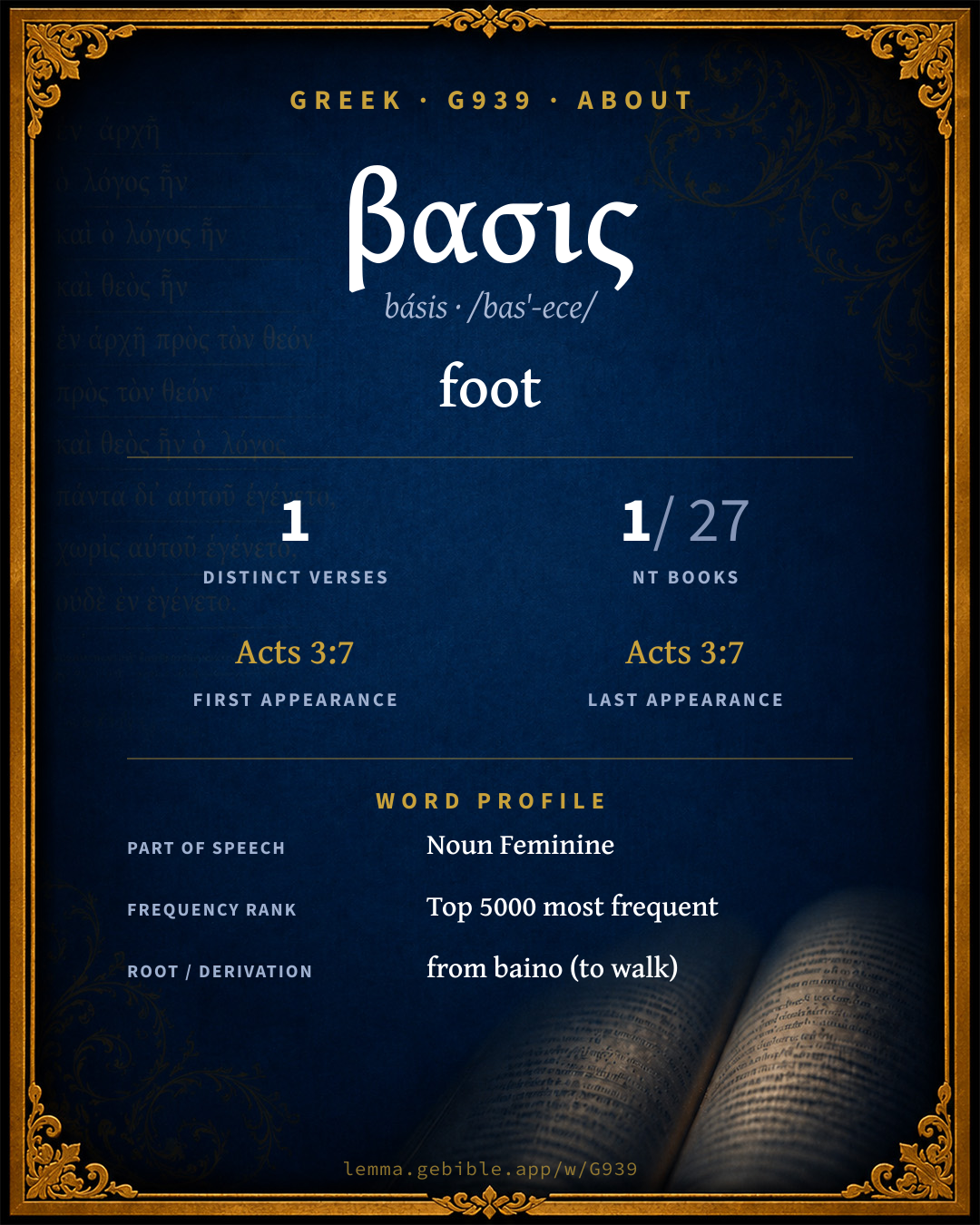
βάσις
foot
‘foot’ is one of 2 main senses fuller range ↓
Full lexicon entry — Thayer's Greek Lexicon
From Thayer's Greek Lexicon
Where this word appears
Grammar key — what these labels mean
Part of speech
- Noun
- A naming word — a person, place, thing, or idea.
Case
- Nominative
- The case of the subject (and the predicate nominative).
Gender
- Feminine
- Grammatically feminine.
Number
- Plural
- More than one.
Every verse where G939 appears — 1 distinct verse across 1 book. Click any verse to open its interlinear word-by-word view. Verse text shown in the World English Bible for context — . Each verse’s Greek form is shown with its reference; the English is not keyword-highlighted, since the data carries no word-level English alignment. Use “Compare translations” on any verse to read it across multiple English versions. This concordance covers the Greek New Testament; Septuagint (Greek Old Testament) occurrences of this word are not indexed here.
Acts 1 verse
About this entry
At a glance — auto-summarized from this page’s data, not written by a person. Every figure links to its source below. This summary describes the numbers; it doesn’t interpret them.
βασις (básis) is a Greek noun most often rendered “foot.” With only 1 verse it sits in the long tail of Greek New Testament vocabulary. Acts dominates its distribution — 1 of 1 verses. Found nowhere else but Acts 3:7. Ranging over 2 senses, it is not a single-sense word. For the data behind this summary, explore the sense tree and the renderings breakdown below.
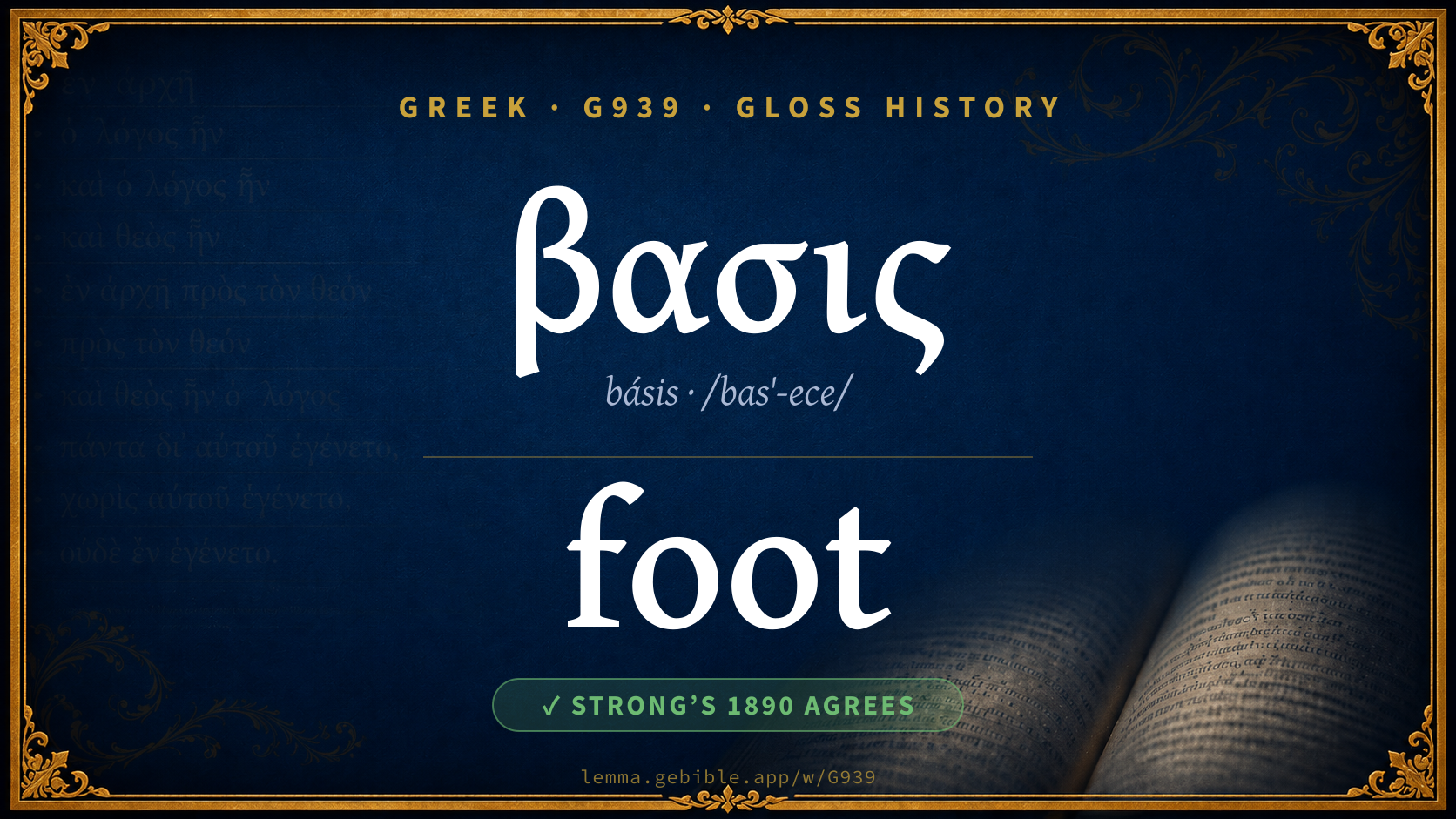
Gloss history
Strong's 1890 vs modern scholarship
About this word
Strong's G939 catalogs a Greek word from the Greek New Testament.
These counts are not copied from any lexicon or concordance. They are computed here, from the morphology-tagged Greek New Testament. What Lemma adds →
- 1
- distinct verses
- The word appears in 1 distinct verse.
- 1 / 27
- NT books
- The word appears in 1 of 27 New Testament books.
- #3,503
- by frequency
- Top 5000 most frequent Greek words (rank 3,503 of 5,347 Greek words by occurrence).
View all 1 occurrence in the concordance →
Most concentrated in
- Acts 1 verse 100%
By section of the New Testament
By traditional corpus
Conventional, traditional groupings — biblical authorship is debated, so this is a traditional corpus grouping, not an authorship claim. Some books belong to more than one corpus (Luke is in both the Gospels and the Lukan corpus, and so on), so these shares overlap and need not total 100%. Each figure is a share of the word’s 1 distinct verse.
- Lukan (Luke–Acts) 1 verse · 100%
How translations render this word
Counts come from each version’s own published word-to-Strong’s tagging or interlinear alignment — an approximate guide to how each version renders this word, not a word-level alignment the data otherwise carries. Because each total is that version’s own tagged count, the per-version totals vary from one another and need not match the appearance or distinct-verse counts above. These counts may also differ from a printed concordance because Lemma counts each distinctly tagged rendering and does not collapse phrase taggings into a single head-word total. This is a fixed set of word-tagged versions (KJV, ASV, BSB, ULT) and does not change with the reading translation you choose elsewhere. Each version’s license is shown beside its name below (and on Sources).
- King James Version: Feet 1×
- American Standard Version: Feet 1×
- Berean Standard Bible: Feet 1×
- unfoldingWord Literal Text: Feet 1×
King James Version Public Domain
Renders G939 across 1 tagged occurrence — most commonly:
American Standard Version Public Domain
Renders G939 across 1 tagged occurrence — most commonly:
Berean Standard Bible Public Domain
Renders G939 across 1 tagged occurrence — most commonly:
unfoldingWord Literal Text CC BY-SA 4.0
Renders G939 across 1 tagged occurrence — most commonly:
Senses in Thayer's
The 2 senses Thayer's distinguishes for this word, in lexicon order (not ranked by frequency or importance). The full entry — with sub-senses — is in the Lexicon Entry tab.
- a stepping, walking
- that with which one steps, the foot
Word origin
Origin: from baino (to walk)
From βαίνω bainō (to walk ); a pace (base) that is (by implication) the foot : - foot.
— Strong’s Exhaustive Concordance (1890), public domain.
Same root — word family
Other Thayer's entries built from the same root as G939, grouped by Strong’s listed origin. These share a root / origin per the lexicon — not necessarily a shared meaning. Each links to that word’s own entry.
Derived from this word
- βαθυς bathýs G901 deep
- βαΐον baḯon G902 palm branch
- βαρος báros G922 heaviness
- βασανος básanos G931 touchstone
- βασιλευς basileús G935 king
- βασταζω bastázō G941 to take up
- βεβαιος bébaios G949 firm
- βεβηλος bébēlos G952 profane
- βημα bēma G968 judgment seat
- βωμος bōmós G1041 elevated place
Compare all same-root words → Showing 4 of 11 — not the complete family. They share a root, not necessarily a meaning.
Septuagint usage
The same Greek word βασις appears 67 times in the Greek Old Testament (Septuagint), across 57 verses in 9 books.
- 67
- LXX occurrences
- Tagged occurrences of this Greek word in the Septuagint.
- 57
- verses
- Distinct Septuagint verses containing this word.
- 9 / 39
- OT books
- The word appears in 9 of the 39 Old Testament books.
Sample Septuagint occurrences
- Exodus 26:19 βάσις
- Leviticus 1:15 βάσις
- Numbers 3:36 βάσις
- Deuteronomy 12:27 βάσις
- 2 Kings 16:17 βάσις
- 2 Chronicles 6:13 βάσις
- Song of Solomon 5:15 βάσις
- Jeremiah 52:17 βάσις
- Ezekiel 16:31 βάσις
Septuagint occurrences (same lexeme)
Every verse where the same Strong’s number (G939) appears in the Greek Septuagint — showing the first 50 of 57. Verse text shown in the World English Bible for context; the Greek form is the matched word — the English is not keyword-highlighted.
- Exodus 26:19 βάσις You shall make forty sockets of silver under the twenty boards; two sockets under one board for its two tenons, and two sockets under another board for its two tenons.
- Exodus 26:21 βάσις and their forty sockets of silver; two sockets under one board, and two sockets under another board.
- Exodus 26:25 βάσις There shall be eight boards, and their sockets of silver, sixteen sockets; two sockets under one board, and two sockets under another board.
- Exodus 26:32 βάσις You shall hang it on four pillars of acacia overlaid with gold; their hooks shall be of gold, on four sockets of silver.
- Exodus 26:37 βάσις You shall make for the screen five pillars of acacia, and overlay them with gold: their hooks shall be of gold: and you shall cast five sockets of brass for them.
- Exodus 27:10 βάσις and the pillars of it shall be twenty, and their sockets twenty, of brass; the hooks of the pillars and their fillets shall be of silver.
- Exodus 27:11 βάσις Likewise for the north side in length there shall be hangings one hundred cubits long, and the pillars of it twenty, and their sockets twenty, of brass; the hooks of the pillars, and their fillets, of silver.
- Exodus 27:12 βάσις For the breadth of the court on the west side shall be hangings of fifty cubits; their pillars ten, and their sockets ten.
- Exodus 27:13 βάσις The breadth of the court on the east side eastward shall be fifty cubits.
- Exodus 27:14 βάσις The hangings for the one side of the gate shall be fifteen cubits; their pillars three, and their sockets three.
- Exodus 27:15 βάσις For the other side shall be hangings of fifteen cubits; their pillars three, and their sockets three.
- Exodus 27:16 βάσις For the gate of the court shall be a screen of twenty cubits, of blue, and purple, and scarlet, and fine twined linen, the work of the embroiderer; their pillars four, and their sockets four.
- Exodus 27:17 βάσις All the pillars of the court round about shall be filleted with silver; their hooks of silver, and their sockets of brass.
- Exodus 27:18 βάσις The length of the court shall be one hundred cubits, and the breadth fifty every where, and the height five cubits, of fine twined linen, and their sockets of brass.
- Exodus 29:12 βάσις You shall take of the blood of the bull, and put it on the horns of the altar with your finger; and you shall pour out all the blood at the base of the altar.
- Exodus 30:18 βάσις "You shall also make a basin of brass, and the base of it of brass, in which to wash. You shall put it between the tent of meeting and the altar, and you shall put water in it.
- Exodus 30:28 βάσις the altar of burnt offering with all its utensils, and the basin with its base.
- Exodus 31:9 βάσις the altar of burnt offering with all its vessels, the basin and its base,
- Exodus 37:4 βάσις He made poles of acacia wood, and overlaid them with gold.
- Exodus 37:6 βάσις He made a mercy seat of pure gold. Its length was two and a half cubits, and a cubit and a half its breadth.
- Exodus 37:8 βάσις one cherub at the one end, and one cherub at the other end. He made the cherubim of one piece with the mercy seat at its two ends.
- Exodus 37:9 βάσις The cherubim spread out their wings on high, covering the mercy seat with their wings, with their faces toward one another. The faces of the cherubim were toward the mercy seat.
- Exodus 37:10 βάσις He made the table of acacia wood. Its length was two cubits, and its breadth was a cubit, and its height was a cubit and a half.
- Exodus 37:12 βάσις He made a border of a handbreadth around it, and made a golden molding on its border around it.
- Exodus 37:13 βάσις He cast four rings of gold for it, and put the rings in the four corners that were on its four feet.
- Exodus 37:15 βάσις He made the poles of acacia wood, and overlaid them with gold, to carry the table.
- Exodus 37:17 βάσις He made the lampstand of pure gold. He made the lampstand of beaten work. Its base, its shaft, its cups, its buds, and its flowers were of one piece with it.
- Exodus 38:23 βάσις With him was Oholiab, the son of Ahisamach, of the tribe of Dan, an engraver, and a skillful workman, and an embroiderer in blue, in purple, in scarlet, and in fine linen.
- Exodus 38:26 βάσις a beka a head, that is, half a shekel, after the shekel of the sanctuary, for everyone who passed over to those who were numbered, from twenty years old and upward, for six hundred three thousand five hundred fifty men.
- Exodus 39:7 βάσις He put them on the shoulder-pieces of the ephod, to be stones of memorial for the children of Israel, as Yahweh commanded Moses.
- Exodus 39:8 βάσις He made the breastplate, the work of a skillful workman, like the work of the ephod; of gold, of blue, purple, scarlet, and fine twined linen.
- Exodus 39:13 βάσις and the fourth row, a chrysolite, an onyx, and a jasper. They were enclosed in gold settings.
- Leviticus 1:15 βάσις The priest shall bring it to the altar, and wring off its head, and burn it on the altar; and its blood shall be drained out on the side of the altar;
- Leviticus 4:7 βάσις The priest shall put some of the blood on the horns of the altar of sweet incense before Yahweh, which is in the tent of meeting; and he shall pour out all the blood of the bull out at the base of the altar of burnt offering, which is at the door of the Tent of Meeting.
- Leviticus 4:18 βάσις He shall put some of the blood on the horns of the altar which is before Yahweh, that is in the Tent of Meeting; and the rest of the blood he shall pour out at the base of the altar of burnt offering, which is at the door of the Tent of Meeting.
- Leviticus 4:25 βάσις The priest shall take some of the blood of the sin offering with his finger, and put it on the horns of the altar of burnt offering. He shall pour out the rest of its blood at the base of the altar of burnt offering.
- Leviticus 4:30 βάσις The priest shall take some of its blood with his finger, and put it on the horns of the altar of burnt offering; and the rest of its blood he shall pour out at the base of the altar.
- Leviticus 4:34 βάσις The priest shall take some of the blood of the sin offering with his finger, and put it on the horns of the altar of burnt offering; and all the rest of its blood he shall pour out at the base of the altar.
- Leviticus 5:9 βάσις He shall sprinkle some of the blood of the sin offering on the side of the altar; and the rest of the blood shall be drained out at the base of the altar. It is a sin offering.
- Leviticus 7:2 βάσις In the place where they kill the burnt offering, he shall kill the trespass offering; and its blood he shall sprinkle on the altar round about.
- Leviticus 8:11 βάσις He sprinkled it on the altar seven times, and anointed the altar and all its vessels, and the basin and its base, to sanctify them.
- Leviticus 8:15 βάσις He killed it; and Moses took the blood, and put it on the horns of the altar round about with his finger, and purified the altar, and poured out the blood at the base of the altar, and sanctified it, to make atonement for it.
- Leviticus 9:9 βάσις The sons of Aaron presented the blood to him; and he dipped his finger in the blood, and put it on the horns of the altar, and poured out the blood at the base of the altar:
- Numbers 3:36 βάσις The appointed charge of the sons of Merari shall be the tabernacle's boards, its bars, its pillars, its sockets, all its instruments, all its service,
- Numbers 3:37 βάσις the pillars of the court around it, their sockets, their pins, and their cords.
- Numbers 4:14 βάσις They shall put on it all its vessels, with which they minister about it, the fire pans, the flesh hooks, the shovels, and the basins; all the vessels of the altar; and they shall spread on it a covering of sealskin, and put in its poles.
- Numbers 4:31 βάσις This is the charge of their burden, according to all their service in the Tent of Meeting: the tabernacle's boards, its bars, its pillars, its sockets,
- Numbers 4:32 βάσις and the pillars of the court around it, and their sockets, and their pins, and their cords, with all their instruments, and with all their service: and by name you shall appoint the instruments of the charge of their burden.
- Deuteronomy 12:27 βάσις and you shall offer your burnt offerings, the flesh and the blood, on the altar of Yahweh your God; and the blood of your sacrifices shall be poured out on the altar of Yahweh your God; and you shall eat the flesh.
- 2 Kings 16:17 βάσις King Ahaz cut off the panels of the bases, and removed the basin from off them, and took down the sea from off the brazen oxen that were under it, and put it on a pavement of stone.
These are occurrences of the same Greek lexeme (G939) in the Septuagint — not a translation of any one Hebrew word. The store carries no word-level Hebrew↔Greek alignment, so no Hebrew original is asserted here. Counts come from the recovered LXX Strong's tagging — high-frequency vocabulary is well covered, while rare or late forms may be untagged — so they reflect tagged occurrences and may slightly undercount.