Revelation 9:2

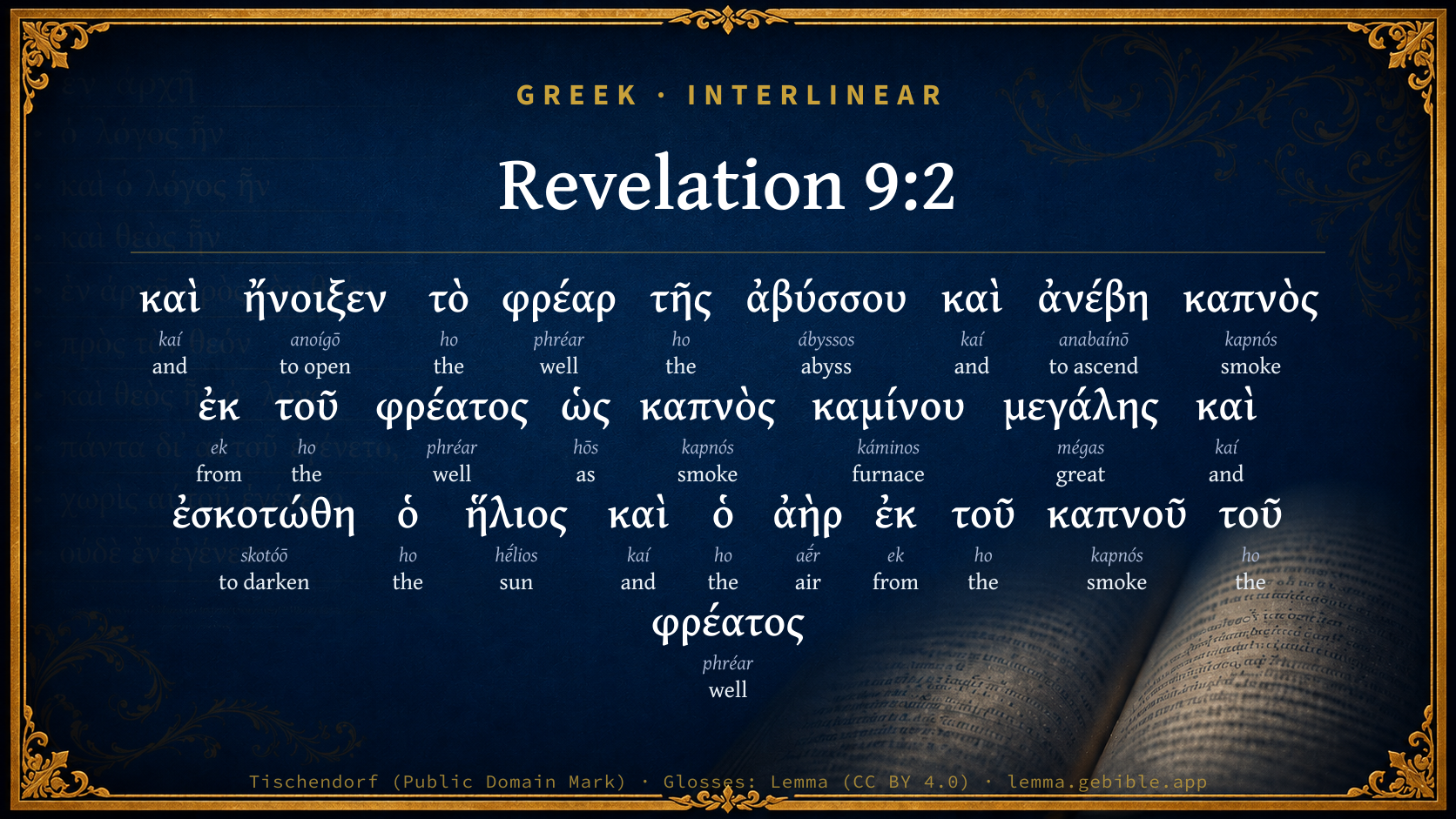
Greek (Tischendorf 8th ed.) Revelation 9:2 appears in the Greek New Testament. The text above is from the Tischendorf 8th edition. Each word links to its Strong’s number and a concise gloss. Click any word for its full Thayer’s Greek Lexicon entry.
Download image
Cite this verse

Revelation 9:2 (World English Bible). Public Domain. Lemma interlinear Bible study tool, https://lemma.gebible.app/v/revelation/9/2.

Show BibTeX & RIS
BibTeX
RIS
English Translation
He opened the pit of the abyss, and smoke went up out of the pit, like the smoke from a burning furnace. The sun and the air were darkened because of the smoke from the pit.
World English Bible · Public Domain
Download a study sheet

One document with this verse’s original text, its word-by-word gloss line, the meaning frame, cross-references with their text, attributed commentary, and full source and license credits — printable, and it pastes into notes with its structure intact.

This verse Autodidact and up

Study sheet (.html) Plain text (.txt)

A passage Seminary Student

Up to 50 verses in one chapter. A passage sheet keeps up to 6 commentary sources and 12 cross-references per verse, in the order this page ranks them, and says so on the sheet whenever that leaves anything out. Ask for a single verse and you get the Autodidact verse sheet above.

Everything on this page stays free to read, with no account — the sheet is a download of what is already on screen, not access to it.

Want to remove ads? Support Godless Engineer
Compare translations 3

The same verse in 3 English versions, stacked beneath the original-language interlinear above. Click any original word for its lexicon entry.

Each is an independent rendering of the whole verse — the interlinear is not word-aligned to these translations.

Highlighted words mark where these versions differ — a whole-verse word diff, not a word-by-word alignment.

  • World English Bible Public Domain
    He opened the pit of the abyss, and smoke went up out of the pit, like the smoke from a burning furnace. The sun and the air were darkened because of the smoke from the pit.
  • King James Version Public Domain
    And he opened the bottomless pit; and there arose a smoke out of the pit, as the smoke of a great furnace; and the sun and the air were darkened by reason of the smoke of the pit.
  • unfoldingWord Literal Text CC BY-SA 4.0
    And he opened the shaft of the abyss, and smoke went up from the shaft like the smoke of a great furnace, and the sun and the air were darkened from the smoke of the shaft.

unfoldingWord Literal Text — © unfoldingWord, licensed CC BY-SA 4.0. Word-aligned USFM3 via Door43 (git.door43.org/unfoldingWord/en_ult).

Versions to compare (up to 4)

3 of 4 selected

Show all 19 translations

Every available English version of this verse, each an independent rendering of the whole verse.

  • World English Bible Public Domain
    He opened the pit of the abyss, and smoke went up out of the pit, like the smoke from a burning furnace. The sun and the air were darkened because of the smoke from the pit.
  • Berean Standard Bible Public Domain
    The star opened the pit of the Abyss, and smoke rose out of it like the smoke of a great furnace, and the sun and the air were darkened by the smoke from the pit.
  • Majority Standard Bible Public Domain
    The star opened the pit of the Abyss, and smoke rose out of it like the smoke of a burning furnace, and the sun and the air were darkened by the smoke from the pit.
  • King James Version Public Domain
    And he opened the bottomless pit; and there arose a smoke out of the pit, as the smoke of a great furnace; and the sun and the air were darkened by reason of the smoke of the pit.
  • American Standard Version (1901) Public Domain
    And he opened the pit of the abyss; and there went up a smoke out of the pit, as the smoke of a great furnace; and the sun and the air were darkened by reason of the smoke of the pit.
  • Revised Version (1885) Public Domain
    And he opened the pit of the abyss; and there went up a smoke out of the pit, as the smoke of a great furnace; and the sun and the air were darkened by reason of the smoke of the pit.
  • Geneva Bible (1599) Public Domain
    And he opened the bottomlesse pit, and there arose the smoke of the pit, as the smoke of a great fornace, and the sunne, and the ayre were darkened by the smoke of the pit.
  • Douay-Rheims (1899) Public Domain
    And he opened the bottomless pit: and the smoke of the pit arose, as the smoke of a great furnace; and the sun and the air were darkened with the smoke of the pit.
  • Young's Literal Translation Public Domain
    and he did open the pit of the abyss, and there came up a smoke out of the pit as smoke of a great furnace, and darkened was the sun and the air, from the smoke of the pit.
  • Literal Standard Version CC BY-SA 4.0
    and [he] opened the pit of the abyss, and there came up a smoke out of the pit as smoke of a great furnace, and the sun and the air were darkened from the smoke of the pit.
  • Unlocked Literal Bible CC BY-SA 4.0
    He opened the shaft of the bottomless pit, and smoke went up out of the shaft like smoke from a huge furnace. The sun and the air turned dark by the smoke pouring out of the shaft.
  • unfoldingWord Literal Text CC BY-SA 4.0
    And he opened the shaft of the abyss, and smoke went up from the shaft like the smoke of a great furnace, and the sun and the air were darkened from the smoke of the shaft.
  • Darby Bible Public Domain
    And it opened the pit of the abyss; and there went up smoke out of the pit as [the] smoke of a great furnace; and the sun and the air were darkened with the smoke of the pit.
  • World Messianic Bible Public Domain
    He opened the pit of the abyss, and smoke went up out of the pit, like the smoke from a burning furnace. The sun and the air were darkened because of the smoke from the pit.
  • Webster's Bible Public Domain
    And he opened the bottomless pit; and there arose a smoke out of the pit, as the smoke of a great furnace; and the sun and the air were darkened by reason of the smoke of the pit.
  • Free Bible Version CC BY-SA 4.0
    He opened the entrance to the Abyss, and smoke came up out of the Abyss like the smoke of a huge furnace. The sun and the atmosphere became dark because of the smoke from the Abyss.
  • Bible in Basic English Public Domain
    And he made the great deep open and a smoke went up from it, like the smoke of a great oven; and the sun and the air were made dark because of the smoke.
  • Text-Critical English NT CC BY 4.0
    He opened the pit of the abyss, and from the pit rose smoke like the smoke of a burning furnace. The sun and the air were darkened by the smoke from the pit.
  • Tyndale New Testament (1534) Public Domain
    And he opened the botomlesse pytt and there arose the smoke of a grett fornace. And the sunne and the ayer were darkned by the reason of the smoke of the pytt.

Literal Standard Version (2020), Covenant Press — licensed CC BY-SA 4.0. Text via the HelloAO Bible API (eBible.org). Unlocked Literal Bible (unfoldingWord) — licensed CC BY-SA 4.0. Text via the HelloAO Bible API (eBible.org). unfoldingWord Literal Text — © unfoldingWord, licensed CC BY-SA 4.0. Word-aligned USFM3 via Door43 (git.door43.org/unfoldingWord/en_ult). Free Bible Version, Dr. Jonathan Gallagher — licensed CC BY-SA 4.0. Text via the HelloAO Bible API (eBible.org).

Word by word

More ways to search: Search by grammar → Find every occurrence → Compare this word →

Practice this passage: Drill this verse → Learn its vocabulary →

ἐσκοτώθη
skotóō
G4656
“to darken”
Verb, Aorist, Passive, Indicative, 3rd person, Singular
Part of Speech
Verb
Tense
Aorist
Voice
Passive
Mood
Indicative
Person
3rd person
Number
Singular
Full Thayer's Definition

Origin: from G4655

TDNT: 14:03,1

1. to darken, cover with darkness 2. metaph. to darken or blind the mind
  1. καὶ kaí G2532 “and” Conjunction
  2. ἤνοιξεν anoígō G455 “to open” Verb, Aorist, Active, Indicative, 3rd person, Singular
  3. τὸ ho G3588 “the” Article, Accusative, Singular, Neuter
  4. φρέαρ phréar G5421 “well” Noun, Accusative, Singular, Neuter
  5. τῆς ho G3588 “the” Article, Genitive, Singular, Feminine
  6. ἀβύσσου ábyssos G12 “abyss” Noun, Genitive, Singular, Feminine
  7. καὶ kaí G2532 “and” Conjunction
  8. ἀνέβη anabaínō G305 “to ascend” Verb, Aorist, Active, Indicative, 3rd person, Singular
  9. καπνὸς kapnós G2586 “smoke” Noun, Nominative, Singular, Masculine
  10. ἐκ ek G1537 “from” Preposition
  11. τοῦ ho G3588 “the” Article, Genitive, Singular, Neuter
  12. φρέατος phréar G5421 “well” Noun, Genitive, Singular, Neuter
  13. ὡς hōs G5613 “as” Adverb
  14. καπνὸς kapnós G2586 “smoke” Noun, Nominative, Singular, Masculine
  15. καμίνου káminos G2575 “furnace” Noun, Genitive, Singular, Feminine
  16. μεγάλης mégas G3173 “great” Adjective, Genitive, Singular, Feminine
  17. καὶ kaí G2532 “and” Conjunction
  18. ὁ ho G3588 “the” Article, Nominative, Singular, Masculine
  19. ἥλιος hḗlios G2246 “sun” Noun, Nominative, Singular, Masculine
  20. καὶ kaí G2532 “and” Conjunction
  21. ὁ ho G3588 “the” Article, Nominative, Singular, Masculine
  22. ἀὴρ aḗr G109 “air” Noun, Nominative, Singular, Masculine
  23. ἐκ ek G1537 “from” Preposition
  24. τοῦ ho G3588 “the” Article, Genitive, Singular, Masculine
  25. καπνοῦ kapnós G2586 “smoke” Noun, Genitive, Singular, Masculine
  26. τοῦ ho G3588 “the” Article, Genitive, Singular, Neuter
  27. φρέατος phréar G5421 “well” Noun, Genitive, Singular, Neuter

About this verse

These counts appear in no published source. They are computed here, from the morphology-tagged text and Lemma’s own curated glosses. What Lemma adds →

28
words
14
distinct lemmas
Revelation
section

Notable vocabulary

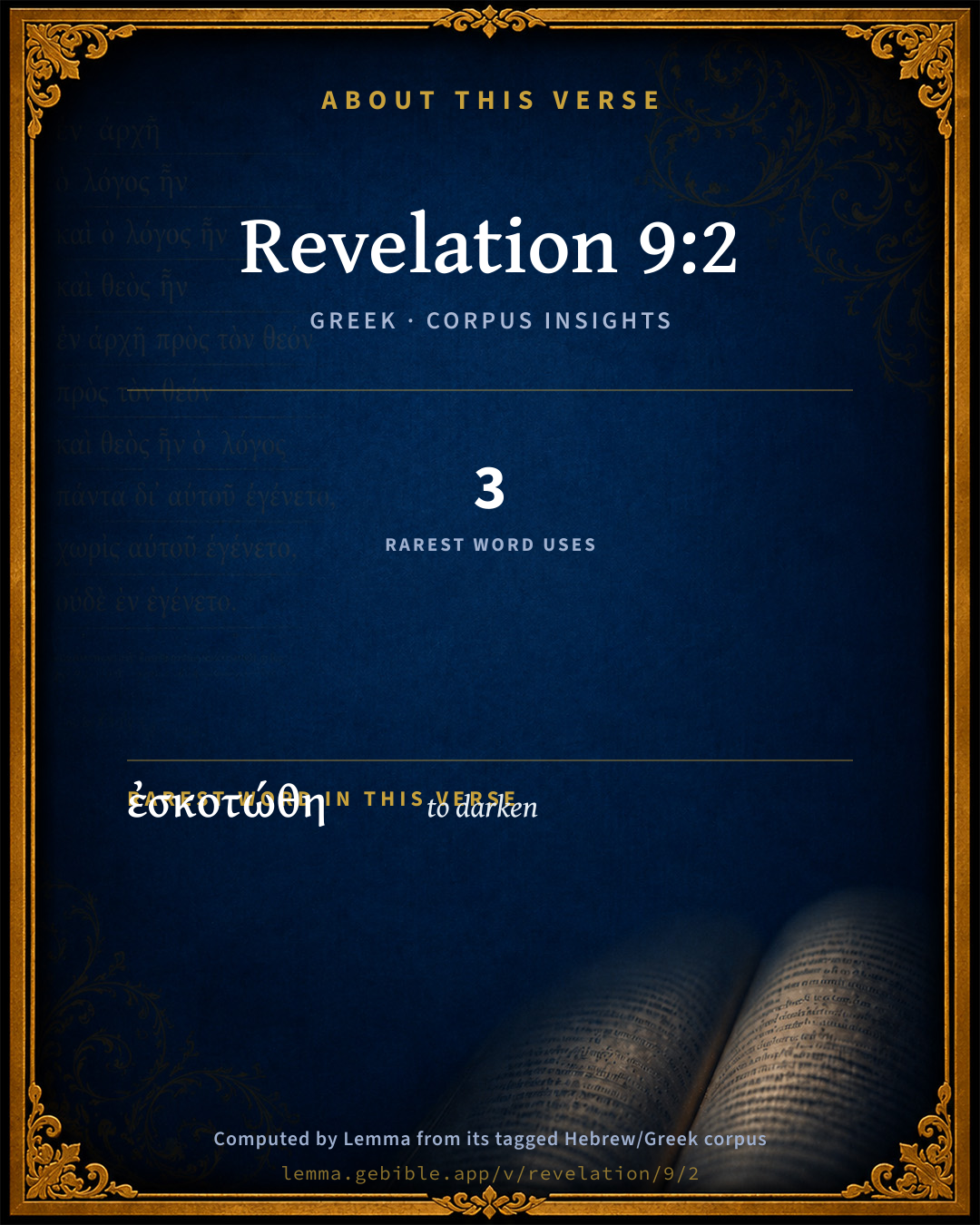
The rarest word here is ἐσκοτώθη to darken G4656 — appearing just 3 times in the whole Greek New Testament.

Shared distinctive vocabulary

ἐσκοτώθη to darken G4656 occurs in 3 verses of the Greek New Testament. Also found in:

Repetition

Words recur within this verse:

Cross-references

12

Topical passages linked to Revelation 9:2 in the Treasury of Scripture Knowledge — connected by theme and wording, ordered by reader-vote popularity; previews shown in the World English Bible.

  • Joel 2:10 The earth quakes before them. The heavens tremble. The sun and the moon are darkened, And the stars withdraw their shining.
  • Genesis 19:28 He looked toward Sodom and Gomorrah, and toward all the land of the plain, and looked, and saw that the smoke of the land went up as the smoke of a furnace.
  • Joel 2:2 A day of darkness and gloominess, A day of clouds and thick darkness. As the dawn spreading on the mountains, A great and strong people; There has never been the like, Neither will there be any more after them, Even to the years of many generations.
  • Isaiah 14:31 Howl, gate; cry, city; you are melted away, Philistia, all of you; for there comes a smoke out of the north, and there is no straggler in his ranks.
  • Joel 2:30 I will show wonders in the heavens and in the earth: Blood, fire, and pillars of smoke.
  • Acts 2:19 I will show wonders in the sky above, And signs on the earth beneath; Blood, and fire, and billows of smoke.
  • Exodus 10:21–23 Yahweh said to Moses, "Stretch out your hand toward the sky, that there may be darkness over the land of Egypt, even darkness which may be felt."
  • Exodus 19:18 Mount Sinai, the whole of it, smoked, because Yahweh descended on it in fire; and its smoke ascended like the smoke of a furnace, and the whole mountain quaked greatly.
  • Revelation 14:11 The smoke of their torment goes up forever and ever. They have no rest day and night, those who worship the beast and his image, and whoever receives the mark of his name.
  • Genesis 15:17 It came to pass that, when the sun went down, and it was dark, behold, a smoking furnace, and a flaming torch passed between these pieces.
  • Revelation 8:12 The fourth angel sounded, and one third of the sun was struck, and one third of the moon, and one third of the stars; so that one third of them would be darkened, and the day wouldn't shine for one third of it, and the night in the same way.
  • Revelation 9:17 Thus I saw the horses in the vision, and those who sat on them, having breastplates of fiery red, hyacinth blue, and sulfur yellow; and the heads of lions. Out of their mouths proceed fire, smoke, and sulfur.

Cross-references courtesy of OpenBible.info (CC BY 4.0).

Commentary

Notes on Revelation 9:2 from classic Christian and Jewish commentators (each source and its license shown beneath its notes). The classic Christian expositions comment on the surrounding passage and are grouped to its opening verse, so a note may address several verses; the Jewish commentaries on the Tanakh (Rashi and others) are per-verse, so they appear only where the commentator wrote on this verse.

Lemma curates 59 commentaries, every one of them public domain or Creative Commons licensed, each selected and text-cleaned for this edition rather than reprinted as found. About our sources →

Joseph Benson's Commentary

Rev 9:2-3. There arose a smoke out of the pit — As a great smoke hinders the sight, so do errors blind the understanding. The apostle keeps to the allegory, says Grotius, for smoke takes from us the sight of the stars; smoke, especially when proceeding from a fierce fire, is also a representation of devastation. Thus when Abraham beheld the destruction of Sodom and Gomorrah, the smoke of the country went up as the smoke of a furnace. The great displeasure of God is represented by the same figurative expressions of smoke and fire, Psa 18:7-8. And there came out of the smoke locusts upon the earth — Many Protestant writers imagine these locusts signify the religious orders of monks and friars, &c., but Mede understands by them the inundation of the Saracens, locusts and grasshoppers being elsewhere expressly made to signify both the multitude of the eastern nations invading Israel, and the swift progress and destruction they made, Jdg 6:5. And Lowman confirms this interpretation, and shows that the rise and progress of the Mohammedan religion and empire, till checked by internal divisions, is a remarkable accomplishment of this part of the prophecy; which is further illustrated by the ignorance and error the Mohammedans everywhere spread, their great number and hardiness, their habits, customs, and manners, namely, twisting their hair, wearing beards, their care of their horses, invading their neighbours in summer like locusts, sparing the trees and fruits of the countries they invaded; the captivity of the men, and the miserable condition of the women, exposed to persons who gave an almost unbounded liberty to their lusts, which was enough to make them even to desire death, Rev 9:6. All these circumstances are suitable to the character of the Arabians, the history of this period, and to the particulars of this prophecy.

That the Saracens were intended by the locusts here mentioned, was also the opinion of Bishop Newton, who interprets this part of the prophecy as follows: — “At the sounding of the fifth trumpet, a star fallen from heaven, meaning the wicked impostor Mohammed, opened the bottomless pit, and there arose a smoke out of the pit, and the sun and the air were darkened by it; that is, a false religion was set up, which filled the world with darkness and error, and swarms of Saracen or Arabian locusts overspread the earth. A false prophet is very fitly typified by a blazing star or meteor. The Arabians, likewise, are properly compared to locusts, not only because numerous armies frequently are so, but also because swarms of locusts often arise from Arabia; and also because in the plagues of Egypt, to which constant allusion is made in these trumpets, the locusts (Exo 10:13) are brought by an east wind, that is, from Arabia, which lay eastward of Egypt; and also because in the book of Judges, (Jdg 7:12,) the people of Arabia are compared to locusts or grasshoppers for multitude, for in the original the word for both is the same. As the natural locusts are bred in pits, and holes of the earth, so these mystical locusts are truly infernal, and proceed with the smoke from the bottomless pit.” It is too a remarkable coincidence, that at this time the sun and the earth were really darkened. For we learn from an eminent Arabian historian, that “in the seventeenth year of Heraclius half the body of the sun was eclipsed, and this defect continued from the former Tisrin to Haziran, (that is, from October to June,) so that only a little of its light appeared.” The seventeenth year of Heraclius coincides with the year of Christ 626, and with the fifth year of the Hegira; and at this time Mohammed was training and exercising his followers in depredations at home, to fit them for greater conquests abroad.

Joseph Benson's Commentary on the Old and New Testaments (1811–1818) — public domain. Text from a community e-Sword module.

Tyndale Open Study Notes

Tyndale Open Resources

9:2 The smoke from the pit turned the sky dark, as in the plague on Egypt (Exod 10:21-29; see Matt 27:45).

Tyndale Open Study Notes — © Tyndale Open Resources, licensed CC BY-SA 4.0. Text via the HelloAO Bible API.

Bengel's Gnomon

Johann Albrecht Bengel

Rev 9:2. Καὶ ἐσκοτίσθη ὁ ἥλιος καὶ ὁ ἀὴφ, and the sun was darkened and the air) It is an instance of ἓν διὰ δυοῖν, as ch. Rev 1:14, His head and His hair: ch. Rev 19:16, His vesture and His thigh. The air was obscured, in so far as it is illuminated by the sun; the sun, in so far as it transmits its light through the air to men. Hence ἐσκοτίσθη is used, not ἐσκοτίσθησαν. Wherefore there is no need to inquire separately here, what the sun is, and its obscuring; what the air is, and its obscuring. The darkness, which arose to the Jews in Persia, is here pointed out. [Cent. vi.]

Bengel's Gnomon of the New Testament — English translation (T&T Clark, Edinburgh, 1860) — public domain. Text from a community e-Sword module.

Meyer's Critical & Exegetical Commentary

Heinrich August Wilhelm Meyer

Rev_9:2-3. The smoke arising from the opened well, comparable to the smoke of a great furnace,[2533] was so thick that thereby (ἐν τ. καπν., cf. Rev_8:11) the sun and moon were obscured.

ὁ ἥλιος καὶ ὁ ἀήρ is not an hendiadys,[2534] but, according to the more natural view, it is apparent that both, viz., the sun and the air, are darkened by the thick mass of smoke.

καὶ ἐκ τ. καπν. ἐξῆλθον ἀκρίδες εἰς τ. γ. The καπνός, therefore, was not merely an apparent mass of smoke, yet in fact a dreadful swarm of locusts;[2535] but the infernal smoke is the covering under which the miraculous locusts ascend, and from which they come out, in order to execute the plagues with which they are commissioned.[2536] Against the force of the words, Klief. explains: The material for the locusts already existed on earth, but the smoke ascending from hell converts it into locusts.

καὶ ἐδόθη

οἱ σκορπίοι τῆς γῆς. The power given (cf. Rev_9:5) these locusts corresponds with their form and equipment (Rev_9:10). The τῆς γῆς with οἱ σκορπἱοι does not refer to the distinction, which is here entirely out of place, between land-and sea-beasts,[2537] but to the fact that the locusts are not from the earth; the infernal locusts receive a power like that of earthly scorpions. Hence no allusion should be made[2538] to the statement of Jewish writings, that hell is full of scorpions.

[2533] Cf. Gen_19:28; Exo_19:18.

[2534] The air, so far as illumined by the sun (Beng.).

[2535] Vitr., Eichh., Züll., Ebrard.

[2536] Cf. Ewald, De Wette, etc.

[2537] Against Ew. i., without reference to Ew. ii.: known to men.

[2538] Ew. ii.

Meyer — Critical and Exegetical Commentary on the New Testament — English translation by Peter Christie, edited by Frederick Crombie (T&T Clark, 1880) — public domain. Text from a community e-Sword module.

Expositor's Greek Testament

ed. W. Robertson Nicoll

Rev 9:2 . For the following description of this destructive horde of weird locusts, see Joe 2 . with Driver’s notes and excursus ( C. B. ) to which add the famous description of a locust-plague in Newman’s Callista (ch. 15). Naturally the sketch is far more idealised than that given by Joel; it often recalls the monstrous associates created by Tiamat out of the primeval abyss (Jastrow, pp. 419 f.); i.e. , strong warriors, “great serpents, merciless in attack, sharp of tooth. With poison instead of blood she filled their bodies. Furious vipers she clothed with terror, made them high of stature.”

The Expositor's Greek Testament, edited by W. Robertson Nicoll (1897–1910) — public domain. Text from a community e-Sword module.

Geneva Bible (1599)

Geneva Bible translators

Unto this is added, the smoke of the hellish and infernal spirits, all dark, and darkening all things in heaven and in earth. The spiritual darknesses are the causes of all disorder and confusion. For the devil at a time certain (whereof the fifth verse) sent these darknesses into his kingdom, that he might at once and with one impression overthrow all things, and pervert if it were possible the elect themselves. By this darkness all spiritual light, both active as of the Sun, and passive, as of the air which is lightened by the Sun, is taken away: and this is that which goeth before the spirits: it followeth of the spirits themselves.

Geneva Bible (1599) marginal notes — public domain. Text via Bolls.life.

Adam Clarke's Commentary

Verse 2. He opened the bottomless pit] το φρεαρ της αβυσσου The pit of the bottomless deep. Some think the angel means Satan, and the bottomless pit hell. Some suppose Mohammed is meant; and Signior Pastorini professes to believe that Luther is intended!

There arose a smoke] False doctrine, obscuring the true light of heaven.

Adam Clarke's Commentary on the Bible (1810–1826) — public domain. Text from a community e-Sword/MySword module.

Ellicott's Commentary for English Readers

(2) And he opened . . .—Translate, And he opened the pit of the abyss; and there went up smoke out of the pit, as the smoke of a great furnace; and the sun was darkened, and the air, by reason of the smoke of the pit. The first result of the opening of the pit is the diffusion of such a dense smoke that light and atmosphere are darkened. In the previous vision there was an obscuration of light arising from the smiting of the luminaries; in this the obscuration arises from causes external to the luminaries. In that the light-giving power was enfeebled; in this the light is not enfeebled, but hindered. This must be remembered. The interpretation of these visions is most difficult; but we must bear in mind that they are descriptive of that great war which the Church is waging with the world, which good is waging with evil, but the end of which, we are assured, is the victory of good. The kingdoms of this world become the kingdoms of the Lord, and of His Christ (Rev_11:15); but during the progress of the war the issue will often appear doubtful: nay, even the triumph may seem to be in the hand of the enemy; but faith disregards the back-flowing waves, for she knows the tide is coming in. We have seen that the advance of Christianity is marked by the manifestation of evils as well as the establishment of good. Christianity does not create evils, but the very intense honesty of her principles reveals the hidden force of unsuspected corruption. Thus the faith of Christ is come to give light unto the world, but in her progress many lights fall—the false lights of world-power, world-wisdom, false religionism, and heresies. The enemy, too, is at work, and seeks to obscure her light by the diffusion of dark and low-born thoughts. The smoke of the pit blackens the light and confuses the atmosphere. Now, this obscuration is surely the diffusion on earth of evil thoughts and ideas, the spirit of falsehood and hate, hostility to truth, and enmity against God and man. The bright, clear air made gladsome by the sun is darkened; “all forms that once appeared beautiful become hideous.”

A Bible Commentary for English Readers, edited by Charles John Ellicott (1878–1897) — public domain. Text from a community e-Sword module.

John Gill's Exposition

And he opened the bottomless pit,.... With the key that was given him; he made use of his universal power over all bishops and churches, enacted laws, issued out decrees, made articles of faith, and imposed them on men's consciences, and obliged all to submit to his hellish principles and practices; and this, as it may be applied to Mahomet, the eastern antichrist, may regard the publishing of his Alcoran, and obliging all his followers to receive it as the infallible word of God:

and there arose a smoke out of the pit, as the smoke of a great furnace; the Complutensian edition reads, "of a burning furnace"; and so the Syriac and Arabic versions; which may design false doctrine, and superstitious worship, which sprung from the decrees of popes and councils, and the Alcoran of Mahomet: and smoke being a dark thin vapour, and very troublesome to the eyes and nose, and of a perishing nature, which soon vanishes away, these are fitly expressed by it; for they are the hidden things of darkness, and the authors and abettors of them are such who darken counsel by words without knowledge; they are empty things, have no solidity and substance in them, are comparable to wood, hay, stubble, smoke, and wind; and are very troublesome and offensive to all enlightened persons, and who have the smell and savour of divine things; and will all perish with the using, being the doctrines and commandments of men, when the true Gospel is an everlasting one. Smoke sometimes designs great afflictions, punishments, and judgments upon men, Gen 15:17; and here may represent those judgments, both spiritual and temporal, which the antichristian doctrine and worship, brought upon the world, and which have been manifest in all ages since.

And the sun and the air were darkened by reason of the smoke of the pit; Christ, the sun of righteousness, was greatly obscured by the Romish antichrist, by his false doctrine and worship, in his offices, merits, and grace, he taking upon him to be head of the church, the infallible interpreter of Scripture, and to give out pardons and indulgences; and particularly by the doctrines of merit, of works of supererogation, and of justification by works, &c. as he also was by Mahomet, who represented him only as a mere man, and exalted himself above him as a prophet; and by both were "the air", the church which receives its light from Christ, darkened; or the Scriptures, which are the breath of God, are given by inspiration of him, these were most grievously beclouded, and most wretchedly perverted, both by the decrees of popes, and the Alcoran of Mahomet. And it is remarkable what Abulpharagius (b), an Arabic writer, reports, that in the seventeenth year of Heraclius the emperor, which was the year 627, and the fifth of the Hegira, in which year Mahomet began to plunder and make war; for in this year was his plundering excursion into Dumato'l Jundal, and the battle of Bani Lahyan, that half of the body of the sun was darkened; and the darkness remained from Tisrin the first, to the month Haziran, so that very little of its light appeared; which might portend that darkness he was introducing by his wretched religion. And frequently the sun and air have been darkened at noonday by the locusts, as Pliny (c) relates; and of which we have had a late account from Transylvania; see Exo 8:15.

(b) Hist. Dynast. p. 99, 102. (c) Nat. Hist. l. 11. c. 29.

John Gill's Exposition of the Whole Bible (1746–1763) — public domain (CC PDM 1.0). Text via the HelloAO Bible API.

Trapp's Complete Commentary

John Trapp

2 And he opened the bottomless pit; and there arose a smoke out of the pit, as the smoke of a great furnace; and the sun and the air were darkened by reason of the smoke of the pit.

Ver. 2. And there arose a smoke] Of heretical opinions and flagitious practices. All the old heretics fled and hid themselves in the Popish clergy. Those dark corners also of the earth are full of the habitations of cruelty. Take heed (said the Lord Audely, chancellor of England) how you deal with Popish priests; for (you may believe me) some of them be knaves all. (Acts and Mon., fol. 1117.) Petrus de Aliaco long since wrote, Ad hunc stature venit Romana Ecclesia, ut non esset digna regi nisi per reprobos, The Church of Rome hath for a long season been ruled by a rabble of reprobates. (De Reform. Eccl.)

The sun and the air were darkened] That is, saith Carthusian, the prelates and the people.

John Trapp, A Commentary or Exposition upon All the Books of the Old and New Testament (1647–1656) — public domain. Text from a community e-Sword module.

Albert Barnes' Notes on the Bible

And he opened the bottomless pit - It is represented before as wholly confined, so that not even the smoke or vapor could escape.

And there arose a smoke out of the pit - Compare Rev 14:11. The meaning here is that the pit, as a place of punishment, or as the abode of the wicked, was filled with burning sulphur, and consequently that it emitted smoke and vapor as soon as opened. The common image of the place of punishment, in the Scriptures, is that of a “lake that burns with fire and brimstone.” Compare Rev 14:10; Rev 19:20; Rev 20:10; Rev 21:8. See also Psa 11:6; Isa 30:33; Eze 38:22. It is not improbable that this image was taken from the destruction of Sodom and Gomorrah, Gen 19:24. Such burning sulphur would produce, of course, a dense smoke or vapor; and the idea here is, that the pit had been closed, and that as soon as the door was opened a dense column escaped that darkened the heavens. The purpose of this is, probably, to indicate the origin of the plague that was about to come upon the world. It would be of such a character that it would appear as if it had been emitted from hell; as if the inmates of that dark world had broke loose upon the earth. Compare notes on Rev 6:8.

As the smoke of a great furnace - So in Gen 19:28, whence probably this image is taken: “And he looked toward Sodom and Gomorrah, and all the land of the plain, and beheld and lo, the smoke of the country went up as the smoke of a furnace.”

And the sun and the air were darkened, ... - As will be the case when a smoke ascends from a furnace. The meaning here is, that an effect would be produced as if a dense and dark vapor should ascend from the under-world. We are not, of course, to understand this literally.

Albert Barnes' Notes on the Bible (1834–1885) — public domain. Text from a community e-Sword/MySword module.

Haydock's Catholic Bible Commentary

And the smoke, &c. Luther and his followers propagated and defended their new doctrines with such heat and violence, as to occasion every where seditions and insurrections, which they seemed to glory in. Luther openly boasted of it. "You complain," said he, "that by our gospel the world is become more tumultuous; I answer, God be thanked for it; these things I would have so to be, and woe to me if such things were not." --- The sun was darkened, &c. The light of faith, which is the word of God, may well be represented by the sun, according to that of the Psalm cxviii. 105. "Thy word, O Lord, is a lamp to my feet, and a light to my paths." And as the air is the spring of man’s respiration and life, it may be a just type of morality, which gives spiritual life and worth to all human actions. By the sun, therefore, and air being darkened, we are to understand faith and morality obscured and perverted by the novel doctrines of the reformers. (Pastorini, hic.[here])

George Leo Haydock (1774–1849), Haydock's Catholic Family Bible and Commentary, 1859 edition — public domain. Excludes Psalms (Douay-Rheims chapter numbering differs from Protestant) and Deuterocanonical books (Catholic canon only).

Matthew Poole's English Annotations

And he opened the bottomless pit; he was a means of hell’s breaking loose, by loosing Satan.

And there arose a smoke out of the pit, as the smoke of a great furnace: I had rather interpret this generally of the great influence upon the world, that the devil, being loosed, had, in filling the world with ignorance, error, and wickedness, (for which this and the following age are infamous in all histories), and then particularly of the errors this time abounded with.

And the sun and the air were darkened by reason of the smoke of the pit; this influence of the devil darkened the sun of the gospel, and the whole church of that age, with ignorance, error, and abominable superstition in the worship of God, attended with the lewdness and debauchery of men in their lives, which usually go together.

Matthew Poole's English Annotations on the Holy Bible (1683–1685) — public domain. Text from a community e-Sword/MySword module.

Whedon's Commentary on the Bible

Daniel D. Whedon

2. A smoke—As from the crater of a volcano, indicating that there is a hellish fire in the under world as well as water. This smoke images the infernal darkening power of error, in which sin becomes predominant over our world.

Sun… air… darkened—The moral atmosphere is in a demoniac twilight.

Daniel D. Whedon (gen. ed.), Commentary on the Old and New Testaments (1874–1909) — public domain. Text from a community e-Sword module.

The Pulpit Commentary

And he opened the bottomless pit; pit of the abyss, as above. This phrase is omitted by a, B, Coptic, Aethiopic, and others. It is inserted by A, B, many cursives, Vulgate, Syriac, Andreas. And there arose a smoke out of the pit, as the smoke of a great furnace. The smoke of the incense (Rev_8:4) purified the prayers of the saints, making them acceptable before God; the smoke which ascends from the abyss clouds men"s minds and darkens their understandings. And the sun and the air were darkened by reason of the smoke of the pit. The air, becoming filled with the smoke, obscured the light of the sun, so that both appeared dark. This darkening of the atmosphere may have been suggested by the description of the locust plague, (Exo_10:15) or by the account in Joe 2. But it is the smoke, not the locusts, which is here said to cause the obscurity; the locusts issue forth out of the smoke. It is doubtful whether we ought to seek any particular interpretation of the smoke; it is probably only accessory to the general picture. If we may press the meaning so far, it is perhaps best to regard the smoke as the evil influence of the devil, which darkens men"s understandings, and from which issue the troubles which are the result of heresy and infidelity, portrayed by the locusts. (cf. 2Co_4:4, "In whom the god of this world hath blinded the minds of the unbelieving," etc.)

The Pulpit Commentary (1880–1919), ed. H.D.M. Spence-Jones & Joseph S. Exell — public domain. Text from a community e-Sword module.

John Wesley's Explanatory Notes

And there arose a smoke out of the pit - The locusts, who afterwards rise out of it, seem to be, as we shall afterwards see, the Persians; agreeable to which, this smoke is their detestable idolatrous doctrine, and false zeal for it, which now broke out in an uncommon paroxysm. As the smoke of a great furnace - where the clouds of it rise thicker and thicker, spread far and wide, and press one upon another, so that the darkness increases continually. And the sun and the air were darkened - A figurative expression, denoting heavy affliction. This smoke occasioned more and more such darkness over the Jews in Persia.

John Wesley, Explanatory Notes Upon the Whole Bible (1754–1765) — public domain. Text via the GEBible commentary corpus.

Scofield Reference Notes

C. I. Scofield

smoke

Contra, Rev 21:24; Joe 2:10.

The Scofield Reference Bible (1917 edition), notes by C. I. Scofield — public domain. Text from a community e-Sword module.

The People's New Testament

B. W. Johnson

2. There arose a smoke. From that source came forth some influence, symbolized by smoke, which darkened the earth.

B. W. Johnson's The People's New Testament with Notes (1889–1891) — public domain. Electronic text from the Christian Classics Ethereal Library (CCEL) ThML edition.

Cambridge Greek Testament for Schools and Colleges

2. καὶ ἤνοιξεν … ἀβύσσου. These words are omitted by אB2 vg[310] (am[311] harl. tol[312]) cop[313] arm[314] æth[315]

[310] Vulgate.

[311] Codex Amiatinus 6th century in Laurentian Library at Florence.

[312] Codex Toletanus 10th century at Madrid.

[313] Coptic.

[314] Armenian.

[315] Aethiopic Version.

ἐκ τοῦ φρέατος ὡς καπνός. A omits ὡς, 1 omits all five words.

μεγάλης. B2 syr[316] read καιομένης.

[316] Syriac.

ἐκ τοῦ καπνοῦ τοῦ φρέατος καὶ. א* omits these words.

Cambridge Greek Testament for Schools and Colleges (Cambridge University Press, 1896; 21 vols, various authors incl. Carr, Maclear, Plummer, Farrar, Lumby, Moule, M. R. James, Simcox) — public domain. Text from a community e-Sword module.

Vincent's Word Studies in the New Testament

Marvin R. Vincent

Smoke of a great furnace. Compare Gen 19:28; Exo 19:18; Mt 13:42, 50.

Marvin R. Vincent, Word Studies in the New Testament (1887–1900) — public domain. Text from a community e-Sword/MySword module.

Lesson kit

Teaching starters — assembled from the data on this page, not authored interpretation. Every prompt links to the verse data it draws on. Edit before teaching.

Revelation, in the Revelation, opens this verse with 28 words (14 distinct Greek lemmas). Its most distinctive word is skotóō (“to darken”). A historical commentator’s framing appears above. Read the whole chapter for the surrounding context.

Discussion questions

  1. What does “to darken” (skotóō) contribute to the verse as a whole?
  2. Ephesians 4:18 shares the word «to darken» with this verse. How do the two illuminate each other?
  3. “well” occurs 3× in this one verse. What is the effect of the repetition?
  4. These translations render this verse differently; the difference is in the English rendering, not the original. What questions does that raise?
  5. Reading how Joseph Benson's Commentary and Tyndale Open Study Notes read this verse, where do the two commentators agree and where do they part?

Things to notice

Reading settings

Reading text

Shown beneath each verse's original-language words.

Old Testament
Old Testament edition

Read the OT as the Masoretic Hebrew (MT) or the Greek Septuagint (LXX).

English shown for the Greek Septuagint (in the Hebrew ↔ Greek comparison).

Comparing translations? Open the Compare panel on any verse page to stack up to four side by side.