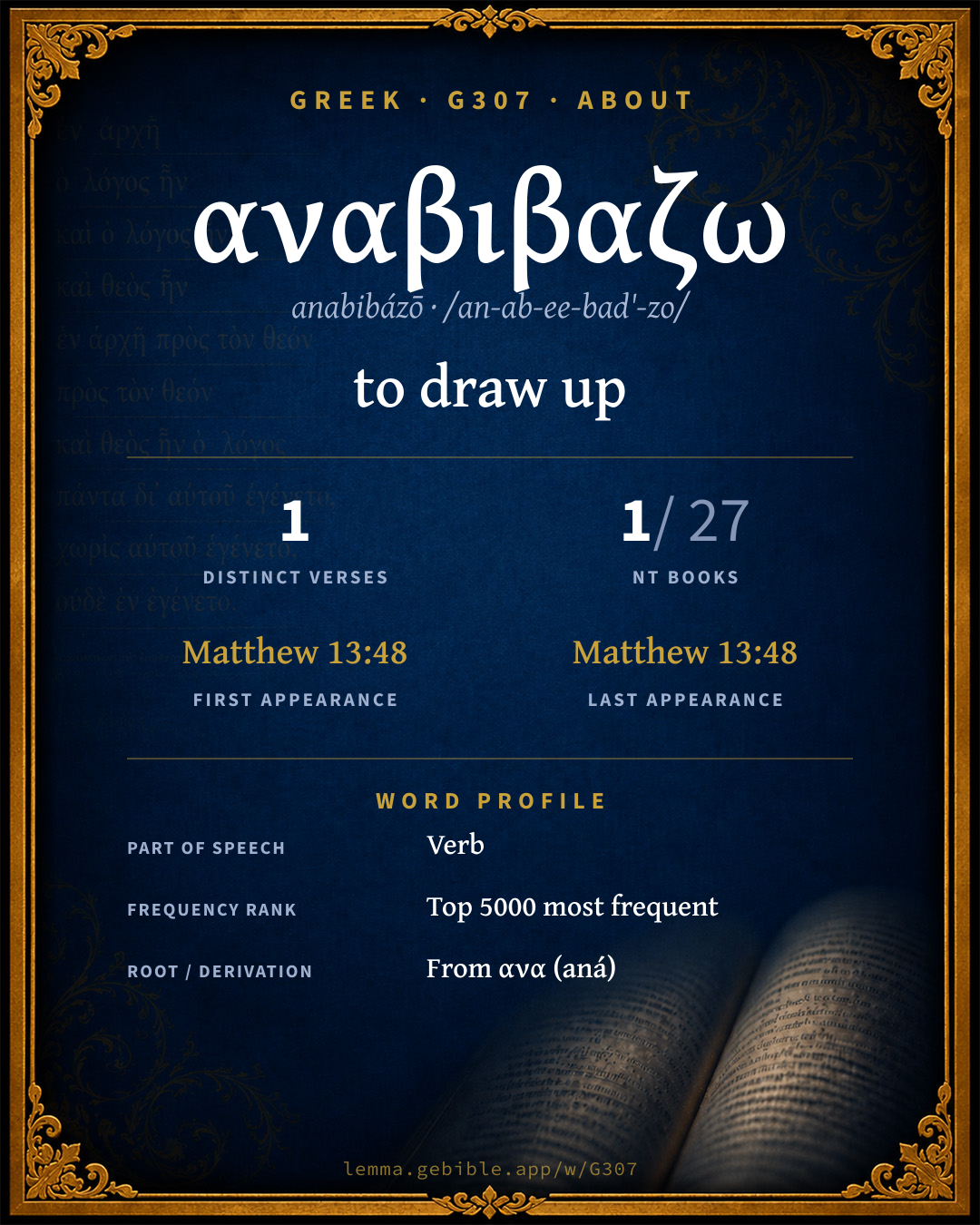
ἀναβιβάζω
to draw up
Full lexicon entry — Thayer's Greek Lexicon
From Thayer's Greek Lexicon
Where this word appears
Grammar key — what these labels mean
Part of speech
- Verb
- An action or state-of-being word.
Tense
- Aorist
- Action viewed as a simple whole, without regard to duration — often past (perfective aspect).
Voice
- Active
- The subject performs the action.
Mood
- Participle
- A verbal adjective (“writing,” “having written”).
Case
- Nominative
- The case of the subject (and the predicate nominative).
Gender
- Masculine
- Grammatically masculine.
Number
- Plural
- More than one.
Every verse where G307 appears — 1 distinct verse across 1 book. Click any verse to open its interlinear word-by-word view. Verse text shown in the World English Bible for context — . Each verse’s Greek form is shown with its reference; the English is not keyword-highlighted, since the data carries no word-level English alignment. Use “Compare translations” on any verse to read it across multiple English versions. This concordance covers the Greek New Testament; Septuagint (Greek Old Testament) occurrences of this word are not indexed here.
Matthew 1 verse
About this entry
At a glance — auto-summarized from this page’s data, not written by a person. Every figure links to its source below. This summary describes the numbers; it doesn’t interpret them.
The Greek verb αναβιβαζω centers on the idea of “to draw up.” The Greek New Testament uses it only 1 verse. The word gravitates to Matthew (100%). A true hapax — its single appearance is Matthew 13:48. It clusters with ανα, αναβαινω and αναβαλλομαι under a shared root. Dig into 1-verse concordance and the renderings breakdown below.
Gloss history
Strong's 1890 vs modern scholarship
About this word
Strong's G307 catalogs a Greek word from the Greek New Testament.
These counts are not copied from any lexicon or concordance. They are computed here, from the morphology-tagged Greek New Testament. What Lemma adds →
- 1
- distinct verses
- The word appears in 1 distinct verse.
- 1 / 27
- NT books
- The word appears in 1 of 27 New Testament books.
- #3,503
- by frequency
- Top 5000 most frequent Greek words (rank 3,503 of 5,347 Greek words by occurrence).
View all 1 occurrence in the concordance →
Most concentrated in
- Matthew 1 verse 100%
By section of the New Testament
By traditional corpus
Conventional, traditional groupings — biblical authorship is debated, so this is a traditional corpus grouping, not an authorship claim. Some books belong to more than one corpus (Luke is in both the Gospels and the Lukan corpus, and so on), so these shares overlap and need not total 100%. Each figure is a share of the word’s 1 distinct verse.
- Gospels 1 verse · 100%
How translations render this word
Counts come from each version’s own published word-to-Strong’s tagging or interlinear alignment — an approximate guide to how each version renders this word, not a word-level alignment the data otherwise carries. Because each total is that version’s own tagged count, the per-version totals vary from one another and need not match the appearance or distinct-verse counts above. These counts may also differ from a printed concordance because Lemma counts each distinctly tagged rendering and does not collapse phrase taggings into a single head-word total. This is a fixed set of word-tagged versions (KJV, ASV, BSB, ULT) and does not change with the reading translation you choose elsewhere. Each version’s license is shown beside its name below (and on Sources).
- King James Version: They drew 1×
- American Standard Version: They drew 1×
- Berean Standard Bible: Pulled 1×
- unfoldingWord Literal Text: Having dragged 1×
King James Version Public Domain
Renders G307 across 1 tagged occurrence — most commonly:
American Standard Version Public Domain
Renders G307 across 1 tagged occurrence — most commonly:
Berean Standard Bible Public Domain
Renders G307 across 1 tagged occurrence — most commonly:
unfoldingWord Literal Text CC BY-SA 4.0
Renders G307 across 1 tagged occurrence — most commonly:
Senses in Thayer's
The 1 sense Thayer's distinguishes for this word, in lexicon order (not ranked by frequency or importance). The full entry — with sub-senses — is in the Lexicon Entry tab.
- to cause to go up or ascend, to draw up
Word origin
Derived from ανα (aná) (G303) — among.
Same root — word family
Other Thayer's entries built from the same root as G307, grouped by Strong’s listed origin. These share a root / origin per the lexicon — not necessarily a shared meaning. Each links to that word’s own entry.
Derives from
Shares the same root
- αναβαινω anabaínō G305 to ascend
- αναβαλλομαι anabállomai G306 to delay
- αναβλεπω anablépō G308 to look up
- αναβοαω anaboáō G310 to cry out
- αναγγελλω anangéllō G312 to announce
- αναγενναω anagennáō G313 to be born again
- αναγινωσκω anaginṓskō G314 to recognize
- αναγκη anánkē G318 necessity
- αναγνωριζομαι anagnōrízomai G319 to recognize
- αναγω anágō G321 to lead up
- αναδεικνυμι anadeíknymi G322 to proclaim
- αναδεχομαι anadéchomai G324 to take up
- αναδιδωμι anadídōmi G325 to give forth
- αναζαω anazáō G326 to live again
- αναζητεω anazētéō G327 to search out
- αναζωννυμι anazṓnnymi G328 to gird up
- αναζωπυρεω anazōpyréō G329 to inflame
- αναθαλλω anathállō G330 to sprout up
- αναθεωρεω anatheōréō G333 to observe
- αναιρεω anairéō G337 to take away
- ανακαθιζω anakathízō G339 to sit up
- ανακαινιζω anakainízō G340 to renew
- ανακαινοω anakainóō G341 to make new
- ανακαλυπτω anakalýptō G343 to uncover
+51 more words share this root (not shown).
Compare all same-root words → Showing 4 of 77 — not the complete family. They share a root, not necessarily a meaning.
Septuagint usage
The same Greek word αναβιβαζω appears 36 times in the Greek Old Testament (Septuagint), across 36 verses in 17 books.
- 36
- LXX occurrences
- Tagged occurrences of this Greek word in the Septuagint.
- 36
- verses
- Distinct Septuagint verses containing this word.
- 17 / 39
- OT books
- The word appears in 17 of the 39 Old Testament books.
Sample Septuagint occurrences
- Genesis 37:28 ἀναβιβάζω
- Exodus 3:17 ἀναβιβάζω
- Leviticus 2:12 ἀναβιβάζω
- Numbers 20:25 ἀναβιβάζω
- Deuteronomy 20:1 ἀναβιβάζω
- Joshua 2:6 ἀναβιβάζω
- Judges 2:1 ἀναβιβάζω
- 2 Samuel 2:8 ἀναβιβάζω
- 1 Kings 21:33 ἀναβιβάζω
- 2 Kings 10:15 ἀναβιβάζω
- 2 Chronicles 23:20 ἀναβιβάζω
- Esther 6:9 ἀναβιβάζω
Septuagint occurrences (same lexeme)
Every verse where the same Strong’s number (G307) appears in the Greek Septuagint. Verse text shown in the World English Bible for context; the Greek form is the matched word — the English is not keyword-highlighted.
- Genesis 37:28 ἀναβιβάζω Midianites who were merchants passed by, and they drew and lifted up Joseph out of the pit, and sold Joseph to the Ishmaelites for twenty pieces of silver. They brought Joseph into Egypt.
- Genesis 41:43 ἀναβιβάζω and he made him to ride in the second chariot which he had. They cried before him, "Bow the knee!" He set him over all the land of Egypt.
- Genesis 46:4 ἀναβιβάζω I will go down with you into Egypt. I will also surely bring you up again. Joseph will close your eyes."
- Exodus 3:17 ἀναβιβάζω and I have said, I will bring you up out of the affliction of Egypt to the land of the Canaanite, the Hittite, the Amorite, the Perizzite, the Hivite, and the Jebusite, to a land flowing with milk and honey."'
- Exodus 4:20 ἀναβιβάζω Moses took his wife and his sons, and set them on a donkey, and he returned to the land of Egypt. Moses took God's rod in his hand.
- Exodus 8:2 ἀναβιβάζω If you refuse to let them go, behold, I will plague all your borders with frogs:
- Exodus 17:3 ἀναβιβάζω The people were thirsty for water there; and the people murmured against Moses, and said, "Why have you brought us up out of Egypt, to kill us, our children, and our livestock with thirst?"
- Exodus 32:4 ἀναβιβάζω He received what they handed him, and fashioned it with an engraving tool, and made it a molten calf; and they said, "These are your gods, Israel, which brought you up out of the land of Egypt."
- Exodus 32:6 ἀναβιβάζω They rose up early on the next day, and offered burnt offerings, and brought peace-offerings; and the people sat down to eat and to drink, and rose up to play.
- Exodus 32:8 ἀναβιβάζω They have turned aside quickly out of the way which I commanded them. They have made themselves a molten calf, and have worshiped it, and have sacrificed to it, and said, 'These are your gods, Israel, which brought you up out of the land of Egypt.'"
- Leviticus 2:12 ἀναβιβάζω As an offering of firstfruits you shall offer them to Yahweh: but they shall not come up for a sweet savor on the altar.
- Numbers 20:25 ἀναβιβάζω Take Aaron and Eleazar his son, and bring them up to Mount Hor;
- Numbers 20:27 ἀναβιβάζω Moses did as Yahweh commanded: and they went up into Mount Hor in the sight of all the congregation.
- Numbers 22:41 ἀναβιβάζω It happened in the morning, that Balak took Balaam, and brought him up into the high places of Baal; and he saw from there the utmost part of the people.
- Numbers 23:4 ἀναβιβάζω God met Balaam: and he said to him, I have prepared the seven altars, and I have offered up a bull and a ram on every altar.
- Numbers 23:14 ἀναβιβάζω He took him into the field of Zophim, to the top of Pisgah, and built seven altars, and offered up a bull and a ram on every altar.
- Deuteronomy 20:1 ἀναβιβάζω When you go forth to battle against your enemies, and see horses, and chariots, [and] a people more than you, you shall not be afraid of them; for Yahweh your God is with you, who brought you up out of the land of Egypt.
- Deuteronomy 32:13 ἀναβιβάζω He made him ride on the high places of the earth, He ate the increase of the field; He made him to suck honey out of the rock, Oil out of the flinty rock;
- Joshua 2:6 ἀναβιβάζω But she had brought them up to the roof, and hid them with the stalks of flax, which she had laid in order on the roof.
- Joshua 9:2 ἀναβιβάζω that they gathered themselves together, to fight with Joshua and with Israel, with one accord.
- Joshua 22:23 ἀναβιβάζω that we have built us an altar to turn away from following Yahweh; or if to offer thereon burnt offering or meal-offering, or if to offer sacrifices of peace-offerings thereon, let Yahweh himself require it;
- Judges 2:1 ἀναβιβάζω The angel of Yahweh came up from Gilgal to Bochim. He said, I made you to go up out of Egypt, and have brought you to the land which I swore to your fathers; and I said, I will never break my covenant with you:
- 2 Samuel 2:8 ἀναβιβάζω Now Abner the son of Ner, captain of Saul's host, had taken Ish-bosheth the son of Saul, and brought him over to Mahanaim;
- 1 Kings 21:33 ἀναβιβάζω
- 2 Kings 10:15 ἀναβιβάζω When he was departed there, he lighted on Jehonadab the son of Rechab coming to meet him; and he greeted him, and said to him, Is your heart right, as my heart is with your heart? Jehonadab answered, It is. If it be, give me your hand. He gave him his hand; and he took him up to him into the chariot.
- 2 Chronicles 23:20 ἀναβιβάζω He took the captains of hundreds, and the nobles, and the governors of the people, and all the people of the land, and brought down the king from the house of Yahweh: and they came through the upper gate to the king's house, and set the king on the throne of the kingdom.
- 2 Chronicles 35:24 ἀναβιβάζω So his servants took him out of the chariot, and put him in the second chariot that he had, and brought him to Jerusalem; and he died, and was buried in the tombs of his fathers. All Judah and Jerusalem mourned for Josiah.
- Esther 6:9 ἀναβιβάζω and let the clothing and the horse be delivered to the hand of one of the king's most noble princes, that they may array the man therewith whom the king delights to honor, and cause him to ride on horseback through the street of the city, and proclaim before him, Thus shall it be done to the man whom the king delights to honor.
- Esther 6:11 ἀναβιβάζω Then took Haman the clothing and the horse, and arrayed Mordecai, and caused him to ride through the street of the city, and proclaimed before him, Thus shall it be done to the man whom the king delights to honor.
- Isaiah 57:7 ἀναβιβάζω On a high and lofty mountain have you set your bed; there also you went up to offer sacrifice.
- Isaiah 58:14 ἀναβιβάζω then shall you delight yourself in Yahweh; and I will make you to ride on the high places of the earth; and I will feed you with the heritage of Jacob your father: for the mouth of Yahweh has spoken it.
- Isaiah 63:11 ἀναβιβάζω Then he remembered the days of old, Moses [and] his people, [saying], Where is he who brought them up out of the sea with the shepherds of his flock? where is he who put his holy Spirit in the midst of them?
- Jeremiah 28:27 ἀναβιβάζω
- Lamentations 2:10 ἀναβιβάζω The elders of the daughter of Zion sit on the ground, they keep silence; They have cast up dust on their heads; they have girded themselves with sackcloth: The virgins of Jerusalem hang down their heads to the ground.
- Ezekiel 39:2 ἀναβιβάζω and I will turn you about, and will lead you on, and will cause you to come up from the uttermost parts of the north; and I will bring you on the mountains of Israel;
- Amos 8:10 ἀναβιβάζω I will turn your feasts into mourning, And all your songs into lamentation; And I will make you wear sackcloth on all your bodies, And baldness on every head. I will make it like the mourning for an only son, And the end of it like a bitter day.
These are occurrences of the same Greek lexeme (G307) in the Septuagint — not a translation of any one Hebrew word. The store carries no word-level Hebrew↔Greek alignment, so no Hebrew original is asserted here. Counts come from the recovered LXX Strong's tagging — high-frequency vocabulary is well covered, while rare or late forms may be untagged — so they reflect tagged occurrences and may slightly undercount.