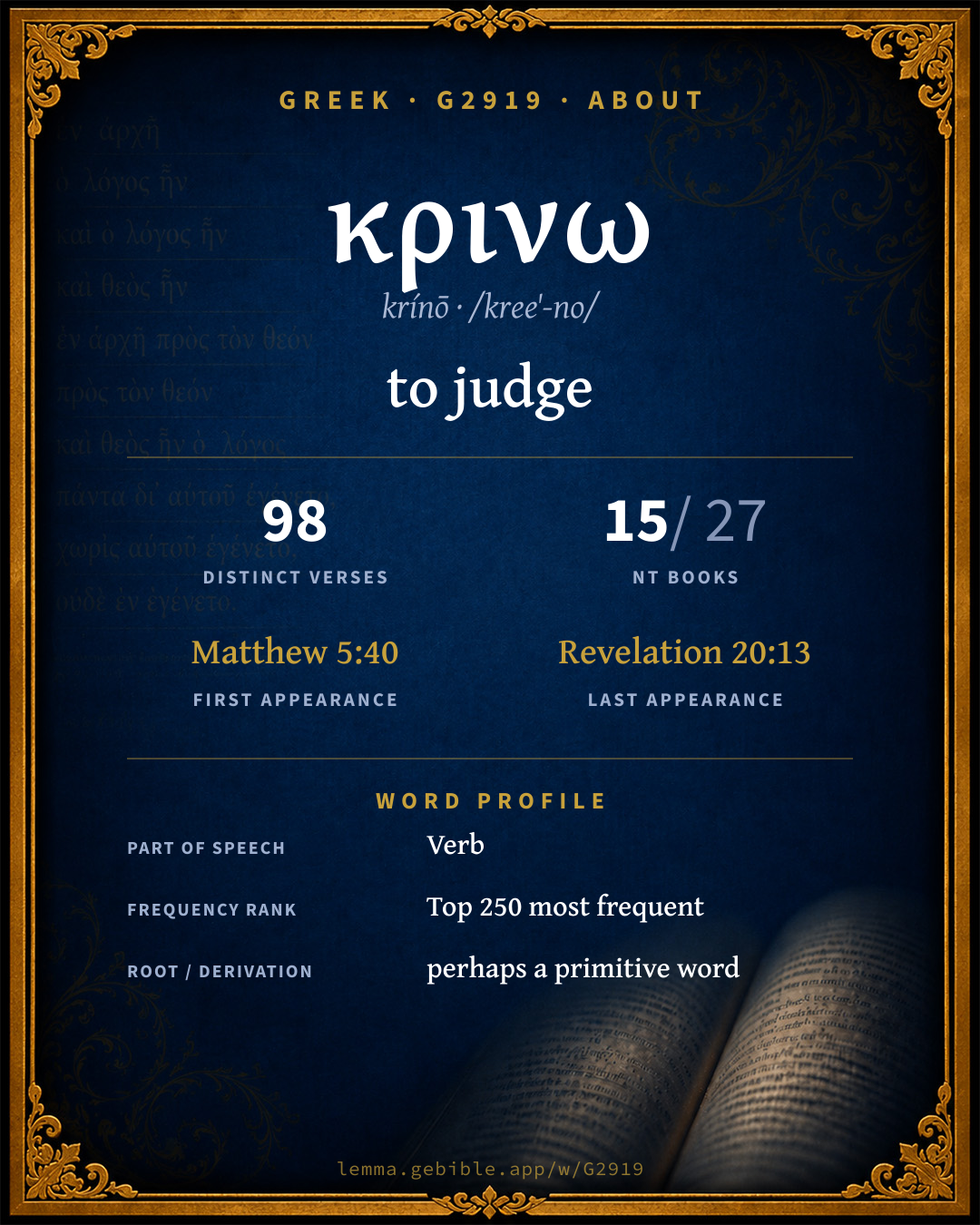
κρίνω
to judge
‘to judge’ is one of 8 main senses fuller range ↓
Full lexicon entry — Thayer's Greek Lexicon
From Thayer's Greek Lexicon
Where this word appears
See every Present-tense verb in the Greek New Testament →
Grammar key — what these labels mean
Part of speech
- Verb
- An action or state-of-being word.
Tense
- Present
- Ongoing or general action in present time (imperfective aspect).
- Aorist
- Action viewed as a simple whole, without regard to duration — often past (perfective aspect).
- Future
- Action expected in future time.
- Perfect
- A completed past action with continuing present results.
- Imperfect
- Continuous or repeated action in past time (“was writing”).
- Pluperfect
- A past action completed before another past point (“had written”).
Voice
- Active
- The subject performs the action.
- Passive
- The subject receives the action.
Mood
- Participle
- A verbal adjective (“writing,” “having written”).
- Indicative
- States a fact or asks a factual question (the mood of reality).
- Imperative
- Expresses a command or request.
- Infinitive
- A verbal noun (“to write”), unmarked for person or number.
- Subjunctive
- Expresses probability, purpose, or possibility (the mood of contingency).
Case
- Nominative
- The case of the subject (and the predicate nominative).
- Accusative
- The case of the direct object and of extent.
- Genitive
- The case of source, possession, or “of” — answers “whose / from what.”
- Dative
- The case of the indirect object, means, or location — “to / for / with / in.”
Person
- 3rd person
- The one spoken about (“he / she / it / they”).
- 2nd person
- The one addressed (“you”).
- 1st person
- The speaker (“I / we”).
Gender
- Masculine
- Grammatically masculine.
- Neuter
- Grammatically neuter.
Number
- Singular
- One.
- Plural
- More than one.
Grammatical forms 46 distinct
- Verb, Present, Active, Participle, Nominative, Singular, Masculine 9 times (8%)
- Verb, Present, Active, Indicative, 3rd person, Singular 8 times (7%)
- Verb, Aorist, Active, Imperative, 2nd person, Plural 6 times (5%)
- Verb, Future, Active, Indicative, 3rd person, Singular 5 times (4%)
- Verb, Present, Active, Indicative, 2nd person, Plural 5 times (4%)
- Verb, Present, Passive, Indicative, 3rd person, Singular 5 times (4%)
- Verb, Present, Passive, Infinitive 5 times (4%)
- Verb, Present, Active, Indicative, 1st person, Singular 4 times (4%)
+38 more forms (67 occurrences)
Parsed forms decoded from the imported morphology (Robinson–Tischendorf, public domain), counted across 114 parsed occurrences — not distinct verses.
Every verse where G2919 appears — 98 distinct verses across 15 books. Click any verse to open its interlinear word-by-word view. Verse text shown in the World English Bible for context — . Each verse’s Greek form is shown with its reference; the English is not keyword-highlighted, since the data carries no word-level English alignment. Use “Compare translations” on any verse to read it across multiple English versions. This concordance covers the Greek New Testament; Septuagint (Greek Old Testament) occurrences of this word are not indexed here.
Matthew 4 verses
- Matthew 5:40 κριθῆναι aor pass inf If anyone sues you to take away your coat, let him have your cloak also.
- Matthew 7:1 κρίνετε κριθῆτε pres act impv 2pl aor pass subj 2pl "Don't judge, so that you won't be judged.
- Matthew 7:2 κρίνετε κριθήσεσθε pres act ind 2pl fut pass ind 2pl For with whatever judgment you judge, you will be judged; and with whatever measure you measure, it will be measured to you.
- Matthew 19:28 κρίνοντες pres act ptcp nom pl masc Jesus said to them, "Most assuredly I tell you that you who have followed me, in the regeneration when the Son of Man will sit on the throne of his glory, you also will sit on twelve thrones, judging the twelve tribes of Israel.
Luke 5 verses
- Luke 6:37 κρίνετε κριθῆτε pres act impv 2pl aor pass subj 2pl Don't judge, And you won't be judged. Don't condemn, And you won't be condemned. Set free, And you will be set free.
- Luke 7:43 ἔκρινας aor act ind 2sg Simon answered, "He, I suppose, to whom he forgave the most." He said to him, "You have judged correctly."
- Luke 12:57 κρίνετε pres act ind 2pl Why don't you judge for yourselves what is right?
- Luke 19:22 κρίνω fut act ind 1sg "He said to him, 'Out of your own mouth will I judge you, you wicked servant! You knew that I am an exacting man, taking up that which I didn't lay down, and reaping that which I didn't sow.
- Luke 22:30 κρίνοντες pres act ptcp nom pl masc that you may eat and drink at my table in my Kingdom. You will sit on thrones, judging the twelve tribes of Israel."
John 14 verses
- John 3:17 κρίνῃ pres act subj 3sg For God didn't send his Son into the world to judge the world, but that the world should be saved through him.
- John 3:18 κρίνεται κέκριται pres pass ind 3sg perf pass ind 3sg He who believes in him is not judged. He who doesn't believe has been judged already, because he has not believed in the name of the one and only Son of God.
- John 5:22 κρίνει pres act ind 3sg For the Father judges no one, but he has given all judgment to the Son,
- John 5:30 κρίνω pres act ind 1sg I can of myself do nothing. As I hear, I judge, and my judgment is righteous; because I don't seek my own will, but the will of my Father who sent me.
- John 7:24 κρίνετε κρίνατε pres act impv 2pl aor act impv 2pl Don't judge according to appearance, but judge righteous judgment."
- John 7:51 κρίνει pres act ind 3sg "Does our law judge a man, unless it first hears from him personally and knows what he does?"
- John 8:15 κρίνετε κρίνω pres act ind 2pl pres act ind 1sg You judge according to the flesh. I judge no one.
- John 8:16 κρίνω pres act subj 1sg Even if I do judge, my judgment is true, for I am not alone, but I am with the Father who sent me.
- John 8:26 κρίνειν pres act inf I have many things to speak and to judge concerning you. However he who sent me is true; and the things which I heard from him, these I say to the world."
- John 8:50 κρίνων pres act ptcp nom sg masc But I don't seek my own glory. There is one who seeks and judges.
- John 12:47 κρίνω κρίνω pres act ind 1sg pres act subj 1sg If anyone listens to my sayings, and doesn't believe, I don't judge him. For I came not to judge the world, but to save the world.
- John 12:48 κρίνοντα κρινεῖ pres act ptcp acc sg masc fut act ind 3sg He who rejects me, and doesn't receive my sayings, has one who judges him. The word that I spoke, the same will judge him in the last day.
- John 16:11 κέκριται perf pass ind 3sg about judgment, because the prince of this world has been judged.
- John 18:31 κρίνατε aor act impv 2pl Pilate therefore said to them, "Take him yourselves, and judge him according to your law." Therefore the Jews said to him, "It is not lawful for us to put anyone to death,"
Acts 21 verses
- Acts 3:13 κρίναντος aor act ptcp gen sg masc The God of Abraham, Isaac, and Jacob, the God of our fathers, has glorified his Servant Jesus, whom you delivered up, and denied in the presence of Pilate, when he had determined to release him.
- Acts 4:19 κρίνατε aor act impv 2pl But Peter and John answered them, "Whether it is right in the sight of God to listen to you rather than to God, judge for yourselves,
- Acts 7:7 κρινῶ fut act ind 1sg 'I will judge the nation to which they will be in bondage,' said God, 'and after that will they come out, and serve me in this place.'
- Acts 13:27 κρίναντες aor act ptcp nom pl masc For those who dwell in Jerusalem, and their rulers, because they didn't know him, nor the voices of the prophets which are read every Sabbath, fulfilled them by condemning him.
- Acts 13:46 κρίνετε pres act ind 2pl Paul and Barnabas spoke out boldly, and said, "It was necessary that God's word should be spoken to you first. Since indeed you thrust it from you, and judge yourselves unworthy of eternal life, behold, we turn to the Gentiles.
- Acts 15:19 κρίνω pres act ind 1sg "Therefore my judgment is that we don't trouble those from among the Gentiles who turn to God,
- Acts 16:4 κεκριμένα perf pass ptcp acc pl neut As they went on their way through the cities, they delivered the decrees to them to keep which had been ordained by the apostles and elders who were at Jerusalem.
- Acts 16:15 κεκρίκατέ perf act ind 2pl When she and her household were baptized, she begged us, saying, "If you have judged me to be faithful to the Lord, come into my house, and stay." So she persuaded us.
- Acts 17:31 κρίνειν pres act inf because he has appointed a day in which he will judge the world in righteousness by the man whom he has ordained; of which he has given assurance to all men, in that he has raised him from the dead."
- Acts 20:16 κεκρίκει plup act ind 3sg For Paul had determined to sail past Ephesus, that he might not have to spend time in Asia; for he was hastening, if it were possible for him, to be in Jerusalem on the day of Pentecost.
- Acts 21:25 κρίναντες aor act ptcp nom pl masc But concerning the Gentiles who believe, we have written our decision that they should observe no such thing, except that they should keep themselves from food offered to idols, from blood, from strangled things, and from sexual immorality."
- Acts 23:3 κρίνων pres act ptcp nom sg masc Then Paul said to him, "God will strike you, you whitewashed wall! Do you sit to judge me according to the law, and command me to be struck contrary to the law?"
- Acts 23:6 κρίνομαι pres pass ind 1sg But when Paul perceived that the one part were Sadducees and the other Pharisees, he cried out in the council, "Men and brothers, I am a Pharisee, a son of Pharisees. Concerning the hope and resurrection of the dead I am being judged!"
- Acts 24:21 κρίνομαι pres pass ind 1sg unless it is for this one thing that I cried standing among them, 'Concerning the resurrection of the dead I am being judged before you today!'"
- Acts 25:9 κριθῆναι aor pass inf But Festus, desiring to gain favor with the Jews, answered Paul and said, "Are you willing to go up to Jerusalem, and be judged by me there concerning these things?"
- Acts 25:10 κρίνεσθαι pres pass inf But Paul said, "I am standing before Caesar's judgment seat, where I ought to be tried. I have done no wrong to the Jews, as you also know very well.
- Acts 25:20 κρίνεσθαι pres pass inf Being perplexed how to inquire concerning these things, I asked whether he was willing to go to Jerusalem and there be judged concerning these matters.
- Acts 25:25 ἔκρινα aor act ind 1sg But when I found that he had committed nothing worthy of death, and as he himself appealed to the emperor I determined to send him.
- Acts 26:6 κρινόμενος pres pass ptcp nom sg masc Now I stand here to be judged for the hope of the promise made by God to our fathers,
- Acts 26:8 κρίνεται pres pass ind 3sg Why is it judged incredible with you, if God does raise the dead?
- Acts 27:1 ἐκρίθη aor pass ind 3sg When it was determined that we should sail for Italy, they delivered Paul and certain other prisoners to a centurion named Julius, of the Augustan band.
Romans 14 verses
- Romans 2:1 κρίνων κρίνεις κρίνων pres act ptcp nom sg masc pres act ind 2sg pres act ptcp nom sg masc Therefore you are without excuse, O man, whoever you are who judge. For in that which you judge another, you condemn yourself. For you who judge practice the same things.
- Romans 2:3 κρίνων pres act ptcp nom sg masc Do you think this, O man who judges those who practice such things, and do the same, that you will escape the judgment of God?
- Romans 2:12 κριθήσονται fut pass ind 3pl For as many as have sinned without law will also perish without the law. As many as have sinned under the law will be judged by the law.
- Romans 2:16 κρινεῖ pres act ind 3sg in the day when God will judge the secrets of men, according to my Gospel, by Jesus Christ.
- Romans 2:27 κρινεῖ fut act ind 3sg Won't the uncircumcision which is by nature, if it fulfills the law, judge you, who with the letter and circumcision are a transgressor of the law?
- Romans 3:4 κρίνεσθαί pres pass inf May it never be! Yes, let God be found true, but every man a liar. As it is written, "That you might be justified in your words, And might prevail when you come into judgment."
- Romans 3:6 κρινεῖ fut act ind 3sg May it never be! For then how will God judge the world?
- Romans 3:7 κρίνομαι pres pass ind 1sg For if the truth of God through my lie abounded to his glory, why am I also still judged as a sinner?
- Romans 14:3 κρινέτω pres act impv 3sg Don't let him who eats despise him who doesn't eat. Don't let him who doesn't eat judge him who eats, for God has received him.
- Romans 14:4 κρίνων pres act ptcp nom sg masc Who are you who judge another's servant? To his own lord he stands or falls. Yes, he will be made to stand, for God has power to make him stand.
- Romans 14:5 κρίνει κρίνει pres act ind 3sg pres act ind 3sg One man esteems one day as more important. Another esteems every day alike. Let each man be fully assured in his own mind.
- Romans 14:10 κρίνεις pres act ind 2sg But you, why do you judge your brother? Or you again, why do you despise your brother? For we will all stand before the judgment seat of Christ.
- Romans 14:13 κρίνωμεν κρίνατε pres act subj 1pl aor act impv 2pl Therefore let's not judge one another any more, but judge this rather, that no man put a stumbling block in his brother's way, or an occasion for falling.
- Romans 14:22 κρίνων pres act ptcp nom sg masc Do you have faith? Have it to yourself before God. Happy is he who doesn't judge himself in that which he approves.
1 Corinthians 15 verses
- 1 Corinthians 2:2 ἔκρινά aor act ind 1sg For I determined not to know anything among you, except Jesus Christ, and him crucified.
- 1 Corinthians 4:5 κρίνετε pres act impv 2pl Therefore judge nothing before the time, until the Lord comes, who will both bring to light the hidden things of darkness, and reveal the counsels of the hearts. Then each man will get his praise from God.
- 1 Corinthians 5:3 κέκρικα perf act ind 1sg For I most assuredly, as being absent in body but present in spirit, have already, as though I were present, judged him who has done this thing.
- 1 Corinthians 5:12 κρίνειν κρίνετε pres act inf pres act ind 2pl For what have I to do with also judging those who are outside? Don't you judge those who are within?
- 1 Corinthians 5:13 κρινεῖ pres act ind 3sg But those who are outside, God judges. "Put away the wicked man from among yourselves."
- 1 Corinthians 6:1 κρίνεσθαι pres pass inf Dare any of you, having a matter against his neighbor, go to law before the unrighteous, and not before the saints?
- 1 Corinthians 6:2 κρινοῦσιν κρίνεται fut act ind 3pl pres pass ind 3sg Don't you know that the saints will judge the world? And if the world is judged by you, are you unworthy to judge the smallest matters?
- 1 Corinthians 6:3 κρινοῦμεν fut act ind 1pl Don't you know that we will judge angels? How much more, things that pertain to this life?
- 1 Corinthians 6:6 κρίνεται pres pass ind 3sg But brother goes to law with brother, and that before unbelievers!
- 1 Corinthians 7:37 κέκρικεν perf act ind 3sg But he who stands steadfast in his heart, having no necessity, but has power over his own heart, to keep his own virgin, does well.
- 1 Corinthians 10:15 κρίνατε aor act impv 2pl I speak as to wise men. Judge what I say.
- 1 Corinthians 10:29 κρίνεται pres pass ind 3sg Conscience, I say, not your own, but the other's conscience. For why is my liberty judged by another conscience?
- 1 Corinthians 11:13 κρίνατε aor act impv 2pl Judge for yourselves. Is it appropriate that a woman pray to God unveiled?
- 1 Corinthians 11:31 ἐκρινόμεθα impf pass ind 1pl For if we discerned ourselves, we wouldn't be judged.
- 1 Corinthians 11:32 κρινόμενοι pres pass ptcp nom pl masc But when we are judged, we are punished by the Lord, that we may not be condemned with the world.
2 Corinthians 2 verses
- 2 Corinthians 2:1 Ἔκρινα aor act ind 1sg But I determined this for myself, that I would not come to you again in sorrow.
- 2 Corinthians 5:15 κρίναντας aor act ptcp acc pl masc He died for all, that those who live should no longer live to themselves, but to him who for their sakes died and rose again.
Colossians 1 verse
2 Thessalonians 1 verse
2 Timothy 1 verse
Titus 1 verse
Hebrews 2 verses
- Hebrews 10:30 κρινεῖ fut act ind 3sg For we know him who said, "Vengeance belongs to me," says the Lord, "I will repay." Again, "The Lord will judge his people."
- Hebrews 13:4 κρινεῖ fut act ind 3sg Let marriage be held in honor among all, and let the bed be undefiled: but God will judge the sexually immoral and adulterers.
James 4 verses
- James 2:12 κρίνεσθαι pres pass inf So speak, and so do, as men who are to be judged by a law of freedom.
- James 4:11 κρίνων κρίνει κρίνεις pres act ptcp nom sg masc pres act ind 3sg pres act ind 2sg Don't speak against one another, brothers. He who speaks against a brother and judges his brother, speaks against the law and judges the law. But if you judge the law, you are not a doer of the law, but a judge.
- James 4:12 κρίνων pres act ptcp nom sg masc Only one is the lawgiver, who is able to save and to destroy. But who are you to judge another?
- James 5:9 κριθῆτε aor pass subj 2pl Don't grumble, brothers, against one another, so that you won't be judged. Behold, the judge stands at the door.
1 Peter 4 verses
- 1 Peter 1:17 κρίνοντα pres act ptcp acc sg masc If you call on him as Father, who without respect of persons judges according to each man's work, pass the time of your living as strangers here in reverent fear:
- 1 Peter 2:23 κρίνοντι pres act ptcp dat sg masc Who, when he was cursed, didn't curse back. When he suffered, didn't threaten, but committed himself to him who judges righteously;
- 1 Peter 4:5 κρῖναι aor act inf who will give account to him who is ready to judge the living and the dead.
- 1 Peter 4:6 κριθῶσι aor pass subj 3pl For to this end was the Gospel preached even to the dead, that they might be judged indeed as men in the flesh, but live as to God in the spirit.
Revelation 9 verses
- Revelation 6:10 κρίνεις pres act ind 2sg They cried with a loud voice, saying, "How long, Master, the holy and true, until you judge and avenge our blood on those who dwell on the earth?"
- Revelation 11:18 κριθῆναι aor pass inf The nations were angry, and your wrath came, as did the time for the dead to be judged, and to give your bondservants the prophets, their reward, as well as to the saints, and those who fear your name, to the small and the great; and to destroy those who destroy the earth."
- Revelation 16:5 ἔκρινας aor act ind 2sg I heard the angel of the waters saying, "You are righteous, who are and who were, you Holy One, because you have judged these things.
- Revelation 18:8 κρίνας aor act ptcp nom sg masc Therefore in one day her plagues will come: death, mourning, and famine; and she will be utterly burned with fire; for the Lord God who has judged her is strong.
- Revelation 18:20 ἔκρινεν aor act ind 3sg Rejoice over her, O heaven, you saints, apostles, and prophets; for God has judged your judgment on her."
- Revelation 19:2 ἔκρινεν aor act ind 3sg for true and righteous are his judgments. For he has judged the great prostitute, who corrupted the earth with her sexual immorality, and he has avenged the blood of his servants at her hand."
- Revelation 19:11 κρίνει pres act ind 3sg I saw the heaven opened, and behold, a white horse, and he who sat on it is called Faithful and True. In righteousness he judges and makes war.
- Revelation 20:12 ἐκρίθησαν aor pass ind 3pl I saw the dead, the great and the small, standing before the throne, and they opened books. Another book was opened, which is the book of life. The dead were judged out of the things which were written in the books, according to their works.
- Revelation 20:13 ἐκρίθησαν aor pass ind 3pl The sea gave up the dead who were in it. Death and Hades gave up the dead who were in them. They were judged, each one according to his works.
About this entry
At a glance — auto-summarized from this page’s data, not written by a person. Every figure links to its source below. This summary describes the numbers; it doesn’t interpret them.
κρινω (krínō) is a Greek verb most often rendered “to judge.” Ranging over 8 senses, it is not a single-sense word. The Greek New Testament uses it across 98 verses — moderately common. It first appears in Matthew 5:40. Sharing its root, it stands alongside ειλικρινης, κριμα and κριτης. For the data behind this summary, explore the sense tree and the renderings breakdown below.
Gloss history
Strong's 1890 vs modern scholarship

About this word
Strong's G2919 catalogs a Greek word from the Greek New Testament.
These counts are not copied from any lexicon or concordance. They are computed here, from the morphology-tagged Greek New Testament. What Lemma adds →
- 98
- distinct verses
- The word appears in 98 distinct verses.
- 15 / 27
- NT books
- The word appears in 15 of 27 New Testament books.
- #145
- by frequency
- Top 250 most frequent Greek words (rank 145 of 5,347 Greek words by occurrence).
View all 98 occurrences in the concordance →
Most concentrated in
- Acts 21 verses 21%
- 1 Corinthians 15 verses 15%
- John 14 verses 14%
By section of the New Testament
By traditional corpus
Conventional, traditional groupings — biblical authorship is debated, so this is a traditional corpus grouping, not an authorship claim. Some books belong to more than one corpus (Luke is in both the Gospels and the Lukan corpus, and so on), so these shares overlap and need not total 100%. Each figure is a share of the word’s 98 distinct verses.
- Pauline corpus 35 verses · 36%
- Lukan (Luke–Acts) 26 verses · 27%
- Gospels 23 verses · 23%
- Johannine 23 verses · 23%
- Revelation 9 verses · 9%
- General (Catholic) Epistles 8 verses · 8%
- Hebrews 2 verses · 2%
How translations render this word
Counts come from each version’s own published word-to-Strong’s tagging or interlinear alignment — an approximate guide to how each version renders this word, not a word-level alignment the data otherwise carries. Because each total is that version’s own tagged count, the per-version totals vary from one another and need not match the appearance or distinct-verse counts above. These counts may also differ from a printed concordance because Lemma counts each distinctly tagged rendering and does not collapse phrase taggings into a single head-word total. This is a fixed set of word-tagged versions (KJV, ASV, BSB, ULT) and does not change with the reading translation you choose elsewhere. Each version’s license is shown beside its name below (and on Sources).
- King James Version: Judge 31×, Judgeth 7×, Be judged 5×
- American Standard Version: Judge 32×, Be judged 7×, Judged 7×
- Berean Standard Bible: Judge 25×, Judges 6×, Will judge 6×
- unfoldingWord Literal Text: Judge 28×, Judging 15×, Be judged 9×
King James Version Public Domain
Renders G2919 across 130 tagged occurrences — most commonly:
Plus other, less common renderings. Plus 57 renderings that appear only once — usually multi-word phrases or single function words the recovered tagging swept in, not distinct renderings. Not rendered by a distinct English word in 1 further occurrence.
American Standard Version Public Domain
Renders G2919 across 127 tagged occurrences — most commonly:
Plus other, less common renderings. Plus 47 renderings that appear only once — usually multi-word phrases or single function words the recovered tagging swept in, not distinct renderings.
Berean Standard Bible Public Domain
Renders G2919 across 114 tagged occurrences — most commonly:
Plus 59 renderings that appear only once — usually multi-word phrases or single function words the recovered tagging swept in, not distinct renderings.
unfoldingWord Literal Text CC BY-SA 4.0
Renders G2919 across 140 tagged occurrences — most commonly:
Plus other, less common renderings. Plus 39 renderings that appear only once — usually multi-word phrases or single function words the recovered tagging swept in, not distinct renderings.
8 senses in Thayer's, in lexicon order
The 8 senses Thayer's distinguishes for this word, in lexicon order (not ranked by frequency or importance). The full entry — with sub-senses — is in the Lexicon Entry tab.
- to separate, put asunder, to pick out, select, choose
- to approve, esteem, to prefer
- to be of opinion, deem, think, to be of opinion
- to determine, resolve, decree
- to pronounce an opinion concerning right and wrong
- to pronounce judgment, to subject to censure
- to preside over with the power of giving judicial decisions…
- to contend together, of warriors and combatants
Word origin
Origin: perhaps a primitive word
Properly to distinguish that is decide (mentally or judicially); by implication to try condemn punish : - avenge conclude condemn damn decree determine esteem judge go to (sue at the) law ordain call in question sentence to think.
— Strong’s Exhaustive Concordance (1890), public domain.
Forms in the corpus
The 48 distinct written forms G2919 takes in the Greek New Testament, most frequent first — each parse links to that tense’s occurrences in the concordance.
Same root — word family
Other Thayer's entries built from the same root as G2919, grouped by Strong’s listed origin. These share a root / origin per the lexicon — not necessarily a shared meaning. Each links to that word’s own entry.
Derived from this word
Compare all same-root words → They share a root, not necessarily a meaning.
Septuagint usage
The same Greek word κρινω appears 184 times in the Greek Old Testament (Septuagint), across 171 verses in 26 books.
- 184
- LXX occurrences
- Tagged occurrences of this Greek word in the Septuagint.
- 171
- verses
- Distinct Septuagint verses containing this word.
- 26 / 39
- OT books
- The word appears in 26 of the 39 Old Testament books.
Sample Septuagint occurrences
- Genesis 15:14 κρίνω
- Exodus 5:21 κρίνω
- Leviticus 19:15 κρίνω
- Numbers 35:24 κρίνω
- Deuteronomy 1:16 κρίνω
- Judges 3:10 κρίνω
- Ruth 1:1 κρίνω
- 1 Samuel 2:10 κρίνω
- 2 Samuel 18:19 κρίνω
- 1 Kings 3:9 κρίνω
- 2 Kings 23:22 κρίνω
- 1 Chronicles 16:33 κρίνω
Septuagint occurrences (same lexeme)
Every verse where the same Strong’s number (G2919) appears in the Greek Septuagint — showing the first 50 of 171. Verse text shown in the World English Bible for context; the Greek form is the matched word — the English is not keyword-highlighted.
- Genesis 15:14 κρίνω I will also judge that nation, whom they will serve. Afterward they will come out with great substance.
- Genesis 16:5 κρίνω Sarai said to Abram, "This wrong is your fault. I gave my handmaid into your bosom, and when she saw that she had conceived, I was despised in her eyes. Yahweh judge between me and you."
- Genesis 18:25 κρίνω Be it far from you to do things like that, to kill the righteous with the wicked, that so the righteous should be as the wicked. May that be far from you. Shouldn't the Judge of all the earth do right?"
- Genesis 19:9 κρίνω They said, "Stand back!" They said, "This one fellow came in to live as a foreigner, and he appoints himself a judge. Now will we deal worse with you, than with them!" They pressed hard on the man, even Lot, and drew near to break the door.
- Genesis 26:21 κρίνω They dug another well, and they argued over that, also. He called the name of it Sitnah.
- Genesis 30:6 κρίνω Rachel said, "God has judged me, and has also heard my voice, and has given me a son." Therefore called she his name Dan.
- Genesis 31:53 κρίνω The God of Abraham, and the God of Nahor, the God of their father, judge between us." Then Jacob swore by the fear of his father, Isaac.
- Genesis 49:16 κρίνω "Dan will judge his people, As one of the tribes of Israel.
- Exodus 5:21 κρίνω and they said to them, "May Yahweh look at you, and judge, because you have made us a stench to be abhorred in the eyes of Pharaoh, and in the eyes of his servants, to put a sword in their hand to kill us."
- Exodus 18:13 κρίνω It happened on the next day, that Moses sat to judge the people, and the people stood around Moses from the morning to the evening.
- Exodus 18:22 κρίνω Let them judge the people at all times. It shall be that every great matter they shall bring to you, but every small matter they shall judge themselves. So shall it be easier for you, and they shall share the load with you.
- Exodus 18:26 κρίνω They judged the people at all times. They brought the hard causes to Moses, but every small matter they judged themselves.
- Leviticus 19:15 κρίνω "'You shall do no injustice in judgment: you shall not be partial to the poor, nor show favoritism to the great; but in righteousness shall you judge your neighbor.
- Numbers 35:24 κρίνω then the congregation shall judge between the striker and the avenger of blood according to these ordinances;
- Deuteronomy 1:16 κρίνω I charged your judges at that time, saying, Hear [the causes] between your brothers, and judge righteously between a man and his brother, and the foreigner who is living with him.
- Deuteronomy 1:17 κρίνω You shall not show partiality in judgment; you shall hear the small and the great alike; you shall not be afraid of the face of man; for the judgment is God's: and the cause that is too hard for you, you shall bring to me, and I will hear it.
- Deuteronomy 16:18 κρίνω Judges and officers shall you make you in all your gates, which Yahweh your God gives you, according to your tribes; and they shall judge the people with righteous judgment.
- Deuteronomy 25:1 κρίνω If there be a controversy between men, and they come to judgment, and [the judges] judge them; then they shall justify the righteous, and condemn the wicked;
- Deuteronomy 32:36 κρίνω For Yahweh will judge his people, Repent himself for his servants; When he sees that [their] power is gone, There is none [remaining], shut up or left at large.
- Judges 3:10 κρίνω The Spirit of Yahweh came on him, and he judged Israel; and he went out to war, and Yahweh delivered Cushan Rishathaim king of Mesopotamia into his hand: and his hand prevailed against Cushan Rishathaim.
- Judges 3:30 κρίνω So Moab was subdued that day under the hand of Israel. The land had rest eighty years.
- Judges 4:4 κρίνω Now Deborah, a prophetess, the wife of Lappidoth, she judged Israel at that time.
- Judges 10:2 κρίνω He judged Israel twenty-three years, and died, and was buried in Shamir.
- Judges 10:3 κρίνω After him arose Jair, the Gileadite; and he judged Israel twenty-two years.
- Judges 11:27 κρίνω I therefore have not sinned against you, but you do me wrong to war against me: Yahweh, the Judge, be judge this day between the children of Israel and the children of Ammon.
- Judges 12:7 κρίνω Jephthah judged Israel six years. Then died Jephthah the Gileadite, and was buried in [one of] the cities of Gilead.
- Judges 12:8 κρίνω After him Ibzan of Bethlehem judged Israel.
- Judges 12:9 κρίνω He had thirty sons; and thirty daughters he sent abroad, and thirty daughters he brought in from abroad for his sons. He judged Israel seven years.
- Judges 12:11 κρίνω After him Elon the Zebulunite judged Israel; and he judged Israel ten years.
- Judges 12:13 κρίνω After him Abdon the son of Hillel the Pirathonite judged Israel.
- Judges 12:14 κρίνω He had forty sons and thirty sons' sons, who rode on seventy donkey colts: and he judged Israel eight years.
- Judges 15:20 κρίνω He judged Israel in the days of the Philistines twenty years.
- Judges 16:31 κρίνω Then his brothers and all the house of his father came down, and took him, and brought him up, and buried him between Zorah and Eshtaol in the burying-place of Manoah his father. He judged Israel twenty years.
- Judges 21:22 κρίνω It shall be, when their fathers or their brothers come to complain to us, that we will say to them, Grant them graciously to us, because we didn't take for each man his wife in battle, neither did you give them to them, else would you now be guilty.
- Ruth 1:1 κρίνω It happened in the days when the judges judged, that there was a famine in the land. A certain man of Bethlehem Judah went to sojourn in the country of Moab, he, and his wife, and his two sons.
- 1 Samuel 2:10 κρίνω Those who strive with Yahweh shall be broken to pieces; Against them will he thunder in the sky: Yahweh will judge the ends of the earth; He will give strength to his king, Exalt the horn of his anointed.
- 1 Samuel 4:18 κρίνω It happened, when he made mention of the ark of God, that [Eli] fell from off his seat backward by the side of the gate; and his neck broke, and he died: for he was an old man, and heavy. He had judged Israel forty years.
- 1 Samuel 24:16 κρίνω It came to pass, when David had made an end of speaking these words to Saul, that Saul said, Is this your voice, my son David? Saul lifted up his voice, and wept.
- 1 Samuel 25:39 κρίνω When David heard that Nabal was dead, he said, Blessed be Yahweh, who has pleaded the cause of my reproach from the hand of Nabal, and has kept back his servant from evil: and the evil-doing of Nabal has Yahweh returned on his own head. David sent and spoke concerning Abigail, to take her to him as wife.
- 2 Samuel 18:19 κρίνω Then said Ahimaaz the son of Zadok, Let me now run, and bear the king news, how that Yahweh has avenged him of his enemies.
- 2 Samuel 18:31 κρίνω Behold, the Cushite came; and the Cushite said, News for my lord the king; for Yahweh has avenged you this day of all those who rose up against you.
- 2 Samuel 19:10 κρίνω Absalom, whom we anointed over us, is dead in battle. Now therefore why don't you speak a word of bringing the king back?
- 1 Kings 3:9 κρίνω Give your servant therefore an understanding heart to judge your people, that I may discern between good and evil; for who is able to judge this your great people?
- 1 Kings 3:28 κρίνω All Israel heard of the judgment which the king had judged; and they feared the king: for they saw that the wisdom of God was in him, to do justice.
- 1 Kings 7:44 κρίνω and the one sea, and the twelve oxen under the sea;
- 1 Kings 8:32 κρίνω then hear you in heaven, and do, and judge your servants, condemning the wicked, to bring his way on his own head, and justifying the righteous, to give him according to his righteousness.
- 2 Kings 23:22 κρίνω Surely there was not kept such a Passover from the days of the judges who judged Israel, nor in all the days of the kings of Israel, nor of the kings of Judah;
- 1 Chronicles 16:33 κρίνω Then shall the trees of the wood sing for joy before Yahweh; For he comes to judge the earth.
- 2 Chronicles 1:10 κρίνω Give me now wisdom and knowledge, that I may go out and come in before this people; for who can judge this your people, that is so great?
- 2 Chronicles 1:11 κρίνω God said to Solomon, Because this was in your heart, and you have not asked riches, wealth, or honor, nor the life of those who hate you, neither yet have asked long life; but have asked wisdom and knowledge for yourself, that you may judge my people, over whom I have made you king:
These are occurrences of the same Greek lexeme (G2919) in the Septuagint — not a translation of any one Hebrew word. The store carries no word-level Hebrew↔Greek alignment, so no Hebrew original is asserted here. Counts come from the recovered LXX Strong's tagging — high-frequency vocabulary is well covered, while rare or late forms may be untagged — so they reflect tagged occurrences and may slightly undercount.