Acts 16:4

Greek (Tischendorf 8th ed.) Acts 16:4 appears in the Greek New Testament. The text above is from the Tischendorf 8th edition. Each word links to its Strong’s number and a concise gloss. Click any word for its full Thayer’s Greek Lexicon entry.
Download image
Cite this verse

Acts 16:4 (World English Bible). Public Domain. Lemma interlinear Bible study tool, https://lemma.gebible.app/v/acts/16/4.

Show BibTeX & RIS
BibTeX
RIS
English Translation
As they went on their way through the cities, they delivered the decrees to them to keep which had been ordained by the apostles and elders who were at Jerusalem.
World English Bible · Public Domain
Download a study sheet

One document with this verse’s original text, its word-by-word gloss line, the meaning frame, cross-references with their text, attributed commentary, and full source and license credits — printable, and it pastes into notes with its structure intact.

This verse Autodidact and up

Study sheet (.html) Plain text (.txt)

A passage Seminary Student

Up to 50 verses in one chapter. A passage sheet keeps up to 6 commentary sources and 12 cross-references per verse, in the order this page ranks them, and says so on the sheet whenever that leaves anything out. Ask for a single verse and you get the Autodidact verse sheet above.

Everything on this page stays free to read, with no account — the sheet is a download of what is already on screen, not access to it.

Want to remove ads? Support Godless Engineer
Compare translations 3

The same verse in 3 English versions, stacked beneath the original-language interlinear above. Click any original word for its lexicon entry.

Each is an independent rendering of the whole verse — the interlinear is not word-aligned to these translations.

Highlighted words mark where these versions differ — a whole-verse word diff, not a word-by-word alignment.

  • World English Bible Public Domain
    As they went on their way through the cities, they delivered the decrees to them to keep which had been ordained by the apostles and elders who were at Jerusalem.
  • King James Version Public Domain
    And as they went through the cities, they delivered them the decrees for to keep, that were ordained of the apostles and elders which were at Jerusalem.
  • unfoldingWord Literal Text CC BY-SA 4.0
    And as they were going through the cities, they were delivering to them to keep the decrees that had been decided by the apostles and elders in Jerusalem.

unfoldingWord Literal Text — © unfoldingWord, licensed CC BY-SA 4.0. Word-aligned USFM3 via Door43 (git.door43.org/unfoldingWord/en_ult).

Versions to compare (up to 4)

3 of 4 selected

Show all 19 translations

Every available English version of this verse, each an independent rendering of the whole verse.

  • World English Bible Public Domain
    As they went on their way through the cities, they delivered the decrees to them to keep which had been ordained by the apostles and elders who were at Jerusalem.
  • Berean Standard Bible Public Domain
    As they went from town to town, they delivered the decisions handed down by the apostles and elders in Jerusalem for the people to obey.
  • Majority Standard Bible Public Domain
    As they went from town to town, they delivered the decisions handed down by the apostles and elders in Jerusalem for the people to obey.
  • King James Version Public Domain
    And as they went through the cities, they delivered them the decrees for to keep, that were ordained of the apostles and elders which were at Jerusalem.
  • American Standard Version (1901) Public Domain
    And as they went on their way through the cities, they delivered them the decrees to keep which had been ordained of the apostles and elders that were at Jerusalem.
  • Revised Version (1885) Public Domain
    And as they went on their way through the cities, they delivered them the decrees for to keep, which had been ordained of the apostles and elders that were at Jerusalem.
  • Geneva Bible (1599) Public Domain
    And as they went through the cities, they deliuered them the decrees to keepe, ordeined of the Apostles and Elders, which were at Hierusalem.
  • Douay-Rheims (1899) Public Domain
    And as they passed through the cities, they delivered unto them the decrees for to keep, that were decreed by the apostles and ancients who were at Jerusalem.
  • Young's Literal Translation Public Domain
    And as they were going on through the cities, they were delivering to them the decrees to keep, that have been judged by the apostles and the elders who `are' in Jerusalem,
  • Literal Standard Version CC BY-SA 4.0
    And as they were going on through the cities, they were delivering to them the decrees to keep, that have been judged by the apostles and the elders who [are] in Jerusalem,
  • Unlocked Literal Bible CC BY-SA 4.0
    As they went on their way through the cities, they delivered to the churches the instructions for them to obey, the instructions that had been written by the apostles and elders in Jerusalem.
  • unfoldingWord Literal Text CC BY-SA 4.0
    And as they were going through the cities, they were delivering to them to keep the decrees that had been decided by the apostles and elders in Jerusalem.
  • Darby Bible Public Domain
    And as they passed through the cities they instructed them to observe the decrees determined on by the apostles and elders who were in Jerusalem.
  • World Messianic Bible Public Domain
    As they went on their way through the cities, they delivered the decrees to them to keep which had been ordained by the emissaries and elders who were at Jerusalem.
  • Webster's Bible Public Domain
    And as they went through the cities, they delivered to them the decrees to keep that were ordained by the apostles and elders who were at Jerusalem.
  • Free Bible Version CC BY-SA 4.0
    As they went through the different towns they gave them the requirements the apostles and elders in Jerusalem had said should be observed.
  • Bible in Basic English Public Domain
    And on their way through the towns, they gave them the rules which had been made by the Apostles and the rulers of the church at Jerusalem, so that they might keep them.
  • Text-Critical English NT CC BY 4.0
    As they went through the cities, they delivered the decisions that had been reached by the apostles and the elders in Jerusalem for the Gentile believers to obey.
  • Tyndale New Testament (1534) Public Domain
    As they went thorow the cities they delyvered the the decrees for to kepe ordeyned of the Apostles and elders which were at Ierusalem.

Literal Standard Version (2020), Covenant Press — licensed CC BY-SA 4.0. Text via the HelloAO Bible API (eBible.org). Unlocked Literal Bible (unfoldingWord) — licensed CC BY-SA 4.0. Text via the HelloAO Bible API (eBible.org). unfoldingWord Literal Text — © unfoldingWord, licensed CC BY-SA 4.0. Word-aligned USFM3 via Door43 (git.door43.org/unfoldingWord/en_ult). Free Bible Version, Dr. Jonathan Gallagher — licensed CC BY-SA 4.0. Text via the HelloAO Bible API (eBible.org).

Word by word

More ways to search: Search by grammar → Find every occurrence → Compare this word →

Practice this passage: Drill this verse → Learn its vocabulary →

διεπορεύοντο
diaporeúomai
G1279
“to go through”
Verb, Imperfect, Middle or Passive deponent, Indicative, 3rd person, Plural
Part of Speech
Verb
Tense
Imperfect
Voice
Middle or Passive deponent
Mood
Indicative
Person
3rd person
Number
Plural
Full Thayer's Definition

Origin: from G1223 and G4198

TDNT: None

1. to cause to pass through a place 2. to carry across 3. to journey through a place, go through 4. to travel through
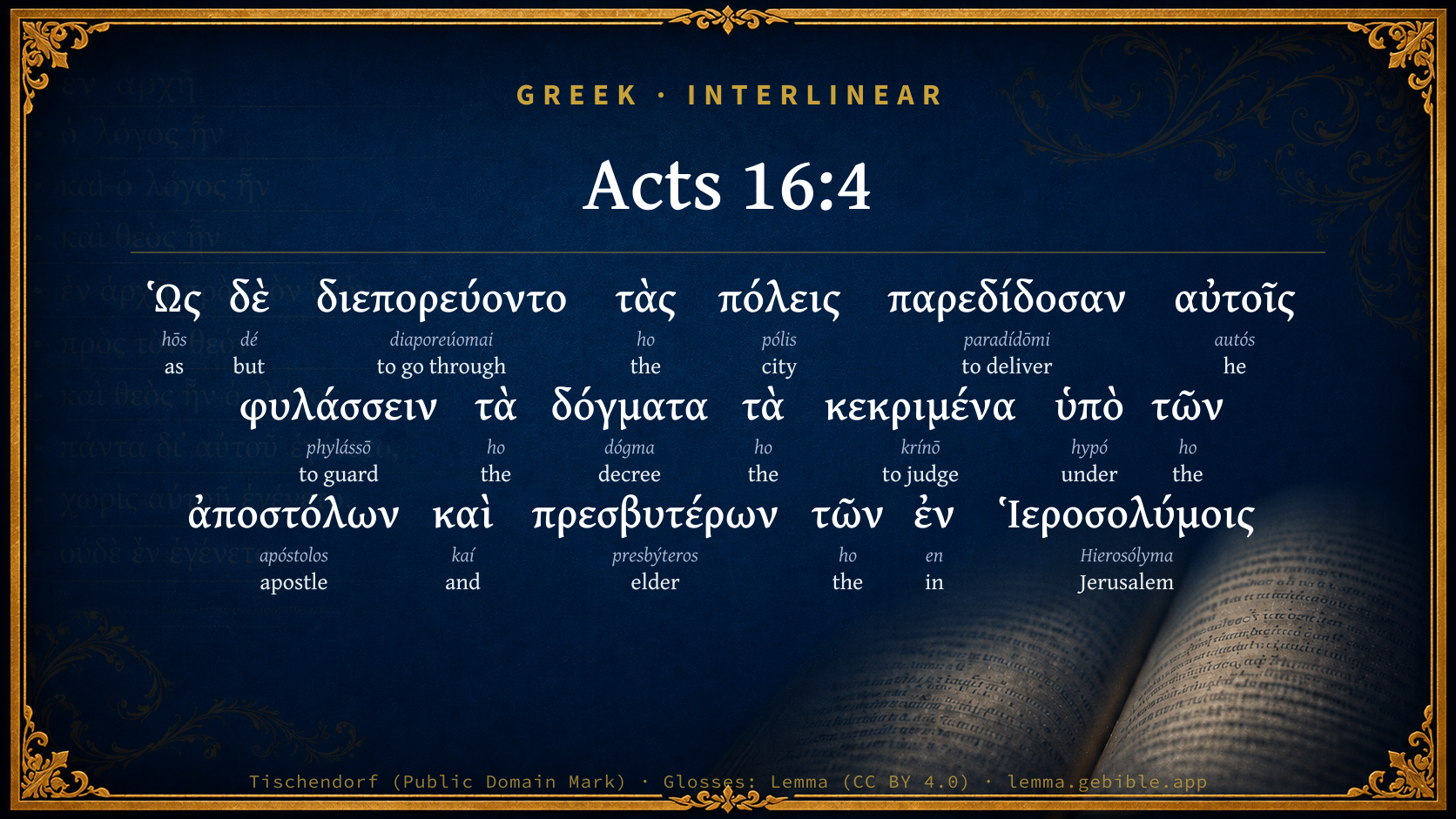
  1. Ὡς hōs G5613 “as” Adverb
  2. δὲ dé G1161 “but” Conjunction
  3. τὰς ho G3588 “the” Article, Accusative, Plural, Feminine
  4. πόλεις pólis G4172 “city” Noun, Accusative, Plural, Feminine
  5. παρεδίδοσαν paradídōmi G3860 “to deliver” Verb, Imperfect, Active, Indicative, 3rd person, Plural
  6. αὐτοῖς autós G846 “he” Personal pronoun, Dative, Plural, Masculine
  7. φυλάσσειν phylássō G5442 “to guard” Verb, Present, Active, Infinitive
  8. τὰ ho G3588 “the” Article, Accusative, Plural, Neuter
  9. δόγματα dógma G1378 “decree” Noun, Accusative, Plural, Neuter
  10. τὰ ho G3588 “the” Article, Accusative, Plural, Neuter
  11. κεκριμένα krínō G2919 “to judge” Verb, Perfect, Passive, Participle, Accusative, Plural, Neuter
  12. ὑπὸ hypó G5259 “under” Preposition
  13. τῶν ho G3588 “the” Article, Genitive, Plural, Masculine
  14. ἀποστόλων apóstolos G652 “apostle” Noun, Genitive, Plural, Masculine
  15. καὶ kaí G2532 “and” Conjunction
  16. πρεσβυτέρων presbýteros G4245 “elder” Adjective, Genitive, Plural, Masculine, Comparative
  17. τῶν ho G3588 “the” Article, Genitive, Plural, Masculine
  18. ἐν en G1722 “in” Preposition
  19. Ἱεροσολύμοις Hierosólyma G2414 “Jerusalem” Noun, Dative, Plural, Neuter

About this verse

These counts appear in no published source. They are computed here, from the morphology-tagged text and Lemma’s own curated glosses. What Lemma adds →

20
words
16
distinct lemmas
Acts
section

Notable vocabulary

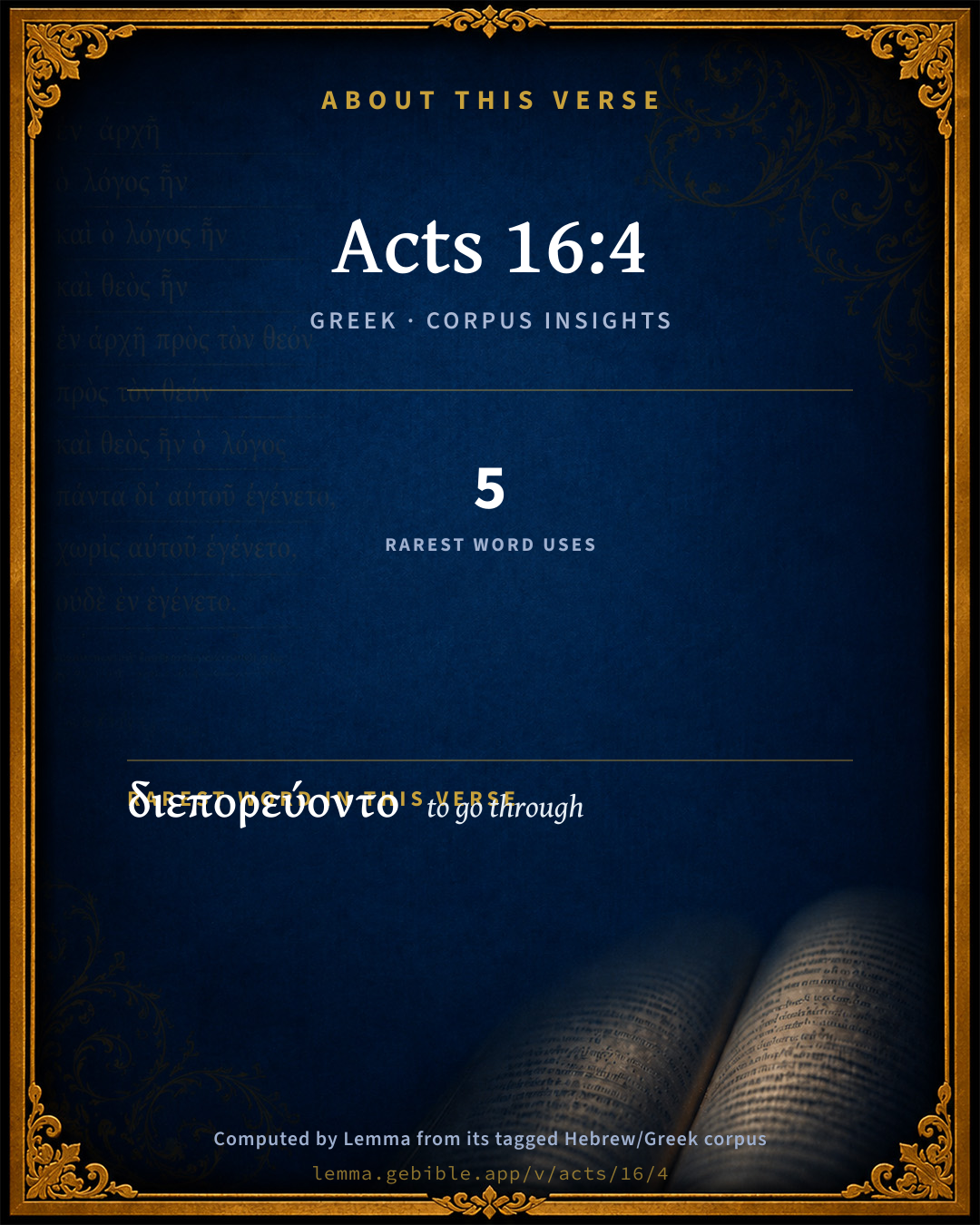
The rarest word here is διεπορεύοντο to go through G1279 — appearing just 5 times in the whole Greek New Testament.

Shared distinctive vocabulary

διεπορεύοντο to go through G1279 occurs in 5 verses of the Greek New Testament. Also found in:

Repetition

A word recurs within this verse:

Cross-references

4

Topical passages linked to Acts 16:4 in the Treasury of Scripture Knowledge — connected by theme and wording, ordered by reader-vote popularity; previews shown in the World English Bible.

  • Acts 15:28–29 For it seemed good to the Holy Spirit, and to us, to lay no greater burden on you than these necessary things:
  • Acts 15:2 Therefore when Paul and Barnabas had no small discord and discussion with them, they appointed Paul and Barnabas, and some others of them, to go up to Jerusalem to the apostles and elders about this question.
  • Acts 11:30 which they also did, sending it to the elders by the hands of Barnabas and Saul.
  • Acts 15:6 The apostles and the elders were gathered together to see about this matter.

Cross-references courtesy of OpenBible.info (CC BY 4.0).

Commentary

Notes on Acts 16:4 from classic Christian and Jewish commentators (each source and its license shown beneath its notes). The classic Christian expositions comment on the surrounding passage and are grouped to its opening verse, so a note may address several verses; the Jewish commentaries on the Tanakh (Rashi and others) are per-verse, so they appear only where the commentator wrote on this verse.

Lemma curates 59 commentaries, every one of them public domain or Creative Commons licensed, each selected and text-cleaned for this edition rather than reprinted as found. About our sources →

Joseph Benson's Commentary

Act 16:4-5. And — In order that peace might be secured among the brethren in these parts, and no unnecessary burden might be imposed upon the Gentile converts, through the arts of any Judaizing teachers; as Paul and his companions went through the cities, they delivered them the decrees for to keep — Committed to the custody of each church an exact and attested copy of the decrees, made by the council at Jerusalem. See Act 15:29 : for, although these decrees were written in the form of a letter to the brethren of the Gentiles in Antioch, Syria, and Cilicia, they belonged equally to all the Gentile converts everywhere. And so were the churches established, &c. — The several churches where they came, being watered by such faithful labourers, and encouraged with so favourable a decision of the grand point then in question, were much confirmed in their adherence to the Christian faith; and increased more and more in number daily — For the burdensome yoke of the law of Moses being now broken, a great obstacle to the conversion of the Gentiles was removed.

Joseph Benson's Commentary on the Old and New Testaments (1811–1818) — public domain. Text from a community e-Sword module.

Tyndale Open Study Notes

Tyndale Open Resources

16:4-5 Paul and Silas faithfully communicated the decisions of the Jerusalem council. The wisdom of the decision was indicated as the churches were strengthened in their faith and grew larger every day (cp. 2:41; 4:4; 5:14; 6:1; 9:31; 21:20).

Tyndale Open Study Notes — © Tyndale Open Resources, licensed CC BY-SA 4.0. Text via the HelloAO Bible API.

Bengel's Gnomon

Johann Albrecht Bengel

Act 16:4. Αὐτοῖς, to them) to the brethren.

Bengel's Gnomon of the New Testament — English translation (T&T Clark, Edinburgh, 1860) — public domain. Text from a community e-Sword module.

Meyer's Critical & Exegetical Commentary

Heinrich August Wilhelm Meyer

Act_16:4-5. Παρεδίδουν] orally, perhaps also partly in writing, by delivering to them a copy of the decree, Act_15:23 ff.

αὐτοῖς] namely, to the Gentile-Christians in the towns, which the connection requires by φυλάσσειν.

τὰ δόγματα] Luk_2:1, the ordinances.

ὑπὸ τῶν ἀποστ. κ.τ.λ.] the mention of the leaders was sufficient; the co-operation of the church is, according to Act_15:22 f., obvious of itself.

τῶν ἐν Ἱερουσ.] belongs only to τ. πρεσβυτ.

Act_16:5. They developed themselves internally in stedfastness of faith, and externally in the daily increasing number of their members. On the former, comp. Col_2:5; καθʼ ἡμέρ. belongs to ἐπερισσ. τ. ἀριθμῷ, comp. Act_2:46.

Meyer — Critical and Exegetical Commentary on the New Testament — English translation by Peter Christie, edited by Frederick Crombie (T&T Clark, 1880) — public domain. Text from a community e-Sword module.

Expositor's Greek Testament

ed. W. Robertson Nicoll

Act 16:4 . A proof of St. Paul’s loyalty to the Jerusalem compact. The decree had not been delivered in Syria and Cilicia (where the letter had been already received), but in Galatia St. Paul delivers it. Wendt regards Act 16:4-5 as interpolated by the author, who desires to give a universal importance to the decree which had previously been read to a few specified Churches (so too Spitta, Jüngst, Hilgenfeld, Clemen, who refers the verses to his Redactor Antijudaicus). But St. Paul might well feel himself bound to deliver the decree to the Churches evangelised by him before the conference in Jerusalem. Weiss, therefore, is probably right in pointing out that as no mention is again made of any similar proceeding, the action was confined to the Pauline Churches which had been previously founded, Churches which were, as it were, daughter Churches of Antioch. δόγματα : in the N.T. only in Luke and Paul (cannot be supported in Heb 11:23 ), and only here of the decrees of the Christian Church relative to right living, cf. Ignat., Magnes. , xiii., 1; Didaché , xi., 3. In 3MMal 1:3 it is used of the rules and requirements of the Mosaic Law, cf. its use by Philo, see further Plummer on Luk 2:1 , and Grimm, sub v . Dr. Hort refers the word back to Act 15:22 , ἔδοξεν , and so κεκρ . to κρίνω Act 15:19 ( cf. Act 21:25 ), used by St. James. In these expressions he sees “more than advice,” but “less than a command,” and so here he regards “resolutions” as more nearly expressing the force of this passage, Ecclesia , pp. 81, 82; see however above on Act 15:19 .

The Expositor's Greek Testament, edited by W. Robertson Nicoll (1897–1910) — public domain. Text from a community e-Sword module.

Geneva Bible (1599)

Geneva Bible translators

These decrees which he spake of in the former chapter.

Charity is to be observed in things indifferent so that regard be had both of the weak, and the quietness of the Church.

Geneva Bible (1599) marginal notes — public domain. Text via Bolls.life.

Jamieson, Fausset & Brown

Robert Jamieson, A. R. Fausset & David Brown

And as they went through the cities, they delivered . . . the decrees . . . And so were the churches established in the faith, and increased in number daily--not the churches, but the number of their members, by this visit and the written evidence laid before them of the triumph of Christian liberty at Jerusalem, and the wise measures there taken to preserve the unity of the Jewish and Gentile converts.

Jamieson, Fausset & Brown — Commentary Critical and Explanatory on the Whole Bible (1871) — public domain (CC PDM 1.0). Text via the HelloAO Bible API.

Adam Clarke's Commentary

Verse 4. They delivered them the decrees for to keep] Τα δογματα, τα κεκριμενα ὑπο των ΑποϚολων. Bishop Pearce contends that τα δογματα, the decrees, is a gloss which was not in the text originally; and that the τα κεκριμενα, the judgments or determinations of the apostles, was all that was originally written here. He supports his opinion by a reference to the word κρινω, I judge, used by James, Ac 15:19, whence the whole decision, as it referred -

1. to the inexpediency of circumcising the Gentiles; and,

2. to the necessity of observing the four precepts laid down, was called τα κεκριμενα, the things that were judged, or decided on; the judgments of the apostolic council.

Instead of γεγραμμενα, the Syrian has a word that answers to γεγραμμενα, the decrees that were written. The word δογμα, from δοκεω, to think proper, determine, decree, signifies an ordinance or decree, properly and deliberately made, relative to any important point, and which, in reference to that point, has the force of law. Our term dogma, which we often abuse, is the Greek word in English letters.

Adam Clarke's Commentary on the Bible (1810–1826) — public domain. Text from a community e-Sword/MySword module.

John Calvin's Commentaries

4. They delivered them the decrees to keep. In these words Luke doth signify unto us how desirous Paul was of peace. The best and strongest bond to keep and foster peace among the churches, was to keep that which was set down by the apostles. When Paul taketh great pains about that, he taketh great heed lest through his fault there arise any trouble. And let us remember that that continued but for a time. Because, so soon as he seeth the danger of offense cease, he doth quite unburthen the churches, and setting apart the decree, he maketh that free which the apostles had their forbidden. And yet doth he not cancel or violate by that abrogation that which the apostles had decreed, or contemn the authors themselves; because they were not determined to establish a perpetual law, but only to mitigate for a short time that which might hurt weak consciences; as I did more at large declare in the former chapter. Whereby the folly of the Papists is sufficiently refuted, who do grievously lay to our charge that we be far unlike Paul, because we will have the consciences of the godly governed by the Word of God alone, setting light by the decrees of the Church, as they call them, and not to be subject to the will of men. But, as I have already said, Paul meant nothing less than to ensnare men’s consciences in the snare of necessity, for he is not contrary to himself, when he crieth in other places, that

“all things are clean to the clean,” (Titus 1:15.)

And again,

“He which is clean eateth all things,” (Romans 14:2.)

And again,

“The kingdom of God is not meat and drink,” (Romans 14:17.)

And again,

“Meat doeth not commend us to God,” (1 Corinthians 8:8.)

Again,

“Eat all things which are sold in the shambles, asking no question for conscience sake,” (1 Corinthians 10:25.)

But in one word he reconcileth those things which might otherwise seem to disagree, when he commanded to abstain from things sacrificed to idols, for another’s man conscience sake. Nevertheless, he taketh great heed that he bind not godly souls with the laws of men.

Therefore we attempt nothing at this day which is contrary to or disagreeing with Paul. But the Papists mock us too grossly when they compare their laws with the decrees of the apostles. The apostles invented no new worship of God, they had erected no new spiritual government; but for the desire they had to maintain peace, they exhorted the Gentiles that they would yield a little to the Jews. Before the Pope can excuse his laws under this color, he must first change them wholly. And as for us, seeing that the Papists do place the spiritual worship of God in man’s inventions, and translate the right which belongeth to God alone unto men, that they may reign as lords over souls; we are enforced manfully to withstand them, unless through treacherous silence we will betray the grace gotten by the blood of Christ. Now, what likelihood can there be between three decrees set down for the help and comfort of the weak, and an infinite heap of laws, which doth not only oppress miserable souls with the weight thereof, but also swallow up faith? We know the complaint of Augustine writing to Januarius, that the Church was wickedly laden even then with too great a burden of traditions. Could he, I pray you, suffer the bondage of these times, which is almost a hundred times harder and heavier?

John Calvin's Commentaries (1540-1563) — public domain. Text from the Calvin Translation Society English edition (1840s-50s) via the Christian Classics Ethereal Library (ccel.org). Calvin's coverage is partial (roughly two-thirds of the Bible); uncommented books and verses are honest gaps, never fabricated. The 19th-century editor's footnotes and remarks are omitted so the notes are faithfully Calvin's own voice.

Ellicott's Commentary for English Readers

(4) They delivered them the decrees.—The number of copies which the process implies is in itself a sufficient guarantee that that which St. Luke gives is a faithful transcript. The decrees were clearly still regarded by the Gentile converts as being the charter on which they might take their stand in any dispute with the Judaisers, and doubtless helped to determine many who had previously hesitated, to seek admission into the Church.

A Bible Commentary for English Readers, edited by Charles John Ellicott (1878–1897) — public domain. Text from a community e-Sword module.

The Cambridge Bible for Schools and Colleges

gen. ed. J. J. S. Perowne

4. they delivered them] i.e. they gave to the Gentile-Christians the decrees to observe, for there was nothing in them which a Jew would be likely to disregard. All that would be needed for the Jews in such cities would be to explain the terms on which Gentiles were to be admitted to the Christian communion.

The Cambridge Bible for Schools and Colleges (gen. ed. J. J. S. Perowne; Cambridge University Press, 1878–1918) — public domain. Text from a community e-Sword module.

John Gill's Exposition

And as they went through the cities,.... Of Derbe, Lystra, and Iconium, and others in Lycaonia, and in Phrygia and Galatia; the Arabic version reads, "they both"; that is, Paul and Barnabas:

they delivered them the decrees for to keep; they gave the churches, in these cities, the sentiments, and determinations to be observed and followed by them:

that were ordained of the apostles which were at Jerusalem; concerning the abstinence of the Gentiles from things offered to idols, and from blood, and from things strangled, and from fornication, Act 15:20.

John Gill's Exposition of the Whole Bible (1746–1763) — public domain (CC PDM 1.0). Text via the HelloAO Bible API.

Trapp's Complete Commentary

John Trapp

4 And as they went through the cities, they delivered them the decrees for to keep, that were ordained of the apostles and elders which were at Jerusalem.

Ver. 4. They delivered them the decrees] Which were agreeable to the Scriptures. And if Gregory thought that the decrees of the four first general councils were to be received with like reverence and respect as the four holy Gospels, how much more these! But what a tyrant is the pope to obtrude his decretals, and the decrees of his councils (though directly opposite to the revealed will of God), upon the consciences of the misled multitude, to be observed, with a Non obstante! The Council of Constance (for instance) comes in with a Non obstante against Christ’s institution, withholding the cup from the sacrament; so for prayers in an unknown tongue, singing of psalms, ministers’ marriage. {a} When the pope sets forth any bulls, commonly he concludes thus, Non obstantibus et ordinationibus Apostolicis, caeterisque contrariis quibuscunque.

{a} Caranza Sum. Concil. sess. 13.

John Trapp, A Commentary or Exposition upon All the Books of the Old and New Testament (1647–1656) — public domain. Text from a community e-Sword module.

Albert Barnes' Notes on the Bible

And as they went through the cities - The cities of Syria, Cilicia, etc.

They delivered them - Paul and Silas delivered to the Christians in those cities.

The decrees - τὰ δόγματα ta dogmata. The decrees in regard to the four things specified in Act 15:20, Act 15:29. The word translated “decrees” occurs in Luk 2:1, “A decree from Caesar Augustus”; in Act 17:7 “The decrees of Caesar”; in Eph 2:15; and in Col 2:14. It properly means a law or edict of a king or legislature. In this instance it Was the decision of the council in a case submitted to it, and implied an obligation on the Christians to submit to that decision, since they had submitted the matter to them. The same principles, also, would be applicable everywhere, and the decision, therefore, at Jerusalem became conclusive. It is probable that a correct and attested copy of the letter Act 15:23-29 would be sent to the various churches of the Gentiles.

To keep - To obey, or to observe.

That were ordained - Greek: that were adjudged or determined.

Albert Barnes' Notes on the Bible (1834–1885) — public domain. Text from a community e-Sword/MySword module.

Haydock's Catholic Bible Commentary

Here, as well as in the last verse of the former chapter, we see St. Paul ordering the new converts, wherever he went, to receive, as their rule of conduct, the ordinances of the apostles and priests assembled in Jerusalem.

George Leo Haydock (1774–1849), Haydock's Catholic Family Bible and Commentary, 1859 edition — public domain. Excludes Psalms (Douay-Rheims chapter numbering differs from Protestant) and Deuterocanonical books (Catholic canon only).

Matthew Poole's English Annotations

The decrees; the determination of the council, mentioned Act 15:20,29.

Ordained of the apostles and elders; by common consent, and not of one only, whosoever he were.

Matthew Poole's English Annotations on the Holy Bible (1683–1685) — public domain. Text from a community e-Sword/MySword module.

Whedon's Commentary on the Bible

Daniel D. Whedon

4. Decrees—Conclusions of the Council at Jerusalem; accepted as rules of compromise by all parties. Yet, by some strange reaction, it really took place that the Churches of Galatia, which Paul was now about to found, became Judaistic and almost apostate. (See his Epistle to the Galatians.)

Daniel D. Whedon (gen. ed.), Commentary on the Old and New Testaments (1874–1909) — public domain. Text from a community e-Sword module.

The Pulpit Commentary

Went on their way for went, A.V.; which had been for that were, A.V.; that for which, A.V.

The Pulpit Commentary (1880–1919), ed. H.D.M. Spence-Jones & Joseph S. Exell — public domain. Text from a community e-Sword module.

Kretzmann's Popular Commentary

Paul E. Kretzmann

Through Asia Minor to Troas:

v. 4. And as they went, through the cities, they delivered them the decrees for to keep, that were ordained of the apostles and elders which were at Jerusalem.

v. 5. And so ’were the churches established in the faith, and increased in number daily.

v. 6. Now, when they had gone throughout Phrygia and the region of Galatia, and were forbidden of the Holy Ghost to preach the Word in Asia,

v. 7. after they were come to Mysia, they assayed to go into Bithynia; but the spirit suffered them not.

v. 8. and they, passing by Mysia, came down to Troas.

The zeal of Paul knew neither weariness nor rest; he was ever active for his Lord. As he traveled through the cities where congregations had been founded through his own efforts or those of disciples that had become missionaries, he and his companions delivered to them all the resolutions which had been fixed by the apostles and elders in Jerusalem. All the congregations were admonished to observe these decrees, although they were directed only to the congregations in Syria and Cilicia. Uniformity of practice, especially in such important matters, is to be recommended very highly for churches of the same confession. In this way the congregations everywhere were established in the faith; the encouraging admonitions of the apostle and his companions strengthened their faith. And a second result of the visitation was that the churches increased in numbers day by day. Thus Paul made the rounds of the congregations in this entire district, which was racially Phrygian, but administratively Galatic: Iconium, Antioch, and all the stations that were connected with these cities, He may even have extended his labors into North Galatia, though recent investigations seem to oppose this assumption. Many congregations sprang into existence under his labors in Galatia, 1Co 16:1, and he was always united with these disciples by the ties of a fervent love. Having carried out his missionary labors to the extent which he had intended in this province, Paul planned next to visit the province of Asia, a maritime province in southwestern Asia Minor, on the Aegean Sea. But he was hindered, prevented, from speaking the Word in this province by the Holy Spirit. This was done either by an inner revelation or by a prophetic intimation which permitted of no misunderstanding. So they journeyed to Mysia, into the borders of this province, west of Phrygia, and there made the attempt to turn northward into Bithynia, a province on the Black Sea. But again the Spirit of Jesus intervened and hindered them. Note: The Holy Spirit is the Spirit of Jesus Christ, Rom 8:9, as well as the Spirit of the Father, Mat 10:20. Nothing now remained for them to do but to travel due west to Troas, a seaport on the Aegean, opposite Greece. It is the Lord that directs and governs the course of the Gospel on earth. All the matters and circumstances are arranged by Him in such a way as to serve the Gospel according to His will.

Paul E. Kretzmann, Popular Commentary of the Bible (1921–1924) — public domain. Text from a community e-Sword module.

Burkitt's Expository Notes on the New Testament

William Burkitt

The sense is this, That as Paul and Silas passed through the cities in Syria and Cilicia, they delivered to the several churches, as they passed along, the decrees to observe, which were ordained by the apostles and elders met in council at Jerusalem, whereby those churches were established in the faith, and many more every day converted unto Christ.

Here note, 1. The messengers which delivered these decrees, Paul and Silas, with a special regard unto the church’s unity and peace. Behold here an excellent pattern for Christians in general, and the ministers of the gospel in particular; as to maintain truth, so to procure, promote, and preserve the church’s peace. Truth and peace, which God hath joined together, Zec 8:19 let none dare to put asunder.

Note, 2. What it was that St. Paul here made the delivery of: the decrees made by the apostles and elders at Jerusalem; not the decrees made by the whole church, but by the ministers of the church only: none so fit to determine church-differences as church-officers.

Note, 3. To whom these decrees were delivered; namely, to the churches, as they passed along through the several cities; so many cities, so many churches: the whole company of Christians within a city and the adjacent territory, where wont to be framed into a Christian society or church, and several congregations made but one church. To set up churches in churches, and to gather churches out of churches, has no precedent, no warrant, no countenance from any phrase of scripture, or practice of the apostles’ times.

Note, 4. The end for which these decrees were delivered; namely, to bring all the churches to unity and uniformity; to unity in judgment, and uniformity in practice, that they might be all of one heart, and one way.

Learn hence, That unity and uniformity among the churches of Christ is a thing to be earnestly desired and endeavoured; their unity is their strength and beauty both.

Note, lastly, The success and fruit of the delivery of these decrees to the churches, ver. 5. So were the churches established in the faith, and increasing in number daily.

Where observe, A double blessing accruing to the churches: the one of confirmation, So were the churches established: the other of augmentation. They increased in number daily.

Learn, 1. That as divisions do shake and unsettle, so unity and uniformity do establish, and confirm, the church of Christ: So were the churches established.

2. That it is a blessed thing to hear of the churches multiplying, by the number of converts increasing, is happy; but to multiply churches by breaking churches in pieces, is a sad multiplication.

The Lord keep his churches from such increases! and the Lord pardon those who for private interest have so increased churches by gathering churches out of churches, pretendedly for greater purity-sake, but really for advantage-sake!

Doctrines crying up purity to the ruin of unity, reject; for the gospel calls for unity as well as for purity.

William Burkitt's Expository Notes on the New Testament (1700–1703) — public domain. Text from a community e-Sword module.

Godbey's Commentary on the New Testament

William B. Godbey

4. In their evangelistic peregrinations, to the unutterable delight and edification of the Gentile converts, they everywhere read to the churches the apostolical decrees, liberating them from all the burdens of ecclesiasticism and conferring on them all the privileges of free grace anticipatory of heavenly glory.

William B. Godbey, Commentary on the New Testament (1896–1900) — public domain. Text from a community e-Sword module.

McGarvey & Pendleton's Commentaries

J. W. McGarvey

4, 5. After so long delay upon the circumcision of Timothy, we are prepared to start forward again with the apostles, cheered as they were by this valuable addition to their company. (4) " And as they passed through the cities they delivered to them to observe the decrees which had been adjudged by the apostles and elders in Jerusalem. (5) And the Churches were confirmed in the faith, and were daily increasing in number. " These decrees were everywhere needed, in order to unite in harmonious fellowship the Jewish and Gentile converts. Presented by Paul, who had been sent to Jerusalem for them, and by Silas, who had been sent out with high commendation by the apostles, to bear them to the Gentiles, that came with their full force to the ears of the brethren, and produced the happiest effects. The peace and harmony which they helped to confirm the brethren in the faith, and the daily increase in number was the result of this happy condition of the Churches.

J. W. McGarvey (with Philip Y. Pendleton), Commentaries on the New Testament (The Fourfold Gospel, 1914; Acts; and the epistles) — public domain. Text from a community e-Sword/MySword module.

The People's New Testament

B. W. Johnson

4, 5. They went through the cities. Where churches were already planted. As they went, they “delivered the decrees on circumcision and the law of Moses” decided upon at Jerusalem (15:23–29).

B. W. Johnson's The People's New Testament with Notes (1889–1891) — public domain. Electronic text from the Christian Classics Ethereal Library (CCEL) ThML edition.

unfoldingWord translationNotes

Door43 World Missions Community

General Information:

The word "they" here refers to Paul, Silas (Acts 15:40), and Timothy (Acts 16:3).

for them to obey

"for the church members to obey" or "for the believers to obey"

that had been written by the apostles and elders in Jerusalem

This can be stated in active form. AT: "that the apostles and elders in Jerusalem had written" (See: Active or Passive)

the churches were strengthened in the faith and increased in number daily

This can be stated in active form. AT: "The believers became stronger in their faith, and there were more and more people becoming believers every day" (See: Active or Passive)

the churches were strengthened in the faith

This speaks of helping someone to believe more confidently as if it were making them physically stronger. (See: Metaphor)

the churches

Here this stands for the believers in the churches. (See: Metonymy)

translationWords

deliver

church

instruct

obey

apostle

elder

Jerusalem

faith

unfoldingWord translationNotes — © Distant Shores Media and the Door43 World Missions Community, licensed CC BY-SA 4.0. Source: git.door43.org/Door43/en_tn.

Cambridge Greek Testament for Schools and Colleges

4. παρεδίδοσαν αὐτοῖς, they delivered to them, i.e. to the converts in the several cities. They gave to the Gentile-Christians the decrees to observe, for there was nothing in them which a Jew would be likely to disregard. All that would be needed for the Jews in such cities would be to explain the terms on which Gentiles were to be admitted to the Christian communion.

τὰ δόγματα τὰ κεκριμένα, the decrees that were ordained. The phrase of James (Act 15:19) was ἐγὼ κρίνω, and the decree was in the form ἔδοξεν ἡμῖν (Act 15:25).

Cambridge Greek Testament for Schools and Colleges (Cambridge University Press, 1896; 21 vols, various authors incl. Carr, Maclear, Plummer, Farrar, Lumby, Moule, M. R. James, Simcox) — public domain. Text from a community e-Sword module.

Alford’s Greek Testament

Henry Alford

4. τὰς πόλ.] Iconium, and perhaps Antioch in Pisidia. He might at Iconium see the elders of the church of Antioch, as he did afterwards those of Ephesus at Miletus. If he went to Antioch, he might regain his route into Phrygia and Galatia by crossing the hills east of that city.

Henry Alford, The Greek Testament (1849–1861) — public domain. Text from a community e-Sword module.

Lesson kit

Teaching starters — assembled from the data on this page, not authored interpretation. Every prompt links to the verse data it draws on. Edit before teaching.

Acts, in the Acts, opens this verse with 20 words (16 distinct Greek lemmas). Its most distinctive word is diaporeúomai (“to go through”). A historical commentator’s framing appears above. Read the whole chapter for the surrounding context.

Discussion questions

  1. How does “to go through” (diaporeúomai) shape what this verse is saying?
  2. Luke 6:1 shares the word «to go through» with this verse. How do the two illuminate each other?
  3. “the” occurs 5× in this one verse. What is the effect of the repetition?
  4. The translations on this page render this verse differently — a whole-verse word diff, not a word-by-word alignment. What might account for the different wordings?
  5. Reading how Joseph Benson's Commentary and Tyndale Open Study Notes read this verse, where do the two commentators agree and where do they part?

Things to notice

Reading settings

Reading text

Shown beneath each verse's original-language words.

Old Testament
Old Testament edition

Read the OT as the Masoretic Hebrew (MT) or the Greek Septuagint (LXX).

English shown for the Greek Septuagint (in the Hebrew ↔ Greek comparison).

Comparing translations? Open the Compare panel on any verse page to stack up to four side by side.