1 Corinthians 5:12

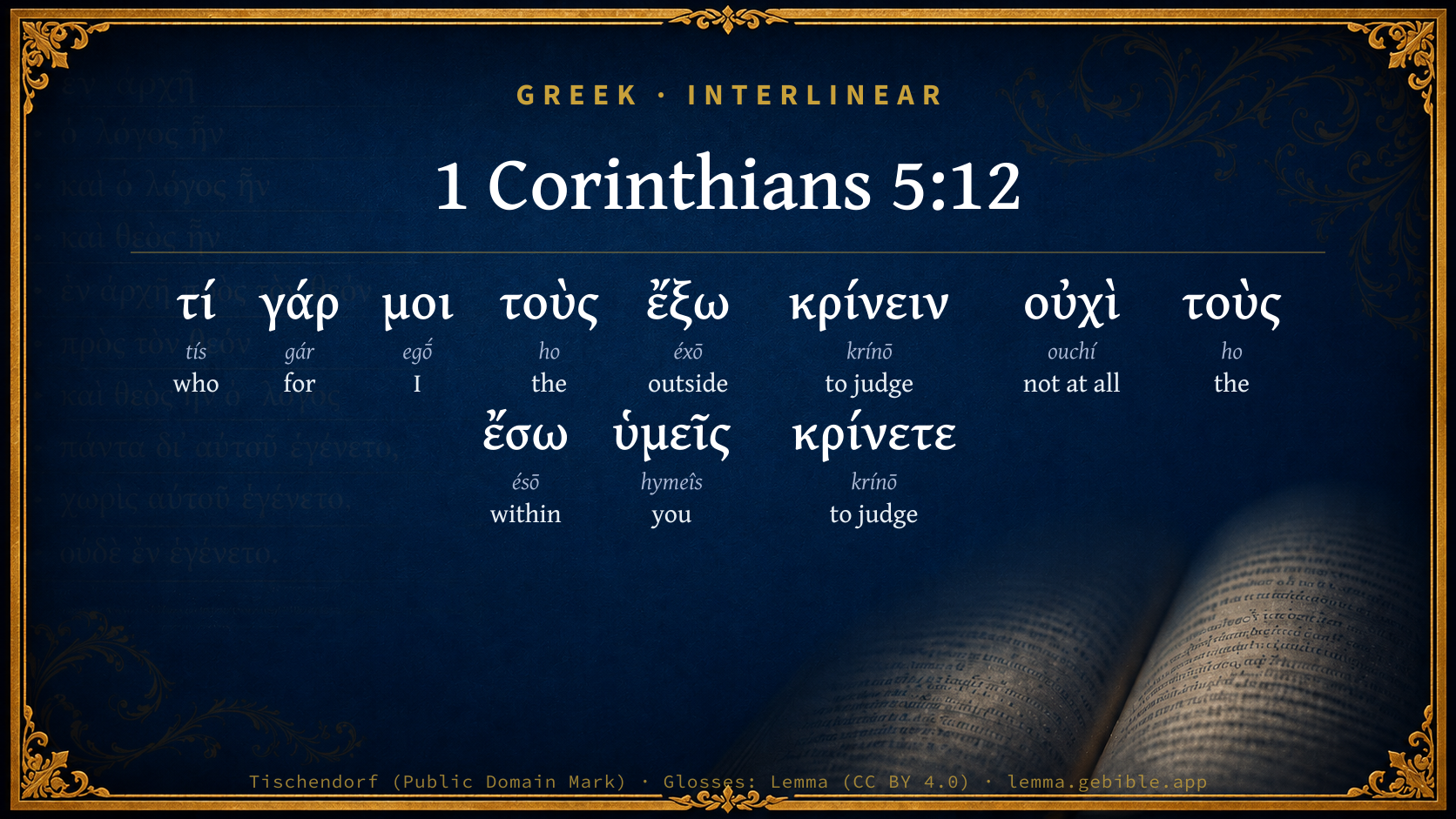
Greek (Tischendorf 8th ed.) 1 Corinthians 5:12 appears in the Greek New Testament. The text above is from the Tischendorf 8th edition. Each word links to its Strong’s number and a concise gloss. Click any word for its full Thayer’s Greek Lexicon entry.
Download image
Cite this verse

1 Corinthians 5:12 (World English Bible). Public Domain. Lemma interlinear Bible study tool, https://lemma.gebible.app/v/1-corinthians/5/12.

Show BibTeX & RIS
BibTeX
RIS
English Translation
For what have I to do with also judging those who are outside? Don't you judge those who are within?
World English Bible · Public Domain
Download a study sheet

One document with this verse’s original text, its word-by-word gloss line, the meaning frame, cross-references with their text, attributed commentary, and full source and license credits — printable, and it pastes into notes with its structure intact.

This verse Autodidact and up

Study sheet (.html) Plain text (.txt)

A passage Seminary Student

Up to 50 verses in one chapter. A passage sheet keeps up to 6 commentary sources and 12 cross-references per verse, in the order this page ranks them, and says so on the sheet whenever that leaves anything out. Ask for a single verse and you get the Autodidact verse sheet above.

Everything on this page stays free to read, with no account — the sheet is a download of what is already on screen, not access to it.

Want to remove ads? Support Godless Engineer
Compare translations 3

The same verse in 3 English versions, stacked beneath the original-language interlinear above. Click any original word for its lexicon entry.

Each is an independent rendering of the whole verse — the interlinear is not word-aligned to these translations.

Highlighted words mark where these versions differ — a whole-verse word diff, not a word-by-word alignment.

  • World English Bible Public Domain
    For what have I to do with also judging those who are outside? Don't you judge those who are within?
  • King James Version Public Domain
    For what have I to do to judge them also that are without? do not ye judge them that are within?
  • unfoldingWord Literal Text CC BY-SA 4.0
    For what to me to judge the ones outside? Do you not judge the ones inside?

unfoldingWord Literal Text — © unfoldingWord, licensed CC BY-SA 4.0. Word-aligned USFM3 via Door43 (git.door43.org/unfoldingWord/en_ult).

Versions to compare (up to 4)

3 of 4 selected

Show all 19 translations

Every available English version of this verse, each an independent rendering of the whole verse.

  • World English Bible Public Domain
    For what have I to do with also judging those who are outside? Don't you judge those who are within?
  • Berean Standard Bible Public Domain
    What business of mine is it to judge those outside the church? Are you not to judge those inside?
  • Majority Standard Bible Public Domain
    What business of mine is it to judge those outside the church? Are you not to judge those inside?
  • King James Version Public Domain
    For what have I to do to judge them also that are without? do not ye judge them that are within?
  • American Standard Version (1901) Public Domain
    For what have I to do with judging them that are without? Do not ye judge them that are within?
  • Revised Version (1885) Public Domain
    For what have I to do with judging them that are without? Do not ye judge them that are within,
  • Geneva Bible (1599) Public Domain
    For what haue I to doe, to iudge them also which are without? doe ye not iudge them that are within?
  • Douay-Rheims (1899) Public Domain
    For what have I to do to judge them that are without? Do not you judge them that are within?
  • Young's Literal Translation Public Domain
    for what have I also those without to judge? those within do ye not judge?
  • Literal Standard Version CC BY-SA 4.0
    for what have I also to judge those outside? Do you not judge those within?
  • Unlocked Literal Bible CC BY-SA 4.0
    For how am I involved with judging those who are outside the church? Instead, are you not to judge those who are inside the church?
  • unfoldingWord Literal Text CC BY-SA 4.0
    For what to me to judge the ones outside? Do you not judge the ones inside?
  • Darby Bible Public Domain
    For what have *I* [to do] with judging those outside also? *ye*, do not ye judge them that are within?
  • World Messianic Bible Public Domain
    For what do I have to do with also judging those who are outside? Don’t you judge those who are within?
  • Webster's Bible Public Domain
    For what have I to do to judge them also that are without? do ye not judge them that are within?
  • Free Bible Version CC BY-SA 4.0
    It's not my place to judge those outside the church. But shouldn't you judge those who are inside the church?
  • Bible in Basic English Public Domain
    For it is no business of mine to be judging those who are outside; but it is yours to be judging those who are among you;
  • Text-Critical English NT CC BY 4.0
    For what have I to do with judging those who are outside the church? Do you not judge those who are inside the church?
  • Tyndale New Testament (1534) Public Domain
    For what have I to do to iudge them which are with out? Do ye not iudge them that are with in?

Literal Standard Version (2020), Covenant Press — licensed CC BY-SA 4.0. Text via the HelloAO Bible API (eBible.org). Unlocked Literal Bible (unfoldingWord) — licensed CC BY-SA 4.0. Text via the HelloAO Bible API (eBible.org). unfoldingWord Literal Text — © unfoldingWord, licensed CC BY-SA 4.0. Word-aligned USFM3 via Door43 (git.door43.org/unfoldingWord/en_ult). Free Bible Version, Dr. Jonathan Gallagher — licensed CC BY-SA 4.0. Text via the HelloAO Bible API (eBible.org).

Word by word

More ways to search: Search by grammar → Find every occurrence → Compare this word →

Practice this passage: Drill this verse → Learn its vocabulary →

About this verse

These counts appear in no published source. They are computed here, from the morphology-tagged text and Lemma’s own curated glosses. What Lemma adds →

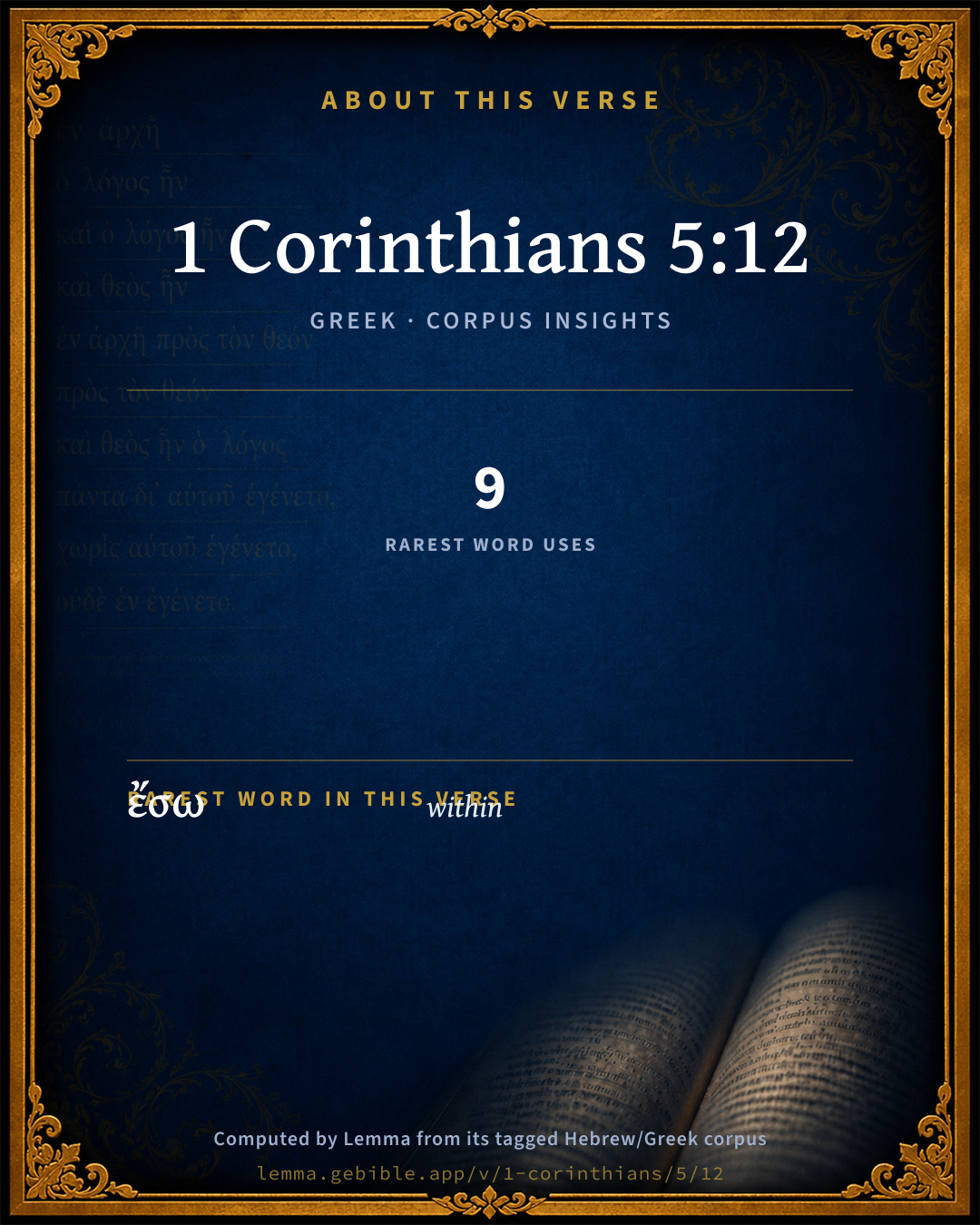
11
words
9
distinct lemmas
Pauline Epistles
section

Notable vocabulary

The rarest word here is ἔσω within G2080 — appearing just 9 times in the whole Greek New Testament.

Shared distinctive vocabulary

ἔσω within G2080 occurs in 9 verses of the Greek New Testament. Also found in:

Repetition

Words recur within this verse:

  • κρίνειν to judge G2919 ×2
  • τοὺς the G3588 ×2

Cross-references

8

Topical passages linked to 1 Corinthians 5:12 in the Treasury of Scripture Knowledge — connected by theme and wording, ordered by reader-vote popularity; previews shown in the World English Bible.

  • Mark 4:11 He said to them, "To you is given the mystery of the Kingdom of God, but to those who are outside, all things are done in parables,
  • Luke 12:14 But he said to him, "Man, who made me a judge or an arbitrator over you?"
  • 1 Timothy 3:7 Moreover he must have good testimony from those who are outside, to avoid falling into reproach and the snare of the devil.
  • 1 Corinthians 5:3–5 For I most assuredly, as being absent in body but present in spirit, have already, as though I were present, judged him who has done this thing.
  • 1 Corinthians 6:1–5 Dare any of you, having a matter against his neighbor, go to law before the unrighteous, and not before the saints?
  • Colossians 4:5 Walk in wisdom toward those who are outside, redeeming the time.
  • 1 Thessalonians 4:12 that you may walk properly toward those who are outside, and may have need of nothing.
  • John 18:36 Jesus answered, "My Kingdom is not of this world. If my Kingdom were of this world, then my servants would fight, that I wouldn't be delivered to the Jews. But now my Kingdom is not from here."

Cross-references courtesy of OpenBible.info (CC BY 4.0).

Commentary

Notes on 1 Corinthians 5:12 from classic Christian and Jewish commentators (each source and its license shown beneath its notes). The classic Christian expositions comment on the surrounding passage and are grouped to its opening verse, so a note may address several verses; the Jewish commentaries on the Tanakh (Rashi and others) are per-verse, so they appear only where the commentator wrote on this verse.

Lemma curates 59 commentaries, every one of them public domain or Creative Commons licensed, each selected and text-cleaned for this edition rather than reprinted as found. About our sources →

The Cambridge Bible for Schools and Colleges

gen. ed. J. J. S. Perowne

12, 13. For what have I to do to judge them also that are without?] The connection of thought in this and the next verse is as follows: “You have supposed me to have been urging you to abstain altogether from any kind of intercourse with sinners. You misunderstood my meaning. I only meant to refer to the members of your own community. As you might have gathered from your own practice, which is confined to the Christian body, I have no authority to deal with those without. They are in the hands of God.” And then he abruptly adds, ‘Cast out the wicked man,’ or ‘the evil thing.’ The word therefore (literally ‘and’) is absent from many MSS., and has been supposed to have been introduced from the Septuagint version of Deu_13:5; Deu_17:7; Deu_21:21, &c. In the Greek the word ye in 1Co_5:12 is emphatic, and the words those that are within scarcely less so—‘it is those that are within that ye judge.’ Some editors would read the following words as a question, ‘Doth not God judge those that are without?’

The Cambridge Bible for Schools and Colleges (gen. ed. J. J. S. Perowne; Cambridge University Press, 1878–1918) — public domain. Text from a community e-Sword module.

The Biblical Illustrator

Joseph S. Exell

1Co_5:12-13

For what have I to do to Judge them also that are without?

Without and within

I. Those without.

1. Have no share in Church privileges.

2. Are exempt from Church jurisdiction.

3. Are liable to the judgment of God.

II. Those within.

1. May be unworthy of fellowship.

2. Are subject to discipline.

3. Must be excluded when their wickedness is proven. (J. Lyth, D. D.)

The judgment of God and the judgment of the Church

1. The one is limited, the other universal.

2. The one is partial, the other absolute.

3. The one is disciplinary, the other infallible.

4. The one is provisional, the other will be final.

5. The effects of the one are temporary, of the other eternal. (J. Lyth, D. D.)

Limitations of apostolic discipline

1. Even in that age of Divine intuitions and preternatural visitations Paul limits the subjects of expulsion from the Christian society to gross and definite vices. No encouragement is given to pry into the secret state of the heart and conscience, or to denounce mere errors of opinion or judgment.

2. Even when insisting most strongly on entire separation from heathen vices, he still allows unrestricted social intercourse with the heathen. He forbears to push his principle to an utopian extravagance: he acknowledges the impracticability of entire separation as a decisive reason against it, and regards the ultimate solution of the problem as belonging not to man, but to God.

3. Whilst strongly condemning the Christian quarrels as in themselves unchristian (chap 6.) he yet does not leave them without a remedy, and so drive them to the objectionable course of going before heathen judges. He recognises the fact, and appeals to their own self- respect to induce them to appoint judges of their own, thus giving the first apostolic sanction to Christian courts of law; in other words, departing from the highest ideal of a Christian Church in order to secure the purity of its actual condition.

4. He lays down the general truth that between all other outward acts and the sin of sensuality there is an essential difference; that the liberty which Christianity concedes to the former, it altogether withholds from the latter; that those sins are utterly inconsistent not merely with any particular relation existing between Christianity and heathenism, but with the very idea of Christianity itself. (Dean Stanley.)

The Biblical Illustrator, edited by Joseph S. Exell (c. 1880s–1900s) — public domain. Text from a community e-Sword module.

Joseph Benson's Commentary

1Co 5:12-13. For, &c. — I speak of Christians only: for what have I to do to judge them that are without — Namely, heathen: do not ye judge them that are within? — Ye, as well as I, judge those of your own community: them that are without, God judgeth — The passing sentence on these God hath reserved to himself, and they shall not go unpunished, though they fall not under your censure. Therefore — In consideration of this, both in one view and the other, let it be your immediate care, as you regard the peace of the church, and the safety of your own souls; to put away from among yourselves — Speedily, and with all due solemnity; that wicked person — Whom I have mentioned, and any others, whose characters may, like his, be scandalous and infections. The apostle is thought, by some, to have written this, and the preceding verse, to show the Corinthians the reason why, after commanding them to pass so severe a sentence on the man, he said nothing to them concerning the woman, who was guilty with him. The discipline of the church was not to be exercised on persons out of it. Hence it appears that this woman was a heathen.

Joseph Benson's Commentary on the Old and New Testaments (1811–1818) — public domain. Text from a community e-Sword module.

Tyndale Open Study Notes

Tyndale Open Resources

5:12-13 Christians are not called to judge (i.e., discipline) sin in unbelievers, but in believers.

Tyndale Open Study Notes — © Tyndale Open Resources, licensed CC BY-SA 4.0. Text via the HelloAO Bible API.

Bengel's Gnomon

Johann Albrecht Bengel

1Co 5:12. Τί γάρ μοι καὶ τοὺς ἔξω κρίνειν; οὐχὶ τοὺς ἔσω ὑμεῖς κρίνετε;) Artemonius, p. 212, refers to the conjecture of Le Clerc, and after changing a few words presents it in this form: τί γάρ μοι καὶ τοῖς ἔξω; καὶ νῦν οὖν τοὺς ἔσω ὑμεῖς κρίνετε. There are here various changes of letters, by which the word κρίνειν, the most necessary of them all, is cancelled. If the meaning of Paul had been, what have I to do with those that are without? the Greek idiom would have required ἐμοί, not μοι. Τί γάρ μοι καὶ τοὺς ἔξω κρίνειν, viz. ἐστί; for what have I to do to judge those that are without? (Verbals [such as Bengel’s “externos judicatio”] govern the case of the verb, ex. gr.: Curatio hanc rem, taking charge of this matter.) Expressions very similar occur, ἱνατί μοι ζῇν, Gen 27:46: οὐ σοὶ, Ὀζία, θυμιᾶσαι, 2Ch 26:18: οὐκ ἔστι γὰρ χαίρειν, λέγει Κύριος, τοῖς ἀσεβέσιν, Isa 48:22: ὄπως μὴ γένηται αὐτῷ χρονοτριβῆσαι, Act 20:16: πόθεν σοι ταῦτα ἐιδέναι, Hippolytus de antichristo, chap. 32. These remarks apply to the whole sentence; we shall now consider the words one by one.—καὶ) also, which intimates, that those, who are within, give me enough to do.[44]—ΚΡΊΝΕΙΝ, to judge) He judges, who is not mixed up with them, does not keep company with them.—οὐχὶ, do not ye?) From what is wont to occur in the Church, you ought to have interpreted my admonition, alluded to in 1Co 5:9, You judge your fellow-citizens, not strangers; how much more should I? You judge, will thus signify righteous judgment. But this may also be a previous [anticipatory], and, that too, a seasonable sting to the Corinthians, who were judging [bringing before heathen courts of justice] them that were within, while [though] they considered the saints removed [exempt] from judgments concerning things pertaining to this life, 1Co 6:1-3.

[44] This very particle καὶ, also, however, is considered of less importance in the 2d, than in the 1st Ed., and it is entirely omitted in the Germ. Vers.—E. B. ABCG Vulg. Memph. fg (ante-Hieron. Lat.) Versions omit καὶ. D and later Syr. retain καὶ.—ED.

Bengel's Gnomon of the New Testament — English translation (T&T Clark, Edinburgh, 1860) — public domain. Text from a community e-Sword module.

Meyer's Critical & Exegetical Commentary

Heinrich August Wilhelm Meyer

1Co_5:12 f. The reason for his having spoken in reference to the Christians, and not those without the Christian pale: for it does not at all concern me to be passing disciplinary judgments upon the latter.

τὶ γάρ μοι] for what concern is it of mine? etc. See Wetstein on the passage, and Schaefer, a[847] Bos. Ell. p. 598. The emphasis falls so entirely upon τί and τοὺς ἔξω, that we have not ἐμοί, which is not needed even if the reading καὶ (even, besides) τ. ἔξω be adopted.

τοὺς ἔξω] was with the Jews the standing name (חיצונים) for the heathen (see Lightfoot, Hor., a[848] Marc. iv. 11; Schoettgen on this verse; Kypke, II. p. 198); and so, in like manner, with the Christians it was the standing appellation for all who were non-Christians, as being outside the fellowship of the true people of God (Col_4:5; 1Th_4:12; 1Ti_3:7).

οὐχὶ τοὺς ἔσω ὑμεῖς κρίνετε;] By this question Paul appeals, in justification of what he has just said: what does it concern me, etc., to the exercise of judicial functions by his readers themselves in the administration of church discipline, in so far, that is to say, as that discipline bore upon their fellow-Christians, and not upon those outside of the Christian society. Rückert thinks that Paul means to say: Judging is not my matter at all (seeing that the members of the church were judged by their fellow-members themselves; while those without, again, God would hereafter judge). But judging was doubtless his matter (see 1Co_5:4-6, 1Co_5:11; 1Co_5:13), only not respecting those ἔξω. What he means is rather this: To judge those who are not Christians is no concern of mine, any more than you take in hand to judge any others except your fellow-believers. Ex eo, quod in ecclesia fieri solet, interpretari debuistis monitum meum, 1Co_5:9; cives judicatis, non alienos, Bengel. The simple κρίνετε is altered in meaning by Billroth: Is it not enough that ye? etc., as well as by Castalio, Grotius, al[849]: judicare debetis (we find this interpretation as early as Theophylact). The Corinthians actually judged, every time that they passed a sentence of ecclesiastical discipline. Lastly, it is a mistake to render, as is done by τινές in Theophylact, Knatchbull, Hammond, Michaelis, Semler, Rosenmüller, Flatt, Heydenreich: No; judge ye your fellow-Christians! Οὐχί is not a suitable answer to ΤΊ, and would, besides, require ἈΛΛΆ after it (Rom_3:27; Luk_1:60; Luk_12:51; Luk_13:3; Luk_13:5; Luk_16:30), and that with a clause forming a logically correct antithesis to the question put.

[847] d refers to the note of the commentator or editor named on the particular passage.

[848] d refers to the note of the commentator or editor named on the particular passage.

[849] l. refers to the note of the commentator or editor named on the particular passage.

Meyer — Critical and Exegetical Commentary on the New Testament — English translation by Peter Christie, edited by Frederick Crombie (T&T Clark, 1880) — public domain. Text from a community e-Sword module.

Expositor's Greek Testament

ed. W. Robertson Nicoll

1Co 5:12-13 . τί γάρ μοι τοὺς ἔξω κ . τ . λ .; “For what business of mine is it ( Quid mea refert? Cv [879] ) to judge those that are outside? (Is it) not those within (that) you judge, while those without God judges?” By these questions P. justifies his excluding the impure ἀδελφὸς ὀνομαζ . from the communion and social courtesies of the Church. He holds jurisdiction over those within its pale; of their conduct the Church ( ὑμεῖς ) is bound to take note; the world outside must be left to the judgment of God: “cives judicate, ne alienos” (Bg [880] ). The Ap. places himself and the Cor [881] on the one side ( cf. 1Co 6:4 ; also 1Co 12:25 f.), in contrast with God who judges τοὺς ἔξω . “Within” and “without” denoted in Synagogue usage members and non-members of the sacred community (see parls.): οἱ ἔσω = οἱ ἅγιοι , οἱ οἰκεῖοι τῆς πίστεως , οἱ τοῦ Χριστοῦ , etc. Yet this mutual judgment of Christians by each other has great limitations (Rom 14:4-10 ; Mat 7:1 ff.); its sphere lies in vital matters of character essential to Church life; and there it is subject to the final Court of Appeal (see 1Co 4:3 ff.). ὁ Θεὸς κρίνει (not κρινεῖ ): P. is not anticipating the Last Judgment, but laying down the principle that God is the world’s Judge; see Rom 2:16 ; Rom 3:6 , Heb 12:23 , etc. The interrog. οὐχὶ holds under its regimen the two clauses linked by the contrastive δέ ; El [882] however reads τοὺς δὲ ἔξω κ . τ . λ . assertively, as a concluding “grave enunciation”.

[879] Calvin’s In Nov. Testamentum Commentarii .

[880] Bengel’s Gnomon Novi Testamenti.

[881] Corinth, Corinthian or Corinthians.

[882] C. J. Ellicott’s St. Paul’s First Epistle to the Corinthians .

From his digression to the lost Ep. and the general social problem, the Ap. returns, with vehement emphasis, to the offender of 1Co 5:1 f. and demands his expulsion in the solemn words of the Deuteronomic law. τὸν πονηρὸν is not Satan (“scelerum omnium principem,” Cv [883] ), nor “the wicked” in general each case as it arises (Hf [884] ); but “istum improbum” (Bz [885] ), the case of notorious and extreme guilt which gave rise to the whole discussion. ἐξάρατε ( cf. ἐκκαθάρατε , 1Co 6:7 ) takes up again the ἵνα ἀρθῇ of 1Co 5:2 , with the added thought ( ἐξ - … ἐξ ὑμῶν αὐτῶν ) of the riddance effected by his removal. The terrible sentence of 1Co 5:3 ff. had not, in so many words, prescribed ejection, though implying it; and P. needed to be very explicit: see note on 1Co 5:9 . The formal expulsion must proceed from the Cor [886] , ὑμεῖς κρίνετε ; the Church is a self-governing body.

[883] Calvin’s In Nov. Testamentum Commentarii .

[884] J. C. K. von Hofmann’s Die heilige Schrift N.T. untersucht , ii. 2 (2te Auflage, 1874).

[885] Beza’s Nov. Testamentum: Interpretatio et Annotationes (Cantab., 1642).

[886] Corinth, Corinthian or Corinthians.

The Expositor's Greek Testament, edited by W. Robertson Nicoll (1897–1910) — public domain. Text from a community e-Sword module.

Godet's Commentaries

Frédéric Louis Godet

Vv. 12, 13. “For what have I to do to judge them also that are without? do ye not judge them that are within? 13. But them that are without, God judgeth. And put away from among yourselves that wicked person.”

The first question is the justification (for) of 1Co 5:10 : “We have not to judge unbelievers.” The second is the justification of 1Co 5:11 : “But we have to judge believers.”

Our competency to exercise discipline does not extend further than the solidarity established by confession of the common faith. This general truth the apostle expresses in his own person (μοί, mine), as is often done in stating moral maxims (1Co 6:12, for example); this form does not therefore assume, as has been sometimes thought, that the word κρίνειν, to judge, has here a particular meaning, applicable exclusively to the apostle; for example, that of laying down disciplinary rules: “The rules which I prescribe to you on this subject are not to be applied to those who are without.” This sense of κρίνειν is inadmissible. In any case, had it been the part which he had to take personally on which Paul wished to lay stress, he would not have used the enclitic form (μοι), but the full form (ἐμοί). He speaks of himself, not as an apostle, but as a Christian; and what he says applies consequently to every Christian. Every Christian has individually the mission to exercise the judgment of which he speaks in 1Co 5:11. We have already pointed out the profound analogy which prevails between this chapter and the disciplinary direction given to the apostles by the Lord (Mat 18:15-20). We find in the latter (in Mat 5:17) the same use of the singular pronoun, which strikes us here in the language of the apostle; only the pronoun is in the second person, because it is Jesus who is addressing the believer: “Let him be to thee as a heathen and publican.” It is therefore every believer who is bound freely at his own hand to pronounce this rupture of relations with the unbelieving brother which Paul prescribes to the Church in general. For if it is in itself the duty of all, it cannot be other in point of fact than a completely individual act.

T. R. with 3 Mjj. reads: “What have I to do to judge those also (καί) that are without?” This καί may, after all, be authentic: “The competency which I have in regard to my brethren, should I not also extend to others?” The Jews called the heathen chitsonim, those without (Lightfoot, Hor. hebr., p. 6). The apostle borrows the name from them to designate, not only the heathen, but the Jews themselves; comp. the analogous term used by Jesus, Mar 4:11. In all the synagogues dispersed throughout heathen countries careful watch was kept over the respectability of the members of the community. Should the Church in this point remain behind the synagogue?

The term judge can only be explained in the context by what precedes. It can only therefore refer to the means which have just been indicated, viz. private rupture.

The second question (1Co 5:12 b) is in the same relation to 1Co 5:11 as the first (1Co 5:12 a) to 1Co 5:10. “I have not the task of judging them that are without; but have not you that of judging them that are within, the vicious among believers, and that in name of the faith which they profess along with you?” We are called to remark the emphasis put on the word ὑμεῖς, ye, in opposition to θεός, God, the subject of the following proposition.

Frédéric Louis Godet — Commentaries on Luke, John, Romans, and 1 Corinthians — English translation (T&T Clark, Edinburgh, 1870s–1890s) — public domain. Text from a community e-Sword module.

Hodge's Commentary on Romans, Ephesians & First Corinthians

Charles Hodge

1Co_5:12

For what have I to do to judge them also that are without? do not ye judge them that re within?

Those without; those out of the church. Mar_4:11; Col_4:5; 1Th_4:12. The command of the apostle had reference only to those within the church, for it was not his prerogative to judge those that are without. The Corinthians acted on the same principle. They confined church discipline to church members, and therefore should not have understood his injunction not to company with the wicked to apply to others than to those within the church.

Charles Hodge — Commentary on Romans (1835), First Corinthians (1857), and Ephesians (1856) — public domain. Text from a community e-Sword module.

Geneva Bible (1599)

Geneva Bible translators

Such as are false brethren, ought to be cast out of the Congregation: as for them which are without, they must be left to the judgment of God.

Geneva Bible (1599) marginal notes — public domain. Text via Bolls.life.

Jamieson, Fausset & Brown

Robert Jamieson, A. R. Fausset & David Brown

what have I to do--You might have easily understood that my concern is not with unbelievers outside the Church, but that I referred to those within it.

also--Implying, Those within give me enough to do without those outside.

do not ye, &c.--Ye judge your fellow citizens, not strangers: much more should I [BENGEL]. Rather, Is it not your duty to judge them that are within? God shall judge them that are without: do you look at home [GROTIUS]. God is the Judge of the salvation of the heathen, not we (Rom 2:12-16). Paul here gives an anticipatory censure of their going to law with saints before heathen tribunals, instead of judging such causes among themselves within.

Jamieson, Fausset & Brown — Commentary Critical and Explanatory on the Whole Bible (1871) — public domain (CC PDM 1.0). Text via the HelloAO Bible API.

Adam Clarke's Commentary

Verse 12. For what have I to do to judge them also that are without?] The term without, τους εξω, signifies those who were not members of the Church, and in this sense its correspondent term: החיצונים hachitsonim, those that are without, is generally understood in the Jewish writers, where it frequently occurs. The word και also, which greatly disturbs the sense here, is wanting in ABCFG, and several others, with the Syriac, Coptic, Slavonic, Vulgate, and the Itala; together with several of the fathers. The sentence, I think, with the omission of και also, should stand thus: Does it belong to me to pass sentence on those which are without-which are not members of the Church? By no means (ουχι.) Pass ye sentence on them which are within-which are members of the Church: those which are without-which are not members of the Church, God will pass sentence on, in that way in which he generally deals with the heathen world. But put ye away the evil from among yourselves. This is most evidently the apostle's meaning, and renders all comments unnecessary. In the last clause there appears to be an allusion to De 17:7, where the like directions are given to the congregation of Israel, relative to a person found guilty of idolatry: Thou shalt put away the evil from among you-where the version of the Septuagint is almost the same as that of the apostle: και εξαρεις τον πονηρον εξ ὑμων αυτων.

THERE are several important subjects in this chapter which intimately concern the Christian Church in general.

1. If evil be tolerated in religious societies, the work of God cannot prosper there. If one scandal appear, it should be the cause of general humiliation and mourning to the followers of God where it occurs; because the soul of a brother is on the road to perdition, the cause of God so far betrayed and injured, and Christ recrucified in the house of his friends. Pity should fill every heart towards the transgressor, and prayer for the backslider occupy all the members of the Church.

2. Discipline must be exercised in the Christian Church; without this it will soon differ but little from the wilderness of this world. But what judgment, prudence, piety, and caution, are requisite in the execution of this most important branch of a minister's duty! He may be too easy and tender, and permit the gangrene to remain till the flock be infected with it. Or he may be rigid and severe, and destroy parts that are vital while only professing to take away what is vitiated. A backslider is one who once knew less or more of the salvation of God. Hear what God says concerning such: Turn, ye backsliders, for I am married unto you. See how unwilling He is to give them up! He suffers long, and is kind: do thou likewise; and when thou art obliged to cut off the offender from the Church of Christ, follow him still with thy best advice and heartiest prayers.

3. A soul cut off from the flock of God is in an awful state! his outward defence is departed from him; and being no longer accountable to any for his conduct, he generally plunges into unprecedented depths of iniquity; and the last state of that man becomes worse than the first. Reader, art thou without the pale of God's Church? remember it is here written, them that are WITHOUT God judgeth, 1Co 5:13.

4. Christians who wish to retain the spirituality of their religion should be very careful how they mingle with the world. He who is pleased with the company of ungodly men, no matter howsoever witty or learned, is either himself one with them, or is drinking into their spirit. It is impossible to associate with such by choice without receiving a portion of their contagion. A man may be amused or delighted with such people, but he will return even from the festival of wit with a lean soul. Howsoever contiguous they may be, yet the Church and the world are separated by an impassable gulf.

5. If all the fornicators, adulterers, drunkards, extortioners, and covetous persons which bear the Christian name, were to be publicly excommunicated from the Christian Church, how many, and how awful would the examples be! If however the discipline of the visible Church be so lax that such characters are tolerated in it, they should consider that this is no passport to heaven. In the sight of God they are not members of his Church; their citizenship is not in heaven, and therefore they have no right to expect the heavenly inheritance. It is not under names, creeds, or professions, that men shall be saved at the last day; those alone who were holy, who were here conformed to the image of Christ, shall inherit the kingdom of God. Those who expect it in any other way, or on any other account, will be sadly deceived.

Adam Clarke's Commentary on the Bible (1810–1826) — public domain. Text from a community e-Sword/MySword module.

John Calvin's Commentaries

12. For what have I to do to judge them that are without? There is nothing to hinder us from judging these also — nay more, even devils themselves are not exempt from the judgment of the word which is committed to us. But Paul is speaking here of the jurisdiction that belongs peculiarly to the Church. “The Lord has furnished us with this power, that we may exercise it upon those who belong to his household. For this chastisement is a part of discipline which is confined to the Church, and does not extend to strangers. We do not therefore pronounce upon them their condemnation, because the Lord has not subjected them to our cognizance and jurisdiction, in so far as that chastisement and censure are concerned. We are, therefore, constrained to leave them to the judgment of God.” It is in this sense that Paul says, that God will judge them, because he allows them to wander about unbridled like wild beasts, because there is no one that can restrain their wantonness.

John Calvin's Commentaries (1540-1563) — public domain. Text from the Calvin Translation Society English edition (1840s-50s) via the Christian Classics Ethereal Library (ccel.org). Calvin's coverage is partial (roughly two-thirds of the Bible); uncommented books and verses are honest gaps, never fabricated. The 19th-century editor's footnotes and remarks are omitted so the notes are faithfully Calvin's own voice.

Ellicott's Commentary for English Readers

(12) For what have I to do . . .?—The Apostle in this verse at once explains the grounds of the limitation of his remarks to Christians, and seems to hint also, by the form of expression here, that the Corinthian Church ought to have been able to have understood his remarks as only applicable to themselves and not to the heathen.

Them also that are without.—The heathen. It was a common form of expression amongst the Jews to designate the Gentile world (Mar_4:11).

Do not ye judge them that are within?—As the Christian Church could sit in judgment only on its own members, so they should have concluded that only on them had St. Paul passed judgment.

A Bible Commentary for English Readers, edited by Charles John Ellicott (1878–1897) — public domain. Text from a community e-Sword module.

John Gill's Exposition

For what have I to do to judge,.... To admonish, reprove, censure, and condemn:

them also that are without? without the church, who never were in it, or members of it; to whom ecclesiastical jurisdiction does not reach; and with whom the apostle had no more concern, than the magistrates of one city, or the heads of one family have with another:

do not ye judge them that are within? and them only? The apostle appeals to their own conduct, that they only reproved, censured, and punished with excommunication, such as were within the pale of the church, were members of it, and belonged unto it; nor did they pretend to exercise a power over others; and it would have been well if they had made use of the power they had over their own members, by admonishing and reproving such as had sinned; by censuring delinquents, and removing from their communion scandalous and impenitent offenders; and therefore they need not wonder that the apostle only meant fornicators, &c. among them, and not those that were in the world, by his forbidding to company with such: reference seems to be had to ways of speaking among the Jews, who used not only to call themselves the church, and the Gentiles the world, and so them that were without, both their land and church; but even those among themselves that were profane, in distinction from their wise and good men. They say (q),

"if a man puts his phylacteries on his forehead, or upon the palm of his hand, this is the way of heresy (or, as in the Talmud (r), the way of the Karaites); if he covered them with gold, and put them upon his glove (or on his garments without, so Bartenora, or, as Maimonides interprets it, his arm, shoulder, or breast), lo, this is , "the way of them that are without":''

on which the commentators (s) say, "these are the children of men, who walk after their own judgment, and not the judgment of the wise men": and Maimonides (t) says, they are such who deny the whole law, and neither believe anything, either of the written or the oral law.

(q) Misn. Megilla, c. 4. sect. 8. (r) T. Bab. Megilla, fol. 24. 2. (s) Jarchi, Bartenora, & Yom Tob, in Misn. Megilla, c. 4. sect. 8. (t) In. ib.

John Gill's Exposition of the Whole Bible (1746–1763) — public domain (CC PDM 1.0). Text via the HelloAO Bible API.

Trapp's Complete Commentary

John Trapp

12 For what have I to do to judge them also that are without? do not ye judge them that are within?

Ver. 12. Them also that are without] These come not under the verge of Church censures, Rev 22:15.

John Trapp, A Commentary or Exposition upon All the Books of the Old and New Testament (1647–1656) — public domain. Text from a community e-Sword module.

Albert Barnes' Notes on the Bible

For what have I to do ... - I have no authority over them; and can exercise no jurisdiction over them. All my rules, therefore, must have reference only to those who are within the church.

To judge - To pass sentence upon; to condemn; or to punish. As a Christian apostle I have no jurisdiction over them.

Them also that are without - Without the pale of the Christian church; pagans; people of the world; those who did not profess to be Christians.

Do not ye judge ... - Is not your jurisdiction as Christians confined to those who are within the church, and professed members of it? ought you not to exercise discipline there, and inflict punishment on its unworthy members? Do you not in fact thus exercise discipline, and separate from your society unworthy persons - and ought it not to be done in this instance, and in reference to the offender in your church?

Albert Barnes' Notes on the Bible (1834–1885) — public domain. Text from a community e-Sword/MySword module.

Haydock's Catholic Bible Commentary

To judge them that are without. Those who are said by the apostle to be without, are those who have never been converted to the faith, and therefore are not within the jurisdiction of the Church.

George Leo Haydock (1774–1849), Haydock's Catholic Family Bible and Commentary, 1859 edition — public domain. Excludes Psalms (Douay-Rheims chapter numbering differs from Protestant) and Deuterocanonical books (Catholic canon only).

Matthew Poole's English Annotations

For what have I to do to judge them also that are without? My jurisdiction extendeth not to heathens; God hath intrusted to me not the government of the world, but the government of his church.

Do not ye judge them that are within? Nor would I have you concern yourselves further, than in judging your own members, those that are within the pale of your church, and who, by a voluntary joining with you, have given you a power over them.

Matthew Poole's English Annotations on the Holy Bible (1683–1685) — public domain. Text from a community e-Sword/MySword module.

Whedon's Commentary on the Bible

Daniel D. Whedon

12. For—I limit the application of this rule to a brother, for the following reason.

What… to do—What right do I possess?

Judge… without— Church discipline assumes but to govern the Church, whose members have voluntarily placed themselves under its authority. The Church is a holy republic, governed by its own laws.

Do not ye—Do not you, as a Church, limit your discipline to your own number, and thereby show that such was the meaning of my letter?

Daniel D. Whedon (gen. ed.), Commentary on the Old and New Testaments (1874–1909) — public domain. Text from a community e-Sword module.

The Pulpit Commentary

For what have I to do to judge them also that are without? To pass sentence on heathens is no concern of mine; it is no part of my office. The phrase "them that are without" was originally a Jewish phrase. To the Jews all men were outsiders (chitsonin) except themselves. The phrase was adopted by Christians, but in a less contemptuous sense. (1Th_4:12; Col_4:5) We find a description of "those that were without from the commonwealth of Israel, and strangers from the covenant of promise in Eph_2:12. Do not ye judge them that are within! An appeal to their own practice and to common sense. Christian rules can, of course, only apply to Christian communities.

The Pulpit Commentary (1880–1919), ed. H.D.M. Spence-Jones & Joseph S. Exell — public domain. Text from a community e-Sword module.

John Wesley's Explanatory Notes

I speak of Christians only. For what have I to do to judge heathens? But ye, as well as I, judge those of your own community.

John Wesley, Explanatory Notes Upon the Whole Bible (1754–1765) — public domain. Text via the GEBible commentary corpus.

Burkitt's Expository Notes on the New Testament

William Burkitt

As if the apostle had said, "My jurisdiction extendeth not to the heathens, I have nothing to do to judge and censure them that are without the church: but such as are within the pale of the church, your own members, who own your jurisdiction, these you have an undoubted right and power to judge, leaving the other to the judgment of God: therefore I advise, nay, charge you, to put away from yourselves that wicked and incestuous person, by excommunicating and banishing him from your communion."

As banishment is a civil excommunication, so excommunication is a spiritual banishment: magistrates must drive malefactors out of civil societies, and church officers must expel enormous offenders out of their religious societies; for they who are unfit for civil converse, are much more unfit for spiritual communion.

The last words, Therefore put away from among yourselves that wicked person, help us clearly to understand the former precept, 1Co 5:7. Purge out the old leaven, &c that they are not in their first and proper sense to be interpreted of particular persons purging out their lusts, and mortifying their corruptions, though that be a very necessary duty; but it is to be understood of every Christian church’s duty to pruge out from among them all flagitious and enormous offenders.

William Burkitt's Expository Notes on the New Testament (1700–1703) — public domain. Text from a community e-Sword module.

McGarvey & Pendleton's Commentaries

J. W. McGarvey

For what have I to do with judging them that are without? Do not ye judge them that are within?

J. W. McGarvey (with Philip Y. Pendleton), Commentaries on the New Testament (The Fourfold Gospel, 1914; Acts; and the epistles) — public domain. Text from a community e-Sword/MySword module.

The People's New Testament

B. W. Johnson

12. For what have I to do, etc. It was not Paul's business, nor ours, to judge those without; hence the rule just given is not one to regulate our intercourse with them. Do not ye judge them that are within? The authority of the church is over those who have been united with it. It can judge them.

B. W. Johnson's The People's New Testament with Notes (1889–1891) — public domain. Electronic text from the Christian Classics Ethereal Library (CCEL) ThML edition.

Cambridge Greek Testament for Schools and Colleges

12. τί γάρ μοι. The connection of thought in this and the next verse is as follows: ‘You have supposed me to have been urging you to abstain altogether from any kind of intercourse with sinners. You misunderstood my meaning. I only meant to refer to the members of your own community. As you might have gathered from your own practice, which is confined to the Christian body, I have no authority to deal with those without. They are in the hands of God.’ And then he abruptly adds, ‘Cast out the wicked man,’ or ‘the evil thing.’ See Critical Note on 1Co 5:13.

οὐχὶ τοὺς ἔσω ὑμεῖς κρίνετε; ὑμεῖς is of course emphatic, and τοὺς ἔσω scarcely less so. ‘How should I undertake to judge those that are without? What do you do? Must not you confine your sentences to those that are within. Have you any power over others?’

Cambridge Greek Testament for Schools and Colleges (Cambridge University Press, 1896; 21 vols, various authors incl. Carr, Maclear, Plummer, Farrar, Lumby, Moule, M. R. James, Simcox) — public domain. Text from a community e-Sword module.

Alford’s Greek Testament

Henry Alford

12.] Ground of the above limitation.

τί γάρ μοι.…] for what concern of mine is it …? So Ælian, Var. H. vi. 11, τοὺς δὲ ἄλλους ἐῶ. τί γάρ μοι κωφοῖς κ. ἀνοήτοις συμβουλεύειν τὰ λυσιτελέστατα; see other examples in. Wetst.

τοὺς ἔξω] reff. It was among the Jews the usual term for the Gentiles. Cf. Schöttgen in loc.

He means, ‘this might have been easily understood to be my meaning: for what concern have I with pronouncing sentence on the world without, or with giving rules of discipline for them? I could only have referred to persons among yourselves.’

οὐχὶ τοὺς ἔσω] “Ex eo, quod in ecclesia fieri solet, interpretari debuistis monitum meum, ver. 9. Cives judicatis, non alienos: quanto magis ego.” Bengel. But I am not quite certain of this interpretation, which is also that of De Wette and Meyer, because it would more naturally correspond to οὐχὶ τοὺς ἔσω καὶ ὑμεῖς κρίνετε; A preferable way seems to be this; ‘My judgment was meant to lead your judgment. This being the case, what concern had I with those without? Is it not on those within, that your judgments are passed?’ The arrangement mentioned by Theophylact, and adopted by Knatchbull, Hammond, Michaelis, Rosenm., al., οὐχί· τοὺς ἔσω ὑμεῖς κρίνετε, ‘No: those within do ye (imper.) judge,’—is clearly wrong, for οὐχί is no answer to τί, and would require ἀλλά after it,—even supposing μοι τοὺς ἔξω κρίνειν and τοὺς ἔσω ὑμεῖς κρίνετε formed any intelligible logical contrast, which they do not.

Henry Alford, The Greek Testament (1849–1861) — public domain. Text from a community e-Sword module.

International Critical Commentary

12. τί γάρ μοι τοὺς ἔξω κρίνειν; ‘For what business of mine is it to judge those that are outside?’ Quid enim mhi (Vulg.); Ad quid mihi (Tert.); Quid mea interest (Beza). Gives the reason why they ought never to have supposed that he ordered them to shun the company of heathen who were fornicators: the meaning given in v. 11 is the only possible meaning. The phrase τοὺς ἔξω (1Th 4:12; Col 4:5) is of Jewish origin. Jews applied it to Gentiles; our Lord applies it to Jews who are not His disciples (Mar 4:11); St Paul applies it to non-Christians, whether Jews or Gentiles. In 1Ti 3:7, where he speaks of non-Christians judging Christians, he uses οἱ ἔξωθεν. The expression states a fact, without any insinuation of censure. How could they suppose that he claimed jurisdiction over heathen and placed a stigma upon them for heathen behaviour? Epictetus (Enchir. 47) tells those who are continent not to be severe upon those who are not, or to claim any superiority.

οὐχὶ τοὺς ἒσω ὑμεῖς κρίνετε; τοὺς ἔσω and ὑμεῖς are in emphatic juxtaposition: ‘Is it not those that are within that you judge? They are your sphere of jurisdiction.’ The present tense is ‘axiomatic,’ stating what is normal. The proposal to put a colon at οὐχί and make κρίνετε an imperative (‘No; judge ye those who are within’) is unintelligent. Οὐχί is not an answer to τί; and the sentence is much less telling as a command than as a question. οὐκί is one of the words which are far more common in Paul and Luke than elsewhere in N.T.

International Critical Commentary — older volumes (1896–1929), various authors — public domain. Text from a community e-Sword module.

Lesson kit

Teaching starters — assembled from the data on this page, not authored interpretation. Every prompt links to the verse data it draws on. Edit before teaching.

1 Corinthians, in the Pauline Epistles, opens this verse with 11 words (9 distinct Greek lemmas). Its most distinctive word is ésō (“within”). A historical commentator’s framing appears above. Read the whole chapter for the surrounding context.

Discussion questions

  1. How does “within” (ésō) shape what this verse is saying?
  2. How does Matthew 26:58, which shares the word «within», read alongside this verse?
  3. What does the repetition of “to judge” (2× in this one verse) do in this verse?
  4. The translations on this page render this verse differently — a whole-verse word diff, not a word-by-word alignment. What might account for the different wordings?
  5. Compare how The Cambridge Bible for Schools and Colleges and The Biblical Illustrator read this verse. Where do they agree or differ?

Things to notice

  • These translations choose different wording for 13 words in this verse.
  • “to judge” occurs 2× in this single verse.
  • 9 distinct Greek lemmas span 11 words in this verse.

Reading settings

Reading text

Shown beneath each verse's original-language words.

Old Testament
Old Testament edition

Read the OT as the Masoretic Hebrew (MT) or the Greek Septuagint (LXX).

English shown for the Greek Septuagint (in the Hebrew ↔ Greek comparison).

Comparing translations? Open the Compare panel on any verse page to stack up to four side by side.