John 7:24

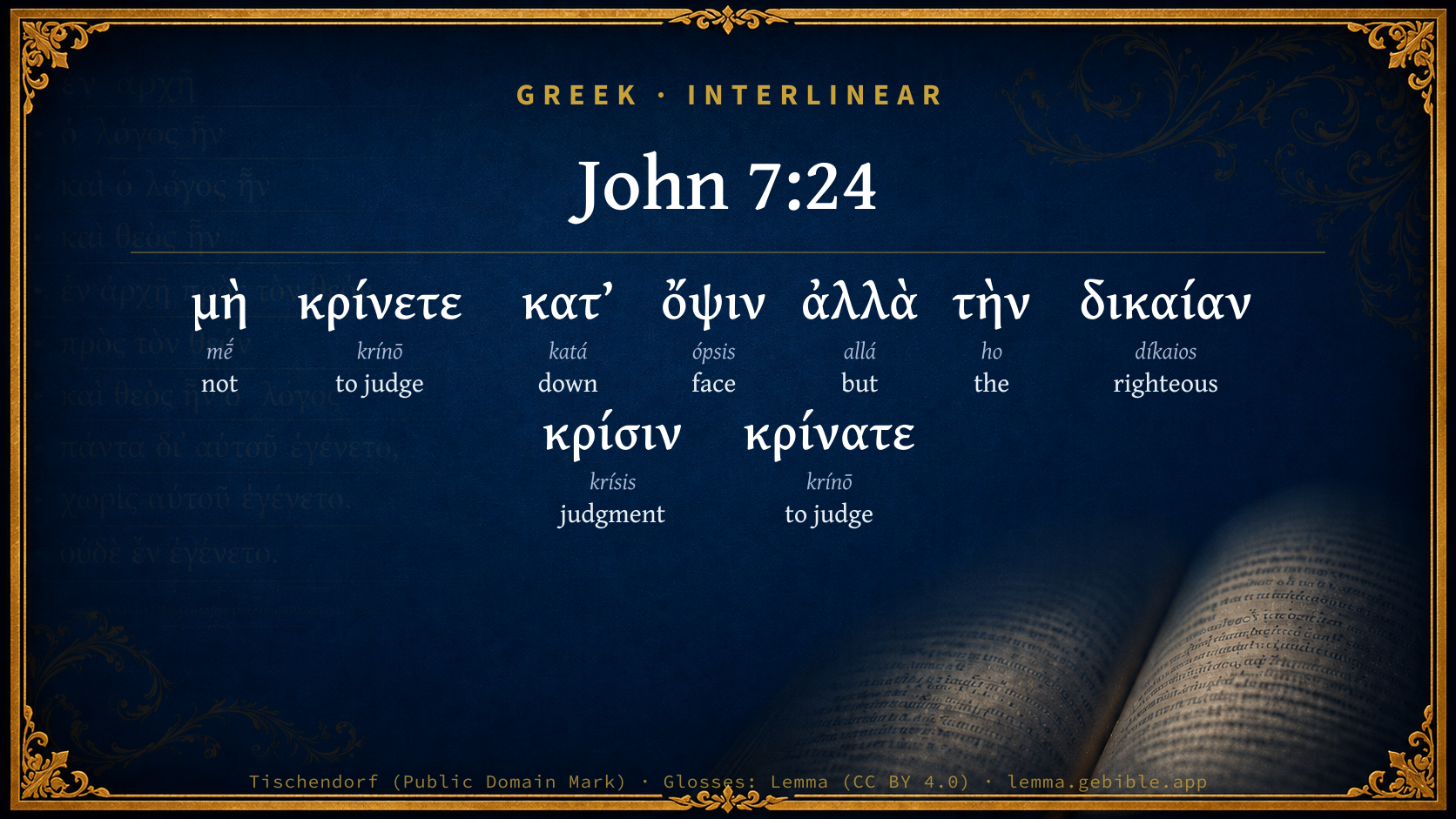
Greek (Tischendorf 8th ed.) John 7:24 appears in the Greek New Testament. The text above is from the Tischendorf 8th edition. Each word links to its Strong’s number and a concise gloss. Click any word for its full Thayer’s Greek Lexicon entry.
Download image
Cite this verse

John 7:24 (World English Bible). Public Domain. Lemma interlinear Bible study tool, https://lemma.gebible.app/v/john/7/24.

Show BibTeX & RIS
BibTeX
RIS
English Translation
Don't judge according to appearance, but judge righteous judgment."
World English Bible · Public Domain
Highlights
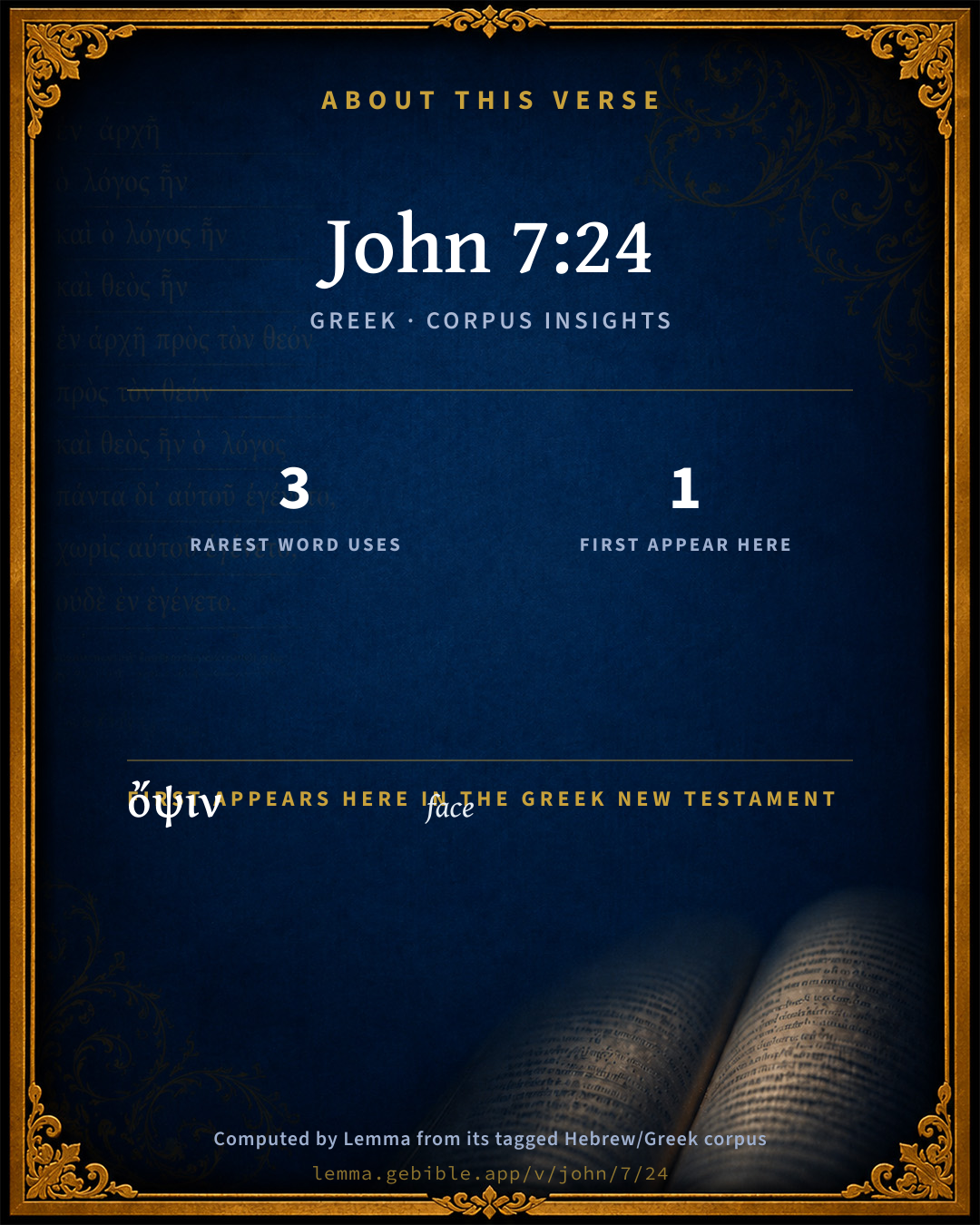
  • 1 first appearance in the Greek New Testament
Full analysis ↓
Download a study sheet

One document with this verse’s original text, its word-by-word gloss line, the meaning frame, cross-references with their text, attributed commentary, and full source and license credits — printable, and it pastes into notes with its structure intact.

This verse Autodidact and up

Study sheet (.html) Plain text (.txt)

A passage Seminary Student

Up to 50 verses in one chapter. A passage sheet keeps up to 6 commentary sources and 12 cross-references per verse, in the order this page ranks them, and says so on the sheet whenever that leaves anything out. Ask for a single verse and you get the Autodidact verse sheet above.

Everything on this page stays free to read, with no account — the sheet is a download of what is already on screen, not access to it.

Want to remove ads? Support Godless Engineer
Compare translations 3

The same verse in 3 English versions, stacked beneath the original-language interlinear above. Click any original word for its lexicon entry.

Each is an independent rendering of the whole verse — the interlinear is not word-aligned to these translations.

Highlighted words mark where these versions differ — a whole-verse word diff, not a word-by-word alignment.

  • World English Bible Public Domain
    Don't judge according to appearance, but judge righteous judgment."
  • King James Version Public Domain
    Judge not according to the appearance, but judge righteous judgment.
  • unfoldingWord Literal Text CC BY-SA 4.0
    Do not judge according to appearance, but judge righteous judgment.”

unfoldingWord Literal Text — © unfoldingWord, licensed CC BY-SA 4.0. Word-aligned USFM3 via Door43 (git.door43.org/unfoldingWord/en_ult).

Versions to compare (up to 4)

3 of 4 selected

Show all 19 translations

Every available English version of this verse, each an independent rendering of the whole verse.

  • World English Bible Public Domain
    Don't judge according to appearance, but judge righteous judgment."
  • Berean Standard Bible Public Domain
    Stop judging by outward appearances, and start judging justly.”
  • Majority Standard Bible Public Domain
    Stop judging by outward appearances, and start judging justly.”
  • King James Version Public Domain
    Judge not according to the appearance, but judge righteous judgment.
  • American Standard Version (1901) Public Domain
    Judge not according to appearance, but judge righteous judgment.
  • Revised Version (1885) Public Domain
    Judge not according to appearance, but judge righteous judgment.
  • Geneva Bible (1599) Public Domain
    Iudge not according to the appearance, but iudge righteous iudgement.
  • Douay-Rheims (1899) Public Domain
    Judge not according to the appearance, but judge just judgment.
  • Young's Literal Translation Public Domain
    judge not according to appearance, but the righteous judgment judge.'
  • Literal Standard Version CC BY-SA 4.0
    Do not judge according to appearance, but the righteous judgment judge.”
  • Unlocked Literal Bible CC BY-SA 4.0
    Do not judge according to appearance, but judge righteously.”
  • unfoldingWord Literal Text CC BY-SA 4.0
    Do not judge according to appearance, but judge righteous judgment.”
  • Darby Bible Public Domain
    Judge not according to sight, but judge righteous judgment.
  • World Messianic Bible Public Domain
    Don’t judge according to appearance, but judge righteous judgment.”
  • Webster's Bible Public Domain
    Judge not according to the appearance, but judge righteous judgment.
  • Free Bible Version CC BY-SA 4.0
    Don't judge by appearances; decide what is right!”
  • Bible in Basic English Public Domain
    Let not your decisions be based on what you see, but on righteousness.
  • Text-Critical English NT CC BY 4.0
    Do not judge according to appearance, but judge with right judgment.”
  • Tyndale New Testament (1534) Public Domain
    Iudge not after the vtter aperaunce: but iudge rightewes iudgement.

Literal Standard Version (2020), Covenant Press — licensed CC BY-SA 4.0. Text via the HelloAO Bible API (eBible.org). Unlocked Literal Bible (unfoldingWord) — licensed CC BY-SA 4.0. Text via the HelloAO Bible API (eBible.org). unfoldingWord Literal Text — © unfoldingWord, licensed CC BY-SA 4.0. Word-aligned USFM3 via Door43 (git.door43.org/unfoldingWord/en_ult). Free Bible Version, Dr. Jonathan Gallagher — licensed CC BY-SA 4.0. Text via the HelloAO Bible API (eBible.org).

Word by word

More ways to search: Search by grammar → Find every occurrence → Compare this word →

Practice this passage: Drill this verse → Learn its vocabulary →

About this verse

These counts appear in no published source. They are computed here, from the morphology-tagged text and Lemma’s own curated glosses. What Lemma adds →

9
words
8
distinct lemmas
Gospels
section

Notable vocabulary

The rarest word here is ὄψιν face G3799 — appearing just 3 times in the whole Greek New Testament.

First appearance in Scripture

This word makes its first canonical appearance in the Greek New Testament here:

Shared distinctive vocabulary

ὄψιν face G3799 occurs in 3 verses of the Greek New Testament. Also found in:

Repetition

A word recurs within this verse:

  • κρίνετε to judge G2919 ×2

Cross-references

14

Topical passages linked to John 7:24 in the Treasury of Scripture Knowledge — connected by theme and wording, ordered by reader-vote popularity; previews shown in the World English Bible.

  • Isaiah 11:3–4 His delight shall be in the fear of Yahweh; and he shall not judge after the sight of his eyes, neither decide after the hearing of his ears;
  • James 2:9 But if you show partiality, you commit sin, being convicted by the law as transgressors.
  • Proverbs 17:15 He who justifies the wicked, and he who condemns the righteous, Both of them alike are an abomination to Yahweh.
  • John 8:15 You judge according to the flesh. I judge no one.
  • Proverbs 24:23 These also are sayings of the wise. To show partiality in judgment is not good.
  • James 2:1 My brothers, don't hold the faith of our Lord Jesus Christ of glory with partiality.
  • Leviticus 19:15 "'You shall do no injustice in judgment: you shall not be partial to the poor, nor show favoritism to the great; but in righteousness shall you judge your neighbor.
  • Deuteronomy 1:16–17 I charged your judges at that time, saying, Hear [the causes] between your brothers, and judge righteously between a man and his brother, and the foreigner who is living with him.
  • Deuteronomy 16:18–19 Judges and officers shall you make you in all your gates, which Yahweh your God gives you, according to your tribes; and they shall judge the people with righteous judgment.
  • Isaiah 5:23 Who acquit the guilty for a bribe, But deny justice for the innocent!
  • Psalms 58:1–2 Do you indeed speak righteousness, silent ones? Do you judge blamelessly, you sons of men?
  • Psalms 82:2 "How long will you judge unjustly, And show partiality to the wicked?" Selah.
  • Psalms 94:20–21 Shall the throne of wickedness have fellowship with you, Which brings about mischief by statute?
  • James 2:4 haven't you shown partiality among yourselves, and become judges with evil thoughts?

Cross-references courtesy of OpenBible.info (CC BY 4.0).

Commentary

Notes on John 7:24 from classic Christian and Jewish commentators (each source and its license shown beneath its notes). The classic Christian expositions comment on the surrounding passage and are grouped to its opening verse, so a note may address several verses; the Jewish commentaries on the Tanakh (Rashi and others) are per-verse, so they appear only where the commentator wrote on this verse.

Lemma curates 59 commentaries, every one of them public domain or Creative Commons licensed, each selected and text-cleaned for this edition rather than reprinted as found. About our sources →

Godbey's Commentary on the New Testament

William B. Godbey

RIGHTEOUS JUDGMENT

Joh 7:24-31. “Judge not according to sight.” The verb here is in the perpetual present, setting forth human proneness to judge people from the outward appearance. “But judge righteous judgment.” The verb in this clause is in the aorist tense, which means an instantaneous action and a permanent state following, involving the conclusion that instead of these helter-skelter judgments from the outside, we are to deliberately investigate, ascertain the truth, adopt it, and stick to it permanently. “Then certain ones of the Jerusalemites were saying, Is not this the One whom they are seeking to kill? And, behold, He speaks boldly, and they say nothing to Him.” These people in Jerusalem knew well that the high priests, scribes, and Pharisees had determined and boasted, during His long absence in Galilee, that if He ever came back there, they would kill Him. “Whether have the rulers truly found out that He is the Christ.” There was a prevalent, popular dogma that when Christ came, the wise rabbis and the Sanhedrin would be the first to find it out and tell the people. Now, as these Jerusalemites had heard them say that if He ever came back there they would have Him arrested and put to death, at the same time predicting that He would never come, alleging that He could do wonders off in Galilee among the ignorant people, but they dared Him to come to Jerusalem; and now that He is here, boldly and powerfully preaching to the multitudes, attending the Festival of Tabernacles, on the Temple Campus, and they do not molest Him; therefore they conclude that their great men must in some way have found out that He is the Christ, and consequently are just letting Him alone. “But we know this One, whence He is; but when Christ may come, no one knows whence He is.” There was a popular dogma that when Christ comes on tile earth, He will suddenly appear to the people, and no one will know anything about His origin, the prophecies of His conception and birth being mystified, so they did not understand them. “Then Jesus cried out, teaching in the temple, and saying, You know Me, and you know whence I am. But I did not come of Myself, but the One having sent Me is true, whom you know not.” He had been born at Bethlehem, only seven miles south of Jerusalem, and lived thirty years at Nazareth, only one hundred and fifty miles north of Jerusalem. Of course, He was well known to the Jewish nation, being a native of their country. But while they knew Him personally, though they claimed to be the most godly people in the world, He here frankly informs them that they do not know Him. “I know Him, because I am with Him, and He has sent Me.” Jesus here uses the present tense, only applicable to His Divinity, which was omnipresent, His humanity at that time being confined to this world. We frequently hear silly twaddle nowadays in reference to the impracticability of His presence on earth and in heaven during the millennium. All this is answered by His own proclamation, stating that while in Jerusalem, He was present with the Father. “Then they were seeking to arrest Him, and no One laid his hand on Him, because His hour had not yet come.” Jesus was immortal till His work was done, and so are His true followers. Therefore let us fear neither sickness nor death. We shall live till we finish our work. Then heaven will be infinitely preferable. “And many of the multitude believed on Him, and continued to say, When Christ may come, will He do more miracles than those which this Man doeth?” N.B. — Myriads of people were then at Jerusalem who had witnessed His mighty works in Galilee.

William B. Godbey, Commentary on the New Testament (1896–1900) — public domain. Text from a community e-Sword module.

Bengel's Gnomon

Johann Albrecht Bengel

Joh 7:24. Μὴ κρίνετε κατʼ ὄψιν, ἀλλὰ τὴν δικαίαν κρίσιν κρίνατε, judge not according to the appearance, but judge true judgment) On that Sabbath, which fell among the days of the Feast of Tabernacles (the Sabbath moreover had fallen this year on the fifth day of the feast), there used to be read the book Ecclesiastes, a great portion of which is this very precept as to avoiding superficial judgment and holding to right judgment. [It is also judging according to appearance, or (what is the same) according to the flesh; ch. Joh 8:15, “Ye judge after the flesh,” when the letter is taken independently of the (spiritual) sense. Christ Himself judges according to truth. Isa 11:3-4, “He shall not judge after the sight of His eyes, neither reprove after the hearing of His ears, But with righteousness shall He judge the poor, and reprove with equity for the meek of the earth.”—V. g.]—τήν) The judgment that is true, is one.[186] This is the force of the article.

[186] Whilst false judgments are many.—E. and T.

Bengel's Gnomon of the New Testament — English translation (T&T Clark, Edinburgh, 1860) — public domain. Text from a community e-Sword module.

Meyer's Critical & Exegetical Commentary

Heinrich August Wilhelm Meyer

Joh_7:24. This closing admonition is general, applicable to every case that might arise, but drawn by way of deduction from the special one in point. According to the outward appearance, that act was certainly, in the Jewish judgment, a breach of the Sabbath; but the righteous judgment was that to which Jesus had now conducted them. Upon ὄψις, id quod sub visum cadit, res in conspicuo posita, see Lobeck, Paralip. p. 512. It does not here mean visage, as in Joh_11:44, and as Hengstenberg makes it, who introduces the contrast between Christ without form or comeliness, and the shining countenance of Moses. On κρίνειν κρίσιν δικαίαν, comp. Tob_3:2; Susannah 53; Zec_7:9.

Meyer — Critical and Exegetical Commentary on the New Testament — English translation by Peter Christie, edited by Frederick Crombie (T&T Clark, 1880) — public domain. Text from a community e-Sword module.

Geneva Bible (1599)

Geneva Bible translators

By the show that I make: for I seem to be but an abject and rascal of Galilee, and a carpenter’s son, whom no man maketh account of: but mark the matter itself well, and judge the tree by the fruit.

We must judge according to the truth of things, lest the persons of men do turn us and carry us away.

Geneva Bible (1599) marginal notes — public domain. Text via Bolls.life.

Jamieson, Fausset & Brown

Robert Jamieson, A. R. Fausset & David Brown

Judge not, &c.--that is, Rise above the letter into the spirit of the law.

Jamieson, Fausset & Brown — Commentary Critical and Explanatory on the Whole Bible (1871) — public domain (CC PDM 1.0). Text via the HelloAO Bible API.

Adam Clarke's Commentary

Verse 24. Judge not according to the appearance] Attend to the law, not merely in the letter, but in its spirit and design. Learn that the law which commands men to rest on the Sabbath day is subordinate to the law of mercy and love, which requires them to be ever active to promote God's glory in the comfort and salvation of their fellow creatures; and endeavour to judge of the merit or demerit of an action, not from the first impression it may make upon your prejudices but from its tendency, and the motives of the person, as far as it is possible for you to acquaint yourselves with them; still believing the best, where you have no certain proof to the contrary.

Adam Clarke's Commentary on the Bible (1810–1826) — public domain. Text from a community e-Sword/MySword module.

John Calvin's Commentaries

24. Judge not according to the appearance. Having concluded his defense, he likewise administers a reproof on this ground, that they are carried away by wicked dispositions, and do not form a judgment according to the fact and the matter in hand. Circumcision was properly held by them in reverence; and when it was performed on the Sabbath-day, they knew that the Law was not violated by it, because the works of God agree well with each other. Why do they not arrive at the same conclusion as to the work of Christ, but because their minds are preoccupied by a prejudice which they have formed against his person? Judgment, therefore, will never be right, unless it be regulated by the truth of the fact; for as soon as persons appear in public, they turn their eyes and senses on them, so that the truth immediately vanishes. While this admonition ought to be observed in all causes and affairs, it is peculiarly necessary when the question relates to the heavenly doctrine; for there is nothing to which we are more prone than to dislike that doctrine on account of the hatred or contempt of men.

John Calvin's Commentaries (1540-1563) — public domain. Text from the Calvin Translation Society English edition (1840s-50s) via the Christian Classics Ethereal Library (ccel.org). Calvin's coverage is partial (roughly two-thirds of the Bible); uncommented books and verses are honest gaps, never fabricated. The 19th-century editor's footnotes and remarks are omitted so the notes are faithfully Calvin's own voice.

Ellicott's Commentary for English Readers

(24) Judge not according to the appearance.—He has put the case before them in its true light, I and from their own point of view. There was another Positive Precept of Moses which these judges were forgetting, though it, too, formed part of the first section of the Law read at Tabernacles (Deu_1:16-17). (Comp. Note on Joh_7:19.) Let them who profess to judge Him by the Law obey it, and form a just and honest opinion, and not be biased by the appearance of a mere technicality. Even if His work did fall under the condemnation of what they held to be the letter of the Mosaic law (comp. Note on Joh_5:10), they knew perfectly well—and their own practice as to circumcision proved this—that it did so in appearance only.

A Bible Commentary for English Readers, edited by Charles John Ellicott (1878–1897) — public domain. Text from a community e-Sword module.

The Cambridge Bible for Schools and Colleges

gen. ed. J. J. S. Perowne

24. according to the appearance] ‘According to the appearance’ Christ’s act was a breach of the Sabbath. This is almost certainly the meaning, although the word translated ‘appearance’ may mean ‘face,’ and is rightly translated ‘face’ in Joh_11:44 (see note there). There is no reference here to Christ’s having ‘no form nor comeliness,’ as if He meant ‘Judge not by My mean appearance.’

The Cambridge Bible for Schools and Colleges (gen. ed. J. J. S. Perowne; Cambridge University Press, 1878–1918) — public domain. Text from a community e-Sword module.

John Gill's Exposition

Then said some of them of Jerusalem,.... Who were inhabitants of Jerusalem, and so are distinguished from the people, Joh 7:20, who came up out of the country to the feast; so Jose ben Jochanan is called , "a man of Jerusalem" (c); that is, an inhabitant of it: now these men living in the city, knew more of the temper and disposition, the designs and attempts, of the chief priests, Scribes, and elders, to take away the life of Christ; and therefore say,

is not this he whom they seek to kill? they knew that they had formed a design to kill him, ever since the passover before the last; when he wrought the miracle referred to in the text, and that they had been ever since plotting against his life, and were now at this feast seeking an opportunity to lay hold on him and kill him.

(c) Pirke Abot, c. 1. sect. 4, 5.

John Gill's Exposition of the Whole Bible (1746–1763) — public domain (CC PDM 1.0). Text via the HelloAO Bible API.

Trapp's Complete Commentary

John Trapp

24 Judge not according to the appearance, but judge righteous judgment.

Ver. 24. Judge not according to the appearance] Nothing is more ordinary with many than to precipitate a censure, to exercise their critics, and to reprehend that which they do not comprehend. Arbitror saith Augustine (de Trim i. 3), nonnullos opinaturos me sensisse quod non sensi, aut non sensisse quod sensi, I suppose that several in reading some places in my books will think that I thought that which never came into my mind to think, and the contrary. This was his fear, and this befell him, as Baronius witnesseth. Compertum est, saith Erasmus. It is well known that many points are condemned as heretical in Luther’s books, which in Augustine’s and Bernard’s books are read and received for good and orthodox. {a} Hill, in his Quartern of Reasons, saith, the Catholics follow the Bible, but the Protestants force the Bible to follow them. And the author of the Gag for the New Gospel assures his Catholics, that our condemnation is so expressly set down in our own Bibles, and is so clear to all the world, that nothing more needs hereto than that they know to read, and to have their eyes in their heads, at the opening of our Bible. This is their judgment of us. But what among themselves! He that tastes an egg, saith Erasmus, at an undue time, is cast into prison, and made to answer for his heresy; but he that spends all the Lord’s day in drinking, drabbing, dicing, is called a good fellow, and passeth unpunished. Qui totam diem Dominicam vacat temulentiae scortis et aleae audit bellus homo, &c.

{a} Erasm. epist, ad Cardinal. Maguntin.

John Trapp, A Commentary or Exposition upon All the Books of the Old and New Testament (1647–1656) — public domain. Text from a community e-Sword module.

Albert Barnes' Notes on the Bible

Judge not according to the appearance - Not as a thing first offers itself to you, without reflection or candor. In appearance, to circumcise a child on the Sabbath might be a violation of the law; yet you do it, and it is right. So, to appearance, it might be a violation of the Sabbath to heal a man, yet it is right to do works of necessity and mercy.

Judge righteous judgment - Candidly; looking at the law, and inquiring what its spirit really requires.

Albert Barnes' Notes on the Bible (1834–1885) — public domain. Text from a community e-Sword/MySword module.

Matthew Poole's English Annotations

Do not judge persons, and condemn me for what I have done, merely out of your hatred, prejudice, and malice against me. Or, do not judge according to the first appearance of this fact. It looketh to you as a violation of the sabbath; it is not indeed so, but the performance of a duty greater than that of sanctifying the sabbath is. Judge righteously, and do not condemn in me what you yourselves do in other causes, because of your hatred to and prejudice against me; nor condemn an action which is in itself a righteous action, and not deserving condemnation.

Matthew Poole's English Annotations on the Holy Bible (1683–1685) — public domain. Text from a community e-Sword/MySword module.

Whedon's Commentary on the Bible

Daniel D. Whedon

24. According to the appearance—By the mere external act, as if that settled in all cases its right or wrong.

Righteous judgment—Applying the principles of conscience to the nature of the deed and motive. True religion has this proof of its genuineness namely, that it agrees with and truly quickens and strengthens our conscience.

Daniel D. Whedon (gen. ed.), Commentary on the Old and New Testaments (1874–1909) — public domain. Text from a community e-Sword module.

The Pulpit Commentary

Judge not according to appearance the superficial aspect of things, the merely formal side, the unexplained letter of the Law. Oqiv id quod sub visum cadit res in conspicuo posita. According to that, the healing and the bed carrying consequent upon it would be a positive infraction of a certain enactment. But judgerighteous judgment. Consider the case, and see that I have done, in this act of healing, less than you are doing yourselves, notwithstanding all your punctilio, and with a higher justification. The aorist krinate involves probably "the one true and complete decision which the case admits" (Westcott).

The Pulpit Commentary (1880–1919), ed. H.D.M. Spence-Jones & Joseph S. Exell — public domain. Text from a community e-Sword module.

Scofield Reference Notes

C. I. Scofield

righteous

(See Scofield "1Jn 3:7").

The Scofield Reference Bible (1917 edition), notes by C. I. Scofield — public domain. Text from a community e-Sword module.

Burkitt's Expository Notes on the New Testament

William Burkitt

From the foregoing argument, Christ draws an inference or conclusion, That there is no making a judgment according to the first appearance of things: and that suddenness or rashness, prejudice or partiality, in judging, overthrows righteous judgment. This is the general application of what Christ had said before: and the particular application of it, as to himself, comes to this, Judge not according to appearance, but judge righteous judgment; as if Christ had said, "Lay aside your prejudices against my person, and compare these cases attentively and impartially with one another; and then see whether you can justly condemn me as a sabbath-breaker, and acquit yourselves." Such was the perfect innocency of our Saviour’s actions, that he could and did submit them to the reason and judgment of his very enemies.

William Burkitt's Expository Notes on the New Testament (1700–1703) — public domain. Text from a community e-Sword module.

Cambridge Greek Testament for Schools and Colleges

24. κατ’ ὄψιν. According to appearance Christ’s act was a breach of the Sabbath. ὄψις may mean ‘face,’ as in Joh 11:44 (see note there); but there is no reference to Christ’s having ‘no form nor comeliness,’ as if He meant ‘Judge not by My mean appearance.’

τὴν δικ. κρ. The righteous judgment: there is only one.

Cambridge Greek Testament for Schools and Colleges (Cambridge University Press, 1896; 21 vols, various authors incl. Carr, Maclear, Plummer, Farrar, Lumby, Moule, M. R. James, Simcox) — public domain. Text from a community e-Sword module.

Alford’s Greek Testament

Henry Alford

24.] No stress must be laid on the article (τήν) with κρίνετε: it is merely expressive of habit,—Let your judgment (ἡ κρ. ὑμῶν) be a just one.

κρίνετε implies habit—in all your judgments: whereas the aorist (see var. readd.) would enjoin right judgment on the present occasion, directing the attention on what had just happened.

Henry Alford, The Greek Testament (1849–1861) — public domain. Text from a community e-Sword module.

International Critical Commentary

24. μὴ κρίνετε κατʼ ὄψιν, “do not judge by looks,” i.e. superficially, the too frequent weakness of the Pharisees, which is rebuked again ὑμεῖς κατὰ τὴν σάρκα κρίνετα (8:15). Cf. Isa 11:3 οὐ κατὰ τὴν δόξαν κρινεῖ, and 2Co 10:7. ὄψις occurs again in the N.T. only at 11:44 and Rev 1:16, and then in the sense of “face.”

ἀλλὰ τὴν δικαίαν κρίσιν κρίνατε, “but judge righteous judgment,” i.e. be fair. The expression is used of the judgments of God, Tob. 3:2. Cf. also Zec 7:9 κρίμα δίκαιον κρίνατε. The constr. κρίσιν κρινειν is common (Isa 11:4) and is also classical (Plato, Rep. 360 E).

International Critical Commentary — older volumes (1896–1929), various authors — public domain. Text from a community e-Sword module.

Vincent's Word Studies in the New Testament

Marvin R. Vincent

Appearance [οψιν] . Primarily, seeing or sight. In Joh 11:44; Revelation 1 16, face, and hence external appearance. The word occurs only in the three passages cited.

Righteous judgment (thn dikaian krisin). Properly, the righteous judgment; that which is appropriate to the case in hand.

Marvin R. Vincent, Word Studies in the New Testament (1887–1900) — public domain. Text from a community e-Sword/MySword module.

Godet's Commentaries

Frédéric Louis Godet

Ver. 24. “Judge not according to the appearance; but pronounce the judgment which is in accordance with righteousness.”

῎Οψις, sight, hence appearance, designates here the external and purely formal side of things. It was only from this defective point of view that the healing of the impotent man could be made the subject of accusation. There is no question here of the humble appearance of Jesus which had perverted the judgment of the Jews (Waitz). Righteous judgment is that which estimates the acts according to the spirit of the law. The article before the word κρίσιν, judgment, may denote either the judgment in this definite case, or, in general, the judgment in each case where there is occasion to pass judgment. In the first clause, which is negative, the present κρίνετε is very appropriate: for the question is of the judgment pronounced in this case on the act of Jesus. But in the second, the present is probably a correction in accordance with the first. The aorist, κρίνατε, is perfectly suitable: Judge righteously in every case (without reference to time).

Frédéric Louis Godet — Commentaries on Luke, John, Romans, and 1 Corinthians — English translation (T&T Clark, Edinburgh, 1870s–1890s) — public domain. Text from a community e-Sword module.

Lesson kit

Teaching starters — assembled from the data on this page, not authored interpretation. Every prompt links to the verse data it draws on. Edit before teaching.

John, in the Gospels, opens this verse with 9 words (8 distinct Greek lemmas). Its most distinctive word is ópsis (“face”). A historical commentator’s framing appears above. Read the whole chapter for the surrounding context.

Discussion questions

  1. What does “face” (ópsis) contribute to the verse as a whole?
  2. The word “face” first appears here in Scripture. What is being introduced at this debut?
  3. John 11:44 shares the word «face» with this verse. How do the two illuminate each other?
  4. “to judge” occurs 2× in this one verse. What is the effect of the repetition?
  5. These translations render this verse differently. What is at stake in choosing one wording over another?
  6. Reading how Godbey's Commentary on the New Testament and Bengel's Gnomon read this verse, where do the two commentators agree and where do they part?

Things to notice

  • 1 word makes its first canonical appearance in Scripture here.
  • These translations choose different wording for 2 words in this verse.
  • “to judge” occurs 2× in this single verse.
  • 8 distinct Greek lemmas span 9 words in this verse.

Reading settings

Reading text

Shown beneath each verse's original-language words.

Old Testament
Old Testament edition

Read the OT as the Masoretic Hebrew (MT) or the Greek Septuagint (LXX).

English shown for the Greek Septuagint (in the Hebrew ↔ Greek comparison).

Comparing translations? Open the Compare panel on any verse page to stack up to four side by side.