2 Thessalonians 2:12

Greek (Tischendorf 8th ed.) 2 Thessalonians 2:12 appears in the Greek New Testament. The text above is from the Tischendorf 8th edition. Each word links to its Strong’s number and a concise gloss. Click any word for its full Thayer’s Greek Lexicon entry.
Download image
Cite this verse

2 Thessalonians 2:12 (World English Bible). Public Domain. Lemma interlinear Bible study tool, https://lemma.gebible.app/v/2-thessalonians/2/12.

Show BibTeX & RIS
BibTeX
RIS
English Translation
that they all might be judged who didn't believe the truth, but had pleasure in unrighteousness.
World English Bible · Public Domain
Download a study sheet

One document with this verse’s original text, its word-by-word gloss line, the meaning frame, cross-references with their text, attributed commentary, and full source and license credits — printable, and it pastes into notes with its structure intact.

This verse Autodidact and up

Study sheet (.html) Plain text (.txt)

A passage Seminary Student

Up to 50 verses in one chapter. A passage sheet keeps up to 6 commentary sources and 12 cross-references per verse, in the order this page ranks them, and says so on the sheet whenever that leaves anything out. Ask for a single verse and you get the Autodidact verse sheet above.

Everything on this page stays free to read, with no account — the sheet is a download of what is already on screen, not access to it.

Want to remove ads? Support Godless Engineer
Compare translations 3

The same verse in 3 English versions, stacked beneath the original-language interlinear above. Click any original word for its lexicon entry.

Each is an independent rendering of the whole verse — the interlinear is not word-aligned to these translations.

Highlighted words mark where these versions differ — a whole-verse word diff, not a word-by-word alignment.

  • World English Bible Public Domain
    that they all might be judged who didn't believe the truth, but had pleasure in unrighteousness.
  • King James Version Public Domain
    That they all might be damned who believed not the truth, but had pleasure in unrighteousness.
  • unfoldingWord Literal Text CC BY-SA 4.0
    so that they might all be judged, the ones not having believed the truth, but having taken pleasure in the unrighteousness.

unfoldingWord Literal Text — © unfoldingWord, licensed CC BY-SA 4.0. Word-aligned USFM3 via Door43 (git.door43.org/unfoldingWord/en_ult).

Versions to compare (up to 4)

3 of 4 selected

Show all 19 translations

Every available English version of this verse, each an independent rendering of the whole verse.

  • World English Bible Public Domain
    that they all might be judged who didn't believe the truth, but had pleasure in unrighteousness.
  • Berean Standard Bible Public Domain
    in order that judgment may come upon all who have disbelieved the truth and delighted in wickedness.
  • Majority Standard Bible Public Domain
    in order that judgment may come upon all who have disbelieved the truth and delighted in wickedness.
  • King James Version Public Domain
    That they all might be damned who believed not the truth, but had pleasure in unrighteousness.
  • American Standard Version (1901) Public Domain
    that they all might be judged who believed not the truth, but had pleasure in unrighteousness.
  • Revised Version (1885) Public Domain
    that they all might be judged who believed not the truth, but had pleasure in unrighteousness.
  • Geneva Bible (1599) Public Domain
    That all they might be damned which beleeued not the trueth, but had pleasure in vnrighteousnes.
  • Douay-Rheims (1899) Public Domain
    But we ought to give thanks to God always for you, brethren, beloved of God, for that God hath chosen you firstfruits unto salvation, in sanctification of the spirit, and faith of the truth:
  • Young's Literal Translation Public Domain
    that they may be judged -- all who did not believe the truth, but were well pleased in the unrighteousness.
  • Literal Standard Version CC BY-SA 4.0
    that they may be judged—all who did not believe the truth, but were well pleased in the unrighteousness.
  • Unlocked Literal Bible CC BY-SA 4.0
    The result is that they will all be judged, those who did not believe the truth but instead took pleasure in unrighteousness.
  • unfoldingWord Literal Text CC BY-SA 4.0
    so that they might all be judged, the ones not having believed the truth, but having taken pleasure in the unrighteousness.
  • Darby Bible Public Domain
    that all might be judged who have not believed the truth, but have found pleasure in unrighteousness.
  • World Messianic Bible Public Domain
    that they all might be judged who didn’t believe the truth, but had pleasure in unrighteousness.
  • Webster's Bible Public Domain
    That they all may be damned who believed not the truth, but had pleasure in unrighteousness.
  • Free Bible Version CC BY-SA 4.0
    As a result everyone who did not trust in the truth will be condemned, for they preferred what is evil.
  • Bible in Basic English Public Domain
    So that they all may be judged, who had no faith in what is true, but took pleasure in evil.
  • Text-Critical English NT CC BY 4.0
    so that all who have not believed the truth but have taken pleasure in unrighteousness will be condemned.
  • Tyndale New Testament (1534) Public Domain
    that all they myght be damned which beleved not the trueth but had pleasure in vnrightewesnes.

Literal Standard Version (2020), Covenant Press — licensed CC BY-SA 4.0. Text via the HelloAO Bible API (eBible.org). Unlocked Literal Bible (unfoldingWord) — licensed CC BY-SA 4.0. Text via the HelloAO Bible API (eBible.org). unfoldingWord Literal Text — © unfoldingWord, licensed CC BY-SA 4.0. Word-aligned USFM3 via Door43 (git.door43.org/unfoldingWord/en_ult). Free Bible Version, Dr. Jonathan Gallagher — licensed CC BY-SA 4.0. Text via the HelloAO Bible API (eBible.org).

Word by word

More ways to search: Search by grammar → Find every occurrence → Compare this word →

Practice this passage: Drill this verse → Learn its vocabulary →

εὐδοκήσαντες
eudokéō
G2106
“to be pleased”
Verb, Aorist, Active, Participle, Nominative, Plural, Masculine
Part of Speech
Verb
Tense
Aorist
Voice
Active
Mood
Participle
Case
Nominative
Number
Plural
Gender
Masculine
Full Thayer's Definition

Origin: from G2095 and G1380

TDNT: 14:18,3

1. it seems good to one, is one's good pleasure a. think it good, choose, determine, decide b. to do willingly c. to be ready to, to prefer, choose rather 2. to be well pleased with, take pleasure in, to be favourably inclined towards one
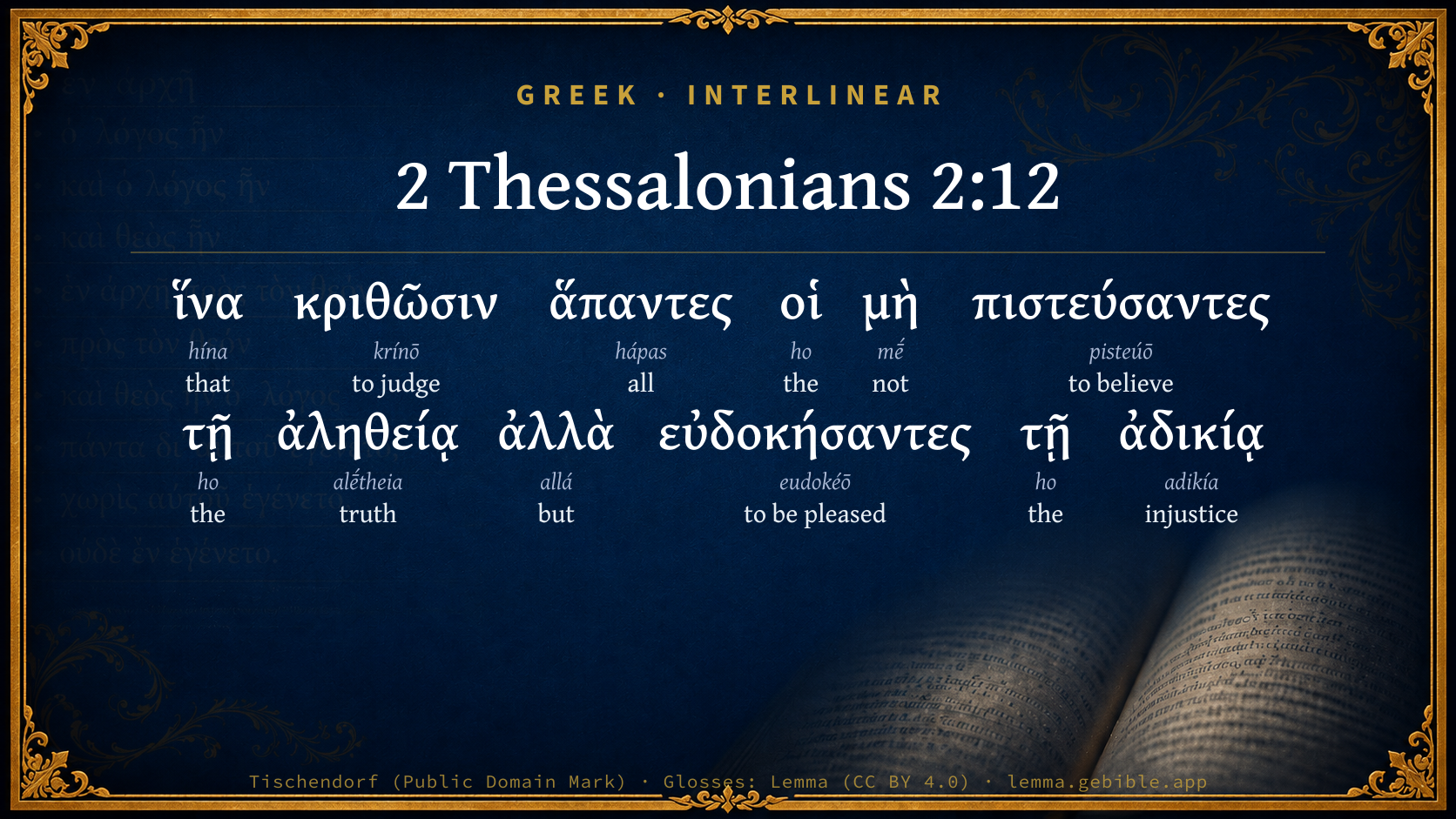
  1. ἵνα hína G2443 “that” Conjunction
  2. κριθῶσιν krínō G2919 “to judge” Verb, Aorist, Passive, Subjunctive, 3rd person, Plural
  3. ἅπαντες hápas G537 “all” Adjective, Nominative, Plural, Masculine
  4. οἱ ho G3588 “the” Article, Nominative, Plural, Masculine
  5. μὴ mḗ G3361 “not” Particle, Negative
  6. πιστεύσαντες pisteúō G4100 “to believe” Verb, Aorist, Active, Participle, Nominative, Plural, Masculine
  7. τῇ ho G3588 “the” Article, Dative, Singular, Feminine
  8. ἀληθείᾳ alḗtheia G225 “truth” Noun, Dative, Singular, Feminine
  9. ἀλλὰ allá G235 “but” Conjunction
  10. τῇ ho G3588 “the” Article, Dative, Singular, Feminine
  11. ἀδικίᾳ adikía G93 “injustice” Noun, Dative, Singular, Feminine

About this verse

These counts appear in no published source. They are computed here, from the morphology-tagged text and Lemma’s own curated glosses. What Lemma adds →

12
words
10
distinct lemmas
Pauline Epistles
section

Notable vocabulary

The rarest word here is εὐδοκήσαντες to be pleased G2106 — appearing just 21 times in the whole Greek New Testament.

Shared distinctive vocabulary

εὐδοκήσαντες to be pleased G2106 occurs in 21 verses of the Greek New Testament. Also found in:

Repetition

A word recurs within this verse:

Cross-references

18

Topical passages linked to 2 Thessalonians 2:12 in the Treasury of Scripture Knowledge — connected by theme and wording, ordered by reader-vote popularity; previews shown in the World English Bible.

  • Romans 1:32 who, knowing the ordinance of God, that those who practice such things are worthy of death, not only do the same, but also approve of those who practice them.
  • Romans 8:7–8 because the mind of the flesh is hostile towards God; for it is not subject to God's law, neither indeed can it be.
  • Mark 16:16 He who believes and is baptized will be saved; but he who disbelieves will be condemned.
  • Romans 2:8 but to those who are self-seeking, and don't obey the truth, but obey unrighteousness, will be wrath and indignation,
  • Psalms 11:5 Yahweh examines the righteous, But the wicked and him who loves violence his soul hates.
  • Hosea 7:3 They make the king glad with their wickedness, And the princes with their lies.
  • John 3:36 One who believes in the Son has eternal life, but one who disobeys the Son won't see life, but the wrath of God remains on him."
  • 1 Thessalonians 5:9 For God didn't appoint us to wrath, but to the obtaining of salvation through our Lord Jesus Christ,
  • 2 Peter 2:13–15 receiving the wages of unrighteousness; people who count it pleasure to revel in the day-time, spots and blemishes, reveling in their deceit while they feast with you;
  • Mark 14:11 They, when they heard it, were glad, and promised to give him money. He sought how he might conveniently deliver him.
  • John 3:19–21 This is the judgment, that the light has come into the world, and men loved the darkness rather than the light; for their works were evil.
  • Romans 12:9 Let love be without hypocrisy. Abhor that which is evil. Cling to that which is good.
  • Jude 1:4–5 For there are certain men who crept in secretly, even those who were long ago written about for this condemnation: ungodly men, turning the grace of our God into lasciviousness, and denying our only Master, God, and Lord, Jesus Christ.
  • Deuteronomy 32:35 Vengeance is mine, and recompense, At the time when their foot shall slide: For the day of their calamity is at hand, The things that are to come on them shall make haste.
  • Psalms 50:16–21 But to the wicked God says, "What right do you have to declare my statutes, That you have taken my covenant on your lips,
  • Psalms 52:3–4 You love evil more than good, Lying rather than speaking the truth. Selah.
  • Micah 3:2 You who hate the good, And love the evil; Who tear off their skin, And their flesh from off their bones;
  • 3 John 1:11 Beloved, don't imitate that which is evil, but that which is good. He who does good is of God. He who does evil hasn't seen God.

Cross-references courtesy of OpenBible.info (CC BY 4.0).

Commentary

Notes on 2 Thessalonians 2:12 from classic Christian and Jewish commentators (each source and its license shown beneath its notes). The classic Christian expositions comment on the surrounding passage and are grouped to its opening verse, so a note may address several verses; the Jewish commentaries on the Tanakh (Rashi and others) are per-verse, so they appear only where the commentator wrote on this verse.

Lemma curates 59 commentaries, every one of them public domain or Creative Commons licensed, each selected and text-cleaned for this edition rather than reprinted as found. About our sources →

The Biblical Illustrator

Joseph S. Exell

2Th_2:12

That they all might be damned who believed not the truth, but had pleasure in unrighteousness

Progress in unrighteousness

This is a terrible judgment--filling up the measure of their obduration, that they may at length fall into condemnation.

But it is equitable. They believed not the truth, received not the gospel in the simplicity of it, as revealed by Christ and His apostles, and recorded in the Scriptures, but wilfully and for their own interests sake, gave themselves up to these corruptions. And more, they had pleasure, etc. In 2Th_2:10 it was, they received not the love of the truth; now they delight in its opposite.

I. What is unrighteousness? Righteousness is giving every one his due--man and God (Mat_22:21); man (Tit_2:12); God, in the way of worship and reverence (Psa_29:2; Psa_96:8). This unrighteousness is principally meant in the latter sense. False worship is the greatest unrighteousness; for by this the glory of God is given to another (Rom_1:18; Rom_1:23; Rom_1:25).

II. They had pleasure in it; in those things they please themselves, not lapse into it out of simple ignorance and error of mind. And so the apostle parallels the two great apostasies from the light of nature and the light of the gospel (Rom_1:32; Psa_97:7).

III. Their condemnation. Observe--

1. Errors of judgment as well as sins of practice may bring damnation on the souls of men. All sins do in their own nature tend to damnation (Rom_6:23), and errors of judgment are sins because contrary to the law of God (1Jn_3:4). There is nothing so wicked that a man blinded with error will not attempt against those that differ from him (Joh_16:2). A blind horse is full of mettle, but stumbles; therefore, if a man be not guided by sound judgment, his zealous affections will precipitate him into mischief (Rom_10:2). How true this is of the papacy.

2. Though all errors may bring damnation, yet some are especially damning (2Pe_2:1). This may be either from--

(1) The matter held, if destructive of the way of salvation by Christ; or

(2) The manner--

(a) When men profess what they believe not and voluntarily choose error for worldly ends.

(b) When they are vented by some Christian professor to the seducing of others (Act_20:30; Gal_5:20).

(c) When, though they should not err fundamentally, they so far debauch Christianity, as that God gives them up to believe a lie, and to defend and maintain corruptions of doctrine and worship.

(d) When there is gross negligence, it is equivalent to standing out against the light (Joh_3:20; 2Pe_3:5). (T. Manton, D. D.)

God not the author of damnation

God is too good to damn anybody, so we hear some say nowadays. They are quite right. God does not damn anybody; but many damn themselves. Damnation is sin and suffering producing and perpetuating each other. We see suffering producing sin in this world, and sin producing suffering. Look at the low dens, with their diseased, poisoned, putrescent inmates, their depravity, their profligacy, their brutality, their bodily torture, their mental anguish. Is not that damnation?--sin and suffering acting and reacting. God does not damn men; He tries to prevent it. He moves heaven and earth to prevent it. Was not the crucifixion moving heaven and earth? The crucifixion was Gods supreme effort to keep men from hell. How unreasonable to charge God with your death! Suppose I went, sick and suffering, through the stormy night, to hold a light for you at some dizzy chasm; suppose you struck down the light which I had brought with so much pains; suppose you lost your foothold and fell into the abyss below, could I be charged with your death? Well, then, did not God bring you light? Did He not with scarred hand hold that light over your pathway? If you reject it and fall, can you charge Him with your death? No! oh, no! (Joh_3:19). (R. S. Barrett.)

The Biblical Illustrator, edited by Joseph S. Exell (c. 1880s–1900s) — public domain. Text from a community e-Sword module.

Tyndale Open Study Notes

Tyndale Open Resources

2:12 They will be condemned (see 1:6-9) by God’s judicial verdict for not believing the truth (2:10), instead believing the lie of the man of lawlessness (2:9-10).

Tyndale Open Study Notes — © Tyndale Open Resources, licensed CC BY-SA 4.0. Text via the HelloAO Bible API.

Bengel's Gnomon

Johann Albrecht Bengel

2Th 2:12. [20] Πάντες, all) That error then is to exhibit extensive, long-continued, and violent prevalence.

[20] Εἰς τὸ, that) Endeavour therefore with all your might to believe the truth.—V. g.

Bengel's Gnomon of the New Testament — English translation (T&T Clark, Edinburgh, 1860) — public domain. Text from a community e-Sword module.

Meyer's Critical & Exegetical Commentary

Heinrich August Wilhelm Meyer

2Th_2:12. Ἵνα] dependent on εἰς τὸ πιστεῦσαι κ.τ.λ., not on πέμπει, as Hofmann thinks. A statement of the further or higher design.

ἵνα κριθῶσι] in order that they may be judged, i.e. according to the context, condemned.

The truth is the Christian truth, and the unbelief, shown against it, is the consequence of the love for the truth in general being wanting (2Th_2:10).

CONCLUDING REMAEKS ON CHAP. 2Th_2:1-12

The apocalyptic teaching of the apostle in chap. 2Th_2:1-12 has occupied Christians of all times, and has been very variously interpreted. A chief distinction in the interpretations consists in this, that this Pauline prediction may be considered either as that which will be fulfilled in the near or more distant future, or as having already received its fulfilment.

I. The Church Fathers belong to the representatives of the first view (Irenaeus, adv. haer. v. 25, 29, 30; Tertullian, de resur. carn. c. 24; Chrysostom in loco; Cyril. Hierosolym. Catech. 15; Augustine, de civit. dei, xx. 19; Theodoret in loco, and epit. decret. div. c. 23; Theodorus Mopsuestius, and others). They correctly agree in considering that by the advent (2Th_2:1; 2Th_2:8), or the day of the Lord (2Th_2:2), is to be understood the personal advent of Christ for the last judgment and for the completion of the Messianic kingdom. Also it is correctly regarded as proved, that the Antichrist here described is to be considered as an individual person, in whom sin will embody itself. Yet Augustin already remarks, that nonnulli non ipsum principem, sed universum quodam modo corpus ejus i. e. ad eum pertinentem hominum multitudinem simul cum ipso suo principe hoc loco intelligi Antichristum volunt. The restraining power by which the appearance of Antichrist is delayed, is usually considered to be the continuance of the Roman Empire (τὸ κατέχον) and its representative the Roman emperor (ὁ κατέχων). Some, however, as Theodorus Mopsuestius and Theodoret, understand by it τοῦ Θεοῦ τὸν ὅρον, i.e. more exactly, the counsel of God to keep back the appearance of Antichrist until the gospel is proclaimed throughout the earth. This latter interpretation is certainly unsuitable enough. For although the difference of gender τὸ κατέχον and ὁ κατέχων may be to distinguish Gods counsel and God Himself, yet ἐκ μέσου γίνεσθαι is not reconcilable with the masculine ὁ κατέχων. Chrysostom chooses a third interpretation, that by the restraining power is meant the continuance of the extraordinary gifts of the Spirit. But he directly refutes this by the fact that if so, Antichrist must have already appeared, as those gifts have long since disappeared in the Christian church. The temple of God, in which Antichrist will place himself, is referred either to the Christian church (so Chrysostom, Theodoret, Augustin), the expression being taken figuratively, or to the actual temple of Jerusalem (so Irenaeus and Cyril); in which latter case the objection, that this temple was already destroyed, is met by the shift that a new temple rebuilt in place of the old one by Antichrist is to be thought on. Lastly, some, as Chrysostom,[52]although in contradiction to the chronology of the Epistle,interpret the ΜΥΣΤΉΡΙΟΝ Τῆς ἈΝΟΜΊΑς, which already begins to work, of Nero, the forerunner and type of Antichrist in St. Pauls time; and others, as Theodoret, of the outbreak of heresies.

[52] Νέρωνα ἐνταῦθά φησιν, ὡσανεὶ τύπον ὄντα τοῦ Ἀντιχρίστου· καὶ γὰρ οὗτος ἐβούλετο νομίζεσθαι Θεός. Καὶ καλῶς εἶπε τὸ μυστήριον· οὐ γὰρ φανερῶς ὡς ἐκεῖνος, οὐδὲ ἀπηρυθριασμένως. Εἰ γὰρ πρὸ τοῦ χρόνου ἐκείνου ἀνευρέθη, φησίν, ὃς οὐ πολύ τοῦ Ἀντιχρίστου ἐλείπετο κατὰ τὴν κακίαν, τί θαυμαστόν, εἰ ἤδη ἔσται;

The common and grave error in the explanations of the Fathers, by means of which they run counter to the Pauline representation, consisted in their not doing sufficient justice to the point of nearness of the event predicted by Paul. It is incontestable, as the result of correct exegesis, that Paul not only considered Antichrist as directly preceding the advent, but also regarded the advent as so near, that he himself might then be alive. It was natural that the Fathers, as the prophecy of the apostle had not been fulfilled in their times, should disregard this point; but they held that in this prophecy a picture of the last things, fully corresponding to the reality in the future, must have been given. They therefore satisfied themselves with the consideration that the prediction had already begun to be fulfilled in the apostolic times, but that the apostle could not possibly give an exact statement of time, as he only says that Antichrist will be revealed in his appointed time.[53]

[53] Comp. Augustin, Epist. 80 (Ep. 199, ed. Bened.): … ita sane obscure sunt et mystice dicta, ut tamen appareat, eum nihil de statutis dixisse temporibus, nullumque eorum intervallum spatiumque aperuisse. Ait enim: ut reveletur in suo tempore, nec dixit, post quantum temporis hoc futurum sit.

The view of the Fathers remained in the following ages the prevalent one in the Christian church. It was necessary, however, partially to change and transform it, the relation of Christianity to the Roman state having altered, as the Christian church, instead of being exposed to renewed hostilities from the secular power, had obtained the sovereignty of the state, and, penetrating larger portions of the world, represented itself as the kingdom of God on earth, and an imposing hierarchy was placed at its head. Whilst, accordingly, the idea of the advent stepped more and more into the background in the church generally, and especially with the hierarchy, on the other hand, those who had placed themselves in opposition to the hierarchy believed themselves obliged to apply to it the description of the apostle, as well as the figures in the Apocalypse of St. John. Thus arosewhilst the early view concerning the παρουσία τοῦ κυρίου was held with only the modification that its entrance was to be expected in the distant futurethe view, first in the eleventh century, that the establishment and growing power of the Papacy is to be considered as the Antichrist predicted by Paul. At first this view was expressed in the conflict between the emperors and the popes by the partisans of the imperial power; but was then repeated by all those who had placed themselves in opposition with the hierarchy, because they wished, instead of the rigid ecclesiastical power, a freer spirit of Christianity to rule; thus by the Waldenses, the Albigenses, and the followers of Wickliffe and Huss. The empirewhich was regarded as nothing else than a revival and renewal of the old Roman Empirewas considered as the restraining power which still delayed the destruction of the Papacy.

This reference[54] of Antichrist to the papal hierarchy became specially prevalent toward the time of the Reformation, and after that event was almost regarded as a dogma in the evangelical church. It is found in Bugenhagen, Zwingli, Calvin, Victorin Strigel, Hemming, Hunnius, Lucius and Andrew Osiander, Camero, Balduin, Aretius, Er. Schmid, Beza, Quistorp, Calixt, Calovius, Newton, Wolf, Joachim Lange, Turretin, Benson, Bengel, Macknight, Zachariae, Michaelis, and others. Accordingly it is expressed in the Lutheran symbolical books; comp. Articul. Smalcald. II. 4 (ed. Meyer, p. 189 f.): Haec doctrina praeclare ostendit, papam esse ipsum verum Antichristum, qui supra et contra Christum sese extulit et evexit, quandoquidem Christianos non vult esse salvos sine sua potestate, quae tamen nihil est, et a deo nec ordinata nec mandata est. Hoc proprie loquendo est se efferre supra et contra deum, sicut Paulus 2 Thessalonians 2 loquitur.

De pot. et prim. pap. (p. 210): Constat autem, Romanos pontifices cum suis membris defendere impiam doctrinam et impios cultus. Ac plane notae Antichristi competunt in regnum papae et sua membra. Paulus enim ad Thessalonicenses describens Antichristum, vocat eum adversarium Christi, extollentem se super omne, quod dicitur aut colitur deus, sedentem in templo dei tanquam deum. Also Luthers powerful treatise against the papal bull bore the title: Adversus exsecrabilem bullam Antichristi. It was thought that the Papacy would go on more and more developing what was anti-Christian in it, and that then the last judgment would overtake it. The ἀποστασία was the falling away from the pure gospel to the traditions of men. The singular Ὁ ἌΝΘΡΩΠΟς Τῆς ἉΜΑΡΤΊΑς Κ.Τ.Λ. is to be understood collectively as a series et successio hominum, inasmuch as the question is concerning an imperium monarchicum which remains one and the same, although its temporal head may be changed. The godlessness of Antichrist, described in 2Th_2:4, is historically proved by the pope placing himself above all human and divine authority, the words πάντα λεγόμενον Θεὸν κ.τ.λ., in accordance to biblical usage, being referred to the princes and great men of the world, and an allusion being discovered in ΣΈΒΑΣΜΑ to the Roman imperial title ΣΕΒΑΣΤΌς. The objection, that there have been pious popes, is removed by the proverb: a potiori fit denominatio. ναὸς τοῦ Θεοῦ is referred to the Christian church, and the ΚΑΘΊΣΑΙ to the tyrannical power usurped over it. By ΤῸ ΚΑΤΈΧΟΝ is nearly universally understood the Roman Empire, and by Ὁ ΚΑΤΈΧΩΝ the Roman emperor, for which proof is deduced from history, that the papal power sprang from the ruins of the Roman Empire, whilst in reference to the continuation of the empire in Germany, it is observed that praeter titulum nihil fere remains. The declaration τὸ μυστήριον ἤδη ἐνεργεῖται τῆς ἀνομίας, 2Th_2:7, is considered as justified by the fact that at least the semina erroris et ambitionis, which paved the way for the Papacy, were present in the time of the apostle; for which Camero appeals to Galatians 1, 2, and others to other proofs. For an enumeration of τέρατα ψεύδους, 2Th_2:9, relics, transubstantiation, purgatory, etc., afford rich material. The annihilation of Antichrist by the ΠΝΕῦΜΑ ΤΟῦ ΣΤΌΜΑΤΟς of the Lord, is understood to denote the annihilation of his importance in the minds of men by the divine word of Scripture being again opened up and diffused in its purity by means of the Reformation; whilst the ΚΑΤΑΡΓΉΣΕΙ Τῇ ἘΠΙΦΑΝΕΊᾼ Τῆς ΠΑΡΟΥΣΊΑς ΑὐΤΟῦ denotes the final and material destruction of Antichrist by the coming of Christ to judgment.

[54] See against this view, Koppe, Excurs. II. p. 120 ff.

In the presence of such polemics used against them, the Catholics are certainly not to be blamed that in retaliation they interpreted ἀποστασία as the defection from the Roman church and from the pope, and Antichrist as the heretics, especially Luther and the evangelical church. Comp. Estius, Fromond., Bern. a Piconio.

Yet even before the reference of Antichrist to Popery was maintained, Mohammed[55] was already regarded by the divines of the Greek church (latterly by Faber Stapulensis and others) as the Antichrist predicted by Paul, and in the ἈΠΟΣΤΑΣΊΑ was seen the defection of several Oriental and Greek churches from Christianity to Mohammedanism. This interpretation at least so far exercised an influence on the evangelical church, that some of its theologians have assumed a double Antichristone Oriental, viz. Mohammed and the Turkish power, and the other Western, viz. the pope and his power. So Melancthon, Bucer, Musculus, Bullinger, Piscator, and Vorstius.

[55] See against this view, Turretin, p. 515 ff.

Related to this whole method of interpretation is the assumption,[56] made in our own century, that by the apostasy is to be understood the enormities of the French Revolution; by Antichrist, Napoleon; and by him that restraineth, the continuation of the German Empirean interpretation which the extinction of the German Empire in 1806 has already condemned.

[56] See Leutwein, das Thier war und ist nicht, und wird wiederkommen aus dem Abgrunde. Eine Abhandlung für nachdenkende Leser, Ludwigsb. 1825.

In recent times it has often been considered as objectionable to determine exactly the individual traits of the imagery used by Paul. Accordingly the representation of the apostle has been interpreted in a general, ideal, or symbolical sense. To this class of interpreters belongs Koppe, according to whom Paul, founding on an old national Jewish oracle, supported especially by Daniel, would describe the ungodliness preceding the last day, which already worked, but whose full outbreak was only to take place after the death of the apostle; so that Paul himself was the κατέχων.[57] Similarly Storr (l.c.), who understands by the ἄνθρωπος τῆς ἁμαρτίας potestas aliqua, deo omnique religioni adversaria, quae penitus incognita et futuro demum tempore se proditura sit, and by the preventing power the copia hominum verissimo amore inflammatorum in christianam religionem.

Further, Nitzsch (l.c.) thinks on the power of atheism first come to have public authority, or the contempt of all religion generally. Further, the opinion of Pelt is entirely peculiar, who in His Commentary, p. 204,[58] sums up his views in the following words: Mihi … adversarius illi principium esse videtur sive vis spiritualis evangelio contraria, quae huc usque tamen in Pontificiorum Romanorum operibus ac serie luculentissime sese prodidit, ita tamen, ut omnia etiam mala, quae in ecclesia compareant, ad eandem Antichristi ἐνέργειαν sint referenda. Ejus vero ΠΑΡΟΥΣΊΑ i. e. summum fastigium, quod Christi reditum qui nihil aliud est, nisi regni divini victoria,[59] antecedet, futurum adhuc esse videtur, quum illud tempus procul etiamnum abesse putemus, ubi omnes terrae incolae in eo erunt, ut ad Christi sacra transeant. Κατέχον vero cum Theodoreto putarim esse dei voluntatem illud Satanae regnum cohibentem, ne erumpat, et, si mediae spectantur causae, apostolorum tempore maxime imperii Romani vis, et quovis aevo illa resistentia, quam malis artibus, quae religionem subvertere student, privati commodi et honoris augendorum cupiditas opponere solet. Pelt thinks that the symptoms of the future corruption of the Christian church were already present in the apostolic age in the danger of falling away from Christian freedom into Jewish legalism, in the mingling of heathenism with Christianity, in the false gnosis and asceticism, in the worship of angels, and in the fastus a religione Christiana omnino alienus. To the same class belongs Olshausen,[60] who considers the Pauline description only as a typical representation of future events. According to him, the chief stress lies on ΤῸ ΜΥΣΤΉΡΙΟΝ ἬΔΗ ἘΝΕΡΓΕῖΤΑΙ Τῆς ἈΝΟΜΊΑς. Antichrist is a union of the individuality and spiritual tendency in masses of individuals. The revolt of the Jews from the Romans, and the fearful divine punishment in the destruction of Jerusalem, Nero, Mohammed and his spiritual devastating power, the development of the Papacy in the Middle Ages, the French Revolution of 1789, with the abrogation of Christianity, and the setting up of prostitutes on altars for worship, in the external world, as well as the constantly spreading denial of the fundamentals of all religious truth and morality, of the doctrines of God, freedom, and immortality, and likewise the self-deification of the ego in the internal world,all these phenomena are the real precursors of Antichrist; but they contain only some of his characteristics, not all; it is the union of all these characteristics which shall make the full Antichrist. The preventing power is to be understood of the preponderance of the Christian world in its German and Roman constituents over the earth; i.e. of the whole political condition of order, with which, on the one hand, there is the constant repression of all ἀποστασία and ἈΝΟΜΊΑ, and on the other hand, the continued and peaceful development of Christianity. Of this condition the Roman Empire, as the strongest and most orderly secular organization which history knows, is the natural type. Baumgarten-Crusius is also here to be named. According to him, the Pauline prediction contains no new teachings peculiar to the apostle, but only representations from the old Messianic pictures in the prophets, especially in Daniel. The apostles design is practical, to make the Thessalonians calmly observant, attentive to the times, prepared and strong for the future; the passage has a permanent value in this reference, and in the chief thought that the development and determination of these things can only gradually take place. The passage is indeed historical and for the near future, but Paul has no definite or personal manifestations, whether present or future, in view, at least not in ἈΝΤΙΚΕΊΜΕΝΟς, which he describes as still entirely concealed; and it is even doubtful whether he understood by it an individual person. Only ΤῸ ΚΑΤΈΧΟΝ has a definite reference, but not to a person; on the contrary, the new spirit of Christianity is meant. The difference in gender, Ὁ ΚΑΤΈΧΩΝ and ΤῸ ΚΑΤΈΧΟΝ, is used either only to correspond with ἈΝΤΙΚΕΊΜΕΝΟς, or Paul thinks on ΧΡΙΣΤῸς ἘΝ ΑὐΤΟῖς, Col_1:27! Lastly, to the same class belong Bloomfield and Alford.[61] According to the former, the μυστήριον τῆς ἀνομίας is something still continuing; the prediction of the apostle will obtain its complete fulfilment only at the end of time, when only then the preventing powerwhich is most probably to be understood, with Theodoret, of the council of divine Providencewill be removed. According to the latter (see Proleg. p. 67 ff.), we stand, though 1800 years later, with regard to the ἀνομός where the apostle stood; the day of the Lord not present, and not to arrive until the man of sin be manifested; the ΜΥΣΤΉΡΙΟΝ Τῆς ἈΝΟΜΊΑς still working, and much advanced in his working; the preventing power not yet taken out of the way. All this points to a state in which the ἈΝΟΜΊΑ is working on underground, under the surface of things, gaining an expansion and power, although still hidden and unconcentrated. It has already partially embodied itself in Popery, in Nero and every Christian persecutor, in Mohammed and Napoleon, in Mormonism, and such like. The ΚΑΤΈΧΟΝ and the ΚΑΤΈΧΩΝ are to be understood of the fabric of human polity and those who rule that polity, by which hitherto all outbursts of godlessness have been suppressed and hindered in their course and devastations.

[57] To prove this view of the κατέχων by Koppe as the correct one by a closer exposition, is the object of the above-mentioned treatise of Beyer (on 2Th_2:7). Also Heydenreich, Schott, and Grimm (Stud. u. Krit. 1850, Part 4, p. 790 ff.) so far agree with Koppe, that they understand the neuter as the multitude of the truly pious and believers (Heydenreich), or as the veri religionis doctores (Schott), or as the apostolorum chorus (Grimm). For the removal of the objection, that Paul hoped to survive the advent, and that accordingly ἐκ μέσου γίνεσθαι would be unsuitable, Schott and Grimm consider it probable that by this expression we are to think not on death, but on alia res externa, e.g. captivitas dura. Akin to this interpretation of the κατέχων is Wieselers view (Chronologie des apost. Zeitalt., Götting. 1848, p. 272 f.), that Paul would denote with it the pious in Jerusalem, particularly the Christians, or in case κατέχων necessarily denoted an individual, the Apostle James the Just. Comp. also Böhme, de spe messiana apostolica, Hal. 1826, p. 30, according to whom the apostolic circle are denoted in general, and in particular the most prominent member, perhaps the Apostle James. Hofmann judges differently upon τὸ κατέχον and ὁ κατέχων, Schriflbeweis, Part 1, 2d ed. Nördling. 1857, p. 352 f., and in his h. Schr. N.T., Part 1, p. 318 ff., with whom Baumgarten, l.c. p. 609, Luthardt, l.c. p. 159 f., and Riggenbach coincide. According to Hofmann, as throughout the whole passage 2Th_2:5-7 Paul refers apparently to the visions of Daniel, he must have spoken to the Thessalonians of that which hinders the man of sin from coming sooner than his proper time with reference to these prophecies of Daniel. Therefore, in agreement with Daniel, a spiritual power is to be thought of which rules in the secular world and in the various governments in agreement with the divine will, and opposes the influences of the spirit of nations and kingdoms working contrary to the divine will. This power may be designated both as neuter and as masculine, as κυριότης and as κύριος, and the words μόνον ὁ κατέχων ἄρτι ἕως ἐκ μἑσου γένηται· καὶ τότε ἀποκαλυφθήσεται ὁ ἄνομος are sufficiently similar to those of Daniel: וַאֲנִי יוֹצֵא וְהִנֵּה שַׂר־יָוָן בָּא (Dan_10:20), in order to be recognised as a transfer of the same to those last times when the spiritual power which now preserves the earthly commonwealth in agreement with the kingdom of God entirely recedes, in order that every form of secular power may enter which will allow no more place for the church of God on earth. Still differently, Ewald, Jahrb. der bibl. Wissenschaft, Jahr. 3, Gött. 1851, p. 250 f. (comp. Sendschreiben des Ap. Paulus, Gött. 1857, p. 27): We have here a mystery before us which in the early apostolic times only believers loved to talk over and to diffuse among themselves, so that Paul may have been unwilling to speak openly upon it. The appearance of Antichrist was expected according to Mat_24:15 (?), and Paul here describes it, only more openly and freely than it is there indicated in the prophecy of Christ; but an opinion must have been formed in the bosom of the mother church at Jerusalem why Antichrist had not as yet appeared, which was imparted only to believers. We may, however, pretty nearly guess what it was from other signs. If we reflect that, according to Rev_11:3 ff., Antichrist was not to be considered as coming until the two martyrs of the old covenant had appeared, and their destruction was the true beginning of his extreme rage; further, that instead of these two assumed martyrs, it was also, or rather originally, still more commonly supposed that only Elijah must return before Christ, and accordingly also before Antichrist. Elijahs return is not actually denied in that passage, where this expectation is treated of in the freest manner (Mat_17:11 f., comp. Mat_11:13 f.), so it is most probable that by that which hindereth the appearance of Antichrist the coming of Elijah is meant (Sendschr. des Ap. Paulus, p. 27: the tarrying of Elijah in heaven); and by him who hitherto hindered, and who must be taken out of the way before the last atrocious wickedness of Antichrist, is meant Eljiah himself. Still otherwise Noack (Der Ursprung des Christenthums, vol. II., Leipz. 1857, p. 313 ff.), who by him that hinderetharbitrarily identifying the same with the man of sinunderstands Simon Magus and his machinations. Still differently Jowett, according to whom (after the suggestion of Ewald, Jahrb. X., Gött. 1860, p. 235) τὸ κατέχον is designed to indicate the Mosaic law.

[58] In only an unessentially modified form Pelt has latterly maintained the same view in the Theolog. Mitarbeiten. Jahrg. 4, Kiel 1841, H. 2, p. 114 ff.

[59] Comp. Pelt, p. 185: … tenentes, illum Christi adventum a Paulo non visibilem habitum.

[60] Bisping follows him in all essential points.

[61] Comp. also Düsterdieck, die drei johanneischen Briefe, Bd. I., Gött. 1852, p. 306: John, as Paul (2Th_2:1-12), in conformity to the instruction of the Lord, recognises in the powerful errors of the present the signs of an approaching decision. The last hour is present, the advent is at hand. The last hour is the concluding period of αἰὼν οὗτος, the period of travail, which continues in an unbroken connection from its commencement, the destruction of Jerusalem, even to the end, to which the advent directly succeeds. John has not erred in that he soon expected the real commencement of the crisis, continually carried on throughout the whole historical development of the kingdom of Christ; for that generation, as our Lord had predicted, survived the destruction of the holy city, an event of whose importance in the history and judgment of the world there can be no doubt. Moreover, in reference to 1Th_4:15 (ἡμεῖς οἱ ζῶντες κ.τ.λ.), Düsterdieck (l.c. p. 308) recognises that there Paul has shortened the chronological perspective too much; but then he thinks, referring to 2Th_2:1 ff. and Rom_11:25 ff., that this is an imperfection which was gradually overcome in the apostle by the moral development of his life in God, and that it was changed for the real truth. But it is assumed, without right, that an entirely different view of things lies at the foundation of the section 2Th_2:1-12 than of the section 1Th_4:13 ff., as the Second Epistle to the Thessalonians was written only a few months after the First; and besides, 2Th_2:5 points to the agreement of the written explanations there given with the oral instructions to the Thessalonians given even previously to the First Epistle. Further on, Düsterdieck (p. 330) concedes that because Paul in 1Th_4:13 ff. has abbreviated the interval to the advent, he was also in 2Th_2:1 ff. constrained to represent the personal appearance of the opponent incorrectly in point of chronology.

It is evident that all these explanations are arbitrary. The Pauline description is so definitely and sharply marked, and has for its whole compass so much the idea of nearness for its supposition, that it can by no means be taken generally, and in this manner explained away.

II. Others have regarded the apocalyptic instruction of the apostle as a prophecy already fulfilled. Thus Grotius, Wetstein, Hammond, Clericus, Whitby, Schoettgen, Noesselt, Krause, and Harduin.[62] The reference of the παρουσία τοῦ κυρίου to the coming of the Lord in judgment at the destruction of Jerusalem, is common to all these writers. In reference to the other chief points of the Pauline representation they differ as follows:

[62] What is necessary to be said on Kerns view has already been observed in the Introduction, sec. 3. Döllinger (l.c.), who like Kern understands by Antichrist Nero, thinks, however, that with this assumption the authenticity of the Epistle, and even its composition in the year 53, are perfectly reconcilable. According to Döllinger, the prophecy in all its essentials was fulfilled close upon the apostles days, although a partial fulfilment at the end of time is not excluded by this assumption. Already Paul has recognised the youthful Nero as the future Antichrist, whose public appearance was already prepared, but was yet prevented by Claudius as the then possessor of the imperial throne. The coming of Christ is His coming to execute judgment on Jerusalem. Nero, although he personally undertook nothing against the temple of Jerusalem, yet entrusted Vespasian with the guidance of the war, and accordingly broughtcertainly only after his deaththe abomination of desolation into the holy city. Lastly, the apostasy is the being led astray into the false doctrines of the Gnostics.

Grotius[63] understands by Antichrist the Emperor Caius Caligula, notorious for his ungodliness, who, according to Suetonius, Caligul. xxii. 33, ordered universal supplication to himself as the supreme God, and according to Joseph. Antiq. xviii. 8, and Philo, legat. ad Caj. p. 1022, wished to set up his colossal statue in the temple of Jerusalem; by the κατέχων, L. Vitellius, the proconsul of Syria and Judea, who dissuaded from the erection of the statue; and by the ἄνομος, Simon Magus.

This opinion is sufficiently contradicted, partly by the impossibility of distinguishing the ἄνομος from ἌΝΘΡΩΠΟς Τῆς ἉΜΑΡΤΊΑς as a separate person, and partly by its incongruity with the period of the composition of the Epistle. See sec. 2 of the Introduction.

[63] See against him, Turretin, p. 483 ff.

According to Wetstein, the ἄνθρωπος τῆς ἁμαρτίας is Titus, whose army, according to Joseph. de bello Jud. vi. 6. 1, brought idols into the captured temple of Jerusalem, sacrificed there, and saluted Titus as imperator. The κατέχων is Nero, whose death must precede the rule of Titus; and the ἀποστασία is the rebellion and murder of Galba, Otho, and Vitellius. But how can Titus, the ornament of the Roman emperors, pass for Antichrist; and Nero, that monster in human form, the power which hinders the outburst of Antichrist?

Hammond[64] understands by the man of sin Simon Magus and the Gnostics, whose head he was. The ἐπισυναγωγὴ ἐπʼ αὐτόν, 2Th_2:1, is the major libertas coeundi in ecclesiasticos coetus ad colendum Christum; the ἈΠΟΣΤΑΣΊΑ is the falling away of Christians to the Gnostics (1Ti_4:1); ἈΠΟΚΑΛΥΦΘῆΝΑΙ denotes the casting off the mask of Christianity; 2Th_2:4 refers to the fact that Simon Magus se dictitaret summum patrem omnium rerum, et qui ipsum Judaeorum deum creaverat. ΤῸ ΚΑΤΈΧΟΝ is the circumstance that the apostles and orthodox Christians still preserved union with the Jews, and had not yet turned themselves to the Gentiles. The neuter ΚΑΤΈΧΟΝ and the masculine ΚΑΤΈΧΩΝ are equivalent; or if a distinction is to be maintained, Ὁ ΚΑΤΈΧΩΝ must be regarded as the same as Ὁ ΝΌΜΟς. The ΜΥΣΤΉΡΙΟΝ Τῆς ἈΝΟΜΊΑς is the duplicis generis scelera horum hominum, libidines nefariae et odium in Christianos. 2Th_2:8 refers to the contest of Peter and Paul with Simon Magus in Rome, which ended in the death of the latter.

The exegetical and historical monstrosity of this interpretation is at present universally acknowledged.

[64] Comp. against him, Turretin, p. 493 ff.

The interpretations of Clericus, Whitby, Schoettgen, Noesselt, Krause, and Harduin have a greater resemblance between them.

According to Clericus,[65] the apostasy is the rebellion of the Jews against the Roman yoke; the man of sin is the rebellious Jews, and especially their leader, Simon the son of Giora, of whose atrocities Josephus informs us. πᾶς λεγόμενος Θεὸς κ.τ.λ. denotes the government. ΤῸ ΚΑΤΈΧΟΝ is whatever hindered the open outbreak of the rebellion, partly the fear of the proceres Judaeae gentis, who mistrusted the war because they expected no favourable result, partly the fear of the Roman army; ὁ κατέχων on the one side praeses Romanus, on the other side gentis proceres, rex Agrippa et pontifices plurimi. The ΜΥΣΤΉΡΙΟΝ Τῆς ἈΝΟΜΊΑς which already works consists in the rebellious ambition which conceals itself under the pretext of the independence of the Jewish people, yea, under the cloak of a careful observance of the Mosaic law, until at length what strives in secret is openly manifested.

[65] See against him, Turretin, p. 501 ff.

Whitby[66] considers the Jewish people as Antichrist, and finds in the apostasy the rebellion against the Romans, or also the falling away from the faith; and in the ΚΑΤΈΧΩΝ the Emperor Claudius, during whose life the Jews could not possibly think of a rebellion, as he had shown himself favourable to them.

[66] See against him, Turretin, p. 508 ff.

According to Schoettgen, the Jewish Pharisees and Rabbis are Antichrist. The ἀποστασία is the rebellion excited by them, of the Jews against the Romans; πᾶς λεγόμενος Θεός refers likewise to the rulers; τὸ κατέχον and ὁ κατέχων are probably the Christians who by their prayers effected a respite from the catastrophe, until, in consequence of a divine oracle, they left Jerusalem, and betook themselves to Pella; μυστήριον τῆς ἀνομίας denotes ipsa doctrina perversa.

Noesselt, whom Krause follows, understands Antichrist of the Jewish zealots, but interprets the preventing power, as Whitby does, of the Emperor Claudius.

Lastly, Harduin explains the ἀποστασία of the falling off of the Jews to heathenism. He considers the high priest Ananias (Act_23:2) as the ἄνθρωπος τῆς ἁμαρτίας, and his predecessor in office as the κατέχων, who must first be removed by death in order to make place for Ananias. At the beginning of his high-priesthood the ἄνθρωπος τῆς ἁμαρτίας will appear as a deceitful prophet, and be destroyed at the destruction of Jerusalem by Titus.

All these interpretations of the second class avoid, it is true, the common error of the interpretations of the first class, as they give due prominence to the point of the nearness of the catastrophe described by Paul; but, apart from many and strong objections which may be brought against each, they are all exposed to this fatal objection, the impossibility of understanding the coming of the Lord, mentioned by Paul, of the period of the destruction of Jerusalem.

Tychsen (l.c.) has endeavoured to divest the Pauline representation of its prophetic character, by assuming that the apostle follows step by step the course of an Epistle received from Thessalonica, from which he perceived that the church had been led astray into the erroneous notion that the advent of Christ was already at hand. The apostle cites passages from that writing, and adds each time his refutation. For the statement of this opinion, which only claims attention on account of its strangeness, it will be sufficient to give the translation from 2Th_2:3 and onwards, in which Tychsen (p. 184 f.) sums up the view he has already stated at length. It is as follows: You certainly wrote to me, This day cannot come until the great apostasy will occur; when a thoroughly lawless and corrupt man will publicly appear, who in hostile pride exalts himself above all that man calls divine and honourable, who also intrudes even into the temple of God, and gives himself out as a god. But do you not remember that I, when I was with you, told you something of this? and besides, you know what is in the way of that lawless one, so that he can only appear in his time, not yet at present. This wickedness, you say further, even now secretly works. Only that hindrance must first be removed out of the way! And when this is removed, ye think, the wicked one will soon fearlessly show himself. Now let him do it! The Lord Jesus will annihilate him with His divine power, and destroy him by His solemn appearance. When this lawless one comes, ye continue, so will his appearance be accompanied by the assistance of Satan with deceiving miracles, delusions, and everything which can lead to blasphemy. Yet all this cannot seduce you, but only those unhappy persons who have no love for true religion, and accordingly are helplessly lost by their own fault. God for a punishment to them permitted seducers to rise up, that they might believe the lie. A merited punishment for all friends of vice who are prepossessed against true doctrine!

For a correct judgment of the apocalyptic instruction of the apostle, it is firmly to be maintained that Paul could not possibly wish to give a representation of the distant future. On the contrary, the events which he predicted were for him so near, that he himself even thought that he would survive them. He hoped to survive even to the personal return of the Lord for judgment and for the completion of His kingdom; His return shall be preceded by the appearance of Antichrist, whom he considered not as a collective idea, but as an individual person, and not in the political, but in the religious sphere, and specially as a caricature of Christ and the culmination of ungodliness; but Antichrist can only appear when the preventing power, which at present hinders his appearance, will be removed. As, now, these circumstances, which Paul thinks were to be realized in the immediate future, have not actually taken place, so it is completely arbitrary to expect the fulfilment of the prophecy only in a distant future; rather it is to be admitted, that although, as the very kernel of Pauls representation, the perfectly true idea lay at the bottom, that the return of the Lord for the completion of the kingdom of God was not to be expected until the moral process of the world had reached its close by the complete separation of the susceptible and the unsusceptible, and accordingly also until the opposition to Christ had reached its climax, yet Paul was mistaken concerning the nearness of the final catastrophe, and, carried along by his idiosyncrasy, had wished to settle more exactly concerning its circumstances and moral conditions than is allotted to man in general to know, even although he should be the apostle, the most filled with the Spirit of Christ. Comp. Mat_24:36; Mar_13:32; Act_1:7.

We can thus only determine the meaning and interpretation which Paul himself connected with his prophecy, and how he came to the assertion of such a prophecy. It rests on the apocalyptic views of the Jews. It was a prevalent opinion of the Jews in the time of Christ, that a time of tribulation and travail and an Antichrist were to precede the appearance of the Messiah. Comp. Gfrörer, das Jahrhundert des Heils, Part 2, p. 256 ff., 300 ff., 405 ff. The description of Antiochus Epiphanes in Dan_8:23 ff; Dan_11:36 ff., and the apocalyptic representation of Gog and Magog in Ezekiel 38, 39, were esteemed as types of Antichrist. From these passages it is further explicable how Paul conceived Antichrist as a personality, as an individual.

Accordingly, it remains only still to determine, for the explication of the Pauline prophecy, what is to be understood by the preventing power, which still delayed the appearance of Antichrist. Without doubt, the Fathers have already correctly recognised by τὸ κατέχον the Roman Empire, andin another form of expression for itby ὁ κατέχων the Roman emperor, as the representative of the empire. This is the more probable as, according to the Book of Daniel, the whole history of the world was to fall within the four monarchies of the world, but the fourth was by Josephus and others regarded as the Roman Empire, whose impending ruin the apostle might not without reason think himself justified in inferring from many symptoms.

Meyer — Critical and Exegetical Commentary on the New Testament — English translation by Peter Christie, edited by Frederick Crombie (T&T Clark, 1880) — public domain. Text from a community e-Sword module.

Expositor's Greek Testament

ed. W. Robertson Nicoll

2Th 2:12 . Like the prophet John half a century later (Joh 13:2 f.), Paul distinguishes his anti-Christ or antitheistic hero from the Satan whose campaign he executes; but, unlike John, the apostle has nothing to say about the fate of Satan. The tools and the victims of Satan are destroyed, and they alone. εὐδοκ . not with ἐν as usual, but with the less common ( cf. e.g. , 1Ma 1:43 , καὶ πολλοὶ ἀπὸ Ἰσραὴλ ηὐδόκησαν τῇ λατρίᾳ αὐτοῦ ) dative. “And the greater number of those who shall have been associated together in order to receive the Beloved he [ i.e. , Beliar] will turn aside after him” ( Asc. Isa. , iv. 9).

The Expositor's Greek Testament, edited by W. Robertson Nicoll (1897–1910) — public domain. Text from a community e-Sword module.

International Critical Commentary

12. ἵνα κριθῶσιν κτλ The ultimate purpose of πέμπε is contingent upon the fulfilment of the initial purpose in εἰς τὸ πιστεῦσα; hence ἵν depends on εἰς το Wishing to insist that the basis of judgment (cf. 1:5-10) is “believing the falsehood,” Paul repeats the thought in a parallelism which designates “the doomed” negatively as “all who have not believed the truth” of Christ, and positively, “who have consented to the unrighteousness” of the Anomos (cf. ἀδικία v. 10). The antithesis of “truth” and “unrighteousness” (cf. Rom 2:8, 1Co 13:6) intimates that “truth” is regarded more on the moral than on the purely intellectual side, the truth of God, Christ, or the gospel as preached by Paul; and the parallelism of πιστεύει and εὐδοκεῖ hints that in believing the will is an important factor.

The phrases πιστεύειν τῷ ψεύδε (v. 11) and τῇ ἀληθείᾳ do not occur elsewhere in the Gk. Bib. πιστεύει with dative is employed elsewhere by Paul only in citations, (Rom 4:3 τῷ θεῷ Rom 10:16 τῇ ἀκοῇ cf. the accus. 1Co 13:7 πάντα πιστεύε). For the impersonal object, cf. πίστι with εὐαγγελίο (Php 1:27) and ἐνεργεία (Col 2:12). The construction εὐδοκεῖν τιν (1 Esd. 4:39, Sir. 18:31 (A) 1 Mac. 1:43) does not appear elsewhere in N. T.; Paul construes εὐδοκεῖ elsewhere with the infinitive (see I 2:8) and with ἐ and dative (1Co 10:5, 2Co 12:10; so here AEKLP, et al.).—κρίνεσθα (opposed to σώζεσθα v. 10) gets here by context the meaning κατακρίνεσθα (cf. Heb 13:4); κρίνει is common in Gk. Bib. (Rom 2:12, Rom 3:7, Isa 66:16, etc.).—Exegetically it is unimportant whether πάντε (BDEKLP, et al.) or ἅπαντε (אAGF, et.al.) is read (cf. Gal 3:28); WH. read ἅπα but once in Paul (Eph 6:13). The expression ἅπας ο or ὁ ἅπα is chiefly Lukan (also Mat 28:11, Mar 16:15, 1Ti 1:16; cf. Gen 19:4, etc.); on πάντες οἱ πιστεύοντε (which K reads here), see I 1:7; on πάντες οἱ πιστεύσαντε, cf. 1:10.—On the contrast between ἀλήθει and ἁδικί, cf. Rom 2:8, 1Co 13:6; on the thought of vv. 11-12, cf. Born ad loc. and Rom 1:18-32.

The Origin and Significance of the Anomos

On the basis of what has been said above on vv. 3-7, a general word may be added as to the origin of the Anomos and the significance of the same to Paul. The name “Antichrist,” commonly employed to designate the being variously described by Paul as “the man of lawlessness” = “the lawless one,” “the son of destruction,” “the one who opposes and exalts himself against every one called God,” etc., does not appear in extant literature before First John (2:18, 22, 4:3; cf. 2Jn 1:7). In that epistle, the Antichrist, who is assumed to be a familiar figure, is both the definite being who is to come and the spirit already in the world (κόσμο), possessing men so that they are themselves called “Antichrists” (2:18), and leading them both to deny that Jesus is the Christ, Son of God, come in the flesh (4:2) and to separate themselves from their fellow-Christians (2:19). Whether the name was coined by the Ephesian school is unknown.

But while the designation “Antichrist” is later than Paul, the idea for which it stands is evidently pre-Christian. On the one hand, the opponent of Israel and so of God is identified with a heathen ruler, for example, with Antiochus Epiphanes by Daniel (the earliest instance; cf. Pompey in Ps. Sol., and “the last leader of that time” in Apoc. Bar. 40:1); on the other hand, the opponent of God is conceived as a Satanic being, Beliar (e. g. Jub. and Test. xii). But the Anomos of Paul is neither a heathen tyrant, nor a political ruler, nor a Zealotic false-Messiah (Mar 13:22 = Mat 24:24 and possibly Joh 5:43), but is an extraordinary man controlled completely by Satan,—a non-political conception that suggests the original influence of the Babylonian myth of Tiâmat, the sea-monster that opposes Marduk and is vanquished, but who at the end is to revolt only to be destroyed. In fact, due to the researches of such scholars as Gunkel, Bousset, Charles, and Gressmann, it is not infrequently held that traces of that primeval myth, however applied, are discoverable in the O. T. (cf. Daniel’s description of Antiochus), in subsequent Jewish apocalyptic, and in the apocalyptic utterances in the N. T.; and it is confidently expected by some that from the same source light may shine upon the hitherto inexplicable technical terms of apocalyptic. The precise question, however, whether the Anomos of Paul is the indirect result of the conception of the Antichrist as originally a humanised devil (Bousset) or is the direct result of the fusion of the Antichrist conceived as purely human and of Belial conceived as purely Satanic (Charles, whose sketch of the development of the idea of Antichrist, especially in the period subsequent to Paul when the figure of Antichrist is further affected by the Neronic myths, is particularly attractive) may perhaps be regarded as still open.

In estimating the significance of apocalyptic in general, it is to be remembered that actual experiences of suffering compelled the Jews, a people singularly sensitive to spiritual values, to attempt to reconcile these experiences with the ineradicable conviction that the Lord is righteous and that they are his elect, and that the apocalyptic category, whatever may have been the origin of its component elements, is the means by which the assertion of their religious faith is expressed. The Book of Daniel, for example, is considered as a classic instance not only of apocalyptic form but also of the venture of faith in the triumph of righteousness,—a judgment sustained by the immediate effect of that “tract for the times,” and by its subsequent influence not only on apocalyptic writers in general but also on the Master himself. The literary successors of Daniel are not to be reckoned as purely imitators; they adhere indeed closely, sometimes slavishly, to the classic tradition; but they also proclaim, each in his way, their originality by what they retain, omit, or insert, and by what they emphasise or fail to emphasise; and still further, they keep alive the old religious faith, even if they differ widely from one another in spiritual insight.

Into the apocalyptic and eschatological tradition and faith of late Judaism, Paul entered as did the Master before him. But Paul, to refer only to him, brought to his inheritance not only his own personal equation but also his religious experience in Jesus the Christ. Through that experience, his world became enlarged and his sympathies broadened. To him, Christianity was a universal religion in which Jesus the Messiah was not a national political factor but the world-redeeming power and wisdom of God. While holding to the traditional conceptualism of apocalyptic and to the essence of its faith, he demonstrates the originality of his religious insight in his attitude to the traditional forms. This scribe who had been made a disciple to the kingdom knows how to bring forth out of his treasures things new and old. The political traits of the Antichrist being uncongenial, he reverts, quite unconsciously, in the attempted session of the Anomos in the heavenly temple of God, to elements of the non-political primeval myth; and equips the Anomos with Satanic power not for political purposes, but to deceive the doomed (cf. the false prophet in Rev 16:13, Rev 19:20, Rev 20:10). On the other hand, his mystical experience in Christ leads him to make the parallel between the Spirit of holiness in Christ and the operation of the spirit of Satan in the Anomos almost complete. This fusion of the old and new in the mind of the Christian Paul gives an original turn to the conception of the Antichrist. With a supreme disregard for externals and with a keen sense for the relevant, he succeeds in making pre-eminent his faith that God is Abba, that the world is moral, that righteousness triumphs; and his confidence is immovable that a day will come when the sway of the sovereign Father of the Lord Jesus Christ will be recognised, for obstacles will be removed and the believer will be delivered from the evil one. And Paul is at pains to observe that even Satan and his peculiar instrument, the Anomos, are under the control of the divine purpose; that “the destined to destruction” destroy themselves by refusing to welcome the heavenly influence which makes for their salvation; and that therefore it is really God himself who on the ground of their refusal sends to the doomed an ἐνέργεια πλάνη “It must have been a great, deeply religious spirit who created this conception, one proof more for the genuinely Pauline origin of our epistle” (Dob. 296).

The literature of the subject is enormous. Of especial importance are Schürer; Bousset, Relig2; Charles, Eschat. (together with his editions of apocalyptic literature and his articles in EB and Ency. Brit.11); Söderblom, La Vie Future d’ apres le Mazdeisme, 1901; Volz. Eschat.; Gunkel, Zum religionsgeschichtlichen. Verständniss des N. T. 1903; Klausner, Die Messianischen Vorstellungen des jüdischen Volkes im Zeitalter der Tannaiten, 1904; Gressmann, Der Ursprung der Israel itschen jüdischen Eschatologie, 1905; Mathews, The Messianic Hope in the N. T. 1905; Bousset’s commentary on Revelation in Meyer, 1906; J. H. Gardiner, The Bible as English Literature, 1906, 250 ff.; Rabinsohn, Le Messianisme dans le Talmud et les Midraschim, 1907; Oesterley, Evolution of the Messianic Idea, 1908; Clemen, Religionsgeschichtliche Erklärung des N. T. 1909; Dibelius, Die Geisterwelt im Glauben des Paulus, 1909; and Moffatt’s commentary on Revelation in EGT 1910. Likewise of special importance are such specific works as Gunkel’s Schöpfung und Chaos, 1895; Bousset’s Antichrist, 1895 (in English, 1896; cf. his articles on Antichrist in EB ERE. and Ency. Brit.11); Wadstein’s Eschatologische Ideengruppe: Antichrist, etc., 1896; Charles’s Ascension of Isaiah, 1900, li ff.; Friedländer’s Der Antichrist in den vorchristlichen jüdischen Quellen, 1901; the articles on Antichrist by Louis Ginsberg in the Jewish Ency., and by Sieffert in PRE; and the discussions by Briggs in his Messiah of the Apostles, and by Born, Find., Schmiedel, Wohl., Mill., Dob. and Dibelius in their respective commentaries. For the later history of the Antichrist, see, in addition to Bousset’s monograph, Preuss, Die Vorstellung vom Antichrist im späteren Mittelalter, bei Luther, etc. 1906 (and Köhler’s review in TLZ 1907, 356 ff.). For the history of the interpretation of 2:1-12, see the commentaries of Lün., Born and Wohl.; Mill. (166-173) gives an excellent sketch.

IV. THANKSGIVING, COMMAND, AND PRAYER (2:13-17)

Like the thanksgiving and prayer (1:3-12) and the exhortation (vv. 1-12), this new section (vv. 13-17), though addressed to the converts as a whole, is intended especially for the encouragement of the faint-hearted whose assurance of salvation was wavering, and who had become agitated by the assertion (v. 2) that the day of the Lord was actually present. With a purposed repetition of 1:3, Paul emphasises, his obligation to thank God for them notwithstanding their discouraged utterances, because, as was said in the first epistle (I 1:4 ff.), they are beloved and elect, chosen of God from everlasting, and destined to obtain the glory of Christ (vv. 13-14). Thus beloved and elect, they should have no fear about the future and no disquietude by reason of the assertion that the day is present; on the contrary, remembering the instructions received both orally and in the first epistle, they should stand firm and hold to those deliverances (v. 15). Aware, however, that only the divine power can make effectual his appeal, and aware that righteousness, guaranteed by the Spirit, is indispensable to salvation, Paul prays that Christ and God who in virtue of their grace had already commended their love to Christians in the death of Christ and had granted them through the Spirit inward assurance of salvation and hope for the ultimate acquisition of the glory of Christ, may vouchsafe also to the faint-hearted readers that same assurance of salvation, and strengthen them in works and words of righteousness.

This section differs from 1:3-12, and from I 2:13-3:13 which it resembles closely in arrangement (cf. αὐτὸς δε vv. 16-17 with I 3:11, and the repeated thanksgiving v. 13 with I 2:13), in having the command (v. 15).

13Now we ought to thank God always for you, brothers beloved by the Lord, because God chose you from the beginning of time to be saved by consecration of the Spirit and by faith in the truth; 14and to this end he called you by the gospel which we preach, namely, to the obtaining of the glory of our Lord Jesus Christ. 15So then, brothers, stand firm and hold fast to the instructions that you have been taught whether we delivered them orally or by letter. 16Now may our Lord, Jesus Christ himself and God, or Father, who loved us (Christians) and gave us, in virtue of grace, eternal encouragement and good hope, 17encourage your hearts, and make you steady in every good work you do and word you utter.

International Critical Commentary — older volumes (1896–1929), various authors — public domain. Text from a community e-Sword module.

Geneva Bible (1599)

Geneva Bible translators

They liked lies so well, that they had pleasure in them which is the greatest madness that may be.

Geneva Bible (1599) marginal notes — public domain. Text via Bolls.life.

Jamieson, Fausset & Brown

Robert Jamieson, A. R. Fausset & David Brown

they all . . . damned--rather as Greek, "that all," &c. He here states the general proposition which applies specially to Antichrist's adherents. Not all in the Church of Rome, or other anti-Christian systems, shall be damned, but only "all who believed not the truth," when offered to them, "but had pleasure in unrighteousness" (Rom 1:32; Rom 2:8). Love of unrighteousness being the great obstacle to believing the truth.

Jamieson, Fausset & Brown — Commentary Critical and Explanatory on the Whole Bible (1871) — public domain (CC PDM 1.0). Text via the HelloAO Bible API.

Adam Clarke's Commentary

Verse 12. That they all might be damned] Ἱνα κριθωσι· So that they may all be condemned who believed not the truth when it was proclaimed to them; but took pleasure in unrighteousness, preferring that to the way of holiness. Their condemnation was the effect of their refusal to believe the truth; and they refused to believe it because they loved their sins. For a farther and more pointed illustration of the preceding verses, see the conclusion of this chapter. "2Th 2:17"

Adam Clarke's Commentary on the Bible (1810–1826) — public domain. Text from a community e-Sword/MySword module.

John Calvin's Commentaries

12 That all may be condemned. That is, that they may receive the punishment due to their impiety. Thus, those that perish have no just ground to expostulate with God, inasmuch as they have obtained what they sought. For we must keep in view what is stated in Deuteronomy 13:3, that the hearts of men are subjected to trial, when false doctrines come abroad, inasmuch as they have no power except among those who do not love God with a sincere heart. Let those, then, who take pleasure in unrighteousness, reap the fruit of it. When he says all, he means that contempt of God finds no excuse in the great crowd and multitude of those who refuse to obey the gospel, for God is the Judge of the whole world, so that he will inflict punishment upon a hundred thousand, no less than upon one individual.

The participle εὐδοκήσαντες (taking pleasure) means (so to speak) a voluntary inclination to evil, for in this way every excuse is cut off from the ungrateful, when they take so much pleasure in unrighteousness, as to prefer it to the righteousness of God. For by what violence will they say that they have been impelled to alienate themselves by a mad revolt from God, towards whom they were led by the guidance of nature? It is at least manifest that they willingly and knowingly lent an ear to falsehoods.

John Calvin's Commentaries (1540-1563) — public domain. Text from the Calvin Translation Society English edition (1840s-50s) via the Christian Classics Ethereal Library (ccel.org). Calvin's coverage is partial (roughly two-thirds of the Bible); uncommented books and verses are honest gaps, never fabricated. The 19th-century editor's footnotes and remarks are omitted so the notes are faithfully Calvin's own voice.

Ellicott's Commentary for English Readers

(12) That they all.—This is God’s purpose in making them believe the lie—“in order that, one and all, they might be judged.” He who desireth not the death of a sinner, now is said actually to lay plans with the intention of judging him: such are the bold self-contradictions of the Bible! It must not, however, be forgotten for a moment that God did not begin to will the sinner’s judgment till after He had offered him freely the love of His own blessed truth, and had been rejected. When once the sinner is incurable, the only way to vindicate truth and righteousness is by hastening on his condemnation, whatever that condemnation may mean.

Who believed not the truth. . . .—Once more the offence for which they are condemned is insisted upon. Theirs is no fancy sin. What God wanted them to believe was not some fantastical dogma, some fiction between which and the fictions of the Man of Sin there was nothing morally to choose, but the inviolable truth by which God Himself is bound. But had pleasure in the unrighteousness (so runs the Greek): i.e., consciously gave their moral consent to the unrighteousness of 2Th_2:10, the unrighteousness which sought to impose itself upon them, and which they would never have been led into had they loved the truth.

A Bible Commentary for English Readers, edited by Charles John Ellicott (1878–1897) — public domain. Text from a community e-Sword module.

The Cambridge Bible for Schools and Colleges

gen. ed. J. J. S. Perowne

12. that they all might be damned who believed not the truth] that they may be judged is what the Apostle says.

Here is the further, judicial purpose of the great imposture. God intends that men who are so disposed should “believe the lie,” so that their false belief may be a touchstone and demonstration of their falseness. Men without love of truth naturally believe the lie when it comes; there is nothing else for them. And this is a terrible judgement upon them. As Christ came at first “for judgement into this world” (Joh_9:39, &c.), by His presence discriminating the lovers of truth and falsehood, so it will be with Antichrist at his coming. He will attract his like; and this attraction will be the exposure of their hatred of the truth. Comp. Rom_2:8 : “To those who obey not the truth, but obey unrighteousness … wrath and indignation.”

This is not yet the Last Judgement, and it is possible that some under this retribution may yet repent, seeing how shameful is the delusion into which they have fallen by rejecting Christ.

all (probably all together, in the Greek) marks the universal range of this judgement; the delusion takes effect everywhere; it will be the one thing in which the enemies of Christ agree, and it furnishes a decisive test of their character. Comp. “the mark of the Wild Beast” in Rev_13:3; Rev_13:16 : “The whole earth wondered after the beast … All that dwell on the earth shall worship him, every one whose name hath not been written in the Lamb’s book of life.”

That they had pleasure in unrighteousnes explains the readiness of these unhappy men to accept the “deceit of unrighteousness” (2Th_2:10). They are credulous of that which falls in with their evil inclination. Wicked men are the dupes of wickedness. Comp. Rom_1:32, where the fact that men not only do the vilest things, but “take pleasure in those who do them,” adds the finishing touch to the Apostle’s black picture. Such an one does wrong not through force of passion or example or habit, but out of sheer delight in wrong. “The light that is in him has become darkness.” He says with Milton’s Satan,

“Farewell remorse, all good to me is lost;

Evil be thou my good!”

Men of this type will welcome eagerly the reign of Antichrist. But their triumph will prove shortlived.

The Cambridge Bible for Schools and Colleges (gen. ed. J. J. S. Perowne; Cambridge University Press, 1878–1918) — public domain. Text from a community e-Sword module.

John Gill's Exposition

That they all might be damned,.... Or judged, discerned and distinguished from true Christians and real believers, or rather that they might be condemned and punished with everlasting destruction from the presence of the Lord, and have their portion in the lake which burns with fire and brimstone; where the devil, the false prophet, and the beast, whose followers they are, will be cast; and it is but a righteous thing with God to give them up to such delusion,

that they may be damned, since they received not the love of the truth that they might be saved; and the following character of them justifies the divine procedure:

who believed not the truth; neither the word of truth, the Gospel of salvation, nor Christ, who is truth itself; and therefore were righteously given up to believe a lie; and whose damnation is just, according to the declaration of Christ, he that believeth not shall be damned:

but had pleasure in unrighteousness; in sin, as all unrighteousness is; in sinful ways and works, and in unrighteous doctrines; as the doctrines of merit, of works of supererogation, and of justification by works, being derogatory to the justice of God, and to the righteousness of Christ; and in the unrighteous persecution and bloodshed of the saints, the martyrs of Jesus; in which the followers of antichrist take as much delight and pleasure, as an intemperate man does in drinking wine or strong drink to excess; and therefore the whore of Babylon is said to be drunk with the blood of the saints; and it is but just she should have blood to drink, or be punished both with temporal and eternal destruction.

John Gill's Exposition of the Whole Bible (1746–1763) — public domain (CC PDM 1.0). Text via the HelloAO Bible API.

Trapp's Complete Commentary

John Trapp

12 That they all might be damned who believed not the truth, but had pleasure in unrighteousness.

Ver. 12. That they all might be damned] Heresy is the leprosy in the head, Lev 13:29, which is utterly incurable, and destroys the soul. See Rev 19:21.

Had pleasure in unrighteousness] These are delivered up to that dead and dedolent disposition, Eph 4:19, losing at length all passive power also of awakening out of the snare of the devil, who taketh them alive at his pleasure, 2Ti 2:26.

John Trapp, A Commentary or Exposition upon All the Books of the Old and New Testament (1647–1656) — public domain. Text from a community e-Sword module.

Albert Barnes' Notes on the Bible

That they all might be damned - The word “damned” we commonly apply now exclusively to future punishment, and it has a harsher signification than the original word; compare the notes, 1Co 11:29. The Greek word - κρίνω krinō - means to judge, determine, decide; and then to condemn; Rom 2:27; Rom 14:22; Jam 4:11; Joh 7:51; Luk 19:22; Act 13:27. It may be applied to the judgment of the last day Joh 5:22; Joh 8:50; Act 17:31; Rom 3:6; 2Ti 4:1, but not necessarily. The word “judged” or “condemned,” would, in this place, express all that the Greek word necessarily conveys. Yet there can be no doubt that the judgment or condemnation which is referred to, is that which will occur when the Saviour will appear. It does not seem to me to be a necessary interpretation of this to suppose that it teaches that God would send a strong delusion that they should believe a lie, in order that all might be damned who did not believe the truth; or that he desired that they should be damned, and sent this as the means of securing it; but the sense is, that this course of events would be allowed to occur, “so that” ἵνα hina - not εἰς τὸ eis to all who do not love the truth would be condemned.

The particle here used, and rendered “that” (ἵνα hina), in connection with the phrase “all might be damned” is employed in two general senses, either as marking the end, purpose, or cause for, or on account of, which anything is done; to the end that, or in order that it may be so and so; or as marking simply the result, event, or upshot of an action, so that, so as that. Robinson, Lexicon. In the latter case it denotes merely that something will really take place, without indicating that such was the design of the agent, or that what brought it about was in order that it might take place. It is also used, in the later Greek, so as neither to mark the purpose, nor to indicate that the event would occur, but merely to point out that to which the preceding words refer. It is not proper, therefore, to infer that this passage teaches that all these things would be brought about in the arrangements of Providence, in order that they might be damned who came under their influence. The passage teaches that such would be the result; that the connection between these delusions and the condemnation of those who were deluded, would be certain. It cannot be proved from the Scriptures that God sends on men strong delusions, in order that they may be damned. No such construction should be put on a passage of Scripture if it can be avoided, and it cannot be shown that it is necessary here.

Who believed not the truth The grounds or reasons why they would be damned are now stated. One would be that they did not believe the truth - not that God sent upon them delusion in order that they might be damned. That people will be condemned for not believing the truth, and that it will be right thus to condemn them, is everywhere the doctrine of the Scriptures, and is equally the doctrine of common sense; see the notes on Mar 16:16.

But had pleasure in unrighteousness - This is the second ground or reason of their condemnation. If men have pleasure in sin, it is proper that they should be punished. There can be no more just ground of condemnation than that a man loves to do wrong.

Albert Barnes' Notes on the Bible (1834–1885) — public domain. Text from a community e-Sword/MySword module.

Haydock's Catholic Bible Commentary

That God hath chosen you first-fruits. Called you the first, or before many others, by his eternal decree, to the faith, whilst he hath left others in darkness and infidelity. (Witham)

George Leo Haydock (1774–1849), Haydock's Catholic Family Bible and Commentary, 1859 edition — public domain. Excludes Psalms (Douay-Rheims chapter numbering differs from Protestant) and Deuterocanonical books (Catholic canon only).

Matthew Poole's English Annotations

That they all might be damned, or condemned. The Greek is, judged, but often translated as in the text; the simple verb being taken for the compound: so Joh 3:17; 1Co 11:29; Jud 1:4. It is true a man may be judged and not condemned, but the judgment of the wicked is condemnation; and damnation is here mentioned either as the event, or the effect of their believing lies, or as the purpose of God in sending them strong delusions. They are first justly punished with spiritual judgment, and then eternal, and God is just in both; whence we see that there are some errors in judgment which are damnable. As we read of damnable heresies, 2Pe 2:1, or heresies of destruction; such are many in the Romish Church; and the apostle speaks of such, Col 2:19, not holding the Head, & c.; not meant of a total rejection of Christ, but of voluntary humility, and worshipping of angels, mingled with the true worship of the gospel; and such cannot be saved.

Who believed not the truth: where we have a further description of these persons who are to be damned, which is added by the apostle, either to clear God’s justice, as in sending them strong delusions to believe a lie, so also in their condemnation; or to assign the cause why they believed a lie, because they believed not the truth. Those will easily be brought to believe a lie who believe not the truth; and the belief here mentioned is that of assent, yet snch an assent as is operative and practical, which they had not; for it was said before, they received not the truth in the love of it.

But had pleasure in unrighteousness; did not only practise, but had great complacence and contentment of mind in it, as the Greek word imports, and so had rather believe a false doctrine which will countenance their practice, than the truth which doth condemn it: see Pro 10:23; Rom 1:32. By unrighteousness some expositors understand false doctrine, or error, because it is set in opposition here to truth, as sin is set in opposition to it, Joh 8:46; and that the apostle hath peculiar reference to the corrupt doctrines of Simon Magus and the Nicolaitanes, that gave liberty to the lusts of the flesh. But why not rather to the doctrines of the man of sin, which he had been before speaking of? I rather take the word in the largest sense, so all sin is unrighteousness; and the apostle St. John saith, all unrighteosness is sin, 1Jo 5:17, where unrighteousness is expressed by ανομια, a word which imports transgression of the law, as in this text by αδικια, a word which signifies injustice. So that we see here an erroneous mind and a vicious life going together. And when sin is come to this height, that men take pleasure in it, it makes them ripe for damnation. And how well these things agree to the antichristian church, let men consider and judge.

Matthew Poole's English Annotations on the Holy Bible (1683–1685) — public domain. Text from a community e-Sword/MySword module.

Whedon's Commentary on the Bible

Daniel D. Whedon

12. That they all might be damned—Not damned, but judged. And damned if judgment justly goes against them. But a true translation should give only what the apostle says, and let the inferential results take care of themselves. God’s purpose is not that any man should be damned.

Believed not—St. Paul reiterates, as if anxious to secure a true view of man’s responsibility and God’s justice, that they were voluntary rejecters of truth which it was in their power to accept.

Had pleasure—Not from necessity, nor from God’s decree, but from free choice.

Daniel D. Whedon (gen. ed.), Commentary on the Old and New Testaments (1874–1909) — public domain. Text from a community e-Sword module.

The Pulpit Commentary

That; in order that. The statement of purpose depending, not upon "that they should believe a lie," but upon "God sends them a strong delusion denoting a still more remote purpose of God. God, as the moral Ruler of the universe, will pronounce sentence of condemnation against them, this sentence being the necessary result of their receiving not the love of the truth. Its reception would have been the cause of their salvation; its rejection results in their condemnation. They all might be damned; or rather, judged (R.V). The verb employed does not here, or elsewhere, express the idea of condemnation, though this is implied by the context. Who believed not the truth; namely, the Christian truth; their unbelief of it was the consequence of their want of love of the truth, and was the cause of their being judged. But had pleasure in unrighteousness. Their delight in unrighteousness was wholly incompatible with their belief in the truth; their want of faith arose, not from any defect in their understanding, but from the perversion of their moral nature.

Here the description of the man of sin concludes, and hence the second division of the Epistle closes. The succeeding verses should have been attached to a new paragraph, being the commencement of the third or hortatory portion of the Epistle.

The Pulpit Commentary (1880–1919), ed. H.D.M. Spence-Jones & Joseph S. Exell — public domain. Text from a community e-Sword module.

John Wesley's Explanatory Notes

That they all may be condemned - That is, the consequence of which will be, that they all will be condemned who believed not the truth, but had pleasure in unrighteousness - That is, who believed not the truth, because they loved sin.

John Wesley, Explanatory Notes Upon the Whole Bible (1754–1765) — public domain. Text via the GEBible commentary corpus.

McGarvey & Pendleton's Commentaries

J. W. McGarvey

that they all might be judged who believed not the truth, but had pleasure in unrighteousness . [God permits Satan to present lies to those who, because of their love for sin, desire to be deceived ( Deu_13:1-5 ). Having given our exposition of the above passage, we should like also to give a history of its exposition, but must content ourselves with referring the reader to those given by Newton, Lunemann, Alford, Gloag, etc. We should like also to discuss the theory of most commentators who identify the man of sin with the beast at Rev. 13, and the Roman Empire with the red dragon at Rev. 12, and who find in the Antiochus of Daniel the prototype of this lawless one. See Newton on the Prophecies, Dissertation 22. But we will content ourselves with the presentation of the antichrist, and remarks on this prophecy. The term "antichrist" conveys not only the idea of one who is opposed to Christ, but also of one who is the antithesis of Christ. This latter idea has been touched upon, but not fully developed. The antichrist is a counterfeit or caricature of Christ, and his life is an elaborate parody of that part of the Christ life which may be so contradicted, contorted and adapted so as to comport with worldly ambition. The antichrist is the personification of sin (verse 3), whereas Christ is the incarnation of righteousness ( Act_3:14 ). He is the son of perdition (verse 3), just as Jesus is the Prince of life ( Act_3:14 ). He opposes his will against God, and exalts himself against God, and enthrones himself in the temple of God, and displays himself as God (verse 4), while Jesus resigned himself to the Father's will ( Luk_22:42 ) and humbled himself in complete obedience ( Phi_2:5-8 ), and, though truly claiming to be divine ( Joh_14:8-11 ), waited until he was exalted of God (Phil 2:9), when he sat down at the right hand of the majesty in the true temple on high, because he was divine ( Heb_1:3-5 ; Heb_8:1-2 ). Antichrist has a season or time for revelation (verse 6), just as Jesus had ( Gal_4:4 ), and still has a proper time for revealing himself ( Act_1:6-7 ). He first exists as a mystery, and then has his open revelation (Greek, apocalypse)--verses 7, and 3, 6, 8; and so also did Jesus ( Rom_16:25-26 ). Moreover, as a mystery the antichrist existed as lawlessness, and finally came forth the lawless one, while Jesus was first concealed in the mysterious types of the law ( Joh_5:46 ; Rom_3:21-22 ), and was born under the law ( Gal_4:4 ) and was the very incarnation of law ( Rom_10:4 ; Mat_5:17-18 ), and is the mystery of godliness ( 1Ti_3:16 ). He has a coming (Greek, parousia)--verse 9, just as Christ has (verse 8). His coming is according to the working of Satan with lying power, signs and wonders (verse 9), while Jesus came after the working of God ( Joh_5:19-20 ; Eph_1:19-20 ), with God's real powers, signs and wonders-- Act_2:22 ("powers" being translated "mighty works"). With these lying miracles he established an anti-gospel, formed in the deceit of unrighteousness and producing death (verse 10); while Jesus, as is shown by the same verse, brought the gospel of truth that men might he saved. And finally, his kingdom rests on belief--the belief of a lie (verse 11)--just as Christ's rests upon the belief of the truth. Thus, step by step, the antichrist parodies the glories, but not the humiliations of the Christ, but he fails to rise to the last step, for he has no manifestation (Greek, epiphany) answering to that which Christ has, as shown by verse 8. That is to say, he has no divinity to subdue all things by the outburst of its glory. He can assume the figure of Christ, but can not rival Christ transfigured. In interpreting this passage commentators divide themselves into three parties: 1. Those who think the prophecy long since fulfilled. 2. Those who regard it as in process of fulfillment. 3. Those who look upon it as yet to be fulfilled in the future. The first class fail to note that the antichrist is to be destroyed by the epiphany of Christ's coming. Hence antichrist can not have come and gone, since this epiphany is yet to take place. The great body of Protestant commentators are found in the second class, who look upon the long line of popes as the antichrist, and the church of Rome as the apostasy. The third class, of whom Alford and Olshausen are exponents, look upon the pope as a prefiguration or forerunner of the antichrist, having many of his characteristics, but not filling up all the Scripture details by which he is described; Olshausen urging that the pope can not be antichrist, because, contrary to Joh_2:22 ; he confesses that Jesus is the Christ; and Alford objecting on the two grounds that the pope does not oppose God, and exalt himself above God, according to verse 4, for the pope is found to be very worshipful; and because the Papacy has existed for some fifteen hundred years, and Christ has not yet come, though the revelation of the antichrist is to immediately precede the coming of Christ. Taking up these three objections in their order, we would note, first, that a mere verbal, formal or ceremonial confession of Christ certainly will not relieve any one from being charged by the Spirit with having denied Christ. To really confess Jesus as Christ, is to look to him as the supreme Priest, to be guided by him as the all-authoritative Prophet or Teacher, to be ruled by him utterly as the divine and absolute King. Does the pope's confession answer to this? Secondly, the language of verse 4 should not be so strained as to make it stronger than it is. It must be borne in mind that antichrist is a man, and not a deity, and hence his opposition to God, exaltation of self against God, etc., must be such as is possible to man. Alford so construes verse 4 as to demand not only one who lifts himself against God, but even above God, so as to make himself the sole object of worship. But Whedon justly remarks, "If this prophecy is to wait for a being who literally exalts himself above the Omnipresent and Omnipotent, it waits for an impossibility." Moreover, in permitting the worship of saints and of the virgin, the pope does not avoid the charge of opposing all that is worshiped, for it must be borne in mind that the very spirit of worship demands an unseen element. If the pope should entirely deny all the unseen, then worship itself would be at an end. Since he must permit some continuance of this unseen element or defeat his own purposes, he contents himself with dictating as to it, deciding for himself in what it shall consist. Too rigorous a denial of all worship would destroy that which he seeks to parody, and obliterate his title as antichrist, Lastly, the third objection, that the Papacy has existed for fifteen hundred years, carries no weight; for the word "immediately," on which Alford founds it, is neither in the text nor in the thought, and prophecy has very little perspective at best. It is sufficient that the Papacy still exists, and if it continues to exist till the Lord comes, and is brought to naught by that event, it will fulfill that part of the prophecy under consideration. In short, while we will not attempt to say that the final form of antichrist, Papal or otherwise, may not exceed in wickedness all that we have yet seen (for prophecies are certainly iterative), yet we are constrained to contend that if no other form appears, the Papacy has already fulfilled the prophecy, for it agrees in all the points, as follows: 1. It has one official man ever at its head, and the arrogancy of its claims are centered in him. 2. That man came with and out of all apostasy, and the very kind of an apostasy which Paul elsewhere describes ( 1Ti_4:1-3 ; 2Ti_3:1-9 ). Can that apostacy exist for all these centuries, and antichrist be still unborn of it? 3. The spiritual pride and lawlessness which worked and would have produced antichrist in Paul's day, was curbed by the person of the Cæsar whose superior spiritual pride and lawlessness restrained that of the church by contempt and persecution. 4. When, notwithstanding the overshadowing emperor, the bishops of Rome began to assert themselves spiritually, they were still checked and restrained from revealing themselves as earthly potentates by the temporal power of the empire, just as the language of verses 6 and 7 so carefully distinguishes. 5. When the power of the Roman Empire was taken away, the pope appeared, and has since been unceasingly in evidence. Paul's readers could readily see how the emperor and the empire would check the antichrist; but Paul could not openly write that emperor and empire were to fall, for, had he done so, the Romans would have appealed to his words as affording a just cause for persecuting the church. So thought Tertullian (A. D. 150-240), Cyril of Jerusalem (315-386), Ambrose (340-397), Jerome (342-420), Chrysostom (347-407), Augustine (354-430), etc. 6. The pope is careful to keep up his line of succession, so as to establish his identity and claims; and arising out of the fall of Rome and the apostasy of the church, which accompanied that event, he has continued for centuries with little change, and certainly none for the better. 7. He exalts himself against God and Christ, calling himself the vicar, or infallible substitute for Christ, and permitting and encouraging his followers to speak of him thus: "Our Lord God the Pope, another God upon earth . . . doeth whatsoever he listeth, even things unlawful, and is more than God." Under these titles he presumes to set aside divine laws in favor of his own. Thus as a substitute person he makes substitute laws, and arrogates to himself divine power, as did Pope Clement VI. when he commanded the angels to admit certain souls to paradise. 8. He sits in the temple of God, i. e., he has his sphere of dominion in the church, and the temple or church which he occupies is still a temple erected to God, albeit the Spirit and presence of God may have long since departed from it. 9. He proves his supreme claims by fraudulent miracles, signs and wonders; of which cures effected by relics and shrines and pictures; prayers, made effectual by blessed beads; indulgences; souls prayed out of purgatory for money; absolution, and transubstantiation are fair samples.]

J. W. McGarvey (with Philip Y. Pendleton), Commentaries on the New Testament (The Fourfold Gospel, 1914; Acts; and the epistles) — public domain. Text from a community e-Sword/MySword module.

The People's New Testament

B. W. Johnson

12. Be damned. Because “they had pleasure in unrighteousness.”

B. W. Johnson's The People's New Testament with Notes (1889–1891) — public domain. Electronic text from the Christian Classics Ethereal Library (CCEL) ThML edition.

Cambridge Greek Testament for Schools and Colleges

12. απαντες, אAG; παντες, BDKLP &c. The peculiar force of ἁπαντες does not lie on the surface (see Expos. Note); there was no obvious temptation to copyists to insert the α-, otherwise rare in N.T.

εν is prefixed to τῃ αδικιᾳ by AK and the Syrians, conforming to the ordinary construction: see 1Co 10:5; 2Co 12:10.

12. ἵνα κριθῶσιν πάντες, that they might be judged, all (of them)—or, all (of them) together (ἅπαντες). Ἵνα κριθῶσιν is parallel to εἰς τὸ εἶναι … ἀναπολογήτους of Rom 1:20 (this whole passage, as Bornemann points out, is full of parallels—some manifest, others recondite—with Rom 1:18-32, both in expression and thought). For the opposite purpose on God’s part, see 2Th 2:13 f., 2Th 1:10; 1Th 5:9, &c. All God’s dispensations, in dealing both with good and evil men, have this aim, and find their terminus in “the day of the Lord”: cf. Rom 2:5-16; Rom 14:10 f.; 1Co 4:5; 2Co 5:9 f.; Act 17:30 f., &c.

Πάντες: “late ergo et diu et vehementer grassatur error ille” (Bengel). If the ἐνέργεια πλάνης and the ψεῦδος in question belong specifically to the παρουσία of Antichrist, Bengel’s diu is scarcely justified: Antichrist is but “revealed,” when his destruction comes (2Th 2:8); his appearance signals to the Church her Lord’s approach (2Th 2:3). Granting ἅπαντες the true reading (see Textual Note), then this judgement comes sweepingly, it descends on the deceived all together, in a body; for the delusion of Antichrist takes effect everywhere; this is the one thing in which the enemies of Christ agree, and serves as a crucial test of their character: cf. τὸ χάραγμα τοῦ θηρίου (Rev 13:3; Rev 13:16, &c.), and its universal currency.

“Judgement” implies here condemnation, as in Rom 2:1; Rom 2:3; Rom 3:7, 1Co 11:31 f., &c.; the point of the statement lies not in the nature of the sentence passed, but in the judicial purpose of God’s controlling action in the case. The subjects of this judgement of God are defined almost in the terms of 2Th 2:10: οἱ μὴ πιστεύσαντες τῇ ἀληθείᾳ recalls τῆς ἀληθείας; τῇ ἀδικίᾳ repeats τῆς ἀδικίας of that passage; while ἀλλὰ εὐδοκήσαντες κ.τ.λ. echoes οὐκ ἐδέξαντο τὴν ἀγάπην: who did not believe the truth, but had a good-will toward unrighteousness. Cf. with the two clauses respectively, Rom 1:18; Rom 1:28; Rom 1:32 (εὐδοκήσαντες κ.τ.λ., the climax of the denunciation); also Rom 2:18, for the whole expression. Εὐδοκέω is construed elsewhere with ἐν, importing the element in which the satisfaction lies; here only in N.T. with dative (scil. of interest, i.e. favour, inclination to, being parallel to πιστεύσαντες τῇ ἀληθ.): the same construction is found in 1Ma 1:43, and in Polybius. “Obedience to unrighteousness,” instead of “truth” (Rom 2:8), is the practical expression of “favour (inclination) toward unrighteousness,” which excludes “faith in the truth.”

The men described are such as sin not through force of passion or example or habit, but out of delight in wrong; “the light that is in” them has “become darkness”; evil is their good. They are credulous of what falls in with their inclination: “the Man of Lawlessness” is welcomed as their Messiah and God; his advent is the Avatar of their hopes. Their reception of “the adversary” is itself a terrible judgement upon misbelievers, proving a touchstone of their falsehood of heart and leaving them open, without excuse, to the speedy condemnation of Christ’s tribunal. Men without love of truth naturally believe the lie when it comes; there is nothing else for them. As Christ came at first “for judgement into this world” (Joh 9:39, &c.), by His presence discriminating the lovers of truth and falsehood, so will it be, in the opposite sense, at Antichrist’s coming. He attracts his like; and the attraction is evidence of character. This is not, however, as yet the Last Judgement; it is possible that some, under this retribution, may repent even at the eleventh hour, seeing how shameful is the delusion into which they have fallen by rejecting Christ.

Cambridge Greek Testament for Schools and Colleges (Cambridge University Press, 1896; 21 vols, various authors incl. Carr, Maclear, Plummer, Farrar, Lumby, Moule, M. R. James, Simcox) — public domain. Text from a community e-Sword module.

Vincent's Word Studies in the New Testament

Marvin R. Vincent

Might be damned (kriqwsin). More correctly, judged. See on damnation, 1Ti 5:12. 35

Marvin R. Vincent, Word Studies in the New Testament (1887–1900) — public domain. Text from a community e-Sword/MySword module.

Lesson kit

Teaching starters — assembled from the data on this page, not authored interpretation. Every prompt links to the verse data it draws on. Edit before teaching.

2 Thessalonians, in the Pauline Epistles, opens this verse with 12 words (10 distinct Greek lemmas). Its most distinctive word is eudokéō (“to be pleased”). A historical commentator’s framing appears above. Read the whole chapter for the surrounding context.

Discussion questions

  1. What does “to be pleased” (eudokéō) contribute to the verse as a whole?
  2. How does Matthew 3:17, which shares the word «to be pleased», read alongside this verse?
  3. What does the repetition of “the” (3× in this one verse) do in this verse?
  4. These translations render this verse differently; the difference is in the English rendering, not the original. What questions does that raise?
  5. Compare how The Biblical Illustrator and Tyndale Open Study Notes read this verse. Where do they agree or differ?

Things to notice

Reading settings

Reading text

Shown beneath each verse's original-language words.

Old Testament
Old Testament edition

Read the OT as the Masoretic Hebrew (MT) or the Greek Septuagint (LXX).

English shown for the Greek Septuagint (in the Hebrew ↔ Greek comparison).

Comparing translations? Open the Compare panel on any verse page to stack up to four side by side.