1 Corinthians 10:15

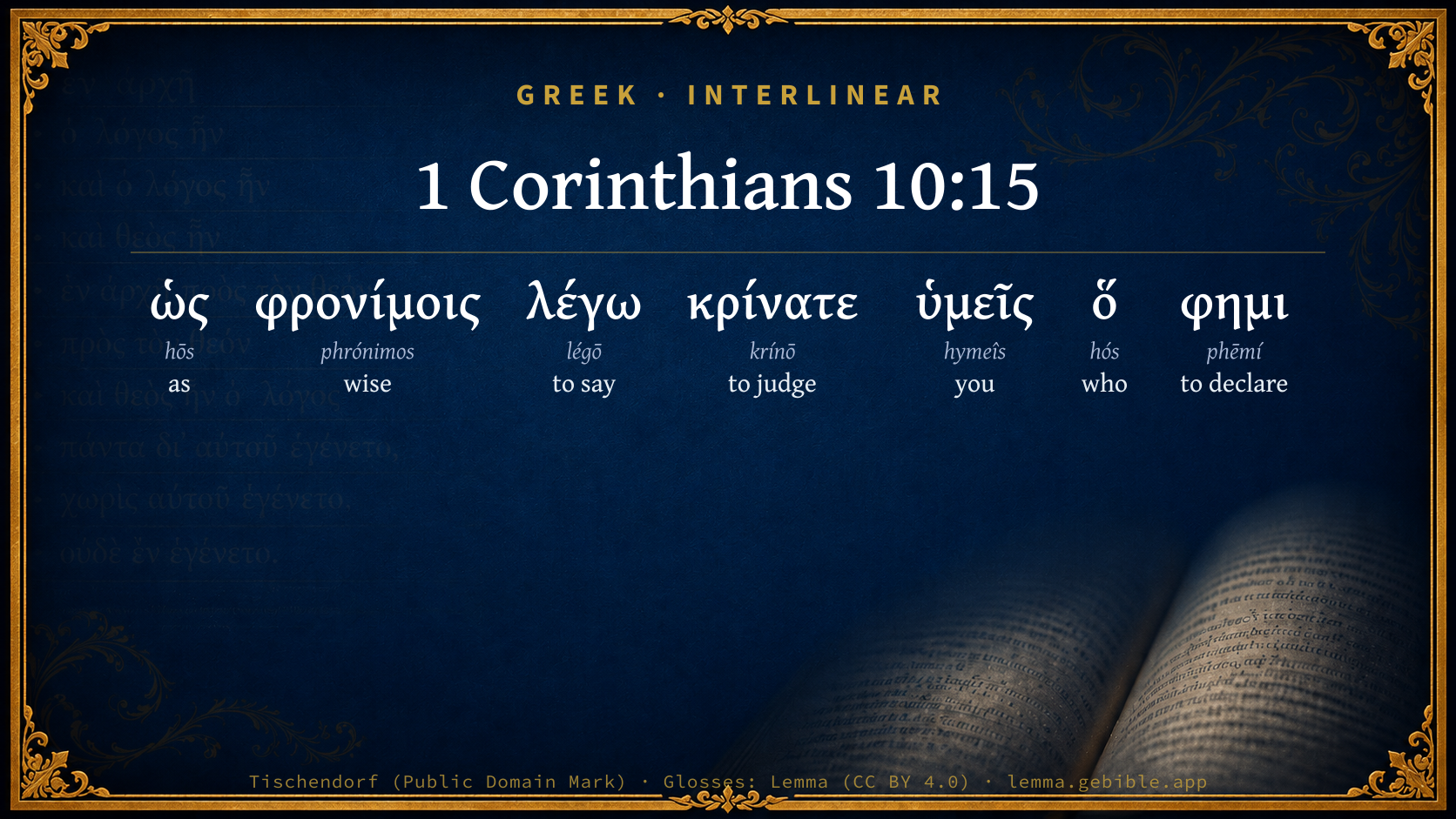
Greek (Tischendorf 8th ed.) 1 Corinthians 10:15 appears in the Greek New Testament. The text above is from the Tischendorf 8th edition. Each word links to its Strong’s number and a concise gloss. Click any word for its full Thayer’s Greek Lexicon entry.
Download image
Cite this verse

1 Corinthians 10:15 (World English Bible). Public Domain. Lemma interlinear Bible study tool, https://lemma.gebible.app/v/1-corinthians/10/15.

Show BibTeX & RIS
BibTeX
RIS
English Translation
I speak as to wise men. Judge what I say.
World English Bible · Public Domain
Download a study sheet

One document with this verse’s original text, its word-by-word gloss line, the meaning frame, cross-references with their text, attributed commentary, and full source and license credits — printable, and it pastes into notes with its structure intact.

This verse Autodidact and up

Study sheet (.html) Plain text (.txt)

A passage Seminary Student

Up to 50 verses in one chapter. A passage sheet keeps up to 6 commentary sources and 12 cross-references per verse, in the order this page ranks them, and says so on the sheet whenever that leaves anything out. Ask for a single verse and you get the Autodidact verse sheet above.

Everything on this page stays free to read, with no account — the sheet is a download of what is already on screen, not access to it.

Want to remove ads? Support Godless Engineer
Compare translations 3

The same verse in 3 English versions, stacked beneath the original-language interlinear above. Click any original word for its lexicon entry.

Each is an independent rendering of the whole verse — the interlinear is not word-aligned to these translations.

Highlighted words mark where these versions differ — a whole-verse word diff, not a word-by-word alignment.

  • World English Bible Public Domain
    I speak as to wise men. Judge what I say.
  • King James Version Public Domain
    I speak as to wise men; judge ye what I say.
  • unfoldingWord Literal Text CC BY-SA 4.0
    I speak as to sensible. Judge for yourselves what I say.

unfoldingWord Literal Text — © unfoldingWord, licensed CC BY-SA 4.0. Word-aligned USFM3 via Door43 (git.door43.org/unfoldingWord/en_ult).

Versions to compare (up to 4)

3 of 4 selected

Show all 19 translations

Every available English version of this verse, each an independent rendering of the whole verse.

  • World English Bible Public Domain
    I speak as to wise men. Judge what I say.
  • Berean Standard Bible Public Domain
    I speak to reasonable people; judge for yourselves what I say.
  • Majority Standard Bible Public Domain
    I speak to reasonable people; judge for yourselves what I say.
  • King James Version Public Domain
    I speak as to wise men; judge ye what I say.
  • American Standard Version (1901) Public Domain
    I speak as to wise men; judge ye what I say.
  • Revised Version (1885) Public Domain
    I speak as to wise men; judge ye what I say.
  • Geneva Bible (1599) Public Domain
    I speake as vnto them which haue vnderstanding: iugde ye what I say.
  • Douay-Rheims (1899) Public Domain
    I speak as to wise men: judge ye yourselves what I say.
  • Young's Literal Translation Public Domain
    as to wise men I speak -- judge ye what I say:
  • Literal Standard Version CC BY-SA 4.0
    as to wise men I speak—judge what I say.
  • Unlocked Literal Bible CC BY-SA 4.0
    I speak to you as people who have understanding, so you may judge what I say.
  • unfoldingWord Literal Text CC BY-SA 4.0
    I speak as to sensible. Judge for yourselves what I say.
  • Darby Bible Public Domain
    I speak as to intelligent [persons]: do *ye* judge what I say.
  • World Messianic Bible Public Domain
    I speak as to wise men. Judge what I say.
  • Webster's Bible Public Domain
    I speak as to wise men; judge ye what I say.
  • Free Bible Version CC BY-SA 4.0
    I'm talking to sensible people, so you decide whether I'm telling the truth.
  • Bible in Basic English Public Domain
    What I am saying is for wise men, do you be the judges of it.
  • Text-Critical English NT CC BY 4.0
    I am speaking as I would to sensible people; judge for yourselves what I am saying.
  • Tyndale New Testament (1534) Public Domain
    I speake as vnto them which have discrecion Iudge ye what I saye.

Literal Standard Version (2020), Covenant Press — licensed CC BY-SA 4.0. Text via the HelloAO Bible API (eBible.org). Unlocked Literal Bible (unfoldingWord) — licensed CC BY-SA 4.0. Text via the HelloAO Bible API (eBible.org). unfoldingWord Literal Text — © unfoldingWord, licensed CC BY-SA 4.0. Word-aligned USFM3 via Door43 (git.door43.org/unfoldingWord/en_ult). Free Bible Version, Dr. Jonathan Gallagher — licensed CC BY-SA 4.0. Text via the HelloAO Bible API (eBible.org).

Word by word

More ways to search: Search by grammar → Find every occurrence → Compare this word →

Practice this passage: Drill this verse → Learn its vocabulary →

About this verse

These counts appear in no published source. They are computed here, from the morphology-tagged text and Lemma’s own curated glosses. What Lemma adds →

7
words
7
distinct lemmas
Pauline Epistles
section

Notable vocabulary

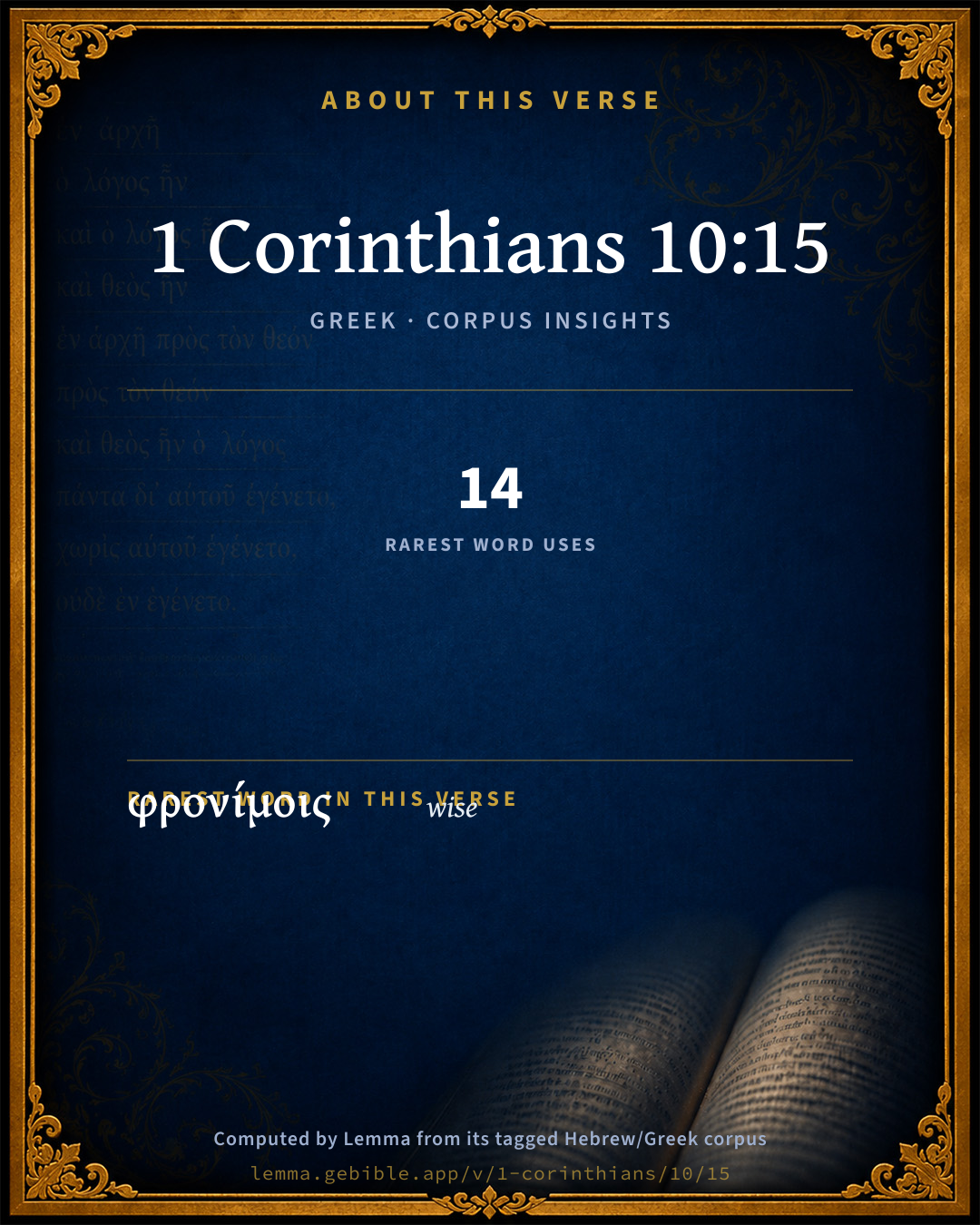
The rarest word here is φρονίμοις wise G5429 — appearing just 14 times in the whole Greek New Testament.

Shared distinctive vocabulary

φρονίμοις wise G5429 occurs in 14 verses of the Greek New Testament. Also found in:

Cross-references

7

Topical passages linked to 1 Corinthians 10:15 in the Treasury of Scripture Knowledge — connected by theme and wording, ordered by reader-vote popularity; previews shown in the World English Bible.

  • 1 Thessalonians 5:21 Test all things, and hold firmly that which is good.
  • 1 Corinthians 8:1 Now concerning things sacrificed to idols: We know that we all have knowledge. Knowledge puffs up, but love builds up.
  • Job 34:2–3 "Hear my words, you wise men; Give ear to me, you who have knowledge.
  • 1 Corinthians 4:10 We are fools for Christ's sake, but you are wise in Christ. We are weak, but you are strong. You have honor, but we have dishonor.
  • 1 Corinthians 6:5 I say this to move you to shame. Isn't there even one wise man among you who would be able to decide between his brothers?
  • 1 Corinthians 11:13 Judge for yourselves. Is it appropriate that a woman pray to God unveiled?
  • 1 Corinthians 14:20 Brothers, don't be children in thoughts, yet in malice be babies, but in thoughts be mature.

Cross-references courtesy of OpenBible.info (CC BY 4.0).

Commentary

Notes on 1 Corinthians 10:15 from classic Christian and Jewish commentators (each source and its license shown beneath its notes). The classic Christian expositions comment on the surrounding passage and are grouped to its opening verse, so a note may address several verses; the Jewish commentaries on the Tanakh (Rashi and others) are per-verse, so they appear only where the commentator wrote on this verse.

Lemma curates 59 commentaries, every one of them public domain or Creative Commons licensed, each selected and text-cleaned for this edition rather than reprinted as found. About our sources →

Matthew Henry's Commentary

In this passage the apostle urges the general caution against idolatry, in the particular case of eating the heathen sacrifices as such, and out of any religious respect to the idol to whom they were sacrificed.

I. He prefaces his argument with an appeal to their own reason and judgment: "I speak to wise men, judge you what I say, Co1 10:15. You are great pretenders to wisdom, to close reasoning and argument; I can leave it with your own reason and conscience whether I do not argue justly." Note, It is no dishonour to an inspired teacher, nor disadvantage to his argument, to appeal for the truth of it to the reason and consciences of his hearers. It comes upon them with the greater force when it comes with this conviction. Paul, an inspired apostle, would yet, in some cases, leave it with the Corinthians to judge whether what he taught was not conformable to their own light and sense.

II. He lays down his argument from the Lord's supper: The cup which we bless, is it not the communion of the blood of Christ? The bread which we break, is it not the communion of the body of Christ? Is not this sacred rite an instrument of communion with God? Do we not therein profess to be in friendship, and to have fellowship, with him? Is it not a token whereby we professedly hold communion with Christ, whose body was broken, and blood shed, to procure remission of our sins, and the favour of God? And can we be in alliance with Christ, or friendship with God, without being devoted to him? In short, the Lord's supper is a feast on the sacrificed body and blood of our Lord, epulum ex oblatis. And to eat of the feast is to partake of the sacrifice, and so to be his guests to whom the sacrifice was offered, and this in token of friendship with him. Thus to partake of the Lord's table is to profess ourselves his guests and covenant people. This is the very purpose and intention of this symbolical eating and drinking; it is holding communion with God, and partaking of those privileges, and professing ourselves under those obligations, which result from the death and sacrifice of Christ; and this in conjunction with all true Christians, with whom we have communion also in this ordinance. Because the bread is one, we, being many, are one body, for we are made partakers of one bread, or loaf (Co1 10:17), which I think is thus more truly rendered: "By partaking of one broken loaf, the emblem of our Saviour's broken body, who is the only true bread that came down from heaven, we coalesce into one body, become members of him and one another." Those who truly partake by faith have this communion with Christ, and one another; and those who eat the outward elements make profession of having this communion, of belonging to God and the blessed fraternity of his people and worshippers. This is the true meaning of this holy rite.

III. He confirms this from the Jewish worship and customs: Behold Israel after the flesh: are not those who eat of the sacrifices partakers of the altar, that is, of the sacrifice offered upon it? Those who were admitted to eat of the offerings were reckoned to partake of the sacrifice itself, as made for them, and to be sanctified thereby; and therefore surely to worship God, and be in alliance or covenant with him, even the God of Israel, to whom the sacrifice was made: this was a symbol or token of holding communion with him.

IV. He applies this to the argument against feasting with idolaters on their sacrifices, and to prove those that do so idolaters. This he does, 1. By following the principle on which they would argue it to be lawful, namely, that an idol was nothing. Many of them were nothing at all, none of them had any divinity in them. What was sacrificed to idols was nothing, no way changed from what it was before, but was every whit as fit for food, considered in itself. They indeed seem to argue that, because an idol was nothing, what was offered was no sacrifice, but common and ordinary food, of which they might therefore eat with as little scruple. Now the apostle allows that the food was not changed as to its nature, was as fit to be eaten as common food, where it was set before any who knew not of its having been offered to an idol. But, 2. He proves that the eating of it as a part of a heathen sacrifice was, (1.) A partaking with them in their idolatry. It was having fellowship with devils, because what the Gentiles sacrificed they sacrificed to devils; and to feast with them upon these sacrifices was to partake in the sacrifice, and therefore to worship the god to whom it was made, and have fellowship or communion with him just as he who eats the Lord's supper is supposed to partake in the Christian sacrifice; or as those who ate the Jewish sacrifices partook of what was offered on their altar. But heathens sacrificed to devils: "Therefore do not feast on their sacrifices. Doing it is a token of your having fellowship with the demons to whom they are offered. I would not have you be in communion with devils." (2.) It was a virtual renouncing of Christianity: You cannot drink the cup of the Lord, and the cup of devils: you cannot be partakers of the Lord's table, and the table of devils, Co1 10:21. To partake of this Christian feast was to have communion with Christ: to partake of the feasts made in honour of the heathen idols, and made of things sacrificed to them, was to have communion with devils. Now this was to compound contraries; it was by no means consistent. Communion with Christ, and communion with devils, could never be had at once. One must be renounced, if the other was maintained. He who held communion with Christ must renounce that with devils; he who held communion with devils must by that very deed renounce communion with Christ. And what a manifest self-contradiction must that man's conduct be that would partake of the Lord's table, and yet partake of the table of demons! God and mammon can never be served together, nor fellowship be at once had with Christ and Satan. Those who communicate with devils must virtually renounce Christ. This may also intimate that such as indulge themselves in gluttony or drunkenness, and by so doing make their own table the table of devils, or keep up fellowship with Satan by a course of known and wilful wickedness, cannot partake truly of the cup and table of the Lord. They may use the sign, but do not the thing signified thereby. For a man can never be at once in communication with Christ and his church and yet in fellowship with Satan. Note, How much reason have we to look to it that every sin and idol be renounced by us, when we eat and drink at the Lord's table.

V. He warns them, upon the whole, against such idolatry, by signifying to them that God is a jealous God (Co1 10:22): Do we provoke the Lord to jealousy? Are we stronger than he? It is very probable that many among the Corinthians made light of being at these heathen feasts, and thought there was no harm in it. But the apostle bids them beware. The reason with which the second commandment is enforced is, I am a jealous God. God cannot endure a rival in matter of worship; nor give his glory, nor suffer it to be given, to another. Those who have fellowship with other gods provoke him to jealousy, Deu 32:16. And, before this be done, persons should consider whether they are stronger than he. It is a dangerous thing to provoke God's anger, unless we could withstand his power. But who can stand before him when he is angry? Nah 1:6. This should be considered by all who continue in the love and liking of sin, and in league with it, while yet they profess to keep up communion with Christ. Is not this the way to provoke his jealousy and indignation? Note, Attention to the greatness of God's power should restrain us from provoking his jealousy, from doing any thing to displease him. Shall we rouse almighty wrath? And how shall we withstand it? Are we a match for God? Can we resist his power, or control it? And, if not, shall we arm it against us, by provoking him to jealousy? No, let us fear his power, and let this restrain us from all provocation.

Matthew Henry's Commentary on the Whole Bible (1708–1710) — public domain (CC PDM 1.0). Text via the HelloAO Bible API.

Bengel's Gnomon

Johann Albrecht Bengel

1Co 10:15. Φρονίμοις, to the wise) to whom a few words are sufficient to enable them to form their judgment concerning this mystery.

Bengel's Gnomon of the New Testament — English translation (T&T Clark, Edinburgh, 1860) — public domain. Text from a community e-Sword module.

Meyer's Critical & Exegetical Commentary

Heinrich August Wilhelm Meyer

1Co_10:15 ff. Paul has just been forbidding his readers to participate in the sacrificial feasts, on the ground of its being idolatry. This he now explains by the analogy of the holy fellowship, into which the Lords Supper (1Co_10:15-17), and participation in the Israelitish sacrifices (1Co_10:18), respectively brought those who partook of them. It does not follow from his second illustration that the idols were gods, but that they were demons, with whom his readers should have no fellowship; one could not partake both of Christs table and of the table of demons (1Co_10:19-22). The former excludes the latter.

1Co_10:15. Ὡς φρονίμοις] i.e. to those of whom I take for granted that they are intelligent; ὡς indicates the mode of contemplation, the aspect under which he regards his readers in saying to them, etc. Comp 1Co_3:1; 2Co_6:13, al[1643] See Bernhardy, p. 333.

λέγω refers to κρίνατε ὑμ. ὅ φ. (comp 1Co_7:12), and ὅ φημι points to what follows in 1Co_10:16-18. As to intelligent men (who can judge aright), I say: judge ye what I affirm. On the difference between λέγω and φημί, comp Rom_3:8; Herod. iii. 35; Xen. Apol. 13, Anab. i. 7. 18, vi. 6. 16, ii. 1. 14; Ellendt, Lex. Soph. II. p. 906.

The emphasis is on ὑμεῖς; your own judgment shall decide.

[1643] l. and others; and other passages; and other editions.

Meyer — Critical and Exegetical Commentary on the New Testament — English translation by Peter Christie, edited by Frederick Crombie (T&T Clark, 1880) — public domain. Text from a community e-Sword module.

Expositor's Greek Testament

ed. W. Robertson Nicoll

1Co 10:15-24 . § 33. THE COMMUNION OF THE LORD, AND OF DEMONS. A further warning the Ap. will give against dalliance with idolatry, based on Christian practice as the former was based on Israelite history. He points to the table of the Lord’s Supper , and asks the Cor [1485] to judge as men of sense whether it is possible to take of Christ’s cup and loaf , and then to sit at a table where in reality one communicates with demons! What can be more revolting than such conduct? what more insulting towards the Lord?

[1485] Corinth, Corinthian or Corinthians.

1Co 10:15 . Ὡς φρονίμοις λέγω · κρίνατε ὑμεῖς ὅ φημι : “As to men of sense I speak; be yourselves the judges of what I affirm.” With this prefatory appeal to the intelligence of the readers cf. the introductory phrases of Rom 6:19 , Gal 3:15 ; the ground of admonition in this § lies entirely within the judgment of the Cor [1486] , as that of the last § did not (1Co 10:1 ). The Cor [1487] are φρόνιμοι , intellectually clever and shrewd, not σοφοί (as some of them thought themselves to be, 1Co 3:18 ); this compliment is consistent with the censure of 1Co 3:1 ff.; see parls., also Trench Syn ., § lxxv. “The new conception of the πνευματικὸς caused the word φρόνιμος to sink to a much lower level in the N.T. than it occupied in Plato or Aristotle” (Ed [1488] ). Philo disparages φρόνησις , denning it as μέση πανουργίας κ . μωρίας ( Quod Deus immut ., § 35); he says, σοφία μὲν γὰρ πρὸς θεραπείαν Θεοῦ , φρόνησις δὲ πρὸς ἀνθρώπινον βίον διοίκησιν ( De prœm. et pœn ., § 14). On φημί (again in 19), cf 1Co 7:29 , and note. For like appeals, see Luk 12:57 , Act 4:19 . The questions that follow, the readers will easily answer from their knowledge of religious custom and feeling.

[1486] Corinth, Corinthian or Corinthians.

[1487] Corinth, Corinthian or Corinthians.

[1488] T. C. Edwards’ Commentary on the First Ep. to the Corinthians .

The Expositor's Greek Testament, edited by W. Robertson Nicoll (1897–1910) — public domain. Text from a community e-Sword module.

Hodge's Commentary on Romans, Ephesians & First Corinthians

Charles Hodge

1Co_10:15

I speak as to wise men; judge ye what I say.

Unto wise men; i.e. as to men of sense; men capable of seeing the force of an argument. Pauls appeal is not to authority, whether his own or that of the Scriptures. The whole question was, whether a given service came within the scriptural definition of idolatry. He was willing, as it were, to leave the decision to themselves; and therefore said, judge ye what I say, i.e. sit in judgment on the argument which I present. Should they differ from the apostle, that would not alter the case. The service was idolatrous, whatever they thought of it. But he takes this way of convincing them.

Charles Hodge — Commentary on Romans (1835), First Corinthians (1857), and Ephesians (1856) — public domain. Text from a community e-Sword module.

Geneva Bible (1599)

Geneva Bible translators

Now returning to those idols’ feasts, that he may not seem to dally at all, first he promiseth that he will use no other reasons than such as they knew very well themselves. And he useth an induction borrowed of the agreement that is the things themselves. The holy banquets of the Christians are pledges, first of all of the community that they have with Christ, and next, one with another. The Israelites also do ratify in the sacrifices, their mutual conjunction in one selfsame religion: therefore so do the idolaters also join themselves with their idols or devils rather (for idols are nothing) in those solemn banquets, whereupon it followeth, that that table is a table of devils, and therefore you must eschew it: for you cannot be partakers of the Lord and of idols together, much less may such banquets be accounted for things indifferent. Will ye then strive with God? and if you do, think you that you shall get the upper hand?

Geneva Bible (1599) marginal notes — public domain. Text via Bolls.life.

Jamieson, Fausset & Brown

Robert Jamieson, A. R. Fausset & David Brown

Appeal to their own powers of judgment to weigh the force of the argument that follows: namely, that as the partaking of the Lord's Supper involves a partaking of the Lord Himself, and the partaking of the Jewish sacrificial meats involved a partaking of the altar of God, and, as the heathens sacrifice to devils, to partake of an idol feast is to have fellowship with devils. We cannot divest ourselves of the responsibility of "judging" for ourselves. The weakness of private judgment is not an argument against its use, but its abuse. We should the more take pains in searching the infallible word, with every aid within our reach, and above all with humble prayer for the Spirit's teaching (Act 17:11). If Paul, an inspired apostle, not only permits, but urges, men to judge his sayings by Scripture, much more should the fallible ministers of the present visible Church do so.

To wise men--refers with a mixture of irony to the Corinthian boast of "wisdom" (Co1 4:10; Co2 11:19). Here you have an opportunity of exercising your "wisdom" in judging "what I say."

Jamieson, Fausset & Brown — Commentary Critical and Explanatory on the Whole Bible (1871) — public domain (CC PDM 1.0). Text via the HelloAO Bible API.

Adam Clarke's Commentary

Verse 15. I speak as to wise men] The Corinthians valued themselves not a little on their wisdom and various gifts; the apostle admits this, and draws an argument from it against themselves. As ye are so wise, surely ye can see the propriety of abominating idolatry of every kind: for an idol is nothing in the world, and can do nothing for you and nothing against you.

Adam Clarke's Commentary on the Bible (1810–1826) — public domain. Text from a community e-Sword/MySword module.

John Calvin's Commentaries

15. I speak as to wise men. As he was about to take his argument from the mystery of the Supper, he arouses them by this little preface, that they may consider more attentively the magnitude of the thing. “I do not address mere novices. You understand the efficacy of the sacred Supper in it we are ingrafted into the Lord’s body. How unseemly a thing is it then, that you should enter into fellowship with the wicked, so as to be united in one body. At the same time, he tacitly reproves their want of consideration in this respect, that, while accurately instructed in the school of Christ, they allowed themselves in gross vice, as to which there was no difficulty in forming an opinion.

John Calvin's Commentaries (1540-1563) — public domain. Text from the Calvin Translation Society English edition (1840s-50s) via the Christian Classics Ethereal Library (ccel.org). Calvin's coverage is partial (roughly two-thirds of the Bible); uncommented books and verses are honest gaps, never fabricated. The 19th-century editor's footnotes and remarks are omitted so the notes are faithfully Calvin's own voice.

Ellicott's Commentary for English Readers

(15) I speak as to wise men.—These words are not hypothetical; they imply the point of view from which the Apostle is now regarding his readers—viz., competent to recognise the force of his argument. Having warned them against any participation in idolatry, even such as would be involved in joining in the sacrificial feasts, as dangerous to themselves, he now proceeds to show that such a participation would be derogatory to, and incompatible with, their union with Christ. The identity and intimacy of that union is first established by a reference to the Holy Communion, in partaking of which both the unity of the Church and its union with Christ are vividly expressed.

A Bible Commentary for English Readers, edited by Charles John Ellicott (1878–1897) — public domain. Text from a community e-Sword module.

The Cambridge Bible for Schools and Colleges

gen. ed. J. J. S. Perowne

15–22. The danger of eating Meats sacrificed to Idols shewn from the example of Sacrificial Feasts in general

15. I speak as to wise men; judge ye what I say] Even in the plenitude of his Apostolic authority, he does not forbid the Corinthians the exercise of their reason. They, as well as he, have the unction from above (1Jn_2:20, cf. ch. 1Co_2:12), and can therefore discern the force of what he says. See also ch. 1Co_11:13.

The Cambridge Bible for Schools and Colleges (gen. ed. J. J. S. Perowne; Cambridge University Press, 1878–1918) — public domain. Text from a community e-Sword module.

John Gill's Exposition

I speak as to wise men,.... That is, what he was now going to say concerning the Lord's supper, and the communion which believers have with Christ in it, which they as Christians must have knowledge of; and concerning the participation of the altar the Israelites had, who ate of the sacrifices of it, which many of them, being Jews, as such must know; and therefore being fully persuaded of the propriety and pertinency of the instances he was about to produce, and of the justness of his reasoning upon them, he appeals to the Corinthians, as men of wisdom and understanding in these things, and makes them themselves judges thereof:

judge what I say; consider and weigh the matter well, and you will discern and judge that what I say is proper and pertinent, just and right.

John Gill's Exposition of the Whole Bible (1746–1763) — public domain (CC PDM 1.0). Text via the HelloAO Bible API.

Trapp's Complete Commentary

John Trapp

15 I speak as to wise men; judge ye what I say.

Ver. 15. I speak as to wise men] i.e. Well skilled in the doctrine of the sacraments, from one of which I am about to argue. Piscator, after he had read some of the Fathers, gave over for this reason, because scarce any of them did rightly understand the use and efficacy of baptism.

Judge ye what I say] Jovianus the emperor was wont to wish that he might govern wise men, and that wise men might govern him.

John Trapp, A Commentary or Exposition upon All the Books of the Old and New Testament (1647–1656) — public domain. Text from a community e-Sword module.

Albert Barnes' Notes on the Bible

I speak as to wise men ... - I speak to people qualified to understand the subject; and present reasons which will commend themselves to you. The reasons referred to are those which occupy the remainder of the chapter.

Albert Barnes' Notes on the Bible (1834–1885) — public domain. Text from a community e-Sword/MySword module.

Matthew Poole's English Annotations

As to the present case, you are persons that understand the principles of Christian religion, I will make you judges in this case.

Matthew Poole's English Annotations on the Holy Bible (1683–1685) — public domain. Text from a community e-Sword/MySword module.

Whedon's Commentary on the Bible

Daniel D. Whedon

15. Wise men—In the apostolic Church there was, in spite of every shortcoming, an inspired wisdom, responsive to the inspired teachings of the apostles, and ratifying them as the true doctrine of Christ.

Judge ye— For the statement of the true nature of the holy communion he relies on their full knowledge of its history and character. All this shows that the evangelical history was familiar both to apostle and Church, and is full proof of its truth and reality.

Daniel D. Whedon (gen. ed.), Commentary on the Old and New Testaments (1874–1909) — public domain. Text from a community e-Sword module.

The Pulpit Commentary

Vers. 15-22. The inherent disgracefulness of any tampering with idolatry.

I speak as to wise men; judge ye what I say. An appeal to their own reason to confirm his argument. (comp., 1Co_11:13) perhaps with a touch of irony in the first clause. (1Co_4:10; 2Co_11:19) The word for "I say" is fhmi, I affirm.

The judgment of the wise.

The apostle, being specially and divinely inspired, claimed to have authority in the Church of Christ. Yet it is observable that he did not require an unintelligent and unreasoning assent to his doctrine and counsel. If his words were true and right, he had the reason and the conscience of the rational and the spiritual upon his side. Hence the frankness and fearlessness of his appeal. If Paul took such a position, his language may well be adopted by teachers and preachers of Christianity, who, whatever their abilities, piety, and zeal, do not profess to enjoy the special and supernatural guidance vouchsafed to an apostle.

I THE SPIRIT AND METHOD PROPER TO THE CHRISTIAN PREACHER AND TEACHER.

1. He should not speak as to the ignorance of the ignorant, as if his aim were to take advantage of, to impose upon, persons whose slender knowledge, ability, and opportunities incapacitated and forbade them to receive and appreciate the truth.

2. He should not address himself to the credulity and superstition of men; for there are too many who are content to believe upon the authority of man, when they ought to inquire with regard to what comes to them whether it comes with the authority of truth, of God.

3. He should not appeal to the selfish interests or the selfish fears of men; for these are methods which are certain to produce an immediate and powerful effect, but are unlikely to work real good.

4. But he should speak as unto wise men, inviting their attention and inquiries. Christ and his apostles proceeded upon this method; they appealed to the thoughtfulness, the conscience, the right feelings of those whom they addressed. Compare the language of Scripture with that of arrogant priests, of domineering pastors, of superficial revivalists; and what is the result of the comparison? It is to produce the impression How just, temperate, thoughtful, reasonable, convincing, persuasive, are the arguments, expositions, and appeals of Scripture!

II THE SPIRIT AND METHOD PROPER TO HEARERS AND READERS OF THE WORD.

1. Let them cultivate wisdom; for it is to wise men that the Word of God is addressed. In the Old Testament, especially in the Proverbs, there are innumerable eulogies of wisdom, and the sons of men are entreated to listen to the voice of wisdom, to cherish, seek, and pray for it. And in the New Testament, our Lord"s discourses evince the same appreciation of this quality of mind. Christ commends the wise man who built his house upon the rock, the wise virgins who took oil in their vessels, the wise and faithful servant who did his Lord"s will, the disciples who are wise as serpents. Not a pretentious and proud spirit, but the wisdom of humility, is the preparation for the kingdom; the wise of this world, the wise in their own conceit, are not in the way for the blessing.

2. Let them judge the religious teaching they receive. This admonition, of St. Paul"s is a copy of that of Christ himself: "Why even of yourselves judge ye not what is right?" It was an admonition which the apostle seems often to have repeated: "Prove all things;" "Judge ye if it is not unseemly," etc.; "We who are spiritual judge all things." There is abundant material for judging, in nature and in revelation; there are canons and counsels of judgment which all may use; and each Christian has a certain ability and opportunity to judge for himself. Happily the most really important matters are the least difficult to judge.

3. Let them judge with a view to practical conduct and under a constant sense of responsibility. We are not called upon to judge other men, but to judge of what relates to our duty as followers of Christ Jesus. The questions for us to decide are questions of pressing moment for ourselves. The responsibility of deciding such questions cannot be shifted from our shoulders to those of others. The messenger and minister of Christ speaks as unto wise men; as wise men let the hearers of the Word hear, judge, and act. T.

The Pulpit Commentary (1880–1919), ed. H.D.M. Spence-Jones & Joseph S. Exell — public domain. Text from a community e-Sword module.

McGarvey & Pendleton's Commentaries

J. W. McGarvey

I speak as to wise men; judge ye what I say . [As idolatry had proved the mother of sins in Israel, so had it also in Corinth. Paul, therefore, in exhorting his readers to flee from it, appeals to their own past experience. They were wise men in this respect, and could, out of an abundant personal knowledge, judge as to the wisdom of his counsel when he thus told them to shun all that pertained to it. Idolatry was so interwoven with lust, drunkenness, reveling, etc., that it practically included them, and it was not to be dallied with. If we go to the verge of what is allowable, we make it easy for Satan to draw us over the line into what is sinful.]

J. W. McGarvey (with Philip Y. Pendleton), Commentaries on the New Testament (The Fourfold Gospel, 1914; Acts; and the epistles) — public domain. Text from a community e-Sword/MySword module.

Cambridge Greek Testament for Schools and Colleges

15–22. THE DANGER OF EATING MEATS SACRIFICED TO IDOLS SHEWN FROM THE EXAMPLE OF SACRIFICIAL FEASTS IN GENERAL

15. ὡς φρονίμοις λέγω. I speak to you as to sensible men, or as Meyer, to you, as sensible men, I say, Judge ye what I affirm. Even in the plenitude of his Apostolic authority, he does not forbid the Corinthians the exercise of their reason. They, as well as he, have the unction from above (1Jn 2:20, cf. ch. 1Co 2:12), and can therefore discern the force of what he says. See also ch. 1Co 11:13.

Cambridge Greek Testament for Schools and Colleges (Cambridge University Press, 1896; 21 vols, various authors incl. Carr, Maclear, Plummer, Farrar, Lumby, Moule, M. R. James, Simcox) — public domain. Text from a community e-Sword module.

Alford’s Greek Testament

Henry Alford

15-22.] By the analogy of the Christian participation in the Lord’s Supper, and the Jewish participation in the feasts after sacrifices, joined to the fact that the heathens sacrifice to devils, he shews that the partaker in the idol feast is a partaker with devils; which none can be, and yet be a Christian.

15.] An appeal to their own sense of what is congruous and possible,—as introducing what is to follow.

ὡς expresses an assumption on the Apostle’s part, that they are φρόνιμοι. De W. compares Plato, Alcib. i. 104, ὡς ἀκουσομένῳ λέγω.

λέγω and φημί both refer to what follows, vv. 16-21.

ὑμεῖς is emphatic—be ye the judges of what I am saying.

Henry Alford, The Greek Testament (1849–1861) — public domain. Text from a community e-Sword module.

International Critical Commentary

15. ὡς φρονίμοις. Cf. 3:1; Eph 5:28. There is no sarcasm, as in 2Co 11:19. They have plenty of intelligence, and can see whether an argument is sound or not, so that pauca verba sufficiunt ad judicandum (Beng.). Yet there is perhaps a gentle rebuke in the compliment. They ought not to need any argument in a matter, de quo judicium ferre non erat difficile (Calv.). Resch, Agrapha, p. 127.

κρίνατε ὑμεῖς ὅ φημι. The ὑμεῖς is emphatic, and the change from λέγω to φημί should be marked in translation, although it may be made merely for variety; ‘Judge for yourselves what 1 declare.’ Vulg. has loquor and dico; in Rom 3:8 aiunt (φασί) and dicere (λέγειν).

International Critical Commentary — older volumes (1896–1929), various authors — public domain. Text from a community e-Sword module.

Vincent's Word Studies in the New Testament

Marvin R. Vincent

Wise [φρονιμοις] . See on wisdom, Luk 1:17; wisely, Luk 16:8. The warning against the sacrificial feasts and the allusion in ver. 3 suggest the eucharistic feast. An act of worship is sacramental, as bringing the worshipper into communion with the unseen. Hence he who practices idolatry is in communion with demons (ver. 20), as he who truly partakes of the Eucharist is in communion with Christ. But the two things are incompatible (ver. 21). In citing the Eucharist he appeals to them as intelligent (wise) men, concerning a familiar practice.

Marvin R. Vincent, Word Studies in the New Testament (1887–1900) — public domain. Text from a community e-Sword/MySword module.

Lesson kit

Teaching starters — assembled from the data on this page, not authored interpretation. Every prompt links to the verse data it draws on. Edit before teaching.

1 Corinthians, in the Pauline Epistles, opens this verse with 7 words (7 distinct Greek lemmas). Its most distinctive word is phrónimos (“wise”). A historical commentator’s framing appears above. Read the whole chapter for the surrounding context.

Discussion questions

  1. How does “wise” (phrónimos) shape what this verse is saying?
  2. Matthew 7:24 shares the word «wise» with this verse. How do the two illuminate each other?
  3. These translations render this verse differently; the difference is in the English rendering, not the original. What questions does that raise?
  4. Reading how Matthew Henry's Commentary and Bengel's Gnomon read this verse, where do the two commentators agree and where do they part?

Things to notice

Reading settings

Reading text

Shown beneath each verse's original-language words.

Old Testament
Old Testament edition

Read the OT as the Masoretic Hebrew (MT) or the Greek Septuagint (LXX).

English shown for the Greek Septuagint (in the Hebrew ↔ Greek comparison).

Comparing translations? Open the Compare panel on any verse page to stack up to four side by side.