

Colossians 2:16
Greek (Tischendorf 8th ed.) Colossians 2:16 appears in the Greek New Testament. The text above is from the Tischendorf 8th edition. Each word links to its Strong’s number and a concise gloss. Click any word for its full Thayer’s Greek Lexicon entry.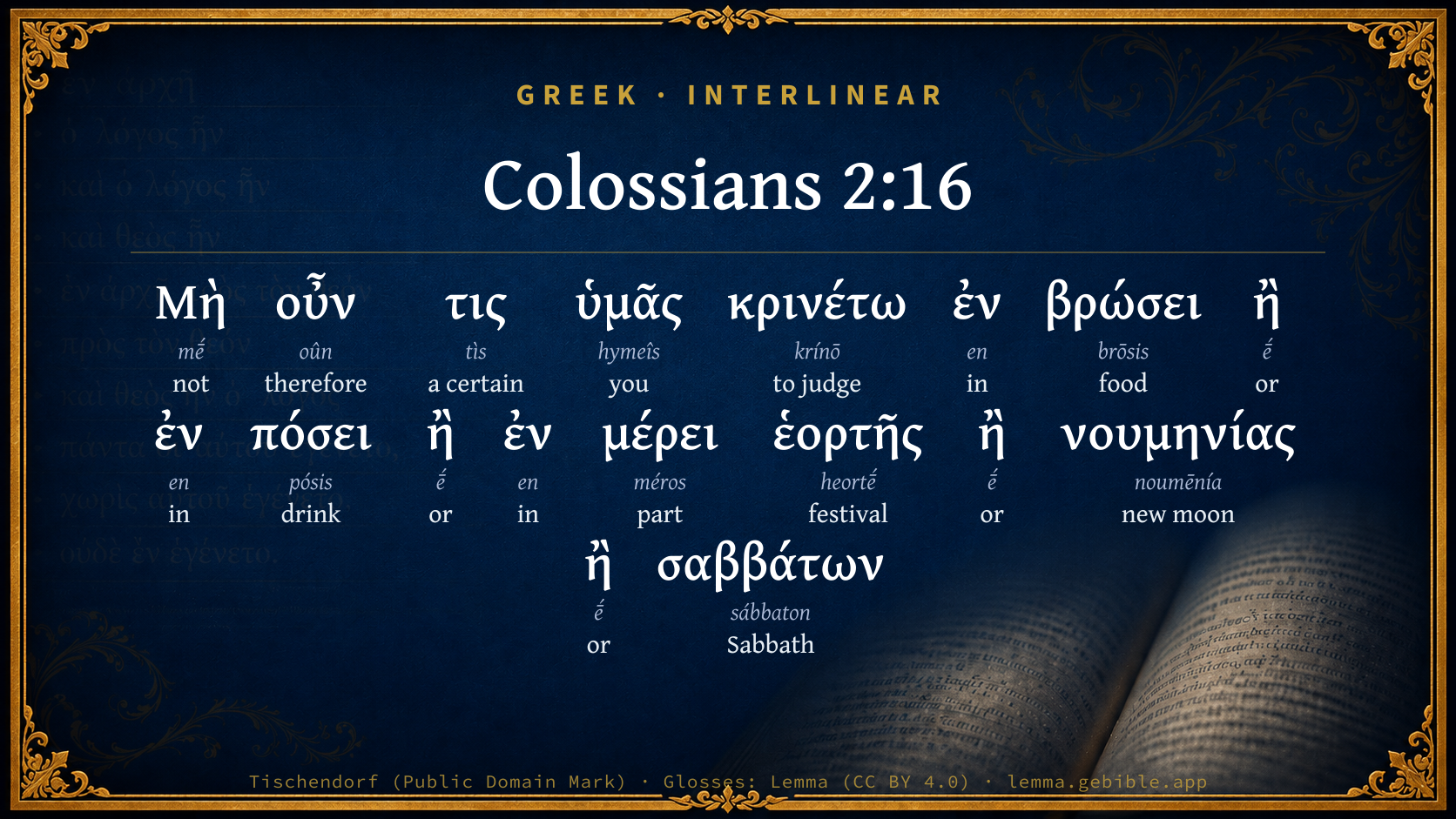
Let no man therefore judge you in eating, or in drinking, or with respect to a feast day or a new moon or a Sabbath day,
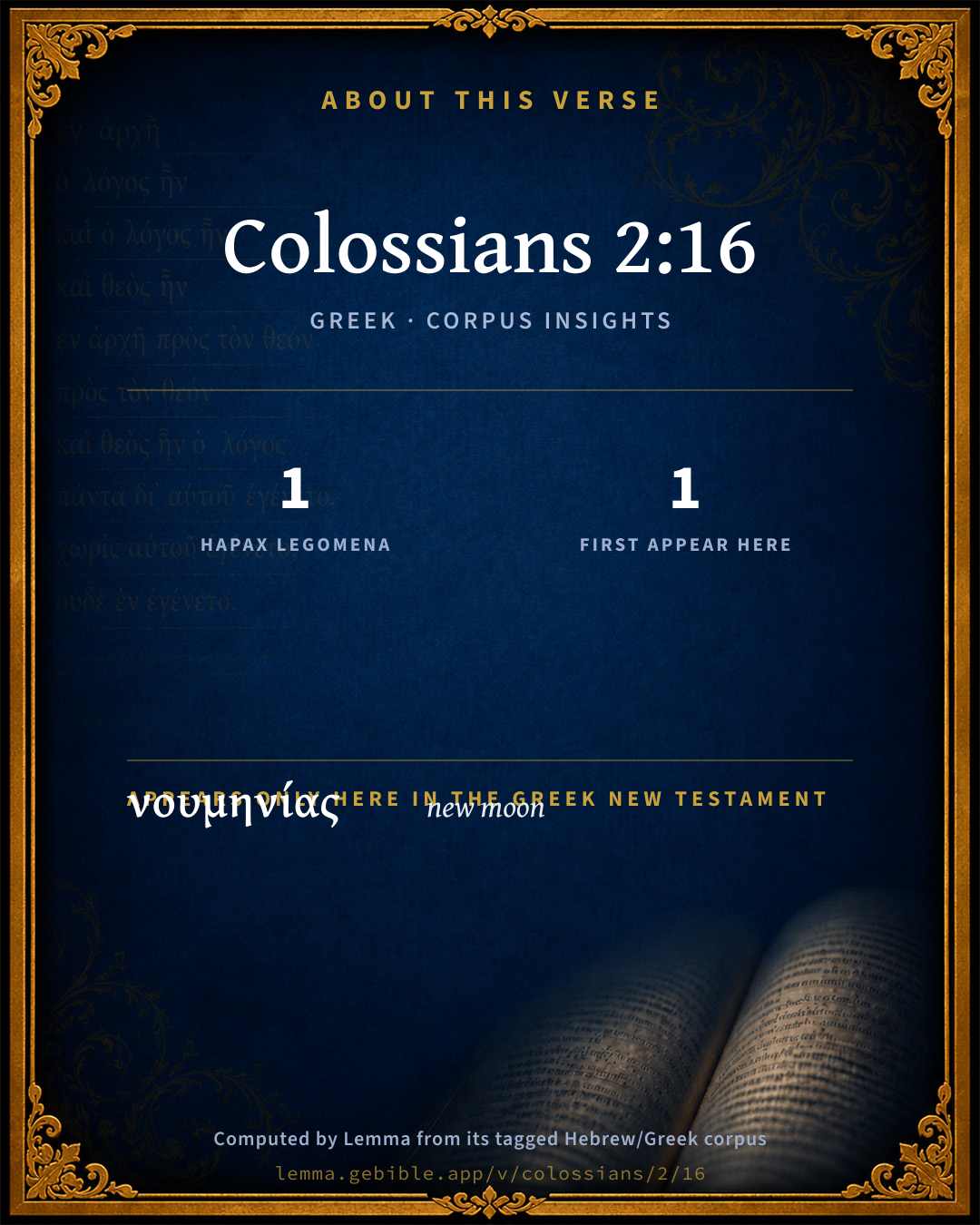
- 1 hapax legomenon — only here in the Greek New Testament
- 1 first appearance in the Greek New Testament
Download a study sheet
One document with this verse’s original text, its word-by-word gloss line, the meaning frame, cross-references with their text, attributed commentary, and full source and license credits — printable, and it pastes into notes with its structure intact.
This verse Autodidact and up
A passage Seminary Student
Up to 50 verses in one chapter. A passage sheet keeps up to 6 commentary sources and 12 cross-references per verse, in the order this page ranks them, and says so on the sheet whenever that leaves anything out. Ask for a single verse and you get the Autodidact verse sheet above.
Everything on this page stays free to read, with no account — the sheet is a download of what is already on screen, not access to it.
Compare translations 3
The same verse in 3 English versions, stacked beneath the original-language interlinear above. Click any original word for its lexicon entry.
Each is an independent rendering of the whole verse — the interlinear is not word-aligned to these translations.
Highlighted words mark where these versions differ — a whole-verse word diff, not a word-by-word alignment.
-
World English Bible Public Domain
Let no man therefore judge you in eating, or in drinking, or with respect to a feast day or a new moon or a Sabbath day,
-
King James Version Public Domain
Let no man therefore judge you in meat, or in drink, or in respect of an holyday, or of the new moon, or of the sabbath days:
-
unfoldingWord Literal Text CC BY-SA 4.0
Therefore, do not let anyone judge you in food or in drink or in regard to a festival or a new moon or Sabbaths,
unfoldingWord Literal Text — © unfoldingWord, licensed CC BY-SA 4.0. Word-aligned USFM3 via Door43 (git.door43.org/unfoldingWord/en_ult).
Show all 19 translations
Every available English version of this verse, each an independent rendering of the whole verse.
-
World English Bible Public Domain
Let no man therefore judge you in eating, or in drinking, or with respect to a feast day or a new moon or a Sabbath day,
-
Berean Standard Bible Public Domain
Therefore let no one judge you by what you eat or drink, or with regard to a feast, a New Moon, or a Sabbath.
-
Majority Standard Bible Public Domain
Therefore let no one judge you by what you eat or drink, or with regard to a feast, a New Moon, or a Sabbath.
-
King James Version Public Domain
Let no man therefore judge you in meat, or in drink, or in respect of an holyday, or of the new moon, or of the sabbath days:
-
American Standard Version (1901) Public Domain
Let no man therefore judge you in meat, or in drink, or in respect of a feast day or a new moon or a sabbath day:
-
Revised Version (1885) Public Domain
Let no man therefore judge you in meat, or in drink, or in respect of a feast day or a new moon or a sabbath day:
-
Geneva Bible (1599) Public Domain
Let no man therefore condemne you in meate and drinke, or in respect of an holy day, or of the newe moone, or of the Sabbath dayes,
-
Douay-Rheims (1899) Public Domain
Let no man therefore judge you in meat or in drink, or in respect of a festival day, or of the new moon, or of the sabbaths,
-
Young's Literal Translation Public Domain
Let no one, then, judge you in eating or in drinking, or in respect of a feast, or of a new moon, or of sabbaths,
-
Literal Standard Version CC BY-SA 4.0
Let no one, then, judge you in eating or in drinking, or in respect of a celebration, or of a new moon, or of Sabbaths,
-
Unlocked Literal Bible CC BY-SA 4.0
So then, let no one judge you in eating or in drinking, or about a feast day or a new moon, or about Sabbath days.
-
unfoldingWord Literal Text CC BY-SA 4.0
Therefore, do not let anyone judge you in food or in drink or in regard to a festival or a new moon or Sabbaths,
-
Darby Bible Public Domain
Let none therefore judge you in meat or in drink, or in matter of feast, or new moon, or sabbaths,
-
World Messianic Bible Public Domain
Let no one therefore judge you in eating or drinking, or with respect to a feast day or a new moon or a Sabbath day,
-
Webster's Bible Public Domain
Let no man therefore judge you in food, or in drink, or in respect of a holy-day, or or the new-moon, or of the sabbaths:
-
Free Bible Version CC BY-SA 4.0
So don't let anyone criticize you for what you eat or what you drink, or regarding which religious festival, new moon ritual, or ceremonial sabbaths you choose to observe.
-
Bible in Basic English Public Domain
For this reason let no man be your judge in any question of food or drink or feast days or new moons or Sabbaths:
-
Text-Critical English NT CC BY 4.0
Therefore let no one judge you in regard to food or drink, or in the matter of a feast, a New Moon celebration, or a Sabbath day.
-
Tyndale New Testament (1534) Public Domain
Let noman therfore trouble youre conscieces aboute meate and drynke or for a pece of an holydaye as the holydaye of the newe mone or of the sabboth dayes
Literal Standard Version (2020), Covenant Press — licensed CC BY-SA 4.0. Text via the HelloAO Bible API (eBible.org). Unlocked Literal Bible (unfoldingWord) — licensed CC BY-SA 4.0. Text via the HelloAO Bible API (eBible.org). unfoldingWord Literal Text — © unfoldingWord, licensed CC BY-SA 4.0. Word-aligned USFM3 via Door43 (git.door43.org/unfoldingWord/en_ult). Free Bible Version, Dr. Jonathan Gallagher — licensed CC BY-SA 4.0. Text via the HelloAO Bible API (eBible.org).
Word by word
More ways to search: Search by grammar → Find every occurrence → Compare this word →
Practice this passage: Drill this verse → Learn its vocabulary →
- Appears 1× in the Greek New Testament
- First appears here
- Part of Speech
- Noun
- Case
- Genitive
- Number
- Singular
- Gender
- Feminine
Full Thayer's Definition
- Μὴ mḗ G3361 “not” Particle, Negative
- οὖν oûn G3767 “therefore” Conjunction
- τις tìs G5100 “a certain” Indefinite pronoun, Nominative, Singular, Masculine
- ὑμᾶς hymeîs G5210 “you” Personal pronoun, 2nd person, Accusative, Plural
- κρινέτω krínō G2919 “to judge” Verb, Present, Active, Imperative, 3rd person, Singular
- ἐν en G1722 “in” Preposition
- βρώσει brōsis G1035 “food” Noun, Dative, Singular, Feminine
- ἢ ḗ G2228 “or” Particle
- ἐν en G1722 “in” Preposition
- πόσει pósis G4213 “drink” Noun, Dative, Singular, Feminine
- ἢ ḗ G2228 “or” Particle
- ἐν en G1722 “in” Preposition
- μέρει méros G3313 “part” Noun, Dative, Singular, Neuter
- ἑορτῆς heortḗ G1859 “festival” Noun, Genitive, Singular, Feminine
- ἢ ḗ G2228 “or” Particle
- νουμηνίας noumēnía G3561 “new moon” Noun, Genitive, Singular, Feminine
- ἢ ḗ G2228 “or” Particle
- σαββάτων sábbaton G4521 “Sabbath” Noun, Genitive, Plural, Neuter
About this verse
These counts appear in no published source. They are computed here, from the morphology-tagged text and Lemma’s own curated glosses. What Lemma adds →
- 18
- words
- 13
- distinct lemmas
- Pauline Epistles
- section
Notable vocabulary
1 hapax legomenon — a word that appears only here in the entire Greek New Testament:
- νουμηνίας new moon G3561
First appearance in Scripture
This word makes its first canonical appearance in the Greek New Testament here:
- νουμηνίας new moon G3561
Shared distinctive vocabulary
πόσει drink G4213 occurs in 3 verses of the Greek New Testament. Also found in:
Cross-references
40Topical passages linked to Colossians 2:16 in the Treasury of Scripture Knowledge — connected by theme and wording, ordered by reader-vote popularity; previews shown in the World English Bible.
- Romans 14:5–6 One man esteems one day as more important. Another esteems every day alike. Let each man be fully assured in his own mind.
- Romans 14:10 But you, why do you judge your brother? Or you again, why do you despise your brother? For we will all stand before the judgment seat of Christ.
- Romans 14:13–17 Therefore let's not judge one another any more, but judge this rather, that no man put a stumbling block in his brother's way, or an occasion for falling.
- Galatians 4:10 You observe days, months, seasons, and years.
- Romans 14:2–3 One man has faith to eat all things, but he who is weak eats only vegetables.
- Hebrews 13:9 Don't be carried away by various and strange teachings, for it is good that the heart be established by grace, not by food, through which those who were so occupied were not benefited.
- Ezekiel 45:17 It shall be the prince's part to give the burnt offerings, and the meal-offerings, and the drink-offerings, in the feasts, and on the new moons, and on the Sabbaths, in all the appointed feasts of the house of Israel: he shall prepare the sin-offering, and the meal-offering, and the burnt offering, and the peace-offerings, to make atonement for the house of Israel.
- 1 Chronicles 23:31 and to offer all burnt offerings to Yahweh, on the Sabbaths, on the new moons, and on the set feasts, in number according to the ordinance concerning them, continually before Yahweh;
- Nehemiah 10:33 for the show bread, and for the continual meal-offering, and for the continual burnt-offering, for the Sabbaths, for the new moons, for the set feasts, and for the holy things, and for the sin-offerings to make atonement for Israel, and for all the work of the house of our God.
- Matthew 15:11 That which enters into the mouth doesn't defile the man; but that which proceeds out of the mouth, this defiles the man."
- Mark 2:27–28 He said to them, "The Sabbath was made for man, not man for the Sabbath.
- 1 Timothy 4:3–5 forbidding marriage and commanding to abstain from foods which God created to be received with thanksgiving by those who believe and know the truth.
- Hebrews 9:10 being only (with meats and drinks and various washings) fleshly ordinances, imposed until a time of reformation.
- Galatians 2:12–13 For before some people came from James, he ate with the Gentiles. But when they came, he drew back and separated himself, fearing those who were of the circumcision.
- 1 Corinthians 10:28–31 But if anyone says to you, "This was offered to idols," don't eat it for the sake of the one who told you, and for the sake of conscience. For "the earth is the Lord's, and all its fullness."
- James 4:11 Don't speak against one another, brothers. He who speaks against a brother and judges his brother, speaks against the law and judges the law. But if you judge the law, you are not a doer of the law, but a judge.
- Mark 7:19 because it doesn't go into his heart, but into his stomach, then into the latrine, thus making all foods clean?"
- Acts 11:3–18 saying, "You went in to uncircumcised men, and ate with them!"
- Romans 14:20–21 Don't overthrow God's work for food's sake. All things indeed are clean, however it is evil for that man who creates a stumbling block by eating.
- 1 Corinthians 8:7–13 However, that knowledge isn't in all men. But some, with consciousness of the idol until now, eat as of a thing sacrificed to an idol, and their conscience, being weak, is defiled.
- Numbers 28:1–29 Yahweh spoke to Moses, saying,
- Leviticus 11:2–47 "Speak to the children of Israel, saying, 'These are the living things which you may eat among all the animals that are on the earth.
- Leviticus 16:31 It is a Sabbath of solemn rest to you, and you shall afflict your souls; it is a statute forever.
- Leviticus 17:10–15 "'Any man of the house of Israel, or of the strangers who live as foreigners among them, who eats any kind of blood, I will set my face against that soul who eats blood, and will cut him off from among his people.
- Leviticus 23:1–44 Yahweh spoke to Moses, saying,
- Deuteronomy 16:1–17 Observe the month of Abib, and keep the Passover to Yahweh your God; for in the month of Abib Yahweh your God brought you forth out of Egypt by night.
- 1 Samuel 20:5 David said to Jonathan, Behold, tomorrow is the new moon, and I should not fail to sit with the king at meat: but let me go, that I may hide myself in the field to the third day at evening.
- 1 Samuel 20:18 Then Jonathan said to him, Tomorrow is the new moon: and you will be missed, because your seat will be empty.
- 2 Kings 4:23 He said, Why will you go to him today? it is neither new moon nor Sabbath. She said, It shall be well.
- Nehemiah 8:9 Nehemiah, who was the governor, and Ezra the priest the scribe, and the Levites who taught the people, said to all the people, This day is holy to Yahweh your God; don't mourn, nor weep. For all the people wept, when they heard the words of the law.
- Nehemiah 10:31 and if the peoples of the land bring wares or any grain on the Sabbath day to sell, that we would not buy of them on the Sabbath, or on a holy day; and that we would forego the seventh year, and the exaction of every debt.
- Psalms 42:4 These things I remember, and pour out my soul within me, How I used to go with the crowd, and led them to the house of God, With the voice of joy and praise, a multitude keeping a holy day.
- Psalms 81:3 Blow the trumpet at the New Moon, At the full moon, on our feast day.
- Isaiah 1:13 Bring no more vain offerings. Incense is an abomination to me; New moons, Sabbaths, and convocations: I can't bear with evil assemblies.
- Ezekiel 4:14 Then said I, Ah Lord Yahweh! behold, my soul has not been polluted; for from my youth up even until now have I not eaten of that which dies of itself, or is torn of animals; neither came there abominable flesh into my mouth.
- Ezekiel 46:1–3 Thus says the Lord Yahweh: The gate of the inner court that looks toward the east shall be shut the six working days; but on the Sabbath day it shall be opened, and on the day of the new moon it shall be opened.
- Acts 15:20 but that we write to them that they abstain from the pollution of idols, from sexual immorality, from what is strangled, and from blood.
- Deuteronomy 14:3–21 You shall not eat any abominable thing.
- Numbers 10:10 Also in the day of your gladness, and in your set feasts, and in the beginnings of your months, you shall blow the trumpets over your burnt offerings, and over the sacrifices of your peace-offerings; and they shall be to you for a memorial before your God: I am Yahweh your God.
- Amos 8:5 Saying, 'When will the new moon be gone, that we may sell grain? And the Sabbath, that we may market wheat, Making the ephah small, and the shekel large, And dealing falsely with balances of deceit;
Cross-references courtesy of OpenBible.info (CC BY 4.0).
Lesson kit
Teaching starters — assembled from the data on this page, not authored interpretation. Every prompt links to the verse data it draws on. Edit before teaching.
Colossians, in the Pauline Epistles, opens this verse with 18 words (13 distinct Greek lemmas). Its most distinctive word is noumēnía (“new moon”). A historical commentator’s framing appears above. Read the whole chapter for the surrounding context.
Discussion questions
- How does “new moon” (noumēnía) shape what this verse is saying?
- 1 word here appears nowhere else in the Greek New Testament. Why might the author reach for such rare wording?
- This is the first place “new moon” appears in Scripture (first appears here). What does its debut here establish?
- How does John 6:55, which shares the word «drink», read alongside this verse?
- What does the repetition of “or” (4× in this one verse) do in this verse?
- The translations on this page render this verse differently — a whole-verse word diff, not a word-by-word alignment. What might account for the different wordings?
- Compare how Matthew Henry's Commentary and The Biblical Illustrator read this verse. Where do they agree or differ?
Things to notice
- 1 word in this verse appears nowhere else in the Greek New Testament.
- 1 word makes its first canonical appearance in Scripture here.
- These translations choose different wording for 17 words in this verse.
- “or” occurs 4× in this single verse.
- 13 distinct Greek lemmas span 18 words in this verse.
Commentary
Notes on Colossians 2:16 from classic Christian and Jewish commentators (each source and its license shown beneath its notes). The classic Christian expositions comment on the surrounding passage and are grouped to its opening verse, so a note may address several verses; the Jewish commentaries on the Tanakh (Rashi and others) are per-verse, so they appear only where the commentator wrote on this verse.
Lemma curates 59 commentaries, every one of them public domain or Creative Commons licensed, each selected and text-cleaned for this edition rather than reprinted as found. About our sources →
Matthew Henry's Commentary
Matthew Henry's Commentary on the Whole Bible (1708–1710) — public domain (CC PDM 1.0). Text via the HelloAO Bible API.
The Biblical Illustrator
Joseph S. Exell
The Biblical Illustrator, edited by Joseph S. Exell (c. 1880s–1900s) — public domain. Text from a community e-Sword module.
Joseph Benson's Commentary
Joseph Benson's Commentary on the Old and New Testaments (1811–1818) — public domain. Text from a community e-Sword module.
Whedon's Commentary on the Bible
Daniel D. Whedon
Daniel D. Whedon (gen. ed.), Commentary on the Old and New Testaments (1874–1909) — public domain. Text from a community e-Sword module.
The Preacher's Complete Homiletical Commentary
Joseph S. Exell (gen. ed.)
The Preacher's Complete Homiletical Commentary (gen. ed. Joseph S. Exell; Funk & Wagnalls, c. 1892) — public domain (pre-1929). A full-Bible homiletical/sermon-outline anthology covering 65 of 66 books (2 John is absent from the source module). Text from a community e-Sword module.
Lange's Commentary on the Holy Scriptures
Lange's Commentary on the Holy Scriptures (Critical, Doctrinal, and Homiletical), ed. John Peter Lange, English translation edited by Philip Schaff (1864–1880) — public domain. Text from a community e-Sword module.
The Expositor's Bible
William Robertson Nicoll, ed., The Expositor's Bible (London: Hodder & Stoughton, 1887–1910) — public domain. 65 of 66 books (1 Corinthians is not separately keyed, as that volume carries no machine-parseable verse references); section-level commentary keyed to the opening verse. Introductory and overview sections not keyed to a specific passage are excluded.
Tyndale Open Study Notes
Tyndale Open Resources
Tyndale Open Study Notes — © Tyndale Open Resources, licensed CC BY-SA 4.0. Text via the HelloAO Bible API.
Bengel's Gnomon
Johann Albrecht Bengel
Bengel's Gnomon of the New Testament — English translation (T&T Clark, Edinburgh, 1860) — public domain. Text from a community e-Sword module.
Meyer's Critical & Exegetical Commentary
Heinrich August Wilhelm Meyer
Meyer — Critical and Exegetical Commentary on the New Testament — English translation by Peter Christie, edited by Frederick Crombie (T&T Clark, 1880) — public domain. Text from a community e-Sword module.
Expositor's Greek Testament
ed. W. Robertson Nicoll
The Expositor's Greek Testament, edited by W. Robertson Nicoll (1897–1910) — public domain. Text from a community e-Sword module.
Cambridge Greek Testament for Schools and Colleges
Cambridge Greek Testament for Schools and Colleges (Cambridge University Press, 1896; 21 vols, various authors incl. Carr, Maclear, Plummer, Farrar, Lumby, Moule, M. R. James, Simcox) — public domain. Text from a community e-Sword module.
Geneva Bible (1599)
Geneva Bible translators
Geneva Bible (1599) marginal notes — public domain. Text via Bolls.life.
Jamieson, Fausset & Brown
Robert Jamieson, A. R. Fausset & David Brown
Jamieson, Fausset & Brown — Commentary Critical and Explanatory on the Whole Bible (1871) — public domain (CC PDM 1.0). Text via the HelloAO Bible API.
Adam Clarke's Commentary
Adam Clarke's Commentary on the Bible (1810–1826) — public domain. Text from a community e-Sword/MySword module.
John Calvin's Commentaries
John Calvin's Commentaries (1540-1563) — public domain. Text from the Calvin Translation Society English edition (1840s-50s) via the Christian Classics Ethereal Library (ccel.org). Calvin's coverage is partial (roughly two-thirds of the Bible); uncommented books and verses are honest gaps, never fabricated. The 19th-century editor's footnotes and remarks are omitted so the notes are faithfully Calvin's own voice.
Ellicott's Commentary for English Readers
A Bible Commentary for English Readers, edited by Charles John Ellicott (1878–1897) — public domain. Text from a community e-Sword module.
The Cambridge Bible for Schools and Colleges
gen. ed. J. J. S. Perowne
The Cambridge Bible for Schools and Colleges (gen. ed. J. J. S. Perowne; Cambridge University Press, 1878–1918) — public domain. Text from a community e-Sword module.
John Gill's Exposition
John Gill's Exposition of the Whole Bible (1746–1763) — public domain (CC PDM 1.0). Text via the HelloAO Bible API.
Trapp's Complete Commentary
John Trapp
John Trapp, A Commentary or Exposition upon All the Books of the Old and New Testament (1647–1656) — public domain. Text from a community e-Sword module.
Albert Barnes' Notes on the Bible
Albert Barnes' Notes on the Bible (1834–1885) — public domain. Text from a community e-Sword/MySword module.
Haydock's Catholic Bible Commentary
George Leo Haydock (1774–1849), Haydock's Catholic Family Bible and Commentary, 1859 edition — public domain. Excludes Psalms (Douay-Rheims chapter numbering differs from Protestant) and Deuterocanonical books (Catholic canon only).
Matthew Poole's English Annotations
Matthew Poole's English Annotations on the Holy Bible (1683–1685) — public domain. Text from a community e-Sword/MySword module.
The Pulpit Commentary
The Pulpit Commentary (1880–1919), ed. H.D.M. Spence-Jones & Joseph S. Exell — public domain. Text from a community e-Sword module.
John Wesley's Explanatory Notes
John Wesley, Explanatory Notes Upon the Whole Bible (1754–1765) — public domain. Text via the GEBible commentary corpus.
Kretzmann's Popular Commentary
Paul E. Kretzmann
Paul E. Kretzmann, Popular Commentary of the Bible (1921–1924) — public domain. Text from a community e-Sword module.
Burkitt's Expository Notes on the New Testament
William Burkitt
William Burkitt's Expository Notes on the New Testament (1700–1703) — public domain. Text from a community e-Sword module.
Godbey's Commentary on the New Testament
William B. Godbey
William B. Godbey, Commentary on the New Testament (1896–1900) — public domain. Text from a community e-Sword module.
The People's New Testament
B. W. Johnson
B. W. Johnson's The People's New Testament with Notes (1889–1891) — public domain. Electronic text from the Christian Classics Ethereal Library (CCEL) ThML edition.
unfoldingWord translationNotes
Door43 World Missions Community
unfoldingWord translationNotes — © Distant Shores Media and the Door43 World Missions Community, licensed CC BY-SA 4.0. Source: git.door43.org/Door43/en_tn.
Alford’s Greek Testament
Henry Alford
Henry Alford, The Greek Testament (1849–1861) — public domain. Text from a community e-Sword module.
International Critical Commentary
International Critical Commentary — older volumes (1896–1929), various authors — public domain. Text from a community e-Sword module.
Vincent's Word Studies in the New Testament
Marvin R. Vincent
Marvin R. Vincent, Word Studies in the New Testament (1887–1900) — public domain. Text from a community e-Sword/MySword module.
Lightfoot's Colossians and Philemon
J. B. Lightfoot
J. B. Lightfoot, St Paul's Epistles to the Colossians and Philemon: a revised text with introductions, notes and dissertations (London: Macmillan, 1875) — public domain. Electronic text from Project Gutenberg (ebook #50857). Covers Colossians and Philemon only (the verse-by-verse notes; introductions and dissertations are omitted); Lightfoot's companion Galatians and Philippians volumes are not included, as the available public-domain scans carry garbled Greek that cannot be faithfully reproduced.