Revelation 18:8

Greek (Tischendorf 8th ed.) Revelation 18:8 appears in the Greek New Testament. The text above is from the Tischendorf 8th edition. Each word links to its Strong’s number and a concise gloss. Click any word for its full Thayer’s Greek Lexicon entry.
Download image
Cite this verse

Revelation 18:8 (World English Bible). Public Domain. Lemma interlinear Bible study tool, https://lemma.gebible.app/v/revelation/18/8.

Show BibTeX & RIS
BibTeX
RIS
English Translation
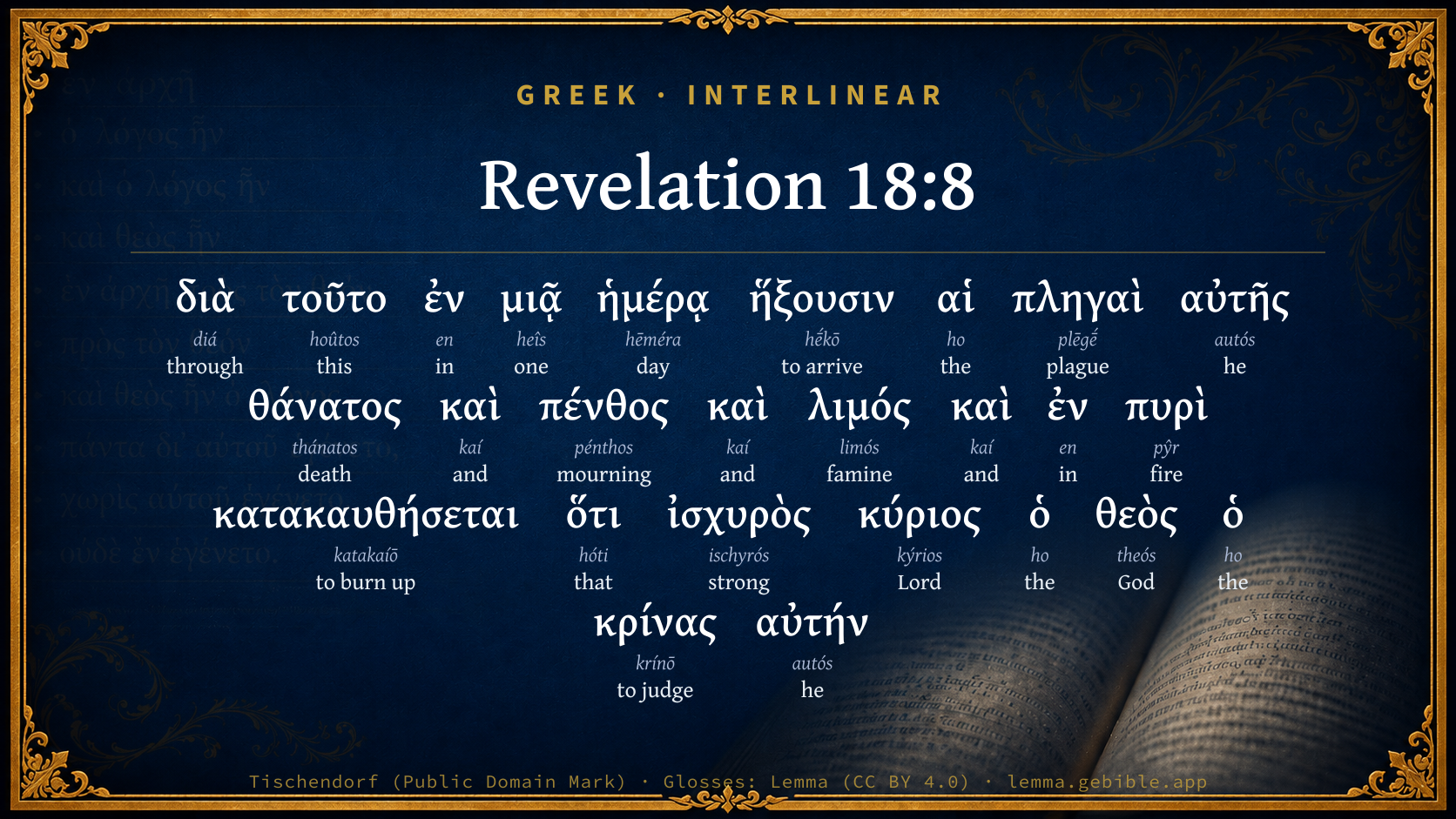
Therefore in one day her plagues will come: death, mourning, and famine; and she will be utterly burned with fire; for the Lord God who has judged her is strong.
World English Bible · Public Domain
Download a study sheet

One document with this verse’s original text, its word-by-word gloss line, the meaning frame, cross-references with their text, attributed commentary, and full source and license credits — printable, and it pastes into notes with its structure intact.

This verse Autodidact and up

Study sheet (.html) Plain text (.txt)

A passage Seminary Student

Up to 50 verses in one chapter. A passage sheet keeps up to 6 commentary sources and 12 cross-references per verse, in the order this page ranks them, and says so on the sheet whenever that leaves anything out. Ask for a single verse and you get the Autodidact verse sheet above.

Everything on this page stays free to read, with no account — the sheet is a download of what is already on screen, not access to it.

Want to remove ads? Support Godless Engineer
Compare translations 3

The same verse in 3 English versions, stacked beneath the original-language interlinear above. Click any original word for its lexicon entry.

Each is an independent rendering of the whole verse — the interlinear is not word-aligned to these translations.

Highlighted words mark where these versions differ — a whole-verse word diff, not a word-by-word alignment.

  • World English Bible Public Domain
    Therefore in one day her plagues will come: death, mourning, and famine; and she will be utterly burned with fire; for the Lord God who has judged her is strong.
  • King James Version Public Domain
    Therefore shall her plagues come in one day, death, and mourning, and famine; and she shall be utterly burned with fire: for strong is the Lord God who judgeth her.
  • unfoldingWord Literal Text CC BY-SA 4.0
    Because of this in one day her plagues will come: death and mourning and famine, and she will be consumed by fire, for the Lord God judging her mighty.”

unfoldingWord Literal Text — © unfoldingWord, licensed CC BY-SA 4.0. Word-aligned USFM3 via Door43 (git.door43.org/unfoldingWord/en_ult).

Versions to compare (up to 4)

3 of 4 selected

Show all 19 translations

Every available English version of this verse, each an independent rendering of the whole verse.

  • World English Bible Public Domain
    Therefore in one day her plagues will come: death, mourning, and famine; and she will be utterly burned with fire; for the Lord God who has judged her is strong.
  • Berean Standard Bible Public Domain
    Therefore her plagues will come in one day—death and grief and famine—and she will be consumed by fire, for mighty is the Lord God who judges her.”
  • Majority Standard Bible Public Domain
    Therefore her plagues will come in one day—death and grief and famine—and she will be consumed by fire, for mighty is the Lord God who judges her.”
  • King James Version Public Domain
    Therefore shall her plagues come in one day, death, and mourning, and famine; and she shall be utterly burned with fire: for strong is the Lord God who judgeth her.
  • American Standard Version (1901) Public Domain
    Therefore in one day shall her plagues come, death, and mourning, and famine; and she shall be utterly burned with fire; for strong is the Lord God who judged her.
  • Revised Version (1885) Public Domain
    Therefore in one day shall her plagues come, death, and mourning, and famine; and she shall be utterly burned with fire; for strong is the Lord God which judged her.
  • Geneva Bible (1599) Public Domain
    Therefore shall her plagues come at one day, death, and sorowe, and famine, and she shalbe burnt with fire: for that God which condemneth her, is a strong Lord.
  • Douay-Rheims (1899) Public Domain
    Therefore shall her plagues come in one day, death, and mourning, and famine, and she shall be burnt with the fire; because God is strong, who shall judge her.
  • Young's Literal Translation Public Domain
    because of this, in one day, shall come her plagues, death, and sorrow, and famine; and in fire she shall be utterly burned, because strong `is' the Lord God who is judging her;
  • Literal Standard Version CC BY-SA 4.0
    because of this, in one day, will come her plagues: death, and sorrow, and famine; and she will be utterly burned in fire, because strong [is] the LORD God who is judging her;
  • Unlocked Literal Bible CC BY-SA 4.0
    Therefore in one day her plagues will come: death, mourning, and famine. She will be consumed by fire, for the Lord God is mighty, and he is her judge.”
  • unfoldingWord Literal Text CC BY-SA 4.0
    Because of this in one day her plagues will come: death and mourning and famine, and she will be consumed by fire, for the Lord God judging her mighty.”
  • Darby Bible Public Domain
    for this reason in one day shall her plagues come, death and grief and famine, and she shall be burnt with fire; for strong [is the] Lord God who has judged her.
  • World Messianic Bible Public Domain
    Therefore in one day her plagues will come: death, mourning, and famine; and she will be utterly burned with fire, for the Lord God who has judged her is strong.
  • Webster's Bible Public Domain
    Therefore shall her plagues come in one day, death, and mourning, and famine; and she shall be utterly burned with fire: for strong is the Lord God who judgeth her.
  • Free Bible Version CC BY-SA 4.0
    Because of this her plagues will come upon her in just one day: death, mourning, and famine. She will be completely destroyed by fire, for the Lord God who condemns her has great power.
  • Bible in Basic English Public Domain
    For this reason in one day will her troubles come, death and sorrow and need of food; and she will be completely burned with fire; for strong is the Lord God who is her judge.
  • Text-Critical English NT CC BY 4.0
    Therefore her plagues will come in a single day— death, mourning, and famine. She will be burned up with fire, for mighty is the Lord God who has judged her.”
  • Tyndale New Testament (1534) Public Domain
    Therfore shall her plages come at one daye deeth and sorowe and honger and she shallbe brent with fyre: for stronge ys the lorde god which iudgeth her.

Literal Standard Version (2020), Covenant Press — licensed CC BY-SA 4.0. Text via the HelloAO Bible API (eBible.org). Unlocked Literal Bible (unfoldingWord) — licensed CC BY-SA 4.0. Text via the HelloAO Bible API (eBible.org). unfoldingWord Literal Text — © unfoldingWord, licensed CC BY-SA 4.0. Word-aligned USFM3 via Door43 (git.door43.org/unfoldingWord/en_ult). Free Bible Version, Dr. Jonathan Gallagher — licensed CC BY-SA 4.0. Text via the HelloAO Bible API (eBible.org).

Word by word

More ways to search: Search by grammar → Find every occurrence → Compare this word →

Practice this passage: Drill this verse → Learn its vocabulary →

πένθος
pénthos
G3997
“mourning”
Noun, Nominative, Singular, Neuter
Part of Speech
Noun
Case
Nominative
Number
Singular
Gender
Neuter
Full Thayer's Definition

Origin: strengthened from the alternate of G3958

TDNT: 06:40,8

1. mourning
  1. διὰ diá G1223 “through” Preposition
  2. τοῦτο hoûtos G3778 “this” Demonstrative pronoun, Accusative, Singular, Neuter
  3. ἐν en G1722 “in” Preposition
  4. μιᾷ heîs G1520 “one” Adjective, Dative, Singular, Feminine
  5. ἡμέρᾳ hēméra G2250 “day” Noun, Dative, Singular, Feminine
  6. ἥξουσιν hḗkō G2240 “to arrive” Verb, Future, Active, Indicative, 3rd person, Plural
  7. αἱ ho G3588 “the” Article, Nominative, Plural, Feminine
  8. πληγαὶ plēgḗ G4127 “plague” Noun, Nominative, Plural, Feminine
  9. αὐτῆς autós G846 “he” Personal pronoun, Genitive, Singular, Feminine
  10. θάνατος thánatos G2288 “death” Noun, Nominative, Singular, Masculine
  11. καὶ kaí G2532 “and” Conjunction
  12. καὶ kaí G2532 “and” Conjunction
  13. λιμός limós G3042 “famine” Noun, Nominative, Singular, Masculine
  14. καὶ kaí G2532 “and” Conjunction
  15. ἐν en G1722 “in” Preposition
  16. πυρὶ pŷr G4442 “fire” Noun, Dative, Singular, Neuter
  17. κατακαυθήσεται katakaíō G2618 “to burn up” Verb, Future, Passive, Indicative, 3rd person, Singular
  18. ὅτι hóti G3754 “that” Conjunction
  19. ἰσχυρὸς ischyrós G2478 “strong” Adjective, Nominative, Singular, Masculine
  20. κύριος kýrios G2962 “Lord” Noun, Nominative, Singular, Masculine
  21. ὁ ho G3588 “the” Article, Nominative, Singular, Masculine
  22. θεὸς theós G2316 “God” Noun, Nominative, Singular, Masculine
  23. ὁ ho G3588 “the” Article, Nominative, Singular, Masculine
  24. κρίνας krínō G2919 “to judge” Verb, Aorist, Active, Participle, Nominative, Singular, Masculine
  25. αὐτήν autós G846 “he” Personal pronoun, Accusative, Singular, Feminine

About this verse

These counts appear in no published source. They are computed here, from the morphology-tagged text and Lemma’s own curated glosses. What Lemma adds →

26
words
20
distinct lemmas
Revelation
section

Notable vocabulary

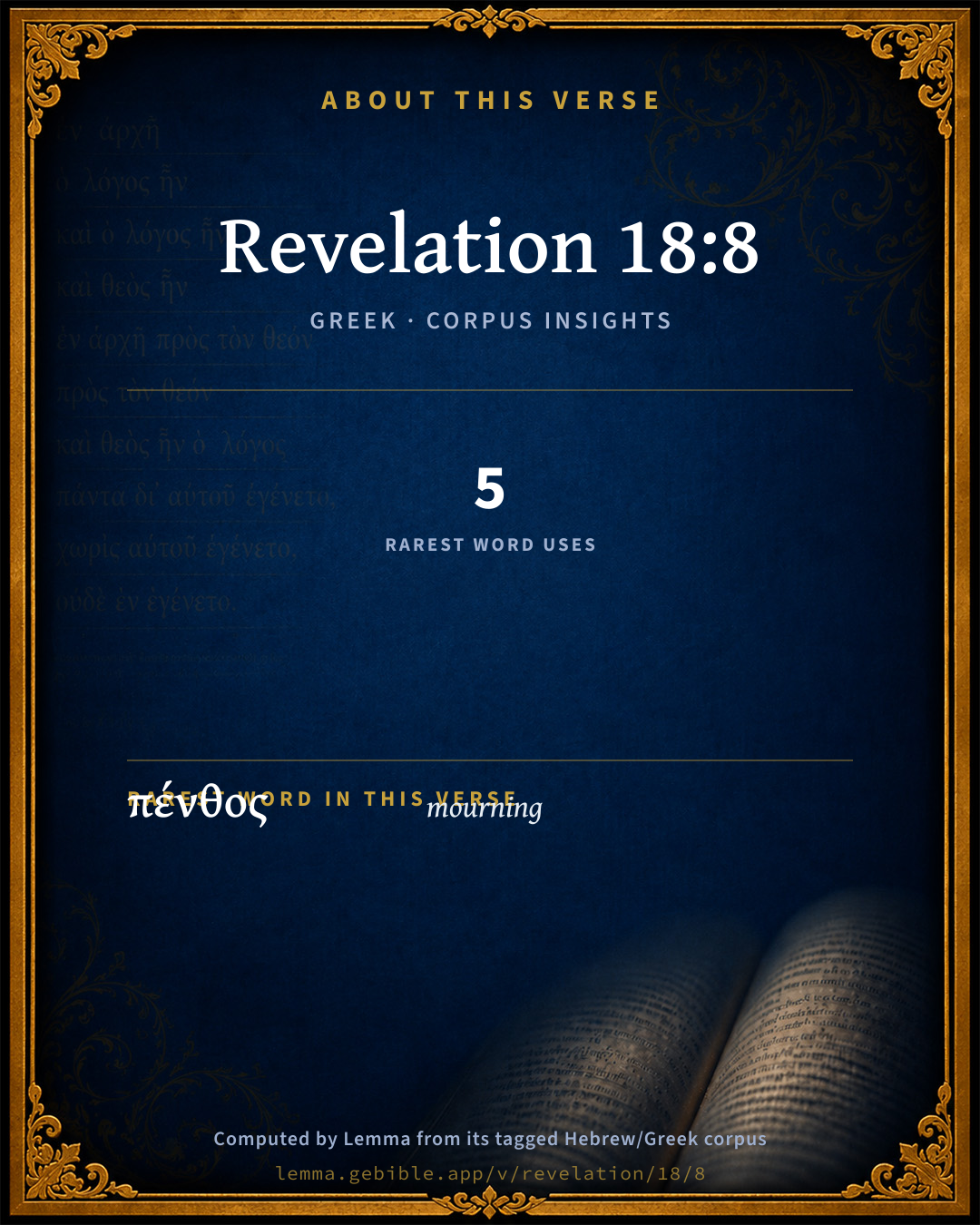
The rarest word here is πένθος mourning G3997 — appearing just 5 times in the whole Greek New Testament.

Shared distinctive vocabulary

πένθος mourning G3997 occurs in 4 verses of the Greek New Testament. Also found in:

Repetition

Words recur within this verse:

Cross-references

16

Topical passages linked to Revelation 18:8 in the Treasury of Scripture Knowledge — connected by theme and wording, ordered by reader-vote popularity; previews shown in the World English Bible.

  • Jeremiah 50:31 Behold, I am against you, you proud one, says the Lord, Yahweh of Hosts; for your day is come, the time that I will visit you.
  • Jeremiah 50:34 Their Redeemer is strong; Yahweh of Hosts is his name: he will thoroughly plead their cause, that he may give rest to the earth, and disquiet the inhabitants of Babylon.
  • Revelation 17:16 The ten horns which you saw, and the beast, these will hate the prostitute, and will make her desolate, and will make her naked, and will eat her flesh, and will burn her utterly with fire.
  • Revelation 18:9–10 The kings of the earth, who committed sexual immorality and lived wantonly with her, will weep and wail over her, when they look at the smoke of her burning,
  • Isaiah 47:9–11 but these two things shall come to you in a moment in one day, the loss of children, and widowhood; in their full measure shall they come on you, in the multitude of your sorceries, and the great abundance of your enchantments.
  • Jeremiah 51:6 Flee out of the midst of Babylon, and save every man his life; don't be cut off in her iniquity: for it is the time of Yahweh's vengeance; he will render to her a recompense.
  • Jeremiah 51:58 Thus says Yahweh of hosts: The broad walls of Babylon shall be utterly overthrown, and her high gates shall be burned with fire; and the peoples shall labor for vanity, and the nations for the fire; and they shall be weary.
  • 1 Corinthians 10:22 Or do we provoke the Lord to jealousy? Are we stronger than he?
  • Revelation 18:19 They cast dust on their heads, and cried, weeping and mourning, saying, 'Woe, woe, the great city, in which all who had their ships in the sea were made rich by reason of her great wealth!' For in one hour is she made desolate.
  • Job 9:19 If it is a matter of strength, behold, he is mighty! If of justice, 'Who,' says he, 'will summon me?'
  • Psalms 62:11 God has spoken once, Twice I have heard this, That power belongs to God.
  • Revelation 11:17 saying: "We give you thanks, Lord God, the Almighty, the one who is and who was; because you have taken your great power, and reigned.
  • Revelation 17:18 The woman whom you saw is the great city, which reigns over the kings of the earth."
  • Revelation 18:17 For in an hour such great riches are made desolate.' Every shipmaster, and everyone who sails anywhere, and mariners, and as many as gain their living by sea, stood far away,
  • Revelation 19:3 A second said, "Hallelujah! Her smoke goes up forever and ever."
  • Isaiah 27:1 In that day Yahweh with his hard and great and strong sword will punish leviathan the swift serpent, and leviathan the crooked serpent; and he will kill the monster that is in the sea.

Cross-references courtesy of OpenBible.info (CC BY 4.0).

Commentary

Notes on Revelation 18:8 from classic Christian and Jewish commentators (each source and its license shown beneath its notes). The classic Christian expositions comment on the surrounding passage and are grouped to its opening verse, so a note may address several verses; the Jewish commentaries on the Tanakh (Rashi and others) are per-verse, so they appear only where the commentator wrote on this verse.

Lemma curates 59 commentaries, every one of them public domain or Creative Commons licensed, each selected and text-cleaned for this edition rather than reprinted as found. About our sources →

Tyndale Open Study Notes

Tyndale Open Resources

18:8 The plagues (18:2-3) are a reminder that destruction was not merely a human action; it is the Lord God who judges her. He is mighty, able to accomplish what he promises.

Tyndale Open Study Notes — © Tyndale Open Resources, licensed CC BY-SA 4.0. Text via the HelloAO Bible API.

Bengel's Gnomon

Johann Albrecht Bengel

Rev 18:8. Ἰσχυρὸς, strong) אל, LXX., ἰσχυρὸς, 2Sa 22:32, and everywhere.

Bengel's Gnomon of the New Testament — English translation (T&T Clark, Edinburgh, 1860) — public domain. Text from a community e-Sword module.

Expositor's Greek Testament

ed. W. Robertson Nicoll

Rev 18:8 . This drastic, ample punishment, though executed by subordinates in Rev 17:16-17 , is here (as in 5, 20) regarded on its divine side. God is strong, as well as guilty, glorious Rome (Rev 18:10 , cf. on Rev 6:15 ); and his strength is manifested in the huge shocks of history, as well as in creation (Rev 4:11 , Rev 5:13 ). Rome’s proud disregard of all that was mutable in human conditions is visited with condign retribution. The prophet sees not a decline and fall but a sudden collapse (Rev 18:10 ; Rev 18:16 ; Rev 18:19 ).

The Expositor's Greek Testament, edited by W. Robertson Nicoll (1897–1910) — public domain. Text from a community e-Sword module.

Geneva Bible (1599)

Geneva Bible translators

Shortly and at one instant.

Geneva Bible (1599) marginal notes — public domain. Text via Bolls.life.

Jamieson, Fausset & Brown

Robert Jamieson, A. R. Fausset & David Brown

death--on herself, though she thought herself secure even from the death of her husband.

mourning--instead of her feasting.

famine--instead of her luxurious delicacies (Rev 18:3, Rev 18:7).

fire--(See on Rev 17:16). Literal fire may burn the literal city of Rome, which is situated in the midst of volcanic agencies. As the ground was cursed for Adam's sin, and the earth under Noah was sunk beneath the flood, and Sodom was burnt with fire, so may Rome be. But as the harlot is mystical (the whole faithless Church), the burning may be mainly mystical, symbolizing utter destruction and removal. BENGEL is probably right in thinking Rome will once more rise to power. The carnal, faithless, and worldly elements in all churches, Roman, Greek, and Protestant, tend towards one common center, and prepare the way for the last form of the beast, namely, Antichrist. The Pharisees were in the main sound in creed, yet judgment fell on them as on the unsound Sadducees and half-heathenish Samaritans. So faithless and adulterous, carnal, worldly Protestant churches, will not escape for their soundness of creed.

the Lord--so B, C, Syriac, and ANDREAS. But A and Vulgate omit. "Strong" is the meaning of God's Hebrew name, "EL."

judgeth--But A, B, and C read the past tense (Greek, "krinas"), "who hath judged her": the prophetical past for the future: the charge in Rev 18:4 to God's people to come out of her implies that the judgment was not yet actually executed.

Jamieson, Fausset & Brown — Commentary Critical and Explanatory on the Whole Bible (1871) — public domain (CC PDM 1.0). Text via the HelloAO Bible API.

Adam Clarke's Commentary

Verse 8. Therefore shall her plagues come] Death, by the sword of her adversaries; mourning on account of the slaughter; and famine, the fruits of the field being destroyed by the hostile bands.

Utterly burned with fire] Of what city is this spoken? Rome pagan has never been thus treated; Alaric and Totilas burnt only some parts with fire. Rome papal has not been thus treated; but this is true of Jerusalem, and yet Jerusalem is not generally thought to be intended.

Adam Clarke's Commentary on the Bible (1810–1826) — public domain. Text from a community e-Sword/MySword module.

Ellicott's Commentary for English Readers

(8) Therefore shall her plagues come . . .—Read, For this cause in one day shall come her plagues, death and mourning . . . and with fire shall she be burnt, for strong is the Lord God who judged her. God, the mighty God, has passed sentence. She thought herself strong; she forgot the strength of the Almighty. Her plagues are four-fold, as though from every quarter her trouble came: “death for her scorn of the prospect of widowhood; mourning, for her inordinate revelling; famine, for her abundance;” and fire, the punishment of her fornication (Lev_20:14; Lev_21:9). (Comp. the series of contrasts in Isa_3:24-26.)

THE LAMENT OF THE KINGS (Rev_18:9-10).—(Their words of lament are given in Rev_18:10.)

A Bible Commentary for English Readers, edited by Charles John Ellicott (1878–1897) — public domain. Text from a community e-Sword module.

The Cambridge Bible for Schools and Colleges

gen. ed. J. J. S. Perowne

8. she shall be utterly burnt with fire] So Rev_17:16. While literally true of the city, the doom may refer to that pronounced by the Law on certain cases of foul fornication, Lev_21:9, &c.

for strong is the Lord God] Jer_50:34.

that Judgeth] Rather, that hath judged.

The Cambridge Bible for Schools and Colleges (gen. ed. J. J. S. Perowne; Cambridge University Press, 1878–1918) — public domain. Text from a community e-Sword module.

John Gill's Exposition

Therefore shall her plagues come in one day,.... The seven last plagues, which will be in a very little time executed upon her, very speedily and very quickly, one after another, if not all together; and particularly the fifth vial may be respected, as well as the plagues that follow; see Isa 47:9

death; not the second death, which will not be till after the decisive battle at Armageddon, when the beast will be taken, and cast alive into the lake which burns with fire and brimstone, which is the second death; but either the pestilence, which is called so, Rev 6:8 or rather death by the sword, war, which will be brought upon her, and in which she and her children will be slain with the sword:

mourning; for the loss of her children, the destruction of the city of Rome itself, the seat of the beast, and for the darkness of his kingdom, the inhabitants of which shall be in such pain, as to gnaw their tongues for it:

famine; which generally attends war, at least sieges; and it looks as if Rome would be besieged awhile before it is destroyed, which will produce a grievous famine in it; this is opposed to her living deliciously, as well as the two former are to her notion of sitting a queen for ever, and knowing no sorrow:

and she shall be utterly burnt with fire; the burning of Rome has been attempted several times, by different persons, and has been burnt in part, but not wholly; see Gill on Rev 17:16 but now it will be entirely destroyed by fire; either by fire from heaven, as Sodom and Gomorrah were; or by fire breaking out of the earth, it being very manifest that there are volcanos, burning mountains, and subterraneous fires in those parts, which seem to be so many preparations in nature for the burning of that city; or rather by the ten kings, who will set fire to it; and it may be by all these ways. The Jews have a notion, that, at the coming of the Messiah, Rome will be burnt (a), as Sodom has been; you will find, say they (b), that of Sodom and of that kingdom (Rome, of which they are speaking, and which they afterwards call the fourth kingdom), it is decreed concerning them both, that they "should be burnt with fire"; of Sodom, Gen 19:24 and of the fourth kingdom (Rome), Isa 34:9.

for strong is the Lord God that judgeth her; the Alexandrian copy reads, "that has judged": and so the Syriac and Arabic versions; that is, has purposed and determined her destruction, and therefore it is unavoidable; he that has resolved upon it, and foretold it, and has condemned her to it, is the Lord God Almighty; and he is able to execute the sentence determined and pronounced, and it is impossible she should escape: it may be understood of Christ the mighty God, the Judge of quick and dead; see Jer 50:34.

(a) Zohar in Gen. fol. 74. 3. & in Numb. fol. 86. 1. (b) Yalkut Simeoni, par. 2. fol. 48. 2.

John Gill's Exposition of the Whole Bible (1746–1763) — public domain (CC PDM 1.0). Text via the HelloAO Bible API.

Trapp's Complete Commentary

John Trapp

8 Therefore shall her plagues come in one day, death, and mourning, and famine; and she shall be utterly burned with fire: for strong is the Lord God who judgeth her.

Ver. 8. Therefore shall her plagues] Security ushereth in destruction, God shall shoot at such with an arrow suddenly, and fetch them off, as he did the rich fool, Luk 12:16-21

Come in one day] To confute their fond conceit of an eternal empire. See the like, Isa 48:9. When the war began in Germany, A. D. 1619, it was reported, that a great brass image of the Apostle Peter (that had Tu es Petrus, &c., Thou art Peter, and upon this rock will I build my Church, engraven about it) standing in St Peter’s church at Rome, there was a great and massive stone fell down upon it, and so shattered it to pieces, that not a letter of that sentence was left legible, save these words, Aedificabo Ecclesiam meam, I will build my Church. This was ominous to that tottering title of Rome, and might have taught the popelings, that God is about to build his Church upon the ruins of their worm eaten title. The Lord thereby seemed to say the same unto them, that once he did to Israel by Ezekiel, "An end is come, the end is come, it watcheth for this, behold it is come," Eze 7:6. Sed surdis fabulam. This hath been long and loud rung in their ears, but they will not be warned.

Death] That is, war, that deadly evil, called an evil, κατ αντονομασιαν, Isa 45:7; "I make peace, and create evil," that is, war: a woeful evil that hews its way through a wood of men, in a minute of time, from the mouth of a murderingpiece, and causeth thousands to exhale their breath without so much as "Lord, have mercy upon us." Hence the poet:

" Omega nostrorum mors est, Mars Alpha malorum."

And mourning] πενθος. For the loss of dead friends.

And famine] The usual concomitant of war, in sieges especially. {See Trapp on "Rev 6:5"}

For strong is the Lord] Full able to effect it, seem it to Babel’s brats never so improbable or impossible.

John Trapp, A Commentary or Exposition upon All the Books of the Old and New Testament (1647–1656) — public domain. Text from a community e-Sword module.

Albert Barnes' Notes on the Bible

Therefore - In consequence of her pride, arrogance, and luxury, and of the calamities that she has brought upon others.

Shall her plagues come in one day - They shall come in a time when she is living in ease and security; and they shall come at the same time - so that all these terrible judgments shall seem to be poured upon her at once.

Death - This expression, and those which follow, are designed to denote the same thing under different images. The general meaning is, that there would be utter and final destruction. It would be as if death should come and cut off the inhabitants.

And mourning - As there would be where many were cut off by death.

And famine - As if famine raged within the walls of a besieged city, or spread over a land,

And she shall be utterly burned with fire - As completely destroyed as if she were entirely burned up. The certain and complete destruction of that formidable anti-Christian power is predicted under a great variety of emphatic images. See Rev 14:10-11; Rev 16:17-21; Rev 17:9, Rev 17:16. Perhaps in this so frequent reference to a final destruction of that formidable anti-Christian power by fire, there may be more intended than merely a figurative representation of its final ruin. There is some degree of probability, at least, that Rome itself will be literally destroyed in this manner, and that it is in this way that God intends to put an end to the papal power, by destroying what has been so long the seat and the center of this authority. The extended prevalence of this belief, and the grounds for it, may be seen from the following remarks:

(1) It was an early opinion among the Jewish rabbies that Rome would be thus destroyed. Vitringa, on the Apocalypse, cites some opinions of this kind; the Jewish expectation being founded, as he says, on the passage in Isa 34:9, as Edom was supposed to mean Rome. “This chapter,” says Kimchi, “points out the future destruction of Rome, here called Bozra, for Bozra was a great city of the Edomites.” This is, indeed, worthless as a proof or an interpretation of Scripture, for it is a wholly unfounded interpretation; it is of value only as showing that somehow the Jews entertained this opinion.

(2) The same expectation was entertained among the early Christians. Thus Mr. Gibbon (vol. i. p. 263, ch. xv.), referring to the expectations of the glorious reign of the Messiah on the earth (compare the notes on Rev 14:8), says, speaking of Rome as the mystic Babylon, and of its anticipated destruction: “A regular series was prepared (in the minds of Christians) of all the moral and physical evils which can afflict a flourishing nation; intestine discord, and the invasion of the fiercest barbarians from the unknown regions of the north; pestilence and famine, comets and eclipses, earthquakes and inundations. All these were only so many preparatory and alarming signs of the great catastrophe of Rome, when the country of the Scipios and Caesars should be consumed by a flame from heaven, and the city of the seven hills, with her palaces, her temples, and her triumphal arches, should be buried in a vast lake of fire and brimstone.” So even Gregory the Great, one of the most illustrious of the Roman pontiffs, himself says, acknowledging his belief in the truth of the tradition: Roma a Gentilibus non exterminabitur; sed tempestatibus, coruscis turbinibus, ac terrae motu, in se marcescet (Dial. Isa 2:15).

(3) Whatever may be thought of these opinions and expectations, there is “some” foundation for the opinion in the nature of the case:

(a) The region is adapted to this. “It is not Aetna, the Lipari volcanic islands, Vesuvius, that alone offer visible indications of the physical adaptedness of Italy for such a catastrophe. The great Apennine mountain-chain is mainly volcanic in its character, and the country of Rome more especially is as strikingly so almost as that of Sodom itself.” Thus the mineralogist Ferber, in his “Tour in Italy,” says: “The road from Rome to Ostia is all volcanic ashes until within two miles of Ostia.” “From Rome to Tivoli I went on fields and hills of volcanic ashes or tufa.” “A volcanic hill in an amphitheatrical form includes a part of the plain over Albano, and a flat country of volcanic ashes and hills to Rome. The ground about Rome is generally of that nature,” pp. 189, 191, 200, 234.

(b) Mr. Gibbon, with his usual accuracy, as if commenting on the Apocalypse, has referred to the physical adaptedness of the soil of Rome for such an overthrow. Speaking of the anticipation of the end of the world among the early Christians, he says: “In the opinion of a general conflagration, the faith of the Christian very happily coincided with the tradition of the East, the philosophy of the Stoics, and the analogy of nature; ‘and even the country, which, from religious motives, had been chosen for the origin and principal scene of the conflagration, was the best adapted for that purpose by natural and physical causes;’ by its deep caverns, beds of sulphur, and numerous volcanoes, of which those of Aetna, of Vesuvius, and of Lipari, exhibit a very imperfect representation,” vol. i. p. 263, ch. xv. As to the general state of Italy, in reference to volcanoes, the reader may consult, with advantage, Lyell’s Geology, book ii. ch. 9–12. See also Murray’s Encyclopaedia of Geography, book ii. ch. 2. Of the country around Rome it is said in that work, among other things: “The country around Rome, and also the hills on which it is built, is composed of tertiary marls, clays, and sandstones, and intermixed with a preponderating quantity of granular and lithoidal volcanic tufas. The many lakes around Rome are formed by craters of ancient volcanoes.” “On the road to Rome is the Lake of Vico, formerly the Lacus Cimini, which has all the appearance of a crater.”

The following extract from a recent traveler will still further confirm this representation: “I behold everywhere - in Rome, near Rome, and through the whole region from Rome to Naples - most astounding proof, not merely of the possibility, but the probability, that the whole region of central Italy will one day be destroyed by such a catastrophe (by earthquakes or volcanoes). The soil of Rome is tufa, with a volcanic subterranean action going on. At Naples the boiling sulphur is to be seen bubbling near the surface of the earth. When I drew a stick along the ground, the sulphurous smoke followed the indentation; and it would never surprise me to hear of the utter destruction of the southern peninsula of Italy. The entire country and district is volcanic. It is saturated with beds of sulphur and the substrata of destruction. It seems as certainly prepared for the flames, as the wood and coal on the hearth are prepared for the taper which shall kindle the fire to consume them. The divine hand alone seems to me to hold the element of fire in check by a miracle as great as what protected the cities of the plain, until the righteous Lot had made his escape to the mountains” (Townsend’s Tour in Italy in 1850).

For strong is the Lord God who judgeth her - That is, God has ample power to bring all these calamities upon her.

Albert Barnes' Notes on the Bible (1834–1885) — public domain. Text from a community e-Sword/MySword module.

Matthew Poole's English Annotations

Therefore shall her plagues come in one day; as was threatened to old Babylon, Isa 47:9.

In one day; that is, in a short time.

Death, and mourning, and famine; and she shall be utterly burned with fire; all manner of judgments, till she be fully consumed.

For strong is the Lord God who judgeth her; for she hath to do with a strong Lord: she thinks she hath secured herself from man, by interesting kings and princes in her quarrel; but it is the Lord that judgeth her, and she will find him strong enough to accomplish his word upon her.

Matthew Poole's English Annotations on the Holy Bible (1683–1685) — public domain. Text from a community e-Sword/MySword module.

Whedon's Commentary on the Bible

Daniel D. Whedon

8. Plagues—Note on Rev_18:4.

One day—Modification of Isa_47:9. Referring here, not so much to their suddenness as to their simultaneity in the end. Most commentators understand that her plagues came gradually, and even in chronological order.

Death… mourning… famine—The united consequence of her plagues.

Burned with fire—Jer_51:58.

Daniel D. Whedon (gen. ed.), Commentary on the Old and New Testaments (1874–1909) — public domain. Text from a community e-Sword module.

The Pulpit Commentary

Therefore shall her plagues come in one day, death, and mourning, and famine. This is the retribution for her boasting in ver. 7. (cf. Isa_47:9, "These two things shall come to thee in a moment in one day," etc.) Alford says, death, for her scorn of the prospect of widowhood; mourning, for her inordinate revelling; famine, for her abundance" (cf. ver. 3). The description is not to be taken literally, but is typical of a sudden and overwhelming reverse, viz. that which will occur at the last judgment day. (cf. the words of our Lord in Mat_24:37-42) Some writers see here an allusion to the second, third, and fourth seals. (see Re 6) And she shall he utterly burned with fire: for strong is the Lord God who judgeth her. Who judged her; krinav is found in a, A, B, C, P, and others. This is the fulfilment of the predicted punishment of the harlot. (Rev_17:16) The last clause replies, as it were, to the boast in ver. 7, "I sit as a queen," etc.

The Pulpit Commentary (1880–1919), ed. H.D.M. Spence-Jones & Joseph S. Exell — public domain. Text from a community e-Sword module.

John Wesley's Explanatory Notes

Therefore - as both the natural and judicial consequence of this proud security Shall her plagues come - The death of her children, with an incapacity of bearing more. Sorrow - of every kind. And famine - In the room of luxurious plenty: the very things from which she imagined herself to be most safe. For strong is the Lord God who judgeth her - Against whom therefore all her strength, great as it is, will not avail.

John Wesley, Explanatory Notes Upon the Whole Bible (1754–1765) — public domain. Text via the GEBible commentary corpus.

The People's New Testament

B. W. Johnson

8. Therefore shall her plagues come. Notwithstanding her pride and exultation. Burned with fire. See 17:16. When an ancient city was taken and destroyed it was burned with fire.

B. W. Johnson's The People's New Testament with Notes (1889–1891) — public domain. Electronic text from the Christian Classics Ethereal Library (CCEL) ThML edition.

Cambridge Greek Testament for Schools and Colleges

8. θάνατος καὶ πένθος καὶ λιμός. B2 has θανάτου πένθος καὶ λιμοῦ.

8. θάνατος καὶ πένθος καὶ λιμός. Mourning naturally comes after death, why famine after mourning? Is the order of the plagues first pestilence, with the streets full of mourners, then a siege and famine, then fire more terrible than the sword? There is certainly a succession, for famine is felt by degrees.

ἐν πυρὶ κατακαυθήσεται. So Rev 17:16. While literally true of the city, the doom may refer to that pronounced by the Law on certain cases of foul fornication, Lev 21:9, &c.

ὅτι ἰσχυρός. Jer 50:34.

ὁ κρίνας. The voice is heard before the judgement is executed: the judgement was passed before the voice spoke.

Cambridge Greek Testament for Schools and Colleges (Cambridge University Press, 1896; 21 vols, various authors incl. Carr, Maclear, Plummer, Farrar, Lumby, Moule, M. R. James, Simcox) — public domain. Text from a community e-Sword module.

Vincent's Word Studies in the New Testament

Marvin R. Vincent

Therefore shall her plagues come, etc. See Isa 47:8, 9.

Who judgeth [ο κρινων] . Read krinav judged.

Marvin R. Vincent, Word Studies in the New Testament (1887–1900) — public domain. Text from a community e-Sword/MySword module.

Lesson kit

Teaching starters — assembled from the data on this page, not authored interpretation. Every prompt links to the verse data it draws on. Edit before teaching.

Revelation, in the Revelation, opens this verse with 26 words (20 distinct Greek lemmas). Its most distinctive word is pénthos (“mourning”). A historical commentator’s framing appears above. Read the whole chapter for the surrounding context.

Discussion questions

  1. What does “mourning” (pénthos) contribute to the verse as a whole?
  2. James 4:9 shares the word «mourning» with this verse. How do the two illuminate each other?
  3. “the” occurs 3× in this one verse. What is the effect of the repetition?
  4. The translations on this page render this verse differently — a whole-verse word diff, not a word-by-word alignment. What might account for the different wordings?
  5. Reading how Tyndale Open Study Notes and Bengel's Gnomon read this verse, where do the two commentators agree and where do they part?

Things to notice

Reading settings

Reading text

Shown beneath each verse's original-language words.

Old Testament
Old Testament edition

Read the OT as the Masoretic Hebrew (MT) or the Greek Septuagint (LXX).

English shown for the Greek Septuagint (in the Hebrew ↔ Greek comparison).

Comparing translations? Open the Compare panel on any verse page to stack up to four side by side.