

1 Peter 2:23
Greek (Tischendorf 8th ed.) 1 Peter 2:23 appears in the Greek New Testament. The text above is from the Tischendorf 8th edition. Each word links to its Strong’s number and a concise gloss. Click any word for its full Thayer’s Greek Lexicon entry.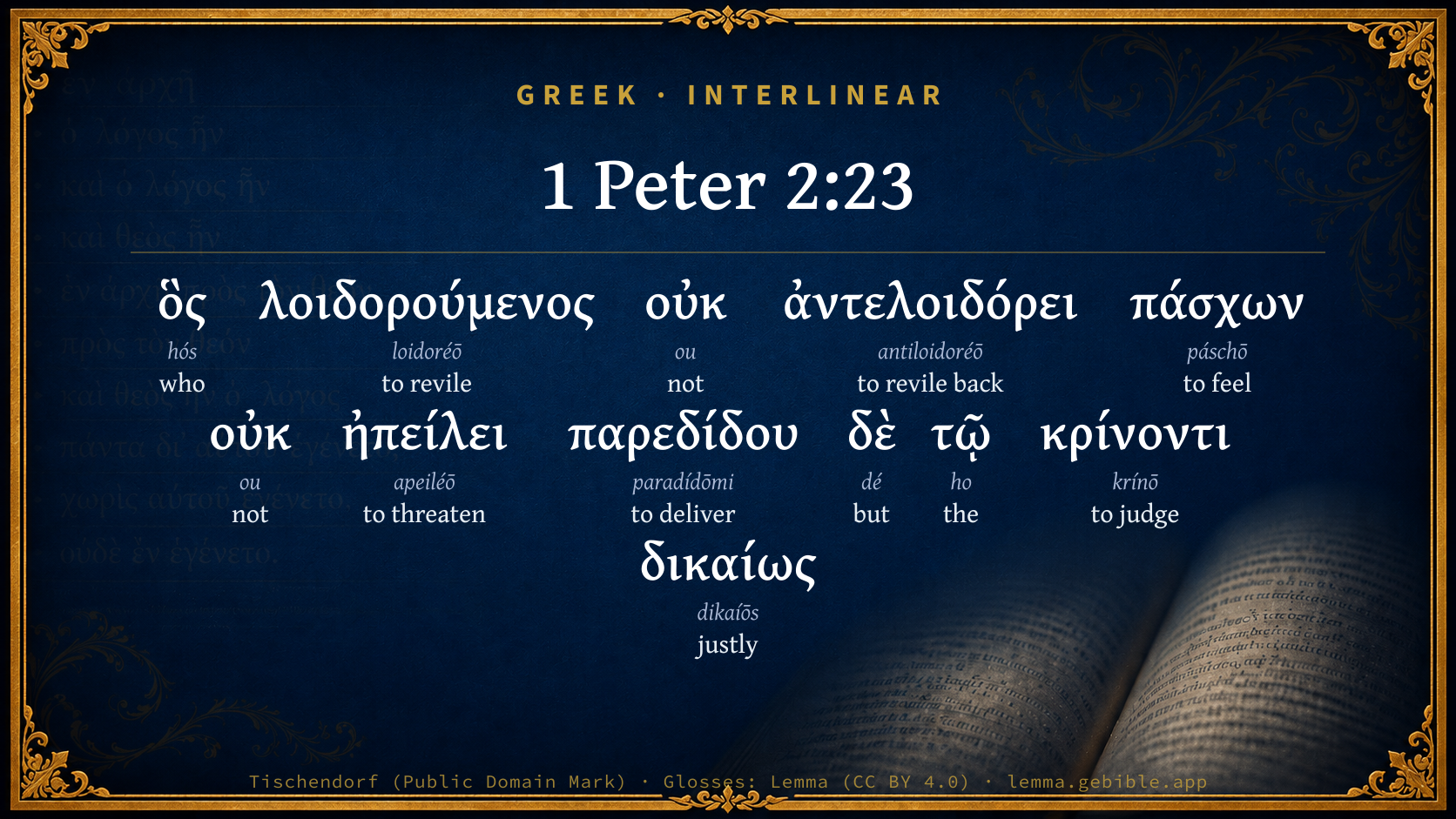
Who, when he was cursed, didn't curse back. When he suffered, didn't threaten, but committed himself to him who judges righteously;
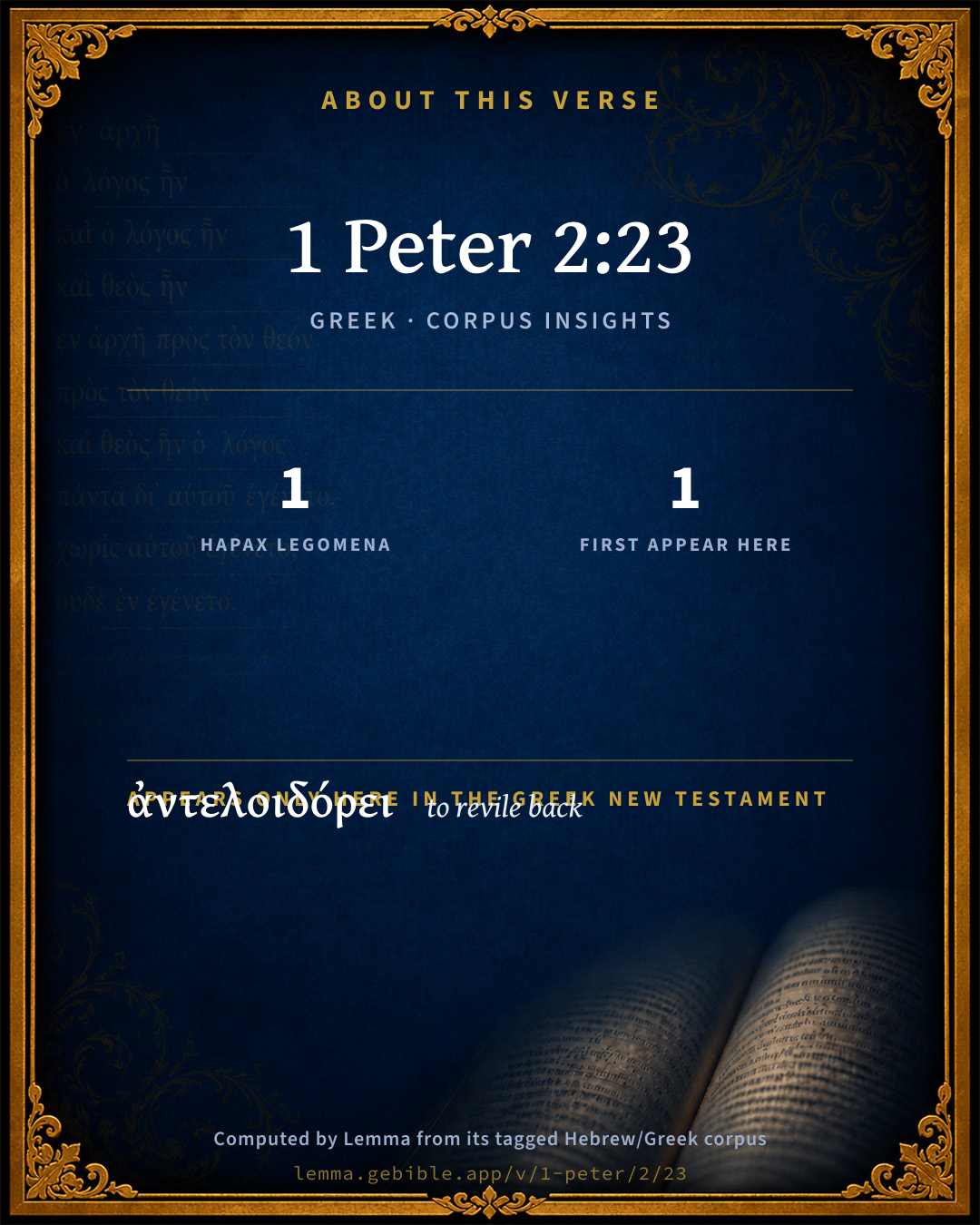
- 1 hapax legomenon — only here in the Greek New Testament
- 1 first appearance in the Greek New Testament
Download a study sheet
One document with this verse’s original text, its word-by-word gloss line, the meaning frame, cross-references with their text, attributed commentary, and full source and license credits — printable, and it pastes into notes with its structure intact.
This verse Autodidact and up
A passage Seminary Student
Up to 50 verses in one chapter. A passage sheet keeps up to 6 commentary sources and 12 cross-references per verse, in the order this page ranks them, and says so on the sheet whenever that leaves anything out. Ask for a single verse and you get the Autodidact verse sheet above.
Everything on this page stays free to read, with no account — the sheet is a download of what is already on screen, not access to it.
Compare translations 3
The same verse in 3 English versions, stacked beneath the original-language interlinear above. Click any original word for its lexicon entry.
Each is an independent rendering of the whole verse — the interlinear is not word-aligned to these translations.
Highlighted words mark where these versions differ — a whole-verse word diff, not a word-by-word alignment.
-
World English Bible Public Domain
Who, when he was cursed, didn't curse back. When he suffered, didn't threaten, but committed himself to him who judges righteously;
-
King James Version Public Domain
Who, when he was reviled, reviled not again; when he suffered, he threatened not; but committed himself to him that judgeth righteously:
-
unfoldingWord Literal Text CC BY-SA 4.0
who being reviled, did not revile back; suffering, he did not threaten, but he entrusted to the one judging justly;
unfoldingWord Literal Text — © unfoldingWord, licensed CC BY-SA 4.0. Word-aligned USFM3 via Door43 (git.door43.org/unfoldingWord/en_ult).
Show all 19 translations
Every available English version of this verse, each an independent rendering of the whole verse.
-
World English Bible Public Domain
Who, when he was cursed, didn't curse back. When he suffered, didn't threaten, but committed himself to him who judges righteously;
-
Berean Standard Bible Public Domain
When they heaped abuse on Him, He did not retaliate; when He suffered, He made no threats, but entrusted Himself to Him who judges justly.
-
Majority Standard Bible Public Domain
When they heaped abuse on Him, He did not retaliate; when He suffered, He made no threats, but entrusted Himself to Him who judges justly.
-
King James Version Public Domain
Who, when he was reviled, reviled not again; when he suffered, he threatened not; but committed himself to him that judgeth righteously:
-
American Standard Version (1901) Public Domain
who, when he was reviled, reviled not again; when he suffered threatened not; but committed `himself' to him that judgeth righteously:
-
Revised Version (1885) Public Domain
who, when he was reviled, reviled not again; when he suffered, threatened not; but committed himself to him that judgeth righteously:
-
Geneva Bible (1599) Public Domain
Who when hee was reuiled, reuiled not againe: when hee suffered, hee threatned not, but comitted it to him that iudgeth righteously.
-
Douay-Rheims (1899) Public Domain
Who, when he was reviled, did not revile: when he suffered, he threatened not: but delivered himself to him that judged him unjustly.
-
Young's Literal Translation Public Domain
who being reviled -- was not reviling again, suffering -- was not threatening, and was committing himself to Him who is judging righteously,
-
Literal Standard Version CC BY-SA 4.0
who being reviled—was not reviling again, suffering—was not threatening, and was committing Himself to Him who is judging righteously,
-
Unlocked Literal Bible CC BY-SA 4.0
When he was reviled, he did not revile back. When he suffered, he did not threaten back, but he gave himself to the one who judges justly.
-
unfoldingWord Literal Text CC BY-SA 4.0
who being reviled, did not revile back; suffering, he did not threaten, but he entrusted to the one judging justly;
-
Darby Bible Public Domain
who, [when] reviled, reviled not again; [when] suffering, threatened not; but gave [himself] over into the hands of him who judges righteously;
-
World Messianic Bible Public Domain
When he was cursed, he didn’t curse back. When he suffered, he didn’t threaten, but committed himself to him who judges righteously.
-
Webster's Bible Public Domain
Who, when he was reviled, reviled not again; when he suffered, he threatened not; but committed himself to him that judgeth righteously:
-
Free Bible Version CC BY-SA 4.0
and when he was badly treated, he didn't retaliate. When he suffered, he didn't threaten to take revenge. He simply placed himself in the hands of the one who always judges rightly.
-
Bible in Basic English Public Domain
To sharp words he gave no sharp answer; when he was undergoing pain, no angry word came from his lips; but he put himself into the hands of the judge of righteousness:
-
Text-Critical English NT CC BY 4.0
When he was reviled, he did not revile in return; when he suffered, he did not threaten but entrusted himself to him who judges justly.
-
Tyndale New Testament (1534) Public Domain
which when he was reviled reviled not agayne: when he suffered he threatened not: but committed the cause to him that iudgeth ryghteously
Literal Standard Version (2020), Covenant Press — licensed CC BY-SA 4.0. Text via the HelloAO Bible API (eBible.org). Unlocked Literal Bible (unfoldingWord) — licensed CC BY-SA 4.0. Text via the HelloAO Bible API (eBible.org). unfoldingWord Literal Text — © unfoldingWord, licensed CC BY-SA 4.0. Word-aligned USFM3 via Door43 (git.door43.org/unfoldingWord/en_ult). Free Bible Version, Dr. Jonathan Gallagher — licensed CC BY-SA 4.0. Text via the HelloAO Bible API (eBible.org).
Word by word
More ways to search: Search by grammar → Find every occurrence → Compare this word →
Practice this passage: Drill this verse → Learn its vocabulary →
- Appears 1× in the Greek New Testament
- First appears here
- Part of Speech
- Verb
- Tense
- Imperfect
- Voice
- Active
- Mood
- Indicative
- Person
- 3rd person
- Number
- Singular
Full Thayer's Definition
- ὃς hós G3739 “who” Relative pronoun, Nominative, Singular, Masculine
- λοιδορούμενος loidoréō G3058 “to revile” Verb, Present, Passive, Participle, Nominative, Singular, Masculine
- οὐκ ou G3756 “not” Particle, Negative
- ἀντελοιδόρει antiloidoréō G486 “to revile back” Verb, Imperfect, Active, Indicative, 3rd person, Singular
- πάσχων páschō G3958 “to feel” Verb, Present, Active, Participle, Nominative, Singular, Masculine
- οὐκ ou G3756 “not” Particle, Negative
- ἠπείλει apeiléō G546 “to threaten” Verb, Imperfect, Active, Indicative, 3rd person, Singular
- παρεδίδου paradídōmi G3860 “to deliver” Verb, Imperfect, Active, Indicative, 3rd person, Singular
- δὲ dé G1161 “but” Conjunction
- τῷ ho G3588 “the” Article, Dative, Singular, Masculine
- κρίνοντι krínō G2919 “to judge” Verb, Present, Active, Participle, Dative, Singular, Masculine
- δικαίως dikaíōs G1346 “justly” Adverb
About this verse
These counts appear in no published source. They are computed here, from the morphology-tagged text and Lemma’s own curated glosses. What Lemma adds →
- 12
- words
- 11
- distinct lemmas
- General Epistles
- section
Notable vocabulary
1 hapax legomenon — a word that appears only here in the entire Greek New Testament:
- ἀντελοιδόρει to revile back G486
First appearance in Scripture
This word makes its first canonical appearance in the Greek New Testament here:
- ἀντελοιδόρει to revile back G486
Shared distinctive vocabulary
ἠπείλει to threaten G546 occurs in 2 verses of the Greek New Testament. Also found in:
Repetition
A word recurs within this verse:
- οὐκ not G3756 ×2
Cross-references
31Topical passages linked to 1 Peter 2:23 in the Treasury of Scripture Knowledge — connected by theme and wording, ordered by reader-vote popularity; previews shown in the World English Bible.
- Isaiah 53:7 He was oppressed, yet when he was afflicted he didn't open his mouth; as a lamb that is led to the slaughter, and as a sheep that before its shearers is mute, so he didn't open his mouth.
- 1 Peter 4:19 Therefore let them also who suffer according to the will of God in doing good entrust their souls to him, as to a faithful Creator.
- Hebrews 12:3 For consider him who has endured such contradiction of sinners against himself, that you don't grow weary, fainting in your souls.
- Psalms 37:5 Commit your way to Yahweh. Trust also in him, and he will do this:
- Acts 4:29 Now, Lord, look at their threats, and grant to your servants to speak your word with all boldness,
- Acts 8:32–35 Now the passage of the Scripture which he was reading was this, "He was led as a sheep to the slaughter. As a lamb before his shearer is silent, So he doesn't open his mouth.
- 2 Timothy 1:12 For this cause I suffer also these things. Yet I am not ashamed, for I know him whom I have believed, and I am persuaded that he is able to guard that which I have committed to him against that day.
- 1 Peter 3:9 not rendering evil for evil, or reviling for reviling; but instead blessing; knowing that to this were you called, that you may inherit a blessing.
- Psalms 31:5 Into your hand I commend my spirit. You redeem me, Yahweh, God of truth.
- 2 Timothy 4:8 From now on, there is stored up for me the crown of righteousness, which the Lord, the righteous judge, will give to me on that day; and not to me only, but also to all those who have loved his appearing.
- Psalms 10:14 But you do see trouble and grief; You consider it to take it into your hand. You help the victim and the fatherless.
- Psalms 38:12–14 They also who seek after my life lay snares. Those who seek my hurt speak mischievous things, And meditate deceits all day long.
- Luke 23:46 Jesus, crying with a loud voice, said, "Father, into your hands I commit my spirit!" Having said this, he breathed his last.
- Genesis 18:25 Be it far from you to do things like that, to kill the righteous with the wicked, that so the righteous should be as the wicked. May that be far from you. Shouldn't the Judge of all the earth do right?"
- Psalms 7:11 God is a righteous judge, Yes, a God who has indignation every day.
- Psalms 96:13 Before Yahweh; for he comes, For he comes to judge the earth. He will judge the world with righteousness, The peoples with his truth.
- Matthew 27:39–44 Those who passed by blasphemed him, wagging their heads,
- Mark 14:60–61 The high priest stood up in the midst, and asked Jesus, "Have you no answer? What is it which these testify against you?"
- Mark 15:29–32 Those who passed by blasphemed him, wagging their heads, and saying, "Ha! You who destroy the temple, and build it in three days,
- Luke 22:64–65 Having blindfolded him, they struck him on the face and asked him, "Prophesy! Who is the one who struck you?"
- Luke 23:9 He questioned him with many words, but he gave no answers.
- Luke 23:34–39 Jesus said, "Father, forgive them, for they don't know what they are doing." Dividing his garments among them, they cast lots.
- John 8:48–49 Then the Jews answered him, "Don't we say well that you are a Samaritan, and have a demon?"
- John 19:9–11 He entered into the Praetorium again, and said to Jesus, "Where are you from?" But Jesus gave him no answer.
- Acts 9:1 But Saul, still breathing threats and slaughter against the disciples of the Lord, went to the high priest,
- Acts 17:31 because he has appointed a day in which he will judge the world in righteousness by the man whom he has ordained; of which he has given assurance to all men, in that he has raised him from the dead."
- Romans 2:5 But according to your hardness and unrepentant heart you are treasuring up for yourself wrath in the day of wrath, revelation, and of the righteous judgment of God;
- Ephesians 6:9 You masters, do the same things to them, and give up threatening, knowing that he who is both their Master and yours is in heaven, and there is no partiality with him.
- 2 Thessalonians 1:5 This is an obvious sign of the righteous judgment of God, to the end that you may be counted worthy of the Kingdom of God, for which you also suffer.
- Revelation 19:11 I saw the heaven opened, and behold, a white horse, and he who sat on it is called Faithful and True. In righteousness he judges and makes war.
- Acts 7:59 They stoned Stephen as he called out, saying, "Lord Jesus, receive my Spirit!"
Cross-references courtesy of OpenBible.info (CC BY 4.0).
Lesson kit
Teaching starters — assembled from the data on this page, not authored interpretation. Every prompt links to the verse data it draws on. Edit before teaching.
1 Peter, in the General Epistles, opens this verse with 12 words (11 distinct Greek lemmas). Its most distinctive word is antiloidoréō (“to revile back”). A historical commentator’s framing appears above. Read the whole chapter for the surrounding context.
Discussion questions
- The word antiloidoréō carries the sense “to revile back.” How does it shape the verse?
- This verse holds 1 word here found nowhere else in the Greek New Testament. What might the rare word draw attention to?
- The word “to revile back” first appears here in Scripture. What is being introduced at this debut?
- Acts 4:17 shares the word «to threaten» with this verse. How do the two illuminate each other?
- “not” occurs 2× in this one verse. What is the effect of the repetition?
- The translations on this page render this verse differently — a whole-verse word diff, not a word-by-word alignment. What might account for the different wordings?
- Reading how Bengel's Gnomon and Meyer's Critical & Exegetical Commentary read this verse, where do the two commentators agree and where do they part?
Things to notice
- 1 word in this verse appears nowhere else in the Greek New Testament.
- 1 word makes its first canonical appearance in Scripture here.
- These translations choose different wording for 24 words in this verse.
- “not” occurs 2× in this single verse.
- 11 distinct Greek lemmas span 12 words in this verse.
Commentary
Notes on 1 Peter 2:23 from classic Christian and Jewish commentators (each source and its license shown beneath its notes). The classic Christian expositions comment on the surrounding passage and are grouped to its opening verse, so a note may address several verses; the Jewish commentaries on the Tanakh (Rashi and others) are per-verse, so they appear only where the commentator wrote on this verse.
Lemma curates 59 commentaries, every one of them public domain or Creative Commons licensed, each selected and text-cleaned for this edition rather than reprinted as found. About our sources →
Bengel's Gnomon
Johann Albrecht Bengel
Bengel's Gnomon of the New Testament — English translation (T&T Clark, Edinburgh, 1860) — public domain. Text from a community e-Sword module.
Meyer's Critical & Exegetical Commentary
Heinrich August Wilhelm Meyer
Meyer — Critical and Exegetical Commentary on the New Testament — English translation by Peter Christie, edited by Frederick Crombie (T&T Clark, 1880) — public domain. Text from a community e-Sword module.
Expositor's Greek Testament
ed. W. Robertson Nicoll
The Expositor's Greek Testament, edited by W. Robertson Nicoll (1897–1910) — public domain. Text from a community e-Sword module.
Geneva Bible (1599)
Geneva Bible translators
Geneva Bible (1599) marginal notes — public domain. Text via Bolls.life.
Jamieson, Fausset & Brown
Robert Jamieson, A. R. Fausset & David Brown
Jamieson, Fausset & Brown — Commentary Critical and Explanatory on the Whole Bible (1871) — public domain (CC PDM 1.0). Text via the HelloAO Bible API.
Adam Clarke's Commentary
Adam Clarke's Commentary on the Bible (1810–1826) — public domain. Text from a community e-Sword/MySword module.
John Calvin's Commentaries
John Calvin's Commentaries (1540-1563) — public domain. Text from the Calvin Translation Society English edition (1840s-50s) via the Christian Classics Ethereal Library (ccel.org). Calvin's coverage is partial (roughly two-thirds of the Bible); uncommented books and verses are honest gaps, never fabricated. The 19th-century editor's footnotes and remarks are omitted so the notes are faithfully Calvin's own voice.
Ellicott's Commentary for English Readers
A Bible Commentary for English Readers, edited by Charles John Ellicott (1878–1897) — public domain. Text from a community e-Sword module.
The Cambridge Bible for Schools and Colleges
gen. ed. J. J. S. Perowne
The Cambridge Bible for Schools and Colleges (gen. ed. J. J. S. Perowne; Cambridge University Press, 1878–1918) — public domain. Text from a community e-Sword module.
John Gill's Exposition
John Gill's Exposition of the Whole Bible (1746–1763) — public domain (CC PDM 1.0). Text via the HelloAO Bible API.
Trapp's Complete Commentary
John Trapp
John Trapp, A Commentary or Exposition upon All the Books of the Old and New Testament (1647–1656) — public domain. Text from a community e-Sword module.
Albert Barnes' Notes on the Bible
Albert Barnes' Notes on the Bible (1834–1885) — public domain. Text from a community e-Sword/MySword module.
Haydock's Catholic Bible Commentary
George Leo Haydock (1774–1849), Haydock's Catholic Family Bible and Commentary, 1859 edition — public domain. Excludes Psalms (Douay-Rheims chapter numbering differs from Protestant) and Deuterocanonical books (Catholic canon only).
Matthew Poole's English Annotations
Matthew Poole's English Annotations on the Holy Bible (1683–1685) — public domain. Text from a community e-Sword/MySword module.
Whedon's Commentary on the Bible
Daniel D. Whedon
Daniel D. Whedon (gen. ed.), Commentary on the Old and New Testaments (1874–1909) — public domain. Text from a community e-Sword module.
The Pulpit Commentary
The Pulpit Commentary (1880–1919), ed. H.D.M. Spence-Jones & Joseph S. Exell — public domain. Text from a community e-Sword module.
The People's New Testament
B. W. Johnson
B. W. Johnson's The People's New Testament with Notes (1889–1891) — public domain. Electronic text from the Christian Classics Ethereal Library (CCEL) ThML edition.
Cambridge Greek Testament for Schools and Colleges
Cambridge Greek Testament for Schools and Colleges (Cambridge University Press, 1896; 21 vols, various authors incl. Carr, Maclear, Plummer, Farrar, Lumby, Moule, M. R. James, Simcox) — public domain. Text from a community e-Sword module.
Alford’s Greek Testament
Henry Alford
Henry Alford, The Greek Testament (1849–1861) — public domain. Text from a community e-Sword module.
Vincent's Word Studies in the New Testament
Marvin R. Vincent
Marvin R. Vincent, Word Studies in the New Testament (1887–1900) — public domain. Text from a community e-Sword/MySword module.