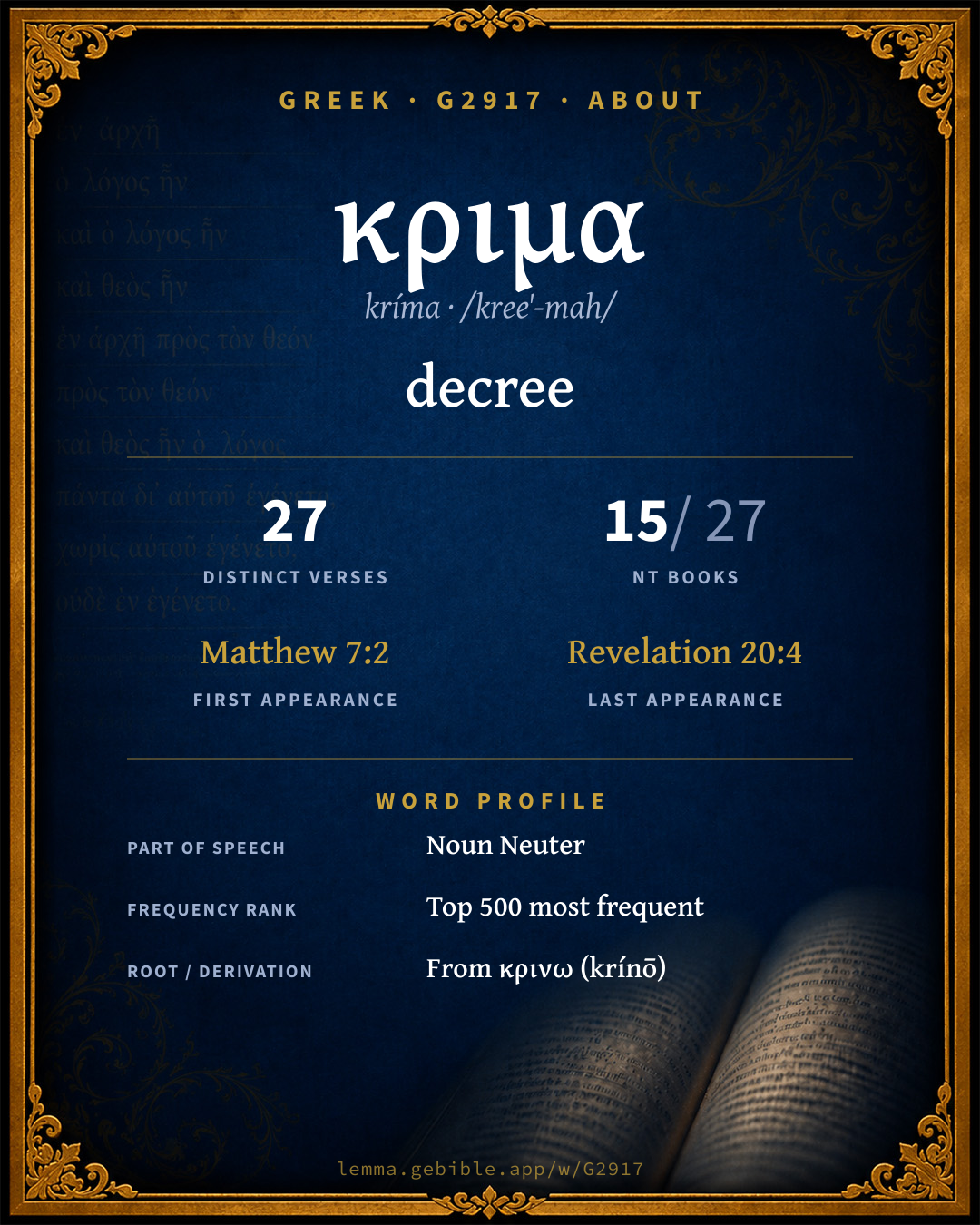
κρίμα
decree
‘decree’ is one of 3 main senses fuller range ↓
Full lexicon entry — Thayer's Greek Lexicon
From Thayer's Greek Lexicon
Where this word appears
See every Accusative-case word in the Greek New Testament →
Grammar key — what these labels mean
Part of speech
- Noun
- A naming word — a person, place, thing, or idea.
Case
- Accusative
- The case of the direct object and of extent.
- Nominative
- The case of the subject (and the predicate nominative).
- Dative
- The case of the indirect object, means, or location — “to / for / with / in.”
- Genitive
- The case of source, possession, or “of” — answers “whose / from what.”
Gender
- Neuter
- Grammatically neuter.
Number
- Singular
- One.
- Plural
- More than one.
Grammatical forms
- Noun, Accusative, Singular, Neuter 16 times (59%)
- Noun, Nominative, Singular, Neuter 5 times (19%)
- Noun, Dative, Singular, Neuter 2 times (7%)
- Noun, Genitive, Singular, Neuter 2 times (7%)
- Noun, Accusative, Plural, Neuter 1 time (4%)
- Noun, Nominative, Plural, Neuter 1 time (4%)
Parsed forms decoded from the imported morphology (Robinson–Tischendorf, public domain), counted across 27 parsed occurrences — not distinct verses.
Every verse where G2917 appears — 27 distinct verses across 15 books. Click any verse to open its interlinear word-by-word view. Verse text shown in the World English Bible for context — . Each verse’s Greek form is shown with its reference; the English is not keyword-highlighted, since the data carries no word-level English alignment. Use “Compare translations” on any verse to read it across multiple English versions. This concordance covers the Greek New Testament; Septuagint (Greek Old Testament) occurrences of this word are not indexed here.
Matthew 1 verse
Mark 1 verse
Luke 3 verses
- Luke 20:47 κρίμα n acc sg neut who devour widows' houses, and for a pretense make long prayers: these will receive greater condemnation."
- Luke 23:40 κρίματι n dat sg neut But the other answered, and rebuking him said, "Don't you even fear God, seeing you are under the same condemnation?
- Luke 24:20 κρίμα n acc sg neut and how the chief priests and our rulers delivered him up to be condemned to death, and crucified him.
John 1 verse
Acts 1 verse
Romans 6 verses
- Romans 2:2 κρίμα n nom sg neut We know that the judgment of God is according to truth against those who practice such things.
- Romans 2:3 κρίμα n acc sg neut Do you think this, O man who judges those who practice such things, and do the same, that you will escape the judgment of God?
- Romans 3:8 κρίμα n nom sg neut Why not (as we are slanderously reported, and as some affirm that we say), "Let us do evil, that good may come?" Those who say so are justly condemned.
- Romans 5:16 κρίμα n nom sg neut The gift is not as through one who sinned: for the judgment came by one to condemnation, but the free gift came of many trespasses to justification.
- Romans 11:33 κρίματα n nom pl neut Oh the depth of the riches both of the wisdom and the knowledge of God! How unsearchable are his judgments, and his ways past tracing out!
- Romans 13:2 κρίμα n acc sg neut Therefore he who resists the authority, withstands the ordinance of God; and those who withstand will receive to themselves judgment.
1 Corinthians 3 verses
- 1 Corinthians 6:7 κρίματα n acc pl neut Therefore it is already altogether a defect in you, that you have lawsuits one with another. Why not rather be wronged? Why not rather be defrauded?
- 1 Corinthians 11:29 κρίμα n acc sg neut For he who eats and drinks in an unworthy manner eats and drinks judgment to himself, if he doesn't discern the Lord's body.
- 1 Corinthians 11:34 κρίμα n acc sg neut But if anyone is hungry, let him eat at home, lest your coming together be for judgment. The rest I will set in order whenever I come.
Galatians 1 verse
1 Timothy 2 verses
Hebrews 1 verse
James 1 verse
1 Peter 1 verse
2 Peter 1 verse
Jude 1 verse
Revelation 3 verses
- Revelation 17:1 κρίμα n acc sg neut One of the seven angels who had the seven bowls came and spoke with me, saying, "Come here. I will show you the judgment of the great prostitute who sits on many waters,
- Revelation 18:20 κρίμα n acc sg neut Rejoice over her, O heaven, you saints, apostles, and prophets; for God has judged your judgment on her."
- Revelation 20:4 κρίμα n nom sg neut I saw thrones, and they sat on them, and judgment was given to them. I saw the souls of those who had been beheaded for the testimony of Jesus, and for the word of God, and such as didn't worship the beast nor his image, and didn't receive the mark on their forehead and on their hand. They lived, and reigned with Christ for the thousand years.
About this entry
At a glance — auto-summarized from this page’s data, not written by a person. Every figure links to its source below. This summary describes the numbers; it doesn’t interpret them.
κριμα (kríma) is a Greek noun most often rendered “decree.” Debuting at Matthew 7:2, it then recurs through the corpus. With 27 verses in 15 books, it is a moderately common word in the Greek New Testament. Its lexical range runs to 3 senses. From the same root come κρινω, ειλικρινης and κριτης. The sections below give every sense, occurrence, and version rendering.
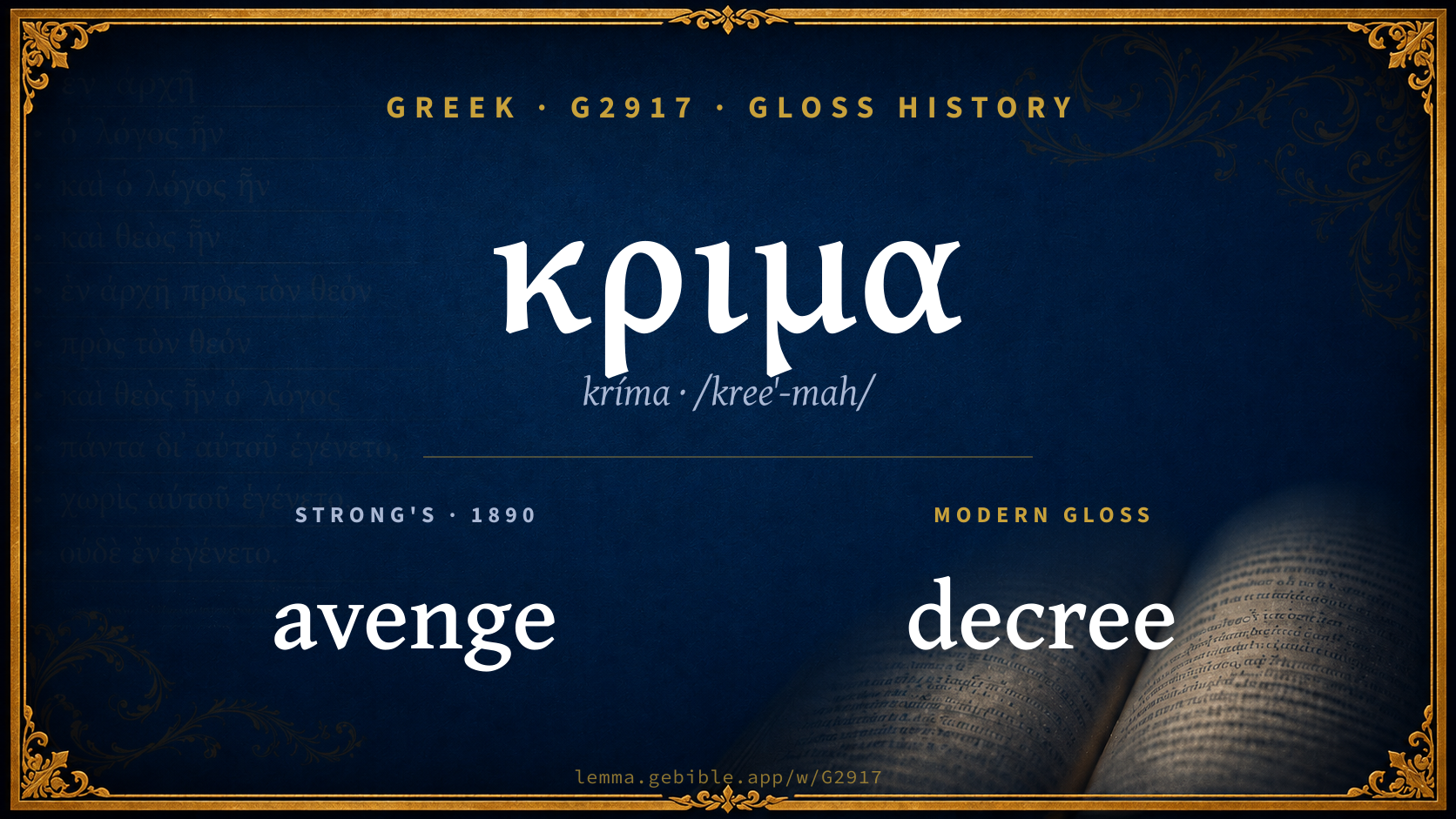
Gloss history
Strong's 1890 vs modern scholarship
About this word
Strong's G2917 catalogs a Greek word from the Greek New Testament.
These counts are not copied from any lexicon or concordance. They are computed here, from the morphology-tagged Greek New Testament. What Lemma adds →
- 27
- distinct verses
- The word appears in 27 distinct verses.
- 15 / 27
- NT books
- The word appears in 15 of 27 New Testament books.
- #500
- by frequency
- Top 500 most frequent Greek words (rank 500 of 5,347 Greek words by occurrence).
View all 27 occurrences in the concordance →
Most concentrated in
- Romans 6 verses 22%
- Luke 3 verses 11%
- 1 Corinthians 3 verses 11%
By section of the New Testament
By traditional corpus
Conventional, traditional groupings — biblical authorship is debated, so this is a traditional corpus grouping, not an authorship claim. Some books belong to more than one corpus (Luke is in both the Gospels and the Lukan corpus, and so on), so these shares overlap and need not total 100%. Each figure is a share of the word’s 27 distinct verses.
- Pauline corpus 12 verses · 44%
- Gospels 6 verses · 22%
- Lukan (Luke–Acts) 4 verses · 15%
- Johannine 4 verses · 15%
- General (Catholic) Epistles 4 verses · 15%
- Revelation 3 verses · 11%
- Hebrews 1 verse · 4%
How translations render this word
Counts come from each version’s own published word-to-Strong’s tagging or interlinear alignment — an approximate guide to how each version renders this word, not a word-level alignment the data otherwise carries. Because each total is that version’s own tagged count, the per-version totals vary from one another and need not match the appearance or distinct-verse counts above. These counts may also differ from a printed concordance because Lemma counts each distinctly tagged rendering and does not collapse phrase taggings into a single head-word total. This is a fixed set of word-tagged versions (KJV, ASV, BSB, ULT) and does not change with the reading translation you choose elsewhere. Each version’s license is shown beside its name below (and on Sources).
- King James Version: Judgment 11×, Damnation 7×, Condemnation 5×
- American Standard Version: Judgment 13×, Condemnation 7×
- Berean Standard Bible: Judgment 15×, Condemnation 5×
- unfoldingWord Literal Text: Judgment 22×, Condemnation 4×
King James Version Public Domain
Renders G2917 across 28 tagged occurrences — most commonly:
Plus 5 renderings that appear only once — usually multi-word phrases or single function words the recovered tagging swept in, not distinct renderings.
American Standard Version Public Domain
Renders G2917 across 27 tagged occurrences — most commonly:
Plus 7 renderings that appear only once — usually multi-word phrases or single function words the recovered tagging swept in, not distinct renderings.
Berean Standard Bible Public Domain
Renders G2917 across 27 tagged occurrences — most commonly:
Plus 7 renderings that appear only once — usually multi-word phrases or single function words the recovered tagging swept in, not distinct renderings.
unfoldingWord Literal Text CC BY-SA 4.0
Renders G2917 across 29 tagged occurrences — most commonly:
Plus 3 renderings that appear only once — usually multi-word phrases or single function words the recovered tagging swept in, not distinct renderings.
Senses in Thayer's
The 3 senses Thayer's distinguishes for this word, in lexicon order (not ranked by frequency or importance). The full entry — with sub-senses — is in the Lexicon Entry tab.
- a decree, judgments
- judgment
- a matter to be judicially decided, a lawsuit, a case in court
Word origin
Derived from κρινω (krínō) (G2919) — to judge.
From G2919 ; a decision (the function or the effect for or against [crime]): - avenge condemned condemnation damnation + go to law judgment.
— Strong’s Exhaustive Concordance (1890), public domain.
Forms in the corpus
The 4 distinct written forms G2917 takes in the Greek New Testament, most frequent first — each parse links to that case’s occurrences in the concordance.
| Form | Parsing | Example | Uses |
|---|---|---|---|
| κρίμα kríma | Noun, Accusative, Singular, Neuter | Mark 12:40 | 21 |
| κρίματα krímata | Noun, Accusative, Plural, Neuter | 1 Corinthians 6:7 | 2 |
| κρίματι krímati | Noun, Dative, Singular, Neuter | Matthew 7:2 | 2 |
| κρίματος krímatos | Noun, Genitive, Singular, Neuter | Acts 24:25 | 2 |
Same root — word family
Other Thayer's entries built from the same root as G2917, grouped by Strong’s listed origin. These share a root / origin per the lexicon — not necessarily a shared meaning. Each links to that word’s own entry.
Derives from
Shares the same root
Compare all same-root words → They share a root, not necessarily a meaning.
Septuagint usage
The same Greek word κριμα appears 196 times in the Greek Old Testament (Septuagint), across 192 verses in 25 books.
- 196
- LXX occurrences
- Tagged occurrences of this Greek word in the Septuagint.
- 192
- verses
- Distinct Septuagint verses containing this word.
- 25 / 39
- OT books
- The word appears in 25 of the 39 Old Testament books.
Sample Septuagint occurrences
- Exodus 18:22 κρίμα
- Leviticus 18:4 κρίμα
- Numbers 35:24 κρίμα
- Deuteronomy 4:1 κρίμα
- 1 Samuel 2:10 κρίμα
- 2 Samuel 8:15 κρίμα
- 1 Kings 2:3 κρίμα
- 2 Kings 11:14 κρίμα
- 1 Chronicles 15:13 κρίμα
- 2 Chronicles 4:7 κρίμα
- Ezra 7:10 κρίμα
- Job 9:15 κρίμα
Septuagint occurrences (same lexeme)
Every verse where the same Strong’s number (G2917) appears in the Greek Septuagint — showing the first 50 of 192. Verse text shown in the World English Bible for context; the Greek form is the matched word — the English is not keyword-highlighted.
- Exodus 18:22 κρίμα Let them judge the people at all times. It shall be that every great matter they shall bring to you, but every small matter they shall judge themselves. So shall it be easier for you, and they shall share the load with you.
- Exodus 23:6 κρίμα "You shall not deny justice to your poor people in their lawsuits.
- Leviticus 18:4 κρίμα You shall do my ordinances, and you shall keep my statutes, and walk in them: I am Yahweh your God.
- Leviticus 18:5 κρίμα You shall therefore keep my statutes and my ordinances; which if a man does, he shall live in them: I am Yahweh.
- Leviticus 20:22 κρίμα "'You shall therefore keep all my statutes, and all my ordinances, and do them; that the land, where I am bringing you to dwell, may not vomit you out.
- Leviticus 26:15 κρίμα and if you shall reject my statutes, and if your soul abhors my ordinances, so that you will not do all my commandments, but break my covenant;
- Leviticus 26:43 κρίμα The land also will be left by them, and will enjoy its sabbaths while it lies desolate without them: and they will accept the punishment of their iniquity; because, even because they rejected my ordinances, and their soul abhorred my statutes.
- Leviticus 26:46 κρίμα These are the statutes, ordinances and laws, which Yahweh made between him and the children of Israel in Mount Sinai by Moses.
- Numbers 35:24 κρίμα then the congregation shall judge between the striker and the avenger of blood according to these ordinances;
- Numbers 35:29 κρίμα These things shall be for a statute [and] ordinance to you throughout your generations in all your dwellings.
- Numbers 36:13 κρίμα These are the commandments and the ordinances which Yahweh commanded by Moses to the children of Israel in the plains of Moab by the Jordan at Jericho.
- Deuteronomy 4:1 κρίμα Now, Israel, listen to the statutes and to the ordinances, which I teach you, to do them; that you may live, and go in and possess the land which Yahweh, the God of your fathers, gives you.
- Deuteronomy 4:8 κρίμα What great nation is there, that has statutes and ordinances so righteous as all this law, which I set before you this day?
- Deuteronomy 4:45 κρίμα these are the testimonies, and the statutes, and the ordinances, which Moses spoke to the children of Israel, when they came forth out of Egypt,
- Deuteronomy 5:1 κρίμα Moses called to all Israel, and said to them, Hear, Israel, the statutes and the ordinances which I speak in your ears this day, that you may learn them, and observe to do them.
- Deuteronomy 5:31 κρίμα But as for you, stand you here by me, and I will speak to you all the commandment, and the statutes, and the ordinances, which you shall teach them, that they may do them in the land which I give them to possess it.
- Deuteronomy 6:1 κρίμα Now this is the commandment, the statutes, and the ordinances, which Yahweh your God commanded to teach you, that you might do them in the land where you go over to possess it;
- Deuteronomy 6:4 κρίμα Hear, Israel: Yahweh is our God; Yahweh is one:
- Deuteronomy 6:20 κρίμα When your son asks you in time to come, saying, What mean the testimonies, and the statutes, and the ordinances, which Yahweh our God has commanded you?
- Deuteronomy 7:11 κρίμα You shall therefore keep the commandment, and the statutes, and the ordinances, which I command you this day, to do them.
- Deuteronomy 8:11 κρίμα Beware lest you forget Yahweh your God, in not keeping his commandments, and his ordinances, and his statutes, which I command you this day:
- Deuteronomy 21:22 κρίμα If a man have committed a sin worthy of death, and he be put to death, and you hang him on a tree;
- Deuteronomy 26:16 κρίμα This day Yahweh your God commands you to do these statutes and ordinances: you shall therefore keep and do them with all your heart, and with all your soul.
- Deuteronomy 26:17 κρίμα You have declared Yahweh this day to be your God, and that you would walk in his ways, and keep his statutes, and his commandments, and his ordinances, and listen to his voice:
- Deuteronomy 32:41 κρίμα If I whet my glittering sword, My hand take hold on judgment; I will render vengeance to my adversaries, Will recompense those who hate me.
- 1 Samuel 2:10 κρίμα Those who strive with Yahweh shall be broken to pieces; Against them will he thunder in the sky: Yahweh will judge the ends of the earth; He will give strength to his king, Exalt the horn of his anointed.
- 2 Samuel 8:15 κρίμα David reigned over all Israel; and David executed justice and righteousness to all his people.
- 2 Samuel 22:23 κρίμα For all his ordinances were before me; As for his statutes, I did not depart from them.
- 1 Kings 2:3 κρίμα and keep the charge of Yahweh your God, to walk in his ways, to keep his statutes, [and] his commandments, and his ordinances, and his testimonies, according to that which is written in the law of Moses, that you may prosper in all that you do, and wherever you turn yourself.
- 1 Kings 3:11 κρίμα God said to him, Because you have asked this thing, and have not asked for yourself long life, neither have asked riches for yourself, nor have asked the life of your enemies, but have asked for yourself understanding to discern justice;
- 1 Kings 3:28 κρίμα All Israel heard of the judgment which the king had judged; and they feared the king: for they saw that the wisdom of God was in him, to do justice.
- 1 Kings 10:9 κρίμα Blessed be Yahweh your God, who delighted in you, to set you on the throne of Israel: because Yahweh loved Israel forever, therefore made he you king, to do justice and righteousness.
- 2 Kings 11:14 κρίμα and she looked, and, behold, the king stood by the pillar, as the manner was, and the captains and the trumpets by the king; and all the people of the land rejoiced, and blew trumpets. Then Athaliah tore her clothes, and cried, Treason! treason!
- 2 Kings 17:26 κρίμα Therefore they spoke to the king of Assyria, saying, The nations which you have carried away, and placed in the cities of Samaria, don't know the law of the god of the land: therefore he has sent lions among them, and, behold, they kill them, because they don't know the law of the god of the land.
- 2 Kings 17:27 κρίμα Then the king of Assyria commanded, saying, Carry there one of the priests whom you brought from there; and let them go and dwell there, and let him teach them the law of the god of the land.
- 2 Kings 17:33 κρίμα They feared Yahweh, and served their own gods, after the manner of the nations from among whom they had been carried away.
- 2 Kings 17:34 κρίμα To this day they do after the former manner: they don't fear Yahweh, neither do they after their statutes, or after their ordinances, or after the law or after the commandment which Yahweh commanded the children of Jacob, whom he named Israel;
- 2 Kings 17:37 κρίμα and the statutes and the ordinances, and the law and the commandment, which he wrote for you, you shall observe to do forevermore; and you shall not fear other gods:
- 2 Kings 17:40 κρίμα However they did not listen, but they did after their former manner.
- 1 Chronicles 15:13 κρίμα For because you didn't carry it at the first, Yahweh our God made a breach on us, because we didn't seek him according to the ordinance.
- 1 Chronicles 16:12 κρίμα Remember his marvelous works that he has done, His wonders, and the judgments of his mouth,
- 1 Chronicles 16:14 κρίμα He is Yahweh our God; His judgments are in all the earth.
- 1 Chronicles 18:14 κρίμα David reigned over all Israel; and he executed justice and righteousness to all his people.
- 1 Chronicles 22:13 κρίμα Then shall you prosper, if you observe to do the statutes and the ordinances which Yahweh gave Moses concerning Israel. Be strong, and of good courage. Don't be afraid, neither be dismayed.
- 1 Chronicles 28:7 κρίμα I will establish his kingdom forever, if he be constant to do my commandments and my ordinances, as at this day.
- 2 Chronicles 4:7 κρίμα He made the ten lampstands of gold according to the ordinance concerning them; and he set them in the temple, five on the right hand, and five on the left.
- 2 Chronicles 4:20 κρίμα and the lampstands with their lamps, to burn according to the ordinance before the oracle, of pure gold;
- 2 Chronicles 6:39 κρίμα then hear from heaven, even from your dwelling-place, their prayer and their petitions, and maintain their cause, and forgive your people who have sinned against you.
- 2 Chronicles 7:17 κρίμα As for you, if you will walk before me as David your father walked, and do according to all that I have commanded you, and will keep my statutes and my ordinances;
- 2 Chronicles 9:8 κρίμα Blessed be Yahweh your God, who delighted in you, to set you on his throne, to be king for Yahweh your God: because your God loved Israel, to establish them forever, therefore made he you king over them, to do justice and righteousness.
These are occurrences of the same Greek lexeme (G2917) in the Septuagint — not a translation of any one Hebrew word. The store carries no word-level Hebrew↔Greek alignment, so no Hebrew original is asserted here. Counts come from the recovered LXX Strong's tagging — high-frequency vocabulary is well covered, while rare or late forms may be untagged — so they reflect tagged occurrences and may slightly undercount.