Acts 25:20

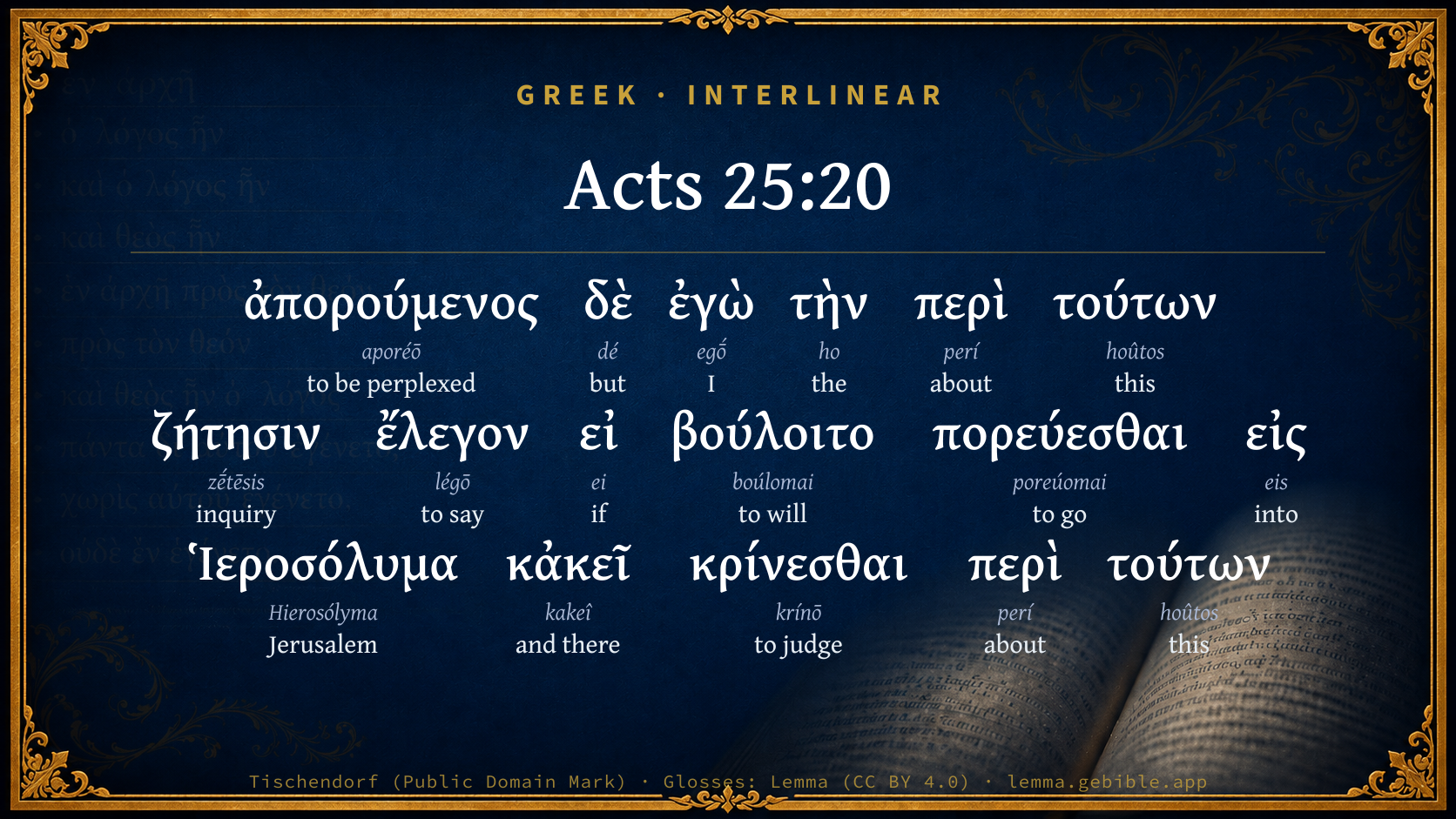
Greek (Tischendorf 8th ed.) Acts 25:20 appears in the Greek New Testament. The text above is from the Tischendorf 8th edition. Each word links to its Strong’s number and a concise gloss. Click any word for its full Thayer’s Greek Lexicon entry.
Download image
Cite this verse

Acts 25:20 (World English Bible). Public Domain. Lemma interlinear Bible study tool, https://lemma.gebible.app/v/acts/25/20.

Show BibTeX & RIS
BibTeX
RIS
English Translation
Being perplexed how to inquire concerning these things, I asked whether he was willing to go to Jerusalem and there be judged concerning these matters.
World English Bible · Public Domain
Download a study sheet

One document with this verse’s original text, its word-by-word gloss line, the meaning frame, cross-references with their text, attributed commentary, and full source and license credits — printable, and it pastes into notes with its structure intact.

This verse Autodidact and up

Study sheet (.html) Plain text (.txt)

A passage Seminary Student

Up to 50 verses in one chapter. A passage sheet keeps up to 6 commentary sources and 12 cross-references per verse, in the order this page ranks them, and says so on the sheet whenever that leaves anything out. Ask for a single verse and you get the Autodidact verse sheet above.

Everything on this page stays free to read, with no account — the sheet is a download of what is already on screen, not access to it.

Want to remove ads? Support Godless Engineer
Compare translations 3

The same verse in 3 English versions, stacked beneath the original-language interlinear above. Click any original word for its lexicon entry.

Each is an independent rendering of the whole verse — the interlinear is not word-aligned to these translations.

Highlighted words mark where these versions differ — a whole-verse word diff, not a word-by-word alignment.

  • World English Bible Public Domain
    Being perplexed how to inquire concerning these things, I asked whether he was willing to go to Jerusalem and there be judged concerning these matters.
  • King James Version Public Domain
    And because I doubted of such manner of questions, I asked him whether he would go to Jerusalem, and there be judged of these matters.
  • unfoldingWord Literal Text CC BY-SA 4.0
    And I, doubting the investigation about these things, asked if he might be willing to go to Jerusalem and be judged there about these things.

unfoldingWord Literal Text — © unfoldingWord, licensed CC BY-SA 4.0. Word-aligned USFM3 via Door43 (git.door43.org/unfoldingWord/en_ult).

Versions to compare (up to 4)

3 of 4 selected

Show all 19 translations

Every available English version of this verse, each an independent rendering of the whole verse.

  • World English Bible Public Domain
    Being perplexed how to inquire concerning these things, I asked whether he was willing to go to Jerusalem and there be judged concerning these matters.
  • Berean Standard Bible Public Domain
    Since I was at a loss as to how to investigate these matters, I asked if he was willing to go to Jerusalem and be tried there on these charges.
  • Majority Standard Bible Public Domain
    Since I was at a loss as to how to investigate this matter, I asked if he was willing to go to Jerusalem and be tried there on these charges.
  • King James Version Public Domain
    And because I doubted of such manner of questions, I asked him whether he would go to Jerusalem, and there be judged of these matters.
  • American Standard Version (1901) Public Domain
    And I, being perplexed how to inquire concerning these things, asked whether he would go to Jerusalem and there be judged of these matters.
  • Revised Version (1885) Public Domain
    And I, being perplexed how to inquire concerning these things, asked whether he would go to Jerusalem, and there be judged of these matters.
  • Geneva Bible (1599) Public Domain
    And because I doubted of such maner of question, I asked him whether he would goe to Hierusalem, and there be iudged of these things.
  • Douay-Rheims (1899) Public Domain
    I therefore being in a doubt of this manner of question, asked him whether he would go to Jerusalem, and there be judged of these things.
  • Young's Literal Translation Public Domain
    and I, doubting in regard to the question concerning this, said, If he would wish to go on to Jerusalem, and there to be judged concerning these things --
  • Literal Standard Version CC BY-SA 4.0
    and I, doubting in regard to the question concerning this, asked if he was willing to go on to Jerusalem, and to be judged there concerning these things—
  • Unlocked Literal Bible CC BY-SA 4.0
    I was not certain about how to investigate this matter, and so I asked him if he was willing to go to Jerusalem to stand trial there about these charges.
  • unfoldingWord Literal Text CC BY-SA 4.0
    And I, doubting the investigation about these things, asked if he might be willing to go to Jerusalem and be judged there about these things.
  • Darby Bible Public Domain
    And as I myself was at a loss as to an inquiry into these things, I said, Was he willing to go to Jerusalem and there to be judged concerning these things?
  • World Messianic Bible Public Domain
    Being perplexed how to inquire concerning these things, I asked whether he was willing to go to Jerusalem and there be judged concerning these matters.
  • Webster's Bible Public Domain
    And because I doubted of such manner of questions, I asked him whether he would go to Jerusalem, and there be judged concerning these matters.
  • Free Bible Version CC BY-SA 4.0
    Since I was undecided as to how to proceed in investigating such matters, I asked him if he was willing to go to Jerusalem and be tried there.
  • Bible in Basic English Public Domain
    And as I had not enough knowledge for the discussion of these things, I made the suggestion to him to go to Jerusalem and be judged there.
  • Text-Critical English NT CC BY 4.0
    Since I was at a loss as to how to investigate this matter, I asked if he might be willing to go to Jerusalem and stand trial there on these charges.
  • Tyndale New Testament (1534) Public Domain
    And be cause I douted of soche maner questions I axed him whyther he wolde goo to Ierusalem and there be iudged of these matters.

Literal Standard Version (2020), Covenant Press — licensed CC BY-SA 4.0. Text via the HelloAO Bible API (eBible.org). Unlocked Literal Bible (unfoldingWord) — licensed CC BY-SA 4.0. Text via the HelloAO Bible API (eBible.org). unfoldingWord Literal Text — © unfoldingWord, licensed CC BY-SA 4.0. Word-aligned USFM3 via Door43 (git.door43.org/unfoldingWord/en_ult). Free Bible Version, Dr. Jonathan Gallagher — licensed CC BY-SA 4.0. Text via the HelloAO Bible API (eBible.org).

Word by word

More ways to search: Search by grammar → Find every occurrence → Compare this word →

Practice this passage: Drill this verse → Learn its vocabulary →

ἀπορούμενος
aporéō
G639
“to be perplexed”
Verb, Present, Middle, Participle, Nominative, Singular, Masculine
Part of Speech
Verb
Tense
Present
Voice
Middle
Mood
Participle
Case
Nominative
Number
Singular
Gender
Masculine
Full Thayer's Definition

Origin: from a compound of G1 (as a negative particle) and the base of G4198

TDNT: None

1. to be without resources, to be in straits, to be left wanting, to be embarrassed, to be in doubt, not to know which way to turn 2. to be at a loss with one's self, be in doubt 3. not to know how to decide or what to do, to be perplexed
  1. δὲ dé G1161 “but” Conjunction
  2. ἐγὼ egṓ G1473 “I” Personal pronoun, 1st person, Nominative, Singular
  3. τὴν ho G3588 “the” Article, Accusative, Singular, Feminine
  4. περὶ perí G4012 “about” Preposition
  5. τούτων hoûtos G3778 “this” Demonstrative pronoun, Genitive, Plural, Neuter
  6. ζήτησιν zḗtēsis G2214 “inquiry” Noun, Accusative, Singular, Feminine
  7. ἔλεγον légō G3004 “to say” Verb, Imperfect, Active, Indicative, 1st person, Singular
  8. εἰ ei G1487 “if” Conditional
  9. βούλοιτο boúlomai G1014 “to will” Verb, Present, Middle or Passive deponent, Optative, 3rd person, Singular
  10. πορεύεσθαι poreúomai G4198 “to go” Verb, Present, Middle or Passive deponent, Infinitive
  11. εἰς eis G1519 “into” Preposition
  12. Ἱεροσόλυμα Hierosólyma G2414 “Jerusalem” Noun, Accusative, Singular, Feminine
  13. κἀκεῖ kakeî G2546 “and there” Adverb, Aramaic form
  14. κρίνεσθαι krínō G2919 “to judge” Verb, Present, Passive, Infinitive
  15. περὶ perí G4012 “about” Preposition
  16. τούτων hoûtos G3778 “this” Demonstrative pronoun, Genitive, Plural, Neuter

About this verse

These counts appear in no published source. They are computed here, from the morphology-tagged text and Lemma’s own curated glosses. What Lemma adds →

17
words
15
distinct lemmas
Acts
section

Notable vocabulary

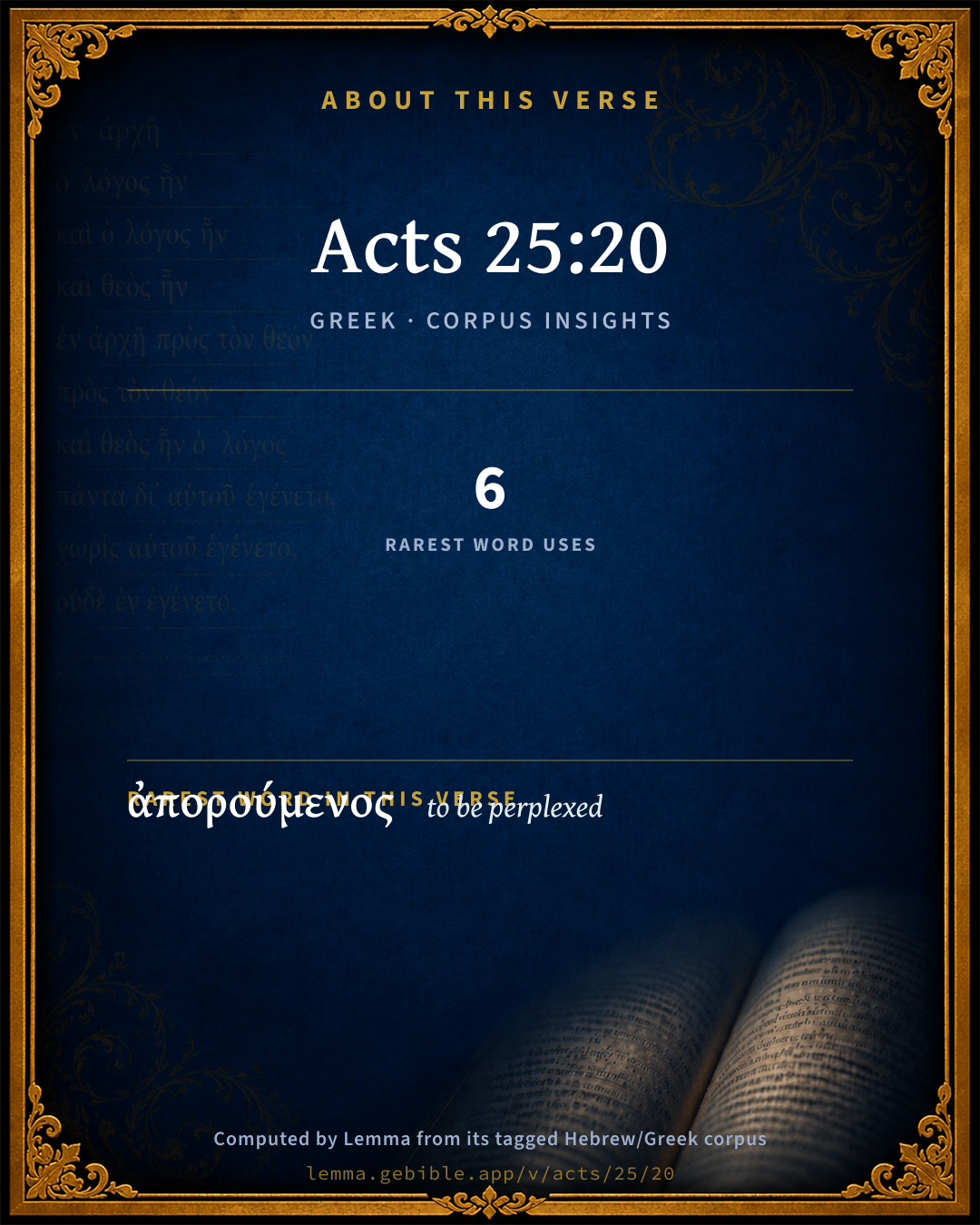
The rarest word here is ἀπορούμενος to be perplexed G639 — appearing just 6 times in the whole Greek New Testament.

Shared distinctive vocabulary

ἀπορούμενος to be perplexed G639 occurs in 6 verses of the Greek New Testament. Also found in:

Repetition

Words recur within this verse:

  • περὶ about G4012 ×2
  • τούτων this G3778 ×2

Cross-references

1

Topical passages linked to Acts 25:20 in the Treasury of Scripture Knowledge — connected by theme and wording, ordered by reader-vote popularity; previews shown in the World English Bible.

  • Acts 25:9 But Festus, desiring to gain favor with the Jews, answered Paul and said, "Are you willing to go up to Jerusalem, and be judged by me there concerning these things?"

Cross-references courtesy of OpenBible.info (CC BY 4.0).

Commentary

Notes on Acts 25:20 from classic Christian and Jewish commentators (each source and its license shown beneath its notes). The classic Christian expositions comment on the surrounding passage and are grouped to its opening verse, so a note may address several verses; the Jewish commentaries on the Tanakh (Rashi and others) are per-verse, so they appear only where the commentator wrote on this verse.

Lemma curates 59 commentaries, every one of them public domain or Creative Commons licensed, each selected and text-cleaned for this edition rather than reprinted as found. About our sources →

The Biblical Illustrator

Joseph S. Exell

Act_25:20

And because I doubted of such manner of questions, I asked him whether he would go to Jerusalem.

Politeness and piety

1. Festus was at his wits ends through Felixs mismanagement of the case. Now anybody who ever saw the ludicrous awkwardness of a politician suddenly forced to answer a religious question can quite appreciate the embarrassment of Festus. The Jews charged Paul with heresy, treason, and sacrilege. Of treason he could form a judgment; but what did he know about heresy or sacrilege? And he was acute enough to see that the only treason of which Paul was guilty was in supporting a theological King. Manifestly the whole thing was altogether out of his range. But it was of some value that he should make friends with his subjects. And he was surprised to find that his first act of government should put him at such a pitiable disadvantage; so he proposed that Paul should go up to Jerusalem, and be regularly tried by the Sanhedrin. Then the apostle appealed to Caesar. Here fell a new embarrassment upon this unfortunate governor, who had, by law, to send with every prisoner the full report of his case to the emperor. And no one can tell what he would have done about Paul if there had not occurred at the moment an incident promising to be most hopeful.

2. Herod Agrippa, the nominal king of the Jews, suddenly avowed his intention of paying a visit to Festus. This pleased the governor exceedingly. Paul had his rights. Nay, more; he had had his wrongs. And Festus did not know how to defend the one or extenuate the other. But Agrippa, an educated Jew, would understand all the complications that so confused him. So he put the case to him.

3. Festus is the type of a large class of educated, polite persons who look upon religious questions as belonging solely to religious people. They doubt of such manner of questions. They will sometimes indulge in a patronising little discussion; but when invited personally to the tests of a religious experience, they admit they do not understand them, are not interested in them, and respectfully remand all consideration of them fully to such people as will give them intelligent appreciation, and to whose peculiar superstition they belong. Now we do not need to imply reproach upon the character of this class. There is chance here to put in an honest word even for Festus. History makes a very creditable record of his administration, as well as of his reputation generally for candour, courage, and gentlemanly demeanour to all, and this narrative shows him in an amiable light.

4. Now the modern Festus has not, like Festus in Judea, just arrived. His whole early life has been passed within the reach of gospel practices and customs. He has grown up under the force and fervency of religious appeal. What does he think of all these things? Much will depend upon how far they seem likely to go. Festus could get on very well with Agrippa, for the king was one of that cool sort of Pharisees who in all ages hold their piety quite quietly in hand. But when Paul began to preach, and great, honest words of argument and burning appeal began to fly around the audience chamber, he was forced out of his discreet reserve, and exclaimed, Paul, thou art beside thyself; much learning doth make thee mad. And this pretty well represents the feeling with which many men of the world regard the ordinary phenomena of a religious life. They are scrupulously polite towards Christians. Some of them are excellent neighbours and worthy citizens. Only let a man keep within bounds and avoid reckless excitement. There is such a thing as going too far, and so becoming obtrusive. And then they intimate with cool politeness that good breeding may be shown even in ones style of piety; it is best always to be careful, or one may unconsciously become coarse.

5. It cannot have escaped the notice of anyone that there does not seem to have passed across the mind of Festus the thought of examining Christianity. For all his conduct betrays, you might as well think of him as of one raised above the awkward necessity of being saved. And this is the exact lack to be observed in many men of the world. They contemplate religion as simply a phase of human nature, with which they have nothing in common. One would think these calm philosophers had forgotten that they had any souls of their own.

6. It so happens that one of the principles of our religion requires us to arouse others upon this neglect. Here is seen another step of this polite forbearance. We summon men to think, to investigate, to decide. They reply, There are ever so many sects and creeds in the Church; for one, I doubt of such manner of questions; they are out of my line of thinking: they belong to other people. One feels tempted to reply, Well, does your soul, also, your Maker, heavens glory, belong to other people; or earths work, or bells wailing and woe? How did you reach that serene height of undisturbed satisfaction, your past flawless, your present unreproached, your future secure, so that you can look down upon human passion and conflict and toil, and smile as you say, These all seem to have some questions of their own superstition? It is the part of simple kindness to move on, even at the risk of being impolite. The danger is too urgent; the duty is too pressing; the sanctions are too heavy. Men err if they suppose that becoming a Christian can be contemplated as one criticises a new painting with an eye-glass or looking through his hand. (C. S. Robinson, D. D.)

The Biblical Illustrator, edited by Joseph S. Exell (c. 1880s–1900s) — public domain. Text from a community e-Sword module.

Joseph Benson's Commentary

Act 25:20-21. And because I doubted of such manner of questions — Whether they were dangerous to the state and punishable, and whether I was a competent judge of them; I asked him whether he would go to Jerusalem — I proposed that the cause should be adjourned to the Jewish courts, as best able to take cognizance of an affair of this nature. But when Paul appealed to Augustus — Being apprehensive, as I plainly perceived, of some clandestine attempt upon his life; I commanded him to be kept — Under confinement as before; till I might send him to Cesar — By some convenient opportunity.

Joseph Benson's Commentary on the Old and New Testaments (1811–1818) — public domain. Text from a community e-Sword module.

Bengel's Gnomon

Johann Albrecht Bengel

Act 25:20. Ἀπορούμενος, being in doubt) Thou oughtest to have inquired, Festus. An elegant construction, ἀπορούμενος ζήτησιν. Scapula has examples.—ζήτησιν) Ζητήματα are tne things which are the subjects of inquiry, Act 25:19: ζήτησις, the act of inquiry or question. The ζήτημα is the object (or subject) of inquiry, ζήτησις.—[εἰς Ἰερουσαλὴμ, to Jerusalem) Here Festus is silent as to his dangerous purpose (counsel), which he had taken up through desire to favour the Jews against Paul.—V. g.]

Bengel's Gnomon of the New Testament — English translation (T&T Clark, Edinburgh, 1860) — public domain. Text from a community e-Sword module.

Expositor's Greek Testament

ed. W. Robertson Nicoll

Act 25:20 . ἀπορούμενος δὲ : “being perplexed how to inquire concerning,” R.V., omitting εἰς , the verb ἀπορ . talking a direct accusative. See above on Act 2:12 . Festus might have truly said that he was perplexed, as he still was, concerning Paul, and it is possible that the positive motive assigned for his action in Act 25:9 was an honest attempt on his part to get more definite information at Jerusalem than he would obtain in Cæsarea but we know how St. Paul viewed his question. On the other hand he may have wished to conceal his real motive (Weiss).

The Expositor's Greek Testament, edited by W. Robertson Nicoll (1897–1910) — public domain. Text from a community e-Sword module.

Jamieson, Fausset & Brown

Robert Jamieson, A. R. Fausset & David Brown

because I doubted of such manner of questions--The "I" is emphatic. "I," as a Roman judge, being at a loss how to deal with such matters.

Jamieson, Fausset & Brown — Commentary Critical and Explanatory on the Whole Bible (1871) — public domain (CC PDM 1.0). Text via the HelloAO Bible API.

Adam Clarke's Commentary

Verse 20. I doubted of such manner of questions] Such as, whether he had broken their law, defiled their temple; or whether this Jesus, who was dead, was again raised to life.

Adam Clarke's Commentary on the Bible (1810–1826) — public domain. Text from a community e-Sword/MySword module.

Ellicott's Commentary for English Readers

(20) Because I doubted of such manner of questions.—Better, I, being perplexed as to the inquiry about these things. The word implies more than mere doubt, and his perplexity is his justification for bringing the matter before a prince who, being a Jew, might be a better judge of the point at issue.

A Bible Commentary for English Readers, edited by Charles John Ellicott (1878–1897) — public domain. Text from a community e-Sword module.

The Cambridge Bible for Schools and Colleges

gen. ed. J. J. S. Perowne

20. And because I doubted of such manner of questions] Rev. Ver., with ancient authorities, gives “And I, being perplexed how to inquire concerning these things.” The whole subject was a strange one to Festus, and when he found that some Jews in part at least agreed with St Paul, while others of them were his bitter opponents, he could find no better plan than to turn to a Jew for an explanation. He did not himself know how to conduct an inquiry on such a subject, and yet the Jews’ religion, being now allowed by the Empire, must have its causes adjudicated on.

The Cambridge Bible for Schools and Colleges (gen. ed. J. J. S. Perowne; Cambridge University Press, 1878–1918) — public domain. Text from a community e-Sword module.

John Gill's Exposition

And because I doubted of such manner of questions,.... Or was ignorant of them, and knew not what to make of them, or to say to them, and was at an entire loss what to do in this affair:

I asked him whether he would go to Jerusalem, and there be judged of these matters; before the Jewish sanhedrim, who best understood them.

John Gill's Exposition of the Whole Bible (1746–1763) — public domain (CC PDM 1.0). Text via the HelloAO Bible API.

Trapp's Complete Commentary

John Trapp

20 And because I doubted of such manner of questions, I asked him whether he would go to Jerusalem, and there be judged of these matters.

Ver. 20. And because] He tells not Agrippa, that to gratify the Jews (who in all likelihood had bribed him) he asked, whether he would go up to Jerusalem; but pretends another matter. Nature need not be taught to tell her own tale, or to make the best of her own case, bad though it be. And this is incident to the very best, as to do what we can to hide our bodily deformities, so our moral defects and frailties. What dost thou here, Elias? saith God. I have been very zealous for the Lord of hosts, saith he. He had rather say so, than, I was fearful of Jezebel, and here I hide me from her malicious pursuit. But were it not better to speak out, and to acknowledge all with aggravation of circumstances? since such only find mercy as in confession show the Lord the iniquity of their sin, the filthiness of their lewdness, the abomination of their provocations.

John Trapp, A Commentary or Exposition upon All the Books of the Old and New Testament (1647–1656) — public domain. Text from a community e-Sword module.

Albert Barnes' Notes on the Bible

And because I doubted of such manner of questions - See the margin. Because I hesitated about the right way of disposing of them; because I was ignorant of their nature and bearing, I proposed to go to Jerusalem, that the matter might be there more fully investigated. It is obvious, that if Paul was not found guilty of any violation of the laws, he should have been at once discharged. Some interpreters understand this as affirming that he was not satisfied about the question of Paul’s innocence, or certain whether he ought to be set at liberty or not.

Albert Barnes' Notes on the Bible (1834–1885) — public domain. Text from a community e-Sword/MySword module.

Matthew Poole's English Annotations

Festus pretends, that he knew not by what rule those cases were to be decided, nor before what judges; whether before himself or the Jewish sanhedrim. But this is only his pretension: the true cause why he would not acquit Paul, though he knew him to be innocent, we read, Act 25:9, viz. that he might do the Jews a pleasure. He asked Paul this question, Whether he would go to Jerusalem? But with a resolution to have sent him whether he would or not, had he not appealed; but then he durst not: for in certain cases none could hinder appeals, from any judge, to the people in the former times, or to their emperor in the latter times.

Matthew Poole's English Annotations on the Holy Bible (1683–1685) — public domain. Text from a community e-Sword/MySword module.

The Pulpit Commentary

I, being perplexed how to inquire concerning these things, asked for because I doubted of such manner of questions, I asked him, A.V. and T.R. I, being perplexed, etc. The zhthsiv spoken of by Festus does not mean his own judicial inquiry, though it is so used once in Polybius (6. 16:2), but the disputes or discussions on such subjects as the Resurrection, etc. (Joh_3:25; 1Ti_1:4 1Ti_6:4; Tit_3:9) in which Festus felt himself at a loss. The A.V., therefore, expresses the sense more nearly than the R.V. The T.R. too, which inserts eijv before thn peritwn zhthsin, is preferable to the R.T., because ajporoumai does not govern an accusative case, but is almost always followed by a preposition. Those who follow the reading of the T.R., peritou, either understand pragmatov or refer toutou to Paul or to Jesus.

The Pulpit Commentary (1880–1919), ed. H.D.M. Spence-Jones & Joseph S. Exell — public domain. Text from a community e-Sword module.

McGarvey & Pendleton's Commentaries

J. W. McGarvey

See notes on verse 14

J. W. McGarvey (with Philip Y. Pendleton), Commentaries on the New Testament (The Fourfold Gospel, 1914; Acts; and the epistles) — public domain. Text from a community e-Sword/MySword module.

Cambridge Greek Testament for Schools and Colleges

20. ἀπορούμενος δὲ ἐγὼ τὴν περὶ τούτων ζήτησιν, and I being perplexed how to inquire concerning these things. The whole subject would be strange to Festus, and when he found that some Jews in part at least agreed with St Paul, while others of them were his bitter opponents, he could find no better plan than to turn to a Jew for an explanation. He did not himself know how to conduct an inquiry on such a subject, and yet the Jews’ religion, being now allowed by the Empire, must have its causes adjudicated on.

Cambridge Greek Testament for Schools and Colleges (Cambridge University Press, 1896; 21 vols, various authors incl. Carr, Maclear, Plummer, Farrar, Lumby, Moule, M. R. James, Simcox) — public domain. Text from a community e-Sword module.

Alford’s Greek Testament

Henry Alford

20.] See the real reason why he proposed this, ver. 9. This he now conceals, and alleges his modesty in referring such matters to the judgment of the Jews themselves. This would be pleasing to his guest Agrippa.

ἀπορ. εἰς] so σὺ δʼ εἰς τὰ μητρὸς μὴ φοβοῦ νυμφεύματα, Soph. Œd. Tyr. 980; and ἀμφινοῶ ἐς τέρας, Antig. 372.

ἔλεγον] There is a mixed construction between ‘I said, wilt thou?’ as in ver. 9, and ‘I asked him whether he would.…’

Henry Alford, The Greek Testament (1849–1861) — public domain. Text from a community e-Sword module.

Lesson kit

Teaching starters — assembled from the data on this page, not authored interpretation. Every prompt links to the verse data it draws on. Edit before teaching.

Acts, in the Acts, opens this verse with 17 words (15 distinct Greek lemmas). Its most distinctive word is aporéō (“to be perplexed”). A historical commentator’s framing appears above. Read the whole chapter for the surrounding context.

Discussion questions

  1. The word aporéō carries the sense “to be perplexed.” How does it shape the verse?
  2. Mark 6:20 shares the word «to be perplexed» with this verse. How do the two illuminate each other?
  3. “about” occurs 2× in this one verse. What is the effect of the repetition?
  4. The translations on this page render this verse differently — a whole-verse word diff, not a word-by-word alignment. What might account for the different wordings?
  5. Reading how The Biblical Illustrator and Joseph Benson's Commentary read this verse, where do the two commentators agree and where do they part?

Things to notice

Reading settings

Reading text

Shown beneath each verse's original-language words.

Old Testament
Old Testament edition

Read the OT as the Masoretic Hebrew (MT) or the Greek Septuagint (LXX).

English shown for the Greek Septuagint (in the Hebrew ↔ Greek comparison).

Comparing translations? Open the Compare panel on any verse page to stack up to four side by side.