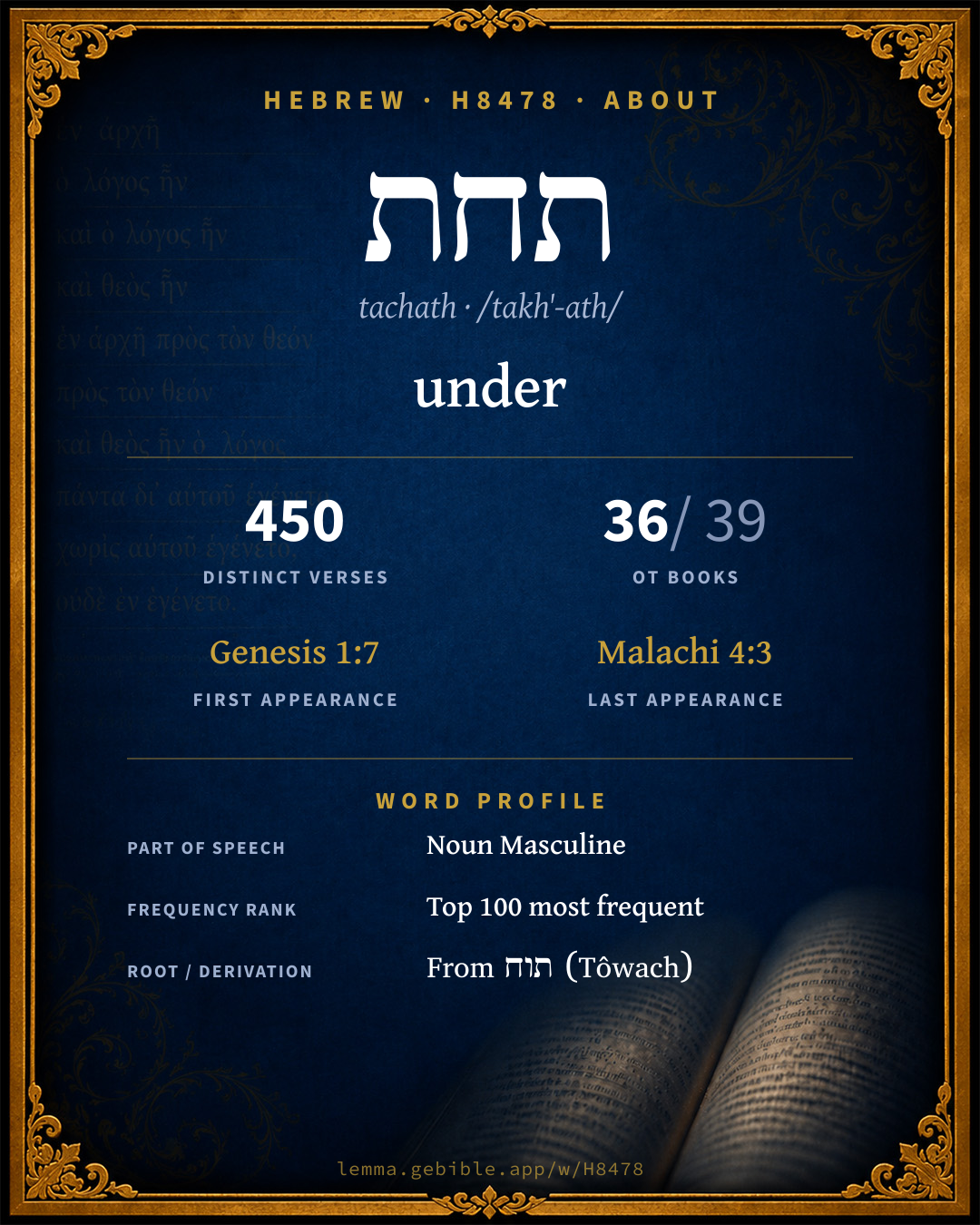
תַּחַת
under
‘under’ is one of 9 main senses fuller range ↓
Full lexicon entry — Brown-Driver-Briggs (BDB)
From Brown-Driver-Briggs (BDB)
Where this word appears
Grammar key — what these labels mean
Part of speech
- Preposition
- A relational word (e.g. “in,” “to,” “from”) governing a noun.
- Noun
- A naming word — a person, place, thing, or idea.
Noun type
- Common
- A common noun — a general class of person, place, or thing (“king,” “city,” “water”), not a specific name.
State
- Absolute
- The independent form of a noun, not bound to a following word.
Gender
- Masculine
- Grammatically masculine.
Number
- Singular
- One.
Every verse where H8478 appears in the Book of Genesis — 30 distinct verses. Click any verse to open its interlinear word-by-word view. Verse text shown in the World English Bible for context — . Each verse’s Hebrew form is shown with its reference; the English is not keyword-highlighted, since the data carries no word-level English alignment. Use “Compare translations” on any verse to read it across multiple English versions. This concordance covers the Hebrew Bible; Septuagint (Greek Old Testament) occurrences are not indexed here.
Genesis
- Genesis 1:7 מִ/תַּ֣חַת prep + prep God made the expanse, and divided the waters which were under the expanse from the waters which were above the expanse, and it was so.
- Genesis 1:9 מִ/תַּ֤חַת prep + prep God said, "Let the waters under the sky be gathered together to one place, and let the dry land appear," and it was so.
- Genesis 2:21 תַּחְתֶּֽ/נָּה prep + sfx pers 3fs Yahweh God caused a deep sleep to fall on the man, and he slept; and he took one of his ribs, and closed up the flesh in its place.
- Genesis 4:25 תַּ֣חַת prep Adam knew his wife again. She gave birth to a son, and named him Seth. For, she said, "God has appointed me another child instead of Abel, for Cain killed him."
- Genesis 6:17 מִ/תַּ֖חַת prep + prep I, even, I do bring the flood of waters on this earth, to destroy all flesh having the breath of life from under the sky. Everything that is in the earth will die.
- Genesis 7:19 תַּ֖חַת prep The waters prevailed exceedingly on the earth. All the high mountains that were under the whole sky were covered.
- Genesis 16:9 תַּ֥חַת prep The angel of Yahweh said to her, "Return to your mistress, and submit yourself under her hands."
- Genesis 18:4 תַּ֥חַת prep Now let a little water be fetched, wash your feet, and rest yourselves under the tree.
- Genesis 18:8 תַּ֥חַת prep He took butter, milk, and the calf which he had dressed, and set it before them. He stood by them under the tree, and they ate.
- Genesis 21:15 תַּ֖חַת prep The water in the bottle was spent, and she cast the child under one of the shrubs.
- Genesis 22:13 תַּ֥חַת prep Abraham lifted up his eyes, and looked, and saw that behind him was a ram caught in the thicket by his horns. Abraham went and took the ram, and offered him up for a burnt offering instead of his son.
- Genesis 24:2 תַּ֥חַת prep Abraham said to his servant, the elder of his house, who ruled over all that he had, "Please put your hand under my thigh.
- Genesis 24:9 תַּ֛חַת prep The servant put his hand under the thigh of Abraham his master, and swore to him concerning this matter.
- Genesis 30:2 הֲ/תַ֤חַת ptcl inter + prep Jacob's anger was kindled against Rachel, and he said, "Am I in God's place, who has withheld from you the fruit of the womb?"
- Genesis 30:15 תַּ֖חַת prep She said to her, "Is it a small matter that you have taken away my husband? Would you take away my son's mandrakes, also?" Rachel said, "Therefore he will lie with you tonight for your son's mandrakes."
- Genesis 35:4 תַּ֥חַת prep They gave to Jacob all the foreign gods which were in their hands, and the rings which were in their ears; and Jacob hid them under the oak which was by Shechem.
- Genesis 35:8 מִ/תַּ֥חַת תַּ֣חַת prep + prep prep Deborah, Rebekah's nurse, died, and she was buried below Bethel under the oak; and the name of it was called Allon Bacuth.
- Genesis 36:33 תַּחְתָּ֔י/ו prep + sfx pers 3ms Bela died, and Jobab, the son of Zerah of Bozrah, reigned in his place.
- Genesis 36:34 תַּחְתָּ֔י/ו prep + sfx pers 3ms Jobab died, and Husham of the land of the Temanites reigned in his place.
- Genesis 36:35 תַּחְתָּ֜י/ו prep + sfx pers 3ms Husham died, and Hadad, the son of Bedad, who struck Midian in the field of Moab, reigned in his place. The name of his city was Avith.
- Genesis 36:36 תַּחְתָּ֔י/ו prep + sfx pers 3ms Hadad died, and Samlah of Masrekah reigned in his place.
- Genesis 36:37 תַּחְתָּ֔י/ו prep + sfx pers 3ms Samlah died, and Shaul of Rehoboth by the river, reigned in his place.
- Genesis 36:38 תַּחְתָּ֔י/ו prep + sfx pers 3ms Shaul died, and Baal Hanan, the son of Achbor reigned in his place.
- Genesis 36:39 תַּחְתָּי/ו֙ prep + sfx pers 3ms Baal Hanan the son of Achbor died, and Hadar reigned in his place. The name of his city was Pau. His wife's name was Mehetabel, the daughter of Matred, the daughter of Me-zahab.
- Genesis 41:35 תַּ֧חַת prep Let them gather all the food of these good years that come, and lay up grain under the hand of Pharaoh for food in the cities, and let them keep it.
- Genesis 44:4 תַּ֥חַת prep When they had gone out of the city, and were not yet far off, Joseph said to his steward, "Up, follow after the men. When you overtake them, ask them, 'Why have you rewarded evil for good?
- Genesis 44:33 תַּ֣חַת prep Now therefore, please let your servant stay instead of the boy, a bondservant to my lord; and let the boy go up with his brothers.
- Genesis 47:29 תַּ֣חַת prep The time drew near that Israel must die, and he called his son Joseph, and said to him, "If now I have found favor in your sight, please put your hand under my thigh, and deal kindly and truly with me. Please don't bury me in Egypt,
- Genesis 49:25 תָּ֑חַת n c ms Even by the God of your father, who will help you, By the Almighty, who will bless you, With blessings of heaven above, Blessings of the deep that lies below, Blessings of the breasts, and of the womb.
- Genesis 50:19 הֲ/תַ֥חַת ptcl inter + prep Joseph said to them, "Don't be afraid, for am I in the place of God?
About this entry
At a glance — auto-summarized from this page’s data, not written by a person. Every figure links to its source below. This summary describes the numbers; it doesn’t interpret them.
The Hebrew noun תחת centers on the idea of “under.” The lexicon spreads it across several senses; see its full sense range. Spanning 450 verses in 36 books, it ranks among the common words of the Hebrew Bible. Debuting at Genesis 1:7, it then recurs through the corpus. Sharing its root, it stands alongside תוח, תחות and תחת. Dig into 450-verse concordance and the renderings breakdown below.
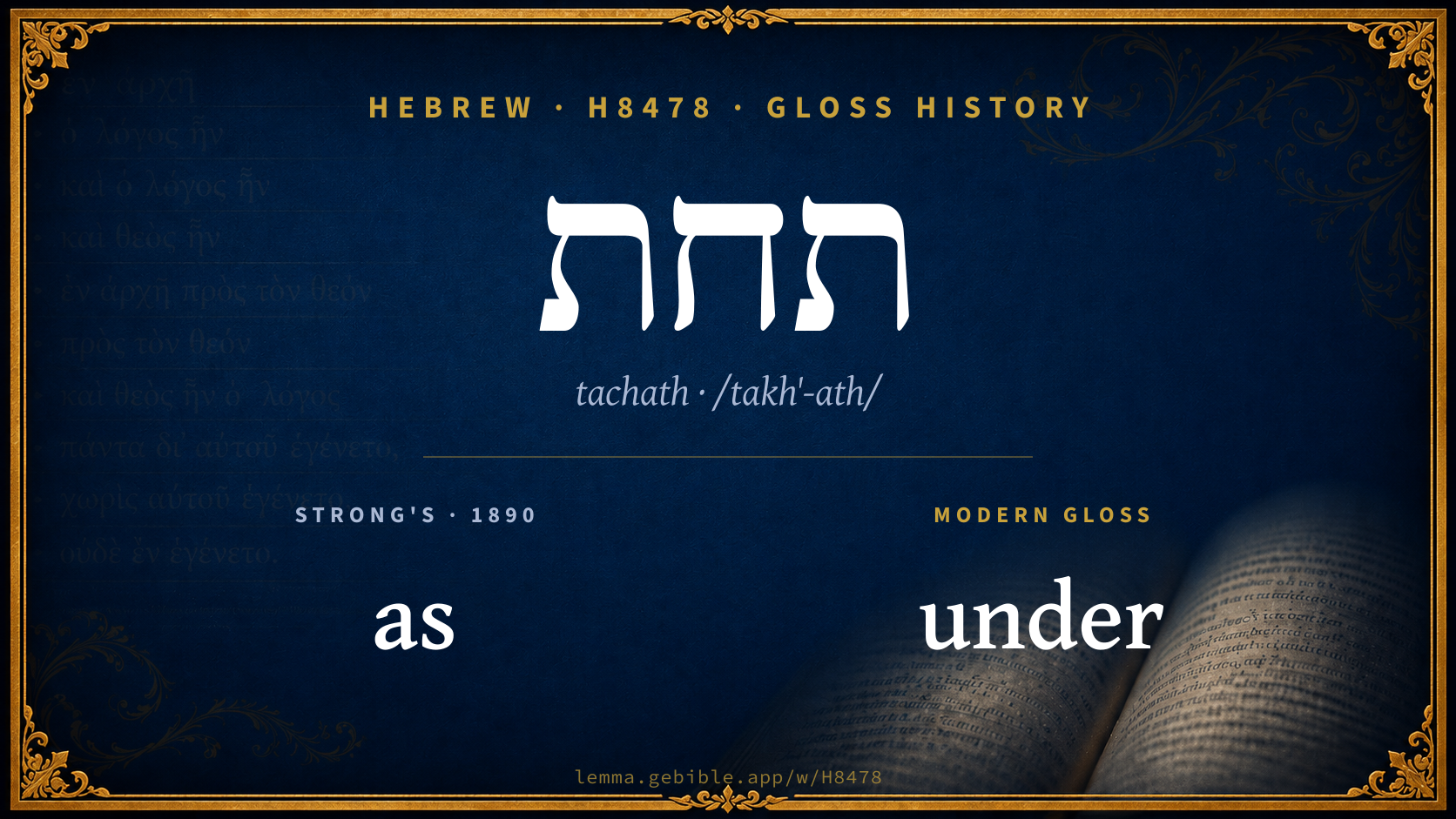
Gloss history
Strong's 1890 vs modern scholarship
About this word
Strong's H8478 catalogs a Hebrew word from the Hebrew Old Testament.
These counts are not copied from any lexicon or concordance. They are computed here, from the morphology-tagged Hebrew Old Testament. What Lemma adds →
- 450
- distinct verses
- The word appears in 450 distinct verses.
- 36 / 39
- OT books
- The word appears in 36 of 39 Old Testament books.
- #95
- by frequency
- Top 100 most frequent Hebrew words (rank 95 of 8,640 Hebrew words by occurrence).
View all 450 occurrences in the concordance →
By section of the Old Testament
By traditional corpus
Conventional, traditional groupings — biblical authorship is debated, so this is a traditional corpus grouping, not an authorship claim. Each share is this word’s portion of its verses in that division of the Hebrew canon. Each figure is a share of the word’s 450 distinct verses.
- Prophets (Nevi'im) 202 verses · 45%
- Writings (Ketuvim) 135 verses · 30%
- Torah (Pentateuch) 113 verses · 25%
How translations render this word
Counts come from each version’s own published word-to-Strong’s tagging or interlinear alignment — an approximate guide to how each version renders this word, not a word-level alignment the data otherwise carries. Because each total is that version’s own tagged count, the per-version totals vary from one another and need not match the appearance or distinct-verse counts above. These counts may also differ from a printed concordance because Lemma counts each distinctly tagged rendering and does not collapse phrase taggings into a single head-word total. This is a fixed set of word-tagged versions (KJV, ASV, BSB, ULT) and does not change with the reading translation you choose elsewhere. Each version’s license is shown beside its name below (and on Sources).
BDB lists this Strong’s number as 2 distinct words (homographs). Each count above pools all of them and is not split by sense — see the Senses section below. A low-frequency rendering may belong to a different one of those words, not the primary meaning.
- King James Version†: Under 3×, Beneath 2×, For 2×
- American Standard Version†: Under 3×, Place 2×
- Berean Standard Bible†: Under 132×, Place 104×, For 34×
- unfoldingWord Literal Text†: Under 164×, Place 92×, Instead of 34×
King James Version Public Domain
Renders H8478 across 23† tagged occurrences — most commonly:
Plus 12 renderings that appear only once — usually multi-word phrases or single function words the recovered tagging swept in, not distinct renderings. Not rendered by a distinct English word in 1 further occurrence.
American Standard Version Public Domain
Renders H8478 across 23† tagged occurrences — most commonly:
Plus 18 renderings that appear only once — usually multi-word phrases or single function words the recovered tagging swept in, not distinct renderings.
Berean Standard Bible Public Domain
Renders H8478 across 465† tagged occurrences — most commonly:
Plus other, less common renderings. Plus 55 renderings that appear only once — usually multi-word phrases or single function words the recovered tagging swept in, not distinct renderings. Not rendered by a distinct English word in 36 further occurrences.
unfoldingWord Literal Text CC BY-SA 4.0
Renders H8478 across 502† tagged occurrences — most commonly:
Plus other, less common renderings. Plus 36 renderings that appear only once — usually multi-word phrases or single function words the recovered tagging swept in, not distinct renderings.
26 senses and sub-senses in the full BDB
What do BDB’s symbols mean?
BDB uses these scholarly abbreviations:
| Symbol | Meaning |
|---|---|
| 𝔊 | the Septuagint (the ancient Greek translation, LXX) |
| 𝔙 | the Vulgate (the Latin translation) |
| 𝔖 | the Syriac version (the Peshitta) |
| 𝔗 | the Targum (the Aramaic translation) |
| ψ | the Psalms |
| √ | root (the underlying root or stem) |
| ‖ | parallel passage (a synonymous or contrasted parallel) |
| † | the dagger: every passage where the word occurs is cited |
The 26 senses and sub-senses the full Brown-Driver-Briggs lexicon distinguishes for this word, in lexicon order (not ranked by frequency), with BDB’s own verbatim wording and sub-sense lettering. Shown in Hebrew script with BDB’s own scholarly abbreviations. The condensed entry is in the Lexicon Entry tab. See also the Forms in the corpus table below.
תחת I
- I. as adv. accus. †Gn 49:25 (= Dt 33:13) the deep רֹבֶצֶת תָּ֑חַת that coucheth beneath; more usually with מִן, מִתָּחַת lit. off (מִן 1 c) the under part = beneath, †Ex 20:4 (= Dt 5:8) בָּאָרֶץ מִתָּ֑חַת (so Dt 4:39; Jos 2:11; 1 K 8:23 [both D2], Is 51:6), Dt 33:27; Ju 7:8; Am 2:9; Is 14:9; Jb 18:16;Ez 47:1b. e.g. Genesis 49:25
- II. as prep.; so cstr., and with sf. (usually in the pl., and so lit. in the parts underneath) תַּחְתַּי Hb 3:16 +, תַּחְתֵּנִי (cf. בַּעֲדֵנִי, עוֹדֶנִּי: Ges§ 103 d) †2 S 22:37, 40, 48 (ψ 18:37, 40, 48 תַּחְתָּ֑י); תַּחְתֶּיךָ; תַּחְתָּיו (Kt תַּחְתּוֹ †2 S 2:23; 3:12; 16:8 Jb 9:13), תַּחְתֶּיהָ Lv 13:23 + 16 times, תַּחְתֶּ֫נָּה (cf. אֵינֶנַּה, עוֹדֶנָּה) †Gn 2:21; תַּחְתֵּינוּ †1 S 14:9 ψ 47:4; תַּחְתֵּיכֶם †Jos 2:14; Am 2:13; תַּחְתֵּיהֶם †Nu 16:31; 1 K 20:24; 1 Ch 4:41; 5:22; 2 Ch 12:10 (for תַּחְתָּם 1 K 14:27), תַּחְתָּם Dt 2:12 + 10 times, תַּחְתֵּיהֶן †Je 28:13;— e.g. Habakkuk 3:16
- 1. under, beneath, Gn 7:19 תַּחַת כָּל־ הַשָּׁמַיִם under the whole heaven (so †Dt 2:25; 4:19; Jb 28:24; 37:3; 41:3; Dn 9:12), 18:4 ת׳ הָעֵץ, 21:15; 24:2 + often; Jb 30:14 תּ׳ שׁוֹאָה under the crash they roll themselves against me; ת׳ הַשֶּׁמֶשׁ Ec 1:3, 9, 13 + often Ec. (so in Ph., Cooke 4. 7; 5. 12). With לְ, †2 Ch 4:3 תַּחַת לוֹ, Ct 2:6 = 8:3 ת׳ לְרֹאשִׁי. Idiom. e.g. Genesis 7:19
- a. תַּחַת הָהָר at the foot of the mt., Ex 24:4; Dt 4:11, so 3:17 ת׳ אַשְׁדֹּת הַפִּסְגָּה, Jos 11:3, 17 +; fig. ψ 18:37 תַּרְחִיב צְעָדַי תַּחְתָּ֑י thou broadenest my steps under me, Jb 36:16 רַחַב לֹא מוּצָק תַּחְתֶּיךָ (so read for תחתיה, Di Bu) breadth unstraitened is beneath thee. e.g. Exodus 24:4
- b. ת׳ הַלָּשׁוֹן, of something held there as a dainty morsel, and ready, when needed, to be brought out, fig. of sweetness Ct 4:11, of evil ψ 10:7 ת׳ לְשֹׁנוֹ עָמָל וָאָוֶן, Jb 20:12 (so ת׳ שְׂפָתֵימוֹ ψ 140:4), of praise ψ 66:17 וְרוֹמַם ת׳ לְשׁוֹנִי (syn. בִּגְרוֹנָם 149:6). e.g. Song of Solomon 4:11
- c. תַּחַת פ׳: (a) of subjection, ψ 18:40 תַּכְרִיעַ קָמַי תַּחְתָּ֑י, v 48 (cf. 47:4; 144:2), 45:6; Jb 9:13. (b) of a woman, ת׳ אִישָׁהּ, i.e. under his authority, Nu 5:19, 20, 29, so Ez 23:5 תַּחְתַּי being under me = being mine (fig. of Israel as י׳’s spouse), cf. ὕπανδρος Rom 7:2, and تَحْت Ḳor 66:10. (c) of being burdened or oppressed under, Is 24:5 the earth הָֽנְפָה ת׳ יֽשְׁבֶיהָ, Pr 30:12 ת׳ שָׁלוֹשׁ רָֽגְזָה אֶרֶץ, v 22, 23; Hb 3:7 ת׳ אָוֶן i.e. (si vera l.) suffering under calamity. e.g. Psalms 18:40
- d. ת׳ יַד פ׳, of authority or control, Gn 41:35 וְיִצְבְּרוּ בָר ת׳ יַד פַּרְעֹה; Ju 3:30 (cf. ψ 106:42), 1 S 21:4, 5 (del. אֶל; dittogr. חֹל), v 9 Is 3:6. e.g. Genesis 41:35
- e. ת׳ רַגְלֵי פ׳, of subjection or conquest, ψ 8:7 כֹּל שַׁתָּה ת׳ רַגְלָיו, 18:39; 47:4; La 3:34, cf. Mal 3:21. e.g. Psalms 8:7
- 2. what is under one, the place in which one stands: hence as accus.,
- a. with reflex. pron., idiom., in one’s place, where one stands, Ex 16:29 שְׁבוּ אִישׁ תַּחְתָּיו abide every one in his place, Lv 13:23, 28; Jos 5:8; 6:5, 20; Ju 7:21; 1 S 14:9 וְעָמַדְנוּ תַחְתֵּינוּ we will remain where we are, 2 S 2:23 וַיָּמָת תַּחְתָּו he died where he was (cf. Je 38:9 [read וּמֵת]), 7:10; Is 25:10; 46:7; Am 2:13; Hb 3:16 וְתַחְתַּי אֶרְגָּ֑ז I tremble where I stand, Zc 12:6; 14:10; Jb 36:20; 40:12 וַהֲדֹךְ רְשָׁעִים תַּחְתָּם e.g. Exodus 16:29
- b. in transferred sense, in place of, instead of: (a) Gn 2:21; 4:25 ת׳ הֶבֶל instead of Abel, 22:13 ת׳ בְּנוֹ, 30:2 הֲת׳ אלהים אנכי (cf. 50:19), 44:33; 2 S 19:1 + often; Nu 32:14; Jb 16:4; Is 3:24; 55:13; 61:3, 7; of one succeeding to the place of another, וַיִּמְלֹךְ תַּחְתָּיו Gn 36:33–39; 1 K 8:20; 11:43; 14:20 + often, Dt 2:12, 21 וַיֵּֽשְׁבוּ תַחְתָּם, Lv 16:32; 1 K 2:35 +; ψ 45:17 in place of thy fathers (whom thou mayest therefore forget) will be thy children. cf. in Ph. CIS i. 3, 9 (Cooke30). Sq. inf. Is 60:15 ת׳ הֱיוֹתֵךְ instead of thy being … Peculiarly Jb 34:26 (si vera l.) = as if they were, like; but text very dubious; Bi Bu תָּחֵת חֲמָתוֹ רְשָׁעִ֑ים his wrath breaketh in pieces the wicked. (b) in partic., of things mutually interchanged, in place of, in exchange or return for: Gn 30:15 ת׳ דּוּדָאֵי בְנֵךְ in return for thy son’s love-apples, Ex 21:23 נֶפֶשׁ ת׳ גֶפְשׁ life for life, v 24, 25, 26, 27, 36, 37, Jos 2:14 נַפְשֵׁנוּ תַחְתֵּיכֶם לָמוּת, 1 S 2:20; 1 K 20:39 נפשׁך ת׳ נפשׁו, v 42 (cf. 2 K 10:24), 21:2; Is 43:3, 4; often with vbs. of requiting, Gn 44:4 לָ֫מָּה שִׁלַּמְתֶּם רָעָה ת׳ טוֹבָם why have ye rewarded evil in exchange for good? 1 S 25:21; 2 S 16:12; 19:22 ψ 35:12 יְשַׁלְּמוּנִי רָעָה ת׳ טוֹבָה, 38:21 a 109:4, 5; Pr 17:13 +; Je 5:19 תַּחַת מֶה in return for what? (cf. עַל־מֶה 22:8; Dt 29:23; 1 K 9:8). So sq. inf. ψ 38:21 b. e.g. Genesis 2:21
- 3. as conj.:
- a. תַּחַת אֲשֶׁר: (a) instead of that (Germ. anstatt dass), Dt 28:62 ת׳ א׳ הֱיִיתֶם instead of that ye were …, instead of your being …, Ez 36:34. (b) in return for (the fact) that, because that 𝔊 ἀνθʼ ὧν often), Nu 25:13 ת׳ אֲשֶׁר קִנָּא לא׳, Dt 21:14; 22:29; 28:47; 1 S 26:21; 2 K 22:17 = 2 Ch 34:25; Is 53:12; Je 29:19; 50:7; 2 Ch 21:12. e.g. Deuteronomy 28:62
- b. תַּחַת כִּי Dt 4:37 (but? read וַתֶּֽחִי׃ as end of v 36), Pr 1:29. cf. (כִּי) עֵקֶב אֲשֶׁר. e.g. Deuteronomy 4:37
- 1. under, beneath, Gn 7:19 תַּחַת כָּל־ הַשָּׁמַיִם under the whole heaven (so †Dt 2:25; 4:19; Jb 28:24; 37:3; 41:3; Dn 9:12), 18:4 ת׳ הָעֵץ, 21:15; 24:2 + often; Jb 30:14 תּ׳ שׁוֹאָה under the crash they roll themselves against me; ת׳ הַשֶּׁמֶשׁ Ec 1:3, 9, 13 + often Ec. (so in Ph., Cooke 4. 7; 5. 12). With לְ, †2 Ch 4:3 תַּחַת לוֹ, Ct 2:6 = 8:3 ת׳ לְרֹאשִׁי. Idiom. e.g. Genesis 7:19
- III. compounds:—
- 1. אֶל־תַּחַת, after a vb. of motion:
- a. (in) under, Ju 6:19 וַיּוֹצֵא אֶל־ת׳ הָאֵלָה, 1 K 8:6 (‖ 2 Ch 5:7), Je 3:6; 38:11 (on 1 S 21:5 v. II. 1 d); after קָרָא Zc 3:10: so אֶל־ת׳ לְ׳ Ez 10:2. e.g. Judges 6:19
- b. into the place of, Lv 14:42. e.g. Leviticus 14:42
- 2. מִתַּחַת (= ὑπʼ ἐκ):
- a. alone, from under, from beneath, as מִתַּחַת הַשָּׁמַיִם †Gn 1:7, and especially after such vbs. as שִׁחֵת 6:17, מָחָה Ex 17:14; Dt 9:14; 25:19; 29:19; 2 K 14:27, הֶאֱבִיד Dt 7:24, cf. La 3:66; Ez 47:1a מִתּ׳ מִפְתַּן הַבַּיִת, Pr 22:27 לָ֫מָּה יִקַּח מִשְׁכָּֽבְךָ מִתַּחְתֶּיךָ; Ex 6:6, 7 מִתּ׳ סִבְלוֹת מִצְרַיִם, Ho 4:12 וַיִּזְנוּ מִתּ׳ אֱלֹהֵיהֶם (cf. II. 1 c a, b); מִתּ׳ יַד פ׳ (cf. II. 1 d) from under the hand (power) of … Ex 18:10; 2 K 8:20, 22; 13:5; 17:7 +; מִתַּחְתָּיו (cf. II. 2 a) from his place Ex 10:23; Zc 6:12. Rarely = תַּחַת or מִתַּחַת לְ׳, Gn 1:7 (P) Ez 1:8; 42:9; 46:23; Jb 26:5. e.g. Genesis 1:7
- b. מִתַּחַת לְ׳ (opp. מִמַּעַל לְ׳) under, beneath: Gn 1:17 הַמַּיִם אֲשֶׁר מִתּ׳ לָרָקִיעַ, Ex 20:4 הַמַּיִם מִתַּחַת לָאָרֶץ (so Dt 4:18; 5:8), Ju 3:16 מִתּ׳ לְמַדָּיו, Je 38:12 +; of locality, †Gn 35:8 מִתּ׳ לְבֵיתְאֵל, 1 S 7:11; 1 K 4:12. e.g. Genesis 1:17
- c. †לְמִתַּחַת לְ׳ (cf. מִן 9 b), i.q. מִתַּחַת לְ׳ 1 K 7:32. e.g. 1 Kings 7:32
- 1. אֶל־תַּחַת, after a vb. of motion:
תחת II
- 1. m.
- a. Levite 1 Ch 6:9, 22. e.g. 1 Chronicles 6:9
- b. Ephraimite 7:20(×2).—Θααθ, Κααθ, etc. e.g. 1 Chronicles 7:20
- 2. loc. station in wilderness Nu 33:26, 27; Κατααθ. e.g. Numbers 33:26
Senses from the full Brown-Driver-Briggs lexicon (Brown, Driver, Briggs; Oxford 1906 — public domain), digitized via Sefaria, supplemented by the OpenScriptures HebrewLexicon (CC BY 4.0). Full attribution on Sources.
Word origin
n.[m.] the under part (Arabic تَحْتٌ id.), hence as adv. accus. and prep. underneath, below, instead of (so Arabic تَحْتَ, Sab. תחת, Ethiopic ታሕት: Ph. תחת (Lzb385); Biblical Aramaic 𝔗 תְּחוֹת, Palm. in מן לתחת Tariff 1:4 (Cooke 320), Syriac ܬܚܽܘܬ );—
— Brown-Driver-Briggs (Oxford 1906, public domain), digitized via Sefaria, supplemented by the OpenScriptures HebrewLexicon (CC BY 4.0). See Sources.
Derived from תוח (Tôwach) (H8430) — Toah.
Jastrow Dictionary
A second Hebrew/Aramaic lexicon for comparison, covering Aramaic and post-biblical (Talmudic, Targumic, Midrashic) usage that the biblical-Hebrew BDB does not. Matched by lemma rather than by Strong’s number, so a lemma may carry more than one Jastrow headword (shown separately below), and the entries cover usage well beyond the Bible.
תַּחַת
- under, beneath, in place of, instead of. Peah VII, 3 המניח … ת׳ הגפן וכ׳ he who places a basket under a vine when cutting grapes, robs the poor. Tosef. Dem. VI, 4 תַּחְתַּיי in my place, v. אוֹצָר. Gen. R. s. 18 מת׳ חרוב אחד from under a carob tree; a. v. fr.
תַּחַת ²
- ; לת׳ downward. Targ. O. Deut. XXVIII, 13; 43.—Pes. 74ᵇ פומא לת׳ with the mouth (open side) downward.—V. תְּחוֹת.
A Dictionary of the Targumim, the Talmud Babli and Yerushalmi, and the Midrashic Literature (Marcus Jastrow; London, Luzac, 1903) — Public Domain. Digitized via Sefaria. Digitized via Sefaria. Full attribution on Sources.
Forms in the corpus
The 107 distinct written forms H8478 takes in the Hebrew Bible, most frequent first — each parse links to that state’s occurrences in the concordance. Hebrew forms include their vowel points and cantillation, so a single lemma takes many written forms.
| Form | Parsing | Example | Uses |
|---|---|---|---|
| תַּ֣חַת | Preposition | Deuteronomy 4:11 | 91 |
| תַּ֥חַת | Preposition | Ecclesiastes 1:3 | 52 |
| תַּחְתָּֽי/ו | Preposition | Deuteronomy 10:6 | 52 |
| תַּ֖חַת | Preposition | Deuteronomy 2:25 | 41 |
| תַּחְתָּ֔י/ו | Preposition | Genesis 36:33 | 19 |
| תַּ֚חַת | Preposition | Daniel 9:12 | 17 |
| תַּֽחַת | Preposition | Ecclesiastes 5:18 | 17 |
| מִ/תַּ֖חַת | Preposition | Deuteronomy 7:24 | 15 |
| תַּ֤חַת | Preposition | 1 Chronicles 10:12 | 9 |
| מִ/תַּ֥חַת | Preposition | Deuteronomy 4:18 | 8 |
| מִ/תַּ֣חַת | Preposition | Exodus 30:4 | 7 |
| תַּ֗חַת | Preposition | Deuteronomy 28:47 | 7 |
| וְ/תַ֖חַת | Preposition | Deuteronomy 12:2 | 6 |
| וְ/תַ֥חַת | Preposition | Isaiah 3:24 | 6 |
| תַֽחַת | Preposition | Ecclesiastes 8:17 | 6 |
| תַּחְתָּ֑י/ו | Preposition | 1 Kings 21:6 | 6 |
| תַּ֛חַת | Preposition | Deuteronomy 3:17 | 5 |
| תַּ֧חַת | Preposition | Exodus 38:4 | 5 |
| תַּחְתֶּ֑י/הָ | Preposition | Daniel 8:22 | 5 |
| תַּחַת֩ | Preposition | Exodus 25:35 | 5 |
| מִ/תָּ֑חַת | Preposition | Deuteronomy 4:39 | 4 |
| תַּחְתָּֽ/ם | Preposition | Job 26:8 | 4 |
| תחת/ו | Preposition | 2 Samuel 2:23 | 4 |
| וְ/תַ֤חַת | Preposition | Ezekiel 31:6 | 3 |
| וְ/תַ֨חַת | Preposition | Ezekiel 6:13 | 3 |
| וְ/תַ֨חַת֙ | Preposition | Ezekiel 1:23 | 3 |
| מִ/תַּ֨חַת֙ | Preposition | Exodus 6:6 | 3 |
| תַּחְתֶּֽי/הָ | Preposition | Joshua 7:21 | 3 |
| תַּחְתָּ֑/י | Preposition | Ezekiel 23:5 | 3 |
| תַּחְתָּ֖י/ו | Preposition | Exodus 29:30 | 3 |
| תַּחְתָּֽ/י | Preposition | Nehemiah 2:14 | 3 |
| תַּחְתָּי/ו֙ | Preposition | Genesis 36:39 | 3 |
| וְ/תַ֣חַת | Preposition | Exodus 24:10 | 2 |
| וְ/תַֽחַת | Preposition | Job 31:40 | 2 |
| וּ/מִ/תַּ֖חַת | Preposition | Deuteronomy 33:27 | 2 |
| מִ/תַּ֤חַת | Preposition | Genesis 1:9 | 2 |
| מִ/תַּ֨חַת | Preposition | Ezekiel 47:1 | 2 |
| מִ/תָּֽחַת | Preposition | Amos 2:9 | 2 |
| תַחְתָּ֖י/ו | Preposition | Exodus 17:12 | 2 |
| תַחְתָּֽ/ם | Preposition | Deuteronomy 2:21 | 2 |
| תַּחְתֵּֽ/נִי | Preposition | 2 Samuel 22:40 | 2 |
| תַּחְתֵּי/הֶֽם | Preposition | 1 Kings 20:24 | 2 |
| תַּחְתֶּ֔י/הָ | Preposition | Daniel 8:8 | 2 |
| תַּחְתֶּ֔י/ךָ | Preposition | Isaiah 43:4 | 2 |
| תַּחְתֶּ֨י/ךָ֙ | Preposition | 1 Kings 5:5 | 2 |
| תַּחְתֶּֽי/ךָ | Preposition | 1 Kings 19:16 | 2 |
| תַּחְתָּ֔/ם | Preposition | 1 Kings 14:27 | 2 |
| תַּחְתָּ֗י/ו | Preposition | Exodus 16:29 | 2 |
| תַּחְתָּ֜י/ו | Preposition | Genesis 36:35 | 2 |
| תַּחְתָּ֥י/ו | Preposition | 2 Samuel 3:12 | 2 |
| הֲ/תַ֣חַת | Preposition | 2 Samuel 19:21 | 1 |
| הֲ/תַ֤חַת | Preposition | Genesis 30:2 | 1 |
| הֲ/תַ֥חַת | Preposition | Genesis 50:19 | 1 |
| ו/מ/תחת/ה | Preposition | Ezekiel 42:9 | 1 |
| וְ/תַ֗חַת | Preposition | Deuteronomy 4:37 | 1 |
| וְ/תַ֧חַת | Preposition | Isaiah 10:16 | 1 |
| וְ/תַחְתַּ֣/י | Preposition | Habakkuk 3:16 | 1 |
| וְ֝/תַחְתֶּ֗י/הָ | Preposition | Job 28:5 | 1 |
| וּ/מִ/תַּ֨חַת֙ | Preposition | 1 Kings 7:29 | 1 |
| וּ/מִ/תַּחְתָּ֣י/ו | Preposition | Zechariah 6:12 | 1 |
The 60 most common forms are shown; 47 rarer forms follow in the full concordance.
Same root — word family
Other BDB entries built from the same root as H8478, grouped by Strong’s listed origin. These share a root / origin per the lexicon — not necessarily a shared meaning. Each links to that word’s own entry.
Derives from
Derived from this word
Proper names from this root
People and places named from this root — a name, not an additional meaning of the word.
Compare all same-root words → Showing 4 of 7 — not the complete family. 2 of the same-root words are proper names (people or places). They share a root, not necessarily a meaning.
Septuagint verse parallels
This word appears in 419 verses that also exist in the Greek Old Testament (Septuagint), out of the 450 Hebrew verses it occurs in. You can read those verses in Greek by switching the Old Testament edition to the Septuagint.
Read these verses in the Septuagint
- Genesis 1:7
- Exodus 6:6
- Leviticus 6:22
- Numbers 3:12
- Deuteronomy 2:12
- Joshua 2:11
- Judges 1:7
- Ruth 2:12
- 1 Samuel 2:20
- 2 Samuel 2:23
- 1 Kings 1:30
- 2 Kings 1:17
This is a verse-level parallel only — the same verses exist in both the Hebrew and Greek Old Testaments. No word-level Hebrew↔Greek correspondence is claimed: the data carries no such alignment, so no Greek word is shown as this Hebrew word’s translation. Coverage is not total — the Septuagint omits the deuterocanon and renumbers the Psalms, so some Hebrew verses have no direct Greek parallel.